"Yisro — Part II — Leadership, Courts, and the Birth of a Torah Society"

Mitzvah Minute Logo Icon

2.5 — The “Empty Throne”: Why No Human Authority Is Absolute

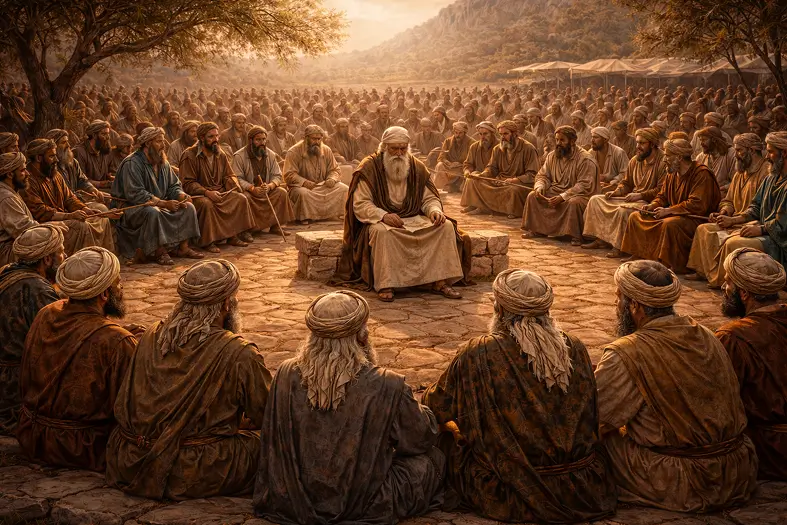
Moses and the elders' gathering
Parshas Yisro introduces a radical idea: the highest seat of authority is empty. This essay, drawing on Rabbi Jonathan Sacks, explores how Torah society limits power by subordinating all leadership to Divine sovereignty. Moshe leads without reigning, institutions replace personalities, and no human voice is final. The “empty throne” protects against tyranny while preserving authority, creating a society governed by law rather than rulers.

"Yisro — Part II — Leadership, Courts, and the Birth of a Torah Society"

2.5 — The “Empty Throne”: Why No Human Authority Is Absolute

Power With a Missing Seat

Parshas Yisro quietly introduces one of the Torah’s most radical political ideas: there is no occupied throne at the top of human authority. Moshe leads, judges, and teaches—but he does not reign. The highest seat remains empty, reserved for Hashem alone.

This essay explores the Torah’s central claim about power: authority is necessary, but it is never absolute. Leadership in a Torah society exists under a ceiling—and that ceiling is Divine.

Why Torah Distrusts Absolute Power

The Torah does not deny the need for authority. On the contrary, Parshas Yisro builds a layered system of judges, officers, and leaders. What it denies is finality. No human voice is ultimate. Even Moshe—the greatest prophet—must consult Heaven.

This is why Yisro’s reforms are so consequential. They do not merely solve burnout; they redesign authority itself.

Key features of Torah authority:

  • Delegated — power is distributed, not centralized
  • Accountable — decisions are reviewable
  • Subordinate — all authority answers upward

The throne is empty by design.

Rabbi Jonathan Sacks: Authority That Knows Its Limits

Rabbi Jonathan Sacks often described Judaism as a civilization built on law, not rulers. Kings come later—and even they are bound by Torah. Prophets speak truth to power. Judges apply law under Heaven. The result is a society in which no human being can claim ultimate control.

This is the meaning of the “empty throne.” Power exists, but sovereignty does not reside in people.

Where God is sovereign, no human being can be.

Moshe as the Model of Limited Authority

Moshe’s greatness lies precisely in what he does not claim. He does not insist on judging every case. He does not canonize his own wisdom. He accepts Yisro’s advice—but only after Divine assent.

Moshe embodies a paradox:

  • supreme authority,
  • radical humility.

His leadership teaches that the highest form of power is submission to truth beyond oneself.

Institutions as Guardians Against Tyranny

By creating courts of thousands, hundreds, fifties, and tens, the Torah ensures that power is:

  • diffused, preventing domination
  • localized, preventing alienation
  • procedural, preventing arbitrariness

Institutions, not personalities, carry continuity. This protects the people from leaders—and leaders from themselves.

Why This Comes Before Sinai

It is no accident that this political theology appears before revelation. A people incapable of limiting human power cannot receive Divine law. If Moshe were absolute, Torah would be unnecessary. Law presumes restraint.

Sinai can only occur once the people understand that:

  • no leader replaces G-d,
  • no court replaces conscience,
  • no system replaces covenant.

Chassidic Insight: Bitul Without Annihilation

Chassidic thought frames this as bitul—self-nullification before Hashem that does not erase identity but aligns it. Authority emptied of ego becomes a vessel for holiness. Authority filled with self becomes idolatry.

The empty throne is not absence; it is presence rightly placed.

Application for Today

Modern societies oscillate between authoritarianism and chaos. Parshas Yisro offers a third path: authority bounded by law, law grounded in Divine sovereignty. Leaders lead. Judges judge. But no one replaces the transcendent moral center.

The enduring Torah claim is simple and demanding: power must always answer to something higher than itself.

📖 Sources

  • Full sources available on the Mitzvah Minute Parshas Yisro page under insights and commentaries.

Organized by:
Boaz Solowitch
February 2, 2026
Mitzvah Minute Logo Icon

Connections

Mitzvah Minute Logo Icon

Mitzvah Links

Mitzvah 1

To know there is a G‑d
A Siddur
Learn this Mitzvah

Mitzvah 1

1
To know there is a G‑d

Mitzvah 11

To emulate His ways
A Siddur
Learn this Mitzvah

Mitzvah 11

11
To emulate His ways

Mitzvah 540

Appoint judges
A Siddur
Learn this Mitzvah

Mitzvah 540

540
Appoint judges

Mitzvah 564

The judge must not fear a violent man in judgment
A Siddur
Learn this Mitzvah

Mitzvah 564

564
The judge must not fear a violent man in judgment
The Luchos - Ten Commandments
View Mitzvah Notes

Mitzvah Reference Notes

"x" close page navigation button

Mitzvah Reference Notes

“The ‘Empty Throne’: Why No Human Authority Is Absolute”

Mitzvah #1 — To know there is a G-d (Exodus 20:2)

אָנֹכִי ה׳ אֱלֹקֶיךָ

Knowing Hashem as sovereign negates all claims of absolute human authority. The empty throne reflects recognition that ultimate power belongs only to G-d.

Mitzvah #11 — To emulate His ways (Deuteronomy 28:9)

וְהָלַכְתָּ בִדְרָכָיו

Hashem governs with justice and restraint. Emulating His ways requires leadership that limits itself rather than dominating.

Mitzvah #540 — To appoint judges (Deuteronomy 16:18)

שֹׁפְטִים וְשֹׁטְרִים תִּתֵּן לְךָ

Distributed judicial authority prevents concentration of power and preserves accountability within a Torah society.

Mitzvah #564 — Judges must not fear any man (Deuteronomy 1:17)

לֹא תָגוּרוּ מִפְּנֵי אִישׁ

Judges answer to Hashem alone. The empty throne empowers them to rule without fear or favoritism.

Parsha Links

יִתְרוֹ - Yisro

Haftarah: Isaiah 6:1-13
A Siddur
Learn this Parsha

יִתְרוֹ - Yisro

יִתְרוֹ - Yisro
The Luchos - Ten Commandments
View Parsha Notes
"x" close page navigation button

Parsha Reference Notes

“The ‘Empty Throne’: Why No Human Authority Is Absolute”

Parshas Yisro (Shemos 18:1–20:23)

Before Sinai, the Torah reshapes authority. Yisro’s reforms establish that leadership must be distributed and accountable, ensuring no human figure becomes absolute. This prepares the nation to receive Divine law by teaching that covenantal life requires limits on power and submission to Hashem as the ultimate authority.

Mitzvah Minute
Mitzvah Minute Logo

Learn more.

Dive into mitzvos, tefillah, and Torah study—each section curated to help you learn, reflect, and live with intention. New insights are added regularly, creating an evolving space for spiritual growth.

Luchos
Live a commandment-driven life

Mitzvah

Explore the 613 mitzvos and uncover the meaning behind each one. Discover practical ways to integrate them into your daily life with insights, sources, and guided reflection.

Learn more

Mitzvah #

1

To know there is a G‑d
The Luchos - Ten Commandments
Learn this Mitzvah

Mitzvah Highlight

Siddur
Connection through Davening

Tefillah

Learn the structure, depth, and spiritual intent behind Jewish prayer. Dive into morning blessings, Shema, Amidah, and more—with tools to enrich your daily connection.

Learn more

Tefillah

COMING SOON.
A Siddur
Learn this Tefillah

Tefillah Focus

A Sefer Torah
Study the weekly Torah portion

Parsha

Each week’s parsha offers timeless wisdom and modern relevance. Explore summaries, key themes, and mitzvah connections to deepen your understanding of the Torah cycle.

Learn more

יִתְרוֹ - Yisro

Haftarah: Isaiah 6:1-13
A Sefer Torah
Learn this Parsha

Weekly Parsha