"Yisro — Part III — Sinai as Public Reality: The Anti-Metaphor Parsha"

Mitzvah Minute Logo Icon

3.1 — The Seven (or Eight) Sinai Phenomena: A Designed Overwhelm

Har Sinai
Why did Sinai require thunder, fire, shofar, smoke, and a trembling mountain? This essay argues that revelation was deliberately structured to shatter ordinary modes of perception and knowing. Each phenomenon blocks a different naturalistic escape route—psychology, metaphor, coincidence, or imagination. Drawing on Abarbanel, it argues that Sinai was engineered to be un-dismissable, establishing Torah not as private spirituality but as a public, historical event witnessed by an entire nation.

"Yisro — Part III — Sinai as Public Reality: The Anti-Metaphor Parsha"

3.1 — The Seven (or Eight) Sinai Phenomena: A Designed Overwhelm

Why Sinai Could Not Be Gentle

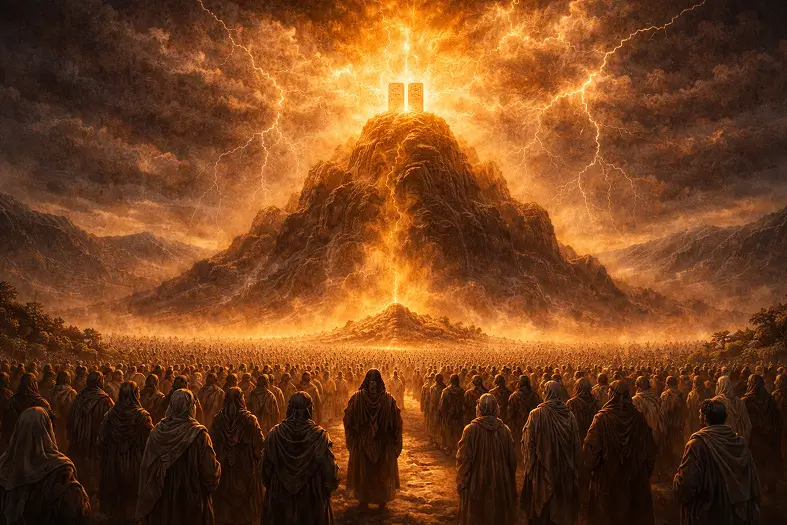
The Torah describes Sinai with an accumulation of sensory force that borders on excess: thunder, lightning, cloud, fire, smoke, shofar, trembling—until the mountain itself convulses. The verse captures the effect in a single phrase: [וַיֶּחֱרַד כָּל הָהָר — “the whole mountain trembled”].

This was not theatrical flourish. It was design. Sinai was designed to override human categories of understanding, not to provoke feeling but to establish truth. Each phenomenon blocks a different escape route by which a listener might reduce revelation to imagination, psychology, coincidence, or myth.

Revelation as an Epistemic Event

Abarbanel asks a daring question: if Hashem wished to give commandments, why surround them with such violence of sensation? His answer reframes Sinai entirely. The revelation was not only about content (mitzvos) but about certainty.

Sinai had to be un-dismissable. It had to leave no room for:

  • private interpretation,
  • the reduction of revelation into metaphor,
  • inner-experience reduction,
  • or post-facto rationalization.

The phenomena do not repeat an effect; they seal off doubt.

The Phenomena and the Escape Routes They Close

Abarbanel and later thinkers map the events as a system, not a spectacle. Each element negates a different naturalistic explanation:

  • Thunder & Lightning (קוֹלוֹת וּבְרָקִים)
    Blocks the claim of quiet inspiration or subjective vision.
  • Thick Cloud (עָנָן כָּבֵד)
    Prevents attributing the experience to clarity of imagination or internal visualization.
  • Fire (אֵשׁ)
    Denies the possibility of abstract philosophy detached from physical reality.
  • Smoke (עָשָׁן)
    Disrupts the idea of visual hallucination by obscuring sight while sound continues.
  • Shofar Blast Growing Stronger (קוֹל שׁוֹפָר הוֹלֵךְ וְחָזֵק מְאֹד)
    Rejects natural acoustics; no human breath intensifies indefinitely.
  • Earthquake / Trembling (וַיֶּחֱרַד כָּל הָהָר)
    Eliminates psychological projection—mountains do not share hallucinations.
  • Public Assembly
    Denies private revelation; this is witnessed by an entire nation.

Some count Moshe’s voice answering the Divine voice as an eighth phenomenon—human speech synchronized with Heaven—further collapsing the boundary between command and reception.

Why One Miracle Was Not Enough

A single miracle can be reinterpreted. A sequence cannot. Torah wisdom understands the human mind: we seek exits. Sinai closes them.

  • One sense can deceive.
  • Multiple senses cross-verify.
  • Nature itself responding removes the final refuge of skepticism.

The result is not coercion, but clarity. The people are overwhelmed not into silence, but into certainty.

Public Revelation vs. Private Spirituality

The Torah makes a decisive move at Sinai: truth is not private. Whatever else religion may be, it cannot be reduced to inner feeling. Sinai occurs before the eyes and ears of a nation.

This is why later prophecy never recreates Sinai. The foundation need not be repeated once certainty is secured.

“The Whole Mountain Trembled”

The mountain is not a backdrop; it is a participant. [וַיֶּחֱרַד כָּל הָהָר] means creation itself testifies. Revelation is not humanity reaching upward, but reality responding downward.

Sinai insists: this is not metaphor, not poetry, not myth. It is event.

Chassidic Insight: Overwhelm to Make Space

Chassidic masters explain that overwhelm empties the self. When the ego collapses, truth can enter. Sinai does not persuade; it clears. The noise strips away the listener’s defenses so that command can be heard without distortion.

Application for Today

Modern spirituality often seeks calm, comfort, and personalization. Sinai teaches the opposite lesson: truth sometimes arrives with force, not because it is cruel, but because certainty matters.

The Torah does not ask us to feel Sinai again. It asks us to trust the moment when all escape routes were closed—and to live according to the way Hashem wants us to be.

📖 Sources

  • Full sources available on the Mitzvah Minute Parshas Yisro page under insights and commentaries.

Organized by:
Boaz Solowitch
February 2, 2026
Mitzvah Minute Logo Icon

Connections

Mitzvah Minute Logo Icon

Mitzvah Links

Mitzvah 1

To know there is a G‑d
A Siddur
Learn this Mitzvah

Mitzvah 1

1
To know there is a G‑d

Mitzvah 2

Not to entertain thoughts of other gods besides Him
A Siddur
Learn this Mitzvah

Mitzvah 2

2
Not to entertain thoughts of other gods besides Him

Mitzvah 3

To know that He is One
A Siddur
Learn this Mitzvah

Mitzvah 3

3
To know that He is One

Mitzvah 9

To listen to the prophet speaking in His Name
A Siddur
Learn this Mitzvah

Mitzvah 9

9
To listen to the prophet speaking in His Name

Mitzvah 10

Not to test the prophet unduly
A Siddur
Learn this Mitzvah

Mitzvah 10

10
Not to test the prophet unduly
The Luchos - Ten Commandments
View Mitzvah Notes

Mitzvah Reference Notes

"x" close page navigation button

Mitzvah Reference Notes

“The Seven (or Eight) Sinai Phenomena: A Designed Overwhelm”

Mitzvah #1 — To know there is a G-d (Exodus 20:2)

אָנֹכִי ה׳ אֱלֹקֶיךָ

The overwhelming, public revelation at Sinai establishes daʿat Elokim as knowledge rather than subjective belief. The coordinated phenomena—sound, fire, trembling, and mass witness—remove the possibility of metaphor or inner experience alone. This mitzvah rests on the historical certainty created when all “escape routes” of doubt were closed before the nation.

Mitzvah #2 — Not to entertain thoughts of other gods besides Him (Exodus 20:3)

לֹא יִהְיֶה לְךָ אֱלֹקִים אֲחֵרִים עַל פָּנָי

Sinai’s multi-sensory revelation denies theological relativism. By revealing Himself publicly and unmistakably, Hashem forecloses the legitimacy of competing divine claims. The impossibility of alternative explanations reinforces exclusive allegiance as a rational obligation, not merely a commanded loyalty.

Mitzvah #3 — To know that He is one (Deuteronomy 6:4)

שְׁמַע יִשְׂרָאֵל ה׳ אֱלֹקֵינוּ ה׳ אֶחָד

The unity proclaimed in Shema is rooted in the unity of the Sinai event itself. All phenomena converge toward a single source, demonstrating that multiplicity in experience does not imply multiplicity in cause. Sinai teaches that the One G-d may be perceived through many channels without division.

Mitzvah #9 — To listen to the prophet speaking in His Name (Deuteronomy 18:15)

אֵלָיו תִּשְׁמָעוּן

The public revelation at Sinai establishes the credibility of prophecy itself. Moshe’s voice responding within the Divine voice anchors prophetic authority in witnessed history, ensuring that later prophecy is not evaluated in isolation but measured against the national experience of revelation.

Mitzvah #10 — Not to test the prophet unduly (Deuteronomy 6:16)

לֹא תְנַסּוּ אֶת ה׳ אֱלֹקֵיכֶם

Once Sinai has removed epistemic doubt, perpetual testing becomes faithlessness rather than caution. The designed overwhelm of revelation teaches that certainty, once granted, obligates trust. Endless demands for proof undermine the very foundation Sinai established.

Mitzvah #580 — Not to add to the Torah commandments (Deuteronomy 13:1)

לֹא תֹסֵף עָלָיו

By presenting Torah within an unrepeatable, overwhelming revelation, Sinai fixes the canon of command. No later spiritual experience—however intense—may claim equivalent authority. The uniqueness of Sinai guards against innovation masquerading as revelation.

Mitzvah #581 — Not to diminish from the Torah any commandments (Deuteronomy 13:1)

וְלֹא תִגְרַע מִמֶּנּוּ

Just as nothing may be added, nothing may be explained away. The concrete, public nature of Sinai prevents reduction of Torah into metaphor, ethics alone, or cultural artifact. The mitzvot stand as binding law rooted in historical encounter.

Parsha Links

יִתְרוֹ - Yisro

Haftarah: Isaiah 6:1-13
A Siddur
Learn this Parsha

יִתְרוֹ - Yisro

יִתְרוֹ - Yisro
The Luchos - Ten Commandments
View Parsha Notes
"x" close page navigation button

Parsha Reference Notes

“The Seven (or Eight) Sinai Phenomena: A Designed Overwhelm”

Parshas Yisro (Shemos 18:1–20:23)

Parshas Yisro presents Sinai as a public, multi-sensory revelation. The accumulation of phenomena surrounding Matan Torah establishes certainty before commandment, ensuring the Torah cannot be reduced to metaphor or inner experience. The trembling mountain itself becomes a witness, anchoring covenant in shared historical reality.

Mitzvah Minute
Mitzvah Minute Logo

Learn more.

Dive into mitzvos, tefillah, and Torah study—each section curated to help you learn, reflect, and live with intention. New insights are added regularly, creating an evolving space for spiritual growth.

Luchos
Live a commandment-driven life

Mitzvah

Explore the 613 mitzvos and uncover the meaning behind each one. Discover practical ways to integrate them into your daily life with insights, sources, and guided reflection.

Learn more

Mitzvah #

1

To know there is a G‑d
The Luchos - Ten Commandments
Learn this Mitzvah

Mitzvah Highlight

Siddur
Connection through Davening

Tefillah

Learn the structure, depth, and spiritual intent behind Jewish prayer. Dive into morning blessings, Shema, Amidah, and more—with tools to enrich your daily connection.

Learn more

Tefillah

COMING SOON.
A Siddur
Learn this Tefillah

Tefillah Focus

A Sefer Torah
Study the weekly Torah portion

Parsha

Each week’s parsha offers timeless wisdom and modern relevance. Explore summaries, key themes, and mitzvah connections to deepen your understanding of the Torah cycle.

Learn more

יִתְרוֹ - Yisro

Haftarah: Isaiah 6:1-13
A Sefer Torah
Learn this Parsha

Weekly Parsha