בְּהַעֲלֹתְךָ – Beha’aloscha
Parshas Beha’aloscha traces the difficult transition from a nation gathered around Har Sinai to a nation beginning its journey through the wilderness toward Eretz Yisrael. The parsha opens with the lighting of the מנורה — Menorah, the consecration of the לויים — Levi’im, and the orderly movement of the camp around the Mishkan, all reflecting clarity, structure, and Divine purpose. Yet as the journey begins, the deeper struggles of the nation emerge. Complaints, cravings, fear, spiritual exhaustion, and failures of speech reveal how difficult it is to transform a freed people into a holy nation living entirely על פי ה׳ — by the word of Hashem. From the gift of פסח שני — the Second Pesach, which offers another opportunity for closeness, to the downfall of תאוה — uncontrolled desire, to Miriam’s punishment for speaking against Moshe, the parsha repeatedly contrasts spiritual elevation with human weakness. Beha’aloscha becomes a portrait of a nation learning that holiness is not built only through miracles, structure, or movement, but through humility, trust, restraint, gratitude, and the willingness to follow Hashem even through uncertainty.
Haftarah: Zachariah 2:14 - 4:7
בְּמִדְבַּר – Bamidbar – Numbers
36
Parshas Beha’aloscha begins with light. Aharon is commanded to raise the נרות — lamps of the מנורה — Menorah so their light faces forward, and he does exactly as Hashem commanded. The parsha then turns from light to service. The לויים — Levi’im are taken from among Bnei Yisrael, purified, brought before the אהל מועד — Tent of Meeting, and given to Aharon and his sons for the עבודת המשכן — service of the Mishkan. Their role is not casual work. They are separated, elevated, and dedicated as servants of Hashem in place of the firstborn, who had been sanctified when Hashem struck the firstborn in Mitzrayim.
The nation then prepares to move forward as a people formed around the Mishkan. The second Korban Pesach — Pesach offering is brought in the wilderness of Sinai at its proper time. Yet some men are טמאים — ritually impure from contact with the dead and cannot bring the offering. Their cry is simple and powerful: למה נגרע — “Why should we be diminished?” They do not ask to be excused from the mitzvah; they ask for a way back into it. Moshe brings their question before Hashem, and Hashem gives the law of פסח שני — the Second Pesach. A person who was impure or far away receives another opportunity to bring the Korban Pesach one month later. But the Torah also warns that one who is pure, present, and still refuses to bring it bears guilt. The message is clear: distance can be repaired, but indifference cannot.
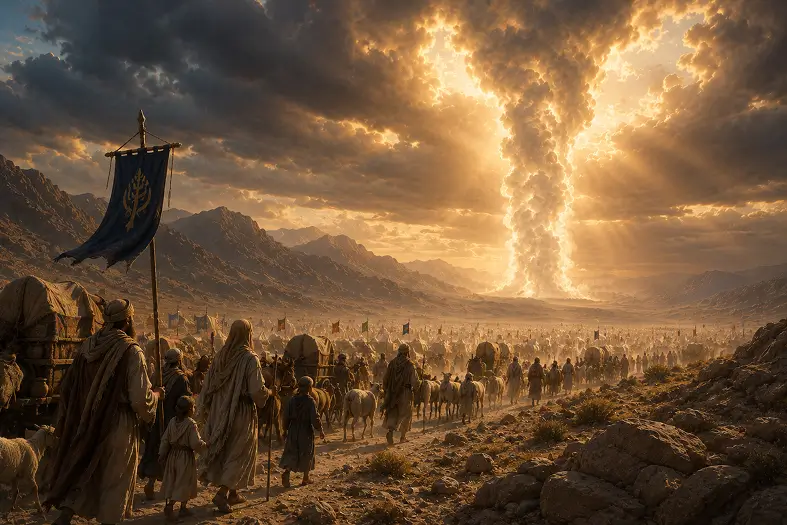
The Mishkan now becomes the center of movement. The ענן — cloud rests over it by day, and a fiery appearance rests over it by night. Bnei Yisrael travel only when the cloud rises, and they camp only when it rests. Sometimes the cloud remains for many days; sometimes only overnight; sometimes for two days, a month, or a year. Their task is to live על פי ה׳ — by the command of Hashem. The nation must learn that holiness does not move according to human impatience. They march when called, wait when held back, and build their life around Divine direction.
Hashem then commands Moshe to make two silver חצוצרות — trumpets. These trumpets organize the nation’s public life. They gather the people, summon the נשיאים — leaders, signal the camps to travel, sound during war, and are blown on days of joy, festivals, ראשי חדשים — new months, and offerings. The sound of the trumpet teaches that the nation is not a crowd moving by instinct. It is a camp trained to hear, respond, gather, travel, remember, and rejoice before Hashem.
Then the journey begins. In the second year, on the twentieth day of the second month, the cloud rises from the Mishkan, and Bnei Yisrael leave Har Sinai. The camp moves in ordered formation: Yehudah first, then the carriers of the Mishkan, then the other camps, with the holy vessels carried in their proper place. Moshe invites Chovav, his father-in-law, to travel with them, promising that the good Hashem gives Yisrael will be shared with him. As the ארון — Ark travels, Moshe says, קומה ה׳ — “Arise, Hashem,” and when it rests, he says, שובה ה׳ — “Return, Hashem.” The journey begins with order, kedushah — holiness, and the hope that the nation is ready to move toward its destiny.
But the inner strain appears quickly. The people complain bitterly, and Hashem’s anger burns against the edge of the camp. Moshe prays, and the fire dies down. The place is called תבערה — burning, because the fire of Hashem had burned among them. Soon after, the mixed multitude begins craving meat, and Bnei Yisrael weep with them. They remember the fish, cucumbers, melons, leeks, onions, and garlic of Mitzrayim, while looking at the מן — manna with frustration. The food that had sustained them from Heaven now becomes, in their eyes, a symbol of what they claim to lack.
Moshe is crushed by the burden of carrying the nation. He turns to Hashem and says that he cannot bear this people alone. Hashem answers by appointing seventy elders, placing upon them some of the רוח — spirit that rests on Moshe, so they can help carry the burden of leadership. Hashem also promises meat, not for one day or two, but for a full month, until the craving itself becomes sickening. Moshe wonders how such a thing can happen for such a vast nation, and Hashem answers, “Is Hashem’s hand too short?” The question cuts to the root of the crisis: the people’s hunger is not only for food, but their lack of trust in Hashem’s power and care.
The elders receive רוח — spirit and prophesy. Eldad and Meidad also prophesy in the camp, and Yehoshua urges Moshe to restrain them. Moshe answers with greatness of spirit: “Would that all Hashem’s people were prophets.” His leadership is not threatened by others receiving spiritual elevation. He wants the nation itself to rise.
The promised meat comes through a great wind that brings quail from the sea. The people gather enormous amounts, but while the meat is still between their teeth, Hashem strikes them with a severe plague. The place is called קברות התאוה — Graves of Craving, because there they buried the people who craved. The name captures the tragedy. Desire, when it rules the person, does not merely ask for food; it can bury a person’s higher self.
The parsha closes with a final wound, this time inside Moshe’s own family. Miriam and Aharon speak about Moshe regarding the Cushite woman he had married, and they ask whether Hashem speaks only through Moshe. The Torah immediately testifies that Moshe is עניו מאד — exceedingly humble, more than any person on earth. Hashem calls Moshe, Aharon, and Miriam to the אהל מועד — Tent of Meeting, descends in a pillar of cloud, and teaches that Moshe’s prophecy is unlike all others. Other prophets receive visions and dreams; Moshe is trusted בכל ביתי — “in all My house,” and Hashem speaks with him directly.
Miriam is struck with צרעת — a spiritual skin affliction, and Aharon pleads with Moshe to pray for her. Moshe cries out in five brief words: קל נא רפא נא לה — “Please, Hashem, heal her, please.” Miriam is shut outside the camp for seven days, and the nation does not travel until she is brought back. Only then does Bnei Yisrael move on from Chatzeiros toward the wilderness of Paran.
Beha’aloscha begins with a nation lit by the Menorah and arranged around the Mishkan, ready to travel by the word of Hashem. Yet as soon as the march begins, the parsha reveals the deeper work still needed: patience with Divine timing, gratitude for daily sustenance, trust in Hashem’s power, humility before Moshe’s leadership, and the discipline to speak with holiness. The camp can move only when its outer order is joined by inner faith.