Each Parsha page on Mitzvah Minute is designed as a guided, three-level journey through the weekly Torah reading—integrating the narrative, the mitzvos, and the classical commentaries into one unified experience.
Begin with the foundations of the Parsha:
This level gives you the storyline, the key mitzvos, and the essential connections between them.
A complete journey through the parsha—moving from clarity and depth to inner connection and real-world meaning, culminating in a way to live its ideas in everyday life.
These sections show how the Parsha speaks to the mind, the heart, and the real world — offering wisdom rooted in enduring Torah.
A complete, structured commentary on the parsha—presented pasuk by pasuk, with chapter and overall summaries for clarity and flow.
This level reveals the structural depth of the Parsha and the classical underpinnings of each theme.
Together, these layers create a complete Parsha journey —
narrative, mitzvah, and commentary — all flowing toward deeper understanding, spiritual insight, and meaningful growth.
Tap the Page Navigation tab on the right side of your screen anytime to access quick-links to the entire Parsha page.
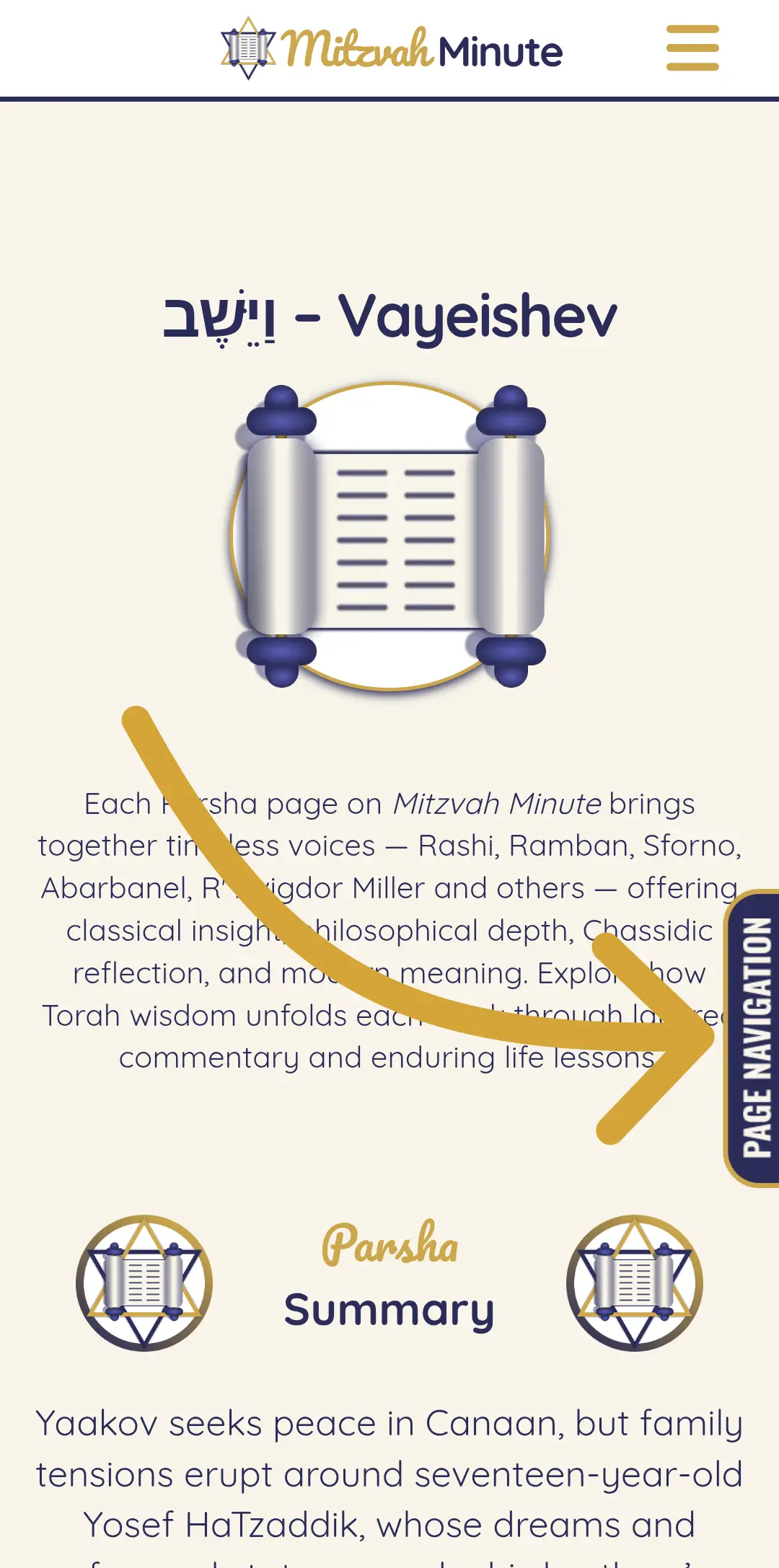
The quick-link panel gives instant access to every section — Parsha Summary, Mitzvos, Divrei Torah, Insights, and Commentaries.
“Every word of Torah and every mitzvah lifts us higher — may your learning bring you closer to Hashem.”

Parshas Yisro marks the transition from redemption to revelation, as the newly freed nation is shaped into a covenantal people bound by law, responsibility, and awe. Yisro, Moshe’s father-in-law, arrives after hearing of Hashem’s deliverance of Yisrael, recognizes Hashem’s supremacy, and offers counsel that transforms leadership from solitary burden into a structured system of justice shared by capable, G-d-fearing judges. The parsha then moves to the encampment at Har Sinai, where Yisrael is summoned into covenant and defined as a mamleches kohanim v’goy kadosh. Amid thunder, fire, and trembling, Hashem reveals Himself publicly and gives the Aseres HaDibros, establishing the foundations of faith, morality, Shabbos, human dignity, and social order. Overwhelmed by direct revelation, the people step back in fear, learning that Divine closeness demands boundaries, reverence, and disciplined approach. Parshas Yisro thus presents Torah not as abstract belief, but as lived structure—law joined to awe, freedom anchored by obligation, and holiness expressed through both ethical command and reverent restraint.

Living at Sinai: Freedom, Structure, and Responsibility
אָנֹכִי ה׳ אֱלֹקֶיךָ אֲשֶׁר הוֹצֵאתִיךָ מֵאֶרֶץ מִצְרַיִם
Parshas Yisro places da’at Elokim not as an abstract belief but as publicly revealed knowledge, witnessed by an entire nation. The opening declaration of the Aseres HaDibros establishes that emunah is grounded in lived history — the Exodus — rather than private experience or philosophical inference. As emphasized throughout the parsha, knowledge of Hashem precedes command, law, and obligation. Covenant begins with recognition: Hashem exists, acts in history, and speaks. This mitzvah anchors all others, transforming freedom from Egypt into conscious responsibility under Divine authority.
לֹא יִהְיֶה לְךָ אֱלֹקִים אֲחֵרִים עַל־פָּנָי
The immediacy of this command following אָנֹכִי teaches that intellectual clarity must be protected from internal distortion. Parshas Yisro repeatedly emphasizes boundaries — at Sinai, in worship, and in leadership — because divided allegiance fractures covenant. Rashi and Ramban both frame idolatry not merely as ritual error but as moral disintegration, undermining justice, dignity, and unity. The prohibition against entertaining other powers safeguards the integrity of revelation and preserves the coherence of Torah life.
אֶת־ה׳ אֱלֹקֶיךָ תִּירָא
Although its formal command appears elsewhere, yiras Hashem is enacted at Sinai itself. The people’s trembling, retreat, and awe are not failures of faith but essential moral conditioning. As developed in the parsha, fear is not paralysis but restraint — a consciousness that guards against sin and preserves responsibility. Yisro’s narrative establishes that enduring covenant requires awe that disciplines freedom, ensuring that law is received not as convenience but as binding truth.
וְהָלַכְתָּ בִּדְרָכָיו
Parshas Yisro presents Divine order as a model for human governance. Just as Hashem structures revelation with mercy, boundaries, and accommodation for human capacity, so must human leadership reflect wisdom, patience, and justice. Yisro’s counsel to Moshe embodies this mitzvah in action: delegation, humility, and care for both leader and people mirror Divine concern for sustainability and dignity. Emulating Hashem means building systems that preserve life rather than exhaust it.
וְאָהַבְתָּ לְרֵעֲךָ כָּמוֹךָ
The Torah’s description of Israel encamping at Sinai “כְּאִישׁ אֶחָד בְּלֵב אֶחָד” establishes unity as a prerequisite for revelation. Love of fellow Jews here is not emotional sentiment but covenantal solidarity — the willingness to bind oneself to others in shared responsibility. Without this unity, Torah cannot be received. Parshas Yisro teaches that communal harmony is not a byproduct of law, but a condition for its existence.
וּבַיּוֹם הַשְּׁבִיעִי תִּשְׁבֹּת
Shabbos appears in the Aseres HaDibros as testimony to creation and Divine sovereignty. In Parshas Yisro, it functions as a weekly reorientation of freedom itself. Rest is not withdrawal from purpose but affirmation that human worth is not defined by production alone. By ceasing from labor, one bears witness that the world belongs to Hashem, not to human mastery. Shabbos thus transforms time into covenantal space, anchoring faith in lived rhythm.
לֹא תַעֲשֶׂה כָל־מְלָאכָה
The prohibition of labor complements the command to rest by establishing restraint as the mechanism of sanctity. As emphasized by Ramban and later thinkers, holiness is preserved not through excess but through disciplined limitation. In Parshas Yisro, this principle parallels the boundaries placed around Sinai itself: closeness to Hashem is achieved through obedience to limits, not their breach.
זָכוֹר אֶת־יוֹם הַשַּׁבָּת לְקַדְּשׁוֹ
“זָכוֹר” is understood by Chazal as ongoing consciousness. In the context of Yisro, Shabbos is not isolated from the week but governs it, shaping preparation, priorities, and perception of time. Sanctifying Shabbos through speech affirms that holiness enters life not only through action but through awareness and declaration. The covenant is sustained when memory is cultivated, not left to inspiration alone.
וּבוֹ תִדְבָּק
Parshas Yisro repeatedly emphasizes proximity to Torah knowledge through human vessels. Yisro’s arrival, Moshe’s teaching of law, and the elders’ presence all demonstrate that attachment to Hashem occurs through attachment to those who embody and transmit His Torah. Revelation does not eliminate mediation; it sanctifies it. Cleaving to sages ensures that Divine truth enters life in forms the human being can absorb, preserving continuity beyond the moment of Sinai.
וְשִׁנַּנְתָּם לְבָנֶיךָ
Yisro’s counsel explicitly includes the obligation to teach: “וְהִזְהַרְתָּ אֶתְהֶם” — Moshe must instruct the people in the laws, the path they must walk, and the actions they must perform. Torah is not meant to remain concentrated at the summit of Sinai or in the hands of one leader. It must be transmitted, explained, and internalized across the nation. Teaching Torah is therefore a foundational act of covenantal sustainability.
מִפְּנֵי שֵׂיבָה תָּקוּם
Moshe’s deference to Yisro — bowing, greeting, and honoring him — models kavod for wisdom regardless of origin. Parshas Yisro teaches that Torah authority is not self-generated but recognized. Honoring sages preserves humility, continuity, and reverence for law itself. Without kavod for teachers, Torah becomes opinion; with it, Torah remains covenant.
שְׁמַע יִשְׂרָאֵל
While Shema is not commanded explicitly in Yisro, its core content is publicly revealed here. The first two Dibros — knowledge of Hashem and rejection of other powers — form the theological nucleus later crystallized in Shema. Parshas Yisro thus represents the national birth of what Shema later formalizes into daily avodah: constant awareness of Divine unity and sovereignty.
וַעֲבַדְתֶּם אֵת ה׳ אֱלֹקֵיכֶם
Yisro’s declaration “בָּרוּךְ ה׳” and Moshe’s ongoing dialogue with Hashem frame avodah as verbal recognition and dependence. Prayer emerges in the parsha not as ritual alone, but as acknowledgment that judgment, law, and leadership ultimately answer to Hashem. Service through speech anchors governance in humility rather than control.
וַהֲרֵעֹתֶם בַּחֲצֹצְרוֹת
The fear at Sinai and the people’s plea that Moshe speak on their behalf establish a template for responsive avodah in moments of overwhelm. Crying out to Hashem is not weakness but recognition of dependence. Parshas Yisro frames fear as educational — directing human vulnerability toward covenantal relationship rather than despair.
כַּבֵּד אֶת־אָבִיךָ וְאֶת־אִמֶּךָ
Placed at the center of the Aseres HaDibros, honoring parents functions as the bridge between obligations to Hashem and obligations to other human beings. Parshas Yisro presents this mitzvah not merely as familial ethics, but as covenantal continuity. Parents are partners with Hashem in creation; honoring them affirms gratitude, humility, and acknowledgment of one’s origin. In a nation emerging from slavery, this command stabilizes identity across generations, ensuring that freedom does not sever memory, authority, or transmission.
לֹא תַחְמֹד בֵּית רֵעֶךָ
The Torah concludes the Aseres HaDibros by legislating the inner life. Parshas Yisro teaches that covenant cannot be sustained by regulating action alone; desire itself must be disciplined. Coveting corrodes trust, fractures community, and transforms others into obstacles rather than partners. By prohibiting חמד, the Torah insists that moral society begins in thought, not only deed. Freedom without inner restraint leads to rivalry and instability; covenant requires the cultivation of contentment and respect for boundaries.
לֹא תִרְצָח
Murder appears in Parshas Yisro as a theological violation, not merely a social crime. Ramban and Rashi both emphasize that human life bears the Divine image; to destroy it is to rebel against the Creator Himself. The placement of “לא תרצח” among the foundational commandments establishes that covenantal life is built on the inviolability of human dignity. Sinai thus declares that power, anger, and desire may never override the sanctity of life. Justice, leadership, and worship all collapse when life itself is not protected absolutely.

Rashi presents Parshas Yisro as a journey toward Torah that begins with lived history. Yisro is not drawn by philosophy or speculation, but by concrete events: the splitting of the Sea and the war with Amalek. Revelation, in Rashi’s view, is never detached from experience. Torah is accepted because it is seen, endured, and survived. This emphasis frames the entire parsha: faith emerges from encounter, not abstraction.
Yisro’s many names reflect this journey. Each name records a stage of transformation—searching, adding, loving, attaching. Rashi underscores that Yisro’s greatness lies not only in recognition of Hashem, but in the cost of conversion: leaving honor, comfort, and familiarity to dwell in the wilderness for the sake of Torah.
Throughout Chapter 18, Rashi weaves a consistent ethic of honor and humility. Moshe bows to Yisro. Moshe serves while others eat. Moshe sits in judgment not as domination but as burden. Leadership is measured not by authority but by responsibility.
Yisro’s critique of Moshe’s judicial role is not logistical alone; it is ethical. A system that exhausts the leader and degrades the people is unsustainable. Rashi emphasizes that true Torah leadership requires delegation, structure, and dignity—for the judge and for those judged. Even one hour of honest judgment, Rashi teaches, makes a judge a partner in Creation.
When Israel arrives at Sinai, Rashi pauses on a single grammatical anomaly: “וַיִּחַן שָׁם יִשְׂרָאֵל” — singular. From this, he derives one of his most famous principles: Israel encamped as one person with one heart.
For Rashi, unity is not a moral add-on; it is a prerequisite for revelation. All previous encampments were marked by complaint and division. Only at Sinai does unity emerge, and only then can Torah be given. Revelation requires not only preparation and purity, but relational harmony.
Rashi’s Sinai is defined by preparation and restraint. Days are counted. Boundaries are marked. Warnings are repeated. Separation is commanded. Nothing is rushed.
These limits are not signs of distance from Hashem, but expressions of reverence. Rashi emphasizes that even longing for closeness can become destructive if it breaks Divine order. The people’s desire to ascend, to see, to approach must be disciplined. Holiness is preserved not by proximity alone, but by obedience to limits.
At Sinai, Rashi insists that revelation is calibrated to human ability. The shofar grows gradually louder so ears can adjust. The mountain smokes like a kiln so human language can describe the indescribable. Hashem arrives before the people, like a teacher waiting for students.
Even the Ten Commandments reflect this accommodation. All were spoken in a single Divine utterance beyond human capacity, yet repeated in a way Israel could absorb. Only the first two were heard directly from Hashem; the rest required Moshe as intermediary. Revelation is maximal, but never annihilating.
When Rashi explains “וַיְדַבֵּר אֱלֹהִים”, he highlights the Name of judgment. The Ten Commandments are not inspirational ideals; they are binding law. Reward and punishment are implicit, even when unstated.
The commandments form a coherent legal structure: idolatry, Shabbos, honoring parents, and crimes against human dignity are all covenantal violations. Kidnapping belongs alongside murder and adultery because it denies the sanctity of the human person. Law is not arbitrary; it reflects the moral weight of creation.
For Rashi, Shabbos is not merely a day—it is a mindset. “זָכוֹר” means continuous remembrance. One lives the week oriented toward Shabbos, setting aside the best in advance. When Shabbos arrives, all work should appear complete, even in thought.
Shabbos testifies weekly to creation and rest. If Hashem, whose acts require no exertion, “rested,” then humanity must all the more so. Blessing and sanctity are woven into time itself through manna, rest, and restraint.
Rashi interprets fear at Sinai not as terror meant to repel, but awe meant to protect. The people recoil, tremble, and retreat—not in rejection, but in recognition of holiness.
Fear here is educational. It imprints awareness that Hashem is not an abstract idea but a present reality. This fear guards against sin, not by threat alone, but by memory of encounter.
The parsha concludes, in Rashi’s reading, with laws of the altar that translate revelation into ethical behavior. Iron is banned because it shortens life, while the altar prolongs life and brings peace. If stones must not be treated with disrespect, how much more so human beings.
Even ascent toward holiness must preserve modesty. Steps are forbidden lest they introduce exposure or arrogance. Worship is not spectacle; it is restraint, dignity, and peace. The final kal va-chomer seals the parsha: Torah culminates not in mysticism, but in respect for life.
Across Parshas Yisro, Rashi presents Torah as a discipline that shapes perception, behavior, and responsibility. Revelation does not overwhelm humanity—it educates it. Leadership requires humility. Unity precedes holiness. Law preserves dignity. Even stones and structures must reflect ethical sensitivity.
In Rashi’s vision, Sinai is not only where Hashem speaks, but where Israel learns how to live in the presence of the Divine.
📖 Source
Ramban presents Parshas Yisro as the moment Torah becomes a permanent structure rather than a transient miracle. Redemption from Egypt, in his view, was never the endpoint. Its purpose was to create a people capable of living under Divine law with order, restraint, and responsibility. Every major section of the parsha contributes to this transition from dependence on open miracles to covenantal stability.
Yisro’s counsel is therefore foundational. Ramban emphasizes that Moshe’s acceptance of advice does not weaken prophecy; it clarifies its role. Divine revelation provides truth and law, but human administration must be structured, layered, and sustainable. Torah does not demand constant charismatic leadership. It demands justice that can function daily, compassionately, and without exhaustion. By instituting courts before Sinai, Ramban teaches that Torah is meant to govern real human society, not remain suspended in supernatural dependence.
At Sinai, Ramban is deeply concerned with boundaries. Revelation is not chaos, ecstasy, or mystical erasure. It is measured, staged, and limited by design. Fire descends while Hashem remains in heaven. Sound intensifies gradually. The people are repeatedly warned not to breach limits.
Ramban insists that these constraints are not concessions to weakness but expressions of Divine mercy. Human beings cannot survive unmediated encounter. True revelation preserves life while instilling awe.
This framework explains Ramban’s reading of the people’s fear and retreat. Their reaction is not a failure of faith but a correct recognition of human finitude. Moshe reassures them not to fear destruction, yet affirms that fear itself is essential.
Awe is meant to endure as a permanent moral restraint. Revelation is not intended to remove choice; it is meant to make responsibility unavoidable.
In the Aseres HaDibros, Ramban reveals a unified moral architecture. The commandments concerning Hashem and those governing human relationships are not separate domains but reflections of one another.
Honoring parents belongs among the commandments of faith because parents are partners in creation. Murder, adultery, and kidnapping are not merely social crimes; they are theological violations that deny the Divine image in man, corrupt lineage, and reduce persons to objects.
Shabbos stands at the center as living testimony to creation, providence, and sovereignty, embedding belief into the rhythm of time itself.
Ramban’s treatment of the altar laws completes this vision. Having rejected intermediaries in belief, the Torah rejects them in worship as well. No silver, no gold, no carved stone, no iron.
Iron represents destruction and bloodshed and therefore cannot touch the place of life and blessing. Even ascent toward Hashem must avoid arrogance and display. Worship is defined by simplicity, humility, and direct encounter.
Where Hashem causes His Name to be remembered, He Himself comes and blesses — without symbolic manipulation or human excess.
Across Parshas Yisro, Ramban’s classical insight is consistent and uncompromising: closeness to Hashem does not erase structure; it demands it. Revelation creates obligation, not escape.
Torah endures precisely because it is disciplined, bounded, ethical, and direct — shaping a people capable of carrying Divine truth within the limits of human life.
📖 Source
Parshas Yisro marks the Torah’s transition from redemption to obligation. For Rambam, this movement is not merely historical but philosophical: freedom attains meaning only when it is shaped by law, intellect, and disciplined moral structure. The events of Yisro — Yisro’s recognition of Hashem, Moshe’s judicial reorganization, and Maamad Har Sinai — collectively articulate the Rambam’s vision of how human perfection is cultivated within a covenantal society.
Rambam insists that the revelation at Sinai was uniquely public in order to ground emunah in certainty rather than subjective experience. The mass revelation to all of Yisrael eliminates reliance on prophecy as hearsay and anchors faith in shared, national knowledge (Moreh Nevuchim II:33). Parshas Yisro reflects this principle by placing the giving of the Aseres HaDibros at the center of national identity. Emunah is not emotional ecstasy but intellectual clarity: knowing that Hashem exists, governs, and commands.
For Rambam, this explains why the Torah emphasizes קול, אש, וברק — sound, fire, and visibility — rather than mystical abstraction (שמות י״ט:ט״ז–י״ט). Revelation is calibrated to human cognition, enabling knowledge rather than overwhelming it.
The Rambam rejects the notion that law constrains freedom; rather, law refines it. True freedom is the alignment of human action with reason and truth, not the indulgence of impulse. The Aseres HaDibros function, in Rambam’s framework, as foundational axioms of both belief and ethics: obligations toward Hashem and obligations toward man form one unified moral system.
This unity reflects Rambam’s position that ethical behavior is not socially convenient but metaphysically necessary for human perfection (Hilchos De’os 1:4). Parshas Yisro presents law not as an external imposition but as the formative structure through which a redeemed people becomes a wise nation.
Yisro’s counsel to Moshe represents a critical Rambamian principle: no individual, regardless of greatness, should monopolize authority. Sustainable leadership requires systems governed by reason, hierarchy, and competence. Rambam emphasizes that law must be administered through orderly institutions, not charismatic dominance (Hilchos Sanhedrin 1:1).
Moshe’s acceptance of Yisro’s advice illustrates intellectual humility — the willingness to submit even prophetic leadership to rational organization. Authority divorced from structure leads to exhaustion, injustice, and instability; authority structured by wisdom produces justice and continuity.
Rambam defines yiras Hashem not as dread but as awe born of understanding (Hilchos Yesodei HaTorah 2:2). The fear experienced at Sinai is therefore not meant to paralyze, but to educate: awareness of Divine grandeur disciplines human behavior and restrains moral excess. The people’s trembling is not an end; it is the beginning of wisdom.
Thus, Parshas Yisro establishes fear as the emotional response that protects reason, ensuring that intellect governs desire rather than being subverted by it.
For Rambam, the covenant at Sinai completes the Exodus. Redemption without law is incomplete, because man’s purpose is not freedom alone but perfection through knowledge, virtue, and obedience to truth. Parshas Yisro therefore stands as the philosophical heart of the Torah: a declaration that the highest human life is one shaped by reason, guided by law, and oriented toward the knowledge of Hashem.
In Rambam’s worldview, Yisro is not merely the giving of commandments — it is the moment humanity is taught how freedom becomes wisdom, and how wisdom becomes sanctity.
📖 Sources
Ralbag approaches Parshas Yisro as a concentrated presentation of the Torah’s educational aims. The narrative, commandments, and covenantal framework are all understood as instruments for human perfection — intellectually, morally, and socially. Throughout the parsha, Ralbag repeatedly frames events in terms of their “to’elot” (benefits), identifying how each stage of revelation and governance advances man toward his ultimate purpose: knowing Hashem through disciplined thought and virtuous action.
Ralbag explains that Yisro’s journey to the wilderness was motivated by intellectual honesty rather than convenience or self-interest. Despite his status and comfort in Midyan, Yisro was compelled to witness the wonders Hashem performed for Yisrael in order to grasp their true meaning. From Hashem’s actions one arrives at knowledge of Hashem Himself; the more wondrous the act, the greater the insight into the Divine power behind it. This is why Yisro declares, “עתה ידעתי כי גדול ה׳ מכל האלהים” — knowledge born from careful observation and reflection. Human perfection, Ralbag stresses, is achieved through apprehension of Hashem’s truth to the fullest extent possible.
Ralbag emphasizes that the Torah’s goal is to perfect both human character and intellect. The commandments are structured to restrain evil actions while actively cultivating good ones. This dual movement — guarding against wrongdoing and pursuing virtue — is the foundation of ethical completeness. In this light, the Aseres HaDibros are not arbitrary decrees but a carefully ordered system designed to shape moral habits and intellectual clarity simultaneously.
Ralbag highlights Moshe Rabbeinu’s unwavering dedication to guiding the people, even at great personal cost. Despite Moshe’s intense deveikus to Hashem, which limited his ability to shift easily into human discourse, he nevertheless judged the people tirelessly to prevent conflict and injustice. This demonstrates that true leadership demands continuous involvement in the moral and legal wellbeing of society. A leader may not withdraw from responsibility under the pretext of spiritual elevation; the highest spiritual state must be expressed through just governance and concern for others.
Within the commandments, Ralbag identifies honoring parents as a foundational category encompassing broader social obligations. One who fails to habituate himself to giving each entity its proper due will ultimately dishonor even those most deserving of respect. Included within this ethical framework are reverence for rulers, judges, and sages, fair compensation of laborers, returning entrusted property, and generosity toward the vulnerable. Acts of charity, loans to the poor, shemittah, yovel, freeing servants, and gifts to the disadvantaged all emerge from a single principle: imitating Hashem’s beneficence, Who bestows good upon all creation to the greatest extent possible.
Ralbag teaches that adherence to the ways of Torah draws Divine providence upon the individual and the nation. Hashem promises protection and elevation to those who heed His voice, designating Yisrael as a treasured people before fully defining the legal structure of the covenant. This ordering is deliberate: the Torah first presents the benefit of observance in order to inspire desire and willingness to accept its demands. Through this process, Yisrael becomes a “ממלכת כהנים וגוי קדוש,” sustained by a providence that corresponds to moral and intellectual refinement.
Ralbag explains that prophecy is shaped by the prophet’s mental focus. Moshe’s reception of Divine communication varied according to the intention with which he contemplated the people’s words. When his thought shifted, the form of prophecy adjusted accordingly. This demonstrates that prophetic experience is not arbitrary; it is conditioned by intellectual preparation and directed contemplation. Revelation, therefore, operates in harmony with human cognition rather than bypassing it.
Ralbag presents Parshas Yisro as a philosophical blueprint for human and national perfection. Knowledge of Hashem arises from observing His actions, moral excellence is achieved through disciplined habituation, leadership requires sustained responsibility, and Divine providence responds to intellectual and ethical development. Sinai is thus not merely a moment of command, but a comprehensive educational system designed to elevate humanity through reason, virtue, and structured covenantal life.
📖 Source
Parshas Yisro is the parsha in which revelation becomes internalized. The giving of the Torah is not only an event that occurred once at Sinai, but a perpetual encounter in which the inner life of a Jew is reshaped. The Chassidic masters reveal that Yisro, Sinai, Shabbos, and the Aseres HaDibros all describe one process: the descent of Divine truth into human action, speech, and inner consciousness.
The Baal Shem Tov teaches that Moshe Rabbeinu’s life itself embodied this paradox of descent and elevation. When the Torah describes Aharon and the elders eating before Elokim with Yisro, Moshe’s eating is not mentioned, because his “eating” was entirely spiritual. His engagement with the physical world was already transformed into avodah. True deveikus does not flee the physical, but refines it until it becomes transparent to its source (שמות י״ח:י״ב).
This inner integration appears again in Yisro’s counsel regarding judgment. A true dayan must judge דין אמת לאמיתו, absolute truth, which the Baal Shem Tov explains as the unification of chesed and gevurah into tiferes. When these opposing forces are harmonized in the mind of the judge, truth emerges, and the judge becomes a partner with Hashem in creation (שבת י׳ ע״א). Corruption fractures this unity, while אמת clarifies and refines even the hidden dross within the world.
Yisro’s instruction to teach the people “the path they should walk” is read as a warning against the subtle enticements of the yetzer hara. The Degel Machaneh Ephraim compares the world to a forest filled with false paths; wisdom lies not only in knowing what is permitted, but in discerning the straight path that preserves spiritual life (שמות י״ח:כ׳). Chassidus distinguishes between derech, a disciplined and safeguarded path of avodah, and orach, a more flexible route that engages the world for the sake of Heaven, which requires constant tefillah lest one be led astray.
At Sinai itself, coercion precedes desire. When Chazal describe Hashem holding the mountain over Bnei Yisrael “like a barrel,” this teaches that even when inner passion is absent, avodah must continue. Especially in times of katnus, spiritual smallness, consistent action preserves the soul until inner longing returns. A Jew is never free to disengage from Torah and service, even when enthusiasm is lacking (שבת פ״ח ע״א).
The Baal Shem Tov further reveals that the Aseres HaDibros contain the entirety of Torah, just as the entire Torah can be contained within a single word. This reaches its deepest expression in אנכי, which Chazal interpret as אנא נפשי כתבית יהבית — “I wrote and gave My soul.” The Torah is Hashem’s self-disclosure. Just as the human body has רמ״ח איברים and שס״ה גידים, the Torah’s mitzvos correspond to and vivify each aspect of the soul. Torah is therefore not external command alone, but the very source of spiritual life (שבת ק״ה ע״א).
The Kedushas Levi deepens this vision by explaining that holiness emerges through tzimtzum, Divine self-contraction. Kedushah means separation that enables finite beings to survive the intensity of Divine presence. Shabbos expresses the unique bond between Hashem and Knesses Yisrael, a sanctity the nations could never truly grasp. Only a people capable of receiving holiness without distortion can sanctify time itself (שמות כ׳:ח׳).
The Sfas Emes explains that creation itself remained incomplete until the Torah was given. The Aseres HaDibros correspond to the ten utterances of creation, repairing and elevating them. Before Sinai, the world existed in a state akin to תהו ובהו; at Sinai, Divine vitality was clarified and restored. Yisro’s arrival before Matan Torah was essential: Amalek sought to fracture and undermine revelation through doubt, while Yisro represented submission to Divine truth and the alignment of the nations with Hashem’s sovereignty.
Finally, the Sfas Emes teaches that נעשה ונשמע reveals the deepest structure of reality. Action awakens Divine speech embedded within creation. When a Jew performs mitzvos, he uncovers the קול ה׳ concealed in the world. Shabbos, when action ceases, allows this קול to be heard in its pure form. Thus Shabbos and Torah are inseparable: Shabbos channels Torah into life, and Torah gives Shabbos its voice.
Parshas Yisro, as revealed through Chassidus, teaches that revelation is not thunder and fire alone, but the lifelong work of aligning action, speech, and thought with Divine truth. Through Torah, judgment, Shabbos, and disciplined avodah, the finite human being becomes a vessel for infinite light, until the soul itself stands again at Sinai.
📖 Sources
Parshas Yisro marks the moment when redemption gives way to responsibility, and freedom acquires its moral form. Rabbi Jonathan Sacks reads this parsha not primarily as the giving of laws, nor even only as the revelation at Sinai, but as the birth of a society shaped by covenant rather than power. What unfolds across Yisro is a transformation unprecedented in human history: a group of former slaves becomes a nation bound not by coercion, territory, or hierarchy, but by freely accepted moral obligation under the sovereignty of Hashem.
In Rabbi Sacks’ reading, the juxtaposition that defines the parsha is deliberate and decisive. Before revelation comes governance; before thunder and fire, delegation and listening; before the Ten Commandments, the quiet wisdom of Yisro. Sinai does not descend into a vacuum. It crowns a carefully constructed moral architecture in which leadership is shared, authority is limited, justice is tempered by peace, and holiness is defined not by domination but by restraint. Covenant, not contract, becomes the foundation of collective life.
Across these essays, Rabbi Sacks traces how Judaism pioneers a vision in which holiness creates space rather than suppresses it, freedom is secured by moral limits rather than raw will, and national identity coexists with universal human dignity. Yisro thus emerges as the parsha in which Judaism articulates its most enduring contribution to civilization: a society capable of sustaining freedom without collapsing into chaos, and authority without descending into tyranny — because it is answerable to something beyond itself.
Rabbi Jonathan Sacks opens his reading of Parshas Yisro by redefining one of the Torah’s most misunderstood concepts: holiness. When the Torah declares that Israel is called to become a goy kadosh, a holy nation, it is not describing a people withdrawn from the world or elevated above it. Rather, holiness is the disciplined creation of space — time, place, and authority — in which the presence of Hashem can be encountered without erasing human freedom.
Holiness, in this sense, is not maximal sanctity but bounded sanctity. Rabbi Sacks draws attention to the Torah’s most concrete expressions of kedushah: Shabbos and the Mishkan. Shabbos is not holy because of activity, but because of restraint. By ceasing melachah, human beings step back from creative dominance and experience themselves as creations rather than creators. The Mishkan functions in the same way spatially: a deliberately limited domain set aside for Divine presence, defined entirely by Divine command rather than human initiative. Nadav and Avihu’s tragic error lay precisely here — introducing religious creativity where obedience and self-effacement were required. Holiness exists only where human will yields to Divine will.
This pattern reveals a deeper principle. A world in which all time or all space were holy would be uninhabitable for human beings. Conversely, a world with no holiness would become one in which Hashem is functionally absent, leaving no limits on human self-assertion. The Torah therefore introduces holiness as selective and structural — certain times, certain places, certain roles — so that Divine presence can inform human life without negating it. Holiness is not withdrawal from the world, but the moral architecture that allows the world to remain humane.
From here, Rabbi Sacks extends the idea of holiness beyond ritual and into national life itself. At Sinai, Israel becomes not merely a people with private faith, but a body politic whose public institutions are shaped by Torah. The phrase goy kadosh means that authority itself must remain unoccupied — the “empty throne” reserved for Hashem alone. Unlike other nations, where sovereignty rests ultimately in kings, emperors, or the state, Israel’s political life is defined by the refusal to absolutize any human power. Judges, leaders, even kings are subject to a law that transcends them.
This is why Sinai occurs in the wilderness, before land, monarchy, or political stability. Israel is constituted as a nation prior to all conventional foundations of nationhood. Its unity does not arise from territory, military might, or dynastic rule, but from covenant. The Torah becomes Israel’s written constitution, binding individuals into a collective whose shared responsibility is moral before it is political.
Gratitude, too, emerges as a foundational gesture of holiness. Rabbi Sacks notes that the Torah places expressions of thanksgiving — especially Baruch Hashem — in the mouths of figures who recognize Hashem’s acts before they analyze or systematize them. Thanksgiving precedes theology. Recognition comes before ideology. A society capable of holiness must begin not with abstract principles, but with acknowledgment of dependence, gift, and grace.
Holiness, then, is the discipline of making room for the Other — for Hashem in time, space, authority, and national life. Just as Hashem, through tzimtzum, creates space for humanity, so Israel is summoned to create space for Hashem through restraint rather than domination. This vision was incomprehensible to ancient empires, which expected holiness to appear as overwhelming presence or sacred objects. The Torah’s revolution lies elsewhere: holiness as listening rather than speaking, being rather than doing, submission rather than mastery.
In Parshas Yisro, Rabbi Sacks shows that holiness is not an escape from history but the condition that allows history to remain moral. A holy nation is not one that withdraws from public life, but one that structures public life around limits, humility, and responsibility — ensuring that power never becomes ultimate, and that freedom never loses its soul.
One of the most striking features of Parshas Yisro is that some of its most formative insights come from outside the covenant. The Torah records that it was Yisro, a Midianite priest, who taught Moshe how to organize leadership, and it places his name on the parsha that contains the revelation at Sinai itself. Rabbi Jonathan Sacks sees this not as incidental detail, but as a deliberate statement about the Torah’s understanding of wisdom, universality, and chosenness.
Judaism, he explains, operates with a dual structure. On the one hand, there is chochmah — wisdom — the universal human capacity to understand the world through reason, observation, and experience. On the other, there is Torah — revelation — a covenantal system of law and sanctity rooted in a specific historical relationship between Hashem and the people of Yisrael. These are not competing forms of knowledge, nor does one negate the other. They belong to different domains. Wisdom tells us how the world is; Torah tells us how the world ought to be.
This distinction explains why Yisro can be both an outsider to the covenant and a genuine teacher of Israel. His advice about governance demonstrates intellectual clarity, moral insight, and practical understanding — all expressions of chochmah. The Torah records this moment to make a crucial point: Israel was not chosen because it possessed superior intelligence. There are sages among the nations, people of deep understanding and insight. Israel was chosen because of Hashem’s love and covenantal purpose, not because of inherent intellectual superiority.
Rabbi Sacks emphasizes that this distinction prevents a dangerous confusion. If Torah were merely wisdom, then it would be one philosophy among many, judged solely by reason and utility. If wisdom were dismissed as “secular,” then Judaism would become insular, blind to truth wherever it appears. Instead, the Torah affirms both. Wisdom is a religious category, because it is rooted in creation, which itself is the work of Hashem. This is why Chazal instituted a blessing upon seeing a sage of the nations of the world, acknowledging that Divine wisdom can appear beyond the boundaries of Israel.
At the same time, Torah is not universal. It is inherited, transmitted through a chain of covenantal fidelity, not discovered by independent inquiry. This is why, as Chazal teach, one may say “there is wisdom among the nations” and it is true, but “there is Torah among the nations” is not. Torah is not a set of ideas alone, but a lived constitution of sanctity that binds a specific people to a specific way of life.
This dual vision clarifies one of Judaism’s most subtle commitments: Hashem is universal, but the covenant is particular. The Torah repeatedly highlights non-Jewish figures who recognize Hashem, praise Him, and act with moral greatness — Noach, Eliezer, Malki-Tzedek, and Yisro himself. Even Yishmael and the people of Nineveh are shown to receive Divine concern and blessing. These narratives are not peripheral; they are essential. They teach that recognition of Hashem and moral responsibility are not the exclusive possession of Israel.
Yet this universalism does not dissolve difference. Rabbi Sacks stresses that Judaism rejects the idea of “one God, one truth, one way.” Instead, it affirms one God and many legitimate human paths. Israel’s role is not to erase diversity, but to model how a particular identity can serve a universal moral horizon. The Torah’s decision to name this parsha after Yisro, a non-Jew, precisely at the moment of revelation, is one of the clearest expressions of this principle.
In the modern world, Rabbi Sacks argues, this insight is indispensable. Humanity faces global challenges that transcend any single culture or nation, yet human beings live within distinct traditions and identities. The Torah’s answer is neither homogenization nor fragmentation, but a covenantal vision in which particular communities remain faithful to their unique obligations while recognizing the dignity and wisdom of others.
Parshas Yisro thus teaches that universality and particularity are not opposites but partners. Wisdom belongs to all humanity, because all humanity is created in the image of Hashem. Torah belongs to Israel, because Israel is bound by covenant. When revelation engages creation rather than denying it, the result is not withdrawal from the world, but the possibility of redemption within it.
At the heart of Parshas Yisro, Rabbi Jonathan Sacks identifies a foundational distinction that shapes not only Jewish political thought, but the very possibility of a stable moral society: the difference between covenant and contract. This distinction explains why the Torah places Yisro’s advice about governance immediately before the revelation at Sinai. Before laws are given, the form of society itself must be clarified.
A contract is an exchange driven by self-interest. Two or more parties come together to secure mutual advantage, and the relationship lasts only as long as it serves those interests. A covenant is something altogether different. It is a bond of loyalty and trust, entered not for gain but for shared responsibility. Contracts create transactions; covenants create relationships. Contracts are about “me” and “you”; covenants are about “us.” Contracts benefit; covenants transform.
This difference is decisive for understanding both Yisro’s counsel and the structure of Jewish society. Yisro observes that Moshe is attempting to lead alone, adjudicating every dispute himself. The result is exhaustion for Moshe and frustration for the people. His solution is not merely administrative efficiency but moral architecture: delegated authority, shared responsibility, and layered leadership. Justice must be accessible, human, and relational, not concentrated in a single heroic figure.
Rabbi Sacks deepens this insight through the teaching of the Netziv, who explains why this system benefited not only Moshe but the people themselves. Moshe, as the greatest of prophets, knew the truth of each case almost immediately. This made compromise impossible. Strict justice may be correct, but it does not always lead to peace. Ordinary judges, lacking prophetic certainty, were forced to listen, deliberate, and seek equitable outcomes. Through them, justice could coexist with peace. A society that values only absolute verdicts may be lawful, but it will not be harmonious.
This leads to one of Rabbi Sacks’ most penetrating observations: no single individual, however great, can embody all the virtues a society needs. Prophets, judges, mediators, leaders, and teachers each play distinct roles. A nation is greater than any one of its heroes because it distributes moral responsibility across its members. Leadership, in Judaism, is not a zero-sum competition for power but a network of relationships in which each person contributes what they alone can give.
The Torah’s preference for covenant over contract also explains its resistance to both tyranny and anarchy. A purely contractual society risks fragmentation, as individuals withdraw allegiance when obligations become inconvenient. A covenantal society, by contrast, binds people together even in moments of disagreement, because their commitment is to a shared moral future, not merely to immediate advantage. This is why Judaism insists on consent rather than coercion, mediation rather than domination, and shared responsibility rather than centralized control.
Rabbi Sacks contrasts this covenantal vision with the modern tendency to reduce society to two arenas alone: the market and the state. The market distributes wealth; the state distributes power. Neither can generate trust, loyalty, or love. These arise only in the spaces between — families, communities, congregations, and voluntary associations — the very spaces sustained by covenant rather than contract. Without covenant, societies become collections of competing interests. With covenant, they become moral communities.
In Parshas Yisro, the Torah offers a radical alternative to politics built on force or calculation. It proposes a society held together by responsibility freely assumed, justice tempered by compassion, and authority restrained by humility. Covenant is not a rejection of law, but its humanization. It is the DNA of a society capable of sustaining freedom without disintegration and order without oppression.
Rabbi Jonathan Sacks argues that the revelation at Har Sinai was not only a religious turning point but the most consequential political moment in human history. At Sinai, a radically new vision of freedom entered the world — one grounded not in power, conquest, or majority rule, but in moral law freely accepted by an entire people. No other event before or since compares to it: never again would Hashem reveal Himself publicly to a whole nation, men, women, and children alike.
The public nature of the revelation is central. Revelation to an individual can always be questioned; revelation witnessed by an entire nation cannot. For the medieval Jewish thinkers, this removed epistemological doubt. But Rabbi Sacks insists that Sinai’s deeper significance lies elsewhere. It created a new kind of politics: a society bound together by covenant rather than coercion. Israel was forged into a nation not by force of arms, nor by territorial settlement, nor by charismatic authority, but by consent to a moral code under the sovereignty of Hashem.
This vision stands in deliberate contrast to the political cultures of the ancient world. Egypt was a society in which the few ruled and the many served. Power flowed downward, unchecked by any higher moral authority. Sinai dismantles this model at its root. Long before Israel had kings or institutions of government, it entered into a covenant that placed moral limits on all future exercises of power. Torah established, for the first time, the primacy of right over might.
This is why the Torah insists on consent at Sinai. Hashem commands Moshe to present the covenant to the people, and only after they respond, “Na’aseh,” does revelation proceed. There can be no legitimate authority without the consent of the governed — even when the governor is the Creator of heaven and earth. Rabbi Sacks notes how extraordinary this idea is. Freedom, in Judaism, is not the absence of obligation, but the freedom to bind oneself to moral responsibility.
Chazal later wrestled with the tension inherent in this moment. The Talmud imagines the mountain suspended over the people, raising the question of coercion. Yet the same tradition insists that the covenant was later reaffirmed freely, in the days of Achashverosh and again at the threshold of the land. The Torah is acutely aware that genuine covenant must be renewed by choice, not fear. Hashem, the Rabbis insist, does not rule tyrannically over His creations.
Sinai also introduces a decisive safeguard against the tyranny of the majority. In Greek democracy, the will of the people could itself become absolute. In the Torah’s model, even kings and nations are subject to law. Prophets are empowered to challenge rulers who act unjustly. Individuals are morally obligated to resist illegal or immoral commands. The covenant creates a society in which no human authority is final, because all authority answers to Hashem.
Equally revolutionary is the inclusiveness of the covenant. The Torah emphasizes that all the people stood at Sinai — men, women, and children. Citizenship in this moral community was universal from the outset. Thousands of years before modern democracies extended political dignity to all members of society, the Torah articulated a vision in which every person counted as a bearer of responsibility and obligation.
Rabbi Sacks concludes that Sinai gave birth to freedom of an entirely different kind than the ancient world had known. It was not freedom from law, but freedom through law. Not freedom secured by power, but freedom preserved by moral limits. The covenant at Sinai laid the groundwork for a society capable of resisting both tyranny and chaos, because it anchored political life in something higher than human will.
In Parshas Yisro, freedom is not a revolutionary slogan but a disciplined achievement. It emerges when a people voluntarily accepts the constraints that make dignity, justice, and shared life possible. That is the enduring legacy of Sinai: the politics of freedom, born not in the city-states of Greece, but in the wilderness under the mountain.
Parshas Yisro concludes Rabbi Jonathan Sacks’ vision of Sinai by redefining leadership itself. The Torah deliberately places Yisro’s practical counsel to Moshe alongside the most exalted moment of revelation in history, not to diminish Sinai, but to clarify its implications. Revelation does not create a nation of passive followers awaiting instruction from above. It creates a nation in which responsibility is distributed, leadership is shared, and moral agency belongs to all.
Yisro observes that Moshe is attempting the impossible: to lead and judge alone. His concern is not merely Moshe’s exhaustion, but the fragility of a society dependent on a single individual. A nation built around one towering figure, however great, cannot endure. The solution Yisro proposes — a hierarchy of judges over thousands, hundreds, fifties, and tens — is not bureaucratic convenience. It is a philosophy of leadership rooted in dignity, trust, and participation.
Rabbi Sacks emphasizes that this system reflects a profound truth: no one person can embody all the virtues a society needs. Moshe is a prophet, lawgiver, and liberator, but even he cannot be everything at once. Others, less exalted yet indispensable, possess gifts Moshe does not — patience, mediation, attentiveness to human complexity. By delegating authority, Moshe enables these qualities to emerge, transforming leadership from solitary heroism into a collective enterprise.
This insight reframes the meaning of chosenness. Israel is not chosen to be ruled by a spiritual elite while the many obey. It is chosen to become a people in which every individual bears responsibility for the moral life of the whole. Leadership in Judaism is not confined to prophets or kings. It appears wherever people accept responsibility for one another — in families, courts, communities, and acts of everyday faithfulness.
Rabbi Sacks contrasts this covenantal model with cultures that concentrate power in charismatic rulers or rigid institutions. Such systems may achieve efficiency, but they stifle initiative and erode dignity. The Torah’s alternative is slower, more demanding, and ultimately more resilient. By trusting ordinary people with real authority, it creates a society capable of moral self-renewal long after its greatest leaders are gone.
This is why the Torah insists that Sinai was experienced by all. Revelation does not absolve individuals of responsibility; it intensifies it. A nation that has heard the voice of Hashem cannot outsource its moral life to a single leader. Each generation, and each person within it, must shoulder their share of the covenant.
In Parshas Yisro, Rabbi Sacks shows that the true miracle of Sinai was not thunder or fire, but the creation of a people prepared to lead — not through domination, but through service; not through command, but through commitment. Israel becomes a nation of leaders because it is bound by covenant, and covenant demands participation. The endurance of Jewish history, against all odds, testifies to the power of this vision: a society sustained not by the greatness of its few, but by the responsibility of its many.
Across his essays on Parshas Yisro, Rabbi Jonathan Sacks presents a unified vision of Sinai as the moment Judaism introduces a new moral architecture into history. What begins with Yisro’s practical wisdom and culminates in revelation is not a sequence of unrelated episodes, but a single unfolding argument about how free human beings can live together under the sovereignty of Hashem without collapsing into tyranny or chaos.
Holiness, in this vision, is not withdrawal from the world but the discipline of restraint that makes space for the Divine within it — in time, in space, and in authority. Wisdom is affirmed wherever it appears, even beyond the covenant, while Torah remains the particular inheritance of Israel, shaping a distinctive way of life without denying the dignity of others. Covenant, rather than contract, becomes the bond that turns individuals into a people, creating trust, responsibility, and peace where mere law or power would fail. Freedom is born not through the absence of limits, but through freely accepted moral obligation, publicly affirmed and continually renewed.
Above all, Rabbi Sacks shows that Sinai creates not a nation ruled by heroes, but a nation of leaders. Authority is shared, responsibility distributed, and moral agency demanded of all. Israel endures not because of the greatness of its few, but because covenant binds the many into a collective life shaped by justice, humility, and hope. Parshas Yisro thus emerges as the Torah’s blueprint for a society capable of sustaining freedom across generations — a society that listens before it speaks, serves before it rules, and always remembers that no human power is ultimate, because all stand equally before Hashem.
📖 Source
Rav Kook opens Parshas Yisro through Yisro’s blessing over the miracles of the Exodus, teaching that true gratitude demands more than acknowledgment of rescue alone. A miracle is not an isolated act with a single outcome; it radiates meaning into all its details and consequences. One must thank Hashem not only for deliverance itself, but also for the manner in which it occurred, the justice embedded within it, and the surrounding circumstances that absorbed its spiritual imprint. Yisro’s blessing names not only liberation from Egypt, but rescue from both the people and Pharaoh, and it highlights the middah keneged middah by which the Egyptians were punished through their own designs. Gratitude, in Rav Kook’s view, is the capacity to perceive Divine harmony across all dimensions of an event, including its moral structure and lasting resonance.
This sensitivity explains how a blessing may be recited even at locations not immediately associated with the miracle’s climax. Places touched by Divine intervention retain spiritual significance, just as human vessels that once carried Divine influence continue to radiate sanctity. Recognition of Hashem’s action therefore requires attentiveness to the full web of cause, effect, justice, and consequence through which Divine purpose unfolds.
The Torah’s description of Yisro, Aharon, and the elders eating “before Elokim” becomes, for Rav Kook, a window into how finite beings encounter infinite holiness. Chazal teach that sharing a meal with a Torah scholar is akin to enjoying the radiance of the Shechinah. Rav Kook explains that Divine wisdom itself exceeds human comprehension, yet even limited contact with its vessels can fill the soul with light and joy.
Most people cannot access lofty wisdom directly. Intellectual or spiritual greatness may feel distant, even discouraging. A shared meal, however, forms a common human bond through which holiness becomes approachable rather than overwhelming. Through ordinary human interaction, the scholar’s elevated conduct and inner refinement become accessible to others according to their capacity. Just as the pleasure of Divine presence depends on the soul’s readiness, so too the benefit drawn from closeness to a sage varies with spiritual receptivity. Sinai thus teaches that elevation must be mediated through human vessels, allowing holiness to be encountered without alienation.
Rav Kook applies this principle of balance to Moshe’s judging of the people “from morning to evening.” Chazal insist this cannot mean unceasing labor. Rather, a judge who judges truthfully even for a single hour is deemed a partner with Hashem in Creation. Rav Kook explains that creation itself unfolds through a rhythm of activity and renewal — day and night forming one complete unit. Human service must mirror this structure.
Those devoted to public service may believe that constant activity maximizes their contribution. Rav Kook cautions that neglect of personal physical and spiritual renewal ultimately undermines service itself. Time devoted to rest, study, and inner growth is not a withdrawal from responsibility, but an essential component of it. Just as creation requires both exertion and rest, so communal leadership demands balance. A life structured around this rhythm participates in sustaining the world.
This same integrative vision appears in Rav Kook’s discussion of the date of Matan Torah. The debate whether the Torah was given on the sixth or seventh of Sivan reflects two complementary truths. Torah perfects humanity, completing the work begun on the sixth day of Creation. Yet its ultimate aim is even higher: the refinement of the entire universe, associated with the seventh day, Shabbos, the culmination of Creation. Torah begins by elevating human beings, but it ultimately sanctifies all existence.
Rav Kook applies this dialectic to education itself. One approach emphasizes punishment first, uprooting evil to clear the way for holiness. Another floods the soul with goodness, refining even raw and dangerous energies by redirecting them toward holy ends, and only later removing what cannot be redeemed. Both approaches are valid, addressing different dimensions of the human soul. Torah does not negate human complexity; it engages and integrates it.
The Midrashic image of coercion at Sinai — the mountain held over the people’s heads — raises a fundamental question about freedom. Rav Kook explains that while moral choice must remain free, the Torah itself is not optional at the level of existence. Free will is itself imposed; we are not free to choose whether to choose. Similarly, Torah expresses the inner essence of Israel and the sustaining truth of creation. To reject it would be to rebel against one’s own deepest self.
Mount Sinai becomes the symbol of this cosmic necessity. On the day of revelation, the mountain absorbs the weight of all existence, representing the universe concentrated at a single point. Israel, standing beneath it, bears responsibility not only for itself but for the world’s spiritual coherence. Acceptance of Torah is thus inseparable from the possibility of existence itself.
This unity is experienced directly at Sinai through the phenomenon of “seeing sounds.” Rav Kook explains that sensory divisions belong to a fragmented world. At the source of creation, perception is unified. Standing near that source, Israel perceived reality as an undivided whole, registering revelation through all senses simultaneously. Sinai granted a glimpse into the inner unity underlying the multiplicity of the world.
The location of Sinai reinforces this universality. The Torah is given not in the Land of Israel, nor on its holiest mountain, but in the wilderness, a place belonging to no one. This signals that Torah speaks to all humanity. The nations’ refusal to accept it therefore creates estrangement — the sin’ah associated with Sinai. Yet this rejection is not final. The prophets foresee a future in which the nations will recognize their error and seek closeness to Hashem through Israel.
Rav Kook concludes by emphasizing the pristine clarity of the Torah’s revelation and transmission. Moshe’s ascent and descent at daybreak symbolize a revelation untouched by social, political, or pragmatic considerations. His prophecy, described by Chazal as an aspaklariah me’irah, was a direct, unclouded reception of Divine truth. The Torah does not arise from human need; it defines human life precisely because it transcends it.
Equally significant is the purity of transmission. The Torah Moshe brought down was identical to the Torah he received, uncompromised by circumstance or accommodation. Its laws are not shaped by societal pressure but shape society itself. This absolute integrity is what grants the Torah its power to renew creation, refine humanity, and uplift the world toward holiness.
Through these teachings, Rav Kook presents Parshas Yisro as a disclosure of inner reality. Sinai reveals how miracle and nature, freedom and necessity, soul and cosmos converge in Torah. Israel’s task is not domination, but responsibility — to live a truth that is covenantal in form and universal in meaning, sustaining both human dignity and the world itself.
📖 Sources
Parshas Yisro is not merely the story of how Torah was given; it is the Torah’s instruction for how a redeemed people learns to live responsibly, faithfully, and sustainably in the real world. Every element of the parsha — Yisro’s arrival, Moshe’s exhaustion, the structuring of justice, the boundaries of Sinai, the fear of revelation, the Aseres HaDibros, and the laws of worship — converges into a single demand: freedom must be disciplined, holiness must be structured, and spiritual life must be lived within the limits of human reality.
Modern life places enormous emphasis on freedom — freedom of choice, expression, movement, and identity. Parshas Yisro insists that freedom without obligation is not liberation but instability. Bnei Yisrael leave Egypt as free people, but they do not become a covenantal nation until they accept law, structure, and command. This speaks directly to contemporary experience. Liberation from external constraint does not automatically produce meaning, order, or moral clarity. Without a binding framework, freedom becomes exhausting rather than empowering.
Yisro’s counsel to Moshe highlights this danger. Moshe’s original leadership model — one person carrying everything — mirrors the modern tendency to overcentralize responsibility: the overworked leader, the burned-out parent, the overwhelmed professional who feels indispensable. Torah rejects this model. Responsibility must be distributed, authority shared, and systems built so that life remains livable. Sustainable holiness requires delegation, limits, and trust in others.
In daily life, this means recognizing that saying yes to everything is not spiritual heroism. It is often a failure of wisdom. Torah demands that we build structures — schedules, boundaries, institutions, and shared responsibility — that allow commitment to endure without collapse.
Rashi’s emphasis on “וַיִּחַן שָׁם יִשְׂרָאֵל” — singular — confronts a deep modern tension. We often seek spiritual meaning while tolerating fragmentation, polarization, and relational breakdown. Parshas Yisro reverses the order: unity is not the result of revelation; it is the condition for it. Sinai only occurs when the people stand “כְּאִישׁ אֶחָד בְּלֵב אֶחָד.”
In contemporary terms, this challenges a culture that prioritizes personal expression over shared responsibility. Torah teaches that spiritual growth cannot flourish in a climate of constant division, contempt, or moral isolation. Unity does not mean uniformity or the absence of disagreement; it means a commitment to remain bound to one another even amid difference.
Practically, this demands restraint in speech, patience in judgment, and loyalty to community. It calls for creating spaces — families, shuls, institutions — where disagreement does not fracture belonging. Revelation does not enter a society that cannot hold itself together.
One of the parsha’s most countercultural lessons is the sanctity of distance. At Sinai, closeness to Hashem is achieved not by unrestrained approach but by obeying limits. Warnings are repeated. Boundaries are enforced. Even the most sincere desire to draw near becomes dangerous when it ignores Divine order.
Modern spirituality often equates authenticity with boundary-breaking: saying everything, feeling everything, accessing everything immediately. Parshas Yisro insists on the opposite. Holiness is preserved through discipline. Desire must be shaped by law. Intimacy requires restraint.
This applies powerfully to digital life, relationships, ambition, and religious practice. Not every feeling must be acted upon. Not every opportunity must be seized. Not every space must be entered. Torah teaches that reverence is expressed through self-limitation, not self-expression alone.
The fear at Sinai is not meant to traumatize but to educate. Ramban and Rambam both emphasize that awe is essential precisely because revelation does not remove free will. Fear anchors moral responsibility. It reminds the human being that actions matter, that life is lived before Hashem, and that choice carries consequence.
In a culture that either dismisses fear as unhealthy or exploits it manipulatively, Parshas Yisro offers a third path. Yiras Hashem is not anxiety or panic. It is moral awareness. It is the steady knowledge that life is accountable, that truth is not negotiable, and that dignity must be protected.
This kind of fear guards against ethical erosion. It tempers power, curbs impulse, and preserves humility. It is not an emotion to be escaped, but a posture to be cultivated.
The Aseres HaDibros unite faith and ethics into one moral architecture. Crimes against people are crimes against Hashem because human beings bear the Divine image. Kidnapping belongs alongside murder and adultery because reducing a person to property is a theological violation, not merely a social one.
In modern discourse, morality is often reduced to personal preference or social consensus. Parshas Yisro rejects this. Law is not arbitrary. It reflects the structure of creation itself. Shabbos, kavod av va’eim, and interpersonal prohibitions are not isolated values; they are integrated expressions of a world governed by truth and dignity.
Applied today, this means that ethical behavior is not optional even when socially inconvenient. Integrity is not situational. Torah does not ask whether something is popular, efficient, or advantageous; it asks whether it preserves the sanctity of life, time, and relationship.
Shabbos emerges in the parsha not as retreat from life, but as its realignment. “זָכוֹר” means ongoing consciousness. One lives toward Shabbos, prepares for it, and allows it to reshape the week.
In a world of constant motion, Shabbos restores proportion. It interrupts productivity, reclaims time from utility, and reminds the human being that worth is not measured by output alone. If Hashem “rested,” though no exertion applies to Him, then human beings must rest all the more so.
Shabbos teaches that the world does not collapse when we stop controlling it. On the contrary, it becomes whole. This lesson is urgently needed in a culture defined by burnout, distraction, and perpetual urgency.
The parsha ends not with mystical instruction, but with ethical worship. Iron is excluded from the altar because it shortens life, while the altar extends life and peace. Even stones are treated with dignity. Modesty governs ascent. Holiness is inseparable from restraint.
This culminates in a powerful recalibration of religious life. Torah does not sanctify spectacle, excess, or domination. It sanctifies peace, humility, and respect. If the stones of the altar must not be harmed, then certainly human beings may not be demeaned in the name of religion.
In application, this demands vigilance that religious passion never tramples dignity. Avodas Hashem that produces cruelty, arrogance, or contempt has misunderstood Sinai.
Parshas Yisro teaches that revelation is not confined to thunder and fire. It lives wherever freedom is shaped by law, where leadership is shared, where unity precedes ideology, where boundaries protect holiness, where fear guards responsibility, and where worship generates peace.
To live Yisro today is to accept that spiritual life requires structure, that holiness demands limits, and that dignity is the measure of truth. It is to build lives, communities, and institutions capable of carrying Torah not as an event remembered, but as a covenant lived — steadily, humbly, and responsibly.
Rashi’s commentary on Parshas Yisro traces the movement from recognition to revelation, and from revelation to obligation. Beginning with Yisro’s awakening through history’s great miracles, Rashi emphasizes that Torah is not accepted through abstraction but through lived encounter—events seen, suffered, and internalized. As the parsha progresses, Rashi carefully situates Matan Torah within a framework of humility, unity, preparation, and awe, clarifying chronology, language, and halachic implication at every step. Through Midrashic depth and precise textual sensitivity, Rashi presents Sinai not as a moment of spectacle alone, but as the disciplined formation of a nation capable of bearing Divine law, structure, and responsibility.
וַיִּשְׁמַע יִתְרוֹ — מַה שְּׁמוּעָה שָׁמַע וּבָא? קְרִיעַת יַם סוּף וּמִלְחֶמֶת עֲמָלֵק.
Rashi asks what specific report Yisro heard that motivated him to come. He answers that it was the splitting of the Sea and the war with Amalek. These two events represent overwhelming revelation and sustained conflict—miracle and moral struggle—both of which together stirred Yisro to act (מכילתא; זבחים קט״ז א).
יִתְרוֹ — שֶׁבַע שֵׁמוֹת נִקְרְאוּ לוֹ: רְעוּאֵל, יֶתֶר, יִתְרוֹ, חוֹבָב, חֶבֶר, קֵינִי, פּוּטִיאֵל.
Rashi lists the seven names of Yisro and explains their meanings and origins.
יֶתֶר — because he “added” a section to the Torah, namely the passage beginning “וְאַתָּה תֶחֱזֶה” (שמות י״ח:כ״א).
יִתְרוֹ — when he converted and fulfilled the mitzvos, an additional letter was added to his name.
חוֹבָב — because he loved the Torah (מכילתא). Rashi identifies חובב explicitly as Yisro, citing “מִבְּנֵי חוֹבָב חֹתֵן מֹשֶׁה” (שופטים ד׳:י״א).
Regarding רְעוּאֵל, Rashi records a dispute: some say Reuel was Yisro himself; others say Reuel was Yisro’s father. The verse “וַתָּבֹאנָה אֶל רְעוּאֵל אֲבִיהֶן” (שמות ב׳:י״ח) is then explained as referring to a grandfather, since children call their grandfather “father” (ספרי במדבר ע״ח).
חֹתֵן מֹשֶׁה
Here, Rashi contrasts two moments of honor. At this point, Yisro takes pride in being Moshe’s father-in-law—“I am the father-in-law of the king.” Earlier, Moshe himself attributed his standing to Yisro, as the verse says “וַיָּשָׁב אֶל יֶתֶר חֹתְנוֹ” (שמות ד׳:י״ח). The Torah thus reflects shifting directions of kavod depending on circumstance (מכילתא).
לְמֹשֶׁה וּלְיִשְׂרָאֵל
Rashi explains that Moshe is weighed as equal to all of Israel combined. Mentioning Moshe separately is not redundancy but emphasis—his stature stands alone yet encompasses the nation (מכילתא).
אֵת כָּל אֲשֶׁר עָשָׂה
This refers to the miracles done for them: the descent of the manna, the well, and the defeat of Amalek.
כִּי הוֹצִיא ה׳ אֶת יִשְׂרָאֵל
Rashi states that the Exodus itself surpasses all other miracles and is therefore singled out as the greatest act (מכילתא).
אַחַר שִׁלּוּחֶיהָ — כְּשֶׁאָמַר לוֹ הַקָּבָּ״ה בְּמִדְיָן לֵךְ שֻׁב מִצְרָיִם…
Rashi recounts the Midrashic narrative. When Moshe set out for Egypt with his wife and children, Aharon met him and questioned who they were and where Moshe was taking them. Upon hearing that Moshe intended to bring them to Egypt, Aharon protested: “We already suffer for those who are there—will you add more?” Moshe then told Tzipporah to return to her father’s house, and she left with her two sons (מכילתא).
This refers to the episode when Doson and Aviram revealed that Moshe had killed the Egyptian. When Pharaoh sought to execute Moshe, his neck miraculously became like a pillar of marble, rendering the sword ineffective (שמות רבה א׳:ל״א; רש״י שמות ב׳:ט״ו).
Rashi notes that stating they were in the desert seems unnecessary. Rather, the verse praises Yisro: despite living amid worldly honor and comfort, he chose to go out to the wilderness—a place of desolation—in order to hear words of Torah (מכילתא).
Rashi explains that Yisro sent his message through a messenger (מכילתא).
“אֲנִי חֹתֶנְךָ יִתְרוֹ”
If Moshe would not come out for Yisro’s sake, he should come for his wife’s sake; if not for her, then for the sake of his two sons (מכילתא). The layered appeal reflects relational obligation and responsibility.
Rashi emphasizes the great honor accorded to Yisro. When Moshe went out, Aharon followed, then Nadav and Avihu, and finally all who saw them felt compelled to go out as well (תנחומא).
“וַיִּשְׁתַּחוּ וַיִּשַּׁק לוֹ”
Rashi clarifies ambiguity: who bowed to whom? From the phrase “אִישׁ לְרֵעֵהוּ,” we identify “איש” as Moshe, based on “וְהָאִישׁ מֹשֶׁה” (במדבר י״ב:ג׳). Thus Moshe bowed to Yisro (מכילתא).
Moshe related all that had occurred in order to draw Yisro’s heart closer and attach him to the Torah (מכילתא).
“אֵת כָּל הַתְּלָאָה”
This refers specifically to the hardships at the Sea and the suffering caused by Amalek (מכילתא).
“הַתְּלָאָה”
Rashi concludes with a grammatical explanation. The ל and א belong to the root of the word, while the ת is a formative letter sometimes dropped in usage. He cites parallel forms: תְּרוּמָה, תְּנוּפָה, תְּקוּמָה, תְּנוּאָה.
וַיִּחַדְּ יִתְרוֹ
Rashi explains that in its plain meaning, Yisro rejoiced. However, Midrashically, the word ויחד is read as indicating a physical reaction: his flesh became covered with sharp prickles. This reflects Yisro’s inner pain over the destruction of Egypt. Although he rejoiced in Israel’s salvation, he still felt anguish over the downfall of his former people. From here emerges the common saying: even a convert whose non-Jewish ancestry goes back ten generations should not hear disparagement of that nation in his presence (סנהדרין צ״ד א).
עַל כָּל הַטּוֹבָה
Rashi defines “all the goodness” as the manna, the well, and the Torah. Yet above all these, Yisro rejoiced that Hashem had delivered them from Egypt. Until that moment in history, no slave had ever escaped Egypt, for the land was sealed and inescapable. Nevertheless, six hundred thousand men went forth freely, a redemption unparalleled in human experience (מכילתא).
אֲשֶׁר הִצִּיל אֶתְכֶם מִיַּד מִצְרַיִם
Rashi characterizes Egypt as a harsh and cruel nation.
וּמִיַּד פַּרְעֹה
Pharaoh himself is described as a harsh monarch, emphasizing that both the system and its ruler embodied cruelty.
מִתַּחַת יַד מִצְרַיִם
Rashi explains that “hand” here denotes domination and oppressive authority. The phrase means from beneath Egypt’s rule, referring to the heavy burden of labor that Egypt imposed upon Israel. This follows the understanding of the Targum, which reads the phrase as liberation from subjugation rather than a literal hand.
עַתָּה יָדַעְתִּי
Yisro declares that he knew Hashem even before, but now his knowledge is deeper and more complete. His recognition has intensified through witnessing these events (מכילתא).
מִכָּל הָאֱלֹהִים
This teaches that Yisro had familiarity with every form of idolatry in the world and had worshipped all of them. Only after this exhaustive search did he arrive at the recognition of Hashem’s absolute supremacy (מכילתא).
כִּי בַדָּבָר אֲשֶׁר זָדוּ עֲלֵיהֶם
Rashi explains according to the Targum that the Egyptians were punished through the very means they intended to use against Israel. They sought to destroy Israel by water, and they themselves were destroyed by water.
אֲשֶׁר זָדוּ
This term means that they acted wickedly. Additionally, Chazal interpret it through a wordplay with “וַיָּזֶד יַעֲקֹב נָזִיד” (בראשית כ״ה:כ״ט): in the pot in which they cooked, they themselves were cooked. The instrument of their cruelty became the instrument of their downfall (סוטה י״א א).
עֹלָה
Rashi explains that this refers to a burnt offering, entirely consumed upon the altar.
וּזְבָחִים
These were peace offerings.
וַיָּבֹא אַהֲרֹן וְכָל זִקְנֵי יִשְׂרָאֵל
Rashi asks why Moshe is not mentioned as participating in the meal, despite having initiated all the honor shown to Yisro. He answers that Moshe was standing and serving them. His absence from the verse reflects his humility and role as attendant (מכילתא).
לִפְנֵי הָאֱלֹהִים
From here Rashi derives that one who benefits from a meal at which Torah scholars are present is considered as though he benefited from the radiance of the Shechinah itself (ברכות ס״ד א).
וַיְהִי מִמָּחֳרָת
Rashi states that this was the day after Yom Kippur. This section is not written in chronological order. The phrase “on the morrow” refers to the day after Moshe descended from Har Sinai with the second Tablets. Before Matan Torah, it would have been impossible to say “and I shall make known the statutes of Hashem,” and between Matan Torah and Yom Kippur Moshe could not have judged the people, as he was either on the mountain or dealing with the breaking of the Tablets. Therefore, this judging occurred only after Yom Kippur.
Rashi further explains that even according to the opinion that Yisro arrived before Matan Torah, his departure did not occur until the second year. This is proven from the later account in Bamidbar, where Moshe pleads with Yisro—there called Chovav—not to leave. Chovav is identified as Yisro himself, as shown by the verse “מִבְּנֵי חֹבָב חֹתֵן מֹשֶׁה” (שופטים ד׳:י״א). Thus, the Torah deliberately records these events out of sequence.
וַיֵּשֶׁב מֹשֶׁה… וַיַּעֲמֹד הָעָם
Moshe sat like a king while the people stood. This arrangement disturbed Yisro, who felt it diminished the honor of Israel. He therefore rebuked Moshe for sitting alone while all the people stood, as stated in the following verse (מכילתא).
מִן הַבֹּקֶר עַד הָעָרֶב
Rashi explains that Moshe did not literally judge from morning until evening. Rather, any judge who judges truthfully even for a single hour is regarded by Scripture as though he engaged in Torah study all day and as though he became a partner with Hashem in the work of Creation, which is described with the phrase “וַיְהִי עֶרֶב וַיְהִי בֹקֶר” (שבת י׳ א).
כִּי יָבֹא
Rashi explains that this is equivalent to כִּי בָא, expressing continuous action in the present tense. The verse describes an ongoing reality: when the people come.
לִדְרֹשׁ אֱלֹקִים
Rashi follows the Targum’s rendering, “לְמִתְבַּע אֻלְפַּן,” meaning to seek instruction from the mouth of the Almighty. The people were not merely seeking arbitration but Torah guidance.
כִּי יִהְיֶה לָהֶם דָּבָר בָּא
The phrase refers to the individual who has a dispute. That person comes to Moshe to have the matter addressed.
וַיֹּאמֶר חֹתֵן מֹשֶׁה
Scripture refers to Yisro as Moshe’s father-in-law as a mark of honor, emphasizing his status as the father-in-law of the king.
נָבֹל תִּבֹּל
Rashi explains this as the Targum does: Moshe will surely become worn out. The term denotes withering, comparable to a leaf shriveling from heat or frost. Strength diminishes until one becomes exhausted.
גַּם אַתָּה
The word “also” includes Aharon, Chur, and the seventy elders, all of whom would be affected by the burden.
כִּי כָבֵד מִמְּךָ
The task is heavier than Moshe’s strength can bear.
אִיעָצְךָ וִיהִי אֱלֹקִים עִמָּךְ
Yisro tells Moshe to consult Hashem regarding this advice. The counsel must be validated by the Almighty (מכילתא).
הֱיֵה אַתָּה לָעָם מוּל הָאֱלֹקִים
Moshe is to remain the intermediary between the people and Hashem, serving as their agent and advocate.
אֶת הַדְּבָרִים
This refers specifically to the matters of their disputes.
וְאַתָּה תֶחֱזֶה
Moshe is to select judges through the Holy Spirit that rests upon him (מכילתא).
אַנְשֵׁי חַיִל
These are wealthy men who have no need to flatter or show favoritism.
אַנְשֵׁי אֱמֶת
Men of integrity whose words inspire trust and are therefore accepted.
שֹׂנְאֵי בָצַע
Men who despise gain, to the extent that they are willing to forgo their own money in judgment. A judge from whom payment must be forcibly extracted is unfit (בבא בתרא נ״ח ב).
שָׂרֵי אֲלָפִים, שָׂרֵי מֵאוֹת, שָׂרֵי חֲמִשִּׁים, שָׂרֵי עֲשָׂרֹת
Rashi calculates the total number of officers:
six hundred officers of thousands,
six thousand officers of hundreds,
twelve thousand officers of fifties,
sixty thousand officers of tens (מכילתא; סנהדרין י״ח א).
וְשָׁפְטוּ
Onkelos translates this in the imperative: “and let them judge,” indicating command rather than description.
וְהֵקֵל מֵעָלֶיךָ
This arrangement will lighten the burden from upon Moshe. The grammatical form parallels expressions like “וְהַכְבֵּד” and “וְהַכּוֹת,” denoting ongoing action.
וְצִוְּךָ אֱלֹקִים וְיָכֹלְתָּ עֲמֹד
Moshe is instructed to consult Hashem. If Hashem commands this system, Moshe will be able to endure; if not, he will not succeed (מכילתא).
וְגַם כָּל הָעָם הַזֶּה
This includes Aharon, Nadav, Avihu, and the seventy elders who are presently with Moshe (מכילתא).
וְשָׁפְטוּ
Here the verb describes action rather than command: they judged the people.
יְבִיאוּן
They would bring the difficult matters to Moshe.
יִשְׁפְּטוּ הֵם
This form is equivalent to יִשְׁפְּטוּ. Earlier verses are commands, while these verses describe the implementation of those commands.
וַיֵּלֶךְ לוֹ אֶל אַרְצוֹ
Rashi explains that Yisro returned to his land in order to convert the members of his family (מכילתא).
בַּיּוֹם הַזֶּה
Rashi explains that this refers to Rosh Chodesh. The Torah could have written “on that day,” yet it states “on this day” to teach that the words of Torah must be new to you each day, as if they were given today. Torah is not to be received as something old or familiar, but with daily freshness and renewed attentiveness (ברכות ס״ג ב).
וַיִּסְעוּ מֵרְפִידִים
Rashi asks why the Torah repeats from where they journeyed, since it was already known that they encamped at Rephidim. The repetition serves to compare their departure from Rephidim to their arrival at Sinai. Just as their arrival at Sinai was in a state of repentance, so too their departure from Rephidim was with repentance for the sin committed there (מכילתא).
וַיִּחַן שָׁם יִשְׂרָאֵל
Rashi notes the singular form: Israel encamped “as one man with one heart.” This unity was unique to this encampment; all other encampments were marked by complaint and dispute (מכילתא).
נֶגֶד הָהָר
This means on the eastern side of the mountain. Wherever the term “נגד” appears in reference to place, it signifies facing east (מכילתא).
וּמֹשֶׁה עָלָה
Moshe ascended the mountain on the second day of the month. All of Moshe’s ascents were done early in the morning, as stated elsewhere, “וַיַּשְׁכֵּם מֹשֶׁה בַּבֹּקֶר” (שמות ל״ד:ד׳).
כֹּה תֹאמַר
Moshe was instructed to speak in this precise language and order—no deviation.
לְבֵית יַעֲקֹב
This refers to the women. They were to be addressed first and spoken to in gentle language (מכילתא).
וְתַגִּיד לִבְנֵי יִשְׂרָאֵל
The men were to be taught the punishments and exacting details of the mitzvos, using firm and exact language—words as sharp as sinews (שבת פ״ז א).
אַתֶּם רְאִיתֶם
Rashi emphasizes that Israel’s knowledge of Hashem is not based on tradition, hearsay, or testimony, but on direct experience. They themselves witnessed what Hashem did to Egypt. Although Egypt was liable for punishment long before Israel’s redemption, Hashem only punished them in connection with Israel’s suffering, showing His direct involvement on Israel’s behalf (מכילתא).
וָאֶשָּׂא אֶתְכֶם
This refers to the day Israel gathered at Raamses to leave Egypt. Though they were scattered throughout Goshen, they were gathered together in a single moment. Onkelos translates the term in a manner of honor toward Hashem, rendering it as “I caused you to travel” rather than a physical carrying.
עַל כַּנְפֵי נְשָׁרִים
Rashi explains the metaphor: unlike other birds, which place their young beneath them out of fear of predators, the eagle carries its young on its wings. Since no bird flies above it, the eagle fears only man’s arrow and prefers to absorb danger itself rather than allow harm to its young. So too Hashem placed Himself between Israel and danger at the Sea, absorbing the attacks of Egypt through the protective cloud (שמות י״ד:י״ט–כ׳).
וָאָבִא אֶתְכֶם אֵלָי
Rashi explains this as bringing Israel close to Hashem’s service, following the Targum.
וְעַתָּה
If Israel accepts the Torah now, it will be pleasant for them thereafter, for all beginnings are difficult (מכילתא).
וּשְׁמַרְתֶּם אֶת בְּרִיתִי
This refers to the covenant Hashem would make with them concerning the observance of the Torah.
סְגֻלָּה
Rashi defines this as a treasured possession, like precious objects stored by kings. Israel would be cherished above all nations. However, this does not mean Hashem has no relationship with other peoples; rather, despite all the earth being His, Israel is singled out as His treasured nation (מכילתא).
כִּי לִי כָּל הָאָרֶץ
All the world belongs to Hashem, yet in comparison, the other nations are as nothing before Him.
וְאַתֶּם תִּהְיוּ לִי מַמְלֶכֶת כֹּהֲנִים
Rashi explains “kohanim” here to mean princes or ministers, as in the verse “וּבְנֵי דָוִד כֹּהֲנִים” (שמואל ב ח׳:י״ח). It cannot mean priests literally, since David’s sons were not from the tribe of Levi.
אֵלֶּה הַדְּבָרִים
Moshe was commanded to transmit these words exactly—neither more nor less (מכילתא).
וַיָּשֶׁב מֹשֶׁה אֶת דִּבְרֵי הָעָם
Moshe returned the people’s response on the following day, the third of the month, since he always ascended the mountain early in the morning. Although Hashem already knew the answer, Moshe reported it to teach proper conduct: a messenger must faithfully return with a response and not rely on assumptions of prior knowledge (שבת פ״ז א).
בְּעַב הֶעָנָן
Rashi explains that this refers to the thickness of the cloud, identifying it with the עֲרָפֶל, the dense darkness mentioned later: “וַיִּגַּשׁ מֹשֶׁה אֶל הָעֲרָפֶל” (שמות כ׳:י״ח). This setting emphasizes concealment and awe at the moment of revelation (מכילתא).
וְגַם בְּךָ
The word “also” teaches that the people’s belief in Moshe extends beyond him personally. They would also believe in the prophets who would arise after Moshe, establishing enduring prophetic authority (מכילתא).
וַיַּגֵּד מֹשֶׁה אֶת דִּבְרֵי הָעָם
This occurred on the following day, the fourth of the month.
אֶת דִּבְרֵי הָעָם
Moshe reported the people’s response: they desired to hear Hashem’s words directly. Hearing from a messenger is not the same as hearing from the King Himself. They wished not only to obey, but to encounter their King face to face (מכילתא).
וַיֹּאמֶר ה׳ אֶל מֹשֶׁה
Since the people insisted on direct revelation, Hashem instructed Moshe to go to the people.
וְקִדַּשְׁתָּם
This means to prepare them. Moshe was to designate and ready them for the encounter over the course of that day and the next (מכילתא; תרגום אונקלוס).
וְהָיוּ נְכֹנִים
They were to be prepared by separating from their wives (שבת פ״ז א).
לַיּוֹם הַשְּׁלִישִׁי
This refers to the sixth day of the month. On the fifth, Moshe built the altar and the twelve monuments, as described later in Parshas וְאֵלֶּה הַמִּשְׁפָּטִים (שמות כ״ד:ד׳). This demonstrates that the Torah does not always follow chronological order (אין מוקדם ומאוחר בתורה).
לְעֵינֵי כָּל הָעָם
Rashi teaches that none of the people were blind at that moment; all were healed in preparation for the revelation (מכילתא).
וְהִגְבַּלְתָּ
Moshe was instructed to establish boundary markers as signs, warning the people not to approach beyond the designated limit.
לֵאמֹר
The boundary itself symbolically “speaks,” cautioning them not to cross. Moshe was to reinforce this warning verbally.
וְנָגַע בִּקְצֵהוּ
Even touching the extremity of the mountain was forbidden.
יָרֹה יִיָּרֶה
From this verse Rashi derives the law that those sentenced to stoning are first cast down from an elevated place. The place of stoning was twice a person’s height (סנהדרין מ״ה א).
יָרֹה
The word means to be thrown downward, similar to “יָרָה בַיָּם” (שמות ט״ו:ד׳).
בִּמְשֹׁךְ הַיֹּבֵל
When the ram’s horn emits a prolonged blast, it signals the departure of the Shechinah and the cessation of the Divine voice. Once the Presence withdraws, the people are permitted to ascend the mountain. The phrase indicates permission, not obligation (מכילתא).
הַיֹּבֵל
This refers to a ram’s horn. In Arabic usage, a ram is called יובלא. The horn sounded at Sinai was that of the ram offered in place of Yitzchok (ראש השנה כ״ו א; פרקי דרבי אליעזר ל״א).
מִן הָהָר אֶל הָעָם
Rashi notes that Moshe did not attend to his own affairs first. He went directly from the mountain to the people, demonstrating responsibility and selflessness (מכילתא).
הֱיוּ נְכֹנִים לִשְׁלֹשֶׁת יָמִים
According to Rabbi Yosei, Moshe added an extra day of preparation on his own initiative, so that readiness would be complete by the fourth day. According to the opinion that the Ten Commandments were given on the sixth, Moshe added nothing, and “for three days” means “by the third day” (שבת פ״ו–פ״ז).
אַל תִּגְּשׁוּ אֶל אִשָּׁה
They were to refrain from marital relations for all three days. This ensured that women could immerse and remain ritually pure to receive the Torah, without concern for post-immersion impurity (שבת פ״ו א).
וַיְהִי בִּהְיוֹת הַבֹּקֶר
Rashi teaches that Hashem preceded the people at the place of revelation. Unlike human teachers, who wait for their students, Hashem arrived first. A parallel is found in Yechezkel, where the glory of Hashem stood ready before the prophet arrived (יחזקאל ג׳:כ״ב–כ״ג).
לִקְרַאת הָאֱלֹקִים
Rashi explains that the Shechinah went out to meet Israel, just as a bridegroom goes out to meet his bride. This is alluded to in the verse “Hashem came from Sinai” (Devarim ל״ג:ב׳), which deliberately says “from Sinai” rather than “to Sinai,” indicating Divine movement toward Israel (מכילתא).
בְּתַחְתִּית הָהָר
On a simple level, this means at the foot of the mountain. Midrashically, Rashi explains that the mountain was uprooted and held over them like a barrel, so that they stood literally beneath it. This conveys the overwhelming and inescapable nature of the moment of revelation (שבת פ״ח א).
עָשַׁן כֻּלּוֹ
Rashi notes a grammatical point: this is not a noun (“smoke”), but a verb—“it was smoking.” The vowelization indicates an action, and Onkelos therefore translates it as a verb, “it was all giving forth smoke.” Elsewhere, when the word appears as a noun, it is vocalized differently.
הַכִּבְשָׁן
The mountain’s smoke is compared to a lime kiln. Rashi clarifies that this is not to limit the intensity of the fire, for elsewhere the Torah states the mountain burned “to the heart of the heavens” (Devarim ד׳:י״א). Rather, the comparison is pedagogical—Torah speaks in human terms, using familiar images to make the Divine experience intelligible. Just as Hashem is compared to a roaring lion or rushing waters, so too the furnace imagery helps human ears grasp the overwhelming scene (מכילתא).
הוֹלֵךְ וְחָזֵק מְאֹד
Ordinarily, a trumpet blast weakens the longer it is sounded. Here, however, it grew stronger and stronger. Rashi explains that it began softly so that the people’s ears could gradually adjust to what they were capable of hearing (מכילתא).
מֹשֶׁה יְדַבֵּר
The people heard only the first two commandments—“אָנֹכִי” and “לֹא יִהְיֶה לְךָ”—directly from Hashem. The remaining commandments were conveyed by Moshe, with Hashem strengthening his voice so it could be heard by the entire nation (מכילתא).
יַעֲנֶנּוּ בְקוֹל
Hashem answered Moshe with respect to the voice—responding by empowering it—just as Hashem answers “with fire” by bringing fire down. The response matched the request (מכילתא).
וַיֵּרֶד ה׳ עַל הַר סִינַי
Rashi clarifies that Hashem did not literally descend in a physical sense. Rather, Hashem bent the upper and lower heavens and spread them over the mountain like a bedspread, and the Throne of Glory descended upon them. This preserves both Divine transcendence and nearness (מכילתא).
הָעֵד בָּעָם
Moshe was instructed to warn the people not to ascend the mountain.
פֶּן יֶהֶרְסוּ
The term “break through” means to abandon one’s assigned position out of intense longing to see Hashem. Such movement would shatter the ordered structure of the assembly.
וְנָפַל מִמֶּנּוּ רָב
Even if only a single person were harmed, Hashem would regard it as a great loss. Each individual life carries immense value (מכילתא).
וְגַם הַכֹּהֲנִים
This includes the firstborn, who at that time performed sacrificial service. Even they were warned not to rely on their status to draw nearer than permitted (זבחים קט״ו ב).
יִתְקַדְּשׁוּ
They were to remain prepared and stationed in their designated place.
פֶּן יִפְרֹץ
Hashem might “burst forth,” meaning He could strike them, creating a breach in their ranks.
לֹא יוּכַל הָעָם
Moshe responded that additional warning seemed unnecessary, since the people had already been under restriction for three days and lacked permission to ascend.
לֵךְ רֵד
Hashem nevertheless instructed Moshe to warn them again. Rashi derives from here a general principle: one admonishes a person before an act and again at the moment of action (מכילתא).
וְעָלִיתָ אַתָּה וְאַהֲרֹן עִמָּךְ
Moshe was to ascend further than Aharon, Aharon further than the priests, and the priests further than the people. Each group had its designated boundary, preserving order and sanctity (מכילתא).
פֶּן יִפְרֹץ בָּם
Rashi adds a grammatical note explaining the vowel change in the word יִפְרֹץ when joined with a hyphen, without altering its root meaning.
וַיֹּאמֶר אֲלֵיהֶם
Moshe conveyed this final warning to the people.
וַיְדַבֵּר אֱלֹהִים
Rashi explains that the Name אֱלֹהִים here denotes Judge. Since some sections of Torah promise reward for fulfillment without punishment for neglect, one might have thought the Ten Commandments function similarly. Therefore the Torah emphasizes “אֱלֹהִים”—the Judge who exacts punishment—teaching that these commandments are legally binding with consequences (מכילתא).
אֵת כָּל הַדְּבָרִים הָאֵלֶּה
This teaches that Hashem uttered all Ten Commandments in a single utterance—something impossible for a human being. If so, why are אָנֹכִי and לֹא יִהְיֶה לְךָ stated again? Because Hashem repeated and articulated each of these two commandments separately (מכילתא).
לֵאמֹר
This indicates Israel’s response: to positive statements they answered “yes,” and to prohibitions they answered “no” (מכילתא).
אֲשֶׁר הוֹצֵאתִיךָ מֵאֶרֶץ מִצְרַיִם
The act of redemption itself obligates Israel to accept Hashem’s authority. Another explanation: Hashem appeared at the Sea as a mighty warrior and at Sinai as an elder filled with compassion. Because Hashem appears in different manifestations, Israel might think there are multiple authorities; therefore Hashem clarifies that it was the same One who redeemed them from Egypt and appeared at the Sea (מכילתא).
Another explanation: the people heard many voices—coming from all directions—and might think there are multiple powers. Therefore Hashem stresses singular authority. Why then say אֱלֹקֶיךָ in the singular? To give Moshe grounds to defend Israel after the Golden Calf, arguing that the command was spoken to him individually (“לֹא יִהְיֶה לְךָ”) rather than to the entire nation (שמות רבה).
מִבֵּית הָעֲבָדִים
This means from Pharaoh’s house, where Israel were slaves to the king—not slaves to slaves. Scripture elsewhere clarifies this explicitly, confirming that their servitude was royal bondage (מכילתא).
לֹא יִהְיֶה לְךָ
Why is this stated separately from “You shall not make”? To prohibit not only creating idols, but also retaining idols already made. One may not possess them at all (מכילתא).
אֱלֹהִים אֲחֵרִים
They are called “other gods” not because they are divine, but because others have made them gods. It would be blasphemous to call them “gods beside Me.” Alternatively, they are “other” to their worshippers: people cry out to them and receive no response—like calling to a stranger who does not recognize you (מכילתא).
עַל פָּנָי
This means “so long as I exist.” It teaches that the prohibition of idolatry applies for all generations, not only to those who left Egypt (מכילתא).
פֶּסֶל
A graven image, so called because it is carved or chiseled.
וְכָל תְּמוּנָה
This includes the likeness of anything in the heavens.
אֵל קַנָּא
Hashem is “jealous” in the sense that He zealously exacts punishment and does not waive idolatry. The term denotes resolute determination to punish wrongdoing (מכילתא).
לְשֹׂנְאַי
This applies when descendants continue the sinful practices of their ancestors—when they “hold onto” their forefathers’ deeds (סנהדרין כ״ז ב).
וְנֹצֵר חֶסֶד
Hashem preserves the reward for good deeds for up to two thousand generations. Thus the measure of reward outweighs punishment by a ratio of one to five hundred: punishment extends to four generations, while kindness extends to thousands (תוספתא סוטה).
לַשָּׁוְא
“In vain”—without purpose or truth. A classic example of a false oath is swearing to change an obvious reality, such as declaring a stone pillar to be gold (שבועות כ״ט א).
זָכוֹר
Rashi teaches that “זָכוֹר” (remember) and “שָׁמוֹר” (observe, Devarim 5:12) were spoken in a single utterance—an impossibility for human speech. He illustrates this principle with parallel pairs where one command permits what another forbids (e.g., Shabbos desecration vs. Shabbos offerings; shaatnez vs. tzitzis; the prohibition of a brother’s wife vs. yibbum). This fulfills the verse, “One thing did God speak; two did we hear” (Tehillim 62).
Grammatically, זָכוֹר is an infinitive-like verbal form, meaning: keep remembering continuously. Practically, one should always keep Shabbos in mind—if a fine item is found during the week, set it aside for Shabbos (מכילתא).
וְעָשִׂיתָ כָּל מְלַאכְתֶּךָ
When Shabbos arrives, it should appear as though all work is already completed. One should not even think about weekday labor on Shabbos (מכילתא).
אַתָּה וּבִנְךָ וּבִתֶּךָ
These refer to minors. Adults are already included under “you.” The verse therefore teaches that adults are responsible to ensure the Shabbos rest of their children. Hence, if a minor attempts to extinguish a fire, we do not allow it—because the child’s Shabbos observance is incumbent upon the parent (שבת קכ״א).
וַיָּנַח בַּיּוֹם הַשְּׁבִיעִי
Scripture attributes “rest” to Hashem, so to speak, to teach a kal va-chomer: if Hashem—whose actions require no toil—“rested,” how much more so must a human being, whose work involves effort and fatigue, rest on Shabbos (מכילתא).
בֵּרַךְ… וַיְקַדְּשֵׁהוּ
Hashem blessed Shabbos with the manna—by providing a double portion on Friday—and sanctified it by withholding manna on Shabbos itself (מכילתא).
לְמַעַן יַאֲרִיכֻן יָמֶיךָ
If one honors parents, days are lengthened; if not, they are shortened. Torah statements often imply their opposites: from the positive we infer the negative, and from the negative we infer the positive (מכילתא).
לֹא תִּנְאָף
“Adultery” applies specifically to relations with a married woman, as established by verses prescribing the death penalty for such an act (Vayikra 20; Yechezkel 16).
לֹא תִּגְנֹב
Here the prohibition refers to kidnapping, not monetary theft. This is derived from context: like murder and adultery—crimes punishable by death—so too this theft must be a capital offense, which applies only to kidnapping (סנהדרין פ״ו).
וְכָל הָעָם רֹאִים
This teaches that no one among Israel was blind. Proof that none were mute: “and all the people answered.” Proof that none were deaf: “we will do and we will hear” (מכילתא).
רֹאִים אֶת הַקּוֹלוֹת
They saw what is normally heard—an experience unique to Sinai.
וַיָּנֻעוּ
The term denotes trembling.
וַיַּעַמְדוּ מֵרָחֹק
The people recoiled twelve mil—the length of the camp—and ministering angels brought them back, as alluded to by “the angels of the hosts moved them on” (Tehillim 68; שבת פ״ח).
בַּעֲבוּר נַסּוֹת אֶתְכֶם
Rashi explains that this does not mean “to test” in the sense of trial or doubt, but rather to elevate and to raise you up. The word נַסּוֹת is related to נֵס—a banner or standard raised high. Hashem revealed Himself in glory in order to exalt Israel in the eyes of the nations, so that a great name would go forth in the world that the Divine Presence was revealed to them in honor (מכילתא).
נַסּוֹת
The term denotes elevation and greatness, like: “Lift up an ensign (נֵס)” (ישעיהו ס״ב), “I will raise My banner (נִסִּי)” (ישעיהו מ״ט), and “as an ensign upon a hill” (ישעיהו ל׳). A banner is called a nes because it is raised upright and visible from afar.
וּבַעֲבוּר תִּהְיֶה יִרְאָתוֹ
Through seeing Hashem as awe-inspiring and fearsome, Israel would internalize that there is none besides Him. This experiential fear would guard them from sin—not fear of punishment alone, but reverent awareness of Divine reality.
וַיִּגַּשׁ אֶל הָעֲרָפֶל
Moshe entered inward beyond three concentric divisions: darkness, cloud, and thick cloud. As the verse states: “The mountain burned with fire unto the heart of heaven—darkness, cloud, and thick cloud” (דברים ד׳).
The עֲרָפֶל is the densest layer—the same “thick cloud” Hashem referenced earlier when He said, “Behold, I come to you in a thick cloud” (שמות י״ט).
כֹּה תֹאמַר
Moshe was instructed to transmit the message in this exact language, meaning in Lashon HaKodesh, with no deviation (מכילתא).
אַתֶּם רְאִיתֶם
There is a fundamental difference between what a person personally sees and what others merely relate to him. Testimony from others can leave room for doubt, but direct perception leaves no uncertainty. Israel’s faith is grounded in firsthand experience, not hearsay (מכילתא).
כִּי מִן הַשָּׁמַיִם דִּבַּרְתִּי
Another verse states, “Hashem descended upon Mount Sinai,” which seems contradictory. A third verse resolves this tension: “Out of heaven He made you hear His voice… and upon the earth He showed you His great fire” (דברים ד׳).
Hashem’s glory remained in the heavens, while His fire and power were manifest on earth. Alternatively, Hashem bent the heavens and spread them upon the mountain, as it says, “He inclined the heavens and descended” (תהילים י״ח).
לֹא תַעֲשׂוּן אִתִּי
This prohibits making images of the celestial beings who serve Hashem above—angels and heavenly ministers—even if they are not intended for worship (מכילתא).
אֱלֹהֵי כֶסֶף
This warns regarding the Keruvim: although they are commanded to be made, they must not be made of silver. Any deviation from the commanded form—even seemingly minor—renders them as idols before Hashem.
וֵאלֹהֵי זָהָב
This warns against increasing their number beyond the two prescribed. If one were to make four Keruvim, they would be regarded as “gods of gold” (מכילתא).
לֹא תַעֲשׂוּ לָכֶם
One may not replicate Keruvim in synagogues or study halls, reasoning that since they exist in the Temple, they may be reproduced elsewhere. Sacred forms are restricted to their designated Divine context.
מִזְבַּח אֲדָמָה
An altar attached directly to the earth—built neither on columns nor on a base. Alternatively, when Israel encamped, they filled the hollow copper altar with earth before using it (מכילתא).
תַּעֲשֶׂה לִּי
From its very inception, the altar must be constructed for the sake of Hashem’s Name.
וְזָבַחְתָּ עָלָיו
This means near it, not literally on top of it, since slaughtering does not occur on the altar itself.
בְּכָל הַמָּקוֹם אֲשֶׁר אַזְכִּיר אֶת שְׁמִי
Where Hashem grants permission to invoke His Divine Name, there He will cause His Presence to dwell and bring blessing. This teaches that permission to pronounce the Divine Name was granted only in the place of the Shechinah—the Beis HaMikdash—where the Kohanim would pronounce it during Birchas Kohanim (סוטה ל״ח).
וְאִם מִזְבַּח אֲבָנִים
Rabbi Yishmael explains that although אִם usually implies conditionality, here it means “when”, because building an altar of stone is obligatory. The same applies to other mitzvos introduced with אִם, such as lending money or offering the Omer—each is mandatory.
לֹא תִבְנֶה אֶתְהֶן גָּזִית
Hewn stone is forbidden because iron tools must not touch the altar.
כִּי חַרְבְּךָ הֵנַפְתָּ
Here כִּי means “lest,” not “because”—lest one lift iron upon it.
וַתְּחַלְלֶהָ
Iron shortens life, while the altar prolongs life by bringing atonement and peace. It is therefore inappropriate that an instrument of destruction be raised over an instrument of life.
Moreover, the altar makes peace between Israel and their Father in Heaven. If even stones—which neither feel nor perceive—must be treated with dignity, then all the more so a human being who brings peace between people must be spared harm. This is a powerful kal va-chomer (מכילתא).
וְלֹא תַעֲלֶה בְמַעֲלֹת
The ascent to the altar must be a smooth ramp, not steps. Steps force wide strides, which approach immodesty.
אֲשֶׁר לֹא תְגַלֶּה עֶרְוָתְךָ
Although the Kohanim wore linen breeches, wide steps still constitute a form of disrespect. If stones—insentient and indifferent—must not be treated in a degrading manner, then certainly a fellow human being, created in the image of Hashem and sensitive to disgrace, must be treated with dignity. This kal va-chomer seals the section with an ethical crescendo.
Across Parshas Yisro, Rashi weaves together narrative, halacha, and ethical principle into a single coherent vision of Torah life. Yisro’s arrival models sincere truth-seeking and the cost of conversion, while the judicial reforms establish limits, delegation, and sustainability in leadership. At Sinai, Rashi underscores unity—“as one person with one heart”—and the necessity of boundaries, reverence, and repeated warning in the face of overwhelming holiness. The Ten Commandments are framed not merely as moral imperatives but as legally binding covenantal law, spoken with Divine authority and consequence. The section concludes by grounding revelation in dignity: even stone, structure, and movement toward the altar must reflect modesty, peace, and respect. In Rashi’s telling, Sinai is not only where Hashem speaks—but where Israel learns how to live in His presence.
📖 Source
Ramban’s commentary on Parshas Yisro traces the transformation of Israel from a redeemed people into a covenantal nation ordered by law, hierarchy, and awe of Heaven. From Yisro’s counsel establishing judicial structure, through the overwhelming revelation at Sinai, and into the foundational commands governing faith, Shabbos, human dignity, and worship, Ramban presents Torah not as isolated commandments but as an integrated system flowing from Divine unity. Throughout, Ramban emphasizes that revelation is not mystical excess but measured encounter — one that preserves human capacity while binding Israel permanently to truth, responsibility, and direct relationship with Hashem, without intermediaries.
Ramban opens by noting that Chazal are divided regarding this parsha. Some maintain that Yisro arrived before Matan Torah, following the apparent order of the parshiyos. Others argue that he arrived after the Giving of the Torah. Ramban first presents the arguments supporting the view that Yisro came after Matan Torah.
He cites the pasuk stating that Yisro came to Moshe “אֶל הַמִּדְבָּר אֲשֶׁר הוּא חֹנֶה שָׁם הַר הָאֱלֹהִים” (שמות י״ח:ה׳), emphasizing that this describes Moshe encamped at Har Sinai, where Bnei Yisrael remained for an entire year. This phrasing suggests a post-Sinai arrival. Ramban strengthens this by noting Moshe’s statement, “וְהוֹדַעְתִּי אֶת חֻקֵּי הָאֱלֹהִים וְאֶת תּוֹרֹתָיו” (שמות י״ח:ט״ז), implying that Torah law had already been given.
He adds a further proof from the pasuk describing Yisro’s departure: “וַיְשַׁלַּח מֹשֶׁה אֶת חֹתְנוֹ וַיֵּלֶךְ לוֹ אֶל אַרְצוֹ” (שמות י״ח:כ״ז). Ramban correlates this with the account in Parshas Beha’aloscha, where Moshe speaks to Chovav ben Reuel during the second year, at the time of departure from Sinai (במדבר י:כ״ט–ל״ב). The identical phrasing indicates the same event, placing Yisro’s involvement after Matan Torah.
Ramban then cites an additional argument from Moshe’s retrospective account in Sefer Devarim. There Moshe recounts appointing judges because he could not bear the people alone (דברים א:ט–ט״ו), clearly echoing Yisro’s advice in our parsha (שמות י״ח:י״ג–כ״ו). Since Devarim states that they traveled immediately afterward from Chorev (דברים א:ז), this again suggests Yisro’s arrival occurred after the Revelation. Ramban therefore asks a sharp question: if so, why does the Torah place this parsha before Matan Torah?
He then presents Ibn Ezra’s answer. Ibn Ezra explains that the Torah juxtaposes Yisro with Amalek deliberately. After recounting Amalek’s evil and the command to destroy him, the Torah records Yisro’s goodness in order to teach gratitude. This prepares for the future command that when Amalek is punished, the descendants of Yisro — the Keini — must be spared, as Shaul indeed warned them (שמואל א ט״ו:ו׳).
Ramban, however, challenges this explanation forcefully. He asks why, if Yisro arrived after Matan Torah, the Torah says he heard only of Yetziyas Mitzrayim and not of the Revelation itself, which was the greatest wonder in history (דברים ד:ל״ב–ל״ו). Likewise, when Moshe recounts to Yisro all that Hashem did to Pharaoh and Egypt (שמות י״ח:ח׳), leading Yisro to proclaim “עַתָּה יָדַעְתִּי כִּי גָדוֹל ה׳” (שמות י״ח:י״א), why is there no mention of Maamad Har Sinai, which would have demonstrated unequivocally the truth of Hashem and His Torah (דברים ד:ל״ה–ל״ו)?
Ramban suggests a possible defense: perhaps Yisro heard of the Exodus immediately in Midyan, traveled at once, and arrived after Matan Torah. The Torah did not repeat the account of Sinai because it had just occurred and was universally known. Nonetheless, Ramban finds this unsatisfying.
He therefore states that the explanation closest to him is to follow the order of the Torah: Yisro arrived before Matan Torah, while Bnei Yisrael were in Refidim, as taught in the Mechilta. Rabbi Yehoshua says that Yisro heard of the war with Amalek and came. He then traveled together with Bnei Yisrael from Refidim to Har Sinai.
Ramban explains the geography carefully. Har Sinai lay on the route from Midyan. Moshe had previously shepherded there (שמות ג:א׳), and Aharon met Moshe there (שמות ד:כ״ז). Refidim itself was part of Midbar Sin, which extended from Eilim to Sinai and included Dofkah, Alush, and Refidim (שמות ט״ז:א׳; במדבר ל״ג:י״ב–י״ג). Thus, when the Torah says Yisro came “אֶל הַמִּדְבָּר אֲשֶׁר הוּא חֹנֶה שָׁם” it means that Yisro reached Har Sinai, sent word to Moshe, and Moshe went out to meet him from Refidim. There is no need to assume textual inversion or rearrangement.
Ramban reinforces this with a teaching from the Mechilta, which marvels that Yisro left a place of worldly honor to enter a barren wilderness. The Torah highlights this to praise Yisro, who came specifically because this was “הַר הָאֱלֹהִים,” the place where Hashem revealed Himself (שמות ג:י״ב). Yisro knew that Israel’s Exodus was for the purpose of serving Hashem on this mountain, and he came “לְשֵׁם ה׳ אֱלֹהֵי יִשְׂרָאֵל.”
Ramban then revisits the question of Yisro’s departure. He suggests that Yisro left in the first year, returned briefly to convert his family, and then rejoined Moshe at Sinai. When Moshe later begged him to remain permanently (במדבר י:ל–ל״ב), Yisro accepted and stayed. Evidence for this is found later: Yisro’s descendants appear among Israel in the time of Shaul and in Yerushalayim as the family of Yonadav ben Rechav. Alternatively, Ramban suggests that some Keini living with Amalek were extended relatives, not Yisro’s direct descendants, and Shaul spared them out of gratitude, just as Yehoshua spared the family of Rachav (יהושע ו:כ״ג).
Ramban concludes by citing Chazal who affirm that Yisro ultimately went with Israel. The Sifrei teaches that his descendants were given the fertile land of Yericho, which they held until the Beis HaMikdash was built 440 years later, a tradition also recorded by Rashi (במדבר י:ל״ב). The Mechilta adds that Yisro declared his intention to return home to convert his people, yet the Torah testifies that the children of the Keini later ascended with Israel, proving that Yisro’s bond with the nation endured.
Ramban finally explains the opening phrase “כָּל אֲשֶׁר עָשָׂה אֱלֹהִים לְמֹשֶׁה וּלְיִשְׂרָאֵל.” The wonders done for Moshe refer to the unique kindness Hashem showed him — enabling him to stand before Pharaoh without fear and act as a king over Israel. Ibn Ezra interprets the phrase as “for Moshe and Israel,” referring to the plagues and the drowning of Pharaoh, and Ramban notes that this aligns with Chazal’s statement that Moshe is equivalent to Israel and Israel to Moshe (מכילתא כאן).
He concludes by explaining the use of Divine Names in the pasuk. “אֱלֹהִים” is mentioned first because that is the Name Yisro already knew. “ה׳” is then used regarding the Exodus, because the great Name was revealed through Moshe and through the signs performed, completing Yisro’s recognition of Hashem’s true sovereignty.
Ramban explains that the Torah specifies “after he had sent her away” because earlier it had already stated that Moshe took his wife and sons and returned to Egypt (שמות ד:כ׳). Since that verse implies that Tzipporah accompanied him, the Torah must now clarify that she was in her father’s house, having been sent back by Moshe.
Ramban adds that it is possible the Torah is teaching that Yisro himself took Tzipporah in order to return her to Moshe, even though Moshe had previously sent her away. Having heard all that Elokim had done for Moshe, Yisro recognized that Moshe was now a king in Israel, and it was therefore fitting that his wife should follow him wherever he went.
Ramban notes that although this is not the place where the births of Moshe’s sons are recorded, the Torah nevertheless explains their names here. The reason is that at the time of Eliezer’s birth there was no opportunity to explain his name, as Ramban already clarified in Parshas Shemos (שמות ד:כ׳).
Here, the Torah seeks to highlight the kindness Hashem showed Moshe. Gershom’s name recalls that Moshe was a stranger in a foreign land, while Eliezer’s name expresses gratitude to Elokei avi for saving Moshe from Pharaoh’s sword when he fled Egypt. Ramban emphasizes the contrast: Moshe was once a fugitive foreigner, yet now he is king over Israel, and Pharaoh and his people have been drowned in the sea.
Ramban further clarifies the grammar of the pesukim. The phrase “כִּי אָמַר” refers back to Moshe mentioned earlier, not to Yisro. Likewise, “וְשֵׁם הָאֶחָד אֱלִיעֶזֶר כִּי אֱלֹהֵי אָבִי בְּעֶזְרִי” is also governed by “כִּי אָמַר,” meaning that Moshe himself declared this reason. Ramban notes that this syntactic structure appears in many places in Tanach.
Ramban explains that these words were sent in a written message. A messenger would not say, “I am your father-in-law,” but rather, “Behold, your father-in-law Yisro is coming to you.” Nor could this have been said face to face, because in that case Yisro would simply say, “I have come,” without identifying himself by name, since Moshe would recognize him immediately.
Ramban brings a parallel from Divrei HaYamim, where it says that Chiram king of Tyre spoke “in writing” to Shlomo (דברי הימים ב ב:י׳), showing that such phrasing belongs to written correspondence.
Ramban explains that Yisro praises Hashem for performing a great miracle: Pharaoh and his people did not kill Moshe and Israel, despite the fact that devastating plagues struck Egypt on their account. This miracle was especially great for Moshe, who repeatedly appeared before Pharaoh without fear. Therefore, Yisro addresses Moshe directly, saying “אֶתְכֶם,” meaning “you — Moshe — together with the people.”
Yisro then acknowledges an additional miracle: the deliverance of the people themselves from under the hand of Egypt, leaving bondage and emerging to eternal freedom.
Ramban cites Ibn Ezra, who explains that Yisro first blessed Hashem for saving Moshe and Aharon personally, since the plagues were brought through them, and only afterward blessed Him for redeeming the nation from Egypt and at the sea.
Ramban interprets this as Yisro’s recognition that Hashem’s greatness is revealed precisely through the Egyptians’ intentional wickedness. Hashem had decreed that Israel would be enslaved and afflicted (בראשית ט״ו:י״ג), and for that alone Egypt would not have deserved total destruction. However, the Egyptians acted with deliberate malice, intending to annihilate Israel entirely.
Ramban details this intent: Pharaoh’s declaration “הָבָה נִתְחַכְּמָה לוֹ” (שמות א:י׳), the command to the midwives to kill the male infants, and the decree to cast every newborn boy into the Nile (שמות א:כ״ב). These acts exceeded the Divine decree of servitude and affliction. Because of this premeditated cruelty, Hashem destroyed them utterly, fulfilling “וְגַם אֶת הַגּוֹי אֲשֶׁר יַעֲבֹדוּ דָּן אָנֹכִי” (בראשית ט״ו:י״ד), as Ramban had explained earlier.
Ramban emphasizes that Hashem sees the heart, judges the oppressed, avenges intentional evil, and no one can restrain Him. He cites Nechemiah’s words, “כִּי יָדַעְתָּ כִּי הֵזִידוּ עֲלֵיהֶם” (נחמיה ט:י׳), to show that punishment came specifically for malicious intent.
Ramban then explains Onkelos’ translation, which renders that the Egyptians were judged through the very means they used. Onkelos means that because they drowned Israelite children — an act not included in the decree of servitude — they themselves were destroyed by water.
Ramban states that these sacrifices took place before the arrival at Har Sinai. He then offers an alternative explanation: the Torah may have arranged the entire narrative of Yisro together, even though this particular act occurred after Yisro had already remained with Israel for a long time.
According to this possibility, Yisro formally converted during that period, through circumcision, immersion, and the sprinkling of sacrificial blood, in accordance with halachah.
“And Aharon came, and all the elders of Israel, to eat bread” refers to their eating together with Yisro on the day of his entry into the covenant. Ramban explains that Yisro is described as “חֲתַן דָּמִים,” comparable to a newborn child, marking the day of his covenantal rebirth.
Ramban explains that “on the morrow” refers to the day following the feast described earlier. The Mechilta states that this occurred “on the morrow after Yom Kippur,” but Ramban clarifies that this is not meant literally. The Torah never mentioned Yom Kippur explicitly, so “מִמָּחֳרָת” cannot directly denote the following day. Nor can it mean the literal day after Yom Kippur, since on Yom Kippur itself they would not have eaten, and on the following day Moshe descended with the second Luchos and commanded Bnei Yisrael all that Hashem spoke with him at Sinai (שמות ל״ד:ל״ב). That day could not have been devoted to judging the people from morning until evening.
It is also impossible to interpret this as the day after Yom Kippur of the second year, since at that point, when the camp journeyed, Yisro (Chovav) declared that he would return to his land (במדבר י:ל). Rather, Ramban explains that the intent of the Mechilta is that this judging took place sometime after Yom Kippur of the first year. From the day Bnei Yisrael arrived at Har Sinai until after Yom Kippur, Moshe had no free day available for such continuous judicial activity.
Ramban then notes that the Torah’s use of the phrase “עֹלָה וּזְבָחִים לֵאלֹהִים” reflects that Yisro did not yet fully know the Name Hashem. Moshe had spoken of what Hashem did to Pharaoh and Egypt (שמות י״ח:ח׳), but Yisro still offered sacrifices to Elokim. Ramban points out that such phrasing does not appear in Toras Kohanim regarding sacrificial law, a distinction he promises to explain elsewhere (ויקרא א:ט).
Similarly, when Moshe explains his role to Yisro — “כִּי יָבֹא אֵלַי הָעָם לִדְרֹשׁ אֱלֹהִים… וְהוֹדַעְתִּי אֶת חֻקֵּי הָאֱלֹהִים” (שמות י״ח:ט״ו–ט״ז) — he uses the Name Elokim because he is speaking to someone who does not yet fully know the Tetragrammaton. Ramban adds that Moshe may also have used this Name because “הַמִּשְׁפָּט לֵאלֹהִים הוּא” (דברים א:י״ז), and Chazal consistently identify Elokim with the attribute of justice (בראשית רבה ע״ג:ג).
Ramban explains Moshe’s response to Yisro: the people must stand before him for long periods because they come for many different needs. “Inquiring of Elokim” includes requesting prayer for the sick and asking to be informed about lost property. Ramban defines this as the broader meaning of “דְּרִישַׁת אֱלֹהִים.”
He supports this interpretation by citing later prophetic practice. In earlier times, people would say, “Let us go to the seer” when seeking Divine guidance (שמואל א ט:ט). Similarly, a person would inquire of Hashem through a prophet to know whether he would recover from illness (מלכים ב ח:ח), meaning that the prophet would pray and report whether the prayer was accepted. Rivkah’s inquiry of Hashem (בראשית כ״ה:כ״ב) also falls into this category, as Ramban explains there.
In addition to this role, Moshe judges disputes when matters come before him and teaches Torah, making known the statutes of Elokim and His laws.
Ramban explains Yisro’s phrase “and Elokim be with you” as an instruction to consult with the Almighty regarding this advice. This follows Rashi’s understanding. Ibn Ezra, by contrast, interprets it as a blessing: “Listen to my counsel, and Hashem will help you succeed.”
Ramban resolves the two views by pointing to the continuation of the parsha: “אִם אֶת הַדָּבָר הַזֶּה תַּעֲשֶׂה וְצִוְּךָ אֱלֹהִים” (שמות י״ח:כ״ג). This means that Moshe was to consult Hashem first; if Hashem commanded him to do so, then he would be able to endure. Ramban concludes unequivocally that Moshe did consult Hashem and received Divine approval.
“הֱיֵה אַתָּה לָעָם מוּל הָאֱלֹהִים” means that Moshe should stand on behalf of the people before Elokim, interceding through prayer. Ramban compares this usage to the phrase “נֶגְדֶּךָ” in Tehillim (פ״ח:ב), meaning “before You.”
Finally, “וְהֵבֵאתָ אַתָּה אֶת הַדְּבָרִים אֶל הָאֱלֹהִים” acknowledges Moshe’s earlier point that the people come to inquire of Elokim. Ramban suggests that Yisro was also offering guidance here: Moshe should sit before Hashem in the Ohel Moed, prepared to inquire of Him, and this function should be separate from the place where Moshe adjudicates disputes. In this way, spiritual inquiry and judicial process would not be conflated.
Ramban explains that Yisro fully agrees with Moshe’s role as teacher of Torah and mitzvos. “You shall warn them” means that Moshe must strongly admonish the people, teaching them the Torah and the commandments, and warning them of the punishments associated with transgression. In this sense, Yisro concedes Moshe’s earlier statement, “וְהוֹדַעְתִּי אֶת חֻקֵּי הָאֱלֹהִים וְאֶת תּוֹרֹתָיו.”
Ramban adds that this too is part of Yisro’s counsel: since Moshe will no longer personally execute all judgments, it is especially necessary that he actively warn and instruct the people in mitzvos and consequences. However, in the area of adjudication — “וְשָׁפַטְתִּי בֵּין אִישׁ וּבֵין רֵעֵהוּ” — Yisro advises Moshe to appoint judges to serve alongside him, because the burden of judgment is heavier than all else. Relieving Moshe of this load benefits both Moshe and the people, as the judges will share the responsibility with him.
Ramban notes that Moshe already had officers (shotrim) who enforced judgments and brought litigants before him. Many of these officers were later appointed to serve as judges as well. This explains Moshe’s later statement in Sefer Devarim: “וְשׁוֹטְרִים לְשִׁבְטֵיכֶם” (דברים א:ט״ו). The Torah does not mention them here because their appointment was not part of Yisro’s original advice.
Ramban explains that “men of chayil” refers broadly to individuals capable of leading a large population. The term chayil denotes any organized strength or resource — not only military might, but wealth, produce, and communal capacity. Thus, an ish chayil in judgment is one who is wise, alert, and upright; in war, one who is courageous and strategically skilled. Similarly, an eishet chayil is a woman diligent and capable in managing her household.
Yisro therefore speaks in both general and specific terms. Generally, Moshe must choose people capable of leadership in judicial matters. Specifically, they must be G-d-fearing, truthful, and hating unjust gain. Without these moral traits, no one can truly be an ish chayil in judgment. Ramban explains that wisdom and understanding need not be stated explicitly, since they are already included in the term anshei chayil.
When the Torah later states that Moshe chose “anshei chayil from all Israel,” it means the finest individuals among the people, possessing all these qualities. Because Yisro was unfamiliar with the nation, he spelled out the traits explicitly; Moshe, by contrast, already knew whom to select.
Ramban then cites an alternative view that anshei chayil emphasizes physical strength and energy, as in other Biblical usages. Even so, when the Torah says that Moshe chose anshei chayil, all necessary virtues are included, as Ramban has explained.
Ramban devotes extended attention to the phrase “שֹׂנְאֵי בָצַע.” Rashi explains it as judges who despise their own money in judgment, to the extent that they willingly return money even if it is legally theirs. Ramban notes that this is not the wording of the Mechilta. There, Rabbi Yehoshua explains that “hating gain” means refusing to accept money in judgment — that is, hating bribery. Rabbi Elazar of Modi’in explains it as despising one’s own wealth: if they disdain their own money, they will certainly disdain that of others.
Ramban further cites the Yelamdeinu, which describes such judges as people who would say, “Even if this man burns my stack or cuts down my plantings, I will judge him fairly.” This reflects Moshe’s later warning, “לֹא תָגוּרוּ מִפְּנֵי אִישׁ” (דברים א:י״ז).
Onkelos translates the phrase as “those who hate to receive money,” meaning that judges should never accept gifts or loans from litigants, so that favoritism cannot arise. Chazal similarly rule that a judge who borrows from someone is disqualified from judging that person’s case.
In its simplest meaning, Ramban concludes, “men of truth, hating gain” refers to individuals who love truth and despise oppression. When they see injustice or violence, they cannot tolerate it, and their sole desire is to rescue the oppressed from the hand of the oppressor.
Ramban explains that with many judges available, the oppressed person will be able to approach a judge at any time and find him accessible. By contrast, approaching Moshe directly was nearly impossible due to the vast crowds and Moshe’s overwhelming responsibilities. As a result, many people would endure injustice rather than abandon their work and wait for an opportunity to present their case.
This reality, Ramban explains, opens the door to robbery and oppression. The phrase “וְעַל מְקֹמוֹ יָבֹא בְשָׁלוֹם” therefore means that each person will be able to live in peace wherever they are within the camp, because justice will be readily accessible.
Ramban adds that Chazal derived a halachic principle from the phrase “בְּכָל עֵת”: civil cases may be concluded even at night, since the Torah did not restrict judgment to daytime by saying “all the day.”
In Chapter 18, Ramban presents Yisro’s arrival not as a narrative interlude, but as a theological and institutional turning point. Yisro recognizes that redemption without structure cannot endure, and his counsel introduces hierarchy, delegation, and sustainable leadership into Israel’s national life. Ramban stresses that Moshe’s acceptance of this advice does not diminish prophecy; rather, it refines it, distinguishing between Divine revelation and human administration. Justice, Ramban teaches, must be accessible, orderly, and humane — reflecting Hashem’s wisdom through layered responsibility. The establishment of courts before Sinai signals that Torah is meant to govern lived society, not remain suspended in miraculous dependence.
Ramban opens by noting that the verse could have been written in the standard travel formula: “They journeyed from Refidim and encamped in the wilderness of Sinai, in the third month after their departure from Egypt,” just as the Torah does earlier when describing their arrival in the Wilderness of Sin (שמות ט״ז:א׳). Instead, the Torah begins with “בַּחֹדֶשׁ הַשְּׁלִישִׁי,” emphasizing the timing before describing the journey itself.
Ramban explains that this deviation reflects the unique emotional and spiritual significance of arriving at Sinai. Their entry into the wilderness of Sinai was a moment of joy and festivity, long anticipated since their departure from Egypt. From the outset of the Exodus, they knew that the purpose of redemption was to serve Hashem at this mountain, as Moshe had told them: “תַּעַבְדוּן אֶת הָאֱלֹהִים עַל הָהָר הַזֶּה” (שמות ג:י״ב). Moshe had also said to Pharaoh, “נֵלֲכָה נָּא דֶּרֶךְ שְׁלֹשֶׁת יָמִים בַּמִּדְבָּר וְנִזְבְּחָה לַה׳ אֱלֹהֵינוּ” (שמות ה:ג), which refers to the journey from Egypt to Sinai. Because of this yearning, the Torah opens the parsha by stating that on the very day the third month began, they arrived there. Only afterward does it return to the usual travel language: “וַיִּסְעוּ מֵרְפִידִים.”
Ramban then addresses a second textual deviation. The Torah could have written, “וַיִּסְעוּ מֵרְפִידִים וַיַּחֲנוּ בְּמִדְבַּר סִינָי,” yet instead it says, “וַיָּבֹאוּ מִדְבַּר סִינַי.” Ramban explains that this teaches that as soon as Bnei Yisrael arrived at the wilderness of Sinai and saw the mountain before them, they immediately encamped. They did not search for a more suitable or comfortable location, but camped in the desolate wilderness, in Horev, directly facing the mountain. This explains the verse, “וַיַּחֲנוּ בַּמִּדְבָּר וַיִּחַן שָׁם יִשְׂרָאֵל נֶגֶד הָהָר.”
Ramban suggests an additional layer of meaning in the phrase “וַיִּחַן שָׁם יִשְׂרָאֵל.” It is possible that at this moment Bnei Yisrael separated themselves from the mixed multitude, leaving Israel alone encamped directly before the mountain, while the erev rav remained behind them. Since the Torah was given specifically to Israel — as stated later, “כֹּה תֹאמַר לְבֵית יַעֲקֹב וְתַגֵּיד לִבְנֵי יִשְׂרָאֵל” (שמות י״ט:ג) — this separation would be appropriate. Alternatively, Ramban explains that the Torah may be using the name “Israel” here as an expression of honor, highlighting their elevated status at the moment of receiving the Torah.
Ramban then turns to Rashi’s comment, which explains the repetition of “וַיִּסְעוּ מֵרְפִידִים” as a comparison: just as their encampment at Sinai was with repentance, so too was their departure from Refidim. Ramban challenges this explanation, noting that the Torah repeats the place of departure in all travel narratives, such as from Elim to the Wilderness of Sin and from the Wilderness of Sin to Refidim. The repetition, he argues, simply indicates that there were no intermediate encampments.
Ramban then brings the Mechilta, which refines this idea. The Mechilta observes that this journey is repeated verbatim both here and later in Parshas Mas’ei (במדבר ל״ג:ט״ו). Since all the other journeys are repeated there because of events that occurred at those locations, the repetition of this journey requires interpretation. The Mechilta therefore explains that the Torah emphasizes this journey to draw the analogy noted by Rashi, connecting the manner of their departure from Refidim to the manner of their encampment at Sinai.
Ramban concludes that this explanation accounts for both the textual repetition and the special spiritual framing of Israel’s arrival at the mountain where they would receive the Torah.
Ramban explains that from the moment Bnei Yisrael arrived at Har Sinai, the cloud covered the mountain and the Kavod Hashem was already present there, as the Torah later states: “וַיִּשְׁכֹּן כְּבוֹד ה׳ עַל הַר סִינַי… שֵׁשֶׁת יָמִים” (שמות כ״ד:ט״ז). This presence preceded the Giving of the Torah.
Therefore, when the verse says “Moshe went up to Elokim,” it does not mean that Moshe entered the thick darkness where Hashem was, but that he ascended to the edge of the mountain, positioning himself to receive Divine communication. Only afterward did Hashem call to him from the top of the mountain, instructing him: “כֹּה תֹאמַר לְבֵית יַעֲקֹב.”
Ramban rejects Ibn Ezra’s explanation that “וַיִּקְרָא אֵלָיו” is temporally prior (that Hashem called Moshe first and Moshe then ascended). Ramban argues that the calling refers specifically to the message Moshe was commanded to convey to Israel. The correct reading is that Moshe ascended toward the Divine Presence, and Hashem then called to him in order to transmit the content of the revelation.
Ramban concludes that Moshe ascended toward the Kavod Hashem, which had settled on the mountain in preparation for the declaration of the Aseres HaDibros. From this elevated state, Hashem would speak with Moshe using His Great Name, in the manner described in “אִם יִהְיֶה נְבִיאֲכֶם…” (במדבר י״ב:ו–ח).
Ramban explains that “I brought you unto Me” means: to the place of My Glory, namely this mountain, where the Shechinah resides among Israel. This is not a metaphorical closeness alone, but a physical and spiritual drawing near to the locus of Divine Presence.
Onkelos, however, translates the phrase as “I brought you near to My service,” deliberately avoiding a literal expression that might imply corporeality. Ramban notes that Onkelos consistently adapts such verses out of reverence for Hashem, choosing language that preserves Divine transcendence.
Ramban explains that “My covenant” refers to the covenant already made with the Avos — that Hashem would be their G-d and the G-d of their descendants (בראשית י״ז:ז). Ibn Ezra, by contrast, understands it as the covenant that Moshe would later formalize with Israel after Matan Torah (שמות כ״ד:ח).
Ramban then introduces a deeper explanation “על דרך האמת.” Here, keeping the covenant means cleaving to Hashem, listening to His voice, and doing all that He commands. In this sense, covenantal loyalty is existential attachment, not merely legal compliance.
The term סְגֻלָּה is explained in two complementary ways:
Ramban cites verses that reinforce this exclusivity: “וָאַבְדִּל אֶתְכֶם מִן הָעַמִּים לִהְיוֹת לִי” (ויקרא כ׳:כ״ו). He further notes the Midrashic interpretation that Hashem alone rules over Israel directly, without delegating authority to intermediaries, as implied by “הִנֵּה לֹא יָנוּם וְלֹא יִישָׁן שׁוֹמֵר יִשְׂרָאֵל” (תהלים קכ״א:ד).
“A kingdom of priests” means a kingdom of those who serve Hashem. Israel is designated as a nation whose collective identity is one of Divine service.
“A holy nation” means a people cleaving to the Holy G-d, as expressed elsewhere: “קְדֹשִׁים תִּהְיוּ כִּי קָדוֹשׁ אֲנִי ה׳” (ויקרא י״ט:ב). Ramban emphasizes that this promise encompasses both this world and the World to Come — sanctity is not merely spiritual aspiration, but a guaranteed destiny rooted in covenant.
Ramban explains that Moshe “set before them” the Divine words in the sense of presenting a choice. He told them: these are the terms; choose whether you will accept them. This mirrors the language used elsewhere: “רְאֵה נָתַתִּי לְפָנֶיךָ הַיּוֹם…” (דברים ל׳:ט״ו).
This explains why the people respond immediately, “כֹּל אֲשֶׁר דִּבֶּר ה׳ נַעֲשֶׂה.” Acceptance of Torah is framed as a conscious, collective act of will.
Ramban rejects Rav Saadia Gaon’s interpretation that “וַיָּשֶׂם לִפְנֵיהֶם” refers to placing words in their mouths (i.e., transmission of Oral Law). Instead, Ramban insists the phrase denotes presentation for acceptance.
Moshe first summoned the elders — the wise men and judges — since the power of decision rests with them. Yet the Torah emphasizes that the entire nation, young and old alike, responded simultaneously, without waiting for deliberation. This unified response reflects the national consent that underlies the covenant at Sinai, repeated again later in Parshas Mishpatim (שמות כ״ד:ג).
Ramban explains that Moshe returned to Hashem at the mountain with the people’s response. The verse does not mean that Moshe “reported” information unknown to Hashem, for everything is already revealed before Him. Rather, it describes Moshe’s physical and spiritual return to the Divine Presence.
This usage of “וַיָּשֶׁב” as returning with is paralleled elsewhere, such as the spies who “returned with the things they saw” (במדבר י״ג:כ״ו), before subsequently reporting their findings. For this reason, Ramban dismisses Ibn Ezra’s attempt to reinterpret the verse differently; the language is already clear and precise.
When Moshe came before Hashem, Hashem declared His intention to appear within a thick cloud so that the people would hear Him speaking with Moshe and thereby believe in Moshe forever. At that point, Moshe conveyed the people’s response: that Israel are believers who accept upon themselves everything Hashem will say.
Ramban explains that the “thick cloud” refers to the same arafel — dense darkness — described later as the place where Hashem is found (שמות כ׳:כ״א). All the people perceived this cloud as the visible manifestation of the Divine Presence, like devouring fire atop the mountain (שמות כ״ד:י״ז).
Ibn Ezra suggests that the purpose of this revelation was to remove lingering doubts among some Israelites regarding the possibility of prophecy. Ramban rejects this entirely. The descendants of Avraham never doubted prophecy; they already believed in Hashem and in Moshe from earlier events, such as the Exodus and the splitting of the sea.
Instead, Ramban offers his central interpretation: Hashem’s purpose was that the people themselves become direct witnesses — even participants — in prophecy. By hearing Hashem speak from within the fire, Israel would not rely on secondhand testimony. The entire nation would experience revelation firsthand.
This encounter would establish Moshe’s prophetic supremacy for all generations. If any future prophet were to arise and contradict Moshe, Israel would immediately reject him, having seen and heard with their own eyes and ears that Moshe reached the highest possible level of prophecy — peh el peh, mouth to mouth, as described in במדבר י״ב:ו–ח.
Thus, “וְגַם בְּךָ יַאֲמִינוּ לְעוֹלָם” means that Moshe’s authority as the supreme prophet would be eternally confirmed. When the people later say, “Today we have seen that G-d speaks with man and he lives” (דברים ה׳:כ״א), they are acknowledging that this Divine objective has been fulfilled.
Ramban notes that the Mechilta presents an interpretation closer to Ibn Ezra, suggesting that belief would extend both to Moshe and to future prophets. Nevertheless, Ramban maintains that the primary intent is the eternal validation of Moshe’s unique prophetic status.
Ramban explains that “sanctify them today and tomorrow” does not primarily mean washing, as Ibn Ezra suggests, since immersion would only be required once. Rather, sanctification refers to separation from marital relations and from all sources of ritual impurity.
One who guards himself from impurity is called mekudash, just as the Torah describes the kohanim as holy when they refrain from defilement. Ramban brings multiple verses to show that holiness is defined by restraint and preparation.
Nevertheless, immersion in water did take place, as is evident from the command to wash garments. Ramban cites the Mechilta, which teaches that whenever washing of garments is required in the Torah, immersion of the body is implied as well.
Ramban clarifies that Hashem’s “descent” means that all the people would perceive the manifestation of His Glory — like a consuming fire atop the mountain. They would not see Hashem Himself, for the Torah explicitly states, “No man shall see Me and live” (שמות ל״ג:כ׳).
The revelation at Sinai thus balances visibility and transcendence: the Divine Presence is unmistakably revealed, yet Hashem Himself remains beyond human sight.
Ramban cites Rashi, who explains that hayovel refers to a ram’s horn, identified in Midrash as the horn of the ram offered in place of Yitzchak. Ramban challenges this literally: that ram was entirely consumed as an olah, including its horns. While it is conceivable that Hashem reconstituted the horn from its ashes, Ramban rejects a purely physical explanation.
Instead, Ramban insists that this Aggadah conceals a deep secret. The sound heard at Sinai was the Pachad Yitzchak — the metaphysical awe and gevurah associated with Yitzchak. This explains why Scripture states that all the people trembled in the camp. At this manifestation of Divine power, Israel did not grasp articulated speech, but only a voice, as described: “קוֹל דְּבָרִים אַתֶּם שֹׁמְעִים” (דברים ד:י״ב).
Ramban explains that this verse teaches that even the command to sanctify the people was given to Moshe while he was on the mountain. Moshe ascended repeatedly to speak with Hashem and then descended immediately to fulfill each instruction.
The Mechilta derives from this that Moshe never turned to personal matters or returned home during this period. Rather, he went directly from the mountain to the people, devoting himself entirely to preparing Israel for revelation.
Ramban presents two interpretive paths.
According to the Mechilta and Rashi, this verse refers to the moment of Matan Torah itself, when Moshe would articulate the commandments to Israel and Hashem would reinforce them with a Divine voice.
According to the peshat, however, the verse refers to the preparatory stage before the Ten Commandments. Hashem descended upon the mountain, Moshe brought the people out of the camp to face the visible Glory, and Israel stood at the foot of the mountain. Moshe ascended near the summit, where the Glory resided in a designated place, and instructed Israel while Hashem responded to Moshe in a voice the people could hear but not comprehend.
This continued even during the utterance of the Dibros, for Moshe did not enter the thick darkness where Hashem was until after Matan Torah. Ramban cites Moshe’s later testimony: “אָנֹכִי עֹמֵד בֵּין ה' וּבֵינֵיכֶם” (דברים ה:ה׳), confirming Moshe’s mediating role.
Some explain that Moshe first calmed the people, preparing them for the terrifying sound of the shofar that grew increasingly powerful, after which Hashem responded in that same overwhelming voice.
Ramban explains that Hashem’s Great Name descended upon Mount Sinai and dwelled there in fire. Throughout this section, all Divine communication with Moshe occurs through the Tetragrammaton. Moshe’s ascents and the people’s approach were toward the place of the Divine Glory, not toward Hashem’s essence.
The warning that the people must not break through to gaze upon Hashem applies even to the nobles of Israel, who also did not see Him. Israel heard the Voice from within the fire — this is the meaning of “וַיְדַבֵּר אֱלֹהִים” — where Elokim denotes the attribute of judgment. Thus, Chazal say that the first two commandments were heard “מִפִּי הַגְּבוּרָה.”
Ramban resolves an apparent contradiction: when the people say, “Who has heard the Voice of the living G-d speaking from within the fire,” they do not mean that they heard Hashem Himself speaking, but rather the Voice — the perceptible manifestation of Divine speech. This is why they asked Moshe to draw nearer and receive the remainder on their behalf.
Ramban concludes with a profound teaching. Chazal say the Torah was given in seven voices, hinted at throughout this section and alluded to by David in Tehillim (Psalm 29). The verses in this parsha intentionally omit plural markers to indicate that although multiple Divine voices existed, Israel perceived them as one.
Moshe, however, heard all seven voices distinctly and comprehended them. Israel heard a single unified voice — “קוֹל גָּדוֹל וְלֹא יָסָף.” This distinction explains the Midrashic traditions that speak of five voices, seven voices, and one voice: they describe different levels of perception.
By way of sod, Ramban explains this with the verse: “אַחַת דִּבֶּר אֱלֹהִים, שְׁתַּיִם זוּ שָׁמָעְנוּ.” The Divine speech is one; human reception is manifold.
Ramban explains that this refers to those who serve by offering korbanos to the Glorious Name. Even they — despite their sanctity — were required to sanctify themselves and remain within their designated boundaries, underscoring that proximity to holiness demands heightened restraint.
Chapter 19, in Ramban’s reading, is a prolonged act of preparation — physical, moral, and metaphysical — for an encounter that would otherwise overwhelm human existence. Ramban emphasizes boundaries: ascent and descent, approach and retreat, sound and silence. The people are sanctified, restrained, and warned repeatedly, not because revelation is distant, but because it is dangerously near. Ramban explains that the Divine Presence descends in fire while Hashem remains in heaven, establishing the enduring structure of mediated revelation. Sinai is not chaos; it is choreography — designed so that Israel can encounter the Voice without dissolution, and so that Moshe’s unique prophetic role is permanently established.
Ramban opens by stating unequivocally that this utterance constitutes a positive commandment. The words “I am Hashem” are not merely introductory; they command Israel to know and believe that Hashem exists and that He is their G-d. This knowledge is not abstract philosophy but binding obligation.
Ramban explains the meaning of the Divine Name here. Hashem denotes the Eternal Being — existent, primordial, and the source of all existence — through Whose will and power everything came into being. Elokim denotes that this Eternal Being is their G-d, to Whom they are obligated in service and obedience.
The phrase “Who brought you out of the land of Egypt” is central. Ramban explains that the Exodus demonstrates multiple foundational truths simultaneously:
Israel are not theoretical believers; they are witnesses to these truths. This is why the command is grounded in lived history, not metaphysical abstraction.
Ramban explains that Egypt is called a house of bondage because Israel were literally captives under Pharaoh’s dominion. By redeeming them, Hashem established His exclusive claim upon them: since He freed them from human mastery, they are now bound to Divine mastery alone. Ramban cites the verse: “They are My servants, whom I brought forth out of the land of Egypt” (ויקרא כ״ה:נ״ה).
Thus, the obligation to serve Hashem is not coercive — it is the moral consequence of redemption.
Ramban notes that the dual use of Divine Names here (Hashem and Elokim) reflects deep metaphysical structure, which he previously alluded to al derech ha’emet.
Ramban states that this commandment is known in the words of Chazal as Kabbalas Malchus Shamayim — accepting the yoke of Heaven’s sovereignty.
He cites the Mechilta’s parable: a king enters a land, and the people ask him to issue laws. The king responds that laws can only follow acceptance of sovereignty. So too, Hashem first declares, “I am Hashem your G-d”, and only afterward commands, “You shall have no other gods.” Acceptance of kingship precedes obedience to decrees.
Israel had already accepted Hashem’s sovereignty in Egypt; Sinai formalizes and eternalizes that acceptance through mitzvos.
Ramban concludes by noting that all Ten Commandments are phrased in the singular — “your G-d,” “who brought you out” — unlike earlier verses addressed to the collective.
This teaches that each individual is personally accountable. No one may rely on the majority or hide within the collective. Hashem speaks to every Jew directly, commanding and judging each soul independently. Ramban notes that Moshe later clarifies this principle explicitly in Parshas Atem Nitzavim (דברים כ״ט).
Ramban opens by addressing Rashi’s interpretation, which—based on a beraita in the Mechilta—understands “לֹא יִהְיֶה לְךָ” as a prohibition not merely against worshipping idols, but even against retaining an idol already made, even without worship. According to that view, this verse would constitute a distinct negative commandment prohibiting the maintenance of idolatry, separate from the prohibitions of bowing or serving.
Ramban strongly rejects this as normative halachah. He explains that this beraita represents a minority opinion, specifically that of Rabbi Yosei, and is contradicted by the majority view recorded in the Sifra. According to the majority, the prohibition of “לֹא יִהְיֶה” does not refer to merely keeping idols, but to something more fundamental: accepting any being as a god other than Hashem.
Ramban therefore redefines the verse according to its peshat and halachic truth.
The correct interpretation, Ramban explains, parallels verses such as:
The Torah is commanding that we must not accept upon ourselves any god other than Hashem alone—not angels, not celestial forces, not intermediaries of any kind.
Thus, “אֱלֹהִים אֲחֵרִים” means any beings regarded as divine besides the Glorious Name, even if one believes Hashem is supreme. Ramban stresses that idolatry does not require denial of Hashem; many idolaters acknowledged Hashem as supreme but assigned independent authority to other forces.
This is precisely why the Torah states elsewhere:
“זֹבֵחַ לָאֱלֹהִים יָחֳרָם בִּלְתִּי לַה׳ לְבַדּוֹ” — even partial or shared worship is forbidden.
Onkelos captures this precisely by translating: “אֱלָהּ אָחֳרָן בַּר מִנִּי” — “no other god besides Me.”
Ramban introduces a crucial linguistic rule:
Why? Because idols are only called “gods” from the perspective of the worshipper’s intention. In truth, they are nothing but “מַעֲשֵׂה יְדֵי אָדָם עֵץ וָאֶבֶן.”
Thus, “לֹא יִהְיֶה לְךָ” prohibits belief, allegiance, and acceptance, not mere physical possession.
Ramban explains “עַל פָּנָי” literally: in My presence. Hashem is declaring that idolatry is committed before Him, because He sees all actions at all times.
Just as an act done in front of a human observer is called “before his face,” so too idolatry is committed openly before Hashem, Who is always present—in private and in public.
On a deeper level (al derech ha’emet), Ramban alludes to the mystery of “פָּנִים בְּפָנִים” at Sinai. The command is given at a moment of unparalleled Divine immediacy, making the betrayal of idolatry not only rebellion, but intimate defiance.
Ramban explains that jealousy (קִנְאָה) is attributed to Hashem only in the context of idolatry. This is because Israel is Hashem’s segulah—His exclusive possession. When Israel turns to other gods, it is compared to marital betrayal or a servant accepting another master.
This language is never used for other nations, whom Hashem has permitted to be governed by celestial forces. Israel alone is ruled directly by Hashem, and therefore idolatry within Israel provokes Divine jealousy.
Ramban concludes with a sweeping historical-philosophical analysis, identifying three forms of idolatry:
The second commandment, Ramban explains, prohibits all three—belief, representation, and worship—leaving no room for intermediaries of any kind.
Ramban explains that this verse expands the second commandment from belief to representation. After prohibiting acceptance of any other power as divine (20:3), the Torah now forbids creating any physical or conceptual representation intended for worship.
The phrase “אֲשֶׁר בַּמַּיִם מִתַּחַת לָאָרֶץ” is not poetic excess. Ramban explains that it includes demons and spiritual forces dwelling beneath the waters, citing Iyov: “מִתַּחַת מַיִם וְשֹׁכְנֵיהֶם.” The Mechilta adds that this also includes reflected images seen in water. The Torah therefore closes every possible avenue: celestial, terrestrial, subterranean, physical, and even illusory.
Ramban emphasizes a critical principle:
Any act of worship whatsoever—bowing, offering, honoring, or serving—is forbidden to anything other than Hashem, even if the person has no intention of rejecting Hashem’s sovereignty. Partial devotion, symbolic gestures, or intermediary worship are all invalid.
By doing so, the Torah reclaims all forms of avodah exclusively for the Divine Name alone, as Chazal teach: all worship must be directed solely to Hashem.
Ramban clarifies that this verse does not introduce a new category but completes the previous one: the making of images and the act of worship are treated as a single prohibition when joined in intention.
He then turns to the phrase “פֹּקֵד עֲוֹן אָבוֹת עַל בָּנִים”, and strongly rejects Ibn Ezra’s interpretation that pekidah here means mere remembrance or postponement. Ramban demonstrates decisively that pekidah with the word “עַל” always means punishment, citing multiple verses where it denotes direct vengeance.
The Torah is therefore stating a concrete principle of Divine justice:
Hashem actively punishes the continuation of a sin across generations when the descendants persist in the same hatred of Hashem.
Ramban explains the structure precisely:
This follows the Torah’s broader pattern: punishment is delayed until the iniquity is complete, as with the Amorites.
The Torah clarifies this explicitly by adding “לְשֹׂנְאָי” — to those who hate Me. Only when the descendants actively perpetuate the sin does punishment continue. This aligns fully with Yechezkel’s teaching that a righteous son does not bear the sin of his father.
Ramban notes that Chazal derive from here a foundational axiom:
The measure of goodness exceeds the measure of punishment.
Ramban adds that this severe generational consequence may apply specifically to idolatry, the ultimate betrayal of covenantal loyalty. For other sins, the Torah maintains the rule: “each person dies for his own sin.”
He concludes by alluding to a deeper, hidden dimension of this principle, referenced in Kohelet, which he has explained elsewhere.
Ramban explains that this verse is a Divine assurance tied specifically to the commandments just discussed — above all, the prohibitions of idolatry. Hashem promises chesed to the thousandth generation for those who love Him and keep His commandments.
Who are called “those who love Me”? Ramban defines this precisely:
they are those who give their lives for Hashem, who acknowledge the Glorious Name and His exclusive G-dship, deny all foreign gods, and refuse to worship them even at the risk of death. This is the love demanded by the verse:
“וְאָהַבְתָּ אֶת ה׳ אֱלֹהֶיךָ… וּבְכָל נַפְשֶׁךָ” — loving Hashem to the point of surrendering one’s life rather than replacing Him or associating another god with Him.
This is why Avraham is called “אֹהֲבִי” — “the seed of Avraham My beloved” — for he endangered his life in Ur Kasdim rather than worship idols. The remaining righteous, Ramban adds, are generally called “those who keep My commandments.”
Ramban addresses a common explanation that “those who love Me” are those who serve Hashem without intent for reward. He does not reject this outright, but insists it is not the primary meaning here. The Mechilta clarifies:
Rabbi Natan expands this further: these are those who dwell in Eretz Yisrael and give their lives for mitzvos. He lists examples of Jews who are executed or punished for circumcision, Torah study, matzah, lulav, and more — concluding with the verse, “אֲשֶׁר הֻכֵּיתִי בֵּית מְאַהֲבָי,” teaching that these wounds themselves deepen love for the Father in Heaven.
Ramban explains that the verse’s core reference is idolatry, since with idolatry we are obligated at all times to die rather than transgress. However, the concept broadens to all mitzvos during times of religious persecution, derived from “וְלֹא תְחַלְּלוּ אֶת שֵׁם קָדְשִׁי.”
He concludes with a brief but profound note al derech ha-sod:
Avraham served Hashem through chesed (loving self-sacrifice), while the prophets served through gevurah (disciplined strength). Understand this.
Ramban explains, following Chazal, that this commandment forbids swearing falsely or vainly by the Glorious Name — for example, swearing about something self-evidently true or false, such as claiming a visible marble pillar is gold or marble.
On the level of peshat, Ramban adds a broader prohibition: uttering the Divine Name needlessly, even without an oath. The verb “תִשָּׂא” means to lift — speech lifts the voice — as in “לֹא תִשָּׂא שֵׁמַע שָׁוְא” or “וּבַל אֶשָּׂא אֶת שְׁמוֹתָם עַל שְׂפָתָי.” Thus, pronouncing Hashem’s Name without purpose is itself forbidden, known by the Sages as “מוציא שם שמים לבטלה.”
Ramban supports this with a kal vachomer: if the Torah instructs someone dedicating a korban not to place Hashem’s Name first lest it rest on something mundane, how much more so must one avoid using the Name pointlessly in ordinary speech.
Ramban explains the placement of this commandment immediately after idolatry. Just as it is fitting to fear Hashem and not give His glory to another, so too it is fitting to honor His Name. One who takes it in vain profanes it, as the Torah states: “וְלֹא תִשָּׁבְעוּ בִשְׁמִי לַשָּׁקֶר.”
Accordingly, the Torah mirrors the structure of punishment:
Ramban notes the precision of language: the Torah does not say Hashem will “visit punishment,” because people tend to minimize this sin and assume forgiveness is warranted. Instead, the Torah warns unequivocally: he will not be cleansed.
Ramban concludes with a foundational clarification. From the wording “אֶת שֵׁם ה׳ אֱלֹהֶיךָ”, it appears as though Moshe is speaking, and so it is for the remaining commandments. By contrast, the first two commandments speak in the first person — “אָנֹכִי… אֲשֶׁר הוֹצֵאתִיךָ”.
This explains Chazal’s teaching that “אָנֹכִי” and “לֹא יִהְיֶה לְךָ” were heard directly from Hashem — they are the root of all belief. Ramban resolves the apparent contradiction: in truth, all ten commandments were heard by all Israel, but:
This structure ensured that all Israel attained prophetic clarity in the foundations of faith and rejection of idolatry, while the rest of Torah would be received through Moshe — whose authority was thereby eternally established.
Ramban situates the commandment of Shabbos as the natural culmination of the foundations of faith established by the first commandments. After commanding belief in the unique Divine Name — that Hashem exists, creates, knows, oversees, and possesses all power — and after commanding reverence for His Name, the Torah now commands a perpetual sign and testimony to these truths: Shabbos, a living remembrance that Hashem created everything.
Shabbos is therefore not merely a ritual day of rest. It is a continual declaration of creation, providence, and Divine sovereignty — zecher l’ma‘aseh Bereishis — embedded into the weekly rhythm of Jewish life.
Ramban addresses the famous discrepancy: here the Torah says “זָכוֹר” (remember), while in Devarim it says “שָׁמוֹר” (observe).
Chazal teach: “Zachor v’shamor b’dibbur echad ne’emru” — both were spoken in a single Divine utterance. Ramban explains the depth of this teaching:
Moshe could not have altered Divine speech from positive to negative; therefore, both were said by Hashem simultaneously, even though only “zachor” was written on the Tablets. Moshe later explained to Israel that “shamor” was included.
This duality has direct halachic consequences: women, who are obligated in negative commandments, are also obligated in Kiddush, despite it being time-bound, because zachor and shamor are inseparably linked.
Ramban then reveals a profound conceptual framework:
Positive commandments emerge from love; negative commandments from awe. This explains why:
This structure is not legalistic—it reflects the inner emotional posture of the servant before his Master.
Ramban emphasizes that zachor means constant remembrance, not only on Shabbos itself. Israel is commanded to remember Shabbos every day of the week, so that it is never forgotten or confused with other days.
This is why Israel counts the days as:
Unlike other nations, who name days independently or after celestial bodies, Israel orients time around Shabbos, ensuring that creation and Creator are never forgotten.
Through this continual remembrance, Shabbos becomes an unbroken testimony that the world has a Creator who supervises and commands.
From the phrase “לְקַדְּשׁוֹ”, Ramban derives the mitzvah of Kiddush — sanctifying Shabbos through verbal proclamation.
Women are fully obligated in Kiddush by Torah law, as derived from the unity of zachor and shamor.
Ramban concludes by explaining why Chazal say that Shabbos is equal to all the mitzvos. Through Shabbos, a Jew testifies weekly to:
Shabbos is not one mitzvah among many — it is the framework that upholds belief itself. By resting, remembering, sanctifying, and reorienting time around Shabbos, Israel bears witness that the world is purposeful, supervised, and holy.
Ramban distinguishes carefully between עֲבוֹדָה (avodah) and מְלָאכָה (melachah).
The Torah therefore states: during the six weekdays, one may engage in both avodah and melachah — all productive human activity. Shabbos, however, is categorically different: no melachah of any kind may be performed.
Ramban notes that this conceptual distinction will later be clarified further in Vayikra, but here it already frames Shabbos as a total cessation from creative human control over the world.
Ramban explains that the Torah explicitly includes minor children, warning parents that they may not allow their children to perform melachah on Shabbos with their knowledge or consent. This establishes the principle that a parent is responsible for the Shabbos observance of minors under their authority.
This refers specifically to servants who have undergone circumcision and immersion, who are obligated in all laws of Shabbos just like Israelites. Ramban cites the verse in Devarim: “לְמַעַן יָנוּחַ עַבְדְּךָ וַאֲמָתְךָ כָּמוֹךָ.”
Although such servants are personally obligated in Shabbos observance, the Torah speaks to the master, because servants are under his authority. Their rest is therefore incumbent upon him, and if he does not prevent them from working, he bears responsibility and punishment.
Ramban notes that in all mitzvos, such servants are obligated like women, as explained by Chazal, and it would have been fitting to command them directly. However, since the Ten Commandments are spoken exclusively to Israel, the Torah addresses the master instead.
Ramban presents two interpretive approaches:
Peshat (primary explanation):
“Your stranger within your gates” refers to a ger toshav — a non-Jew who resides among Israel and accepts the Seven Noachide Laws. Such a person is not personally commanded to observe Shabbos. Rather, Israel is commanded that he must not perform labor for their benefit, just like minors or animals. He may, however, perform work for himself.
This explains why the Torah does not say, “the citizen and the stranger shall not do melachah,” but instead commands us regarding him.
Midrashic explanation (Mechilta):
Chazal interpret the verse oppositely:
According to this reading, the Torah first warns about those fully obligated in Shabbos, and later adds those whose rest is required only insofar as they serve Israel. Ramban shows that both approaches are textually defensible, though the peshat reads most naturally.
Ramban explains that Hashem blessed Shabbos and sanctified it by commanding Israel to bless and honor it through zachor (remembrance) and to sanctify it through shevitah (cessation from work). Shabbos is holy to us because we refrain from melachah.
Ibn Ezra adds that Shabbos was endowed with a special spiritual capacity, enabling the soul to receive additional wisdom beyond that of other days.
Ramban then alludes to a deeper explanation al derech ha’emet, which he developed earlier in Bereishis:
“כִּי שֵׁשֶׁת יָמִים עָשָׂה ה׳” does not mean “in six days Hashem made,” but rather that Hashem made six days themselves — time itself is a created entity. The seventh day is qualitatively different: cessation, sanctity, and spiritual completion.
Ramban explains that with this commandment, the Torah transitions from obligations toward the Creator to obligations toward created beings.
Honor of parents is placed first because a father (and mother) is a partner with Hashem in creation. Hashem is our first Father; the human parent is our last father. Therefore, just as we are commanded to honor Hashem’s Name and sovereignty, we are commanded to honor those who participated with Him in our formation.
The Torah does not define “honor” explicitly, because it is learned from the honor owed to Hashem:
Ramban notes that Chazal explicitly equate honor of parents with honor of Hashem.
Since this mitzvah concerns life on earth, its reward is also expressed in earthly terms: “לְמַעַן יַאֲרִכוּן יָמֶיךָ.”
However, Ramban cites Chazal who explain that the verse contains two promises:
This dual reward is made explicit in Devarim: “לְמַעַן יַאֲרִיכֻן יָמֶיךָ וּלְמַעַן יִיטַב לָךְ.”
Ramban explains that the sequence “לֹא תִּרְצָח, לֹא תִּנְאָף, לֹא תִּגְנֹב” flows directly from the foundations just established: belief in the Creator and honor of parents. Having commanded recognition that Hashem creates all life and that parents are partners in creation, the Torah now warns against destroying that creation.
Murder is first because it obliterates the very work of Hashem’s hands—human life created to honor and acknowledge Him. To spill innocent blood is to deny the purpose for which man was created.
Adultery follows because it corrupts the principle of honoring parents. It introduces falsehood into lineage, causing children to be unsure of their father and to give honor to one who is not truly their parent. Ramban draws a sharp analogy: just as idolaters say to wood and stone “you are my father,” adultery produces a similar denial of truth in human relationships.
“לֹא תִּגְנֹב” here, Ramban clarifies, refers specifically to kidnapping a human being. Stealing a person fractures the same moral structure as murder and adultery—treating a bearer of Divine image as an object to be owned.
Ramban then lays out the hierarchy of severity among sins against one’s fellow:
Ramban broadens the structure of the Aseres HaDibros:
Five commandments concern the glory of the Creator, and five concern the welfare of man. Honor of parents stands at the hinge—counted among the former because honoring those who partnered in creation is itself honor to Hashem.
He explains why reward or punishment is mentioned for some commandments and not others. Idolatry requires explicit warning due to its gravity; honoring parents merits explicit reward because it is a positive commandment. The remaining interpersonal prohibitions need no stated recompense—their reward is intrinsic, as they preserve human society and life.
Finally, Ramban notes the structure of the Tablets: the first five on one tablet and the second five on the other, five opposite five. This symmetry alludes to deeper truths (hinted in Sefer Yetzirah): heaven and earth, groom and bride, two worlds—one unified covenant expressed in two domains.
Ramban opens by rejecting the common assumption that this verse describes events after the Ten Commandments. Many commentators link it to the account in Devarim (“If we hear the voice of Hashem our G-d any more, we shall die”), but Ramban demonstrates that the texts do not align.
He proves this with several precise textual distinctions:
From all this, Ramban concludes that 20:15 occurred before Matan Torah.
Ramban then reconstructs the precise sequence of events on the morning of Sinai:
• First came thunder, lightning, and a powerful shofar blast — before the Shechinah descended.
• The people trembled in the camp, as by a mighty but empty storm (“Hashem was not in the wind”).
• Moshe strengthened them and led them to the foot of the mountain.
• Only then did Hashem descend in fire, smoke rising “to the heart of the heavens,” with cloud and thick darkness.
• The mountain itself shook violently, not metaphorically but literally — like a great earthquake (zalzalah), as described in Tehillim: “The mountains danced like rams.”
• As the shofar grew ever stronger, the people recoiled further backward, beyond the boundary Moshe had set.
• Overwhelmed physically and spiritually, they pleaded that Hashem not speak to them directly, fearing death.
• Moshe reassured them — “אַל תִּירָאוּ” — yet they remained at a distance.
• Moshe then approached the thick darkness (without entering it) — and only then were the Ten Commandments spoken.
The Torah later omits the elders’ post-Dibros request here because it wishes to proceed directly into the laws and ordinances. Moshe recounts that later dialogue in Devarim, where it belongs chronologically and rhetorically.
Ramban closes by addressing the striking phrase “seeing the voices.”
According to the Mechilta, וַיָּנֻעוּ means physical shaking, like a drunken staggering — not merely stepping backward. The people were convulsed by fear, their strength failing.
Others explain וַיָּנֻעוּ as retreating backward, moving away from the mountain and standing afar, as in “a wanderer and fugitive.”
Ramban accepts that both are true:
The revelation overwhelmed the senses to the point that sound became sight — an inversion of natural perception — because the experience exceeded ordinary human capacity.
Ramban devotes this section to a precise and subtle analysis of Onkelos’s translation, engaging directly with the approach of the Rambam in Moreh Nevuchim.
Onkelos translates:
“Let not aught be spoken to us from before Hashem,”
rather than the more literal “let not Hashem speak with us.”
Rambam explains this as reflecting a qualitative gap: although all Israel heard the Divine speech, their level of comprehension was not equal to Moshe’s, so Onkelos avoided language that would imply full parity in prophetic reception.
Ramban rejects this explanation as insufficient and inconsistent. He demonstrates this by citing multiple verses where Onkelos does translate “Hashem spoke” literally — even when referring to speech addressed to all Israel, and even when Israel themselves describe hearing Hashem speak “face to face.” If Rambam’s explanation were correct, Onkelos should have consistently avoided such literal language elsewhere, but he does not.
Ramban therefore offers his own explanation:
Throughout Matan Torah, Israel did not hear direct Divine speech, but rather heard Hashem’s word only from within the fire. This mediated form of revelation is what they were capable of grasping. When the verse here says “let not Elokim speak with us” — without mentioning any partition such as fire or cloud — Onkelos could not translate it literally, as that would imply unmediated Divine speech at the same level as Moshe. Since Aramaic lacks a distinct reverential substitute for Elokim, Onkelos instead negates the notion of direct speech altogether.
Ramban then highlights what he calls the wonder of Onkelos’s wisdom:
At Sinai, Onkelos never translates the revelation as “the Glory of Hashem” or “the Word of Hashem,” but consistently renders it as Hashem revealing Himself, preserving the uniqueness of Sinai while avoiding anthropomorphism or theological confusion. Only when the Torah uses Elokim does Onkelos revert to formulations involving Memra (the Divine Word) or Yekara (Glory), carefully calibrating language to the level of revelation being described.
Ramban concludes that this entire system of translation is internally consistent and reflects a deep metaphysical precision already explained earlier (19:20).
Ramban now turns to Moshe’s reassurance of the people and focuses on the meaning of נַסּוֹת (to test).
He first rejects Rashi’s explanation, which understands nasoth as “to elevate” or “to make great,” like raising a banner (nes). Ramban states plainly: this is not correct.
He then offers several layered interpretations:
Ramban then addresses the Rambam’s explanation: that Sinai was meant to prepare Israel for future tests, such as false prophets, so they would never doubt the truth they had seen with their own eyes. Ramban accepts this as possible, but does not consider it primary.
Ramban’s own conclusion is decisive:
The test is now, not later.
Hashem removed all doubt by revealing Himself openly. Now the question is whether Israel will choose to love Him, desire Him, and keep His commandments — not out of uncertainty, but out of loyalty. This is the essence of nisayon: examination, not information-gathering.
Ramban explains that trials can be for good:
Sinai was such a kindness — unmatched among the nations — and therefore created a heightened expectation of covenantal loyalty. Ramban concludes by citing the prophetic principle:
“You only have I known… therefore I will visit upon you all your iniquities.”
Greater closeness entails greater responsibility.
Ramban explains that Hashem commands Moshe to tell Israel: since you yourselves witnessed that I spoke with you from heaven, and that I alone am Master in heaven and on earth, you must not associate any other power with Me. The verse therefore introduces an emphatic warning against combining Hashem with any other object of belief or worship.
Ramban clarifies the structure of the verse. Its meaning is not merely stylistic repetition, but deliberate emphasis:
Thus, Ramban explains, the Torah issues two warnings:
This dual formulation parallels the verse: “וּפֶסֶל וּמַצֵּבָה לֹא תָקִימוּ לָכֶם” — a prohibition both against faith and against fabrication.
On the level of derech ha’emet, Ramban explains that the word “אִתִּי” (with Me) has the same force as “עַל פָּנַי” (before My face) in the earlier commandment. It denotes an intolerable theological breach: associating any other power in the presence of Hashem’s absolute unity.
Ramban then addresses Rashi’s attempt to reconcile the verses that say Hashem spoke from heaven with those that say Hashem descended upon Mount Sinai. Ramban rejects Rashi’s formulation as imprecise. The correct reconciliation, he explains, is the teaching of Chazal: Hashem is in heaven, while His Glory is revealed on Sinai in fire. Scripture itself affirms both truths simultaneously: “Out of heaven He made you hear His voice… and upon earth He showed you His great fire.”
Ramban emphasizes that all these verses are fully consistent when understood correctly, and he notes that he has already explained this metaphysical framework earlier (19:20). He concludes by citing Ibn Ezra’s remark that one with discernment will grasp this matter further in Parshas Ki Tisa.
Ramban brings Ibn Ezra’s explanation: the Torah now teaches the positive alternative to idolatry and intermediaries. Do not make gods of silver or gold in order to draw down heavenly powers or create intermediaries between Me and you. Instead, know this principle:
“בְּכָל הַמָּקוֹם אֲשֶׁר אַזְכִּיר אֶת שְׁמִי — אָבוֹא אֵלֶיךָ אֲנִי בִּכְבוֹדִי וּבֵרַכְתִּיךָ.”
You have no need for intermediaries at all. Hashem Himself, in His Glory, will come and bless.
According to the teaching of Chazal, these verses refer to the altars of the Mishkan and the Beis HaMikdash. Ramban explains that the Torah emphasizes altars of earth and uncut stone to teach that even sacrificial service must be directed to Hashem alone. All offerings — burnt-offerings and peace-offerings — are to be brought solely for the Glorious Name, and not to demons in the open field, as was common among the nations.
Wherever Hashem’s Name is invoked properly, He will come in His Glory to cause His Shechinah to dwell among Israel and to bless them. The altar is not a conduit to other forces, but a place of direct encounter between Israel and Hashem.
Ramban begins by clarifying the word “וְאִם”. Although it appears conditional, it functions here as an obligatory formulation. The meaning is: when the time comes that Israel merits inheriting the Land and building a permanent altar in the chosen place, they must take care not to build it from hewn stone. One might think that smoothing and shaping stones enhances architectural beauty; the Torah explicitly rejects that instinct.
Ramban cites Ibn Ezra, who understands this verse as referring specifically to the altar of the covenant mentioned later in Parshas Mishpatim (24:4).
Ramban then presents a profound structural reading of the passage:
The altar is therefore not an intermediary nor a channel to other forces. It is the sole authorized point of encounter between Israel and Hashem, where blessing flows directly from Him. Ramban connects the phrase “אַזְכִּיר אֶת שְׁמִי” with “זְכָרָנוּ יְבָרֵךְ” — remembrance of the Name is itself the source of blessing.
Ramban now turns to the phrase “כִּי חַרְבְּךָ הֵנַפְתָּ עָלֶיהָ”, explaining why the Torah refers to iron as a “sword” (חֶרֶב).
Any iron tool with a cutting edge is called cherev — whether sword, knife, chisel, or axe. Chazal explain that the mitzvah expresses hiddur mitzvah: it is unfitting that something which shortens life should be lifted against something which prolongs life.
Ramban surveys alternative explanations:
Ramban rejects both.
Ramban states his own definitive reason:
Iron represents destruction.
The sword devastates the world, and therefore iron must be excluded from the House of Hashem, which stands for life, blessing, and peace.
He connects this to Esav, heir of the sword — “וְעַל חַרְבְּךָ תִחְיֶה” — whose power is bound to bloodshed and destructive celestial forces. Such power has no place in the Divine sanctuary. Thus, when iron touches the altar, it is as though one has raised a murderous sword, increasing bloodshed and profaning holiness.
This explains why:
Ramban explains in detail how Shlomo’s construction adhered to this principle, harmonizing verses that speak of hewn stones with those that insist on silence of iron. The restriction applies specifically to the altar and inner sanctum, emphasizing absolute separation between holiness and violence.
Because the Torah began commanding laws of the altar, Ramban explains, it completes them here, rather than postponing this instruction to the later sections of sacrificial law.
The prohibition against ascending the altar by steps expresses yirat ha-mizbeach — awe and reverence for the altar — and enhances the honor of Hashem. The Torah does not reduce mitzvos to single rationales; each commandment contains many benefits, for both body and soul. Even when one reason is revealed, others remain embedded within the mitzvah’s structure.
In Chapter 20, Ramban reveals the Ten Commandments as the distilled architecture of Torah itself. The opening commandments establish exclusive Divine sovereignty, rejecting intermediaries in belief, representation, and worship. Shabbos becomes the weekly testimony to creation and providence, embedding faith into time itself. From there, Ramban shows how Torah flows naturally into human ethics: honoring parents as partners in creation, preserving life, safeguarding lineage, and protecting human dignity. The chapter concludes with laws of the altar, teaching that true worship requires simplicity, humility, and distance from violence. Iron, excess, and self-elevation are banished from sacred space. Covenant, Ramban teaches, is sustained not by spectacle but by disciplined reverence and direct relationship with Hashem.
Across Parshas Yisro, Ramban constructs a unified vision of Torah as lived reality: revelation grounded in order, faith expressed through restraint, and worship defined by simplicity and truth. Yisro’s counsel anchors law in society; Sinai establishes awe without annihilation; the commandments bind belief to action and heaven to earth. Ramban’s enduring message is that closeness to Hashem does not erase human limits — it sanctifies them. Torah endures because it is structured, ethical, and direct, forming a nation capable of carrying Divine truth responsibly across generations.
📖 Source
Sforno reads Parshas Yisro as the transformation of redemption into responsibility. Having been freed from Egypt, Yisrael must now be shaped into a people capable of covenant, justice, prophecy, and restraint. Throughout this section, Sforno emphasizes purpose over spectacle: miracles serve moral ends, leadership requires structure, and revelation demands preparation. Yisro’s arrival, the establishment of judicial order, and the revelation at Sinai are all expressions of a single principle — that closeness to Hashem is sustained only through wisdom, humility, and disciplined human systems aligned with Divine truth.
Sforno analyzes the Torah’s use of the word וַיִּשְׁמַע (“he heard”) and contrasts it with the term רְאִיָּה (“seeing”). Hearing, he explains, is used for events no longer occurring at the moment they are reported, whereas seeing is used for events presently unfolding — whether near or distant. He demonstrates this linguistic principle through multiple biblical examples where “seeing” refers to secondhand knowledge, such as וַיַּרְא יַעֲקֹב כִּי יֶשׁ־שֶׁבֶר בְּמִצְרָיִם (בראשית מב:א), וַיַּרְא בָּלָק (במדבר כב:ב), and וְרָאוּ כָּל־עַמֵּי הָאָרֶץ (דברים כח:י).
Since the Exodus itself was an ongoing reality at the time, Chazal therefore asked: “What report did Yisro hear?” — answering that it was Keri’as Yam Suf and Milchemes Amalek, events that had already concluded. However, Sforno adds that if the phrase כִּי הוֹצִיא is read as כַּאֲשֶׁר הוֹצִיא (“when He took them out”), then Yisro heard everything Hashem had done for Yisrael at the time of the Exodus — including the plagues, signs, and wonders.
This totality of Divine action is what stirred Yisro’s heart to personally journey into the wilderness rather than send a messenger with Tzipporah and her sons. His motivation was a genuine desire לִדְרוֹשׁ אֱלֹהִים — to seek Elokim directly. Sforno parallels this to the king of Bavel who sent emissaries to investigate the miracle of Chizkiyahu’s recovery (דברי הימים ב לב:לא), emphasizing the human drive to encounter Divine truth firsthand.
Sforno explains that Tzipporah had first sent word to Moshe to determine where Bnei Yisrael were encamped. Moshe informed her that they would not settle permanently until reaching Har HaElokim, the place where they would serve Hashem, in fulfillment of the earlier Divine promise תַּעַבְדוּן אֶת הָאֱלֹהִים עַל הָהָר הַזֶּה (שמות ג:יב).
Because of this, Yisro delayed his arrival until Moshe and the nation reached a stable encampment near the mountain. His delay was thus not hesitation, but patience aligned with the prophetic trajectory of the Exodus.
Sforno clarifies that at the time Eliezer was born, the Egyptian king who sought Moshe’s life had already died, as recorded in וַיָּמָת מֶלֶךְ מִצְרַיִם (שמות ב:כג). Only then did Moshe feel secure from Pharaoh’s reach.
Until that death, Moshe could never feel safe, for Pharaoh’s authority extended internationally. Sforno illustrates this with the example of Achav’s relentless pursuit of Eliyahu, described as spanning multiple kingdoms (מלכים א יח:י). The verse thus emphasizes that Moshe’s salvation from Pharaoh’s sword was only complete after that ruler’s demise.
Sforno reads Yisro’s message as an act of derech eretz and moral sensitivity. By announcing himself in advance, Yisro allowed Moshe to prepare appropriately for his arrival.
This conduct accords with the teaching of Chazal: “Do not enter your own home suddenly — all the more so the home of your fellow” (נדה טז:). Yisro’s righteousness is thus expressed not only in belief, but in refined interpersonal behavior.
Moshe, despite his elevated stature, personally went out to greet Yisro. Sforno stresses that Moshe did not allow his greatness to override gratitude toward one who had shown him kindness in his time of need.
He supports this ethic through parallels: Esther continued to heed Mordechai even after becoming queen (אסתר ב:כ), and Yosef did not disdain his brothers after rising to power. In contrast, the sar hamashkim’s failure to remember Yosef (בראשית מ:כג) exemplifies moral failure through ingratitude. Moshe’s action models enduring hakaras hatov.
Sforno explains that Moshe described Hashem’s acts as vengeance on behalf of His people, echoing the phrase אָשִׁיב נָקָם לְצָרָי (דברים לב:מא). This vengeance was enacted directly upon the Egyptians’ bodies at the sea.
He cites Tehillim עח:מט, which details the stages of Divine anger, a verse later elaborated upon in the Haggadah. Through these acts, Hashem demonstrated His choice of Yisrael as His segulah among the nations.
The phrase אֵת כָּל הַתְּלָאָה includes hunger, thirst, and the war with Amalek. The concluding וַיַּצִּילֵם ה' teaches hashgachah peratis — Hashem’s intimate supervision — made possible because the nation’s beliefs and actions aligned properly, preparing them to serve Hashem together, שְׁכֶם אֶחָד.
Yisro rejoiced over the goodness bestowed upon Yisrael, not over the downfall of Egypt. Sforno notes that true zeal for Divine honor might have rejoiced in the enemy’s destruction, as in יִשְׂמַח צַדִּיק כִּי חָזָה נָקָם (תהלים נח:יא). Yet Yisro’s joy was compassionate rather than triumphant.
He responded like one whose heart is stirred by the tears of the oppressed, revealing a moral sensitivity that values human suffering over national downfall.
Sforno carefully parses Yisro’s blessing:
אֲשֶׁר הִצִּיל אֶתְכֶם — refers specifically to Moshe and Aharon.
מִיַּד מִצְרַיִם — through the physical smiting of the Egyptians.
וּמִיַּד פַּרְעֹה — through repeated confrontations and warnings delivered to him.
אֲשֶׁר הִצִּיל אֶת הָעָם — the enslaved nation as a whole.
Each clause highlights a distinct dimension of salvation: leadership preserved, oppressors punished, tyranny confronted, and a suffering people redeemed.
Sforno explains that Hashem saved Yisrael through the very means with which the Egyptians had acted maliciously against them. The term זָדוּ denotes intentional, willful wrongdoing, similar to its usage in the context of deliberate murder (שמות כא:יד).
The punishment imposed upon Egypt mirrored their crimes precisely:
Through this exact measure-for-measure justice, Yisro recognized Hashem’s absolute supremacy. No other nation believed that any of its gods — even celestial intermediaries — possessed the ability to execute justice with such perfect correspondence in every domain. This precise moral symmetry revealed Hashem’s greatness above all powers.
Sforno understands Yisro’s offerings as a symbolic acceptance of the yoke of Hashem’s sovereignty. This act parallels Naaman’s declaration that he would no longer bring offerings to any god other than Hashem (מלכים ב ה:יז).
The subsequent meal, לֶאֱכׇל לֶחֶם עִם חֹתֵן מֹשֶׁה, expressed communal rejoicing over Yisro’s entry beneath the wings of the Shechinah. This joy aligns with the verse “יִשְׂמַח יִשְׂרָאֵל בְּעֹשָׂיו” (תהלים קמט:ב), celebrating one who has come to recognize and serve the true Creator.
The phrase לִפְנֵי הָאֱלֹהִים indicates that this meal took place before the altar upon which the offerings were brought. Sforno notes uncertainty regarding whether this was the altar built after the defeat of Amalek or another altar not explicitly mentioned. In any case, the consumption of the sacrificial meat occurred in the presence of the mizbeach, similar to offerings eaten within the sacred precincts.
Sforno explains that the people waited for Moshe to become available only after he completed matters of collective national importance and consultations with the leaders of the generation. Individual concerns were necessarily delayed until these broader responsibilities were addressed.
Yisro questioned why Moshe alone was managing all communal affairs. As a result, all individuals who required his personal judgment were forced to wait from morning until evening. Sforno highlights the inefficiency and human strain inherent in such a system.
Moshe explains that the princes and leaders who approach him regarding public matters come to seek Hashem’s word, because national movement and encampment occur only according to Divine instruction, as stated “עַל פִּי ה' יַחֲנוּ” (במדבר ט:יח). Their consultations are therefore inherently theological, not merely administrative.
When disputes arise among these leaders, they come before Moshe for judgment. He adjudicates between them and teaches them Hashem’s statutes and laws so they can know them clearly.
Sforno compares this to the structured transmission of Torah described in שמות לד:לא–לב and explicated by Chazal (עירובין נד.), where Moshe taught the same material repeatedly to Aharon, the elders, and the people in an ordered hierarchy. This educational process consumed significant time, explaining why the general populace had to wait so long for access to Moshe’s judgment.
Yisro warns that Moshe cannot bear the entire burden alone — neither the disputes of the leaders nor the needs of individuals who believe only Moshe can resolve their problems. The system is unsustainable for both Moshe and the nation.
Sforno explains that Moshe’s proper role is to serve as intermediary between the people and Hashem: teaching mitzvos and mishpatim, and bringing unresolved matters before Hashem when necessary.
He cites Moshe’s own conduct in cases where he did not know the law, such as “עִמְדוּ וְאֶשְמְעָה” (במדבר ט:ח) and the daughters of Tzelofchad (במדבר כז:ה). Moshe would seek Hashem’s guidance first, then convey the ruling to the people.
Moshe’s unique responsibility is the selection and appointment of qualified judges. In three domains — teaching Torah, representing the people before Hashem, and appointing leaders — Moshe alone is indispensable. For routine legal rulings, however, a hierarchical judicial system suffices.
Sforno details a four-tier structure, in which cases ascend only when unresolved:
This structure ensures that only a small number of cases ultimately come before him.
The many minor disputes will no longer burden Moshe personally. The appointed judges will share responsibility, allowing Moshe to focus on matters that require his unique authority.
They will also assist in teaching and disseminating knowledge to the people, reinforcing the educational hierarchy previously established.
When justice is rendered through multiple courts and levels of review, litigants will trust the integrity of the verdict and refrain from continued strife. Chazal express this principle succinctly: one who leaves a court having received true judgment departs peacefully, without lingering grievance.
Moshe could not find individuals who possessed all the virtues Yisro described. He therefore prioritized אנשי חיל — capable, experienced individuals skilled at clarifying truth and bringing matters to resolution.
Sforno emphasizes that practical competence outweighed naïve piety in judicial roles. He cites Chazal (שבת סג): a sharp and worldly Torah scholar is preferable to an ignorant but pious person in positions of authority.
Yisro did not accompany Yisrael to the Land, as he explicitly stated “לֹא אֵלֵךְ” (במדבר י:ל). Sforno suggests this may have been due to old age, paralleling Barzilai’s refusal to relocate to Yerushalayim (שמואל ב יט:לח).
Nevertheless, Yisro’s descendants did join Yisrael, as recorded in שופטים א:טז, and their enduring presence was foretold by Bilaam (במדבר כד:כא). Thus, while Yisro himself returned home, his legacy became permanently bound to Yisrael.
In Chapter 18, Sforno presents Yisro as a discerning moral philosopher whose recognition of Hashem stems from justice rather than triumphalism. He hears not only of miracles, but of moral symmetry — measure for measure judgment revealing Divine supremacy. Yisro’s conversion is expressed through reverence, restraint, and counsel, culminating in a judicial system that balances spiritual authority with human limitation. Moshe emerges as a model of humility and gratitude, while leadership itself is redefined: prophecy alone is insufficient without delegation, structure, and sustainable governance. Redemption thus matures into responsibility through law, education, and shared authority.
Sforno explains that “on this day” refers specifically to the first day of the month. The verse emphasizes the calendrical precision of Israel’s arrival, situating the approach to Sinai within a defined and purposeful time frame.
Their departure from Refidim was undertaken with deliberate intent: to arrive at the Wilderness of Sinai, where the Mountain of Elokim stood. Sforno stresses that the people knew this destination in advance, having internalized the Divine promise that they would serve Hashem there, as stated “תַּעַבְדוּן אֶת הָאֱלֹהִים עַל הָהָר הַזֶּה” (שמות ג:יב). The journey itself was thus an act of directed obedience rather than wandering.
While Yisrael occupied themselves with the practical needs of encampment, Moshe ascended to prepare himself for prophecy. Sforno highlights this contrast to show that the nation focused on physical readiness, whereas Moshe readied himself spiritually to receive Divine communication.
Hashem reminds Yisrael how much He had urged Egypt to abandon its wickedness, for He does not desire the death of the wicked. Only after Egypt stubbornly hardened itself did Hashem multiply signs and wonders and ultimately destroy them.
The phrase “וָאֶשָּׂא אֶתְכֶם עַל כַּנְפֵי נְשָׁרִים” signifies a mode of Divine deliverance unlike any previous historical path — just as an eagle carries its young high above all other birds, Hashem led Yisrael by a route untouched by other nations. This separation served to distinguish them from all other peoples and their pursuits, designating them uniquely for Hashem.
The concluding phrase “וָאָבִיא אֶתְכֶם אֵלָי” refers specifically to bringing them to Har HaElokim, a place uniquely prepared for prophecy.
Sforno understands this as a call to accept the Torah and its mitzvos. “וּשְׁמַרְתֶּם אֶת בְּרִיתִי” refers to the covenant that would be enacted after Yisrael declared “נַעֲשֶׂה וְנִשְׁמָע,” sealed with the blood of the covenant (שמות כד:ח). Through this covenantal commitment, Hashem would no longer need to treat Yisrael as He treated Egypt.
“You shall be My treasured possession among all peoples” does not negate the value of the rest of humanity. All humans are precious, as Chazal teach, “חָבִיב אָדָם שֶׁנִּבְרָא בְּצֶלֶם” (אבות ג:יד). Nevertheless, Yisrael would occupy a unique status among them.
The phrase “כִּי לִי כָּל הָאָרֶץ” clarifies that this distinction is one of degree, not exclusion. The entire world belongs to Hashem, and the righteous of the nations are precious to Him, yet Yisrael’s role remains singular.
Yisrael’s uniqueness lies in their mission to function as a kingdom of priests — to understand and teach all of humanity to call upon Hashem and to serve Him together. This vision anticipates the future described by the prophets: “וְאַתֶּם כֹּהֲנֵי ה' תִּקָּרֵאוּ” (ישעיהו סא:ו) and “כִּי מִצִּיּוֹן תֵּצֵא תוֹרָה” (ישעיהו ב:ג).
As a “גּוֹי קָדוֹשׁ,” Yisrael was intended to be imperishable — enduring forever as a unified people. Sforno cites the prophetic vision “וְהָיָה הַנִּשְׁאָר בְּצִיּוֹן… קָדוֹשׁ יֵאָמֶר לוֹ” (ישעיהו ד:ג), and Chazal’s teaching that just as the Holy One is eternal, so too is Yisrael (סנהדרין צב.).
It was Hashem’s original intention to grant Yisrael immortality at Sinai, restoring them to Adam’s pre-sin state. This destiny was lost through the sin of the Golden Calf, as reflected in their removal of the ornaments received at Chorev (שמות לג:ו).
Moshe conveyed to Hashem what he understood from the people’s response: that they accepted the Divine command and did not question his prophetic authority. His report reflected their full willingness to comply.
Although Moshe’s prophecy from Sinai onward would be through an “אספקלריא מאירה,” as stated “וּתְמֻנַת ה' יַבִּיט” (במדבר יב:ח), this initial revelation occurred within a thick cloud. The purpose was pedagogical: that the people themselves hear Hashem speak, thereby establishing eternal faith in Moshe’s unparalleled prophetic stature.
The people already believed in prophecy — they knew the Avos, Moshe, Aharon, and Miriam were prophets — but all previous prophecy had occurred through dreams or visions. At Sinai, they witnessed a new phenomenon: Hashem speaking to man “פָּנִים בְּפָנִים” while the prophet remained fully conscious and physically present (דברים ה:ד; שמות לג:יא). Their declaration “הַיּוֹם הַזֶּה רָאִינוּ כִּי יְדַבֵּר אֱלֹהִים אֶת הָאָדָם וָחָי” (דברים ה:כא) reflects this realization.
This experience confirmed Moshe’s singular status and ensured that no future prophet could challenge his authority, since none would ever attain prophecy on this level.
Moshe then reported the people’s words to Hashem, recognizing that their formulation “כֹּל אֲשֶׁר דִּבֶּר ה' נַעֲשֶׂה” was deliberate. They committed themselves only to Hashem’s direct commands, not to those of an angel, who lacks the power to forgive sin, as stated “כִּי לֹא יִשָּׂא לְפִשְׁעֲכֶם” (שמות כג:כא). In doing so, they affirmed exclusive submission to Hashem’s direct governance.
Sforno explains that readiness for Matan Torah required preparation not only of the soul but also of the body. The prophetic experience awaiting them was unprecedented: prophecy “face to face” while the recipients remained fully conscious and functioning through their senses. Because of this elevated level, physical purity was required.
This explains why Moshe was prohibited from marital relations from the moment he attained this level of prophecy onward, whereas the rest of Yisrael were later permitted to return to their tents. The Torah explicitly distinguishes between them: “שׁוּבוּ לָכֶם לְאָהֳלֵיכֶם, וְאַתָּה פֹּה עֲמֹד עִמָּדִי” (דברים ה:כז–כח). Chazal explain this distinction in Shabbos פז., underscoring that Moshe’s prophetic state became permanent from Sinai onward.
The prohibition against touching the mountain was not merely punitive but preventative. Sforno explains that people might rush forward in their desire to behold the Divine, causing death through their own recklessness.
Such deaths would desecrate the sanctity of the moment by defiling the ground with corpses, casting mourning upon families at what should have been the most joyous spiritual event in history. Since the Shechinah does not rest upon mourners, this would disrupt the Divine presence itself. The boundary was therefore essential to preserve both sanctity and joy.
The sensory manifestations at Sinai — thunder, lightning, and upheaval — paralleled other prophetic revelations. Sforno compares them to Eliyahu’s experience at Sinai (מלכים א יט:יא–יב), as well as David’s poetic description of the event: “אֶרֶץ רָעָשָׁה, אַף שָׁמַיִם נָטְפוּ” (תהלים סח:ט). These phenomena signaled the overwhelming presence of Divine revelation.
Sforno interprets this phrase as referring to the angelic entourage — the celestial retinue accompanying the Shechinah. Yisrael went forth to meet the heavenly assembly in anticipation of Hashem’s descent upon the mountain, which the Torah later records explicitly: “וַיֵּרֶד ה' עַל הַר סִינַי.”
Hashem warns Moshe that while He is speaking to the people, they may mistakenly assume that their prophetic experience elevates them to Moshe’s unique level of “face to face” prophecy. If they were to attempt to cross into Moshe’s domain, the result would be fatal.
Moshe’s remaining below among the people serves as an additional safeguard, reinforcing the boundary between their prophetic experience and his singular stature.
The sanctification of the mountain means declaring it deadly to trespassers during this period. Sforno links this usage to Hashem’s warning at the burning bush, “אַדְמַת קֹדֶשׁ הוּא” (שמות ג:ה), where stepping improperly could result in death. Here too, both man and beast were warned that crossing the boundary would be fatal.
Moshe is instructed to remain below with the people during the revelation itself. Only afterward — following the completion of the Aseres HaDibros and Parashas Mishpatim — would Moshe and Aharon ascend, as later commanded: “עֲלֵה אֶל ה' אַתָּה וְאַהֲרֹן” (שמות כד:א). The elders, though present, would prostrate themselves from a distance.
Moshe faithfully conveyed Hashem’s warning to the people, including both the prohibition and its consequence — lest they break through and many fall. This final admonition ensured that the boundaries of sanctity were understood and preserved.
Chapter 19 depicts the deliberate and exacting preparation for revelation. Sforno stresses precision — in time, place, boundaries, and hierarchy — as essential conditions for Divine encounter. Yisrael is summoned not merely to receive commandments, but to become a “mamleches kohanim v’goy kadosh,” entrusted with humanity’s spiritual education. Revelation itself is carefully limited: awe is cultivated, boundaries enforced, and Moshe’s singular prophetic status permanently established. Sinai, in Sforno’s view, is not chaos or ecstasy, but ordered holiness — a moment where closeness to Hashem is achieved through restraint, readiness, and reverent distance.
After Moshe completed his final warning to the people, Hashem spoke all of these dibros directly to the entire assembly. Sforno emphasizes that none of the commandments were conveyed privately or through intermediaries; rather, they were spoken openly to all of Yisrael, as Moshe later testified: “אֶת כָּל הַדְּבָרִים הָאֵלֶּה דִּבֶּר ה' אֶל כָּל קְהַלְכֶם בָּהָר” (דברים ה:יח).
“אָנֹכִי” declares Hashem as the sole, primordial source of existence — the Creator who gives reality itself. He is known to Yisrael not through abstraction, but through received tradition and demonstrated miracles.
“אֱלֹהֶיךָ” affirms Hashem’s fulfillment of His covenantal promise to be their G-d directly, without intermediaries. Therefore, prayer and worship must be directed to Him alone.
“אֲשֶׁר הוֹצֵאתִיךָ מֵאֶרֶץ מִצְרַיִם” highlights that the Exodus required Hashem to override all natural forces and intermediaries. This confirmed what Yisrael had already proclaimed at the sea: “זֶה אֵלִי וְאַנְוֵהוּ” (שמות טו:ב).
“מִבֵּית עֲבָדִים” underscores that liberation removed all external coercion, since authentic mitzvah observance requires freedom of choice.
Even after accepting Hashem’s sovereignty, Yisrael is warned not to attribute divinity to any other being — even as a secondary object of reverence. Sforno compares this to a servant honoring another servant in the presence of the king, an act of profound disrespect.
He cites the Samarians described in מלכים ב יז:לג, who claimed to worship Hashem while simultaneously serving other gods — a form of worship that is ultimately meaningless. “עַל פָּנָי” teaches that Hashem’s presence fills all places equally; there is no context in which divided worship is tolerable.
Sforno clarifies that even the creation of a sculpted image is prohibited, regardless of whether it is intended for worship. The act itself initiates a conceptual distortion that undermines pure belief.
The prohibition extends even to bowing before natural phenomena. Hashem describes Himself as “אֵל קַנָּא” — not out of insecurity, but because no comparison can exist between the Creator and created forces. Exclusive worship is a matter of truth, not jealousy.
“פּוֹקֵד עֲוֹן אָבוֹת” reflects Hashem’s patience: He delays punishment while descendants continue the sins of their forebears, allowing guilt to accumulate until eradication becomes necessary. Sforno illustrates this principle through historical examples such as Yeravam, Omri, and Yehu, and links it to the delayed punishment of the Emorites described in בראשית טו:טז.
At times, Hashem’s extended forbearance is due to the merit of righteous ancestors. In their merit, kindness is extended across generations, even when later descendants falter. Sforno emphasizes that Divine justice weighs both sin and merit across time.
This commandment forbids invoking Hashem’s Name in a needless or false oath. Even a truthful oath is forbidden if unnecessary, as it demeans the sanctity of Hashem’s Name.
A false oath is even more severe, constituting a denial of Hashem’s truth itself, as stated: “וְלֹא תִשָּׁבְעוּ בִשְׁמִי לַשֶּׁקֶר, וְחִלַּלְתָּ אֶת שֵׁם אֱלֹהֶיךָ” (ויקרא יט:יב). Only when truth cannot be established by any other means does an oath become permissible or required.
The infinitive “זָכוֹר” obligates constant awareness of Shabbos throughout the week. Just as one is commanded to remember Amalek or the month of redemption daily, so too Shabbos must inform all weekday planning.
“לְקַדְּשׁוֹ” teaches that weekday labor should be structured so that one can fully disengage from mundane concerns on Shabbos, thereby sanctifying the day in practice.
The six days of labor are devoted to transient worldly needs — often burdensome and fraught — necessary for survival in a world that is not our true domain.
“וְעָשִׂיתָ כָּל מְלַאכְתֶּךָ” refers specifically to the essential activities required to sustain one’s livelihood.
Shabbos belongs entirely to Hashem. It is a day devoted to learning and teaching Torah, observing mitzvos, and delighting in spiritual service. Instead of serving survival, one serves the Source of life itself.
This obligation extends to one’s children, who observe Shabbos under the guidance and responsibility of their parents. Through this, Shabbos becomes a shared covenantal experience across generations.
The repetition of creation in six days teaches that a person is meant to emulate the Creator as much as possible. This imitation is achieved through study, contemplation, and free-willed action aligned with Divine will.
"וַיָּנַח בַּיּוֹם הַשְּׁבִיעִי" signifies that once creation reached its intended completion, a state of מנוחה became possible — not idleness, but a harmonious rest free of competing demands.
"עַל כֵּן בֵּרַךְ ה' אֶת יוֹם הַשַּׁבָּת" refers to the gift of a נֶפֶשׁ יְתֵרָה, an added spiritual capacity enabling deeper Divine service.
"וַיְקַדְּשֵׁהוּ" means that the entire day is set apart exclusively for Hashem.
"לְמַעַן יַאֲרִיכוּן יָמֶיךָ" refers not merely to longevity in this world, but to eternal life — “עוֹלָם שֶׁכֻּלּוֹ אָרֹךְ,” as described by Chazal. The first five dibros, which all express honor toward Hashem, secure this boundless existence.
These commandments affirm Hashem as Creator ex nihilo, the sole Divinity, and the ultimate authority over thought, speech, and action. Honoring Hashem naturally extends to honoring parents, who are His partners in creation.
"עַל הָאֲדָמָה" teaches that observance of these dibros also ensures continued dwelling in the Land without exile. By contrast, the latter five dibros protect a person from harm to body, dignity, and property in both this world and the next.
"לא תנאף" focuses on adultery with a married woman, the most common form of sexual transgression, but encompasses all forbidden relations.
"לא תגנוב" includes not only theft of money but kidnapping and deception — גניבת דעת — misleading others through false impressions.
"לא תענה ברעך עד שקר" applies primarily to false testimony in court but also includes slander and character assassination, even outside formal judicial settings.
Coveting must be rendered psychologically impossible by regarding another’s possessions as utterly unattainable. Once desire takes hold, theft soon follows, as illustrated by Achan’s confession: “וָאֶחְמְדֵם וָאֶקָּחֵם.”
“Seeing the sounds” means intellectual perception rather than sensory sight, similar to “וְלִבִּי רָאָה.” The people comprehended the unbearable intensity of the Divine voice and feared they could not survive further exposure.
"וַיָּנֻעוּ" describes involuntary trembling — physical disorientation born of overwhelming awe.
The revelation was meant to accustom Yisrael to prophetic experience of the highest order — פנים אל פנים. Their experience parallels Eliyahu’s encounter at the same mountain, where overpowering phenomena prepared the way for refined revelation.
"וּבַעֲבוּר תִּהְיֶה יִרְאָתוֹ עַל פְּנֵיכֶם" teaches that awe restrains sin. Sforno illustrates this through Rabbi Yehoshua’s parable to the Roman emperor: if one cannot gaze at the sun, how much less at its Creator.
Hashem did not descend physically; rather, heaven and earth momentarily converged. There is no barrier separating them — Divine perception spans both seamlessly, as expressed in Tehillim: “הַמַּגְבִּיהִי לָשֶׁבֶת, הַמַּשְׁפִּילִי לִרְאוֹת.”
Having directly experienced communication with Hashem, there is no need for intermediaries. Any attempt to fabricate such conduits — even ostensibly for worship — is forbidden.
Elaborate structures are unnecessary. An earthen altar suffices, for Hashem’s accessibility does not depend on grandeur.
"בְּכָל הַמָּקוֹם אֲשֶׁר אַזְכִּיר אֶת שְׁמִי" teaches that wherever Hashem chooses to associate His Name, He will come and bless — without human contrivance.
Sforno explains that smoothing stones for aesthetic enhancement is unnecessary and even undesirable in Divine service. Simplicity preserves sincerity.
Even without architectural splendor, reverence is mandatory. Approaching the altar must avoid any form of immodesty or frivolity. Respect for sanctity is expressed through restraint, not display.
In Chapter 20, Sforno frames the Aseres HaDibros as the architecture of a moral universe. The first commandments establish exclusive Divine sovereignty, meaningful freedom, and sacred time; the latter safeguard human dignity, property, truth, and inner discipline. Shabbos anchors existence in purpose rather than survival, while reverence replaces intermediaries with direct accountability. Even Divine service itself is stripped of excess — simplicity, humility, and restraint preserve sanctity. The chapter concludes by teaching that true closeness to Hashem is sustained not through spectacle, but through ethical living shaped by awe, discipline, and truth.
Across Parshas Yisro, Sforno presents Torah as the refinement of freedom into form. Miracles awaken recognition, but justice secures belief; revelation inspires awe, but structure sustains holiness. Leadership must be humble, prophecy bounded, worship restrained, and law accessible. Yisro’s wisdom, Moshe’s humility, Sinai’s boundaries, and the Dibros’ moral clarity together form a single vision: a nation capable of bearing Divine presence without collapse. In Sforno’s reading, the greatness of Yisro lies not in thunder or fire, but in the disciplined harmony between heaven and human responsibility.
📖 Source
In his commentary on Parshas Yisro, Abarbanel presents Sinai not merely as a moment of revelation, but as the deliberate construction of a covenantal system—intellectual, moral, and legal. He approaches the parsha through his characteristic method of sharp questioning, isolating conceptual tensions in leadership, revelation, fear, law, and worship, and resolving them through careful theological and philosophical synthesis. From Yisro’s counsel to Moshe, through the awe of Sinai, to the foundations of civil law, Abarbanel shows that the Torah is not a collection of isolated commands, but a rigorously ordered structure in which belief gives rise to law, and revelation matures into responsibility.
וַיִּשְׁמַע יִתְרוֹ כֹּהֵן מִדְיָן חֹתֵן מֹשֶׁה אֵת כָּל אֲשֶׁר עָשָׂה אֱלֹקִים לְמֹשֶׁה וּלְיִשְׂרָאֵל עַמּוֹ כִּי הוֹצִיא ה׳ אֶת יִשְׂרָאֵל מִמִּצְרָיִם.
And Yisro, the priest of Midian, the father-in-law of Moshe, heard all that Elokim had done for Moshe and for Israel His people, that Hashem had taken Israel out of Egypt.
Before Abarbanel begins any explanation of the narrative, he pauses to interrogate the text rigorously. He insists that the parsha, as written, raises multiple conceptual, literary, and historical problems that cannot be dismissed as stylistic. These questions touch on redundancy, chronology, leadership, judicial structure, and the dignity of Moshe Rabbeinu himself.
Abarbanel explicitly frames his commentary here as a series of foundational questions (שאלות), which must be resolved before the episode of Yisro can be understood coherently.
First Question
Why does the Torah, after stating broadly that Yisro heard “all that Elokim had done for Moshe and for Israel His people”, repeat specifically “that Hashem took Israel out of Egypt”?
Second Question
Why does the Torah insert here the names of Moshe’s sons, Gershom and Eliezer, in the narrative of Yisro returning Moshe’s wife to him?
Third Question
Why does Yisro say to Moshe: “I, your father-in-law Yisro, am coming to you”?
Fourth Question
Why does Moshe recount to Yisro “all that Hashem had done to Pharaoh and to Egypt”?
Fifth Question
Regarding Yisro’s advice to appoint judges:
How could such an obvious solution require Yisro’s intervention?
Sixth Question
Why did Yisro recommend — and Moshe implement — such an extensive hierarchy of judges?
Seventh Question
Why does Yisro’s criteria for judges omit the most essential quality: wisdom?
These seven questions form the entire intellectual pressure of Abarbanel’s opening move on Parshas Yisro. No answers are offered yet. The text is intentionally left unresolved, demanding a comprehensive explanation that accounts simultaneously for:
Only after fully establishing these difficulties does Abarbanel proceed to resolve them.
וַיִּשְׁמַע יִתְרוֹ כֹּהֵן מִדְיָן חֹתֵן מֹשֶׁה אֵת כָּל אֲשֶׁר עָשָׂה אֱלֹקִים לְמֹשֶׁה וּלְיִשְׂרָאֵל עַמּוֹ כִּי הוֹצִיא ה׳ אֶת יִשְׂרָאֵל מִמִּצְרָיִם.
After laying out his seven questions, Abarbanel announces his approach explicitly: “והנני מפרש הפסוקים באופן יותרו השאלות כלם” — he will explain the pesukim in a way that resolves all the questions together. His solution is not piecemeal, but architectural. The key to everything, he argues, is determining when Yisro came and how the Torah structures narrative time.
Abarbanel first investigates whether Yisro’s arrival and counsel occurred before or after Matan Torah.
He records a fundamental dispute:
Abarbanel carefully presents Ibn Ezra’s five proofs, then dismantles them one by one.
First Proof: “Har HaElokim”
Ibn Ezra argues that “אל המקום אשר הוא חונה שם הר האלהים” implies Sinai had already been reached.
Abarbanel responds:
Second Proof: Yisro’s sacrifices without a new altar
Ibn Ezra claims that since Yisro offered sacrifices without building a new altar, the Mishkan altar must already have existed.
Abarbanel replies:
Third Proof: “I teach them the laws and the teachings”
Ibn Ezra argues there were no chukim or torot before Matan Torah.
Abarbanel rejects this:
Fourth Proof: “We are traveling to the place Hashem said”
Ibn Ezra claims this implies the second-year journey from Sinai.
Abarbanel answers:
Fifth Proof: Moshe’s account in Devarim
Ibn Ezra points to Moshe’s recounting of judicial appointments near Sinai (דברים א).
Abarbanel resolves this by distinction:
Abarbanel now presents his own position:
This narrative technique is not unusual. Abarbanel proves it by analogy to the manna narrative, which describes events spanning forty years in a single section (שמות ט״ז).
With this framework established, Abarbanel resolves each earlier difficulty:
On “כי הוציא ה׳”
The word כי means “כאשר”. The phrase encompasses:
On naming Moshe’s sons
The names symbolize Moshe’s life arc:
On Yisro’s self-announcement
Yisro sends advance notice out of humility and affection:
On Moshe recounting the miracles
Moshe’s recounting was detailed and personal:
On Yisro’s judicial advice
Moshe lacked nothing:
On the multiplicity of judges
The layered structure reflects:
On absence of “wisdom”
Wisdom was implicit:
Abarbanel concludes that Yisro’s arrival, counsel, and faith transformation form a single coherent narrative grounded in history, theology, and Torah structure. The Torah’s ordering reflects thematic completeness, not chronological confusion, and Moshe Rabbeinu emerges unblemished — a leader whose humility absorbs counsel without surrendering authority.
וַיְהִי מִמָּחֳרָת וַיֵּשֶׁב מֹשֶׁה לִשְׁפֹּט אֶת הָעָם וַיַּעֲמֹד הָעָם עַל מֹשֶׁה מִן הַבֹּקֶר עַד הָעָרֶב.
And it was on the next day that Moshe sat to judge the people, and the people stood before Moshe from morning until evening.
The Narrative Setting and Yisro’s Initial Observation
Abarbanel explains that “ממחרת” refers to the day immediately following Yisro’s arrival. The Torah emphasizes this to clarify that Moshe did not allow the arrival of his father-in-law, wife, and children to distract him for many days. Although Moshe was necessarily occupied with them on the day they arrived, the very next day he returned fully to the governance of the people and sat in judgment from morning until evening.
This detail establishes Moshe’s priorities. Leadership of Israel was not suspended for personal matters, even for family, and Moshe devoted the entire day to the needs of the nation without turning to Yisro, his wife, or his children.
Yisro, however, does not immediately rebuke Moshe. Abarbanel stresses that it is improper to criticize the actions of a wise man before fully understanding his intent. Yisro therefore assumes that Moshe may be acting:
Only after careful observation does Yisro question Moshe, framing his inquiry not as accusation but as investigation.
When Yisro asks, “מה הדבר הזה אשר אתה עושה לעם”, he does not mean “what are you doing?” in the sense of impropriety, but rather:
Yisro clarifies his question further:
Abarbanel notes that Yisro is not criticizing Moshe for sitting while the litigants stand. That is proper judicial protocol. Rather, Yisro questions why Moshe bears the entire burden alone, such that the people cannot complete their cases in a single day due to sheer volume.
Moshe’s Explanation: Four Distinct Roles
Moshe responds by explaining the underlying causes of the people’s constant presence before him. Abarbanel carefully delineates four distinct functions Moshe was performing:
Abarbanel emphasizes that Moshe consistently uses the Name Elokim rather than the Divine Name, because:
Yisro responds that this arrangement is unsustainable. Moshe will wear himself down, and the people will suffer alongside him. Yisro’s statement “נבול תבול” applies equally to both leader and nation.
When Yisro says “ויהי אלוקים עמך”, Abarbanel rejects the idea that this is merely a blessing. Rather, Yisro means that Moshe’s current burden prevents the constant presence of prophecy. If Moshe frees himself from judicial overload, he will once again be available for uninterrupted Divine communication.
Yisro therefore proposes a division:
This preserves Moshe’s singular spiritual function while relieving him of impossible administrative weight.
וַיֹּאמֶר מֹשֶׁה לְחֹתְנוֹ כִּי יָבֹא אֵלַי הָעָם לִדְרֹשׁ אֱלֹקִים.
And Moshe said to his father-in-law: Because the people come to me to inquire of Elokim.
The Irreplaceable Roles of Moshe Rabbeinu
Abarbanel crystallizes Moshe’s explanation here into a foundational principle: Moshe occupied four roles, but only one could truly be delegated.
This pasuk therefore does not justify Yisro’s advice; it explains why Moshe acted as he did at that time. Until the Torah and its judicial system were formally transmitted, no other judges could rule without relying on conjecture and personal reasoning, which would fracture the nation.
Thus:
Chapter 18 introduces Yisro’s arrival and counsel, framing leadership as a burden that cannot—and must not—be borne alone. Abarbanel explains that Moshe’s initial centralization of authority was appropriate at the outset, but unsustainable for a nation destined to live by law. Yisro’s advice establishes a system of shared responsibility, qualified judges, and hierarchical justice, teaching that Divine truth must be administered through human structure. The chapter lays the groundwork for Mishpatim by showing that Torah requires not only revelation, but organized governance capable of preserving it.
בַּחֹדֶשׁ הַשְּׁלִישִׁי לְצֵאת בְּנֵי־יִשְׂרָאֵל מֵאֶרֶץ מִצְרָיִם בַּיּוֹם הַזֶּה בָּאוּ מִדְבַּר סִינָי.
In the third month from the Exodus of the Children of Israel from the land of Egypt, on that very day, they came to the wilderness of Sinai.
Abarbanel explains pshat in 6 segments
A — 14 Questions
B — Why then (Time)
C — Why there (Place)
D — Moshe as intermediary
E — Ten מעלות of Moshe
F — Nature of revelation
Abarbanel opens this unit by declaring that the pesukim from 19:1 through the beginning of the Aseres HaDibros raise a large number of foundational difficulties. These are not stylistic curiosities but conceptual problems touching the very essence of Torah: why, where, how, and through whom it was given, and what exactly occurred at the moment of revelation.
He therefore enumerates a series of questions that must all be answered together by a unified explanation.
First Question — The Time of Torah
Why was the Torah given specifically in the third month after the Exodus?
Second Question — The Place of Torah
Why was the Torah given in the wilderness of Sinai?
Third Question — Repetition of the Journey
Why does the Torah repeat the journey description multiple times?
All of this appears to be unnecessary repetition, and existing explanations are unsatisfactory.
Fourth Question — Moshe’s Ascent and the Divine Call
Why does the Torah say Moshe ascended before stating that Hashem called to him?
Fifth Question — The Elders and the People
Moshe conveys Hashem’s message to the elders, yet:
Sixth Question — The Thick Cloud
Why does Hashem say He will come in a thick cloud?
Seventh Question — Repetition of Moshe’s Report
Why does the Torah say twice that Moshe reported the people’s words to Hashem?
The explanations offered by commentators do not satisfy Abarbanel.
Eighth Question — Delay of Sanctification
Why does Hashem command Moshe to sanctify the people only after Moshe reports their words?
Ninth Question — The Manner of Revelation
Why was the Torah given with:
Why not with quiet dignity, as with Eliyahu’s kol demamah dakah?
Tenth Question — “Do Not Break Through to See”
When Hashem warns the people “lest they break through to see”:
If ascent is the issue:
If seeing is the issue:
Eleventh Question — “And Many Will Fall”
What is the punishment implied by “and many will fall”?
Twelfth Question — “They Cannot Ascend”
Moshe says “the people cannot ascend” rather than “may not ascend”.
Thirteenth Question — Moshe and Aharon Ascending
Why does Hashem say “you and Aharon shall ascend”?
Fourteenth Question — How Were the Dibros Heard?
How did Israel experience the Aseres HaDibros?
Abarbanel rejects:
He challenges:
And demands a coherent explanation consistent with pesukim and Chazal.
These fourteen questions define the entire conceptual battlefield of Abarbanel’s approach to Matan Torah. Nothing has yet been answered. The text is intentionally left unresolved, requiring a single integrated explanation that addresses:
Only after fully establishing these difficulties does Abarbanel proceed to resolve them.
Abarbanel begins his resolution by addressing the first and most fundamental difficulty: why the Torah was given at this particular moment in history—the third month after the Exodus—and not earlier, to the first humans, the early covenants, or the Avos. His answer unfolds in a structured argument grounded in the nature of Torah itself.
The Torah, Abarbanel argues, cannot be given to an individual. By its essence, it requires a collective national recipient, publicly constituted and numerically significant. Chazal state that the Divine Presence does not rest upon fewer than two myriads and thousands of Israel, as derived from “שׁוּבָה ה׳ רִבְבוֹת אַלְפֵי יִשְׂרָאֵל”—for “ברב עם הדרת מלך”.
For this reason:
Abarbanel addresses a potential objection: Chazal teach that Adam and Noach were commanded mitzvos, and that Avraham observed the Torah. These were indeed Divine commands, not human conventions. However, Abarbanel clarifies the distinction:
Therefore, those commandments do not constitute Torah in the full sense. Torah, by definition, is a covenantal law revealed to an entire people as a unified ציבור.
This explains why Hashem commands Moshe to gather all Israel—“כה תאמר לבית יעקב ותגד לבני ישראל”—because the Torah belongs to the nation as a whole, not to spiritual elites alone.
The Torah also required a uniquely qualified intermediary—Moshe Rabbeinu—whose perfection surpassed that of all earlier prophets. Abarbanel emphasizes that Moshe’s singular stature is not incidental but essential to the timing of Torah.
No prior generation possessed a leader who embodied:
While Abarbanel will later enumerate Moshe’s ten distinct מעלות in full, he establishes here the principle that Torah could only be transmitted through a messenger whose authority was unquestionable and whose prophecy was universally compelling.
Thus, even had Israel existed earlier as a people, Torah could not yet have been given until such a messenger arose.
Abarbanel adds a third, decisive factor: Torah must be preceded by open, public miracles that establish foundational beliefs beyond doubt.
These miracles served as preparation for faith:
Torah is not merely a legal system; it is a structure of belief. Without these prior demonstrations, the people could not receive it with certainty or permanence.
For this reason:
Abarbanel approvingly cites the Rambam’s formulation that no other law can properly be called Torah except that which was given through Moshe amid unmistakable public miracles.
Abarbanel thus resolves the first question by identifying three converging necessities:
Only after all three conditions were met—after the Exodus, with Moshe as leader, and following the great signs—could the Torah be given.
This explains why the Torah begins here, “בַּחֹדֶשׁ הַשְּׁלִישִׁי”, and not at any earlier moment in human history.
Having explained why the Torah was given at that moment, Abarbanel now turns to the second foundational issue: why the Torah was given specifically in the wilderness of Sinai, rather than in Egypt, at Marah or Elim, or in Eretz Yisrael itself.
He argues that the place of revelation is not incidental geography, but a deliberate theological choice that teaches essential truths about Torah and Israel.
Abarbanel explains that Egypt was categorically unfit to serve as the location of Torah revelation.
Torah cannot be given in a land that symbolizes subjugation and spiritual distortion. Redemption must precede revelation, and the site of slavery cannot serve as the cradle of Divine law.
Abarbanel next addresses Marah and Elim, where significant spiritual events occurred.
At Marah, Israel received:
However:
At Elim, Israel experienced material blessing:
But Torah is not given in a place of comfort. Abarbanel stresses that Torah requires discipline and readiness, not ease and abundance.
Thus, neither Marah nor Elim possessed the moral and symbolic conditions required for full revelation.
The most penetrating question, according to Abarbanel, is why Torah was not given in the Land of Israel itself.
His answer is multi-layered:
Thus, Sinai’s barrenness is its virtue. Torah emerges not from possession, but from humility.
Abarbanel emphasizes that the wilderness itself teaches Torah values:
This setting strips human pride and prepares the people to receive Divine authority alone.
Sinai was chosen precisely because it lacked:
Torah stands in contrast to all three.
Abarbanel now resolves the third question: the apparent redundancy in describing Israel’s journey.
Each phrase contributes a distinct idea:
The repetition is deliberate, emphasizing not motion but readiness:
Only once Israel achieved this unified posture could revelation occur.
Abarbanel concludes that Sinai was chosen because it uniquely embodied:
Torah could not emerge from:
It required a place that taught, by its very nature, that Torah belongs to no one—and therefore to everyone.
Having resolved when the Torah was given (Segment B) and where it was given (Segment C), Abarbanel now addresses the next cluster of questions: why Moshe ascends the mountain before the Divine call, why the message is structured as it is, and why Moshe’s role is indispensable.
The core principle Abarbanel establishes is this: Torah requires an intermediary, and not merely a messenger, but a singular human being whose stature bridges Heaven and earth without distortion.
The Torah states: “וַיַּעַל מֹשֶׁה אֶל הָאֱלֹקִים וַיִּקְרָא אֵלָיו ה׳”. Abarbanel explains that Moshe’s ascent was not in response to a summons, but an act of preparedness.
This order teaches that Moshe was not passively commanded upward; he actively aligned himself with the Divine will. The ascent reflects Moshe’s constant prophetic readiness, a trait unmatched by any other prophet.
Abarbanel turns next to the phrasing of Hashem’s command:
He explains that this distinction is intentional:
Women are addressed first because:
Torah must be rooted in the household before it is legislated in the public sphere.
This also resolves why women are explicitly included here, though later verses revert to the general term Bnei Yisrael. The initial acceptance must be universal; subsequent instruction can proceed through representative leadership.
Moshe conveys Hashem’s words to the elders, yet the response comes from the entire people: “כל אשר דבר ה׳ נעשה”.
Abarbanel explains:
Once the elders fulfill their role of communication, they recede. Their disappearance is not an omission, but a theological statement: no intermediary can accept Torah on behalf of the nation.
Abarbanel notes the grammatical anomaly: the people say “נעשה”—“we have done”—rather than “we will do.”
This language reflects:
By speaking in the past tense, Israel declares that their consent precedes content. They bind themselves before hearing details, affirming trust rather than negotiation.
Hashem states that the public revelation will cause the people to believe not only in Him, but “also in you forever.”
Abarbanel emphasizes the word “גם” (“also”):
This moment establishes Moshe’s credibility eternally:
Without this public validation, Moshe’s role as lawgiver could never achieve permanence.
Abarbanel now articulates the essential conclusion of this segment:
Moshe alone possessed:
Thus:
This structure preserves:
Abarbanel concludes that every feature of this section—the ascent, the phrasing, the role of women and elders, the people’s response, and the affirmation of Moshe’s authority—serves a single purpose: to establish Moshe Rabbeinu as the necessary and exclusive intermediary of Torah.
Without this, Torah could not endure beyond the moment of revelation.
Opening Framework
Abarbanel now establishes the theological core of his explanation: the Torah required not merely a prophet, but a prophet possessing ten distinct and cumulative perfections (מעלות). These מעלות justify why Moshe—and only Moshe—could serve as the intermediary of Sinai, and why belief in his prophecy must be eternal.
This section is not rhetorical praise. It is a systematic proof that Moshe’s prophecy is categorically different from all others before and after him.
First מעלה — Perfection of the Physical Constitution
Moshe possessed a perfectly balanced physical nature, free from excess or deficiency. His body neither overwhelmed his intellect nor weakened his spiritual capacity. This physical harmony enabled sustained prophecy without collapse or distortion.
Second מעלה — Moral Perfection
Moshe’s character traits were perfected to their fullest degree:
His moral purity ensured that no personal inclination could infiltrate Divine transmission.
Third מעלה — Intellectual Perfection
Moshe achieved the highest possible level of human intellect. His understanding was not fragmentary or intuitive alone, but comprehensive and ordered. He grasped truth as truth, without confusion or speculation.
Fourth מעלה — Constant Prophetic Readiness
Unlike all other prophets, Moshe did not require:
Prophecy could come to him at any moment, by day or night, standing or sitting. This constancy made him uniquely fit to serve as the conduit of an entire Torah.
Fifth מעלה — Redeemer of the Nation
Moshe was not merely a teacher, but the redeemer of Israel:
This established him not as a theoretician, but as a proven agent of Divine will in history.
Sixth מעלה — Holder of All National Offices
Moshe combined in himself all forms of leadership:
No authority existed outside his role. This unity prevented fragmentation of power and ensured coherence in law, governance, and faith.
Seventh מעלה — Absolute Truthfulness of His Prophecy
Moshe’s prophecy admitted no falsehood, exaggeration, or symbolic ambiguity. His words were אמת גמור, and therefore binding forever. This truthfulness distinguished his Torah from all later prophetic messages.
Eighth מעלה — Non-Imaginal Prophecy
All other prophets receive prophecy through:
Moshe alone received prophecy without imagination, directly and clearly, “פה אל פה”. This ensured that Torah law is literal, not metaphorical, and immune to reinterpretation as allegory.
Ninth מעלה — Source of All Subsequent Prophecy
Every later prophet draws authority from Moshe’s Torah. Their role is not to innovate law, but to:
No prophet may add to or subtract from Moshe’s Torah, because his prophecy defines the boundary of revelation.
Tenth מעלה — Direct Reception from Hashem
Moshe alone received Torah directly from Hashem, without intermediaries:
This final מעלה seals the entire structure: Torah is not filtered through any created being, but transmitted intact through Moshe.
Abarbanel concludes that these ten מעלות together establish an unassailable truth:
Without such a figure, the Torah could never claim absolute authority across generations.
Abarbanel now addresses the final and most philosophically delicate set of questions: how the people of Israel heard the Aseres HaDibros, what role Moshe played during the utterance itself, and how to understand the thunder, fire, cloud, shofar, fear, warnings, and punishments described by the Torah.
He insists that any explanation must satisfy all pesukim simultaneously, without contradiction, allegory that empties meaning, or denial of Israel’s direct experience.
Abarbanel explicitly rejects several prominent approaches:
It is impossible that all of Israel became prophets.
Thus, revelation cannot mean that every Israelite attained prophetic status.
The Rambam holds that Israel heard sound without intelligible speech, and only Moshe understood the words.
Abarbanel rejects this forcefully:
Sound without meaning does not constitute dibbur.
The Ramban holds that Israel heard and understood only the first two Dibros, while the rest were conveyed through Moshe.
Abarbanel rejects this as well:
Selective hearing undermines the unity of Sinai.
Abarbanel now presents his own synthesis:
This hearing was:
It was direct auditory revelation, enabled by Divine power for that moment alone.
Abarbanel explains that the overwhelming sensory phenomena served multiple purposes:
The shofar is emphasized as “חזק מאוד” because its unnatural intensity signaled Divine origin, not human instrument.
Abarbanel clarifies that the warning refers not to climbing the mountain, but to attempting to perceive the Divine essence, even from below.
Thus:
The punishment described is death by Heaven, not judicial execution.
Moshe’s language reflects spiritual incapacity, not legal prohibition.
Abarbanel explains that this ascent refers after the Dibros:
This reinforces hierarchy without negating Israel’s auditory experience.
Abarbanel’s full resolution is as follows:
Sinai thus becomes the epistemological foundation of Torah:
With this, Abarbanel resolves all fourteen questions:
וּמֹשֶׁה עָלָה אֶל הָאֱלֹקִים וַיִּקְרָא אֵלָיו ה׳ מִן הָהָר לֵאמֹר כֹּה תֹאמַר לְבֵית יַעֲקֹב וְתַגֵּיד לִבְנֵי יִשְׂרָאֵל.
Abarbanel explains pshat in 2 sections
Abarbanel begins by addressing the sequence: “Moshe ascended to Elokim, and Hashem called to him from the mountain.”
He records the view of Ibn Ezra, who reverses the order and explains that Hashem first called Moshe to ascend and only afterward did Moshe go up. Abarbanel rejects this as unnecessary and less faithful to the plain sense.
Instead, he explains the verse according to its order:
Abarbanel adds a second interpretive layer:
The phrase “Moshe ascended to Elokim” may describe an intellectual ascent, an elevation of mind and soul through deliberate isolation and readiness for prophecy, rather than a physical climb. This is supported by the fact that the verse does not name the mountain; it says only “to Elokim.”
By contrast, the calling is described explicitly as “from the mountain”, implying Moshe was not yet physically on it at the moment of the call. In this way, both readings—physical and intellectual—converge: Moshe prepares himself, and Hashem summons him.
This resolves the earlier difficulty concerning why ascent precedes the call.
Hashem commands Moshe to go to the people to ascertain their willingness to accept the Torah. This inquiry is not limited to leaders or elites.
Abarbanel stresses that Moshe is instructed to address everyone—from the righteous to the morally compromised—“from one end of the camp to the other.” Torah cannot be imposed by representatives; it must be accepted by the entire nation.
The dual formulation—“to the house of Yaakov” and “to the children of Israel”—is deliberate.
Abarbanel presents several complementary explanations:
In all readings, the message is the same: Torah acceptance must be universal, spanning every social and moral stratum.
Hashem says: “You have seen what I did to Egypt.”
Abarbanel notes the extreme brevity of this reminder.
Human nature, he explains, recoils from repeatedly hearing of favors received, as it induces a sense of indebtedness and diminishment. Therefore, Hashem mentions Egypt only briefly, without detail.
Instead, the emphasis shifts to beneficence toward Israel:
Then comes the deeper statement:
Abarbanel records Ibn Ezra’s explanation—that this refers to bringing Israel to Sinai to receive the Torah—and accepts it as complementary rather than contradictory.
Hashem now introduces a new framework:
“And now, if you will indeed listen to My voice and keep My covenant…”
Abarbanel emphasizes:
The condition has two parts:
The promise “והייתם לי סגולה מכל העמים” is explained through a powerful metaphor:
When calamities strike the world, they will fall upon the nations—not upon Israel, Hashem’s treasured possession.
The phrase “for all the earth is Mine” reinforces that Hashem governs universally, yet chooses Israel uniquely.
Abarbanel interprets “ממלכת כהנים” as addressing a philosophical challenge:
Is submission to Divine law a loss of freedom or its fulfillment?
His answer: Torah obedience elevates rather than subjugates.
“A holy nation” signifies collective sanctity:
Abarbanel notes that this promise addresses spiritual reward, aligning with Ramban’s view that it alludes to eternal, soul-level fulfillment.
The verse concludes: “These are the words you shall speak to the children of Israel.”
Here Abarbanel draws a critical distinction:
This is why בית יעקב is no longer mentioned. The culmination of the message is directed to those capable of receiving its deepest meaning.
Section I establishes the theological proposal of Sinai:
The narrative now turns to Israel’s response and the mechanics of revelation itself.
After Moshe conveys Hashem’s words, the Torah states:
“וַיַּעֲנוּ כָל הָעָם יַחְדָּו כֹּל אֲשֶׁר דִּבֶּר ה׳ נַעֲשֶׂה.”
Abarbanel emphasizes two features:
This response bypasses the elders intentionally. Acceptance of Torah cannot be delegated or filtered; each individual must assent personally. The elders’ role was transmission, not authorization.
Abarbanel notes the grammatical anomaly. The people do not say “we will do,” but “we have done.”
He explains that this phrasing signals unconditional acceptance:
By speaking in the past tense, Israel treats acceptance as already complete—an accomplished reality rather than a future intention.
The Torah records two reports by Moshe:
Abarbanel rejects explanations that collapse these into redundancy.
He explains:
Each report serves a distinct purpose within the unfolding dialogue.
Hashem answers Moshe:
“הִנֵּה אָנֹכִי בָּא אֵלֶיךָ בְּעַב הֶעָנָן…”
Abarbanel explains that this proposal responds to Israel’s deeper concern: how Torah will be authenticated permanently.
The cloud serves several functions:
Most crucially, Hashem states the purpose explicitly:
“בַּעֲבוּר יִשְׁמַע הָעָם בְּדַבְּרִי עִמָּךְ” — so the people will hear Me speaking with you.
This public encounter establishes Moshe’s authority eternally.
Abarbanel stresses the theological weight of this phrase.
This moment ensures:
The word “גם” (“also”) signals addition, not equivalence: belief in Moshe flows from belief in Hashem.
Abarbanel explicitly challenges the Ralbag’s theory that revelation consists of imaginative sound interpreted by intellect.
He rejects this decisively:
Sound without intelligibility cannot bind a nation to law.
After Hashem agrees to public revelation, He commands sanctification:
Abarbanel explains the sequence:
Consent alone is insufficient; physical and mental preparation is required to withstand revelation without harm.
The command to set limits around Sinai addresses danger, not ownership.
The punishments described—skila or yira—underscore that proximity without permission is fatal, whether by human or Heavenly means.
Abarbanel clarifies:
Thus, the mountain’s sanctity is functional, not permanent.
Abarbanel completes 19:3 by weaving together:
Together, Sections I and II present Sinai as:
Abarbanel opens this unit by declaring that the influence bestowed at the chosen moment of Matan Torah, specifically in the hearing of the Dibros, requires investigation along three foundational axes:
Abarbanel insists that the resolution of these questions must emerge only from:
Speculative philosophy or harmonizing abstractions are rejected.
Abarbanel establishes unequivocally that the Torah was given directly by Hashem, the Sibat HaSibot (First Cause), without any intermediary—neither the sechel hapo’el nor any created intellect.
He draws a deliberate parallel:
This is proven from multiple verses:
Abarbanel explains:
This categorically rejects any model of mediated revelation.
Abarbanel states explicitly:
The recipient of that influence was the entire people of Israel — men, women, and children.
This is proven from:
This fact immediately raises a major difficulty, which Abarbanel now formulates:
Why was the Torah not delivered as all other commandments were—through Moshe alone, the faithful messenger?
To this, Abarbanel answers by identifying five essential purposes (חמש סבות תכליתיות).
Abarbanel cites Ibn Ezra, who explains that some Israelites denied the very possibility of prophecy, similar to certain Eastern philosophies that claim G-d cannot speak to humans while alive.
Although Ramban objects—arguing that the descendants of Avraham surely believed in prophecy—Abarbanel responds:
Therefore, Hashem revealed Himself publicly so that belief in prophecy itself would be forever beyond doubt.
This is explicitly stated:
The Torah given at Sinai is fundamentally different from:
Why?
Abarbanel cites:
This public revelation ensures:
This is also the meaning of:
Philosophers claimed prophecy is a natural result of intellectual and moral perfection.
Abarbanel rejects this entirely.
Hashem demonstrated at Sinai:
Proof:
This was unprecedented in history:
Thus, prophecy is revealed as a פלא, not a product of nature.
Hashem intended to implant within Israel a permanent spiritual capacity for prophecy.
Just as:
So too:
Chazal teach:
This is hinted in:
Finally, Hashem sought to engrave yirah into Israel’s soul:
This is articulated explicitly:
Abarbanel explains:
Chazal describe this as בושה המביאה ליראת חטא — a shame-born reverence.
Abarbanel now interprets the verses describing Hashem’s descent and the subsequent warnings.
This means:
Moshe, initially in isolation, is summoned upward to that place of manifestation.
This warning does not concern:
Rather, it concerns imaginative misperception:
Such an error is called:
Therefore:
Moshe is commanded to descend and stand with the people during the Dibros.
Reason:
Thus Moshe serves not only as transmitter, but as guardian of correct belief.
Whether referring to:
They too must sanctify their thoughts, lest flawed belief provoke Divine breach.
Abarbanel resolves the final question:
Abarbanel concludes:
Every warning, boundary, and terror of Sinai served intellectual purity, not spectacle.
Abarbanel explicitly does three things in this marker:
Source text provided in the uploaded document. Follow Marker Integrity + No Omissions.
Abarbanel opens with a forceful denunciation of certain Jewish philosophers who attempted to reinterpret the entire event of Matan Torah as an allegory for intellectual cognition rather than a historical, supernatural revelation.
These thinkers claimed:
They allegorized nearly every element of the narrative.
They explained:
All punishments, boundaries, sounds, and sights were similarly allegorized.
Abarbanel notes that these views were explicitly attributed to the Rambam by commentators such as Narboni, who reduced Sinai to metaphor and philosophy.
Abarbanel responds with sharp clarity:
He asks pointed rhetorical questions:
These explanations collapse under scrutiny.
Abarbanel concludes this section unequivocally:
All these interpretations amount to denial of Torah from Heaven.
They do not merely err in interpretation — they erase revelation, transforming the defining moment of Jewish faith into a philosophical parable accessible even to Greek thinkers.
This, Abarbanel declares, is intolerable.
Having rejected these distortions, Abarbanel states:
“האמנם אמתת תכונת הספור הזה הוא כמו שאפרש”
“Rather, the true nature of this narrative is as I will now explain.”
This signals the move from polemic to positive exposition.
Having rejected philosophical allegory, Abarbanel now constructs his positive explanation. He establishes that Matan Torah was accompanied by multiple, simultaneous miracles, each deliberately chosen to demonstrate that the event did not arise from any natural cause.
The purpose of these phenomena was to show that:
Rather, it is a direct, supernatural act of Hashem, overriding the entire natural order.
Abarbanel enumerates eight distinct phenomena, each corresponding to natural processes—but appearing without their natural causes, thereby proving their miraculous origin.
Thunder normally arises from:
At Sinai:
This showed that sound itself was being commanded by Divine will.
Lightning ordinarily results from:
At Sinai:
Thus, light itself became a tool of Divine speech.
Abarbanel distinguishes this cloud from ordinary clouds:
This cloud functioned to:
Fire typically requires:
At Sinai:
This mirrors—but surpasses—the bush of Moshe’s first prophecy.
Smoke normally results from burning matter.
At Sinai:
This inverted natural expectations, reinforcing that effects were present without causes.
Mountains do not quake without geological cause.
At Sinai:
This demonstrated that even the earth itself was being commanded.
The shofar is the most astonishing of the phenomena.
Normally:
At Sinai:
This alone disproves any naturalistic explanation.
Finally, there was:
Sound became law, not sensation.
This is the culmination of all miracles: speech emerging directly from Hashem, overriding every natural category.
Abarbanel now demonstrates that these miracles encompass all four classical elements, proving total cosmic suspension:
Not one element retained autonomy. All served revelation.
This totality proves:
It was objective, external, and absolute.
Abarbanel explains that one miracle could be dismissed, but many—across all elements—cannot.
The multiplicity ensures:
Sinai overwhelms skepticism by design.
Abarbanel now signals the transition from fact to interpretation:
This leads directly to the final section.
Having established the objective, supernatural reality of the Sinai phenomena, Abarbanel now turns to their conceptual meaning. He asks a penetrating question:
Why did the people fear the sound of the shofar more than the thunder, fire, lightning, or earthquake—despite those phenomena being visually and physically terrifying?
The answer, he argues, lies in distinguishing between two fundamentally different modes of knowledge.
This form of knowledge:
It corresponds to:
These phenomena represent natural or semi-natural cognition—powerful, impressive, yet ultimately limited and humanly mediated.
Prophetic knowledge is categorically different:
Rather:
This form of knowledge is represented by the shofar.
Abarbanel explains that the shofar possesses three properties that distinguish it from all other sounds:
These properties reflect prophecy itself:
Thus:
This is why:
“וַיֶּחֱרַד כָּל הָעָם אֲשֶׁר בַּמַּחֲנֶה”
Abarbanel now resolves the enigmatic phrase:
“משה ידבר והאלהים יעננו בקול”
He explains:
Moshe’s speech articulated meaning; Hashem’s voice affirmed authority. The people heard both, but the Divine response overwhelmed all else.
This shows:
Abarbanel emphasizes that this detail is decisive.
In nature:
At Sinai:
This proves:
It also conveys a message:
Abarbanel now resolves the emotional dimension.
Fear was not:
Rather, it was:
The shofar did what philosophy cannot:
This is why Moshe later reassures them:
“אל תיראו… ובעבור תהיה יראתו על פניכם”
The fear was meant to remain, not to paralyze.
Abarbanel concludes by resolving the earlier unresolved question:
Why was the shofar more frightening than all other manifestations?
Because:
Israel feared not destruction—but command.
Abarbanel’s full picture now stands complete:
It was:
The shofar was the crown of Sinai because it embodied Torah itself: a command that does not persuade, but obligates.
וַיֹּאמֶר מֹשֶׁה אֶל ה׳ לֹא יוּכַל הָעָם לַעֲלֹת אֶל הַר סִינָי כִּי אַתָּה הַעֵדֹתָה בָּנוּ לֵאמֹר הַגְבֵּל אֶת הָהָר וְקִדַּשְׁתּוֹ.
Moshe responds to Hashem’s command to descend by raising a practical difficulty:
If the people cannot ascend the mountain, what risk remains that they will “break through” to see?
Abarbanel explains Moshe’s reasoning precisely:
Therefore, Moshe argues, if ascent is impossible, there is no danger of:
This resolves the earlier question (י״ב): why Moshe says “לא יוכל” (“cannot”) rather than “may not.”
Abarbanel now reveals the true Divine purpose behind Hashem’s insistence that Moshe descend.
Hashem’s overriding concern was not physical danger, but epistemological certainty:
To uproot this possibility entirely, Hashem orchestrated a פלא:
Ideally, Hashem would have revealed all Torah in this manner, but Israel begged:
“דַּבֵּר אַתָּה עִמָּנוּ וְנִשְׁמָעָה… פֶּן נָמוּת.”
If Moshe were on the mountain at the moment of revelation, Israel might say:
Therefore Hashem commands:
“רֵד הָעֵד בָּעָם”
Abarbanel interprets this as:
This is the true meaning of the warning:
“פֶּן יֶהֶרְסוּ אֶל ה׳ לִרְאוֹת”
Not:
But:
If such a suspicion took hold, “ונפל ממנו רב” would follow:
Abarbanel explains that this warning extends even to:
Even they must guard their thoughts:
Such error would provoke “פריצה” — death by Heaven — not stoning, but spiritual annihilation through heresy.
Moshe, focused on the external rationale, continues to argue that descent is unnecessary.
Because Moshe resists descending, Hashem reiterates:
“לֵךְ רֵד”
And adds:
“וְעָלִיתָ אַתָּה וְאַהֲרֹן עִמָּךְ”
Abarbanel clarifies a crucial point:
Hashem reassures Moshe:
This resolves the earlier question (י״ג).
Abarbanel brings decisive textual proof:
These statements only make sense if:
Otherwise, direct speech would have been impossible.
Abarbanel explains Moshe’s later statement:
“אָנֹכִי עֹמֵד בֵּין ה׳ וּבֵינֵיכֶם” (Devarim 5)
This does not mean:
Rather:
This follows Ramban’s explanation precisely.
The verse concludes:
“וַיֵּרֶד מֹשֶׁה אֶל הָעָם וַיֹּאמֶר אֲלֵהֶם”
Abarbanel explains:
This fulfills the Divine plan perfectly:
Chazal illustrate this with a parable:
A king commands his agent repeatedly, even against objections, to ensure the plan unfolds exactly as intended.
Abarbanel concludes:
Thus, at the moment of revelation:
In Chapter 19, the Torah describes Israel’s preparation for Sinai and the boundaries imposed around the mountain. Abarbanel emphasizes that these limits are not arbitrary restrictions, but safeguards reflecting human capacity. The escalating sensory phenomena—cloud, fire, sound, and trembling—demonstrate both Divine presence and human limitation. This chapter explains why national revelation must be finite, and why Moshe alone is prepared to draw closer. Sinai, for Abarbanel, is as much about learning how Torah is received as what is received.
Abarbanel opens by returning to what he earlier defined as the third great inquiry of Maʿamad Har Sinai:
What was the nature of the perception and Divine influence (ההשגה והשפע) that Israel attained when they heard the Aseres HaDibros?
How did they attain it, and in what manner?
This question is not about what was said, but how it was received—sensory, intellectual, prophetic, or some combination thereof.
Abarbanel states decisively:
This sensory perception occurred in two modalities:
They saw the created Divine glory at the summit of the mountain:
As the Torah states:
“וההר בוער באש עד לב השמים חשך ענן וערפל”
They heard:
This voice was not symbolic, imagined, or internal—it was objective and sensory.
Abarbanel now draws a crucial connection.
Earlier, before the Dibros:
“משה ידבר והאלהים יעננו בקול”
Israel had already heard:
Therefore, when the Dibros were spoken, Israel recognized that:
Hence the Torah states:
“פנים בפנים דבר ה׳ עמכם”
This means:
Abarbanel references his own earlier work (מאמר להקת הנביאים) where he classified prophetic levels.
He explains:
This explains how:
Abarbanel emphasizes a critical clarification:
This event added nothing to Moshe’s prophetic perfection.
Moshe:
The purpose of the event was not Moshe’s elevation, but Israel’s certainty.
The entire spectacle served one end:
While:
Through sensory perception, Israel inferred a fortiori:
If we perceived this with our senses,
how much more real is prophetic speech grasped by the intellect?
Thus, belief in prophecy itself was permanently established.
Abarbanel stresses:
He addresses Midrashic statements suggesting differing perceptions (as with the manna), and explains:
At the Dibros themselves:
This supports Chazal’s statement:
“ראו מה שלא ראה יחזקאל בן בוזי”
Because Yechezkel’s vision was spiritual prophecy, whereas Sinai was sensory revelation.
Abarbanel now directly addresses the Rambam.
Abarbanel objects strongly:
He concludes:
Abarbanel surveys three views:
Abarbanel rules decisively in favor of Ibn Ezra.
Proof:
Therefore:
The phrase:
“קול גדול ולא יסף”
Means:
Chazal state:
“אנכי ולא יהיה לך מפי הגבורה שמעום”
Abarbanel clarifies:
These two were never repeated verbatim by Moshe later.
All other mitzvos:
Hence:
This resolves all numerical and conceptual difficulties.
Abarbanel explains:
This term:
Likewise:
Abarbanel concludes:
This resolves the fourteenth question definitively.
אָנֹכִי ה׳ אֱלֹקֶיךָ אֲשֶׁר הוֹצֵאתִיךָ מֵאֶרֶץ מִצְרַיִם מִבֵּית עֲבָדִים.
Abarbanel explains pshat in 4 segments:
Abarbanel opens his commentary on the first Dibbur by stating that the Aseres HaDibros raise a large set of conceptual, theological, and structural problems. These are not stylistic matters, but foundational issues touching the nature of mitzvah, belief, reward and punishment, and the internal architecture of Torah.
He therefore enumerates thirteen questions, all of which must be resolved together through a single, coherent framework.
First Question — Why Exactly Ten?
Why were ten statements chosen as the foundation of Torah?
Second Question — Positive and Negative Formulations
Why do the Dibros include a mix of:
If they are foundational principles, why are they not formulated uniformly?
Third Question — Unequal Punishments
Why do some Dibros include:
While others include none at all?
If all Dibros are equal in stature, why is their legal framing unequal?
Fourth Question — The Division Between the Two Tablets
Why are the Dibros divided such that:
Why this specific distribution?
Fifth Question — Why These Interpersonal Mitzvos?
Among all mitzvos between אדם לחבירו, why were only these selected?
Why not:
What makes these five uniquely foundational?
Sixth Question — Reasons Given Selectively
Why do some Dibros include explicit reasoning?
While others present commands without explanation?
If reasons are pedagogically necessary, why are they not universal?
Seventh Question — Is “Anochi” a Mitzvah at All?
Is “Anochi Hashem Elokecha” itself a commandment?
If so:
Eighth Question — Why These Divine Names?
Why is the Divine Name Elokim used in some Dibros and Hashem in others?
Ninth Question — “Visiting the Iniquity of Fathers”
How can Divine justice include:
“פוקד עון אבות על בנים”?
Tenth Question — Why Swearing and Testimony Are Separated
Why is:
Both concern falsehood; why are they placed on different tablets and treated as distinct categories?
Eleventh Question — Why Shabbos and Not the Festivals
Why is Shabbos singled out among all sacred times?
If Shabbos represents creation, why is that more foundational than redemption?
Twelfth Question — The Selective Use of “רעך”
Why does the Torah specify “רעך” (“your fellow”) in:
But not in:
Is not every human one’s fellow?
What conceptual distinction is being drawn?
Thirteenth Question — Absence of Metaphysical Doctrine
Finally, why does the Torah reveal no abstract metaphysics at Sinai?
Why does the greatest moment of revelation focus on:
Rather than philosophical truth?
These thirteen questions define the entire interpretive burden of Abarbanel’s commentary on Anochi Hashem Elokecha. None are yet resolved. The text intentionally creates tension around:
Only after all these difficulties are fully articulated does Abarbanel proceed to resolve them.
Having presented the thirteen questions, Abarbanel now lays down a governing axiom: the Aseres HaDibros are not merely ten mitzvos among many, but ten foundational principles that differ categorically from all other commandments.
Their uniqueness rests on three singular maʿalot (excellences) that no other mitzvos possess—either individually or collectively. These three features explain why these ten, and only these ten, stand at the center of Sinai.
First Maʿalah — Spoken Directly by Hashem Himself
The first and greatest distinction is that the Aseres HaDibros were spoken directly by Hashem, not transmitted through Moshe as an intermediary.
Abarbanel stresses:
Because their source is immediate Divine speech, these ten possess a level of authority and permanence unmatched by any other commandment.
This alone distinguishes them from the remaining 603 mitzvos.
Second Maʿalah — Heard by All of Israel Together
The second excellence is that all of Israel heard the Aseres HaDibros simultaneously, as a single nation.
Abarbanel emphasizes:
This fulfills:
“אֵת הַדְּבָרִים הָאֵלֶּה דִּבֶּר ה׳ אֶל כָּל קְהַלְכֶם”
Because the nation collectively witnessed and heard these ten principles:
This is also why these ten were not repeated in the same manner ever again.
Third Maʿalah — Written by Hashem on Stone
The third excellence is that the Aseres HaDibros were written by Hashem Himself, engraved upon stone tablets.
Abarbanel highlights several implications:
Unlike oral transmission, which may be forgotten or disputed:
Abarbanel contrasts this with later Torah writing:
This explains why they were placed in the Ark as the physical core of the covenant.
Abarbanel now draws the synthesis:
Only when all three converge does a statement qualify as a root principle (klal) rather than a detailed law (prat).
Thus:
This framework begins to resolve:
Having established why the Aseres HaDibros are unique, Abarbanel now proceeds to explain how they function:
As comprehensive principles that encompass all 613 mitzvos.
This leads directly to the next segment.
Abarbanel now articulates the organizing theory that resolves most of the earlier questions:
The Aseres HaDibros are not ten discrete commandments, but ten all-inclusive principles (מאמרים כוללים / כללים) under which all 613 mitzvos are ordered.
They are therefore:
This explains why:
Each Dibbur functions as a category of obligation, not a single act.
Abarbanel explains that the Dibros are divided not arbitrarily, but according to the most fundamental distinction in Torah:
Each tablet contains five general principles, and each principle generates an entire family of mitzvos.
This Dibbur is the root of all belief.
It includes:
Every mitzvah that presupposes belief—prayer, service, obedience—derives from this principle.
This Dibbur is the root of all prohibitions against false belief.
It includes:
Even subtle theological errors fall under this heading.
This Dibbur governs speech relating to Hashem.
It includes:
Thus, it extends far beyond courtroom oaths.
This Dibbur is the root of all sacred time.
It includes:
Shabbos is singled out because:
All moedim are subordinate expressions of this principle.
Though it appears interpersonal, Abarbanel places this Dibbur on the first tablet.
Why?
Because honoring parents is:
It bridges:
Thus it belongs with obligations toward Hashem.
This Dibbur is the root of all laws protecting human life.
It includes:
All civil and criminal protections of life derive from this principle.
This Dibbur is the root of all sexual prohibitions.
It includes:
Marriage, lineage, and moral boundaries all flow from this Dibbur.
This Dibbur is the root of all monetary and property law.
It includes:
Abarbanel notes that this refers specifically to monetary theft, not kidnapping, which belongs to a different legal category.
This Dibbur governs truth and justice in speech.
It includes:
Justice collapses without truth; therefore, this Dibbur anchors all legal process.
This Dibbur addresses inner desire, not external action.
It includes:
Abarbanel emphasizes:
This Dibbur seals the system by addressing the internal origin of sin.
Abarbanel now resolves an earlier question:
Why were these five selected instead of kindness, charity, or mercy?
Answer:
Torah begins with preventing collapse, then builds toward goodness.
Abarbanel explains:
The Dibros are pedagogical, not uniform legal codes.
The Aseres HaDibros now stand revealed as:
They are the map, not the territory.
The rest of Torah is the detailed journey within that map.
Abarbanel now turns to what he identifies as the most difficult and foundational question raised earlier:
Is “Anochi Hashem Elokecha” itself a mitzvah—or is it something categorically different?
This question is not technical. It determines:
Abarbanel first lays out the principal views among the Rishonim and early philosophers, carefully and without caricature.
This view holds:
Support offered:
Abarbanel notes that this view was adopted by:
Others argue:
This approach attempts to preserve counting Anochi while avoiding logical difficulty.
This position argues:
This approach treats Anochi as:
Abarbanel now states his decisive objection to counting Anochi as a mitzvah:
A command cannot obligate belief in the existence of the commander.
Why?
Thus:
This creates an inescapable contradiction.
Abarbanel sharpens the distinction:
Therefore:
If Anochi is not a mitzvah, why is it proclaimed at the moment of revelation?
Abarbanel answers:
Anochi is kabbalat malchut Shamayim — acceptance of Divine sovereignty.
It functions as:
Only after this acceptance do mitzvos become meaningful.
Abarbanel now explains why the verse states:
“אשר הוצאתיך מארץ מצרים”
and not:
“Who created heaven and earth”
Because:
The Exodus established:
Torah is not grounded in abstract metaphysics, but in experienced redemption.
Abarbanel highlights the unusual usage of Anochi:
This term appears:
This further proves:
Abarbanel now resolves the numerical problem:
Chazal state:
Resolution:
This preserves:
Abarbanel explains the distinction:
Thus:
This framework resolves multiple questions at once:
Abarbanel’s final position is unequivocal:
Thus, Sinai unfolds in perfect order:
Abarbanel opens with a critical clarification: “Lo yihyeh lecha” is not an affirmative command of belief, just as Anochi was not. Rather, it is a warning—an explicit prohibition against corrupting the honor of Hashem by accepting divinity from any source other than Him.
This prohibition guards against two forms of heresy:
The verse addresses the second danger in particular: accepting or invoking any “god” besides Hashem alone.
Abarbanel explains the breadth of the prohibition by identifying three distinct categories of created beings, corresponding to three realms of existence:
The Torah prohibits deifying any created being from any of these realms.
The phrase “elokim” can refer to angels and spiritual intellects, as Chazal teach and as the Rambam explains.
Thus:
Abarbanel explains “al panai” here as:
The Torah next prohibits images and forms “in the heavens above”.
Abarbanel explains:
He cites Ramban, who explains that early idolaters:
This practice extended even to human deification, when individuals were believed to possess ascendant stars.
The verse continues by forbidding images of beings:
Abarbanel explains this with scientific precision:
Thus:
Abarbanel notes that the word “lecha” (“for you”) is not superfluous.
It emphasizes:
Thus:
Abarbanel summarizes:
This final clause unifies all three realms under a single absolute prohibition.
He notes that Ramban also identifies three categories of idolatry, but Abarbanel’s formulation—grounded in the structure of existence itself—is more precise and comprehensive.
The Torah now provides a reason:
“Ki Anochi Hashem Elokecha Keil Kana”
Abarbanel explains Divine jealousy through analogy:
So too:
Abarbanel devotes extended analysis to the difficult clause:
“Poked avon avot al banim”
He presents two complementary explanations:
This applies up to four generations, which a person may live to see.
This is why the verse specifies:
“Leson’ai” — to those who hate Me
Righteous children are never punished for their parents’ sins.
Abarbanel explains:
Other sins do not generate generational punishment in this way.
This explains:
Abarbanel highlights the contrast:
This reflects:
Chazal therefore teach:
“זכות אבות לא תמה”
Abarbanel offers an additional integrated reading:
If Hashem:
Then all other “powers” are null.
Abarbanel concludes with a philological insight:
Thus the verse may mean:
The Torah uses intentionally multivalent language to encompass all distortions of faith.
Abarbanel concludes that through this Dibbur:
With this explanation:
Abarbanel frames the third Dibbur as addressing כפירה והאפיקורסות ההעדרית—a denial that does not add other gods (as in idolatry), but empties Divine honor through degradation, trivialization, or verbal contempt.
This is not merely about false oaths. It is about treating the Divine Name as weightless—in speech, lips, or heart—through levity, disrespect, or debasement.
Abarbanel rejects the view that “תשא” refers only to vocalization. Rather, the Torah deliberately chose תשא because it is a shared term with multiple usages, allowing this Dibbur to encompass many warnings at once.
He unfolds several meanings of “תשא”, each yielding a distinct prohibition:
From usages where שוא denotes falsehood or emptiness, this Dibbur includes:
This explains why in Va’etchanan false testimony is called שוא—the term includes:
Thus, this Dibbur prohibits all misuse of the Name in oaths, whether false, deceptive, or pointless.
Abarbanel broadens the scope further. Included here are:
All of these express contempt for Divine authority, even if no formal oath is uttered.
The term תשא also means to elevate (as in נשיא).
Under this usage, the Dibbur warns against a subtler heresy:
This is the doctrine Abarbanel associates with those who “plot deception” by attributing distance to Hashem—raising Him up “לשוא” in order to deny providence.
Here, תשא means: do not elevate Hashem falsely so as to negate His relationship with the world.
Drawing from משא דבר ה׳, Abarbanel includes:
Not only is the listener culpable, but:
“לא ינקה הנביא אשר ישא את שמו יתברך לשוא”
From this לאו emerges a הן:
a mitzvah to heed a true prophet, and a prohibition to heed a false one.
A further usage: to ascribe or attach words to a source.
Thus this Dibbur also warns against:
This includes:
Abarbanel cites the prophet Malachi, where punishment comes for those who “carry faces in Torah”—i.e., distort its meaning.
Abarbanel now unifies all these strands:
This Dibbur combats the opposite extreme of idolatry.
True perfection requires distance from both extremes:
Thus, all roots of belief and doctrine are guarded here.
Abarbanel parses the phrase carefully:
One may not deny:
Either denial constitutes נשיאת השם לשוא.
Abarbanel explains why the verse says:
“כי לא ינקה ה׳”
This is not to detail punishment, but to distinguish this sin from idolatry:
Yet, despite being a sin of speech without physical act:
Even where a korban applies, the offense is not fully erased without reckoning.
The verse says “שמו” to include:
Reason:
This is why the sin provokes Divine anger specifically as Hashem, not as Redeemer or Governor.
Hence:
No merit—neither redemption nor providence—shields against this corruption.
Abarbanel resolves the structural question:
Why is לא תשא placed among the Divine commandments and not beside לא תענה?
Because:
Its subject is אלוהות, not social justice.
Therefore, it rightly belongs on the first tablet, among the mitzvos between אדם למקום.
Abarbanel concludes that this Dibbur:
With this, the tenth question raised earlier is fully resolved.
Abarbanel opens by situating Shabbos within the progression of the Dibros.
Desecrating Shabbos is not merely a ritual violation. It is a behavioral denial of Hashem’s miracles and wonders, testified to explicitly by the Torah. A person who does not keep Shabbos demonstrates, through action, that he does not truly accept Divine creation and providence.
For this reason, Zachor es Yom HaShabbos is placed immediately after Lo Tisa, because both combat negative atheism:
Abarbanel explains that “Zachor” does not refer only to the arrival of Shabbos itself.
Rather, it means:
Therefore, Israel is instructed:
This practice ensures that every day is oriented toward Shabbos, and that Shabbos is the axis around which the week revolves.
Abarbanel cites the Mechilta, which teaches:
Do not count as others count—count for the sake of Shabbos.
Abarbanel adds an additional layer based on Chazal (Sanhedrin 56b):
Thus, “Zachor” also means:
Remember what you were already commanded.
This reading deepens Shabbos as a continuous covenant, not a novelty of Sinai.
The phrase “Le’kadsho” teaches that Shabbos must be actively sanctified.
Chazal explain:
Abarbanel emphasizes that sanctity is not automatic; it requires human participation in recognizing and declaring holiness.
The Torah does not say “remember the seventh day,” but “remember the day of Shabbos.”
From this Abarbanel derives a crucial principle:
All sacred times that prohibit מלאכה fall under the broader category of Shabbos, as the Torah itself states:
“מלבד שבתות ה׳”
The weekly Shabbos is then singled out and detailed explicitly afterward.
Abarbanel rejects the simplistic view that “six days you shall work” merely grants permission to labor.
He offers a deeper polemic interpretation:
Israel is commanded:
Only the seventh day is forbidden—not because of astrology, but because:
“It is Shabbos to Hashem your G-d.”
Abarbanel explains the theological core:
The cessation testifies to:
This is why Shabbos reveals chiddush ha’olam (creation), not negated by the fact that cessation is inactivity. The cessation points to the one act Hashem no longer performs: creating existence from nothing.
The Torah states:
“על כן ברך ה׳ את יום השבת ויקדשהו”
Abarbanel notes:
Shabbos thus becomes:
Abarbanel critiques Ramban’s explanation that:
Abarbanel rejects this distinction:
This reinforces the authority of Torah she’ba’al peh in defining Shabbos law.
Abarbanel explicitly postpones discussion of:
These will be addressed fully in Parshas Va’etchanan, where the Dibros are repeated.
Abarbanel confronts a major challenge:
How can cessation, which is absence of action, testify to creation, which is action?
His answer:
Thus, Shabbos is the clearest testimony to creation.
Abarbanel addresses Ramban’s critique of Rambam, who wrote that Shabbos also recalls the Exodus.
Abarbanel explains:
This remembrance is internal, not demonstrative to outsiders:
“וזכרת כי עבד היית…” — you must remember
That is why:
Abarbanel adds a further objective, cited by Rambam:
Chazal therefore say:
“לא ניתנו שבתות וימים טובים לישראל אלא לעסוק בהן בתורה” (Beitzah 16a)
This explains why:
Shabbos is equivalent to all mitzvos
Abarbanel closes by resolving Question Eleven from earlier:
Shabbos teaches creation, which must be:
Therefore, the next Dibbur is:
“כבד את אביך ואת אמך”
Without honoring transmission, belief in creation collapses.
For Abarbanel, Shabbos is:
Thus, Zachor es Yom HaShabbos stands at the very center of faith lived through deed.
Abarbanel opens by noting the apparent tension: Kibbud Av Va’Em seems self-evidently a mitzvah between אדם לחבירו, and indeed this is the view of the Ramban. Parents are the most beloved and immediate of all human relations.
Yet, strikingly, the Torah places this Dibbur on the first tablet, among the mitzvos between אדם למקום.
Abarbanel explains that this placement is deliberate and essential.
The key lies in the phrase “כבד את אביך” itself. Embedded within honoring one’s parents is honoring Hashem, the true Father, the most primary of the three partners in human creation.
As the Torah states:
“הֲלֹא הוּא אָבִיךָ קָּנֶךָ הוּא עָשְׂךָ וַיְכֹנְנֶךָ”
Thus, honoring parents habituates the soul to:
These are precisely the traits required for honoring Hashem.
For this reason, Kibbud Av Va’Em belongs with belief, Shabbos, and the rejection of idolatry.
Abarbanel anchors his position in Chazal, citing multiple מדרשים and גמרות:
From these parallels, the Sages conclude explicitly:
כבוד אב ואם הוקש לכבוד המקום
Yehoshua’s words to Achan—“בני שים נא כבוד לה׳”—are cited as further proof that honoring authority figures trains the soul toward honoring Hashem Himself.
Abarbanel emphasizes that this Dibbur is far broader than biological parents alone.
Chazal teach:
All legitimate bearers of Torah authority fall under this Dibbur.
Abarbanel cites the Gemara (Kiddushin):
The Gemara praises certain sages who exemplified this mitzvah, underscoring its moral and spiritual weight.
Here Abarbanel reaches the heart of the mitzvah.
The root purpose of Kibbud Av Va’Em is:
To make acceptance of tradition authoritative and trustworthy in the eyes of the child.
Human knowledge—especially Torah knowledge—depends upon received transmission.
As the Torah commands:
“זכור ימות עולם… שאל אביך ויגדך זקניך ויאמרו לך”
And Iyov states:
“שאל נא לדור ראשון וכונן לחקר אבותם”
Without reverence for parents and elders, Torah transmission collapses.
Because acceptance of tradition (קבלת הראשונים) is a foundational pillar of Torah, this mitzvah must appear on the first tablet, among the Divine principles.
Abarbanel explains that Hashem intended two meanings in the promise of long life.
Conversely, one who denies gratitude to those who gave him life is unworthy of prolonged life:
“ושנות רשעים תקצורנה”
This reward applies specifically:
This reflects both:
The phrase also works causally, not only as reward.
Abarbanel explains:
Thus, honoring parents ensures dignity and care in one’s own old age. The mitzvah protects not only the elderly, but the future self of the one who performs it.
This second intention is subtle here, which is why Moshe later clarifies it explicitly in Va’etchanan:
“למען יאריכון ימיך ולמען ייטב לך”
Abarbanel offers an additional interpretive layer:
Thus:
“למען יאריכון ימיך”
means: because you will live long upon the land, you must rely upon the transmission of your ancestors—hence, you must honor them.
Abarbanel cites Ibn Ezra, who explains:
Abarbanel affirms this reading as correct and in line with Chazal.
Abarbanel concludes:
With Kibbud Av Va’Em, the five Dibros between אדם למקום are complete.
They establish:
Only after these foundations are laid can the Torah turn to the five Dibros between אדם לחבירו.
For Abarbanel, Kibbud Av Va’Em is:
Without honoring parents, belief itself cannot endure.
Abarbanel opens by citing the Mekhilta, which explains the inner symmetry of the Dibros:
Rabbi Ḥanina ben Gamliel holds that five Dibros were on each tablet, a view Abarbanel endorses as the most coherent. If all ten appeared on both tablets, two tablets would be unnecessary. The two tablets exist to separate Divine principles from interpersonal law.
A further proof:
Chazal’s metaphors (heaven/earth, groom/bride, two worlds) all point to this division.
Abarbanel insists that רציחה is not limited to killing:
From these usages, Abarbanel includes under Lo Tirtzach:
Thus, Lo Tirtzach protects life, dignity, and sustenance—not only from the knife, but from every act that destroys a person.
Although ניאוף technically denotes adultery with a married woman, Abarbanel—following Ibn Ezra—states that the term is used generically:
The verse in Iyov (“ועין נואף שמרה נשף”) proves the broader usage. Hence, Lo Tin’af is the umbrella for all sexual prohibitions.
Abarbanel explains the precise ordering:
Therefore, adultery rightly stands between murder and theft, bridging harm to body and harm to property.
Abarbanel broadens גניבה to include:
Thus, Lo Tignov encompasses all violations of ownership, trust, and truth.
Having warned against harming one’s fellow:
The Torah proceeds from outer action to inner motive, completing the moral circle.
Abarbanel presents the classic debate:
Abarbanel records both views and explains the double wording (house and wife twice):
He also explains the ordering differences between Yisro and Va’etchanan:
The first three of the final five (murder, adultery, theft) were already Noachide laws, binding on all humanity. Hence, “רעך” is unnecessary.
But false testimony and coveting are added now as Torah obligations among fellows united by covenant—therefore the term רעך appears.
Abarbanel explains why these Dibros are so concise:
Abarbanel briefly notes Ibn Ezra’s view that the Dibros correspond to celestial spheres. He dismisses this as forced and bewildering, preferring ethical and covenantal structure over speculative cosmology.
Abarbanel closes with a sweeping synthesis:
Sinai was not meant to teach speculative philosophy. Such inquiry:
Instead, Hashem implanted at Sinai the foundations of true religion:
These are precisely what philosophers denied or weakened—and precisely what Torah must secure.
Thus, the Dibros establish:
And with this, the thirteenth question is fully resolved.
Abarbanel reveals the last five Dibros as:
They complete the Torah’s architecture, resting upon the Divine foundations of the first tablet.
Abarbanel explains pshat in 5 segments:
Abarbanel opens this unit by isolating five difficulties embedded in the people’s reaction after the Dibros:
These questions all revolve around the limits of human perception at Sinai.
Abarbanel rejects any mystical or metaphorical reading that treats “seeing voices” as a special prophetic vision.
Rather, he explains:
Thus:
“רואים את הקולות” means
they apprehended the sounds with the certainty and immediacy of sight
This is not higher prophecy—it is sensory saturation.
Abarbanel notes that the verse does not say:
“they heard the voice of Hashem”
Instead, it lists:
Why?
Because:
This linguistic shift signals that Israel is reaching the limit of what it can endure.
Abarbanel stresses a crucial point:
This fear was:
It was existential overload — the soul recoiling from intensity it cannot integrate.
This explains why:
“וינועו ויעמדו מרחוק”
They physically retreat; the body mirrors the soul’s withdrawal.
When Israel says:
“דַּבֵּר אַתָּה עִמָּנוּ וְנִשְׁמָעָה”
Abarbanel insists this is not a failure of faith.
Rather:
This request does not negate the Dibros already heard.
It simply establishes that:
This marks the end of national prophecy and the beginning of Moshe’s unique role.
Moshe responds:
“אַל תִּירָאוּ כִּי לְבַעֲבוּר נַסּוֹת אֶתְכֶם בָּא הָאֱלֹקִים וּבַעֲבוּר תִּהְיֶה יִרְאָתוֹ עַל פְּנֵיכֶם לְבִלְתִּי תֶחֱטָאוּ.”
Abarbanel resolves the contradiction by distinguishing two types of fear:
Thus:
Abarbanel explains ניסיון here not as trial for reward or punishment, but as clarification:
Sinai therefore restructures Torah delivery, without invalidating revelation itself.
Abarbanel concludes:
Sinai thus teaches not only what Torah is, but how much the human soul can receive at once.
Abarbanel opens by noting the intentional contrast in the verse:
This is not mere description; it marks a structural turning point in revelation.
Until now:
From this moment onward:
The verse records the transfer of proximity.
Abarbanel explains that Israel’s distance is not imposed as punishment, nor is it the result of sin.
Rather, it follows naturally and correctly from what was just revealed:
Standing at a distance becomes:
By contrast, Moshe approaches.
Abarbanel stresses that this is not simply physical courage. It reflects Moshe’s qualitative difference:
This difference is not elitism; it is function. Torah requires a conduit who can endure uninterrupted revelation.
The verse specifies that Moshe approaches “the darkness” (הָעֲרָפֶל).
Abarbanel explains that Scripture deliberately uses the innermost term, completing a threefold structure already introduced:
Israel remains outside these layers. Moshe alone enters the deepest concealment.
This teaches a paradox:
Abarbanel emphasizes that this darkness is not absence of Hashem, but the opposite:
Thus:
This verse establishes a lasting arrangement, not a temporary one.
From here onward:
Yet this does not undermine Sinai, because:
This resolves the apparent tension:
Abarbanel rejects interpretations that see Moshe’s entry as heroic symbolism or mystical ascent.
Instead, he explains:
This is the ideal posture for receiving law.
Abarbanel concludes:
With this verse, the Torah quietly but decisively reorders its entire mode of communication.
Abarbanel opens by asking why, immediately after the climactic revelation, the Torah warns:
“You shall not make with Me gods of silver or gods of gold.”
Why speak of idolatry now—after Hashem has already spoken directly from Heaven?
His answer: precisely because Hashem spoke directly from Heaven.
Abarbanel anchors the entire section in the phrase:
“You yourselves have seen that from Heaven I spoke with you.”
This sentence establishes a decisive theological fact:
Therefore, any attempt to create an intermediary is a denial of lived experience.
Idolatry is not only false—it is irrational, given what Israel has just witnessed.
Abarbanel explicitly rejects the Ramban’s explanation that this verse merely warns against misunderstanding the future keruvim or sacred vessels of the Mishkan.
His objections:
Therefore, this prohibition is conceptual, not architectural.
Abarbanel focuses on the critical word “אִתִּי” (“with Me”).
The Torah does not say:
It says:
This targets a subtler and more dangerous error:
This includes:
All are forbidden even if one claims to worship Hashem alone.
Abarbanel explains that silver and gold are mentioned not because of wealth, but because of precision and durability.
These metals were used to:
Thus, the Torah bans religious technology, not merely idols.
The warning is against:
Making tools to “assist” Hashem’s governance
Abarbanel identifies the underlying heresy:
This belief contradicts Sinai itself.
Hashem demonstrated:
Therefore:
Any intermediary is not reverence—it is denial.
Abarbanel offers a sharp insight:
This makes it:
Hence the Torah’s severity.
Abarbanel stresses:
The issue is function, not form.
If it is treated as:
It violates “לא תעשון איתי”.
Abarbanel explains the order:
Because if intermediaries are allowed:
The Torah therefore clears the ground before introducing korbanot.
Abarbanel concludes:
This command preserves:
Only after this is secured can the Torah describe how to serve Hashem.
Abarbanel opens by posing the core difficulty:
If the Torah has just prohibited intermediaries, symbols, and religious mechanisms,
why does it immediately command the construction of an altar?
Is this not a contradiction?
His answer: the altar is the opposite of an intermediary—and its design proves it.
The Torah commands:
“מִזְבַּח אֲדָמָה תַּעֲשֶׂה לִּי”
Abarbanel explains that earth is chosen deliberately:
This ensures the altar cannot become:
Unlike silver and gold, earth cannot pretend to channel power.
The Torah permits stone altars only if an earthen one is not feasible.
Even then:
Abarbanel stresses:
The altar must remain functionally minimal, not artistically elevated.
Rambam explains that unhewn stone avoids resemblance to pagan temples and prevents engraving images.
Abarbanel agrees this is true, but insists it is not sufficient.
The deeper reason:
Thus:
The verse states:
“בְּכָל הַמָּקוֹם אֲשֶׁר אַזְכִּיר אֶת שְׁמִי אָבוֹא אֵלֶיךָ”
Abarbanel emphasizes:
This prevents a critical error:
Thinking that the altar causes Divine presence
Presence remains a matter of Divine will, not ritual engineering.
If simplicity is ideal, why allow altars?
Abarbanel answers:
Thus:
The Torah concludes:
“וְלֹא תַעֲלֶה בְמַעֲלֹת עַל מִזְבְּחִי”
Abarbanel rejects narrow explanations (e.g., exposure alone) as incomplete.
The deeper concern:
The altar must lower the human, not raise him.
Abarbanel notes the striking implication:
This teaches:
Holiness is not achieved through elevation of self, but through self-effacement.
Abarbanel ties this segment directly to the prior one:
Together they ensure:
For Abarbanel, the altar is:
It expresses:
Thus, the Torah teaches how to act religiously without becoming religiously dangerous.
Abarbanel opens with a polemic against those who claim “אין מוקדם ומאוחר בתורה” in the sense of disorder or happenstance.
He insists: Torah is architected. Its sequence reflects an intentional movement from foundations to applications.
The placement of Parshas Mishpatim immediately after the Dibros is therefore not narrative convenience—it is conceptual necessity.
Abarbanel frames the relationship succinctly:
The Dibros establish:
Mishpatim then translate those truths into law, procedure, and enforceable justice.
Without the Dibros, Mishpatim would be technical regulation.
Without Mishpatim, the Dibros would be abstract ideals.
Abarbanel demonstrates that each of the last five Dibros generates an entire legal domain in Mishpatim:
Thus, Mishpatim are not a new subject—they are the unfolding of Sinai.
Abarbanel anticipates an objection:
Many Mishpatim appear rational. Why not leave them to human legislation?
His answer is decisive:
If Mishpatim were merely rational law:
By anchoring civil law in Divine command, Torah ensures:
These laws bind conscience, not only compliance.
Abarbanel insists that Mishpatim are not a second category of Torah, but faith expressed socially.
Thus:
One who violates Mishpatim undermines Sinai itself.
This explains why Torah law addresses:
These are the testing ground of belief.
Abarbanel explains that Mishpatim generate both material and spiritual consequences:
Conversely:
Thus, Mishpatim protect not only victims—but the moral ecosystem of Israel.
Abarbanel stresses that law without revelation becomes coercion, while revelation without law becomes abstraction.
Sinai establishes:
Only afterward can law function as:
Therefore:
Abarbanel concludes that 20:16–end is not a coda, but a bridge:
With this, the Torah transitions seamlessly into Parshas Mishpatim, not as a new topic, but as Sinai continued.
For Abarbanel:
Sinai was not meant to inspire—it was meant to govern.
And Mishpatim are where revelation becomes life.
Chapter 20 contains the Dibros and the immediate instructions that follow them. Abarbanel shows that the Dibros are not isolated commands, but foundational principles divided between faith in Hashem and moral responsibility toward others. The people’s fear, Moshe’s mediation, and the prohibition of intermediaries all serve to protect the purity of revelation. The commands regarding the altar reinforce simplicity and submission in worship. The chapter concludes by establishing that the Dibros function as general principles, which must be unfolded into detailed law—necessitating the transition to Parshas Mishpatim.
Abarbanel’s reading of Parshas Yisro reveals Sinai as the transition point from revelation to lived Torah. The Dibros establish the principles of faith, authority, and moral restraint, while the surrounding commands clarify how those principles must be protected from distortion—whether through misplaced intermediaries, aesthetic excess, or human domination of worship. By concluding with an explanation of why Mishpatim must immediately follow the Dibros, Abarbanel affirms that Torah was never meant to remain abstract. Revelation demands law, awe demands structure, and belief must ultimately govern action. Parshas Yisro thus emerges not only as the moment of Divine speech, but as the blueprint for a just and enduring society.
📖 Source
In Parshas Yisro, Rav Avigdor Miller reveals that Matan Torah was not an isolated moment of revelation, but the culmination of a long and demanding spiritual process. Before a nation could hear Hashem’s voice, it had to learn how to listen; before it could approach holiness, it had to learn restraint; before Torah could become eternal, it had to be transmitted with humility and national integrity. Through Yisro’s journey, the discipline of Sinai, the authority of collective revelation, and the obligation to think with the Torah, Rav Miller presents Yisro as the gateway to understanding what it truly means to receive the Torah. This commentary unfolds Torah not as spectacle, but as a lifelong avodah that begins in awareness and ends in responsibility.
Parshas Yisro opens not with thunder and fire, but with a man who listened. Before revelation, before law, before covenant, Rav Avigdor Miller teaches that there must first be spiritual attentiveness — the capacity to hear, to process, and to allow events to transform one’s understanding of Hashem.
This first Part explores the inner awakening that made Yisro worthy of standing at the threshold of Sinai. Through disciplined listening and moral analysis of history, Yisro becomes the paradigm of how a human being grows in da’as Hashem. Emunah here is not passive belief, but an active refusal to dismiss events as coincidence, and a determination to seek Divine purpose in everything that occurs.
Parshas Yisro begins with a striking action: Yisro leaves the comfort and honor of his home in Midyan and journeys into the wilderness. The Torah explains this decision with a single phrase: וַיִּשְׁמַע יִתְרוֹ — Yisro heard. What he heard was not merely information; it was something that stirred his mind and awakened an ideal within him. Reports of what had occurred in Mitzrayim and at the Yam Suf triggered a profound internal response that compelled him to act.
When Yisro arrived at the camp of Yisroel, he blessed Hashem for the miracles performed: בָּרוּךְ ה׳ אֲשֶׁר הִצִּיל אֶתְכֶם מִיַּד מִצְרַיִם וּמִיַּד פַּרְעֹה (שמות יח:י). Yet the climax of his statement was deeper still: עַתָּה יָדַעְתִּי כִּי גָדוֹל ה׳ מִכָּל הָאֱלֹקִים. Rashi explains that Yisro had known Hashem before, but now he knew Him more. This new knowledge was not factual; it was experiential, reflective, and morally reasoned.
Yisro had long been familiar with Hashem — through his lineage from Avraham, through family tradition, and through Moshe Rabbeinu himself. Yet he declared that only now had he attained a new level of understanding. Rav Miller emphasizes that this phrase, עַתָּה יָדַעְתִּי, expresses the lifelong aspiration of a Jew: continual growth in da’as Hashem.
Yisro’s insight came through careful reflection on events. He pondered why the Egyptians were drowned at the Yam Suf. If Hashem merely wished to save His people, there were many simpler ways to do so. Pharaoh could have fallen ill, lost his resolve, or been incapacitated. Even after the makkos, Pharaoh should have accepted defeat.
Yet Pharaoh pursued, and the Egyptians were drowned. Yisro understood that Hashem had deliberately led events to unfold this way. The Torah records his explanation: כִּי בַּדָּבָר אֲשֶׁר זָדוּ עֲלֵיהֶם — in the very matter with which they acted wickedly, it returned upon them. Yisro recognized measure-for-measure justice. The Egyptians who had drowned Jewish infants were themselves drowned.
This realization was not accidental insight. Rav Miller stresses that Yisro possessed the discipline to think deeply rather than dismiss events. He understood that Hakadosh Baruch Hu acts with intention, and therefore historical events must be studied for their moral meaning.
Yisro rejected the notion that events “just happen.” For a thinking individual, coincidence is not an acceptable explanation. Hashem always acts with purpose, and the responsibility of man is to search for that purpose.
Rav Miller explains that attributing events solely to natural causes is a subtle form of atheism. Of course Hashem works through natural agents — disease, armies, weather — but those agents are tools, not causes. The ancients understood this clearly. Modern man, dazzled by scientific mechanisms, mistakenly attributes power to the tools themselves.
A Jew must understand that natural law is merely the method by which Hashem governs the world. True emunah means recognizing Divine intent behind every occurrence.
Yisro’s greatness is astonishing. A gentile not only joins the Jewish people but becomes eternally enshrined in Torah — a parsha bears his name, and his counsel becomes Divine law. Moshe Rabbeinu listens to him, and Hashem commands Moshe to accept his advice (שמות יח:כד).
The Gemara repeatedly cites Yisro’s words in defining judicial procedure (סנהדרין ז א ועוד). Even more remarkably, Yisro’s descendants sat in the Lishkas HaGazis as members of the Sanhedrin (סוטה יא א). His voice continued to shape Torah generations later.
This greatness did not come easily. Yisro had once been an enthusiastic priest of idolatry, tending offerings with devotion (רש״י במדבר כה:יא). He rose from spiritual bankruptcy to towering greatness.
What caused this transformation? The Torah provides the answer: וַיִּשְׁמַע יִתְרוֹ — Yisro listened. He was affected by what he heard. Others heard the same news — nations trembled (שמות טו:יד) — yet they quickly forgot. Yisro did not.
Rav Miller emphasizes that mankind is remarkably impervious to even catastrophic events. Disasters briefly capture attention and are then forgotten. Yisro was different. He allowed news to penetrate his consciousness, to challenge his assumptions, and to demand response.
Listening, in Rav Miller’s vocabulary, means allowing information to reshape one’s worldview. It is not passive hearing but active internalization.
Part I establishes the spiritual foundation of Parshas Yisro. Before Sinai, before law, before covenant, there must be a human being capable of listening — truly listening — to Hashem’s messages in history.
Yisro teaches that greatness begins not with revelation but with attentiveness; not with miracles, but with moral reflection. Emunah is forged when a person refuses to dismiss events as coincidence and instead searches for Hashem’s purpose within them.
Only a nation — and an individual — trained in such listening is ready to stand at Har Sinai.
After awakening the human capacity to listen, Parshas Yisro turns to a more demanding question: how does one approach Hashem Himself? Rav Avigdor Miller teaches that revelation is not accessed through emotional impulse or unrestrained curiosity, but through discipline, awe, and restraint.
This section reframes Har Sinai not as a moment of ecstatic closeness alone, but as an encounter that required boundaries — even for a generation of unparalleled spiritual stature. The warnings at Sinai reveal a fundamental truth: closeness to Hashem demands self-control more than enthusiasm.
When the nation stood at Har Sinai awaiting revelation, Hashem commanded Moshe with unusual urgency: רֵד הָעֵד בָּעָם — descend and warn the people, lest they break through to Hashem to see, and many fall (שמות יט:כא).
At first glance, this seems puzzling. Such warnings are necessary when dealing with undisciplined crowds — like people tempted to touch a live wire. Barriers and threats make sense for the reckless and the ignorant.
But Rav Miller asks: Who were these people? Were they a wild mob?
Rav Miller insists that the Dor De’ah was vastly misunderstood. Our forefathers were not spiritually crude or impulsive. They were superior in discipline and self-control, far exceeding modern leaders and dignitaries. The common portrayal of the generation of the wilderness as spiritually deficient is historically and theologically false.
These were the greatest people who ever lived.
Teachers and preachers — even Orthodox ones — have tragically misrepresented them, training generations to think poorly of their own ancestors. Rav Miller rejects this entirely. The truth is that the generation that left Mitzrayim possessed clarity and refinement beyond anything imaginable today.
Before reaching Sinai, the nation completed an unparalleled curriculum in emunah. Each makkah was a course — not symbolic, but experiential education. Dam, tzefardea, kinim — each implanted awareness of Hashem into their very bones.
Even prolonged study of classic mussar texts could not bring later generations close to the emunah attained after a single makkah. At Yam Suf, their training reached postgraduate level: וַיַּרְא יִשְׂרָאֵל אֶת הַיָּד הַגְּדֹלָה (שמות יד:לא). Even the maidservants attained prophetic vision exceeding that of Yechezkel ben Buzi.
Hashem Himself testified to their spiritual attainment: וַיַּאֲמִינוּ בַּה׳ — they believed in Hashem.
Rav Miller emphasizes a staggering truth recorded by Rabbi Yehuda HaLevi in the Kuzari: most of the generation of the wilderness attained prophecy. Men and women alike strove for nevuah, and most succeeded.
This was not poetic exaggeration. The Kuzari speaks with precision. The people at Sinai were not spiritually fragile beginners; they were a nation of nevi’im.
And yet, despite all this greatness, Hashem imposed strict boundaries. Despite prophecy, emunah, discipline, and moral clarity, they were warned repeatedly not to draw closer.
Why?
Because proximity to Hashem is dangerous when driven by curiosity rather than obedience. The desire “to see” can become self-serving, even spiritualized ego. Holiness does not tolerate impulsive closeness.
Rav Miller explains that true yiras Hashem expresses itself not by rushing forward, but by stepping back when commanded. The warnings at Sinai were not insults to the people; they were acknowledgments of the power of revelation.
Hashem was teaching that discipline is the highest form of reverence. Not seeing more, but stopping when told — that is greatness.
Har Sinai teaches that Hashem is not accessed through excitement alone. Emotional intensity is insufficient and even dangerous when not governed by submission.
The highest spiritual level is not curiosity, but restraint. Not passion, but obedience. Not self-expression, but humility before Divine command.
Part II establishes a critical foundation for understanding Matan Torah. Even a nation of prophets required boundaries. Even the greatest spiritual generation needed warnings.
Rav Avigdor Miller reveals that true closeness to Hashem is achieved not by rushing forward, but by standing back when commanded. Awe, restraint, and discipline are not obstacles to revelation — they are its conditions.
Only a people who know when not to approach are worthy of being drawn close.
After awakening the capacity to listen and defining the proper approach to revelation, Parshas Yisro turns to a decisive question: how does Divine truth become permanent Torah? Rav Avigdor Miller teaches that revelation alone is not enough. Torah must be transmitted through humility, structure, and national witness in order to endure.
This Part explains why Torah authority rests not on charisma, private vision, or individual brilliance, but on listening, institutional continuity, and collective experience. Sinai is not merely an encounter with Hashem; it is the foundation of a system that binds generations together.
When Yisro arrived at the encampment and saw the people standing before Moshe from morning until night, he was astonished. The nation crowded around Moshe not for personal grievances, but לִדְרֹשׁ אֱלֹקִים — to seek Hashem (שמות יח:טו). This alone testifies to the spiritual caliber of the Dor De’ah.
Yisro questioned Moshe’s method: why was one man bearing the entire burden of judging the nation?
Moshe replied with a phrase that became the focus of deep rabbinic analysis: כִּי יָבֹא אֵלַי הָעָם לִדְרֹשׁ אֱלֹקִים — the people come to me to seek Hashem.
The Mechilta records that Yehuda Ish Kfar Akko challenged this wording. Why did Moshe say “to me”? Moshe Rabbeinu was the humblest of all men — עָנָו מְאֹד מִכֹּל הָאָדָם. He should have said simply that the people come to seek Hashem.
Rabban Gamliel answered that Moshe was not elevating himself. He was stating a truth: Torah seekers must come through a human conduit. Moshe’s humility did not negate his responsibility to serve as the channel of Divine instruction.
True Torah leadership is invisible ego paired with unavoidable authority.
Rav Miller emphasizes that authentic Torah leaders strive to erase themselves. Like the Chofetz Chaim, they are personally inconspicuous, allowing Hashem’s will to speak through them rather than their own personality.
Yet this very self-effacement grants them authority. The people do not come to the leader for the leader — they come because the leader transmits Torah.
Moshe’s greatness lay not in diminishing his role, but in using it faithfully.
The ultimate proof of Yisro’s greatness is that Moshe listened to him: וַיִּשְׁמַע מֹשֶׁה לְקוֹל חֹתְנוֹ (שמות יח:כד). Even Moshe Rabbeinu accepted counsel.
Torah authority is preserved not by stubbornness, but by the willingness of great men to listen when truth is spoken.
Rav Miller turns to the uniqueness of Sinai as a historical event. Religious claims elsewhere rely on private visions, unverified miracles, or coercion. Sinai is categorically different.
At least two million people stood together and heard Hashem speak: אָנֹכִי ה׳ אֱלֹקֶיךָ (שמות כ:ב). No other religion dares to claim national revelation.
If people accept the existence of George Washington — whom only a small number of individuals ever saw — then denying Sinai is intellectually dishonest.
The Torah emphasizes repeatedly that revelation was public and collective: פָּנִים בְּפָנִים דִּבֶּר ה׳ עִמָּכֶם (דברים ה:ד). It was not secret, symbolic, or mediated through elites.
Other religions avoided national claims precisely because such claims are easily falsified. Sinai stands alone in history because it is unverifiable only by rejecting the testimony of an entire nation.
Rav Miller contrasts Torah with religions spread by sword or state decree. Torah was accepted freely by a nation that witnessed revelation firsthand. There was no coercion, no blind faith, and no reliance on rulers imposing belief on the masses.
Torah authority rests on shared memory, preserved through tradition, not enforced through violence.
Because Torah truth depends on national transmission, it cannot be replaced, reinterpreted, or privately revised. Each generation inherits not an idea, but a witnessed reality.
Torah authority endures because it belongs to the nation, not to individuals.
Part III establishes why Torah is binding and eternal. Revelation became Torah only because it was transmitted through humility, structured leadership, and national witness.
Rav Avigdor Miller shows that authority in Judaism does not arise from charisma or private inspiration, but from listening, continuity, and collective memory. Moshe listened to Yisro. The nation heard Hashem together. And Torah became the shared possession of Klal Yisroel forever.
After awakening the soul to listen, after establishing reverence for revelation, and after grounding Torah in national transmission, Rav Avigdor Miller turns to the deepest demand of Sinai: the obligation to think like the Torah.
Parshas Yisro does not merely command obedience. It introduces a far more exacting avodah — aligning one’s mind, values, and inner judgments with the thoughts of Hashem Himself, as they are revealed through Torah.
Rav Miller opens with the Mishnah: עֲשֵׂה רְצוֹנוֹ כִּרְצוֹנְךָ (אבות ב:ד). This teaching is often understood superficially — that a person should obey Hashem’s commands. While correct, this explanation is incomplete.
The Mishnah demands something far greater: that a person reshape his will to mirror Hashem’s will, not merely comply with instructions. This requires adopting Hashem’s priorities, values, and patterns of judgment.
Torah observance is not limited to physical action. While mitzvos govern behavior, Torah governs thought. Rav Miller explains that a person can be technically observant and still lack Torah consciousness if his mind operates according to foreign values.
The Torah was given not only to regulate conduct, but to educate the intellect.
This is why Chazal say: רָצָה הַקָּדוֹשׁ בָּרוּךְ הוּא לְזַכּוֹת אֶת יִשְׂרָאֵל לְפִיכָךְ הִרְבָּה לָהֶם תּוֹרָה וּמִצְוֹת (מכות כג ב).
Mitzvos direct action; Torah directs thought.
The word “Torah” means teaching — not merely law. It is Hashem’s system of ideas, His way of evaluating reality. To learn Torah properly is to train the mind to think along Divine lines.
A Jew who fulfills mitzvos but does not absorb Torah thinking is incomplete. True Torah observance requires both correct action and a mind shaped by Torah values.
Rav Miller addresses a central question: how is אָנֹכִי ה׳ אֱלֹקֶיךָ a commandment? It appears to be a statement, not an instruction.
The Rambam explains that it is a mitzvah לֵידַע וּלְהַאֲמִין — to know and to believe (הלכות יסודי התורה א:א; ספר המצוות א). But Rav Miller stresses that “knowing” here goes far beyond belief in existence.
The generation at Sinai already saw Hashem’s actions daily. They ate mann, lived under the ananei hakavod, and heard Hashem’s voice directly. What, then, was commanded?
The mitzvah of Anochi commands a person to learn how Hashem thinks. It obligates us to study Torah in order to internalize Divine priorities — what matters, what is trivial, what is noble, and what is corrupt.
Of course, Hashem’s mind is infinitely beyond ours: כִּּי לֹא מַחְשְׁבוֹתַי מַחְשְׁבוֹתֵיכֶם (ישעיה נה:ח). Yet Hashem revealed what we are meant to know through Torah.
Torah is the accessible portion of Divine thought that humans are commanded to absorb.
Thus, Anochi contains a hidden but fundamental demand: train your mind. Think differently than the world. Judge differently. Value differently.
This intellectual avodah is not optional. It is the first commandment heard at Sinai, because without Torah thinking, mitzvos themselves become hollow routines.
Sinai did not aim merely to produce obedient Jews, but thinking Jews — people whose instincts, reactions, and judgments reflect Torah truth.
Rav Miller emphasizes that the ultimate goal of Kabolas HaTorah is not action alone, but the transformation of consciousness.
Part IV reveals the inner heart of Torah observance. Rav Avigdor Miller teaches that Sinai imposed an obligation not only on the hands, but on the mind.
To fulfill Torah is to adopt Hashem’s way of thinking — to judge reality through Torah values rather than cultural instinct. Anochi is not a statement of belief; it is a commandment to know, to understand, and to internalize Divine thought.
Only a Jew who thinks with the Torah has truly received it.
Parshas Yisro does not conclude with revelation alone. Before thunder, fire, and the Aseres HaDibros, the Torah places a quieter but decisive subject at the threshold of Sinai: how human beings treat one another.
Rav Avigdor Miller teaches that Torah thinking and Torah observance must culminate in lived responsibility — in derech, in action, and in justice between people. Without this, all revelation remains incomplete.
When Yisro advises Moshe how to guide the nation, he tells him to teach two things:
וְהוֹדַעְתָּ לָהֶם אֶת הַדֶּרֶךְ יֵלְכוּ בָהּ — the path they must walk,
וְאֶת הַמַּעֲשֶׂה אֲשֶׁר יַעֲשׂוּן — and the deeds they must perform (שמות יח:כ).
Rav Miller emphasizes that these words are not merely wise advice; they are Torah itself. Hashem granted Yisro the privilege of speaking words that became part of the eternal Torah.
The derech refers to a distinct Jewish worldview — a way of thinking, evaluating, and approaching life that differs fundamentally from the surrounding nations. This derech is not cultural decoration; it is a mission.
Jews do not adopt the values, fashions, or ideologies of the world. They walk a separate path directed toward Olam Haba, shaped by Torah priorities.
Rav Miller recalls how great Torah teachers stressed that talmidei chachamim must possess a unique derech — not merely knowledge, but a distinctive manner of thought and conduct.
However, derech alone is insufficient. Lofty ideals without action are meaningless. Torah demands deeds — lived expression of belief.
A Jew who claims Judaism “in his heart” but does not keep Shabbos, kashrus, or mitzvos is self-deceived. True commitment manifests in behavior.
Rav Miller illustrates this with a parable: a lifeguard who claims in his heart to want to save a drowning man, yet does nothing. Good intentions without action save no one.
Torah demands more than ideals; it demands performance.
Beyond obligation lies another demand — going above and beyond. Rav Miller explains that Torah expects Jews not merely to meet minimum requirements, but to rise higher in integrity, generosity, and moral courage.
The derech leads naturally to deeds that exceed strict legal obligation. This is the fullness of Torah life.
Before Matan Torah, the Torah records Yisro’s intervention in Moshe’s judicial system. This placement is deliberate. Torah begins not with ritual, but with justice between people.
Moshe judged the nation from morning to night, resolving disputes and teaching right conduct. Yisro objected — not to the mission, but to the unsustainable burden — and advised creating a system of judges: אַנְשֵׁי חַיִל, יִרְאֵי אֱלֹקִים, אַנְשֵׁי אֱמֶת, שֹׂנְאֵי בֶּצַע (שמות יח:כא).
This judicial system becomes the introduction to revelation.
Rav Miller teaches that the Torah intentionally precedes Sinai with laws of interpersonal justice. Shabbos, kashrus, and ritual are vital — but they do not test patience, fairness, or restraint in the same way human interactions do.
True Torah character is revealed in how one treats others.
The Gemara records a gentile who asked to be taught the entire Torah on one foot. Hillel answered: דַּעֲלָךְ סְנֵי לְחַבְרָךְ לָא תַעֲבֵיד — what is hateful to you, do not do to your fellow man; this is the entire Torah, and the rest is commentary (שבת לא א).
Rav Miller explains that this principle is not simplistic. It is comprehensive. All Torah elaborates how to live this rule correctly and deeply.
Rashi offers two interpretations of “your fellow.” One refers to fellow humans. The other refers to Hashem Himself — the truest Friend a Jew has ever known.
Thus, treating others properly is inseparable from one’s relationship with Hashem. Interpersonal ethics are not peripheral; they are the arena where loyalty to Hashem is tested.
Rav Miller concludes that Torah is validated not by claims, philosophy, or miracles, but by lived behavior. A nation that heard Hashem at Sinai must demonstrate that truth through justice, honesty, patience, and kindness.
Only then is Matan Torah complete.
Part V completes the arc of Parshas Yisro. Torah thinking must become Torah living. Revelation must translate into justice, derech, and responsibility toward others.
Rav Avigdor Miller teaches that the true proof of Sinai is not thunder and fire, but the daily conduct of a people who live by a higher moral standard. Torah begins with listening, rises to thought, and culminates in action — especially in how one treats his fellow man.
Rav Avigdor Miller’s commentary on Parshas Yisro teaches that Torah is not acquired through excitement or belief alone, but through disciplined listening, moral reflection, and lived accountability. Yisro becomes the model of human greatness by refusing to ignore events, by seeking Hashem’s purpose in history, and by allowing truth to reshape his thinking. Sinai itself demands awe and restraint, not impulsive closeness, while Torah authority is secured through humility, national witness, and faithful transmission. Ultimately, Rav Miller shows that the goal of Torah is not only correct action, but transformed thought — and that the proof of Matan Torah is found in how a people live with one another. Revelation reaches completion only when Torah thinking becomes Torah living.
📖 Sources

Dive into mitzvos, tefillah, and Torah study—each section curated to help you learn, reflect, and live with intention. New insights are added regularly, creating an evolving space for spiritual growth.

Explore the 613 mitzvos and uncover the meaning behind each one. Discover practical ways to integrate them into your daily life with insights, sources, and guided reflection.

Learn the structure, depth, and spiritual intent behind Jewish prayer. Dive into morning blessings, Shema, Amidah, and more—with tools to enrich your daily connection.
Each week’s parsha offers timeless wisdom and modern relevance. Explore summaries, key themes, and mitzvah connections to deepen your understanding of the Torah cycle.