6.1 — The Daily Mishkan & the Model of the Universe
Bamidbar can look like a parsha of details. Names, numbers, banners, families, Levi’im, coverings, carrying, guarding, and travel order fill the opening chapters. Yet these details are not scattered. Together they form one great picture: a world built around Hashem.
The Torah opens במדבר סיני באהל מועד — “in the wilderness of Sinai, in the Ohel Moed — Tent of Meeting.” Sinai was the place of revelation. The Ohel Moed is the place where that revelation continues. The fire of Har Sinai does not disappear. It becomes a center that travels with Klal Yisrael.
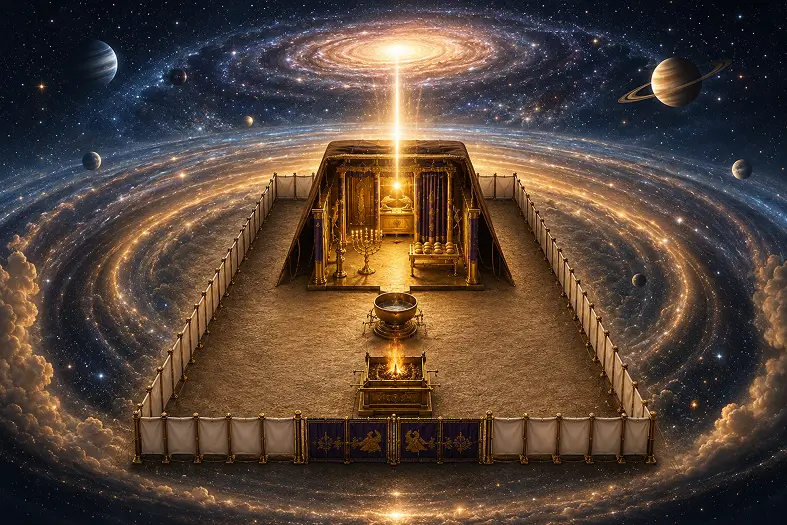
Ramban reveals the majesty of this structure. The Mishkan — Sanctuary stands at the center. The Levi’im surround the Mishkan. The tribes surround the Levi’im. The four camps face the four directions. The camp below reflects the order Above, mirroring the חיות — living creatures and the כסא הכבוד — Throne of Glory. The Mishkan becomes the meeting place between heaven and earth, where Divine order enters physical life and gives it sacred direction. Klal Yisrael is not merely organized for travel. It is arranged as a living reflection of Divine order.
Abarbanel gives this vision a human image. The Mishkan is the לב — heart, and the tribes are the איברים — limbs. A limb has its own function, but it only lives when connected to the heart. So too, every part of the camp has meaning because the Mishkan gives it life. When the center is holy, the whole body can become holy.
But the Mishkan is not only the heart of the nation. It is also a model of creation itself.
Bereishis begins with separation and order. Light is separated from darkness. Heaven from earth. Sea from dry land. Time itself is divided into days, seasons, and sacred rhythms. Creation becomes livable because everything receives גבול — boundary, place, and purpose.
The camp of Bamidbar mirrors this same pattern. The Mishkan stands at the center like the hidden source of life. Around it are circles of increasing distance: קדש הקדשים — the Holy of Holies, the קדש — Sanctuary, the Levi’im, and the tribes. Life and holiness flows outward through ordered layers, just as creation itself unfolds through structure, separation, and harmony.
That is why the Torah is so exact about directions, families, coverings, movement, and placement. Disorder is not only inefficient. It hides the unity of creation. The camp teaches that existence itself becomes meaningful when everything faces the proper center.
The Menorah — Candelabrum reflects light. The Aron — Ark reflects hidden wisdom. The שולחן — Table reflects blessing and sustenance. The Mizbeach — Altar reflects elevation and return. The Mishkan gathers the powers of creation into one place devoted entirely to Hashem.
Bamidbar therefore describes more than a traveling nation. It describes a miniature universe ordered around Divine Presence.
Ralbag explains why the Torah spends so much space on these details. אריכות והכפל — length and repetition are not filler. The Torah repeats and arranges because holiness becomes real through exactness. Gershon, Kehos, and Merari are first arranged by תולדותם — birth order. Later, Kehos comes first because of מעלתם — spiritual rank. Natural order matters. Spiritual rank matters. Every role has dignity when it stands in its proper place.
Rambam grounds this in ‘עֲבוֹדַת ה — service of Hashem. Holiness is not emotion alone. Torah gives kedushah — holiness form through places, times, leaders, roles, and mitzvos. A life without structure cannot carry holiness for long. Inspiration needs vessels.
Rav Kook teaches this as the movement from קדושת שעה — temporary holiness to קדושת עולם — enduring holiness. Har Sinai was a towering moment. But a moment, even the greatest moment, must become life. The Mishkan turns revelation into permanence. Awe becomes service. Fire becomes routine. The mountain becomes a dwelling place.
The Kedushas Levi adds that Torah and mitzvos are lights. The Mishkan draws those lights into a form the world can receive. Spiritual light cannot remain only above. It must enter vessels, speech, movement, service, and the daily patterns of Klal Yisrael.
The Sfas Emes brings this vision into the inner life of the Jew. The Mishkan is not only a structure in space. A person can also arrange his inner world around a sacred center. Thoughts, desires, speech, and actions become ordered when they circle around awareness of Hashem.
The external camp therefore becomes a model for the internal soul. Just as the Mishkan stood at the center of Klal Yisrael, a Jew must learn to build a spiritual center within himself that gives order to the rest of life.
Rashi’s phrase כאשר יחנו כן יסעו — “as they encamp, so shall they travel” completes the picture. Holy order is not only for stable moments. A Jew must carry his center through movement, pressure, change, and uncertainty.
Bamidbar is not only about where everyone stood in the wilderness. It is a vision of what happens when life is built around a true center. The Mishkan teaches that holiness enters the world through order, boundary, direction, and purpose. When everything turns toward Hashem, the scattered parts of life begin to form a living whole.
A person’s life slowly arranges itself around whatever stands at its center. Sometimes that center becomes success, comfort, approval, pressure, entertainment, or fear. Even without realizing it, the rest of life begins orbiting that point.
Bamidbar teaches that holiness begins by choosing a true center.
When the Mishkan stood in the middle of the camp, every tribe, path, and movement received direction from it. The same is true within a person. Thoughts become clearer when they move toward a purpose. Desires become healthier when they are ordered instead of scattered. Responsibilities become meaningful when they are connected to something larger than the self.
Modern life often feels fragmented because everything competes to become the center. Bamidbar answers with סדר — sacred order. Not every part of life is equally central. A Jew survives spiritually by learning what must stand in the middle.
The goal is alignment. When Hashem becomes the center, the scattered parts of life begin to form a world that reflects Hashem’s order, will, and Presence.
📖 Sources


6.1 — The Daily Mishkan & the Model of the Universe
Bamidbar can look like a parsha of details. Names, numbers, banners, families, Levi’im, coverings, carrying, guarding, and travel order fill the opening chapters. Yet these details are not scattered. Together they form one great picture: a world built around Hashem.
The Torah opens במדבר סיני באהל מועד — “in the wilderness of Sinai, in the Ohel Moed — Tent of Meeting.” Sinai was the place of revelation. The Ohel Moed is the place where that revelation continues. The fire of Har Sinai does not disappear. It becomes a center that travels with Klal Yisrael.
Ramban reveals the majesty of this structure. The Mishkan — Sanctuary stands at the center. The Levi’im surround the Mishkan. The tribes surround the Levi’im. The four camps face the four directions. The camp below reflects the order Above, mirroring the חיות — living creatures and the כסא הכבוד — Throne of Glory. The Mishkan becomes the meeting place between heaven and earth, where Divine order enters physical life and gives it sacred direction. Klal Yisrael is not merely organized for travel. It is arranged as a living reflection of Divine order.
Abarbanel gives this vision a human image. The Mishkan is the לב — heart, and the tribes are the איברים — limbs. A limb has its own function, but it only lives when connected to the heart. So too, every part of the camp has meaning because the Mishkan gives it life. When the center is holy, the whole body can become holy.
But the Mishkan is not only the heart of the nation. It is also a model of creation itself.
Bereishis begins with separation and order. Light is separated from darkness. Heaven from earth. Sea from dry land. Time itself is divided into days, seasons, and sacred rhythms. Creation becomes livable because everything receives גבול — boundary, place, and purpose.
The camp of Bamidbar mirrors this same pattern. The Mishkan stands at the center like the hidden source of life. Around it are circles of increasing distance: קדש הקדשים — the Holy of Holies, the קדש — Sanctuary, the Levi’im, and the tribes. Life and holiness flows outward through ordered layers, just as creation itself unfolds through structure, separation, and harmony.
That is why the Torah is so exact about directions, families, coverings, movement, and placement. Disorder is not only inefficient. It hides the unity of creation. The camp teaches that existence itself becomes meaningful when everything faces the proper center.
The Menorah — Candelabrum reflects light. The Aron — Ark reflects hidden wisdom. The שולחן — Table reflects blessing and sustenance. The Mizbeach — Altar reflects elevation and return. The Mishkan gathers the powers of creation into one place devoted entirely to Hashem.
Bamidbar therefore describes more than a traveling nation. It describes a miniature universe ordered around Divine Presence.
Ralbag explains why the Torah spends so much space on these details. אריכות והכפל — length and repetition are not filler. The Torah repeats and arranges because holiness becomes real through exactness. Gershon, Kehos, and Merari are first arranged by תולדותם — birth order. Later, Kehos comes first because of מעלתם — spiritual rank. Natural order matters. Spiritual rank matters. Every role has dignity when it stands in its proper place.
Rambam grounds this in ‘עֲבוֹדַת ה — service of Hashem. Holiness is not emotion alone. Torah gives kedushah — holiness form through places, times, leaders, roles, and mitzvos. A life without structure cannot carry holiness for long. Inspiration needs vessels.
Rav Kook teaches this as the movement from קדושת שעה — temporary holiness to קדושת עולם — enduring holiness. Har Sinai was a towering moment. But a moment, even the greatest moment, must become life. The Mishkan turns revelation into permanence. Awe becomes service. Fire becomes routine. The mountain becomes a dwelling place.
The Kedushas Levi adds that Torah and mitzvos are lights. The Mishkan draws those lights into a form the world can receive. Spiritual light cannot remain only above. It must enter vessels, speech, movement, service, and the daily patterns of Klal Yisrael.
The Sfas Emes brings this vision into the inner life of the Jew. The Mishkan is not only a structure in space. A person can also arrange his inner world around a sacred center. Thoughts, desires, speech, and actions become ordered when they circle around awareness of Hashem.
The external camp therefore becomes a model for the internal soul. Just as the Mishkan stood at the center of Klal Yisrael, a Jew must learn to build a spiritual center within himself that gives order to the rest of life.
Rashi’s phrase כאשר יחנו כן יסעו — “as they encamp, so shall they travel” completes the picture. Holy order is not only for stable moments. A Jew must carry his center through movement, pressure, change, and uncertainty.
Bamidbar is not only about where everyone stood in the wilderness. It is a vision of what happens when life is built around a true center. The Mishkan teaches that holiness enters the world through order, boundary, direction, and purpose. When everything turns toward Hashem, the scattered parts of life begin to form a living whole.
A person’s life slowly arranges itself around whatever stands at its center. Sometimes that center becomes success, comfort, approval, pressure, entertainment, or fear. Even without realizing it, the rest of life begins orbiting that point.
Bamidbar teaches that holiness begins by choosing a true center.
When the Mishkan stood in the middle of the camp, every tribe, path, and movement received direction from it. The same is true within a person. Thoughts become clearer when they move toward a purpose. Desires become healthier when they are ordered instead of scattered. Responsibilities become meaningful when they are connected to something larger than the self.
Modern life often feels fragmented because everything competes to become the center. Bamidbar answers with סדר — sacred order. Not every part of life is equally central. A Jew survives spiritually by learning what must stand in the middle.
The goal is alignment. When Hashem becomes the center, the scattered parts of life begin to form a world that reflects Hashem’s order, will, and Presence.
📖 Sources


“The Daily Mishkan & the Model of the Universe”
אָנֹכִי ה׳ אֱלֹקֶיךָ
The entire structure of Bamidbar begins with one center: awareness of Hashem. The Mishkan, the camp, the Levi’im, the vessels, and the travel order all teach that life becomes whole when everything faces Hashem. This mitzvah anchors the essay’s core claim: true סדר — sacred order begins when Hashem stands at the center of thought, space, purpose, and action.
וְעָשׂוּ לִי מִקְדָּשׁ
The Mishkan is the heart of Bamidbar’s universe. It gathers light, wisdom, blessing, elevation, and service into one center devoted entirely to Hashem. This mitzvah expresses the essay’s main image: holiness enters physical life through a built structure, where every part receives גבול — boundary, direction, and sacred purpose.
וּמִקְדָּשִׁי תִּירָאוּ
Reverence for the Mikdash teaches that the sacred center must shape how the whole camp behaves. The Mishkan is not merely located in the middle; it commands awe, distance, order, and alignment. This mitzvah supports the essay’s theme that holiness becomes real when life is arranged around Hashem with יראה — awe and disciplined awareness.
וְשָׁמְרוּ אֶת מִשְׁמֶרֶת אֹהֶל מוֹעֵד
Guarding the Mishkan shows that holiness must be actively protected. A sacred center cannot remain strong if it is treated casually. The Levi’im standing around the Mishkan reflect the ordered layers of the camp and creation itself: each boundary preserves the flow of kedushah — holiness from the center outward.
וְעָבַד הַלֵּוִי הוּא אֶת עֲבֹדַת אֹהֶל מוֹעֵד
The Levi’im give the Mishkan movement, rhythm, and service. Their avodah — sacred service turns holiness from a central idea into lived responsibility. This mitzvah aligns with the essay’s claim that inspiration needs vessels: roles, service, order, and repeated action that carry Hashem’s Presence through daily life.
וְשִׁנַּנְתָּם לְבָנֶיךָ
Torah gives the inner Mishkan its center. Just as the camp is arranged around the Mishkan, a Jew’s mind, speech, and daily choices are arranged through Torah learning. This mitzvah connects the cosmic order of Bamidbar to personal life: Hashem’s wisdom enters the world when Torah becomes the organizing force of the soul.


“The Daily Mishkan & the Model of the Universe”
Parshas Bamidbar opens במדבר סיני באהל מועד — “in the wilderness of Sinai, in the Ohel Moed,” joining revelation with enduring structure. The nation encamps סביב למשכן יחנו — “around the Mishkan,” with tribes, Levi’im, banners, guarding, carrying, and ordered movement. כאשר יחנו כן יסעו — “as they encamp, so shall they travel” teaches that kedushah — holiness must remain centered even through movement and change. Bamidbar becomes a living map of Divine order entering space, nation, service, and daily life.

Dive into mitzvos, tefillah, and Torah study—each section curated to help you learn, reflect, and live with intention. New insights are added regularly, creating an evolving space for spiritual growth.

Explore the 613 mitzvos and uncover the meaning behind each one. Discover practical ways to integrate them into your daily life with insights, sources, and guided reflection.

Learn the structure, depth, and spiritual intent behind Jewish prayer. Dive into morning blessings, Shema, Amidah, and more—with tools to enrich your daily connection.

Each week’s parsha offers timeless wisdom and modern relevance. Explore summaries, key themes, and mitzvah connections to deepen your understanding of the Torah cycle.