www.Mitzvah-Minute.com
"Ki Sisa — Part I — “זֶה יִתְּנוּ”: Building a Covenant Community"
1.4 — The Coin of Fire
“This They Shall Give”
The Torah introduces the half-shekel with unusual emphasis:
שמות ל:יג
“זֶה יִתְּנוּ כָּל־הָעֹבֵר עַל־הַפְּקֻדִים מַחֲצִית הַשֶּׁקֶל.”
[“This they shall give: everyone who passes among those counted shall give a half-shekel.”]
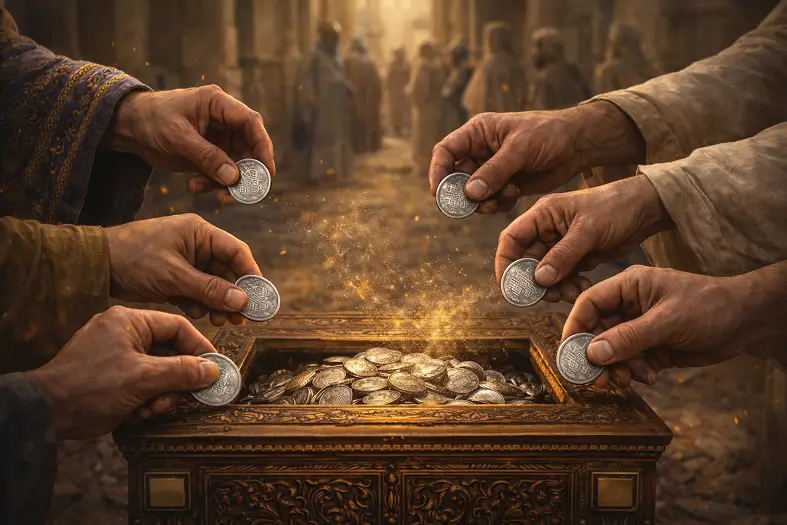
Chazal explain that Moshe had difficulty understanding the mitzvah until Hashem showed him a coin of fire and said, “זֶה יִתְּנוּ” — “This they shall give.”
The difficulty is striking. The mitzvah seems straightforward: a fixed amount of silver given equally by all. Yet Moshe required a visual demonstration. The Midrash’s answer reveals that the challenge was not technical but conceptual. The half-shekel was not only a structure for counting Israel. It was meant to express the inner life of the covenant.
The coin had to be made of fire.
The Baal Shem Tov: The Missing Flame
The Baal Shem Tov explains the image of the fiery coin through a mashal. A master craftsman once taught his apprentice every step of the trade, describing the tools and the procedures in perfect detail. But he omitted one instruction: lighting the coals. Without fire, the student could not complete the work.
The same is true of avodas Hashem. A person may learn the structure of mitzvos and the precision of halachah, yet something essential remains missing if the inner flame is absent.
The half-shekel represents participation in covenant life, but the coin of fire teaches that participation alone is not enough. A mitzvah can be performed outwardly while the heart remains distant. Structure without vitality produces a form of service that is technically correct but spiritually incomplete.
The Torah therefore emphasizes “זֶה יִתְּנוּ” — not merely the coin, but the coin of fire.
The covenant requires both obedience and inner awakening.
Fire as Inner Life
Fire has unique qualities that make it a powerful symbol of spiritual vitality. Fire rises upward, never content to remain where it began. Fire spreads warmth and illumination. Fire transforms whatever it touches.
The fiery coin therefore represents the inward dimension of mitzvah observance — the longing that lifts a person beyond habit and routine toward living connection with Hashem.
The half-shekel creates a structure for communal life:
- Every individual contributes.
- Every individual gives equally.
- Every individual stands within the covenant.
But the coin of fire teaches that structure alone cannot sustain the covenant. The Mishkan may stand, the korbanos may be offered, and the laws may be observed, yet without inner vitality the system becomes fragile.
The Torah requires not only coins of silver but coins of fire.
Rabbi Sacks: Institutions Need Spirit
Rabbi Jonathan Sacks emphasized that covenant societies depend on institutions: structures of law, obligation, and shared practice that preserve identity across generations. The Mishkan and its service represent such institutions, providing the framework that holds Klal Yisrael together.
Yet institutions alone cannot sustain a living people. Structures endure only when they are animated by commitment.
Ki Sisa itself demonstrates this danger. The people stood at Sinai and accepted the covenant, yet only weeks later they built the Golden Calf. Revelation and structure proved insufficient without inner understanding and loyalty.
The coin of fire expresses the missing element. Covenant life must be supported not only by institutions but by inward attachment. Without that attachment, the outer forms remain but their meaning fades.
The Torah therefore teaches that the half-shekel must be imagined as fire: a visible structure sustained by invisible devotion.
Fire Before Crisis
The coin of fire appears at the very opening of the parsha, before the story of the Golden Calf. The sequence is revealing.
First the Torah establishes the structure of covenant life through the half-shekel. Then it reveals the inner dimension through the image of fire. Only afterward does the narrative describe the catastrophe that followed when inward clarity failed.
The Golden Calf represents a form of religious energy without proper structure. The fiery coin represents the opposite danger: structure without inward life.
The covenant requires both.
The Mishkan stands only when disciplined service and living devotion join together.
The Hidden Flame in Every Soul
The image of the coin of fire also suggests something deeper. Fire cannot exist without fuel, yet once kindled it possesses a life of its own. The spark within the soul behaves in a similar way.
A Jew may pass through periods when avodas Hashem feels distant or routine. Yet beneath the surface, the flame remains alive. The covenant is sustained by the quiet persistence of that inner fire.
The half-shekel expresses belonging to Klal Yisrael. The coin of fire expresses the soul’s longing for Hashem.
Together they form a complete vision of covenant life: outward participation joined with inward vitality.
Application for Today — Bringing Fire into Structure
A Torah life is built from structure. Fixed times of tefillah, regular Torah learning, Shabbos observance, and the rhythms of mitzvos create the framework that holds a life steady. Without such structure, spiritual aspirations fade into inconsistency.
Yet structure alone cannot carry a person forward. A mitzvah performed only from habit may preserve continuity, but it does not always create closeness. Over time, even meaningful practices can begin to feel mechanical.
The coin of fire reminds us that the goal of mitzvos is not only continuity but connection. The outward act is meant to awaken inward life.
When a person pauses before a mitzvah with even a brief moment of awareness — recognizing that he stands before Hashem, that he participates in a covenant older than himself, and that his small act joins countless others across generations — the mitzvah begins to change character. What might have felt routine becomes alive again.
The Torah does not demand constant intensity. Fire does not always burn with the same brightness. But it must remain present.
The half-shekel teaches that a Jew belongs to the covenant. The coin of fire teaches that he belongs with his whole heart.
A covenant community stands securely when its institutions are steady and its inner flame is alive. And a Jew’s life becomes enduring when structure and fire grow together — mitzvos performed faithfully and a soul that continues to rise toward Hashem.
📖 Sources
- Full sources available on the Mitzvah Minute Parshas Ki Sisa page under insights and commentaries