Each Parsha page on Mitzvah Minute is designed as a guided, three-level journey through the weekly Torah reading—integrating the narrative, the mitzvos, and the classical commentaries into one unified experience.
Begin with the foundations of the Parsha:
This level gives you the storyline, the key mitzvos, and the essential connections between them.
A complete journey through the parsha—moving from clarity and depth to inner connection and real-world meaning, culminating in a way to live its ideas in everyday life.
These sections show how the Parsha speaks to the mind, the heart, and the real world — offering wisdom rooted in enduring Torah.
A complete, structured commentary on the parsha—presented pasuk by pasuk, with chapter and overall summaries for clarity and flow.
This level reveals the structural depth of the Parsha and the classical underpinnings of each theme.
Together, these layers create a complete Parsha journey —
narrative, mitzvah, and commentary — all flowing toward deeper understanding, spiritual insight, and meaningful growth.
Tap the Page Navigation tab on the right side of your screen anytime to access quick-links to the entire Parsha page.
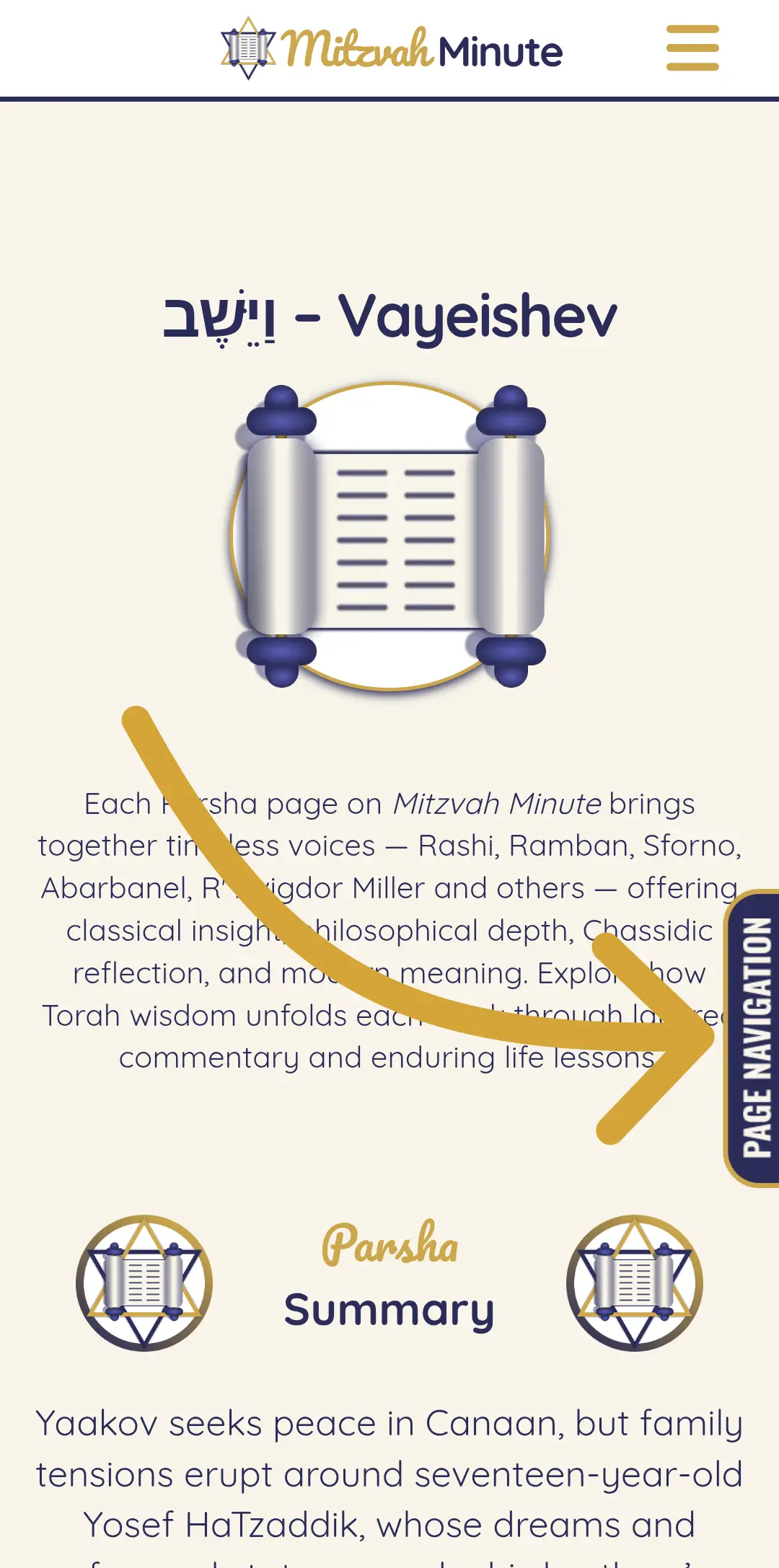
The quick-link panel gives instant access to every section — Parsha Summary, Mitzvos, Divrei Torah, Insights, and Commentaries.
“Every word of Torah and every mitzvah lifts us higher — may your learning bring you closer to Hashem.”

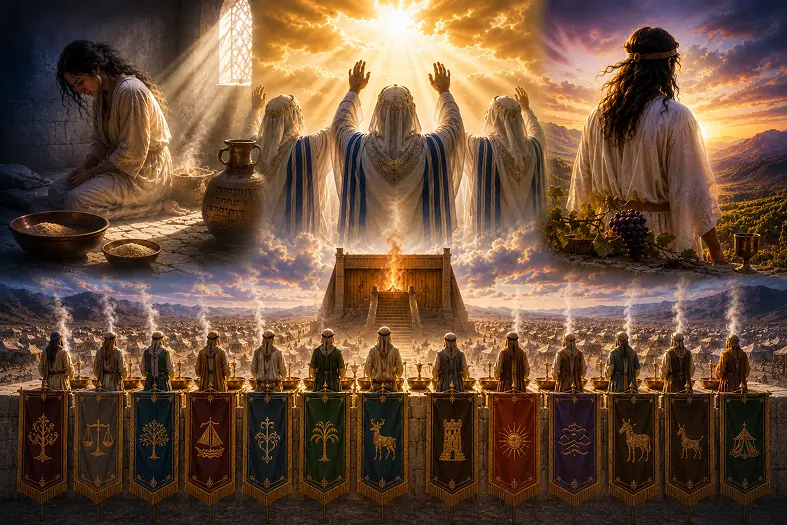
Parshas Nasso builds the spiritual structure of Klal Yisrael around the Mishkan — Sanctuary. The Levi’im — Levites receive their sacred responsibilities for carrying and guarding the Mishkan, the camps are purified through the removal of ritual impurity, and the Torah establishes laws of confession, restitution, the סוטה — suspected wife, and the נזיר — Nazirite. At the center of the parsha stands ברכת כהנים — the Priestly Blessing, where the Kohanim bless the nation with protection, light, and peace. The parsha concludes with the נשיאים — tribal leaders dedicating the מזבח — altar through twelve days of offerings, ending with Moshe hearing the voice of Hashem from between the כרובים — cherubim above the Aron — Ark. Nasso reveals a nation learning how to build holiness not only through worship, but through order, purity, responsibility, blessing, and devotion.

וְהָלַכְתָּ בִּדְרָכָיו
Parshas Nasso repeatedly portrays holiness not as withdrawal from life, but as living in a way that reflects Hashem’s order, justice, compassion, and peace. The Kohanim bless with kindness, the camp is structured with care, wrongs are repaired through confession and restitution, and leaders dedicate themselves without rivalry. Nasso teaches that walking in Hashem’s ways means shaping ordinary human behavior around holiness, dignity, and responsibility.
וְאָהַבְתָּ לְרֵעֲךָ כָּמוֹךָ
Birkas Kohanim — the Priestly Blessing reveals that blessing flows through love, concern, and peace among the people. Rabbi Jonathan Sacks describes Nasso as a parsha that restores dignity to every individual within Klal Yisrael — the Jewish people. The repeated offerings of the נשיאים — tribal leaders further show that no shevet — tribe is ignored or treated as less significant. Love of fellow Jews becomes visible through honor, inclusion, and concern for another person’s well-being.
וַאֲהַבְתֶּם אֶת־הַגֵּר
The Torah’s discussion of הגר גזל — theft from a convert who dies without heirs reveals the Torah’s special protection for vulnerable people. Ramban and Ralbag both emphasize that justice does not disappear simply because a person lacks defenders or family support. Nasso teaches that holiness is measured not only through ritual devotion, but through the way society protects the dignity of those who could easily be overlooked.
לֹא־תִשְׂנָא אֶת־אָחִיךָ בִּלְבָבֶךָ
The laws of Sotah — the suspected adulteress confront suspicion, jealousy, and hidden fracture within relationships. Yet the Torah channels these painful emotions into halachic process rather than personal vengeance. Nasso teaches that unchecked resentment destroys peace, trust, and holiness. A holy nation cannot be sustained when hatred is allowed to grow silently within the heart.
וְלֹא־תִשָּׂא עָלָיו חֵטְא
Even within the difficult process of the Sotah, the Torah preserves restraint and dignity. Rashi explains that the woman is first pressured toward confession before the המיוחד שם — Divine Name must be erased. The goal is not humiliation or spectacle, but truth and restoration where possible. Nasso teaches that even when confronting wrongdoing, Torah demands sensitivity toward human dignity.
כָּל־אַלְמָנָה וְיָתוֹם לֹא תְעַנּוּן
Ralbag explains that the Torah highlights theft from the convert in order to distance robbery, conflict, and exploitation from Yisrael. Nasso repeatedly protects the vulnerable: the convert without heirs, the injured marriage, and the person struggling with failure or impurity. A society becomes holy when strength is used to protect rather than exploit.
וְשִׁנַּנְתָּם לְבָנֶיךָ
Parshas Nasso ends with Moshe hearing the קול — Divine voice from between the כרובים — Keruvim above the כפורת — Ark-cover. The entire structure of the camp, the Mishkan — Sanctuary, purity laws, and offerings all move toward one center: Divine communication entering the life of Yisrael. Torah learning is not separate from holiness. It is the voice around which the nation is ordered.
וְהִתְוַדּוּ אֶת־חַטָּאתָם אֲשֶׁר עָשׂוּ
Confession stands at the center of Nasso’s vision of repair. The Baal Shem Tov explains that every עבירה — sin contains an element of גזל — theft from Hashem’s world, and teshuvah — repentance begins by returning life to its true purpose. Nasso teaches that holiness does not mean never failing. It means refusing to remain trapped inside failure. Through confession, restitution, and return, the person rebuilds his relationship with Hashem.
כֹּה תְבָרְכוּ אֶת־בְּנֵי יִשְׂרָאֵל
Birkas Kohanim — the Priestly Blessing stands at the emotional center of Parshas Nasso. Ramban explains that blessing now flows outward from the Mishkan — Sanctuary into the life of the nation. The Kohanim become channels of protection, grace, Divine closeness, and peace. Nasso teaches that the highest spiritual greatness is not domination or separation, but becoming a vessel through which blessing reaches others.
וְעָשָׂה לָהּ הַכֹּהֵן אֵת כָּל־הַתּוֹרָה הַזֹּאת
The laws of Sotah reveal how seriously the Torah guards קדושת המשפחה — holiness of the family. Ramban describes the Sotah waters as a פלא ונס קבוע — a fixed wonder and miracle that protected the purity of Yisrael while the nation lived faithfully before Hashem. Nasso teaches that marriage is not merely a private arrangement. Trust, loyalty, and moral restraint are foundations upon which the שכינה — Divine Presence rests.
לֹא־יִצֹק עָלָיו שֶׁמֶן
Rashi explains that the Sotah offering lacks שמן — oil because oil symbolizes beauty, elevation, and radiance. The absence of oil reflects the spiritual damage caused by betrayal and hidden corruption. Nasso teaches that sin darkens what was meant to shine with holiness and trust.
וְלֹא־יִתֵּן עָלָיו לְבֹנָה
The Sotah offering also lacks לבונה — frankincense, which normally symbolizes pleasantness and purity. Rashi connects this absence to separation from the path of the אימהות — Matriarchs. Nasso teaches that holiness is not merely technical obedience. It is faithfulness to the spiritual beauty and moral refinement upon which Jewish family life is built.
גַּדֵּל פֶּרַע שְׂעַר רֹאשׁוֹ
Ramban views the Nazir — Nazirite as entering a state of elevated קדושה — holiness resembling priestly sanctity. The Nazir’s growing hair becomes an outward sign that the person has separated himself toward a higher level of spiritual focus. Nasso teaches that holiness sometimes requires visible commitment and disciplined restraint.
מִיַּיִן וְשֵׁכָר יַזִּיר
The Nazir separates from wine after the Torah discusses the Sotah because, as Rashi explains, one who witnesses moral collapse should strengthen his own boundaries. Wine itself is not evil, but Nasso recognizes how desire can cloud דעת — inner awareness and judgment. Holiness requires the wisdom to know when distance creates clarity.
וְגִלַּח הַנָּזִיר פֶּתַח אֹהֶל מוֹעֵד
The completion of נזירות — Nazirite separation teaches that even elevated holiness must eventually return to ordinary life. Rambam emphasizes that the goal is not permanent withdrawal from the world, but disciplined balance. The Nazir concludes his vow, brings korbanos — offerings, and re-enters society with renewed clarity. Nasso teaches that temporary separation should ultimately strengthen a person’s ability to live holiness within everyday life.

Rashi reads Parshas Nasso as a parsha of ordered קדושה — holiness. The Mishkan — Sanctuary is not carried, guarded, or approached casually. The Levi’im — Levites are counted by age, family, task, and משא — burden. גרשון בני — the sons of Gershon carry the curtains and coverings, while מררי בני — the sons of Merari carry the boards, pillars, sockets, pegs, and cords. Even שיר — song is called עבודה — service, because the Levi’im’s music serves the korbanos — offerings and completes the avodah — sacred service.
This gives the parsha its first major lesson. Holiness does not become smaller when it is organized. It becomes stronger. Each Levi is assigned his place, his age range, his burden, and his work על פי ה׳ — by the command of Hashem. Rashi shows that the Mishkan is not only a holy building. It is a world of exact responsibility, where every person serves Hashem through the role given to him.
When the Torah commands that טמאים — ritually impure people be sent out from the camp, Rashi explains that there were three מחנות — camps: מחנה שכינה — the Camp of the Shechinah, מחנה לויה — the Camp of Levi, and מחנה ישראל — the Camp of Israel. Each form of טומאה — ritual impurity creates a different level of separation. A צרוע — one with tzaraas is sent outside all three camps. A זב — one with a bodily discharge is sent from the two inner camps. A טמא לנפש — one impure through contact with the dead is sent only from מחנה שכינה — the Camp of the Shechinah.
Rashi’s pshat gives the reader a clear picture of קדושה — holiness as graduated nearness to Hashem. The Torah does not treat all impurity the same way, because not every halachic state creates the same distance. Nasso therefore teaches that closeness to Hashem requires definition. The closer one comes to the Mishkan, the more careful the boundaries become.
Rashi explains that the parsha of theft and false oaths is repeated here to teach confession, the חומש — added fifth, the אשם — guilt-offering, and the special case of גזל הגר — robbery from a convert who dies without heirs. A person who steals from another and swears falsely has not only damaged a human relationship. He has committed מעל בה׳ — treachery against Hashem.
This is one of Rashi’s sharpest themes in the parsha. Torah law does not divide “religious” sins from “ordinary” financial sins. Money, speech, trust, and restitution all stand before Hashem. When the victim has no heir, the payment becomes לה׳ לכהן — to Hashem, to the Kohen. Even lost human claims are not lost before Heaven.
Rashi’s treatment of the סוטה — suspected adulteress is exact and deeply moral. The process begins only after קינוי — warning and סתירה — seclusion. The Torah is not punishing rumor. It responds to a halachic situation: warning was given, seclusion occurred, and טומאה — defilement remains unknown.
Every detail of the procedure exposes the inner shape of the suspected sin. The barley offering reflects animal-like behavior. The absence of שמן — oil removes beauty and light from the korban — offering. The absence of לבונה — frankincense reflects separation from the ways of the אימהות — Matriarchs. The water comes from the כיור — laver, made from the mirrors of women who cherished their husbands in Mitzrayim, while this woman is suspected of turning away from her husband.
Yet Rashi also shows the Torah’s restraint. The woman is moved and burdened in the hope that she will confess before the שם המיוחד — special Divine Name must be erased. The goal is not spectacle. It is truth, repair where possible, and the protection of קדושת המשפחה — family holiness.
Rashi explains that the parsha of נזיר — nazirite follows the parsha of סוטה — suspected adulteress because one who sees her downfall should separate from wine. נזירות — nazirite status is not ordinary self-denial. It is a protective response to the power of desire. The נזיר — nazirite separates from wine, avoids טומאת מת — corpse impurity, and lets his hair grow in קדושה — holiness.
Rashi’s insight is practical and exact. When a person sees where loosened boundaries can lead, he should not simply feel disgust or judgment. He should strengthen his own guardrails. The נזיר — nazirite teaches that holiness sometimes requires distance from things that are permitted, when those things can become a path toward failure.
Rashi explains Birkas Kohanim — the Priestly Blessing as a blessing of abundance, protection, favor, mercy, and peace. The Kohanim speak, but Hashem gives the blessing its power. On ואני אברכם — “and I will bless them,” Rashi gives two explanations: Hashem confirms the blessing given to Bnei Yisrael, or Hashem blesses the Kohanim who bless His people.
This turns the Kohanim into channels, not independent sources. Their hands are raised, their words are spoken, and Hashem’s Name is placed upon Klal Yisrael. The blessing is therefore both human and Divine: human beings serve as faithful vessels, while Hashem Himself gives the brachah — blessing.
Rashi’s reading of the נשיאים — tribal leaders shows that their repeated korbanos — offerings are not empty repetition. Even though each nasi — tribal leader brought the same korban — offering, the Torah repeats every detail again and again to honor each one equally. No tribe is shortened, absorbed into another, or treated as less important. Every vessel, weight, animal, and number carries symbolic meaning, alluding to Adam, Noach, the Avos, Yosef, Moshe and Aharon, the Torah, the Aseres HaDibros — Ten Commandments, and the unity of Klal Yisrael.
Rashi shows that the repetition itself is part of the message. Hashem wanted each nasi — tribal leader to receive his own full section, with his offering recorded independently before the Torah. Unity in Torah does not erase individuality. The same korban — offering can express shared national dedication while still honoring the distinct dignity, mission, and identity of each shevet — tribe.
The parsha closes with Moshe entering the Ohel Moed — Tent of Meeting and hearing the קול — voice from above the כפורת — ark-cover, between the כרובים — keruvim. Rashi explains that this resolves the pesukim: the voice came from above the כפורת — ark-cover and then went out into the Ohel Moed, where Moshe heard it.
This ending reveals the purpose of everything before it. The counting, guarding, purity laws, restitution, סוטה — suspected adulteress, נזיר — nazirite, Birkas Kohanim — Priestly Blessing, and offerings of the נשיאים — leaders all build toward one center: a people ordered around the word of Hashem. Nasso is not a collection of separate laws. According to Rashi, it becomes a map of how Divine holiness enters the camp, the home, the body, the wallet, the vow, the blessing, and the national heart.
📖 Source
Ramban sees the opening of Parshas Nasso as a vision of sacred order. The Levi’im — Levites are not general workers around the Mishkan — Sanctuary. Each family receives its own משא — burden and עבודה — service. Each כלי — vessel, board, curtain, cord, and pillar is placed under clear command, with Aharon, his sons, Moshe, Elazar, and Isamar all part of the structure of פקידה — appointed responsibility.
This gives the Mishkan’s service a strong halachic message. קדושה — holiness is not built through enthusiasm alone. It requires boundaries, assignment, and accountability. A Levi may not decide for himself which task to perform, and he may not exchange roles with another Levi. Ramban’s reading shows that serving Hashem properly means serving from the place Hashem gave him.
When the Mishkan is erected, Ramban explains that the entire camp must now become fit for the שכינה — Divine Presence. The command to send out טמאים — ritually impure people is not only about the Mishkan building itself. The holiness of the Mishkan spreads into the structure of the nation around it. The camp of Yisrael becomes a holy dwelling place, and that requires protection from טומאה — ritual impurity.
Ramban’s insight is that national holiness has a physical form. The way the camp is arranged, guarded, purified, and governed reflects the fact that Hashem rests among Yisrael. Once the שכינה — Divine Presence is present, the entire society must live with a higher standard.
Ramban explains the law of אשם גזלות — guilt-offering for thefts as a sin between people that becomes a betrayal against Hashem when a person swears falsely in His Name. The thief damages another person, but he also turns Divine speech into a tool for falsehood. This is why the Torah calls it למעל מעל בה׳ — committing treachery against Hashem.
The special case of גזל הגר — theft from a convert who dies without heirs deepens this point. Even when there is no human relative left to receive the money, justice does not disappear. The payment becomes לה׳ לכהן — to Hashem, to the Kohen. Ramban shows that Torah justice protects even the person with no family structure to defend him.
Ramban gives careful attention to תרומה — heave-offering, ביכורים — first fruits, קדשים — holy gifts, and the owner’s right of טובת הנאה — benefit of choosing the recipient. Even when something is holy, its halachic ownership must be defined. Some holy items remain with the owner to be eaten according to their laws, while other gifts must be given to the Kohen. Yet the Kohen may not seize them by force. The owner gives them to the proper recipient.
This continues Ramban’s larger theme. קדושה — holiness does not erase law. It becomes real through law. The Torah defines who owns, who gives, who receives, and how holiness moves from the field, the home, and the person into the service of Hashem.
Ramban presents the סוטה — suspected adulteress as one of the most unusual laws in the Torah. He states that among the משפטי התורה — ordinances of the Torah, no other law depends on a miracle in this way. The waters are a פלא ונס קבוע — a wonder and fixed miracle, active when most of Yisrael is doing the רצון המקום — Will of Hashem.
This miracle exists because Hashem wants to guard the purity of Jewish family life and remove ממזרות — forbidden offspring from the nation. The process is not simply punishment. It protects the ability of the שכינה — Divine Presence to rest among Yisrael. When the people became corrupted and no longer desired this holiness, the miracle stopped. Ramban’s reading makes the sotah law a measure of the nation’s spiritual health.
For Ramban, the נזיר — Nazir is not merely someone who avoids wine. He enters a state of elevated קדושה — holiness. His abstention, his growing hair, and his avoidance of טומאת מת — corpse impurity raise him toward a level resembling priestly or prophetic sanctity. This is why Ramban sees the end of נזירות — Nazirite separation as a kind of descent that requires כפרה — atonement.
The Nazir also teaches the power of voluntary holiness. If he expands his vow and accepts additional korbanos — offerings, he becomes bound by what he accepted. A person may rise beyond the minimum, but once he does, his words create real obligation before Hashem.
Ramban explains that ברכת כהנים — priestly blessing is placed here because the Mishkan — Sanctuary has now become the center from which blessing flows outward to Yisrael. Aharon blessed the people during the inauguration of the Mishkan, but here the Torah establishes this blessing לדורות — for all generations. The blessing emerges from the place where the שכינה — Divine Presence rests among the nation.
The Kohanim speak the words, but the blessing itself comes from Hashem. Ramban reads the blessing as both revealed and hidden Divine favor. יברכך — “may He bless you” refers to protection and increase. יאר ה׳ פניו אליך — “may Hashem illuminate His countenance toward you” refers to the light of the שכינה — Divine Presence shining upon Yisrael with favor, wisdom, and closeness. ישא ה׳ פניו אליך — “may Hashem lift His countenance toward you” expresses רצון — Divine favor and loving attention directed toward His people.
The blessing reaches its completion with שלום — peace. For Ramban, peace is not merely the absence of conflict. It is wholeness and harmony, the condition in which blessing can endure. Wealth without peace cannot remain secure, wisdom without peace becomes fractured, and Divine favor without peace cannot fully settle upon the nation. The Kohanim therefore place Hashem’s Name upon Yisrael so that the light of the שכינה — Divine Presence, Divine favor, and lasting peace may rest together upon the people.
Ramban presents the offerings of the נשיאים — princes as one of the Torah’s great examples of קדושה — holiness rising upward through human initiative and then being accepted by Hashem. The princes were not responding to an explicit command when they first brought the wagons and oxen for the Mishkan — Sanctuary. They saw what was needed, desired to strengthen the avodah — sacred service, and offered their gifts willingly. Hashem then ratified their initiative and transformed it into part of the Divine order itself. Ramban compares this to other moments in Torah where sincere human action helped reveal what Hashem desired for future generations.
This theme runs throughout Nasso. The Nazir — Nazirite voluntarily rises toward greater holiness. The princes voluntarily dedicate the מזבח — altar. Human beings awaken from below through desire for קדושה — holiness, and Hashem responds from above by accepting and sanctifying that effort. In Ramban’s reading, holiness is not only imposed from Heaven downward. It can also begin through the willing heart of Yisrael rising upward toward Hashem.
Their repeated offerings also reveal a deep balance. Every nasi — prince brings the same korban — offering, showing shared unity before Hashem. Yet each offering carries its own meaning for that shevet — tribe. Ramban’s Nasso ends with a powerful picture of Klal Yisrael: one nation, one Mishkan, one Divine Presence, and many distinct paths through which Yisrael rises upward in sacred service before Hashem..
📖 Source
For Rambam, עבודת ה׳ — service of Hashem is never built on vague feeling alone. It must take shape through defined action, clear responsibility, and disciplined order. Parshas Nasso opens with the counting and assignment of the Levi’im, each family receiving its own role in carrying the Mishkan. This reflects a central Rambam idea: קדושה — holiness becomes real when it is organized through mitzvah, structure, and duty.
The Levi does not choose his task based on emotion or personal preference. He serves where Torah places him. This is not a lowering of individuality. It is the refinement of individuality. Each person becomes elevated when his strengths are placed inside avodas Hashem — Divine service. Rambam’s world is one where human greatness comes through disciplined purpose, not self-expression without limits.
The parsha’s section of סוטה — the suspected adulteress shows how deeply Torah protects the structure of marriage, trust, and communal purity. Rambam treats marriage as a binding halachic reality, not only an emotional relationship. Suspicion, jealousy, betrayal, and repair must therefore be handled through law, not impulse.
This is very Rambam-like. Strong emotion is real, but it cannot rule. קנאה — jealousy, fear, shame, and accusation must be brought under Torah process. The Sotah procedure does not allow private rage to become justice. It brings the matter before the Kohen, into the Mishkan, and under the authority of Hashem’s Name. Moral life needs truth, but truth must be pursued through commanded order.
The Nazir represents a person who senses that ordinary desire has become spiritually dangerous. Wine, appearance, and contact with death are not evil in themselves. Yet the Nazir separates because he recognizes that his inner balance needs correction.
This fits Rambam’s teaching in Hilchos De’os that a person must train his middos — character traits toward the דרך האמצעית — the balanced middle path. When a person has leaned too far toward indulgence, he may need temporary separation to restore balance. The Nazir’s קדושה — holiness is therefore not an escape from normal life. It is a corrective path back toward moral health.
At the same time, the Nazir later brings a קרבן — offering. This reminds the reader that extreme separation is not the final ideal. Rambam’s framework values disciplined moderation. A person should not worship desire, but he should also not imagine that holiness means rejecting the world Hashem created. The goal is a governed life, not a broken one.
ברכת כהנים — the priestly blessing moves from protection, to Divine light, to חן — grace, and finally to שלום — peace. In Rambam’s thought, peace is not merely quiet or comfort. Peace is the condition in which people, families, and nations can pursue knowledge of Hashem and moral perfection.
The Kohanim bless Yisrael, but the blessing comes from Hashem. This preserves a key Rambam principle: no human being is an independent spiritual power. The Kohen is a servant and channel, not a source. His role is dignified because he submits himself to the words Hashem commanded.
The offerings of the נשיאים — tribal leaders repeat with striking equality. Each nasi brings the same korbanos — offerings, and the Torah records every one in full. Rambam would see here a disciplined model of leadership. Honor is not found in outshining another person. It is found in fulfilling one’s role before Hashem with complete intention.
The repetition teaches that equal acts can carry individual dignity. In Torah leadership, greatness does not require novelty, display, or competition. Each nasi stands as the head of his shevet — tribe, yet each submits to the same Mishkan-centered service. Public leadership becomes holy when it strengthens the shared order of Klal Yisrael — the Jewish people.
Through Rambam’s lens, Nasso teaches that holiness is not chaos, emotion, or spiritual drama. It is the elevation of life through Torah structure. The Levi serves through assigned responsibility. The Sotah process protects trust through law. The Nazir disciplines desire through temporary restraint. The Kohanim bless through commanded speech. The Nesi’im lead through equal devotion.
Nasso therefore presents a full philosophy of human perfection. The person becomes holy when body, emotion, speech, family, leadership, and service are all brought under the wisdom of Torah.
📖 Sources
Ralbag opens his תועלות — lessons from Parshas Nasso with the mitzvah to send those who are טמאים — ritually impure out from the Mikdash according to their levels of טומאה — ritual impurity. This teaches that קדושה — holiness is not only an inner feeling. It must be protected through boundaries, order, and proper distance.
The Mikdash is the center of national avodah — Divine service, and not every person may enter every space in every state. Ralbag reads this as a mitzvah with clear practical and educational purpose. The nation learns that closeness to holiness demands preparation. Reverence is built when access is guided by law.
Ralbag’s second lesson is from גזל הגר — theft from a convert who dies without heirs. He explains that the Torah emphasizes this case to distance robbery, violence, dispute, and quarrel from Yisrael. A person might treat the convert’s money lightly, thinking that if the convert dies without heirs, no family member will claim it. That attitude could create great corruption and conflict.
This is a deeply moral reading. Ralbag sees the Torah guarding the weak point in society. The test of justice is not only how people treat those with power, family, and defenders. It is how they treat the person who seems easiest to exploit. By addressing גזל הגר — theft from a convert, the Torah closes the door to hidden theft before it becomes public strife.
Ralbag then points to the laws of סוטה — the suspected adulteress and נזיר — the Nazirite. He notes that he has already explained their benefit and the benefit of all the warnings connected to them in his commentary on those sections. Even in this short summary, the philosophical pattern is clear: Torah law deals directly with the forces that can disturb family, desire, and moral stability.
סוטה — the suspected adulteress addresses suspicion, jealousy, marital trust, and the danger of hidden betrayal. נזיר — the Nazirite addresses desire, restraint, and the need for a person to separate when ordinary pleasures become spiritually dangerous. For Ralbag, these are not isolated rituals. They are mitzvos that train human life. Torah does not ignore emotion and desire. It gives them legal form, moral direction, and protective limits.
Ralbag’s fifth lesson is the mitzvah for the Kohanim to bless Yisrael with this wondrous berachah — blessing. He writes that he already explained the benefit that comes from it earlier. In the flow of Parshas Nasso, ברכת כהנים — the priestly blessing stands after laws of purity, restitution, Sotah, and Nazir. The nation is being shaped into a vessel that can receive Divine blessing.
The Kohanim do not bless as private spiritual figures. They bless as servants of Hashem within the ordered life of the Mishkan. Ralbag’s focus on תועלת — practical benefit helps frame the blessing as part of the Torah’s national structure. Blessing rests where holiness, justice, family integrity, and disciplined desire are guarded.
Ralbag gives special attention to the נשיאים — tribal leaders and their offerings. His sixth lesson is ethical: a person should not change from the custom of his friends when they have agreed to perform a well-known good action. If he changes in order to glorify himself or shame others, people may say, “This one did such-and-such, and this one did only such-and-such.”
That is why the Torah records that the donations of the נשיאים — tribal leaders were equal. No nasi — tribal leader changed from the practice of his fellow. Ralbag adds that for this reason, their view agreed with the will of Hashem. Public service must not become a stage for self-display. Even a good deed can become morally damaged if it is used to compete, embarrass, or elevate oneself over others.
Ralbag’s seventh lesson is the mitzvah that the בני קהת — sons of Kehas must carry the ארון — Ark on the shoulder, not on wagons. This was because of the honor and קדושה — holiness of the ארון — Ark.
Here Ralbag shows that not all sacred objects are treated the same. The wagons were proper for other parts of the Mishkan, but not for the ארון — Ark. Its holiness required direct human carrying. The body itself becomes part of the act of honor. The Torah teaches that true reverence is seen in the way a mitzvah is performed, not only in the fact that it is performed.
Ralbag’s eighth lesson returns to the order of the נשיאים — tribal leaders. In matters where honor is given to the one who comes first, the Torah is careful only that the first should be the most honored. After that, the order does not follow rank, but practical arrangement. Therefore Nachshon ben Aminadav, nasi — leader of Yehudah, offered first, because Yehudah was the most honored shevet — tribe. After that, the order continued according to arrangement, so jealousy would not fall among them.
Ralbag explains that if the Torah had ranked each tribe by honor, Reuven might have had to come after Yehudah because he was the bechor — firstborn. This could have led to argument over which tribe was greater. By arranging the order according to position rather than rank, the Torah removed jealousy and dispute. The earlier place did not prove higher greatness. It reflected structure, not superiority.
Ralbag’s ninth lesson is to publicize the miracle of nevuah — prophecy. It was perceptible to Yisrael that כבוד ה׳ — the glory of Hashem rested upon the כפורת — Ark-cover, and from there nevuah — prophecy came to Moshe from between the two כרובים — Keruvim. This showed the nation that Moshe’s prophecy was not private imagination or hidden claim. It was connected to the revealed holiness of the Mishkan.
This final point completes Ralbag’s philosophical reading of Nasso. The parsha is not only about laws and offerings. It teaches how a nation becomes ordered around holiness, justice, restraint, blessing, humility, reverence, peace among leaders, and public awareness of Divine communication.
Through Ralbag’s lens, Nasso is a parsha of disciplined national formation. Every law has תועלת — purposeful benefit. Every structure protects the people from disorder. Every sacred act trains Yisrael to become a society where holiness is visible, justice is guarded, leadership is humble, and the presence of Hashem is recognized at the center.
📖 Source
(Baal Shem Tov · Kedushas Levi · Sfas Emes)
Parshas Nasso reveals a deep Chassidic truth: the most physical parts of life can become vessels for the highest closeness to Hashem. The Nazir says איש כי יפליא — a person who does something wondrous. His wonder is not escape from the world alone. It is the ability to stand inside עולם הזה — the physical world and still reach the פלא — hidden wonder within it. Hashem performs מפליא לעשות — wondrously joining the נשמה — soul to the גוף — body. The Nazir uncovers that same mystery in avodah: the body can live in this world while the heart reaches above it.
The Sfas Emes explains that this is the longing of creation itself. The Midrash says שוקיו עמודי שש — “His legs are pillars of marble,” referring to the six days of creation. The world stands on תשוקה — longing. Hashem desired a world where distance itself would awaken desire. The lower world is not a mistake. It is the place where a Jew can feel far and still yearn upward. That yearning brings the world to its purpose.
Shabbos reveals this secret openly. During the week, Hashem’s רצון — will is clothed inside action. On Shabbos, action stops, and the רצון — will itself shines. The six weekdays are the pillars that connect Divine will to human deeds. Shabbos renews that will, and from Shabbos a person receives fresh strength to bring holiness back into the coming week.
The Baal Shem Tov reads the confession of theft as the root of all תשובה — repentance. Every עבירה — sin contains a form of גזל — theft, because the person has taken Hashem’s world, Hashem’s energy, and Hashem’s gifts, and used them against their true purpose. If a person truly knows that Hashem is מחיה הכל — the One who gives life to everything, he cannot sin with that thing.
Yet the path back begins with mercy. The Arizal teaches that before תשובה — repentance, even a person’s good deeds can be drawn into the wrong side, because his inner direction is still damaged. But the first repair is simple and powerful: עזיבת החטא — leaving the sin. Once he stops, the flow stops feeding the wrong place. After that, when he can, he adds וידוי — confession, חרטה — regret, and deeper תיקון — repair.
The Baal Shem Tov adds that ומודה ועוזב ירוחם — “one who confesses and leaves will be shown mercy” means more than pardon. ירוחם — mercy is related to love. When a person admits the truth and leaves the sin, his avodah becomes accepted again, and he can come to אהבת Hashem — love of Hashem. Teshuvah is not only cleaning the past. It restores the relationship.
Even the fallen spark inside sin can become the force that brings a person home. The pleasure of sin comes from ניצוצות — sparks that fell into קליפת נוגה — the mixed shell. When a person regrets the sin, that very spark rises back to its source. The fall itself becomes material for return.
The Baal Shem Tov reads אחרי שובי נחמתי — “after I returned, I was comforted” as the soul’s relief after תשובה — repentance. Hashem certainly accepts those who return. His right hand is open to receive them. Yet the pasuk continues with a trembling doubt: אחרי הודעי ספקתי — after I knew this, I still questioned myself. A person may know that Hashem accepts תשובה — repentance, but when he sees impurity still clinging to him, he worries whether his return has fully entered his life.
This doubt is not despair. It is the pain of someone who wants truth. It pushes the person to continue refining himself. The Baal Shem Tov also teaches this through honor. When people honor a person, Heaven examines whether he deserves that honor. At first, honor looks dangerous. But if he is wise, honor becomes a gift, because it makes him search his deeds and return to Hashem. The praise of others becomes a mirror for private teshuvah.
The Baal Shem Tov reads the Sotah passage as a map of inner healing. The “wife” who strays represents the חומר — physical body, which can pull a person away from the straight path. When a person no longer knows how to choose correctly, he must go to תלמידי חכמים — Torah scholars, whom Rambam calls רופאי הנפשות — doctors of the soul.
The כהן — priest takes מים קדושים — holy water, meaning Torah, and places it in a כלי חרס — earthen vessel. Torah must be given in language the person can receive: משל — analogy, מליצה — gentle expression, and תוכחת מוסר — moral correction shaped to heal. But there is one condition. If the teacher becomes proud, his words will not enter. Therefore the כהן — priest adds עפר — dust from the Mishkan floor. The healer must mix Torah with שפלות — humility. Only then can the words become medicine.
The Sfas Emes deepens this through the עפר סוטה — dust of the Sotah. Dust is the root of growth. Avraham said ואנכי עפר ואפר — “I am dust and ashes,” and through that ביטול — self-nullification, he became the foundation of the world. A seed grows only when it breaks down into the earth. So too, a person becomes renewed when ego softens into humility.
The command to send the impure outside the camp becomes, in the Sfas Emes, a picture of inner purification. The Midrash compares it to removing סיגים — dross from silver. As long as waste is mixed into the silver, the vessel cannot show its beauty. At Har Sinai, Bnei Yisrael were healed and became true כלים — vessels for Hashem’s service. After the חטא העגל — sin of the Golden Calf, the waste returned. The Mishkan now teaches how to remove it again.
This happens through Torah. תורה תמימה — the perfect Torah is משיבת נפש — it restores the soul. The Torah can descend into the lowest places and still remain whole. That is why it is יקרה מפנינים — more precious than pearls, and even more precious than the כהן גדול — Kohen Gadol entering לפני ולפנים — the innermost chamber. The holy inner chamber is exalted, but Torah has an even greater wonder: it can enter the outside, the street, the low place, the broken place, and bring it back to the root.
This is why Torah is called ראשית — beginning. Every letter contains the whole Torah, because Torah is one with Hashem’s unity. No עבירה — sin can extinguish Torah. No טומאה — impurity can make Torah impure. When Torah is engraved in the heart of Bnei Yisrael, it remains alive beneath every fall. A sin can create a מום עובר — passing blemish, but not a מום קבוע — permanent blemish, because the inner beauty of Klal Yisrael remains whole.
The Nazir shows what happens when a Jew sanctifies himself from below. אדם מקדש עצמו מעט מלמטה — when a person makes himself holy a little from below, Hashem sanctifies him much from above. By accepting פרישות — separation from wine, the Nazir draws upon himself a holiness compared to the כהן גדול — Kohen Gadol.
This power comes through דיבור — speech. Only Bnei Yisrael can create נזירות — Nazir holiness, because at Matan Torah they received holy speech. The Sfas Emes explains that the mouth can repair the נפש — lower soul, because speech belongs to רוח ממללא — the speaking spirit. Sin wounds the נפש — lower soul, but Torah and tefillah spoken through the mouth can repair it.
Wine is especially tied to דעת — inner knowing, because דעת — inner connection joins body and soul. That is why wine can go either way. There is a כוס יין לטובה — cup of wine for good, and a כוס יין לרעה — cup of wine for harm. The Nazir steps back from wine because he senses the danger in the meeting point between physical pleasure and inner awareness. His פרישות — separation is not rejection of life. It is protection of דעת — holy awareness.
Birkas Kohanim teaches that blessing flows when Yisrael becomes a vessel for Hashem’s delight. The Kedushas Levi brings the Baal Shem Tov’s teaching on ה׳ צלך — Hashem is your shadow. A shadow follows the person. So too, the way a person acts below awakens the way Hashem deals with him from above. When a person gives צדקה — charity, shows רחמים — compassion, and does kindness, he awakens Divine kindness.
This is the meaning of כה תברכו — “so shall you bless.” כה — thus means that what happens above mirrors what Yisrael does below. Hashem wants to give even more than the calf wants to nurse, for more than the recipient wants blessing, the Giver wants to give it. But the deepest tefillah is not only asking to receive. It is praying and acting so that Hashem should have תענוג — delight from His people.
That is why the Kohanim raise their hands as givers. The palms face downward, like one who pours blessing. They are not only requesting from Heaven. They become channels of blessing because they want Hashem to have pleasure from Yisrael.
The words must be spoken aloud. Thought alone is not enough. The letters of the ברכה — blessing must enter the ears of Bnei Yisrael and leave a רושם — impression. They shine upon their faces and place Hashem’s Name upon them. Then Hashem says, ואני אברכם — I will bless them.
The Baal Shem Tov teaches that שלום — peace is the vessel that holds ברכה — blessing. Blessing without peace is like wealth inside a house with open windows. Thieves can enter by day and robbers by night. But when the house is whole and guarded, the wealth remains. שלום — peace is the vessel. ברכה — blessing is the inner content.
The Sfas Emes explains that שלום — peace is not only calm between people. It is שלימות — wholeness. It is the inner life point that gives completion to everything. This is why Birkas Kohanim moves from יאר ה׳ פניו — Hashem shining His face, to ישא ה׳ פניו — Hashem lifting His face, to וישם לך שלום — placing peace. פנים — face means פנימיות — innerness. The blessing is that a Jew should be attached to the inner root of life.
This also explains why Hashem “shows favor” to Bnei Yisrael. They bless Him even for a כזית — olive-size amount or כביצה — egg-size amount. They do not measure the gift only by quantity. They see the פנימיות — inner source within it. Since they treat even a small gift from Hashem as precious, Hashem treats their small avodah as precious. A little becomes much when it comes from the inner point of truth.
The נשיאים — princes are called by a name rooted in נשא — lifting. Their task is to raise the people toward עבודת Hashem — service of Hashem. Yet their greatness came from feeling חסרון — lack. They stood over the פקודים — counted ones, and פקד can also mean something missing. True leaders do not rise because they feel complete. They rise because they fear what might be missing in themselves and in the people.
The Sfas Emes explains that when the Mishkan was completed, the נשיאים — princes felt it immediately and drew close. The שבטים — tribes are the boundaries of the world, and the נשיאים — princes bring the general blessing into twelve distinct paths. The three blessings of Birkas Kohanim are rooted in the Avos, who were blessed בכל מכל כל — with all, from all, in all. From there, the blessing flows into the twelve tribes, each according to its own gate.
Parshas Nasso begins with purification of the camp, moves through confession, Sotah, Nazir, Birkas Kohanim, and the offerings of the נשיאים — princes. Chassidus reads all of this as one movement. The camp must remove the waste so the silver can shine. The sinner must return what was stolen from Hashem. The body must be healed by Torah mixed with humility. The Nazir must uncover the פלא — wonder hidden inside physical life. The Kohanim must bless with love. The leaders must lift the people without losing humility.
The deepest point is that nothing in Jewish life is meant to remain outside holiness. The weekday, the body, speech, food, leadership, blessing, even the place of failure, can all become vessels for Hashem. Torah descends into the lowest place because Hashem wants the lowest place to reveal Him. Shabbos shows the inner will. Torah brings that will into action. Peace holds the blessing. Teshuvah restores the spark. And the Jew, even while standing in עולם הזה — the physical world, can long upward until the whole world becomes a כלי — vessel for Hashem’s light.
📖 Sources
Parshas Nasso unfolds like the construction of a holy society. The Torah moves from the arrangement of the מחנה — encampment, to the responsibilities of the Levi’im, to the laws of the Sotah, the Nazir, and Birkas Kohanim — the Priestly Blessing. At first glance, these subjects seem disconnected. Rabbi Jonathan Sacks reveals that they are bound together by one central question: How does a nation create a society in which every human being is seen as possessing dignity, worth, and holiness?
Again and again, Nasso returns to the value of the individual. The Torah counts the people not to reduce them to numbers, but to “lift their heads” — to remind every person that he or she matters before G-d. The Kohanim bless the nation not with wealth or conquest, but with protection, grace, and peace. The Nazir searches for holiness not by fleeing humanity permanently, but by learning how to discipline desire while remaining engaged with the world. Even the repetition of the tribal offerings teaches that no tribe is interchangeable, and no contribution is insignificant. Every נשיא — tribal prince, receives the same space in the Torah because each act of devotion carries unique dignity before Heaven.
Rabbi Sacks consistently returns to one of the Torah’s most revolutionary ideas: a society becomes holy only when it refuses to treat people as masses, statistics, or instruments of power. Ancient empires measured greatness through pyramids, armies, and monuments. The Torah measures greatness through the ability to honor the image of G-d within another person. Holiness appears when human beings learn to see one another not as objects to control, but as souls deserving blessing, recognition, and care.
This vision shapes every theme of Nasso. Leadership becomes service rather than status. Blessing becomes the ability to bring healing and peace into another person’s life. Spiritual greatness is measured not by escape from the world, but by the courage to sanctify ordinary life. Even conflict itself is approached through the pursuit of reconciliation and restored trust. Running beneath the entire parsha is the belief that peace is not merely the absence of war. שלום — peace, is the harmony created when every person is given a place, a voice, and a measure of honor within the covenantal community.
Rabbi Sacks saw in Nasso a blueprint for moral civilization. A nation survives not through power alone, but through its ability to protect human dignity, restrain envy, elevate responsibility, and remind every individual that they are counted by G-d and needed within His world.
At the center of Parshas Nasso stands one of the most beloved passages in the Torah: Birkas Kohanim — the Priestly Blessing. Rabbi Jonathan Sacks explains that these blessings are not merely beautiful words recited in the Mishkan or synagogue. They are the Torah’s vision of what human beings truly need in order to live meaningful and holy lives. The blessings move in deliberate progression: protection, grace, and peace. Together they form the spiritual architecture of a covenantal society.
The first blessing, “יְבָרֶכְךָ ה׳ וְיִשְׁמְרֶךָ — May G-d bless you and protect you,” speaks about material blessing. Rabbi Sacks emphasizes that Judaism never rejected the physical world. Unlike traditions that glorify poverty or self-denial, the Torah sees creation itself as fundamentally good. Rain, sustenance, homes, prosperity, family life, and stability are all forms of Divine blessing. Holiness is not found by escaping the world, but by elevating life within it. Wealth itself is not evil. The danger comes when blessing causes a person to forget its Source.
Rabbi Sacks notes that civilizations often collapse not from poverty, but from abundance. When societies become prosperous, they may lose the ideals and discipline that built them. Comfort can slowly turn into selfishness. Gratitude weakens. Moral sensitivity declines. The blessing therefore includes protection: not only protection from enemies, but protection from the spiritual corruption that success itself can create. Material blessing without moral responsibility eventually becomes destructive.
The second blessing, “יָאֵר ה׳ פָּנָיו אֵלֶיךָ וִיחֻנֶּךָּ — May G-d make His face shine upon you and be gracious to you,” introduces the quality Rabbi Sacks calls חֵן — grace. Grace is more than kindness. It is the ability to see the good within another person and bring it forward with gentleness and generosity. Judaism values intellect, wisdom, and learning, but Rabbi Sacks stresses that Torah greatness without human warmth becomes spiritually incomplete. The presence of G-d becomes visible not through harshness or severity, but through compassion, patience, dignity, and the ability to illuminate the humanity of others.
A gracious person changes the emotional atmosphere around them. A smile, a word of encouragement, or genuine attentiveness can restore dignity to someone carrying loneliness or pain. Rabbi Sacks describes grace as allowing the “face” of G-d to become visible within human interaction. Holiness reveals itself in the way people speak, listen, and respond to one another. The Torah’s ideal is not cold righteousness, but compassionate holiness.
The final blessing rises even higher: “יִשָּׂא ה׳ פָּנָיו אֵלֶיךָ וְיָשֵׂם לְךָ שָׁלוֹם — May G-d turn His face toward you and grant you peace.” Rabbi Sacks explains that peace begins with the knowledge that a person possesses unconditional worth. Human beings constantly search for recognition, approval, and validation. Much of life becomes a struggle to feel seen and valued. Yet human recognition is unstable. Society often admires wealth, power, fame, or charisma while ignoring inner goodness.
The Torah offers a deeper source of dignity: the knowledge that G-d sees the human soul completely and still grants love. Rabbi Sacks describes the experience almost personally — like seeing someone important in a crowd who recognizes you, smiles at you, and silently communicates that you matter. That recognition restores inner peace. A person no longer feels invisible or anonymous. Divine recognition becomes the foundation of human stability.
This idea transforms the meaning of peace itself. שלום — peace, is not merely political calm or the absence of conflict. It is the wholeness created when a person knows they are valued by G-d and therefore no longer needs to live through endless competition for approval. Only people secure in their own dignity can genuinely bless others without envy or resentment.
Rabbi Sacks further explains that the Kohanim themselves symbolize this truth. The priests owned no tribal territory and accumulated no independent economic power. Their wellbeing depended upon the wellbeing of the nation. Precisely because their fate was tied to the people, they could bless with sincerity and fullness of heart. Their role was not domination, but service. They became channels through which Divine blessing flowed into the community.
The Torah therefore concludes: “וְשָׂמוּ אֶת שְׁמִי עַל בְּנֵי יִשְׂרָאֵל וַאֲנִי אֲבָרְכֵם — They shall place My Name upon the children of Yisrael, and I will bless them.” Rabbi Sacks emphasizes that holiness never belongs to human beings themselves. The Kohanim possess no magical power. They are not religious celebrities controlling Divine favor. They are vessels of humility through whom G-d’s blessing reaches His people. The source of blessing always remains G-d Himself.
Nasso therefore teaches that a holy society is built through the giving of blessing. People require protection from the corruptions of success, grace that restores human dignity, and peace rooted in the certainty that every soul matters before Heaven. The greatness of a nation is measured not by how much power it accumulates, but by how deeply it learns to bless.
One of Rabbi Jonathan Sacks’ deepest insights on Parshas Nasso is that the Torah transforms the meaning of human worth. Ancient civilizations measured greatness through numbers, armies, monuments, wealth, and political power. The individual person mattered little beside the glory of the empire. The Torah introduced a radically different vision: every human being possesses infinite dignity because every human being is created בצלם אלקים — in the image of G-d.
This idea appears throughout Nasso in subtle but powerful ways. The Torah repeatedly describes the census with the unusual phrase שְׂאוּ אֶת רֹאשׁ — “lift the head.” Rabbi Sacks explains that the Torah deliberately avoids ordinary language for counting. Human regimes count people as masses. Empires count populations for taxation, labor, or military strength. The Torah’s counting is entirely different. To count a Jew is to “lift the head” — to make each person stand upright in the knowledge that they matter before G-d.
Rabbi Sacks notes that this is why a census in the Torah carries spiritual danger. Human beings can easily become reduced to statistics. Once people are seen merely as numbers, their individuality disappears. Tyrannical societies always think collectively and impersonally. The person becomes expendable for the sake of the state, ideology, or ruler. The Torah stands in protest against this worldview. A Divine census is not about the power of the nation. It is about the sanctity of the individual soul.
This becomes one of the Torah’s most revolutionary teachings. The greatness of society is not measured by how powerful the collective becomes, but by whether the individual remains visible within it. Rabbi Sacks explains that the Torah rejects the idea that people exist simply as part of a mass. Every person has a name, a face, a story, a calling, and a unique purpose within creation.
To illustrate this, Rabbi Sacks points to the verse in Tehillim: “מוֹנֶה מִסְפָּר לַכּוֹכָבִים לְכֻלָּם שֵׁמוֹת יִקְרָא — He counts the number of the stars; He calls each of them by name.” Human beings count numbers. G-d counts names. A name represents individuality and uniqueness. Even among billions of souls, no person is interchangeable. Every life carries irreplaceable value.
Rabbi Sacks often returned to the danger of anonymity. One of the cruelest acts of dehumanization in totalitarian regimes was stripping people of their names and replacing them with numbers. The Torah moves in the opposite direction. G-d “lifts the head” of every individual to remind them that they are seen, recognized, and remembered.
This longing to be recognized lies deep within human nature. People seek status, achievement, fame, and approval because they want confirmation that their existence matters. Yet human recognition is unstable and conditional. Society admires success one moment and discards it the next. Rabbi Sacks argues that the deepest form of dignity comes from knowing that G-d sees the human being fully and still grants love.
That is the meaning of “יִשָּׂא ה׳ פָּנָיו אֵלֶיךָ — May G-d lift His face toward you.” Divine “face” represents relationship and recognition. Rabbi Sacks describes the emotional experience of catching the eye of someone important who remembers you and is genuinely happy to see you. In that moment, a person no longer feels invisible. Their worth has been affirmed. The Torah teaches that this experience exists spiritually in the relationship between G-d and every human soul.
This understanding reshapes the entire moral life. If every person carries the image of G-d, then dignity must extend to every encounter. Rabbi Sacks emphasizes that holiness appears not only in grand acts, but in daily human interaction. To “lift another person’s head” means to treat them as someone who matters. A smile, attentiveness, gratitude, patience, or respect can restore dignity to another human being.
He especially stresses the importance of honoring those whom society often overlooks — workers, assistants, caretakers, servers, guards, and ordinary people whose contributions are easily ignored. The Torah’s vision of holiness is tested precisely there. Greatness belongs not to those who demand honor, but to those who give honor.
Rabbi Sacks connects this idea to one of the defining principles of Judaism: the balance between individuality and community. Every person matters infinitely, yet no person exists alone. Judaism rejects both the crushing collective that erases individuality and the radical individualism that destroys responsibility to others. Human beings are unique, but they are also bound together in covenantal responsibility.
This is why the prayers of Judaism are overwhelmingly communal. Jews pray in the plural: “Heal us,” “Bless us,” “Forgive us.” Rabbi Sacks explains that holiness emerges when people recognize that their dignity is inseparable from the dignity of others. A society becomes holy when individuals no longer seek greatness through domination, but through helping others stand tall.
Nasso therefore reveals one of the Torah’s deepest moral truths: to see another person fully is itself a sacred act. The face of G-d becomes visible wherever human beings grant dignity, recognition, and honor to one another.
Among the most striking figures in Parshas Nasso is the Nazir — the individual who voluntarily accepts a period of heightened restraint. The Nazir refrains from wine, avoids ritual impurity through contact with the dead, and allows his hair to grow. At first glance, the Torah seems to present the Nazir as a model of holiness. “קָדֹשׁ הוּא לַה׳ — He is holy to G-d.” Yet the Torah also requires the Nazir to bring a חטאת — sin-offering, at the conclusion of his vow. Rabbi Jonathan Sacks sees in this tension one of Judaism’s deepest insights into the moral and spiritual life.
The question surrounding the Nazir is larger than one individual. It asks whether holiness is found through withdrawal from the world or engagement with it. Many religious traditions idealized the ascetic — the monk, hermit, or mystic who abandons ordinary life in pursuit of spiritual purity. Judaism’s relationship with such a path has always been complex. Rabbi Sacks explains that the Torah neither fully rejects nor fully embraces asceticism. Instead, it creates a delicate balance between spiritual discipline and worldly responsibility.
On one side stands the view of the Ramban, who sees the Nazir as spiritually elevated. By restraining physical appetite and dedicating himself more intensely to G-d, the Nazir resembles a prophet. According to this view, the tragedy is not that the Nazir became holy, but that he eventually returns to ordinary life. The sin-offering at the end of the vow atones for descending once again into the distractions and temptations of the material world.
Yet another tradition, represented by רבי אלעזר הקפר — Rabbi Elazar HaKappar, reaches the opposite conclusion. If the Nazir must bring a sin-offering, it is because self-denial itself contains danger. Rabbi Sacks explains that Judaism fundamentally affirms creation. The physical world is not evil. Pleasure, marriage, food, celebration, work, and human creativity are not obstacles to holiness. They are arenas in which holiness is meant to emerge. To reject the goodness of the world entirely is itself a distortion of Torah.
Rabbi Sacks sees this debate reaching its fullest expression in the thought of the Rambam. Remarkably, the Rambam appears to take both sides. In one place he criticizes excessive asceticism as spiritually unhealthy. In another, he praises the Nazir as holy and noble. Rabbi Sacks explains that the Rambam is teaching that Judaism recognizes two distinct spiritual models: the חסיד — saint, and the חכם — sage.
The saint seeks personal perfection through exceptional devotion. The saint willingly moves toward extremes of discipline, humility, abstinence, or self-sacrifice. Such a life possesses undeniable greatness. Yet the sage follows a different path — the דרך האמצע — middle way. The sage seeks balance rather than extremity, understanding that life contains multiple responsibilities that must coexist.
This distinction becomes one of Rabbi Sacks’ most profound ethical teachings. A saint may retreat from society in pursuit of holiness. But a society cannot be built entirely from saints. Human civilization requires people willing to raise families, build communities, defend nations, earn livelihoods, and carry the burdens of ordinary life. The Torah’s ultimate goal is not the creation of isolated holy individuals, but the creation of a holy society.
Rabbi Sacks explains that this is why Judaism consistently directs holiness back into the world rather than away from it. The Torah does not idealize permanent withdrawal. Instead, it asks human beings to sanctify ordinary existence. Marriage becomes holy. Business becomes holy. Eating becomes holy. Community becomes holy. The challenge is not escaping life, but elevating it.
The Nazir therefore represents an important but temporary spiritual condition. At times, people require separation in order to regain clarity and discipline. Human beings can become consumed by materialism, distraction, addiction to pleasure, or social corruption. The Nazir reminds society that self-control matters, that freedom requires moral boundaries, and that desire must never become the ruler of the soul.
Yet Rabbi Sacks insists that the Torah ultimately calls people back into society. Holiness must withstand the pressures of ordinary existence. True spirituality is tested not in isolation, but in relationship, responsibility, and engagement with others. The goal is not to flee the world, but to bring the presence of G-d into the world itself.
This insight also reshapes the Torah’s understanding of heroism. Many cultures admire the conqueror, the warrior, or the political ruler. Others admire the ascetic who escapes human struggle entirely. Judaism charts a more difficult path. The true hero is the person who enters the complexities of life while remaining faithful to moral and spiritual ideals.
Rabbi Sacks often returned to the courage required for such a life. It is easier to become consumed by the material world, but it is also easier to reject it completely. The harder task is balance: to live among human desires without becoming enslaved by them; to pursue success without worshipping it; to enjoy blessing without forgetting G-d; to remain spiritually alive while fully engaged in society.
This, for Rabbi Sacks, is the deeper message of the Nazir. Temporary withdrawal may inspire growth, but Judaism ultimately asks human beings to return to the world carrying greater holiness, discipline, compassion, and responsibility. The Torah does not seek saints detached from humanity. It seeks human beings courageous enough to sanctify life itself.
Parshas Nasso repeatedly returns to the structure of leadership within Klal Yisrael. The Levi’im are assigned their responsibilities. The Kohanim bless the people. The נשיאים — tribal princes, bring their offerings. Yet Rabbi Jonathan Sacks emphasizes that the Torah’s vision of leadership differs fundamentally from the political culture of the ancient world. In surrounding civilizations, rulers elevated themselves above the people. Power was measured through grandeur, wealth, control, and domination. The Torah instead defines leadership as service, humility, and responsibility toward others.
This idea appears immediately in the Torah’s language of counting. Leaders are commanded not merely to count the people, but to “lift their heads.” Rabbi Sacks explains that true leadership raises the dignity of others. A leader does not seek self-glorification. A leader helps human beings recognize their own worth. The task of authority within Torah is not to make others feel small, but to help them stand tall.
The Kohanim embody this principle. Their role is not political control or military authority. They are entrusted with blessing. Rabbi Sacks stresses that the priestly role is profoundly relational. The Kohanim stand before the people and invoke protection, grace, and peace. Their task is to channel Divine compassion into the national life.
Significantly, the Kohanim possessed no tribal territory of their own. They depended materially upon the nation’s wellbeing. Their prosperity rose and fell together with the people they served. Rabbi Sacks sees enormous wisdom in this structure. Leadership becomes healthier when leaders remain connected to the needs of the community rather than separated from them by wealth or privilege. The Kohen blesses sincerely because his own future is bound together with the future of the nation.
This stands in sharp contrast to political systems built on hierarchy and self-interest. Throughout history, rulers often viewed the population as instruments for their own greatness. The Torah rejects such leadership entirely. Authority exists only as a form of service before G-d.
Rabbi Sacks repeatedly connects this principle to Moshe Rabbeinu himself. The Torah’s greatest leader is also its humblest. Moshe does not seek power for its own sake. Again and again he resists personal grandeur, carrying instead the unbearable burden of responsibility for the people. His greatness emerges precisely through his willingness to serve rather than dominate.
Rabbi Sacks notes that this principle reshapes the very meaning of greatness. Modern culture often equates greatness with fame, charisma, visibility, or influence. The Torah measures greatness differently. “Who is honored?” ask Chazal. “One who honors others.” A truly elevated person creates dignity in the lives of others.
This idea also explains one of Rabbi Sacks’ recurring themes: holiness is inseparable from humility. The Torah consistently warns against the corruptions of power because power can easily become self-worship. Leaders begin believing that the nation exists for them rather than they for the nation. The result is moral decay, exploitation, and eventually collapse.
By contrast, the Torah’s ideal leader remains conscious that authority is a trust granted by G-d. The Kohanim are not the source of blessing; G-d is. Moshe is not the owner of Torah; he is its transmitter. The נשיאים — princes, are not celebrated because of status alone, but because they dedicate their resources and energy toward the Mishkan — the dwelling place of the Divine Presence.
Rabbi Sacks further observes that the Torah democratizes dignity. In many religions or political systems, holiness belongs to a spiritual elite. Judaism resists this sharply. While roles differ, human worth does not. The Kohen may bless, the Levi may serve in the Mishkan, and the leader may guide the nation, but every Jew remains created in the image of G-d. Leadership never cancels the equal dignity of others.
This helps explain why the Torah devotes such extraordinary space to the offerings of the tribal princes. Each נשיא brings precisely the same offering, yet the Torah repeats every detail twelve separate times. From a literary perspective, the repetition appears unnecessary. Rabbi Sacks explains that the Torah deliberately grants each leader individual recognition. No tribe becomes absorbed into anonymity. No contribution is dismissed as replaceable.
The Torah’s model of leadership therefore protects against two dangers simultaneously: arrogance among leaders and invisibility among followers. A holy society requires leaders who elevate others rather than themselves, and communities that recognize the dignity of every individual contribution.
Rabbi Sacks saw this as one of Judaism’s enduring gifts to civilization. Leadership is not the privilege of standing above others. It is the sacred responsibility of serving them. The highest leaders are those who help other people discover their own value, purpose, and capacity for holiness. In Torah, greatness is measured not by how many people serve you, but by how many people you help lift toward blessing, dignity, and peace.
One of Rabbi Jonathan Sacks’ recurring insights throughout Parshas Nasso is that societies are not destroyed only by external enemies. Often they are weakened from within through resentment, rivalry, and envy. Human beings naturally compare themselves to others. They measure status, recognition, power, and importance. When people feel unseen or undervalued, jealousy begins to erode trust and unity. Much of Nasso, Rabbi Sacks explains, can be read as the Torah’s response to this danger.
The Torah therefore works carefully to give every group, tribe, and individual a place of dignity within the national structure. The Levi’im receive sacred responsibilities. The Kohanim receive the role of blessing. The Nazir is given a legitimate outlet for heightened spiritual aspiration. The tribal princes each bring offerings for the dedication of the Mishkan. Again and again, the Torah ensures that no segment of the nation feels excluded from holiness.
This concern becomes especially visible in the long section describing the offerings of the נשיאים — tribal leaders. Each prince brings the exact same offering, and yet the Torah repeats the details twelve separate times. From a purely literary perspective, this appears unnecessarily repetitive. The Torah could have listed the offering once and simply stated that each tribe brought the same gift.
Rabbi Sacks explains that the repetition is itself the message. The Torah refuses to reduce the tribes to a collective mass. Although the offerings are externally identical, each one expresses a distinct heart, identity, and act of devotion. Every tribe needed to feel individually recognized before G-d. The Torah grants equal space and honor to each contribution because peace within a nation depends upon people believing that their service matters.
This insight reveals something fundamental about envy. Jealousy grows when people feel invisible or diminished. When human dignity is ignored, competition for recognition intensifies. The Torah therefore creates structures through which different forms of service become honorable rather than threatening to one another.
Rabbi Sacks often emphasized that unity in Judaism never means uniformity. The Mishkan itself depended upon multiple roles functioning together. The Kohen could not replace the Levi. One tribe possessed one strength, another tribe a different strength. Holiness emerged not through sameness, but through harmony between different contributions.
This also explains the role of the Nazir within the parsha. Rabbi Sacks notes that spiritual ambition can itself become dangerous when no legitimate outlet exists for it. Some individuals hunger for greater intensity, discipline, or transcendence. The Torah provides the institution of Naziriteship as a controlled and temporary framework for elevated holiness. Rather than suppressing spiritual longing entirely, the Torah channels it constructively.
Yet even here, the Torah protects against spiritual elitism. The Nazir may pursue heightened holiness, but he ultimately returns to ordinary communal life. Judaism resists the creation of permanent spiritual castes detached from society. Holiness belongs within the covenantal community, not outside it.
Rabbi Sacks connects this idea to one of the Torah’s deepest social principles: every person must know that they matter. A society cannot survive if honor is reserved only for the powerful, wealthy, or visibly successful. Human beings require recognition, purpose, and belonging. The Torah’s social vision therefore distributes dignity broadly throughout the nation.
This becomes especially important in understanding conflict itself. Much of human rivalry begins from the fear that another person’s success diminishes one’s own worth. The Torah challenges this assumption completely. Divine blessing is not limited. Another person’s greatness does not reduce your value before G-d. Every tribe can bring its offering. Every individual can contribute uniquely to the Mishkan of national life.
Rabbi Sacks saw this principle reflected in healthy communities. The strongest societies are not those that eliminate difference, but those that honor difference while binding people together through shared covenant and responsibility. Peace emerges when individuals no longer feel forced into endless competition for dignity.
This is why the Torah repeatedly emphasizes names, tribes, families, and individual identities throughout Bamidbar and Nasso. G-d does not desire faceless masses. He desires a nation in which every person knows they are counted, needed, and valued.
The politics of envy therefore finds its antidote in the ethics of honor. A holy society deliberately creates room for different gifts, different forms of service, and different expressions of holiness. The Mishkan becomes the symbol of this truth. Every vessel, every tribe, every role, and every offering contributes to the resting place of the שכינה — Divine Presence.
Rabbi Sacks teaches that societies fracture when people seek greatness through comparison. They become holy when people learn to celebrate the unique contribution each person brings before G-d. Nasso therefore constructs not merely a camp in the wilderness, but a moral civilization built upon dignity, belonging, and shared honor.
Running quietly beneath every section of Parshas Nasso is one recurring ideal: שלום — peace. Rabbi Jonathan Sacks explains that peace is not merely one topic among many in the parsha. It is the hidden thread binding the entire structure together. The laws of the Sotah, the Nazir, Birkas Kohanim, the census, the Levi’im, and the tribal offerings all revolve around the Torah’s attempt to build a society capable of sustaining harmony without erasing human individuality.
The culmination of Birkas Kohanim makes this explicit: “וְיָשֵׂם לְךָ שָׁלוֹם — May He grant you peace.” Rabbi Sacks emphasizes that peace is the climax of the blessings because it is the vessel that allows all other blessings to endure. Wealth without peace becomes corruption. Strength without peace becomes violence. Religious passion without peace becomes fanaticism. Even holiness itself can become destructive if it fractures human relationships rather than healing them.
Yet the Torah’s understanding of peace is far deeper than social quiet or political stability. שלום — peace, comes from the Hebrew root שלם — wholeness or completeness. Peace exists when different parts come together in harmony while still remaining distinct. A peaceful society is not one in which everyone becomes identical. It is one in which differences no longer become threats.
This idea explains the structure of Nasso itself. The Mishkan depends upon many forms of service. Kohanim, Levi’im, tribal leaders, and ordinary Israelites each possess different roles. The Torah does not flatten distinctions. Instead, it organizes them toward shared holiness. Peace emerges when every individual contribution finds its proper place within the larger covenant.
Rabbi Sacks sees this principle most dramatically in the juxtaposition between the Sotah and the Nazir. The Sotah section addresses suspicion, betrayal, and the breakdown of trust within marriage. Jealousy and secrecy threaten the stability of the home, which is the foundation of society itself. Immediately afterward, the Torah presents the Nazir — the person seeking holiness through restraint and discipline.
Rabbi Sacks explains that these sections together reveal the Torah’s understanding of moral disorder. Human passions can either destroy relationships or elevate them. Desire without boundaries leads to chaos. But spirituality detached from human relationship also becomes incomplete. The Torah therefore seeks balance: discipline that strengthens life rather than escapes it.
Even more striking is the role of peace within the Sotah ritual itself. Chazal famously note that the Name of G-d is erased in the מים המאררים — bitter waters, in order to restore peace between husband and wife. Rabbi Sacks sees enormous significance in this teaching. Peace between human beings is so precious that even Divine honor yields before it. Judaism does not glorify conflict. The Torah’s goal is reconciliation, healing, and restored trust whenever possible.
This same pursuit of harmony appears in the tribal offerings. The princes bring identical gifts, yet each offering receives full individual recognition. Rabbi Sacks explains that peace requires people to feel seen. Uniformity imposed from above eventually breeds resentment. Real unity emerges only when individuality itself is honored within the collective.
The census reflects the same truth. The Torah counts by “lifting heads” because peace depends upon human dignity. Anonymous masses do not create covenantal societies. Human beings must know they matter. Once people feel invisible, social fracture begins. A holy society therefore builds peace by granting recognition and worth to every person.
Rabbi Sacks repeatedly warns that modern societies often misunderstand peace. Many cultures pursue peace through power, control, or enforced conformity. The Torah rejects all three. Peace cannot be sustained through domination because domination eventually humiliates the human spirit. Nor can peace emerge through radical individualism, where every person lives entirely for themselves. The Torah instead creates covenant — shared moral responsibility rooted in the dignity of every individual before G-d.
This is why Rabbi Sacks saw prayer itself as an act of peacebuilding. Jewish prayer is spoken largely in the plural: “Heal us,” “Bless us,” “Forgive us.” The individual joins their fate to the community. Spiritual life becomes collective responsibility rather than private escape.
At the deepest level, Rabbi Sacks explains that peace begins internally. Human beings who constantly seek validation, status, or superiority struggle to live peacefully with others. Only those secure in their own worth can genuinely celebrate the dignity of another person. That is why the priestly blessings culminate in peace only after blessing and grace. Material security and human dignity create the inner stability necessary for reconciliation and harmony.
Nasso therefore presents peace not as passive calm, but as an active moral achievement. שלום — peace, is built slowly through blessing, recognition, restraint, humility, justice, compassion, and the honoring of difference. It emerges when human beings stop treating one another as rivals for dignity and begin seeing one another as partners in covenant.
Rabbi Sacks saw this as one of the Torah’s greatest contributions to civilization. The Torah does not merely command peace. It constructs the spiritual, emotional, and social conditions through which peace becomes possible. Nasso is therefore not simply a collection of laws and ceremonies. It is a blueprint for building a society in which the Divine Presence can rest because human beings have learned how to live together with dignity, holiness, and peace.
Rabbi Jonathan Sacks saw Parshas Nasso as one of the Torah’s great blueprints for moral civilization. Beneath its censuses, offerings, blessings, and laws stands a single revolutionary principle: a holy society is built when human beings learn to honor the dignity of one another. The Torah does not measure greatness through wealth, military power, monuments, or empire. It measures greatness through the ability to “lift heads” — to help people know that they are seen, valued, and needed before G-d.
Again and again, Nasso resists the reduction of human beings into masses or numbers. Every tribe receives recognition. Every offering is repeated individually. Every person is counted by name and family. The Kohanim bless the nation not with conquest, but with protection, grace, and peace. Even the Nazir, who temporarily separates from ordinary life in pursuit of holiness, ultimately returns to the community, because Judaism seeks not isolated saints but a sanctified society.
Rabbi Sacks consistently taught that the Torah’s deepest concern is not only how people relate to G-d, but how people relate to one another in the presence of G-d. Holiness emerges when human beings refuse to humiliate, ignore, or erase one another. Peace becomes possible when dignity is shared broadly rather than hoarded by the powerful. Leadership becomes holy when it serves rather than dominates. Communities become strong when they honor difference without allowing difference to become division.
This vision stands in sharp contrast to the ancient world surrounding the Torah. Empires sought greatness through numbers and force. The Torah sought greatness through covenant and responsibility. Ancient societies glorified rulers. The Torah insisted that every person bears the image of G-d. That single idea transformed the moral imagination of humanity.
Nasso therefore becomes far more than a parsha about the wilderness camp. It describes the architecture of a nation capable of carrying the שכינה — Divine Presence, within human society itself. Blessing, discipline, humility, dignity, responsibility, and peace are not isolated virtues. Together they create the conditions through which holiness can dwell among human beings.
At the heart of Rabbi Sacks’ reading of Nasso is the belief that every person longs to know that their life matters. Much of human conflict grows from insecurity, envy, invisibility, and the hunger for recognition. The Torah answers that longing by teaching that every soul is counted by G-d, known by G-d, and called toward a unique purpose within creation.
A society built upon that truth becomes capable of extraordinary holiness. When people learn to bless instead of dominate, to honor instead of envy, and to build peace instead of pursuing power, the camp of Israel becomes more than a nation. It becomes a dwelling place for the Divine Presence in the world.
📖 Source
Rav Kook saw Parshas Nasso not merely as a collection of laws governing the wilderness camp, but as the spiritual formation of a redeemed nation. Beneath the census, the blessings of the Kohanim, the Nazir, the Sotah, and the tribal offerings runs a deeper process: the restoration of the inner life of Klal Yisrael. Nasso describes how holiness enters the human soul, the Jewish home, and eventually the life of the nation itself.
Again and again, the parsha returns to the relationship between outer structure and inner spirit. The camp of Yisrael must be organized physically, but organization alone cannot sustain holiness. The nation also requires trust, moral refinement, spiritual aspiration, gratitude, and connection to Torah. Without inner elevation, even a strong society eventually deteriorates. Rav Kook therefore reads the parsha as a guide to the spiritual health of both the individual and the collective.
At the center of this process stand the Kohanim. Their role is not political power or social prestige. They become channels through which Divine blessing enters the nation. Birkas Kohanim — the Priestly Blessing, moves from material wellbeing, to spiritual illumination, and finally to peace. Rav Kook explains that human growth requires all three. A person needs physical stability, inner enlightenment, and finally the peace of mind that comes from knowing that G-d guides human life with compassion even amid imperfection.
Nasso also confronts the fragility of holiness. The Sotah section reveals the devastation caused when trust collapses inside the Jewish home. Rav Kook treats this not only as a private tragedy, but as a national danger. The moral health of the family becomes the moral health of the nation. When fidelity, modesty, and spiritual sensitivity weaken, society itself begins to unravel. Conversely, when the home is guarded with holiness and trust, the שכינה — Divine Presence, rests within the nation.
At the same time, the parsha acknowledges the deep human longing for spiritual greatness. The Nazir seeks separation and elevated holiness. Rav Kook sees within this yearning something genuine and noble: the soul’s desire to rise beyond ordinary existence. Yet the goal of Torah is not escape from the world. Holiness must ultimately return to life itself — to marriage, community, labor, Torah, and national responsibility.
This vision appears powerfully in Rav Kook’s own life and in the lives of those around him. Whether blessing a simple farmer in Rehovot, awakening the soul of the future Rav HaNazir through prayer, or speaking about gratitude toward G-d even for a small piece of bread, Rav Kook consistently reveals the same principle: redemption begins through inner transformation. National rebirth is inseparable from spiritual rebirth.
For Rav Kook, Nasso describes the rebuilding of the Jewish soul after exile. A nation returns to its land not only to cultivate fields and build cities, but to restore holiness to every layer of life — blessing, family, morality, gratitude, Torah, and peace. Only through this inner renewal can the camp of Yisrael become a dwelling place for the Divine Presence once again.
“כֹּה תְבָרְכוּ אֶת בְּנֵי יִשְׂרָאֵל — Thus shall you bless the children of Yisrael.” The mitzvah of Birkas Kohanim — the Priestly Blessing, reveals one of Rav Kook’s deepest themes: holiness is not meant to remain hidden within the private world of the spirit. True holiness overflows outward and becomes a source of blessing for others.
Rav Kook saw the Kohen not as a figure of status or power, but as a living channel through which Divine goodness enters the nation. The Kohen stands before the people with love, humility, and spiritual sensitivity, carrying blessing into Jewish life. The role of the Kohen is therefore inseparable from service. Holiness is measured not by separation from the people, but by the ability to elevate them.
This ideal appeared vividly in Rav Kook’s own life. During periods of exhaustion from the immense burdens of the Chief Rabbinate in Jaffa, Rav Kook would travel to Rehovot during the grape harvest season. He found deep joy in watching Eretz Yisrael — the Land of Israel, slowly return to life through Jewish labor and settlement. Rav Kook described his emotional response to seeing vineyards, fig trees, and pomegranate orchards cultivated once again by Jewish hands after centuries of desolation. The rebuilding of the land represented far more than agriculture. It was the awakening of the national soul itself.
Yet even there, Rav Kook could not truly separate himself from the needs of the people. Residents constantly approached him with questions, concerns, halachic matters, and communal issues. Rav Kook’s holiness naturally flowed outward toward others. Torah for him was never detached from life. It illuminated labor, settlement, public responsibility, and the rebuilding of Jewish society.
The story of Rav Kook and Avraham Yitzchak Lipkovitz captures this idea powerfully. Lipkovitz, who hosted Rav Kook in his modest home, longed to receive a blessing from the Rav. Yet Rav Kook initially responded with surprise. Why request a blessing, he asked, when you already possess the privilege of living securely in Eretz Yisrael? Rav Kook saw life in the Holy Land itself as an immense Divine blessing.
Still, Rav Kook immediately added that as a Kohen, it remained his mitzvah to bless the Jewish people constantly. This response reveals Rav Kook’s understanding of the Kohen’s role. Blessing is not reserved only for moments of crisis or suffering. The Kohen trains people to recognize the blessing already present within life itself.
Rav Kook then blessed Lipkovitz with אריכות ימים — long life, until the time of redemption. Lipkovitz carried this blessing within him for decades with simple and complete faith. Even after the Six-Day War, when Yerushalayim was liberated and Jewish sovereignty expanded, he wondered whether the blessing had already reached fulfillment. Yet he continued living many more years, eventually passing away at the age of 108. Throughout his life, he attributed his longevity to Rav Kook’s blessing.
For Rav Kook, this story reflected more than the power of a righteous individual’s words. It revealed the spiritual bond created when blessing emerges from holiness joined to love of the Jewish people. The Kohen blesses not mechanically, but מתוך אהבה — מתוך love. The blessing becomes effective because it emerges from a soul deeply connected to Torah, compassion, and the destiny of Klal Yisrael.
At the same time, Rav Kook’s personal conduct reveals another dimension of blessing. Even while resting in the vineyard hut built for him, his mind remained immersed in Torah. During those quiet hours among the vineyards of Rehovot, Rav Kook composed Be’er Eliyahu, his profound commentary explaining the teachings of the Vilna Gaon on Shulchan Aruch. Rav Kook later described feeling as though he stood directly before the Gaon himself, presenting the classic sefarim before his master with awe and devotion.
This image carries enormous symbolism. The vineyard — representing the physical rebirth of the land, and the Torah scholarship unfolding within it become united. Rav Kook saw no contradiction between spiritual greatness and national rebuilding. The holiness of Torah and the renewal of Jewish life in Eretz Yisrael nourished one another.
The Kohen therefore symbolizes more than ritual blessing. He represents the ideal of a life that transmits holiness outward into the world. A true spiritual leader does not hoard holiness privately. His Torah strengthens people, restores hope, deepens gratitude, and awakens faith within the nation.
Rav Kook understood that the Jewish people returning to their land required more than political restoration. The nation needed souls capable of blessing — individuals who could reveal the Divine goodness hidden within ordinary life. The vineyards of Rehovot, the rebuilding of the land, the study of Torah, and the blessing of a simple farmer all became expressions of one redemptive process.
Birkas Kohanim thus becomes more than a ritual recited in the synagogue. It is the transmission of life itself through holiness, love, gratitude, and faith. The Kohen stands before the nation to remind every Jew that Divine blessing still flows into the world, and that the renewal of Klal Yisrael begins when holiness once again becomes alive within the heart of the people.
Rav Kook understood Birkas Kohanim — the Priestly Blessing, as a gradual elevation of the human being from physical existence toward inner spiritual wholeness. The three blessings are not random expressions of goodness. They form a carefully ordered progression through which G-d sustains the body, illuminates the soul, and grants the peace necessary for spiritual growth.
The first blessing, “יְבָרֶכְךָ ה׳ וְיִשְׁמְרֶךָ — May G-d bless you and protect you,” refers to material blessing and protection within ordinary life. Human beings require physical stability in order to live properly. A person struggling constantly with fear, poverty, or insecurity finds it difficult to develop spiritually. Rav Kook therefore sees material blessing not as something opposed to holiness, but as its necessary foundation. The physical world itself is meant to become a vessel for Divine goodness.
Yet material blessing alone cannot satisfy the human soul. A person may possess comfort and success while remaining spiritually empty. The second blessing therefore rises higher: “יָאֵר ה׳ פָּנָיו אֵלֶיךָ וִיחֻנֶּךָּ — May G-d enlighten you and grant you grace.” Rav Kook explains that this blessing speaks about spiritual illumination. The “light” of G-d represents expanded awareness, wisdom, moral refinement, and the deepening of the inner life.
As a person grows spiritually, however, new struggles emerge. Greater understanding creates greater responsibility. A person who acquires more wisdom also becomes more aware of their own moral shortcomings and inner imperfections. Higher spiritual awareness can therefore lead not only to elevation, but also to discouragement. The more clearly one sees truth, the more painfully one may recognize the distance still left to travel.
This tension leads directly into the third blessing: “יִשָּׂא ה׳ פָּנָיו אֵלֶיךָ — May G-d lift His countenance toward you.” Rav Kook explains that “lifting the face” is an expression of favor or special consideration. In ordinary human judgment, favoritism is dangerous because it distorts justice. A judge must not show preference between litigants. Yet in the relationship between G-d and the human soul, this Divine leniency becomes an expression of compassion.
Rav Kook teaches that spiritual growth would become unbearable if human beings were judged only according to absolute perfection. The soul ascends gradually within the limitations of physical existence. G-d therefore judges humanity with understanding, taking into account human weakness, struggle, and the difficult conditions of earthly life.
This Divine compassion is not meant to encourage laziness or moral complacency. Rav Kook carefully explains that the blessing exists so that people do not lose heart while striving for holiness. The soul needs encouragement in order to continue ascending. Human beings require the confidence that G-d desires their growth even amid imperfection.
Still, a person may feel uneasy about receiving such compassion. Divine leniency could potentially create embarrassment or spiritual instability. One may wonder whether their spiritual achievements possess real worth if G-d continually overlooks their failings. The priestly blessing therefore concludes with its final gift: “וְיָשֵׂם לְךָ שָׁלוֹם — And may He grant you peace.”
For Rav Kook, this peace is not merely external tranquility. It is inner harmony. שלום — peace, emerges when a person no longer feels crushed by the tension between spiritual aspiration and human limitation. A healthy soul recognizes both truths simultaneously: the obligation to keep striving upward and the awareness that G-d guides that process with compassion.
This inner peace becomes essential for authentic spiritual growth. Without peace of mind, religious life can collapse into despair, anxiety, or harsh self-judgment. Rav Kook consistently opposed forms of spirituality rooted in fear or emotional paralysis. True holiness expands the soul. It fills a person with confidence, gratitude, and renewed strength to continue growing.
The structure of the blessings therefore mirrors the structure of human development itself:
Rav Kook saw this process not only within individuals, but within the national life of Klal Yisrael. The Jewish people returning to Eretz Yisrael required physical rebuilding, spiritual renewal, and finally the inner peace necessary for redemption to unfold properly. A nation, like a soul, cannot survive on material success alone. It requires moral vision, spiritual sensitivity, and faith in Divine guidance even amid struggle and imperfection.
Birkas Kohanim thus becomes a map of redemption itself. The Kohen blesses the people that every layer of existence — body, mind, soul, and nation — should gradually become illuminated by the presence of G-d. True blessing is not the removal of all struggle, but the ability to continue growing toward holiness with strength, clarity, and peace.
Among the most painful sections in Parshas Nasso is the law of the Sotah — the suspected adulteress. Rav Kook approaches this subject with profound seriousness and sensitivity. The Torah is not merely addressing a legal procedure. It is confronting the collapse of trust within the most intimate structure of human life: the Jewish home.
For Rav Kook, the family is not a private social arrangement alone. It is one of the foundational vessels through which holiness enters the world. The relationship between husband and wife must be built upon אמון — trust, constancy, modesty, and moral responsibility. When that trust begins to fracture, the damage spreads outward into the spiritual health of society itself.
The Torah therefore treats the Sotah situation with extraordinary gravity. A husband who warned his wife not to seclude herself with a certain man now faces suspicion and uncertainty. The resulting emotional state is explosive — jealousy, humiliation, fear, anger, and confusion threaten to destroy the home completely. The Torah responds by bringing the situation into the presence of holiness at the Beis HaMikdash — Holy Temple, rather than allowing suspicion and resentment to consume the relationship privately.
Rav Kook explains that the Sotah waters carry a dual possibility: judgment or healing. If the woman was guilty, the waters exposed corruption already hidden beneath the surface. But if she was innocent, the waters became a source of blessing and restoration. “וְנִקְּתָה וְנִזְרְעָה זָרַע — She shall remain unharmed and bear children.” The very process that appeared terrifying could become the means through which life and blessing reentered the home.
The Sages debated the nature of this blessing. Rabbi Yishmael understood the verse literally: a barren woman would become pregnant. Rabbi Akiva interpreted the blessing more cautiously, suggesting easier childbirth, healthier children, or increased fertility. Rav Kook carefully examines the disagreement and the concern underlying Rabbi Akiva’s position. If the Sotah waters literally granted children, would desperate barren women intentionally place themselves into suspicion in order to receive the blessing?
Rav Kook answers that the ordeal itself was so degrading and emotionally overwhelming that no ordinary person would willingly submit to it. The ceremony exposed a woman publicly at the entrance of the Mikdash — Temple, uncovering the collapse of trust within the marriage before the nation and before G-d. The natural shame and fear surrounding the process prevented abuse of the system.
Yet Hannah represented an entirely unique case. Rav Kook explains that Hannah’s longing for a child was not merely biological or emotional. She sensed prophetically that the child she sought would possess extraordinary spiritual greatness. Her yearning transcended personal fulfillment. She desired to bring a soul into the world whose mission belonged to Klal Yisrael itself.
This explains why Hannah could speak about undergoing the Sotah process. Her willingness emerged not from desperation alone, but from total devotion to a spiritual destiny larger than herself. Rav Kook sees in Hannah the image of holy yearning purified from selfishness. Her pain became transformed into tefillah — prayer, and her longing became a vessel for prophecy and redemption through the birth of Shmuel HaNavi — Samuel the Prophet.
At the heart of Rav Kook’s reading of the Sotah lies a larger truth about spiritual life. Human relationships cannot survive without trust, moral sensitivity, and fidelity. Once suspicion and corruption enter the home, the entire emotional and spiritual structure begins to weaken. The Torah therefore intervenes dramatically because the preservation of holiness within marriage is essential to the preservation of holiness within the nation.
At the same time, Rav Kook reveals the Torah’s astonishing commitment to healing rather than destruction. Even within one of the Torah’s most painful and humiliating procedures, the possibility of restoration remains alive. If innocence remains beneath the surface, the waters themselves become life-giving.
This principle reflects Rav Kook’s broader understanding of redemption. Spiritual decline is real, and moral corruption carries devastating consequences. Yet the Torah never abandons the possibility of renewal. Even broken trust can sometimes be repaired when human beings return honestly to holiness and truth.
The Sotah section therefore becomes more than a legal response to infidelity. It expresses the Torah’s vision of the Jewish home as sacred ground. Marriage must become a place of loyalty, dignity, trust, and shared holiness. When these foundations weaken, the nation itself suffers. But when they are restored, life, blessing, and spiritual renewal can once again emerge from within the home.
Rav Kook saw this as essential to the rebuilding of Klal Yisrael in every generation. National redemption cannot rest only upon politics, land, or institutions. It must also include the restoration of holiness within the inner emotional life of the Jewish people — within the trust between husband and wife, the sanctity of family life, and the moral purity that allows the שכינה — Divine Presence, to dwell among the nation once again.
Rav Kook saw in Hannah one of the purest examples of spiritual yearning in all of Tanach. Her pain was not merely the sorrow of personal barrenness. It was the cry of a soul longing to bring holiness into the world. Through Hannah, Rav Kook reveals that true yearning becomes transformative when it rises beyond private desire and joins itself to the needs of Klal Yisrael and the unfolding purpose of G-d within history.
The background to Hannah’s story emerges from the discussion of the Sotah waters. The Torah states that if the suspected adulteress was innocent, “וְנִקְּתָה וְנִזְרְעָה זָרַע — she shall remain unharmed and bear children.” Chazal debate whether this blessing literally enabled barren women to conceive or whether it referred to lesser forms of blessing, such as easier childbirth or healthier offspring.
Rabbi Akiva resisted the literal interpretation because of its obvious danger. If the Sotah waters guaranteed fertility, barren women might intentionally place themselves into suspicious situations in order to receive the blessing. Rav Kook acknowledges the force of this concern, yet explains why such abuse would almost never occur. The Sotah ordeal was emotionally crushing and publicly humiliating. No ordinary woman would willingly endure such degradation merely to obtain children.
Hannah, however, stood outside the ordinary human framework. Rav Kook explains that her longing for a child was entirely exceptional. She sensed within her soul that the child she sought belonged to a larger Divine mission. Her yearning was not driven merely by loneliness, social shame, or maternal instinct, though all of those emotions were certainly present. Hannah desired to bring into the world a soul capable of elevating the nation spiritually.
This transformed the nature of her suffering. Hannah’s tears became more than personal pain. They became a form of holy aspiration directed toward Heaven. Rav Kook consistently taught that the deepest prayers emerge when human longing becomes attached to a higher spiritual purpose. A person rises beyond the narrow boundaries of the self and begins yearning for the revelation of Divine goodness within the world.
That is why Hannah’s tefillah — prayer, possessed such extraordinary power. She did not merely ask for relief from suffering. She stood before G-d with total sincerity and selflessness, willing to dedicate the child entirely to Divine service. Her request therefore became aligned with the deeper needs of Klal Yisrael itself.
Rav Kook sees this as one of the great secrets of spiritual creativity. Human longing is not inherently negative. Desire becomes destructive only when trapped within selfishness and material obsession. When elevated and purified, however, yearning itself becomes holy. The soul’s incompleteness awakens movement toward greater closeness to G-d.
Hannah’s willingness to undergo even the humiliation of the Sotah process demonstrates the intensity of this holy yearning. Rav Kook explains that only a person driven by spiritual vision beyond ordinary human desire could contemplate such a step. Her longing had become completely transformed into avodas Hashem — service of G-d.
This also explains why her prayers were ultimately answered through miracle. Rav Kook emphasizes that Shmuel HaNavi — Samuel the Prophet, was not born merely to resolve one woman’s suffering. His birth marked the emergence of a new spiritual force within Jewish history. Shmuel would guide the people through one of the most decisive transitions in Tanach, from the chaotic period of the Shoftim — Judges, into the establishment of monarchy and national leadership.
Hannah therefore becomes the mother not only of a child, but of renewal itself. Through her tears and prayers, a future redeemer of the nation emerges.
Rav Kook saw in this story an enduring principle about redemption. The future is born first within the hidden yearnings of the soul. Before great spiritual transformations appear outwardly, they begin inwardly through longing, dissatisfaction, and the painful awareness that the world has not yet reached its fullness.
This understanding shaped Rav Kook’s entire approach to Jewish rebirth in Eretz Yisrael. The return to the land was not simply political nationalism. Beneath it lived a deeper spiritual yearning — often unconscious — pulling the Jewish people back toward holiness, destiny, and Divine closeness. Even secular pioneers, in Rav Kook’s view, were often expressing hidden longings rooted in the soul of the nation itself.
Hannah embodies this redemptive yearning in its purest form. She teaches that pain can become prayer, longing can become holiness, and private suffering can become the birthplace of national renewal. Through her, Rav Kook reveals that the deepest spiritual growth often begins not from comfort or completion, but from the aching desire to bring more life, holiness, and Divine light into the world.
The figure of the Nazir — the individual who voluntarily embraces heightened holiness and separation — appears in Parshas Nasso as a symbol of spiritual yearning. Rav Kook saw within the Nazir not merely ascetic discipline, but the soul’s longing to recover inner clarity and wholeness. Beneath the restrictions of the Nazir lies a deeper human struggle: the search for a life aligned fully with holiness, truth, and the inner voice of the soul.
This theme became embodied powerfully in one of Rav Kook’s closest disciples, Rabbi David Cohen, known throughout the Jewish world as the Rav HaNazir — the Nazir of Yerushalayim. Rav Kook’s account of their relationship reveals not only the personality of an extraordinary תלמיד חכם — Torah scholar, but also Rav Kook’s broader understanding of spiritual awakening and redemption.
Rabbi David Cohen possessed rare intellectual brilliance. He studied in the great Lithuanian yeshivos and later immersed himself in philosophy and classical literature at European universities. Outwardly, he achieved remarkable success. Yet internally, he felt profound unrest. Rav Kook describes him as a young man torn between worlds — faithful to mitzvos and prayer, yet spiritually unsettled and searching for deeper certainty and meaning.
This inner tension reflected something larger within modern Jewish life itself. Many Jews in the modern era encountered philosophy, secular knowledge, nationalism, and intellectual freedom while simultaneously yearning for spiritual rootedness. Rav Kook understood this struggle intimately. He did not dismiss the search itself. Instead, he believed that beneath confusion and doubt often lies a hidden longing for holiness.
When Rabbi David Cohen heard that Rav Kook was staying in Switzerland during the First World War, he sought him out desperately, even pawning his gold watch to fund the journey. Rav Kook initially spent hours discussing philosophy and Greek literature with him. Yet the young scholar left disappointed. He feared he had traveled so far only to remain trapped within intellectual discussion without finding the spiritual clarity his soul truly sought.
The turning point came not through philosophical argument, but through tefillah — prayer.
Before dawn, Rabbi David Cohen overheard Rav Kook reciting the prayers surrounding the Akeidah — the binding of Yitzchok. Rav Kook’s prayer was filled with holiness, sweetness, trembling devotion, and living attachment to G-d. The melodies, the emotion, and the purity of the tefillah pierced directly into the young scholar’s soul. Rav Kook’s prayer revealed a Torah that was alive — not merely studied intellectually, but experienced inwardly with total sincerity and spiritual depth.
Rabbi David Cohen later wrote that at that moment, “I became a new person.”
Rav Kook saw this transformation as the true essence of holiness. Spiritual awakening does not occur only through abstract reasoning. The soul changes when it encounters authentic holiness embodied in life itself. A living Torah personality awakens dimensions within others that intellectual argument alone cannot reach.
This encounter eventually shaped Rabbi David Cohen into the Rav HaNazir. His Nazirite practices — refraining from wine, avoiding grapes, and allowing his hair to grow — expressed his yearning for spiritual elevation and inward purity. Yet Rav Kook’s influence ensured that this holiness would not become detached isolation. The Rav HaNazir devoted his life to organizing and publishing Rav Kook’s teachings, helping bring Rav Kook’s vision of redemption, holiness, and Torah to Klal Yisrael.
Here Rav Kook reveals a critical dimension of the Nazir ideal. Separation and spiritual discipline possess value only when they ultimately strengthen connection to the nation and the mission of Torah. Holiness that withdraws permanently from the Jewish people becomes incomplete. The soul ascends not in order to escape responsibility, but in order to illuminate life more deeply.
Rav Kook consistently viewed spiritual searching with compassion rather than fear. The unrest of the soul often signals hidden greatness struggling to emerge. Doubt, dissatisfaction, and longing can become destructive, but they can also become the beginning of profound renewal when guided toward holiness.
This understanding also shaped Rav Kook’s vision of redemption. The Jewish people returning to Eretz Yisrael were themselves engaged in a search for inner wholeness. Beneath political movements, labor, settlement, and national rebuilding, Rav Kook perceived a deeper spiritual process unfolding within the collective soul of the nation. The modern Jewish search for meaning mirrored the Nazir’s inward longing for holiness and clarity.
The Nazir therefore becomes more than an ascetic figure. He represents the human soul refusing to remain spiritually asleep. Rav Kook teaches that authentic holiness begins when a person senses that ordinary life alone cannot satisfy the deepest needs of the soul. Yet the purpose of this awakening is not escape from the world. It is the transformation of the world through renewed holiness, prayer, Torah, and inner clarity.
The story of the Rav HaNazir captures this process beautifully. A restless intellectual searching across philosophy and culture ultimately found renewal not in abstract ideas alone, but in the living holiness of Torah experienced through prayer, purity, and attachment to a great soul. Through Rav Kook, the longing of the Nazir became joined once again to the destiny of Klal Yisrael and the unfolding redemption of the Jewish people.
In the middle of Parshas Nasso’s detailed organization of the wilderness camp, the Torah suddenly introduces the painful subject of the Sotah — the suspected adulteress. Rav Kook notes that this transition appears surprising. The laws of jealousy, broken trust, and marital suspicion seem disconnected from the census, the Levi’im, and the national structure surrounding the Mishkan — Tabernacle.
Chazal, however, identify a deliberate connection. The verses immediately preceding the Sotah discuss the gifts and tithes given to the Kohanim. From this juxtaposition, the Sages derive a powerful warning: one who withholds the gifts due to the Kohen may ultimately require the Kohen’s intervention in the tragic matter of the Sotah.
Rav Kook explains that this teaching reaches far beyond financial obligation. The gifts to the Kohanim are not merely economic support for a priestly class. They preserve the living bond between the people and those dedicated to Torah, holiness, and spiritual leadership.
The Kohanim represent more than ritual functionaries. They embody the presence of Torah within national life. As the Navi states, “כִּי שִׂפְתֵי כֹהֵן יִשְׁמְרוּ דַעַת וְתוֹרָה יְבַקְשׁוּ מִפִּיהוּ — The lips of the Kohen guard knowledge, and Torah is sought from his mouth.” The relationship between the people and the Kohanim therefore sustains the moral and spiritual atmosphere of the nation itself.
Rav Kook emphasizes that Torah scholars and spiritual leaders refine themselves through immersion in Torah and avodas Hashem — service of G-d. Yet their influence must also reach the broader nation. The gifts and tithes create not only practical support, but emotional and spiritual connection. Through honoring Torah leadership, the people remain attached to holiness and moral guidance.
When this relationship weakens, however, spiritual decline begins gradually and almost invisibly. A person absorbed entirely within material life begins distancing himself from Torah and those who represent it. Spiritual sensitivity weakens. Moral refinement becomes secondary to physical pursuit and self-interest. Eventually, the atmosphere of the home itself changes.
Rav Kook describes this deterioration with profound seriousness. Once a household loses connection to holiness, even basic human virtues such as modesty, loyalty, and fidelity begin to erode. The result is not merely personal decline, but the collapse of trust and moral stability within family life itself. The husband who once dismissed the Kohen as irrelevant eventually finds himself forced to seek the Kohen’s help amid the devastation of suspicion and betrayal.
This process, Rav Kook explains, also unfolds on the national level.
A society consumed entirely with material pleasure and physical success may eventually distance itself from Torah scholars altogether. Spiritual leadership begins to appear unnecessary, outdated, or even burdensome. Those dedicated to holiness may be mocked or treated with contempt. Once this separation deepens, however, the moral fabric of the nation itself begins to unravel.
Rav Kook warns that a culture detached from Torah inevitably loses its inner restraints. Immorality spreads. Modesty weakens. Corruption becomes normalized. The nation once known for dignity and spiritual refinement slowly becomes degraded in the eyes of the world and within its own conscience.
At first, people may celebrate this rejection of holiness as liberation. Yet eventually, even those still possessing a small spark of spiritual sensitivity begin recognizing the devastation around them. They see that the abandonment of Torah severed the nation from its moral center. The very people once ridiculed — Torah scholars, Kohanim, and spiritual leaders — become desperately needed once again to help heal the collapse.
Rav Kook’s language here reflects one of his deepest concerns about modernity. He did not oppose material development, national rebuilding, or worldly progress. In fact, he passionately celebrated the rebuilding of Eretz Yisrael and Jewish national revival. But he warned repeatedly that material growth without spiritual depth leads ultimately to inner emptiness and moral confusion.
The rebuilding of Jewish life therefore required more than agriculture, politics, or economics. It demanded the restoration of the nation’s bond with Torah, holiness, and those who dedicate themselves to spiritual leadership.
At the same time, Rav Kook never portrays the Kohanim as distant elites disconnected from the people. Their role exists entirely for the sake of elevating the nation. Torah leadership becomes authentic only when it serves as a source of moral light, compassion, and spiritual guidance.
The gifts and tithes therefore symbolize something much larger than financial support. They express the nation’s recognition that spiritual wisdom is essential for collective survival. A society that honors holiness strengthens its inner moral life. A society that mocks holiness eventually undermines its own foundations.
For Rav Kook, the Sotah section becomes a warning about what happens when the connection between Torah and life begins to break apart. Fidelity within marriage mirrors fidelity within the nation’s relationship to holiness itself. When the Jewish people distance themselves from Torah, the moral collapse eventually reaches the home, the family, and the national soul.
Nasso therefore teaches that redemption requires not only external rebuilding, but inner attachment to holiness. The nation survives spiritually only when Torah remains alive at the center of its life, guiding the moral, emotional, and spiritual direction of the people.
The final blessing of Birkas Kohanim — the Priestly Blessing, contains a striking phrase: “יִשָּׂא ה׳ פָּנָיו אֵלֶיךָ — May G-d lift His countenance toward you.” Rav Kook explains that this expression refers to Divine favor or special consideration. Yet this immediately raises a profound question. Does the Torah not teach that G-d judges with perfect justice and without favoritism?
Chazal themselves raise this difficulty through a remarkable image. The ministering angels ask how G-d can show special favor to Yisrael when the Torah declares that He “does not show favor and does not take bribes.” G-d responds that the Jewish people recite Birkat Hamazon — Grace After Meals, even after eating only an olive-sized portion of bread, despite the Torah technically requiring the blessing only after true satiation.
At first glance, the answer appears puzzling. Why should this extra stringency earn special Divine leniency? Rav Kook explains that the issue reaches far deeper than legal technicality. The Jewish people’s willingness to bless G-d even for a small measure of sustenance reveals a profound inner quality: הכרת הטוב — genuine gratitude.
Rav Kook teaches that Divine judgment exists not as revenge or punishment, but as part of humanity’s moral and spiritual growth. Human beings require accountability in order to refine themselves properly. If every failing were ignored completely, people would lose the motivation to correct their flaws and strive toward greater holiness.
In this sense, unchecked leniency could actually become spiritually dangerous. A person might mistakenly conclude that actions do not truly matter, that moral effort is unnecessary, or that G-d does not carefully guide human behavior. Divine compassion, if misunderstood, could weaken spiritual growth rather than strengthen it.
Yet Rav Kook explains that there exists a different kind of individual — one whose gratitude itself becomes the engine of moral elevation. Such a person does not interpret Divine kindness as permission for complacency. Instead, undeserved compassion awakens deeper responsibility, humility, and longing for self-improvement.
This is the meaning of the angels’ question and G-d’s response. The Jewish people demonstrate through Birkat Hamazon that their relationship with G-d is rooted in gratitude rather than entitlement. Even when only partially satisfied — even when still physically lacking — they bless G-d sincerely for the goodness already received.
Rav Kook sees this as an extraordinary spiritual achievement. Most people feel gratitude only when all their needs are fulfilled completely. Human nature tends to focus upon what remains absent rather than what has already been given. The ability to recognize Divine goodness even amid incompleteness reveals deep spiritual health.
This gratitude transforms the entire relationship between Divine leniency and human growth. A grateful soul does not become spiritually lazy through compassion. On the contrary, gratitude inspires greater effort. The person feels indebted to Divine kindness and therefore longs to grow morally and spiritually in response.
Rav Kook describes two opposing reactions that can emerge when punishment is withheld.
One possibility is spiritual distortion. A person may imagine that actions carry no real consequence and therefore stop striving toward improvement. This reaction weakens conscience and leads toward moral decline.
The second possibility is entirely different. A person may become overwhelmed with appreciation for G-d’s patience and kindness. Realizing how much compassion they receive despite imperfection, they become motivated to refine themselves even more deeply.
Which response will prevail depends upon the condition of the soul itself.
The true test, Rav Kook explains, is gratitude in incompleteness. A person who blesses G-d sincerely even while still hungry, even while needs remain unmet, demonstrates that gratitude has become a natural and deeply rooted character trait. Such a person understands that Divine goodness permeates life continuously, even amid struggle and limitation.
This understanding becomes essential to Rav Kook’s broader spiritual worldview. Human beings live within a process of gradual growth. Neither individuals nor nations achieve perfection instantly. The soul develops slowly through effort, failure, compassion, and renewal. Gratitude allows a person to continue ascending without becoming consumed by frustration or despair.
Rav Kook saw this principle reflected within the unfolding redemption of Klal Yisrael itself. The Jewish return to Eretz Yisrael was incomplete, difficult, and filled with spiritual tension. Yet the ability to recognize the goodness already emerging — even while redemption remained unfinished — revealed profound spiritual vision. Gratitude for partial light allows greater light eventually to emerge.
This is why Birkat Hamazon after even a small amount of bread carries such significance. The blessing reveals a soul capable of perceiving Divine kindness before fullness arrives. Such a soul can withstand Divine favor without corruption because gratitude itself becomes a source of continued growth.
The final blessing of the Kohanim therefore does not represent arbitrary favoritism. Divine compassion flows toward those capable of transforming kindness into deeper holiness. The Jewish people’s instinctive gratitude demonstrates that even leniency itself can become part of spiritual ascent.
For Rav Kook, this gratitude stands at the heart of redemption. A nation that learns to recognize the goodness of G-d even within partial restoration, struggle, and incompleteness develops the spiritual strength necessary to continue growing toward greater holiness and ultimate peace.
Rav Kook saw Parshas Nasso as the story of a nation learning how to rebuild its inner life. Beneath the organization of the camp, the laws of the Nazir and Sotah, the blessings of the Kohanim, and the offerings of the tribes unfolds a deeper process: the restoration of holiness within the soul of Klal Yisrael.
Again and again, the parsha returns to the relationship between outer structure and inner spirit. A nation may possess land, institutions, leadership, and material success, yet still remain spiritually fractured. The Torah therefore turns continually toward the hidden world of the human heart — toward trust, gratitude, moral refinement, prayer, aspiration, and holiness.
The Kohanim stand at the center of this vision. Their blessings reveal that human beings require more than physical wellbeing alone. The soul longs for spiritual illumination, compassion, and peace. Rav Kook understood Birkas Kohanim as a gradual elevation of life itself, guiding both the individual and the nation from material existence toward inner harmony with the Divine will.
At the same time, Nasso acknowledges the fragility of spiritual life. The Sotah reveals how devastating the collapse of trust can become within the Jewish home. Rav Kook treats this not as an isolated legal problem, but as a warning about the moral health of the nation itself. When holiness weakens within family life, society gradually loses its spiritual foundation.
Yet even in the midst of failure and pain, Rav Kook consistently uncovers the possibility of renewal. The Sotah waters can heal. Hannah’s tears can bring prophecy into the world. The restless search of the Rav HaNazir can become a path toward spiritual awakening. Divine leniency itself can inspire deeper gratitude and moral growth.
This is one of Rav Kook’s defining teachings: the soul of Yisrael always contains hidden holiness struggling to emerge. Even confusion, longing, weakness, and incompleteness may become the beginning of redemption when directed toward G-d sincerely.
Rav Kook therefore reads Nasso not as a static description of religious law, but as the spiritual formation of a redeemed people. The rebuilding of Jewish life in Eretz Yisrael demanded more than agriculture, politics, or national defense. It required the renewal of the Jewish heart itself — the restoration of gratitude, modesty, holiness, Torah, prayer, and moral sensitivity.
This process unfolds both individually and nationally. A person must learn to recognize Divine blessing even amid incompleteness. A home must become a place of trust and sanctity. Torah scholars and spiritual leaders must remain connected to the people. The nation must rebuild its relationship with holiness rather than becoming consumed entirely by material life.
For Rav Kook, redemption emerges gradually through this inner elevation. Holiness spreads outward from the soul into the home, from the home into society, and from society into the life of the nation. Only then can the camp of Yisrael truly become a dwelling place for the שכינה — Divine Presence.
Nasso therefore becomes a parsha of spiritual rebirth. It teaches that the future of Klal Yisrael depends not only upon physical survival, but upon the continual renewal of the inner soul of the nation. When blessing, gratitude, holiness, trust, and yearning for G-d return to Jewish life, redemption itself begins to unfold within the world.
📖 Source
Parshas Nasso speaks directly to modern life because most people today are not short on desire, information, or opportunity. They are short on order. Days fill quickly. Phones interrupt constantly. Work follows people home. Private life becomes public. The mind is always moving, but the soul can feel scattered.
The Levi’im — Levites teach that קדושה — holiness grows when life has shape. Each family had its משא — burden, its עבודה — service, and its place around the Mishkan — Sanctuary. No one carried everything. No one served everywhere. A holy nation needed defined roles, clear boundaries, and steady responsibility.
That is a powerful message for today. A person becomes stronger when life is not ruled by mood alone. Torah asks a person to build rhythms that protect what matters: fixed times for tefillah — prayer, fixed time for Torah, honest work, real attention at home, and space where the soul can breathe. Structure does not make life colder. It gives holiness a place to live.
Nasso places theft, false oaths, and restitution near the center of the parsha because trust is one of the foundations of a holy life. Rashi and Ramban both show that a financial wrong is not “just business.” When money, speech, and honesty are damaged, the sin reaches before Hashem.
This is deeply relevant in a world where dishonesty can feel easy and hidden. A person can exaggerate an invoice, underpay a worker, hide a mistake, misrepresent a product, or speak falsely because “everyone does it.” The Torah refuses that split. The way a person handles money is part of ‘עֲבוֹדַת ה — service of Hashem.
The person shaped by Nasso becomes someone whose word is safe. He does not need pressure to be honest. He does not take advantage of the person with less power, less knowledge, or fewer defenders. Ralbag’s focus on הגר גזל — theft from a convert reminds us that the true test of justice is how we treat the person who may not be able to fight back.
The סוטה — suspected adulteress is one of the most painful sections in the Torah, but Nasso does not avoid painful realities. The parsha faces suspicion, jealousy, secrecy, broken trust, and the danger of hidden betrayal. The Torah does not let emotion become chaos. It brings the crisis into a halachic process, before the Kohen, under the authority of Hashem.
Modern life makes this lesson sharper. Trust can be weakened quietly through private messages, emotional secrecy, constant comparison, careless boundaries, and the belief that “nothing happened” unless something visible happened. Nasso teaches that holiness in the home needs protection before collapse.
A Jewish home is not built only by love. It is built by loyalty, clarity, modesty, and emotional honesty. The שכינה — Divine Presence rests where people are careful with one another’s dignity. Marriage, family, and friendship all need spaces where trust is guarded, not tested for no reason.
The Nazir — Nazirite appears after the סוטה — suspected adulteress because seeing moral collapse should awaken personal responsibility. The lesson is not to look down at someone else’s failure. The lesson is to ask what must be strengthened in oneself.
Today, wine is only one example. Every generation has its own forms of pull: endless scrolling, entertainment without limits, food without thought, comparison, status, anger, and desire dressed up as freedom. The Nazir teaches that a person is not weak for needing boundaries. He is wise for knowing where his soul becomes vulnerable.
Not every pleasure is forbidden. Rambam’s middle path reminds us that Torah does not want a broken life. But when something permitted begins to weaken the person, distance can become holy. Sometimes קדושה — holiness begins with the courage to step back.
Birkas Kohanim — the Priestly Blessing teaches that human beings can become channels of blessing. The Kohanim do not create the blessing. Hashem does. But they lend their hands, their voices, and their love to bring blessing into the world.
That matters in a culture where speech is often sharp, public, and careless. A person can use words to embarrass, dismiss, criticize, or reduce another human being. Nasso teaches a different kind of speech: words that protect, illuminate, lift, and bring שלום — peace.
Rabbi Sacks’ reading of Nasso makes this especially powerful. A holy society is built when people are not treated like numbers, tools, or background noise. Every person needs to feel seen. Every person carries צלם אלקים — the image of Hashem. A word of blessing can restore dignity to someone who feels invisible.
שלום — peace is not simply the absence of fighting. Ramban sees it as wholeness, the vessel that allows blessing to remain. Without peace, success becomes tense. Wealth becomes fragile. Homes become cold. Communities become competitive. Even spiritual life can become harsh.
Modern people often chase blessing without building the vessel that holds it. They want success, growth, influence, and recognition, but they may not build patience, humility, forgiveness, and calm. Nasso places peace at the end of Birkas Kohanim because peace completes every other blessing.
A person shaped by Nasso becomes a calmer presence. He does not need every conversation to become a victory. He does not turn every difference into a fight. He knows that peace is not weakness. It is שלימות — wholeness, the strength to make room for another person without losing one’s own center.
The נשיאים — tribal leaders all brought the same offering, and the Torah gives each one full space. Rashi shows that no נשיא — leader is erased. Ramban shows how human initiative can rise upward and be accepted by Hashem. Ralbag adds that public good should not become a stage for competition.
This speaks directly to modern religious and communal life. So much today is measured, posted, compared, and branded. Even good deeds can become a way to stand above others. Nasso teaches leadership without performance. The נשיא — leader brings his gift fully, but he does not need to outshine the others.
Real leadership lifts. It does not need constant attention. It notices what is missing and moves closer. It gives with humility. It strengthens the shared mission. It helps others feel that they, too, have a place before Hashem.
The deepest application of Nasso is that nothing in Jewish life is outside holiness. The parsha touches the camp, the home, the body, money, speech, desire, leadership, blessing, and peace. It teaches that Hashem is not found only in rare spiritual moments. He is found in the way life is arranged and lived.
A person becomes a Mishkan-minded Jew when the ordinary parts of life become vessels for Hashem. The calendar becomes holy through consistency. The home becomes holy through trust. Work becomes holy through honesty. Speech becomes holy through blessing. Desire becomes holy through discipline. Community becomes holy through dignity and peace.
Nasso does not ask a person to escape modern life. It asks him to elevate it. The same world that distracts can become a place of avodah — Divine service. The same pressures that scatter the soul can become the reason a person builds stronger inner order. The same relationships that test patience can become the place where שכינה — Divine Presence rests.
Parshas Nasso teaches that holiness is not a feeling that appears by accident. It is a life built carefully enough for Hashem’s blessing to enter.
Rashi on Parshas Nasso reveals how holiness enters every layer of Jewish life. The parsha moves from the guarded structure of the Mishkan — Sanctuary and the camps of Yisrael, to purity laws, restitution, the סוטה — suspected adulteress, the נזיר — nazirite, Birkas Kohanim — the Priestly Blessing, and finally the offerings of the נשיאים — tribal leaders. Throughout the parsha, Rashi explains how Torah transforms ordinary actions into sacred responsibility. Every camp has boundaries, every gift has purpose, every vow has consequence, and every korban — offering carries spiritual meaning. The Mishkan stands at the center, but its holiness spreads outward into family life, speech, honesty, purity, service, and the relationship between Hashem and Klal Yisrael.
Rashi on this opening section of Parshas Nasso explains the precise organization of the Levi’im — Levites in the carrying and service of the Mishkan — Sanctuary. His comments clarify which family carried which parts, how the work was assigned, and how every detail of משא — carrying and עבודה — service was counted under command and supervision.
Take the sum of the sons of Gershon also, by their fathers’ houses, by their families.
Rashi explains that גם הם — “also them” connects the counting of בני גרשון — the sons of Gershon to the earlier command about בני קהת — the sons of Kehas. Just as Moshe was commanded to count בני קהת — the sons of Kehas and see how many had reached the age of עבודה — service, so too he was commanded to count בני גרשון — the sons of Gershon. The Torah is not merely giving a number. It is identifying who has entered the age range fit for Mishkan service.
They shall carry the curtains of the Mishkan, and the Ohel Moed, its covering, and the tachash covering that is above it, and the screen for the entrance of the Ohel Moed.
Rashi explains that יריעות המשכן — the curtains of the Mishkan refers to the ten lower curtains. These were the main lower coverings of the Mishkan structure, and they belonged to the burden carried by בני גרשון — the sons of Gershon.
Rashi explains that אהל מועד — the Tent of Meeting here refers to the יריעות עזים — goat-hair curtains. These curtains were made as a tent over the Mishkan, covering the lower curtains above them.
Rashi explains that מכסהו — its covering refers to עורות אילים מאדמים — red-dyed ram skins. This identifies the next layer of covering in the Mishkan’s structure.
Rashi explains that מסך פתח — the screen of the entrance means the וילון המזרחי — eastern curtain. This was the entrance screen on the east side of the Ohel Moed — Tent of Meeting.
And the hangings of the courtyard, and the screen for the entrance gate of the courtyard, which are around the Mishkan and the mizbeach, and their cords, and all the utensils of their service, and everything that will be done for them; they shall serve.
Rashi explains that אשר על המשכן — which are upon or around the Mishkan refers to the קלעים — hangings and the מסך — screen of the חצר — courtyard. These surrounded, screened, and protected the Mishkan — Sanctuary and the מזבח הנחושת — copper altar on all sides.
Rashi follows Targum Onkelos and explains this phrase as “everything that is handed over to them,” meaning everything given over to בני גרשון — the sons of Gershon for their assigned Mishkan service. The phrase does not mean whatever they happen to do on their own; it means the items formally entrusted to their charge.
By the instruction of Aharon and his sons shall be all the service of the sons of Gershon, for all their carrying and for all their service; you shall appoint over them, as a charge, all their carrying.
Rashi explains that the service of בני גרשון — the sons of Gershon was under the instruction of Aharon and his sons. He then asks which of Aharon’s sons was appointed over them. The answer appears in the next pasuk: their service was ביד איתמר בן אהרן הכהן — under the hand of Isamar son of Aharon the Kohen. This means that although the broader authority belonged to Aharon and his sons, the direct supervision of this group was assigned to Isamar.
And the pillars of the courtyard all around, and their sockets, and their pegs, and their cords, with all their utensils and all their service; by name you shall appoint the utensils of the charge of their carrying.
Rashi explains that the יתדות — pegs and מיתרים — cords mentioned here refer specifically to the pegs and cords of the pillars. They do not refer to the pegs and cords of the hangings, because those belonged to the משא — burden of בני גרשון — the sons of Gershon.
Rashi then clarifies the Mishkan structure. There were pegs and cords for the curtains and hangings at their lower edges, so the wind would not lift them. There were also pegs and cords for the surrounding pillars, used to suspend the hangings by their upper edges on poles and rails. This is the arrangement described in the ברייתא דמלאכת המשכן — Baraisa dealing with the work of the Mishkan.
From thirty years old and upward until fifty years old, everyone who comes to perform the service of service and the service of carrying in the Ohel Moed.
Rashi explains that עבדת עבדה — the service of service refers to the שיר — song of the Levi’im, accompanied by מצלתים — cymbals and כינורות — harps. It is called “service of service” because it is an עבודה — service attached to another עבודה — service, namely the sacrificial service. Rashi cites ערכין י״א — Arachin 11a for this teaching.
Rashi explains that עבודת משא — the service of carrying means exactly what it says: the physical task of carrying the Mishkan and its vessels during travel. Here Rashi separates the musical service from the carrying service, so each expression in the pasuk has its own meaning.
By the command of Hashem, he appointed them through Moshe, each man to his service and to his carrying; and his appointed ones were those whom Hashem commanded Moshe.
Rashi explains that ופקדיו — his appointed ones refers to those appointed by Moshe according to the command Hashem gave him. That command defined the eligible age range: from thirty years old until fifty years old. The final count is therefore not a general census alone. It is a commanded appointment of each Levi according to his proper age, service, and burden.
Rashi’s commentary on Bamidbar 4:22–49 turns the Levi’im’s assignments into a clear map of sacred responsibility. בני גרשון — the sons of Gershon carry the coverings, curtains, screens, and assigned materials. בני מררי — the sons of Merari carry the boards, pillars, sockets, pegs, and cords that belong to their charge. The Levi’im’s song is also called עבודה — service, because it accompanies the sacrificial service. Every detail is counted, named, supervised, and assigned על פי ה׳ — by the command of Hashem.
Command Bnei Yisrael, and they shall send out from the camp every metzora, every zav, and everyone tamei through contact with the dead.
Rashi explains that this parsha was said on the day the Mishkan — Sanctuary was erected. On that same day, eight parshiyos — Torah sections were said, as the Gemara teaches in גיטין ס׳ — Gittin 60a, in the perek called הניזקין. This places the command of sending out טמאים — ritually impure people within the first day of the Mishkan’s active holiness.
Rashi explains that there were three מחנות — camps when Bnei Yisrael encamped. The area inside the קלעים — hangings was מחנה שכינה — the Camp of the Shechinah. Around it was the encampment of the Levi’im — Levites, called מחנה לויה — the Camp of Levi, as described earlier in Parshas Bamidbar. From there outward, until the edge of the camps of the דגלים — tribal banners in all four directions, was מחנה ישראל — the Camp of Israel.
Rashi then explains that each type of טומאה — ritual impurity has a different level of exclusion. The צרוע — person with tzaraas is sent outside all three camps. The זב — person with a bodily discharge may remain in מחנה ישראל — the Camp of Israel, but is sent out from the two inner camps. The טמא לנפש — one who became impure through contact with the dead may even remain in מחנה לויה — the Camp of Levi, and is sent out only from מחנה שכינה — the Camp of the Shechinah. Rashi notes that Chazal derive all of this from the pesukim in פסחים ס״ז — Pesachim 67a.
Rashi cites Onkelos, who translates טמא לנפש — impure through a human dead body with the phrase דמסאב לטמי נפשא דאנשא. Rashi explains that the word טמי in this Aramaic phrase means human bones. According to Rashi, Onkelos is saying that the person is impure because of the bones of a human being. Rashi supports this from many examples in בראשית רבה — Bereishis Rabbah, such as the phrase אדריאנוס שחיק טמיא, meaning “Hadrian, may his bones be crushed.”
Speak to Bnei Yisrael: when a man or woman commits any of the sins against man, acting deceitfully against Hashem, that soul becomes guilty.
Rashi explains that the Torah repeats here the parsha of a person who steals from another and swears falsely. This law already appeared in Parshas Vayikra: ומעלה מעל בה׳ וכחש בעמיתו וגו׳ — “and he commits treachery against Hashem and denies to his fellow” (ויקרא ה׳:כ״א). It is repeated here because two new points are taught in this section.
The first new point is the phrase והתודו — “they shall confess.” This teaches that the thief is not obligated to pay the חומש — added fifth or bring the אשם — guilt-offering through the testimony of witnesses alone. He becomes obligated in those added requirements only when he personally admits and confesses the matter. The second new point concerns גזל הגר — robbery from a convert. If the convert dies without heirs, the stolen money is given to the Kohanim — priests, as Rashi will explain later from ספרי — Sifrei.
They shall confess their sin that they committed; he shall return his guilt in its principal amount, add its fifth upon it, and give it to the one to whom he is guilty.
Rashi explains that אשמו בראשו — his guilt in its principal amount refers to the קרן — principal. This is the original stolen amount about which he swore falsely. Rashi cites בבא קמא ק״י — Bava Kamma 110a.
Rashi explains that לאשר אשם לו — to whom he is guilty means to the person to whom he became financially obligated. The payment must be returned to the rightful claimant, the one against whom the theft and false oath created the obligation. Rashi cites כתובות י״ט — Kesubos 19a.
But if the man has no redeemer to whom the guilt can be returned, the returned guilt belongs to Hashem, to the Kohen, besides the ram of atonement with which atonement is made for him.
Rashi explains that this means the claimant who made the thief swear has died and left no heirs. The issue is not that the thief has no relatives, but that the victim has no heir to receive the returned money.
Rashi explains that להשיב האשם אליו — to return the guilt to him refers to the moment when the thief later decides to confess his sin. Chazal ask: can there be any Jew who has no redeemer or relative at all? Every Jew has some family connection, whether a son, brother, or another paternal relative going back to Yaakov. Therefore, Rashi explains, this pasuk refers to a גר — convert who died without heirs. Since his non-Jewish relatives do not inherit him halachically, there is no heir to receive the restitution. Rashi cites ספרי — Sifrei and בבא קמא ק״ט — Bava Kamma 109a.
Rashi explains that האשם המושב — the guilt that is returned includes both the קרן — principal and the חומש — added fifth. The term האשם points to the principal, while המושב includes what must be returned together with it. Rashi cites בבא קמא ק״י — Bava Kamma 110a.
Rashi explains that לה׳ לכהן — to Hashem, to the Kohen means that Hashem acquires this returned money and gives it to the Kohen of that משמר — priestly watch. The money does not remain ownerless. Since there is no human heir, it becomes Hashem’s and is then given to the serving Kohen. Rashi cites ספרי — Sifrei.
Rashi explains that איל הכפרים — the ram of atonement is the אשם — guilt-offering already mentioned in Parshas Vayikra. The thief must bring this korban — offering in addition to returning the principal and the added fifth.
Every terumah from all the holy things of Bnei Yisrael that they bring to the Kohen shall be his.
Rashi brings the teaching of רבי ישמעאל — Rabbi Yishmael. He asks: do people bring תרומה — heave-offering to the Kohen? Usually the Kohen goes around to the granaries to receive תרומה — heave-offering. If so, what does the Torah mean by אשר יקריבו לכהן — “which they bring to the Kohen”?
Rashi explains that this refers to ביכורים — first fruits. About ביכורים — first fruits, the Torah says תביא בית ה׳ אלקיך — “you shall bring [them] to the House of Hashem your G-d” (שמות כ״ג:י״ט). However, that pasuk does not clearly say what is done with them after they are brought. Therefore, our pasuk teaches לכהן לו יהיה — “to the Kohen, it shall be his.” The Torah is teaching that ביכורים — first fruits are given to the Kohen. Rashi cites ספרי — Sifrei.
Each man’s holy things shall be his; whatever a man gives to the Kohen shall be his.
Rashi explains that since the Torah mentions מתנות כהונה ולויה — gifts to the Kohanim and Levi’im, one might think the Kohanim and Levi’im may come and take them by force. Therefore, the Torah says ואיש את קדשיו לו יהיו — “each man’s holy things shall be his.” This teaches that טובת הנאה — the benefit of choosing the recipient belongs to the owner. The gifts must be given, but the owner has the right to decide which proper Kohen or Levi receives them.
Rashi adds that many other halachos — laws are derived from this pasuk in ספרי — Sifrei. He also brings an aggadic explanation from תנחומא ראה — Midrash Tanchuma, Re’eh. If a person holds back his מעשרות — tithes and does not give them, then לו יהיו — “they shall be his” means that only the amount of the מעשרות — tithes will remain his. His field will eventually produce only one-tenth of what it was accustomed to produce.
Rashi explains that איש אשר יתן לכהן — the man who gives to the Kohen means a person who gives the gifts that are properly due to the Kohen. The pasuk praises the one who gives the required מתנות כהונה — priestly gifts in the proper way.
Rashi explains that לו יהיה — it shall be his means that such a person will have ממון הרבה — abundant wealth. By giving what is due to the Kohen, he becomes worthy of blessing and increase. Rashi cites ברכות ס״ג — Berachos 63a.
Speak to Bnei Yisrael and say to them: any man, if his wife goes astray and acts treacherously against him.
Rashi explains the placement of this parsha by looking at what came immediately before it. The Torah had said, ואיש את קדשיו לו יהיו — “each man’s holy things shall be his.” Rashi teaches that if a person withholds the gifts due to the Kohen — priest, then his life may come to a painful measure-for-measure result: he will need to come to the Kohen with his סוטה — suspected adulteress wife. The same Kohen whose gifts he did not give will now be needed for the ordeal of the waters. Rashi cites ברכות ס״ג — Berachos 63a.
Rashi reads this connection sharply. A person who keeps קדשים — holy gifts for himself and refuses to give the Kohen what is due may end up needing the Kohen’s service in the most painful area of family life. The words לו יהיו — “they shall be his” can be read as “they,” meaning the man and his wife, will become dependent on the Kohen.
Rashi explains that the doubled phrase איש איש — “man, man” teaches that the woman’s betrayal is in two directions. She acts treacherously against the איש מלחמה — Man of War above, meaning Hashem, as in the pasuk ה׳ איש מלחמה — “Hashem is a Man of War” (שמות ט״ו:ג׳). She also acts treacherously against her איש — husband below. Rashi cites מדרש תנחומא — Midrash Tanchuma, Va’eschanan 5.
Rashi brings the teaching of Chazal that adulterers do not sin unless a רוח שטות — spirit of foolishness enters them. This is learned from כי תשטה — “if she goes astray,” read in the sense of becoming foolish or mad. The same idea appears regarding the man in נואף אשה חסר לב — “one who commits adultery with a woman lacks understanding” (משלי ו׳:ל״ב).
Rashi then gives the פשוטו של מקרא — plain meaning of the pasuk. כי תשטה — “if she goes astray” means she turns away from דרכי צניעות — the ways of modesty and becomes suspect in her husband’s eyes. Rashi compares the word to שטה מעליו ועבור — “turn away from it and pass on” (משלי ד׳:ט״ו), and אל ישט אל דרכיה לבך — “let your heart not turn to her ways” (משלי ז׳:כ״ה). The word therefore carries both the derashah — teaching of foolishness and the peshat — plain meaning of deviation from the path.
Rashi asks what the מעל — treachery is. The answer is in the next words: ושכב איש אתה — “a man lay with her.” The betrayal is not vague suspicion alone. The Torah defines the breach as the possibility of forbidden intimacy with another man.
And a man lies with her carnally, and it is hidden from the eyes of her husband; she secluded herself and became defiled, and there is no witness against her, and she was not forced.
Rashi explains that איש — a man excludes both a קטן — minor and one who is not included in the term איש — man, such as an animal. The סוטה — suspected adulteress law applies only when the suspected act is with an adult man. Rashi cites ספרי — Sifrei and סוטה כ״ד — Sotah 24a.
Rashi explains that the phrase אותה שכבת זרע — with her carnally teaches that her own forbidden intercourse is what makes her unfit to remain with her husband. If her sister had relations with him, that does not make this woman forbidden to her husband. Rashi notes the case discussed by Chazal of two sisters who looked very similar, yet the halachah follows the actual act done by this woman, not confusion caused by another woman’s act.
Rashi explains that the phrase מעיני אישה — from the eyes of her husband excludes a blind husband. Since the Torah speaks of something hidden from his eyes, the husband must be capable of sight for this procedure to apply. Rashi also explains that if the husband did see her improper conduct but deliberately ignored it, the מים — waters do not test her. The parsha applies when the matter was hidden from him, not when he saw and chose to look away. Rashi cites ספרי — Sifrei and סוטה כ״ז — Sotah 27a.
Rashi explains that ונסתרה — she secluded herself means she was secluded with the man for enough time that ביאה — intercourse could have taken place. The halachic concern is not momentary proximity, but seclusion for a שיעור — measure of time that could allow טומאת ביאה — defilement through intercourse. Rashi cites סוטה ד׳ — Sotah 4a.
Rashi first explains that ועד אין בה — there is no witness against her means there is no witness who says she became defiled. If even one witness says נטמאת — she became defiled, then she does not drink the מים המאררים — bitter waters, and she becomes forbidden to her husband. Rashi cites סוטה ב׳ — Sotah 2b.
Rashi adds that the absence of a witness refers specifically to טומאה — defilement. However, there are witnesses to the סתירה — seclusion. The procedure depends on this distinction: the warning and seclusion are established, but the actual טומאה — defilement remains unproven.
Rashi explains that נתפשה — seized means נאנסה — she was forced. The pasuk says והיא לא נתפשה — she was not forced, meaning the סוטה — suspected adulteress procedure concerns a case where the suspected act was not under coercion. Rashi compares this word to ותפשה ושכב עמה — “he seized her and lay with her” (דברים כ״ב:כ״ח).
And a spirit of jealousy passed over him, and he warned his wife, and she became defiled; or a spirit of jealousy passed over him, and he warned his wife, and she did not become defiled.
Rashi explains that ועבר עליו — it passed over him means that the רוח קנאה — spirit of jealousy had come upon him before the סתירה — seclusion. The Torah is not describing jealousy after the fact alone. It describes the husband’s prior warning before she secluded herself.
Rashi explains that וקנא — and he became jealous means התראה — warning. The husband warns her, אל תסתרי עם איש פלוני — “do not seclude yourself with that specific man.” The jealousy here is not only an emotion. It becomes a formal warning that creates the halachic framework for the סוטה — suspected adulteress process. Rashi cites סוטה ג׳ — Sotah 3a.
Rashi explains that the pasuk means the husband warned her, she violated his warning, and it remains unknown whether she became defiled or not. This uncertainty is central to the parsha. The warning happened, the seclusion happened, but the טומאה — defilement is not known. Rashi cites ספרי — Sifrei.
The man shall bring his wife to the Kohen, and he shall bring her offering for her: one-tenth of an eifah of barley flour. He shall not pour oil on it and shall not place frankincense on it, because it is a meal-offering of jealousies, a meal-offering of remembrance, recalling sin.
Rashi explains that קמח — flour teaches that her offering is not brought from סולת — fine flour. It is a lower-grade flour, fitting the lowered nature of the act under suspicion.
Rashi explains that the offering must be שעורים — barley, not חיטים — wheat. Since she did מעשה בהמה — an animal-like act, her korban — offering is made from מאכל בהמה — animal food. Rashi cites ספרי — Sifrei and סוטה י״ד — Sotah 14a.
Rashi explains that no שמן — oil is poured on the offering so that her korban — offering should not be מהודר — beautified. He also adds a symbolic reason: שמן — oil is called אור — light, while she acted בחושך — in darkness. Therefore, the element of light is withheld from her offering. Rashi cites מדרש תנחומא — Midrash Tanchuma and סוטה ט״ו — Sotah 15a.
Rashi explains that no לבונה — frankincense is placed on the offering because the אימהות — Matriarchs are called לבונה — frankincense, as the pasuk says ואל גבעת הלבונה — “to the hill of frankincense” (שיר השירים ד׳:ו׳). She separated herself from their ways, so the symbol associated with them is not placed on her korban — offering. Rashi cites מדרש תנחומא — Midrash Tanchuma.
Rashi explains that the word הוא — it is refers back to קמח — flour, because קמח — flour is masculine. The pasuk means: this flour is a מנחת קנאות — meal-offering of jealousies.
Rashi explains that it is called מנחת קנאות — meal-offering of jealousies because it arouses two קנאות — jealousies against her: קנאת המקום — the jealousy of Hashem, and קנאת הבעל — the jealousy of the husband. The offering stands at the meeting point of betrayal above and betrayal below. Rashi cites תוספתא סוטה — Tosefta Sotah and ספרי — Sifrei.
The Kohen shall take holy water in an earthen vessel; and from the dust that will be on the floor of the Mishkan, the Kohen shall take and place it into the water.
Rashi explains that מים קדשים — holy water means water sanctified in the כיור — laver. The water is taken specifically from the כיור — laver because the כיור — laver was made from the copper mirrors of the צובאות — women who assembled at the entrance of the Ohel Moed, as described in Shemos 38:8. Those women cherished their husbands in Mitzrayim, while this woman separated from their דרכים — ways. Since they had been with their husbands under the apple tree in Mitzrayim, and she damaged herself through another man, she is tested through water from the כלי — vessel made from their mirrors. Rashi cites במדבר רבה ט׳:י״ד — Bamidbar Rabbah 9:14.
Rashi explains that the water is placed בכלי חרש — in an earthen vessel because she gave the adulterer fine wine to drink in fine cups. Therefore, she must drink the bitter water from a lowly earthen vessel. The vessel itself becomes part of the measure-for-measure exposure of the suspected act. Rashi cites סוטה ט׳ — Sotah 9a.
The Kohen shall stand the woman before Hashem, uncover the woman’s head, and place upon her hands the remembrance-offering, which is a meal-offering of jealousies; and in the Kohen’s hand shall be the bitter curse-causing waters.
Rashi asks why the Torah says again that the Kohen stands her before Hashem, since this was already stated earlier. He explains that they would move her from place to place in order to tire her, confuse her thoughts, and bring her to confess if she was guilty. The goal was not cruelty. It was to avoid erasing the שם המיוחד — the special Divine Name into the water if confession could still come first. Rashi cites סוטה ח׳ — Sotah 8a.
Rashi explains that ופרע — he shall put in disorder means the Kohen loosens and undoes her hair-plaits in order to disgrace her. From here, Rashi notes, Chazal learn that גילוי הראש — uncovering the head is a disgrace for married Jewish women. Rashi cites כתובות ע״ב — Kesubos 72a and ספרי — Sifrei.
Rashi explains that לפני ה׳ — before Hashem means at שער ניקנור — the Gate of Nikanor. This was the eastern gate of the עזרה — Temple Courtyard, the place through which all who entered would pass. The location made the procedure public and exposed, fitting the Torah’s process of shame and clarification. Rashi cites סוטה ז׳ — Sotah 7a.
Rashi explains that the Kohen places the מנחת הזכרון — remembrance meal-offering into her hands in order to tire her further. Perhaps her thoughts would become confused and she would confess, so the שם המיוחד — the special Divine Name would not need to be erased into the water. Rashi cites ספרי — Sifrei and סוטה י״ד — Sotah 14a.
Rashi explains that the waters are called מרים — bitter because of their final effect. They are not bitter in taste by definition; they become bitter for her if she is guilty. The name looks to the end result of the waters. Rashi cites ספרי — Sifrei and סוטה כ׳ — Sotah 20a.
Rashi explains that המאררים — curse-causing means the waters cause her to disappear or pine away from the world. He connects the word to סלון ממאיר — “a removing brier” (יחזקאל כ״ח:כ״ד), meaning something that removes or eats away.
Rashi adds that it cannot mean “cursed waters,” because the waters are actually קדושים — holy. The Torah also does not say ארורים — cursed, but מאררים — causing a curse to others. Onkelos likewise does not translate them as ליטיא — cursed, but as מלטטיא — waters that show a curse on this woman’s body.
The Kohen shall adjure her and say to the woman: If no man has lain with you, and if you have not gone astray in defilement under your husband, be free from these bitter curse-causing waters.
Rashi explains that the oath is contained in the words אם לא שכב איש אותך... הנקי — “if no man has lain with you… be free.” From this negative statement, the opposite is understood: if a man did lie with her, then she deserves punishment. Rashi notes that the Torah begins with the side of innocence because in דיני נפשות — capital cases, the proceedings should begin with a statement that supports acquittal. Rashi cites סוטה י״ז — Sotah 17a, שבועות ל״ו — Shevuos 36a, and סנהדרין ל״ג — Sanhedrin 33a.
But if you have gone astray under your husband, and if you have become defiled, and a man other than your husband has placed his seed within you.
Rashi explains that כי here means אם — if. The pasuk is not saying “because you went astray,” as though guilt is already assumed. It is stating the condition: if you went astray. Rashi compares this usage to his explanation on Bereishis 18:15.
The Kohen shall adjure the woman with the oath of the curse, and the Kohen shall say to the woman: May Hashem make you an execration and an oath among your people, when Hashem makes your thigh fall and your belly swell.
Rashi explains that שבועת האלה — the oath of the curse means an oath that contains the curse. It is not a neutral oath. The curse is built into the sworn statement.
Rashi explains that יתן ה׳ אותך לאלה — Hashem shall make you an execration means that everyone will curse by mentioning her. People will say, “May what happened to so-and-so happen to you.” Her punishment would become a public example used in curses.
Rashi explains that ולשבעה — and an oath means that everyone will swear by mentioning her. A person would say, “If I am not speaking truthfully, may what happened to so-and-so happen to me.” Rashi compares this to והנחתם שמכם לשבועה לבחירי — “you shall leave your name as an oath for My chosen” (ישעיהו ס״ה:ט״ו), meaning the righteous swear by referencing the punishment of the wicked.
Rashi adds that the same structure appears for blessing. The Torah says ונברכו בך — “through you they shall bless themselves” (בראשית י״ב:ג׳), and בך יברך ישראל לאמר — “by you shall Yisrael bless, saying…” (בראשית מ״ח:כ׳). A person’s name can become the model for curse, oath, or blessing.
Rashi explains that in the curse, the thigh is mentioned before the belly because the thigh was where the sin began. Even though another pasuk later mentions the belly first, here the order follows the beginning of the aveirah — sin. Rashi cites סוטה ח׳ — Sotah 8b and סוטה ט׳ — Sotah 9b.
Rashi explains צבה according to the Targum: נפוחה — swollen. The word describes the belly swelling as part of the punishment described by the oath.
These curse-causing waters shall enter your innards, to make the belly swell and the thigh fall; and the woman shall say: Amen, Amen.
Rashi explains that לצבות בטן means להצבות בטן — to cause the belly to swell. The לamed with a patach is functioning as a shortened form of the infinitive with ה. Rashi compares this to לנחותם הדרך — “to guide them on the way” (שמות י״ג:כ״א), and לראתכם בדרך אשר תלכו בה — “to show you the way in which you should go” (דברים א׳:ל״ג). So too, לנפל ירך means להנפיל ירך — to cause the thigh to fall. The waters cause the belly to swell and the thigh to fall.
Rashi explains that this phrase refers to the belly and thigh of the בועל — adulterer. Since the pasuk here does not say “your belly” and “your thigh,” it can refer to him as well. One might think it refers only to the נבעלת — woman who sinned, but the earlier pasuk already said את ירכך נופלת ואת בטנך צבה — “your thigh falling and your belly swelling.” Therefore, this pasuk adds that the adulterer is also punished through the waters. Rashi cites סוטה כ״ח — Sotah 28a and ספרי — Sifrei.
Rashi explains that saying אמן — Amen means accepting the oath. The double אמן includes many acceptances. She accepts אמן על האלה — Amen to the curse, and אמן על השבועה — Amen to the oath. She accepts that the curse should take effect if she was defiled by this man, and also if she was defiled by another man.
Rashi adds that the double אמן also covers different stages of her relationship. She declares that she did not go astray while she was ארוסה — betrothed, nor while she was נשואה — married. In the case of a שומרת יבם — widow awaiting yibbum, it also covers whether she went astray while awaiting her brother-in-law or after entering marriage with him. Rashi cites סוטה י״ח — Sotah 18a.
He shall make the woman drink the bitter curse-causing waters, and the curse-causing waters shall enter her to become bitter.
Rashi explains that this pasuk is not giving the actual order of the procedure. In practice, the Kohen first brings her מנחה — meal-offering, as the later pesukim describe. Here, the Torah is telling us the result: when he later gives her the water to drink, the water will become bitter within her.
Rashi adds that although the Torah mentioned the בטן — belly and ירך — thigh, the punishment affects the whole body. This is learned from ובאו בה — “they shall enter into her,” meaning into all of her. If so, why did the Torah mention the בטן — belly and ירך — thigh separately? Because those parts began the sin first, so the punishment begins with them first. Rashi cites ספרי — Sifrei.
Rashi explains that למרים means the waters become רעים ומרים — harmful and bitter for her. Their bitterness is not merely a taste; it describes the damaging effect they have if she is guilty.
The Kohen shall take from the woman’s hand the meal-offering of jealousies, wave the meal-offering before Hashem, and bring it near to the mizbeach.
Rashi explains that והניף — he shall wave means the Kohen moves the מנחה — meal-offering forward and backward, upward and downward. The woman also waves it together with him, because her hand must be above the hand of the Kohen. Rashi cites סוטה י״ט — Sotah 19a.
Rashi explains that והקריב אותה — he shall bring it near refers to הגשה — bringing the meal-offering to the southwest corner of the מזבח — altar before קמיצה — taking the handful. This follows the procedure of other מנחות — meal-offerings. Rashi cites סוטה י״ד — Sotah 14b.
The Kohen shall take a handful from the meal-offering, its memorial portion, and burn it on the mizbeach; afterward he shall make the woman drink the water.
Rashi explains that אזכרתה — its memorial portion means the קומץ — handful. It receives this name because through its הקטרה — burning on the mizbeach, the מנחה — meal-offering is brought as a זכרון — remembrance before Hashem. Rashi cites ספרי — Sifrei.
He shall make her drink the water, and it shall be that if she became defiled and acted treacherously against her husband, the curse-causing waters shall enter her to become bitter; her belly shall swell, her thigh shall fall, and the woman shall become an execration among her people.
Rashi explains that this repeated phrase teaches an additional halachah. If, after the מגילה — scroll has already been erased into the water, she says, “I will not drink,” they force her to drink against her will. The only exception is if she says, טמאה אני — “I am defiled,” because then no further test is needed. Rashi cites ספרי — Sifrei and סוטה כ׳ — Sotah 20a.
Rashi explains that although the curse earlier mentioned the ירך — thigh before the בטן — belly, the waters test her according to the way they enter her body. Since the waters enter the belly first, her belly swells first, and only afterward the thigh falls. Rashi cites סוטה ט׳ — Sotah 9b.
Rashi explains that והיתה האשה לאלה — the woman shall become an execration means, as he explained earlier, that everyone will curse by mentioning her. Her name becomes an example used in curses.
Rashi explains why the Torah adds בקרב עמה — among her people. There is a difference between a person being disgraced in a place where he is known and being disgraced in a place where he is unknown. The disgrace is sharper when it happens among one’s own people, where the person’s name and story are known.
But if the woman was not defiled and she is pure, she shall be cleared and shall conceive seed.
Rashi explains that ואם לא נטמאה האשה — if the woman was not defiled refers specifically to this סתירה — seclusion with this man. The pasuk first says that she was not defiled in the suspected incident now being examined.
Rashi explains that וטהרה היא — and she is pure means she is also pure ממקום אחר — from any other place. She was not defiled through another man either. The pasuk clears both the immediate suspicion and any other possible defilement covered by the oath.
Rashi explains that ונקתה — she shall be cleared means she is free from the effect of the מים המאררים — curse-causing waters. More than that, ונזרעה זרע — “she shall conceive seed.” If she previously gave birth with pain, she will now give birth with ease. If she previously bore dark or unattractive children, she will now bear fair and beautiful children. Rashi cites ספרי — Sifrei and סוטה כ״ו — Sotah 26a.
Or a man upon whom a spirit of jealousy passes, and he warns his wife; he shall stand the woman before Hashem, and the Kohen shall perform for her all this Torah.
Rashi explains that או — or here means אם — if, like the phrase או נודע — “if it becomes known” (שמות כ״א:ל״ו). The pasuk means: if the man is a jealous man, then he brings his wife before Hashem and the Kohen performs this full procedure.
The man shall be clean from sin, and that woman shall bear her sin.
Rashi gives two explanations. First, if the waters test her and she dies, the husband should not worry and say, “I became guilty through her death.” He is נקי מן העונש — free from punishment, because the Torah’s process caused the result.
Rashi’s second explanation is that once he has made her drink and she is found innocent, she is permitted to him again, and he is free from sin in remaining with her. Before the trial, however, a סוטה — suspected adulteress is forbidden to her husband. Only after the waters clear her may she return to him in היתר — permitted status. Rashi cites ספרי — Sifrei.
Rashi’s commentary on Bamidbar Chapter 5 explains how holiness within the camps of Yisrael required clear boundaries of purity, honesty, and faithfulness. The three מחנות — camps each carried different levels of קדושה — holiness, and different forms of טומאה — ritual impurity required separation from different areas. Rashi then explains the laws of theft, false oaths, confession, restitution, and repayment to a גר — convert without heirs, showing that sins between people are also considered betrayal against Hashem. The long section of סוטה — the suspected adulteress reveals the Torah’s process of warning, seclusion, testing, and public exposure, while emphasizing the desire to avoid erasing Hashem’s Name whenever possible. Every detail of the מנחה — meal-offering, water, oath, and procedure reflects measure-for-measure justice. Yet if the woman is innocent, the waters become a source of blessing, purity, and renewed life.
Speak to Bnei Yisrael and say to them: when a man or woman clearly utters a vow of a nazir, to separate for Hashem.
Rashi explains that כי יפלא means יפריש — he shall clearly set apart or separate. The word marks a distinct act of verbal commitment.
Rashi then asks why the parsha of נזיר — nazirite is placed next to the parsha of סוטה — suspected adulteress. The answer is that anyone who sees a סוטה — suspected adulteress in her disgrace should separate himself from wine, because wine can bring a person to ניאוף — adultery. Rashi cites סוטה ב׳ — Sotah 2a.
Rashi explains that the word נזיר — nazir always means פרישה — separation. Here it means that he separates himself from wine. The נדר — vow does not begin as a vague spiritual feeling. It creates a defined separation from wine and grape products.
Rashi explains that להזיר לה׳ means to separate himself from wine לשם שמים — for the sake of Heaven. The purpose of נזירות — nazirite status is not mere self-denial. It is a separation directed toward Hashem.
From wine and strong drink he shall separate; vinegar of wine and vinegar of strong drink he shall not drink; any steeping of grapes he shall not drink; fresh grapes and dried grapes he shall not eat.
Rashi explains מיין ושכר according to the Targum: the נזיר — nazirite separates from חמר חדש — new wine and חמר עתיק — old wine. Old wine is called שכר — intoxicating drink because wine becomes more intoxicating when it is aged.
Rashi explains that משרת — steeping means something soaked in water or another liquid. The word describes a liquid that has absorbed the taste of grapes. Rashi notes that this usage appears often in the language of the Mishnah, such as אין שורין דיו וסמנים — one may not soak ink materials and dyes (שבת י״ז), and נזיר ששרה פתו — a nazir who soaked his bread in wine (נזיר ל״ד). This teaches that even grape-flavored liquid is included.
All the days of his nazirite separation, from anything made from the grapevine, from kernels to husk, he shall not eat.
Rashi explains that חרצנים — grape kernels are the seeds inside the grape.
Rashi explains that זג — grape husk refers to the outer skin. It is called זג because the חרצנים — kernels sit inside it like the clapper inside a bell, which is also called a זוג — bell. Rashi cites ספרי — Sifrei and נזיר ל״ד — Nazir 34b.
All the days of the vow of his nazirite separation, a razor shall not pass over his head; until the completion of the days that he separates for Hashem, it shall be holy; he shall let the wild growth of the hair of his head grow.
Rashi explains that קדש יהיה — it shall be holy refers to his hair. His hair becomes holy because he must let the פרע — wild growth of his head hair grow. The holiness here is expressed through the untouched growth of the נזיר — nazirite’s hair. Rashi cites ספרי — Sifrei and תענית י״א — Taanis 11a.
Rashi explains that פרע — wild growth is attached in meaning to שער ראשו — the hair of his head. The word means overgrowth or uncut growth of hair. A similar usage appears by the Kohen Gadol: את ראשו לא יפרע — “he shall not let his hair grow wild” (ויקרא כ״א:י׳).
Rashi adds that hair growth of less than thirty days is not called פרע — wild growth. Therefore, the halachic meaning of פרע depends on a recognizable period of growth. Rashi cites ספרי — Sifrei and סנהדרין כ״ב — Sanhedrin 22b.
All the days of his nazirite separation, he is holy to Hashem.
Rashi explains that this pasuk refers to קדושת הגוף — holiness of the body. The נזיר — nazirite’s body is holy in the sense that he must not become טמא למתים — ritually impure through the dead. His separation is not only from wine and haircuts; it also requires guarding his body from corpse-impurity. Rashi cites ספרי — Sifrei.
If a dead person dies near him suddenly, and he defiles the head of his nazirite separation, he shall shave his head on the day of his cleansing; on the seventh day he shall shave it.
Rashi explains that בפתע — suddenly refers to אונס — an unavoidable accident. The נזיר — nazirite did not choose the טומאה — ritual impurity, but the impurity still interrupts his נזירות — nazirite status.
Rashi explains that פתאום — suddenly refers to שוגג — inadvertent action. He adds that some say פתע פתאום — sudden, suddenly is one combined expression, meaning a sudden occurrence. Rashi preserves both readings.
Rashi explains that עליו — near him means באהל שהוא בו — in the same tent where the נזיר — nazirite is located. The corpse’s presence in that same ohel — tent brings טומאת מת — corpse impurity upon him.
Rashi explains that ביום טהרתו — on the day of his cleansing means the day of his הזאה — sprinkling with מי חטאת — the water mixed with ashes of the פרה אדומה — red heifer. One might think it means the eighth day, when he is fully clean. Therefore, the Torah says ביום השביעי — “on the seventh day.” But if the Torah had only said “on the seventh day,” one might think he shaves even without having been sprinkled. Therefore, it also says ביום טהרתו — on the day of his cleansing. The shaving depends on the seventh day together with the required sprinkling. Rashi cites ספרי — Sifrei.
On the eighth day he shall bring two turtledoves or two young doves to the Kohen, to the entrance of the Ohel Moed.
Rashi explains that ביום השמיני — on the eighth day excludes the seventh day. One might ask whether it instead excludes the ninth day, meaning the korbanos — offerings must be brought only on the eighth and not later. Rashi answers through a comparison. The Torah fixes a time for animals to become fit as korbanos — offerings, and it also fixes a time for people who bring korbanos — offerings. Just as animals are fit from the eighth day onward, so too this person brings his korbanos — offerings from the eighth day onward. Therefore, the eighth day excludes the seventh or earlier days, not the ninth or later days. Rashi cites ספרי — Sifrei.
The Kohen shall make one as a sin-offering and one as a burnt-offering, and he shall atone for him for having sinned regarding the soul; and he shall sanctify his head on that day.
Rashi first explains that his חטא — sin is that he was not careful enough to avoid טומאת המת — corpse impurity. Even though the case may have happened suddenly, the Torah still describes a failure in guarding the holiness of נזירות — nazirite status.
Rashi then brings רבי אלעזר הקפר — Rabbi Elazar HaKappar, who says the sin is that he afflicted himself by separating from wine. This view understands the נזיר — nazirite’s abstinence itself as a form of self-affliction that requires כפרה — atonement. Rashi cites ספרי — Sifrei and נזיר י״ט — Nazir 19a.
Rashi explains that וקדש את ראשו — he shall sanctify his head means he begins again the counting of his נזירות — nazirite period. His earlier count was interrupted by טומאה — impurity, so he now starts the count again.
He shall separate for Hashem the days of his nazirite separation, and he shall bring a lamb in its first year as a guilt-offering; the earlier days shall fall away, because his nazirite separation became impure.
Rashi explains that this means he must return and count his נזירות — nazirite period from the beginning. He does not simply continue from where he left off.
Rashi explains that the earlier days are יפלו — they fall away, meaning they do not count toward his נזירות — nazirite period. The days already observed are lost from the count because the נזירות — nazirite status became טמא — impure.
This is the Torah of the nazirite: on the day the days of his nazirite separation are completed, he shall bring him to the entrance of the Ohel Moed.
Rashi explains that יביא אותו — he shall bring him means יביא את עצמו — he shall bring himself. This is one of three places where רבי ישמעאל — Rabbi Yishmael explains the word אותו — him in a reflexive sense.
Rashi gives two parallels. One is והשיאו אותם עון אשמה — “they will cause them to bear the sin of guilt” (ויקרא כ״ב:ט״ז), meaning they will bring guilt upon themselves. The other is ויקבר אותו בגי — “he buried him in the valley” (דברים ל״ד:ו׳), which Rashi explains as Moshe burying himself. Here too, the נזיר — nazirite brings himself to the entrance of the Ohel Moed. Rashi cites ספרי — Sifrei.
And a basket of matzos of fine flour, cakes mixed with oil, wafers of matzos spread with oil, and their meal-offerings and their drink-offerings.
Rashi explains that ומנחתם ונסכיהם — their meal-offering and their drink-offerings refers to the מנחה — meal-offering and נסכים — drink-offerings of the עולה — burnt-offering and שלמים — peace-offering mentioned earlier. A חטאת — sin-offering generally does not require נסכים — drink-offerings, except for the חטאת — sin-offering of a metzora.
Rashi then explains the halachic structure. The נזיר — nazirite’s עולה — burnt-offering and שלמים — peace-offering are part of the general category of עולה ושלמים — burnt-offerings and peace-offerings. Here they were taken out of that general category for a new requirement: they must be accompanied by bread. Since they were singled out for that new law, the Torah returns them to the general rule by stating that they also require נסכים — drink-offerings and מנחות — meal-offerings like other עולה ושלמים — burnt-offerings and peace-offerings. Rashi cites ספרי — Sifrei.
Rashi explains that חלות מצות — unleavened cakes and רקיקי מצות — unleavened wafers means ten of each kind. The word מצות — unleavened applies to both the cakes and the wafers. Rashi cites מנחות ע״ז — Menachos 77b.
And he shall make the ram a peace-offering to Hashem, together with the basket of matzos; and the Kohen shall make its meal-offering and its drink-offering.
Rashi explains that the שלמים — peace-offering is slaughtered על סל המצות — together with the basket of matzos, meaning with intent to sanctify the bread through that slaughtering. The שחיטה — slaughtering of the שלמים — peace-offering gives the bread its required קדושה — sanctity. Rashi cites מנחות מ״ו — Menachos 46b.
Rashi explains that את מנחתו ואת נסכו — its meal-offering and its drink-offering refers to the ram’s מנחה — meal-offering and נסך — drink-offering. These accompany the איל — ram of the נזיר — nazirite’s שלמים — peace-offering.
The nazir shall shave, at the entrance of the Ohel Moed, the head of his nazirite separation; he shall take the hair of the head of his nazirite separation and place it on the fire that is under the peace-offering.
Rashi explains that one might think the נזיר — nazirite must shave inside the עזרה — Temple Courtyard, because the Torah says פתח אוהל מועד — at the entrance of the Ohel Moed. But that would be דרך בזיון — a disgraceful practice in the עזרה — Temple Courtyard. Therefore, Rashi explains that the pasuk means the נזיר — nazirite shaves after the שלמים — peace-offering has been slaughtered, about which the Torah says ושחטו פתח אוהל מועד — “he shall slaughter it at the entrance of the Ohel Moed” (ויקרא ג׳:ב׳). Rashi cites ספרי — Sifrei and נזיר מ״ה — Nazir 45a.
Rashi explains that אשר תחת זבח השלמים — under the peace-offering means under the pot in which the שלמים — peace-offering is cooked. The נזיר — nazirite’s שלמים — peace-offering was cooked in the עזרה — Temple Courtyard because the Kohen had to take the זרוע — foreleg or shoulder after it was cooked and wave it before Hashem. Rashi cites נזיר מ״ה — Nazir 45b.
The Kohen shall take the cooked shoulder from the ram, one unleavened cake from the basket, and one unleavened wafer, and place them on the palms of the nazir after he has shaved his nazirite separation.
Rashi explains that הזרוע בשלה — the cooked shoulder means after it has been cooked. The Kohen takes the זרוע — shoulder only after the cooking is complete. Rashi cites חולין פ״ח — Chullin 88a.
The Kohen shall wave them as a waving before Hashem; it is holy for the Kohen, in addition to the breast of waving and the thigh of lifting. Afterward, the nazir may drink wine.
Rashi explains that קדש הוא לכהן — it is holy for the Kohen refers to the חלה — cake, the רקיק — wafer, and the זרוע — shoulder. These are a תרומה — lifted portion for the Kohen.
Rashi explains that על חזה התנופה — besides the breast of waving means that the breast and the שוק — thigh already belong to the Kohen from every regular שלמים — peace-offering. In the case of שלמי נזיר — the nazirite’s peace-offering, this cooked זרוע — shoulder is added.
Rashi explains the halachic structure again. שלמי נזיר — the nazirite’s peace-offering was part of the general category of שלמים — peace-offerings, but it was singled out for a new law: the separation of the זרוע — shoulder. Therefore, the Torah had to return it to the general rule and teach that it still requires the regular חזה ושוק — breast and thigh given from all שלמים — peace-offerings. Rashi cites ספרי — Sifrei.
This is the law of the nazir who vows his offering to Hashem for his nazirite separation, besides what his hand can afford; according to the vow he makes, so shall he do, in addition to the law of his nazirite separation.
Rashi explains that מלבד אשר תשיג ידו — besides what his hand can afford teaches that if a person accepts נזירות — nazirite status on condition that at the end he will shave together with one hundred עולות — burnt-offerings and one hundred שלמים — peace-offerings, he must do as he vowed. That is the meaning of כפי נדרו אשר ידור כן יעשה — according to the vow that he vowed, so he must do. These extra offerings are in addition to the regular תורת נזרו — law of his nazirite separation.
Rashi then stresses the limit of this rule. The words על תורת הנזיר — in addition to the law of the nazir mean he may add to the required korbanos — offerings, but he may not subtract from them. Therefore, if he says, “I accept five terms of נזירות — nazirite status on condition that I shave with only these three animals,” his words cannot reduce the Torah’s requirement. In such a case, Rashi says we do not apply the phrase “according to the vow he vowed, so he must do” in a way that removes required offerings. He must still bring the required korbanos — offerings for each term of נזירות — nazirite status. Rashi cites ספרי — Sifrei.
Speak to Aharon and to his sons, saying: So shall you bless Bnei Yisrael, saying to them.
Rashi explains that אמור — saying is an infinitive form, like זכור — remember (שמות כ׳:ח׳) and שמור — guard (דברים ה׳:י״ב). It means “saying,” not a simple command form.
Rashi explains that אמור להם — saying to them means the Kohanim must say the blessing in a way that all of Bnei Yisrael hear. It is not enough for the Kohanim to bless when the people are absent or unaware. The blessing must be spoken toward them and heard by them. Rashi cites ספרי — Sifrei.
Rashi adds that אמור is written מלא — full, with a ו. This teaches that the Kohanim should not bless Bnei Yisrael בחפזון ובהלות — hurriedly and in panic. They must bless בכוונה ובלב שלם — with intention and a full heart. Rashi cites תנחומא — Tanchuma.
May Hashem bless you and guard you.
Rashi explains that יברכך — may Hashem bless you means שיתברכו נכסיך — that your property should be blessed and increased. The first blessing is material increase.
Rashi explains that וישמרך — and guard you means that robbers should not come and take your money. A human king can give a gift to his servant, but he cannot guard it from everyone. If thieves come and steal it, what benefit does the servant have from the gift? But Hashem gives and also guards. Rashi cites תנחומא — Tanchuma, and notes that ספרי — Sifrei gives many other midrashic teachings on this pasuk.
May Hashem shine His face toward you and grant you favor.
Rashi explains that יאר ה׳ פניו אליך — may Hashem shine His face toward you means that Hashem should show you פנים שוחקות — a smiling face and פנים צהובות — a bright, beaming face. The blessing asks for warmth, welcome, and visible Divine favor.
Rashi explains that ויחנך — and may He grant you favor means יתן לך חן — may Hashem give you grace and favor. Rashi cites תנחומא — Tanchuma.
May Hashem lift His face toward you and place peace for you.
Rashi explains that ישא ה׳ פניו אליך — may Hashem lift His face toward you means יכבוש כעסו — may Hashem suppress His anger. The blessing asks that Hashem hold back judgment and turn toward Bnei Yisrael with restraint and mercy. Rashi cites במדבר רבה י״א:ז׳ — Bamidbar Rabbah 11:7.
They shall place My Name upon Bnei Yisrael, and I will bless them.
Rashi explains that ושמו את שמי — they shall place My Name means that the Kohanim bless Bnei Yisrael with the שם המפורש — Explicit Divine Name. The blessing is not merely human speech; it carries Hashem’s Name upon the people. Rashi cites ספרי — Sifrei.
Rashi gives two explanations. First, ואני אברכם — and I will bless them refers to Bnei Yisrael. Hashem says that He will agree with the Kohanim and confirm their blessing. The Kohanim speak, but Hashem gives the blessing its force.
Rashi’s second explanation is that ואני אברכם — and I will bless them refers to the Kohanim. Hashem blesses the Kohanim who bless Bnei Yisrael. Rashi cites חולין מ״ט — Chullin 49a.
Rashi’s commentary on Bamidbar Chapter 6 explains the holiness and restrictions of the נזיר — nazirite. The parsha follows the סוטה — suspected adulteress to teach that one who sees moral collapse should separate from wine, which can lead to sin. Rashi explains that נזירות — nazirite status means separation for the sake of Heaven through abstaining from wine, avoiding corpse-impurity, and allowing the hair to grow untouched in holiness. Even grape flavor absorbed into liquid becomes forbidden, and the hair itself acquires קדושה — holiness through its growth. If impurity occurs suddenly, the נזיר — nazirite must purify himself and restart the process. Rashi then explains the korbanos — offerings and breads brought at the completion of נזירות — nazirite status, along with the shaving and waving procedures performed in the Mishkan. The chapter concludes with Birkas Kohanim — the Priestly Blessing, where the Kohanim bless Klal Yisrael with abundance, protection, favor, mercy, and peace through the Name of Hashem.
It was on the day that Moshe finished setting up the Mishkan, and he anointed it and sanctified it and all its vessels, and the mizbeach and all its vessels; he anointed them and sanctified them.
Rashi explains that כלות — “finished” is written חסר — deficient, without the letter ו, so it can be read like כלת — bride. This teaches that on the day the Mishkan — Sanctuary was erected, Yisrael were like a כלה — bride entering the חופה — wedding canopy. The completion of the Mishkan was not only a construction milestone. It was a moment of closeness between Hashem and His people, like a marriage entering its dwelling. Rashi cites פסיקתא — Pesikta and תנחומא — Tanchuma.
Rashi explains that although Betzalel, Oholiav, and all the חכמי לב — wise-hearted craftsmen made the Mishkan, the Torah attributes its completion to Moshe. This is because Moshe gave himself over to the work with complete devotion. He watched that the form of every object matched exactly what Hashem showed him on the mountain, and he guided the craftsmen so that no shape or structure was mistaken.
Rashi compares this to Dovid HaMelech. Since Dovid gave himself over to the building of the Beis HaMikdash, as the pasuk says, זכור ה׳ לדוד את כל ענותו אשר נשבע לה׳ — “Hashem, remember for Dovid all his affliction, how he swore to Hashem” (תהלים קל״ב), the Beis HaMikdash is called by his name, as in ראה ביתך דוד — “see your house, Dovid” (מלכים א׳ י״ב). Devotion to a holy project can make it counted as one’s own.
Rashi explains that the Torah says כלות משה להקים — Moshe finished setting up, not simply ביום הקים — on the day he set it up. This teaches that during all seven days of מילואים — inauguration, Moshe would set up the Mishkan and take it down. On this day, the eighth day, he set it up and did not dismantle it. Therefore, the Torah says he “finished setting up,” because on that day all his repeated set-ups came to an end.
Rashi adds the timeline. This was ראש חודש ניסן — the first of Nisan. On the second day, the פרה אדומה — red heifer was burned. On the third day, the Levi’im — Levites received the first הזאה — sprinkling with the purification water. On the seventh day, after a second sprinkling, they shaved and became ready for their service. Rashi cites ספרי — Sifrei.
The leaders of Yisrael, the heads of their fathers’ houses, brought near; they were the leaders of the tribes, they were the ones who stood over the counted ones.
Rashi explains that these נשיאים — leaders were the same officers who had been appointed over Bnei Yisrael in Mitzrayim and were beaten on their behalf. The Torah had said, ויכו שוטרי בני ישראל — “the officers of Bnei Yisrael were beaten” (שמות ה׳). Their leadership was not newly invented here. It had already been proven through suffering for the people. Rashi cites ספרי — Sifrei.
Rashi explains that הם העומדים על הפקודים — they stood over the counted ones means these leaders stood with Moshe and Aharon when Bnei Yisrael were counted. This matches the earlier command, ואתכם יהיו — “with you shall be” a leader from each tribe (במדבר א׳:ד׳). They were the tribal representatives in the census.
They brought their offering before Hashem: six covered wagons and twelve oxen, one wagon for every two leaders and one ox for each; they brought them before the Mishkan.
Rashi explains that צב means covered. Therefore, שש עגלות צב — six wagons of צב means six covered wagons. He supports this from the pasuk ובצבים ובפרדים — “in covered wagons and on mules” (ישעיהו ס״ו:כ׳), where covered wagons are called צבים.
Rashi explains that the נשיאים — leaders brought the wagons before the Mishkan, but Moshe did not accept them until Hashem told him to accept them. Their donation needed Divine approval because it introduced a practical tool for carrying the Mishkan.
Rashi then brings Rabbi Nosson’s teaching. Why did the נשיאים — leaders donate first here, while in the building of the Mishkan they did not donate first? At the Mishkan’s construction, they said: let the ציבור — community donate what they donate, and whatever is missing, we will complete. But the people brought everything needed, as the pasuk says, והמלאכה היתה דים — “the work was enough” (שמות ל״ו:ז׳). The נשיאים — leaders then asked, “What is left for us to do?” They brought the אבני השוהם — onyx stones and אבני המילואים — setting stones for the אפוד — ephod and חושן — breastplate. Because they waited then, they gave first now.
The two wagons and the four oxen he gave to the sons of Gershon, according to their service.
Rashi explains that בני גרשון — the sons of Gershon received two wagons and four oxen according to their service because their load was lighter than the load of בני מררי — the sons of Merari. בני מררי — the sons of Merari carried the קרשים — boards, עמודים — pillars, and אדנים — sockets, which were heavier. The distribution of wagons matched the practical weight of each group’s משא — burden.
But to the sons of Kehas he did not give, because the service of the holy things was upon them; they carried on the shoulder.
Rashi explains that עבודת הקדש — service of the holy things means the burden of carrying the most sacred objects, such as the ארון — Ark, שולחן — Table, and other holy vessels. Because these sacred items were assigned to בני קהת — the sons of Kehas, they were not placed on wagons. Instead, בכתף ישאו — they carried them on the shoulder.
The leaders brought the dedication of the mizbeach on the day it was anointed; the leaders brought their offering before the mizbeach.
Rashi explains that after the נשיאים — leaders donated the wagons and oxen for carrying the Mishkan, their hearts moved them to donate korbanos — offerings for the מזבח — altar, in order to dedicate it. Here, ויקריבו — they brought means they offered sacrifices.
Rashi explains again that Moshe did not accept these offerings from the נשיאים — leaders until Hashem commanded him. Even their korbanos — offerings for the dedication of the מזבח — altar required the direct word of Hashem before being accepted. Rashi cites ספרי — Sifrei.
Hashem said to Moshe: one leader per day, one leader per day, shall they bring their offering for the dedication of the mizbeach.
Rashi explains that Moshe still did not know the order in which the נשיאים — leaders should bring their offerings. Should they bring according to birth order of the sons of Yaakov, which would place Reuven first, or according to the order of travel, which placed Yehudah first? Hashem told him that they should bring according to the order of travel, but איש יומו — each leader on his own day, not three together as the tribes traveled in groups. Rashi cites ספרי — Sifrei.
The one who brought his offering on the first day was Nachshon son of Amminadav, of the tribe of Yehudah.
Rashi explains that this day took ten crowns, meaning it was distinguished in ten ways. It was the first day of Creation, the first day of the נשיאים — leaders’ offerings, and other firsts listed in סדר עולם — Seder Olam. Rashi cites סדר עולם — Seder Olam.
Rashi explains that למטה יהודה — of the tribe of Yehudah identifies Nachshon’s tribal lineage. It does not mean he collected the offering from the tribe and brought it on their behalf. One might have thought that “of the tribe” means the tribe funded it. Therefore, the Torah later says זה קרבן נחשון — “this was the offering of Nachshon,” teaching that he brought it from his own property. Rashi cites ספרי — Sifrei.
His offering was one silver bowl, weighing one hundred and thirty shekels, one silver basin of seventy shekels by the shekel of the Sanctuary; both filled with fine flour mixed with oil for a meal-offering.
Rashi explains that both the silver bowl and the silver basin were filled with סולת — fine flour for a מנחת נדבה — voluntary meal-offering. Their vessels were not empty gifts; they were filled with a free-will מנחה — meal-offering.
One spoon of ten gold, filled with incense.
Rashi explains עשרה זהב according to the Targum: the spoon contained the weight of ten shekels of the Sanctuary in gold.
Rashi explains that מלאה קטרת — filled with incense is unusual. We do not find קטרת — incense brought by an individual, and we do not find קטרת — incense offered on the מזבח החיצון — outer altar, except here. Therefore, this קטרת — incense was a הוראת שעה — temporary Divine instruction for this moment. Rashi cites מנחות נ׳ — Menachos 50b.
One young bull, one ram, one lamb in its first year, for a burnt-offering.
Rashi explains that פר אחד — one bull means מיוחד שבעדרו — the choicest or unique one in his herd. The korban — offering was not merely “one bull” in number; it was a selected animal of distinction.
One goat as a sin-offering.
Rashi explains that this חטאת — sin-offering came to atone for קבר התהום — an unknown grave deep in the ground, creating טומאת ספק — doubtful ritual impurity. Since people may have passed over such a hidden grave unknowingly and become טמא — impure, this korban — offering provided atonement for that possible hidden impurity. Rashi cites ספרי — Sifrei.
On the second day, Nesanel son of Tzuar, leader of Yissachar, brought.
Rashi asks why the word הקריב — he brought is used by the tribe of Yissachar in a way not used by the other tribes. He explains that Reuven came and objected. Reuven said: “After Yehudah already preceded me, let me at least bring after him.” Moshe answered that he had been told מפי הגבורה — from the mouth of the Almighty, that the נשיאים — leaders must bring according to the order of travel, meaning according to their דגלים — camp divisions.
Rashi then explains that the word הקרב is written without a י, so it can be read as הַקְרֵב — “bring,” in the command form. This shows that Moshe was commanded by Hashem to bring Yissachar’s offering second.
Rashi also asks why הקריב appears twice. Yissachar merited to bring second for two reasons. First, they were יודעי בינה לעתים — men who understood the times, as the pasuk says about the sons of Yissachar (דברי הימים א׳ י״ב:ל״ג). Second, they were the ones who advised the נשיאים — leaders to donate these offerings. Rashi adds that in the teaching of רבי משה הדרשן — Rabbi Moshe HaDarshan, רבי פנחס בן יאיר — Rabbi Pinchas ben Yair says that Nesanel ben Tzuar gave the leaders this idea.
He brought his offering: one silver bowl, weighing one hundred and thirty shekels; one silver basin of seventy shekels by the shekel of the Sanctuary; both filled with fine flour mixed with oil for a meal-offering.
Rashi explains that the גימטריא — numerical value of the words קערת כסף — silver bowl is 930. This corresponds to the 930 years of Adam HaRishon — the first man. Rashi cites במדבר רבה — Bamidbar Rabbah.
Rashi explains that the weight of 130 shekels alludes to Adam HaRishon. When Adam produced children who would continue the world, he was 130 years old, as the pasuk says, ויחי אדם שלשים ומאת שנה ויולד — “Adam lived one hundred and thirty years and begot” (בראשית ה׳:ג׳). The weight therefore reflects the rebuilding of the world through offspring.
Rashi explains that the גימטריא — numerical value of מזרק אחד כסף — one silver basin is 520. This alludes to Noach, who produced offspring at the age of 500, and to the twenty years before his children were born when the decree of the מבול — Flood had already been issued. Together, these equal 520 years.
Rashi adds that this is why the pasuk says מזרק אחד כסף — basin, one, silver, and not מזרק כסף אחד — silver basin, one, as it says by the bowl. The word אחד — one is placed in a way that its letters join the numerical count.
Rashi explains that the seventy shekels correspond to the שבעים אומות — seventy nations that descended from the sons of Noach.
One spoon of ten gold, filled with incense.
Rashi explains that כף — spoon also means “hand.” The one כף — hand alludes to the Torah that was given from the hand of HaKadosh Baruch Hu — the Holy One, blessed be He.
Rashi explains that עשרה זהב — ten gold corresponds to the עשרת הדברות — Ten Commandments.
Rashi explains that the גימטריא — numerical value of קטרת — incense is 613, corresponding to the תרי״ג מצוות — 613 mitzvos. This works by replacing the letter ק with ד according to the אתב״ש — Atbash letter-exchange system, where letters are exchanged from opposite ends of the alphabet.
One young bull, one ram, one lamb in its first year, for a burnt-offering.
Rashi explains that the פר — bull alludes to Avraham, about whom the Torah says ויקח בן בקר — “he took a young bull” (בראשית י״ח:ז׳).
Rashi explains that the איל — ram alludes to Yitzchok, by whom the Torah says ויקח את האיל — “he took the ram” (בראשית כ״ב:י״ג), when Avraham offered the ram in place of his son.
Rashi explains that the כבש — lamb alludes to Yaakov, about whom the Torah says והכשבים הפריד יעקב — “Yaakov separated the lambs” (בראשית ל׳:מ׳).
One goat as a sin-offering.
Rashi explains that the שעיר עיזים — goat came to atone for מכירת יוסף — the selling of Yosef. By that sin, the Torah says וישחטו שעיר עזים — “they slaughtered a goat” (בראשית ל״ז:ל״א), when the brothers dipped Yosef’s coat in its blood.
And for a peace-offering sacrifice: two cattle, five rams, five he-goats, five lambs in their first year; this was the offering of Nesanel son of Tzuar.
Rashi explains that the two cattle brought as שלמים — peace-offerings allude to Moshe and Aharon, who made peace between Yisrael and their Father in Heaven.
Rashi explains that the three types — אילים — rams, כבשים — lambs, and עתודים — he-goats — allude to three sets of three. They correspond to כהנים — Kohanim, לויים — Levi’im, and ישראלים — Yisraelim. They also correspond to תורה — Torah, נביאים — Prophets, and כתובים — Writings.
Rashi adds that there are three groups of five: five rams, five he-goats, and five lambs. These correspond to the חמשה חומשי תורה — Five Books of the Torah, the five commandments written on one לוח — Tablet, and the five commandments written on the other לוח — Tablet. Rashi notes that this is the end of what he found in the teaching of רבי משה הדרשן — Rabbi Moshe HaDarshan.
On the third day, the leader of the sons of Zevulun, Eliav son of Cheilon.
Rashi explains the wording of the later offerings. ביום השלישי נשיא לבני זבולון means that on the third day, the נשיא — leader who brought was from the sons of Zevulun. The same pattern applies to all the following tribes.
Rashi contrasts this with Nesanel of Yissachar. Since by Nesanel the Torah already said הקריב נתנאל — Nesanel brought, it then fits to add נשיא יששכר — leader of Yissachar. But by the other tribes, where the Torah does not begin with “he brought,” the wording is נשיא לבני פלוני — the leader of the sons of such-and-such tribe, meaning that on that day the leader who brought belonged to that tribe.
This was the dedication of the mizbeach on the day it was anointed, from the leaders of Yisrael: twelve silver bowls, twelve silver basins, twelve gold spoons.
Rashi explains that ביום המשח אותו — on the day it was anointed means that on the very day the מזבח — altar was anointed, the dedication offering was brought. If so, what does the later phrase אחרי המשח — “after it was anointed” mean? It means that first the מזבח — altar was anointed, and afterward, still that same day, the offering was brought.
Rashi rejects the idea that אחרי המשח might mean a later time, and that ביום המשח אותו only teaches that the anointing took place by day. We already know from ביום משחו אותם — “on the day He anointed them” (ויקרא ז׳:ל״ו) that anointing is by day. Therefore, here ביום המשח אותו teaches that the offering was brought on the same day the מזבח — altar was anointed. Rashi cites ספרי — Sifrei.
Rashi explains that the phrase twelve silver bowls teaches that these were the very same bowls the נשיאים — leaders had donated, and no פסול — disqualification occurred to them in the meantime.
Each silver bowl was one hundred and thirty, and each basin was seventy; all the silver of the vessels was two thousand four hundred by the shekel of the Sanctuary.
Rashi asks why the Torah repeats the weight of each bowl and basin after listing it so many times. He explains that earlier the Torah said only “one hundred and thirty” without specifying which shekel was used. Therefore, the Torah repeats the weights here and concludes that all the silver was measured בשקל הקדש — by the shekel of the Sanctuary.
Rashi explains that the total teaches the exactness of the Mishkan vessels’ weight. If each vessel was weighed separately, its weight matched precisely. If all were weighed together, the total also matched precisely. There was no extra and no deficiency. Rashi cites ספרי — Sifrei.
Twelve gold spoons filled with incense, each spoon ten by the shekel of the Sanctuary; all the gold of the spoons was one hundred and twenty.
Rashi asks why the Torah states כפות זהב שתים עשרה — twelve gold spoons. Earlier, each נשיא — leader’s offering already included one spoon. He explains that the earlier phrase כף אחת עשרה זהב could have been misunderstood. One might think it means one gold spoon weighing ten silver shekels, or perhaps one silver spoon weighing ten gold shekels. Since gold shekels and silver shekels do not have the same weight, the Torah clarifies here: כפות זהב — the spoons themselves were gold. Rashi cites ספרי — Sifrei.
When Moshe came into the Ohel Moed to speak with Him, he heard the voice speaking to him from above the kapores that was upon the Ark of Testimony, from between the two keruvim, and He spoke to him.
Rashi explains that this pasuk resolves an apparent contradiction between two pesukim. One pasuk says וידבר ה׳ אליו מאהל מועד — “Hashem spoke to him from the Ohel Moed” (ויקרא א׳:א׳), which sounds outside the פרוכת — curtain. Another pasuk says ודברתי אתך מעל הכפרת — “I will speak with you from above the kapores” (שמות כ״ה:כ״ב), which sounds from inside the פרוכת — curtain.
This pasuk reconciles them. Moshe entered the Ohel Moed — Tent of Meeting, and there he heard the קול — voice that came from above the כפורת — ark-cover, from between the two כרובים — keruvim. The voice came from Heaven to the space between the two כרובים — keruvim, and from there it went out into the Ohel Moed, where Moshe heard it. Rashi cites ספרי — Sifrei.
Rashi’s commentary on Bamidbar Chapter 7 explains the dedication of the Mishkan — Sanctuary and the offerings of the נשיאים — tribal leaders. The completion of the Mishkan is compared to a bride entering the חופה — wedding canopy, expressing the closeness between Hashem and Klal Yisrael. Rashi clarifies the wagons and oxen given for transporting the Mishkan and explains why בני קהת — the sons of Kehas carried the holiest vessels directly upon their shoulders. The repeated offerings of the נשיאים — leaders are filled with symbolic meaning: the vessels, weights, animals, and numbers allude to Adam, Noach, the Avos, Yosef, Moshe and Aharon, the Torah, the Aseres HaDibros — Ten Commandments, and the unity of Klal Yisrael. The chapter concludes with Moshe entering the Ohel Moed — Tent of Meeting and hearing the Divine voice from between the כרובים — keruvim above the Aron — Ark, showing that the Mishkan’s ultimate purpose was to create a place for direct Divine communication.
Rashi’s commentary on Parshas Nasso presents a world ordered entirely around Divine holiness. The Levi’im — Levites carry the Mishkan with precision and responsibility. The camps of Yisrael preserve different levels of קדושה — holiness and purity. Theft, false oaths, and betrayal damage not only human relationships but a person’s standing before Hashem. The סוטה — suspected adulteress and the נזיר — nazirite both reveal the power of desire and the need for self-control. Birkas Kohanim — the Priestly Blessing shows Hashem’s desire to place peace and blessing upon His people. The offerings of the נשיאים — leaders then conclude the parsha by turning every vessel, number, and korban — offering into a symbol of Torah, creation, the Avos, and the unity of Klal Yisrael. The parsha closes with Moshe hearing the Divine voice from between the כרובים — keruvim, showing that all the order, purity, and dedication of the Mishkan ultimately exist to create a dwelling place for the word of Hashem among His people.
📖 Source
Ramban on Parshas Nasso reveals a Torah world built through order, responsibility, holiness, and Divine presence. The Levi’im are not described as general laborers but as individuals entrusted with precise sacred tasks, each burden assigned by name and guarded with accountability. The camp of Yisrael becomes a structured dwelling place for the שכינה — Divine Presence, requiring boundaries of purity, justice, and moral discipline. Ramban moves from the physical holiness of the Mishkan — Sanctuary to the moral holiness of the nation itself, connecting theft, family integrity, נזירות — Nazirite separation, and כהנים ברכת — priestly blessing into one unified vision of a people living beneath Hashem’s Presence. Throughout the parsha, Ramban also reveals how human initiative can rise upward and align with דעת העליונה — the higher Divine Will. The offerings of the נשיאים — princes, the sanctity of the Nazir, and the miraculous sotah process all show that holiness in Yisrael is not merely symbolic. It is a living reality sustained through obedience, purity, accountability, and Divine favor.
English Translation
“And the hangings of the courtyard, and the screen of the entrance gate of the courtyard that is around the Mishkan — Sanctuary and around the mizbeach — altar, and their cords, and all the vessels of their service, and all that shall be made for them; and they shall serve.”
Ramban begins by citing Rashi, who explains כָּל אֲשֶׁר יֵעָשֶׂה לָהֶם — “all that shall be made for them” according to Targum Onkelos as “all that is handed over to them,” meaning all the items entrusted to the בני גרשון — sons of Gershon. According to that reading, the phrase לָהֶם — “to them” refers to the Gershonites, and יֵעָשֶׂה — “shall be made” means something like “their assigned objects” or “possessions under their charge.”
Ramban explains that if this is Rashi’s intent, then יֵעָשֶׂה — “shall be made” must be understood like the phrase וּמַעֲשֵׂהוּ בַכַּרְמֶל — “and his possessions were in Carmel” (שמואל א כה:ב). There, מַעֲשֵׂהוּ — “his work” means the property or possessions through which a person conducts his affairs. On this level, the Torah would be saying that the Gershonites served with all the objects placed in their control.
Ramban then offers what he considers the more correct explanation. The phrase כָּל אֲשֶׁר יֵעָשֶׂה לָהֶם — “all that shall be made for them” refers not to the Gershonites, but to the Mishkan — Sanctuary and the mizbeach — altar mentioned earlier in the pasuk. The Torah means that the Gershonites were responsible for all the accessories made for the Mishkan and mizbeach, since both required many supporting vessels and service-items.
English Translation
“By the command of Aharon and his sons shall be all the service of the sons of the Gershonites, for all their burdens and for all their service; and you shall appoint over them, as a charge, all their burdens.”
Ramban again cites Rashi, who explains that the phrase “by the command of Aharon and his sons” means that one of Aharon’s sons was appointed over the Gershonites, namely Ithamar. Ramban rejects this as insufficient, because if only Ithamar was meant, the pasuk should not have mentioned Aharon himself.
Ramban explains instead that the service of the בני גרשוני — sons of the Gershonites was under the direct command of Aharon and his sons. They assigned each Levi to his exact work. One Gershonite might be appointed as גזבר — overseer or treasurer over a specific matter. Another might be assigned to be a משורר — singer in a specific role. Another might serve as a שוער — gatekeeper in a defined way. Another might carry a specific portion of the יריעות — curtains.
This command structure also applied during travel. The Gershonites could not dismantle the Mishkan — Sanctuary, load its parts, or begin their work on their own initiative. They waited until Aharon and his sons gave the command. The avodah — service was not merely physical labor. It was a carefully appointed holy responsibility.
Ramban then explains the larger hierarchy. All of Aharon and his sons were needed for the פקידה — appointment or charge. Elazar served as אמרכל — chief administrator over the three leaders of the Levi families. Ithamar served as גזבר — appointed overseer over Gershon and Merari. Moshe was also present at the time of appointment, as the pasuk says, וּפְקַדְתֶּם עֲלֵהֶם בְּמִשְׁמֶרֶת — “you shall appoint over them, as a charge.” But the daily control of their charge was in Ithamar’s hand.
This meant that when the Mishkan came to rest, each Levi returned the vessels entrusted to him back to Ithamar. Each one would say, in effect: “Here before you are the vessels that were handed over into my care.” Ramban’s reading turns the Levi’im’s work into a system of personal accountability. Every object had an assigned carrier, every task had an appointed command, and every holy item had to be returned responsibly.
English Translation
“And the pillars of the courtyard around, and their sockets, and their pins, and their cords, with all their vessels and all their service; and by names you shall appoint the vessels of the charge of their burden.”
Ramban first cites Rashi’s explanation. Rashi says that the יְתֵדֹת — pins and מֵיתָרִים — cords mentioned here refer to those of the עמודים — pillars, because the pins and cords of the קלעים — hangings were already part of the burden of the בני גרשון — sons of Gershon. According to Rashi, there were pins and cords at the lower edges of the curtains and hangings to keep the wind from lifting them. There were also pins and cords for the pillars, used to hang the upper edges of the hangings with poles and rails, as taught in the ברייתא דמלאכת המשכן — Baraisa on the work of the Mishkan.
Ramban strongly questions this. He does not understand what pins would do for the pillars. He also asks why the pins of the pillars would be treated differently from all other pins, with some given to Gershon and others to Merari. More than that, Ramban says he did not find in the Mishnah of מלאכת המשכן — the work of the Mishkan any teaching that there were special pins for the pillars.
Instead, Ramban quotes the teaching found there: Moshe joined the קונדסין — rails by means of cords to the pillars and attached them to the pins of the אהל — Tent. Just as there were pins for the Mishkan — Sanctuary, so there were pins for the courtyard, as the pasuk says, לְכָל כְּלֵי הַמִּשְׁכָּן בְּכֹל עֲבֹדָתוֹ וְכָל יְתֵדֹתָיו וְכָל יִתְדֹת הֶחָצֵר סָבִיב נְחֹשֶׁת — “all the vessels of the Mishkan in all its service, and all its pins, and all the pins of the courtyard around, shall be copper” (שמות כז:יט). This source speaks of pins for the Mishkan and pins for the courtyard, but not separate pins for the pillars.
Ramban therefore explains differently. The pins and cords of the courtyard hangings were in the hands of the בני מררי — sons of Merari, not the בני גרשון — sons of Gershon. The cords and pins assigned to Gershon were those of the Mishkan and the אהל מועד — Tent of Meeting. When the Torah says earlier, וְאֶת מֵיתְרֵיהֶם וְאֶת כָּל כְּלֵי עֲבֹדָתָם — “and their cords and all the vessels of their service” (במדבר ד:כו), the pronoun “their” refers back to the יריעות המשכן — curtains of the Mishkan and the אהל מועד — Tent of Meeting mentioned at the start of the previous pasuk. It does not refer to the courtyard hangings.
Ramban supports this from the earlier pasuk, וְאֶת מֵיתָרָיו — “and its cords” (במדבר ג:כו). There too, the word “its” refers back to the Mishkan mentioned just before, not to the hangings of the courtyard. Ramban notes that this kind of reference happens elsewhere in the Torah. In במדבר יח:ג, אַךְ אֶל כְּלֵי הַקֹּדֶשׁ וְאֶל הַמִּזְבֵּחַ לֹא יִקְרָבוּ — “but they shall not come near the vessels of holiness or the altar” refers back to the more distant phrase שֵׁבֶט אָבִיךָ — “the tribe of your father,” not to the closer phrase בָנֶיךָ — “your sons.” Likewise, in במדבר יח:טז, וּפְדוּיָו מִבֶּן חֹדֶשׁ תִּפְדֶּה — “and its redeemed ones, from one month old you shall redeem” refers back to בְּכוֹר הָאָדָם — “the firstborn of man,” not to the closer phrase בְּכוֹר הַבְּהֵמָה הַטְּמֵאָה — “the firstborn of an impure animal.” Ramban says there are many such examples.
Ramban then adds another layer based on the language of the Baraisa. It appears that the בני גרשון — sons of Gershon carried only בְּגָדִים — cloth materials, not copper or wood at all. This matches the teaching that the sons of Gershon were stationed on the west and were appointed over כְּלֵי הָאֶרֶג — woven materials. If so, the phrase וִיתֵדֹתָם — “their pins” in our pasuk means the pins of the Mishkan and the pins of the courtyard pillars, while וּמֵיתְרֵיהֶם — “their cords” means only the cords of the courtyard pillars.
This also explains the earlier listing for Merari: קַרְשֵׁי הַמִּשְׁכָּן וּבְרִיחָיו וְעַמּוּדָיו וַאֲדָנָיו וְכָל כֵּלָיו וְכֹל עֲבֹדָתוֹ — “the boards of the Mishkan, its bars, its pillars, its sockets, all its vessels, and all its service” (במדבר ג:לו). The phrase “all its vessels” includes its pins. Therefore, cords are mentioned in both Gershon and Merari because different cords belonged to different burdens. The pins, however, are mentioned only by Merari, since Gershon did not carry wood or copper, only woven materials.
Ramban explains that וּבְשֵׁמֹת תִּפְקְדוּ — “by names you shall appoint” means that Ithamar assigned the carrying-vessels to each individual by name and by number. He would say: “This person will carry this many קרשים — boards,” and “this person will carry this many בריחים — bars or עמודים — pillars.” The command was not given vaguely to the family as a whole.
This detail mattered especially for Merari because their burden was heavy. If the assignment had been general, one person might try to lighten his own load and shift the weight onto another. The Torah therefore required exact personal appointment. Each man knew his burden, and each burden had a named person responsible for it.
Ramban adds that the same principle really applied to the בני קהת — sons of Kehos and בני גרשון — sons of Gershon as well. The Torah states it first by Merari only because their loads were the heaviest and therefore most likely to create unfair shifting of responsibility.
English Translation
“By the command of Hashem he appointed them through Moshe, each man according to his service and according to his burden; and his appointed ones were those whom Hashem commanded Moshe.”
Ramban first cites Rashi, who explains based on the Masorah that there are words written אֲשֶׁר — “which” but understood as כַּאֲשֶׁר — “as.” According to this reading, the phrase means that they were counted “as Hashem commanded Moshe,” and those counted were from age thirty to age fifty, exactly according to the mitzvah — command.
Ramban notes that according to Rashi’s reading, וּפְקֻדָיו — “his counted ones” refers to Moshe. They were counted by him as Hashem commanded him.
Ramban then cites Rabbi Avraham ibn Ezra, who explains that אִישׁ אִישׁ — “each man” refers to the three Levi families: Gershon, Kehos, and Merari. Moshe appointed each one to his service and to his burden, as the Torah described earlier. According to this, וּפְקֻדָיו means the appointment of each individual man.
Ramban then offers his own plain reading. The word אֲשֶׁר — “which” can remain in its simple meaning and does not need to be read as כַּאֲשֶׁר — “as.” The pasuk means that Moshe appointed each of the three brother-families, Gershon, Kehos, and Merari, each one to his service and to his burden, as explained above. Then, among the individuals of each family whom Hashem commanded Moshe to count by their heads, each person was appointed to his exact service and burden.
The pasuk therefore teaches two levels of appointment. First, Moshe counted them by family. Then he counted and appointed the individuals, each man according to his own avodah — service and massa — burden. The work of the Levi’im was not general labor. It was precise, assigned, and bounded.
Ramban closes with the halachic principle that follows from this. A Levi from one group may not do the work of another group, and may not even assist him in that work. Ramban cites Sifrei Korach ט, where Rabbi Yehoshua ben Chananyah once wanted to help Rabbi Yochanan ben Gudgada close the gates of the Mikdash — Temple. Rabbi Yochanan told him to turn back, because he would become liable for death, since Rabbi Yochanan was from the שוערים — gatekeepers, while Rabbi Yehoshua was from the משוררים — singers.
This final Ramban reveals the full force of the earlier appointments. The Levi’im were not interchangeable workers. Each family, and each individual within the family, had a defined holy task. To serve Hashem properly meant serving in the exact place and role that Hashem assigned.
Ramban explains that the עבודת הלוים — service of the Levi’im was governed through exact structure, accountability, and holiness. The בני גרשון — sons of Gershon and בני מררי — sons of Merari did not carry vague communal responsibilities. Every כלי — vessel, curtain, board, cord, and burden was individually assigned through the command of Aharon, his sons, and Moshe. Ramban emphasizes that the Mishkan — Sanctuary could not be dismantled, transported, or reassembled through personal initiative. Every act required appointed authority and precise designation. He also carefully distinguishes which materials belonged to Gershon and which belonged to Merari, showing how every detail of the Mishkan’s structure reflected ordered קדושה — holiness. The chapter closes with Ramban’s powerful principle that each Levi had a unique sacred role that could not be exchanged or casually shared. Serving Hashem properly meant serving within the exact task assigned by Hashem Himself.
English Translation
“Command the children of Yisrael, and they shall send out from the camp every metzora, every zav, and everyone who is tamei through contact with the dead.”
Ramban explains that once Moshe had erected the Mishkan — Sanctuary, Hashem commanded Klal Yisrael to send the טמאים — impure people out of the camp. The purpose was that the camp should be קדוש — holy and fit for the שכינה — Divine Presence to rest within it. The Mishkan did not stand as an isolated holy structure. Its presence changed the entire camp and required the surrounding space to be guarded from טומאה — ritual impurity.
Ramban emphasizes that this mitzvah was not only for that moment in the wilderness. It was נוהגת מיד ולדורות — active immediately and for future generations. Once the Mishkan was established, the people needed a camp arranged around holiness, and that holiness required boundaries.
Ramban then connects this command to the larger flow of the parsha. Since Hashem had counted Yisrael according to their families and fathers’ houses, and had separated from them the ערב רב — mixed multitude within them, the Torah now completes this theme through the law of אשם גזלות — guilt-offering for thefts, specifically the case of one who robs a גר — convert. The census clarified the identity and family structure of Klal Yisrael, and the following laws protect the holiness, integrity, and justice of that camp.
English Translation
“Speak to the children of Yisrael: When a man or woman commits any of the sins of man, to commit a trespass against Hashem, and that soul becomes guilty.”
Ramban explains the phrase מִכָּל חַטֹּאת הָאָדָם — “from any of the sins of man” as if the Torah had written: when a person does any of the sins that a human being may commit against another person. The case is theft or denial of another’s property, as described earlier in the Torah: a person sins against his fellow and denies the truth.
When the pasuk says לִמְעֹל מַעַל בַּה׳ — “to commit a trespass against Hashem,” Ramban explains that the person has sworn falsely in Hashem’s Name. The sin is therefore not only against the victim. It becomes a מעילה — betrayal or trespass against Hashem, because the thief uses Hashem’s Name to support a lie.
Ramban notes that this sin was already taught in Vayikra, where the Torah discusses אשם גזלות — guilt-offering for thefts (ויקרא ה:כ–כו). Here, the Torah is not repeating the entire law to teach the basic case again. It speaks briefly because the main new point here is גזל הגר — theft from a convert, where the stolen property has no human heir and must be returned according to the special law taught in this parsha.
Ramban also explains why the Torah says אִישׁ אוֹ אִשָּׁה — “a man or woman.” Since robbery is less usual for a woman, one might have thought that the Torah would not obligate her in the חומש — additional fifth payment and אשם — guilt-offering in the same way as a man. The pasuk therefore states both man and woman to teach that both are fully included in this law.
Ramban then explains why the Torah mentions וְכָל תְּרוּמָה לְכָל קָדְשֵׁי בְנֵי יִשְׂרָאֵל — “every terumah of all the holy things of the children of Yisrael” (במדבר ה:ט) in this section. One explanation is that once תרומה — heave-offering has been given to the כהן — priest, it becomes his property. If someone then steals it from him, the thief is judged under the law of אשם גזלות — guilt-offering for thefts. That is why this law appears near the section of robbery.
Ramban offers another explanation. The Torah may be completing here the תורת הכהנים — laws of the kohanim concerning תרומה — heave-offering. Until this point, תרומה had only been mentioned through hints, such as מְלֵאָתְךָ וְדִמְעֲךָ לֹא תְאַחֵר — “your fullness and your flowing produce you shall not delay” (שמות כב:כח), and הֵם יֹאכְלוּ בְלַחְמוֹ — “they may eat of his bread” (ויקרא כב:יא). But the Torah had not yet explained clearly that תרומה is given to the כהן — priest.
Ramban adds that the Torah did mention מעשר — tithe at the end of Toras Kohanim, saying that it is holy to Hashem. Now the Torah comes to command that תרומה — heave-offering and קדשים — holy gifts belong to the kohanim through the owners’ giving. The owners choose which כהן — priest receives them, because טובת הנאה לבעלים — the benefit of choosing the recipient belongs to the owners.
Ramban then turns to the structure of the next parshiyos. The מנחת סוטה — sotah meal-offering was not included with the other מנחות — meal-offerings in Toras Kohanim because it is a מנחת קנאות — meal-offering of jealousy, not a קרבן כפרה — offering of atonement. Its purpose is different, so the Torah completes its law here in Sefer Bamidbar.
There is also a deeper reason for its placement. Since Hashem had just traced the nation by בית אבותם — their fathers’ houses, the Torah now gives a דין — legal process to clarify questions of family integrity when suspicion enters a husband’s heart concerning his wife. Through the law of סוטה — suspected adulteress, the Torah provides a way to identify cases of ממזרים — children born from forbidden unions, who are not the children of their mothers’ husbands.
Ramban then explains why the law of נזיר — Nazirite also appears here. After the Mishkan was established and the טמאים — impure people were separated from the camp, Hashem took from the young men of Yisrael those who became נזירים — Nazirites. They gathered at the entrance of the אהל מועד — Tent of Meeting to stand before Hashem, serve Him, and bless in His Name.
Ramban adds that a woman who accepts נזירות — Nazirite status is the opposite of the סוטה — suspected adulteress. For this reason, the Torah says in that section אִישׁ אוֹ אִשָּׁה כִּי יַפְלִא — “when a man or woman makes a wondrous vow” (במדבר ו:ב). The Torah places the Nazir near the sotah because the Nazir represents restraint, holiness, and self-control, while the sotah section addresses suspicion of moral breakdown.
Ramban then cites Chazal: “Why is the section of נזירות — Naziriteship placed next to the section of סוטה — suspected adulteress? Because whoever sees a סוטה — suspected adulteress in her disgrace should separate himself from wine” (סוטה ב.). The reason is the pasuk זְנוּת וְיַיִן וְתִירוֹשׁ יִקַּח לֵב — “immorality, wine, and new wine take away the heart” (הושע ד:יא). Wine can weaken judgment and open the path to sin.
Ramban also explains the Nazir’s growing of hair. The גידול שיער — growing of hair is the opposite of young men who curl and style their hair to beautify themselves. Letting the hair grow wild creates דאגה — concern or unease in the heart of a person. It turns him away from vanity and toward seriousness. Therefore, the Nazir is called קדוש — holy and must guard himself from טומאה — ritual impurity, because he is like a כהן — priest who serves before his Elokim.
English Translation
“And every terumah of all the holy things of the children of Yisrael that they bring to the kohen shall be his.”
Ramban explains the plain meaning of the pasuk. The תרומה — heave-offering that the children of Yisrael sanctify, meaning that they separate it from their produce and make it holy, belongs to the כהן — priest. Since the Torah gives no fixed minimum measure for תרומה, the pasuk teaches that whatever amount the owner separates becomes the priest’s when the owner brings it and gives it to him.
However, Ramban stresses that the כהן — priest may not take תרומה by force. The owner must give it. This preserves the principle that טובת הנאה — the benefit of choosing the recipient remains with the owner. The owner has the right to decide which כהן receives the gift.
Ramban cites Sifrei Nasso ל, where Rabbi Akiva teaches that if a person wants to make his entire granary תרומה — heave-offering, he may do so, provided that he leaves over some small amount as ordinary produce. This supports Ramban’s reading that the Torah does not assign a fixed Torah measure to תרומה.
Ramban then cites another teaching from the Sifrei. Rabbi Yishmael asks: Does one “bring” תרומה to the כהן? What does the phrase אֲשֶׁר יַקְרִיבוּ לַכֹּהֵן לוֹ יִהְיֶה — “that they bring to the kohen shall be his” mean? Since the Torah had already said רֵאשִׁית בִּכּוּרֵי אַדְמָתְךָ תָּבִיא בֵּית ה׳ אֱלֹקֶיךָ — “the first of the first fruits of your land you shall bring to the House of Hashem your G-d” (שמות כג:יט), but had not yet explained what should be done with them, this pasuk teaches that ביכורים — first fruits are given to the כהן — priest.
Ramban then addresses Rashi’s explanation of Rabbi Yishmael’s question. Rashi explains, “Does one bring תרומה to the כהן?” as meaning: does the כהן not go around to the granaries seeking it? Ramban says this is not clear. In his view, Rabbi Yishmael’s question is based on the word הקרבה — bringing near or offering. In the Torah, לשון הקרבה — language of bringing near is used for items offered on the מזבח — altar. Therefore, Rabbi Yishmael interprets אֲשֶׁר יַקְרִיבוּ — “that they bring” as referring not to ordinary תרומה, but to ביכורים — first fruits, which require תנופה — waving and הגשה — bringing near.
According to this reading, the Torah is saying that all ביכורים — first fruits that the owners bring to Hashem are given to the officiating כהן — priest. When Rabbi Yishmael says that we did not yet know what is done with ביכורים, he means that until this pasuk we had not yet learned that ביכורים are among the מתנות כהונה — priestly gifts.
Ramban notes that later, in the section of priestly gifts, the Torah repeats this law: בִּכּוּרֵי כָּל אֲשֶׁר בְּאַרְצָם לְךָ יִהְיֶה — “the first fruits of all that is in their land shall be yours” (במדבר יח:יג). There the Torah also repeats תרומה — heave-offering and קדשים — holy gifts in order to gather all מתנות כהונה — priestly gifts into one section and establish a ברית מלח — covenant of salt concerning them (במדבר יח:יט).
That later section also teaches new details, such as כָּל טָהוֹר בְּבֵיתְךָ יֹאכְלֶנּוּ — “everyone who is tahor in your house may eat it” (במדבר יח:13). But the first teaching that ביכורים are given to the כהן appears here.
Ramban concludes that this pasuk also teaches that ביכורים — first fruits are given specifically to the אנשי משמר — kohanim of the active Temple watch who offer them. They are not like תרומה — heave-offering, which the owner may give to whichever כהן he chooses. Since the pasuk uses אֲשֶׁר יַקְרִיבוּ — “that they bring,” connected to service in the Mikdash — Temple, the gift belongs to the kohanim who are serving at that time.
English Translation
“And every man’s holy things shall be his; whatever any man gives to the kohen shall be his.”
Ramban explains that the correct plain meaning of this pasuk is that all קדשים — holy items belonging to a person remain his, unless the Torah specifically commands that they be given to a כהן — priest. Even though these items are called קודש — holy, the owners may still benefit from them when the Torah allows it.
This includes מעשר שני — second tithe, נטע רבעי — fourth-year fruit, and מעשר בהמה — animal tithe. The Torah calls these holy to Hashem, as in ויקרא כז:ל, ויקרא יט:כד, and ויקרא כז:לב, yet they remain the owner’s property in the sense that he may eat or benefit from them according to their halachic rules.
Ramban then explains the second half of the pasuk: אִישׁ אֲשֶׁר יִתֵּן לַכֹּהֵן לוֹ יִהְיֶה — “whatever any man gives to the kohen shall be his.” Even regarding those קדשים — holy gifts that the Torah does command to be given to a כהן — priest, the owner still retains a certain right in them. They go to the particular כהן whom the owner chooses to give them to, and then they become that כהן’s property.
Ramban connects this to the laws later taught in Parshas Korach, where the Torah commands that many holy gifts be given to the kohanim. Even there, the kohanim may not seize them by force from the owners. They must be given by the owners themselves. From here we learn the principle of טובת הנאה לבעלים — the benefit of choosing the recipient belongs to the owners.
Ramban says this is the correct פשט — plain meaning of the pasuk, and it is also the opinion of Onkelos. Onkelos translates the pasuk in a way that points to the owner’s holy tithe remaining his, which fits Ramban’s reading that the pasuk includes holy items that are not transferred to the kohen.
Ramban adds that the Sifrei interprets the pasuk in a similar direction. The Sifrei says that all קדשים — holy items were included in the verse וְאִישׁ אֶת קֳדָשָׁיו לוֹ יִהְיוּ — “every man’s holy things shall be his,” but Scripture then removed many of them and gave them to the kohanim. What remained for the owners were תודה — thanksgiving-offering, שלמים — peace-offering, פסח — Pesach-offering, מעשר בהמה — animal tithe, מעשר שני — second tithe, and נטע רבעי — fourth-year fruit.
Ramban clarifies that the Sifrei mentions תודה, שלמים, and פסח because those offerings also belong to the owners in the sense that the owners eat from them. Still, Ramban says that this pasuk is not really needed to teach those cases, because their laws already show that the owners eat them. The pasuk is mainly needed for holy items like מעשר שני — second tithe and נטע רבעי — fourth-year fruit, where the Torah calls them holy yet leaves them in the owner’s possession.
English Translation
“And the man shall bring his wife to the kohen, and he shall bring her korban for her: one-tenth of an eifah of barley flour. He shall not pour oil upon it and shall not place frankincense upon it, for it is a meal-offering of jealousies, a meal-offering of remembrance that brings sin to remembrance.”
Ramban first cites Rashi, based on Chazal. The Torah commands that the husband not pour שמן — oil on the מנחת סוטה — sotah meal-offering so that her korban — offering should not be made beautiful or dignified. Oil is called אור — light, while she acted בחושך — in darkness. The form of the offering reflects the moral darkness of the suspected act.
Ramban continues Rashi’s explanation that לבונה — frankincense is not placed on this offering because the אמהות — Matriarchs are compared to לבונה — frankincense, as the pasuk says, אֶל גִּבְעַת הַלְּבוֹנָה — “to the hill of frankincense” (שיר השירים ד:ו). This woman has separated herself from their ways, as taught in Midrash Tanchuma Nasso ג. Therefore, her offering is not beautified with לבונה.
Ramban cites Rashi’s further explanation from Chazal that this flour arouses two קנאות — jealousies: קנאת המקום — the jealousy of Hashem, and קנאת הבעל — the jealousy of the husband, as taught in Sifrei Nasso נ. The offering is therefore called מנחת קנאות — meal-offering of jealousies because it awakens both the Divine claim against betrayal and the husband’s claim created by suspicion.
Ramban then explains the view of the commentators. According to them, the phrase כִּי מִנְחַת קְנָאֹת הוּא — “for it is a meal-offering of jealousies” explains why this korban is lowered in dignity. Since it is a מנחת עונש — meal-offering connected to punishment, it is brought from שעורים — barley, without שמן — oil and without לבונה — frankincense. By contrast, a regular מנחה — meal-offering whose אזכרה — memorial portion comes לרצון לה׳ — to be accepted before Hashem is brought from fine wheat flour, with oil and frankincense.
Ramban then gives his own explanation. In his view, the phrase כִּי מִנְחַת קְנָאֹת הוּא — “for it is a meal-offering of jealousies” refers back to the beginning of the pasuk. The Torah is explaining why the husband brings the korban for his wife, meaning in her place. Since it is a מנחת קנאות — meal-offering of jealousies that brings her sin to remembrance, it is not fitting for her to bring it from her own property. Rather, he brings the מנחה — meal-offering to Hashem so that Hashem will take note of his קנאה — jealousy and avenge his claim against her if she is guilty.
Ramban then explains the symbolism of the שעורים — barley. The barley hints to סערת חמת ה׳ — the storm of Hashem’s fury. Ramban connects שעורים — barley with סער — storm, as in the language of חֵמָה יֹצְאָה סַעַר מִתְחוֹלֵל עַל רֹאשׁ הָרְשָׁעָה יָחוּל — “fury has gone forth, a whirling storm; it shall whirl upon the head of wickedness.” He also compares it to the צליל שעורים — barley cake in the story of Gideon, which was interpreted as a sign of סער — storm and great turmoil against Midyan (שופטים ז:יג).
The כלי חרס — earthen vessel also carries meaning. It is a sign that, if she is guilty, she will be broken like a כלי יוצר — potter’s vessel. The עפר — dust placed into the water also carries meaning, because she is dust and to dust she will return.
Ramban then addresses the unusual wording of the pasuk. The Torah says הוּא — “it,” in masculine form, even though מנחה — meal-offering is feminine. Ramban explains that הוּא refers to קמח — flour, which is masculine. Yet he adds that this usage contains a סוד — hidden mystical meaning. Later, when the offering is in the woman’s hand, the Torah says הִיא — “she” (במדבר ה:יח). Here, however, the pasuk first mentions the זכרון — remembrance, and then says that “she” is מזכרת עון — one that brings sin to remembrance.
English Translation
“And the kohen shall stand the woman before Hashem, and uncover the woman’s head, and place upon her hands the meal-offering of remembrance; it is a meal-offering of jealousies. In the hand of the kohen shall be the bitter waters that cause the curse.”
Ramban begins by citing the explanation of the commentators. They say the Torah calls the water מֵי הַמָּרִים — waters of bitterness because of its final effect. It will become bitter for her, for Hashem will deal bitterly with her and the water will curse her. Ramban adds that Chazal teach similarly in the Sifrei: the waters are called bitter because of their end, since they make the body bitter and expose the sin.
Ramban then notes that the Gemara in Sotah כ says the kohen places something bitter into the water in order to awaken or unsettle her. If so, Ramban asks, the later pasuk should have said that “the bitter waters will enter her to curse,” since they were already bitter before she drank them. Instead, the pasuk says וּבָאוּ בָהּ הַמַּיִם הַמְאָרְרִים לְמָרִים — “the curse-causing waters shall enter her and become bitter” (במדבר ה:כד). This wording suggests that the bitterness becomes active only after the waters enter her.
Ramban also cites another teaching from the Sifrei on וּמָחָה אֶל מֵי הַמָּרִים — “he shall erase it into the waters of bitterness” (במדבר ה:כג). The Sifrei teaches that the writing erased into the water is what makes the water bitter. This supports the idea that the bitterness is tied to the written curses that are dissolved in the water.
Ramban gives his own plain explanation. When the woman drinks the water, it tastes to her like ordinary water. Only afterward, when it enters her body, if she has become נטמאה — defiled through adultery, the water awakens against her. She immediately feels bitterness in her mouth and within her body.
This is why the Torah says that after she drinks, if she is defiled and has betrayed her husband, then וּבָאוּ בָהּ הַמַּיִם הַמְאָרְרִים לְמָרִים — “the curse-causing waters shall enter her and become bitter” (במדבר ה:כז). The bitterness happens after the drinking, when the waters enter her belly. Ramban compares it to substances that nauseate and cause vomiting. Once inside, they feel very bitter to the person who drank them.
After that, the Torah’s punishment unfolds: her belly swells and her thigh falls. The water is called מְאָרְרִים — curse-causing because of the אלות — curses erased into it, which curse her and bring those effects upon her if she is guilty.
Ramban then discusses the grammar of מֵי הַמָּרִים. Some commentators say that מֵי — “waters of” functions here like מַיִם הַמָּרִים — “the bitter waters,” with a construct form used where an absolute form would normally appear. Ramban notes a reverse type of expression in מַיִם בִּרְכָּיִם — “waters of the ankles” (יחזקאל מז:ד), where the absolute form מַיִם is used in place of the construct מֵי.
Ramban then cites Rabbi Avraham ibn Ezra, who says that מֵי is indeed construct, and הַמָּרִים is an adjectival noun. According to that reading, מֵי הַמָּרִים means “the water of bitter substances,” and Ibn Ezra adds that its secret is known. Ramban rejects this explanation because the later pasuk says the waters enter her and become bitter. That wording shows that their bitterness is not simply because bitter substances were already in them, but because they become bitter through the curse when they enter her.
English Translation
“The kohen shall make her swear and say to the woman: If no man has lain with you, and if you have not gone aside to impurity while under your husband, be free from these bitter curse-causing waters.”
Ramban explains that these two conditions are really one condition. The pasuk does not mean to set up two separate tests, because her husband has certainly lain with her, and he too is an איש — man. Rather, the kohen’s words mean: if no man has lain with you in a way that means you strayed into טומאה — impurity beneath your husband, then you are clean from these waters.
Ramban also offers another possible reading. The word איש — man may be missing the definite article, as though the Torah meant האיש — “the man.” On this reading, the kohen says: if “the man” did not lie with you, meaning the particular man about whom your husband warned you, and if you did not stray into טומאה — impurity under your husband at all, then you are clean.
According to this second reading, the oath includes both a specific and a general denial. She swears about the particular man connected to the קינוי — warning of jealousy, and also about any other man. Ramban connects this to Chazal’s teaching that when she says אָמֵן אָמֵן — “Amen, Amen,” it means: אָמֵן מאיש זה — “Amen, not with this man,” and אָמֵן מאיש אחר — “Amen, not with another man” (סוטה יח.).
English Translation
“But if you have gone aside while under your husband, and if you have become impure, and a man other than your husband has lain with you.”
Ramban explains that the phrase וְאַתְּ כִּי שָׂטִית — “but if you have gone aside” is connected to the later phrase יִתֵּן ה׳ אוֹתָךְ — “may Hashem make you” in the following pasuk. The Torah is saying: if you have gone aside into טומאה — impurity while under your husband, and if you have become defiled, and a man other than your husband placed his lying with you, then may Hashem make you into an אָלָה — curse and שְׁבוּעָה — oath among your people.
Because the conditions are long, the Torah repeats וְהִשְׁבִּיעַ הַכֹּהֵן אֶת הָאִשָּׁה — “the kohen shall make the woman swear” in the next pasuk. That repetition explains that the words יִתֵּן ה׳ אוֹתָךְ — “may Hashem make you” are the שְׁבוּעַת הָאָלָה — oath of curse.
Ramban then cites Rabbi Avraham ibn Ezra, who explains that the first mention of swearing means that she swears by Hashem’s Name, while the second mention means that she swears through the curse. Ramban rejects this. The kohen would not make her swear by Hashem’s Name using a conditional wording of “if,” as the Torah says here, אִם לֹא שָׁכַב — “if no man has lain.”
Ramban then states a major principle. In all the משפטי התורה — ordinances of the Torah, nothing depends on a miracle except this matter. The sotah waters are a פלא ונס קבוע — a wonder and fixed miracle that operates in Yisrael when most of the nation is doing the רצון המקום — Will of Hashem.
Hashem desired, למען צדקו — for the sake of His righteousness, to discipline and guide the women of Yisrael so they would not follow the זימת יתר העמים — immoral behavior of the other nations. He also desired to cleanse Yisrael from ממזרות — forbidden offspring, so they would be worthy for the שכינה — Divine Presence to rest among them.
For this reason, Ramban explains, the sotah process stopped when the people became corrupted by aveiros — sins. Chazal say: משֶרבו הנואפים פסקו מי סוטה — “when adulterers became many, the sotah waters ceased” (סוטה מז.). They base this on the pasuk: לֹא אֶפְקוֹד עַל בְּנוֹתֵיכֶם כִּי תִזְנֶינָה וְעַל כַּלּוֹתֵיכֶם כִּי תְנָאַפְנָה כִּי הֵם עִם הַזֹּנוֹת יְפָרֵדוּ וְעִם הַקְּדֵשׁוֹת יְזַבֵּחוּ וְעַם לֹא יָבִין יִלָּבֵט — “I will not punish your daughters when they commit immorality, nor your daughters-in-law when they commit adultery, for they themselves separate with immoral women and sacrifice with prostitutes, and a people without understanding will be trapped” (הושע ד:יד).
Ramban stresses that this pasuk does not mean adulterous women are free from sin because their husbands also sin. Rather, it means that this great miracle will no longer be performed for them. The miracle was done for their honor, and because Yisrael is an עם קדוש — holy nation. But when they no longer understood this goodness and did not desire it, the miracle ceased.
Ramban explains the phrase וְעַם לֹא יָבִין יִלָּבֵט — “a people without understanding will be trapped.” It means the people are caught in their own foolishness. Ramban compares this to the pasuk וֶאֱוִיל שְׂפָתַיִם יִלָּבֵט — “a foolish speaker will be trapped” (משלי י:ח), which the Targum Yerushalmi renders as “the fool is caught by his lips.”
This also explains Chazal’s teaching on the later pasuk וְנִקָּה הָאִישׁ מֵעָוֹן — “the man shall be clean from sin.” When the man is clean from sin, the waters test his wife. If the man is not clean from sin, the waters do not test his wife (סוטה מז.). Ramban explains that the husband’s “cleanliness” means that he did not have relations with her after he warned her and she secluded herself.
Ramban then notes that some explain this more broadly: if the husband ever had any forbidden relations during his lifetime, the waters no longer test his wife. Ramban adds that the halachic conclusion is even broader in one respect: if his sons or daughters committed adultery and he did not rebuke them, the waters would not test his wife.
Ramban closes the marker with the principle behind it all: the sotah process is a נס — miracle and כבוד לישראל — honor for Yisrael. It is not a natural legal mechanism. It is a miraculous sign given to a holy nation, and it functions only when the nation still lives in a way that can receive that honor.
Ramban presents Chapter 5 as the moral and spiritual safeguarding of the camp of Yisrael after the establishment of the Mishkan — Sanctuary. The removal of טמאים — impure individuals protects the holiness required for the שכינה — Divine Presence to dwell among the nation. Ramban then connects the laws of theft, false oaths, and restitution to the integrity of the covenantal community, especially in cases involving the גר — convert who lacks natural inheritors. The discussion of תרומה — heave-offering and קדשים — holy gifts establishes both the sanctity of priestly gifts and the owner’s right of טובת הנאה — choosing the recipient. Ramban then develops the profound spiritual meaning of the סוטה — suspected adulteress process, describing it as a פלא ונס קבוע — a fixed Divine miracle that protected the holiness and family purity of Yisrael when the nation was spiritually worthy. Against this stands the Nazir, whose self-restraint, קדושה — holiness, and separation from worldly desire represent the opposite path from moral corruption. Throughout the chapter, Ramban portrays Yisrael as a nation whose holiness depends not only on ritual purity, but also on justice, restraint, family integrity, and moral accountability.
English Translation
“The kohen shall prepare one as a sin-offering and one as a burnt-offering, and he shall atone for him from that which he sinned concerning the soul; and he shall sanctify his head on that day.”
Ramban explains that the Torah does not openly explain why a נזיר — Nazirite brings a חטאת — sin-offering when his days of נזירות — Nazirite separation are completed. On the level of פשט — plain meaning, Ramban says that this person has sinned against his own soul when he completes his נזירות — Nazirite separation.
Until now, the Nazir was separated in קדושה — holiness and עבודת השם — service of Hashem. He stood apart from ordinary desires and lived in a state of higher dedication. Therefore, Ramban says, it would have been proper for him to remain separated forever and to continue all his days as a Nazir and קדוש לאלוקיו — holy to his G-d.
Ramban supports this from the pasuk in Amos: וָאָקִים מִבְּנֵיכֶם לִנְבִיאִים וּמִבַּחוּרֵיכֶם לִנְזִרִים — “I raised up from your sons prophets and from your young men Nazirites” (עמוס ב:יא). The pasuk compares the Nazir to a נביא — prophet. Ramban also points to the Torah’s own language: כָּל יְמֵי נִזְרוֹ קָדֹשׁ הוּא לַה׳ — “all the days of his Nazirite separation, he is holy to Hashem” (במדבר ו:ח).
For this reason, when the Nazir returns to regular life, he requires כפרה — atonement. Ramban describes this return as going back to become defiled by תאוות העולם — the desires of the world. The חטאת — sin-offering marks the loss of that elevated state, because ending נזירות means stepping down from a life of special קדושה — holiness.
English Translation
“This is the law of the Nazir who vows his offering to Hashem for his Nazirite separation, besides that which his means can afford; according to his vow that he vows, so shall he do, according to the law of his Nazirite separation.”
Ramban explains the structure of the pasuk. One possible reading is that the Torah means: “This is the law of the Nazir who vows a vow of נזירות — Nazirite separation; his korban — offering to Hashem for his נזירות shall be in addition to whatever his means can afford.” Another possible reading is: “This is the law of the Nazir, and this is the law of his korban to Hashem for his נזירות.”
Ramban then offers another possible interpretation. The pasuk may mean: “This is the law of the Nazir who vows his korban for his נזירות.” In other words, he does not need to identify a specific animal. It is enough for him to say, “I will bring a korban for my נזירות,” or even to say simply, “I am a Nazir.” Once he vows to become a Nazir, the required korbanos — offerings mentioned by the Torah become binding upon him.
Ramban explains the phrase מִלְּבַד אֲשֶׁר תַּשִּׂיג יָדוֹ — “besides that which his means can afford.” If he is wealthy, he may add more korbanos. According to the vow he makes concerning those korbanos, whether rich or poor, so he must do, על תורת נזרו — according to the law of his Nazirite separation. This phrase teaches that he may add, but he may not bring less than the Torah requires.
Ramban applies this to a case where the Nazir is wealthy and wants to bring many offerings. If he said at the beginning, “I am a Nazir and I will bring a thousand עולות — burnt-offerings and שלמים — peace-offerings,” he must bring all of them on the day his נזירות is completed. He may not drink wine until he has offered them all, because all of them are included in תורת נזרו — the law of his Nazirite separation.
Ramban adds that the phrase may also mean: “besides what his means can afford, so shall he do according to his vow that he vows.” The Torah mentions this because it is usually the way of a wealthy person to make such an expanded vow.
English Translation
“Speak to Aharon and to his sons, saying: So shall you bless the children of Yisrael; say to them.”
Ramban says that he already explained in Parshas Shemini, on Vayikra 9:22, that Hashem commanded Aharon to lift his hands toward the people and bless them on that day, the eighth day of the inauguration, when the Mishkan was fully established. Here, however, the Torah commands Aharon and his sons to give this blessing לדורות — for all generations.
Here the Torah also explains the exact ברכה — blessing with which the kohanim are to bless Klal Yisrael. The earlier blessing in Shemini happened at the moment of inauguration. This section establishes the ongoing mitzvah of ברכת כהנים — priestly blessing.
Ramban explains why this blessing is mentioned near the setting up of the Mishkan. There, at the Mishkan, Hashem commanded the blessing, חיים עד העולם — life forever. The Mishkan is the place where Divine blessing rests upon Yisrael.
Ramban cites Chazal in Sotah לז.: In the מקדש — Sanctuary, the kohanim pronounced the blessing with the שם המפורש — Explicit Divine Name. Outside the Mikdash, they pronounced it with a כינוי — substitute Name. In the Mikdash, they said the entire blessing as one ברכה — blessing. In the גבולין — provinces outside the Mikdash, they said it as three ברכות — blessings, with the people responding Amen after each pasuk.
Ramban explains that this is because the blessing in the Mikdash was מיוחדת בשם המיוחד — singled out through the Unique Name. The place of the Shechinah carried a higher form of blessing, expressed through the most direct revelation of Hashem’s Name.
English Translation
“May Hashem bless you and keep you.”
Ramban explains this pasuk על דרך האמת — according to the path of truth, meaning the deeper mystical teaching. The ברכה — blessing comes מלמעלה — from Above. The שמירה — guarding means that the person should preserve that blessing after receiving it.
Ramban compares this to זכור ושמור — “remember” and “guard” regarding Shabbos. Just as Shabbos has both receiving and preserving, the blessing from Hashem also needs both flow and protection. Hashem gives the ברכה, and the person must be guarded so that the blessing remains.
Ramban continues with the next pasuk of ברכת כהנים — priestly blessing. יָאֵר ה׳ פָּנָיו אֵלֶיךָ — “may Hashem make His face shine toward you” means that the Great Name causes His פנים — countenance that looks upon you to shine. Ramban cites the Sifrei, where Rabbi Nosson says that this refers to מאור שכינה — the light of the Shechinah.
The phrase וִיחֻנֶּךָּ — “and may He grant you grace” means that you should find חן — favor in His eyes. Ramban compares this to the teaching in Bereishis Rabbah ט:ד, where Hashem says, “My world, My world, may you find favor before Me at every moment.” The blessing is not only protection or success. It is the gift of being received with Divine favor.
Ramban explains that יִשָּׂא ה׳ פָּנָיו אֵלֶיךָ — “may Hashem lift His face toward you” means that Hashem lifts His face toward the heavens above and grants you peace. The result is וְיָשֵׂם לְךָ שָׁלוֹם — “and may He place peace for you,” meaning peace in all of your house.
Ramban cites the Sifrei, where Rabbi Nosson says that this refers to שלום מלכות בית דוד — the peace of the kingdom of the House of Dovid. The blessing of peace is not only private calm. It includes the ordered peace of Jewish kingship and the stability of Klal Yisrael.
Ramban then explains the closing phrase וְשָׂמוּ אֶת שְׁמִי עַל בְּנֵי יִשְׂרָאֵל וַאֲנִי אֲבָרֲכֵם — “they shall place My Name upon the children of Yisrael, and I will bless them.” The kohanim place Hashem’s Great Name upon Yisrael, but the blessing itself comes directly from Hashem. Ramban closes with the sense that Hashem says: I am the One speaking; here I am, and peace.
Ramban explains Chapter 6 as a portrait of elevated קדושה — holiness flowing from human dedication to Hashem. The Nazir rises above ordinary physical desire and lives in a state resembling prophetic sanctity, which is why Ramban sees the completion of נזירות — Nazirite separation itself as a spiritual descent requiring כפרה — atonement. Ramban also emphasizes the binding power of vows and the seriousness of voluntarily accepted holiness, especially when a Nazir expands his obligations through additional korbanos — offerings. The chapter then turns to כהנים ברכת — priestly blessing, where Ramban describes the Mishkan as the earthly center through which Divine blessing flows into Yisrael. The blessing itself reflects both revealed and hidden dimensions of Divine favor: blessing and protection, the light of the שכינה — Divine Presence, grace before Hashem, and peace for both the individual and the nation. Ramban concludes that the kohanim place Hashem’s Name upon Yisrael, but the blessing itself always comes directly from Hashem.
English Translation
“And it was on the day that Moshe finished setting up the Mishkan — Sanctuary, and he anointed it and sanctified it and all its vessels, and the mizbeach — altar and all its vessels, and he anointed them and sanctified them.”
Ramban first cites Rashi, based on Chazal in Sifrei Nasso קמה. The Torah does not say בְּיוֹם הָקִים — “on the day he set up,” but בְּיוֹם כַּלּוֹת — “on the day he finished.” This teaches that during all seven days of מילואים — inauguration, Moshe would set up the Mishkan — Sanctuary and dismantle it. On this day, the eighth day, he set it up and did not dismantle it. Therefore, the Torah says בְּיוֹם כַּלּוֹת מֹשֶׁה לְהָקִים — “on the day Moshe finished setting up,” because on that day all his acts of setting up were completed.
Rashi adds the chronology. This was ראש חודש ניסן — the first day of Nisan. On the second of Nisan, the פרה — red heifer was burned. On the third of Nisan, the first הזאה — sprinkling of purification water was done for the Levi’im. On the seventh of Nisan, they shaved and were ready for their service.
Ramban then qualifies Rashi’s proof. He says this wording is not a complete proof that Moshe set up and dismantled the Mishkan each day of the שבעת ימי המילואים — seven days of inauguration. The phrase בְּיוֹם כַּלּוֹת — “on the day he finished” is not attached only to לְהָקִים — “setting up.” Rather, it can mean: on the day Moshe finished setting up the Mishkan, anointing it, sanctifying it, and doing the same for the mizbeach — altar and all its vessels, then the נשיאים — princes brought their korbanos — offerings, once all this was completed.
Even so, Ramban agrees that this happened on the eighth day of the inauguration. His point is only that the wording of the pasuk itself does not fully prove the repeated setting-up and dismantling during the first seven days.
Ramban then explains why this parsha is written here, even though the events occurred earlier. On the first day of the מילואים — inauguration, Hashem called to Moshe from the אהל מועד — Tent of Meeting and spoke to him all the parshiyos from the beginning of Sefer Vayikra until וַיְהִי בַּיּוֹם הַשְּׁמִינִי — “it was on the eighth day.” Those sections deal with דיני הקרבנות — the laws of the offerings.
From the eighth day onward, Moshe was told all the parshiyos beginning with זֹאת הַחַיָּה אֲשֶׁר תֹּאכְלוּ — “these are the living creatures that you may eat” (ויקרא יא:ב). Those sections deal with איסור והיתר — forbidden and permitted matters, yet they also relate to korbanos — offerings. Ramban says the subjects continued in proper order until this place, as he had explained earlier.
Once the Torah completed the mitzvos that Moshe was commanded to say to Yisrael — all of them laws of עבודה — Divine service, korbanos — offerings, משמרת אהל מועד — the charge of the Tent of Meeting, and its service — the Torah returned here to tell of the נדבת הנשיאים — freewill gifts of the princes.
These offerings of the נשיאים — princes took place from the eighth day until the nineteenth of Nisan, or according to Chazal in Seder Olam chapter 7, until the twelfth day of the month.
Ramban cites Rabbi Avraham ibn Ezra, who explains that Moshe anointed them with שמן המשחה — anointing oil and sanctified them with the blood of the חטאת — sin-offering. Ibn Ezra supports this from the pasuk in Vayikra: וַיְחַטֵּא אֶת הַמִּזְבֵּחַ וְאֶת הַדָּם יָצַק אֶל יְסוֹד הַמִּזְבֵּחַ וַיְקַדְּשֵׁהוּ לְכַפֵּר עָלָיו — “he purified the altar, and he poured the blood at the base of the altar, and he sanctified it to atone upon it” (ויקרא ח:טו).
Ramban rejects this explanation. The same language is used about the Mishkan itself: וַיִּמְשַׁח אֹתוֹ וַיְקַדֵּשׁ אֹתוֹ וְאֶת כָּל כֵּלָיו — “he anointed it and sanctified it and all its vessels.” But the Mishkan was not sanctified through blood or through any korban — offering at all.
Therefore, Ramban explains that וַיִּמְשָׁחֵם וַיְקַדֵּשׁ אֹתָם means that Moshe anointed them in order to sanctify them. The משיחה — anointing itself was the act that brought קדושה — sanctity upon the Mishkan, the mizbeach — altar, and their vessels.
Ramban explains that the phrase וְאֶת הַמִּזְבֵּחַ וְאֶת כָּל כֵּלָיו — “and the altar and all its vessels” connects back to the beginning of the pasuk. The meaning is: on the day Moshe finished setting up the Mishkan, the mizbeach — altar, and all their vessels, and had anointed and sanctified them, then the נשיאים — princes brought their offerings.
This reading keeps the whole pasuk as one connected description of completion. The day was not only the day the Mishkan stood. It was the day its vessels, altar, anointing, and sanctification were all brought to completion.
English Translation
“They brought their korban before Hashem: six covered wagons and twelve oxen, one wagon for every two princes and one ox for each; and they brought them before the Mishkan — Sanctuary.”
Ramban explains that the wagons are called a קרבן — offering because they were brought for the sake of the korbanos — offerings and the service of the Mishkan — Sanctuary. Even though the wagons themselves were not altar-offerings, they served the holy work where offerings would be brought before Hashem. Ramban compares this to the phrase וַנַּקְרֵב אֶת קָרְבַּן ה׳ אִישׁ אֲשֶׁר מָצָא כְלִי זָהָב — “we have brought Hashem’s offering, each man what he found of gold vessels” (במדבר לא:נ), where the word קרבן — offering means a gift for בדק הבית — Temple maintenance.
Ramban explains the thought of the נשיאים — princes. They realized that it was not fitting or practical for the Levi’im to carry the קרשים — boards and אדנים — sockets of the Mishkan on their shoulders, because these items were extremely heavy. Therefore, they brought wagons on their own initiative. This was the normal way that those who transported royal houses and palatial tents would carry them: by wagons.
Ramban then offers another reading of the phrase שֵׁשׁ עֶגְלֹת צָב — “six covered wagons.” It may mean six large wagons carrying the princes’ korbanos — offerings, with twelve oxen pulling them. According to this, the נשיאים brought the wagons full, together with the oxen, before the Mishkan. Hashem then told Moshe, קַח מֵאִתָּם — “take from them,” meaning take everything. The wagons and oxen that were not themselves korbanos became dedicated לַעֲבֹד אֶת עֲבֹדַת אֹהֶל מוֹעֵד — to serve the service of the Tent of Meeting.
Afterward, the נשיאים — princes removed their korbanos from the wagons and brought them before the Mishkan. Their original thought was to offer everything that same day, once they had been permitted to bring it before Hashem. But Hashem commanded, נָשִׂיא אֶחָד לַיּוֹם יַקְרִיבוּ — “one prince per day shall bring” (במדבר ז:יא). For this reason, it was not necessary for Hashem to say again at that point, “Take from them,” because the first acceptance already included the whole gift.
Ramban adds a linguistic point. It is common for lashon hakodesh — the holy language to say “wagons” while meaning the contents of the wagons. He compares this to אֹכְלֵי שֻׁלְחַן אִיזֶבֶל — “those who ate at Izevel’s table” (מלכים א יח:יט), meaning the food provided by her table. He also compares it to כִּי יוֹדֵעַ כָּל שַׁעַר עַמִּי — “all the gate of my people knows” (רות ג:יא), meaning the people sitting in the gate. Chazal also speak this way when they say “one hundred wagons of jugs of wine, jugs of oil, and silver and gold vessels” (בבא בתרא קמו), meaning the contents carried by those wagons.
Ramban says it is possible that צָב means מלאות — full. He compares this to וּבַצַּבִּים וּבַפְּרָדִים — “with wagons and mules” (ישעיהו סו:כ), which can mean wagons full of people. According to this, שֵׁשׁ עֶגְלֹת צָב means six full wagons, and their contents were the korbanos of the חנוכת המזבח — dedication of the altar, which the Torah later details.
Ramban then explains why the Torah lists each prince’s korban in full detail and afterward summarizes all of them together. Rashi, based on Rabbi Moshe HaDarshan, says that the repeated totals teach that the כלי הקודש — sacred vessels were exact in weight. If they were weighed one by one and then all together, the total did not increase or decrease.
Ramban says he does not understand the purpose of that explanation. If this was a נס — miracle, what benefit was there in such a miracle? And if it is simply the normal result of accurate weights, why would the Torah need to mention it?
Ramban then brings the Sifrei, which explains more clearly that כלי בית עולמים — vessels of the eternal House are not like ordinary vessels. Ordinary vessels may show slight differences when weighed separately and then together. But the sacred vessels did not vary. Rabbi Nosson says further that if one weighed all the sacred vessels, melted them into אסימון — raw bullion, and then remade them as vessels, their weight would still not increase or decrease. Ramban explains that this does not mean a miracle occurred. It means that they were made from very pure gold or silver, so even melting and remaking them did not reduce their weight.
Ramban then gives what he sees as the correct reason for the Torah’s repetition. Hashem gives honor to those who fear Him, as the pasuk says, כִּי מְכַבְּדַי אֲכַבֵּד — “those who honor Me, I will honor” (שמואל א ב:ל). All the נשיאים — princes brought this korban together on one day, because they had all agreed to it together. Yet practically, one prince had to precede another. Hashem honored those earlier in the order of the דגלים — tribal banners by allowing them to bring first.
Still, Hashem wanted every נשיא — prince to be honored by name, with the full details of his korban and the day on which he brought it. The Torah did not merely say, “This was the korban of Nachshon ben Aminadav, and the other princes brought the same on their days.” That would have lessened the honor of the others. Therefore, each one is listed separately.
Afterward, the Torah gathers them all into one summary to show that they were equal before Hashem. Ramban cites the Sifrei: just as they were equal in one shared thought, so they were equal in זכות — merit. The phrase קַעֲרֹת כֶּסֶף שְׁתֵּים עֶשְׂרֵה — “twelve silver dishes” teaches that these were the very dishes they donated, and no פסול — disqualifying defect occurred to them.
Ramban then brings another Midrashic layer. Each נשיא intended to bring the same measure of korbanos for the חנוכת המזבח — dedication of the altar, but each one had his own inner reason for that same amount. Nachshon had one kavannah — intention, and each other prince had his own kavannah.
For Nachshon ben Aminadav, Chazal say that the קערת כסף — silver dish had letters whose numerical value was nine hundred thirty, corresponding to the years of Adam HaRishon. Its weight, one hundred thirty shekels, corresponded to the years at which Adam produced the children through whom the world was continued. This is the Midrashic explanation Rashi cites.
Ramban then cites another Midrash, that each shevet — tribe held a tradition from Yaakov Avinu about everything that would happen to it until the days of Mashiach. Nachshon, from Shevet Yehudah, brought his korbanos according to the order of מלכות — kingship. The קערה — dish and מזרק — basin corresponded to two kings who would descend from him and rule over sea and land: Shlomo and Melech HaMashiach.
The קערה — dish corresponded to the sea, because the sea surrounds the world and resembles a round dish. Its weight was one hundred thirty because on the third day of Creation, Hashem gathered the seas into one place and called them ימים — seas, whose numerical value is one hundred. Shlomo added one ים — sea to the work of the Mikdash, and its circumference was thirty amos, giving a total of one hundred thirty.
The מזרק כסף — silver basin of seventy shekels corresponded to the world, which is shaped like a sphere. The seventy shekels alluded to the seventy nations over whom these kings would rule. The phrase שְׁנֵיהֶם מְלֵאִים — “both of them full” means that gifts would be brought to them from all nations.
The סולת — fine flour alluded to the precious and refined, as in הַמְסֻלָּאִים בַּפָּז — “those weighed against fine gold” (איכה ד:ב). The oil alluded to טוֹב שֵׁם מִשֶּׁמֶן טוֹב — “a good name is better than good oil” (קהלת ז:א). The silver alluded to כֶּסֶף נִבְחָר לְשׁוֹן צַדִּיק — “the tongue of the righteous is choice silver” (משלי י:כ).
The כַּף אַחַת עֲשָׂרָה זָהָב — one golden spoon of ten shekels corresponded to the ten generations from Peretz to Dovid, all of whom were tzaddikim — righteous people filled with good deeds like the fragrance of ketores — incense.
The פר אחד — one bull corresponded to Avraham. The איל אחד — one ram corresponded to Yitzchok. The כבש אחד — one lamb corresponded to Yaakov. The שעיר עזים אחד — one goat for a sin-offering came to atone for the act of Yehudah, who brought Yosef’s coat to his father.
The זבח השלמים — peace-offering also carried meaning. The two cattle corresponded to Dovid and Shlomo, who began the royal line and were righteous, and in whose days the kingdom was whole. The five rams, five goats, and five yearling lambs corresponded to the fifteen kings from Rechavam until Tzidkiyahu, each one a king and son of a king. Some were completely righteous, some were average, and some were completely wicked. This was the inner thought of Nachshon ben Aminadav.
Ramban then turns to Nesanel ben Tzuar of Shevet Yissachar. He also intended to bring this same measure of korbanos, but with a different kavannah. He brought them in the name of Torah, because the praise of Shevet Yissachar was חכמת התורה — wisdom of Torah. The קערת כסף — silver dish corresponded to the Torah, which is called bread, as it says, לְכוּ לַחֲמוּ בְלַחֲמִי — “go, eat of my bread” (משלי ט:ה). This also connects to the לחם הפנים — showbread, where the Torah says, וְעָשִׂיתָ קְּעָרֹתָיו — “you shall make its dishes” (שמות כה:כט).
Zevulun also brought with his own kavannah. Zevulun engaged in commerce, worked hard, and placed sustenance into the mouth of Yissachar, sharing in his reward. Therefore, his קערה — dish corresponded to the sea, because Zevulun was located at the shore of the seas, as explained in Bamidbar Rabbah יג:טז.
Ramban says the Midrash finds a unique reason for every shevet and for the exact measures of each korban. Therefore, the Torah made them equal by listing each one separately, as if no other had already been mentioned. Then it summarized them all together to hint that the thought to bring the חנוכה — dedication offering arose in all their hearts at one time. No one preceded the other in thought, and no one preceded the other in bringing the gift before the Mishkan. For this reason, the Torah mentions them all with equality.
English Translation
“His korban was one silver dish, its weight one hundred thirty shekels; one silver basin of seventy shekels, by the holy shekel; both of them filled with fine flour mixed with oil for a meal-offering.”
Ramban explains that the נשיאים — princes dedicated the מזבח — altar with every type of korban — offering that could be brought upon it. Therefore, their dedication included a מנחה — meal-offering, קטורת — incense, עולה — burnt-offering, חטאת — sin-offering, and שלמים — peace-offering. Their korbanos were not random gifts. They formed a complete inauguration of the mizbeach through the full range of avodah — sacrificial service.
Ramban notes that the קטורת — incense and חטאת — sin-offering were הוראת שעה — a temporary ruling for that moment. Normally, these cannot be brought as נדבה — voluntary offerings. A חטאת comes only for a required sin-offering, and קטורת has its own fixed service. Here, however, Hashem allowed them as part of the חנוכת המזבח — dedication of the altar, so that the dedication would include all kinds of korbanos.
Ramban explains that this completed the dedication because Yisrael does not bring other categories of korbanos beyond these. He adds that חטאת — sin-offering and אשם — guilt-offering are considered one general matter, sharing one name and one Torah structure for this purpose. Therefore, by bringing a חטאת, the נשיאים included that whole category of atonement-offerings within the dedication.
Ramban then emphasizes that Hashem agreed to the intention of the נשיאים. The Torah says נָשִׂיא אֶחָד לַיּוֹם יַקְרִיבוּ — “one prince per day shall bring” (במדבר ז:יא). Their thought began as a voluntary initiative, but Hashem accepted it and commanded how it should be carried out.
From here, Ramban suggests that this may be a mitzvah לדורות — for all generations: whenever the Beis HaMikdash — Temple and the mizbeach — altar are newly established, they should be dedicated with special korbanos. This explains why Shlomo made a חנוכת הבית — dedication of the House, as the pasuk says, וַיַּחְנְכוּ אֶת בֵּית הָאֱלֹקִים הַמֶּלֶךְ וְכָל הָעָם — “the king and all the people dedicated the House of G-d” (דברי הימים ב ז:ה).
Ramban adds that the אנשי כנסת הגדולה — Men of the Great Assembly also made a dedication for the Second Beis HaMikdash. The pasuk says, וַעֲבַדוּ בְנֵי יִשְׂרָאֵל כָּהֲנַיָּא וְלֵוָאֵי וּשְׁאָר בְּנֵי גָלוּתָא חֲנֻכַּת בֵּית אֱלָהָא — “the children of Yisrael, the kohanim, the Levi’im, and the rest of the exiles performed the dedication of this House of G-d” (עזרא ו:טז).
Ramban further explains that the same idea will apply in the days of Mashiach. Yechezkel describes seven days of atonement and purification for the mizbeach, followed by the eighth day and onward, when the kohanim will bring the עולות — burnt-offerings and שלמים — peace-offerings of Yisrael upon the mizbeach. This is the future חנוכה — dedication of the mizbeach through מילואים — inauguration offerings, as stated in Yechezkel 43:26–27.
Ramban concludes that this mitzvah resembles two other Torah sections: the parsha of the טמאים בפסח — people who were ritually impure and could not bring the Pesach offering on time, and the parsha of בנות יוסף — the daughters of Tzelofchad’s tribe regarding inheritance. In those cases, human initiative aligned with דעת העליונה — the higher Divine will, and a law was established לדורות — for future generations. So too here, the נשיאים’ desire to dedicate the mizbeach was accepted by Hashem and may become a model for all future dedications.
Ramban presents Chapter 7 as the joyful dedication of the Mishkan — Sanctuary and the revelation of unified devotion among the נשיאים — princes of Yisrael. The princes recognized the practical and spiritual needs of the Mishkan and voluntarily brought wagons, oxen, and korbanos — offerings to support its service and inaugurate the מזבח — altar. Ramban explains that their offerings included every major category of sacrificial service, creating a complete חנוכת המזבח — dedication of the altar accepted by Hashem Himself. He further teaches that this dedication became a model לדורות — for future generations, reflected later in the dedications of the Beis HaMikdash by Shlomo, the אנשי כנסת הגדולה — Men of the Great Assembly, and even the future Temple described by Yechezkel. Ramban also develops the deeper symbolism behind the repeated offerings of the princes. Although every נשיא brought the same korban, each one carried unique inner meaning connected to the destiny, spiritual identity, and mission of his shevet — tribe. The repetition of the offerings therefore reveals both equality and individuality within Klal Yisrael: one shared devotion to Hashem expressed through many distinct forms of sacred purpose.
Ramban presents Parshas Nasso as the completion of a holy national structure centered around the Mishkan — Sanctuary and the resting of the שכינה — Divine Presence among Yisrael. Every layer of the parsha reinforces the same truth: holiness requires exact order, defined responsibility, moral purity, and loyalty to Hashem’s will. The Levi’im carry assigned burdens with precision, the camp is protected from טומאה — ritual impurity, family life is guarded through miraculous justice, and the Nazir rises toward a life of elevated קדושה — holiness. Even the offerings of the נשיאים — princes reveal how human devotion can become accepted and established לדורות — for future generations. Ramban’s parsha ultimately describes a nation whose physical structure, spiritual life, and moral conduct are all arranged around the Presence of Hashem.
📖 Source
Sforno reads Parshas Nasso as the construction of a holy society built through responsibility, order, restraint, and closeness to Hashem. The Levi’im — Levites are assigned exact duties with named burdens and defined service. Theft from a גר — convert becomes a betrayal against Hashem Himself. The סוטה — suspected wife section protects the sanctity of marriage through a process meant to reveal truth and remove hidden corruption. The נזיר — Nazirite separates from physical indulgence in order to become wholly devoted to Hashem, while כהנים ברכת — the Priestly Blessing traces the soul’s ascent from material blessing to eternal peace. The parsha concludes with the נשיאים — princes dedicating the Mishkan through offerings brought on behalf of their tribes, revealing that true leadership carries spiritual responsibility for the people. Throughout the parsha, Sforno returns to one central principle: holiness rests where there is precision, accountability, unity, and sincere preparation for the שכינה — Divine Presence.
Sforno reads this section with exact attention to duty, timing, and personal appointment. The בני גרשון — sons of Gershon were not only counted as a group. Their עבודת המשכן — Mishkan service was defined by when they served, what they guarded, what they carried, and how each person knew his exact responsibility.
“This is the service of the families of the Gershonites, to serve and to carry.”
Sforno explains that these two words divide the role of בני גרשון — the sons of Gershon into two time periods. לַעֲבֹד — to serve refers to their work while Klal Yisrael was encamped. וּלְמַשָּׂא — and to carry refers to their task when Klal Yisrael traveled.
Earlier, the Torah had said, וּמִשְׁמֶרֶת בְּנֵי גֵרְשׁוֹן בְּאֹהֶל מוֹעֵד — “the charge of the sons of Gershon in the Ohel Moed — Tent of Meeting” (במדבר ג:כה). There, Sforno says, the Torah was describing their משמרת — charge or guarded responsibility during encampment. Here, the Torah adds that the same items placed under their responsibility while the camp rested were also under their responsibility when the nation traveled.
This means their service was continuous. In camp, they watched and maintained the items. During travel, they carried them. The same sacred assignment changed form depending on the movement of the מחנה — camp, but the responsibility itself remained theirs.
“And the curtains of the courtyard, and the screen for the entrance gate of the courtyard that surrounds the Mishkan and the mizbeach, and their cords, and all the vessels of their service, and everything that will be done for them, they shall serve.”
Sforno explains that וְעָבְדוּ — they shall serve refers here to the time of encampment. When Klal Yisrael rested in place, the בני גרשון — sons of Gershon were responsible not only for the main coverings and curtains, but also for all the כלי עֲבוֹדָה — service vessels and auxiliary items connected to their work.
The phrase וְאֵת כָּל אֲשֶׁר יֵעָשֶׂה לָהֶם — everything that will be done for them means everything made for these items or needed for their use. Sforno gives concrete examples: צֶבֶת — tongs and מַקָּבוֹת — hammers used to plant and remove the יְתֵדוֹת — pegs. These tools helped keep the coverings firmly set in the ground, so the wind would not blow away the roof-coverings of the Mishkan — Sanctuary.
Sforno’s point is that sacred service includes the supporting tools that make the visible structure possible. The curtains, screens, cords, pegs, and tools all belonged to the same area of responsibility. The בני גרשון — sons of Gershon guarded the system that held the Mishkan’s outer structure in place.
“By the word of Aharon and his sons shall be all the service of the sons of the Gershonites, for all their carrying and for all their service; and you shall appoint over them, as a charge, all their carrying.”
Sforno explains that לְכָל מַשָּׂאָם — for all their carrying refers to the time of travel. When the camp moved, the בני גרשון — sons of Gershon were responsible for carrying the items assigned to them.
Sforno explains that וּלְכֹל עֲבֹדָתָם — for all their service refers to the time of encampment. Their עבודה — service was not only movement and transport. It also included standing responsibility while the Mishkan — Sanctuary remained set up in the camp.
The pasuk therefore repeats the two-part structure already established. There is מַשָּׂא — carrying during travel, and there is עבודה — service during encampment. Both are under the direction of Aharon and his sons.
“By the word of Hashem, he appointed them through Moshe, each man to his service and to his carrying, and his appointments, as Hashem commanded Moshe.”
Sforno explains that each Levi was personally appointed to his exact task. עֲבֹדָתוֹ — his service refers to what he would do during encampment. מַשָּׂאוֹ — his carrying refers to what he would carry during travel. Each person had to know the weight of his burden, so that the work would be clear, ordered, and manageable.
Sforno then explains וּפְקֻדָיו — his appointments as the named items for which each man was responsible. He had to know the names of the specific vessels or objects he would carry, because the Torah had already said, וּבְשֵׁמֹת תִּפְקְדוּ אֶת כְּלֵי מִשְׁמֶרֶת מַשָּׂאָם — “you shall appoint by name the vessels of the charge of their carrying” (במדבר ד:לב).
This final marker shows that the service of the Levi’im — Levites was not vague group labor. Each person had a defined עבודה — service, a defined מַשָּׂא — carrying assignment, and defined פְּקֻדִים — appointed objects. The Mishkan’s holiness required precision, order, and personal responsibility.
For Sforno, this passage teaches that the עבודת הלויים — service of the Levi’im was arranged with exact purpose. The בני גרשון — sons of Gershon had one responsibility during encampment and another during travel, but both belonged to the same sacred charge. Even the tools, pegs, cords, and named carrying assignments mattered. The Mishkan — Sanctuary was not served through general devotion alone. It required each person to know his place, his burden, his tools, and his appointed task.
In this perek, Sforno reads Nasso as a parsha of violated trust and restored order. גזל הגר — robbery of the convert is not only theft; it becomes חילול השם — desecration of Hashem’s Name before one who came under His wings. The פרשת סוטה — section of the suspected wife is also built around trust, doubt, warning, oath, and public clarification. Sforno’s focus is precise: Torah does not ignore suspicion, but it also does not allow suspicion to remain vague. It creates a process that reveals truth, protects holiness, and assigns responsibility where it belongs.
“Speak to Bnei Yisrael: A man or woman who commits any of the sins of man, to commit a trespass against Hashem, that soul shall be guilty.”
Sforno explains that the received tradition identifies this pasuk as speaking about גזל הגר — robbery of a convert. The case is that someone stole from a גר — convert, and the convert died without heirs before the thief confessed and returned what he stole.
This theft is called מַעַל בַּה׳ — a trespass against Hashem because it is not only a crime against another person. The thief desecrates the Name of his G-d in the eyes of the גר — convert, who came to take shelter under the wings of the שכינה — Divine Presence. A person born into Klal Yisrael should have represented the honor of Hashem to him. Instead, he made the convert see betrayal and corruption.
For that reason, Sforno says the Torah calls this robber מועל בקודש — one who trespasses against the sacred. Since the act violates something sacred, he must bring an אשם — guilt-offering, like the law of anyone who commits מעילה — misuse of sacred property.
“But if the man has no redeemer to whom the guilt-payment can be returned, the guilt-payment that is returned to Hashem shall belong to the kohen, aside from the ram of atonement through which atonement is made for him.”
Sforno explains that when the original owner is no longer alive and has no heir, the stolen object should be returned to the true Master of the owner. That Master is Hashem Himself.
Sforno connects this to the words of Chazal: מת העבד, יחזיר לרבו — “if the servant died, he returns it to his master.” Since all property in this world is ultimately under Hashem’s ownership, when the human owner no longer exists, the restitution becomes הַמּוּשָׁב לַה׳ — returned to Hashem. Practically, the Torah gives it to the kohen, who receives it as Hashem’s agent.
“And every terumah from all the holy things of Bnei Yisrael that they bring to the kohen shall be his.”
Sforno explains that the tradition identifies the תְּרוּמָה — separated holy gift in this pasuk as ביכורים — first fruits. These are brought before Hashem, as landowners customarily bring the first fruits of their land to the true Owner of the land.
That is why the one bringing ביכורים — first fruits says, הִגַּדְתִּי הַיּוֹם לַה׳ אֱלֹקֶיךָ כִּי בָאתִי אֶל הָאָרֶץ אֲשֶׁר נִשְׁבַּע ה׳ — “I declare today to Hashem your G-d that I have come to the land that Hashem swore” (דברים כו:ג). The farmer presents the fruit to Hashem because the land and its produce are truly His.
Sforno explains the comparison. Just as גזל הגר — robbery of the convert, which is called הַמּוּשָׁב לַה׳ — returned to Hashem, is given to the kohen of that משמר — priestly watch, so too ביכורים — first fruits, which are brought to Hashem, are given to the kohen of that משמר — priestly watch.
“And each man’s holy things shall be his; whatever a man gives to the kohen shall be his.”
Sforno explains that other קדשים — holy gifts, such as תרומות — priestly portions and מעשרות — tithes, are different from the previous cases. Even though they are also sanctified to Hashem, they are not automatically assigned to one specific kohen.
Rather, they remain under the owner’s right of distribution. The owner may choose which kohen or Levi to give them to. They do not have to be given specifically to the kohen serving in the Beis Hamikdash at that time.
Sforno explains that once the owner gives one of his holy portions to a kohen, it is no longer included in קֳדָשָׁיו — his holy things. From that point onward, לוֹ יִהְיֶה — it belongs to the receiving kohen.
Neither the original owner nor other kohanim can remove it from him. The owner had the right to choose the recipient, but after the gift is given, the kohen’s ownership is complete.
“Speak to Bnei Yisrael and say to them: Any man, if his wife shall go astray and commit a trespass against him.”
Sforno explains that תִשְׂטֶה — she shall go astray means that she turns away from דרכי צניעות — the ways of modesty and chastity. The Torah begins not with proven adultery, but with a movement away from proper conduct.
Sforno explains that her act is called מַעַל — betrayal because she profanes the holiness that Hashem loves in קידושי אישות — the sanctity of marriage. This includes acts of closeness such as embracing and kissing someone other than her husband, or similar behavior.
Sforno anchors this to the pasuk in Malachi, which describes betrayal against the holiness Hashem loves (מלאכי ב:יא). Marriage is not only a private relationship. It carries קדושה — holiness, and violating its boundaries is a betrayal of that holiness.
“And a man lies with her carnally, and it is hidden from her husband’s eyes, and she secluded herself and became defiled, and there is no witness against her, and she was not forced.”
Sforno explains that this step follows the earlier decline because such is the way of the יצר הרע — evil inclination. It leads a person from one wrong to another, from a lighter sin to a more serious sin.
The Torah’s sequence is therefore meaningful. First she strays from דרכי צניעות — ways of modesty, then she violates marital holiness through improper closeness, and then the matter can descend further into actual defilement.
Sforno explains that even after earlier signs of suspicion and jealousy, the actual act may remain hidden from her husband’s eyes. It is as if his eyes became weak and did not see what was taking place.
This hiddenness is necessary for the process of סוטה — the suspected wife. If the husband actually knew that she had been unfaithful and remained silent, the waters would not test her at all. Sforno cites Chazal in Sifrei, who make this rule clear: the waters only test when the matter was truly hidden from him.
Sforno explains that וְנִסְתְּרָה — she secluded herself means that after all the earlier events, she then secluded herself, and this seclusion became known to her husband.
This is the point that activates the process. The husband does not know that she became defiled, but he does know that she violated the warning through סתירה — seclusion.
“And a spirit of jealousy passes over him, and he warns his wife, and she was defiled; or a spirit of jealousy passes over him, and he warns his wife, and she was not defiled.”
Sforno first explains רוּחַ קִנְאָה — spirit of jealousy as a רוח טהרה — pure spirit. The husband wants to warn her because he already knows that she has strayed from דרכי צניעות — ways of modesty.
In this reading, jealousy is not presented as low suspicion. It is a protective response to real conduct that has crossed proper boundaries.
Sforno explains that וְקִנֵּא — he warned means that he gave her התראה — warning. He told her not to seclude herself with a certain specific man.
The warning must be concrete. It is not a vague feeling or a general accusation. He says, “Do not seclude yourself with פלוני — this specific man.”
Sforno then gives the second possibility. Sometimes רוּחַ קִנְאָה — spirit of jealousy means a רוח שטות — foolish spirit, without any proper reason for jealousy.
This means the Torah includes even a case where his jealousy was not well-founded. The process is still not dismissed, because once there was warning and later seclusion, the Torah establishes a formal way to clarify the truth.
Sforno explains that this means she had not actually become defiled. Nevertheless, she ignored her husband’s warning and secluded herself with another man.
Even in that case, the Torah does not cancel the process. We do not say that his jealousy should be ignored because it may have been foolish or unsupported. Once the Torah’s conditions were met, the process continues in order to reveal the truth.
“The man shall bring his wife to the kohen, and he shall bring her offering for her: a tenth of an ephah of barley flour. He shall not pour oil upon it and shall not place frankincense upon it, for it is a meal-offering of jealousies, a meal-offering of remembrance, recalling sin.”
Sforno explains that the Torah still requires the husband to bring his wife to the kohen. We do not say that since she had already strayed from דרכי צניעות — ways of modesty and committed betrayal, while the husband sat silently and kept suspicion in his heart, his jealousy should be dismissed as רוע לב — bad-heartedness.
Even if the actual act was hidden from his eyes, and even if he had not acted earlier, the Torah does not ignore the jealousy once the formal warning and seclusion took place. Likewise, if he warned without proper cause, the Torah still does not declare his jealousy meaningless.
Therefore, Sforno says, we erase the מגילה — scroll and bring the offering as written in the parsha. The Torah allows the holy Name to be erased in this process in order to reveal the truth.
“The kohen shall make her swear and say to the woman: If no man has lain with you, and if you have not strayed in defilement under your husband, be cleared from these bitter curse-bearing waters.”
Sforno explains that the kohen tells her to accept upon herself the שבועת האלה — oath of the curse, under this condition. The oath will serve as the judge that reveals whether she is guilty or innocent.
Sforno explains that this refers to the present case. The kohen is saying: if no man lay with you now, in this matter under investigation.
Sforno explains that this phrase refers to other times. The kohen includes whether she had strayed in defilement on other occasions that her husband never knew about and never suspected.
The oath therefore covers more than the immediate incident. It includes hidden defilement from the past that would also be relevant to the truth of her standing.
Sforno explains why the Torah must say הִנָּקִי — be cleared. Earlier the Torah says, כִּי לֹא יְנַקֶּה ה׳ אֵת אֲשֶׁר יִשָּׂא אֶת שְׁמוֹ לַשָּׁוְא — “Hashem will not clear one who takes His Name in vain” (שמות כ:ז). Even when a person swears truthfully with a שבועת האלה — oath of curse, if the oath was unnecessary, like swearing about something already known, the person would not be cleared from the curse.
Here, the woman caused the matter to become doubtful before Beis Din and brought herself into the need for this oath. One might think that even if she swears truthfully, she should still not be fully cleared, because she caused Hashem’s Name to be mentioned through an oath. Therefore the Torah says הִנָּקִי — be cleared. She accepts the curses on this condition: if she did not stray, she will be cleared from them.
“But you, if you have strayed under your husband, and if you became defiled, and a man other than your husband placed his seed in you.”
Sforno explains that וְאַתְּ — and you means that she must also accept this side of the oath upon herself. Just as she accepts the condition of being cleared if innocent, she must accept the condition of punishment if guilty.
Sforno explains that the curse takes effect only because she strayed and became defiled. It applies for this cause, and for no other cause.
If the reason for making her drink is removed, because the accusation proves false, then the words of the אלה — curse have no effect at all. The oath is not a danger to an innocent woman when the cause is not real.
“These curse-bearing waters shall enter your innards, causing the belly to swell and the thigh to fall; and the woman shall say: Amen, amen.”
Sforno explains that she repeats אָמֵן — amen because she accepts both conditions stated by the kohen. She accepts that if she did not stray, she will be cleared. She also accepts that if she did stray, the curse will take effect.
The double אָמֵן — amen therefore shows full acceptance of both possible outcomes: innocence and punishment.
“But if the woman was not defiled and she is pure, then she shall be cleared and shall bear seed.”
Sforno explains that וְנִקְּתָה — she shall be cleared means that she is cleared from the punishment of having caused the oath. This is despite the earlier pasuk, כִּי לֹא יְנַקֶּה — “He will not clear” (שמות כ:ז), which teaches the seriousness of bringing Hashem’s Name into an unnecessary oath.
In this case, Hashem specifically wants the woman to be cleared if she is innocent, because He knows יצרנו — our inner formation and human weakness. The oath is not treated as frivolous when the Torah itself established this process to remove doubt and reveal the truth.
“This is the law of jealousies, when a woman strays under her husband and becomes defiled.”
Sforno explains that תּוֹרַת הַקְּנָאֹת — the law of jealousies includes two kinds of קנאה — jealousy. One is קנאה הנעשית בדין — jealousy done according to the law. The other is קנאה הנעשית שלא כדין — jealousy done not according to the law.
The Torah explains the justified case with the words אֲשֶׁר תִּשְׂטֶה אִשָּׁה תַּחַת אִישָׁהּ וְנִטְמָאָה — when a woman strays under her husband and becomes defiled. That is a case where the jealousy has a proper legal basis.
Sforno then explains that the Torah adds another case: אוֹ אִישׁ אֲשֶׁר תַּעֲבֹר עָלָיו רוּחַ קִנְאָה — or a man over whom a spirit of jealousy passes. This second case refers to jealousy without a proper reason.
“Or a man over whom a spirit of jealousy passes, and he warns his wife; he shall stand the woman before Hashem, and the kohen shall perform for her this entire law.”
Sforno explains that וְקִנֵּא — he warned her means that he warned her not to seclude herself with any man, in any place.
Here Sforno broadens the warning from the earlier specific case. The husband’s act is still formal התראה — warning, but it may be framed as a general command not to enter seclusion.
Sforno explains that the kohen performs the entire process and is not concerned about מחיקת המגילה — erasing the scroll, including the holy Name of Hashem written in it.
Even though erasing the Name is normally a grave concern, the Torah commands it here. The purpose is to reveal the truth and settle the matter through the procedure Hashem gave.
“The man shall be cleared of sin, and that woman shall bear her sin.”
Sforno explains that the husband is cleared from sin even though he suspected a woman who may have been innocent. The reason is that her conduct caused his suspicion. She passed over his warning and created רגלים לדבר — grounds for the matter.
Sforno cites Chazal in Shabbos 56, where they say that Dovid did not accept לשון הרע — harmful speech about Mefivoshes. Rather, he responded to דברים הניכרים — recognizable evidence. So too here, the husband is not blamed for suspicion that arose from recognizable conduct.
Sforno explains that the woman bears her sin in either outcome. If she was actually defiled, she dies. If she was not defiled, she still suffers public disgrace because she had the boldness to ignore her husband’s warning and seclude herself.
This means the Torah distinguishes between innocence from adultery and innocence from all wrongdoing. She may be innocent of טומאה — defilement, but she is still responsible for creating the situation through improper seclusion after warning.
Sforno’s reading of this perek is built around sacred trust. Theft from a גר — convert becomes מַעַל בַּה׳ — trespass against Hashem because it disgraces Hashem before someone who came under His wings. The gifts given to Hashem are placed in the hands of His kohanim, while other holy gifts remain under the owner’s choice until given. In the פרשת סוטה — section of the suspected wife, Sforno shows that Torah treats marital holiness with seriousness and precision. Suspicion alone is not enough, but neither is it dismissed once warning and seclusion occur. The Torah’s process protects truth, clears the innocent, punishes the guilty, and teaches that holiness in relationships must be guarded with visible responsibility.
In this perek, Sforno reads the נזיר — Nazirite as a person who separates from ordinary physical pleasure in order to become wholly devoted to Hashem. His abstinence is not self-punishment. It is focused separation: less wine, less vanity, less ordinary attachment, and more Torah, holiness, and closeness to Hashem. The section then moves into ברכת כהנים — the Priestly Blessing, where Sforno sees a spiritual ladder: material stability, protection, inner light, and finally the peace of eternal life.
“Speak to Bnei Yisrael and say to them: A man or woman who shall clearly utter a vow, the vow of a Nazir, to separate for Hashem.”
Sforno explains that כִּי יַפְלִא — when he shall make a distinct separation means that he separates himself from הבלי ותענוגות בני האדם — the vanities and pleasures of human life. The נזיר — Nazirite begins by stepping away from the normal pull of physical enjoyment.
This separation is not hatred of the body. It is a decision to stop living around ordinary pleasure. The person wants a life with a clearer spiritual center.
Sforno explains that נדר נזיר — vow of a Nazir means becoming נזור ופרוש — removed and separated from the regular pleasures people are used to. The נזיר — Nazirite accepts a life of restraint, not as an empty practice, but as a defined path of holiness.
His vow changes his daily rhythm. He no longer treats common pleasures as ordinary rights. He places distance between himself and the habits that usually shape human desire.
Sforno explains that לְהַזִּיר לַה׳ — to separate for Hashem means separating from all these pleasures so that he becomes entirely for Hashem. His goal is to engage in Torah, walk in Hashem’s ways, and cleave to Him.
This is the purpose of נזירות — Nazirite separation. It is not withdrawal for its own sake. It is separation in order to become כלו לה׳ — entirely for Hashem, with the mind, body, and daily life directed toward עבודת ה׳ — service of Hashem.
“From wine and strong drink he shall separate; vinegar of wine and vinegar of strong drink he shall not drink; any steeping of grapes he shall not drink; and fresh or dried grapes he shall not eat.”
Sforno explains that the נזיר — Nazirite is not commanded to afflict himself through fasting. Fasting weakens a person and reduces his מלאכת שמים — service of Heaven, as Chazal teach. He also should not pain his body with lashes or harsh physical punishments, like the practice of hypocritical religious figures and monks.
Instead, the Torah directs him to abstain from wine. This is a measured form of separation. It greatly reduces empty behavior, lowers the force of the יצר — inner urge, and does not weaken his strength.
Sforno’s point is very sharp. Torah holiness is not built through breaking the body. The נזיר — Nazirite avoids what inflames desire, but he preserves the strength needed to serve Hashem fully.
“All the days of his vow of Naziriteship, a razor shall not pass over his head. Until the completion of the days that he separates for Hashem, he shall be holy; he shall let the hair of his head grow wild.”
Sforno explains that by not cutting and shaping his hair, the נזיר — Nazirite throws behind him every thought of beauty and hair-grooming. He is not building an image around appearance.
The uncut hair becomes a visible break from preening and self-display. It trains him to stop investing in the external polish that often feeds pride and bodily desire.
Sforno explains that קָדֹשׁ יִהְיֶה — he shall be holy means that he is separated from תאוות חומריות — physical desires. His holiness is expressed through distance from bodily urges and addiction to fleshly pleasure.
This is holiness as separation with purpose. The נזיר — Nazirite does not merely avoid sin. He withdraws from the lower forces that pull a person away from full service of Hashem.
“All the days that he separates for Hashem, he shall not come near a dead body.”
Sforno explains that the נזיר — Nazirite must not desecrate the work of his קדושה — holiness by involving himself in the honor of the dead. In this respect, he resembles the כהן גדול — Kohen Gadol, whose holiness also prevents him from becoming טמא — ritually impure through contact with the dead.
Sforno adds the teaching of Chazal from Yerushalmi Chagigah 1:7. A father once sent his son to learn Torah in Tiverya. When he heard that his son was busy with acts of kindness there, he sent him a message: “Are there no graves in Tiverya that I sent you to Netzivin?” The point is that some acts of kindness can be done by others, while this person was sent for a higher calling.
So too, the נזיר — Nazirite has a dedicated spiritual role. Burial and honor for the dead are great mitzvos, but they can be performed by others. His sacred activity should not be interrupted by that involvement.
“All the days of his Naziriteship, he is holy to Hashem.”
Sforno explains that the נזיר — Nazirite will merit אור באור החיים — light within the light of life. He becomes prepared to understand and teach properly to קדושי הדור — the holy ones of the generation.
This is the positive result of his separation. He is not only avoiding desire. He is becoming a vessel for higher understanding and instruction.
Sforno says this may be what Elkanah meant when he said, אַךְ יָקֵם ה׳ אֶת דְּבָרוֹ — “May Hashem fulfill His word” (שמואל א א:כג). Elkanah agreed to Chanah’s vow that the child would be a נזיר — Nazirite. He asked for nothing else for the child except that Hashem fulfill this word: that the child should become קָדֹשׁ לַה׳ — holy to Hashem.
“This is the law of the Nazir: on the day his days of Naziriteship are completed, he shall bring him to the entrance of the Ohel Moed.”
Sforno explains, based on Chazal, that יָבִיא אֹתוֹ — he shall bring him means that the נזיר — Nazirite brings himself. Normally, when a person is entering a new status, he is brought by someone greater than himself. אין חבוש מתיר עצמו — one who is bound cannot release himself.
That is why a מצורע — person afflicted with tzaraas is described as וְהוּבָא אֶל הַכֹּהֵן — “he shall be brought to the kohen” (ויקרא יד:ב), both in his impurity and purification. The סוטה — suspected wife is brought by her husband, as it says, וְהֵבִיא הָאִישׁ אֶת אִשְׁתּוֹ אֶל הַכֹּהֵן — “the man shall bring his wife to the kohen” (במדבר ה:טו). An עבד — servant who chooses to remain beyond his term is brought by his master, as it says, וְהִגִּישׁוֹ אֲדֹנָיו אֶל הָאֱלֹקִים — “his master shall bring him to the judges” (שמות כא:ו).
The נזיר — Nazirite is different. At the end of his term, he will undergo גילוח — shaving, and through it he becomes like an איש אחר — a different man. Yet there is no one greater than him to bring him forward. Therefore, he brings himself.
Sforno’s phrase preserves the nobility of the נזיר — Nazirite. His spiritual level is so elevated that the usual pattern does not apply. No superior person presents him; he presents himself before Hashem.
“May Hashem bless you and guard you.”
Sforno explains that יְבָרֶכְךָ — may He bless you refers to wealth and possessions. This comes first because material stability supports Torah life.
He cites Chazal’s teaching: אם אין קמח אין תורה — “if there is no flour, there is no Torah” (אבות ג:יז). A person needs an economic base in order for Torah to flourish.
Sforno explains that וְיִשְׁמְרֶךָ — may He guard you means protection from thieves. It is not enough to receive possessions. A person also needs Hashem’s protection so that what he has is not taken from him.
The first line of ברכת כהנים — the Priestly Blessing therefore asks for both blessing and preservation: that Hashem grant material good and guard it from loss.
“May Hashem shine His face toward you and favor you.”
Sforno explains that יָאֵר — may He shine means that Hashem should open your eyes with the light of His face. This light enables a person to see the wonders of His Torah and His deeds.
This blessing comes after the first line. Once a person has received his needs through Hashem’s blessing, he can rise higher. He can recognize that all he has achieved came from Hashem, and he can look more deeply into the wonders of Torah and creation.
“May Hashem lift His face toward you and place peace for you.”
Sforno explains that יִשָּׂא ה׳ פָּנָיו אֵלֶיךָ — may Hashem lift His face toward you refers to חיי עולם — eternal life. It is like the pasuk, כִּי עִמְּךָ מְקוֹר חַיִּים בְּאוֹרְךָ נִרְאֶה אוֹר — “For with You is the source of life; in Your light we see light” (תהלים לו:י).
Sforno also cites Chazal in Berachos 17a: צדיקים יושבים ועטרותיהם בראשיהם ומתענגים מזיו שכינה — “the righteous sit with their crowns on their heads and enjoy the radiance of the Shechinah.” The blessing reaches beyond material life and even beyond insight. It points toward the light of the World to Come.
Sforno explains that וְיָשֵׂם לְךָ שָׁלוֹם — and may He place peace for you means מנוחת שלום — the restfulness of peace. This is נצחיות — eternal existence, without any mixture of punishment, fitting for one who is שלם — complete for חיי עולם — eternal life.
For Sforno, peace is not only the absence of conflict. It is the calm wholeness of eternal life, undisturbed and unbroken, the final blessing of a soul brought close to Hashem.
Sforno’s commentary on this perek presents a full path of holiness. The נזיר — Nazirite separates from ordinary pleasure not to weaken himself, but to become entirely for Hashem. He avoids wine because it lowers desire without damaging his strength. He lets his hair grow to abandon vanity. He avoids contact with the dead because his קדושה — holiness must remain focused. At the height of this path, he becomes ready for the light of life and for teaching the holy ones of his generation. ברכת כהנים — the Priestly Blessing then completes the ladder: wealth, protection, spiritual sight, eternal life, and the peaceful wholeness of the World to Come.
In this final perek of Nasso, Sforno reads the dedication of the Mishkan through two lenses: communal responsibility and spiritual worth. The נשיאים — princes bring offerings not only as personal gifts, but as leaders who stand for their tribes and seek כפרה — atonement for them. Their shared wagons show brotherhood, their repeated offerings show distinct tribal intention, and the closing voice from the Ohel Moed reveals that this modest desert חנוכה — dedication was deeply beloved before Hashem.
“And it was on the day Moshe finished setting up the Mishkan, and he anointed it and sanctified it and all its vessels, and the mizbeach and all its vessels; he anointed them and sanctified them.”
Sforno explains that this phrase means Moshe set up the מזבח — altar and all its כלי המזבח — altar vessels, each one in its proper place. The dedication did not begin with a loose collection of sacred items. Each object first had to be arranged in its correct place and prepared for its proper avodah — service.
Sforno explains that Moshe anointed and sanctified them after each component had been set in its proper order. The משיחה — anointing and קידוש — sanctification came once the Mishkan’s parts were not only present, but correctly positioned.
This teaches that holiness rests upon ordered purpose. The vessels are sanctified as part of a functioning avodah — service, each one standing where it belongs.
“The princes of Yisrael, the heads of their fathers’ houses, brought offerings; they were the princes of the tribes, they were the ones standing over those who were counted.”
Sforno explains that because these leaders were נשיאי המטות — princes of the tribes and also עומדים על הפקודים — those who stood over the counted people, each one brought an offering on behalf of his tribe and its members.
Their leadership gave them awareness. Since each nasi — prince stood over the people counted in his tribe, he sensed that some members of his tribe were suspected of certain עבירות — sins. Since they were נשיאים — princes, they agreed to stand in the breach and bring korbanos — offerings to seek כפרה — atonement on behalf of their tribes.
Sforno presents leadership as responsibility for the spiritual condition of the people. The nasi — prince does not stand above his tribe only for honor. He carries concern for their failures and brings an offering for their repair.
“They brought their offering before Hashem: six covered wagons and twelve oxen, one wagon for every two princes and one ox for each; and they brought them before the Mishkan.”
Sforno explains that one wagon was shared by two princes as a sign of אחווה — brotherhood between them. This was not because they were stingy or unwilling to give more. They wanted to show that there was no rivalry among them.
This brotherhood made them worthy for the שכינה — Divine Presence to rest among them. Sforno cites the pasuk, וַיְהִי בִישֻׁרוּן מֶלֶךְ בְּהִתְאַסֵּף רָאשֵׁי עָם יַחַד — “There was a King in Yeshurun when the heads of the people gathered together” (דברים לג:ה). Unity among the leaders creates the condition for Hashem’s kingship to be revealed among the people.
Sforno contrasts this with the opposite state, חָלַק לִבָּם עַתָּה יֶאְשָׁמוּ — “their heart is divided; now they will be guilty” (הושע י:ב). When leaders are divided, guilt follows. When they join together in brotherhood, they become fit for the שכינה — Divine Presence.
“Take from them, and they shall be for performing the service of the Ohel Moed; you shall give them to the Levi’im, each according to his service.”
Sforno explains that Hashem had to tell Moshe to accept the wagons because Moshe thought all the Levi’im’s carrying should be done on the shoulder. He had learned this from the בני קהת — sons of Kehos, whose sacred loads were carried by hand and shoulder, as the Torah later states regarding them.
Moshe therefore assumed that the entire משא הלויים — burden of the Levi’im should follow that model. Hashem corrected him and told him to accept the wagons for the service of those whose work involved transporting the structure of the Ohel Moed — Tent of Meeting.
“But to the sons of Kehos he did not give, because the service of the holy was upon them; they carried on the shoulder.”
Sforno explains that the בני קהת — sons of Kehos did not receive wagons because their work was עבודת הקודש — the service of the holy, not עבודת אהל — the service of the tent structure. The wagons were given for עבודת אהל מועד — the service of the Ohel Moed, which belonged to the בני גרשון — sons of Gershon and בני מררי — sons of Merari.
The בני קהת — sons of Kehos did not carry parts of the Mishkan’s physical structure. They carried the holy vessels inside it. These are called מקדש — Sanctuary, as the Torah says, וְנָסְעוּ הַקְּהָתִים נֹשְׂאֵי הַמִּקְדָּשׁ — “the Kehosites, bearers of the Sanctuary, shall travel” (במדבר י:כא).
Their task therefore required carrying on the shoulder. The wagons served the transport of the Ohel Moed’s structure, not the נשיאת המקדש — carrying of the Sanctuary’s holiest vessels.
“The princes brought the dedication of the mizbeach on the day it was anointed, and the princes brought their offering before the mizbeach.”
Sforno explains that this means the נשיאים — princes sanctified the חנוכת המזבח — dedication of the altar. Their bringing was not only a transfer of items. It was an act of הקדשה — consecration, assigning these offerings to the sacred dedication of the mizbeach — altar.
Sforno explains that after the נשיאים — princes sanctified the korban — offering, they brought it before the mizbeach — altar. First came consecration; then came presentation.
This preserves the order of sacred action. The offering was first designated as holy, then brought into the place of avodah — service.
“His offering was one silver bowl, weighing one hundred and thirty shekels; one silver basin, seventy shekels by the sacred shekel; both of them filled with fine flour mixed with oil for a meal-offering.”
Sforno explains that each nasi — prince brought all kinds of korbanos — offerings for the dedication of the mizbeach — altar and its attendants. Their offerings included עולה — burnt offering, מנחה — meal-offering, חטאת — sin-offering, שלמים — peace-offerings, and קטורת — incense.
The only type not brought was אשם — guilt-offering, because חטאת ואשם תורה אחת להם — the sin-offering and guilt-offering share one law. The חטאת — sin-offering represented that category of atonement for the purpose of the dedication.
Sforno explains why the Torah repeats the offering of each nasi — prince separately instead of combining all twelve into one summary. Each prince intended to atone for the particular sins that were common or numerous in his own tribe. Each detail of his korban — offering was directed toward making his tribe acceptable before Hashem.
The nasi — prince also stood over the korbanos — offerings on behalf of his tribe, like the מעמדות — standing representatives who attended communal korbanos — offerings. His offering was therefore not merely personal. It carried the voice, concern, and responsibility of his entire shevet — tribe.
“This was the dedication of the mizbeach on the day it was anointed, from the princes of Yisrael: twelve silver bowls, twelve silver basins, twelve golden spoons.”
Sforno explains that when compared to the חנוכת בית ראשון — dedication of the First Beis Hamikdash, this dedication of the mizbeach — altar in the Mishkan seems very small. Shlomo’s dedication had far greater vessels, wealth, and abundance of sacrifices, as described in Melachim I chapter 8.
Sforno does not deny the physical difference. In material scale, this desert dedication was modest. Its vessels and korbanos — offerings were few when measured against the splendor of Shlomo’s Beis Hamikdash.
“When Moshe came into the Ohel Moed to speak with Him, he heard the voice speaking to him from above the kapores that was upon the Aron of Testimony, from between the two keruvim, and He spoke to him.”
Sforno explains that even though the Mishkan’s dedication was very small compared to Shlomo’s dedication, it produced a spiritual result that Shlomo’s Beis Hamikdash did not match. When Moshe came into the Ohel Moed — Tent of Meeting, he heard the same קול — voice that he had heard before the sin of the עגל — Golden Calf.
This did not happen in the First Beis Hamikdash, and certainly not in the Second Beis Hamikdash. In the Second Beis Hamikdash, no prophet entered the Mikdash — Sanctuary and immediately received prophecy there.
For Sforno, this proves that the חנוכה — dedication was accepted with favor. The dedication itself, the leaders who brought it, and Moshe as the רועה — shepherd of Klal Yisrael, were all pleasing before Hashem. The outer scale was smaller, but the inner closeness was greater.
At the same time, Sforno adds that even this greatness did not fully equal the level before the עגל — Golden Calf. Before that sin, Moshe could hear Hashem’s voice without needing the Mishkan and its holy ground. After the dedication, he heard the voice when he entered the Ohel Moed — Tent of Meeting.
Sforno reads מִדַּבֵּר — speaking as “speaking to Himself.” This means that Hashem’s speech is not like human speech, where one person speaks outward to another because he lacks something or needs to transfer thought.
Sforno explains this through the pasuk, כָּל פָּעַל ה׳ לַמַּעֲנֵהוּ — “Everything Hashem made is for His purpose” (משלי טז:ד). Hashem understands Himself, and through that perfect divine knowledge He knows and gives good to others with generous השפעה — flowing bestowal that has no depletion.
The effect of that divine speech appears in the recipient according to the recipient’s הכנה — preparation. This explains every place in the Torah where it says וַיְדַבֵּר ה׳ — “Hashem spoke.” Hashem’s speech is perfect divine expression, and each listener receives it according to the level of readiness he has prepared.
Sforno’s commentary on the dedication of the Mishkan shows that spiritual greatness is not measured only by wealth, size, or public display. The נשיאים — princes bring offerings because they carry responsibility for their tribes. Their shared wagons show unity, which makes Klal Yisrael worthy of the שכינה — Divine Presence. Their repeated offerings show that each tribe needed its own כפרה — atonement and its own intention. Though the dedication was small compared to Shlomo’s Beis Hamikdash, Moshe heard the voice of Hashem in the Ohel Moed. For Sforno, that voice proves the true measure of the חנוכה — dedication: Hashem accepted it, drew close, and spoke to Moshe according to the holy preparation of the Mishkan and its leaders.
Sforno’s commentary on Nasso presents holiness not as abstraction, but as disciplined spiritual structure carried into every area of life. The Levi’im — Levites teach that sacred service depends on exact responsibility. The laws of theft and סוטה — the suspected wife show that Torah protects trust, dignity, and truth with seriousness and clarity. The נזיר — Nazirite demonstrates that separation from excess can elevate a person toward deeper attachment to Hashem without rejecting the physical world entirely. כהנים ברכת — the Priestly Blessing then lifts the reader from material blessing toward spiritual illumination, eternal life, and peaceful completeness before Hashem. Finally, the dedication of the Mishkan reveals that even a physically modest sanctuary can surpass grander structures when it is filled with unity, humility, and the living presence of Hashem. For Sforno, the greatness of Nasso lies in its vision of a nation where every person, object, offering, and responsibility stands in its proper place before the שכינה — Divine Presence.
📖 Source
Abarbanel approaches Parshas Nasso as a continuation of the great national structure established in Parshas Bamidbar. The camps of Yisrael are already arranged around the Mishkan, the Levi’im have received their burdens, and the nation now begins the process of preserving holiness within that structure. Throughout these chapters, Abarbanel traces how קדושה — holiness must exist not only in sacred space, but also in family life, moral conduct, leadership, speech, blessing, and inner spiritual discipline. The removal of impurity from the camp, the protection of honesty and lineage, the ordeal of the סוטה — suspected adulteress, the separation of the נזיר — Nazirite, the כהנים ברכת — Priestly Blessing, and the offerings of the נשיאים — princes all become part of one unified movement: the creation of a nation capable of carrying the שכינה — Divine Presence in its midst. Again and again, Abarbanel shows that the Torah’s order is never random. Every section emerges naturally from what came before it, and every mitzvah strengthens the spiritual structure of the camp surrounding the Mishkan.
And Hashem spoke to Moshe, saying.
Abarbanel opens the parsha by noting that the Torah now discusses the families of קהת — Kehos, גרשום — Gershon, and מררי — Merari. Since this section speaks about their count, their service, and their משא — burden of carrying, he raises eight structural questions that must be answered before the pesukim can be understood clearly.
Abarbanel asks why Hashem commanded Moshe first to count the בני קהת — children of Kehos, and only afterward the בני גרשום — children of Gershon. Gershon was the oldest of Levi’s sons, as the Torah says, ובני לוי גרשום קהת ומררי — “the sons of Levi were Gershon, Kehos, and Merari.” It would seem more fitting to count them in birth order, the oldest first and the youngest last.
Abarbanel asks why, by the counting of Kehos, the command was given to both Aharon and Moshe, as the Torah says, וידבר ה׳ אל משה ואל אהרן — “Hashem spoke to Moshe and to Aharon.” Yet by Gershon, the command was given only to Moshe, and by Merari, the Torah does not introduce a new דיבור — Divine speech at all. It simply says that the בני מררי — children of Merari should be counted.
Abarbanel asks why, besides the command to count Kehos, there is another command: אל תכריתו את שבט משפחות הקהתי — “Do not cause the tribe of the Kehosi families to be cut off.” No such warning is given by Gershon or Merari.
Abarbanel asks why the Torah says by Gershon, נשא את ראש בני גרשום גם הם — “Count the heads of the children of Gershon, also them.” The phrase גם הם — “also them” does not appear by Merari, nor does it appear in the counting of the other shevatim — tribes.
Abarbanel asks why the arranger of the parshiyos began this parsha with Gershon. Since Kehos is mentioned first in the counting of the Levi’im here, it would have seemed more fitting for the parsha to begin with Kehos. Or, if a new subject was needed, it could have begun with וישלחו מן המחנה — “They shall send out from the camp.” Instead, the counting of Kehos remains in Parshas Bamidbar, while Gershon and Merari are placed in Parshas Nasso.
Abarbanel asks why the Torah describes the leadership differently for each family. By Kehos, it says that אלעזר בן אהרן הכהן — Elazar son of Aharon the Kohen was נשיא נשיאי הלוי — leader of the leaders of Levi, overseeing שומרי משמרת הקדש — guardians of the sacred charge. By Merari, it says their service was ביד איתמר בן אהרן הכהן — “in the hand of Isamar son of Aharon the Kohen.” But by Gershon, it says their entire service would be על פי אהרן ובניו — “by the command of Aharon and his sons,” and that their charge would be ביד איתמר — “in the hand of Isamar.” If Elazar was the leader of all the Levi’im, Abarbanel asks, what role did Isamar have in this leadership? And why is Aharon mentioned by Gershon in a way not stated by Kehos and Merari?
Abarbanel asks why the Torah seems to repeat itself in describing the work of Gershon. First it says, זאת עבודת משפחות בני הגרשני לעבוד ולמשא — “This is the service of the families of the Gershoni, for service and for carrying.” Then it says again that their service would be על פי אהרן ובניו — “by the command of Aharon and his sons,” for all their burdens and all their service. Then it repeats, זאת עבודת משפחות בני הגרשני — “This is the service of the families of the Gershoni.” It also says ופקדתם עליהם במשמרת — “you shall appoint them over their charge,” and then repeats that משמרתם — their charge was in the hand of Isamar.
Abarbanel asks why, by Merari, the Torah says, ובשמות תפקדו את כלי משמרת משאם — “by names you shall assign the vessels of the charge of their burden.” This language is not found by the burden of Kehos or by the burden of Gershon.
Abarbanel answers that the Torah does not list Kehos, Gershon, and Merari here according to birth order. Rather, it lists them according to the greatness of their משא — burden of carrying. The importance of the object being carried gives honor and distinction to those who carry it.
For this reason, Kehos is listed first. The בני קהת — children of Kehos carried the ארון העדות — Aron of testimony, the כלי ההיכל — vessels of the Sanctuary, and the מזבח העולה — altar of the burnt offering. Since their burden had the highest קדושה — holiness, they were raised in honor and mentioned first.
Abarbanel proves this from the earlier counting of the Levi’im from one month old. There, the Torah lists them in birth order: Gershon first, Kehos second, and Merari last. That earlier count was not based on their burden. But here, where the counting is for the work of carrying, the order follows the greatness of the service.
This resolves שאלה א — Question 1. Kehos is counted before Gershon not because Kehos was older, but because Kehos carried the holiest objects.
Abarbanel then asks why this holiest burden was given to Kehos and not to Gershon, the older brother. He answers that just as Shevet Levi — the tribe of Levi was chosen for עבודת הקדש — sacred service because Moshe and Aharon came from that tribe, so too Kehos was chosen because he was the father of Amram, the father of Moshe and Aharon.
The honor given to Kehos was therefore rooted in the honor of Moshe and Aharon. Their tribe, their father’s house, and their family were elevated because of them. That is why the בני קהת — children of Kehos were chosen to carry the כלי הקדש — sacred vessels.
After Kehos, the Torah lists Gershon, because Gershon carried the יריעות המשכן — curtains of the Mishkan, the מכסה עורות תחשים — covering of tachash skins, and the קלעי החצר — curtains of the courtyard. After Gershon came Merari, whose burden was lower in sanctity, since he carried the קרשים — boards, בריחים — bars, עמודים — pillars, אדנים — sockets, and יתדות — pegs.
Abarbanel explains that by Kehos, Aharon had to be commanded together with Moshe because Aharon and his sons had a direct role in preparing the burden of Kehos. Before the בני קהת — children of Kehos could enter to carry the sacred objects, Aharon and his sons had to come first, lower the פרוכת — curtain, and cover the vessels.
This is why the Torah also gives the separate warning, אל תכריתו את שבט משפחות הקהתי — “Do not cause the tribe of the Kehosi families to be cut off.” Their burden was dangerous because of its intense קדושה — holiness. If the vessels were not properly covered by Aharon and his sons, the Kehosim could die when approaching the קדש הקדשים — Holy of Holies.
By contrast, the burdens of Gershon and Merari did not require this special covering by Aharon. Therefore, Aharon is not commanded with Moshe in the same way regarding them, and the warning אל תכריתו — “Do not cut off” is not stated by them.
This resolves שאלה ב — Question 2 and שאלה ג — Question 3. Aharon is included by Kehos because his family must cover the sacred vessels, and the warning appears only by Kehos because their work involved danger from the highest level of קדושה — holiness.
Abarbanel explains that Kehos received a separate דיבור — Divine speech because Elazar son of Aharon was appointed over them. Gershon and Merari, however, were both under the משמרת — charge of Isamar son of Aharon. Since both were under the same officer, they were included together within one broader command, and Merari did not need a separate introductory דיבור — Divine speech.
Abarbanel now explains the placement of the parsha break. The Torah itself placed Kehos before Gershon because of the greatness of Kehos’s burden. But the arranger of the parshiyos saw that it would not be proper for the younger brother to appear to overpower the older brother completely. Therefore, Parshas Nasso begins with Gershon, giving Gershon a form of honor as the בכור — firstborn.
Kehos was already elevated by being mentioned first because of his holy burden. Gershon was therefore given honor by becoming the opening subject of the new parsha. This balances the two forms of honor: Kehos receives honor through קדושה — holiness of service, while Gershon receives honor through בכורה — firstborn status.
This resolves שאלה ה — Question 5. Parshas Nasso begins with Gershon to restore honor to the older brother after Kehos was listed first because of his burden.
Abarbanel explains that once Kehos was counted before Gershon, Moshe might have thought that Gershon would be counted differently. The Torah therefore says, נשא את ראש בני גרשום גם הם — “Count the heads of the children of Gershon, also them.” The phrase גם הם — “also them” means that Gershon should be counted in the same manner as Kehos.
This concern did not apply to Merari. Since Merari was neither the firstborn nor the family whose order had been displaced in the same way, the Torah did not need to say גם הם — “also them” by Merari.
This resolves שאלה ד — Question 4. The phrase גם הם teaches that Gershon, though counted after Kehos, is counted in the same way.
Abarbanel explains the phrase זאת עבודת משפחות בני הגרשני לעבוד ולמשא — “This is the service of the families of the Gershoni, for service and for carrying.” At first glance, the Torah seems to mention only their burden, not another form of service. Abarbanel answers that the Torah had already explained earlier that the general service of the Levi’im included שמירת המקדש — guarding the Mikdash, by day and night, and also שירה — song.
Here, the Torah needed to explain only the burden, because that had not yet been detailed. Therefore, לעבוד — “for service” includes שמירה — guarding and שירה — song, while למשא — “for carrying” is then explained in detail: ונשאו את יריעות המשכן — “They shall carry the curtains of the Mishkan,” and the other materials assigned to Gershon.
When the Torah says ואת כל כלי עבודתם — “all the vessels of their service,” Abarbanel rejects the Targum-style explanation that it means whatever would be handed over to them. The burden had already been described. Rather, כלי עבודתם — “vessels of their service” refers to the musical instruments used for שירה — song, such as כנורות — lyres, מצלתים — cymbals, צלצלי שמע — sounding cymbals, and the other כלי נגון — musical instruments.
Thus, ואת כל אשר יעשה להם ועבדו — “and all that shall be done for them, they shall serve” refers to whatever belongs to their assigned work, whether שירה — song or שמירה — guarding.
Abarbanel notes that by Gershon, the Torah first says לבית אבותם — “according to their fathers’ houses,” and only afterward למשפחותם — “according to their families.” This differs from Kehos and Merari. He explains that Gershon’s נשיאות ראש — elevation in the count was connected to his father, because Gershon was the בכור — firstborn. Kehos, however, was elevated because of the burden he carried, not because of firstborn status. Therefore, by Kehos, the Torah first says למשפחותם — “according to their families.” The same applies to Merari, who was also not the firstborn.
Abarbanel also explains why the Torah says by Gershon לצבא צבא — “to perform a service of service.” Gershon was the בכור — firstborn, and the firstborn receives פי שנים — a double portion. The doubled phrase reflects that elevated status.
Abarbanel explains that when the Torah says על פי אהרן ובניו תהיה כל עבודת בני הגרשוני — “by the command of Aharon and his sons shall be all the service of the children of Gershon,” it teaches that Gershon could not decide on their own when to travel, when to stop, when to lift their burden, or when to set it down. Everything depended on Aharon and his sons.
Aharon and his sons would appoint their משמרות — watches or assigned charges, and they would organize when the Gershonim should sing and when they should guard. This was necessary because Moshe might have thought that only Kehos required such supervision, since Kehos carried holy vessels. Gershon, whose burden was “only” curtains and coverings, might not seem to need the same kind of priestly direction. The Torah therefore teaches that even Gershon’s lighter burden in קדושה — holiness required command by Aharon and his sons.
This applies לכל משאם ולכל עבודתם — “to all their burdens and all their service.” Their burdens refer to carrying. Their service refers to שירה — song and שמירה — guarding.
Abarbanel explains that ופקדתם עליהם במשמרת לכל משאם — “you shall appoint them over their charge for all their burdens” refers specifically to the burden of carrying. They needed supervision so they would not forget anything and would not damage or lose anything.
When the Torah later says זאת עבודת משפחות בני הגרשוני באהל מועד — “This is the service of the families of the Gershoni in the Ohel Moed,” it is summarizing the whole matter. The Torah then states that their משמרת — charge was ביד איתמר — “in the hand of Isamar.”
Elazar, the older son of Aharon and the future כהן גדול — Kohen Gadol after his father, was appointed over the most sacred matters. Isamar, the younger brother, was appointed over the burdens lower in קדושה — holiness. Gershon and Merari were therefore placed under Isamar.
This resolves שאלה ו — Question 6 and שאלה ז — Question 7. Elazar supervised the holiest sacred vessels carried by Kehos, while Isamar supervised the lower-level burdens of Gershon and Merari. The repetition by Gershon separates general service, burden, priestly command, and practical supervision.
Abarbanel explains that the Torah says by Merari, ובשמות תפקדו את כלי משמרת משאם — “by names you shall assign the vessels of the charge of their burden,” because Merari carried heavy and rough physical materials: קרשים — boards, עמודים — pillars, and other large structural pieces.
Since these items did not require as many people as the lighter but more numerous coverings, the assignments had to be exact. Each pillar and each board would have the name of its carrier assigned to it. The leaders would also estimate each person’s strength and assign a burden according to his ability.
This prevented confusion and disorder. Each person knew his exact place and exact burden, so איש על מקומו יבא בשלום — “each man would come to his place in peace.” The command was not given generally, that all the בני מררי — children of Merari should carry the boards and pillars together. Rather, each person was assigned exactly what he was to carry.
This was necessary specifically by Merari because their burden consisted of heavy, bulky objects. A person might otherwise try to lighten his own burden and place it on another. Therefore, the Torah required assignment by name.
This resolves שאלה ח — Question 8. Merari’s items were assigned by name because their burden was heavy, large, and easy to shift unfairly onto someone else.
Abarbanel then cites the Midrash, which asks why the נשיאים — princes were needed in the counting of the Levi’im. Hashem had not commanded that the נשיאים be present for the counting of Levi. The Midrash answers that since the נשיאים participated in the counting of Yisrael, Hashem did not want to cause them חלישות דעת — emotional discouragement, so He also brought them into the counting of the Levi’im.
Abarbanel says that the count of the Levi’im teaches several important points. Among Kehos, those old enough to serve were close to one third of their total number from one month old and above. Earlier, the בני קהת — children of Kehos numbered 8,600 from one month old. Here, from thirty to fifty years old, they numbered 2,750.
Among Gershon, the working-age men were more than one third of the earlier total. From one month old and above, Gershon numbered 7,500. Here, from thirty to fifty, they numbered 2,630.
With Merari, the matter was even more surprising. From one month old and above, Merari numbered 6,200. Yet from thirty to fifty, those fit for service numbered 3,200. This means that among Merari, the adults were more numerous than all the younger children.
Abarbanel notes that according to the normal pattern of nature, adults are not usually even one fifth of the number of children and infants. From this, he learns that the בני מררי — children of Merari were also chosen for their heavy burden because they had many strong adults. This was not random. מחשבות האל עמקו — “the thoughts of Hashem are deep.”
Abarbanel explains the phrase כל הבא לעבוד עבודת עבודה ועבודת משא באהל מועד — “everyone who comes to perform the service of service and the service of carrying in the Ohel Moed.” The phrase עבודת עבודה — “service of service” refers to שירה — song, because song is a service performed for the sake of the korban — offering, which itself is the direct service of Hashem.
Abarbanel then discusses the phrase ויהיו פקודיהם וגו׳ על פי ה׳ וגו׳ ופקידיו אשר צוה ה׳ את משה — “their count was by the mouth of Hashem…and his appointed ones, as Hashem commanded Moshe.”
He says this should not be understood like Rashi, who explains it as “his counted ones were as Hashem commanded Moshe.” Abarbanel asks why the Torah would need to say that, since it already stated that Moshe counted them על פי ה׳ — “by the mouth of Hashem.”
Rather, Abarbanel follows the explanation of Ramban. Moshe counted Kehos, Gershon, and Merari, each one according to his own עבודה — service and משא — burden. The phrase פקודיו אשר צוה ה׳ את משה — “his appointed ones, as Hashem commanded Moshe” means that each Levi was counted individually, איש איש על עבודתו ועל משאו — “each man according to his service and his burden.”
From here comes the law that a Levi may not enter into the work of another Levi, nor may he assist him in that work. Abarbanel cites the episode where רבי יהושע בן חנניה — Rabbi Yehoshua ben Chananya wanted to help רבי יוחנן בן גודגדא — Rabbi Yochanan ben Gudgeda close the gates. Rabbi Yochanan told him to go back, because Rabbi Yehoshua was from the משוררים — singers, while Rabbi Yochanan was from the שוערים — gatekeepers. By assisting in the wrong service, he would become liable for death.
This completes Abarbanel’s explanation of 4:21. All eight opening questions are resolved: the order of the families, the role of Aharon, the special danger of Kehos, the phrase גם הם — “also them,” the parsha break at Gershon, the different supervision of Elazar and Isamar, the repetition by Gershon, and the named assignments of Merari.
Abarbanel explains Chapter 4 as the completion of the organization of the Levi’im around the Mishkan, where every family receives its unique burden according to the level of קדושה — holiness associated with its service. Kehos is counted first not because of birth order, but because the בני קהת — children of Kehos carry the holiest vessels, including the Aron and the sacred כלי המשכן — vessels of the Mishkan. Gershon and Merari follow according to the holiness and practical nature of their burdens. Abarbanel carefully explains the distinct leadership roles of Elazar and Isamar, the special danger surrounding Kehos, the purpose of the phrase הם גם — “also them” by Gershon, and the detailed supervision required for the heavy burdens of Merari. He further explains that the Levi’im were assigned individually according to their exact עבודה — service and משא — burden, teaching that each person within the Mishkan structure possessed a precise role that could not be exchanged or neglected. Through the arrangement of the Levi’im, Abarbanel presents the Mishkan not as chaos, but as a perfectly ordered system of קדושה — holiness, responsibility, hierarchy, and service surrounding the dwelling place of the שכינה — Divine Presence.
Hashem spoke to Moshe, saying.
Abarbanel opens this marker by observing that the Torah now moves from the camp arrangement of the shevatim — tribes and Levi’im into a series of laws that seem, at first, difficult to place here. The Torah commands the sending away of טמאים — impure people from the camp, then discusses one who steals and swears falsely, then the law of סוטה — suspected adulteress, then נזיר — Nazirite, and finally ברכת כהנים — the Priestly Blessing. Abarbanel therefore raises nine questions about the order, placement, and inner connection of these sections.
Abarbanel asks why the command וישלחו מן המחנה — “they shall send out from the camp” is written here. The laws of צרעת — tzaraas, זיבה — bodily emission impurity, and טומאת מת — corpse impurity belong naturally in Sefer Vayikra, together with the laws of טומאה וטהרה — impurity and purity. Why does the Torah place this command here in Sefer Bamidbar?
Abarbanel asks why the Torah says וישלחו מן המחנה כל צרוע וכל זב וכל טמא לנפש — “they shall send out from the camp every metzora, every zav, and everyone impure through a corpse.” These three are not equal in the law of being sent away. A מצורע — one afflicted with tzaraas is sent away from all three camps. A זב — one with bodily emission impurity may remain in מחנה ישראל — the Israelite camp. A טמא לנפש — one impure through contact with a corpse may remain even in מחנה ישראל — the Israelite camp and מחנה לויה — the Levite camp, and is sent only from מחנה שכינה — the camp of the Shechinah.
Abarbanel asks why the Torah repeats the law of איש או אשה אשר יעשו מכל חטאת האדם למעול מעל — “a man or woman who commits any of the sins of man, acting treacherously.” This law, concerning one who steals and swears falsely, was already stated in Sefer Vayikra, in the parsha of ומעלה מעל וכחש בעמיתו — “he acts treacherously and denies falsely to his fellow.” Why is it repeated here, and why is it placed after the sending away of the impure?
Abarbanel asks why the law of סוטה — suspected adulteress is written in this place. Its laws seem to belong in תורת כהנים — the priestly law sections of Sefer Vayikra. What connection does it have to the sections that came before it?
Abarbanel asks that the Torah seems to speak in two opposite ways about the סוטה — suspected adulteress. On one side, the Torah sounds certain that she became impure, saying ומעלה בו מעל — “she acted treacherously against him,” ושכב איש אותה שכבת זרע — “a man lay with her carnally,” and והיא נטמאה — “she became impure.” But on the other side, the Torah presents the matter as doubtful, saying ונעלם מעיני אישה — “it was hidden from her husband’s eyes,” ועד אין בה — “there is no witness against her,” and והיא לא נתפשה — “she was not seized.” If the husband did not see the act, no witness saw it, and she was not caught with the suspected man, how do we know she became impure?
Abarbanel asks why the Torah seems to repeat the placement of the woman before Hashem. First it says והקריב אותה הכהן והעמידה לפני ה׳ — “the kohen shall bring her near and stand her before Hashem.” Then it says again והעמיד הכהן את האשה לפני ה׳ — “the kohen shall stand the woman before Hashem.” Why is this repeated?
Abarbanel asks why the Torah changes its language regarding the waters. Before the woman drinks, the Torah calls them מי המרים המאררים — “the bitter waters that curse.” Later, when the curses are written, it calls them מי המרים — “the bitter waters,” without calling them המאררים — “that curse.” Then, when describing their effect, the Torah says המים המאררים למרים — “the waters that curse become bitter.” Why are they sometimes called bitter, sometimes cursing, and sometimes both?
Abarbanel quotes the question of Chazal: Why is the parsha of נזיר — Nazirite placed next to the parsha of סוטה — suspected adulteress? Chazal answer that whoever sees a סוטה — suspected adulteress in her disgrace should separate himself from wine, because wine can lead to immorality. Abarbanel says this answer does not fully satisfy the textual question, because if that were the whole reason, נזירות — Nazirite separation should have been connected especially to women, not equally to men. Also, the parsha of נזיר includes korbanos — offerings of the Nazirite, so why were those korbanos not written in Sefer Vayikra together with the laws of offerings?
Abarbanel asks why the command of ברכת כהנים — Priestly Blessing appears here. In Parshas Shemini, the Torah says וישא אהרן את ידיו אל העם ויברכם — “Aharon lifted his hands toward the people and blessed them.” Abarbanel understands that blessing to be the same blessing later written here: יברכך — “May Hashem bless you,” יאר — “May Hashem shine,” and ישא — “May Hashem lift.” If so, why was the text of the blessing not written there, and why is it written here after the counting of the nation and the Levi’im?
Abarbanel explains that the command to send טמאים — impure people out of the camp is placed here because it follows the arrangement of the דגלים — banners and מחנות — camps. In Sefer Vayikra, the Torah already taught regarding the מצורע — one afflicted with tzaraas, בדד ישב מחוץ למחנה מושבו — “he shall sit alone; his dwelling shall be outside the camp.” But as long as the camps of Yisrael and Levi had not yet been organized, the practical command of sending out the impure was not yet fully relevant.
Now, however, the Torah has arranged every camp in its proper place. The kohanim — priests are in their משמרת — appointed charge. The Levi’im are in their dwelling places around the Mishkan. Yisrael stands in its ordered formation under the banners. Once each group has its defined place, Hashem commands the nation to carry out what had already been taught: the impure must be sent away from the place where their impurity does not belong.
Abarbanel anchors this in the Torah’s phrase ולא יטמאו את מחניהם — “they shall not make their camps impure.” The command depends on the existence of structured camps. Once the camps are defined, each person must remain in the place fitting for his spiritual state.
This resolves שאלה א — Question 1. The law appears here because only after the camps were arranged did the command to remove impurity from each camp become fully practical.
Abarbanel then explains that although the Torah mentions the מצורע — one afflicted with tzaraas, the זב — one with bodily emission impurity, and the טמא לנפש — one impure through contact with a corpse together, they are not all sent away to the same degree. Chazal explain in Maseches Pesachim that the מצורע — one afflicted with tzaraas is sent from all three camps: מחנה שכינה — the camp of the Shechinah, מחנה לויה — the Levite camp, and מחנה ישראל — the Israelite camp. The זב — one with bodily emission impurity may remain in מחנה ישראל — the Israelite camp, but is sent away from מחנה לויה — the Levite camp and מחנה שכינה — the camp of the Shechinah. The טמא נפש — one impure through contact with a corpse may remain in both מחנה ישראל — the Israelite camp and מחנה לויה — the Levite camp, and is sent away only from מחנה שכינה — the camp of the Shechinah.
This is why the Torah says וישלחו מן המחנה — “they shall send out from the camp,” in the singular, and not מן המחנות — “from the camps,” in the plural. The Torah does not mean that every impure person is sent from all camps equally. Rather, each is sent from the camp that his level of טומאה — impurity forbids him to enter.
This resolves שאלה ב — Question 2. The Torah lists all three together because each must be sent away from some camp, but it uses the singular “camp” because their laws are not equal.
Abarbanel continues with the teaching of Chazal. The Torah says וישלחו מן המחנה — “they shall send out from the camp,” which teaches one camp. Then it says אל מחוץ למחנה תשלחום — “outside the camp you shall send them,” which adds a second camp. Then it says ולא יטמאו את מחניהם — “they shall not make their camps impure,” which includes three camps.
From here Chazal teach that there are three camps: מחנה ישראל — the Israelite camp, מחנה לויה — the Levite camp, and מחנה שכינה — the camp of the Shechinah. In later kedushah — holiness geography, from the entrance of Yerushalayim until Har Habayis is מחנה ישראל — the Israelite camp. From the entrance of Har Habayis until the עזרה — Temple courtyard is מחנה לויה — the Levite camp. From the עזרה — courtyard inward is מחנה שכינה — the camp of the Shechinah.
Abarbanel adds that Chazal prove that a טמא מת — one impure through contact with the dead is permitted on Har Habayis from the pasuk ויקח משה את עצמות יוסף עמו — “Moshe took the bones of Yosef with him.” The word עמו — “with him” teaches that Yosef’s bones were carried within מחנה לויה — the Levite camp. This shows that corpse impurity does not ban a person from מחנה לויה — the Levite camp.
Abarbanel explains the inner meaning of ולא יטמאו את מחניהם — “they shall not make their camps impure.” It means that no impure or degraded thing should be seen among them, because impurity blocks the pure soul from its קדושה — holiness. This is like the Torah’s command והיה מחנך קדוש — “your camp shall be holy.”
The reason for all these levels of kedushah — holiness is stated in the words אשר אני שוכן בתוכם — “for I dwell among them.” Abarbanel compares this to the pasuk כי ה׳ אלקיך מתהלך בקרב מחנך — “for Hashem your G-d walks within your camp,” which refers to the Aron of Elokim and the Shechinah resting upon it. The Shechinah in the camp is like the heart in a living body. Therefore, the closer one comes to the heart, the more clean, refined, and chosen he must be.
Abarbanel then cites the Midrash, which reads this parsha as an allusion to the exiles of Klal Yisrael. צו את בני ישראל — “command the children of Israel” hints that because Bnei Yisrael violated the mitzvos, they became liable for גלות — exile and שילוח — being sent away, as the pasuk says שלח מעל פני ויצאו — “send them away from before Me and let them go out.”
According to this Midrash, וישלחו מן המחנה — “they shall send out from the camp” refers to being sent from Eretz Yisrael, where the Shechinah rests. The three categories hint to the three severe aveiros — sins that caused exile. צרוע — one afflicted with tzaraas hints to עבודה זרה — idol worship, which defiles like tzaraas. זב — one with bodily emission impurity hints to גילוי עריות — forbidden relations, which defiles through שכבת זרע — emission of seed. טמא לנפש — one impure through a corpse hints to שפיכות דמים — bloodshed.
Abarbanel then explains that the Torah’s statement that Bnei Yisrael did as commanded means that before the banners began to travel, they purified their camps from all these forms of impurity.
He adds that Chazal say that in the camp that went out to war, there were no women and no children, because the Aron was among them. That is why the Torah required them to have a יד — designated place outside the camp, as stated later in the Torah.
Abarbanel explains that the law of איש או אשה כי יעשו מכל חטאת האדם למעול מעל — “a man or woman who commits any of the sins of man, acting treacherously” is placed here because the Torah had just spoken earlier about the כסף פדיון — redemption money of the extra firstborns, which was given to the kohen. Since the Torah mentioned money and gifts going to the kohanim — priests, it now mentions other gifts and payments that go to the kohanim from the people.
The law here concerns the same five types of theft already mentioned in Sefer Vayikra in the parsha of נפש כי תחטא ומעלה מעל בה׳ — “a soul that sins and acts treacherously against Hashem.” The case is one who denies money, swears falsely, and then later admits guilt. That false oath is the מעל — treachery mentioned here.
Abarbanel says that the Torah adds two new points here. First, it says והתודו את חטאתם אשר עשו — “they shall confess the sin that they committed.” This teaches that the person is not obligated in the חומש — added fifth and אשם — guilt-offering merely because witnesses proved the theft. Rather, this obligation applies when he himself confesses his guilt, whether the victim is alive or dead. Then he must first return the principal to the one whom he wronged, as the Torah says והשיב את אשמו בראשו — “he shall return his guilt-payment at its head,” meaning the principal comes first.
The second new point is that if the stolen party has no גואל — redeemer or relative to receive the payment, such as a גר — convert who has no family relatives in Yisrael, then האשם המושב — the returned guilt-payment, meaning the principal and the חומש — added fifth, goes to the kohen of that משמר — priestly watch.
Abarbanel explains that the phrase וכל תרומה לכל קדשי בני ישראל — “every separated gift from all the holy things of Bnei Yisrael” teaches that whatever is raised from Yisrael to be brought to Hashem belongs to the kohen. More specifically, it belongs to the kohen who receives it through his share in that week’s משמר — priestly watch.
However, Abarbanel distinguishes this from other קדשים — sacred gifts that a person may choose to give to whichever kohen he wants. When the Torah says איש את קדשיו לו יהיו — “a man’s holy things shall be his,” it means that he may choose the kohen to whom he gives them. The kohen cannot force the owner to give them to him against his will.
Then the Torah says איש אשר יתן לכהן לו יהיה — “whatever a man gives to the kohen shall be his.” Abarbanel explains that a person should not think that since he chose the kohen himself, the gift will not count for him as צדקה — righteousness or merit. The word לו — “his” refers to HaKadosh Baruch Hu. The person’s act of giving belongs to Hashem, and therefore his reward remains with Hashem, ושכרו אתו ופעולתו לפניו — “his reward is with Him and his work is before Him.”
Abarbanel also cites the Midrash, which applies this idea to מעשר כספו — tithing one’s money, מעשר בהמתו — animal tithe, שלמים — peace-offerings, נטע רבעי — fourth-year fruit, תודה — thanksgiving-offering, and פסח — Pesach offering, which the owner eats in Yerushalayim.
Abarbanel then brings Ramban’s explanation. Since Bnei Yisrael had just been counted למשפחותם לבית אבותם — “by their families according to their fathers’ houses,” the ערב רב — mixed multitude was separated from them. Therefore, the Torah now mentions the law of one who steals from a גר — convert. This is why the Torah says ואם אין לאיש גואל — “if the man has no redeemer,” because such a case can happen only with a convert who has no inherited family among Yisrael.
Abarbanel also cites the Midrash that Hashem gave honor to converts. After the parsha of sending away the impure, the Torah writes the warning regarding theft from converts. This teaches that Hashem distances the sinners of Yisrael outside the camp, but brings close the converts who enter His Torah. Whoever steals from them is treated as one who steals from a born Jew.
According to this approach, the parsha is repeated here because it is focused on the protection and dignity of גרים — converts. The Torah also warns about תרומה — separated priestly gifts, teaching that if תרומה is given to the kohanim, one who steals it from them is judged under the law of אשם גזלות — guilt-offering for theft. Earlier, the Torah said מלאתך ודמעך לא תאחר — “you shall not delay your fullness-offering and your terumah,” but it did not fully explain the law of תרומה — priestly gift. Therefore, the Torah completes that priestly law here.
This resolves שאלה ג — Question 3. The law is repeated here either because it follows the gifts given to kohanim, or because after the national counting by family, the Torah highlights the protection of the גר — convert, who has no family redeemer in Yisrael. Both explanations show why this law belongs specifically here.
Hashem spoke to Moshe, saying.
Abarbanel explains that after the Torah counted the nation למשפחותם לבית אבותם — “according to their families and according to their fathers’ houses,” it became necessary to establish certainty regarding lineage and family identity. The counting was not merely numerical. It established the true השתלשלות — lineage and transmission of each family within Klal Yisrael.
For this reason, the Torah now introduces the law of סוטה — suspected adulteress. A husband may carry suspicion in his heart regarding his wife and consequently regarding his children, wondering whether they are truly his children or perhaps בני זנונים — children born from forbidden relations. He may fear that they come from another tribe or another father’s house.
Therefore, the Torah gives a דין — legal process through which hidden doubt can be clarified. This is the meaning of איש איש כי תשטה אשתו — “if a man’s wife goes astray.” The Torah is speaking to every Jew — whether Yisrael, Levi, or Kohen — whose wife appears in his eyes to have strayed from the proper path.
Abarbanel explains that the word תשטה — “goes astray” means that she turns from the straight and proper way in the perception and thought of her husband. It comes from the expression שטה מעליו ועבור — “turn aside from him and pass on.” The Torah describes not a proven act at the outset, but a deviation that creates suspicion in the mind of the husband.
The Midrash, however, explains תשטה — “goes astray” from the language of שטות — foolishness, teaching that אין האשה מזנה אלא אם כן נכנסה בה רוח שטות — “a woman does not commit adultery unless a spirit of foolishness enters her.”
This resolves שאלה ד — Question 4. The parsha of סוטה — suspected adulteress appears specifically here because after the national counting by families, the Torah establishes a process to protect the integrity and certainty of Jewish lineage.
Abarbanel now resolves the apparent contradiction in the Torah’s language. On one side, the Torah speaks as though the woman truly sinned: ומעלה בו מעל — “she acted treacherously against him,” ושכב איש אותה שכבת זרע — “a man lay with her carnally,” and והיא נטמאה — “she became impure.” Yet afterward the Torah speaks in uncertainty: ונעלם מעיני אישה — “it was hidden from her husband’s eyes,” ועד אין בה — “there is no witness against her,” והיא לא נתפשה — “she was not seized.”
Abarbanel explains that the earlier language reflects the husband’s מחשבה — suspicion and internal belief, not objective certainty. In the husband’s eyes, she has betrayed him. In his mind, another man lay with her. According to his suspicion, she became impure.
But in truth, there is no direct evidence. The husband himself did not see the act. There are no witnesses. She was not seized together with the suspected man during the act itself. Rather, the husband saw only נסתרה — seclusion in private with the suspected man under suspicious conditions.
Because there is no clear testimony, the matter remains uncertain. Therefore the Torah says ועבר עליו רוח קנאה — “a spirit of jealousy passed over him.” It is possible she became impure in that seclusion, and it is possible she did not. The Torah therefore establishes the miraculous test of the מי סוטה — waters of the suspected adulteress.
Abarbanel explains that the phrase ושכב איש אותה — “a man lay with her” refers only to the husband’s assumption and suspicion. Likewise, והיא נטמאה — “she became impure” does not mean the Torah has already declared her guilty with certainty. Rather, this is how the husband views the situation in his heart, and therefore he brings her to the trial.
This resolves שאלה ה — Question 5. The Torah’s language alternates between certainty and doubt because the certainty belongs to the husband’s suspicion, while the actual legal status remains unresolved until the miraculous examination.
Abarbanel cites the Midrash, which explains that the phrase ומעלה בו מעל — “she acted treacherously against him” contains two acts of treachery. The first treachery is against her husband, because she may falsely claim that the child she bears belongs to him and will inherit his portion. The second treachery is against HaKadosh Baruch Hu Himself, who commanded that the land be inherited according to true paternal lineage, איש לבית אבותיו — “each man according to his fathers’ house.” Through adultery, she may cause someone from another lineage to inherit land and identity that do not belong to him.
Abarbanel explains that because the woman becomes forbidden to her husband until the matter is clarified, the Torah says והביא האיש את אשתו אל הכהן — “the man shall bring his wife to the kohen.” The responsibility to investigate belongs to the husband when suspicion remains in his heart.
The Torah then says והביא את קרבנה עליה — “he shall bring her offering upon her behalf.” Abarbanel explains that the offering is called her offering because it comes on account of her actions, even though the husband physically brings it. The husband himself did not sin and therefore is not bringing a korban — offering for his own wrongdoing.
Abarbanel explains that the Torah commands the offering to be made from קמח שעורים — barley flour in order to disgrace the act and expose its animalistic nature. The woman acted with behavior lacking proper covenantal loyalty to her husband. Therefore her offering resembles food associated more with animals than with dignified human offerings.
The Torah calls it מנחת קנאות — “an offering of jealousies,” because it reflects both the jealousy of the husband and the jealousy of HaKadosh Baruch Hu. Usually, a person beautifies a gift or offering presented before a ruler in order to gain favor. But here the husband does not seek favor for her. Because of his jealousy and suspicion, the offering is intentionally degraded and plain.
For this reason, it is made from coarse flour rather than fine flour, from barley rather than wheat, and without שמן — oil or לבונה — frankincense. It is meant to awaken Divine judgment against the sin and to remind Heaven of the suspected wrongdoing.
Abarbanel explains that the Torah therefore calls it מנחת זכרון — “an offering of remembrance,” because it comes להזכיר עון — “to bring sin to remembrance.” By way of metaphor, the offering calls upon Hashem to remember the woman’s actions and judge her truthfully.
Abarbanel then cites Ramban, who explains that the offering is specifically barley so that שערת ה׳ חימה — “the סערה — stormwind of Hashem’s wrath” should go forth against her. Ramban compares this to the expression צליל שעורים — “a barley loaf” in the story of Gideon, which symbolized destruction and upheaval.
Abarbanel now resolves the repetition in the verses. The Torah first says והקריב אותה הכהן והעמידה לפני ה׳ — “the kohen shall bring it near and stand it before Hashem.” Later it says והעמיד הכהן את האשה לפני ה׳ — “the kohen shall stand the woman before Hashem.”
Abarbanel explains that the first phrase does not refer to the woman at all. The word אותה — “it” refers to the מנחה — offering. The kohen first takes the offering from the husband’s hand and brings the offering near to Hashem, meaning near the מזבח — altar.
Only afterward does the kohen prepare the מים קדושים — sanctified waters from the כיור — laver and place into them the עפר — dust from the floor of the Mishkan courtyard. Then, after preparing the waters, the kohen stands the woman herself before Hashem.
The first act of הקרבה — bringing near refers to the offering. The second act refers to the woman herself. Therefore the Torah repeats the phrase.
This resolves שאלה ו — Question 6. The first “bringing near” concerns the מנחה — offering, while the second concerns the woman standing before Hashem for the ordeal itself.
Hashem spoke to Moshe, saying.
Abarbanel explains that the Torah commands the כהן — kohen to perform six distinct actions in the ordeal of the סוטה — suspected adulteress. Each action is filled with symbolic meaning and reflects the disgrace and spiritual corruption of the suspected sin.
The first action is that the כהן — kohen takes מים קדושים — sanctified waters from the כיור — laver of the Mikdash.
The second action is that he places into the water עפר מקרקע המשכן — dust from the ground of the Mishkan courtyard.
The third action is that he uncovers and loosens the woman’s hair before Hashem.
The fourth action is that he administers the שבועה ואלה — oath and curse, and the woman responds אמן אמן — “Amen, Amen.”
The fifth action is that the כהן — kohen writes the curses in a scroll and erases the writing into the water.
The sixth action is that he brings her מנחה — meal-offering upon the מזבח — altar.
Abarbanel explains that every one of these actions alludes to the disgrace of the woman’s suspected conduct.
The מים — waters symbolize the Torah of Hashem, which warned against forbidden relations, yet she crossed that boundary through her impurity.
The עפר מקרקע המשכן — dust from the floor of the Mishkan symbolizes the honor of the Beis Hashem — House of Hashem and His dwelling place. A place of holiness cannot tolerate the wages of immorality and betrayal. Therefore, the very dust of the Mishkan testifies against the degradation of the act.
Abarbanel adds another symbolism. The dust also reminds the woman that עפר היא ואל עפר תשוב — “she is dust and to dust she shall return.” Her end is mortality and decay.
The Torah commands these waters to be placed specifically into a כלי חרס — earthenware vessel. Abarbanel explains that this hints that she herself may ultimately be broken like a fragile earthenware vessel.
Abarbanel explains that פריעת ראש האשה — uncovering and loosening the woman’s hair symbolizes exposure and shame. A modest woman normally covers herself with dignity and modesty. The exposure of her hair represents the uncovering of her hidden disgrace.
He adds that women naturally use their hair to frame and conceal the face out of modesty and shame. Here, however, the hair itself becomes part of the public humiliation. The exposure reflects the removal of concealment from her suspected actions.
Abarbanel explains that the שבועה ואלה — oath and curse function as the prayer and declaration of the כהן — kohen regarding her situation. When the woman responds אמן אמן — “Amen, Amen,” she accepts and confirms the truth of the oath upon herself.
The writing of the curses into a scroll gives the matter additional permanence and force. Abarbanel compares this to the pasuk ומאמר אסתר קיים דברי הפורים האלה ונכתב בספר — “the decree of Esther confirmed these matters of Purim and it was written in a book.” Written words possess enduring strength, like מסמרות נטועים — firmly planted nails.
The Torah then commands that the Shem Hashem — Name of Hashem written within the oath be erased into the waters. Abarbanel explains that this demonstrates the severity of her actions. Through her behavior she degraded the Torah, dishonored the Mikdash, shamed the daughters of Yisrael, and caused the holy Name itself to be erased because of her.
Abarbanel explains that the bringing of the מנחה — meal-offering acts almost as though the woman herself testifies against the ugliness of her conduct and the flooding of immoral desire that overcame her.
The Midrash adds another layer. The מים — waters are taken specifically from the כיור — laver because the כיור was made from the mirrors of the righteous women who gathered at the entrance of the Ohel Moed in purity and devotion. The righteous women used their mirrors for holiness, while this woman is now tested through those same waters because of suspected betrayal.
The Midrash further explains that the מים — waters remind the woman that she originated from a putrid drop, the עפר — dust reminds her that she will ultimately return to dust and worms, and the written scroll reminds her before Whom she will eventually stand in judgment. These correspond to the famous teaching of עקביא בן מהללאל — Akavya ben Mahalalel regarding where a person comes from, where he is going, and before Whom he will give judgment and accounting.
Abarbanel explains the wording of the curse. If the woman truly did not stray and did not become impure through forbidden relations, then she will remain unharmed by the waters. The Torah says ונקתה — “she shall be clean,” meaning that the מי המרים — bitter waters will not damage her.
But if she became impure, then through Divine providence and miraculous intervention the waters will cause physical destruction within her body. The Torah says לצבות בטן ולנפיל ירך — “to swell the belly and cause the thigh to collapse.”
Abarbanel explains that these waters have no natural power to create such effects. The punishment occurs only דרך נס — through miracle, by the power of the oath and Divine judgment.
The woman will become a curse among her people, so that people will say to others, “May you become like that woman.” The punishment strikes specifically the organs associated with the sin. The ירך — thigh collapses because she spread her legs for the sinful act, and the בטן — belly swells because she sought pregnancy through forbidden relations.
Abarbanel adds that the swelling of the belly may also reflect disease and internal collapse caused through the corruption brought by the waters.
Abarbanel explains that because there are two curses, the woman responds אמן אמן — “Amen, Amen.” One אמן corresponds to the collapse of the thigh, and the second corresponds to the swelling of the belly.
Alternatively, the first אמן means, “So shall it be if I became impure,” and the second means, “So shall it be that I remain innocent if I did not become impure.”
Abarbanel adds that if the woman refuses to say אמן אמן — “Amen, Amen,” her refusal is treated as an admission of guilt. In that case the Name of Hashem is not erased into the waters, and she is judged as one effectively confessing her wrongdoing.
Chazal describe how Beis Din would attempt to persuade the woman to confess beforehand. They would tell her, “My daughter, many before you failed because wine causes much, frivolity causes much, youth causes much, and bad neighbors cause much.” They would remind her of incidents such as Yehudah and Tamar, Reuven and Bilhah, and Amnon and Tamar, hoping she would confess before the holy Name would need to be erased.
Abarbanel notes that if she confessed, some opinions held that she would simply lose her כתובה — marriage settlement and leave. Others held she would receive capital punishment, and Abarbanel writes that this second opinion appears more correct.
Abarbanel now resolves שאלה ז — Question 7. He explains that the waters are called by different names because the Torah emphasizes different aspects of them at different stages.
The waters are called מי המרים — “bitter waters” because of the dust mixed into them and because of the dissolved ink of the curses erased into them. Physically, they were bitter to drink.
They are called המאררים — “those that curse” because of the supernatural effect they produce in the guilty woman, bringing curse, destruction, and suffering upon her.
Therefore, when the Torah first says וביד הכהן יהיו מי המרים המאררים — “in the hand of the kohen shall be the bitter waters that curse,” it refers both to their natural bitterness and their miraculous destructive power.
Similarly, when the כהן — kohen administers the oath, he says הנקי ממי המרים המאררים האלה — “be cleansed from these bitter waters that curse,” because both aspects are already conceptually present.
But when the Torah discusses the writing and erasing of the curses into the waters, it calls them merely מי המרים — “the bitter waters,” because before the woman drinks them they have not yet acted as מאררים — “those that curse.” At that stage, they are only naturally bitter waters.
Once the woman drinks them, however, both qualities unite. Therefore the Torah then says והשקה את האשה את מי המרים המאררים — “he shall give the woman the bitter waters that curse,” because they now possess both natural bitterness and miraculous destructive power.
Likewise, when the Torah says ובאו בה המים המאררים למרים — “the waters that curse shall enter her bitterly,” Abarbanel explains that within her body the waters now carry out their miraculous effects of curse and destruction together with their bitterness.
The Midrash adds that the waters become bitter specifically ביד הכהן — “in the hand of the kohen.” Another teaching says that something bitter had to be placed into the waters themselves.
This resolves שאלה ז — Question 7. The Torah changes terminology because sometimes it emphasizes the natural bitterness of the waters, sometimes their miraculous destructive function, and sometimes both together.
Abarbanel cites Ramban, who says that among all the laws of the Torah there is no judgment more openly miraculous than the ordeal of סוטה — suspected adulteress. It is a constant public miracle performed within Klal Yisrael.
Hashem performed this miracle only while most of the nation remained faithful to His will. The purpose was to purify the daughters of Yisrael from hidden immorality so that the Shechinah could dwell among them.
For this reason, the miracle ceased once adultery became widespread. Chazal taught: משרבו הנואפים פסקו מי סוטה — “once adulterers increased, the waters of the סוטה ceased.” The pasuk says לא אפקוד על בנותיכם כי תזנינה — “I will no longer punish your daughters when they commit immorality,” because the corruption had spread too broadly.
Chazal also taught ונקה האיש מעון — “the man shall be free of sin” means that only when the husband himself is free from immorality do the waters test his wife. If he himself is guilty of such sin, the waters no longer function.
Abarbanel explains that the Torah says ואחר ישקה את האשה את המים — “afterward he shall give the woman the waters to drink” in order to teach that the הקרבת המנחה — offering of the meal-offering comes before the drinking of the waters.
Chazal further taught that once the scroll has already been erased into the waters, the process cannot stop. Even if the woman confesses afterward, she is still forced to drink, because the Name of Hashem has already been erased.
If the woman is innocent and no forbidden relations occurred, then ונקתה — “she shall be clean.” The waters will not harm her, and if she had previously been barren, she will merit ונזרעה זרע — “she shall conceive seed” from her husband.
The Torah then says ונקה האיש מעון והאשה ההיא תשא את עונה — “the man shall be free from sin, and that woman shall bear her sin.”
Abarbanel explains that if the woman is found innocent, one should not think the husband sinned merely because he suspected a righteous woman. Since she secluded herself under suspicious circumstances, he acted properly in bringing the matter for examination. Therefore, ונקה האיש מעון — “the husband is free from sin.”
But if she was indeed impure, then והאשה ההיא תשא את עונה — “that woman shall bear her sin” and receive the punishment described earlier.
Abarbanel also cites another explanation: even if she ultimately emerges innocent of adultery, she still bears some degree of guilt because her improper seclusion with another man created suspicion in her husband’s heart and forced this entire humiliating process to occur.
With this, Abarbanel concludes the central discussion of the פרשת סוטה — parsha of the suspected adulteress, and resolves שאלה ז — Question 7 concerning the names of the waters.
The remaining unresolved questions are:
Questions 8–9 intentionally carry forward into the next Abarbanel markers where Nazir and ברכת כהנים are actually discussed.
Abarbanel explains Chapter 5 as the Torah’s movement from the physical arrangement of the camps into the moral and spiritual purification necessary for the שכינה — Divine Presence to dwell among Yisrael. The sending away of the מצורע — one afflicted with tzaraas, the זב — one with bodily impurity, and the נפש טמא — one impure through contact with the dead reflects the different levels of holiness within the three camps surrounding the Mishkan. The laws of theft and false oaths are then connected to the protection of justice, the dignity of the גר — convert, and the sacred gifts belonging to the kohanim. Abarbanel presents the parsha of סוטה — suspected adulteress as a direct continuation of the national census by family and lineage, since the Torah must preserve certainty within the houses and inheritance of Yisrael. He explains the entire ordeal of the סוטה as a miraculous Divine judgment designed to expose hidden corruption and protect the holiness of Jewish family life. Every detail of the waters, the dust, the offering, the oath, and the erasing of the Shem Hashem — Name of Hashem reflects both the seriousness of betrayal and the sanctity of covenantal faithfulness. Throughout the chapter, Abarbanel shows that the holiness of the camp depends not only on ritual purity, but also on honesty, moral conduct, family integrity, and the removal of hidden corruption from within the nation.
Hashem spoke to Moshe, saying.
Abarbanel explains that the placement of this parsha follows directly from the earlier structure of Sefer Bamidbar. HaKadosh Baruch Hu had already arranged the מדרגות — ranks and levels of His nation. The כהנים — kohanim were placed in their own service, the Levi’im in their own service, and Yisrael in their own camp formation beneath the דגלים — banners. Afterward, Hashem commanded the purification of the camp from the מצורעים — those afflicted with tzaraas, the other טמאים — impure people, the גזלנים — thieves, and the ממזרים — children born from forbidden unions caused by women who betrayed their husbands.
After organizing the people by camp, role, purity, and family integrity, Hashem now introduces another spiritual level within the nation. This is the level of people who become more קדוש — holy than ordinary members of the nation, and in some ways even more elevated than Levi’im, though they are not Levi’im. In certain ways they also become קדוש — holy beyond the כהני ה׳ — kohanim of Hashem, though they are not kohanim. These people are the נזירים — Nazirites.
Abarbanel explains that the קדושה — holiness of the Nazir differs from the קדושה — holiness of the kohanim. The kohanim are holy by birth, from the womb and from conception. Their status is permanent. The Nazir, however, becomes holy through his own will, by the force of his נדר — vow. His נזירות — Nazirite separation depends on what he accepted upon himself, whether for a longer or shorter time, and according to the details of the vow he made.
This resolves שאלה ח — Question 8 from the previous marker. The parsha of נזיר — Nazirite is placed here because the Torah is now describing another distinct level of קדושה — holiness within Klal Yisrael. After the camps, the Levi’im, the kohanim, the purification of the camp, and the protection of family purity, the Torah introduces a person who voluntarily creates a higher personal level of קדושה — holiness through נזירות — Nazirite separation.
Abarbanel explains that the word נזיר — Nazirite can be understood from the language of נזורו אחור — “they turned backward,” meaning separation, withdrawal, and distancing from certain worldly matters. The Nazir is called נזיר because he separates himself from the things forbidden to him by his vow.
He then adds another possibility. נזר — crown may mean עטרה — crown, because the Torah says נזר אלקיו על ראשו — “the crown of his G-d is upon his head.” Through the קדושה — holiness of נזירות — Nazirite separation, the Nazir carries a kind of crown upon his head.
The Torah therefore says איש או אשה כי יפליא לנדור נדר נזיר להזיר לה׳ — “a man or woman who shall do something wondrous by vowing a Nazirite vow, to separate for Hashem.” Abarbanel emphasizes the word יפליא — “shall do something wondrous,” because the Nazir truly does something exceptional. He steps beyond ordinary religious life and accepts a special discipline for the sake of Hashem.
Abarbanel explains that when a person accepts a general vow of נזירות — Nazirite separation without specifying special conditions, he becomes obligated in three main things.
First, he must separate from everything that comes from גפן היין — the grapevine. This includes יין — wine, שכר — intoxicating drink, vinegar made from wine or intoxicating drink, and משרת ענבים — anything soaked in grape liquid, such as bread or another food dipped in grape juice. It also includes ענבים לחים ויבשים — fresh and dried grapes, and everything that comes from the grapevine, from חרצנים — grape seeds to זג — grape skin.
Abarbanel explains that all of this is forbidden in order to create a גדר ושמירה — protective fence and guard around the Nazir. Chazal express this with the phrase אמרין לנזירא סחור סחור לכרמא לא תקרב — “we tell the Nazir: go around, go around; do not come near the vineyard.” This extra distance brings a person toward טהרה — purity and קדושה — holiness. This is the first obligation created by a general vow of נזירות — Nazirite separation.
Second, the Nazir may not cut his hair. The Torah says תער לא יעבור על ראשו — “a razor shall not pass over his head,” because קדוש הוא לאלקיו — “he is holy to his G-d.” Abarbanel explains גדל פרע שער ראשו — “he shall let the hair of his head grow wild” to mean that he must allow his hair to grow and may not cut it, even with scissors.
The reason is that he separates from wine so his heart will not be drawn after it and his דעת — mind will not be damaged. He must remain constantly attached to Hashem. Likewise, he does not cut the hair of his head to show that the full דעת — understanding that Hashem placed upon his head remains complete. He does not weaken it through wine or through any act of removal, even by removing one hair from his head.
Abarbanel says the hair is called נזר — crown because just as a king is recognized by the crown on his head, the Nazir is recognized through the abundant hair on his head. His hair becomes the visible form of his crown.
Abarbanel then cites the Midrash, which asks why the Nazir was commanded not to cut his hair. The Midrash answers that shaving beautifies a person, as seen by Yosef, about whom the Torah says ויגלח ויחלף שמלותיו — “he shaved and changed his garments.” Physical beautification can cause a person’s heart to become proud. The Nazir therefore avoids that form of beauty.
Third, the Nazir may not become טמא — impure through contact with the dead. The Torah says כל ימי הזירו לה׳ על נפשות מת לא יבא — “all the days of his separation to Hashem, he shall not come upon a dead soul.” This applies even to his father, mother, brother, and sister, despite their closeness. Certainly it applies to other relatives and other people.
Abarbanel explains that the Torah gives one shared reason for all three obligations: כי נזר אלקיו על ראשו — “for the crown of his G-d is upon his head.” Therefore, כל ימי הזירו קדוש יהיה לה׳ — “all the days of his separation, he shall be holy to Hashem.”
How can a person be קדוש — holy if wine intoxicates him and weakens his mind? If the נזר אלקיו — crown of his G-d is upon his head, how can he shave the hair that represents that crown and damage it? If the נזר אלקיו — crown of his G-d is upon his head, how can he become impure through contact with the dead and thereby invalidate that crown?
Abarbanel compares this to the Torah’s command בנים אתם לה׳ אלקיכם לא תתגודדו ולא תשימו קרחה בין עיניכם למת — “You are children to Hashem your G-d; you shall not cut yourselves and you shall not place a bald spot between your eyes for the dead.” Just as the Jewish people must not damage their dignity as Hashem’s children through mourning practices of cutting and baldness, the Nazir must not damage the נזר — crown and עטרה — diadem of Divine attachment upon his head. His portion is with חי העולמים — the Eternal Living One, not with the dead.
Abarbanel then explains the Torah’s law of accidental טומאה — impurity. If someone dies upon the Nazir פתע פתאום — “suddenly and unexpectedly,” this means a sudden incident, such as if a person is killed or choked in front of him, or if the Nazir unknowingly enters a tent where a dead body is present. In such a case, he has become טמא ראש נזרו — “he has made the head of his crown impure.”
The Nazir then remains in his טומאה — impurity for seven days. On the seventh day, when he is already becoming purified, meaning the day of הזאת מי נדה — sprinkling of the purification waters, he shaves the hair of his head. On the eighth day, he brings his korbanos — offerings.
The Torah says וכפר עליו מאשר חטא על הנפש — “he shall atone for him, for that he sinned concerning the soul.” Abarbanel gives two explanations. The first is that he sinned concerning the נפש המת — soul of the dead person, meaning that through the dead body he interrupted his נזירות — Nazirite separation.
The second, and Abarbanel says this is the true explanation according to פשט — plain meaning, is that he sinned against his own נפש — soul. His soul had been living in פרישות — separation and דבקות — attachment to Hashem, and he sinned against it by interrupting that state. He should have guarded himself more carefully, because לא יאונה לצדיק כל און — “no wrong should befall the righteous” (משלי י״ב:כ״א).
Abarbanel rejects the explanation of Rabbi Yishmael, who taught that מאשר חטא על הנפש — “for that he sinned concerning the soul” means that the Nazir sinned by causing himself distress through abstaining from wine. Abarbanel says that if this were the meaning, the Torah should have said it at the completion of the Nazir’s vow, not specifically when he became impure through the dead.
Abarbanel explains the phrase וקדש את ראשו ביום ההוא — “he shall sanctify his head on that day.” From the eighth day onward, after the sprinkling of מי נדה — purification waters, the Nazir returns to his original קדושה — holiness.
His korban — offering consists of שתי תורים או שני בני יונה — two turtledoves or two young doves, one for חטאת — sin-offering and one for עולה — burnt-offering, together with a כבש בן שנתו לאשם — yearling lamb for a guilt-offering.
Abarbanel explains that because his sin was שוגג — unintentional and not deliberate, the expense of the korban — offering is relatively small: two birds. One is brought first as a חטאת — sin-offering to atone for his failure. The other is brought as an עולה — burnt-offering so he can become attached to Hashem again as before. The lamb is brought as an אשם — guilt-offering because his failure was unintentional.
Abarbanel explains that when the Torah says והימים הראשונים יפלו — “the first days shall fall away,” it teaches that the earlier days of נזירות — Nazirite separation do not count after impurity. For example, if a person vowed to be a Nazir for two years and became impure after one year, he may not simply continue for one more year and say he has completed the vow. The first days fall away completely and do not count. He must begin again and observe all the days of the vow anew.
If, however, a person accepted נזירות — Nazirite separation without specifying a time, Chazal received the tradition that סתם נזירות שלשים יום — an unspecified Nazirite vow lasts thirty days. They derive this from the phrase קדוש יהיה — “he shall be holy,” because the numerical value of יהיה is thirty.
Abarbanel concludes this part by returning to the question from the previous marker. The parsha of נזיר — Nazirite appears here because the Torah is describing another level among the קדושים — holy ones of Klal Yisrael. The Nazir is neither kohen nor Levi, yet he enters a special degree of קדושה — holiness through voluntary separation.
Abarbanel supports this from the pasuk ואקים מבניכם לנביאים ומבחוריכם לנזירים — “I raised up from your children prophets and from your young men Nazirites.” The Nazir is a distinct spiritual rank within the people, raised from among them through dedication to Hashem.
This resolves שאלה ח — Question 8. נזיר — Nazirite is placed after סוטה — suspected adulteress not only because seeing her disgrace teaches a person to separate from wine, but because the Torah is now presenting a new voluntary level of קדושה — holiness inside the ordered camp of Klal Yisrael.
Hashem spoke to Moshe, saying.
Abarbanel explains that after the Torah discusses the laws and restrictions of the Nazir, it then turns to the korbanos — offerings brought at the completion of the Nazir’s term. The Torah says וזאת תורת הנזיר ביום מלאת ימי נזרו — “and this is the law of the Nazir on the day the days of his Nazirite separation are completed.”
Abarbanel explains that this refers to a Nazir who now wishes to return to ordinary worldly life and once again participate in physical pleasures and material concerns after living in קדושה — holiness and פרישות — separation. The Torah therefore says יביא אותו אל פתח אהל מועד — “he shall bring him to the entrance of the Ohel Moed.”
Abarbanel offers two explanations of this phrase. The first is that the Nazir brings himself to the entrance of the Ohel Moed, meaning that he personally comes there in order to transition out of his elevated state. The second explanation is that the Torah refers to the bringing of the korban — offering that is immediately described afterward in the pesukim.
Abarbanel explains that the korbanos — offerings are necessary because the Nazir is now leaving behind a life of heightened קדושה — holiness and פרישות — separation. He had elevated himself by distancing from worldly desires and physical indulgence. By ending his נזירות — Nazirite separation and returning to ordinary physical life, he requires a form of כפרה — atonement.
Abarbanel therefore suggests a striking idea. If a Nazir, after completing his days, wished to continue in his קדושה — holiness and not abandon his state of separation, he would not require these korbanos — offerings. The offerings are brought specifically because he is leaving the level of קדושה — holiness he had attained.
For this reason, Abarbanel describes the korbanos as resembling תשובה — repentance and a request for forgiveness. The Nazir seeks atonement because he is returning from a life of spiritual elevation into ordinary physical existence.
The Midrash explains the korbanos differently. The Nazir brings three kinds of offerings because he now seeks permission again for the three things previously forbidden to him: טומאה — impurity through the dead, תגלחת — cutting the hair, and the products of the vine.
According to the Midrash, the חטאת — sin-offering permits him again regarding טומאה — impurity. The עולה — burnt-offering permits him again regarding shaving the hair. The שלמים — peace-offering permits him again regarding wine and the pleasures symbolized by it.
The Midrash also notes that because there were two separate warnings regarding wine, the Nazir brings two forms of bread offerings together with the korbanos.
Abarbanel explains that the Torah obligates the Nazir to perform six actions at the completion of his vow.
The first is bringing a כבש בן שנתו תמים לעולה — an unblemished yearling lamb as a burnt-offering.
The second is bringing כבשה אחת תמימה לחטאת — an unblemished ewe as a sin-offering.
The third is bringing איל אחד תמים לשלמים — an unblemished ram as a peace-offering.
The fourth is bringing סל המצות — a basket of matzos together with the מנחות — meal-offerings and נסכים — libations connected to the korbanos.
The fifth is that the Nazir shaves his hair and places it into the fire beneath the זבח השלמים — peace-offering.
The sixth is that the כהן — kohen separates the cooked foreleg of the ram and performs תנופה — waving with it together with the breads.
Abarbanel explains that the עולה — burnt-offering symbolizes renewed attachment to Hashem even after the Nazir leaves behind his state of נזירות — Nazirite separation. Although he will no longer maintain the same degree of abstinence, he still seeks closeness to the Ribbono Shel Olam.
The חטאת — sin-offering comes to atone for the Nazir’s decision to abandon the קדושה — holiness and פרישות — separation he had embraced. He is returning to physical desires and ordinary worldly life, and therefore he requires כפרה — atonement for leaving that higher level.
The שלמים — peace-offering expresses joy and completion because the Nazir successfully fulfilled the days of his vow. The offering celebrates the completion of the spiritual mission he accepted upon himself.
Abarbanel explains that the basket of מצות — matzos, together with the meal-offerings and libations, expresses the Nazir’s hope that Hashem will favor him through these gifts and accept his return favorably.
When the Torah says ועשה הכהן את מנחתו ואת נסכו — “the kohen shall perform its meal-offering and libation,” Abarbanel explains that this refers to the proper מנחה — meal-offering and נסך — libation associated with each korban — offering according to the laws already explained in Sefer Vayikra.
Abarbanel explains that the Torah commands the Nazir to shave פתח אהל מועד — “at the entrance of the Ohel Moed” as a form of embarrassment and humiliation.
Yesterday, his hair was called נזר אלקיו — “the crown of his G-d.” It represented holiness, separation, and attachment to Hashem. Now he removes that very hair and burns it in fire like a rejected object.
The Torah specifically commands the Nazir to place the hair beneath the fire of the שלמים — peace-offering rather than beneath the עולה — burnt-offering or חטאת — sin-offering. Abarbanel explains that since the שלמים — peace-offering represents joy over the completion of the vow, the hair is burned there to show that the period of נזירות — Nazirite separation has now fully ended.
By placing the hair beneath the שלמים — peace-offering, the Nazir symbolically declares: “There is no longer hair, no longer vow, and no longer Nazirite separation.”
Abarbanel explains that the Torah commands the כהן — kohen to take the זרוע בשלה — cooked foreleg from the ram after it has already been cooked for the owners from the שלמים — peace-offering.
The foreleg is given to the כהן — kohen as a sign that it was through the strength of his own arm that this Nazir originally separated himself from physical desire in order to become a Nazir.
Together with the breads and matzos, which symbolize the worldly enjoyments to which the Nazir will now return, the כהן — kohen performs תנופה — waving before Hashem.
The waving expresses the Nazir’s declaration that although he will no longer maintain the formal status of נזירות — Nazirite separation, he still intends to serve Hashem throughout his life.
After all these acts are completed, the Torah says that the Nazir may once again drink wine.
Abarbanel notes that the Torah specifically mentions wine because wine symbolizes all physical enjoyments and pleasures. He cites the pasuk למשוך ביין את בשרי — “to draw my flesh through wine,” where wine represents broader bodily desire and worldly pleasure.
The Nazir therefore returns לאיתנו הראשון — “to his original state,” meaning to ordinary human life after completing his elevated period of separation.
Abarbanel explains the final words of the parsha: זאת תורת הנזיר אשר ידור קרבנו לה׳ — “this is the law of the Nazir who vows his offering to Hashem.”
One explanation is that this refers to the mandatory korbanos — offerings the Nazir must bring whether he is rich or poor, and whether his period of נזירות — Nazirite separation was long or short. Beyond those obligations, the Torah says מלבד אשר תשיג ידו — “besides what his hand can attain,” meaning that if he voluntarily vowed additional offerings or if he was wealthy and wished to bring more, he is permitted to do so.
But Abarbanel says the more correct explanation is that the pasuk refers not primarily to additional korbanos — offerings, but to the actual scope of the Nazir’s vow itself.
The Torah first explains the standard laws of a general Nazir. Then it says מלבד אשר תשיג ידו — “besides what his hand can attain,” meaning that a person may voluntarily add additional forms of קדושה — holiness and restraint according to the strength of his רוחניות — spirituality.
For example, a person might vow not only to avoid wine, but also to separate from women or from additional physical pleasures. The phrase תשיג ידו — “his hand can attain” refers to the strength of his יצר טוב — good inclination overcoming his יצר הרע — evil inclination.
According to whatever higher level of קדושה — holiness he accepts upon himself, ככל היוצא מפיו יעשה — “according to everything that leaves his mouth, so shall he do.”
With this, Abarbanel concludes the parsha of נזיר — Nazirite separation and fully resolves שאלה ח — Question 8 from the previous marker. The Nazir represents a voluntary level of קדושה — holiness within Klal Yisrael, standing between ordinary life and the permanent holiness of the כהנים — kohanim.
So shall you bless the children of Israel; say to them.
Abarbanel begins by citing the view of the mefarshim — commentators that these three parshiyos — סוטה — suspected adulteress, נזיר — Nazirite, and ברכת כהנים — Priestly Blessing — were all said on the day Moshe established the Mishkan, on the first of Nissan. Their reason is that on that day the Torah says וישא אהרן את ידיו אל העם ויברכם — “Aharon lifted his hands toward the people and blessed them.”
Abarbanel challenges this view. Even if Aharon blessed the nation on the day of the Mishkan’s inauguration, the mefarshim do not explain why these mitzvos were not written there. If they were commanded then, why does the Torah wait until here to record them?
Therefore, Abarbanel argues that the Torah writes matters according to their proper time and true order. These three mitzvos were not commanded at Har Sinai on the day the Mishkan was established. Rather, they were commanded here, in Midbar Sinai, from the Ohel Moed, in the same order in which they are written.
Even though Aharon blessed the nation on the eighth day of the מילואים — inauguration, he did not yet know this exact נוסח הברכה — wording of the blessing. The precise text of ברכת כהנים — Priestly Blessing was commanded only here.
Abarbanel explains that after Hashem commanded the mitzvah of סוטה — suspected adulteress and the mitzvah of נזיר — Nazirite for the reasons already explained, He now commanded ברכת כהנים — Priestly Blessing.
The reason is that the entire camp had now been arranged according to the Divine order. The Mishkan of Hashem stood in the middle, like the לב — heart in the center of the body. The Levi’im stood around it in their appointed משמרות — watches, according to their families, on their known sides. The shevatim — tribes of Yisrael and their נשיאים — princes stood around them, each one beneath his דגל — banner.
Through the wisdom of Hashem, the camp became קדוש — holy, beautiful, and pleasant. Once the nation was fully arranged in its camps and roles, Hashem commanded Moshe to teach Aharon and his sons the specific form of blessing with which they should bless all of Bnei Yisrael.
Abarbanel explains that when the kohanim saw the great multitudes of Yisrael arranged in their ordered camps, they were to bless them so that no harm would come to them through עין הרע — the evil eye.
He connects this to Balak’s attempt to hire Bilaam. Balak wanted Bilaam to curse Yisrael in order to damage them through his harmful eye. That is why Balak brought Bilaam to places where he could see all of Yisrael dwelling according to their shevatim — tribes. Abarbanel says this will be explained later in its place.
Here, then, the command of ברכת כהנים — Priestly Blessing was needed specifically because Bnei Yisrael now stood fully organized in their דגלים — banners and משמרות — appointed formations. Their visible greatness required a protective blessing.
Abarbanel suggests that this may be why ברכת כהנים — Priestly Blessing contains three pesukim, and each pasuk contains the שם המפורש — explicit Divine Name. Each pasuk corresponds to one of the three major levels in the camp: Yisrael, Levi, and the kohanim.
The first pasuk, יברכך ה׳ וישמרך — “May Hashem bless you and guard you,” corresponds to the דגלי ישראל — banners of Yisrael and their shevatim — tribes. The blessing asks that Hashem bless Beis Yisrael and guard them, as the pasuk says שומר נפשות חסידיו — “He guards the souls of His pious ones.”
The second pasuk, יאר ה׳ פניו אליך ויחנך — “May Hashem shine His face toward you and favor you,” corresponds to the Levi’im. Since the Levi’im were teachers of Torah, as the Torah says יורו משפטיך ליעקב ותורתך לישראל — “they shall teach Your judgments to Yaakov and Your Torah to Yisrael,” they are blessed with אור פנים — light of the face, meaning ידיעה וחכמה — knowledge and wisdom. The word ויחנך — “and favor you” is connected to חונן לאדם דעת — “He grants man knowledge.”
The third pasuk, ישא ה׳ פניו אליך וישם לך שלום — “May Hashem lift His face toward you and place peace upon you,” corresponds to the kohanim, who stood in מחנה שכינה — the camp of the Shechinah. Since the kohanim lift their hands toward Hashem in prayer on behalf of Yisrael, the blessing asks that Hashem accept their prayer always. The phrase ישא ה׳ פניו — “May Hashem lift His face” is related to the expression הישא מכם פנים — “will He show you favor?” It means that Hashem should turn favorably toward them and accept their tefillos — prayers.
Abarbanel adds that וישם לך שלום — “and place peace upon you” means that there should be no quarrel or division among them.
This resolves שאלה ט — Question 9. ברכת כהנים — Priestly Blessing is written here, not earlier in Parshas Shemini, because the Torah is now describing the fully ordered camp of Yisrael. After the people were counted, arranged by banners, purified from impurity, protected in family purity, and elevated through the possibility of נזירות — Nazirite holiness, the nation needed a blessing that would rest upon that ordered camp.
Aharon may have blessed the people earlier, but the specific text and mitzvah of ברכת כהנים — Priestly Blessing was commanded only here, when the nation’s camp structure made this blessing necessary and fitting.
So shall you bless the children of Israel; say to them.
Abarbanel explains that he already discussed the concept of ברכה — blessing earlier on the pasuk ויהי כי זקן יצחק — “and it was when Yitzchok became old.” There he explained that the word ברכה — blessing is a shared term used in several different ways.
One type of ברכה — blessing comes from Hashem to His creations. This means השפעה והטבה — Divine flow and goodness bestowed upon the world. Examples include וה׳ ברך את אברהם בכל — “Hashem blessed Avraham with everything,” and ברכת ה׳ היא תעשיר — “the blessing of Hashem enriches.”
A second type of ברכה — blessing comes from creations toward Hashem. This does not mean giving something to Hashem, but rather praise, thanksgiving, and exaltation, as in ויברך דוד את ה׳ — “David blessed Hashem,” and אברכה את ה׳ בכל עת — “I will bless Hashem at all times.”
A third type of ברכה — blessing occurs between human beings themselves. This is neither Divine flow, as when Hashem blesses creation, nor praise, as when creation blesses Hashem. Rather, it is תפלה ובקשת רחמים — prayer and request for mercy on behalf of another person, asking that HaKadosh Baruch Hu bestow blessing upon him.
For this reason, Abarbanel explains the Torah’s wording: דבר אל אהרן ואל בניו לאמר כה תברכו את בני ישראל אמור להם — “Speak to Aharon and to his sons, saying: So shall you bless the children of Israel; say to them.”
The Torah specifically says אמור להם — “say to them” so that Aharon and his sons should not think that they themselves are the true source of blessing and influence upon Yisrael. The kohanim are not independently bestowing blessing through their own power.
Rather, they are only מתפללים — praying on behalf of Yisrael that Hashem should bless them. Their role is אמירה ותפלה — speech and prayer, not independent spiritual influence.
This is why the Torah says אמור להם — “say to them.” Their role is verbal prayer before Hashem on behalf of the nation.
Abarbanel explains that the first pasuk, יברכך ה׳ וישמרך — “May Hashem bless you and guard you,” concerns physical and material blessing.
יברכך — “May He bless you” refers to abundance in בני — children, חיי — life, and מזוני — sustenance. Hashem should bestow physical prosperity and success upon the people.
וישמרך — “and guard you” means that these blessings should not be lost or damaged. Every increase requires שמירה — protection. Wealth and success can easily become destructive if they are not guarded properly.
Abarbanel explains that this is especially important because Bnei Yisrael were preparing to wage war against the שבעה עממים — seven Canaanite nations. They therefore needed both blessing and protection.
He adds that the Torah first says יברכך — “May He bless you,” referring to increase in material good, and only afterward וישמרך — “and guard you,” because wealth often becomes harmful to its owner. As Shlomo HaMelech teaches, there is עושר שמור לבעליו לרעתו — “wealth preserved for its owner to his harm.” Therefore the blessing requires guarding as well.
Abarbanel notes that besides the שם המפורש — explicit Divine Name, the first pasuk contains only two words: יברכך and וישמרך.
This shorter structure reflects that the blessing concerns primarily physical matters. Material blessing is important, but it is not yet the highest level of perfection.
The second pasuk, יאר ה׳ פניו אליך ויחנך — “May Hashem shine His face toward you and favor you,” concerns spiritual and intellectual blessing.
יאר ה׳ פניו אליך — “May Hashem shine His face toward you” refers to אור השכל — the light of the intellect. Hashem should illuminate the human soul with wisdom and understanding. Abarbanel cites the pasuk באורך נראה אור — “through Your light we see light.”
ויחנך — “and favor you” means that this wisdom comes as a gift of Divine grace and kindness. Human understanding is not merely self-generated. It is a מתת אלקים — gift from Hashem. Abarbanel connects this to the pesukim אשר חנן אלקים את עבדיו — “that which Hashem graciously granted His servants,” and וחנותי את אשר אחון — “I shall favor whom I shall favor.”
For this reason, Chazal established in Shemoneh Esrei the blessing אתה חונן לאדם דעת — “You graciously grant man knowledge.” דעת — knowledge and wisdom are expressions of Divine favor.
Abarbanel explains that the second pasuk contains four words besides the Divine Name: יאר, פניו, אליך, ויחנך.
This longer structure reflects the greater importance and higher nature of spiritual perfection over physical prosperity.
He also notes that because the previous pasuk already mentioned וישמרך — “and guard you,” the next pasuk naturally continues with יאר ה׳ פניו אליך — “May Hashem shine His face toward you,” because true protection comes when the King does not turn His face away from the person being guarded. As the pasuk says, באור פני מלך חיים — “in the light of the king’s face is life.”
The third pasuk, ישא ה׳ פניו אליך וישם לך שלום — “May Hashem lift His face toward you and place peace upon you,” includes both physical and spiritual perfection together.
For this reason, besides the Divine Name, this pasuk contains six words: ישא, פניו, אליך, וישם, לך, שלום. Abarbanel explains that six is equal to the combined total of the first two pesukim together, which contained two words and four words respectively.
This third blessing therefore gathers together the blessings of body and soul into one complete state of Divine השגחה — providence and success.
Abarbanel explains that ישא ה׳ פניו אליך — “May Hashem lift His face toward you” refers to the highest level of Divine closeness and providence.
נשיאות פנים — “lifting the face” is the opposite of הסתרת פנים — concealment of the Divine face. When Hashem turns His face toward a person, both body and soul become complete through Divine supervision and closeness.
Abarbanel connects this to the pasuk ופניתי אליכם — “I shall turn toward you,” which stands opposite to אעלים עיני מכם — “I shall hide My eyes from you.”
Abarbanel explains that וישם לך שלום — “and place peace upon you” is a comprehensive blessing containing every form of human perfection.
First, it means there should be peace among the people themselves, without quarrel, conflict, or division of kingdoms.
Second, it means peace within the physical body itself, meaning harmony among the bodily elements and humors so that a person enjoys health and long life.
Third, it includes שלום העולם הבא — the peace of the World to Come, as the pasuk says יבא שלום ינוחו על משכבותם — “peace shall come; they shall rest upon their resting places.”
Thus, within these brief blessings are included all forms of good, until no category of blessing remains absent.
Abarbanel explains that because the kohanim bless Yisrael only incidentally through their tefillah — prayer, while the true blessing itself comes from HaKadosh Baruch Hu through His Divine influence, the Torah concludes: ושמו את שמי על בני ישראל ואני אברכם — “they shall place My Name upon the children of Israel, and I shall bless them.”
The kohanim possess only דיבור ותפלה — speech and prayer. Their role is to place and mention the Divine Name upon Bnei Yisrael.
But ואני אברכם — “and I shall bless them” means that the true blessing and השפעה — Divine flow comes from Hashem alone, not from the kohanim themselves.
Abarbanel concludes that this is the correct explanation of ברכת כהנים — Priestly Blessing in his view.
So shall you bless the children of Israel; say to them.
Abarbanel adds that ברכת כהנים — Priestly Blessing may also be explained in another way.
He writes that the political philosophers taught that every organized מדינה — society or state divides generally into three categories of people.
The first category consists of עובדי האדמה ובעלי האומניות והמלאכות — workers of the land, craftsmen, and laborers. These are the productive workers who sustain society through physical labor and trade.
The second category consists of המתבודדים והמעיינים — people devoted to contemplation and intellectual pursuit, whether in wisdom, judgment, or prayer. These are the thinkers and spiritual-intellectual leaders of society.
The third category consists of אנשי המלחמה וגבורי הארץ — warriors and mighty men of the land, the defenders of society and those responsible for its security and strength.
Abarbanel notes that the sages of Rome referred to these groups with their own terms, dividing society according to these functional classes.
According to this second explanation, the first blessing corresponds to the working class of society — those involved in agriculture, trade, labor, and craftsmanship.
יברכך ה׳ — “May Hashem bless you” means that Hashem should send blessing into all the work of their hands, granting prosperity and success in their labor.
וישמרך — “and guard you” means that Hashem should protect them from all forms of damage, loss, and destruction that could undermine their work and livelihood.
The second blessing corresponds to those devoted to wisdom, understanding, judgment, and spiritual contemplation.
יאר ה׳ פניו אליך — “May Hashem shine His face toward you” refers to illumination of the mind and soul with understanding and wisdom.
ויחנך — “and favor you” means that Hashem should grant them חן — grace and intellectual favor, allowing them to attain true comprehension and insight.
The third blessing corresponds to אנשי החיל — men of military strength and defenders of the nation.
ישא ה׳ פניו אליך — “May Hashem lift His face toward you” means that Hashem should show them favor and grant them success.
וישם לך שלום — “and place peace upon you” means that their purpose should ultimately be peace rather than destruction. Their military strength should protect the nation from war and failure rather than lead to downfall and defeat.
Abarbanel again explains the concluding pasuk: ושמו את שמי על בני ישראל ואני אברכם — “they shall place My Name upon the children of Israel, and I shall bless them.”
The kohanim — priests place and mention the שם המיוחד — unique Divine Name upon Bnei Yisrael through their blessing. Then Hashem Himself bestows the true blessing.
Abarbanel explains that because one who pronounces the Divine Name must understand it properly, the כהן גדול — Kohen Gadol knew the שם הנכבד — exalted Divine Name and pronounced it in ברכת כהנים — Priestly Blessing according to its true letters.
The ordinary כהן הדיוט — common kohen, however, did not know the Name in that way and therefore blessed using its substitute pronunciation.
Abarbanel explains that this sacred knowledge of the Divine Name was transmitted privately from father to son and from rebbi — teacher to student only once every שבע שנים — seven years.
The kohanim would also obscure the pronunciation within the melody and chant of the other kohanim because the matter was deeply Divine and hidden.
Abarbanel then cites the Midrash, which interprets the three pesukim of ברכת כהנים — Priestly Blessing as corresponding to the spiritual history and destiny of Klal Yisrael.
יברכך ה׳ — “May Hashem bless you” corresponds to מצות עשה — positive commandments.
וישמרך — “and guard you” corresponds to מצות לא תעשה — negative commandments.
יאר ה׳ פניו אליך — “May Hashem shine His face toward you” corresponds to תורה שבכתב — the Written Torah, as the pasuk says כי נר מצוה ותורה אור — “for a mitzvah is a lamp and Torah is light.”
ויחנך — “and favor you” corresponds to נבואה — prophecy, as the pasuk says כי מצאת חן בעיני — “for you have found favor in My eyes.”
ישא ה׳ פניו אליך — “May Hashem lift His face toward you” corresponds to מלכות בית דוד — the kingdom of the House of David, as the pasuk says ודוד עבדי נשיא להם לעולם — “David My servant shall be prince over them forever.”
וישם לך שלום — “and place peace upon you” refers to the Name of HaKadosh Baruch Hu Himself, for peace is one of the Divine Names among people.
Abarbanel explains the deeper meaning of this Midrash.
The first pasuk blesses all of Klal Yisrael that Hashem should guide them in fulfilling His mitzvos and protecting them from violating His prohibitions.
The second pasuk blesses the nation with ידיעת התורה — knowledge of Torah and with the attainment of prophecy, which are the spiritual heights reached by the sages and prophets of Yisrael.
The third pasuk blesses the nation with the restoration of מלכות בית דוד — the kingdom of David during the future redemption. At that time, the Name of Hashem will become fully known throughout the world, as the Navi says כי אז אהפוך אל עמים שפה ברורה לקרוא כולם בשם ה׳ ולעבדו שכם אחד — “then I shall transform the peoples to a pure language, so that they will all call upon the Name of Hashem and serve Him with one shoulder.”
Abarbanel concludes that this too is a beautiful, honorable, and acceptable explanation of ברכת כהנים — Priestly Blessing.
With this, Abarbanel concludes the 6:23 marker and fully completes the resolution of שאלה ט — Question 9 from the opening questions of the 5:1 marker. The placement of ברכת כהנים — Priestly Blessing is now fully explained within the ordered structure of the camp, the spiritual hierarchy of Klal Yisrael, and the unfolding perfection of the nation under Divine blessing and providence.
Abarbanel explains Chapter 6 as the Torah’s presentation of ascending levels of קדושה — holiness within Klal Yisrael after the purification of the camp and the protection of family integrity established in the previous chapter. The parsha of נזיר — Nazirite introduces a person who voluntarily elevates himself beyond ordinary life through separation from wine, hair-cutting, and impurity through the dead. Unlike the כהנים — kohanim, whose holiness comes through birth, the Nazir attains קדושה — holiness through personal choice and self-discipline. Abarbanel explains the symbolism of the Nazir’s hair as a נזר — crown of Divine attachment and interprets the completion offerings as reflecting the Nazir’s transition back into ordinary worldly life. The chapter then moves into ברכת כהנים — Priestly Blessing, which Abarbanel connects directly to the ordered camps of Yisrael surrounding the Mishkan. Once the nation stands arranged in holiness and harmony, the kohanim are commanded to bless them with material blessing, spiritual illumination, Divine favor, and peace. Abarbanel explains that the kohanim themselves are not the source of blessing, but rather pray that Hashem place His blessing upon the people. Through both the Nazir and the kohanim, the chapter presents two complementary forms of קדושה — holiness: the individual striving upward toward Hashem and the Divine blessing descending downward upon the nation.
And it was on the day Moshe finished setting up the Mishkan.
Abarbanel opens this marker by noting that the Torah now records the offerings of the נשיאים — princes at the חנוכת המזבח — dedication of the altar. This section seems difficult both in timing and in structure. It appears after the census, the camps, the Levi’im, the laws of impurity, סוטה — suspected adulteress, נזיר — Nazirite, and ברכת כהנים — Priestly Blessing. Yet many mefarshim understand it as taking place earlier, on the day the Mishkan was established. Abarbanel therefore raises ten questions.
Abarbanel asks about the words ויהי ביום כלות משה להקים את המשכן — “and it was on the day Moshe finished setting up the Mishkan.” Rashi explains that this was Rosh Chodesh Nissan, and Ramban also understands that this occurred on the eighth day of the מילואים — inauguration days.
Abarbanel finds this very difficult. If חנוכת המזבח — the dedication of the altar took place in Nissan, while the census took place in Iyar, why does the Torah first write the census and only afterward write the dedication of the altar? If this parsha truly happened first, why does the Torah say here הם נשיאי המטות הם העומדים על הפקודים — “they were the princes of the tribes; they were those standing over the counted ones,” as though the census had already happened? According to that view, the census had not yet occurred.
Abarbanel asks why the Torah says ויקריבו נשיאי ישראל — “the princes of Israel brought near,” and then ויביאו את קרבנם שש עגלות צב — “they brought their offering: six covered wagons.” Wagons are not a korban — offering. If the Torah refers to the twelve cattle that pulled the wagons, those cattle also were not fit to be korbanos — offerings, because an animal offering from cattle must be a male, while these were not described as fit sacrificial animals. The Torah also does not say they were brought for slaughter, only that they pulled the wagons. It also does not explain what happened to them.
Abarbanel asks why Hashem had to command Moshe, קח מאתם — “take from them.” Every member of Yisrael brought terumah — contribution and nedavah — donation to Hashem according to what was in his hand, and Hashem did not need to command Moshe to accept each gift. Since the נשיאים — princes were the heads of Bnei Yisrael and were donating for the honor of the Mikdash, why was a special command needed to accept their gift?
Abarbanel asks how the Torah can call the offerings of the נשיאים — princes קרבנות המזבח — offerings of the altar. That name seems proper only for the first korbanos — offerings brought on the altar. But Aharon and his sons had already brought an עגל בן בקר לחטאת — calf as a sin-offering and איל לעולה — ram as a burnt-offering on the eighth day of the מילואים — inauguration. Bnei Yisrael also brought a שעיר עזים לחטאת — goat as a sin-offering, an עגל וכבש בני שנה תמימים לעולה — calf and yearling lambs as burnt-offerings, and שור ואיל לשלמים — ox and ram as peace-offerings. That earlier service should have been the true חנוכת המזבח — dedication of the altar, not the later offerings of the נשיאים.
Abarbanel asks why Hashem commanded נשיא אחד ליום — “one prince each day.” If all the נשיאים — princes brought their offerings together, why were they not all offered together on one day? On the eighth day, all Bnei Yisrael brought their korbanos together. On Yom Kippur, the whole community’s korbanos are brought together, not each shevet — tribe separately. Also, the Torah says זאת חנוכת המזבח ביום המשח אותו מאת נשיאי ישראל — “this was the dedication of the altar on the day it was anointed, from the princes of Israel,” which sounds like they all brought together.
Abarbanel asks about the substance of the korbanos themselves. First, the נשיאים — princes brought קטורת — incense, but the incense was prepared specifically for the Mikdash, and the Torah warns that any man who makes its like to smell it is cut off. Second, they brought a שעיר עזים לחטאת — goat as a sin-offering, even though a חטאת — sin-offering is not normally brought by an individual unless there is a specific sin. These נשיאים were individual donors. How could each bring a חטאת?
Abarbanel asks why all the נשיאים — princes brought exactly the same korban — offering, with no difference of more or less between them. These were voluntary gifts. How could all their hearts and resources be identical in giving? In the earlier donations of the people, there were many differences between one person and another.
Abarbanel asks why the Torah repeats the details of each נשיא’s korban — offering separately, even though they were all identical. It would have been enough to write the offering of the first, such as נחשון בן עמינדב — Nachshon ben Aminadav, and then say that the next prince brought the same on the next day. Instead, the Torah repeats the same details twelve times, which seems like a striking repetition.
Abarbanel asks about the final pasuk of the seder: ובבא משה אל אהל מועד לדבר אתו וישמע את הקול מדבר אליו מעל הכפורת — “when Moshe came into the Ohel Moed to speak with Him, he heard the voice speaking to him from above the kapores.” This seems to contradict Chazal, who teach that every Divine speech, statement, and command was preceded by a קריאה — calling of affection, as in ויקרא אל משה וידבר ה׳ אליו — “He called to Moshe, and Hashem spoke to him.” Here, however, the pasuk sounds like whenever Moshe wanted to hear the Divine voice, he entered the Ohel Moed and heard it, without waiting for a calling. This also relates to the tradition that Moshe could receive prophecy whenever he wished. If prophecy depended entirely on Hashem calling him, then it would not be at Moshe’s initiative.
Abarbanel asks that the pasuk says Moshe entered the Ohel Moed and heard the voice there. It does not say he entered לפני ולפנים — inside the innermost chamber, the קדש הקדשים — Holy of Holies. Yet Chazal teach that Aharon was under the restriction of אל יבא — “he shall not enter,” but Moshe was not under that restriction and could enter before the ארון — Aron whenever needed to hear the Divine voice. This pasuk seems to say otherwise, since it places Moshe only in the Ohel Moed, a space that Aharon and his sons also entered daily to prepare the lamps and burn the incense.
Abarbanel begins his answer by saying that it is far from his view to say that the חנוכת המזבח — dedication of the altar described here took place on Rosh Chodesh Nissan, when the Mishkan was first established and the seven days of מילואים — inauguration began. He also rejects Ramban’s view that it took place on the eighth day of the מילואים — inauguration.
His reason is based on the difficulties raised in the first question. If this event happened before the census, its placement here becomes very hard to explain. Also, the Torah’s description of the נשיאים — princes as those who stood over the counted ones sounds like the census had already taken place.
Abarbanel explains the order differently. When the Mishkan was established in the first month, the days of מילואים — inauguration for Aharon and his sons began immediately. During seven days their hands were filled for service, and they brought their own korbanos — offerings and the korbanos of the people on the eighth day.
For the rest of the first month, Moshe was occupied with anointing the Mishkan, its vessels, the מזבח — altar and its vessels, and all the other matters needed for the Mikdash.
Then, on the first day of the second month, Hashem commanded Moshe to count the people. At that time the נשיאים — princes were identified by name, each one for his own shevet — tribe, and they stood over the census.
Only after the people and the Levi’im were counted, and after the נשיאים were appointed over their tribes, did the נשיאים decide that it was fitting for them to bring korbanos before other individual members of Yisrael. Their role as public heads moved them to be first among individual donors.
Abarbanel explains that the offerings of the נשיאים — princes are called חנוכת המזבח — dedication of the altar not because they were the first korbanos ever brought on the altar by kohanim or by the congregation. Those had already been brought earlier. Rather, these were the first korbanos brought by יחידי הציבור — individual leaders of the community, before ordinary individuals of Yisrael began bringing their personal offerings.
Since the נשיאים were heads of the people, it was fitting that they should bring first. In this sense, they inaugurated the מזבח — altar for the korbanos of private individuals.
The נשיאים also brought these offerings in order to daven to Hashem for their shevatim — tribes. They prayed that their tribes should increase and spread forth, and that Hashem should add to them a thousand times more.
Abarbanel says this same pattern later appears after the war with Midyan. There, the officers of thousands and hundreds told Moshe, עבדיך נשאו את ראש אנשי המלחמה אשר בידנו ולא נפקד ממנו איש ונקרב את קרבן ה׳ — “your servants counted the men of war in our charge, and not one man is missing; therefore we brought an offering of Hashem.” There, the officers brought an offering after seeing that their men survived the war. Here, the נשיאים did something similar before the war and before future dangers, praying for the success and preservation of their tribes.
Thus, the חנוכת המזבח — dedication of the altar and the korbanos of the נשיאים came after the census and are directly connected to it.
This resolves שאלה א — Question 1. The section is written here because, according to Abarbanel, it happened here in time: after the census of the people, after the appointment of the נשיאים, and after the national camp had been ordered.
And it was on the day Moshe finished setting up the Mishkan.
After establishing the general sequence of events, Abarbanel turns to the words וימשחם ויקדש אותם — “he anointed them and sanctified them.”
He notes that Ramban explains these words to mean “he anointed them in order to sanctify them.” According to that reading, the anointing itself brought about the sanctification.
Abarbanel accepts that explanation as possible, but he adds another approach. The words may refer specifically to the מזבח — altar and its vessels. Alternatively, they may refer back to Aharon and his sons mentioned earlier, meaning that Moshe anointed and sanctified them for their service.
Abarbanel next addresses the Torah’s language: ויקריבו נשיאי ישראל ויביאו את קרבנם — “the princes of Israel brought near and brought their offering.”
Ramban explained that because the wagons served the needs of the korbanos — offerings and the Mishkan, they themselves were called a קרבן — offering. Ramban compares this to the later pasuk ונקרב את קרבן ה׳ איש אשר מצא כלי זהב — “we brought the offering of Hashem, every man who found a vessel of gold,” where the gold vessels are called a קרבן because they were donated for sacred service.
Abarbanel says a more correct explanation is that the Torah does not call the wagons themselves the korban — offering. Rather, the phrase ויביאו את קרבנם — “they brought their offering” refers to the silver, gold, flour, incense, and animals intended for the מזבח — altar and the Mishkan service.
These items were true דברים נקרבים לגבוה — things brought near to the Most High. Since the נשיאים wished to bring all their offerings together in one organized presentation, they transported them in six covered wagons.
The wagons therefore functioned merely as carriers for the actual korbanos — offerings. The Torah’s intent is not that the wagons themselves were sacrificial offerings.
Abarbanel explains that the phrase עגלות צב refers to wagons that were covered, beautiful, and honorable, like a royal gift brought before a king.
Other interpreters explain that the word צב refers not to the wagons themselves but to the animals pulling them. According to that view, the word describes large, strong oxen used to draw the wagons, similar to heavy transport animals.
Abarbanel now explains why Hashem specifically commanded Moshe: קח מאתם — “take from them.”
The נשיאים — princes intended only to dedicate the actual contents of the wagons: the silver, gold, incense, flour, animals, and related items. They apparently assumed that the wagons themselves would not be רצויים — acceptable before Hashem as sacred gifts.
Hashem therefore instructed Moshe to accept not only the contents but also the wagons themselves, because the wagons were necessary for the עבודה — service of transporting the Mishkan.
Even though the wagons were not fit to become korbanos — sacrificial offerings upon the מזבח — altar, they still possessed great value for the functioning of the Mishkan.
Abarbanel explains that Moshe distributed the wagons according to the needs of the Levi’im.
The בני גרשון — sons of Gershon received wagons appropriate for the lighter burden of the curtains, coverings, and fabrics.
The בני מררי — sons of Merari received wagons suited to the heavier burden of the boards, pillars, sockets, and structural components.
Moshe did not give wagons to בני קהת — sons of Kehas because their sacred burden was carried בכתף ישאו — “upon the shoulder they shall carry.” The most sacred vessels were not transported through wagons but directly by human carrying.
Abarbanel explains that these interpretations resolve several earlier difficulties.
שאלה ב — Question 2 is resolved because the Torah does not actually define the wagons themselves as sacrificial korbanos — offerings. Rather, the true korbanos were the items carried within them.
שאלה ג — Question 3 is resolved because Hashem’s command קח מאתם — “take from them” was necessary specifically regarding the wagons. The נשיאים may not have intended the wagons themselves as sacred donations, but Hashem wanted Moshe to accept them for the Mishkan service.
שאלה ד — Question 4 is resolved because the offerings of the נשיאים are called חנוכת המזבח — dedication of the altar not because they were the first offerings ever brought upon it, but because they were the first korbanos — offerings of the individual tribal leaders after the ordering of the nation.
Abarbanel then explains a seeming repetition in the pesukim.
The Torah first says ויקריבו הנשיאים את חנוכת המזבח ביום המשח אותו — “the princes brought the dedication of the altar on the day it was anointed.”
Immediately afterward, the Torah again says ויקריבו הנשיאים את קרבנם לפני המזבח — “the princes brought their offering before the altar.”
Abarbanel explains that these are two separate stages.
The first phrase refers to the wagons and their contents being brought together for the needs of the Mishkan. The Torah says ביום המשח אותו — “on the day it was anointed,” meaning during the period when the Mishkan’s anointing and sanctification were being completed.
Abarbanel stresses that the word ביום — “on the day” does not always refer to one literal calendar day. Rather, it can mean “during the time of,” just as the Torah says ביום בחרי בישראל — “on the day I chose Israel,” or ביום בא גוג — “on the day Gog comes.” These expressions describe periods or stages rather than a single twenty-four-hour day.
Thus, the anointing of the Mishkan, its vessels, the מזבח — altar, and all its service equipment could not possibly have happened within one literal day. The Torah therefore refers broadly to the period during which the Mishkan’s sanctification was completed.
Abarbanel explains that once the נשיאים saw that Hashem commanded Moshe to accept the wagons and that Moshe distributed them to Gershon and Merari, they rejoiced greatly.
Immediately afterward, they hurried to remove the actual offerings from the wagons in order to bring them independently before the מזבח — altar in a proper and honorable arrangement.
Their intention at that point was to bring all the korbanos together on one day.
The Torah therefore repeats: ויקריבו הנשיאים את קרבנם לפני המזבח — “the princes brought their offering before the altar,” referring specifically to the offerings after they had been unloaded from the wagons and arranged separately for sacrificial presentation.
At that point, Hashem commanded Moshe: נשיא אחד ליום נשיא אחד ליום יקריבו את קרבנם לחנוכת המזבח — “one prince each day, one prince each day shall bring his offering for the dedication of the altar.”
The נשיאים had planned to bring everything simultaneously, but Hashem instructed that the offerings instead be divided across separate days.
And it was on the day Moshe finished setting up the Mishkan.
Abarbanel now turns to the central question: why did Hashem command that each נשיא — prince bring his korban — offering on a separate day?
At first glance, it would have seemed more appropriate for all the נשיאים — princes to bring their offerings together. They all intended the same act of honor for the Mishkan and the מזבח — altar. Since their offerings were identical, one unified presentation might have appeared more fitting.
Abarbanel explains, however, that Hashem intentionally separated the offerings day by day in order to increase honor for the Mishkan and to increase honor for the נשיאים themselves.
If all twelve נשיאים had brought their offerings together in one day, the joy and celebration would have lasted only briefly. By dividing the offerings across twelve days, the שמחה — rejoicing of the חנוכת המזבח — dedication of the altar continued over an extended period.
In this way, each נשיא — prince received his own day of distinction and public honor before all of Yisrael.
Abarbanel explains further that the separation of days also prevented competition, jealousy, and confusion among the tribes.
Had all the נשיאים brought simultaneously, arguments could have arisen regarding precedence and honor. Each tribe might have wished to stand first or to appear more prominent than another.
Hashem therefore established a precise order and gave every נשיא — prince his own fixed day. Each tribe received complete dignity without interference from another tribe.
This also preserved clarity and public recognition. Every tribe could see its own נשיא — prince standing independently before Hashem on behalf of the shevet — tribe.
Abarbanel explains that the first day was given to נחשון בן עמינדב — Nachshon son of Aminadav, prince of Yehudah.
This was not random. Yehudah possessed precedence among the tribes for several reasons.
First, Yehudah traveled first beneath the banners in the arrangement of the camp.
Second, Yehudah possessed kingship, as the Torah says לא יסור שבט מיהודה — “the scepter shall not depart from Yehudah.”
Third, Nachshon himself possessed personal greatness and merit. Chazal teach that he sanctified the Name of Hashem at the ים סוף — Sea of Reeds by entering the water before the sea split.
For these reasons, Yehudah merited the first day.
Abarbanel explains that after Yehudah, the נשיאים — princes followed the order of the דגלים — banners established earlier in Sefer Bamidbar.
After Yehudah came יששכר — Yissachar and זבולון — Zevulun, completing the eastern camp.
Then came ראובן — Reuven, שמעון — Shimon, and גד — Gad from the southern camp.
Then אפרים — Ephraim, מנשה — Menasheh, and בנימין — Binyamin from the western camp.
Finally came דן — Dan, אשר — Asher, and נפתלי — Naftali from the northern camp.
Abarbanel notes that this preserves the structure already established in the ordering of the camp around the Mishkan.
Abarbanel explains that the Torah repeatedly says ביום הראשון — “on the first day,” ביום השני — “on the second day,” and so forth because each day possessed its own independent significance.
The Torah wanted each נשיא — prince to receive a separate memorial and independent remembrance within the Torah itself. The repetition therefore increases honor rather than serving as needless duplication.
Each tribe receives its own full mention before Hashem.
Abarbanel now addresses another major question: why were all the offerings exactly the same?
He explains that the נשיאים — princes intentionally agreed among themselves that no tribe should elevate itself above another in this dedication.
Although each נשיא brought voluntarily from his own heart, they all recognized that the purpose of the dedication was unity before Hashem rather than personal distinction.
If one tribe had brought more and another less, jealousy and division could have emerged. One tribe might have appeared wealthier, more generous, or more honored than another.
Therefore, with wisdom and humility, they all agreed upon one equal standard of giving.
This preserved אהבה ואחוה — love and brotherhood among the tribes and demonstrated that all the shevatim — tribes stood equally before Hashem in their devotion to the Mishkan.
Abarbanel explains that once each נשיא — prince received his own independent day and his own independent honor, the Torah could not merely summarize the offerings briefly.
If the Torah had written the offering of Nachshon once and then simply stated that the others brought the same, the later tribes would appear secondary and diminished in honor.
The Torah therefore repeats every offering in full to grant each tribe equal dignity and equal remembrance in Torah.
Every נשיא — prince is treated as though his offering stands independently before Hashem.
Abarbanel adds that the repetition itself teaches an important principle.
Human beings often become tired of repeating the same words. But before Hashem, when an act is performed לשם שמים — for the sake of Heaven, repetition does not diminish its beauty.
Each korban — offering was beloved before Hashem as though it were being brought for the first time.
The Torah therefore repeats every detail again and again to show the equal preciousness of each tribe’s devotion.
This resolves several earlier questions.
שאלה ה — Question 5 is resolved because the offerings were separated into twelve days in order to increase the honor of the Mishkan, preserve peace among the tribes, and give each נשיא — prince independent distinction and remembrance.
שאלה ז — Question 7 is resolved because the נשיאים intentionally chose equal offerings in order to avoid jealousy, competition, and inequality among the tribes.
שאלה ח — Question 8 is resolved because the Torah repeats each offering independently to grant every tribe complete honor and equal standing within the eternal memory of the Torah.
And it was on the day Moshe finished setting up the Mishkan.
Abarbanel now turns to the actual details of the korbanos — offerings brought by each נשיא — prince.
Every נשיא brought one קערת כסף — silver bowl weighing one hundred and thirty shekels, one מזרק כסף — silver basin weighing seventy shekels, both filled with סלת בלולה בשמן — fine flour mixed with oil for a מנחה — meal-offering.
Each also brought כף אחת עשרה זהב מלאה קטורת — one golden spoon weighing ten shekels filled with incense.
Then came the animal offerings: פר אחד בן בקר — one young bull, איל אחד — one ram, and כבש אחד בן שנתו — one yearling lamb for an עולה — burnt-offering; שעיר עזים אחד לחטאת — one goat for a sin-offering; and finally two oxen, five rams, five he-goats, and five yearling lambs for a זבח שלמים — peace-offering.
Abarbanel explains that these offerings were arranged in ascending order of closeness to Hashem. The meal-offering and incense reflected honor and service. The עולה — burnt-offering represented complete ascent toward Hashem. The חטאת — sin-offering dealt with purification from sin. The שלמים — peace-offering expressed completion, peace, and joy before Hashem.
Abarbanel now addresses the earlier question concerning the קטורת — incense.
The Torah had warned regarding the sacred incense: איש אשר יעשה כמוה להריח בה ונכרת מעמיו — “any man who makes its like in order to smell it shall be cut off from his people.” How then could the נשיאים bring קטורת — incense as part of their offerings?
Abarbanel explains that the prohibition applies only when a person manufactures incense for personal enjoyment and fragrance. Here, however, the incense was brought entirely לשם שמים — for the sake of Heaven as part of sacred service.
The נשיאים did not create a private incense formula for themselves. Rather, they brought authorized קטורת — incense for the Mikdash service itself.
Therefore, no prohibition was violated.
Abarbanel next explains the שעיר עזים אחד לחטאת — goat brought as a sin-offering.
Normally, a חטאת — sin-offering is brought only when a specific sin requires atonement. Yet these נשיאים — princes were not bringing offerings because of any known transgression.
Abarbanel explains that the חטאת here was not brought because of a definite sin. Rather, it resembled the communal goat offerings brought on festivals and ראשי חדשים — new moons.
The purpose was כפרה כללית — general atonement and purification before Hashem. Whenever a person or community approaches great קדושה — holiness and closeness to Hashem, purification is required even without a known sin.
The נשיאים therefore brought a חטאת — sin-offering on behalf of themselves and their tribes as they dedicated the מזבח — altar and drew close before Hashem.
Abarbanel explains that the sequence of offerings itself reflects a spiritual progression.
First comes the עולה — burnt-offering, expressing complete surrender and elevation toward Hashem.
Second comes the חטאת — sin-offering, removing impurity and deficiency.
Third comes the שלמים — peace-offering, expressing harmony, completion, and joy after closeness and purification have been achieved.
The נשיאים therefore structured their offerings according to the proper spiritual order of approach before Hashem.
After repeating the offering of each נשיא separately, the Torah later summarizes the totals of all the silver vessels, gold vessels, and animals.
Abarbanel explains that this summary demonstrates two things simultaneously.
First, it confirms that all the offerings were truly equal, with no variation among the tribes.
Second, it displays the extraordinary collective generosity and honor shown toward the Mishkan once all the separate offerings are combined together.
The repetition honors each tribe individually, while the concluding totals reveal the unified greatness of all the tribes together.
Abarbanel emphasizes again that the equal offerings demonstrate that no shevet — tribe sought superiority over another.
Although Yehudah came first in order and possessed kingship, its actual korban — offering was no greater than that of Dan, Naftali, or any other tribe.
This teaches that before Hashem, greatness does not depend only upon external rank or worldly status. Every tribe possesses its own portion and dignity in the service of Hashem.
The equal korbanos — offerings therefore became a public expression of unity within diversity among the shevatim — tribes.
Abarbanel praises the wisdom of the נשיאים — princes in arranging their offerings this way.
Had each tribe attempted to express individual creativity or superiority, the dedication of the Mishkan could have produced rivalry and pride.
Instead, the נשיאים demonstrated humility and collective purpose. Their equality itself became part of the beauty of the חנוכת המזבח — dedication of the altar.
This resolves שאלה ו — Question 6.
The קטורת — incense was permitted because it was brought solely for sacred service in the Mishkan and not for private enjoyment.
The שעיר עזים לחטאת — goat as a sin-offering was not brought because of a specific known sin, but rather as a general act of purification and atonement accompanying the dedication and approach before Hashem.
Thus, both the incense and the sin-offering fit properly within the offerings of the נשיאים — princes.
And it was on the day Moshe finished setting up the Mishkan.
After completing his primary פשט — plain meaning explanation, Abarbanel turns to the Midrashim concerning the symbolic meaning of the offerings brought by the נשיאים — princes.
He explains that Chazal did not understand these offerings as random gifts or merely equal tribal donations. Rather, every vessel, weight, number, and animal alluded to deep spiritual concepts, historical events, and the future destiny of Klal Yisrael.
Abarbanel particularly cites the well-known Midrash concerning the offering of נחשון בן עמינדב — Nachshon son of Aminadav, prince of Yehudah, whose korban — offering became the model for all the others.
The Midrash explains that the קערת כסף — silver bowl weighing one hundred and thirty shekels corresponded to אדם הראשון — Adam HaRishon.
The numerical value of one hundred and thirty alludes to the years Adam separated from Chavah after the sin before fathering Sheis.
The vessel itself was made of silver because silver symbolizes purity and value.
The מזרק כסף — silver basin weighed seventy shekels. The Midrash explains that this corresponds to the seventy nations that descended into the world after the generation of Noach.
It also alludes to the seventy souls of Bnei Yisrael who descended to Mitzrayim.
The fine flour mixed with oil symbolizes the righteous individuals who sustain the world through wisdom and Torah.
Just as flour and oil combine harmoniously, so too the righteous combine physical existence with spiritual illumination.
The golden spoon weighing ten shekels corresponds to the עשרת הדברות — Ten Commandments.
The קטורת — incense symbolizes the prayers and righteous deeds of Yisrael rising upward before Hashem like fragrance.
The fact that the spoon was gold alludes to the preciousness of Torah and mitzvos before Hashem.
The פר אחד בן בקר — young bull corresponds to Avraham Avinu, who served guests with cattle and whose strength established the nation.
The איל אחד — ram alludes to יצחק אבינו — Yitzchak Avinu and the איל — ram of the עקדה — binding of Yitzchak.
The כבש אחד בן שנתו — yearling lamb alludes to Yaakov Avinu, who shepherded sheep faithfully and peacefully.
The שעיר עזים לחטאת — goat as a sin-offering alludes to the sale of Yosef, where the brothers dipped Yosef’s garment in goat blood. The offering therefore hints to atonement for the sin of hatred among brothers.
The two oxen correspond to Moshe and Aharon, who together carried the leadership of Yisrael.
The five rams, five he-goats, and five yearling lambs correspond to the five books of the Torah.
The peace-offering itself symbolizes harmony between Hashem, the kohanim — priests, and Yisrael, since portions of the offering are shared among all.
Abarbanel then cites the approach of רבי פנחס בן יאיר — Rabbi Pinchas ben Yair.
According to this interpretation, the korbanos — offerings of the נשיאים were not merely tribal or historical symbols. Rather, they represented the entire structure of creation and human existence.
The silver bowl and basin symbolized the heavens and the earth.
The flour and oil symbolized sustenance and Divine blessing flowing into the world.
The incense symbolized the soul ascending upward toward Hashem.
The animal offerings represented the powers and instincts of human life being elevated toward Divine service.
According to this reading, the נשיאים — princes dedicated not merely the Mishkan but symbolically dedicated all of creation itself toward the service of Hashem.
Abarbanel explains that even though all the offerings were physically identical, Chazal still found unique symbolic meaning in each נשיא’s korban — offering.
This itself reflects the greatness of Torah. Two acts may appear externally identical, yet each may contain different inner intentions and spiritual pathways.
Thus, the identical korbanos — offerings did not erase tribal uniqueness. Rather, each tribe brought its own internal meaning into the shared act of dedication.
Abarbanel explains that this reveals a profound principle about Klal Yisrael.
Externally, all the tribes united in equal service before Hashem. Internally, however, each tribe possessed its own שער — gate, path, and spiritual character.
The Torah therefore preserves both unity and individuality simultaneously.
The offerings were equal in action, but distinct in inner meaning and intention.
Abarbanel concludes that this is another reason why the Torah repeats each offering separately instead of summarizing them briefly.
Every נשיא — prince possessed his own merit, his own intention, and his own spiritual root. The Torah therefore grants each one a complete and independent remembrance.
This repetition is not redundancy. It is kavod — honor for the tribes of Yisrael and testimony that every shevet — tribe possesses its own eternal portion in the service of Hashem.
With this, Abarbanel concludes the primary exposition of the offerings of the נשיאים — princes. Questions 9 and 10 concerning Moshe hearing the Divine קול — voice in the Ohel Moed remain connected to the closing pesukim and will be addressed in the final marker.
And when Moshe came into the Ohel Moed to speak with Him, he heard the voice speaking to him.
Abarbanel returns to the two questions he raised earlier at the beginning of the 7:1 marker.
The first difficulty is that this pasuk seems to contradict the accepted teaching of Chazal that every דיבור — speech, אמירה — statement, and ציווי — command from Hashem to Moshe was preceded by קריאה — calling. Chazal take ויקרא אל משה וידבר ה׳ אליו מאהל מועד — “He called to Moshe, and Hashem spoke to him from the Ohel Moed” as the model for all Divine speech. First Hashem called Moshe, and only then did He speak to him.
But here the pasuk seems to say the opposite. ובבא משה אל אהל מועד — “when Moshe came into the Ohel Moed,” he immediately heard the קול אלקי — Divine voice. This sounds as if the matter depended on Moshe’s own desire to enter and hear, not on Hashem first calling him.
Abarbanel adds that Chazal also received that Moshe could prophesy בכל עת שירצה — whenever he wished. If Moshe only prophesied when Hashem called him first, then his prophecy would not truly be available whenever he wished.
The second difficulty concerns where Moshe stood when he heard the קול — voice. Chazal taught that Aharon was included in the warning אל יבא בכל עת אל הקדש — “he shall not enter the holy place at any time,” but Moshe was not included in that restriction. According to that teaching, Moshe could enter לפני ולפנים — into the innermost chamber, the קדש הקדשים — Holy of Holies, whenever necessary to hear the Divine voice.
Yet this pasuk says only that Moshe came אל אהל מועד — “to the Ohel Moed,” which ordinarily refers to the היכל — Sanctuary chamber containing the שלחן — table, מנורה — Menorah, and מזבח הקטרת — incense altar. Aharon and his sons entered that space every day to prepare the lamps, burn the קטורת — incense, and arrange the לחם הפנים — showbread. If Moshe only entered that space, then what special meaning is there to saying that Aharon was forbidden to enter but Moshe was not?
Abarbanel explains that the proof from ויקרא אל משה — “He called to Moshe” does not mean what it first seems to mean.
In that earlier case, the Mishkan had just been established, the ענן — cloud covered the Ohel Moed, and כבוד ה׳ — the glory of Hashem filled the Mishkan. Moshe could not enter the Ohel Moed because the cloud rested upon it. Therefore, in that unique moment, Hashem needed to call Moshe before speaking to him from the Ohel Moed.
That event does not prove that before every single דיבור — Divine speech, Hashem first called Moshe from outside and invited him in. Rather, that calling was needed because Moshe could not enter on his own at that time.
Abarbanel explains that Chazal’s teaching must be understood more precisely.
They did not mean that Hashem called Moshe while he was in the camp or in his private tent and said, “Go up to Me,” or “Go to the Ohel Moed, and there I will speak to you.” If that were the meaning, that command itself would be a דיבור — speech or ציווי — command, and it too would require another prior קריאה — calling. That would lead to an endless chain of callings before callings.
Rather, Chazal meant that every Divine speech began with Hashem addressing Moshe by name. The speech itself opened with a loving call, such as “Moshe, speak to Bnei Yisrael,” or “Moshe, speak to Aharon,” and similar forms.
This is why Chazal call קריאה — calling a לשון חיבה — language of affection. Because of Hashem’s love for Moshe, He began the speech by calling him by name.
According to this, Abarbanel explains that there is no contradiction between this pasuk and the tradition that Moshe prophesied whenever he wished.
When Moshe came into the Ohel Moed, the קול — voice immediately came to speak with him. In that sense, Moshe could receive prophecy whenever he wished by entering the place of communication.
At the same time, each actual דיבור — Divine speech still began with קריאה — calling, meaning that Hashem lovingly addressed Moshe by name within the speech itself.
Chazal therefore used ויקרא אל משה — “He called to Moshe” as a בנין אב — general model only by way of אסמכתא — supportive association. The inner truth is that every communication began with Hashem calling Moshe by name out of affection, not that Moshe always waited outside until being summoned.
This resolves שאלה ט — Question 9. The pasuk does not deny קריאה — calling before speech. It teaches that Moshe could enter the Ohel Moed whenever he wished, and then the Divine speech would begin with Hashem calling his name in affection.
Abarbanel then turns to the second accepted teaching of Chazal: אהרן בבל יבא ואין משה בבל יבא — “Aharon is included in the prohibition of entering at any time, but Moshe is not included.”
He explains that this pasuk does not come to tell us the exact spot where Moshe stood when hearing the קול — voice. Rather, it teaches that Moshe heard the voice only when he entered the Ohel Moed complex, and not outside it.
The term אהל מועד — Ohel Moed can include both the היכל — Sanctuary chamber and the קדש הקדשים — Holy of Holies. It does not necessarily mean only the outer Sanctuary chamber.
Therefore, when the pasuk says ובבא משה אל אהל מועד — “when Moshe came into the Ohel Moed,” it means that Moshe entered the sacred meeting place where Hashem spoke to him. The קול — voice came from מעל הכפורת מבין שני הכרובים — “above the kapores, from between the two keruvim.” Moshe entered there and heard the voice from that place.
Abarbanel emphasizes that Moshe did not see any form or image. He heard the קול — voice only. The voice came from above the כפורת — kapores and from between the כרובים — keruvim, as if it were speaking with him פנים בפנים — face to face in that place.
This fulfills the earlier promise ונועדתי לך שם ודברתי — “I will meet with you there and speak with you.” The “there” refers to the place above the כפורת — kapores and between the כרובים — keruvim.
Abarbanel supports this from the language וידבר ה׳ אליו מאהל מועד — “Hashem spoke to him from the Ohel Moed.” The pasuk says מאהל מועד — “from the Ohel Moed,” not באהל מועד — “in the Ohel Moed.”
From here Chazal taught that the קול — voice stopped and did not go outside the Ohel Moed. They also expounded: מאהל מועד — “from the Ohel Moed” might imply from anywhere in the Ohel, but the Torah specifies מבין שני הכרובים — “from between the two keruvim.”
Thus, the meaning of ובבא משה אל אהל מועד וישמע את הקול — “when Moshe came into the Ohel Moed and heard the voice” is not that the voice was heard broadly anywhere in the outer chamber. It means that the קול — voice was audible only up to that holy place and stopped there. The actual דיבור — speech came from לפני ולפנים — the innermost chamber, from the place where only Moshe entered.
Abarbanel explains that the pasuk concludes וידבר אליו — “and He spoke to him,” to emphasize that Moshe alone heard the Divine speech.
Kohanim could enter the היכל — Sanctuary chamber for their daily service, but they did not hear the קול — voice. The voice was directed to Moshe alone. It emerged from above the כפורת — kapores and between the כרובים — keruvim, and it was only Moshe who received the דיבור — speech.
This resolves שאלה י — Question 10. The pasuk does not deny Moshe’s access to קדש הקדשים — the Holy of Holies. Rather, אהל מועד — Ohel Moed here includes the sacred meeting place as a whole, and the voice itself came from above the כפורת — kapores, between the כרובים — keruvim, where Hashem spoke specifically to Moshe.
And when Moshe came into the Ohel Moed to speak with Him, he heard the voice speaking to him.
After resolving the earlier questions, Abarbanel turns to explain the nature of the קול — voice that Moshe heard above the כפורת — kapores between the כרובים — keruvim.
He notes that the Rambam in Moreh Nevuchim understood this קול — voice not as an actual audible physical sound, but as a high prophetic perception and intellectual attainment.
Abarbanel says that this approach should not be accepted.
Abarbanel explains that at Har Sinai the Torah explicitly says והאלהים יעננו בקול — “Hashem answered him with a voice,” and all of Yisrael heard קול אלקים מדבר מתוך האש — “the voice of G-d speaking from within the fire.”
The Rambam explained that the voice heard at Sinai was a קול נברא — created sound without articulated letters because the people were not all prepared for prophecy.
But Abarbanel argues that according to the Rambam’s own position, Moshe Rabbeinu possessed the highest level of prophecy above all other prophets. If so, why would Moshe’s prophecy require a קול — voice at all?
If one says the קול — voice was merely an internally imagined created sound, then Moshe’s prophecy would depend upon the כח המדמה — imaginative faculty. Yet the Rambam himself taught that Moshe’s prophecy transcended the imaginative faculty and operated at a uniquely pure intellectual level.
Abarbanel says this same difficulty also appears regarding the visible forms of the Mishkan shown to Moshe on the mountain. Those visible forms were also physical sensory perceptions. According to the Rambam’s framework, such sensory forms should not belong to Moshe’s level of prophecy.
Abarbanel explains that the truth is different.
Among the prophets we indeed find sensory experiences because of their lower prophetic level, such as the קול — voice heard by Shmuel before he yet fully knew Hashem.
But we also find in Moshe Rabbeinu actual sensory perception of קול — voice and visible form.
These sensory experiences were not present because Moshe possessed physical coarseness or material deficiency. Rather, they existed because the subject matter itself required them.
Abarbanel explains that when Hashem commanded Moshe regarding the construction of the Mishkan, it was necessary for Moshe to receive a complete and exact mental picture of all its forms and vessels.
Therefore, Hashem showed him the Mishkan in visible sensory form so the structure would become perfectly fixed in Moshe’s mind. In this way, Moshe could accurately command the craftsmen regarding every detail.
Visual perception creates a more exact and stable image within the human mind than verbal description alone.
Similarly, when Hashem spoke to Moshe the words that would later be written into the Torah — whether narratives or mitzvos — it was necessary that Moshe hear the exact words themselves.
Hashem therefore caused Moshe to hear an actual קול מוחש — audible sensory voice so that Moshe could write the Torah with the very words and language spoken by the Divine mouth.
Abarbanel compares this to a person copying from an ancient manuscript with complete precision.
Thus, Moshe heard the actual קול — voice from above the כפורת — kapores and also saw the visible forms of the Mishkan. These were genuine sensory perceptions, even though the underlying realities themselves were profoundly spiritual.
Abarbanel then discusses Rashi’s interpretation.
Rashi explains מדבר אליו — “speaking to him” as though it were מתדבר — “speaking with itself.” According to Rashi, the Divine glory was speaking to itself, and Moshe heard on his own from there.
Rashi’s intent appears to be that the speech was not a normal audible sound directed outward, but rather a lofty prophetic attainment that Moshe grasped spiritually.
Abarbanel suggests that Rashi seems here to incline toward the approach of the Rambam that the speech was primarily a prophetic perception rather than a simple physical voice.
However, Abarbanel insists that Rashi does not truly deny the plain meaning of the pasuk.
The Torah explicitly says וישמע את הקול — “he heard the voice.” Furthermore, Rashi himself elsewhere explains: יכול קול נמוך — “might one think it was a weak voice?” תלמוד לומר את הקול — “the Torah therefore says ‘the voice,’” meaning the very same קול — voice that spoke with Moshe at Sinai.
Rashi also cites Chazal that when the voice reached the entrance of the Ohel Moed, it stopped and did not continue outside.
From this, Abarbanel argues, it is clear that Rashi also accepted the existence of a real audible קול מוחש — sensory voice.
Abarbanel explains that Rashi’s concern was grammatical and conceptual.
Had the Torah written מְדַבֵּר — “speaking” with a שווא — vocalization under the מ, it would imply that the קול — voice was already actively speaking before Moshe arrived. That would diminish kavod Shamayim — honor of Heaven, since speech would already be occurring even without a listener present.
Rashi therefore interprets the word as מִדַּבֵּר — “speaking with itself,” meaning that the Divine speech remained self-contained until Moshe arrived and heard it.
Nevertheless, Abarbanel argues that this interpretation is not grammatically correct.
The word מדבר with a חיריק — vowelization under the מ is not a reflexive form meaning “speaking with itself.” Rather, it remains the normal active form.
Abarbanel supports this from the Navi Yechezkel, where the same form appears: ואשמע מדבר אלי — “and I heard one speaking to me.” There the word clearly means ordinary speech directed toward the prophet.
Thus, both forms — whether vocalized with חיריק or שווא — carry the same essential meaning of active speech.
Abarbanel further strengthens his position from the words מדבר אליו — “speaking to him.”
If the voice were merely speaking “to itself,” the pasuk should have said simply מדבר — “speaking,” without adding אליו — “to him.”
The conclusion of the pasuk also states explicitly וידבר אליו — “and He spoke to him,” proving that the speech was directed toward Moshe himself, not merely inward or self-contained.
Therefore, Abarbanel concludes that the pasuk should remain in its straightforward meaning. Moshe truly heard a real קול מוחש — audible voice speaking to him from above the כפורת — kapores between the כרובים — keruvim.
Abarbanel concludes that Moshe’s prophecy united the highest spiritual level with perfectly precise sensory communication when needed.
Moshe’s perception was not limited by physicality. Rather, Hashem employed sensory form and audible speech whenever exact transmission was necessary — whether for the structure of the Mishkan or the precise words of the Torah itself.
Thus, the קול — voice Moshe heard above the כפורת — kapores was both a true audible voice and at the same time an expression of the highest Divine communication.
With this, Abarbanel concludes the final marker of Parshas Nasso and fully resolves שאלה ט — Question 9 and שאלה י — Question 10 raised at the opening of the 7:1 marker.
Abarbanel explains Chapter 7 as the national dedication of the Mishkan through the offerings of the נשיאים — princes and the final revelation of the Divine voice to Moshe from above the כפורת — kapores. Rejecting the view that these events occurred on the first day of Nissan, Abarbanel argues that the offerings of the נשיאים took place only after the census and the organization of the camps, when the tribal leaders were fully established over Yisrael. The princes first donated wagons and oxen for the transport of the Mishkan, which Moshe distributed to Gershon and Merari according to their burdens, while Kehos continued carrying the holiest vessels upon their shoulders. The identical offerings of the נשיאים expressed unity, equality, and peace among the tribes, while the separate days of dedication granted honor and distinction to each shevet — tribe individually. Abarbanel further explores the symbolic meanings given by Chazal to every vessel, weight, and animal in the offerings, showing how the dedication of the Mishkan reflected the history of creation, the Avos — Patriarchs, Torah, and the destiny of Yisrael. The chapter concludes with Moshe entering the Ohel Moed and hearing the קול — Divine voice speaking from between the כרובים — keruvim above the Aron. Abarbanel explains that this voice was a true audible revelation directed uniquely to Moshe and represented the ultimate purpose of the Mishkan itself: that the שכינה — Divine Presence should dwell among Yisrael and communicate with Moshe from the holiest place in the camp.
Abarbanel concludes Parshas Nasso by returning to the center of the Mishkan itself, where Moshe hears the קול — Divine voice speaking from above the כפורת — kapores between the כרובים — keruvim. The parsha began with the organization of burdens, camps, purity, and service, and it ends with direct communication between Hashem and Moshe from the holiest place in the nation. Between these points, Abarbanel reveals a gradual ascent of קדושה — holiness: the guarding of sacred objects, the purification of the camp, the protection of truth and lineage, the restoration of trust within marriage, the self-sanctification of the Nazir, the blessing of the kohanim, and the unified offerings of the נשיאים — princes. The dedication of the מזבח — altar and the repeated offerings of the tribes demonstrate that all of Yisrael possesses a share in the dwelling of the שכינה — Divine Presence. Yet the final revelation to Moshe teaches that beyond all human organization and offering stands the ultimate purpose of the Mishkan itself: ונועדתי לך שם ודברתי — “I will meet with you there and speak with you.” The ordered camp, the purified nation, and the sacred service all exist so that the Divine Presence may dwell openly among Yisrael.
📖 Source
Parshas Nasso is filled with people who appear unusual. The Torah speaks about the סוטה — suspected adulteress, the נזיר — Nazir who separates from wine, the נשיאים — tribal princes who bring offerings, and the כהנים — kohanim who bless the nation with uplifted hands. At first glance, these seem like separate subjects gathered together without one unifying thread. Yet Rav Avigdor Miller reveals that they are all teaching one great principle: the greatness of Jewish life depends on learning how to elevate ordinary human experience toward Hashem.
A person speaks words every day. Most people think greetings are empty formalities. Rav Miller teaches that even saying “Good morning” or “Shalom Aleichem” can become an act of אהבת ישראל — love of fellow Jews when a person truly wishes blessing upon another Jew. A person eats every day. Most people eat automatically, like instinct-driven creatures. Rav Miller explains that the Torah wants a Jew to transform eating into awareness, gratitude, and self-control. A person sees beauty, desire, temptation, jealousy, or pride. Most people assume such feelings are unavoidable. The Nazir teaches that greatness begins when a person detects the danger early and chooses discipline before the Yetzer Hara — evil inclination gains power.
Again and again, Nasso returns to the same foundation: holiness is not created only inside the Beis HaMikdash — Temple. Holiness is built in the street, in the home, at the table, in conversation, in private thoughts, and in the way a Jew reacts to temptation. Rav Miller consistently draws attention to what other people overlook. A greeting becomes a diamond mine of mitzvos. A mezuzah becomes an opportunity to bless an unseen Jewish family. A Shabbos greeting becomes an act of genuine prayer for another Jew’s peace and happiness. A passing moment of vanity becomes a battle for the soul. Ordinary life becomes the arena of greatness.
Throughout these booklets, Rav Miller returns repeatedly to one central theme: Hashem loves His people with immeasurable love, and therefore the Jew who learns to love holiness, love discipline, and love fellow Jews becomes attached to the ways of Hashem Himself. The Torah’s goal is not merely to prevent sin. Its goal is to create elevated human beings whose thoughts, desires, habits, and relationships become purified through awareness of Hashem.
The Nazir stands at the center of this vision. He is not escaping the world. He is teaching that a Jew must sometimes step back from indulgence in order to regain clarity. The Sotah teaches the destruction caused when discipline collapses. Birchas Kohanim — Priestly Blessing teaches the power of loving and blessing fellow Jews. Shabbos teaches the mind how to detach from the noise of the world. Even the discussions of food and physical pleasure become lessons in whether a person will live as a servant of appetite or as an עבד ה׳ — servant of Hashem.
Rav Miller’s voice throughout these teachings is both demanding and deeply affectionate. He does not describe greatness as something reserved for rare individuals. He insists that greatness is available constantly, hidden inside the ordinary opportunities of daily life. A Jew walking down the street can fill the world with blessings. A Jew standing at a window can silently pray for strangers. A Jew can transform meals, greetings, thoughts, and routines into eternal achievements. Life itself becomes a field filled with diamonds waiting to be gathered.
Parshas Nasso therefore emerges as a parsha about elevation. It teaches how human beings rise above instinct, selfishness, distraction, vanity, and spiritual laziness. It teaches how an ordinary Jew can become crowned with קדושה — holiness not by abandoning the world, but by sanctifying the world one decision at a time.
Rav Avigdor Miller opens the discussion of ברכת כהנים — Priestly Blessing by drawing attention to something most people never think about. On every Yom Tov, the kohanim stand before the nation with uplifted hands and bless the people of ישראל — the Jewish nation with the eternal words: “יְבָרֶכְךָ ה׳ וְיִשְׁמְרֶךָ” — “May Hashem bless you and guard you.” Even those unable to attend shul still receive the blessing, as the Gemara explains regarding one prevented by circumstances beyond his control, אנוס — someone compelled by circumstances, from attending. The entire nation receives these blessings together. Yet one group appears excluded: the kohanim themselves. They are giving the blessings, but who is blessing them?
The Gemara in חולין explains that the answer lies in an ancient promise made to Avraham Avinu. Hashem declared, “וַאֲבָרְכָה מְבָרְכֶיךָ” — “I will bless those who bless you.” The kohanim therefore lose nothing by blessing the Jewish people. The very act of blessing Jews causes Hashem Himself to bless them in return. Rav Miller explains that this promise was not limited to Avraham personally. It became an eternal covenant with the descendants of Avraham throughout history. Whoever blesses Jews receives blessing from Hashem. Whoever speaks lightly of Jews or humiliates them enters dangerous territory, because the second half of the pasuk warns, “וּמְקַלֶּלְךָ אָאֹר” — “Those who curse you I will curse.”
Rav Miller brings the Gemara about Rabbi Yishmael walking with his תלמידים — students when a gentile greeted him politely with “Shalom.” Rabbi Yishmael responded that the gentile’s reward had already been guaranteed by Hakadosh Baruch Hu. Even a superficial act of honoring a Jew carries weight in Heaven. Rav Miller emphasizes that the gentile was not necessarily sincere or emotionally invested. It may have been simple etiquette or diplomacy. Yet Hashem still considered it significant because honoring a Jew matters enormously in the eyes of Heaven.
From here Rav Miller expands the principle dramatically. Every ordinary interaction between Jews becomes an opportunity for eternal gain. Most greetings are spoken mechanically. People say “hello,” “good night,” “good morning,” or “good Shabbos” with little thought. Rav Miller insists that a Jew should train himself to mean the words. When saying “Yasher Koach” after an aliyah, a person should actually think, “May your strength increase.” When saying “Shalom Aleichem,” he should silently include blessings for peace in the home, health, success, safety, good neighbors, and freedom from suffering. Even “Good night” can become a prayer that the other person sleep peacefully, avoid illness, avoid accidents, and awaken refreshed.
This transforms ordinary speech into עבודת ה׳ — service of Hashem. Rav Miller repeatedly emphasizes that the other person does not even need to hear the blessing. The essential audience is Hakadosh Baruch Hu. A Jew who sincerely wishes good upon another Jew is aligning himself with Hashem’s own love for His people. Rav Miller quotes the Alter of Slabodka who once passed homes belonging to Jews and quietly wished them “Good morning.” When questioned why he spoke to houses whose occupants could not hear him, the Alter replied, “Does he have to hear?” The point was not etiquette. The point was cultivating a heart that desires blessing for Jews.
Rav Miller develops this into an entire worldview. Walking through a Jewish neighborhood should become an opportunity to bless families hidden behind every mezuzah. A person should pray for healthy children, successful marriages, good shidduchim — marriage matches, harmony in the home, parnassah — livelihood, and spiritual growth. Passing a yeshivah should inspire prayer for struggling boys who feel discouraged in learning. Seeing Beis Yaakov girls should awaken heartfelt hopes that they grow into holy mothers building faithful Jewish homes. Rav Miller describes these girls as “צאן קדשים” — a holy flock, future builders of Klal Yisrael. Instead of complaining about the weaknesses of society, a Jew should fill the world with blessing.
Beneath all these examples stands one central foundation: Hashem loves the Jewish people with immeasurable love. Rav Miller quotes the Torah’s declaration that although the heavens and all creation belong to Hashem, “רַק בַּאֲבֹתֶיךָ חָשַׁק ה׳” — “Only in your forefathers did Hashem delight.” The greatness of blessing Jews comes from attaching oneself to the things Hashem Himself loves most. The Mesillas Yesharim teaches that Hashem loves those who love His people. A Jew walking through the street blessing other Jews is fulfilling “וְהָלַכְתָּ בִּדְרָכָיו” — walking in the ways of Hashem.
Rav Miller describes life as a field filled with diamonds lying on the surface. Most people walk past them because they do not recognize the opportunities surrounding them. Every greeting, every blessing, every silent prayer for another Jew is one more diamond gathered for eternity. These acts cost nothing. They require no wealth, no brilliance, and no public recognition. Yet they create immeasurable eternal wealth. A Jew who spends his life blessing others returns to Hashem carrying treasures invisible to the world but precious in Heaven.
Rav Avigdor Miller turns next to the figure of the נזיר — Nazir, the man who voluntarily separates himself from wine and worldly indulgence in order to become elevated toward Hashem. The Torah presents the Nazir immediately after the section of the סוטה — suspected adulteress, and Rav Miller explains that the placement is deliberate. The Torah is teaching that spiritual destruction does not begin suddenly. A person falls because he allows small inner weaknesses to grow unnoticed. The greatness of the Nazir is that he notices the danger early.
Rav Miller begins with the famous story told by Shimon Hatzadik. Throughout his life, Shimon Hatzadik refused to eat from the אשם — guilt-offering brought by a Nazir who became impure during his period of Nezirus — Nazirite separation. Yet one time he made an exception. A young shepherd arrived at the Beis HaMikdash with extraordinarily beautiful hair flowing over his shoulders. Shimon Hatzadik asked him why he would choose to destroy such beauty by becoming a Nazir and shaving his hair at the completion of his vow.
The shepherd then described the moment that changed his life. He had been tending his father’s sheep near a spring. Leaning down to drink, he accidentally saw his reflection in the water. Suddenly he became aware of his own beauty. Rav Miller emphasizes that this was not a shallow or ridiculous event. The young man immediately sensed a stirring within himself: “פחז עלי יצרי” — “My Yetzer Hara — evil inclination leaped upon me.” He recognized that vanity had entered his heart. Pride had begun awakening.
Rav Miller is deeply moved by the shepherd’s sensitivity. Most people never detect the Yetzer Hara at its beginning. They only notice spiritual collapse after arrogance, desire, or selfishness has already become rooted inside them. This shepherd recognized danger at the first tiny movement. He understood that the Yetzer does not arrive announcing catastrophe. It begins with self-admiration, comfort, indulgence, and subtle pride. The young shepherd therefore rebuked himself immediately: “רשע! Why are you becoming proud over a world that does not belong to you?”
Rav Miller explains that the shepherd’s greatness was not merely his self-control. His greatness was his clarity. He understood that arrogance is not a harmless personality flaw. “גאווה — arrogance,” Rav Miller explains, is “ראש כל חטאות” — the root of countless sins. Once a person becomes absorbed in himself, he slowly begins drifting away from awareness of Hashem. The shepherd realized that the Yetzer Hara was attempting “לטרדני מן העולם” — to drive him out of the world entirely. A passing moment of vanity was already the beginning of spiritual destruction.
Rav Miller emphasizes that this shepherd was not a famous talmid chacham — Torah scholar sitting inside a beis medrash — study hall. He was an ordinary Jewish shepherd working alone in the fields. Yet this simple Jew possessed extraordinary inner honesty. Rav Miller repeatedly returns to this theme throughout the booklets: true greatness often exists in hidden places among ordinary Jews who take spiritual life seriously. The shepherd understood that a person must wage war against weakness before it grows powerful. Waiting until temptation becomes overwhelming is already too late.
The Nazir therefore becomes a symbol of proactive holiness. Rav Miller explains that most people imagine holiness means reacting after failure. The Torah teaches the opposite. A wise person builds fences before collapse arrives. The Nazir sees where desire can lead and chooses separation before corruption spreads. He understands that human beings are deeply impressionable. Vanity, physical pleasure, praise, and indulgence slowly reshape the personality. The Nazir interrupts that process deliberately.
Rav Miller also stresses that the Torah does not praise blindness to human weakness. The shepherd did not pretend temptation did not exist. He looked directly at the danger and responded decisively. This honesty is part of authentic עבודת ה׳ — service of Hashem. A person who imagines himself immune to arrogance or temptation is already vulnerable. Greatness begins with recognizing the Yetzer honestly and then choosing action before damage spreads.
Underlying the entire discussion is Rav Miller’s belief that a Jew is capable of greatness far beyond what modern society expects. The world trains people to indulge every impulse and celebrate self-expression without restraint. The Nazir represents the opposite worldview. A Jew is not enslaved to instinct, appearance, appetite, or ego. He can step backward from temptation, impose discipline on himself, and redirect his life toward holiness. The Torah therefore presents the Nazir not as an escape from life, but as proof that human beings possess the ability to govern themselves instead of being governed by desire.
Rav Avigdor Miller develops the idea of the Nazir beyond the narrow question of wine or physical abstinence. The Nazir represents a Jew who understands that the mind cannot become elevated while constantly flooded with distraction, indulgence, and worldly noise. A person whose thoughts are always immersed in business, entertainment, appetite, vanity, and social pressures loses the ability to think clearly about life, eternity, and Hashem. The Nazir therefore becomes a model for creating inner space. He steps back from excess in order to recover clarity.
Rav Miller explains that this is one of the great gifts of Shabbos. During the week, people become buried beneath worries, calculations, errands, arguments, competition, and the endless pursuit of livelihood. Even religious people can spend their lives emotionally trapped inside weekday pressures. The mind becomes overcrowded. A person may continue functioning externally as a frum Jew while internally living with very little calm awareness of Hashem. Shabbos arrives to rescue the Jew from that condition.
The Nazir accomplishes separation voluntarily. Shabbos accomplishes it nationally. For one day, the Jew is commanded to step away from מלאכה — creative labor, commerce, and weekday striving. Rav Miller describes this not merely as physical rest, but as mental liberation. The world constantly pulls a person outward. Shabbos pulls him inward again. The Jew stops building his business, stops chasing profit, stops manipulating the physical world, and remembers who he truly is.
Rav Miller repeatedly emphasizes that authentic holiness requires mental stillness. Without quiet, people cannot think honestly. They cannot examine themselves, recognize their weaknesses, or appreciate the gifts Hashem gives them. That is why modern life becomes spiritually dangerous. A society filled with endless stimulation leaves no room for reflection. People become frightened of silence because silence forces them to confront themselves. The Torah therefore builds pauses directly into Jewish life. The Nazir creates one form of pause. Shabbos creates another.
This is why Rav Miller sees Shabbos not as a burden of restrictions, but as a cleansing of the mind. When a Jew enters Shabbos properly, he escapes the suffocating grip of weekday anxieties. He sits at the table peacefully. He sings זמירות — Shabbos songs. He learns Torah without the pressure of rushing back to work. He walks through the street differently. His conversations become calmer and more elevated. Even the food changes meaning. Eating on Shabbos is no longer hurried consumption. It becomes part of honoring the day Hashem sanctified.
Rav Miller warns that many people technically keep Shabbos while emotionally carrying the weekday with them. Their mouths stop discussing business, but their minds continue racing through worries and calculations. Such a person has not yet tasted the true gift of Shabbos. The purpose of Shabbos is to train a Jew to recognize that his existence depends entirely on Hashem, not on constant labor and control. One day each week, the Jew declares that the world belongs to Hashem and not to human ambition.
The Nazir’s abstinence from wine also becomes part of this lesson. Rav Miller explains that intoxication represents the surrender of clarity. Wine lowers restraint and weakens awareness. The Torah therefore places the Nazir alongside the Sotah because a life without discipline eventually leads to confusion, moral collapse, and ruined judgment. Shabbos moves in the opposite direction. Instead of clouding the mind, Shabbos purifies it. Instead of escape through intoxication, Shabbos creates elevation through awareness.
Rav Miller describes this as one of the greatest opportunities available to a Jew. Most of the world never experiences true inner quiet. Even moments of leisure are usually filled with distraction, noise, and entertainment. The Torah gives the Jewish people an island of holiness every week where the soul can breathe again. Shabbos teaches a person that happiness does not come from endless activity. It comes from living close to Hashem with a settled and disciplined mind.
Underlying the entire discussion is Rav Miller’s conviction that Jewish greatness depends upon training the inner world of thought. Holiness is not created only through dramatic acts. It is built through what occupies the mind every day. The Nazir teaches the courage to separate from excess. Shabbos teaches the ability to live one day every week free from the slavery of the physical world. Together they form a program for recovering clarity, dignity, and awareness of Hashem inside ordinary life.
Rav Avigdor Miller explains that the Torah places the section of the נזיר — Nazir immediately after the סוטה — suspected adulteress because the two subjects are deeply connected. Chazal teach, “כל הרואה סוטה בקלקולה יזיר עצמו מן היין” — whoever sees the Sotah in her downfall should separate himself from wine. Rav Miller explains that the Torah is teaching one of the most important principles in human life: wise people learn from the destruction of others before destruction reaches themselves.
Most people look at moral collapse and immediately distance themselves emotionally. They assume the sinner is fundamentally different from them. Rav Miller insists that this attitude is foolish and dangerous. The Torah wants a Jew to see the Sotah and tremble because every downfall begins with small decisions that once seemed harmless. Nobody wakes up suddenly desiring ruin. The process begins gradually through carelessness, indulgence, lack of discipline, and the belief that one can approach danger safely without consequences.
That is why Chazal specifically connect the Sotah to wine. Rav Miller explains that wine represents more than drinking itself. Wine symbolizes the weakening of restraint. Intoxication lowers the boundaries that normally protect human dignity. A person whose judgment becomes clouded slowly loses the ability to recognize danger clearly. Frivolity, loosened behavior, and emotional recklessness follow naturally afterward. The Nazir therefore reacts to the Sotah by stepping backward from the entire atmosphere that encourages spiritual decline.
Rav Miller repeatedly stresses that the Yetzer Hara — evil inclination rarely attacks openly at first. It proceeds patiently. A person becomes comfortable with small compromises, small indulgences, and environments that weaken seriousness. Eventually the person no longer recognizes how far he has drifted. The Sotah therefore becomes a terrifying lesson in gradual collapse. The Torah publicizes her humiliation not out of cruelty, but as a warning to the nation. Human beings must fear spiritual decline before they experience it personally.
The Nazir represents the opposite response. Instead of assuming he is immune, he reacts defensively. He understands that no human being is beyond temptation. Rav Miller explains that this humility is itself a form of wisdom. One of the greatest mistakes people make is overestimating their own strength. They expose themselves to spiritually dangerous influences while imagining they will remain unaffected. The Torah teaches that true intelligence means respecting the power of temptation and building barriers before collapse occurs.
Rav Miller broadens this lesson far beyond the literal case of wine. Every environment shapes the soul. A person’s conversations, friendships, entertainment, reading material, and daily atmosphere gradually influence what he admires and desires. People often assume that influences leave no mark upon them, but Rav Miller insists that the human mind absorbs constantly. A frivolous environment creates a frivolous person. A holy environment elevates a person even quietly over time.
This is why Rav Miller places such emphasis on vigilance. A Jew must examine not only his actions, but also the direction in which his habits are moving him. The Nazir is not merely avoiding wine. He is refusing to travel down a road that leads toward confusion and loss of self-control. Rav Miller sees this as one of the foundations of successful עבודת ה׳ — service of Hashem. Great people do not merely fight sin after it arrives. They study the pathways that lead toward sin and avoid those roads early.
Rav Miller also notes the tragedy hidden within moral collapse. The Sotah is not portrayed as a monster. She is a human being whose dignity became destroyed through bad decisions and unchecked impulses. This itself should awaken fear. Human beings possess enormous greatness, but also enormous vulnerability. A Jew must therefore live with humility and caution, recognizing that spiritual decline can happen slowly and quietly if discipline disappears.
At the same time, Rav Miller refuses to leave the discussion in fear alone. The Torah reveals these dangers because Hashem wants Jews to succeed. Seeing the downfall of others can become a source of growth if a person reacts honestly. Instead of mocking weakness or assuming immunity, a Jew should strengthen his boundaries, elevate his surroundings, and increase awareness of Hashem in daily life. The Nazir emerges from the story of the Sotah as proof that human beings are capable of redirecting themselves before destruction takes hold.
Through the Sotah and the Nazir together, Rav Miller presents a vision of human responsibility that is both sober and hopeful. The Torah does not deny the existence of temptation. It teaches that greatness belongs to the person who fears the slide early enough to change direction while there is still time.
Rav Avigdor Miller turns next to one of the most ordinary parts of human life: eating. Most people never imagine that their meals define their spiritual level. Eating feels natural, automatic, and unavoidable. Yet Rav Miller explains that the Torah sees appetite as one of the great testing grounds of human greatness. The question is not whether a person eats, but whether he eats as a servant of Hashem or as a servant of instinct.
The Nazir therefore becomes part of a much broader Torah principle. By abstaining from wine, the Nazir demonstrates that human beings are capable of ruling over desire instead of surrendering to it. Rav Miller explains that the world glorifies indulgence. People admire those who pursue pleasure aggressively and satisfy every appetite immediately. The Torah teaches the opposite. A Jew becomes elevated through שליטה עצמית — self-control. Holiness begins when a person proves that physical desire does not dominate him.
At the same time, Rav Miller carefully explains the famous tension within the Torah’s attitude toward the Nazir. On one hand, the Torah calls the Nazir “קדוש” — holy. On the other hand, Chazal state that the Nazir must bring a korban — offering because he denied himself permitted pleasures. Rav Miller explains that both ideas are true simultaneously. The Torah does not idealize unnecessary suffering or complete withdrawal from the physical world. Hashem created physical pleasures to be used properly with gratitude and discipline. The Nazir is praised because he temporarily separated from indulgence for the sake of spiritual repair, but permanent rejection of the world is not the Torah’s ideal.
This balance becomes central to Rav Miller’s understanding of Jewish holiness. Judaism does not demand that people become ascetics hiding from life. Instead, the Torah demands mastery. A Jew should enjoy food, but not greedily. He should appreciate physical blessings, but not become enslaved to them. Rav Miller repeatedly warns that appetite quietly reshapes the personality. Someone who constantly pursues physical pleasure eventually weakens his inner dignity. He begins living reactively instead of thoughtfully.
Rav Miller describes how easily eating can descend into animal behavior. A בהמה — animal eats instinctively without thought, gratitude, restraint, or higher purpose. Human beings can live the same way if they never train themselves to think while eating. The Torah therefore surrounds food with ברכות — blessings, halachos — laws, and restrictions in order to elevate the act itself. Before eating, a Jew pauses and acknowledges that the food comes from Hashem. After eating, he thanks Hashem again. Even appetite becomes attached to awareness of the Creator.
Rav Miller emphasizes that physical indulgence clouds the mind just as surely as intoxication. A person absorbed constantly in comfort and appetite loses sharpness of soul. He becomes spiritually sleepy. The Nazir demonstrates that temporary restraint can awaken a person again. By limiting desire voluntarily, a Jew proves that his soul stands above his cravings. This ability to say “no” is one of the foundations of greatness.
He also explains that gratitude transforms eating completely. Most people consume food automatically while complaining about inconveniences or chasing the next pleasure. A thoughtful Jew sees every meal as evidence of Hashem’s kindness. Bread, water, fruit, meat, and even simple nourishment become expressions of Divine generosity. Rav Miller constantly returns to this principle throughout his teachings: awareness creates holiness. The more consciously a Jew lives, the more elevated his ordinary activities become.
Rav Miller therefore rejects two extremes simultaneously. On one side stands reckless indulgence, where physical pleasure controls the personality. On the other side stands unnecessary self-denial that rejects the goodness of Hashem’s world. The Torah’s ideal path is disciplined enjoyment. A Jew eats, drinks, celebrates, and lives within the physical world while remaining inwardly free from slavery to appetite.
This is why Rav Miller sees eating as a daily opportunity for קדושה — holiness. Every meal asks the same question: Will this person behave merely according to instinct, or will he eat with dignity, gratitude, restraint, and awareness of Hashem? The answer slowly shapes the entire human personality. Someone who trains himself to govern appetite becomes stronger in every other area of life as well. Self-control in eating leads to self-control in speech, desire, anger, and thought.
Underneath the entire discussion stands Rav Miller’s conviction that holiness is built through ordinary acts performed consciously. A Jew does not become elevated only in dramatic spiritual moments. He becomes elevated at the table, during meals, in moments of temptation, and whenever he chooses discipline over impulse. Eating itself becomes part of the lifelong work of transforming the physical world into a כלי — vessel for serving Hashem.
Rav Avigdor Miller returns once more to the figure of the נזיר — Nazir because he sees in the Nazir a model of courage that becomes especially necessary in modern times. The Nazir is not merely a private individual choosing temporary abstinence. He represents a Jew willing to stand apart from society in order to protect his soul. The Torah therefore calls the Nazir “קדוש” — holy because he possesses the strength to resist the pressure to imitate the world around him.
Rav Miller explains that one of the greatest dangers facing human beings is the desire to conform. People are frightened of appearing unusual. They want approval, admiration, and acceptance from those around them. As a result, they slowly absorb the values, fashions, habits, and attitudes of their surroundings even when those surroundings pull them away from holiness. The Nazir teaches that a Jew must sometimes possess the courage to live differently from the culture around him.
In earlier generations, Rav Miller explains, long hair was normal and carried no rebellious meaning. Today, however, many forms of appearance and behavior intentionally signal rejection of dignity, modesty, and responsibility. Rav Miller sees modern society as glorifying rebellion itself. People celebrate whatever shocks, provokes, or rejects restraint. The Torah teaches the opposite ideal. Greatness comes not from rebellion against holiness, but from rebellion against the Yetzer Hara — evil inclination.
The modern Nazir therefore becomes anyone who refuses to surrender his identity to public opinion. Rav Miller explains that a Jew living according to Torah will often appear strange to the world. A person who guards his eyes, speaks modestly, dresses with dignity, values family purity, limits indulgence, and structures life around Torah already lives differently from the surrounding culture. Many people feel embarrassed by that difference and slowly begin compromising in order to appear more “normal.” The Nazir teaches that spiritual survival requires the willingness to stand apart.
Rav Miller repeatedly emphasizes that the Yetzer Hara often operates through imitation. A person sees how others speak, dress, joke, eat, spend money, or pursue pleasure, and eventually begins copying them automatically. Entire societies can drift downward because individuals stop thinking independently. The Nazir interrupts that drift deliberately. By separating himself publicly through Nezirus — Nazirite abstinence, he reminds himself constantly that a Jew belongs first to Hashem and not to society.
At the same time, Rav Miller does not describe separation as bitterness toward the world. The Nazir is not motivated by hatred of humanity or rejection of life. His separation is purposeful. He is creating distance from influences that weaken holiness so that he can strengthen clarity, gratitude, and self-command. Rav Miller consistently presents discipline not as punishment, but as liberation. A person enslaved to public approval is not truly free. Freedom begins when a Jew can choose holiness even when others mock or misunderstand him.
Rav Miller also explains that modern society trains people to pursue constant stimulation and entertainment. Silence, reflection, and restraint become uncomfortable. The Nazir therefore stands as a protest against shallow living. He teaches that a human being is not meant to spend life chasing amusement and appetite endlessly. A Jew must preserve an inner world where Torah, thought, prayer, gratitude, and awareness of Hashem can grow.
This courage to remain different is especially important for preserving future generations. Rav Miller repeatedly stresses that Jewish homes are built through ordinary acts of loyalty and restraint. Parents who maintain standards despite outside pressure create children with stability and dignity. Communities willing to preserve holiness even when mocked by society become places where authentic Jewish life can continue flourishing. The Nazir therefore represents not only personal discipline, but communal survival.
Rav Miller sees enormous beauty in Jews who quietly maintain holiness in an unholy world. A woman dressing with modesty despite cultural pressure, a yeshivah boy remaining serious while surrounded by cynicism, a family structuring life around Torah instead of materialism — all of these become forms of modern Nezirus. They are declarations that the Jewish people refuse to surrender their identity to the spirit of the times.
Underlying the entire discussion is Rav Miller’s conviction that true greatness always requires a measure of separation. A Jew cannot absorb the values of a confused world constantly and still remain spiritually clear. The Nazir teaches that holiness demands courage: the courage to say no, the courage to stand apart, and the courage to belong to Hashem even when doing so makes a person different from everyone around him.
Rav Avigdor Miller concludes the journey of the נזיר — Nazir by revealing that the Nazir’s discipline is not merely personal self-improvement. The Torah describes the Nazir with words of royalty and elevation. “כִּי נֵזֶר אֱלֹקָיו עַל רֹאשׁוֹ” — “The crown of his G-d is upon his head.” Rav Miller explains that the Nazir becomes crowned because he proves that a human being can rise above instinct and dedicate himself to something higher than physical desire. Holiness itself becomes his crown.
Most people imagine crowns belong to kings, wealthy people, or public figures. Rav Miller explains that the Torah defines greatness differently. A person becomes elevated when he governs himself. Someone controlled by appetite, vanity, anger, public approval, or laziness may possess wealth or status, but internally he remains weak. The Nazir, however, demonstrates mastery. He proves that the soul can rule over the body instead of the body ruling over the soul. That inner victory creates true nobility.
Rav Miller emphasizes that every act of restraint strengthens the human personality. Modern culture often portrays self-denial as unhealthy or oppressive. The Torah teaches the opposite. Human dignity grows when a person learns discipline. The Nazir’s separation from wine is not an escape from life. It is training. Every time he restrains desire, he becomes inwardly stronger. Every time he refuses indulgence, he deepens awareness that he belongs to Hashem.
But Rav Miller pushes the idea even further. The Nazir does not elevate only himself. His holiness strengthens the entire Jewish people. Every Jew who lives with discipline adds spiritual health to Klal Yisrael — the collective Jewish nation. A holy person influences the atmosphere around him even quietly. Families become stronger, communities become healthier, and children grow up seeing that greatness is possible. The Nazir therefore carries communal responsibility together with personal responsibility.
Rav Miller explains that societies decline when people stop resisting temptation. Once indulgence, selfishness, and moral laziness become normal, entire communities weaken together. The Torah therefore treasures individuals willing to hold the line. Even one person living seriously can preserve dignity and stability for many others. The Nazir becomes a reminder that private holiness is never truly private. Every individual decision affects the spiritual climate of the nation.
Here Rav Miller introduces the powerful image of bending into the wind. A weak tree collapses because it simply follows the storm. A strong tree survives because it resists and steadies itself against the pressure. The Jewish people throughout history survived because enough Jews were willing to resist the רוח — spirit of the times instead of surrendering to it. The Nazir symbolizes that resistance. He refuses to drift wherever society pulls him. He plants himself firmly in holiness even when surrounded by confusion and temptation.
Rav Miller repeatedly stresses that this crown of holiness is available to ordinary Jews. A person does not need fame, brilliance, or public recognition in order to wear Hashem’s crown. Every Jew who controls his speech, guards his eyes, disciplines appetite, blesses fellow Jews, honors Shabbos, and chooses Torah over impulse participates in this greatness. The crown is built quietly through thousands of hidden decisions made faithfully over a lifetime.
He also explains that the Nazir’s greatness lies partly in what he values. Most of society admires external beauty, entertainment, wealth, and comfort. The Nazir teaches that true beauty is פנימיות — inward greatness. A person shining with self-command, humility, gratitude, and awareness of Hashem possesses a higher form of dignity than anything physical success can provide. Such a life becomes radiant even without public applause.
Rav Miller therefore transforms the Nazir from an ancient Biblical figure into a permanent model for Jewish life. Every generation requires Jews willing to live differently from the surrounding culture. Every generation requires people who understand that holiness protects not only themselves, but the future of the nation. The Nazir’s crown rests upon anyone who chooses discipline over surrender and loyalty to Hashem over the passing spirit of the world.
In the end, the Nazir’s crown is really the crown of human greatness itself. The Torah teaches that the highest form of freedom is not doing whatever one desires. True freedom is becoming strong enough to choose holiness deliberately. A Jew who lives that way does not merely improve himself. He strengthens the soul of Klal Yisrael and carries Hashem’s crown upon his head.
Rav Avigdor Miller reveals Parshas Nasso as a parsha about the hidden greatness possible inside ordinary Jewish life. The Torah does not speak only about rare saints or dramatic miracles. It speaks about greetings, meals, thoughts, discipline, homes, temptation, Shabbos, and daily human behavior. Rav Miller shows that these ordinary moments are exactly where holiness is built.
The כהנים — kohanim teach that loving fellow Jews and blessing them sincerely transforms a person into a partner with Hashem Himself. The נזיר — Nazir teaches that a Jew must recognize danger early and possess the courage to separate from influences that weaken holiness. The סוטה — suspected adulteress teaches how easily a person can slide downward when discipline disappears. Shabbos teaches the mind how to escape the noise of the world and return to clarity. Even eating becomes part of עבודת ה׳ — service of Hashem when appetite is governed with gratitude and restraint instead of instinct and indulgence.
Again and again, Rav Miller returns to one central truth: holiness is created through awareness. Most people drift through life mechanically, speaking empty words, following appetite automatically, absorbing the spirit of society without reflection, and overlooking the spiritual opportunities surrounding them. Rav Miller insists that a Jew can live differently. A greeting can become a blessing. A walk through a Jewish neighborhood can become a stream of prayers for fellow Jews. A meal can become gratitude to Hashem. A moment of temptation can become the beginning of greatness if recognized early enough.
Throughout these teachings, Rav Miller describes life as a field filled with diamonds scattered openly on the ground. Most people walk past them because they never learned how to recognize them. The Jew who fills his days with blessings, discipline, gratitude, kindness, self-control, and awareness of Hashem spends his life gathering eternal treasures hidden inside ordinary experience.
The Nazir’s crown ultimately becomes the symbol of the entire parsha. “כִּי נֵזֶר אֱלֹקָיו עַל רֹאשׁוֹ” — “The crown of his G-d is upon his head.” Rav Miller explains that this crown is not reserved only for the Nazir. Every Jew who struggles to govern desire, preserve holiness, love fellow Jews, honor Shabbos, and live consciously carries part of that crown. True greatness belongs not to those who surrender to the spirit of the world, but to those who quietly dedicate themselves to Hashem in the hidden routines of daily life.
Parshas Nasso therefore emerges as a blueprint for elevated living. It teaches that the Jewish people become holy not only through rare spiritual moments, but through the steady sanctification of ordinary existence. A Jew who blesses others, guards his inner world, disciplines appetite, and fills daily life with awareness of Hashem transforms even simple human actions into eternal קדושה — holiness.
📖 Sources

Dive into mitzvos, tefillah, and Torah study—each section curated to help you learn, reflect, and live with intention. New insights are added regularly, creating an evolving space for spiritual growth.
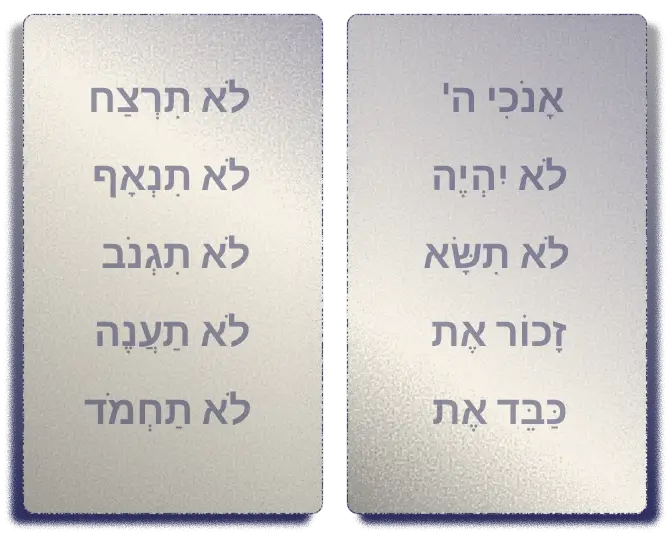
Explore the 613 mitzvos and uncover the meaning behind each one. Discover practical ways to integrate them into your daily life with insights, sources, and guided reflection.
Learn the structure, depth, and spiritual intent behind Jewish prayer. Dive into morning blessings, Shema, Amidah, and more—with tools to enrich your daily connection.
Each week’s parsha offers timeless wisdom and modern relevance. Explore summaries, key themes, and mitzvah connections to deepen your understanding of the Torah cycle.