www.Mitzvah-Minute.com
"Terumah — Part III — “וְשָׁכַנְתִּי בְּתוֹכָם”: The Sanctuary Within the Human Soul"
3.4 — Carrying the Mishkan Inside
The Final Message of “בתוכם”
At the heart of Parshas Terumah lies a phrase that reframes the entire concept of the Mishkan:
וְשָׁכַנְתִּי בְּתוֹכָם
“And I shall dwell among them” (Shemos 25:8)
The Torah does not say that Hashem will dwell within the structure. It says He will dwell within the people. The sanctuary is the instrument, but the human being is the destination.
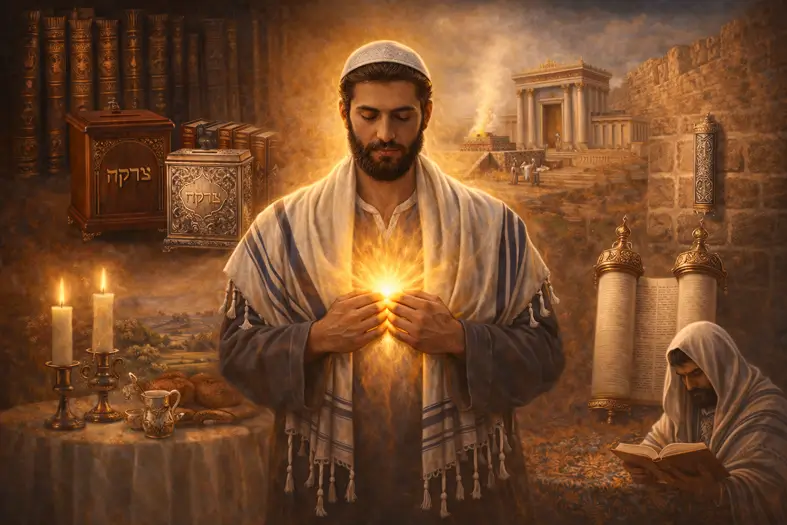
The deeper message of the Mishkan is that holiness is not meant to remain confined to a sacred building. It is meant to enter the fabric of daily life. The sanctuary in the desert is a model for the sanctuary that each person must carry within.
Rabbi Jonathan Sacks: Holiness in the Everyday
Rabbi Jonathan Sacks explains that one of the Torah’s greatest revolutions is the idea that holiness is not limited to sacred places. In the ancient world, temples were isolated spaces where the gods were thought to reside. Holiness belonged to a specific location, and everyday life remained separate from it.
The Mishkan introduces a different vision. The sanctuary stands in the center of the camp, surrounded by the tents of the people. The Divine presence is not distant. It is embedded within the daily life of the nation.
The Torah’s goal is not to create a single holy building. It is to create a holy people.
This is why the verse says “בתוכם”—within them. The physical sanctuary is only the beginning. The true sanctuary is the human being who carries awareness of Hashem into every aspect of life.
Rav Avigdor Miller: Awareness as the Core of Avodah
Rav Avigdor Miller teaches that the essence of avodah is awareness. A person becomes close to Hashem not only through grand spiritual acts, but through constant consciousness of the Divine presence.
He explains that a person who lives with awareness transforms ordinary moments into sacred ones. Eating becomes an act of gratitude. Walking becomes an opportunity to observe the world Hashem created. Speaking becomes an act of responsibility.
In this sense, the Mishkan is not only a place where sacrifices are offered. It is a symbol of a life in which everything becomes an offering.
When a person lives with awareness, his entire life becomes a sanctuary.
From a Building to a Way of Life
The Mishkan was a physical structure, built with gold, silver, copper, and fabric. It had precise measurements, sacred vessels, and a defined system of service.
But the Torah does not intend for holiness to remain within those walls. The Mishkan is a training ground. It teaches the people what holiness looks like so they can carry that model into their lives.
The Mishkan establishes principles:
- There is a sacred center.
- There are boundaries and levels of holiness.
- There is a daily rhythm of service.
- There is order, beauty, and intention.
These principles are not meant only for a building. They are meant for life itself.
A person’s schedule can have a sacred center.
His speech can have boundaries.
His actions can follow a rhythm of service.
His home can reflect order and holiness.
In this way, the Mishkan becomes a template for living.
The Portable Sanctuary
Unlike the great temples of other civilizations, the Mishkan was portable. It moved with the people wherever they traveled. It was dismantled, carried, and rebuilt again and again.
This portability carries a profound message. Holiness is not tied to a single location. It travels with the people.
The Mishkan in the desert becomes the Beis HaMikdash in Jerusalem. After its destruction, holiness moves again—into synagogues, study halls, and Jewish homes across the world.
Ultimately, the Mishkan’s portability points to its deepest meaning: the sanctuary is meant to exist within the person himself. Wherever a Jew goes, the possibility of holiness goes with him.
A Life of Sacred Awareness
The Mishkan teaches that holiness is not only about dramatic acts. It is about awareness within the ordinary.
A life without awareness becomes mechanical. Eating, working, speaking, and resting become empty routines. But a life lived with awareness becomes sacred.
When a person remembers Hashem:
- Work becomes a means of honest service.
- Food becomes an opportunity for gratitude.
- Speech becomes a vehicle for kindness and truth.
- Time becomes a gift, not just a burden.
Awareness transforms the physical into the spiritual.
The Mishkan in the desert was filled with sacred vessels.
A life of awareness turns the entire day into a vessel.
The Inner Sanctuary as the Goal
The Mishkan’s physical structure eventually disappeared. The sanctuary in the desert was dismantled. The Beis HaMikdash was destroyed. But the inner Mishkan—the one carried within the human being—remains possible in every generation.
The ultimate message of Terumah is that holiness is not dependent on a building. It depends on the human heart, mind, and actions.
A person who lives with awareness becomes a walking sanctuary. His thoughts become the inner chamber. His speech becomes the incense. His actions become offerings.
The Shechinah dwells not only in sacred places, but in sacred lives.
Application for Today — Turning the Day into a Sanctuary
Modern life is fast, noisy, and distracted. Many people search for holiness in rare experiences: a special retreat, a powerful speech, or a moment of inspiration.
But the message of the Mishkan is different. Holiness is not meant to be rare. It is meant to be constant.
A person carries the Mishkan inside by cultivating awareness throughout the day:
- Saying brachos slowly, with attention.
- Pausing before speaking, to choose words carefully.
- Setting fixed times for Torah and tefillah.
- Treating other people with dignity and patience.
- Remembering that every moment is lived before Hashem.
These are not dramatic acts. They are quiet acts of awareness. But over time, they transform a life.
The Mishkan was built from gold, silver, and copper.
The inner Mishkan is built from thoughts, words, and actions.
When those are shaped with awareness, a person’s life itself becomes a sanctuary.
📖 Sources
- Full sources available on the Mitzvah Minute Parshas Terumah page under insights and commentaries