Each Parsha page on Mitzvah Minute is designed as a guided, three-level journey through the weekly Torah reading—integrating the narrative, the mitzvos, and the classical commentaries into one unified experience.
Begin with the foundations of the Parsha:
This level gives you the storyline, the key mitzvos, and the essential connections between them.
A complete journey through the parsha—moving from clarity and depth to inner connection and real-world meaning, culminating in a way to live its ideas in everyday life.
These sections show how the Parsha speaks to the mind, the heart, and the real world — offering wisdom rooted in enduring Torah.
A complete, structured commentary on the parsha—presented pasuk by pasuk, with chapter and overall summaries for clarity and flow.
This level reveals the structural depth of the Parsha and the classical underpinnings of each theme.
Together, these layers create a complete Parsha journey —
narrative, mitzvah, and commentary — all flowing toward deeper understanding, spiritual insight, and meaningful growth.
Tap the Page Navigation tab on the right side of your screen anytime to access quick-links to the entire Parsha page.
The quick-link panel gives instant access to every section — Parsha Summary, Mitzvos, Divrei Torah, Insights, and Commentaries.
“Every word of Torah and every mitzvah lifts us higher — may your learning bring you closer to Hashem.”

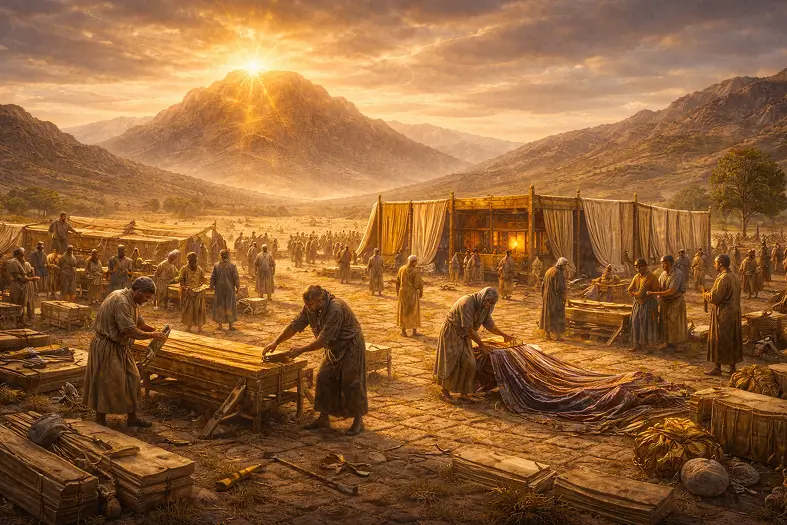
Parshas Terumah begins the Torah’s command to build the Mishkan, the sacred dwelling place where the Divine Presence will rest among the people of Israel. Hashem instructs Moshe to collect voluntary offerings from the nation—gold, silver, copper, fabrics, skins, wood, oil, spices, and precious stones—each given by those whose hearts are moved to contribute. The central purpose of these gifts is declared in the parsha’s defining verse: “וְעָשׂוּ לִי מִקְדָּשׁ וְשָׁכַנְתִּי בְּתוֹכָם” — they shall make for Me a sanctuary, and I will dwell among them. The Torah then details the sacred vessels—the Aron with its Keruvim, the Shulchan with the Lechem HaPanim, and the golden Menorah—followed by the layered curtains, beams, coverings, and partitions of the Mishkan itself. The parsha concludes with the construction of the Mizbe’ach and the courtyard that surrounds the sanctuary. Through these precise instructions, the Torah transforms the revelation at Sinai into a living, portable center of holiness, where the Divine Presence will accompany the nation throughout their journey.

Building a Dwelling for the Shechinah
וְאָהַבְתָּ אֵת ה׳ אֱלֹקֶיךָ
The Mishkan is built from voluntary offerings given “מֵאֵת כָּל־אִישׁ אֲשֶׁר יִדְּבֶנּוּ לִבּוֹ” (שמות כ״ה:ב׳), from every person whose heart inspires him. The sanctuary therefore rests upon love of Hashem, not coercion. The materials of the Mishkan become expressions of inner devotion, transforming gold and wood into vessels of love and reverence.
אֶת ה׳ אֱלֹקֶיךָ תִּירָא
The precise measurements, boundaries, and layered sanctity of the Mishkan cultivate yiras Shamayim. The divisions between the courtyard, the Kodesh, and the Kodesh HaKodashim teach reverence, restraint, and awe before the Divine Presence dwelling among the people.
וְנִקְדַּשְׁתִּי בְּתוֹךְ בְּנֵי יִשְׂרָאֵל
“וְעָשׂוּ לִי מִקְדָּשׁ” (שמות כ״ה:ח׳) commands the creation of a place where Hashem’s presence is revealed. The Mishkan itself becomes a national act of kiddush Hashem, a visible testimony that the people of Israel dedicate their resources and labor to the honor of the Divine.
וְהָלַכְתָּ בִּדְרָכָיו
The Mishkan reflects the structure of creation itself, mirroring the Divine order of the cosmos. By building the sanctuary according to Hashem’s pattern, Israel imitates the Divine act of creation, shaping a world of order, beauty, and holiness.
וְשִׁנַּנְתָּם לְבָנֶיךָ
At the heart of the Mishkan stands the Aron, containing the Luchos. The sanctuary is built around the Torah, teaching that the foundation of Jewish life is learning, transmission, and reverence for Divine wisdom.
מִפְּנֵי שֵׂיבָה תָּקוּם
The centrality of the Aron and the kohanim within the Mishkan reflects the honor given to those who serve and teach the Torah. The sanctuary’s structure places Torah at the center of national life, surrounded by service, leadership, and blessing.
לֹא־תִטַּע לְךָ אֲשֵׁרָה
The Mishkan’s courtyard is carefully structured and measured, free from foreign symbols or practices. This mitzvah reflects the principle that sacred space must remain pure, distinct, and directed solely toward the service of Hashem.
וַעֲבַדְתֶּם אֵת ה׳ אֱלֹקֵיכֶם
The Mishkan becomes the focal point of avodah. The structure trains the people in daily service, discipline, and reverence, ultimately giving rise to prayer as the central form of Divine service.
כֹּה תְבָרְכוּ אֶת־בְּנֵי יִשְׂרָאֵל
The Mishkan establishes the framework for the service of the kohanim, whose role includes blessing the people. The sanctuary becomes the center from which blessing flows to the entire nation.
וּכְתַבְתָּם עַל־מְזוּזוֹת בֵּיתֶךָ
Just as the Mishkan is a sanctified dwelling place for the Shechinah, the mezuzah transforms every Jewish home into a miniature sanctuary. The home becomes a mikdash me’at, echoing the structure and purpose of the Mishkan.
וְעַתָּה כִּתְבוּ לָכֶם אֶת־הַשִּׁירָה הַזֹּאת
The presence of the Luchos within the Aron teaches that the sanctuary exists for the Torah. Writing a Sefer Torah continues this idea, ensuring that the Divine word remains at the center of Jewish life.
וְאָכַלְתָּ וְשָׂבָעְתָּ וּבֵרַכְתָּ
The Shulchan in the Mishkan symbolizes material blessing and sustenance. The mitzvah of Birchas HaMazon transforms eating into an act of gratitude, reflecting the Shulchan’s role as a channel of Divine blessing.
שֵׁשֶׁת יָמִים תַּעֲשֶׂה מַעֲשֶׂיךָ
The Mishkan mirrors creation, and its construction is linked to the rhythm of six days of work and the sanctity of the seventh. Shabbos becomes the weekly sanctuary in time, paralleling the Mishkan as a sanctuary in space.
לֹא תַעֲשֶׂה כָל־מְלָאכָה
The categories of melachah prohibited on Shabbos are derived from the labors used to build the Mishkan. The sanctuary thus defines the boundaries of creative labor and sacred rest.
זָכוֹר אֶת־יוֹם הַשַּׁבָּת לְקַדְּשׁוֹ
Just as the Mishkan sanctifies space, Kiddush sanctifies time. Both teach that holiness emerges when the physical world is set apart for the service of Hashem.
זֶה יִתְּנוּ כָּל־הָעֹבֵר עַל־הַפְּקֻדִים
Although commanded later, the half-shekel supports the Mishkan and its service. It reflects the principle seen in Terumah: the sanctuary is built and sustained through the shared contributions of the entire nation.
וְעָשׂוּ לִי מִקְדָּשׁ
This is the central mitzvah of Parshas Terumah: to construct a dwelling place for the Shechinah. The Mishkan embodies the covenant between Hashem and Israel, transforming the physical world into a place where the Divine Presence rests among the people.

At the opening of the parsha, on the words
25:2 — “וְיִקְחוּ־לִי תְּרוּמָה”
“And let them take for Me an offering,”
Rashi explains that “לִי” means “לִשְׁמִי” — for the sake of My Name. The Mishkan is not merely a building project or a communal donation. It is an act of dedication directed toward the honor of Hashem. The תרומה is something set aside, separated from ordinary use, and elevated into sacred service.
The phrase “אשר ידבנו לבו” teaches that the primary foundation of the Mishkan is the willing heart. The structure that will house the Shechinah is built not only from gold and cedar, but from generosity, devotion, and spiritual intention.
Rashi also explains that the term תרומה appears three times, alluding to three distinct offerings: the half-shekel for the sockets, the half-shekel for communal sacrifices, and the voluntary donations for the construction itself. This indicates that the Mishkan is sustained through both equal communal responsibility and individual generosity.
On the materials for the Mishkan, Rashi cites a tradition regarding the shittim wood:
25:5 — “וַעֲצֵי שִׁטִּים”
“And shittim wood”
He explains that Yaakov Avinu, through רוח הקודש, foresaw that his descendants would one day build a Mishkan in the wilderness. He brought cedar trees down to Egypt and planted them there, instructing his children to take them when they would leave.
This teaching shows that the Mishkan was not an isolated event in the desert. It was part of a long historical arc beginning with the Avos. The sanctuary in the wilderness was rooted in the foresight and preparation of Yaakov, linking the redemption from Egypt to the spiritual vision of the Patriarchs.
25:8 — “וְעָשׂוּ לִי מִקְדָּשׁ”
“And they shall make for Me a sanctuary”
Rashi explains that this means a house of holiness, made for the sake of Hashem’s Name. The Mishkan is not merely functional; it is a sacred dwelling place where the Shechinah will reside among the people.
On the following verse:
25:9 — “כְּכֹל אֲשֶׁר אֲנִי מַרְאֶה אוֹתְךָ”
“According to all that I show you”
Rashi explains that this instruction applies not only to the Mishkan in the wilderness, but to future generations as well. Whenever vessels must be replaced or when the Beis HaMikdash is built, the same Divine pattern must be followed (סנהדרין ט״ז).
The Mishkan therefore establishes a permanent template for all sanctuaries in Israel’s history.
In the description of the Aron, Rashi emphasizes both its physical structure and its symbolic meaning.
25:11 — “וְעָשִׂיתָ זֵר זָהָב”
“And you shall make a golden crown”
Rashi explains that this crown-like border represented the “crown of Torah,” since the Tablets of the Covenant were placed within the Ark (שמות רבה ל״ד).
The construction of the Ark—gold within and gold without—teaches that holiness must be consistent both inside and outside. The Ark is overlaid with gold on all sides, reflecting the ideal of inner and outer purity.
Rashi also explains that the staves of the Ark were never to be removed:
25:15 — “לֹא יָסֻרוּ מִמֶּנּוּ”
“They shall not depart from it” (יומא ע״ב)
This permanence teaches that the Torah must always be ready to travel with the people. The Ark is not fixed in one place; it accompanies Israel through every stage of their journey.
Rashi explains that the cherubim had the faces of children:
25:18 — “שְׁנַיִם כְּרֻבִים”
“Two cherubim” (סוכה ה׳)
They were formed from the same piece of gold as the kapores, emphasizing unity and continuity.
On the verse:
25:22 — “וְנוֹעַדְתִּי לְךָ שָׁם”
“And I will meet with you there”
Rashi resolves the apparent contradiction between verses that say Hashem spoke from above the kapores and others that say He spoke from the Tent of Meeting. He explains that the voice descended from heaven to the space between the cherubim, and from there it was heard by Moshe inside the Tent (במדבר ז׳:פ״ט; ספרי).
The locus of revelation is therefore the space above the Ark, between the cherubim—above the Torah itself.
Rashi interprets the golden borders of the vessels symbolically:
25:24 — “וְעָשִׂיתָ לוֹ זֵר זָהָב”
“And you shall make for it a golden border”
He explains that the border of the table symbolizes the “crown of kingship,” since the table represents wealth, honor, and material greatness.
Together with the Ark’s crown (Torah) and the altar’s crown (priesthood, mentioned elsewhere), these form the three crowns of Israel’s sacred order.
The menorah, formed from a single piece of gold, represents unified spiritual light. Rashi explains that Moshe found its construction difficult, and Hashem showed him a menorah of fire as a model (מנחות כ״ט; תנחומא בהעלותך ג׳). This teaches that certain aspects of holiness transcend human comprehension and require Divine revelation.
Throughout the description of the Mishkan’s structure, Rashi emphasizes precision, measurement, and layered design. The curtains, boards, sockets, bolts, and partitions are all described in exact detail.
On the layered coverings, Rashi derives a moral lesson:
26:13 — the outer coverings protected the inner, more beautiful curtains.
From this, he teaches that a person should take care to protect precious and beautiful objects (ילקוט שמעוני). The Mishkan’s structure itself conveys ethical instruction.
Rashi carefully explains the placement of the vessels:
26:35 — the table stood on the north side, the menorah on the south, and the golden altar in the center between them.
This spatial order reflects the structure of holiness: wisdom (menorah), sustenance and kingship (table), and service (altar), all arranged in precise relationship to one another.
The paroches divides the Mishkan into the Holy and the Holy of Holies, establishing a clear hierarchy of sanctity and access.
In the outer courtyard, Rashi explains the structure and symbolism of the copper altar.
27:2 — the copper overlay atoned for sins committed with brazenness, associated with the expression “a copper forehead” (ישעיהו מ״ח:ד׳).
The altar’s horns, grate, vessels, and surrounding ledges all reflect precise function and symbolism.
Rashi also describes the courtyard’s dimensions and the placement of the Mishkan within it, showing that every space was measured and purposeful.
Across the entire parsha, Rashi reveals the Mishkan as a structure of intention, symbolism, and exact design:
Through Rashi’s lens, the Mishkan becomes not only a physical sanctuary, but a spiritual system. Every detail—from the staves of the Ark to the loops of the curtains—reflects holiness, structure, and purpose, forming a dwelling place where the Shechinah can reside among Israel.
📖 Source
Ramban presents Parshas Terumah as the direct continuation of Matan Torah. After the revelation at Har Sinai, where the Divine Presence was openly revealed, the Mishkan becomes the place where that same Presence dwells among Israel in a concealed and enduring form.
At Sinai it is written:
“וַיִּשְׁכֹּן כְּבוֹד ה׳ עַל הַר סִינַי” (שמות כ״ד:ט״ז)
And regarding the Mishkan:
“וּכְבוֹד ה׳ מָלֵא אֶת הַמִּשְׁכָּן” (שמות מ׳:ל״ד)
The glory that appeared on the mountain now rests in the sanctuary. The Mishkan is therefore a “portable Sinai,” a place where Hashem continues to speak to Moshe and dwell among the nation (במדבר ז׳:פ״ט).
The primary purpose of the Mishkan, according to Ramban, is the resting place of the Shechinah, represented by the Aron.
“וְנוֹעַדְתִּי לְךָ שָׁם וְדִבַּרְתִּי אִתְּךָ” (שמות כ״ה:כ״ב)
The Aron, containing the Luchos, forms the center of the Mishkan. The kapores and the keruvim above it together form a symbolic “Kisei Kavod,” a throne of Divine glory. From between the keruvim, Hashem speaks to Moshe, just as the voice at Sinai descended from heaven.
The keruvim correspond to the heavenly merkavah described by Yechezkel:
“וָאֵדַע כִּי כְרוּבִים הֵמָּה” (יחזקאל י׳:כ׳)
Thus, the Mishkan mirrors the heavenly reality, and the keruvim represent the chariot of the Divine Presence.
On the phrase:
“וְזֹאת הַתְּרוּמָה” (שמות כ״ה:ג׳)
Ramban explains on the level of sod that the word “זֹאת” alludes to a Divine presence. Midrashim interpret the offering itself as representing Knesses Yisrael or even the Presence of Hashem dwelling among them.
As the Midrash teaches:
“וְיִקְחוּ לִי תְּרוּמָה” — “They shall take Me as the offering” (שמו״ר ל״ג:א׳)
This expresses the intimate bond between Hashem and Israel:
“דּוֹדִי לִי וַאֲנִי לוֹ” (שיר השירים ב׳:ט״ז)
The Mishkan is therefore not only a place for offerings, but a dwelling of the Divine within the community itself.
On the command:
“וְעָשׂוּ אֲרוֹן” (שמות כ״ה:י׳)
Ramban notes that the Torah uses the plural form “וְעָשׂוּ” — “and they shall make,” unlike the other vessels, which are described in the singular.
This indicates that all of Israel should participate in the making of the Aron, since it houses the Torah. As the Midrash explains, Hashem desired that everyone be involved so that all would merit a share in the Torah (שמו״ר ל״ד:ב׳).
The Aron thus represents the collective ownership of Torah by the entire nation.
Ramban explains that the keruvim were not decorative figures, but representations of the heavenly chariot.
They were fashioned as humanlike figures, with childlike faces, corresponding to the celestial beings seen by Yechezkel. The name “כְּרוּב” itself is related to “רַבְיָא” — a child.
They were made as one piece with the kapores, symbolizing unity, and they spread their wings upward, forming the throne upon which the Divine glory rests.
This imagery reflects the higher reality of the heavenly merkavah, where:
“גָּבֹהַּ מֵעַל גָּבֹהַּ שֹׁמֵר” (קהלת ה׳:ז׳)
The earthly Mishkan is therefore a reflection of a higher, unseen spiritual structure.
On the Shulchan, Ramban explains the deeper meaning of the golden crown surrounding it.
While Rashi interprets it as the symbol of kingship, Ramban adds that the Shulchan represents the flow of material blessing in the world.
Hashem’s blessing does not normally create something from nothing. Instead, it rests upon an existing source and increases it. Ramban illustrates this with examples:
Similarly, the Lechem HaPanim served as the starting point for blessing, from which abundance spread to all Israel. Even a small portion of this bread satisfied the kohanim (יומא ל״ט.).
The Shulchan therefore represents the principle that Divine blessing flows into the physical world through an existing vessel.
Ramban explains that the structure of the Menorah contains deep and hidden wisdom.
It was fashioned from a single piece of gold, with six branches emerging from the central shaft. All its lamps were directed toward the center, forming a unified source of illumination.
This design reflects profound spiritual truths, though their full meaning is concealed. For this reason, Moshe found the construction of the Menorah difficult to comprehend.
The Menorah thus represents the inner light of wisdom that illuminates creation.
On the command:
“וְעָשׂוּ לִי מִקְדָּשׁ”
“כְּכֹל אֲשֶׁר אֲנִי מַרְאֶה אוֹתְךָ… וְכֵן תַּעֲשׂוּ” (שמות כ״ה:ח׳–ט׳)
Ramban explains that the Mishkan is like a royal palace and throne of majesty, prepared for the Shechinah.
The repetition of “וְכֵן תַּעֲשׂוּ” is not primarily about future generations or specific vessels, but an expression of urgency: Israel must build the Mishkan with zeal and diligence, according to the Divine pattern shown to Moshe.
In his discussion of the stones of the ephod and breastplate, Ramban emphasizes the concept of completeness.
The “אבני מילואים” are not called so because they fill a setting, but because they are whole and perfect stones, left in their natural state. Their spiritual and physical qualities exist precisely because they are not cut or damaged.
For this reason, the stones of the breastplate had to be engraved miraculously with the shamir, preserving their natural perfection (סוטה מח.).
This teaches that certain forms of spiritual beauty must remain whole and unaltered.
In the description of the boards and the structure of the Mishkan, Ramban explains the directional terms:
He adds that these directions also allude to deeper mystical realities connected to the Divine chariot and the structure of creation.
Across his commentary, Ramban portrays the Mishkan as more than a sanctuary. It is a reflection of the cosmic order:
Just as the glory of Hashem rested upon Har Sinai, it now rests within the Mishkan among Israel. The sanctuary becomes a living testimony to the covenant, a physical space in which the presence of Hashem dwells continuously among His people.
📖 Source
Parshas Terumah introduces the command to build the Mishkan, a physical sanctuary in which the Divine Presence would dwell among the people. For the Rambam, this moment is not primarily about architecture or ritual detail, but about the philosophical evolution of the Jewish people. The Mishkan represents a stage in the gradual refinement of human understanding and the redirection of religious instinct toward the service of Hashem.
The Mishkan is therefore not only a structure of wood, gold, and fabric. It is a structure of ideas. It marks the transition from a world shaped by idolatrous instincts to a nation trained in the service of the One G-d, guided step by step toward intellectual and moral perfection.
In the Rambam’s worldview, as presented in the Moreh Nevuchim, humanity emerged from a world saturated with idolatrous practices. People were accustomed to temples, sacrifices, incense, and visible objects of worship. Religious expression was physical, localized, and directed toward many gods.
The Torah, therefore, did not abolish these practices immediately. Instead, it transformed them. Rather than offering sacrifices to many gods, Israel would serve one G-d. Rather than building shrines in every place, they would build a single Mishkan. Rather than serving idols, they would direct all ritual toward the Creator alone.
The Mishkan thus represents a redirection of existing religious instincts. The forms remain familiar, but their meaning is entirely transformed.
Rambam explains that the Torah educates human beings according to their historical and psychological condition. Just as a physician gradually weans a patient from harmful habits, so the Torah redirects the religious instincts of the people into a purified form.
The command of the Mishkan is part of this broader Divine strategy. It allows the people to serve Hashem in ways they can comprehend, while slowly elevating their understanding.
Several philosophical principles emerge from this approach:
In the Mishneh Torah, especially in Hilchos Beis HaBechirah, Rambam describes the Sanctuary as the central place of avodah. It becomes the focal point of national service, pilgrimage, and sacrificial worship.
Centralizing worship serves several philosophical and social purposes:
The Mishkan, and later the Beis HaMikdash, becomes the axis around which the spiritual life of the nation revolves.
Rambam teaches in Hilchos De’os and Hilchos Teshuvah that the goal of life is intellectual and moral perfection: to know Hashem and to align one’s character with the Divine will.
The Mishkan contributes to this process through its structure and service. Its precise measurements, ordered vessels, and carefully regulated rituals train the people in discipline, obedience, and reverence.
The Sanctuary cultivates:
In this way, the Mishkan is not only a place of service; it is a school for the formation of character.
The Torah commands, “וְיִקְחוּ־לִי תְּרוּמָה” — “They shall take for Me an offering” (שמות כ״ה:ב׳). The materials of the Mishkan come not from taxation or coercion, but from voluntary contributions of the people.
Rambam’s ethical system places great emphasis on the formation of character through action. Repeated acts of giving shape the soul, training a person to become generous and compassionate.
The voluntary donations for the Mishkan therefore serve a philosophical purpose:
The Mishkan is built not only from gold, silver, and wood, but from refined character.
Ultimately, Rambam sees the entire system of ritual as a stage in the journey toward intellectual perfection. In Hilchos Teshuvah, he teaches that the highest love of Hashem comes through contemplation and understanding.
The Mishkan trains the nation in proper worship, discipline, and reverence. But the ultimate goal is not the structure itself. The goal is knowledge of Hashem and the perfection of the human mind and character.
From the Rambam’s perspective, the movement is clear:
Parshas Terumah thus becomes a philosophical turning point. The people who left Egypt, surrounded by the symbols of pagan worship, are now commanded to build a sanctuary for the One G-d. The structure is physical, but its purpose is intellectual and spiritual: to shape a nation that serves Hashem with understanding, discipline, and moral clarity.
📖 Sources
Ralbag approaches Parshas Terumah not merely as instructions for building a sacred structure, but as a philosophical system encoded in physical form. The Mishkan, its vessels, and its measurements all serve as symbolic teachings about the structure of existence, the nature of the soul, the order of the cosmos, and the unity of Hashem. Every component of the Sanctuary communicates metaphysical truths and guides the human mind toward knowledge of the Creator.
The first benefit of the parsha, according to Ralbag, is the mitzvah to build a Mikdash for the sake of Hashem: “וְעָשׂוּ לִי מִקְדָּשׁ.” This structure must include the essential components: the Kodesh HaKodashim with the Aron and the Luchos, the Kodesh with the Shulchan, Menorah, and Mizbeach HaKetores, and the courtyard with the Mizbeach HaOlah. These elements form the necessary structure of the Sanctuary.
Ralbag then outlines foundational principles governing the construction of the Mikdash and its vessels. These principles define not only the halachic structure of the Temple but also its philosophical meaning.
Ralbag enumerates a series of fundamental roots governing the Sanctuary:
These roots demonstrate that the Mikdash is not a random structure, but a carefully ordered system designed to reflect both halachic precision and philosophical symbolism.
Ralbag explains that the mitzvos of the Mikdash yield both intellectual and social benefits. On the level of belief, the Sanctuary directs the people toward the recognition of one G-d who rules over all existence and is worthy of service. The grandeur and order of the Mikdash reinforce awareness of the Divine greatness and unity.
The centralized Temple service also provides societal benefits:
Thus, the Sanctuary serves both the perfection of belief and the proper ordering of society.
Ralbag proposes a sweeping philosophical framework: in the time of Moshe, philosophical understanding was limited. Many people recognized only material causes and did not grasp formal, efficient, or final causes. This ignorance led to erroneous doctrines, including denial of Divine providence, prophecy, and even the existence of Hashem.
The Torah therefore guides humanity toward knowledge of reality through symbolic structures. The Mishkan is designed to teach the nature of existence and to direct the mind toward understanding the Creator.
The highest form among earthly beings is the human intellect. Accordingly, the Aron with the Luchos and the Keruvim represents the intellectual soul and the higher intelligences.
Ralbag explains that the two Keruvim represent two forms of intellect:
Their faces turned toward one another signify the interaction between these two intellectual forces. Their wings spread upward represent the aspiration of the intellect to ascend toward higher existence.
The presence of the Luchos within the Aron demonstrates that prophecy is possible through the perfection of the intellect. The Divine voice emerging from between the Keruvim symbolizes this prophetic encounter.
The partition between the Kodesh and Kodesh HaKodashim signifies the distinction between:
Ralbag interprets the vessels of the Kodesh as symbols of different faculties of the soul.
The Shulchan, with the bread placed upon it, represents the nutritive soul. Bread is the most universal form of nourishment, and from the phenomenon of nourishment we deduce the existence of a nutritive power within living beings.
The Menorah represents the sensory soul, especially the faculty of sight, the most refined of the senses. Light enables vision, and through vision, knowledge begins.
The decorative elements of the Menorah—goblets, knobs, and blossoms—represent stages in the transformation of sensory input into intellectual knowledge. Through the senses, imagination, and memory, the intellect extracts abstract ideas from concrete experiences.
Thus, the Menorah symbolizes the process by which the sensory soul prepares material for the intellectual soul.
Ralbag explains that the two altars represent different forms of dissolution.
The rising smoke of the incense represents the ascent of the intellect once freed from material constraints.
The twelve loaves on the Shulchan symbolize the influence of the twelve zodiacal constellations on the lower world. The arrangement of six loaves on each side reflects the northern and southern celestial influences that govern processes of growth and decay.
The pure frankincense placed between them signifies that all these celestial influences ultimately derive their power from Hashem, who stands above the heavenly spheres.
This structure teaches that all existence is interconnected and governed by one Divine source.
The seven lamps of the Menorah represent the seven classical planets. Their continuous illumination reflects the ongoing influence of the heavenly bodies on the processes of growth and decay in the world.
The lighting of the Menorah in the morning and evening reflects the cycles of day and night, corresponding to celestial movements and their effects on earthly life.
The Mishkan’s structure, its curtains, and their numbers all carry philosophical meaning.
These numerical structures demonstrate that all existence is unified and dependent upon a single First Cause.
Ralbag emphasizes two central philosophical conclusions:
Rather, He is the ultimate cause of all existence.
The materials of the Mishkan also communicate philosophical ideas.
Gold, used extensively in the Sanctuary, symbolizes permanence and endurance, reflecting the enduring nature of form. Copper, used in the outer structures, symbolizes materiality and transience.
The layered coverings of the Mishkan correspond to the four categories of forms in the lower world:
Thus, the entire structure of the Mishkan becomes a philosophical diagram of the cosmos.
The outer courtyard represents the realm of material existence and change. The use of copper and the structural emphasis on the number five allude to the material elements and the causes of physical change.
The altar’s four horns represent the four elements from which physical bodies are composed and into which they dissolve.
Even the screen at the entrance, made of four materials, signifies that physical matter exists for the sake of form, not for its own sake.
In Ralbag’s philosophical vision, the Mishkan is a symbolic map of existence. Its vessels represent the faculties of the soul, its numbers reflect the structure of the cosmos, and its layout teaches the unity of all existence under the sovereignty of Hashem. The Sanctuary thus becomes not only a place of worship, but a philosophical model designed to lead the human mind toward knowledge of the Creator and the true structure of reality.
📖 Source
The Chassidic masters read Parshas Terumah not only as the blueprint of a physical Mishkan, but as the revelation of an inner Mishkan within the soul of every Jew. The command to give, build, and sanctify is interpreted as a call to transform desire, thought, speech, and action into vessels for the Shechinah. Drawing from the teachings of the Baal Shem Tov, the Kedushas Levi, and the Sfas Emes, this section traces the inner meaning of the Mishkan as a structure built within the human heart.
The Torah commands:
שמות כ״ה:ב׳
דַּבֵּר אֶל־בְּנֵי יִשְׂרָאֵל וְיִקְחוּ־לִי תְּרוּמָה
“Speak to the children of Israel, and they shall take for Me an offering.”
The Baal Shem Tov notes the unusual wording: the verse says “they shall take for Me,” rather than “they shall give to Me.” This teaches that even physical giving must be understood as a spiritual act. Charity may be given even without pure intention, because the poor person is sustained regardless; yet the recipient must receive it “for the sake of heaven,” using it only for what is truly needed.
From here, the Baal Shem Tov derives a deeper principle: the passions and desires of the heart themselves can be transformed into offerings. The verse says:
שמות כ״ה:ב׳
מֵאֵת כָּל־אִישׁ אֲשֶׁר יִדְּבֶנּוּ לִבּוֹ
“From every person whose heart inspires him.”
Every desire, even a material one, contains within it a fallen spark of love. If a person redirects that desire toward the love of Hashem, the very passion that once pulled him downward becomes a ladder upward.
The Baal Shem Tov compares this to a prince who desired a beautiful woman. The king used that desire as a tool: the prince was allowed to approach her only after mastering a field of knowledge. Through this process, his physical desire became the catalyst for wisdom, until he outgrew the superficial attraction and married a princess worthy of him.
So too, every worldly longing can become a pathway to Torah and avodas Hashem.
The Kedushas Levi teaches that the Mishkan represents the union of holy thought and holy action. The verse states:
שמות כ״ה:ב׳–ג׳
מֵאֵת כָּל־אִישׁ אֲשֶׁר יִדְּבֶנּוּ לִבּוֹ… זָהָב וָכֶסֶף וּנְחֹשֶׁת
“From every man whose heart inspires him… gold, silver, and copper.”
He explains:
Through sacred intention, the Shechinah is “raised from the dust,” while the physical act elevates the person himself. The offering thus joins heaven and earth: thought elevates the Divine presence, and action refines the human being.
This dual structure explains why the Mishkan required both inner devotion and outer materials. It was not merely a building; it was the tangible expression of the collective spiritual state of the people.
The Kedushas Levi further teaches that the Mishkan corresponds to the structure of the human being and the 613 mitzvos. Each vessel represents a spiritual concept, and the Aron represents the core mitzvos that must be remembered constantly:
Because these foundations must never be forgotten, the Torah commands regarding the Aron:
שמות כ״ה:ט״ו
בְּטַבְּעֹת הָאָרֹן יִהְיוּ הַבַּדִּים לֹא יָסֻרוּ מִמֶּנּוּ
“The staves shall remain in the rings of the Ark; they shall not be removed.”
The Ark symbolizes the core of emunah, which must be carried with a person at all times.
The Sfas Emes focuses on the verse:
שמות כ״ה:ח׳
וְעָשׂוּ לִי מִקְדָּשׁ וְשָׁכַנְתִּי בְּתוֹכָם
“They shall make for Me a sanctuary, and I shall dwell within them.”
He emphasizes the phrase “within them,” not “within it.” The Mishkan is meant to be built inside each person. When a person recognizes that every action contains Divine life, his own will becomes nullified to the will of Hashem, and the Divine presence is revealed within that action.
This inner Mishkan depends entirely on the person’s faith and intention:
The Sfas Emes explains that the Torah says “ויקחו לי” — “they shall take for Me,” because the real offering is not the object, but the will of the person. When a Jew desires to fulfill a mitzvah sincerely, even what he cannot accomplish physically is completed from Heaven.
This is like the Menorah, which Moshe found difficult to fashion. Hashem showed him the form, and then it was made by itself. The lesson:
The Sfas Emes and Baal Shem Tov both teach that every desire contains a spark of holiness. The task of the Jew is not to destroy desire, but to elevate it.
According to the Sfas Emes:
Thus, the offering of the Mishkan was not merely gold or silver, but the transformation of the human heart itself.
The Kedushas Levi explains the verse:
שמות כ״ה:ט׳
כְּכֹל אֲשֶׁר אֲנִי מַרְאֶה אֹתְךָ… וְכֵן תַּעֲשׂוּ
“According to all that I show you… so shall you do.”
He teaches that every generation must build the Mishkan according to the spiritual vision available to it. Just as each prophet receives revelation according to his level, so too the structure of the Temple reflects the spiritual stature of the generation.
The Mishkan, therefore, is not only a historical structure. It is the visible garment of the inner service of the people.
Across all three Chassidic masters, a shared principle emerges:
When a Jew takes even a small portion of his will, his desire, or his possessions and dedicates it to Hashem, that act becomes a sanctuary. As the Sfas Emes writes, even a small spark of intention for heaven can elevate the entire action.
In this way, Parshas Terumah teaches that the true dwelling place of the Shechinah is not only in a golden sanctuary in the desert, but in the transformed heart of every Jew.
📖 Sources
Parshas Terumah marks a turning point in the Torah’s narrative. Until now, the Israelites had been the recipients of Divine acts: redemption from Egypt, the splitting of the sea, manna from heaven, water from the rock, and the revelation at Sinai. With the command to build the Mishkan, the direction changes. For the first time, the people are asked to become creators. They are invited not only to obey, but to build; not only to receive, but to give; not only to follow G-d, but to become partners in the work of creation. As Rabbi Jonathan Sacks repeatedly emphasizes, the Mishkan is less about a structure in space than about a transformation in the human spirit.
Across his essays on Terumah, Rabbi Sacks explores the Mishkan as a profound symbol at multiple levels: cosmic, social, psychological, and communal. He shows that the Tabernacle mirrors the creation of the universe itself, suggesting that just as G-d made space for humanity, humanity must now make space for G-d. Holiness emerges not through grandeur or coercion, but through voluntary giving, precise moral order, and the discipline of aligning human will with Divine command. The Mishkan thus becomes a microcosm of the world and a blueprint for the moral architecture of society.
At the same time, Rabbi Sacks highlights the Mishkan’s revolutionary social vision. The Ark, built in the plural — “They shall make an ark” — represents the shared inheritance of Torah, accessible to all. Knowledge, not wealth or power, becomes the foundation of dignity and equality. Through education, study, and participation, the covenantal community becomes a society of equals, united not by force but by shared responsibility and shared learning.
Central to Rabbi Sacks’ reading of Terumah is the transformative power of giving and building. The Israelites, once passive recipients of miracles, are now called to contribute their resources, skills, and energy to a sacred project. In doing so, they gain dignity, maturity, and a sense of ownership. People value what they create; effort generates attachment; responsibility builds character. The Mishkan thus becomes a school for freedom, teaching that true spiritual growth comes not from what we receive, but from what we give.
Finally, Rabbi Sacks shows how the Mishkan’s deepest lesson is its portability. G-d does not dwell in structures of wood and stone, but in the hearts of those who build them. The Tabernacle becomes the prototype for the synagogue, the home, and the community itself — places where people gather to create sacred space together. Holiness, in this vision, is not fixed to a location but carried by a people wherever they go.
Through these themes, Rabbi Sacks presents Terumah as a parsha about human dignity, communal responsibility, and the partnership between heaven and earth. The Mishkan is not merely a sanctuary in the wilderness; it is a model for building a society, a community, and a human heart capable of becoming a home for the Divine.
Rabbi Jonathan Sacks sees the Mishkan not merely as a structure in the wilderness, but as a profound theological statement about creation, holiness, and the relationship between G-d and humanity. In his reading, the Tabernacle is a microcosm of the universe itself, and its construction marks a new stage in the unfolding of sacred history.
The Torah describes two acts of creation: first, G-d’s creation of the universe in Sefer Bereishis, and second, the Israelites’ creation of the Mishkan in Sefer Shemos. The parallels between these two narratives are deliberate and unmistakable. The Torah uses the same cluster of key words in both accounts: making, seeing, completing, blessing, sanctifying, and work. Just as we read, “And G-d saw all that He had made,” so too, “Moshe saw all the work” of the Mishkan. Just as G-d “completed” the creation, so Moshe “completed” the Mishkan. Just as G-d “blessed” the seventh day, so Moshe “blessed” the people when the Mishkan was finished.
These parallels teach a fundamental idea: what creation was for G-d, the Mishkan was for Israel. Just as the universe began with an act of Divine creation, Jewish history begins with a human act of sacred construction. The Mishkan is the first great collective project of the redeemed nation.
Yet there is a striking contrast. The creation of the universe is described in just a few dozen verses, while the construction of the Mishkan takes hundreds. The cosmos is vast; the Mishkan was small, fragile, and portable. Why, then, does the Torah devote so much more space to the Mishkan?
Rabbi Sacks explains that the Torah is not humanity’s book about G-d; it is G-d’s book about humanity. It is not difficult for an infinite Creator to make a home for finite human beings. The real challenge is for finite, vulnerable human beings to make a home for the Infinite. The Mishkan represents that extraordinary achievement.
A Midrash describes the Mishkan as the moment when the Divine Presence returned to earth after having withdrawn because of human sin. From Adam through the generations of sin, the Shechinah retreated step by step from the world. Then came Avraham and his descendants, who gradually drew the Divine Presence back. Finally, with the erection of the Mishkan, the Shechinah returned to dwell among humanity.
This idea is tied to the meaning of the word kadosh, “holy.” Creation itself involved a kind of Divine self-limitation. For human beings to exist as free and responsible moral agents, G-d’s presence cannot be overwhelmingly obvious everywhere. The infinite must, in some sense, withdraw to make room for the finite.
Yet this creates a paradox. If G-d is fully present everywhere, there is no room for human freedom. If G-d is nowhere perceptible, how can humanity know Him? The solution is that G-d designates certain domains as holy—places or times where His presence becomes more visible.
Rabbi Sacks identifies three such domains:
Each is a point where the Divine Presence moves from concealment to revelation. Holiness is thus the meeting point of heaven and earth.
In the realm of the sacred, human autonomy is set aside. Just as in the secular realm G-d withdraws to allow human freedom, so in the holy realm humans withdraw their will to make space for G-d. That is why the Mishkan had to be built exactly “as G-d commanded,” without human improvisation.
The Torah describes the Mishkan in extraordinary detail: its dimensions, materials, curtains, beams, and furnishings. At first glance, this seems unnecessary. The Mishkan was temporary; it did not last forever. Why devote so much space to the measurements of a structure that would eventually be replaced?
Rabbi Sacks explains that the Mishkan was a microcosm of the universe. Just as the universe is governed by precise laws and constants, so the Mishkan was built with exact dimensions. Modern science has shown that the universe depends on finely tuned constants; even the smallest variation would have prevented life from emerging.
Similarly, the Torah describes another structure in precise detail: Noach’s Ark. Both the Ark and the Mishkan represent Divinely ordered worlds—structures that embody harmony, balance, and survival.
The message is that order matters. Just as the physical universe depends on precise laws, so the moral and spiritual universe depends on structure, discipline, and alignment with the Divine will.
The Mishkan’s architecture teaches that moral life has a structure, a choreography, and a precise design. The cosmos is built on law and order; so too must human conduct be.
The Mishkan was built through voluntary contributions: “from everyone whose heart moves him to give.” This is striking, because the service of the Sanctuary was otherwise governed by strict law and obligation. Why was its construction voluntary?
The answer emerges from the later history of the Temple. When King Shlomo built the Beis HaMikdash, he did so using forced labor. Tens of thousands of men were conscripted to carry burdens and cut stone. The people later complained that he had placed a “heavy yoke” upon them—language that echoes the oppression of Egypt.
In effect, the building of the Temple risked turning Israel into a second Egypt. The very structure meant to symbolize freedom became associated with coercion. After Shlomo’s death, this burden led directly to rebellion and the division of the kingdom.
The lesson is profound: the free G-d desires the free worship of free human beings. G-d does not rule tyrannically over His creatures. Therefore, the first sanctuary had to be built through voluntary gifts, not forced labor.
G-d is not found in monumental architecture alone, but in the willing heart.
In Rabbi Sacks’ vision, the Mishkan is a second act of creation, a microcosm of the universe, and the meeting place of heaven and earth. Its precise structure reflects the order of the cosmos, and its voluntary construction reflects the dignity of human freedom. Holiness emerges when G-d makes space for humanity, and humanity, in turn, makes space for G-d.
At the heart of the Mishkan stood the Aron, the Ark that housed the Luchos, the tablets of the covenant. Rabbi Jonathan Sacks shows that the Torah’s description of the Ark contains one of the most powerful and far-reaching ideas in the entire parsha: the equality of all Israel in relation to Torah.
As the Torah commands Moshe regarding the construction of the Mishkan and its vessels, the language follows a consistent pattern. The verbs are in the second person singular:
Yet there is one striking exception. When the Torah introduces the Ark, the verb shifts into the plural:
This is not a stylistic accident. The Torah is highly precise, and such deviations signal deeper meaning. The Sages taught that this change indicates that the Ark was to be built by all, not by one individual. Everyone was to participate in its construction.
The reason lies in what the Ark contained. Inside it were the Luchos—the physical embodiment of the covenant at Sinai. The Ark therefore symbolized Torah itself.
Because Torah belongs to the entire people, the Ark that housed it had to be built collectively.
The Sages described three “crowns” in Israel:
Kingship belonged to the house of David.
Priesthood belonged to the family of Aharon.
But the crown of Torah belonged to all Israel.
Maimonides later expressed this in simple and powerful terms: the crown of Torah is available to anyone who wishes to take it. It is not restricted by birth, status, or position.
The Sages even went so far as to say that a learned person of low social standing takes precedence over an ignorant High Priest. The dignity conferred by knowledge surpasses that conferred by lineage or office.
Rabbi Sacks highlights a revolutionary idea embedded in this symbolism. Most societies are built on hierarchies of wealth, power, or status. Such goods are often “zero-sum”:
Spiritual goods, however, function differently. Knowledge, trust, love, and influence are not diminished when shared. On the contrary, they grow. They are “non-zero-sum” goods. The more they are shared, the more they exist.
Judaism recognized that the most powerful social good is knowledge—specifically, knowledge of Torah. A society in which everyone has access to the law is a society in which everyone has equal dignity as citizens of the covenant.
Thus, the Ark represents more than a sacred object. It symbolizes a social vision:
In this sense, Israel becomes a “republic of faith,” where dignity is rooted not in wealth or power, but in learning and moral responsibility.
Historically, Israel was not fully egalitarian. There were priests, kings, and tribal distinctions. Yet after the destruction of the Temple, a remarkable transformation took place.
With no functioning monarchy and no active priesthood, only one crown remained: the crown of Torah. The Sages then established a system of universal education, ensuring that Torah learning became the inheritance of the entire people.
From that point onward, Jewish identity became rooted in literacy, study, and the life of the mind. The Ark’s symbolism became social reality.
The Sages told stories that illustrate this principle. In one, a great scholar insults a man he assumes is ignorant. The man responds by quoting the verse:
“Moses commanded us the Torah, an inheritance of the congregation of Yaakov.”
The Torah is not the inheritance of scholars alone, but of the entire people.
In another story, a leader restricted entry to the study hall only to the most refined students. When he was removed from office, the doors were opened to everyone. The lesson was clear: the house of study must be open to all.
Throughout history, Jewish society became known for universal education. Even the poorest families sought to educate their children, not for economic gain, but for understanding G-d’s law.
The Ark, built in the plural, represents the shared inheritance of Torah. Unlike kingship or priesthood, the crown of Torah belongs to every Jew. By making knowledge the foundation of dignity, Judaism created a covenantal society of equals, united not by power or wealth, but by shared learning and responsibility.
At the heart of Parshas Terumah lies a profound transformation in the spiritual life of the Jewish people. Rabbi Jonathan Sacks shows that the Mishkan was not merely a sanctuary; it was a turning point in human development. Until now, the Israelites had been passive recipients of Divine miracles. With the command to build the Mishkan, they were invited to become creators, givers, and partners in the sacred.
Up to this point in the narrative, almost everything the Israelites experienced had been given to them by G-d:
At a physical level, this was a miraculous and unprecedented deliverance. But psychologically, it produced a troubling effect. The people became dependent, expectant, and prone to complaint. When they needed something, they cried out. Moshe turned to G-d. G-d performed a miracle. From the people’s perspective, complaint worked.
Now, however, G-d introduced something entirely new: the opportunity to give.
This was not about G-d’s needs. G-d does not require a house, for “the heavens, even the highest heaven, cannot contain” Him. Rather, the command to build the Mishkan was about human dignity. It was about transforming the Israelites from passive dependents into active participants.
Human beings attach value to what they create. Modern behavioral experiments have shown that people value objects they have helped make far more than identical objects made by others. The effort invested in something does not just change the object—it changes the person.
So too with the Mishkan. It was the first collective project the Israelites undertook in the wilderness. Instead of being led, fed, and protected at every step, they were now asked to build.
Everyone could contribute:
Men and women alike were invited to take part. It was not the project of an elite. It was the creation of the entire people.
Through this shared effort, the people invested part of themselves into the Mishkan. The sanctuary was not merely built; it was lived into existence by the hands and hearts of the nation.
The Hebrew word terumah does not simply mean a contribution. It comes from a root meaning “to lift up.” When the people lifted their gifts to G-d, they discovered that they themselves were being lifted.
G-d, in an extraordinary act of self-limitation, gave human beings the chance to become creators. The Creator of the universe invited His people to become His partners in creation.
This is one of the most elevated descriptions of the human condition: not as passive subjects of Divine power, but as collaborators in a sacred enterprise.
Rabbi Sacks emphasizes a counterintuitive principle: giving confers dignity; receiving does not.
The Israelites had received everything from G-d. Yet this created a psychological imbalance. They had no opportunity to give back, to express gratitude in action. Without the ability to give, they could not develop a mature sense of responsibility.
The Torah recognizes this principle even in its laws of charity. Jewish law rules that even a poor person who depends on charity must still give charity to others. At first glance, this seems irrational. Why should someone who has so little be required to give?
The answer is that charity is not only about physical need; it is also about human dignity. To receive without giving is humiliating. Giving restores self-respect and agency.
Thus, the Mishkan was not only a sanctuary for G-d. It was a sanctuary for the human spirit, a structure designed to restore dignity to a people who had known only dependence.
When people invest effort, time, and energy into something, they come to love it. The greater the labour, the greater the attachment. The Mishkan taught the Israelites this lesson at a national scale.
For the first time, they were not merely following the pillar of cloud and fire. They were building something together:
This collective labour transformed the people themselves. It trained them in responsibility, cooperation, and gratitude.
The same principle continues in Jewish life. Shabbos, for example, is not only a day G-d made holy. It is a day the Jewish people continually “make” through their preparation, customs, and songs. The beauty of Shabbos is the result of generations of human participation.
The effort invested in holiness deepens our love for it.
The deepest lesson of the Mishkan is that the greatest gift we can give people is the chance to create. When we give someone responsibility, we show that we trust them and believe in their potential.
Creation transforms the giver:
The Mishkan was not only about building a sanctuary. It was about building builders—people capable of responsibility, creativity, and covenantal life.
Through the command of Terumah, G-d transformed the Israelites from passive recipients into active creators. By giving, building, and contributing, they gained dignity, responsibility, and a sense of partnership with the Divine. The Mishkan thus became not only a sanctuary for G-d, but a school for human maturity and gratitude.
In the final movement of his reflections on Parshas Terumah, Rabbi Jonathan Sacks turns from the act of building the Mishkan to its deeper and more enduring message: holiness is not bound to a structure. The Mishkan’s true significance lies in its portability, its communal character, and the revolutionary idea that G-d dwells not in buildings, but in people.
To understand the meaning of the Mishkan, Rabbi Sacks looks forward in Jewish history to one of its most painful moments: the destruction of the First Beis HaMikdash.
When the Babylonians destroyed the Temple in 586 BCE, the Jewish people lost more than land and sovereignty. Their relationship with G-d had been symbolized by the daily service in Jerusalem. Without the Temple, it seemed as though the connection itself had been severed. The people asked in despair:
“How can we sing the songs of the Lord in a strange land?”
Yet in that moment of crisis, a new form of sacred life began to emerge.
In exile, the people began to gather:
The prophet Yechezkel described this transformation with a remarkable phrase. G-d says:
“I have become for them a small Sanctuary [mikdash me’at] in the countries where they have gone.”
This was the birth of the synagogue, an institution unknown in the Torah. There is no commandment to build local houses of prayer. The Torah speaks only of a central sanctuary. Yet in exile, the people themselves created a new form of sacred space.
The synagogue was a revolution in religious life. It shifted the focus:
Holiness was no longer tied to one place. Wherever people assembled to turn their hearts toward heaven, the Divine Presence could be found.
Where did this revolutionary idea come from? It did not originate with the Temple in Jerusalem. It came from the much earlier institution described in Parshas Terumah: the Mishkan.
The Mishkan was:
It was a temporary structure that produced a permanent spiritual legacy. In contrast, the Temple, meant to be permanent, was eventually destroyed.
The Mishkan taught that holiness does not depend on permanence, grandeur, or geography. It can travel with a people.
At the beginning of the parsha, the Torah says:
“They shall make Me a Sanctuary, and I will dwell among them.”
The verse does not say, “I will dwell in it,” but “in them.” The Divine Presence does not reside in the building itself, but in the hearts of those who build it.
The Mishkan was not a place where G-d existed more than elsewhere. G-d is present everywhere. Rather, it was a place that opened human hearts to that presence. Holiness is not about containing G-d, but about creating a space in which we become aware of Him.
Thus the physical structure was secondary. The real sanctuary was the community of people who built it.
From this insight emerged the synagogue, the most enduring Jewish institution in exile. It became:
The synagogue embodied the deepest message of monotheism: if G-d is everywhere, then He can be reached anywhere.
The Mishkan, fragile and temporary though it was, became the inspiration for the institution that sustained the Jewish people for centuries of dispersion. Its lesson was simple and profound:
G-d does not dwell in buildings of wood and stone.
He dwells in the human heart and in the community that turns toward Him together.
The Mishkan’s deepest lesson is its portability. G-d’s presence is not confined to structures but lives among the people who build them. From the Mishkan emerged the synagogue and the idea that holiness travels with the community. Wherever people gather to serve G-d, there the Divine Presence is found.
Across his reflections on Parshas Terumah, Rabbi Jonathan Sacks presents the Mishkan not merely as a sanctuary in the wilderness, but as a turning point in the spiritual evolution of humanity. The parsha marks the moment when the Israelites move from being passive recipients of miracles to active participants in the work of holiness. G-d, who had brought them out of Egypt and sustained them through the desert, now asks them to build something for Him. In doing so, He gives them the dignity of creation.
At the cosmic level, the Mishkan mirrors the creation of the universe. Just as G-d made space for humanity through an act of Divine self-limitation, so humanity must make space for G-d through acts of discipline, precision, and obedience. Holiness is born at the meeting point of heaven and earth, where human will yields to Divine command. The architecture of the Mishkan, with its exact measurements and careful order, reflects the deeper truth that both the natural world and the moral world depend on structure, balance, and law.
At the social level, the Ark stands at the center of the sanctuary as a symbol of the equality of Torah. Unlike kingship or priesthood, which belong to specific individuals or families, the crown of Torah belongs to all Israel. The Ark is built in the plural because the knowledge it contains is the inheritance of the entire people. Through Torah, Judaism creates a society of equal dignity, grounded not in power or wealth, but in shared learning and moral responsibility.
At the psychological level, the command of Terumah transforms the people themselves. Until now they had received everything. Now they are asked to give. Through the act of building the Mishkan, they discover a fundamental truth: people value what they create, and dignity comes from contribution. By inviting the Israelites to become builders, G-d elevates them from dependence to responsibility, from complaint to gratitude, from spectators of miracles to partners in creation.
At the communal level, the Mishkan teaches that holiness is not confined to a structure. The sanctuary is portable because the Divine Presence does not dwell in buildings but in the hearts of those who build them. This insight later gave rise to the synagogue, the “small sanctuary” that accompanied the Jewish people throughout exile. Wherever Jews gathered to pray, study, and build a community together, there the Shechinah rested among them.
Taken together, these themes reveal the Mishkan as far more than a physical structure. It is a model of a sacred society, a school for human dignity, and a blueprint for the partnership between G-d and humanity. The Creator of the universe invites human beings to become creators in turn—not of worlds, but of communities, sanctuaries, and lives shaped by generosity, responsibility, and faith.
The Mishkan thus becomes the enduring symbol of Judaism itself: a portable holiness, built by many hands, sustained by shared learning, and carried wherever the people of the covenant journey. In building a home for G-d, the Israelites discovered how to build a home for the Divine within themselves.
📖 Source
Rav Kook’s teachings on Parshas Terumah reveal the Mishkan as far more than a physical sanctuary. In his writings, the Tabernacle becomes a symbol of the inner life of the soul, the unfolding of the national spirit of Yisrael, and the gradual elevation of the world toward redemption. Every vessel, every material, and every act of construction expresses a spiritual principle: the harmonization of diverse forces, the elevation of the human spirit, and the revelation of the Divine Presence within the collective life of the nation.
Rav Kook begins with the figure of Betzalel, the master artisan who oversaw the construction of the Mishkan. The Sages note that Betzalel understood the proper order of building the sanctuary — first the structure, then the vessels — because he was “in G-d’s shadow.”
This episode reflects a deeper distinction between two kinds of wisdom:
Moshe, the supreme teacher of Torah, arranged the command according to spiritual importance. Betzalel, the artist, perceived the physical logic of construction. Both forms of wisdom were necessary. Light alone is not enough; we also need shade to perceive depth and dimension.
The Mishkan therefore required not only holiness and law, but also beauty, craftsmanship, and artistic sensitivity. The Divine Presence rests where spiritual insight and aesthetic harmony unite.
Rav Kook then turns to the historical loss of the Beis HaMikdash. The Sages describe the destruction as the erection of a “wall of iron” between humanity and its Creator.
Iron is a precise metaphor:
The destruction of the Temple was a sudden rupture in the spiritual order of the world. But iron also symbolizes something deeper. It is the material of weapons, instruments that shorten life. The Temple, by contrast, exists to lengthen life, spread peace, and bring enlightenment to the world.
When the Temple stood:
When it was destroyed:
Only when justice, morality, and truth are restored will that iron barrier fall, and the Temple’s universal message of peace will return.
One of the most unusual elements of the Mishkan was the outer covering made from the skins of the mysterious tachash, a multi-colored creature whose nature was unclear. Some Sages even questioned whether it was a kosher animal.
Why would the holy sanctuary include material from such a source?
Rav Kook explains that the distinction between pure and impure, good and evil, is essential for moral life. Yet at the deepest level of reality, everything has a place in the Divine plan. Nothing exists that is absolutely evil. All forces, even those that appear negative, ultimately serve a higher purpose.
The Mishkan, which represented the harmony of the entire universe, could therefore incorporate even elements from the margins of purity. The tachash, with its many colors, symbolized:
Placed on the outermost layer, it expressed an intellectual recognition: everything, even what appears impure, is ultimately part of the Divine order.
Rav Kook deepens this symbolism by connecting the tachash to the Erev Rav, the mixed multitude that joined the Israelites during the Exodus.
The Erev Rav caused much suffering:
Yet Rav Kook sees their presence as part of a broader redemptive process. The inclusion of diverse and even problematic elements can ultimately enrich the spiritual life of the nation.
Over time:
Like the tachash skins, these forces belong on the outermost layer. They are not the inner essence of holiness, but they still serve a role in the unfolding of history.
The Sages’ uncertainty about whether the tachash was domesticated or wild reflects a deeper question: will these foreign elements ultimately be absorbed into Israel, or will they only influence the world from outside?
Either way, their role is part of the Divine plan for universal elevation.
When the Torah commands the people to bring offerings, it uses an unusual phrase: “Take for Me an offering.” Why “take,” rather than “give”?
Rav Kook explains that tzedakah has two purposes:
The deeper purpose is the second. Giving is not only about solving someone else’s need. It is about elevating the giver’s character and bringing hidden goodness into reality.
The Sages illustrated this with the shape of the Hebrew letters:
The gimmel appears to run after the dalet. This teaches that the true purpose of charity is the spiritual growth of the giver. The benefactor must pursue the opportunity to give, because through giving, the soul is elevated.
This is why the offerings for the Mishkan had to be voluntary. Only a gift given from the heart refines the soul.
The Mishkan’s structure also symbolizes the spiritual ascent of the human soul. Rav Kook explains that its main elements represent different paths of approaching Hashem.
The three primary components correspond to three spiritual channels:
Both the Ark and the altar were carried on poles, symbolizing the effort required to approach these paths. Human faculties — senses and intellect — can carry us part of the way, but the highest dimension of Torah comes from the hidden depths of the soul.
The Sages taught that the vessels were carried ten handbreadths above the ground. Ten handbreadths represent the domain of physical life. To carry the vessels above that height symbolizes the human calling:
Each person, like the Levites carrying the Mishkan, must carry his or her spiritual burden above the gravitational pull of the material world.
The purpose of the Mishkan is stated clearly:
“וְעָשׂוּ לִי מִקְדָּשׁ וְשָׁכַנְתִּי בְּתוֹכָם”
“Make for Me a sanctuary, and I will dwell in their midst.”
Rav Kook explains that the Temple created three channels of Divine communication, each represented by a vessel:
On Yom Kippur, the Kohen Gadol sprinkled blood in all three locations, symbolizing the purification and restoration of these channels of connection between humanity and Hashem.
Rav Kook presents the Mishkan as a spiritual microcosm of the universe and the human soul. Its artistry reflects the harmony of creation; its materials symbolize the elevation of all forces, even those on the margins of purity. Its structure maps the pathways of human ascent, from contemplation to Torah, from emotion to prophecy. And its offerings reveal that true giving elevates the giver’s soul. The Mishkan thus becomes the national and cosmic instrument through which the Divine Presence flows into the world, guiding humanity toward its ultimate redemption.
📖 Sources
שמות כ״ה:ח׳
וְעָשׂוּ לִי מִקְדָּשׁ וְשָׁכַנְתִּי בְּתוֹכָם
“They shall make for Me a sanctuary, and I shall dwell within them.”
Terumah is the Torah’s insistence that holiness is not a mood and not a miracle. It is a built environment—inside a person, inside a home, and inside a community. The shock of the parsha is that Hashem, Who took us out of Mitzrayim with open wonders, now turns to us and says: create. Build. Contribute. Take responsibility for the space in which the Shechinah can rest. This is not ancient architecture. It is a modern spiritual method: the Mishkan teaches that a life becomes sacred when it is structured, offered “for My Name,” and built by many hands with willing hearts.
שמות כ״ה:ב׳
דַּבֵּר אֶל־בְּנֵי יִשְׂרָאֵל וְיִקְחוּ־לִי תְּרוּמָה
“Speak to the children of Israel, and they shall take for Me an offering.”
The Baal Shem Tov and the Sfas Emes both hear something piercing in the word “ויקחו” (“they shall take”): even when you “give,” you are also taking—taking the act and elevating it into avodas Hashem; taking a piece of life that would have been ordinary and making it holy. In modern life, so much of our day is built around “taking”: attention, validation, entertainment, constant input. Terumah asks for a counter-habit: to take something from ourselves—money, time, skill, focus, desire—and deliberately set it apart upward.
A practical way to live this is to choose one “terumah” each day that is explicitly “לִשְׁמִי”—for Hashem’s honor, not for image. Rashi’s point is blunt: “לִי” means “לִשְׁמִי,” for the sake of My Name. Modern giving is often tangled with branding and identity. Terumah trains a quieter kind of generosity: a gift that is not a performance, but a dedication.
Try making one of these into a steady practice:
Rabbi Jonathan Sacks emphasizes that the Mishkan changed the Jewish people from passive recipients into active creators. People value what they build; dignity comes from contribution. That is not only true in the desert—it is painfully relevant in an era where many feel powerless, replaceable, or reduced to consumers. Terumah’s cure is responsibility that leads to belonging: a crowd becomes a community when people share the labor of something that matters.
In practice, this means you don’t wait until you “feel inspired” to be part of Jewish life. You build the conditions that generate love and attachment. Rabbi Sacks notes that Shabbos itself is not only a day Hashem made holy; it is a day the Jewish people continually “make” through preparation and custom—the effort invested in holiness deepens our love for it.
So ask: where can I stop being a spectator?
The Mishkan’s deepest lesson is its portability: Hashem’s presence is not confined to structures but lives among the people who build them. Rabbi Sacks describes how this truth later gave rise to the synagogue—the mikdash me’at—born in exile, when holiness had to travel with the community. Wherever Jews gather to pray, learn, and build together, the Shechinah rests among them.
This has direct modern consequences. Many of us live fragmented lives: commuting, remote work, travel, shifting schedules, endless digital spaces. Terumah says: holiness is not about a single perfect setting. It is about making space—again and again—for Hashem in the places you actually are.
A modern “portable Mishkan” is built when:
Rav Kook’s opening move is Betzalel: the union of wisdom and beauty. Moshe ordered the command by spiritual priority; Betzalel understood the physical order of construction. Both were necessary. The Divine Presence rests where spiritual insight and aesthetic harmony unite.
This speaks directly to modern religious life, where people often split into extremes:
Terumah rejects both. It demands craft and kavannah together. In real life, that means your Judaism should not be sloppy. If something is worth doing for Hashem, it is worth doing with care: on time, thoughtfully, beautifully, with proper order—structure first, then vessels; foundations first, then refinement.
Rav Kook describes the churban as a sudden “wall of iron” between humanity and its Creator. Iron is the material of weapons—forces that shorten life—while the Beis HaMikdash exists to lengthen life, spread peace, and radiate light. When the world is dominated by “iron,” the noise of war replaces the music of holiness; only when justice, morality, and truth are restored will that barrier fall.
Many people experience a personal version of this wall: anxiety, overload, moral confusion, spiritual numbness, a sense that tefillah “doesn’t get through.” Terumah’s response is not despair and not escapism. It is construction. If you cannot “feel” the Mikdash, you build a mikdash me’at:
Rav Kook’s teaching on the tachash is a startling tool for modernity. The tachash—multi-colored, unclear, on the margins of purity—became the outer covering of the Mishkan. Rav Kook explains: distinctions of good and evil are essential, yet at the deepest level nothing is absolutely evil; all forces ultimately serve a higher purpose. The Mishkan, as a microcosm of the universe, can incorporate even marginal elements—but on the outer layer, not at the core.
Modern life is full of “tachash materials”: technologies, cultures, ideologies, mixed motives, complicated people, inner contradictions. Terumah’s guidance is not naïve acceptance and not total rejection. It is placement and hierarchy:
This is especially urgent for families and communities: you can live in the modern world without letting the modern world become your Mishkan.
Terumah’s great demand is simple and hard: stop waiting for holiness to happen to you. Build it—within you, around you, among you. Take one act, one hour, one resource, one desire, and lift it upward. Begin the work, and then trust that Hashem completes what you cannot complete—like the Menorah that Moshe struggled to form, where human effort begins the process and Divine help finishes it.
When we live this way, the Mishkan is no longer a story about gold and beams. It becomes a map for today: responsibility that gives dignity, beauty joined to truth, community built by shared labor, and an inner sanctuary where the Shechinah can truly dwell “within them.”
Rashi approaches Parshas Terumah as a precise and sacred blueprint for the dwelling place of the Shechinah among Israel. His commentary carefully explains each material, measurement, and structural detail of the Mishkan and its vessels, revealing that nothing in the command is incidental. Every dimension, ornament, and arrangement carries meaning—linguistic, symbolic, or halachic. Through the teachings of Chazal, Rashi shows that the Mishkan was not merely a structure, but a spiritual system designed according to a Divine pattern, with each element reflecting holiness, order, and purpose.
“And let them take for Me an offering.”
Rashi explains that the word “לִי” (“for Me”) means “לִשְׁמִי” — for the sake of My Name. The offering is not simply a donation of materials, but an act dedicated to the honor of Hashem (Midrash Tanchuma, Terumah 1).
The word “תרומה” means something set apart or separated. The command is that the people should set aside from their possessions a voluntary gift in honor of Hashem.
The phrase “ידבנו לבו” refers to a voluntary offering. The root of the word is the same as “נדבה,” and it denotes goodwill or willing-hearted generosity. Rashi notes its linguistic meaning as an expression of good will.
On the phrase “תקחו את תרומתי,” Rashi cites Chazal, who teach that the word “תרומה” appears three times here, alluding to three separate offerings:
Rashi adds that the thirteen materials listed in the section were all necessary either for the construction of the Mishkan or for the garments of the Kohanim.
“And this is the offering…”
Rashi explains that the materials such as gold, silver, and copper were all brought as voluntary gifts, each person giving according to the prompting of his heart.
However, the silver differed. That silver was given equally by all, in the form of the half-shekel contribution. Rashi notes that no additional silver was needed for the Mishkan beyond that amount, since the silver of the census was used for the sockets and hooks (שמות ל״ח:כ״ה–כ״ח).
Any additional silver brought as a voluntary donation was used to make the holy vessels.
“And blue, and purple…”
Rashi explains the materials listed:
“And rams’ skins dyed red…”
Rashi explains:
On “ועצי שטים” (shittim wood), Rashi asks: Where did they obtain such wood in the wilderness?
He answers, citing Rabbi Tanchuma, that Yaakov Avinu foresaw through Ruach HaKodesh that the Jewish people would build a Mishkan in the desert. He brought cedar trees to Egypt, planted them there, and instructed his children to take them when they left Egypt (תנחומא תרומה ט; בראשית רבה צ״ד).
“Oil for the light…”
Rashi explains:
“Onyx stones…”
Rashi explains:
Regarding “לאפד ולחשן,” Rashi clarifies:
“And let them make Me a sanctuary…”
Rashi explains that this means: let them make, for the sake of My Name, a house of holiness.
“According to all that I show you…”
Rashi explains that this verse is connected to the previous one:
“Let them make Me a sanctuary… according to all that I am showing you.”
The phrase “ושכנתי בתוכם” is understood as a parenthetical insertion.
On the words “וכן תעשו,” Rashi explains that this instruction applies not only to the Mishkan but also to future generations.
If one of the vessels is lost, or when vessels are made for the Beis HaMikdash—such as those built by Shlomo—they must follow the same pattern. This interpretation is supported by the wording “וכן תעשו” (סנהדרין ט״ז).
“And they shall make an Ark…”
Rashi explains that the word “ארון” refers to a box-like chest without legs, similar to storage chests known in his time. It rested directly on its base, like a chest or case.
“Within and without shall you overlay it.”
Rashi explains that Betzalel made three arks: two of gold and one of wood. Each had four sides and a base, but was open at the top. He placed the wooden ark inside a larger golden one, and a smaller golden ark inside the wooden one. He then covered the upper rim of the wooden ark with gold. As a result, the ark was overlaid with gold both inside and outside (יומא ע״ב; ירושלמי שקלים ו:א).
On the words “זר זהב” (a golden crown), Rashi explains that this was a crown-like border surrounding the ark above its rim. The outer golden ark was made higher than the inner ones so that it rose slightly above the thickness of the cover. When the cover was placed on top, this golden border extended a little above it. This crown symbolized the “crown of the Torah,” which was placed within the ark (שמות רבה ל״ד).
“And you shall cast for it four rings of gold…”
Rashi explains that “ויצקת” refers to casting metal, as in the Targum.
The word “פעמותיו” refers to its corners. The rings were placed on the upper corners near the cover: two on one side and two on the other, along the width of the ark. The staves were inserted into these rings. The ark’s length created a space of two and a half cubits between the staves so that two men carrying the ark could walk comfortably between them. This is explained in Menachos (צ״ח).
Regarding the phrase “ושתי טבעת על צלעו האחת,” Rashi explains that these are the same four rings mentioned earlier. The verse is clarifying their placement. The letter ו in “ושתי” is technically extra, and the phrase should be understood as though it read “שתי טבעת.” Alternatively, it may be interpreted as “and two of these rings shall be on the one side.”
“צלעו” simply means “its side.”
“And you shall make staves of shittim wood.”
Rashi explains that the word “בדי” means staves or poles.
“They shall not depart from it.”
Rashi explains that this means the staves were never to be removed, ever (יומא ע״ב).
“And you shall place into the ark the testimony…”
Rashi explains that the phrase should be understood as though it read “בארון” — “into the ark.”
“The testimony” refers to the Torah, the Tablets, which serve as a testimony between Hashem and the Jewish people that He commanded them the mitzvos written in it (תנחומא פקודי ד׳).
“And you shall make a cover of pure gold…”
Rashi explains that the kapores was a cover placed over the ark, which was open at the top. It lay flat over it like a slab.
Its length and width matched those of the ark, resting upon the thickness of the four walls. Although the Torah does not specify its thickness, the Sages explain that it was one handbreadth thick (סוכה ה׳).
“And you shall make two cherubim…”
Rashi explains that the cherubim had the faces of children (סוכה ה׳).
On the phrase “מקשה תעשה,” he explains that they were to be made of one piece with the cover, not created separately and then attached. One was to take a large mass of gold, hammer it from the center, and shape the protruding edges into the forms of the cherubim. This was unlike the work of goldsmiths who solder pieces together.
The word “מקשה” refers to beaten work.
“קצות הכפרת” refers to the ends of the cover.
“And make one cherub from one end…”
Rashi explains that this phrase clarifies that there was one cherub at each end, not two on each side.
“מן הכפרת” means that the cherubim were to be made from the cover itself, not separately and then attached. This explains again the meaning of “מקשה תעשה אותם.”
“And the cherubim shall spread their wings…”
Rashi explains that their wings were not to lie flat, but to be spread upward near their heads. The space between the wings and the cover was to measure ten handbreadths, as explained in Sukkah.
“And into the ark you shall place the testimony…”
Rashi notes that this appears to repeat what was already said in verse 16. He explains that it teaches the order: while the ark was still alone, without the cover, the testimony was first placed inside it. Only afterward was the cover placed on top. This is confirmed by the account of the erection of the Mishkan (שמות מ׳:כ׳).
“And I will meet with you there…”
Rashi explains that this means that whenever Hashem would designate a meeting place to speak with Moshe, it would be at that spot.
On the phrase “ודברתי אתך מעל הכפרת,” Rashi notes an apparent contradiction. One verse says that Hashem spoke from above the kapores, while another states that He spoke from the Tent of Meeting (ויקרא א׳:א׳).
A third verse resolves the contradiction: “ובבא משה אל אהל מועד… וישמע את הקול מדבר אליו מעל הכפרת” (במדבר ז׳:פ״ט). Moshe would enter the Mishkan, and once he passed the entrance, a voice descended from heaven to the space between the cherubim. From there it emerged and was heard by Moshe in the Tent of Meeting (ספרי).
On the phrase “ואת כל אשר אצוה אותך אל בני ישראל,” Rashi explains that the letter ו is superfluous. If one wishes, it may be interpreted as: “and that which I speak to you there will be everything I command you concerning the children of Israel.”
“And you shall make a table…”
Rashi explains that the phrase “קמתו” refers to the total height of the table, meaning the height of its legs together with the thickness of the tabletop.
“And you shall make for it a golden border…”
Rashi explains that this golden border symbolized the “crown of kingship.” The table represents wealth and greatness, as people refer to a lavish household as having a “royal table.”
“And you shall make for it a rim…”
Rashi explains that the word “מסגרת” means a rim or frame, as translated by the Targum.
The Sages disagreed about its exact placement:
On the phrase “ועשית זר זהב למסגרתו,” Rashi explains that this refers to the same golden border mentioned previously. Here the Torah clarifies that the border was attached to the rim.
25:27 — “לְעֻמַּת הַמִּסְגֶּרֶת תִּהְיֶיןָ הַטַּבָּעֹת”
Rashi explains that the rings were inserted into the legs of the table, opposite the extremities of the rim.
On the words “לבתים לבדים,” he explains that these rings served as receptacles in which the staves were placed.
The term “לבתים” means “for the purpose of being receptacles,” as translated by the Targum.
“And it shall be borne with them…”
Rashi explains that “ונשא” is in the passive (Niphal) form, meaning that the table was to be carried by means of the staves.
“And you shall make its dishes and its spoons…”
Rashi explains the utensils of the table:
“קערתיו” were molds shaped like the loaves. The bread itself was formed like a box open on two opposite sides, with a base below and its ends folded upward like walls. Because it had surfaces facing both directions, it was called “לחם הפנים” — bread with “faces.”
The loaves were placed lengthwise across the table, with their sides upright at the edges. There were two molds: an iron one used for baking, and a golden one in which the bread was placed after baking until the next Shabbos, when it was arranged on the table. This golden mold is called “קערה.”
“וכפתיו” refers to ladle-like vessels with flat bottoms used to hold the frankincense. There were two of them, for the two handfuls of frankincense placed on the two piles of bread (ויקרא כ״ד:ז׳).
“וקשותיו” were shaped like halves of hollow canes, split lengthwise. Three were placed above each loaf so that the next loaf rested upon them. These separated the loaves, allowing air to circulate so they would not become moldy (מנחות צ״ו–צ״ז).
“ומנקיותיו” are translated by Onkelos as supports. According to this explanation, they were like golden pegs or pillars standing on the ground and rising above the table to the height of the stacks of bread. They had five notches, one above another, into which the ends of the canes rested. This prevented the weight of the upper loaves from crushing the lower ones.
Rashi notes another opinion among the Sages:
However, Onkelos followed the opinion that “מנקיותיו” were the supporting pillars.
On the phrase “אשר יסך בהן,” Rashi explains that it refers to the canes. They covered the loaves like a screen or roof. The term “יסך” means covering or screening, as in במדבר ד׳:ז׳.
“And you shall place on the table the showbread…”
Rashi explains that it is called “לחם הפנים” because it had “faces,” as previously described. The number of loaves and their arrangement are explained later in Parshas Emor (ויקרא כ״ד:ה׳–ט׳).
“And you shall make a menorah of pure gold…”
Rashi explains that “מקשה תיעשה המנורה” means the menorah was to be made from a single piece of gold. One was not to construct it from separate parts and then solder them together. Rather, the craftsman would hammer the gold and shape the branches from the single mass.
The term “מקשה” refers to hammered work, the parts being drawn out from the central mass by blows of the hammer.
The passive form “תיעשה” implies that the menorah would be made “by itself.” Since Moshe found its construction difficult, Hashem told him to throw the gold into the fire, and it would form on its own (תנחומא בהעלותך ג׳).
“ירכה” refers to the base of the menorah, shaped like a box with three legs extending beneath it.
“וקנה” refers to the central shaft rising upward from the base. On it sat the central lamp, shaped like a cup to hold the oil and wick.
“גביעיה” were goblet-shaped ornaments, long and slender, projecting from each branch. They served purely as decoration.
“כפתריה” were round, apple-shaped knobs projecting around the central shaft, like ornamental knobs on royal candlesticks. The Torah specifies their number and placement.
“ופרחיה” were decorative flower-like designs.
The phrase “ממנה יהיו” teaches that all parts were to emerge from the single block of gold, not made separately and attached afterward.
“And six branches shall go out of its sides…”
Rashi explains that the branches extended diagonally from the central shaft, rising upward until their tops were level with the height of the middle branch. They emerged from the central shaft one above another: the lowest branch was the longest, the one above it was shorter, and the highest was the shortest. This arrangement ensured that the tops of all branches reached the same height as the central shaft.
“Three goblets shaped like almonds…”
Rashi explains that the word “משקדים” means that the goblets were engraved or chased in the style used for gold and silver vessels.
Each branch had three projecting goblets, along with a knob and a flower.
“And in the menorah, four goblets…”
Rashi explains that on the body of the central shaft there were four goblets: one below the branches and three above the points where the side branches emerged.
On the phrase “משקדים כפתריה ופרחיה,” Rashi notes that this is one of five verses in the Torah whose grammatical structure is uncertain. It is unclear whether the word “משקדים” describes the goblets alone, or the knobs and flowers as well (יומא נ״ב).
“And a knob under two branches…”
Rashi explains that the branches emerged from the sides of the knobs, extending upward. He then cites the tradition describing the menorah’s full structure:
The total height of the menorah was eighteen handbreadths.
From this calculation:
This structure is derived from the baraisa on the construction of the Mishkan (מנחות כ״ח).
“And you shall make its lamps…”
Rashi explains that the lamps were small bowl-like vessels into which the oil and wicks were placed.
On the phrase “והאיר על עבר פניה,” he explains that the six lamps on the branches were turned toward the central shaft. When lit, their light was directed toward the face of the central branch, illuminating it.
“And its tongs and its snuff-dishes…”
Rashi explains:
“Of a talent of pure gold…”
Rashi explains that the entire menorah, together with all its vessels, had to weigh exactly one talent—no more and no less (מנחות פ״ח).
He describes the measurement: a common talent was sixty manehs, but the sacred talent was double that amount, one hundred twenty manehs.
“And see and make…”
Rashi explains that Hashem showed Moshe the pattern of the menorah on the mountain. This teaches that Moshe found the menorah’s construction difficult until Hashem showed him a menorah of fire as a model (מנחות כ״ט).
On the phrase “אשר אתה מראה,” Rashi explains the grammar: it means “which you are shown,” not “which you show.” The vowelization indicates a passive meaning—that others show it to you.
In Chapter 25, Rashi explains the voluntary offerings of Israel and the sacred intention behind them, emphasizing that the donations were to be given for the sake of Hashem’s Name. He details the materials of the Mishkan and their origins, including traditions about the shittim wood and the special creatures used for coverings. Rashi then carefully describes the construction and symbolism of the Ark, the Kapores, the Cherubim, the Table, and the Menorah. Through these explanations, he reveals both the physical structure and the spiritual meaning of the Mishkan’s central vessels, including the crowns of Torah, kingship, and priesthood represented by their golden borders.
“And you shall make the Mishkan of ten curtains…”
Rashi explains that these ten curtains served as the roof of the Mishkan and also as coverings for the outer sides of the boards. The curtains hung behind the boards in order to cover them.
On the phrase “שש משזר ותכלת וארגמן ותולעת שני,” Rashi explains that each thread consisted of four materials combined together: one strand of linen and three strands of wool (blue, purple, and crimson). Each strand was itself made of six threads. Thus, when the four materials were twisted together, each finished thread was composed of twenty-four strands (יומא ע״א).
On the words “כרבים מעשה חשב,” Rashi explains that the cherubim were woven directly into the fabric, not embroidered afterward with a needle. The designs appeared on both sides of the curtain, with different images on each side—such as a lion on one side and an eagle on the other—similar to finely woven silk belts.
“Five curtains shall be joined together…”
Rashi explains that the five curtains were sewn together with a needle into one section, and the other five were sewn together into a second section.
On the phrase “אשה אל אחתה,” Rashi notes that this is the usual biblical expression when referring to objects of feminine grammatical gender being joined together. When the objects are masculine, the Torah uses the expression “איש אל אחיו.”
“And you shall make loops…”
Rashi explains that “ללאת” are loops or laces, as rendered by the Targum.
On the phrase “מקצה בחברת,” he explains that the loops were placed on the curtain at the end of the joined section. The group of five curtains was called a “חוברת,” a joined unit.
Similarly, the loops were to be made on the outermost curtain of the second joined section.
“The loops shall correspond…”
Rashi explains that the loops had to be measured and placed exactly opposite one another. The spacing between the loops on one curtain had to match the spacing on the other, so that when the two sections were laid together, the loops would align precisely.
He then provides a detailed explanation of the measurements of the curtains and how they covered the Mishkan:
The curtains were laid across the width of the Mishkan:
Along the length:
Rashi cites an alternate opinion in Tractate Shabbos, which holds that the curtains did not cover the eastern pillars. According to that view, nine cubits hung down the back. The verse about the paroches supports this interpretation.
“Catches of gold…”
Rashi explains that these were hooks. One end was inserted into the loops of one section, and the other end into the loops of the second section, thereby joining the two parts of the curtain.
“Curtains of goats’ hair…”
Rashi explains that these were made from goats’ hair.
On the phrase “לאהל על המשכן,” he explains that these curtains served as an upper covering spread over the lower curtains.
“Thirty cubits…”
Rashi explains that these upper curtains were two cubits longer than the lower ones. When laid over the Mishkan in the same manner, they extended an extra cubit on each side. This covered one of the two cubits of boards that had previously been exposed.
The lowest cubit of each board remained uncovered because it was inserted into the socket, and the sockets themselves were one cubit high.
“And you shall double the sixth curtain…”
Rashi explains that this refers to the extra curtain in the upper set, since the goats’-hair curtains were eleven, while the lower set was ten.
On the phrase “אל מול פני האהל,” he explains that half of this curtain hung doubled over the entrance on the east side, in front of the screen. The Mishkan thus resembled a modest bride with her face covered by a veil.
“And the surplus of the curtains…”
Rashi explains that the “curtains of the tent” refers to the upper goats’-hair curtains, which served as a covering over the lower ones.
These upper curtains exceeded the lower ones by half a curtain at the western end. Since half of the extra curtain was doubled over the entrance, the remaining two cubits extended beyond the lower curtains.
On the phrase “תסרח על אחרי המשכן,” Rashi explains that these extra cubits hung over the back of the Mishkan, covering the two cubits of boards that had been left exposed.
“Acharei ha-Mishkan” refers to the west side, which is called the back because the entrance faced east. The north and south sides are therefore referred to as the right and left sides.
“And a cubit on this side and a cubit on that side…”
Rashi explains that this refers to the north and south sides. The extra cubit on each side came from the surplus length of the goats’-hair curtains, which exceeded the length of the lower curtains by two cubits.
On the phrase “יהיה סרוח על צדי המשכן,” Rashi explains that this surplus hung down over the sides of the Mishkan on the north and south. From this, the Torah teaches a moral lesson: a person should take care of beautiful objects. The finer, inner curtains were protected by the coarser outer coverings (ילקוט שמעוני).
“And you shall make a covering for the tent…”
Rashi explains that above the goats’-hair curtains there was another covering of rams’ skins dyed red, and above that a covering of tachash skins. These upper coverings covered only the roof and did not hang down the sides. Their length was thirty cubits and their width ten cubits. This is the opinion of Rabbi Nechemiah.
According to Rabbi Yehudah, there was only one covering, composed half of rams’ skins dyed red and half of tachash skins (שבת כ״ח).
“And you shall make the boards…”
Rashi notes that the verse uses the phrase “the boards,” implying that these were already designated. He explains that Yaakov Avinu planted cedar trees in Egypt and instructed his sons to bring them with them when they left, telling them that Hashem would one day command them to build a Mishkan from shittim wood. Thus, the boards were already prepared for this sacred purpose.
On the phrase “עצי שטים עומדים,” Rashi explains that the boards were to stand upright. The walls were not to be constructed by laying boards horizontally, but by placing them vertically, with their length forming the height of the walls.
“Ten cubits shall be the length of a board…”
Rashi explains that this teaches that the height of the Mishkan was ten cubits, since the boards stood upright.
On the phrase “ואַמָּה וַחֲצִי הָאַמָּה רֹחַב,” he explains that this measurement allows us to calculate the length of the Mishkan: twenty boards on the north and south sides, each one and a half cubits wide, produced a total length of thirty cubits from east to west.
“Two tenons for each board…”
Rashi explains that the lower part of each board was cut in the middle to a height of one cubit, leaving a quarter of the width on each side. These remaining sections formed the two tenons.
The tenons were inserted into hollow sockets, each one cubit high. Forty sockets were placed in a row, close together.
The tenons were cut away on three sides so that the board would cover the entire top of the socket. Otherwise, there would have been a gap between adjacent boards equal to the thickness of the rims of two sockets.
This explains the phrase “ויהיו תואמים מלמטה” — that the boards were to be closely joined at the bottom.
On the word “משלבת,” Rashi explains that the tenons were shaped like the rungs of a ladder, separated from one another and smoothed at their ends so they could fit into the hollow sockets.
On the phrase “אשה אל אחתה,” he explains that the tenons had to correspond exactly, with equal cuts on both sides, so that one would not lean inward and the other outward. The Targum renders “ידות” as “צירין,” pivots, because they resembled door pivots inserted into sockets.
“On the south side southward…”
Rashi explains that the word “פאה” here does not mean a corner, but the entire side. Thus, the verse refers to the southern side.
“And for the back part of the Mishkan…”
Rashi explains that “ירכתי” means the end or back. Since the entrance was on the east, the east was considered the front, and the west the back.
On the phrase “תעשה ששה קרשים,” he explains that six boards were placed at the west, giving a width of nine cubits.
“And two boards you shall make for the corners…”
Rashi explains that these were one for the northwest corner and one for the southwest corner.
Although there were eight boards in total across the west, the two corner boards were not fully visible inside the Mishkan. Only half a cubit of each appeared inside, completing the width to ten cubits.
The remaining cubit of each corner board aligned with the thickness of the boards on the north and south sides, ensuring that the exterior walls were even.
“And they shall be coupled together beneath…”
Rashi explains that all the boards were to be joined closely at the bottom so that the thickness of the socket rims would not create gaps between them.
This was achieved by cutting the tenons so that the boards would extend slightly over the sides, covering the rims of the sockets and fitting tightly together.
The corner boards were also cut along their thickness to correspond with the boards of the north and south walls, preventing the sockets from separating them.
On the phrase “ויחדו יהיו תמים,” Rashi explains that “תמים” here has the same meaning as “תואמים,” indicating that they were to be joined together.
On the words “על ראשו,” he explains that this refers to the top of each board.
On the phrase “אל הטבעת האחת,” Rashi explains that each board had two semi-circular cuts at the top, one on each side, matching the thickness of a ring. Both boards were inserted into the same ring, connecting them.
Rashi notes uncertainty about whether these rings were fixed or movable.
At the corners, the ring was inserted into the cuts of the north and south boards, and the adjacent western board was also inserted into it, thereby connecting the walls.
On the phrase “כן יהיה לשניהם,” he explains that this arrangement applied to both corners: the northwestern and southwestern ends.
“And they shall be eight boards…”
Rashi explains that these eight boards are the same ones mentioned earlier: six boards for the western side, plus two corner boards. Together they formed eight boards on the west.
He cites the Mishnah describing how the boards were constructed. The sockets were hollow, and each board was cut at the bottom so that a quarter of its width remained on each side, with the middle portion removed. This formed two tenons, like two rungs of a ladder, separated from one another. These were smoothed so they could fit into the hollow sockets, like a ladder rung inserted into a hole.
The tenons were inserted into two sockets, as the Torah states. At the top, each board was cut slightly on each side and inserted into a single golden ring so that the boards would be joined together, as it says, “they shall be coupled together beneath.”
“And you shall make bolts…”
Rashi explains that the “בריחים” were bolts, as translated by the Targum.
On the phrase “חמשה לקרשי צלע המשכן,” he explains that the five bolts were effectively three, because the top and bottom bolts were each made of two pieces. One piece extended from one end of the wall to the midpoint, and the other from the opposite end to the midpoint, where they met.
Thus:
The upper and lower bolts were inserted through rings fixed to the boards. Each board had two rings placed at equal intervals along its ten-cubit height, dividing it into four equal sections. This alignment ensured that the rings were opposite one another, allowing the bolts to pass through easily.
The middle bolt did not pass through rings. Instead, the boards were bored through their thickness, and the bolt passed through these holes. This is the meaning of “בתוך הקרשים” — through the midst of the boards.
The lengths of the bolts were as follows:
“Places for the bolts…”
Rashi explains that the rings on the boards served as receptacles into which the bolts were inserted.
On the phrase “וצפית את הבריחם זהב,” he explains that the bolts themselves were not overlaid with gold. Instead, the boards had golden fittings—like two hollow, split tubes—fixed on either side of each ring. The bolts passed through these fittings, giving the appearance that they were overlaid with gold.
These bolts projected outward on the exterior walls. The rings and fittings were not visible from inside the Mishkan; the interior walls appeared smooth and unbroken.
“And you shall set up the Mishkan…”
Rashi explains that this instruction means that after the Mishkan was completed, it was to be erected.
On the phrase “אשר הראית בהר,” he explains that it must be read as “which you will have been shown on the mountain.” Hashem would later show Moshe the manner in which it was to be erected.
“And you shall make a partition…”
Rashi explains that “פרכת” means a partition. In the language of the Sages, “פרגוד” refers to a curtain that separates a king from the people.
On the phrase “תכלת וארגמן,” he explains that each material was composed of six threads twisted together.
“מעשה חשב” refers to a woven fabric with designs on both sides that were different from each other.
“כרבים” indicates that figures of creatures were woven into it.
“Four pillars of shittim wood…”
Rashi explains that these pillars were inserted into four sockets. Hooks were fixed to them, bent upward, on which a pole was placed. The top of the paroches was wrapped around this pole. The hooks are called “ווים,” because they were shaped like the letter vav.
The paroches measured ten cubits by ten cubits. It was placed one-third of the way from the western end of the Mishkan, creating:
This arrangement corresponded to the joining point of the two sections of the roof curtains.
“And you shall place the table…”
Rashi explains the arrangement inside the Mishkan:
All three were placed in the inner half of the outer chamber. The distance from the entrance to the paroches was twenty cubits, and the table, menorah, and altar were positioned ten cubits from the entrance, toward the west.
“And you shall make a screen…”
Rashi explains that the “מסך” was a curtain placed at the entrance, serving as a protective screen. The word is related to “שכת,” meaning to hedge or protect, as in Iyov 1:10.
On the phrase “מעשה רקם,” he explains that the designs were embroidered by needlework. Unlike the woven designs of the paroches, the images on this screen were identical on both sides.
The word “רקם” refers to the embroiderer, the craftsman, not to the craft itself.
The size of this screen was the same as that of the paroches: ten cubits by ten cubits.
In Chapter 26, Rashi explains the structure of the Mishkan itself—its curtains, coverings, boards, bolts, and partitions. He provides detailed measurements and spatial calculations, clarifying how the curtains were arranged and how the boards were fitted together with sockets and bolts. Rashi also describes the layered coverings of the Mishkan and their protective symbolism. He explains the placement of the paroches and the arrangement of the vessels inside the Sanctuary, showing how the Mishkan’s layout reflected order, holiness, and separation between the sacred spaces.
“And you shall make the altar… and its height shall be three cubits.”
Rashi cites a dispute between the Sages:
According to Rabbi Yose, the phrase “three cubits its height” refers only to the height measured from the top edge of the surrounding ledge (the סובב) upward, not from the ground.
“Its horns shall be of the same…”
Rashi explains that the horns of the altar were not to be made separately and then attached. Rather, they were to be formed from the same structure as the altar itself.
On the phrase “וצפית אתו נחשת,” Rashi explains that the copper overlay symbolically atoned for sins committed with brazenness or impudence. The Hebrew expression for such effrontery is “a copper forehead,” as in Yeshayahu 48:4.
“Its pots… to remove its ashes.”
Rashi explains:
He notes that certain Hebrew roots can carry opposite meanings, such as both “to cover with ashes” and “to remove ashes,” and provides several scriptural examples of similar linguistic patterns.
On the additional utensils:
The phrase “לכל כליו” simply means “all its vessels,” with the letter ל being superfluous.
“A grate of network…”
Rashi explains that “מכבר” is related to the word “כברה,” a sieve. It refers to a covering for the altar made with many holes, like a net.
He notes that the verse’s wording is transposed. It should be understood as: “You shall make for it a copper grate, a networked work.”
“The surround of the altar…”
Rashi explains that “כרכב” means a surrounding ledge. Anything encircling an object is called a “כרכב.”
On the altar, this referred to a recessed band running around its sides, one cubit wide, for decoration. It was located near the top of the altar, at the height corresponding to the opinion that the altar was ten cubits tall.
Rashi explains that there were actually two “surrounds”:
Together, the area between the horns and the walking space formed a two-cubit-wide band.
The decorative surround also marked the midpoint of the altar’s height, distinguishing between the upper and lower areas where different sacrificial blood was applied. A similar red line marking this division was later used in the Beis HaMikdash.
Rashi also notes that although the ramp (כבש) is not mentioned here, it is implied earlier by the prohibition against ascending the altar by steps. Instead, there was a smooth ramp on the south side.
The altar was called an “altar of earth” because its hollow interior was filled with earth at each encampment in the wilderness.
“And its staves shall be brought into the rings…”
Rashi explains that this refers to the four rings that were made for the grate of the altar, as described earlier. The staves were inserted into those rings.
“Hollow with boards shall you make it.”
Rashi explains that the altar was constructed as hollow boards of shittim wood on all sides, leaving an empty space inside. It was not made as a single solid block of wood five cubits by five cubits, like the trunk of a hollowed tree.
“Hangings for the courtyard…”
Rashi explains that these hangings were made like the sails of ships—full of holes, formed by plaited work rather than woven fabric. The Targum translates them similarly to the grate, because both were perforated like a sieve.
On the phrase “לפאה האחת,” Rashi explains that the word “פאה” here refers to the entire side, not just a corner.
“And its columns, twenty…”
Rashi explains that there was a space of five cubits between each column.
On the phrase “ואדניהם נחשת,” he explains that the sockets of the columns were made of copper and rested on the ground, with the columns inserted into them.
He describes a rail-like piece attached to each column:
The hook was shaped like the letter vav: one end bent upward, the other driven into the column, similar to hooks used for hanging doors.
Thus, the curtain hung downward from the rail, and its width formed the height of the courtyard walls.
On the phrase “ווי העמודים,” Rashi explains that these are the hooks already described.
“וחשקיהם” refers to silver fillets encircling the columns. Rashi is uncertain whether these encircled the entire column, only the top, or the middle. However, he explains that the term “חשוק” means “bound” or “encircled,” as seen in another verse.
“On the east side, eastward…”
Rashi explains that the words mean “the face of the east.” The term “קדם” denotes the front, while “אחור” denotes the back. Therefore, the east is called the front of the world, and the west the back.
On the phrase “חמשים אמה,” he explains that the full fifty cubits of the eastern side were not closed by hangings, because that was the entrance. Instead:
This is the meaning of the verse describing the screen for the gate of the courtyard as twenty cubits long.
“And their columns, three…”
Rashi explains that there were five cubits between each column. He describes the spacing:
The same arrangement existed on the other side of the entrance.
In addition, four columns supported the entrance screen. Altogether, there were ten columns on the east, corresponding to the ten columns on the west.
“All the columns of the courtyard around…”
Rashi explains that since the Torah explicitly mentioned hooks, fillets, and copper sockets only for the north and south sides, this verse teaches that all the columns around the courtyard—on every side—had copper sockets and fittings.
“The length of the courtyard…”
Rashi explains that the north and south sides, which ran from east to west, measured one hundred cubits.
On the phrase “ורחב חמשים בחמשים,” he explains that the eastern section of the courtyard formed a square of fifty by fifty cubits.
The Mishkan itself measured:
Its entrance was placed at the eastern edge of the inner fifty cubits of the courtyard. As a result:
On the phrase “וקמה חמש אמות,” Rashi explains that the height of the courtyard partitions was five cubits, which was the width of the hanging curtains.
On “ואדניהם נחשת,” he explains that this statement includes the sockets of the entrance screen, so that one should not assume only the sockets of the courtyard hangings were made of copper.
“For all the vessels of the Mishkan…”
Rashi explains that this refers to tools needed for setting up and dismantling the Mishkan, such as hammers used to drive in the pegs and columns.
On the word “יתדת” (pegs), Rashi explains that these were copper stakes used for the curtains of the tent and the courtyard hangings. They were fastened with cords around the lower edges so that the wind would not lift them.
Rashi notes uncertainty about whether they were driven into the ground or simply hung down by their weight. However, he concludes that their name implies they were driven into the ground, and cites a verse in Yeshayahu that supports this understanding.
In Chapter 27, Rashi turns to the outer structures of the Mishkan, especially the copper altar and the courtyard. He explains the construction, measurements, and symbolic elements of the altar, including the horns, the surrounding ledge, and the copper overlay. Rashi details the various vessels used in the sacrificial service and clarifies the structure of the courtyard hangings, pillars, and sockets. He also describes the spatial arrangement of the courtyard and the Mishkan within it, emphasizing the precise order and function of every component.
Rashi’s commentary on Parshas Terumah reveals the Mishkan as a carefully designed sanctuary built with intention, precision, and sacred symbolism. He explains the language of the verses, the traditions of Chazal, and the structural details of the Mishkan and its vessels, showing how each element reflects a deeper spiritual purpose. Through Rashi’s explanations, the Mishkan emerges not only as a physical structure but as a model of holiness—an ordered space where Divine presence could dwell among Israel.
📖 Source
Ramban presents Parshas Terumah as the continuation of the revelation at Sinai, now translated into a physical dwelling for the Divine Presence. The Mishkan is not merely a structure, but a portable Sinai — a place where the Shechinah rests among Israel just as it did on the mountain. Through his commentary, Ramban explains the vessels, materials, and measurements not only in their practical dimensions, but also in their spiritual symbolism: the Aron as the throne of Divine glory, the Shulchan as the channel of blessing, and the Menorah as the hidden light of wisdom. The entire Mishkan is thus understood as a microcosm of creation and a living testimony to the covenant between Hashem and His people.
Ramban explains that after Hashem spoke with Israel face to face at Har Sinai, giving them the Aseres HaDibros, He then commanded them through Moshe certain mitzvos that serve as general principles for the entire Torah. This process is compared to how Chazal instructed converts — first teaching them fundamental mitzvos before the full system (יבמות מז.).
Klal Yisrael accepted upon themselves to fulfill everything Hashem would command through Moshe, and a covenant was established. From this point forward, they became His nation and He became their G-d, fulfilling the earlier condition stated:
“וְעַתָּה אִם שָׁמוֹעַ תִּשְׁמְעוּ בְּקֹלִי… וִהְיִיתֶם לִי סְגֻלָּה” (שמות י״ט:ה׳)
“וְאַתֶּם תִּהְיוּ לִי מַמְלֶכֶת כֹּהֲנִים וְגוֹי קָדוֹשׁ” (שם י״ט:ו׳)
Now that they had become a holy nation, they were worthy that a Sanctuary exist among them for the indwelling of the Shechinah. Therefore, the first command after the covenant concerns the Mishkan — that there should be a house among them dedicated to His Name, from which He would speak with Moshe and command Bnei Yisrael.
The primary purpose of the Mishkan, Ramban explains, is the resting place of the Shechinah, represented by the Aron. As it says:
“וְנוֹעַדְתִּי לְךָ שָׁם וְדִבַּרְתִּי אִתְּךָ מֵעַל הַכַּפֹּרֶת” (שמות כ״ה:כ״ב)
For this reason, the Torah first commands the Aron and the Kapores, since they are foremost in importance. Afterward come the Shulchan and the Menorah, vessels similar to the Aron, which express the purpose for which the Mishkan exists.
However, in Parshas Vayakhel, Moshe first describes the Mishkan structure — its tent and coverings — and Betzalel likewise constructs them first (שמות ל״ה:י״א; ל״ו:ח׳). This is because, from the practical standpoint, the building must precede the vessels.
Ramban then reveals the “secret of the Mishkan”:
The glory that rested openly upon Har Sinai now rests in the Mishkan in a concealed manner. Just as it is written regarding Sinai:
“וַיִּשְׁכֹּן כְּבוֹד ה׳ עַל הַר סִינַי” (שמות כ״ד:ט״ז)
“הֵן הֶרְאָנוּ ה׳ אֱלֹקֵינוּ אֶת כְּבֹדוֹ וְאֶת גָּדְלוֹ” (דברים ה׳:כ״א)
So too regarding the Mishkan:
“וּכְבוֹד ה׳ מָלֵא אֶת הַמִּשְׁכָּן” (שמות מ׳:ל״ד)
This phrase appears twice with respect to the Mishkan, corresponding to “His glory and His greatness” at Sinai. Thus, the same Divine Glory that appeared at Sinai was always present among Israel within the Mishkan.
When Moshe entered the Mishkan, he would hear the Divine speech in the same manner as at Sinai. As it says regarding the giving of the Torah:
“מִן הַשָּׁמַיִם הִשְׁמִיעֲךָ אֶת קֹלוֹ… וְעַל הָאָרֶץ הֶרְאֲךָ אֶת אִשּׁוֹ הַגְּדוֹלָה” (דברים ד׳:ל״ו)
And similarly regarding the Mishkan:
“וַיִּשְׁמַע אֶת הַקּוֹל מִדַּבֵּר אֵלָיו… מִבֵּין שְׁנֵי הַכְּרֻבִים וַיְדַבֵּר אֵלָיו” (במדבר ז׳:פ״ט)
The phrase “וַיְדַבֵּר אֵלָיו” is repeated to teach, according to the received tradition, that the voice came from heaven to Moshe above the Kapores, and from there spoke to him. All Divine speech with Moshe came from heaven during the day and was heard from between the Keruvim, similar to:
“וּדְבָרָיו שָׁמַעְתָּ מִתּוֹךְ הָאֵשׁ” (דברים ד׳:ל״ו)
For this reason, the Keruvim were made of gold.
Scripture also states:
“אֲשֶׁר אִוָּעֵד לָכֶם שָׁמָּה לְדַבֵּר אֵלֶיךָ שָׁם וְנִקְדַּשׁ בִּכְבוֹדִי” (שמות כ״ט:מ״ב–מ״ג)
There, in the Mishkan, would be the appointed place for Divine speech, sanctified by His glory.
One who carefully studies the verses of Matan Torah, Ramban says, will understand the secret of the Mishkan and the Beis HaMikdash. This can also be seen from the prayer of Shlomo HaMelech:
“ה׳ אֱלֹקֵי יִשְׂרָאֵל” (מלכים א׳ ח׳:כ״ג)
Similar to: “וַיִּרְאוּ אֵת אֱלֹקֵי יִשְׂרָאֵל” (שמות כ״ד:י׳)
Shlomo adds the Name “Hashem,” alluding to the idea that the G-d of Israel sits upon the Keruvim, as it says:
“וּכְבוֹד אֱלֹקֵי יִשְׂרָאֵל עֲלֵיהֶם… וָאֵדַע כִּי כְרוּבִים הֵמָּה” (יחזקאל י׳:י״ט–כ׳)
And David said:
“וּלְתַבְנִית הַמֶּרְכָּבָה הַכְּרֻבִים זָהָב… עַל אֲרוֹן בְּרִית ה׳” (דהי״א כ״ח:י״ח)
Shlomo constantly refers to the Mikdash as being “for the Name of Hashem”:
“לְשֵׁם ה׳” (מלכים א׳ ה׳:י״ט)
“לִשְׁמֶךָ” (שם ח׳:מ״ד)
And repeatedly says in his prayer:
“וְאַתָּה תִּשְׁמַע הַשָּׁמַיִם” (שם ח׳:ל״ב)
Meaning: the Divine presence in the Mikdash is an expression of heavenly mercy.
Shlomo also explains:
“כִּי הַאֻמְנָם יֵשֵׁב אֱלֹקִים אֶת הָאָדָם עַל הָאָרֶץ? הִנֵּה שָׁמַיִם וּשְׁמֵי הַשָּׁמַיִם לֹא יְכַלְכְּלוּךָ” (דהי״ב ו׳:י״ח)
Regarding the Aron it says:
“אֲרוֹן הָאֱלֹקִים… שֵׁם ה׳ צְבָאוֹת יֹשֵׁב הַכְּרֻבִים עָלָיו” (שמואל ב׳ ו׳:ב׳)
And similarly:
“אֲרוֹן הָאֱלֹקִים ה׳ יוֹשֵׁב הַכְּרוּבִים אֲשֶׁר נִקְרָא שֵׁם” (דהי״א י״ג:ו׳)
For the Name of Hashem rests upon the Keruvim.
Ramban explains, on the level of sod (“דֶּרֶךְ הָאֱמֶת”), that the word “וְזֹאת” carries a deeper meaning. It parallels other verses where “זֹאת” refers to a Divine endowment or presence:
“וַה׳ נָתַן חָכְמָה לִשְׁלֹמֹה” (מלכים א׳ ה׳:כ״ו)
“וְזֹאת אֲשֶׁר דִּבֶּר לָהֶם אֲבִיהֶם” (בראשית מ״ט:כ״ח)
“וְזֹאת הַבְּרָכָה” (דברים ל״ג:א׳)
“מֵאֵת ה׳ הָיְתָה זֹּאת” (תהלים קי״ח:כ״ג)
Chazal already alluded to this in Bereishis Rabbah (בראשית רבה ק׳:י״ב) on the verse:
“מִזְּקֵנִים אֶתְבּוֹנָן” (תהלים קי״ט:ק׳)
And in Shemos Rabbah it is explained:
“וְזֹאת הַתְּרוּמָה” refers to Knesses Yisrael itself, which is called a terumah, as it says:
“קֹדֶשׁ יִשְׂרָאֵל לַה׳ רֵאשִׁית תְּבוּאָתֹה” (ירמיהו ב׳:ג׳)
Another Midrash (שמו״ר ל״ג:א׳) teaches:
Hashem said to Israel: “I have sold you My Torah, and, as it were, I have sold Myself with it,” as it says:
“וְיִקְחוּ לִי תְּרוּמָה” (שמות כ״ה:ב׳)
The Midrash reads this as: “They shall take Me as the offering.”
Thus, the offering will be for Me — and I will be with it — like the verse:
“דּוֹדִי לִי וַאֲנִי לוֹ” (שיר השירים ב׳:ט״ז)
Similarly, the phrase:
“כְּכֹל אֲשֶׁר אֲנִי מַרְאֶה אוֹתְךָ” (שמות כ״ה:ט׳)
Teaches that “I” — Hashem — am the One showing the form. Likewise:
“הֶרְאָה אֹתְךָ” (שמות כ״ז:ח׳)
“אֲשֶׁר אַתָּה מָרְאֶה” (שמות כ״ח:מ׳)
All allude to the Divine “I” present within the process.
So too David said:
“הַכֹּל בִּכְתָב מִיַּד ה׳ עָלַי הִשְׂכִּיל” (דהי״א כ״ח:י״ט)
Meaning, the hand of Hashem was upon him, guiding the design of the Mikdash.
Ramban records several explanations of the phrase.
Some say this is an abbreviated expression, and the meaning is: “spices for the anointing oil and aromatics for the incense.” Others, citing Ibn Ezra in the name of contemporary sages, explain that the verse should be read in reverse order: “and for the incense of aromatics they shall bring aromatics.” The Torah uses the definite article — “הַסַּמִּים” — to indicate the specific aromatics suitable for incense, even though their full composition is not yet explained here.
Rabbi Avraham Ibn Ezra explains that the verse should be taken literally: spices were brought for both the anointing oil and the incense. The incense included spices such as spikenard, saffron, and cinnamon, as taught by Chazal (כריתות ו.). There was no need for the Torah to say explicitly “spices and aromatics for the incense,” since it already said “incense of aromatics,” just as it does not say “oil for the anointing oil.” Ramban concludes that this is the correct interpretation.
These differing explanations arise because, according to linguists, the terms “סַמִּים” and “בְּשָׂמִים” have distinct meanings:
However, according to Rashi, the word “סַמִּים” is simply another name for “בְּשָׂמִים.” This is also the intent of Chazal, who taught that eleven “סַמָּנִים” of the incense were given to Moshe at Sinai (כריתות ו.), even though some of them — like spikenard, saffron, and cinnamon — are clearly “בְּשָׂמִים.” Onkelos likewise translates both terms as “בֻּסְמִין.” Ramban states that this is the correct understanding of the verse.
Nevertheless, since the Torah uses two different terms, it is possible to explain that “בְּשָׂמִים” refers to the choicest and most distinguished spices. Thus we find:
“בְּשָׂמִים רֹאשׁ” (שמות ל׳:כ״ג)
“בְּרֹאשׁ כָּל בֹּשֶׂם” (יחזקאל כ״ז:כ״ב)
Ramban further suggests that the words “בְּשָׂמִים” and “בֹּשֶׂם” may be composite expressions: “בּוֹ שָׂם” or “בָּהּ סַמִּים” — “in it is spice.”
Proof that “בְּשָׂמִים” includes also “סַמִּים” is found in several verses:
Another proof appears later:
“וְאֶת הַבֹּשֶׂם וְאֶת הַשָּׁמֶן לְמָאוֹר וּלְשֶׁמֶן הַמִּשְׁחָה וְלִקְטֹרֶת הַסַּמִּים” (שמות ל״ה:כ״ח)
There, the Torah mentions only “בֹּשֶׂם,” not “סַמִּים,” implying that all were included under the general category of “בֹּשֶׂם.”
Ramban first cites Rashi, who explains that “אבני מילואים” are stones that fill the indentation made in the gold setting. The indentation is called a “משבצת,” and the stones fill it. According to Rashi, the onyx stones were for the ephod, and the stones of filling were for the breastplate.
Ramban rejects this explanation for several reasons:
Ramban also disagrees with Rashi’s description of the setting. Instead, he follows Onkelos, who translates the setting as “מרמצן,” meaning a gold base with three prongs extending upward to hold the stone. This is similar to a fork-like setting, as described in the language of the Sages (נדה סב.; שבת קג.). This method is still used today when setting precious stones in rings, so that their beauty is visible from all sides rather than hidden inside an indentation.
He brings proof from the verse that describes the gold chains of the breastplate being attached to the “משבצות” on the shoulder-pieces of the ephod (שמות כ״ח:כ״ה). If these were merely indentations for stones, they could not serve to attach chains. Rather, they must be pronged settings with holes for the chains.
He further connects this to the word:
“כִּי אֲחָזַנִי הַשָּׁבָץ” (שמואל ב׳ א׳:ט׳)
Which he explains as referring to warriors holding forked spears used to catch fleeing enemies.
According to Onkelos, the stones were set into frames, from which prongs extended around them to hold them in place.
Ramban then explains the true meaning of the term “מִלֻּאִים”:
It refers to stones that are complete in their natural state, not hewn or cut from a larger quarry. Natural science shows that the special qualities of precious stones exist only when they are in their original, whole state — like smooth stones taken from a river. Therefore Onkelos translates “אבני מילואים” as “אבני אשלמותא” — stones of perfection.
When Onkelos translates the word “מילוי” in other contexts, he renders it literally as “filling,” such as:
“וַתְּמַלֵּא כַדָּהּ” (בראשית כ״ד:ט״ז) — “וּמְלִיאַת”
But here he translates it as “perfection,” as in:
“מִלֵּא אֹתָם חָכְמַת לֵב” (שמות ל״ה:ל״ה)
Which he renders as “אַשְׁלֵם,” meaning that they were perfected in wisdom. This is not a filling of a vessel but a state of completeness.
Thus, in the verse:
“וּבַחֲרֹשֶׁת אֶבֶן לְמַלֹּאת” (שמות ל״א:ה׳)
It means engraving stones in their natural, complete state.
Ramban distinguishes between the stones of the ephod and those of the breastplate:
These stones remained in their natural state, and yet the names of the tribes had to appear upon them. Therefore Moshe had no solution except to use the shamir, as taught by Chazal (סוטה מח:):
The term “בְּמִלֻּאֹתָם” applies only to the stones of the breastplate.
If a Midrash states that the shamir was used for the stones of the ephod, Ramban explains that the breastplate is sometimes called “ephod” by association, since it is attached to it. For example:
“הַגִּישָׁה הָאֵפוֹד” (שמואל א׳ כ״ג:ט׳)
Where the inquiry was actually made through the breastplate.
Thus, according to Ramban, the verse should be understood:
If, however, Chazal hold that even the ephod stones had to be in their natural state, then both the onyx stones and the stones of “milu’im” would apply to both the ephod and the breastplate.
Ramban cites Rashi, who explains that the phrase “וְכֵן תַּעֲשׂוּ” teaches that this pattern must be followed not only for the Mishkan in the wilderness, but also in future generations. If one of the vessels is lost, or when the vessels of the Beis HaMikdash in Yerushalayim are made — such as the tables, menoros, and lavers made by Shlomo — they must follow the same pattern.
Ramban questions this explanation. He does not know how it could be true that Shlomo was obligated to make the vessels of the Beis HaMikdash according to this exact pattern, since we see that the copper altar made by Shlomo was twenty cubits by twenty cubits (דהי״ב ד׳:א׳), different from the altar in the Mishkan.
He then cites Ibn Ezra, who explains that the phrase “וְכֵן תַּעֲשׂוּ” refers only to the vessels, since earlier the Torah said:
“וְעָשׂוּ לִי מִקְדָּשׁ”
“And they shall make for Me a Sanctuary.”
According to Ramban’s own understanding of the peshat, there is no need for either interpretation. Rather, the repetition serves to express emphasis and urgency. The meaning is:
The phrase “וְכֵן תַּעֲשׂוּ” is then repeated to urge them all to act with zeal and diligence. It is similar to the expression:
“וַיַּעֲשׂוּ בְּנֵי יִשְׂרָאֵל כְּכֹל אֲשֶׁר צִוָּה ה׳ אֶת מֹשֶׁה כֵּן עָשׂוּ” (שמות ל״ט:ל״ב)
There, the repetition describes the completed action; here, it emphasizes the command itself.
Ramban explains that the plural expression “וְעָשׂוּ” refers back to the Bnei Yisrael mentioned earlier. But immediately afterward the Torah switches to the singular:
“וְצִפִּיתָ אֹתוֹ”
“וְיָצַקְתָּ לוֹ”
This is because Moshe represents all of Israel, as taught in the Mechilta (מכילתא יתרו א).
Ramban suggests a deeper implication: the plural form indicates that all of Israel should participate in the making of the Aron, since it is the holiest dwelling-place of the Most High, and through this they would all merit the Torah.
Chazal say in Midrash Rabbah (שמו״ר ל״ד:ב׳):
Why does it say regarding all the vessels, “וְעָשִׂיתָ” — “and you shall make,” but regarding the Aron it says “וְעָשׂוּ” — “and they shall make”?
Hashem said: Let everyone come and involve themselves in the making of the Aron so that all may merit the Torah.
This involvement could take several forms:
Ramban cites Rashi, who interprets “פַּעֲמֹתָיו” as “corners,” following the Targum. According to Rashi, the rings were placed on the upper corners near the kapores. The verse then explains that two rings were on one side and two on the other.
Ramban accepts Rashi’s identification of the rings but questions the placement on the upper corners:
Ibn Ezra argues that the word “פַּעַם” never means corner, but rather “foot,” as in:
“מַה יָּפוּ פְעָמַיִךְ” (שיר השירים ז׳:ב׳)
“פַּעֲמֵי דַלִּים” (ישעיה כ״ו:ו׳)
He therefore proposes that the Aron had feet, and there were eight rings: four below for carrying, and four above for decoration.
Ramban rejects this entirely. If “פַּעַם” means foot, then the verse simply means the rings were at the lower corners, which are called “feet” because Hebrew often describes objects using human anatomy — top as “head” and bottom as “foot.”
He then offers his own interpretation: “פַּעַם” means “step” or “stride,” as in:
“מַה יָּפוּ פְעָמַיִךְ” — your steps
“מַדּוּעַ אֶחֱרוּ פַּעֲמֵי מַרְכְּבוֹתָיו” (שופטים ה׳:כ״ח)
Thus, “פַּעֲמֹתָיו” refers to the steps of the kohanim carrying the Aron. This hints to two details:
Assuming the Aron’s length ran east–west:
The Mishnah teaches:
There were four gold rings attached to it, two on the north and two on the south, into which the staves were inserted, and they were never removed.
Ramban asks why this command is repeated, since the Torah already said earlier:
“וְנָתַתָּ אֶל הָאָרֹן אֶת הָעֵדֻת” (שמות כ״ה:ט״ז)
Rashi explains that this teaches the order of actions: while the Aron was still without its cover, the testimony should first be placed inside, and only afterward should the kapores be placed on top. This is also the order described when Moshe erected the Mishkan:
“וַיִּתֵּן אֶת הָעֵדֻת אֶל הָאָרֹן”
Then:
“וַיִּתֵּן אֶת הַכַּפֹּרֶת עַל הָאָרֹן” (שמות מ׳:כ׳)
Ramban questions this explanation. If this were the intent of the command, the verse should have meant that after placing the cover, one would then remove it and insert the testimony, since the object is still called an Aron even when covered.
He also asks: why does the next verse repeat the phrase:
“אֲשֶׁר עַל אֲרֹן הָעֵדֻת”
“which are upon the ark of the testimony,”
when it is already clear that the keruvim are above the ark and the kapores?
Ramban therefore explains differently:
Since the Torah commanded that the keruvim be made with wings spread upward, but did not yet explain their purpose or why they were made in that form, the verse now clarifies their role.
The kapores with its keruvim is a single unit above the Aron, and the Aron contains the testimony. This forms a “Kisei Kavod” — a throne of glory — for Hashem. From there:
This arrangement corresponds to the Divine chariot seen by Yechezkel:
“הִיא הַחַיָּה אֲשֶׁר רָאִיתִי… וָאֵדַע כִּי כְרוּבִים הֵמָּה” (יחזקאל י׳:כ׳)
Thus Hashem is called:
“יֹשֵׁב הַכְּרוּבִים” (שמואל א׳ ד׳:ד׳)
Because the keruvim spread their wings above as the chariot that bears the Divine Glory, as it says:
“וּלְתַבְנִית הַמֶּרְכָּבָה הַכְּרוּבִים זָהָב… עַל אֲרוֹן בְּרִית ה׳” (דהי״א כ״ח:י״ח)
According to Chazal (חגיגה י״ג:), the keruvim had the form of human beings. The word “כְּרוּבִים” comes from the Aramaic “רַבְיָא,” meaning a child. The letter “כ” is comparative — “like children” — indicating their form.
Their faces were turned toward each other, and they were fashioned as one hammered piece, because:
This is the meaning of:
“וּלְתַבְנִית הַמֶּרְכָּבָה”
“The pattern of the chariot.”
The keruvim seen by Yechezkel bear the Divine Glory above, and the keruvim of the Mishkan and Mikdash are patterned after them. For:
“גָּבֹהַּ מֵעַל גָּבֹהַּ שֹׁמֵר” (קהלת ה׳:ז׳)
There is always a higher reality beyond what is seen below.
Thus Yechezkel said:
“וָאֵדַע כִּי כְרוּבִים הֵמָּה”
“I knew that they were keruvim.”
He saw one reality and understood the higher one to which it corresponded. The one who understands the deeper wisdom will grasp this mystery.
Ramban cites Rashi, who explains that this golden crown is a symbol of royal authority, because the Shulchan represents wealth and prominence, as the Sages say, “the table of kings.”
Ramban affirms that this is indeed correct, and reveals that this is the deeper secret of the Shulchan. From the time the world was created, the blessing of Hashem does not create something from nothing in the ordinary course of nature. Rather, the world follows its established order, as it is written:
“וַיַּרְא אֱלֹקִים אֶת כָּל אֲשֶׁר עָשָׂה וְהִנֵּה טוֹב מְאֹד” (בראשית א׳:ל״א)
However, when there is already a root or starting point for something, the Divine blessing descends upon it and increases it. Ramban brings examples from the Nevi’im:
So too, with the Shulchan and the Lechem HaPanim: the blessing rested upon it, and from there abundance spread to all Israel. For this reason, Chazal said:
Every kohen who received even a small portion of the Lechem HaPanim ate and was satisfied (יומא ל״ט.).
Ramban first cites Rashi’s explanation:
These vessels are indeed described in the Gemara (מנחות צ״ז.).
Rashi adds that Onkelos translated “מְנַקִּיֹּתָיו” as “מְכִילָתֵהּ,” meaning “bearers” or “supporters,” from expressions such as:
“וְנִלְאֵיתִי כַּלְכֵּל” (ירמיה כ׳:ט׳)
“נִלְאֵיתִי הָכִיל” (שם ו׳:י״א)
Chazal disagreed about the identification of these terms:
Ramban rejects this interpretation. He argues that in Aramaic the word “מְכִילָא” refers not to supports, but to measures, such as ephahs and similar units. He demonstrates this from several examples:
And from many expressions involving containment or capacity:
All these indicate holding, containing, or measuring.
Ramban suggests that according to Onkelos, the “מְנַקִּיּוֹת” were measuring vessels. Since each loaf required two tenths of an ephah, perhaps there was a special measuring vessel of that size. This would differ from the Mishnah (מנחות פ״ז), which mentions only two dry measures in the Mikdash: the tenth and the half-tenth.
Ramban then offers what he considers the most correct understanding of Onkelos:
The word “מְכִילָא” refers to the mould used for the dough. Chazal taught (מנחות צ״ד) that three moulds were used for the Lechem HaPanim:
This third frame did not need to match the precise shape and size of the bread; it was more like a dish that supported its sides. This corresponds to the “קְּעָרֹתָיו” mentioned in the verse.
The first mould, however, was shaped exactly to the dimensions of the loaf — ten handbreadths long, five wide, with horns seven fingerbreadths high. The dough was measured and formed within this mould, and therefore it was called “מְכִילָא,” because it was used for measuring.
Accordingly, “מְנַקִּיּוֹת” would be a noun like “אֵיפָה” or “סְאָה,” similar in grammatical form to the other vessel names. Perhaps they were called this because they were honest and exact measures, “clean” from falsehood, removing their owners from cheating and sin.
“קְשׂוֹתָיו,” according to Ramban, is a general term that includes both the rods and the supports. The name may derive from their notched or divided structure, possibly involving a linguistic interchange between the letters צ and ש.
Ibn Ezra claimed that the book of Divrei HaYamim contains an error, because it lists different vessels in connection with the Shulchan. Ramban rejects this. He explains that the verses there are speaking broadly about all the vessels of the Beis HaMikdash, not only the Shulchan. Thus:
The verse then concludes:
“הַכֹּל בִּכְתָב מִיַּד ה׳ עָלַי הִשְׂכִּיל כֹּל מַלְאֲכוֹת הַתַּבְנִית” (דהי״א כ״ח:י״ט)
Meaning that David was given, in writing from Hashem, the entire plan for all the vessels and structures of the Mikdash.
Ramban cites Rashi, who explains that it is called “לֶחֶם פָּנִים” — “bread of faces” — because the loaves had surfaces that faced both directions toward the sides of the Sanctuary. The loaves were set lengthwise across the width of the table, with their sides standing upright, aligned with the edges of the table. This follows the teaching of the Mishnah, where Ben Zoma explains that it is called “lechem panim” because it had “faces,” meaning surfaces on both sides.
However, Ramban notes that this explanation fits only according to the opinion that the loaves were shaped like an open box. According to the opinion that they were shaped like a rocking boat, this interpretation would not apply, since such loaves would not have parallel upright surfaces.
Ibn Ezra explains more simply that it is called “lechem panim” because it is placed “before Me always” — that is, before Hashem.
Ramban then reveals the deeper, mystical understanding. When one understands the meaning of the phrase “לְפָנַי” — “before Me” — one will understand both the name and the secret of the showbread. Because of this inner meaning, the Shulchan was placed on the northern side of the Mishkan, since:
“בִּרְכַּת ה׳ הִיא תַעֲשִׁיר” (משלי י׳:כ״ב)
“The blessing of Hashem is what enriches.”
And similarly:
“בְּכָל הַמָּקוֹם אֲשֶׁר אַזְכִּיר אֶת שְׁמִי אָבוֹא אֵלֶיךָ וּבֵרַכְתִּיךָ” (שמות כ׳:כ״א)
“In every place where I cause My Name to be mentioned, I will come to you and bless you.”
Ramban states that he has already alluded to this secret earlier.
He then turns to the Menorah and notes that the wisdom embodied in its cups, knobs, and flowers is extremely hidden and difficult to grasp. Yet the basic structure is understandable: it was made of a single hammered piece, with six branches emerging from the central shaft, and upon them the “lamp of G-d,” all illuminating toward the center. This structure contains deep meaning, as he has explained elsewhere. This is why Chazal said that Moshe found the construction of the Menorah difficult to comprehend.
Ramban cites Rashi, who explains that the total weight of the Menorah together with all its vessels had to be exactly one talent — no more and no less.
Ramban raises difficulties with this explanation:
Ramban then cites the teaching of the Sages in Menachos:
According to Rabbi Yehudah, the lamps were hammered together with the Menorah, yet Scripture still calls them “vessels” because they hold the oil and are considered distinct in name. According to Rabbi Nechemyah, the lamps were not hammered together with the Menorah at all.
Ramban then explains the plain meaning of the verse:
“Of a talent of pure gold shall he make it” — the Menorah itself.
“All these vessels” — the vessels must also be made of pure gold, but not necessarily from that same talent.
Indeed, when the Torah describes the construction, it says:
“וַיַּעַשׂ אֶת נֵרֹתֶיהָ… וּמַלְקָחֶיהָ וּמַחְתֹּתֶיהָ זָהָב טָהוֹר” (שמות ל״ז:כ״ג)
Here, the phrase “pure gold” refers to the tongs and snuffdishes, and then the Torah adds:
“כִּכָּר זָהָב טָהוֹר עָשָׂה אֹתָהּ וְאֵת כָּל כֵּלֶיהָ” (שם כ״ד)
Meaning: the Menorah itself came from the talent, and all its vessels were made of pure gold, though not from that same weight.
The phrase “all its vessels” also includes the oil vessels mentioned later:
“וְאֶת כָּל כְּלֵי שַׁמְנָהּ אֲשֶׁר יְשָׁרְתוּ לָהּ בָּהֶם” (במדבר ד׳:ט׳)
The verse stating:
“עַד יְרֵכָהּ עַד פִּרְחָהּ מִקְשָׁה הִיא” (במדבר ח׳:ד׳)
Indicates, according to the plain meaning, that only the body of the Menorah was of hammered work, not the lamps.
Ramban then cites a Baraisa which teaches differently: the Menorah made by Moshe was of gold, made of hammered work, and included its lamps, lids, and snuffdishes as part of the same beaten piece from the talent. The “melkachayim” were not tongs, but golden covers over the lamps to protect the oil. The “machtos” were small receptacles beneath each lamp to catch sparks.
According to this view:
Similarly, the cups, knobs, and flowers were not essential to the Menorah’s validity; if it were made of another metal, these features were not required. However, the branches were always essential.
Thus, the phrase “with all its vessels” may refer specifically to those vessels that were part of the Menorah’s structure itself.
In summary, according to all opinions, the body of the Menorah came from the talent of gold, while anything external to it did not come from that talent.
In chapter 25, Ramban explains the inner meaning of the Mishkan’s central vessels. The Aron is described as the holiest object, representing the throne of the Shechinah and the resting place of the Divine testimony. Its construction by all of Israel reflects the collective ownership of Torah. The keruvim above the Aron form the symbolic chariot of the Divine Presence, corresponding to the heavenly merkavah seen by the prophets. The Shulchan, crowned with gold, represents material blessing, through which sustenance flows to the world when it rests upon a physical source. The Lechem HaPanim embodies this principle of blessing expanding from an initial point. The Menorah, fashioned from a single piece of gold, represents the hidden wisdom of creation, its form and light hinting at profound spiritual secrets beyond ordinary understanding.
Ramban cites Rashi’s explanation that the lower part of each board was cut out in the middle to the height of one cubit. A quarter of the board’s width was left on each side, forming the two “hands” (tenons), while the middle portion cut away equaled half the width of the board. These tenons were then inserted into the hollow sockets. The sockets were one cubit high and placed side by side, and the tenons were trimmed on three sides so that the boards would fit tightly together without any gap between them.
Ramban on Parshas Terumah – Exo…
Ramban raises a difficulty with this explanation. If the central cut was half the width of the board, and the thickness of the sockets’ rims had to match the remaining quarters, then after cutting away the sides there would be almost nothing left of the tenons themselves. The entire lower portion of the board would be carved away, which seems implausible.
He also questions the proof Rashi brought from the Mishnah describing the construction of the Mishkan. Taken literally, that teaching would imply that a quarter was cut from each side and half from the center, leaving nothing at all from the lower portion of the board.
Ramban therefore explains that the baraita did not intend to specify exact measurements. The Torah itself does not give the thickness of the socket rims. Rather, the teaching means that:
Thus, the amounts removed were not fixed fractions of the board’s width, but were determined by the size of the sockets.
Even with this understanding, Ramban notes a remaining question: at the bottom, to the height of one cubit, the thickness of the two sockets would reduce the interior width of the Mishkan from the stated ten cubits. Perhaps, he says, this discrepancy is not significant.
Ramban also notes that according to Rashi, the cuts were made within the thickness of the tenons themselves, based on the thickness of the socket rims. This is reasonable, though the baraita does not explicitly mention it.
“מְשֻׁלָּבֹת אִשָּׁה אֶל אֲחֹתָהּ”
“Set one against the other.”
Rashi explains that the tenons were shaped like the rungs of a ladder, aligned exactly opposite one another and fitted into the hollow sockets. They were trimmed evenly so that one would not lean inward and the other outward relative to the board’s thickness.
Ramban notes a grammatical difficulty in this explanation. The word “boards” (קְרָשִׁים) is masculine, so the phrase should have said “אִישׁ אֶל אָחִיו” (one to the other, masculine form). He suggests instead that the feminine expression refers to the “shlivoth” (rungs or pegs), a feminine noun, meaning that the connecting pieces corresponded exactly with one another so that the boards would join evenly.
Ramban then cites another teaching from the baraita of the Mishkan’s construction:
According to this view, the phrase “meshulavoth ishah el achothah” refers not to the tenons inserted into the sockets, but to these interlocking pegs between the boards themselves. Each board had two projections that fit into corresponding recesses in the next board, securing them together.
On the phrase:
“קֵדְמָה מִזְרָחָה”
“On the east side, eastward”
Ramban explains the linguistic structure of directional terms in the Torah:
Sometimes the Torah uses a descriptive term and then clarifies it with the precise directional name, such as “kedmah” followed by “mizrachah.”
Ramban adds a mystical note: the deeper meaning of these directional names is connected to the secrets of the Divine Chariot. The west, called “yam,” alludes to Torah and Divine wisdom, as the Sages taught that the Shechinah is in the west and that “yam” often symbolizes Torah.
Ramban cites Rashi’s interpretation that this verse returns to describe all the boards: they were to be fitted together below, where they were cut at their sides, and also joined together above at the top of each board. According to this reading, “unto the one ring” refers to the top of each board, and the phrase “thus shall it be for both of them” refers to the two corner boards.
Ramban raises several questions about this explanation:
He suggests that perhaps the Torah relied on common building practice. Since it was standard to fasten boards together at the top with a ring, the verse simply refers to “the ring” — the known, customary method. Similarly, the Torah later says regarding the bars:
“וְאֶת טַבְּעֹתֵיהֶם תַּעֲשֶׂה זָהָב”
“And you shall make their rings of gold”
Referring to the usual type of rings used for such structures.
Ramban then cites a teaching from the Baraita of the work of the Mishkan:
The verse states:
“וְיִהְיוּ תֹאֲמִים מִלְּמַטָּה, וְיַחְדָּו יִהְיוּ תַמִּים עַל רֹאשׁוֹ אֶל הַטַּבַּעַת הָאֶחָת”
The Baraita explains that the extra phrase “unto the one ring” teaches that this was the location where the bars were inserted. The cut in the board extended up to the place of the upper ring for the bars.
Scripture was not particular about the exact method of attachment at the top — whether the rings were of silver or gold, fixed or movable, or replaced with connecting rods. However, the Baraita teaches that Moshe made rings for this purpose.
According to the plain meaning of the verse, Ramban concludes that this instruction applies only to the corner boards.
Ramban explains that the Torah is not here commanding the order of erection — that first the veil should be hung and only afterward the ark brought inside. At this stage, the Torah is giving instructions for the making of the Mishkan, not for its assembly.
Similarly, the verse:
“וְנָתַתָּ אֶת הַכַּפֹּרֶת עַל אֲרוֹן הָעֵדֻת בְּקֹדֶשׁ הַקֳּדָשִׁים” (שמות כ״ו:ל״ד)
Does not mean that the cover should be placed on the ark only after the ark is already inside the Holy of Holies. Rather, the verse teaches the intended arrangement: the veil is to be hung beneath the clasps so that the ark will stand inside the inner chamber, and the veil will separate between the Holy and the Holy of Holies.
Thus, the command indicates the final placement:
However, when the Torah later gives the instructions for the actual erection of the Mishkan, the order is different. There it says:
“וְשַׂמְתָּ שָׁם אֵת אֲרוֹן הָעֵדוּת” (שמות מ׳:ג׳)
“And you shall place there the ark of the testimony.”
And afterward:
“וְסַכֹּתָ עַל הָאָרֹן אֶת הַפָּרֹכֶת”
“And you shall screen the ark with the veil.”
Similarly, in the account of the actual construction:
Thus, the earlier verse describes the intended arrangement of the Mishkan, not the sequence of its assembly.
In chapter 26, Ramban focuses on the structure of the Mishkan itself, explaining the boards, sockets, rings, bars, and curtains that form its walls and inner chambers. He carefully analyzes the construction details, often questioning Rashi’s interpretations and offering alternative readings grounded in linguistic precision and practical engineering. The interlocking boards and rings show the careful craftsmanship required to create a stable and unified structure. Ramban also explains the placement of the Paroches and the arrangement of the interior, emphasizing that the Torah’s instructions describe the intended spiritual layout rather than the chronological order of assembly. The separation between the Holy and the Holy of Holies reflects the layered structure of sanctity within the Mishkan, with the Aron at its innermost center as the seat of the Divine Presence.
Throughout his commentary on Parshas Terumah, Ramban reveals the Mishkan as both a physical sanctuary and a spiritual system reflecting the structure of creation and the heavenly realms. Every vessel carries meaning: the Aron as the throne of testimony, the keruvim as the Divine chariot, the Shulchan as the source of blessing, and the Menorah as the light of wisdom. The Mishkan’s boards and curtains form not only a structure of wood and fabric, but a carefully ordered space of ascending holiness. In Ramban’s vision, the Mishkan is the earthly counterpart of the celestial realm — a dwelling where the Shechinah rests among Israel and where the revelation of Sinai becomes a permanent presence in the heart of the nation.
📖 Source
Sforno approaches the Mishkan as a spiritual and intellectual model of the world and of the human soul. The structure, its vessels, and its arrangement are not only practical or ceremonial, but educational: each component teaches a principle about the ascent of the human intellect, the harmony between theory and practice, and the ordered hierarchy of holiness. The Mishkan becomes a symbolic cosmos in miniature, guiding Yisrael toward knowledge of Hashem, inner integrity, and the gradual attainment of spiritual perfection.
“Speak to the children of Israel, and let them take for Me a portion.”
Sforno explains that the command was directed to the leaders of Israel to organize the collection. The Torah does not specify who should “take” the contributions; therefore, Moshe was to instruct the official stewards—identified as the Sanhedrin—to gather the donations. This is reflected later, when Moshe addressed “all the congregation of the children of Israel” (שמות לה:ד), meaning the Sanhedrin, and commanded them to collect the contributions.
However, the people did not wait for this organized collection. They came forward immediately and brought such abundant donations that Moshe had to restrain them (שמות לו:ה). As a result, nothing was left for the tribal princes to contribute except the gemstones for the choshen and the oils for the anointing.
Sforno further explains the phrase “מֵאֵת כָּל אִישׁ” — “from every man”:
The collection was not to be taken by force, as in the case of taxes or compulsory charity assessments. Rather, the donations were to come only from willing volunteers.
“And this is the contribution.”
Sforno explains that the word “זֹאת” indicates exclusivity: only the materials listed were acceptable. Substitutes of equal value were not to be accepted.
Examples include:
Only materials that could be incorporated into the Mishkan or its vessels were accepted. The contributions therefore consisted of the thirteen specified materials that directly served the sacred structure and its functions.
“And I will dwell among them… according to all that I show you.”
Sforno explains that the Mishkan was designed so that Hashem would dwell among Yisrael in a manner similar to how His presence had been revealed on Har Sinai. The Shechinah would be manifest above the kapores, between the two keruvim, as part of the entire structure of the Mishkan and its vessels.
The Mishkan’s structure reflects a system of ascending levels of holiness, paralleling the heavenly order perceived by prophets. Just as the prophet Yeshayahu saw the seraphim standing above the Divine throne (ישעיהו ו:ב), the Mishkan’s inner arrangement leads toward the keruvim in the innermost sanctum, suggesting that the Shechinah resides at the highest level.
The Mishkan thus contains progressively more sacred zones, each restricting access, reflecting ascending levels of holiness. These levels are not sealed off, but connected, demonstrating that sanctity can be attained step by step.
Within the Kodesh HaKodashim:
On top of the aron rests the kapores, made entirely of pure gold:
The keruvim on top of the kapores:
This reflects the verse:
“אֹרַח חַיִּים לְמַעְלָה לְמַשְׂכִּיל” — “For the intelligent, the path of life is upward” (משלי טו:כד).
Through such devotion to Torah, one merits Divine attention, as the prophet states:
“וְאֶל זֶה אַבִּיט” — “To this one I will look” (ישעיהו סו:ב).
Sforno then explains the phrase “וְכֵן תַּעֲשׂוּ” — “And so shall you do”:
Hashem would dwell among them through the Mishkan in order to speak with Moshe and to receive the prayers and service of Yisrael. This represents a diminished state compared to the condition before the sin of the Eigel, when Hashem had promised:
“בְּכָל הַמָּקוֹם… אָבֹא אֵלֶיךָ וּבֵרַכְתִּיךָ” (שמות כ:כא) — that His presence would be accessible everywhere.
“And its corners… and two rings on one side.”
Sforno explains that “פעמותיו” refers to the outer corners of the ark.
The term “צלע” refers to the longer side of the ark. Therefore:
Two rings were placed on one long side and two on the other long side.
Sforno notes that this explanation contradicts the interpretations of Rashi and Rashbam.
“And you shall place into the ark.”
Sforno explains that the Torah specifies this because the ark was not a vessel intended for sacrificial service. It had no role in the offering of korbanos; its function was entirely distinct, as the repository of the Torah.
“And the cherubs shall be…”
Sforno explains that the prophets described angels appearing in prophetic visions as keruvim—beings with human faces and wings. Though they appeared in physical form, they represented purely intellectual, disembodied intelligences.
Their movement is always upward, symbolizing their orientation toward Hashem. Each appears according to its rank within the celestial hierarchy.
The keruvim with outstretched wings represent the aspiration of the human intellect toward union with its Divine source. The human intellect begins as potential and must be perfected through:
This understanding is achieved by:
Such knowledge allows the prophet to understand the conditions under which Divine providence is revealed.
This is what Moshe requested when he said:
“הוֹדִיעֵנִי נָא אֶת דְּרָכֶךָ וְאֵדָעֲךָ” (שמות לג:יג) — “Show me Your ways, that I may know You.”
The keruvim were described as male and female:
Their faces turned toward one another symbolize the harmony between:
Only through this union can perfection be achieved on earth.
Although their wings are spread upward—indicating that inspiration originates in heaven—their faces are directed downward toward the kapores, toward the Torah. This teaches that understanding Hashem is achieved through studying His revealed Torah, which is stored in the aron.
The symbolism of the keruvim teaches that the key to attaining these insights is Torah study. By giving the Torah and allowing the construction of the Mishkan, Hashem provided the means for mankind to ascend intellectually and spiritually.
“And you shall place the kapores upon the ark from above, and into the ark you shall place the testimony.”
Sforno explains that the process of intellectual perception, the formation of universal principles, and the abstraction of these principles from material considerations all come about through contemplation and disciplined preparation. Only through such effort can a person internalize these truths as a true acquisition.
All of this is attained by focusing on the testimony placed within the aron beneath the kapores. The testimony—namely the Aseres HaDibros—contains the foundational principles of both the intellectual and the practical dimensions of human perfection. The ark, crowned by the kapores above it, thus represents the means through which a person reaches this intended goal.
“And I will meet with you there, and I will speak with you.”
Sforno explains that this place—the area above the aron and beneath the keruvim—is where the Shechinah would dwell and where Hashem would communicate with Moshe as intimately as is possible for a human being.
This fulfills the earlier statement:
“וְשָׁכַנְתִּי בְּתוֹכָם… כְּכֹל אֲשֶׁר אֲנִי מַרְאֶה אוֹתָךְ” (שמות כה:ח–ט),
and the concluding phrase: “וְכֵן תַּעֲשׂוּ” (שם).
Sforno explains that this principle extends beyond the Mishkan itself. Wherever the sages of the generation direct their efforts toward intellectual understanding of Hashem, the Shechinah dwells among them. This includes the profound studies known as מעשה מרכבה—the relationship between the physical and metaphysical realms. When such studies are pursued for the sake of serving Hashem, the Shechinah assists, and even the ministering angels accompany the scholars, as stated by Chazal (חגיגה יד:).
“And you shall make a table.”
After the aron—which symbolized Hashem’s throne on earth, as implied by the words “וְנוֹעַדְתִּי לְךָ שָׁם”—the Torah commands the construction of the shulchan and the menorah. These function like the furnishings of a guest chamber prepared for a dignitary, as seen in the account of the Shunamis woman who prepared a room for the prophet Elisha with a bed, table, chair, and lamp (מלכים ב ד:י).
Chazal teach (יומא עב:) that the crown-like border around the table symbolizes the crown of kingship. The role of a king in governing a state has two primary aspects:
This is reflected in the people’s request for a king:
“וּשְׁפָטָנוּ מַלְכֵּנוּ… וְנִלְחַם אֶת מִלְחֲמוֹתֵנוּ” (שמואל א ח:כ).
Accordingly, the shulchan had two “crowns”:
Sforno notes that this interpretation differs from Rashi, who maintains that there was only one such crown.
“Its bowls and its spoons.”
Sforno explains that these vessels were types commonly used at royal banquets, fitting the shulchan’s symbolism as part of a royal setting.
“And you shall make a menorah of pure gold.”
After establishing two symbolic “crowns”:
the Torah introduces the menorah.
The menorah was to be made from a single piece of gold, and the light of all its lamps was to converge into one central direction. The flames on the right and left were to incline toward the central lamp.
Since the lights symbolize spiritual enlightenment, this arrangement teaches that in all pursuits of wisdom and spiritual growth, a person must keep the ultimate goal in focus: becoming a better servant of Hashem.
The lights on both sides represent two aspects of intellectual and moral development:
Both must serve the central lamp—the נר המערבי—which faces the Shechinah. Only by directing all pursuits toward this central spiritual goal can the other lights continue to burn properly.
This idea is expressed in the verse:
“בְּהַעֲלֹתְךָ אֶת הַנֵּרֹת אֶל מוּל פְּנֵי הַמְּנוֹרָה יָאִירוּ שִׁבְעַת הַנֵּרֹת” (במדבר ח:ב–ד).
The menorah, though appearing to contain multiple lights, is made from a single piece of gold, symbolizing unity. Its many lights ultimately serve one unified purpose.
“And it shall give light toward its face.”
Sforno reiterates that the lights on the right and left sides were to be directed toward the central lamp.
This teaches that intellectual light must function in both domains:
Both must be directed toward the higher spiritual light, serving Hashem with unified purpose. When all lights are directed toward one goal, true illumination emerges from the great source of light.
This idea is again expressed in the command:
“בְּהַעֲלֹתְךָ אֶת הַנֵּרֹת… וְזֶה מַעֲשֵׂה הַמְּנוֹרָה מִקְשָׁה” (במדבר ח:ב–ד),
teaching that although many lights appear, their purpose is one, just as the menorah itself was formed from a single unified piece.
In Chapter 25, Sforno presents the Mishkan as a system designed to elevate the human being through voluntary devotion, intellectual refinement, and moral integrity. The donations must be freely given, and only materials directly serving the sacred structure are accepted, emphasizing purposeful holiness. The aron, kapores, and keruvim together symbolize the inner and outer unity of the Torah scholar, the ascent of the intellect toward Hashem, and the harmony between spiritual inspiration and human understanding. The shulchan represents the ordered governance and sustenance of the nation, while the menorah embodies the unification of theoretical wisdom and practical conduct, all directed toward the central light of Divine service.
“And you shall make the Mishkan.”
Sforno explains that the curtains themselves are called the Mishkan because within the space they enclosed stood the primary furnishings of a dwelling: the aron, the shulchan, and the menorah. This structure served as the residence of the Shechinah.
The curtains were woven with figures of keruvim. These correspond to the angelic beings seen by the prophets in their visions, such as the seraphim described by Yeshayahu (ישעיהו ו:ב) and the heavenly host standing beside Hashem as described by the prophet Michayah (מלכים א כב:יט). The woven keruvim therefore reflect the celestial realm as perceived in prophetic vision.
“Five curtains shall be joined together.”
Sforno explains that the decorative patterns of the curtains were to correspond to one another, each curtain matching its counterpart. This arrangement distinguished between the curtains covering the Kodesh and those covering the Kodesh HaKodashim.
Although both sets of curtains bore images of keruvim—symbolizing spiritual, disembodied intelligences—they differed in their patterns. This difference alluded to the differing levels of sanctity between the two sections of the Mishkan.
“And the Mishkan shall be one.”
Even though the different sections of the Mishkan represented differing levels of sanctity, they were all arranged together in one unified structure to fulfill the will of their Creator.
This unity is comparable to the description of the angels in Yeshayahu’s vision, where different groups call to one another, proclaiming the holiness of Hashem:
“וְקָרָא זֶה אֶל זֶה וְאָמַר קָדוֹשׁ” (ישעיהו ו:ג).
“For a tent over the Mishkan.”
Sforno explains that the Mishkan itself was not intended primarily as a tent-like shelter. Rather, its essential purpose was that the keruvim would surround the Shechinah, symbolically encircling the Divine presence.
“And you shall join the five curtains separately.”
Sforno explains that even within the Mishkan, there were different levels of sanctity. This is analogous to the structure of the heavens, where various celestial spheres or forces exist at differing distances and ranks, each contributing to the orderly functioning of the universe.
He compares this to the verse:
“לַשֶּׁמֶשׁ שָׂם אֹהֶל בָּהֶם” (תהלים יט:ה),
which describes the sun as set within a “tent” among the celestial bodies. Though each sphere differs in its function and distance, all together proclaim the handiwork of Hashem.
“Acacia boards standing upright.”
Sforno explains that the boards were to stand vertically, not laid horizontally one atop another as is customary in ordinary buildings. This distinguished the Mishkan from secular structures.
“To the one ring.”
Sforno explains that the rings were placed at the thickness of the corner boards. These rings aligned with the rings on the side boards, both at the upper and lower levels.
The bars were inserted through:
Through this arrangement, the western wall was securely joined to the northern and southern walls, giving the structure stability.
“And their rings.”
Sforno explains that, by default, bolts are inserted through rings unless the Torah specifies otherwise. This is why the central bar is described differently, as passing “within the boards” (בְּתוֹךְ הַקְּרָשִׁים), meaning it ran inside them rather than through external rings.
“And you shall place the table outside the curtain.”
After the aron was placed within the Kodesh HaKodashim, a curtain was arranged to separate it from the other furnishings. Outside this curtain stood the shulchan and the menorah, positioned before the “throne” represented by the aron.
The menorah was placed on the right and the shulchan on the left (from the perspective of one entering the sanctuary). This arrangement reflects the verse:
“אֹרֶךְ יָמִים בִּימִינָהּ, בִּשְׂמֹאולָהּ עֹשֶׁר וְכָבוֹד”
“Length of days is in her right hand; in her left, riches and honor” (משלי ג:טז).
In Chapter 26, Sforno explains the structure of the Mishkan itself as a reflection of the heavenly order. The curtains, woven with images of keruvim, mirror the celestial beings seen in prophetic visions, suggesting that the Mishkan is a terrestrial parallel to the Divine throne. Though the Mishkan contains sections of differing sanctity, they are unified into one structure, reflecting the harmonious order of the heavenly hosts. The arrangement of boards, curtains, and connecting bars demonstrates that all levels of holiness are linked together in an ordered ascent toward the innermost sanctuary, where the Shechinah dwells.
“Its horns.”
Sforno explains that the horns were a standard feature of all altars. Just as the altar required horns, so too it required the associated implements—such as the shovels and the basins used for handling the blood. These elements were typical components of altar service.
“The ledge of the altar.”
Sforno explains that such a ledge was a normal feature of wooden vessels. Chazal describe these as unfinished wooden vessels, which are not susceptible to ritual impurity, as long as they are not yet suitable for their intended function (חולין כה.). The altar’s ledge reflects this structural feature common to wooden implements.
“Hollow with boards… as you were shown on the mountain.”
Sforno explains that the altar was constructed like a hollow box, without a base or cover.
When the people encamped, this hollow interior was filled with earth. Upon this earth, the altar fire would be kindled and maintained continuously, as described:
“אֵשׁ תָּמִיד תּוּקַד” (ויקרא ו:ו).
“One hundred cubits, with its twenty pillars.”
Sforno explains that the spacing between the pillars was such that each interval, including one pillar, measured five cubits.
However, the twenty pillars on the north side and the twenty pillars on the south side were not positioned in a perfectly straight alignment with one another. The pillars at the corners, where the sides met the eastern and western sections, were set in such a way that the layout formed proper right angles. Because of this arrangement, it would have been impossible for every pillar to be exactly five cubits apart from its counterpart across the courtyard, since that would have exceeded the total perimeter measurement.
“וַחֲשֻׁקֵיהֶם”
“And their bands.”
Sforno explains that these were circular decorative bands placed around the pillars at their midpoint, serving as ornamentation.
“For all the vessels of the Mishkan in all its service.”
Sforno explains that this refers to the tools required for the various tasks associated with the Mishkan’s service, such as hammers, mallets, and other instruments needed during its dismantling and reassembly.
In Chapter 27, Sforno turns to the outer courtyard and the altar, emphasizing the practical and structural aspects of the Mishkan’s service. The altar’s horns and implements reflect the standard features of sacrificial service, while its hollow, earth-filled structure underscores its connection to the earthly realm. The layout of the courtyard pillars demonstrates careful order and proportional design, and even the decorative bands serve the aesthetic harmony of the structure. The inclusion of the various tools needed for assembly and service shows that every practical element is part of the sacred system, integrating craftsmanship, order, and worship into one unified structure.
Sforno portrays the Mishkan as a philosophical and spiritual blueprint for human perfection. Its voluntary contributions cultivate generosity; its vessels represent the crowns of Torah and kingship; its menorah symbolizes the unification of thought and action; and its layered structure reflects the ordered hierarchy of holiness in the universe. From the inner sanctum of the aron to the outer courtyard of the altar, the entire Mishkan forms a unified system designed to draw Yisrael upward—through Torah, disciplined intellect, and practical service—toward knowledge of Hashem and the presence of the Shechinah among them.
📖 Source
Abarbanel approaches Parshas Terumah as a carefully structured philosophical and theological presentation, not merely a set of architectural instructions. He begins by posing a series of fundamental questions: Why would the Infinite command a dwelling? How can keruvim be permitted after the prohibition of images? Why is the Mishkan described in an order that seems structurally illogical? These questions frame his entire commentary.
Throughout the parsha, Abarbanel moves between several explanatory layers. He presents earlier philosophical and symbolic interpretations of the Mishkan, then develops his own system, and finally returns to the straightforward meaning of the text. In his reading, the Mishkan is not only a physical sanctuary but a symbolic model of human life, society, and the spiritual journey. Its vessels, structure, and courtyard form a descending order from the Torah at the center of existence to the material world at its outer edge. The commands of the Mishkan are therefore arranged not according to construction logic, but according to spiritual significance.
Abarbanel explains pshat in 4 segments:
וידבר ה׳ אל משה לאמר דבר אל בני ישראל ויקחו לי תרומה וגו׳ עד סוף הסדר. ויש לשאול בסדר הזה שאלות:
Abarbanel begins by noting that from the opening command of the parsha—“דבר אל בני ישראל ויקחו לי תרומה”—until the end of the section, there are many matters that require investigation. He therefore presents a structured series of questions that frame the entire discussion of the Mishkan and its vessels.
השאלה הא׳ (Question 1)
Why did the Blessed One command the construction of the Mishkan and say “ושכנתי בתוכם,” as though He were a physical being confined to a place? This seems contrary to the truth, for He is not a body and not a force within a body. How then can a place be attributed to Him? He Himself declared, “השמים כסאי והארץ הדום רגלי אי זה בית אשר תבנו לי ואי זה מקום מנוחתי” (ישעיה ס״ו:א׳), and likewise Shlomo said at the dedication of the Beis HaMikdash, “הנה השמים ושמי השמים לא יכלכלוך אף כי הבית הזה אשר בניתי” (מלכים א׳ ח:כ״ז). These statements appear to contradict the command to build a dwelling for Him.
השאלה הב׳ (Question 2)
Regarding the Keruvim that were commanded to be placed upon the Kapores: does this not violate the prohibition, “לא תעשה לך פסל וכל תמונה אשר בשמים ממעל ואשר בארץ מתחת” (שמות כ:ד׳)? How could they be commanded to make what they had just been warned against?
השאלה הג׳ (Question 3)
Concerning the Shulchan and the Lechem HaPanim: what purpose was served by placing twelve loaves upon the table, with frankincense among them, and forbidding their consumption throughout the week until the seventh day? Was this for a Divine need? Surely the bread was not eaten there, and Hashem requires nothing, for He gives bread to all flesh. Indeed, the author of the Moreh Nevuchim admitted that he did not know the reason for the Shulchan and the Lechem HaPanim.
השאלה הד׳ (Question 4)
Regarding the Menorah: it was commanded that its lamps be lit morning and evening. The Moreh wrote that this was for the honor and beauty of the House, for it is more splendid when illuminated than when in darkness. But if the lighting were only at night, this reasoning would be understandable. What beauty is achieved by lighting lamps during the day, when the sun shines brightly? They provide no assistance or benefit. Furthermore, no reason was given for the six branches, the cups, knobs, and flowers.
השאלה הה׳ (Question 5)
Regarding the Mizbeach HaKetores in the Heichal, between the Shulchan and the Menorah: what need was there for it? The Moreh wrote that it served to remove the odor of slaughtered meat offered upon the outer altar. But this is not plausible. If this were the purpose, the incense should have been burned in the courtyard near the place of slaughter, not in the Heichal where no meat was present. All the more so in the Kodesh HaKodashim, where the Kohen Gadol would bring incense on Yom Kippur—surely there was no odor of slaughtered meat there.
השאלה הו׳ (Question 6)
Concerning the Paroches and the Masach, both mentioned as dividers of the Mishkan: since both served to separate spaces and were made of the same materials—תכלת, ארגמן, תולעת שני, ושש משזר—why were they different in other respects? The Paroches was made “מעשה חושב כרובים,” while the Masach was only “מעשה רוקם,” without the design of Keruvim. Additionally, the Paroches had four silver sockets, while the Masach had five copper sockets.
השאלה הז׳ (Question 7)
Regarding the Mizbeach HaOlah: why was it made without silver or gold, unlike the other vessels, and instead constructed entirely of copper? The incense altar, by contrast, was made of pure gold. Furthermore, why did the outer altar have a copper mesh beneath its ledge, reaching halfway up its height—something not found in the incense altar?
השאלה הח׳ (Question 8)
Regarding the courtyard: the sockets were copper, but the hooks and bands of the pillars were silver. Why was it not entirely of silver or entirely of copper? After all, the incense altar was entirely gold, and the outer altar entirely copper.
השאלה הט׳ (Question 9)
Why were the commands for the Mishkan and its vessels given in an order different from the order of their actual arrangement and construction? In practice, the Mishkan was assembled first—its curtains, boards, pillars, sockets, and bars. Then inside, in the innermost chamber, the Aron and Kapores with the Keruvim were placed. After them came the Paroches, separating the Kodesh from the Kodesh HaKodashim. Then in the Heichal stood the Shulchan, Menorah, and incense altar, followed by the entrance screen, and then the courtyard with the outer altar and laver. Finally, the priestly garments were made.
This same order appears:
If so, why were the original commands not given in this order? Instead, the sequence appears disordered in twelve specific ways, including:
This appears as a great lack of order in the Divine commands, and Abarbanel expresses astonishment at the seeming disorder.
השאלה הי׳ (Question 10)
Why were all the commands of the Mishkan included within a single Divine speech—“וידבר ה׳ אל משה לאמר דבר אל בני ישראל ויקחו לי תרומה”—encompassing so many commands and instructions? Yet in Parshas Ki Sisa, each command is introduced with a separate “וידבר ה׳ אל משה לאמר.” There, six matters are presented with six distinct Divine utterances.
Ordinarily, multiple Divine speeches are used for one of three reasons:
But none of these apply here. All the commands of Terumah and Tetzaveh were given at the same time, concerned the same subject—the Mishkan and its vessels—and were of the highest importance, including the Aron, Shulchan, Menorah, and incense altar. Yet they were all included in a single speech. Why was this so?
Abarbanel concludes this section by stating that this is a significant and worthy inquiry, and he now proceeds to explain the pesukim in a manner that will resolve all the questions.
25:1 — “וַיְדַבֵּר ה׳ אֶל־מֹשֶׁה לֵּאמֹר”
וידבר ה׳ אל משה לאמר וגו׳ ויקחו לי תרומה עד ועשו ארון עצי שטים.
Abarbanel now begins his resolution of the questions by explaining the essential purpose of the Mishkan and the nature of the command to take the terumah.
When the Holy One, blessed be He, desired to grant merit to Israel and to elevate the stature of Moshe His servant—by leading them personally and not through the intermediary of an angel, as had previously been mentioned—He commanded them to construct a Mikdash. Through this sanctuary, His Shechinah would dwell among them, and the Divine glory would rest upon the Aron just as it had rested upon Har Sinai. From that place, the Divine voice and speech would again issue forth to Moshe, just as it had at Sinai.
Therefore, Moshe was commanded to tell the people that they should appoint treasurers and collectors of charity, who would gather contributions for the sake of Hashem. Each individual was to separate from his possessions and wealth according to the generosity of his heart.
Within the expression “ויקחו לי תרומה,” Abarbanel identifies four fundamental intentions.
For these reasons, the Torah repeats the expression “תקחו את תרומתי”—you shall take My offering—meaning the portion set aside for My sake. Sometimes a thing is attributed to the one who performs it, and sometimes to the one who receives it. Thus, prayer is called both “תפלתי” (תהלים ס״ט:י״ד) when referring to the one who prays, and also “בית תפלתי” (ישעיה נ״ו:ז׳) when referring to the place where it is received by Hashem.
The verse then continues, “וזאת התרומה אשר תקחו מאתם,” to clarify that only the specified materials were to be accepted. If someone offered other items—such as iron, lead, garments, or unrelated goods—these were not to be taken. Hashem did not desire that people give whatever happened to be available, like salvaging from a fire. Only those materials truly needed for the Mishkan were to be accepted.
The materials are then listed in order of importance.
Some interpreted these metals as intended for coinage, but Abarbanel rejects this, because the Mishkan was constructed entirely from voluntary donations. The half-shekel was only later required because the donated silver proved insufficient for the large number of sockets.
Next come the dyed materials: תכלת, ארגמן, and תולעת שני.
Ralbag suggested these were dyed wool, but Abarbanel rejects this. The Torah refers to wool as “עזים.” Rather, these were types of silk:
שש refers to Egyptian linen, of especially fine quality. When six threads are twisted together, it is called שש or שש משזר. A single strand is called בד, meaning something solitary.
עזים refers to the soft under-fleece of goats, which grows beneath the coarse outer hair. This material was especially prized in Egypt and in eastern lands, where goat hair was superior to sheep’s wool.
The Torah then mentions עורות אלים מאדמים, the skins of rams dyed red, and עורות תחשים. Chazal taught that the tachash was a special animal that existed in those days, possessing many colors. Ralbag suggested that these were the skins of large goats, strong and durable, suitable for footwear, as implied by the verse “ואנעלך תחש” (יחזקאל ט״ז:י׳).
Next are עצי שטים, a type of cedar wood—thick yet lightweight. The Midrash states that Yaakov planted these trees in Egypt, but Abarbanel considers it unlikely that they were transported through the sea. Ibn Ezra suggested that such trees grew near Har Sinai, and Moshe cut them. Abarbanel proposes a third approach: merchants from surrounding lands came to the Israelite camp, and from them the people purchased the wood, oil, and spices. It is unreasonable to assume that all these materials were carried out of Egypt.
Thus, the command for the terumah was not simply a collection of materials. It was a carefully structured act of voluntary giving, designed to involve the entire nation, cultivate measured generosity, and prepare the physical and spiritual foundations for the dwelling of the Shechinah among Israel.
וזאת התרומה אשר תקחו מאתם…
Abarbanel continues his explanation of the materials listed for the Mishkan, turning especially to the precious stones and their meaning.
After describing the metals, fabrics, animal products, and woods, the Torah mentions:
אבני שוהם ואבני מלאים לאפוד ולחשן
The shoham stones were two stones designated for the ephod, while the filling stones were for the breastplate. Abarbanel now examines the meaning of the term אבני מלואים.
Rashi explained that they were called “אבני מלואים” because a golden setting, like a hollow socket, was made, and the stone filled that cavity. The recess itself was called a משבצת, and the stone that filled it was therefore called a “stone of filling.”
Ramban, however, disagreed with Rashi and argued that “אבני מלואים” meant stones that were naturally whole, not cut from a quarry or shaped by human tools. According to him, they were complete as created.
Abarbanel rejects both views.
He argues against Ramban’s explanation by noting that precious stones must be cut from quarries. When they are first extracted, they lack brilliance and form. They must necessarily be cut, polished, and shaped in order to acquire their proper form and radiance. It is therefore impossible that they remained in their original natural state.
Moreover, the stones of the breastplate had the names of the tribes engraved upon them. This engraving could not be accomplished without removing some material. Even if the engraving was done by the shamir, as Chazal describe, it would still remove portions of the stone in the process.
Chazal in מסכת סוטה (מ״ח) taught that the stones were not written upon with ink, and no iron tool was used. Instead, the shamir was brought and shown to the stones, and they split on their own. This, however, only indicates that iron tools were not used; it does not mean that the stones remained in their original untouched state. Parts of the stone were still removed in the engraving.
Abarbanel therefore offers his own explanation.
The shoham stones of the ephod were few and large. Each stone contained six tribal names, one on each of the two stones. They were placed separately upon the shoulders of the ephod, each set in its own golden setting. Because they were individual stones, not connected to each other, the Torah did not describe them with the term “מלואים.”
The stones of the breastplate, however, were twelve in number and arranged close together in a small space. The breastplate itself was small—one span by one span—and it contained four rows of stones. The entire breastplate was therefore filled with stones. Because the stones filled the entire space of the breastplate, the Torah described them with the term “מלואים,” meaning that they filled the breastplate.
This interpretation is supported by the language of the verse:
ומלאת בו מלואת אבן ארבעה טורים אבן
The breastplate was to be filled with stones. At the end of the description, the Torah states:
משובצים זהב יהיו במלואותם
This means that the filling of the breastplate by the stones would be complete, with each stone set in its golden socket, one next to the other, without gaps or empty spaces.
From this explanation, it follows that if the shamir was used to engrave the tribal names, it was required not only for the breastplate stones but also for the stones of the ephod. No iron tool was raised against either. Thus, Chazal were precise when they said that Moshe brought the shamir for the stones of the ephod as well. Ramban’s suggestion that the term ephod was used there to refer to the breastplate is unnecessary.
Abarbanel then notes a broader structural observation.
In the list of donations, fifteen types of materials were mentioned. These correspond to fundamental categories of creation.
Some explained that the fifteen types correspond to the fifteen foundational components of the universe:
These groupings also parallel other fourfold structures:
Thus, the materials of the Mishkan were not random. They represented a structured reflection of the cosmos itself, hinting at the deeper symbolism of the Mishkan as a microcosm of the world.
After listing these materials and their symbolic correspondences, the Torah concludes:
ועשו לי מקדש
As Abarbanel will explain in the next section, this statement reveals that the purpose of all these donations was not to accumulate wealth, but to create a sacred dwelling in which the Shechinah would reside among Israel.
ועשו לי מקדש ושכנתי בתוכם.
After listing the materials to be donated, the Torah states: “ועשו לי מקדש.” Abarbanel explains that the purpose of these donations was not to gather wealth or accumulate riches. Rather, from the materials given, a sacred structure was to be built—a holy place through which the Shechinah would dwell among Israel, just as the Divine glory had rested upon Har Sinai before their eyes, like a consuming fire within a cloud.
The sanctuary is called by several different names, each expressing a different aspect of its function.
The verse continues:
ככל אשר אני מראה אותך את תבנית המשכן ואת תבנית כל כליו וכן תעשו.
Abarbanel explains that this indicates that the Mishkan and all its vessels were symbolic representations of the structure of the world and its parts, as well as of the proper path that a person should follow to attain ultimate perfection. As he later explains through symbolic interpretations, the entire order of creation and the secrets of existence were reflected in the design of the Mishkan.
For when Hashem showed Moshe the secrets of existence upon the mountain—its structure, the paths of the Torah, and its hidden dimensions—He also informed him that all these realities were alluded to within the craftsmanship of the Mishkan. This is the meaning of “וכן תעשו”: just as I show you the structure of existence and its connections, so you shall construct a parallel structure in My Mishkan and in the vessels of My service.
Some commentators explained this verse differently, saying that it commands that in future generations, when the permanent Beis HaMikdash would be built, it should follow the same pattern—not in size, but in form and conceptual structure. This interpretation is also valid.
However, according to the plain meaning, Abarbanel explains in accordance with Chazal that Hashem showed Moshe an actual, sensory vision of the Mishkan and all its vessels upon the mountain. It was as though they stood before him in tangible form. This miracle was granted so that Moshe could form a perfect mental image of the construction and then instruct the craftsmen precisely how to build it. Matters of engineering and form are grasped more completely through direct sight than through verbal description alone. The human imagination cannot fully grasp the dimensions and relations of physical structures merely through words, as it can through visual perception.
This is similar to what is said elsewhere: “ויראהו ה׳ את כל הארץ” (דברים ל״ד:א׳), where Moshe was shown the land in a direct vision.
For this reason, Moshe would hear the Divine voice speaking to him from above the Kapores, from between the two Keruvim, in a perceptible manner. The prophecy of the master of prophets was unique in this regard. He heard the words in a tangible voice so that he could write the Torah exactly as he heard it from the mouth of the Almighty. This is a fundamental principle concerning prophecy and the unique level of Moshe Rabbeinu.
From all this, Abarbanel concludes that the purpose of the Mishkan and its vessels was to create the conditions through which the Divine Presence would attach itself to Israel, even in the lowly and barren environment of the wilderness. Through the sanctity and preparation of the Mishkan, the Shechinah would dwell among them.
The benefit of this indwelling was that Divine providence and protection would remain attached to Israel. They would not imagine that Hashem had abandoned the earth, nor would they resemble the other nations, who believed that the Creator was distant and unconcerned with human affairs.
Many philosophers among the nations argued that since particular events are known only through physical sensation, and since the Creator is free of all physicality, He does not know or supervise individual matters. They imagined that “השמים כסאו” meant that He is far removed from human life and existence.
To uproot these false beliefs from the hearts of Israel, Hashem commanded the construction of the Mishkan, a sacred sanctuary, as though He Himself would dwell among them. Through this, they would believe that the living G-d was in their midst, and that His providence was attached to them. This is the meaning of:
ושכנתי בתוך בני ישראל
והתהלכתי בתוככם
Such expressions are metaphorical language describing the indwelling of the Shechinah and the attachment of Divine providence, brought about through the sanctity and preparations of the Mishkan.
For this reason, the holy Kohanim were stationed there, whose constant service was their vocation. The laver and its base were placed before them, as if to proclaim: “רחצו הזכו הסירו רוע מעלליכם” (ישעיה א׳:ט״ז).
The outer altar symbolized the burning away of physical desires and the evil inclination. Inside the Heichal, the Shulchan, the Menorah, and the incense altar stood as though they were instruments of service before the King of the world—not because He required any of these things, G-d forbid, but in order to implant in their hearts the awareness that Hashem was present within their camp.
This is the poetic meaning of the verse:
הנה זה עומד אחר כתלנו
משגיח מן החלונות
מציץ מן החרכים
(שיר השירים ב׳:ט׳)
He stands behind our wall, watching through the windows, peering through the cracks—observing all their deeds and thoughts.
This was also the intention behind the verse:
השמים כסאי והארץ הדום רגלי
אי זה בית אשר תבנו לי
(ישעיה ס״ו:א׳)
Meaning: I do not need a house or dwelling, for My hands made all these things. I commanded their construction only to instill within your hearts the awareness of My providence. As the verse continues:
ואל זה אביט
אל עני ונכה רוח
(ישעיה ס״ו:ב׳)
So too, Shlomo intended this when he prayed at the dedication of the Beis HaMikdash.
In this way, Abarbanel concludes, the first question is resolved: the Mishkan was not a physical dwelling for Hashem, but a pedagogical and spiritual structure, designed to embed awareness of Divine presence and providence within the people of Israel.
This next pshat of Abarbanel is quite long containing 4 Sections:
I will explain it in 8 Segments:
“וְעָשׂוּ אֲרוֹן עֲצֵי שִׁטִּים”
Introduction to the Symbolism of the Mishkan
Abarbanel begins his discussion of the Aron by addressing a fundamental question: whether the Mishkan and its vessels were intended to represent deeper philosophical or cosmological truths. Many sages and thinkers, both among Israel and among the philosophers, attempted to interpret the structure of the Mishkan as a symbolic model of the universe. Abarbanel therefore surveys these views before presenting his own approach.
He notes that some among the Sages saw symbolic meaning in the Mishkan. For example, they taught that the phrase “ועשו לי מקדש” corresponds to the creation of the world. Just as it is written, “בראשית ברא אלקים את השמים ואת הארץ,” so too the command to build the Mishkan parallels the structure of creation. In this reading, the Mishkan is a microcosm of the world.
The Rambam followed a different path. He held that the Mishkan and its vessels were not designed as cosmic symbols. Rather, their purpose was practical and educational. The offerings, incense, and other rituals were intended to wean Israel away from idolatrous practices by redirecting their instincts toward the service of Hashem. According to him, the Mishkan’s forms were not meant to represent metaphysical structures, but to serve as a corrective system within the religious life of the people.
Ralbag, however, took yet another approach. He maintained that the Mishkan and its vessels were arranged to reflect the structure of the cosmos. According to his explanation, the sanctuary represented the world in its ordered layers, from the spiritual realm down to the physical.
Other philosophers similarly saw the Mishkan as a symbolic model of the universe. In their view, each vessel corresponded to a different level of existence, from the intellectual world to the celestial spheres and the earthly realm.
Abarbanel then critiques these approaches. He argues that many of these interpretations are forced or overly speculative. The correspondences between the vessels and the cosmic spheres are not always natural or convincing, and some explanations rely on philosophical assumptions that are not necessarily rooted in the Torah itself.
Nevertheless, he acknowledges that there is some truth in the idea that the Mishkan contains symbolic meaning. The Torah is not merely describing physical objects; it is presenting a sacred structure filled with significance.
He therefore announces that he will explain the Mishkan’s symbolism in an orderly manner. First, he will present the philosophical model that relates the Mishkan to the structure of the universe, as some earlier thinkers proposed. After that, he will present the approach that he himself believes to be correct, explaining the Mishkan according to a different symbolic framework. Finally, he will offer the straightforward explanation of the order of the vessels according to the simple meaning of the text.
With this introduction, Abarbanel prepares the reader for the sequence of symbolic correspondences that will follow in the next section, where he begins listing the “places” (המקומות) that express the Mishkan’s relationship to the structure of existence.
After presenting the philosophical approach that views the Mishkan as a model of the universe, Abarbanel begins to outline that system in an ordered sequence. He describes a series of “places” (מקומות), each representing a symbolic correspondence between a component of the Mishkan and a level of creation.
המקום הא׳
The first correspondence lies in the command:
ויקחו לי תרומה
The donations were to be taken from the people willingly, from the generosity of their hearts. This reflects the nature of creation itself. The world was not formed out of necessity or compulsion, but through the Divine will alone. Just as the Mishkan was constructed from voluntary offerings, so too the universe was brought into existence through the רצון אלקי, the free and sovereign will of Hashem.
The act of giving, therefore, symbolizes the act of creation. The Mishkan’s formation from voluntary contributions mirrors the world’s emergence from Divine רצון.
המקום הב׳
The second correspondence lies in the fifteen categories of materials mentioned in the donations. Abarbanel had previously noted that these materials can be grouped into fundamental categories of existence—metals, plants, animals, and colors.
These fifteen materials correspond to the fifteen foundational elements through which the world is structured, as understood by the philosophers. They include:
Thus, the very materials from which the Mishkan was constructed symbolically represent the structure of the universe itself. The Mishkan, built from these fifteen components, reflects the fifteen foundational constituents of existence.
המקום הג׳
The third correspondence concerns the Aron.
ועשו ארון עצי שטים
The Aron represents the highest level of existence: the world of the intellects—the separate, spiritual beings that exist beyond the celestial spheres. These are the pure intelligences that are not bound by matter.
Just as the Aron stood in the innermost sanctum, in the Kodesh HaKodashim, so too the world of the intellects occupies the highest and most elevated realm of existence.
The Aron’s special construction reflects this status:
All of this reflects the purity, perfection, and elevation of the intellectual realm, which stands above the physical cosmos and directs it. The Aron, therefore, symbolizes the highest order of existence—the עולם השכלים הנבדלים, the world of the separate intellects.
With these first three correspondences, Abarbanel establishes the basic structure of the cosmic interpretation: the Mishkan’s materials reflect the structure of creation, and its innermost vessel represents the highest level of spiritual reality.
Abarbanel continues outlining the philosophical system that interprets the Mishkan as a symbolic model of the universe. After associating the Aron with the highest realm of separate intellects, he turns to the vessels of the Heichal.
המקום הד׳
The fourth correspondence concerns the Shulchan.
ועשית שלחן עצי שטים…
The Shulchan represents the sphere of the zodiac—the great celestial sphere that contains the twelve constellations. This correspondence is reflected in the structure of the Shulchan itself.
Upon the table were placed twelve loaves of the Lechem HaPanim, arranged in a fixed order. These twelve loaves correspond to the twelve mazalos of the zodiac. Just as the constellations govern the cycles of time and the distribution of influences in the physical world, the twelve loaves symbolically represent the ordered structure of the heavens.
The Shulchan, therefore, stands for the sphere that encompasses the twelve constellations, the great wheel of the heavens through which the celestial influences are transmitted.
המקום הה׳
The fifth correspondence concerns the Menorah.
ועשית מנרת זהב טהור…
The Menorah corresponds to the seven planets. The planetary bodies were understood by the philosophers to move beneath the sphere of the zodiac, each in its own orbit. The seven branches of the Menorah therefore represent these seven planetary spheres.
The structure of the Menorah itself supports this symbolism:
The Menorah, standing in the Heichal, thus symbolizes the planetary realm—the ordered movement of the seven heavenly bodies that influence the lower world.
Through the Shulchan and the Menorah, Abarbanel’s philosophical model presents the Heichal as corresponding to the celestial spheres: the Shulchan representing the zodiac, and the Menorah representing the seven planets that move beneath it. These vessels therefore express the structure and order of the heavens within the symbolic architecture of the Mishkan.
Abarbanel continues the philosophical interpretation that views the Mishkan as a symbolic representation of the structure of the universe. After associating the Aron with the world of the separate intellects, the Shulchan with the zodiac, and the Menorah with the seven planets, he now turns to the structural elements of the Mishkan itself.
המקום הו׳
The sixth correspondence concerns the curtains of the Mishkan.
ועשית יריעות למשכן…
The curtains of the Mishkan represent the ten celestial spheres. According to the philosophical model, the heavens were composed of multiple concentric spheres, each enclosing the one beneath it. These spheres together formed the structure of the cosmos.
The Mishkan’s coverings, layered one upon another, reflect this arrangement. Just as the celestial spheres surround the lower realms, the curtains enveloped the inner structure of the Mishkan.
The number and layering of the curtains symbolize the ordered structure of the heavens, with each layer corresponding to one of the celestial spheres that encompass the world.
המקום הז׳
The seventh correspondence concerns the Paroches.
ועשית פרכת…
The Paroches, which separated the Kodesh HaKodashim from the Heichal, represents the division between two levels of existence:
The world of the intellects stands above the spheres and is entirely spiritual and immaterial. The spheres themselves, though elevated, still belong to the physical structure of the cosmos. The Paroches symbolizes the boundary between these two domains.
Just as the Paroches separated the innermost sanctum—where the Aron stood—from the outer chamber, so too there is a separation between the highest spiritual realm and the celestial spheres that govern the physical universe.
Through the symbolism of the curtains and the Paroches, the Mishkan reflects not only the existence of the celestial spheres but also the distinctions between the levels of existence within the cosmic order.
Abarbanel continues the philosophical model that interprets the Mishkan as a representation of the structure of the universe. Having described the symbolism of the curtains and the Paroches, he now turns to the remaining elements of the Mishkan and its courtyard.
המקום הח׳
The eighth correspondence concerns the Masach at the entrance of the Mishkan.
ועשית מסך לפתח האהל…
The Masach represents the division between the celestial world and the earthly realm. The heavens, with their spheres and ordered motions, differ fundamentally from the world beneath the moon, which is subject to change, generation, and corruption.
Just as the Masach stood at the entrance of the Mishkan, marking the boundary between the sacred interior and the outer courtyard, so too there is a boundary between the higher celestial domain and the lower world of earthly existence.
המקום הט׳
The ninth correspondence concerns the Mizbeach HaOlah.
ועשית את המזבח…
The outer altar represents the lower world—the sublunar realm in which physical beings exist. This world is characterized by generation, decay, and mortality.
Upon the outer altar, animals were slaughtered and burned. This process symbolizes the nature of the physical world, where all living things are subject to destruction and transformation. The altar thus reflects the realm of material existence, governed by the cycle of life and death.
המקום הי׳
The tenth correspondence concerns the courtyard of the Mishkan.
ועשית את חצר המשכן…
The courtyard represents the domain of human life. It is the place where the people gathered and where the primary sacrificial service took place. This corresponds to the human condition, situated within the lower world and engaged in actions that lead either toward elevation or decline.
The courtyard, therefore, symbolizes the sphere of human existence, the realm in which people act, choose, and bring offerings that reflect their spiritual state.
המקום הי״א
The eleventh correspondence concerns the Mizbeach HaKetores.
ועשית מזבח מקטר קטרת…
The incense altar, placed within the Heichal, represents the ninth celestial sphere. This sphere was understood by the philosophers to be the outermost sphere that encloses all the others and governs their motion.
The incense, rising upward in fragrant smoke, symbolizes the subtle, elevated nature of this sphere. Just as the incense ascends and spreads its influence, the outer sphere encompasses and influences all the lower spheres within it.
Through these final correspondences, the philosophical model presents the Mishkan as a complete symbolic image of the universe:
In this way, the entire structure of the Mishkan is seen as a microcosm of the universe, expressing the ordered hierarchy of existence from the highest spiritual levels down to the world of human action.
After presenting the philosophical system that interprets the Mishkan as a symbolic representation of the cosmos, Abarbanel now turns to the approach he himself accepts.
ואשר אאמינהו אני בזה…
He explains that, although the earlier philosophical correspondences contain elements of truth, they are not the most fitting or faithful interpretation. The Mishkan was not constructed in order to represent the structure of the celestial spheres or the metaphysical universe. Rather, its symbolism is directed toward human life, society, and the path to spiritual perfection through the Torah.
According to Abarbanel, the Mishkan reflects the structure of human society and the ultimate purpose of the Jewish people. The Torah was given not only to guide individual conduct but to shape a complete national order, in which each group contributes to the collective good.
He describes four principal classes within society:
The purpose of the Mishkan, according to this model, is to represent the ideal structure of such a society. It demonstrates that the ultimate perfection of human life is not found in wealth, power, or even intellectual achievement alone, but in the service of Hashem and the attainment of spiritual closeness to Him.
The sanctuary therefore stands as a symbolic center of national life. Its vessels represent the different forms of human striving, and its structure shows how all levels of existence are meant to lead toward the highest goal: the knowledge of Hashem and attachment to Him.
Within this framework, Abarbanel explains that the Mishkan’s vessels correspond to the three principal forms of human reward and perfection. These will be described in the next section, where the Shulchan, Menorah, and Mizbeach HaKetores are interpreted as symbols of these three levels of human attainment.
Abarbanel now explains the inner structure of his own symbolic system. The Mishkan, he teaches, represents the path of human perfection, and its vessels correspond to the three principal forms of reward or attainment available to a person in this world and the next.
Human life is directed toward three fundamental goals:
These three forms of attainment are symbolized by the three primary vessels within the Heichal.
The Shulchan represents material blessing.
The table held the Lechem HaPanim, the bread that was constantly present before Hashem. Bread is the basic symbol of sustenance and physical provision. The Shulchan therefore represents the blessing of material livelihood, the abundance that allows human life to be sustained.
It teaches that physical prosperity is one of the legitimate rewards granted by Hashem, and that the material world, when used properly, becomes a means of serving Him.
The Menorah represents wisdom.
The Menorah, with its radiant light, symbolizes the light of knowledge and understanding. Just as the lamps illuminated the sanctuary, wisdom illuminates the human mind and guides a person toward truth.
The Menorah therefore represents intellectual and spiritual attainment—the wisdom that refines the soul and directs a person toward higher purposes.
The Mizbeach HaKetores represents the immortality of the soul.
The incense altar stood closest to the Kodesh HaKodashim, and its fragrant smoke rose upward. This ascent symbolizes the soul’s elevation beyond the physical world.
The incense, which was neither eaten nor used for practical purposes, represents the purely spiritual reward—the eternal life of the soul in closeness to Hashem.
Thus, the three vessels of the Heichal represent the three principal forms of human attainment:
Abarbanel then explains the symbolism of the outer vessels.
The Mizbeach HaOlah represents death and the destruction of the physical body.
On this altar, animals were slaughtered and burned. This reflects the inevitable end of all physical existence. The body is subject to decay and return to dust, just as the offerings were consumed by fire.
This altar reminds a person of mortality and the transient nature of physical life.
The Kiyor represents purification.
The laver, from which the Kohanim washed before performing the service, symbolizes the purification of one’s actions and character. Just as the Kohanim were required to wash before entering the sacred service, a person must cleanse himself from sin and moral corruption before pursuing higher spiritual goals.
Together, these elements present a complete vision of human life:
In this way, the Mishkan becomes a symbolic map of the human journey—from physical existence, through purification and wisdom, toward eternal spiritual closeness to Hashem.
After presenting the philosophical interpretation and then his own symbolic explanation, Abarbanel concludes with what he considers the straightforward, plain meaning of the text.
הנכון אצלי על דרך הפשט…
According to the simple meaning of the verses, the order in which the vessels are commanded follows a practical and material logic, not merely a symbolic or philosophical one.
The Torah describes the vessels in the order of their materials and their relative importance.
These three vessels were the most precious and honored, constructed from the most valuable material.
After these, the Torah turns to the structure of the Mishkan itself—the curtains, boards, and coverings—which were made from less precious materials such as fabrics, woods, and skins.
Then it proceeds outward to the courtyard and its vessels, which were made of copper, a less valuable metal:
Thus, the order of the commands follows a descending scale of materials:
This progression reflects a movement from the most sacred and precious elements at the center to the less precious materials at the outer levels.
According to this explanation, the Torah’s sequence is neither arbitrary nor symbolic in a purely philosophical sense. Rather, it follows a practical logic based on the nature and value of the materials used in each vessel and part of the Mishkan.
In this way, Abarbanel concludes his discussion of the command:
ועשו ארון עצי שטים
having presented:
ועשית שלחן וגו׳ עד ועשית מנורה.
Abarbanel explains that the Mishkan was constructed in the likeness of the palace of a great king. Its internal arrangement reflects the structure of a royal residence.
The innermost chamber—the Kodesh HaKodashim—corresponds to the king’s private inner room, where his most precious possessions are kept. In such a chamber, the king stores his treasure chest and the repository of his valuables, and no one is permitted to enter. The keys to this room are not entrusted even to a servant. This parallels the place of the Aron, which stood alone in the most sacred inner sanctum.
Outside that inner chamber was the Heichal, corresponding to the royal hall where the king sits. In that space were placed the king’s table, his throne, and his lamp. There, his servants and attendants would enter to serve him.
Thus:
For this reason, incense was burned there morning and evening, just as incense would be burned for kings at the time of their meals, twice each day—morning and evening.
The Shulchan itself was made of acacia wood so that it would be light and easy to carry.
Its dimensions also reflect practical reasoning:
Each of the two arrangements contained six loaves, corresponding to the six days of the week during which the manna descended for Israel. Each day required bread in the morning and bread in the evening.
Thus:
The width of the table was one cubit, so that the open space before the eater measured one cubit by one cubit.
The height of the table was one and a half cubits. This corresponds to the height of a person’s body:
Thus, the table reached to about the navel of a standing person. From this we see that Hashem did not choose for His table to be low and placed upon the ground, as is the custom of desert peoples. Rather, the table was elevated above the ground, as is the custom in refined lands, where people eat at raised tables—especially nobles and kings. This is the more honorable and dignified manner.
The Torah states:
וצפית אותו זהב טהור
This means that the table was entirely overlaid with refined, pure gold—inside and out—with no mixture of inferior metals.
The Torah continues:
ועשית לו מסגרת וגו׳
This indicates that along the outer edge of the table’s top, a golden crown was made around it. Inside that crown, a frame of acacia wood was made, one handbreadth wide on each side. Around this frame, another crown was placed.
Both crowns were also overlaid with gold.
The outer crown served to secure the frame so that it would remain fixed in place and not shift or fall.
The inner frame and crown were designed so that the Lechem HaPanim would not slide from its arrangement or fall to either side.
For transporting the table, the Torah commands:
ועשית לו ארבע טבעות זהב
Four gold rings were to be placed at the four corners near its legs. The legs were at the base of the table, and the rings were attached at the junction of the legs and the table.
So that one would not mistakenly place the rings on the upper frame, the verse clarifies:
לעומת המסגרת תהיינה הטבעות
The rings were to be placed opposite the frame, meaning below it, at the corners where the legs met the table. These rings served as housings for the poles, through which the table would be carried.
As a result, when the table was transported during the journeys, it was carried aloft on the shoulders of those bearing it.
The Torah then commands the making of the utensils for the table:
ועשית קערותיו וכפותיו וקשותיו ומנקיותיו…
The “קערותיו” were the molds used for baking the Lechem HaPanim. These were shaped with three walls, like the Hebrew letter ח.
The bread itself was formed like an open box, with two sides folded upward like walls. For this reason it was called Lechem HaPanim.
The loaves were first baked in iron molds. When removed from the oven on Friday, they were placed into golden molds until the next day, when they were arranged on the table. These golden molds were the “קערות.”
The “כפותיו” were the ladles used in the service of the bread. Rashi explains that they were the bowls in which the frankincense was placed.
The “קשותיו” were hollow half-tubes, split lengthwise, made of gold. They were placed between the loaves so that air could circulate between them and prevent them from becoming moldy.
The “מנקיותיו אשר יסך בהן,” according to Rashi, were like upright golden supports placed on the ground, rising above the table to the height of the bread arrangement. These supports had six branches, one above the other. The ends of the rods placed between the loaves rested upon these branches, so that the weight of the upper loaves would not press down upon the lower ones and cause them to break.
The Torah concludes:
זהב טהור תעשה אותם
This teaches that although these were service vessels, one should not treat them lightly by making them from less refined gold for greater durability. Rather, all of them were to be made from pure gold.
The ultimate purpose of the table was:
ונתת על השלחן לחם פנים לפני תמיד
The bread is called Lechem HaPanim either because it had faces on both sides of the house, or, as Ibn Ezra explains, because it stood constantly “before” Hashem.
This bread was not eaten in the sanctuary itself. Instead, it was divided among the priestly watches. This proves that it was not for the Divine need, but rather served as a symbolic reminder of the deeds of Hashem.
In the symbolic explanation, the table represents the sphere of the zodiac, as previously explained. Alternatively, it serves as a reminder that material blessings—wealth and honor—come from Hashem to those who love Him and keep His commandments.
In this way, Abarbanel resolves the third question he posed earlier.
ועשית מנורת זהב טהור וגו׳ עד ואת המשכן תעשה.
After already explaining the construction of the Shulchan, which stood to the right of one entering the Heichal, Abarbanel now turns to the Menorah, which stood to the left.
The Torah commands that the Menorah be made “מקשה”—hammered from a single piece. According to Rashi, this means that it was to be formed as a single solid body. It was not to be made in separate sections, with branches and lamps constructed independently and then joined together as craftsmen typically do. Rather, the entire structure—the central shaft, branches, knobs, flowers, and cups—was to be fashioned from a single piece of gold, hammered and shaped with tools until the various components were formed.
Thus, the verse states:
מקשה תעשה המנורה
ירכה וקנה…
The “ירך” is its base below, shaped like a box upon which the Menorah rested. The “קנה” is the central shaft rising upward from the base, standing upright, with the central lamp at its top.
The “גביעים” were cup-shaped protrusions extending from each branch, in the number specified by the verse.
The “כפתורים” were round, apple-like knobs protruding around the shaft.
The “פרחים” were decorative floral designs formed upon it.
All of these were to be made from the same single piece of gold.
Ibn Ezra, however, wrote that the Menorah was hollow. He interprets the terms “ירכה,” “קנה,” and the six branches as indicating hollow tubes, for otherwise they could not properly be called branches.
Abarbanel rejects this argument. He explains that the branches could be formed solid on the inside while still appearing externally as branches. There are many examples of rods or reeds that are solid and yet shaped like hollow tubes. Moreover, if the Menorah were hollow, it would be impossible to form it from a single piece, as the Torah requires. The command “מקשה תעשה המנורה” implies that it must be made from one solid mass of gold.
The verse says:
תעשה המנורה
Abarbanel explains that this wording was used because the construction of the Menorah was difficult in Moshe’s eyes. Hashem therefore informed him that it could indeed be made in this hammered form by skilled craftsmen. The Midrash explains that it was formed miraculously, but Abarbanel emphasizes that he is explaining the verse according to its simple meaning.
The Torah continues:
וששה קנים יוצאים מצדיה
This indicates that the central shaft stood in the middle, with three branches extending from one side and three from the other. All of them emerged from the same central structure, since the entire Menorah was made from a single piece.
The verse states:
שלשה גביעים משוקדים…
This teaches that the six side branches each contained three cups. But the central shaft contained four cups, not three. The additional cup was located in the base, while the other three were above, near the knobs, flowers, and lamp, similar to the arrangement in the branches.
The central shaft also contained three knobs. From each of these knobs emerged two branches—one to each side. This is what the verse means:
וכפתור תחת שני הקנים
This phrase is repeated three times to indicate the three knobs from which the six branches emerged.
Although the craftsmanship was complex and elaborate, the Torah insists that:
כפתוריהם וקנותם ממנה יהיו
All the knobs and branches had to be part of the same single piece, for the entire Menorah was to be hammered from one mass of gold.
The Torah again states:
זהב טהור
This teaches that even though the branches, knobs, and flowers were solid, one might have thought that since their interiors were not visible, they could be made from mixed or inferior gold. The Torah therefore emphasizes that everything must be pure gold. As the verse says, “האדם יראה לעינים וה׳ יראה ללבב” (שמואל א ט״ז:ז׳). What is hidden from human sight is known to Hashem, and therefore even the unseen portions must be pure.
After commanding the structure of the Menorah, the Torah commands its lamps:
ועשית את נרותיה שבעה
והעלה את נרותיה והאיר אל עבר פניה
The Menorah was to have seven lamps: one on the central shaft and six on the side branches. The six outer lamps were to be angled toward the central shaft, so that when they were lit, their light would shine toward the middle.
Abarbanel explains that each of the six lamps was directed toward the face of the Menorah—the central shaft. The central lamp itself faced west, toward the Aron. This was known as the western lamp (נר מערבי), from which the lighting began and at which it concluded during the daily tending of the lamps.
Thus, the seven lamps consisted of:
According to the simple explanation, the cups, knobs, and flowers were decorative elements, added for beauty.
However, in the symbolic explanation, the seven branches represent the spheres of the seven planets. The cups, knobs, and flowers correspond to aspects of those celestial spheres and their motions.
In the Torah-symbolic interpretation, the Menorah represents intellectual wisdom. Its seven branches and seven lamps symbolize the seven branches of knowledge, while the other decorative elements represent the branching and interconnection of the sciences. The fact that the Menorah was formed from a single piece symbolizes the unity of all wisdom, just as the subjects of knowledge ultimately unite within the single reality of existence.
According to all these interpretations, Abarbanel states, the fourth question he posed earlier is resolved.
The Torah continues:
ומלקחים ומחתותיה זהב טהור
The tongs used to handle the wicks and the scoops used to remove the ash from the lamps were also to be made of pure gold. Although these were service vessels, they were still to be made from refined gold.
The Torah states that the weight of the Menorah with all its vessels was one talent of pure gold. This does not mean that the tongs and scoops were part of the same hammered piece as the Menorah. Rather, the Menorah itself was to be made from one talent of gold, as taught by Rabbi Yehudah, while the other vessels were also made of pure gold but not included in that weight. Ramban also explains the verse in this way.
Abarbanel then adds that the incense altar was not intended to remove the odor of the slaughtered sacrifices, as some claimed. The fire already consumed and removed any such smell. Instead, the incense altar symbolized the ninth celestial sphere, which contains no stars, or, in the Torah-symbolic interpretation, the immortality of the soul after death, as he explained earlier.
In this way, the fifth question is also resolved. As for why the incense altar is not mentioned here immediately after the Shulchan and Menorah, Abarbanel states that this will be explained at the end of the parsha, in the answer to the ninth question.
Chapter 25 focuses on the central vessels of the Mishkan: the Aron, the Shulchan, and the Menorah. Abarbanel begins by examining the purpose of the Mishkan itself and the meaning of the command to take contributions from the people. He explains that the Mishkan was not meant to contain Hashem physically, but to serve as a place where the Shechinah would rest and where the Divine voice would continue to speak to Moshe, just as it had at Har Sinai.
He then turns to the vessels of the sanctuary, first presenting various symbolic and philosophical interpretations. Some view the Mishkan as a microcosm of the universe, with each vessel representing different cosmic or intellectual realities. Abarbanel surveys these views, then offers his own approach, in which the Mishkan represents the structure of human society and the stages of human life.
In his system, the Aron represents the Torah and the ultimate purpose of existence. The Shulchan represents material success, and the Menorah represents wisdom and intellectual illumination. These are the three rewards that a person may attain through a life directed toward Torah. Finally, Abarbanel returns to the plain meaning of the text, explaining the order of the vessels according to their materials and relative importance.
I will explain Abarbanel’s pshat in 3 parts:
Part 1 — Opening Logic + Inner Curtains
Part 2 — Goat Curtains + Outer Coverings
Part 3 — Boards, Sockets, and Bars
ואת המשכן תעשה עשר יריעות וגו׳.
Abarbanel begins by explaining why the Torah now turns from the vessels to the structure of the Mishkan itself. Earlier, the Torah described the Aron, Shulchan, and Menorah—objects made primarily of gold and associated with the innermost sanctity. Now it proceeds to describe the Mishkan’s construction.
The verse states:
ואת המשכן תעשה…
This indicates that after commanding the vessels, which were of the highest value and sanctity, the Torah now turns to the structure that would house them. The order follows the progression from the most precious objects inward to the structure that surrounds them.
The Mishkan itself consisted primarily of curtains, boards, and coverings. The first to be described are the inner curtains.
עשר יריעות…
Ten curtains were to be made from fine materials:
These were to be woven together in a skillful design, with figures of keruvim woven into them.
מעשה חושב כרובים…
The phrase indicates a highly skilled weaving, in which the designs were integrated into the fabric itself, not embroidered afterward. The keruvim were not separate pieces sewn on, but part of the woven structure of the curtains.
The dimensions of each curtain were:
All ten curtains were of equal size.
These ten curtains were then joined into two sets:
Each set formed a large panel. Along the edges of these panels, loops were made so that the two sections could be joined.
The Torah commands:
ועשית לולאות תכלת…
Fifty loops of blue wool were to be made on the edge of each set of curtains. Opposite each loop on the other set, a corresponding loop was placed.
Then:
ועשית קרסי זהב…
Fifty golden clasps were made to join the loops. These clasps connected the two sets of five curtains into a single unified covering.
The Torah concludes:
והיה המשכן אחד
Through these clasps, the ten curtains became one continuous structure.
Abarbanel explains that this inner curtain served as the primary ceiling and interior covering of the Mishkan. It was the most beautiful and refined of the coverings, woven from fine linen and colored threads, with the figures of keruvim.
This inner layer was the one visible from inside the Mishkan, forming the ceiling above the sacred vessels. For this reason, it was made with the greatest beauty and artistry.
The purpose of the loops and clasps was not only to join the curtains, but also to allow them to be easily assembled and disassembled during the journeys. Since the Mishkan was a portable structure, every component had to be designed for transport.
Thus, the inner curtains formed a single, unified, and beautifully crafted covering, suspended over the boards of the Mishkan and serving as the primary inner roof of the sanctuary.
ועשית יריעות עזים לאהל על המשכן…
After describing the inner curtains of fine linen, Abarbanel explains that the Torah now turns to the second layer—the curtains made from goat hair. These formed an outer tent above the inner linen covering.
These curtains were made of:
עזים — goat hair
This material was coarser and stronger than the linen of the inner curtains. Its purpose was not beauty, but protection and durability. The goat-hair curtains formed a tent-like structure above the Mishkan, shielding the inner curtains from the elements.
Unlike the inner curtains, which were ten in number, these were eleven curtains. Each curtain measured:
Thus, they were longer than the inner curtains by two cubits. Abarbanel explains that this extra length was intentional. The additional length allowed the goat-hair curtains to hang down over the sides of the Mishkan, covering and protecting the inner curtains beneath them.
These eleven curtains were arranged in two groups:
The Torah commands:
וכפלת את היריעה הששית אל מול פני האהל
The sixth curtain of the second group was to be folded over at the front of the tent. This created an additional protective layer at the entrance, the most exposed part of the structure.
Like the inner curtains, the goat-hair curtains were joined together using loops and clasps. However, in this case, the clasps were made of copper, not gold.
Abarbanel explains that this difference reflects the hierarchy of materials:
The Torah then explains the function of the extra length:
וסרח העודף ביריעות האהל…
The additional portion of the goat-hair curtains hung down over the back of the Mishkan. This ensured that the inner linen curtains were fully covered and protected.
The Torah further commands:
והאמה מזה והאמה מזה…
One cubit on each side of the extra curtain was to hang down over the sides of the Mishkan. This completed the protective covering around the structure.
After describing the goat-hair curtains, the Torah commands the outermost coverings:
ועשית מכסה לאהל עורות אלים מאדמים ומכסה עורות תחשים מלמעלה
Two additional coverings were placed above the goat-hair curtains:
These formed the outermost layers of the Mishkan.
Abarbanel explains that these coverings were designed for protection against rain, sun, and wind. They served as a durable exterior shell over the tent-like structure of the Mishkan.
Thus, the Mishkan had three principal layers of covering:
In this way, the sanctuary was both beautiful within and protected from without, combining aesthetic refinement with practical durability.
ועשית את הקרשים למשכן עצי שטים עומדים…
After describing the coverings of the Mishkan, the Torah turns to the structural frame—the boards that formed the walls of the sanctuary.
Abarbanel explains that although the Mishkan was a tent-like structure, it was not supported by ropes and stakes like an ordinary desert tent. Instead, it was constructed as a stable, upright building, with vertical boards forming its walls. This gave the Mishkan the dignity and permanence of a proper dwelling.
The boards were made of:
עצי שטים — acacia wood
This wood was chosen because it was strong, durable, and relatively light, making it suitable for a structure that needed to be assembled, disassembled, and transported.
The Torah states:
עשר אמות אורך הקרש
ואמה וחצי האמה רחב הקרש
Each board was:
These boards stood upright to form the walls of the Mishkan.
The Torah then commands:
שתי ידות לקרש האחד…
Each board had two projecting tenons at its base. These tenons fit into sockets placed on the ground, securing the boards in an upright position.
The sockets were made of silver. Two sockets were placed beneath each board, one for each tenon. In this way, the boards stood firmly in place.
The arrangement of the boards was as follows:
This formed three enclosed sides of the Mishkan, with the entrance on the east.
The Torah then describes the corner boards:
ושני קרשים תעשה לפנות המשכן בירכתים
Two special boards were made for the rear corners. These were joined together at the corners to strengthen the structure and ensure stability. They were constructed in a way that allowed them to connect securely with the boards of both adjoining sides.
All the boards were:
וצפית אותם זהב
They were overlaid with gold. This gave the interior walls a dignified and radiant appearance, suitable for a sanctuary.
The Torah then commands the making of the bars:
ועשית בריחים…
These were horizontal bars made of acacia wood and overlaid with gold. They passed through rings attached to the boards, holding them together and strengthening the entire structure.
There were:
The central bar was special. It ran through the middle of the boards from one end of the structure to the other, passing through the entire length of the wall. This central bar unified the boards into a single continuous structure.
The rings that held the bars were also made of gold.
Through this system of boards, sockets, rings, and bars, the Mishkan achieved both:
The Torah then concludes this section with a final instruction:
והקמות את המשכן כמשפטו אשר הראית בהר
Moshe was commanded to erect the Mishkan according to the precise form that had been shown to him on the mountain. This emphasizes that the structure was not a human invention, but followed a Divine pattern revealed to Moshe.
Thus, the Mishkan’s frame—its boards, sockets, and bars—formed a stable and dignified structure, capable of being assembled and disassembled as the people journeyed through the wilderness, yet built according to the exact pattern shown by Hashem.
ועשית פרכת וגו׳ עד ועשית את המזבח עצי שטים.
After describing the structure of the Mishkan and its coverings, the Torah now turns to the Paroches and the Masach. Abarbanel explains that once the materials of the Mishkan—gold, silver, copper, techeiles, argaman, tolaas shani, fine linen, and acacia wood—had been described, the Torah proceeded to describe the Paroches, which was made in the same manner as the inner curtains of the Mishkan. After it, the Torah describes the Masach at the entrance of the tent.
The Paroches separated between the Kodesh and the Kodesh HaKodashim, while the Masach separated between the courtyard and the Heichal. The materials of the Masach were techeiles, argaman, tolaas shani, and fine linen, with pillars of acacia wood set in copper sockets.
The Paroches was similar to the inner curtains of the Mishkan both in its materials and its craftsmanship. It too was made of fine linen, techeiles, argaman, and tolaas shani, and it was woven in the form of “מעשה חושב כרובים”—a skilled weaving that included the figures of keruvim.
The only difference between the Paroches and the curtains of the Mishkan was in their dimensions and placement. The Paroches was a single square curtain, ten cubits by ten cubits. It was suspended from four acacia-wood pillars, which were overlaid with gold in honor of the sacred space they served.
It is not known whether the pillars stood in front of the Paroches or behind it, but their hooks were made of gold, meaning at the tops of the pillars, from which the Paroches was hung.
The pillars stood upon four silver sockets. The sockets were made of silver because silver is stronger than gold, and their pointed bases were driven into the ground like stakes. The lower ends of the pillars were shaped to fit into these sockets securely.
Copper sockets were not used here, because this location was near the Kodesh HaKodashim, and the honor of that sacred place required the use of silver.
The Torah states:
ונתת את הפרכת תחת הקרסים
This means that the Paroches was to be hung beneath the clasps that joined the inner curtains. It was placed at the point where the clasps were located, which was at one-third of the length of the Mishkan from the west. From that point to the eastern entrance remained twenty cubits—the width of the five connected curtains.
The verse continues:
והבאת שמה מבית לפרכת…
This indicates that the Aron of the Testimony was to be brought into the inner chamber, beyond the Paroches, near the western wall. The Aron contained the Luchos, the testimony between Hashem and Israel, and above it stood the Kapores with the Keruvim.
The Torah then explains the purpose of the Paroches:
והבדילה הפרכת לכם בין הקדש ובין קדש הקדשים
The Paroches served to separate the two chambers, so that one standing in the Heichal would not see the Kapores and the Keruvim within the Kodesh HaKodashim.
Abarbanel notes that the phrase “לכם” indicates that this separation was for all Israel and the Kohanim, not for Moshe. Moshe could enter there at any time and speak with Hashem face to face.
The Torah then instructs what was to be placed outside the Paroches:
The phrase “על צלע המשכן” means along the sides of the Mishkan. The length of the Shulchan ran along the northern wall, and the length of the Menorah ran along the southern wall.
The incense altar stood in front of the Paroches, directly opposite it. The incense rising from it formed a cloud that symbolically separated the viewer from what was beyond.
After commanding the Paroches, which separated between the Kodesh and the Kodesh HaKodashim, the Torah commands the Masach at the entrance of the tent. This stood on the eastern side, separating the Heichal from the courtyard.
The Heichal was called an “Ohel” because it was formed from curtains supported by pillars. The Masach served the purpose of modesty and concealment. Those standing in the courtyard—even the Kohanim performing the sacrificial service—should not look into the Heichal and see the Shulchan, the Menorah, the incense altar, or the Paroches within.
There were three differences between the inner Paroches and the outer Masach:
Abarbanel explains these differences according to the plain meaning.
Because the Paroches separated the Kodesh from the Kodesh HaKodashim, the place of the Aron and the Keruvim, it was fitting that keruvim be woven into it. Thus, it was made as “מעשה חושב,” so that the images of the keruvim would be visible on both sides, indicating that the actual keruvim stood behind it.
The Masach, however, was not near the keruvim, and therefore no such images were required. It was not made as “מעשה חושב,” since there were no keruvim depicted in it.
The Masach was also larger than the Paroches, because it needed to cover the entire entrance of the tent for the sake of modesty. Therefore, it required five pillars, while the Paroches, being smaller, required only four.
The sockets of the Paroches were made of silver because of the honor of the sacred space between the Kodesh and the Kodesh HaKodashim. The Masach, however, stood between the Heichal and the outer altar. Its pillars were overlaid with gold, and their hooks were of gold, indicating that from the side of the Heichal they alluded to the eternity of the heavens. But their sockets were of copper, indicating that from the side of the altar, everything was subject to decay and destruction.
In this way, Abarbanel resolves the sixth question he had posed earlier.
Chapter 26 describes the structure of the Mishkan itself: its curtains, coverings, boards, sockets, and bars, as well as the Paroches and the entrance screen. Abarbanel explains the architectural logic of these elements and their relationship to one another.
The inner curtains, richly woven with keruvim, formed the beautiful inner ceiling of the sanctuary. Above them were the goat-hair curtains, which served as a protective tent, and above those were the outer coverings of ram and tachash skins. These layers combined beauty and function, creating a structure that was both dignified and portable.
He then describes the boards that formed the walls of the Mishkan, their silver sockets, and the bars that held them together. The Mishkan was thus not an ordinary tent, but a stable, upright structure, giving it the appearance of a proper dwelling for the Divine Presence.
Finally, Abarbanel explains the Paroches and the Masach. The Paroches separated the Kodesh from the Kodesh HaKodashim, while the Masach separated the Heichal from the courtyard. The differences in their materials, pillars, and construction reflect the differing levels of sanctity within the Mishkan.
ועשית את המזבח עצי שטים וגו׳ עד ועשית את חצר המשכן.
After describing the items made of gold and silver, and those made from techeiles, argaman, tolaas shani, fine linen, and acacia wood, the Torah now turns to what was to be made from acacia wood and copper alone—without gold, silver, or the fine colored fabrics.
The verse says:
ועשית את המזבח
The definite article indicates that this was the altar everyone expected. All the people of Israel were waiting for the command to build an altar upon which to offer sacrifices, just as all the ancient people had served their deities through offerings. Adam, Noach, Avraham, Yitzchak, and Yaakov had all built altars and offered sacrifices. At Har Sinai as well, Hashem had said:
מזבח אדמה תעשה לי וזבחת עליו…
And Moshe, when he sealed the covenant with Israel, built an altar at the foot of the mountain.
Therefore, the Torah now says:
ועשית את המזבח
Meaning: the altar upon which you will offer sacrifices to Hashem shall be made in the courtyard of the Mishkan, before the entrance of the Ohel Moed.
Although the Kiyor stood between the altar and the entrance curtain—so that Aharon and his sons could wash their hands and feet before entering the sanctuary to burn incense, light the lamps, or arrange the bread—this commandment is not mentioned here. Abarbanel explains that the omission of the Kiyor is intentional and will be clarified later in the answer to the ninth question.
The Torah commands that the altar be made of acacia wood. This refers to the walls of the altar, not its top. The interior was filled with earth, as it says:
מזבח אדמה תעשה לי
If the top had been made of wood, the altar would have burned and been destroyed, since a continual fire was to burn upon it.
It was called a mizbeach because animals were slaughtered upon it and their blood poured out there. The incense altar was also called a mizbeach because it had the same general form, even though animals were not slaughtered upon it.
The Torah states that the altar was to be square:
חמש אמות אורך וחמש אמות רוחב
Five cubits long and five cubits wide. This size was sufficient for offering a single bull. It was not made larger so that it would not be too heavy to carry. For this reason, when King Shlomo later built the Beis HaMikdash, he made a much larger altar in order to accommodate the increased number of offerings.
The height of the altar was:
שלש אמות קומתו
Three cubits high. This height corresponded roughly to the stature of a person, making it convenient to perform the service. There was certainly a ramp (כבש) for ascending the altar, even though it is not mentioned explicitly here.
The Torah commands:
ועשית קרנותיו על ארבע פנותיו
Four horns were to be made at its four corners. They were called “horns” because they projected upward like horns. They were hollow inside so that the blood poured into them would descend through the interior of the altar and flow down into the ground, disappearing from sight.
The verse states:
ממנו תהיינה קרנותיו
This means the horns were to be made from the altar itself, not attached separately. They were to rise directly from its corners, neither protruding outward nor inward, but standing straight upon the corners.
The Torah then commands:
וצפית אותו נחשת
The altar was to be overlaid with copper. However, the copper covering was not uniform throughout. From the midpoint upward, it was made in the form of a mesh, as the Torah later explains.
The Torah lists the altar’s utensils:
ועשית סירותיו…
The “sirot” were pots used to collect the ashes when they accumulated.
The phrase:
לדשנו
Means “for its ashes,” not that the ashes themselves act. The term refers to the ashes produced by the fire.
ויעיו
These were shovels used to gather the ashes into one place.
ומזרקותיו
These were bowls used to receive the blood for sprinkling.
ומזלגותיו
These were forks used to turn over the limbs of the offerings so they would burn properly.
ומחתותיו
These were firepans used to manage and arrange the burning coals.
The Torah concludes:
לכל כליו תעשה נחשת
All the utensils of the altar, both those mentioned and those not specified, were to be made of copper—not silver or gold.
The Torah then commands:
ועשית לו מכבר מעשה רשת
A mesh grating of copper was to be made around the altar, from its midpoint upward to just beneath the ledge known as the כרכוב.
Four copper rings were placed at the four corners of this mesh.
The Torah states:
ונתת אותה תחת כרכוב המזבח
The mesh extended upward to just beneath the ledge at the top of the altar, and downward to the midpoint of the altar’s height.
Since the altar was three cubits tall, the mesh covered the upper one and a half cubits. Its total length encircled all four sides of the altar.
Some commentators said the mesh was only for decoration, but Abarbanel explains that it also served a practical purpose. If the copper covering were solid throughout, the altar would be extremely heavy and difficult to carry. The mesh design reduced the amount of copper needed, making the altar lighter and easier to transport.
However, the mesh only extended halfway down the altar. The lower half was solid copper, because the interior was filled with earth. The weight of the earth pressed downward, and if the entire structure had been mesh, it would not have supported the weight. The solid copper lower half provided the necessary strength.
The ledge (כרכוב) at the top of the altar prevented burning materials from falling onto the sides of the altar.
In the symbolic interpretation, the altar’s copper covering alludes to the word השחתה—destruction—hinting at death and the inevitable decay that overtakes all physical beings.
This altar was quite small in size, but this was intentional so that it could be carried on the shoulders of men during the journeys. For this reason, when King Shlomo built the Temple, he constructed a much larger altar—thirty cubits by thirty cubits, and ten cubits high. That altar required a ramp and a base so that the Kohen could walk around its corners.
Here, however, the Torah does not mention the ramp or the base, because the altar was small and portable. Abarbanel adds that there is also a deeper symbolic reason for this, which he will explain later in Parshas Tetzaveh.
The Torah commands that poles be made to carry the altar. These poles were made of acacia wood and overlaid with copper, since the altar and its poles shared the same symbolic meaning.
The Torah states:
נבוב לוחות תעשה אותו
This means the altar was hollow within, not a solid block of wood. As the Targum explains, it was a hollow structure of boards.
The verse concludes:
כאשר הראה אותך בהר כן יעשו
Just as Hashem had shown Moshe on the mountain, so the altar was to be made.
Abarbanel then notes that this instruction—“as you were shown on the mountain”—appears four times in the commands of the Mishkan. He examines why it appears in some places and not others.
At the beginning of the section, the Torah states generally:
ככל אשר אני מראה אותך את תבנית המשכן ואת תבנית כל כליו וכן תעשו
This general instruction should have sufficed for everything.
However, the phrase is repeated in certain places:
But it is not repeated for the Aron, the Shulchan, the Paroches, the Masach, the courtyard, or the priestly garments.
Abarbanel explains that this repetition occurs only where the design was difficult to imagine or describe. In such cases, Moshe needed a clear visual model to show the craftsmen.
This applied especially to:
In these cases, Moshe was told to follow the exact form shown to him on the mountain.
For the simpler vessels, whose shapes were easy to understand, this repetition was unnecessary, since the initial general command already covered them.
With this explanation, Abarbanel concludes this section and resolves the seventh question he had posed earlier.
Abarbanel’s breaks up his commentary on 27:9 into 3 parts:
Part 1 — Architectural Description of the Courtyard
(This is the technical, structural explanation.)
Part 2 — Symbolic Meaning of the Courtyard
(This is the philosophical-symbolic section.)
Part 3 — Why the Torah’s Command Order Is “Out of Sequence”
(This is a long philosophical synthesis explaining the entire section of Terumah–Tetzaveh.)
ועשית את חצר המשכן וגו׳.
After commanding the construction of the Mizbeach HaOlah, the Torah now turns to the courtyard that surrounded the Mishkan.
Abarbanel explains that the courtyard was enclosed by curtains made of:
שש משזר — fine twisted linen
Unlike the inner curtains of the Mishkan, these did not contain techeiles, argaman, or tolaas shani. They were made only of white linen.
The Mishkan was positioned with its entrance facing east, and the courtyard surrounded it on all four sides.
The Torah describes the southern side first:
לפאת נגב תימנה…
This side measured one hundred cubits in length. Along this side stood twenty pillars.
Each pillar was set into a socket made of copper. The hooks of the pillars, however, were made of silver. Likewise, the bands that encircled the pillars were made of silver.
The same arrangement was repeated on the northern side:
וכן לפאת צפון…
This side also measured one hundred cubits in length and had twenty pillars, each with copper sockets and silver hooks and bands.
The Torah then describes the western side:
ורחב החצר לפאת ים…
The width of the courtyard on the west was fifty cubits. Along this side stood ten pillars, each set into copper sockets, with silver hooks and bands.
The eastern side, which contained the entrance to the courtyard, was also fifty cubits wide. However, this side was divided into three sections.
On the southern side of the entrance:
וחמש עשרה אמה קלעים…
There were fifteen cubits of linen curtains, supported by three pillars.
On the northern side of the entrance, there were also:
וחמש עשרה אמה קלעים…
Another fifteen cubits of curtains, supported by three pillars.
Between these two sections stood the entrance gate itself:
ולשער החצר מסך…
The entrance curtain measured twenty cubits in width. It was made of:
Unlike the other courtyard curtains, which were plain white linen, the entrance curtain was multicolored and embroidered. It was supported by four pillars, each set into copper sockets.
Thus, the eastern side consisted of:
Together, these formed the full fifty-cubit width of the courtyard.
All the pillars of the courtyard shared the same basic construction:
The Torah concludes:
אורך החצר מאה באמה
ורחב חמשים בחמשים
וקמה חמש אמות
The courtyard measured:
The curtains were five cubits tall, forming the enclosure around the courtyard.
The Mishkan itself stood within this courtyard. It was placed in the western portion of the courtyard, leaving open space in front of it toward the east, where the altar stood and where the service was performed.
In this way, the courtyard surrounded the Mishkan, forming a sacred enclosure that separated the holy service from the outside world.
After describing the structure and measurements of the courtyard, Abarbanel turns to its symbolic meaning.
He explains that the materials used in the courtyard—copper sockets, silver hooks, and linen curtains—were not arbitrary. Each element alludes to a deeper idea about the nature of the physical world and human existence.
The pillars of the courtyard stood upon:
אדני נחשת — copper sockets
Copper, in Abarbanel’s symbolic system, represents the material world, which is subject to decay and destruction. The outer altar, also made of copper, symbolized death and the destruction of physical existence. Similarly, the copper sockets of the courtyard represent the foundation of human life in the physical world, which is inherently transient.
However, the hooks and bands of the pillars were made of:
כסף — silver
Silver symbolizes permanence and enduring value. It represents the higher, more lasting aspects of existence—spiritual truth, moral virtue, and the eternal soul.
Thus, each pillar combined:
This teaches that although human existence is rooted in a material and mortal world, it is bound together and uplifted by spiritual and eternal values.
The curtains themselves were made of:
שש — fine white linen
Linen, in its simple white form, represents the natural state of the physical world. Unlike the inner curtains of the Mishkan, which were richly colored and adorned with keruvim, the courtyard curtains were plain. This reflects the outer world, which lacks the spiritual refinement and sanctity of the inner sanctuary.
Abarbanel explains that the courtyard represents the world of human activity—the realm of physical existence, struggle, and moral choice. It is the outermost domain of the Mishkan, corresponding to the lowest level of existence.
He then explains the symbolism of the entrance gate.
The gate curtain was made of:
These are the same refined materials used in the inner sanctuary. Abarbanel explains that this signifies that even in the outer world, there is an entry point into holiness. The gate represents the path through which a person may enter into a higher spiritual life.
Those who seek closeness to Hashem must pass through this gate, leaving behind the plain outer world and entering into the sanctified space within.
Abarbanel then turns to the symbolic meaning of the courtyard’s measurements.
The courtyard measured:
Along the length stood twenty pillars, and along the width stood ten.
He explains that the number one hundred represents completeness and perfection in the realm of action. Human life in the physical world is bound by limits, and the number one hundred symbolizes the full measure of worldly attainment.
The number fifty represents a midpoint or transition. It is a number associated with elevation beyond the ordinary, as seen in the counting of the Omer, which culminates in the fiftieth day, Shavuos.
The twenty pillars along the length correspond to the divisions of human life and activity within the physical world. They represent the structured stages and components of human existence.
The ten pillars along the width represent completeness in another dimension. The number ten is associated with perfection and totality, as seen in the Ten Commandments and other foundational structures.
Through these measurements, the courtyard symbolizes the structured, limited, and transitional nature of human life in the physical world.
In summary, the courtyard represents the lowest level in the symbolic hierarchy of the Mishkan:
Thus, the courtyard stands as a symbolic representation of the human condition: rooted in a transient world, yet given a path toward sanctity and eternal life.
After completing the architectural and symbolic explanations of the courtyard, Abarbanel turns to the ninth question he had posed at the beginning of the parsha.
The question was:
Why does the Torah not present the commands of the Mishkan in a clear structural order? One would expect the Torah to describe the structure first, and only afterward the vessels placed within it. Instead, the Torah begins with the Aron, then the Shulchan and Menorah, and only later turns to the Mishkan itself and the outer altar.
Abarbanel explains that this order is deliberate and deeply meaningful. The Torah does not follow the order of physical construction, but rather the order of spiritual and philosophical significance.
First, the Torah commands the Aron.
This is because the Aron represents the Torah itself, which is the ultimate purpose of human life. Just as the Aron stood in the Kodesh HaKodashim, the innermost chamber, so too the Torah stands at the center of existence. It is the ultimate goal toward which everything else is directed.
Next, the Torah commands the Shulchan and the Menorah.
These represent the blessings that come as a result of the Torah.
These are the benefits that flow from devotion to the Torah.
After these, the Torah commands the structure of the Mishkan.
This represents the broader framework of worldly life—the environment in which a person lives and acts. It symbolizes the external aspects of existence that surround and support the pursuit of Torah.
Then comes the Paroches.
The Paroches separates the Kodesh from the Kodesh HaKodashim. Symbolically, it represents the barrier that stands between a person and the highest level of spiritual attainment. It reflects the distance that exists between ordinary life and the ultimate closeness to Hashem.
Next, the Torah commands the Mizbeach HaOlah.
This altar, made of copper, represents death and the destruction of the physical body. All material existence ultimately ends in decay. The altar, upon which animals were consumed by fire, symbolizes this inevitable end.
Finally, the Torah commands the courtyard.
The courtyard represents the outermost level of existence—the physical world in which people live, act, and struggle. It is the lowest level in the hierarchy, corresponding to the realm of material life.
In this way, the Torah’s order follows a descending spiritual sequence:
Abarbanel then explains how the next parsha, Tetzaveh, continues this philosophical progression.
The command of the oil for the Menorah represents correct beliefs and proper understanding. Just as the oil fuels the light, correct beliefs fuel spiritual illumination.
The command regarding Aharon and his sons represents the teachers of truth. The Kohanim are those who guide the people in the service of Hashem and instruct them in the ways of Torah.
Finally, the command of the incense altar represents the eternal soul. The rising smoke of the incense symbolizes the ascent of the soul after death, when it is freed from the physical body and returns to the spiritual realm.
Thus, the sequence of the commands in Terumah and Tetzaveh forms a complete philosophical system:
With this explanation, Abarbanel resolves the ninth question he posed at the beginning of the parsha.
Chapter 27 turns to the outer altar and the courtyard. Abarbanel explains that the Mizbeach HaOlah was the altar expected by the people, following the long tradition of sacrificial worship from the time of Adam, Noach, and the Avos. It was made of acacia wood and copper, symbolizing the mortal and perishable nature of the physical world.
He then describes the courtyard that surrounded the Mishkan. Its linen curtains, copper sockets, and silver hooks carry symbolic meaning. The copper foundations represent the material world and its decay, while the silver elements represent the enduring spiritual values that uplift human life. The entrance curtain, made of refined materials, symbolizes the path from the physical world into holiness.
Abarbanel concludes the chapter by addressing his ninth question: why the Torah’s commands are not presented in structural order. He explains that the sequence follows a descending spiritual hierarchy. The Aron represents the Torah, the ultimate goal. The Shulchan and Menorah represent the blessings of wealth and wisdom. The Mishkan structure represents worldly life. The Paroches represents the barrier to spiritual attainment. The Mizbeach represents death and decay. The courtyard represents the material world. The following parsha, Tetzaveh, then completes the system with correct belief, spiritual leadership, and the eternal soul.
Abarbanel’s commentary on Parshas Terumah presents the Mishkan as a complete philosophical model of existence. He begins with deep theological questions about the nature of the Divine dwelling and the meaning of the sanctuary. He surveys symbolic and philosophical interpretations, develops his own system, and ultimately returns to the plain meaning of the text.
In his reading, the Mishkan is not only a physical structure but a symbolic map of human life. At its center stands the Aron, representing the Torah as the ultimate purpose of existence. Surrounding it are the vessels and structures that represent wisdom, prosperity, worldly life, mortality, and the material world. The order of the commands reflects this descending spiritual hierarchy, rather than the sequence of construction.
When combined with the commands of Parshas Tetzaveh, the Mishkan becomes a complete system: the Torah as life’s goal, the blessings that flow from it, the structure of worldly existence, the barriers to spiritual ascent, the mortality of the body, the physical world, correct belief, spiritual teachers, and the eternal soul. In this way, the Mishkan serves as both a sanctuary and a philosophical model of the human journey toward closeness with Hashem.
📖 Source
Parshas Terumah introduces one of the most remarkable commands in the Torah: the instruction to build a sanctuary for the Creator of the universe. Until this point, the Torah’s narrative has revolved around redemption from Mitzrayim, the revelation at Har Sinai, and the establishment of the covenant. Now, the Torah turns to the construction of a physical structure—boards, sockets, coverings, vessels, and measurements. At first glance, these chapters appear technical and architectural. But in the teachings of Rav Avigdor Miller, they emerge as a profound program for shaping the Jewish mind and soul.
The Torah declares:
וְעָשׂוּ לִי מִקְדָּשׁ וְשָׁכַנְתִּי בְּתוֹכָם
“And they shall make for Me a sanctuary, and I shall dwell in their midst” (שמות כ״ה:ח׳).
Rav Miller emphasizes that this statement contains an idea so astonishing that it deserves deep reflection. The Creator, whose glory fills the heavens and the earth, announces that He will dwell among the Jewish people in a structure made of wood, cloth, and metal. The Mishkan is not merely a place of prayer or ritual; it is the dwelling place of the Shechinah, the center of Divine Presence among the nation.
Yet in Rav Miller’s approach, this idea does not end with the national sanctuary. The Mishkan is not only a structure in the desert; it is a model for the human being. The command that Hashem will dwell “among them” is understood to mean not only in the midst of the camp, but within each individual. The sanctuary in the center of the nation reflects the sanctuary that must be built inside every Jewish heart.
From this starting point, Rav Miller develops a broad and integrated vision of the Mishkan. Each vessel, each command, and each symbolic detail is not only part of a sacred building, but part of a system designed to educate the Jewish people in the purpose of life. The Mikdash becomes a בית התודה—a House of Thanksgiving—where the entire service is meant to cultivate gratitude to Hashem for the endless gifts of existence.
The teachings of Rav Miller on Parshas Terumah therefore form a coherent progression:
In this way, the Mishkan becomes far more than a structure. It becomes a blueprint for the אדם השלם—the perfected human being. It teaches that the purpose of life is not wealth, status, or external accomplishment, but self-perfection, gratitude, awareness of Hashem, and the sanctification of every aspect of one’s existence.
What begins as a command to build a sanctuary of gold and wood in the wilderness becomes, in Rav Miller’s teachings, a lifelong program for building a sanctuary of thought, character, gratitude, and holiness within the human soul.
At the heart of Parshas Terumah stands one of the most astonishing declarations in the entire Torah:
וְעָשׂוּ לִי מִקְדָּשׁ וְשָׁכַנְתִּי בְּתוֹכָם
“And they shall make for Me a sanctuary, and I shall dwell in their midst” (שמות כ״ה:ח׳).
Rav Avigdor Miller explains that this statement is not poetic or symbolic language. It is a literal and historical reality. The Mishkan was the place where the Shechinah rested among the Jewish people. Although Hashem fills the heavens and the earth, the Torah teaches that there is a concept of a concentrated Divine Presence, a special resting of the Shechinah, and that presence was found among the nation of Yisroel.
This idea is so startling that even Moshe Rabbeinu was amazed. Chazal describe that when Moshe heard the command to build a sanctuary, he wondered: how could the Infinite One, whose glory fills all existence, dwell in a small structure of wood and fabric? The Mishkan was not a palace of stone or a monument of grandeur. It was a portable structure, made of boards, sockets, and coverings. And yet Hashem declared that He would dwell there.
The lesson is that the ways of Hashem are beyond human logic. What seems impossible or incomprehensible to man is entirely natural in the Divine plan. Hashem chose this nation, and He chose to dwell among them. That choice itself is the greatest expression of the uniqueness and greatness of the Jewish people.
Rav Miller asks us to imagine standing on a hill overlooking the camp of Yisroel in the wilderness. Thousands of tents are spread out in orderly formation, each shevet in its proper place. A guide might point out the important figures who lived there:
And then he would point to the center of the camp and say:
“That tent in the middle—that’s where the Creator of the universe lives.”
To an outsider, such a statement might sound impossible. The prophet says:
הַשָּׁמַיִם כִּסְאִי וְהָאָרֶץ הֲדוֹם רַגְלָי
“The heavens are My throne and the earth is My footstool” (ישעיהו ס״ו:א׳).
How could such a Being dwell in a small sanctuary? But the answer is simple: because He chose to. The Mishkan was not a human attempt to contain the Divine. It was a Divine command, a place chosen by Hashem as the center of His Presence among His people.
For the nations of the world, such an idea might be distant or abstract. But for the Jewish people, the Mishkan was a source of immense pride and inspiration. They lived with the awareness that Hashem was in their midst.
Even without the Mishkan, they could take pride in the great individuals among them. They lived near Aharon Hakohen, the man described by the prophet as one who walked with Hashem in peace and uprightness, and who brought many back from sin. Aharon was known as:
To live in the same camp as such people was already a source of greatness. But how much greater was the realization that the Creator Himself dwelled among them.
Rav Miller illustrates this with a simple comparison. If someone can say that a famous artist, a brilliant scientist, or a renowned scholar lives in his neighborhood, it becomes a point of pride. People speak about it. Property values rise. The area gains prestige.
How much more so when the Jewish people could say that Hashem Himself dwelled in their camp.
This awareness was not meant to be an abstract theological concept. It was meant to shape the daily consciousness of the nation. Every Jew knew that in the center of the camp stood the Mishkan—the dwelling place of the Shechinah. Every action, every conversation, and every decision took place in the presence of the Divine.
The Mishkan therefore established a new reality for the Jewish people. They were no longer just a nation that had witnessed miracles or received the Torah. They were now a nation among whom Hashem lived. The Shechinah was not distant. It was in their midst.
This idea forms the foundation of all the teachings of Parshas Terumah. Before we speak about gratitude, self-perfection, youth, character, or wealth, we must first understand this central truth: the Jewish people lived with the Creator as their neighbor.
Part I establishes the foundation of Rav Miller’s teachings on Terumah:
This awareness becomes the starting point for everything that follows. Once the nation understands that Hashem dwells among them, the Mishkan can begin to teach its deeper lessons—gratitude, self-perfection, and the sanctification of every aspect of life.
After establishing that the Shechinah dwells among the Jewish people, Rav Avigdor Miller turns to the next great lesson of the Mishkan: its purpose as a בית התודה, a House of Thanksgiving. The sanctuary was not only a place where Hashem’s Presence rested; it was a place designed to train the Jewish people in the central avodah of life—gratitude.
The very structure and service of the Mishkan were meant to cultivate a constant awareness of the kindness of Hashem. The offerings, the vessels, the arrangement of the sanctuary, and the daily routines were not merely rituals. They were educational tools, designed to impress upon the nation that everything they possessed came from Hashem.
One of the key symbols of this idea was the Shulchan, the Table in the Mishkan, upon which the לחם הפנים, the Showbread, was placed continually. Bread is the universal symbol of sustenance. It represents life itself, the daily nourishment that keeps a person alive. By placing bread in the sanctuary, the Torah was teaching that all sustenance comes from Hashem, and that the proper response to life is gratitude.
The Mikdash therefore functioned as a constant reminder that existence itself is a gift. Every breath, every meal, every moment of health and comfort is an expression of Divine kindness. The sanctuary stood as a public declaration that the purpose of life is not merely to exist, but to recognize the goodness of the Creator.
Rav Miller explains that the entire avodah of the Beis Hamikdash was built on this foundation. When a person brought a korban, he was not merely performing a ritual act. He was expressing awareness. He was acknowledging that his life, his possessions, and his success all came from Hashem. The act of offering something back was a declaration of gratitude.
This idea is reflected in the words of Dovid Hamelech, who described the Mikdash as a place of thanksgiving. The sanctuary was where a person learned to recognize the endless kindness that surrounds him. It was a בית התודה, a House of Thanksgiving, where gratitude was the central theme of all service.
The Jewish people, who had just left Mitzrayim, were surrounded by miracles. They had witnessed the plagues, the splitting of the sea, the giving of the Torah, and the daily provision of manna. The Mishkan was meant to preserve that awareness. Even after the open miracles would fade into the background of daily life, the sanctuary would stand as a permanent reminder of Hashem’s kindness.
The constant presence of bread on the Shulchan symbolized that Hashem continually provides for His people. Food does not appear by accident. The world is designed with systems that sustain life. Rain falls, crops grow, animals reproduce, and the human body is able to digest and benefit from nourishment. All of this is the result of Divine wisdom and kindness.
The Mishkan trained the nation to look at these ordinary processes and see the hand of Hashem. Instead of taking life for granted, the Jew was meant to live with a sense of wonder and appreciation.
Rav Miller emphasizes that gratitude is not a side concept in Judaism. It is the foundation of all avodas Hashem. A person who recognizes the goodness of Hashem naturally comes to love Him, to serve Him, and to live in accordance with His will. Without gratitude, religion becomes mechanical. With gratitude, it becomes alive and personal.
The Mishkan therefore served as a national school of awareness. Every aspect of its service taught one lesson: you live in a world of kindness, and your response must be thanksgiving.
This idea also explains why the Jewish people were commanded to donate materials for the Mishkan. Gold, silver, copper, fabrics, and precious stones were all contributed by the nation. These donations were not merely for construction. They were acts of gratitude. The people were giving back to Hashem from the wealth He had given them.
The Mishkan was built from the gifts of the people, and it existed to remind them that everything they possessed was a gift from Hashem. In this way, the sanctuary itself became a physical expression of gratitude.
The lesson extends beyond the desert. Every Jew is meant to live with this awareness. The world itself is a Mishkan of sorts, a place filled with signs of Hashem’s kindness. Food, health, family, opportunities, and even the ability to think and speak are all expressions of His generosity.
The Mishkan taught the nation to look at life and say: thank You.
Part II reveals the second major lesson of Rav Miller’s teachings on Terumah:
Through the Mishkan, the Jewish people learned that the foundation of avodas Hashem is gratitude. Once a person recognizes the goodness that surrounds him, he is ready to become a sanctuary himself.
After teaching that the Shechinah dwells among the nation and that the Mishkan functions as a House of Gratitude, Rav Avigdor Miller moves to an even deeper idea: the sanctuary is not only a structure in the desert. The ultimate dwelling place of the Shechinah is the Jewish people themselves.
The Torah declares:
וְעָשׂוּ לִי מִקְדָּשׁ וְשָׁכַנְתִּי בְּתוֹכָם
“And they shall make for Me a sanctuary, and I shall dwell among them” (שמות כ״ה:ח׳).
Rav Miller emphasizes the precise wording of the verse. It does not say, “I will dwell in it,” referring to the Mishkan. It says, “I will dwell among them.” The implication is that the true purpose of the Mishkan is not only that Hashem should reside in a structure, but that He should dwell within the Jewish people themselves.
The sanctuary in the center of the camp was therefore a model. It represented a greater truth: every Jew is meant to become a dwelling place for the Divine Presence.
This idea sheds new light on the nature of the Jewish people. The Torah does not view a Jew as merely a physical being who performs religious actions. A Jew is a sacred entity. His body, his life, and his actions possess a level of holiness that surpasses even the sanctity of the Mishkan itself.
Rav Miller illustrates this concept through the Korban Pesach. When the Jewish people ate the korban in Mitzrayim, they were not simply consuming food. The act of eating the korban was itself an act of avodah. The Jewish body functioned as a mizbeiach, an altar upon which the korban was offered.
In this sense, the Jew himself becomes a sanctuary. His body is the place where the service takes place. His life is the place where the Shechinah can reside.
This perspective also sheds light on the famous argument of Korach. Korach claimed:
כִּי כָל הָעֵדָה כֻּלָּם קְדֹשִׁים
“For the entire congregation is holy.”
Although Korach’s rebellion was wrong, Rav Miller explains that the statement itself contains an element of truth. The Jewish people are indeed holy. Every Jew possesses an intrinsic sanctity. The mistake of Korach was not in recognizing the holiness of the people, but in misunderstanding how that holiness is expressed and structured.
The Mishkan therefore serves as a constant reminder of the holiness of the Jewish individual. Just as the sanctuary is a place where the Shechinah rests, so too each Jew is meant to become a place where the Divine Presence dwells.
This understanding transforms the way a person views his own life. If a Jew is a living sanctuary, then every action he performs carries significance. His speech, his thoughts, his behavior, and his choices all take place within a sacred space—his own being.
The holiness of the Jewish body is not merely symbolic. It has practical implications. What a person eats, how he speaks, how he treats others, and how he conducts himself are all part of the service that takes place within this living sanctuary.
In this way, the Mishkan in the desert becomes a teaching device. It trains the nation to see themselves differently. The sanctuary at the center of the camp is only the beginning. The ultimate sanctuary is the Jewish people themselves.
The presence of the Mishkan taught the nation that Hashem dwelled among them. But the deeper lesson was that Hashem wished to dwell within them. The boards, the curtains, the vessels, and the service were all meant to point toward a greater truth: the human being, especially the Jewish human being, is the true dwelling place of the Shechinah.
This idea also connects to the broader purpose of life. If a Jew is a sanctuary, then his task is to maintain that sanctuary. Just as the Mishkan required careful construction, regular service, and constant attention, so too the human being must build, refine, and maintain his inner world.
The sanctuary of wood and gold was temporary. It traveled through the desert, and later it was replaced by the Beis Hamikdash. But the sanctuary within the Jewish soul is meant to endure throughout a lifetime.
The Mishkan taught the Jewish people to see holiness in physical objects. The next step is to see holiness in themselves.
Part III reveals the deeper purpose of the Mishkan:
Through this teaching, the Mishkan moves from being a national structure to becoming a personal reality. Each Jew is called upon to build a sanctuary within himself, preparing the way for the next lesson: the role of youth and idealism in shaping a life of spiritual greatness.
After teaching that the Shechinah dwells among the nation and that each Jew is himself a living sanctuary, Rav Avigdor Miller turns to one of the most striking symbols in the Mishkan: the keruvim. These golden figures, placed atop the aron, were fashioned in the form of children. From this image, Rav Miller develops a profound teaching about youth, spiritual energy, and the true purpose of life.
The presence of the keruvim in the form of children is itself a remarkable phenomenon. The Torah strictly prohibits making images and figures, yet in the holiest place in the world, above the aron that contained the luchos, stood two golden forms of children. This apparent contradiction teaches an important lesson. The keruvim were not decorative sculptures. They were symbolic representations of a central truth: youth is the time of the greatest spiritual potential.
Rav Miller explains that the Torah placed the images of children in the holiest place to teach that the ideal human being is one who retains the enthusiasm, purity, and idealism of youth. A child possesses a natural capacity for wonder, excitement, and growth. He has not yet become cynical, hardened, or complacent. The keruvim therefore represent the ideal state of the human soul.
Youth is not merely a stage of life. It is a Divine gift, a period of powerful spiritual energy that must be used wisely. The years of youth are when character is formed, when attitudes are shaped, and when a person’s direction in life is established.
Rav Miller cites the teaching of Rav Yisroel Salanter, who said that most of a person’s character is already formed by the age of eighteen. The foundations of life—habits, attitudes, values, and outlook—are laid during the years of youth. What a person becomes later in life is largely built upon what he constructed during those early years.
This gives youth an immense significance. It is not a time meant only for enjoyment or experimentation. It is a time meant for building the foundations of greatness. The Mishkan teaches this lesson by placing the images of children in the holiest place in the world.
The keruvim also teach that enthusiasm and freshness are not meant to disappear with age. A person is meant to retain the spirit of youth throughout his life. Even as he grows older, he should continue to approach Torah and mitzvos with excitement, curiosity, and idealism.
Rav Miller explains that every creature in the world has a purpose. The bee, for example, lives a short life, but during that time it fulfills its function by producing honey and pollinating flowers. It does not waste its time or question its purpose. It simply carries out the role it was given.
Human beings, however, often lose sight of their purpose. They become distracted by comfort, entertainment, or material pursuits. The Mishkan teaches that the purpose of human life is self-perfection, the development of character, awareness of Hashem, and spiritual growth.
Youth is the time when this work is most powerful. The energy, imagination, and drive of youth are tools given by Hashem so that a person can shape himself into something great. When those years are used properly, they become the foundation for a lifetime of spiritual success.
The keruvim therefore stand as a constant reminder of this truth. They look like children not because the Torah glorifies childishness, but because it glorifies the potential of youth. They represent the ideal human being: one who retains the enthusiasm and purity of youth while dedicating that energy to serving Hashem.
Rav Miller teaches that this lesson applies not only to young people, but to everyone. Even an older person can reclaim the spirit of youth. He can approach his learning, his mitzvos, and his daily life with renewed enthusiasm. The image of the keruvim reminds every Jew to remain spiritually young.
In this way, the Mishkan becomes a guide not only for the structure of a sanctuary or the holiness of the individual, but for the entire arc of a human life. It teaches how to use the energy of youth, how to shape character, and how to pursue the true purpose of existence.
Part IV reveals another major teaching of the Mishkan:
Through the image of the keruvim, the Mishkan teaches that youth is not a trivial stage of life, but the engine of spiritual greatness. The sanctuary is built not only of gold and wood, but of the energy, ideals, and aspirations formed in the early years of life.
After teaching that the Mishkan reflects the sanctity of the individual and the formative power of youth, Rav Avigdor Miller turns to one of the most important practical lessons of the sanctuary: the relationship between external behavior and internal character. This teaching is drawn from the structure of the aron, the most sacred vessel in the Mishkan.
The Torah commands that the aron be made of acacia wood and plated with gold both inside and outside:
וְצִפִּיתָ אֹתוֹ זָהָב טָהוֹר מִבַּיִת וּמִחוּץ תְּצַפֶּנּוּ
“And you shall overlay it with pure gold, from within and from without shall you overlay it” (שמות כ״ה:י״א).
Chazal teach that this design is not merely aesthetic. It conveys a moral lesson. The aron represents the heart and mind of the human being, the inner chamber where thoughts, values, and beliefs reside. Just as the aron was covered with gold inside and out, so too a person must strive to have purity both in his inner world and in his external conduct.
Rav Miller explains that the gold on the inside represents the correct attitudes, thoughts, and understanding of Torah. A person must fill his mind with true ideas, with awareness of Hashem, and with the principles of Torah life. His inner world must be refined and elevated.
But the gold on the outside represents behavior. A person’s speech, actions, and outward conduct must also reflect dignity, refinement, and holiness. The Torah does not accept a separation between inner belief and outer action. The ideal is that both should shine with the same purity.
However, Rav Miller points out an important practical truth. Human beings do not always begin with a golden interior. A person may not yet feel inspired. He may not yet possess lofty thoughts or pure intentions. His inner world may still be developing.
The Torah therefore provides a method. Even if the inside is not yet gold, the outside must be. A person should act properly even before he feels properly. He should behave with dignity, speak with refinement, and perform mitzvos with care, even if his heart is not yet fully aligned.
This approach may feel artificial at first. Rav Miller calls this stage “artificial man.” A person behaves in a way that is not yet natural to him. He acts with patience even when he feels angry. He speaks kindly even when he feels irritation. He performs mitzvos with care even when he feels distracted.
But this artificial stage is not hypocrisy. It is training. External conduct has a powerful influence on the inner world. When a person consistently behaves in a certain way, those behaviors begin to shape his character. The actions carve pathways in the mind and heart, gradually transforming the person from the outside in.
Over time, the artificial becomes natural. The gold on the outside begins to penetrate inward, until the inside too becomes golden. The person’s thoughts, attitudes, and emotions align with his actions.
The aron therefore becomes a model for human development. The ideal is gold inside and out, but the path to that ideal begins with the outside. Behavior leads the way, and the heart follows.
Rav Miller also explains that the Mishkan as a whole reflects the structure of the human being. The sanctuary is not only a national institution. It is a model of the human soul and body.
Just as the Mishkan contained different vessels, chambers, and functions, so too the human being is a complex structure with different faculties. The mind, the heart, the senses, and the limbs all serve different roles. The goal is to bring all these elements into harmony, so that the entire person becomes a sanctuary for the Shechinah.
The aron, placed in the innermost chamber, represents the deepest part of the human being: the heart and mind. When that inner chamber is refined, the entire structure becomes holy.
This teaching provides a practical program for self-perfection. A person does not wait until he feels inspired or elevated. He begins with action. He behaves properly, speaks properly, and conducts himself with dignity. Over time, those actions shape his character and transform his inner world.
The Mishkan therefore becomes not only a symbol of holiness, but a method for achieving it. It teaches that the path to inner greatness begins with outer conduct.
Part V presents one of Rav Miller’s most practical teachings:
Through the lesson of the aron, the Mishkan teaches that the path to inner perfection begins with outer action. By shaping behavior, a person gradually transforms his heart into a golden sanctuary for the Shechinah.
After teaching that the Mishkan reflects the structure of the human soul and that external conduct shapes internal character, Rav Avigdor Miller turns to another major lesson of Parshas Terumah: the meaning of wealth. The materials used to build the Mishkan—gold, silver, copper, fabrics, and precious stones—were not ordinary resources. They were the very treasures that the Jewish people had taken out of Mitzrayim.
The Torah commands:
וְיִקְחוּ לִי תְּרוּמָה
“And they shall take for Me an offering” (שמות כ״ה:ב׳).
The Jewish people had just left slavery with great wealth. After generations of poverty and oppression, they emerged from Mitzrayim laden with gold, silver, and valuable materials. One might assume that this wealth was given to them as compensation, or as a reward for their suffering. But Rav Miller explains that the Torah reveals a very different perspective.
The very first major use of this wealth was not for personal comfort, luxury, or private benefit. It was for the construction of the Mishkan. The gold and silver that they had carried out of Mitzrayim were immediately dedicated to building a sanctuary for Hashem.
This teaches a fundamental principle: wealth is not an end in itself. It is a tool. Material success is not the purpose of life, but a means for achieving the true purpose—avodas Hashem.
The generation that left Mitzrayim is called the דור דעה, the generation of knowledge. They understood this truth instinctively. When they were asked to donate materials for the Mishkan, they responded with enthusiasm. They did not cling to their wealth or treat it as personal property to be guarded. They saw it as an opportunity to serve Hashem.
Their attitude demonstrates the correct Jewish approach to material possessions. Wealth is not meant to inflate the ego or to create a life of indulgence. It is meant to be used for higher purposes: building sanctuaries, supporting Torah, helping others, and increasing avodas Hashem in the world.
Rav Miller connects this idea to a broader principle taught by the Rambam. The Rambam explains that material blessings are not the reward for mitzvos. The true reward for mitzvos is closeness to Hashem and the opportunity to continue serving Him. When a person receives wealth or comfort, it is not a prize. It is a tool that enables him to do more good.
If a person becomes wealthy, the proper question is not, “How can I enjoy this?” but rather, “What does Hashem want from me now? How can I use this to serve Him better?”
The Mishkan teaches this lesson in the clearest possible way. The wealth of the Jewish people was immediately transformed into sacred objects. Gold became the aron, the menorah, and the vessels of the sanctuary. Fabrics became the curtains and coverings of the Mishkan. Precious stones adorned the garments of the kohanim.
In this transformation, material wealth became spiritual wealth. Physical objects were elevated into instruments of holiness.
This lesson applies far beyond the desert. Every person is given certain resources—money, talents, opportunities, and abilities. These are not random or meaningless. They are tools placed in his hands by Hashem.
A person may have wealth, intelligence, influence, or time. Each of these is a form of “gold” taken from Mitzrayim. The question is what he will do with it. Will it be used for self-indulgence, or will it be used to build a Mishkan?
Rav Miller teaches that the correct approach is to see all material success as an opportunity for avodas Hashem. Wealth becomes meaningful only when it is used for a higher purpose.
The Mishkan therefore stands as a permanent lesson in the true function of wealth. It reminds the Jewish people that the treasures of this world are not meant to distract from spiritual life, but to support and enhance it.
The gold of Mitzrayim was not an end. It was the beginning of the Mishkan.
Part VI presents Rav Miller’s teaching on the meaning of material success:
Through this lesson, the Mishkan teaches that gold and silver have no intrinsic value. Their true worth is revealed only when they are transformed into instruments of holiness and service of Hashem.
In the teachings of Rav Avigdor Miller, Parshas Terumah is not primarily a discussion of architecture, craftsmanship, or sacred vessels. It is a program for life. The Mishkan is presented not merely as a structure in the wilderness, but as a complete system for shaping the Jewish mind, heart, and destiny.
The Torah begins with a declaration that seems almost beyond comprehension:
וְעָשׂוּ לִי מִקְדָּשׁ וְשָׁכַנְתִּי בְּתוֹכָם
“And they shall make for Me a sanctuary, and I shall dwell in their midst.”
This statement forms the foundation of Rav Miller’s entire approach. The Creator of the universe chose to dwell among the Jewish people. The Mishkan stood at the center of the camp as a constant reminder that the nation lived in the presence of the Shechinah. This awareness was meant to shape every aspect of their lives.
From this starting point, the Mishkan becomes a school for the most important lessons of existence.
Seen together, these teachings form a complete philosophy of life. The Mishkan is not only a national sanctuary. It is a blueprint for the אדם השלם—the perfected human being.
It teaches:
The sanctuary of boards, gold, and fabric that stood in the desert was temporary. It traveled from place to place and was eventually replaced by the Beis Hamikdash. But the sanctuary that Rav Miller describes is meant to endure forever. It is the sanctuary built within the Jewish soul.
Every Jew is given the materials for this inner Mishkan:
The task of life is to assemble these materials into a dwelling place for the Shechinah.
In this way, Parshas Terumah ceases to be a technical description of a desert sanctuary. It becomes a lifelong guide to building a holy life. The Mishkan in the wilderness becomes the model for the Mishkan within the heart, where the Divine Presence can dwell not only among the people, but within each individual.
📖 Sources

Dive into mitzvos, tefillah, and Torah study—each section curated to help you learn, reflect, and live with intention. New insights are added regularly, creating an evolving space for spiritual growth.
Explore the 613 mitzvos and uncover the meaning behind each one. Discover practical ways to integrate them into your daily life with insights, sources, and guided reflection.
Learn the structure, depth, and spiritual intent behind Jewish prayer. Dive into morning blessings, Shema, Amidah, and more—with tools to enrich your daily connection.
Each week’s parsha offers timeless wisdom and modern relevance. Explore summaries, key themes, and mitzvah connections to deepen your understanding of the Torah cycle.