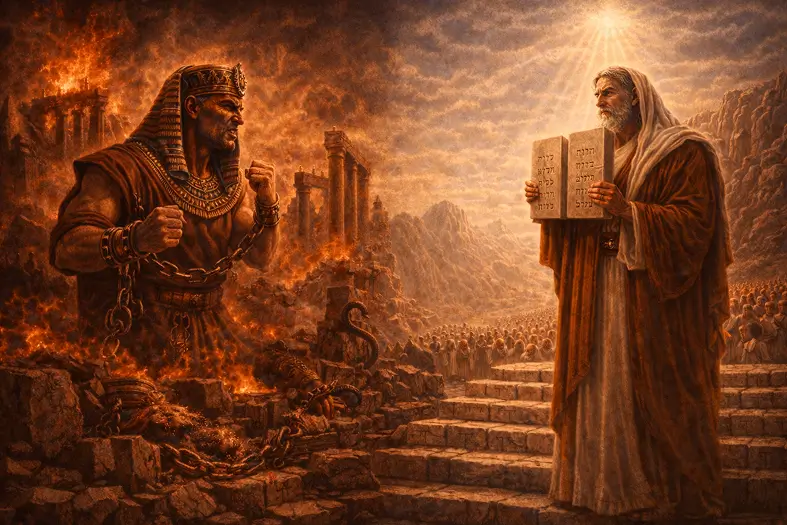
"Va’eira — Part V — Philosophical Synthesis"

Mitzvah Minute Logo Icon

5.1 - Freedom Defined: Rambam on Will, Responsibility, and Redemption

Tyranny and freedom through law
Why does Pharaoh remain enslaved even as his empire collapses? Drawing on the Rambam, this essay redefines freedom as moral responsibility rather than absence of constraint. Va’eira reveals that coercion does not destroy free will—evasion does. Pharaoh commands others but cannot command himself; Israel begins reclaiming freedom by accepting obligation before escape. Redemption, the Rambam teaches, requires restoring the human will so that truth binds action. Only such freedom can endure.

"Va’eira — Part V — Philosophical Synthesis"

5.1 - Freedom Defined: Rambam on Will, Responsibility, and Redemption

Parshas Va’eira forces a philosophical clarification that the Rambam later articulates with precision: freedom is not the absence of pressure, but the presence of responsibility. Egypt collapses under coercion, miracles, and devastation—yet Pharaoh remains unfree. Israel, still enslaved, begins to move toward freedom before leaving Egypt.

The difference lies not in circumstance, but in the condition of the will.

Rambam’s Core Principle: Freedom Is Moral Agency

The Rambam insists that human freedom consists in the ability to choose rightly when choice is costly. External force does not negate freedom; evasion of responsibility does.

In Rambam’s language, free will (bechirah chofshit) exists so that:

  • Command has meaning
  • Reward and punishment are just
  • Torah obligation is coherent

A will that refuses responsibility—even under clarity—is not free. It is defensive.

Pharaoh as Rambam’s Case Study

Va’eira presents Pharaoh as the paradigmatic unfree ruler. He commands an empire, yet cannot command himself.

Pharaoh’s pattern reveals the Rambam’s definition in negative:

  • He chooses relief over truth
  • Control over submission
  • Delay over obligation

Even when external pressure is removed, Pharaoh does not choose alignment. His will is reactive, not responsible.

This is why Rambam explains that hardening does not remove free will—it reveals its prior misuse. A will trained to evade obligation eventually loses flexibility.

Israel’s Early Movement Toward Freedom

Israel, by contrast, begins exercising freedom internally before political liberation. The Torah records:

  • Listening before understanding
  • Obedience before autonomy
  • Alignment before escape

Freedom begins where responsibility is accepted, not where constraint disappears.

This is why Sinai can only occur after Va’eira’s lessons. A people must first learn that freedom means answering to truth—not negotiating with it.

Freedom Is Not Choice Without Cost

Modern instinct equates freedom with option-expansion. Rambam rejects this entirely. A person flooded with options but unbound by obligation is not free—they are unstable.

True freedom requires:

  • A binding moral framework
  • Willingness to accept consequence
  • Commitment that survives pressure and relief

Without these, choice becomes impulse.

Why Pharaoh Cannot Become Free

Even when Pharaoh admits חָטָאתִי, Rambam would say the admission lacks freedom because it lacks responsibility. Pharaoh seeks outcome-change, not self-change.

Freedom would require Pharaoh to act against interest—to release control even when it hurts. He never does.

Thus, Pharaoh is not overpowered. He is exposed.

Redemption as the Restoration of Will

Va’eira teaches that redemption must rehabilitate the human will before altering political reality. Liberation without moral agency simply replaces one master with another.

This is why Hashem does not extract Israel instantly. The plagues are not merely punitive; they are formative.

They train a people to choose responsibility before autonomy.

Rambam’s Warning Embedded in Va’eira

The Rambam’s philosophy issues a warning that echoes throughout the parsha: a society can collapse externally and remain enslaved internally.

Freedom is fragile. It depends on fear of Hashem, acceptance of command, and resistance to delay.

Where these are absent, power increases but freedom diminishes.

The Bridge to the Next Stage

Part V begins the synthesis by defining freedom positively:

  • Not escape from pressure
  • Not dominance over others
  • Not endless choice

But submission to truth that binds the will.

Only such freedom can endure revelation, survive relief, and sustain redemption.

Va’eira is not the story of leaving Egypt.
It is the story of reclaiming the will.

And only a will trained in responsibility can cross the sea when it arrives.

📖 Sources

  • Full sources available on the Mitzvah Minute Parshas Va'eira page under insights and commentaries.

Organized by:
Boaz Solowitch
January 7, 2026
Mitzvah Minute Logo Icon

Connections

Mitzvah Minute Logo Icon

Mitzvah Links

Mitzvah 1

To know there is a G‑d
A Siddur
Learn this Mitzvah

Mitzvah 1

1
To know there is a G‑d

Mitzvah 5

To fear Him
A Siddur
Learn this Mitzvah

Mitzvah 5

5
To fear Him

Mitzvah 9

To listen to the prophet speaking in His Name
A Siddur
Learn this Mitzvah

Mitzvah 9

9
To listen to the prophet speaking in His Name

Mitzvah 11

To emulate His ways
A Siddur
Learn this Mitzvah

Mitzvah 11

11
To emulate His ways

Mitzvah 121

To afflict and cry out before G‑d in times of catastrophe
A Siddur
Learn this Mitzvah

Mitzvah 121

121
To afflict and cry out before G‑d in times of catastrophe
The Luchos - Ten Commandments
View Mitzvah Notes

Mitzvah Reference Notes

"x" close page navigation button

Mitzvah Reference Notes

“Freedom Defined: Rambam on Will, Responsibility, and Redemption”

Mitzvah #1 — To Know There Is a G-d

(Exodus 20:2)

אָנֹכִי ה׳ אֱלֹקֶיךָ

Rambam explains that true freedom begins with recognition of Divine sovereignty. Va’eira shows that knowledge of Hashem establishes the framework within which moral agency operates. Pharaoh knows Hashem’s power yet refuses its implications; Israel’s redemption begins when knowledge becomes binding rather than informational.

Mitzvah #5 — To Fear Hashem

(Deuteronomy 10:20)

אֶת־ה׳ אֱלֹקֶיךָ תִּירָא

Fear of Hashem is the discipline that stabilizes free will. Rambam teaches that without yirah, the will drifts toward impulse and evasion. Va’eira demonstrates that Pharaoh’s lack of fear leaves him reactive, while Israel’s developing yirah allows freedom to form internally before political liberation.

Mitzvah #9 — To Listen to the Prophet Speaking in His Name

(Deuteronomy 18:15)

אֵלָיו תִּשְׁמָעוּן

Freedom requires responsiveness to truth when it is articulated. Rambam emphasizes that prophecy addresses the will, not merely the intellect. Pharaoh hears Moshe but negotiates; Israel begins to listen as command. The mitzvah frames obedience as an expression of moral agency rather than coercion.

Mitzvah #11 — To Walk in His Ways

(Deuteronomy 28:9)

וְהָלַכְתָּ בִּדְרָכָיו

Hashem’s conduct in Va’eira—gradual escalation, restraint, and accountability—models responsible authority. Rambam understands freedom as alignment with this Divine pattern. Emulating Hashem means exercising will with discipline, not reacting to pressure or convenience.

Mitzvah #121 — To Cry Out to Hashem in Times of Distress

(Numbers 10:9)

וַהֲרֵעֹתֶם בַּחֲצֹרוֹת

Crisis tests whether free will turns toward responsibility or evasion. Pharaoh cries out to suspend suffering; Israel is being trained to cry out in submission. Rambam’s framework shows that freedom is preserved when distress produces alignment rather than manipulation.

Parsha Links

וָאֵרָא – Va’eira

Haftarah: Ezekiel 28:25 - 29:21
A Siddur
Learn this Parsha

וָאֵרָא – Va’eira

וָאֵרָא – Va’eira
The Luchos - Ten Commandments
View Parsha Notes
"x" close page navigation button

Parsha Reference Notes

“Freedom Defined: Rambam on Will, Responsibility, and Redemption”

Parshas Va’eira (Shemos 6:2–8; 7:1–5; 9:27–30)

Parshas Va’eira presents freedom as an internal condition long before it becomes a political reality. Hashem introduces redemption not as immediate release but as a process—וְהוֹצֵאתִי… וְהִצַּלְתִּי… וְגָאַלְתִּי… וְלָקַחְתִּי—indicating stages that correspond to transformation of the will, not merely removal of external bondage. The promise of becoming Hashem’s nation precedes physical liberation, framing freedom as covenantal responsibility rather than escape.

Pharaoh’s repeated admissions—חָטָאתִי הַפָּעַם—highlight the contrast. Despite recognizing truth, Pharaoh consistently chooses relief over obligation. Va’eira thus illustrates the Rambam’s principle that freedom is not negated by pressure, but by refusal to accept responsibility. Pharaoh’s heart is revealed as unfree precisely because it cannot choose alignment when it is costly.

Israel, by contrast, begins forming a free will while still enslaved. The parsha records instruction, differentiation, and gradual internal preparation, demonstrating that redemption must first restore moral agency. Va’eira teaches that without a will trained to submit to truth, liberation would collapse into chaos. Freedom emerges not when chains are broken, but when responsibility is embraced.

Mitzvah Minute
Mitzvah Minute Logo

Learn more.

Dive into mitzvos, tefillah, and Torah study—each section curated to help you learn, reflect, and live with intention. New insights are added regularly, creating an evolving space for spiritual growth.

Luchos
Live a commandment-driven life

Mitzvah

Explore the 613 mitzvos and uncover the meaning behind each one. Discover practical ways to integrate them into your daily life with insights, sources, and guided reflection.

Learn more

Mitzvah #

5

To fear Him
The Luchos - Ten Commandments
Learn this Mitzvah

Mitzvah Highlight

Siddur
Connection through Davening

Tefillah

Learn the structure, depth, and spiritual intent behind Jewish prayer. Dive into morning blessings, Shema, Amidah, and more—with tools to enrich your daily connection.

Learn more

Tefillah

COMING SOON.
A Siddur
Learn this Tefillah

Tefillah Focus

A Sefer Torah
Study the weekly Torah portion

Parsha

Each week’s parsha offers timeless wisdom and modern relevance. Explore summaries, key themes, and mitzvah connections to deepen your understanding of the Torah cycle.

Learn more

וָאֵרָא – Va’eira

Haftarah: Ezekiel 28:25 - 29:21
A Sefer Torah
Learn this Parsha

Weekly Parsha