Each Parsha page on Mitzvah Minute is designed as a guided, three-level journey through the weekly Torah reading—integrating the narrative, the mitzvos, and the classical commentaries into one unified experience.
Begin with the foundations of the Parsha:
This level gives you the storyline, the key mitzvos, and the essential connections between them.
A complete journey through the parsha—moving from clarity and depth to inner connection and real-world meaning, culminating in a way to live its ideas in everyday life.
These sections show how the Parsha speaks to the mind, the heart, and the real world — offering wisdom rooted in enduring Torah.
A complete, structured commentary on the parsha—presented pasuk by pasuk, with chapter and overall summaries for clarity and flow.
This level reveals the structural depth of the Parsha and the classical underpinnings of each theme.
Together, these layers create a complete Parsha journey —
narrative, mitzvah, and commentary — all flowing toward deeper understanding, spiritual insight, and meaningful growth.
Tap the Page Navigation tab on the right side of your screen anytime to access quick-links to the entire Parsha page.
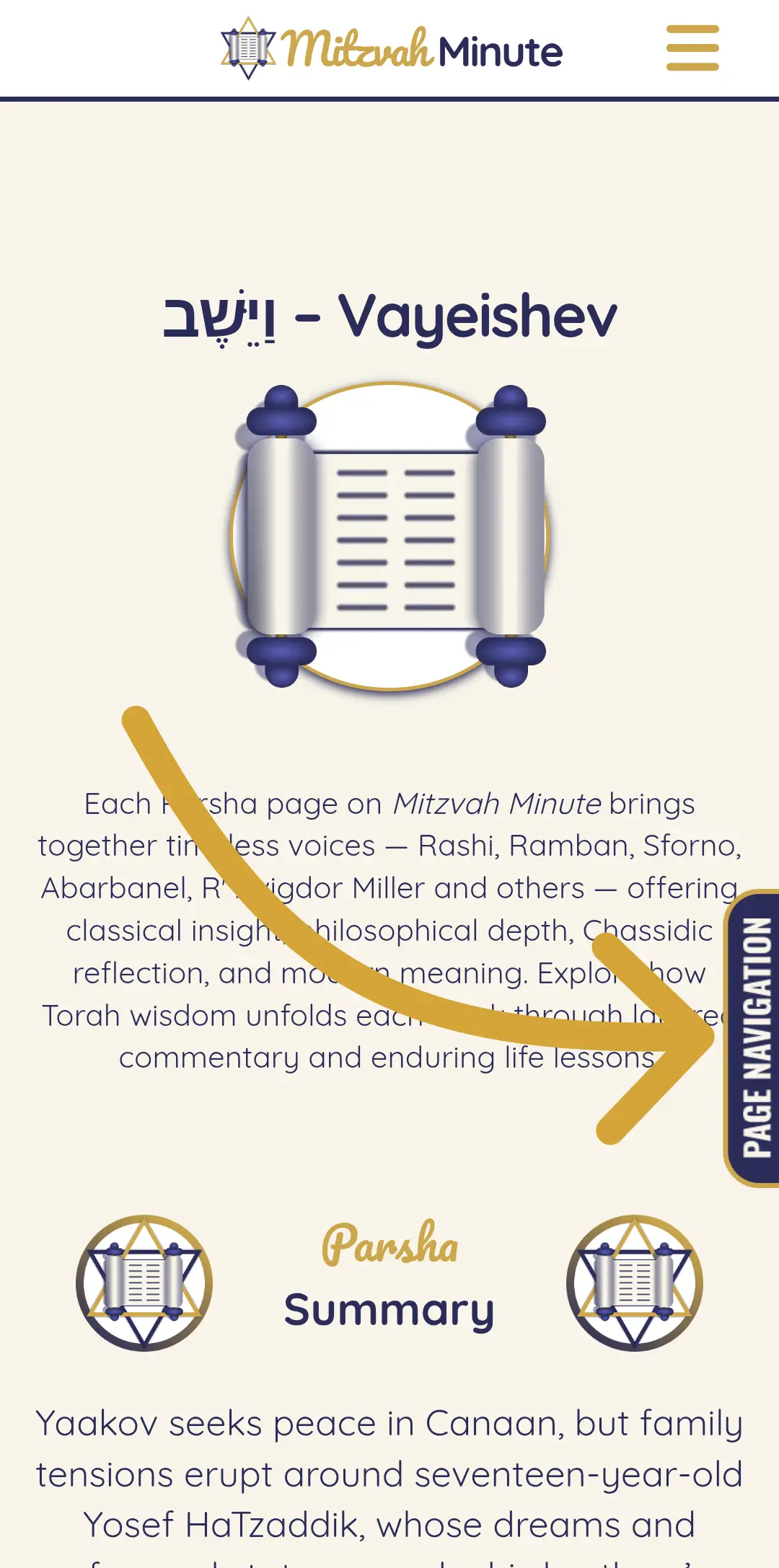
The quick-link panel gives instant access to every section — Parsha Summary, Mitzvos, Divrei Torah, Insights, and Commentaries.
“Every word of Torah and every mitzvah lifts us higher — may your learning bring you closer to Hashem.”

Parshas Tetzaveh continues the commands for the Mishkan by turning from its structure to its living service. The Jewish people are instructed to bring pure olive oil to keep the menorah burning continually, symbolizing an unbroken bond between Hashem and Yisrael. Aharon and his sons are then chosen for the kehunah, and the Torah describes in detail the sacred garments—crafted לְכָבוֹד וּלְתִפְאָרֶת—that they must wear while serving in the Mishkan. The parsha concludes with the seven-day ceremony of their consecration, including offerings, anointing, and sacred rituals that transform them into priests dedicated to lifelong Divine service, establishing the kehunah as a permanent institution within the nation.


"Living the Light: A Life of Steady Avodah"
לְהַעֲלֹת נֵר תָּמִיד
Parshas Tetzaveh opens with the command to bring pure olive oil “לְהַעֲלֹת נֵר תָּמִיד,” to kindle a continual light in the Menorah. This mitzvah establishes the daily avodah of illumination within the Mishkan, symbolizing the steady presence of Divine wisdom among Israel. Rashi emphasizes the purity of the oil, the exact measure for each lamp, and the nightly constancy of the service, teaching that holiness is sustained through disciplined repetition. Ramban highlights the western lamp as a symbol of unbroken Divine light, while the Chassidic masters interpret the Menorah as the inner flame of the Jewish soul, rising on its own once properly kindled. This mitzvah thus expresses the central message of Tetzaveh: the life of avodas Hashem is built not only on moments of inspiration, but on the faithful tending of a daily light.
וְעָשִׂיתָ בִגְדֵי קֹדֶשׁ לְאַהֲרֹן אָחִיךָ לְכָבוֹד וּלְתִפְאָרֶת
Parshas Tetzaveh devotes a central section to the design and purpose of the priestly garments. The Kohanim were commanded to perform the avodah only while wearing these sacred garments, which sanctified their service and distinguished them as servants standing before Hashem. The Torah describes the garments as being made “לְכָבוֹד וּלְתִפְאָרֶת,” expressing dignity and spiritual beauty appropriate to Divine service. The garments transformed the Kohen from a private individual into a representative of the nation before Hashem, teaching that holiness requires both inner devotion and outward form.
לֹא יִקָּרֵעַ
The Torah commands that the priestly garments be constructed in a manner that prevents tearing, and it forbids deliberately tearing them. The garments of the Kohanim represent the dignity and integrity of the avodah, and their wholeness reflects the honor of Divine service. This mitzvah teaches that sacred objects must be treated with reverence and care, preserving the integrity of what has been designated for Hashem’s service.
וְלֹא יִזַּח הַחֹשֶׁן מֵעַל הָאֵפוֹד
The Torah commands that the Choshen of the Kohen Gadol remain firmly attached to the Efod and never be separated. The breastplate carried the names of the tribes of Israel and represented the Kohen Gadol’s role as the spiritual representative of the entire nation. The permanent attachment of the Choshen to the Efod symbolizes the inseparable bond between leadership and responsibility, and between the Kohen Gadol and the people he serves.
וְאָכְלוּ אֹתָם אֲשֶׁר כֻּפַּר בָּהֶם
Parshas Tetzaveh describes the inauguration offerings of the Kohanim and commands that the sacrificial meat be eaten by the Kohanim in the sacred precincts. The eating of the korban is itself part of the avodah, completing the process of atonement and consecration. This mitzvah reveals that the service of the Mikdash extends beyond the altar itself and includes the sanctified participation of the Kohanim in the offerings.
וְנִקְדַּשְׁתִּי בְּתוֹךְ בְּנֵי יִשְׂרָאֵל
Parshas Tetzaveh centers on the sanctification of Hashem’s service through the Kohanim, their garments, and the constant light of the Menorah. The priestly vestments are made “לְכָבוֹד וּלְתִפְאָרֶת,” reflecting the glory of the Divine Presence among Israel. The Kohen’s service, carried out in purity, discipline, and dignity, becomes a living expression of Kiddush Hashem.
וַעֲבַדְתֶּם אֵת ה׳ אֱלֹקֵיכֶם
The entire structure of the Mishkan service reflects the concept of avodah—service before Hashem. The daily lighting of the Menorah and the constant service of the Kohanim form the root of what later becomes the service of prayer. Tetzaveh teaches that spiritual life is sustained not by inspiration alone, but by steady, structured service before Hashem.
כֹּה תְבָרֲכוּ אֶת בְּנֵי יִשְׂרָאֵל
Parshas Tetzaveh establishes the priesthood itself. Aharon and his sons are chosen, clothed, and consecrated to serve as Kohanim. Their role includes representing the people before Hashem and channeling blessing back to the nation. The garments, the inauguration rites, and the avodah all prepare them for this sacred function.
וְלֹא תָתוּרוּ אַחֲרֵי לְבַבְכֶם וְאַחֲרֵי עֵינֵיכֶם
The priestly garments discipline the senses and direct the mind toward holiness. The tzitz on the Kohen Gadol’s forehead, inscribed “קֹדֶשׁ לַה׳,” teaches constant awareness of the Divine. The garments are not decorative; they shape the consciousness of the wearer, reminding him to restrain impulses and focus on sacred purpose.
וְשִׁנַּנְתָּם לְבָנֶיךָ
The Kohanim are established in Tetzaveh as a family devoted to Divine service and spiritual leadership. As later verses describe, “כִּי שִׂפְתֵי כֹהֵן יִשְׁמְרוּ דָּעַת” (מלאכי ב׳:ז׳). Their separation from ordinary labor allows them to guide the people toward knowledge of Hashem, embodying the Torah’s model of spiritual teachers.
וְאָהַבְתָּ אֵת ה׳ אֱלֹקֶיךָ
The Menorah’s light symbolizes the love and connection between Israel and Hashem. Chassidic teachings explain that the light of the mitzvos illuminates the soul, and each commandment draws the person into deeper attachment to the Divine. The steady flame represents a love that endures through discipline and devotion.
אֶת ה׳ אֱלֹקֶיךָ תִּירָא
The bells of the Kohen Gadol’s robe announce his approach to the Sanctuary, reflecting the awe required when entering the presence of the King. The entire system of garments, rituals, and consecration teaches reverence, reminding both the Kohen and the people of the seriousness of standing before Hashem.
וְהָלַכְתָּ בִּדְרָכָיו
The Kohen represents a refined human being—disciplined in character, measured in conduct, and devoted to service. Through the structured avodah, the Torah presents a model of moral and spiritual refinement. By observing the Kohen’s life of order, dignity, and service, the nation learns how to shape its own conduct in the ways of Hashem.
אָנֹכִי ה׳ אֱלֹקֶיךָ
The Mishkan and its service exist to direct the people toward knowledge of Hashem. The continual light of the Menorah, the presence of the Kohanim, and the sanctity of the garments all function as living symbols of Divine presence among Israel, reinforcing awareness of Hashem’s reality.
שְׁמַע יִשְׂרָאֵל ה׳ אֱלֹקֵינוּ ה׳ אֶחָד
The centralized priesthood and unified service in the Mishkan prevent fragmentation of worship. Instead of multiple altars and scattered practices, the nation gathers around one sacred center, one priestly family, and one system of avodah, reinforcing the unity of Hashem.
וּבוֹ תִדְבָּק
The Kohanim serve as spiritual guides for the nation. By attaching themselves to those devoted to Torah and avodah, the people draw closer to Hashem. Tetzaveh establishes this model of spiritual leadership and communal attachment to those who live lives of holiness.
וְעָשׂוּ לָהֶם צִיצִת
The priestly garments demonstrate how clothing can serve as a reminder of spiritual purpose. Just as tzitzit remind a person of the mitzvos, the garments of the Kohanim remind them of their sacred mission. Tetzaveh teaches that even clothing can become a vessel for holiness and awareness.
וְהִתְוַדּוּ אֶת חַטָּאתָם
The inauguration offerings of the Kohanim include a bull that atones for the sin of the Golden Calf. Before they can serve as atoners for the people, they themselves must undergo a process of purification and atonement. Tetzaveh thus teaches that service begins with personal repentance.
שֵׁשֶׁת יָמִים תַּעֲשֶׂה מַעֲשֶׂיךָ
The structured rhythm of the Mishkan service mirrors the rhythm of sacred time. Just as the Menorah is lit in a fixed, consistent pattern, Jewish life is shaped by regular cycles of work and rest. The discipline of Shabbos reflects the same principle of structured holiness expressed in the avodah.
זָכוֹר אֶת יוֹם הַשַּׁבָּת לְקַדְּשׁוֹ
The Mishkan’s rituals teach that sanctity must be marked and articulated. Just as the Kohen’s garments and service distinguish sacred space from ordinary life, Kiddush and Havdalah distinguish sacred time. Tetzaveh reinforces the principle that holiness requires clear boundaries and conscious recognition.
וַהֲרֵעֹתֶם בַּחֲצֹצְרוֹת
The entire system of priestly service is designed to draw the people into closeness with Hashem, especially in times of need. The Kohen Gadol, through the Urim v’Tumim, serves as a channel for Divine guidance, reminding the nation that its ultimate strength lies in calling out to Hashem.
These mitzvos together reflect the central themes of Parshas Tetzaveh: disciplined service, sanctified leadership, structured holiness, and the steady light of a life lived before Hashem. They translate the priestly system of the Mishkan into a timeless program of avodah, guiding the individual and the nation toward purity, responsibility, and Divine closeness.

Rashi opens the parsha by focusing on the command for the Menorah’s oil and lighting, revealing how a short pasuk encodes a full halachic system. The oil must be “שֶׁמֶן זַיִת זָךְ” — pure, sediment-free oil, produced by pounding the olives rather than grinding them. Only the first, clearest oil was valid for the Menorah, while later extractions were reserved for meal-offerings (Menachos פו ע״א).
The command “לְהַעֲלֹת נֵר תָּמִיד” teaches that the Kohen must light the wick until the flame rises on its own (Shabbos כא ע״א). The word תמיד does not always mean uninterrupted continuity; rather, it can mean a regularly recurring service, as with the daily burnt-offering or the twice-daily meal-offering. Here it refers to the nightly lighting of the Menorah.
The measure of oil was precisely calculated: half a log per lamp, sufficient for even the longest winter nights. This same measure was used throughout the year, demonstrating the Torah’s insistence on exact, consistent practice (Menachos פט ע״א).
Through these details, Rashi shows that the Menorah service was defined by purity of materials, precision of measurement, and faithful daily repetition.
When the Torah commands the making of the priestly garments, Rashi emphasizes that the garments themselves effect the sanctification of the Kohen. The phrase “לְקַדְּשׁוֹ לְכַהֲנוֹ לִי” teaches that through these garments, Aharon becomes installed into the priesthood. The term כהונה itself denotes service.
Each garment carries a specific structure and purpose:
Rashi reconstructs the ephod carefully, showing that it consisted of three distinct components:
This structure allowed the breastplate to hang over the Kohen’s heart, secured both above and below so it would not swing loose.
The garments were not merely clothing; they were instruments of sanctification, transforming the wearer into a servant of Hashem.
Rashi devotes great detail to the construction of the ephod and the breastplate, demonstrating the Torah’s precision. The ephod was woven from threads combining gold with colored wool and linen, producing a strand of twenty-eight threads. The weaving was “מעשה חושב,” an artistic method in which the design appeared differently on each side.
The shoulder-stones bore the names of the tribes in birth order, six on each stone, serving as a memorial before Hashem (שמות רבה ל״ח:ח; סוטה ל״ו א).
The breastplate itself had two functions:
The Urim and Tumim were an inscription of the Divine Name placed inside the breastplate, which illuminated and completed its answers. In the Second Temple period, the breastplate existed, but the Divine Name was no longer present.
Thus, the breastplate represented both remembrance of Israel and the Divine clarification of judgment.
The robe beneath the ephod was made entirely of blue wool and surrounded by alternating pomegranates and golden bells. The bells rang as the Kohen Gadol moved within the Sanctuary.
Rashi explains the warning “וְלֹא יָמוּת” — so that he shall not die. From the negative, one infers the positive: when the Kohen performs the service wearing all the required garments, he lives. But if he serves lacking even one garment, he incurs death at the hands of Heaven (סנהדרין פ״ג).
The garments therefore form a complete system: sanctification, protection, and atonement.
The ציץ, the golden forehead plate, bore the words “קֹדֶשׁ לַה׳.” It atoned for impurity in the sacrificial blood or fats, rendering the offerings acceptable.
Rashi explains the phrase “וְהָיָה עַל מִצְחוֹ תָּמִיד”:
Another opinion holds that it only atoned while on his forehead, and therefore the Kohen had to touch it frequently to maintain awareness.
This teaches that holiness requires continual attention and mindfulness.
The inauguration offerings of Aharon and his sons served as their formal installation into the priesthood. The bull offering atoned for the sin of the Golden Calf, since it came from the same species.
The consecration ram, called an איל מלאים, resembled a peace-offering. It created harmony among:
Through these offerings, the priests were sanctified and installed into their eternal service.
Rashi concludes by stressing the gravity of the priestly garments and rites. Whenever the Torah uses the phrase “חֻקַּת עוֹלָם,” it indicates an eternal ordinance. Failure to perform the service with the required garments invalidates the service and incurs severe consequence.
Thus, the priesthood is not defined merely by lineage, but by proper consecration, garments, and service.
Across the parsha, Rashi highlights a single underlying principle: holiness in the Mishkan is achieved through precision, order, and faithful service.
Through Rashi’s lens, Parshas Tetzaveh reveals a world in which sanctity emerges from exact practice, disciplined structure, and constant devotion before Hashem.
📖 Source
Ramban begins by focusing on the Torah’s unusual wording: “וְאַתָּה תְּצַוֶּה” — “and you shall command.” He explains that throughout the Mishkan sections the Torah generally says “וְעָשִׂיתָ,” meaning Moshe would instruct others. Here, however, Moshe himself must command the people to bring the oil, inspect it, and ensure its purity. The oil is brought “אֵלֶיךָ,” to Moshe personally, because he is the examiner and organizer of the sacred service.
Ramban also disputes Rashi’s explanation of the phrase “נֵר תָּמִיד.” Rather than meaning something done regularly each night, Ramban cites the Sifre and Toras Kohanim to explain that “תָּמִיד” refers specifically to the western lamp, which burned continuously day and night. The other lamps burned from evening until morning, but the western lamp represented the constant Divine presence.
Thus, the opening command highlights two themes:
On the command “לְכָבוֹד וּלְתִפְאָרֶת,” Ramban explains that the priestly garments were modeled after royal clothing. The Kohen Gadol appeared as a kingly figure, clothed in garments of gold, techeiles, and purple, similar to royal attire described in Tanach (ישעיה ס״א:י׳; אסתר ח׳:ט״ו; תהלים מ״ה:י״ד).
But Ramban adds a deeper dimension: on the level of “דֶּרֶךְ הָאֱמֶת,” the garments reflect the glory of the Divine Presence dwelling among Israel. They are not merely for human honor, but for the splendor of Hashem’s presence, as expressed in verses such as:
This explains why the craftsmen had to be “חַכְמֵי לֵב” and work with proper intention. The garments were vessels of spiritual glory, not merely decorative clothing.
Ramban notes that the Torah shifts its language when describing the making of the garments. Earlier, Moshe is told “וְעָשִׂיתָ” — “you shall make,” meaning by command. But here the wise-hearted artisans themselves take the gold and materials directly.
This teaches:
Ramban compares this to the Temple workers in later generations, who were trusted without accounting because they acted faithfully (מלכים ב י״ב:ט״ז).
The Mishkan, therefore, was built not only with skill, but with integrity and trust.
Ramban strongly rejects Ibn Ezra’s view that the Urim ve’Tumim were physical objects made by craftsmen. He argues that:
Instead, Ramban accepts Rashi’s position: the Urim ve’Tumim were sacred Divine Names placed inside the doubled breastplate.
Through these Names:
This process was a form of Ruach HaKodesh:
In the Second Beis HaMikdash, when prophecy ceased, the Urim ve’Tumim also ceased, leaving only the Bas Kol.
Ramban frequently disputes Rashi’s interpretations of the priestly garments, grounding his arguments in language, halachah, and textual evidence.
On the me’il:
On the bells and pomegranates:
On the mitznefes:
These disputes show Ramban’s method:
Rashi explains the phrase “וְלֹא יָמוּת” as teaching the general rule that serving without garments incurs death. Ramban rejects this, arguing that the verse appears too early in the sequence of garments to teach such a rule.
Instead, Ramban explains that the bells served as an announcement when the Kohen entered the Sanctuary. Just as one cannot suddenly enter a king’s palace, the bells announced his arrival, like a servant calling out before entering.
He connects this to:
Thus, the bells reflect royal protocol and the awe of entering the Divine presence.
Ramban again disputes Rashi regarding the arrangement of the tzitz. Rashi describes a complex system of multiple strings. Ramban argues that the Torah mentions only one thread of techeiles, and therefore the structure must have been simpler.
According to Ramban:
This explanation preserves the simple meaning of the verses without multiplying threads or structures.
On the phrase “וּמִלֵּאתָ אֶת יָדָם,” Rashi explains that it means initiation into office. Ramban questions how the literal phrase “filling the hand” came to mean appointment, especially if derived from foreign customs.
Ramban instead explains that “מִלּוּי יָדַיִם” means completion or perfection. He supports this from verses where “מלא” refers to completion, such as:
Thus:
The “ram of milu’im” is therefore called so because it completes the priest’s capacity to serve.
In the inauguration rites, Ramban clarifies the sequence of actions. For example, he rejects Ibn Ezra’s claim that the anointing oil was poured before the mitznefes was placed on Aharon’s head. The narrative in Vayikra shows clearly that the mitznefes was already in place when the oil was poured.
He explains that:
This demonstrates Ramban’s method of reconciling commands with their later fulfillment.
Across Parshas Tetzaveh, Ramban presents the kehunah as a synthesis of royal dignity and Divine service.
Through linguistic precision, halachic reasoning, and symbolic depth, Ramban portrays the Kohen Gadol as a figure standing between heaven and earth, clothed in garments of sovereignty, sanctity, and spiritual perfection.
📖 Source
The parsha of Tetzaveh shifts from the physical structure of the Mishkan to the human beings who will serve within it. The garments of the Kohanim, the oil for the menorah, and the inauguration of the avodah all point to a deeper philosophical question: what kind of person is worthy to stand before Hashem? Through the lens of the Rambam, these themes reveal the Torah’s vision of human refinement, disciplined service, and the transformation of physical life into a vehicle for knowledge of the Divine.
Rambam consistently teaches that the goal of the Torah is the perfection of both the individual and society, leading ultimately to knowledge of Hashem and attachment to Him (Moreh Nevuchim III:27–28). Tetzaveh presents this goal not through abstract philosophy, but through the concrete training of the Kohanim and the order of the avodah.
At the center of Tetzaveh is the command:
שמות כ״ח:א
“וְאַתָּה הַקְרֵב אֵלֶיךָ אֶת אַהֲרֹן אָחִיךָ… לְכַהֲנוֹ לִי”
“And you shall bring near Aharon your brother… to serve Me as Kohen.”
The Rambam teaches that holiness is not an inherent mystical state, but the result of disciplined action, correct knowledge, and proper character (הלכות דעות א–ג). The Kohen represents the perfected human being, one who has:
The selection of Aharon and his sons reflects the Rambam’s view that spiritual leadership is not accidental. It requires training, structure, and constant refinement.
The priesthood thus becomes a living example of what the Rambam calls:
“תיקון המידות והדעות”
—the perfection of character and intellect.
The Torah commands that the Kohanim wear special garments:
שמות כ״ח:ב
“וְעָשִׂיתָ בִגְדֵי קֹדֶשׁ… לְכָבוֹד וּלְתִפְאָרֶת”
“And you shall make holy garments… for honor and for splendor.”
For the Rambam, external behavior and inner character are deeply connected. In הלכות דעות, he teaches that a person shapes his inner world through consistent outward actions. Habits form character.
The priestly garments therefore serve a philosophical function:
Just as a judge’s robe or a king’s crown shapes the consciousness of the wearer, the Kohen’s garments form his moral psychology.
The Torah is teaching that human beings are shaped by:
External structure leads to internal refinement.
The parsha describes the daily lighting of the menorah and the detailed process of the inauguration of the Kohanim.
שמות כ״ז:כ׳–כ״א
“לְהַעֲלֹת נֵר תָּמִיד”
“To raise a continual lamp.”
For the Rambam, repetition and order are essential to human perfection. The mitzvos are not random acts of devotion; they are a structured program designed to:
In the Moreh Nevuchim, the Rambam explains that the regularity of the korbanos and avodah trains the nation to recognize order, causality, and Divine wisdom (Moreh Nevuchim III:32).
The continual light of the menorah symbolizes:
Perfection is not achieved in moments of inspiration, but through daily, ordered service.
The Kohen Gadol wears the tzitz upon his forehead:
שמות כ״ח:ל״ו
“קֹדֶשׁ לַה׳”
“Holy to Hashem.”
For the Rambam, leadership is not primarily about charisma or emotion. The ideal leader is:
In הלכות מלכים, the Rambam explains that the king must embody wisdom, restraint, and fear of Heaven. The same principle applies to the Kohen Gadol. His role is to represent the nation before Hashem, which requires a life of:
The inscription “קֹדֶשׁ לַה׳” placed on his forehead symbolizes that his thoughts themselves must be dedicated to the Divine.
Chapter 29 describes the seven-day inauguration of the Kohanim, involving offerings, anointing, and ritual procedures.
For the Rambam, this reflects a central educational principle: people are shaped by repeated action. In הלכות תשובה ה:א, the Rambam emphasizes human free will and responsibility. A person becomes righteous through the choices he makes repeatedly.
The inauguration process serves as:
The Kohanim do not become holy instantly. They are formed through:
This reflects the Rambam’s broader belief that perfection is a gradual, deliberate process.
In the Rambam’s philosophy, the Mishkan is not an end in itself. It is a means to guide the people toward knowledge of Hashem.
The avodah trains the nation in:
Through the Kohanim and the daily service, the Mishkan becomes a national institution for spiritual education.
The goal is not the building, nor even the rituals themselves, but what they produce:
This reflects the Rambam’s teaching that the Torah’s ultimate purpose is:
“להביא בני אדם לשלמות האמיתית”
—to bring human beings to true perfection (Moreh Nevuchim III:27).
Tetzaveh teaches that holiness is not spontaneous. It is cultivated through structure, discipline, and repeated action.
Through the Rambam’s lens, the parsha reveals a profound philosophical system:
The Mishkan is therefore not merely a sacred space. It is a training ground for the perfection of the human soul, guiding individuals and the nation toward knowledge of Hashem and the fulfillment of their highest purpose.
📖 Sources
The Ralbag explains that the commands of Parshas Tetzaveh are not merely ritual instructions, but part of a carefully structured philosophical system. Each element of the avodah, the garments, and the priesthood exists to guide the human mind toward knowledge of Hashem and to sustain Divine providence among Israel. All of the mitzvos in this section serve clear intellectual and societal purposes.
He therefore presents both the conceptual goals of these commands and the practical halachic principles that emerge from them.
The command to light the menorah continually with pure olive oil serves multiple purposes.
The Ralbag notes that the benefit of this continual light had already been explained earlier, and here it also adds to the beauty and honor of the sanctuary, as the Rambam describes regarding the dignity of the Mikdash.
The continual lamp represents a structured, constant service that elevates the perception of the Mikdash and its role.
One of the central ideas in the parsha is that the Kohanim are a single, distinct family devoted exclusively to the service of Hashem.
The Ralbag explains that the ultimate purpose of the Mikdash and its service is:
Because this achievement is difficult and requires freedom from distraction, Hashem established a special family:
Since it would be impossible for the entire nation to be free from work, this role was assigned to a specific family. The rest of the people engage in labor and sustain both themselves and the priestly family through the prescribed gifts.
Hashem chose the tribe of Levi, and from them Aharon and his descendants, because they were the most suitable for this spiritual role. The Torah also emphasizes the lineage of Aharon to show the nobility of his family, unlike the children of Moshe, whose maternal lineage was Midianite.
The Torah itself describes the purpose of the Kohanim:
Thus, the priesthood functions as a class dedicated to knowledge, teaching, and spiritual leadership.
Another benefit of the priestly system is that the Divine service is centralized:
This stands in contrast to the practices of idolaters, who worshipped their gods in every city, as it says:
“כִּי מִסְפַּר עָרֶיךָ הָיוּ אֱלֹקֶיךָ יְהוּדָה”
“For according to the number of your cities were your gods, O Judah” (ירמיהו ב׳:כ״ח).
By concentrating the avodah in one sacred location and one priestly family, the Torah prevents the fragmentation and distortion that characterized idolatrous religion.
The Kohanim are commanded to wear special garments:
שמות כ״ח:ב
“לְכָבוֹד וּלְתִפְאָרֶת”
“For honor and for splendor.”
The Ralbag explains that these garments serve two purposes:
When the Kohen dons these sacred garments, he becomes aware that he has entered a state of holiness. This awareness prevents his thoughts from wandering and keeps his mind directed toward the service of Hashem.
Thus, the garments are not merely symbolic; they are psychological tools for concentration and reverence.
The garments of the Kohen Gadol, especially the ephod and the choshen, serve an additional purpose.
Divine providence accompanies those who cleave to Hashem, protecting them from harm and guiding them toward good. This providence can also manifest in knowledge of future events, as explained elsewhere by the Ralbag.
Because such providence can only attach to a small number of individuals, Hashem arranged that the most distinguished member of the priestly family would attain prophetic insight for the sake of the nation.
For this reason:
Through this constant contemplation of the tribes, the Kohen Gadol could receive Divine guidance concerning the needs of Israel.
The various elements of the Kohen Gadol’s garments also serve philosophical and psychological purposes.
The bells on the robe:
The robe is made entirely of blue (תכלת):
The precious stones in the choshen:
The Ralbag notes that prophets often required preparation to reach a prophetic state, as seen when Elisha requested music before receiving prophecy:
מלכים ב׳ ג׳:ט״ו
“וְעַתָּה קְחוּ לִי מְנַגֵּן… וַיְהִי כְּנַגֵּן הַמְנַגֵּן וַתְּהִי עָלָיו יַד ה׳”
The stones may have had properties that expanded the heart and activated the imagination, preparing the Kohen for prophetic insight.
The materials of the ephod and choshen—four types of threads—represent the four basic forms found in the lower world. Their sixfold strands, combined with a thread of gold, symbolize the six fundamental principles of existence, which ultimately derive from a higher, intellectual world whose source is Hashem.
This symbolism parallels other mitzvos such as:
which also teach about the structure of creation and the dependence of the world on its Divine source.
The inscription on the tzitz:
“קֹדֶשׁ לַה׳”
“Holy to Hashem”
teaches that all the garments are designed to guide the mind toward what is holy to Hashem—namely, the higher spiritual forms that emanate from Him.
Thus, the entire system of priestly garments serves a unified purpose:
The tzitz also serves a practical function: it atones for certain forms of impurity in the offerings.
Without this provision, many people—such as:
might remain unable to achieve full purification, eat sacred foods, or enter the Mikdash if hidden impurities invalidated their offerings.
Since such hidden impurity might not be known at the time of the offering, the tzitz bears the iniquity of the sacred offerings and ensures the completion of the purification process.
There is a distinction:
This reflects the higher level of responsibility expected of the Kohen, who must investigate matters of impurity more carefully than can be expected for the offering itself.
The anointing of Aharon and his sons and the offering of sacrifices during their inauguration serve an important psychological and spiritual function.
Without a tangible ceremony:
The inauguration rituals:
The accompanying offerings also atone for their sins, preparing them to atone for the sins of Israel.
The Ralbag concludes by listing eleven foundational halachic principles that emerge from these commands. These include:
These principles demonstrate that the philosophical system of the parsha is not abstract. It is expressed concretely in detailed halachic structure, ensuring that the ideals of intellectual perfection, reverence, and Divine service are embodied in daily practice.
According to the Ralbag, the mitzvos of Tetzaveh form a coherent philosophical system:
In this way, the entire priestly system is designed not only to perform sacred rituals, but to cultivate the intellectual and spiritual perfection of Israel.
📖 Source
(Baal Shem Tov · Kedushas Levi · Sfas Emes)
The Baal Shem Tov reveals a profound secret about the Urim v’Tumim placed inside the Choshen (שמות כ״ח:ל). The breastplate contained the twenty-two letters of the Hebrew alphabet. Yet the questions posed to the Kohen Gadol often required combinations of letters that were not visibly present. How then were answers received?
He teaches that each of the twenty-two letters contains within it all the other letters in potential form. When the Kohen stood in Ruach HaKodesh, the letters shone not only in their simple form, but also in their expanded spiritual forms. Through that illumination, the complete message emerged.
This reveals a central Chassidic principle:
Just as the letters shine to form answers, the hidden letters within the soul shine when a person enters a state of Divine awareness.
The Kedushas Levi asks the famous question: why is Moshe’s name absent from this parsha?
He explains that true wisdom is יראת ה׳—awe of Hashem (איוב כ״ח:כ״ח). When creation recognizes that all existence flows from one Source, even opposites—fire and water, day and night—are unified in that root. This awareness produces awe, and awe produces unity.
Moshe represents the highest level of this awareness. During the days of the Mishkan’s inauguration, he wore a simple white garment, symbolizing complete self-nullification. White has no color of its own; it receives all colors. So too, Moshe had no ego or personal identity at that level—only attachment to the Infinite.
Because this parsha centers on the priestly garments, which Moshe could only comprehend by nullifying himself entirely, his personal name disappears. This is not a punishment but a praise: he rose beyond individuality.
From here the Kedushas Levi teaches:
On the commandment of the oil for the Menorah—
שמות כ״ז:כ׳ — “וְיִקְחוּ אֵלֶיךָ שֶׁמֶן זַיִת זָךְ… לְהַעֲלֹת נֵר תָּמִיד”
The Kedushas Levi explains that the yetzer hara introduces improper desires and distracting thoughts. But the remedy is not merely suppression; it is transformation.
A person should say:
Through this reasoning:
Thus, the “beaten oil” symbolizes broken or fragmented thoughts being refined into light.
The Sfas Emes explains that the Menorah represents the light of mitzvos within the human soul. The Midrash says Hashem does not need the Menorah’s light; rather, Israel illuminates the world.
Each mitzvah draws Divine light into the body:
The word מצוה also means צוותא—connection. Through mitzvos:
Yet the Sfas Emes stresses a crucial truth:
When a person knows this, all Jews become equal, because the light does not come from personal greatness, but from the Divine will.
The Sfas Emes compares the Jewish people to olives. Just as olive oil does not mix with other liquids and always rises to the top, the inner Divine spark within a Jew never truly mixes with impurity.
But oil is released only through crushing. So too:
Even after sin or spiritual decline, the original “first drop” of devotion remains pure and can be rediscovered.
Another teaching of the Sfas Emes explains Rashi’s phrase:
“שתהא שלהבת עולה מאליה”—the flame should rise on its own.
He interprets this spiritually:
When a person performs mitzvos properly:
The Sfas Emes teaches that every Jewish soul contains a hidden inner point of holiness. Even in times of spiritual darkness, that spark remains.
Through effort, humility, and attachment to the spiritual root, that inner light can be uncovered again. The role of Moshe, the root of Torah-consciousness, is to reconnect the people to that hidden point.
The Sfas Emes explains the crowns of the Mishkan—the crown of Torah, priesthood, and kingship. Each represents a channel of Divine influence:
Together they form the destiny of Israel:
“ואתם תהיו לי ממלכת כהנים וגוי קדוש”—a kingdom of priests and a holy nation.
Across these Chassidic masters, one unified vision emerges:
Tetzaveh thus teaches that the Menorah is not only in the Mishkan.
It burns within the heart of every Jew.
📖 Sources
Parshas Tetzaveh is unique in the Torah. From the moment Moshe first appears in Sefer Shemos until the final chapters of Sefer Devarim, his name dominates the narrative. He is the liberator, the lawgiver, the prophet, the one who speaks with Hashem face to face. Yet in this parsha alone, his name is entirely absent. The Torah turns its attention instead to Aharon and his sons, to the priesthood, the sacred garments, and the service of the Mishkan. What appears at first to be a textual anomaly becomes, in Rabbi Jonathan Sacks’ reading, a profound statement about the nature of leadership, holiness, and the endurance of a people.
Tetzaveh marks a transition from the age of charismatic leadership to the establishment of enduring institutions. Moshe represents the prophet: the visionary, the one who challenges, inspires, and transforms. His leadership is personal, dramatic, and tied to singular historical moments. Aharon represents the priest: the guardian of continuity, the servant of sacred routine, the one who ensures that the flame of holiness burns steadily across generations. Where the prophet ignites the fire, the priest tends the lamp.
The priestly garments, described in great detail, seem at first glance to contradict the Torah’s usual suspicion of outward display. Throughout Bereishis, clothing is repeatedly associated with deception, betrayal, and moral confusion. Judaism is a faith that privileges the inner life over the outer appearance, the ear over the eye, the word over the image. Why, then, does the Torah command vestments “for glory and for beauty”?
Rabbi Sacks explains that these garments do not glorify the individual. They point beyond him. The priest is not honored for his personal charisma, wealth, or power. His garments are symbols of office, reminders that he serves something greater than himself. They are not about the glory of the priest, but about the glory of the Divine Presence dwelling among the people. In this way, the Torah transforms beauty into a language of holiness.
The absence of Moshe’s name thus becomes deeply meaningful. Tetzaveh is not about the heroic individual, but about the structures that outlive any individual. Charisma can ignite a movement, but it cannot sustain a nation across centuries. For that, there must be institutions, rituals, rhythms, and roles. The priesthood represents the routinization of charisma: the transformation of a moment of revelation into a stable, enduring form of service.
Yet Judaism never abandons prophecy. It retains both voices. The prophet speaks truth to power and calls the people to moral greatness. The priest sustains daily holiness through structure and service. Jewish life becomes a synthesis of both: inspiration and continuity, spontaneity and discipline, the fire of vision and the steady light of practice.
In this way, Tetzaveh teaches that true leadership is not measured by how brightly a person shines, but by how well he enables the light to continue after he is gone. Moshe ignites the soul of the nation. Aharon ensures that its flame becomes an eternal light.
At the heart of Parshas Tetzaveh is a striking and unexpected command. Aharon and his sons are to be dressed in special vestments, garments made “for glory and for beauty.” For the first time in the Torah, religious authority is marked by formal clothing, by visible symbols of sacred office. This is a surprising development. The Avos wore no special attire. Moshe, the greatest of the prophets, dressed simply. Throughout the Torah, physical appearance is rarely described, and clothing almost never carries positive meaning.
Indeed, in Sefer Bereishis, garments are repeatedly associated with deception and betrayal. Yaakov wears Eisav’s clothing to mislead Yitzchok. Yosef’s cloak becomes the instrument of deception used by his brothers. Tamar disguises herself in different garments to conceal her identity from Yehudah. Potiphar’s wife uses Yosef’s cloak to falsely accuse him. Even the very first clothing in the Torah appears after Adam and Chavah’s sin, when they sew coverings for themselves in the aftermath of their betrayal of Hashem’s command. The Hebrew word beged itself is linguistically connected to bagad, betrayal. Clothing, in these narratives, hides the truth rather than revealing it.
This is not accidental. Judaism is a religion that places emphasis on inwardness rather than appearances. When Shmuel is sent to anoint a king from among the sons of Yishai, he is drawn to Eliav because of his impressive stature. But Hashem rebukes him: “Man sees what is visible, but Hashem sees into the heart.” The Torah consistently teaches that external appearance can mislead, while true greatness lies in moral character and inner integrity.
In contrast, surrounding cultures often glorified external symbols of authority. Pharaoh dresses Yosef in royal garments and gives him a gold chain. Achashverosh parades Mordechai through the streets in royal robes. Empires used clothing, insignia, and visible displays of honor to exalt rulers and create rigid hierarchies. Such cultures, the Torah implies, often lost sight of the dignity of the individual and the moral worth of the powerless. When societies worship appearances, they risk confusing power with righteousness.
Why, then, does the Torah suddenly command special garments for the kohanim? Why introduce a visual symbol of religious authority in a tradition that otherwise downplays external display?
The answer lies in the nature of the priestly role. The garments of the kohen do not glorify the individual. They represent the office. The priest is not chosen for personal charisma or dramatic vision. He is not a prophet speaking the word of Hashem in moments of crisis. He is a servant of sacred continuity, maintaining the daily service of the Mishkan and later the Beis HaMikdash. His role is not to transform the people through inspiration, but to preserve their connection to holiness through steady, disciplined ritual.
In this context, the garments function differently from the clothing described in Bereishis or the royal attire of foreign courts. They are not instruments of deception or personal aggrandizement. They are symbols of a role that transcends the individual. The priest wears them not to elevate himself, but to point beyond himself. The garments signify that he stands in the service of something greater: the presence of Hashem among His people.
This idea is captured in the phrase that the garments are made “for glory and for beauty.” The glory and beauty do not belong to the priest. They belong to the Divine Presence that dwells among the nation. The kohen becomes a living symbol of transcendence, a reminder that the Jewish people stand in relationship with something beyond the visible world.
In this way, the Torah redeems the concept of clothing. What once symbolized deception is transformed into a symbol of holiness. External beauty is not rejected, but redirected. When it serves ego, it corrupts. When it serves the Divine, it elevates. The priestly garments teach that aesthetics, dignity, and visible beauty have a place in Judaism, but only when they become vehicles for sanctity rather than expressions of vanity.
Thus, the bigdei kehunah do not contradict Judaism’s emphasis on inwardness. They complete it. They show that even the external can become sacred when it reflects and serves the inner presence of holiness.
Parshas Tetzaveh marks a turning point in the Torah’s understanding of leadership. Until this moment, the dominant figure in the story has been Moshe — the prophet, the liberator, the lawgiver, the man of vision and revelation. His leadership is personal, dramatic, and transformative. He confronts Pharaoh, splits the sea, ascends Sinai, and brings down the Torah. He embodies what sociologists would later call charismatic authority: influence rooted in the force of personality, moral courage, and spiritual greatness.
Charismatic leaders change history. They articulate the hopes and fears of a people. They challenge injustice, inspire faith, and call others to greatness. They do not simply manage what exists; they bring something new into being. Moshe did not merely lead the Israelites out of Egypt. He reshaped them into a covenantal nation, bound to Hashem by law, faith, and destiny.
Yet charisma, by its very nature, is unstable. It is personal and cannot easily be transferred from one generation to the next. A movement built entirely on the personality of a single leader cannot survive that leader’s absence. When the charismatic figure disappears, the people are left without the structure needed to sustain what he began.
This crisis appears in dramatic form at the episode of the Golden Calf. The people panic when Moshe does not return from the mountain at the expected time. “This Moshe, the man who brought us up from Egypt—we do not know what has become of him.” Their faith had been tied too closely to the presence of a single individual. When he was gone, even temporarily, they felt spiritually abandoned. Charisma had inspired them, but it had not yet been transformed into enduring structure.
This is the deeper meaning of Parshas Tetzaveh. Here, the Torah introduces the priesthood: a form of leadership not based on personal vision, but on institutional continuity. The kohanim do not lead through dramatic speeches or prophetic confrontation. They serve through daily ritual, regular offerings, and precise, disciplined acts of worship. Their authority does not derive from their individual greatness, but from their role within an enduring office passed down through generations.
The priestly garments become the visible symbol of this transformation. They mark the shift from personal charisma to institutional authority. The kohen is not set apart by his personality, but by his vestments, his role, and his function within the sacred order. His garments signify that the office is greater than the individual who occupies it.
This process is what Max Weber called the “routinization of charisma.” A movement begins with a charismatic leader, but it survives only when that charisma is translated into stable forms: institutions, rituals, laws, and roles that endure beyond the lifetime of any one person. The priesthood represents precisely this transition. It takes the fire of Sinai and gives it a vessel that can preserve it across time.
The absence of Moshe’s name in Tetzaveh is therefore deeply symbolic. The parsha is not about the prophet. It is about what remains when the prophet is no longer present. It is about continuity rather than inspiration, structure rather than spontaneity, endurance rather than dramatic change.
Yet Judaism never chooses one model of leadership over the other. It preserves both. The prophet speaks truth to power, calls the nation to moral renewal, and keeps the service of Hashem from becoming empty routine. The priest sustains the daily rhythm of holiness, ensuring that faith is not dependent on fleeting moments of inspiration.
Without prophets, Judaism would lose its vision.
Without priests, it would lose its permanence.
The greatness of the Torah’s model is that it refuses to choose between them. It recognizes that a nation needs both the fire of charisma and the stability of institution. Moshe ignites the flame. Aharon and his sons ensure that it continues to burn, steadily and faithfully, from generation to generation.
Parshas Tetzaveh places Aharon and the priesthood at the center of the narrative, while Moshe’s name is absent. This shift is not merely literary; it reveals a fundamental duality within Judaism itself. From its earliest moments, the Torah presents two distinct forms of spiritual leadership and two different ways of serving Hashem: the path of the prophet and the path of the priest.
The prophet represents spontaneity, personality, and history. The priest represents structure, continuity, and sacred order. These two roles are not interchangeable. They operate in different domains, speak different languages, and shape the religious life of the nation in different ways.
The role of the priest is dynastic. It passes from father to son. The priest’s authority lies not in personal charisma but in the office he holds. He wears distinctive garments that mark his role. He serves in the sanctuary, removed from the ordinary life of the people, bound by special laws of purity and conduct. His service is precise, structured, and repetitive. Day after day, week after week, year after year, he performs the same sacred actions. He lives in cyclical time, where each day resembles the one before it. His task is to preserve holiness within the natural rhythms of life.
The prophet, by contrast, is not appointed by lineage or office. He is chosen by Hashem, often from unexpected backgrounds: a shepherd like Moshe or Amos, a farmer like Elisha. He wears no special garments, holds no formal rank, and receives no institutional honor. His authority comes from the word of Hashem that burns within him. Each prophet speaks in his own voice, with his own style. No two prophets are alike.
The prophet lives in covenantal time, not cyclical time. He responds to unique historical moments. He challenges kings, rebukes societies, and calls the people to repentance and renewal. The priest sanctifies nature. The prophet interprets history.
Their vocabularies differ as well:
Their actions also differ:
These two modes of spiritual life are not in conflict. They are complementary. The priest represents structure; the prophet represents spontaneity. The priest embodies continuity; the prophet embodies change. Without the prophet, Judaism would not be a religion of history, conscience, and moral challenge. Without the priest, it would not be a religion capable of endurance across generations.
This duality becomes especially clear in the nature of prayer. The Sages record a debate about the origins of daily prayer. One opinion holds that the Avos instituted the prayers: Avraham the morning prayer, Yitzchok the afternoon, and Yaakov the evening. According to this view, prayer is prophetic: spontaneous, personal, and rooted in the individual’s encounter with Hashem.
Another opinion holds that the prayers correspond to the daily sacrifices in the Beis HaMikdash. The morning and afternoon prayers mirror the daily offerings, while the evening prayer corresponds to the burning of the limbs through the night. According to this view, prayer is priestly: structured, communal, and part of an established sacred order.
This debate continues among the Rishonim. The Rambam maintains that prayer is a Biblical obligation, rooted in the prophetic tradition. Every individual is commanded to serve Hashem through personal supplication, even though the precise texts and times were later established by the Sages. The Ramban disagrees. He holds that prayer, except in times of national crisis, is not a Biblical command but a Rabbinic institution that replaced the sacrifices after the destruction of the Beis HaMikdash. In his view, prayer belongs to the priestly tradition of communal worship.
Remarkably, Jewish practice incorporates both views. Each Amidah is recited twice. First, the individual prays silently, standing alone before Hashem in personal supplication. This is the prophetic mode. Then the chazzan repeats the prayer aloud on behalf of the congregation. This is the priestly mode, a communal act that echoes the service of the Temple.
Thus, Jewish prayer becomes a synthesis of both traditions. It contains the spontaneity of the prophet and the structure of the priest. It is at once personal and communal, emotional and disciplined, historical and cyclical.
Parshas Tetzaveh, by focusing on Aharon and omitting Moshe’s name, reminds us that Judaism requires both forms of leadership. Moshe ignited the fire of faith. Aharon tended the flame. The prophet speaks the word of Hashem for this moment. The priest preserves the word of Hashem for all time.
One of the most striking features of Parshas Tetzaveh is the absence of Moshe’s name. From the moment he is introduced in Sefer Shemos until the closing chapters of the Torah, Moshe stands at the center of the narrative. Yet in this single parsha, devoted to the priesthood and the sacred garments, his name does not appear at all. The focus shifts entirely to Aharon, his older brother, and to the office of the Kohen Gadol.
Many explanations were offered by the commentators. Some connect the omission to Moshe’s plea after the sin of the Golden Calf: “If You do not forgive them, blot me out from the book You have written.” Even though the plea was conditional, the words of a tzaddik carry weight, and for one parsha his name is indeed “blotted out.” Others connect it to Moshe’s early reluctance at the burning bush, when he asked Hashem to send someone else. As a result, the priesthood was given to Aharon rather than to Moshe, and in the parsha devoted to the priesthood, Moshe’s name is absent.
Yet beyond these explanations lies a deeper message. Throughout Sefer Bereishis, the Torah tells a recurring story: the tension and rivalry between brothers.
Across these narratives, the Torah traces a slow moral progression. Brotherhood begins in violence and jealousy, but gradually moves toward reconciliation and coexistence. By the end of Bereishis, the possibility of peace between brothers has begun to emerge.
But the story does not end there. There is a fifth chapter: the relationship between Moshe and Aharon. For the first time, there is no rivalry at all. The two brothers work together from the very beginning of the mission to redeem the Israelites.
They stand side by side:
They share leadership, each bringing a different strength. Moshe is the prophet, the man of truth, the bearer of Hashem’s word. Aharon is the man of peace, the one who reconciles, unites, and serves the people. Their roles are different, but they are not in conflict. Instead, they complement one another.
The Torah hints at this unity in a remarkable passage describing their genealogy. The text refers to them twice, once as “Aharon and Moshe,” and again as “Moshe and Aharon.” Even more striking, the verse uses the singular form: “He was Aharon and Moshe… He was Moshe and Aharon.” Grammatically, it should have said “they were,” but instead it speaks of them as though they were one person.
The implication is profound. They functioned as a single unit. There was no hierarchy between them. Sometimes Aharon’s name comes first, sometimes Moshe’s. Their greatness lay not in competing for honor, but in honoring one another.
The Midrash captures this beautifully by linking them to the verse: “Kindness and truth meet together; righteousness and peace kiss each other.”
Moshe represents truth and vision. Aharon represents peace and unity. Without truth, a nation has no direction. Without peace, it cannot endure. Both are necessary. Their partnership is the first true example in the Torah of brothers working together without jealousy or rivalry.
This is why Aharon is the central figure in Parshas Tetzaveh. It is not merely that Moshe is absent. It is that Aharon’s presence is being honored. Just as Aharon made space for Moshe’s leadership, the Torah makes space for Aharon to stand at the center, unshadowed by his younger brother.
The Midrash connects this idea directly to the priestly garments. When Moshe was first sent to redeem the people, Hashem told him that Aharon would rejoice when he saw him. Because Aharon felt no envy and took joy in his brother’s greatness, he merited to wear the choshen, the breastplate with the Urim and Tumim, over his heart. The heart that rejoiced in another’s greatness was worthy to bear the symbols of Divine guidance.
This expresses a timeless principle: true honor belongs to those who honor others. Aharon honored Moshe. Therefore he was granted honor in return. To this day, a Kohen is called first to the Torah — the Torah that Moshe gave to the people.
In the long drama of sibling relationships in the Torah, Moshe and Aharon represent the culmination: fraternity without rivalry, partnership without jealousy, leadership without competition. That is why, in this parsha, the Torah steps back from Moshe’s greatness and allows Aharon to stand in the light.
Parshas Tetzaveh opens with a simple but evocative command: the Jewish people are to bring “pure olive oil, crushed for the light,” so that the menorah may burn continuously. This image — oil produced through crushing, light emerging from pressure — becomes, in Rabbi Jonathan Sacks’ reading, a profound metaphor for the spiritual life of the Jewish people.
Chazal compare Israel to the olive. The olive, at first, is bitter. Only after processing does it become sweet. More importantly, it yields its precious oil only when it is crushed. So too, the Jewish people often reveal their deepest spiritual strength precisely in times of hardship. Under pressure, the hidden oil of faith emerges, producing the light that illuminates the world.
Yet Judaism never romanticizes suffering. The Sages, when asked whether afflictions are precious, answered, “Neither they nor their reward.” Pain is not to be sought, glorified, or explained away. When suffering strikes, it can shake faith, lead to despair, or provoke protest. Even the greatest figures in the Torah questioned Hashem in times of anguish. Avraham asked, “Shall the Judge of all the earth not do justice?” Moshe cried, “Why have You done evil to this people?”
The question, however, is not ultimately “Why did this happen?” That question reaches beyond human understanding. We are not meant to comprehend all the workings of Divine providence. The more fruitful question is: “Given that this has happened, what does Hashem want me to do now?”
The answer lies not in speculation, but in action. Suffering becomes spiritually transformative when it leads to chessed, compassion, and moral growth. Instead of hardening the heart, it can soften it. Instead of leading to bitterness, it can lead to kindness. Instead of extinguishing faith, it can deepen it.
The image of the crushed olive teaches this lesson. When the olive is pressed, it does not produce darkness. It produces light. So too, a person or a people who endure hardship can respond by bringing illumination into the lives of others.
This transformation requires profound faith. It is not the natural reaction to pain. One response to suffering is despair. Another is stoic endurance — the strength to bear what cannot be changed. But there is a higher possibility: to transform suffering into an instrument of love, kindness, and spiritual radiance.
In this sense, the menorah’s light becomes a symbol not only of the Divine Presence, but of the human response to adversity. The light in the Mishkan, later in the Beis HaMikdash, and ultimately in every Jewish home and act of holiness, is fueled by oil that has been crushed. The light of faith does not deny the reality of pain. It emerges from it.
Thus, the opening image of Tetzaveh teaches a life-defining lesson. When faced with hardship, the question is not “Why did this happen?” but “What light can I now bring into the world?” Faith does not remove the darkness. It gives us the power to illuminate it.
At the center of Parshas Tetzaveh stands the figure of the Kohen Gadol, clothed in garments of “glory and beauty,” carrying the names of the tribes on his shoulders and over his heart. He represents sacred authority, but the Torah’s presentation of that authority is deeply counterintuitive. The priest’s garments are magnificent, yet their purpose is not to glorify the individual. They are meant to direct attention away from the person and toward the Divine Presence he serves.
This reflects one of the most important ethical teachings about leadership: true leaders do not seek space for themselves; they create space for others. Leadership in the Torah is not about dominance, prestige, or self-display. It is about responsibility, service, and the ability to honor the dignity of others.
This idea is embodied in the relationship between Moshe and Aharon. Throughout the Torah, their partnership stands as the first example of brothers who lead together without rivalry. Moshe is the prophet, the voice of truth, the man of vision. Aharon is the man of peace, the one who unites the people and restores harmony. Their greatness lies not in competition, but in mutual respect. Each makes room for the other.
The Torah itself reflects this dynamic. In Parshas Tetzaveh, Moshe’s name disappears, allowing Aharon to stand at the center. Just as Aharon rejoiced in Moshe’s greatness, the Torah now honors Aharon by giving him a parsha in which he is not overshadowed by his younger brother. Leadership becomes an act of generosity, a willingness to step back so that another can step forward.
This principle is captured in the teaching of Ben Zoma: “Who is honored? One who honors others.” Aharon becomes worthy of the priesthood precisely because he did not envy Moshe. When he heard that his younger brother had been chosen to lead, “his heart rejoiced.” Because his heart made space for another’s greatness, it became worthy to bear the choshen, the breastplate with the Urim and Tumim, the symbols of Divine guidance.
Holiness, in this sense, is not about status. It is about responsibility. The priest’s garments are not decorations of privilege; they are signs of duty. The Kohen Gadol carries the names of the tribes of Israel over his heart. He does not stand above the people; he carries them with him. His role is to represent them before Hashem, to serve as a living bridge between the nation and the Divine Presence.
This transforms the very meaning of sacred authority. In many cultures, religious or political leaders were exalted figures, elevated above the people and surrounded by symbols of power. In the Torah’s vision, the highest religious figure is defined not by domination, but by service. His garments symbolize not his greatness, but his task: to bear the people, to represent them, and to serve Hashem on their behalf.
The same principle extends beyond the priesthood to all forms of leadership. The true leader does not seek honor; he gives honor. He does not concentrate power; he distributes it. He does not claim space; he makes space. Leadership, in this sense, is an act of humility and generosity.
Thus, the priestly garments teach an ethical lesson as well as a ritual one. They remind us that holiness is not about being elevated above others, but about elevating others. The holiest leader is the one whose heart has room for the greatness of those around him.
One of the recurring insights in Rabbi Jonathan Sacks’ reading of Parshas Tetzaveh is that holiness is not sustained by moments of inspiration alone. It depends on structure, discipline, and faithful routine. The priesthood represents this truth in its purest form.
The prophet is the figure of inspiration. He appears at critical moments in history, challenges the people, rebukes kings, and calls for moral renewal. His words are passionate, spontaneous, and often disruptive. He ignites change.
The priest, by contrast, lives in a world of repetition. His service is carefully structured and precisely regulated. He performs the same offerings, in the same place, at the same times, day after day, year after year. His task is not to transform the nation through dramatic vision, but to sustain its relationship with Hashem through steady, disciplined acts of service.
This contrast reflects a broader truth about spiritual life. Great achievements require both inspiration and effort. Vision without discipline fades quickly. Inspiration without structure cannot endure. The fire of a great moment must be given a vessel if it is to survive.
Parshas Tetzaveh therefore shifts the Torah’s focus from the dramatic moments of redemption and revelation to the quiet, ongoing work that preserves their meaning. The menorah must be lit every day. The garments must be worn according to exact instructions. The service must follow a precise order. Holiness is sustained not only through extraordinary events, but through daily acts of faithfulness.
This is the deeper significance of the priestly role. The kohen embodies what might be called the sanctity of routine. He teaches that spiritual life is not built only on great experiences or emotional highs. It is built on consistency: prayer said each day, mitzvos performed regularly, acts of kindness repeated again and again.
In this sense, Judaism is a religion of both inspiration and perspiration. It values the prophetic moment, but it also honors the steady labor that turns inspiration into lasting reality. The great visions of the Torah are preserved not only by prophets, but by those who serve faithfully in the rhythms of everyday holiness.
The priesthood therefore represents the transformation of inspiration into structure. Moshe ignites the flame. Aharon and his sons ensure that it continues to burn. The prophetic fire must become the steady light of the menorah, tended day after day, so that it never goes out.
This lesson extends far beyond the Mishkan. Every area of life reflects the same truth. Relationships, communities, and spiritual growth are not sustained by occasional bursts of passion. They endure through commitment, habit, and repeated acts of care. What keeps a marriage strong, a community united, or a faith alive is not a single dramatic moment, but the quiet faithfulness of daily practice.
Thus, Parshas Tetzaveh teaches that the highest form of holiness may not lie in the rare moment of revelation, but in the steady discipline of sacred routine. Inspiration lights the flame. Structure keeps it burning.
Parshas Tetzaveh reveals one of the deepest patterns in Jewish history: the movement from charismatic inspiration to enduring continuity. Moshe, the prophet, ignites the spiritual fire of the nation. He confronts Pharaoh, ascends Sinai, and brings the Torah to the people. His leadership is dramatic, personal, and transformative. It changes the course of history.
But a people cannot live forever on moments of revelation alone. Inspiration can ignite the flame, but it cannot sustain it. For a nation to endure, holiness must be built into daily life. It must take the form of institutions, roles, rhythms, and sacred routines. That is the work of the priesthood.
Aharon and his sons represent continuity. They serve not through dramatic speeches or prophetic visions, but through steady, disciplined acts of worship. They light the menorah each day. They offer the korbanos in their appointed times. They wear garments that symbolize not their own greatness, but the presence of the Divine among the people. Their service transforms the fire of revelation into a light that can burn from generation to generation.
This is the meaning of the absence of Moshe’s name in Tetzaveh. The parsha is not about the leader who changes history, but about the structures that preserve his legacy after he is gone. Charisma begins a movement. Institution sustains it. Moshe represents the fire of vision. Aharon represents the vessel that preserves that fire.
Judaism, however, never chooses one over the other. It preserves both the prophetic and the priestly voices. The prophet challenges complacency, speaks truth to power, and calls the nation back to its moral purpose. The priest maintains the daily rhythm of holiness, ensuring that faith does not depend on fleeting moments of inspiration. Without prophets, Judaism would lose its vision. Without priests, it would lose its endurance.
Over time, this balance gave rise to one of Judaism’s most remarkable transformations. After the destruction of the Beis HaMikdash, the priesthood could no longer function in its original form. Yet holiness did not disappear. Instead, it was democratized. Prayer replaced sacrifice. The synagogue became a miniature sanctuary. Through halachah, every detail of daily life became a site of Divine service.
In this way, the original model of the priesthood — the routinization of charisma — was eventually reversed. Judaism became the charismatization of routine. Holiness was no longer confined to a sanctuary or a priestly class. It was woven into the fabric of everyday life. Every Jew, in prayer, mitzvos, and acts of kindness, became in some sense a bearer of sacred light.
The menorah in the Mishkan burned with oil that had been crushed. So too, the Jewish people carried their light through exile, hardship, and history. The fire of Sinai, kindled by Moshe, was preserved by generations of quiet, faithful service — the spiritual heirs of Aharon.
Tetzaveh thus teaches a lasting truth about leadership, faith, and the life of a people. Great leaders inspire. But the true measure of their greatness is whether the light continues after they are gone. Moshe lit the fire. Aharon tended the flame. And through that partnership, the Jewish people became a nation capable of carrying an eternal light.
📖 Source
Rav Kook’s teachings on Parshas Tetzaveh revolve around a single, unifying vision: the transformation of external form into inner holiness. The priestly garments, the golden crown, the light of the Menorah, and even the sanctity of the Temple Mount all point toward the same spiritual truth. Holiness is not merely ritual structure or outward dignity; it is the revelation of an inner light that harmonizes body and soul, individual and nation, sacred and secular.
In Tetzaveh, the Torah describes clothing, crowns, oil, and sanctuaries. Rav Kook reads these not as technical details, but as symbols of the inner spiritual process through which humanity and the Jewish people become vessels for Divine light.
The command to bring pure, crushed olive oil “to raise up a constant flame” teaches a central spiritual principle. The Sages explain that the oil and wick must be of such quality that the flame rises on its own, without constant adjustment.
Rav Kook interprets this as a metaphor for the human being.
If the body is drawn excessively to material pleasures, the intellect cannot illuminate it. Wisdom will remain external, never penetrating the heart. The body must be refined so that it cooperates with the soul, allowing the light to shine naturally and steadily.
Similarly, not all forms of knowledge produce moral and spiritual growth. The oil must be of a type that is easily absorbed by the wick. So too, the mind must be nourished by a wisdom that guides life toward holiness. That wisdom is the Torah, which shapes both thought and action.
This harmony is the essence of Shabbos and of spiritual life itself: when body and soul, action and understanding, are aligned, the flame of holiness rises naturally.
The connection the Sages draw between the Shabbos lights and the Temple Menorah reveals another dimension of this teaching. Shabbos represents the spiritual refinement of the individual, while the Menorah represents the spiritual life of the nation.
In many societies, individuals may seek justice and morality, while the nation as a whole pursues power, wealth, and domination. The Jewish vision is different. The aspirations of the individual and the nation must be one and the same, both guided by the Torah.
Just as the Menorah requires oil and wicks that burn smoothly, so too the national life of Israel must be guided by a wisdom that penetrates reality and directs it toward goodness. The nation’s light must rise naturally from its inner moral structure, not from artificial or imposed ideals.
Parshas Tetzaveh is unique in that Moshe’s name does not appear. Rav Kook explains this absence through a profound spiritual distinction between Moshe and the kohanim.
Clothing, in its deepest sense, is a concession to human weakness. The very word beged is linked to bagad, betrayal. Before the sin of Adam, there was no need for clothing. Garments came into existence only after the loss of humanity’s original purity.
The priestly garments themselves atone for specific sins. They testify to the spiritual dissonance within human beings. The kohen must wear them in order to serve, because his spiritual life is not identical with his physical existence.
Moshe, however, stood on a higher level. He was not defined by his clothing or by a particular role. He was, in essence, an eved Hashem — a servant of G-d at every moment. When he performed the dedication service of the Mishkan, he wore a seamless white robe, almost indistinguishable from his own being. His Divine service was not an external duty, but his very nature.
Thus, Moshe asked to be removed from the section dealing with priestly garments. He was not connected to the need for clothing as atonement. His life was already unified with holiness.
Among the garments of the Kohen Gadol, the golden tzitz stands out. Engraved with the words “Holy to G-d,” it rests upon the forehead, the seat of human will.
For Rav Kook, the placement of the tzitz is deeply symbolic. It stretches from ear to ear, encompassing both forms of listening:
The tzitz unites these two dimensions. It channels lofty spiritual ideals into the will, so that they become real actions in the world. At the same time, it allows engagement with the material world to enrich spiritual insight.
The Kohen Gadol thus becomes a bridge between heaven and earth, spirit and matter, G-d and humanity. His role reflects the deeper mission of the Jewish people: to unify the physical and the spiritual into one harmonious whole.
The holiness of the Temple Mount reflects another aspect of this unifying vision. Rav Kook analyzes the dispute between Rambam and Ra’avad regarding whether the sanctity of the Temple Mount remains after the destruction of the Temple.
The debate turns on a fundamental question: is the Temple Mount merely a vehicle for mitzvos, like a tallis or lulav, whose holiness ends when its use ends? Or is it an object of intrinsic holiness, like tefillin or a Sefer Torah, whose sanctity remains even after its function ceases?
According to Rambam, the holiness of the Temple Mount is rooted in the Shechinah itself, and therefore it can never be nullified. According to Ra’avad, its sanctity was conditional and expired with the Temple’s destruction.
Rav Kook explains that the core of the dispute lies in the phrase “וְנִקְדַּשׁ בִּכְבֹדִי” — “sanctified by My honor.” If this honor refers to human reverence, then the sanctity is dependent on the Temple’s functioning. If it refers to the Divine Presence itself, then the holiness is eternal.
In practice, Rav Kook emphasizes a posture of reverence and distance. Just as we draw closer to G-d by recognizing His transcendence, so too we draw closer to the Temple Mount by respecting its holiness and not approaching it improperly.
Clothing, Rav Kook explains, has two functions.
Animals possess natural coverings, but human beings use clothing to express inner values. Modest dress, tefillin, and tzitzis all elevate a person’s consciousness and connect him to the Divine.
The story of King David illustrates this principle. Because he once cut the edge of Shaul’s cloak, treating it with disrespect, he was later punished by being unable to derive warmth from clothing. By belittling the ethical dimension of clothing, he lost even its physical benefit.
Clothing has value not because it protects the body, but because it elevates the soul.
The story of the convert who wished to become the Kohen Gadol illustrates two essential traits in spiritual life: strictness and humility.
Shammai rejected the convert because his aspiration was superficial, based on the external honor of the priestly garments. His goal lacked depth and realistic grounding.
Hillel, however, saw beneath the surface. The man’s desire to become the High Priest reflected a genuine longing for closeness to G-d. Though his understanding was flawed, the inner spark was real. Through Torah study, he would come to recognize the true dignity of serving G-d through mitzvos.
Rav Kook explains that both approaches are necessary:
The convert’s journey shows how external attraction can lead to inner transformation.
The tzitz bore the inscription “Holy to G-d.” The Sages taught that the words were written in two lines, while historical testimony suggested they appeared in one.
Rav Kook explains that this reflects two spiritual perspectives.
In ordinary life, we see the world divided between kodesh and chol, the sacred and the profane. Human development depends on maintaining this distinction.
But beyond these two realms lies a higher level: kodesh kodashim, the Holy of Holies. At this level, sacred and secular are revealed as parts of a single Divine reality. Each supports and completes the other.
From this higher perspective, the words “Holy to G-d” could be written on one line, expressing their unity. But in practical life, they must be separated, preserving the distinction between sacred and secular that guides moral growth.
Across all seven essays, Rav Kook presents a unified vision of holiness.
In every case, the outer form exists to reveal an inner light. The garments, the crown, the flame, and the sanctuary are all vessels for a deeper spiritual reality.
Holiness, in Rav Kook’s vision, is the process by which all aspects of life — body and soul, individual and nation, sacred and secular — are harmonized and elevated, until the inner light of the Divine rises naturally and shines through the world.
📖 Sources
Parshas Tetzaveh is the Torah’s training manual for a life of steady avodah. It does not begin with dramatic miracles or thunderous revelation, but with pure oil, careful garments, measured rituals, and the quiet light of a lamp that burns night after night. The parsha teaches that holiness is not built in moments of inspiration alone; it is built through consistency, dignity, attention, and prayer. The Mishkan becomes a model not only for sacred space, but for the human soul living in the ordinary rhythms of modern life.
The Torah commands: “שֶׁמֶן זַיִת זָךְ… לְהַעֲלֹת נֵר תָּמִיד”—pure olive oil to raise a constant light. The emphasis is not on brilliance, but on steadiness. Night after night, the same flame must burn. The avodah of the Menorah is not about emotional highs; it is about reliable illumination.
In our world of shifting schedules, notifications, and endless distraction, this teaching feels more relevant than ever. Many people wait for the perfect mood to daven, learn, or do a mitzvah. Tetzaveh teaches the opposite: the light comes from constancy, not inspiration.
In practical terms:
The garments of the Kohanim are described as “לְכָבוֹד וּלְתִפְאָרֶת”—for honor and beauty. But the Torah’s vision of beauty is not ego or fashion. It is dignity in service. The clothing reminds the Kohen—and everyone who sees him—that he is standing before Hashem, carrying responsibility for the people.
In modern life, appearance is often about self-expression or social status. Tetzaveh offers a deeper idea: the way we dress, speak, and present ourselves can shape our inner world.
Think about the difference between:
External form influences internal state. The Torah is teaching that structure and dignity can elevate the soul.
Practical applications:
The Choshen, the breastplate of judgment, carried the names of the tribes and served as the instrument of Divine guidance. It represented clarity, responsibility, and the weight of decision-making.
Today, we may not have the Urim v’Tumim, but we still face difficult choices—career decisions, relationship struggles, financial dilemmas, moral conflicts. The parsha teaches a process of clean judgment.
In real life, that might look like:
The Kohen carried the names of the tribes on his shoulders. Leadership meant carrying others, not only oneself.
So too in our lives:
The golden tzitz on the Kohen Gadol’s forehead bore the words “קֹדֶשׁ לַה׳”—holy to Hashem. It rested in the place of thought and attention, reminding the Kohen that his mind itself must be directed toward holiness.
In today’s world, the greatest battle is often not external temptation, but internal distraction. Our attention is constantly pulled in a hundred directions.
Tetzaveh suggests a different way to live: holiness as attention-management.
You might try:
Rav Kook teaches that life is a journey from separation between sacred and mundane toward a higher unity—where all of life becomes holy. But that unity comes only after we learn to respect boundaries and distinctions.
The Kohen Gadol’s robe had bells that rang as he entered and as he left the sacred space. The sound marked both the beginning and the end of the avodah.
This teaches a quiet but powerful truth: the end of an action reveals the sincerity of the beginning.
In modern life:
Try this as a weekly practice:
Tetzaveh teaches a model of leadership that is quiet, structured, and enduring. It is less about the dramatic hero and more about the steady flame that burns day after day.
In our world, recognition often feels like the goal. We measure success by visibility, followers, and applause. The parsha offers another vision: the highest service may be the work that no one sees.
You can live this teaching by:
Sometimes, the deepest avodah is not to be the flame—but to tend it.
Tetzaveh’s proximity to Purim highlights a core message: the true power of the Jewish people is tefillah—“בְּכׇל קָרְאֵנוּ אֵלָיו,” whenever we call out to Him.
In modern life, we are trained to solve problems through planning, strategy, and optimization. All of that has value—but the Torah reminds us that closeness to Hashem is the deepest source of strength.
In practical terms:
Make tefillah your first move, not your last resort.
When all the messages of Tetzaveh are gathered together, they form a complete vision of spiritual growth. Not fragmented spirituality, not occasional inspiration—but a life shaped by steady light.
Parshas Tetzaveh teaches that avodas Hashem is not built only on moments of fire. It is built on pure oil, careful attention, honest responsibility, and faithful follow-through—until, one day, the inner flame rises on its own.
Rashi’s commentary on Parshas Tetzaveh focuses on the structure of the priesthood and the precision of the Mishkan service. He explains the garments of the Kohanim, the process of their consecration, and the daily offerings that sustain the Divine presence among Israel. Drawing from Midrash and the Talmud, Rashi reveals how each detail — from the stones of the breastplate to the measure of oil in the lamps — carries halachic meaning and spiritual purpose. Through his explanations, the priestly service emerges as a carefully ordered system of sanctification, atonement, and constant devotion before Hashem.
Rashi explains the phrase “שֶׁמֶן זַיִת זָךְ” — pure olive oil.
The word זך (clear/pure) means oil without any sediment or lees. This purity was not achieved by straining the oil after extraction. Rather, as taught in Menachos (פו ע״א), the olives were allowed to ripen at the top of the tree, producing the clearest oil.
On the word “כָּתִית” — beaten — Rashi explains the specific method of extraction.
The olives were pounded in a mortar and not ground in a mill. This method ensured that the oil would be free of sediment. After the first drop of oil was extracted through pounding, the olives could then be taken to the mill and ground.
Rashi clarifies the halachic distinction:
This is derived from the phrase “כָּתִית לַמָּאוֹר” — beaten for the light.
The requirement of being “beaten” applies specifically to the light of the Menorah, but not to the meal-offerings (Menachos פו ע״א; see also Rashi to שמות כ״ט:מ).
On the phrase “לְהַעֲלֹת נֵר תָּמִיד” — to cause the lamp to burn continually —
Rashi explains that the Kohen must light the lamp until the flame rises on its own. The wording “להעלות” implies that the flame must ascend independently. This teaching is based on Shabbos (כא ע״א).
On the word “תָּמִיד” — continually —
Rashi clarifies that “continual” does not always mean uninterrupted. Rather, it can mean a regularly recurring act.
He gives several examples:
Thus, in this context, “תמיד” refers to the regular nightly lighting.
On the phrase “מֵעֶרֶב עַד בֹּקֶר” — from evening until morning —
Rashi explains that the lamp must be given its proper measure of oil so it will burn the entire night.
Chazal calculated this measure as:
They therefore established this same measure for every night of the year.
If oil remained over during the shorter nights, this was not a problem (Menachos פט ע״א).
Closing Summary
In these opening pesukim, Rashi emphasizes the precision of the Menorah service: the purity of the oil, the method of its extraction, the correct lighting technique, and the halachic meaning of “תמיד.” Through citations from Menachos and Shabbos, he shows that the Torah’s brief words encode detailed halachic practice, revealing a service defined by exact measures, disciplined method, and consistent daily devotion.
Rashi explains the phrase “וְאַתָּה הַקְרֵב אֵלֶיךָ” — and you shall bring near to yourself.
This instruction comes after the completion of the work of the Mishkan. Only once the construction of the Mishkan is finished are Aharon and his sons brought forward to be installed into the priesthood.
On the phrase “לְקַדְּשׁוֹ לְכַהֲנוֹ לִי” — to sanctify him, to serve Me as priest —
Rashi explains that the garments themselves effect the sanctification. They install him into the priesthood so that he becomes a Kohen for Hashem.
The term כהונה, priesthood, means service.
Rashi notes that the word denotes servitude or service, citing the old French term that reflects this meaning.
Rashi explains each of the listed garments:
חשן — the breastplate
It is an ornament worn opposite the heart.
אפוד — the ephod
Rashi states that he has not received a tradition nor found a clear description of its shape in the baraisa. Therefore, he offers a reasoned reconstruction.
He suggests:
He proves that the ephod was something girded around the body from the verse:
שמואל ב ו:י״ד — “וְדָוִד חָגוּר אֵפוֹד בָּד”
“And David was girded with a linen ephod.”
This shows the ephod was a garment tied around the body.
However, Rashi explains that it cannot be only a girdle, because:
ויקרא ח:ז — “וַיִּתֵּן עָלָיו אֶת הָאֵפֹד… וַיַּחְגֹּר אֹתוֹ בְּחֵשֶׁב הָאֵפֹד”
“He put the ephod upon him… and girded him with the belt of the ephod.”
From Onkelos’ translation, it is clear that:
Nor can the ephod refer only to the shoulder-straps, since the Torah says:
“שְׁתֵּי כִתְפוֹת הָאֵפוֹד”
“The two shoulder-pieces of the ephod.”
This shows:
Therefore, Rashi concludes:
He further supports this from Yonasan ben Uziel’s translation:
מעיל — the robe
This was like a shirt, similar to the כתונת, but:
תשבץ — quilted or patterned garment
This refers to decorative settings.
מצנפת — the turban
A kind of domed helmet-like covering.
אבנט — the belt
This was the girdle worn over the כתונת.
Rashi explains the order of garments from:
ויקרא ח:ז
Thus:
בגדי קדש — holy garments
Rashi explains that these garments were made from the תרומה that was sanctified for Hashem’s Name (ספרא, אחרי מות א:י).
Rashi explains:
The “they” refers to the wise-hearted craftsmen mentioned earlier.
These craftsmen would receive the gold and blue wool from the donors in order to make the garments.
Rashi explains his method of description:
If he were to explain the ephod and breastplate in the exact order of the verses, the explanation would become fragmented, and the reader might misunderstand how the parts fit together. Therefore, he first describes the entire construction clearly, and only afterward will explain it in the order of the pesukim.
Rashi then describes the structure of the ephod in detail:
The girdle (חשב):
The shoulder-pieces:
Onyx stones:
The breastplate connection:
Lower connections:
Materials of the ephod:
“זָהָב תְּכֵלֶת וְאַרְגָּמָן תּוֹלַעַת שָׁנִי וְשֵׁשׁ מָשְׁזָר”
Rashi explains the weaving process:
Then all were twisted together into one thread.
This resulted in a thread that was twenty-eight strands thick.
This is taught in יומא ע״ב ע״א and derived from:
שמות ל״ט:ג
“וַיְרַקְּעוּ אֶת־פַּחֵי הַזָּהָב… לַעֲשׂוֹת אֶת פְּתִילֵי הַזָּהָב…”
מעשה חשב — work of an artist
Rashi explains that this refers to a special form of weaving:
Rashi explains the structure of the shoulder-pieces in relation to the ephod.
These straps were:
Each strap had an onyx stone fixed into it, one on each shoulder.
On the phrase “אֶל־שְׁנֵי קְצוֹתָיו” — to its two ends —
Rashi explains that this refers to the width of the ephod.
This is derived from:
יחזקאל מ״ד:י״ח — “לֹא יַחְגְּרוּ בַּיָּזַע”
“They shall not gird themselves in a place of sweat.”
From this, Chazal teach:
On the word “וְחֻבָּר” — and it shall be joined —
Rashi explains:
Rashi explains:
וחשב אפדתו
This refers to the girdle by which the ephod was fastened, adjusted, and used to adorn the Kohen.
אשר עליו
This girdle was located on the upper edge of the apron-like ephod.
כמעשהו
The girdle was made in the same manner as the ephod itself:
ממנו יהיה
The girdle was woven together with the ephod as one piece.
Rashi explains that the names of the tribes engraved on the onyx stones were arranged in birth order.
On one stone:
On the second stone:
The name Binyamin was written in its full spelling, as it appears at his birth:
בראשית ל״ה:י״ח
This arrangement produced twenty-five letters on each stone (סוטה ל״ו א).
Rashi explains the grammatical form of the phrase.
The word “חָרַשׁ” is in construct with the word that follows it, meaning:
He brings parallels:
ישעיהו מ״ד:י״ג — “חָרַשׁ עֵצִים”
A worker in wood.
ישעיהו מ״ד:י״ב — “חָרַשׁ בַּרְזֶל”
A worker in iron.
In all these cases, the word is in construct form and therefore has the vowel pattern reflecting that connection.
On the phrase “פִּתּוּחֵי חֹתָם” — engravings of a signet —
Rashi explains:
On “עַל שְׁמֹת”
This simply means the same as “בִּשְׁמוֹת” — with the names.
On “מֻסַבֹּת מִשְׁבְּצוֹת” — surrounded with settings —
Rashi explains:
These settings were then attached to the shoulder-pieces of the ephod.
Rashi explains:
The purpose of the stones was that the Holy One, blessed be He, would see the names of the tribes written before Him and remember their righteousness (שמות רבה ל״ח:ח).
Rashi explains:
The plural form implies a minimum of two settings.
He also notes:
Rashi explains:
שרשרת
This word means chains, similar to שלשלאות.
The letters ר and ל may interchange, as seen in certain Aramaic usages.
מגבלות
This means at the edge or border of the breastplate.
מעשה עבות
This refers to chains made of plaited threads.
On the phrase “וְנָתַתָּ אֶת הַשַּׁרְשְׁרֹת” — and you shall place the chains —
Rashi explains:
This verse only explains part of the function of the settings:
Rashi gives two explanations:
First explanation:
Second explanation:
Rashi explains that the word משפט has three meanings:
Here, it refers to clarification of matters.
On “כְּמַעֲשֵׂה אֵפוֹד”
The breastplate was made:
Rashi explains:
It was:
Rashi explains:
The term “מִלֻּאַת” (fillings) is used because:
Rashi explains the phrase “בְּמִלּוּאֹתָם” — in their fillings.
Thus, “בְּמִלּוּאֹתָם” means that the depth of the gold indentation corresponded exactly to the stone’s thickness.
Rashi explains that the stones were arranged according to the order of the tribes’ births.
On the phrase “עַל הַחֹשֶׁן” —
Rashi explains that it means “for the breastplate,” not “upon it.”
On the word “שַׁרְשְׁרֹת” —
Rashi explains that this term is related to the word שֹׁרֶשׁ (root).
Rashi notes that these chains are the same two chains mentioned earlier with the settings.
He addresses Menachem ben Saruk’s explanation, who suggested that the extra ר in שַׁרְשֶׁרֶת is superfluous, similar to forms like שִׁלְשֹׁם and רֵיקָם.
Rashi rejects this and maintains that:
On “גַּבְלֻת” —
This is the same as מִגְבָּלוֹת mentioned earlier.
On “מַעֲשֵׂה עֲבֹת” —
This refers to plaited work.
Rashi again explains that “עַל הַחֹשֶׁן” means “for the breastplate.”
The same interpretive rule applies to the chains.
On “עַל שְׁנֵי קְצוֹת הַחֹשֶׁן” —
These are the two upper corners of the breastplate near the neck:
Rashi explains:
He adds a proof:
Rashi clarifies that this refers to:
On “תִּתֵּן עַל שְׁתֵּי הַמִּשְׁבְּצוֹת” —
These are the same settings mentioned earlier.
The arrangement:
These settings are then placed on the shoulder-pieces of the ephod.
On “עַל כִּתְפוֹת הָאֵפוֹד” —
The settings were placed:
Thus:
Therefore, additional rings were needed below.
On “אֶל מוּל פָּנָיו” —
This means the outer-facing side of the ephod.
Rashi explains that these rings were placed on:
On “עַל שְׂפָתוֹ אֲשֶׁר אֶל עֵבֶר הָאֵפוֹד בָּיְתָה” —
Rashi gives two identifying markers for their placement:
This is because:
Rashi explains:
This is the meaning of:
A thread of blue wool was inserted:
This fastening:
On “מִמּוּל פָּנָיו” —
This again means the outer-facing side.
Rashi explains “וירכסו” as an expression of joining or binding.
He brings examples:
On “לִהְיוֹת עַל חֵשֶׁב הָאֵפוֹד” —
This means:
On “וְלֹא יִזַּח” —
Rashi explains that this means it should not loosen or detach.
Rashi explains that the Urim and Thummim were:
Through this inscription:
Rashi notes that in the Second Temple:
The breastplate was called “משפט” (judgment) because:
On the phrase “אֶת מִשְׁפַּט בְּנֵי יִשְׂרָאֵל” —
Rashi explains two meanings:
First explanation:
Second explanation (Midrashic):
Rashi explains:
On “כְּלִיל תְּכֵלֶת” —
The robe was entirely made of blue wool.
Rashi explains:
On “בְּתוֹכוֹ” —
The opening was:
On “כְּפִי תַחְרָא” —
This is like the opening of a coat of mail.
On “לֹא יִקָּרֵעַ” —
This was to prevent tearing.
Rashi adds:
Rashi explains:
On “וּפַעֲמֹנֵי זָהָב” —
These were:
On “בְּתוֹכָם סָבִיב” —
Between every two pomegranates:
Rashi explains:
Rashi explains:
If he wears the garments:
But if he enters the Sanctuary:
Rashi explains:
Rashi addresses several apparent contradictions in the verses:
He explains the structure:
The middle string:
Thus:
In this way, all the verses are reconciled.
Rashi explains:
The word “נשא” means:
Thus:
On “עֲוֹן הַקֳּדָשִׁים” —
The plate atoned for:
It did not atone for:
Rather:
On “וְהָיָה עַל מִצְחוֹ תָּמִיד” —
Rashi explains:
It cannot mean literally always on his forehead:
Rather:
According to another opinion:
Rashi explains:
Rashi explains that the ordinary Kohen wore four garments:
Rashi explains:
Aharon received the garments mentioned for him:
His sons received:
On “וּמָשַׁחְתָּ אֹתָם” —
They were anointed with the anointing oil.
On “וּמִלֵּאתָ אֶת יָדָם” —
This means consecration or installation into office.
Rashi explains:
Rashi explains:
Rashi explains:
On “בְּבֹאָם אֶל אֹהֶל מוֹעֵד” —
This refers to entering:
On “וּמֵתוּ” —
From this we learn:
On “חֻקַּת עוֹלָם” —
Rashi explains:
It also indicates:
In Chapter 28, Rashi explains the sacred garments of the Kohen Gadol and the ordinary Kohanim. He describes the structure and symbolism of each garment — the ephod, breastplate, robe, tunic, turban, girdle, and golden plate — and how these garments themselves effect the sanctification of the priest. Rashi provides detailed reconstructions of the ephod and breastplate, explaining their materials, construction, and fastening systems. He also teaches that the garments atone for specific sins and that the priestly service is invalid without them. Through these explanations, the chapter reveals how holiness is expressed through precise form, beauty, and order in the service of the Mishkan.
On the word “לָקַח” — take —
Rashi explains:
On “פַּר אֶחָד” — one bullock —
Rashi explains:
Rashi explains that three types of unleavened bread were brought:
The “לחם מצות” mentioned here is the same as the “חלת לחם שמן” mentioned later (verse 23):
Each of the three types consisted of:
On “בְּלוּלֹת בַּשֶּׁמֶן” — mingled with oil —
Rashi explains:
On “מְשֻׁחִים בַּשֶּׁמֶן” — anointed with oil —
Rashi explains:
Rashi explains:
Rashi explains:
Rashi explains:
Rashi explains:
On “עַל הַמִּצְנֶפֶת” — upon the mitre —
Rashi refers back to his earlier explanation:
Rashi explains:
Rashi explains:
On “וּמִלֵּאתָ” — and you shall fill —
Rashi explains:
On “יָד אַהֲרֹן וְיָד בָּנָיו” — the hand of Aharon and the hand of his sons —
Rashi explains:
Rashi explains:
Rashi explains:
On “וְאֶת כָּל הַדָּם” — all the blood —
Rashi explains:
On “אֶל יְסוֹד הַמִּזְבֵּחַ” — at the base of the altar —
Rashi explains:
Rashi explains:
On “וְאֶת הַיֹּתֶרֶת” — the lobe —
Rashi explains:
Rashi explains:
Rashi explains:
Only a sin-offering required:
Other offerings:
On “סָבִיב” — round about —
Rashi explains:
Thus:
Rashi explains:
Rashi explains:
On “אִשֶּׁה” — an offering by fire —
Rashi explains:
Rashi explains:
On “בֹּהֶן יָדָם” — the thumb of their hand —
Rashi explains:
On “החלב” — the fat —
Rashi explains:
On “והאליה” — the fat tail —
Rashi explains:
Rashi notes:
On “ואת שוק הימין” — the right shoulder —
Rashi explains:
On “כי איל מלאים הוא” — for it is a ram of consecration —
Rashi explains:
The consecration offering is like a peace-offering because:
Therefore:
Rashi explains:
On “וככר לחם” — one loaf of bread:
On “וחלת לחם שמן” — a cake of oiled bread:
On “ורקיק” — one wafer:
Rashi notes:
Here:
Rashi explains the waving procedure:
In this case:
On “תנופה” — a wave offering —
Rashi explains the symbolism:
Rashi explains:
On “על העלה” — beside the burnt-offering:
On “לריח ניחוח” — a pleasing aroma:
On “אשה” — an offering by fire:
On “לה׳” — to Hashem:
Rashi explains:
However:
On “תנופה” — waving:
On “תרומה” — heaving:
Rashi explains:
On “כי תרומה הוא” — for it is a heave-offering:
Rashi explains:
On “למשחה” — for anointing:
On “ולמלא בם את ידם” — to consecrate them through them:
Rashi explains:
On “שבעת ימים” — seven days:
On “ילבשם הכהן” — the priest shall wear them:
On “אשר יבא אל אהל מועד” — who enters the Tent of Meeting:
On “תחתיו מבניו” — in his stead from among his sons:
On “בְּמָקוֹם קָדֹשׁ” — in a holy place —
Rashi explains:
Rashi explains:
29:33 — “וְאָכְלוּ אֹתָם”
“And they shall eat them.”
Rashi explains:
On “אֲשֶׁר כֻּפַּר בָּהֶם” — through which atonement was made:
On “לְמַלֵּא אֶת יָדָם” — to fill their hands:
On “לְקַדֵּשׁ אֹתָם” — to sanctify them:
On “כִּי קֹדֶשׁ הֵם” — for they are holy:
Rashi explains:
On “שִׁבְעַת יָמִים תְּמַלֵּא יָדָם” — seven days you shall consecrate them:
Rashi explains:
He adds:
Therefore:
A Midrashic explanation adds:
On “וְחִטֵּאתָ” — you shall purify:
On “וּמָשַׁחְתָּ אֹתוֹ” — you shall anoint it:
Rashi explains the meaning of its holiness:
“כָּל הַנֹּגֵעַ בַּמִּזְבֵּחַ יִקְדָּשׁ”
“Whatever touches the altar shall become holy.”
This teaches:
However:
It does not apply to animals:
Rashi explains:
On “בְּשֶׁמֶן כָּתִית” — with beaten oil:
Since earlier it says:
Therefore:
Oil from ground olives is also valid.
On “רְבִיעִת הַהִין” — a quarter of a hin:
On “וְנֶסֶךְ” — a libation:
Rashi explains:
The order of offering:
Rashi explains:
On “אֲשֶׁר אִוָּעֵד לָכֶם” — where I shall meet with you:
Rashi gives two opinions:
Thus:
Rashi explains:
On “וְנִקְדַּשׁ בִּכְבֹדִי” — and it shall be sanctified by My glory:
Rashi explains:
A Midrashic interpretation:
This hints to:
Rashi on Parshas Tetzaveh 29_31…
Rashi explains:
In Chapter 29, Rashi explains the seven-day inauguration of Aharon and his sons into the priesthood. He details the sacrifices, the anointing rites, and the symbolic procedures that establish their sacred role. The offerings atone for past sin, consecrate the priests, and sanctify the altar itself. Rashi also clarifies the portions of the offerings, the waving rituals, and the hereditary succession of the High Priest. The chapter culminates with the establishment of the daily continual offering, through which Hashem meets Israel and causes His Presence to dwell among them.
On “מִקְטַר קְטֹרֶת” — for the burning of incense —
Rashi explains:
Rashi explains:
On “זֵר זָהָב” — a crown of gold —
Rashi explains:
Rashi explains:
On “לְבָתִּים לַבַּדִּים” — for places for the staves —
Rashi explains:
Rashi explains:
Rashi explains:
On “הַנֵּרֹת” — the lamps —
Rashi explains:
Rashi explains:
On “יִקְטִירֶנָּה” — he shall burn it —
Rashi explains:
Rashi explains:
On “קְטֹרֶת זָרָה” — strange incense —
Rashi explains:
On “וְעֹלָה וּמִנְחָה” — burnt-offering or meal-offering —
Rashi explains:
Rashi explains:
On “אַחַת בַּשָּׁנָה” — once a year —
Rashi explains:
On “חַטַּאת הַכִּפֻּרִים” — the sin-offering of atonement —
Rashi explains:
On “קֹדֶשׁ קָדָשִׁים” — most holy —
Rashi explains:
In the opening section of Chapter 30, Rashi explains the golden incense altar and its unique function. Unlike the outer altar, it is dedicated solely to the burning of the daily incense, placed directly in line with the Ark beyond the curtain. Rashi clarifies the morning and afternoon incense service, the prohibition against offering any other sacrifices on this altar, and the yearly atonement performed upon it on Yom Kippur. Through these explanations, the incense altar emerges as a vessel of refined, constant service, aligned with the inner sanctum and dedicated exclusively to the offering of the ketores.
Across Parshas Tetzaveh, Rashi presents the priestly service as a system of holiness built from precise materials, garments, offerings, and rituals. He explains how the Kohanim are sanctified through their garments and inauguration rites, how the daily offerings maintain a continual connection with Hashem, and how each vessel and altar has a defined and exclusive role. From the light of the Menorah to the smoke of the incense, every element of the Mishkan service expresses discipline, order, and devotion. Through Rashi’s commentary, the parsha becomes a blueprint for sanctity — showing how careful action, proper preparation, and faithful service create a dwelling place for the Divine Presence among Israel.
📖 Source
In Parshas Tetzaveh, Ramban presents the priesthood, its garments, and its inauguration as a profound synthesis of earthly service and heavenly symbolism. He reads the pesukim with careful linguistic precision, often challenging the interpretations of Rashi and Ibn Ezra, while uncovering deeper layers of meaning rooted in Midrash, halachah, and the hidden wisdom of the Torah. Throughout this parsha, Ramban explains the structure of the kehunah, the royal character of the priestly garments, the inner workings of the Urim ve’Tumim, and the spiritual purpose of the consecration offerings. His commentary reveals that the service of the Kohanim was not merely ceremonial, but a process of spiritual perfection, national atonement, and the revelation of the Shechinah within Israel.
“And you shall command the children of Israel that they bring you pure olive oil, beaten for the light, to cause a lamp to burn continually.”
Ramban explains that the Torah uses the phrase “וְאַתָּה תְּצַוֶּה” here because, in the commands of the Mishkan, the Torah generally states “וְעָשִׂיתָ” — “and you shall make,” meaning through Moshe’s command. Therefore, here it states specifically, “and you yourself shall command them” that they bring the oil for the light.
The verse says that they should bring the oil, not that they should make it. This is because in the wilderness they had no practical means of producing olive oil. Therefore, they were instructed to bring oil that they already possessed. In fact, it was the princes (הנשיאים) who brought this oil, as described later (שמות ל״ה:כ״ז–כ״ח).
The expression “אֵלֶיךָ” — “unto you” — means that they were to bring the oil to Moshe himself so that he could examine it and determine whether it was pure and properly beaten. A similar expression appears in the verse:
“צַו אֶת בְּנֵי יִשְׂרָאֵל וְיִקְחוּ אֵלֶיךָ” (ויקרא כ״ד:ב׳),
where the oil is likewise brought to Moshe for inspection.
The phrase “מֵאֵת בְּנֵי יִשְׂרָאֵל” indicates that the oil was to be taken from among the people — from whoever possessed it — similar to the earlier instruction:
“מֵאֵת כָּל אִישׁ אֲשֶׁר יִדְּבֶנּוּ לִבּוֹ” (שמות כ״ה:ב׳).
Ramban then connects this wording to other expressions in the parsha that emphasize Moshe’s personal involvement. For example:
“וְאַתָּה הַקְרֵב אֵלֶיךָ אֶת אַהֲרֹן אָחִיךָ” (שמות כ״ח:א׳)
— Moshe himself is to summon Aharon and his sons and inform them of their elevation.
“וְעָשִׂיתָ לָהֶם בִּגְדֵי קֹדֶשׁ” (שמות כ״ח:ב׳)
— This does not mean Moshe would physically sew the garments, but that he would command the wise craftsmen to make them, as with all the Mishkan’s work.
“וְאַתָּה תְּדַבֵּר אֶל כָּל חַכְמֵי לֵב” (שמות כ״ח:ג׳)
— Moshe himself would speak to the wise-hearted artisans, because he would recognize their wisdom and determine which work should be assigned to each one.
Since the Torah had said “וְאַתָּה הַקְרֵב” and “וְעָשִׂיתָ,” it therefore had to clarify “וְאַתָּה תְּדַבֵּר אֶל כָּל חַכְמֵי לֵב,” to indicate that the garments would be made by Moshe’s command, just like the rest of the Mishkan’s work, about which it says:
“רְאֵה קָרָאתִי בְשֵׁם בְּצַלְאֵל” (שמות ל״א:ב׳).
Ramban then turns to the phrase “לְהַעֲלֹת נֵר תָּמִיד” — “to cause a lamp to burn continually.”
Rashi explains that something done every night is called “תָּמִיד,” just as:
“עוֹלַת תָּמִיד” (במדבר כ״ח:ו׳)
— the continual burnt-offering, though it was brought only once each day.
Similarly, the daily meal-offering of the Kohen Gadol is called “תָּמִיד” (ויקרא ו:י״ג), even though half was offered in the morning and half in the evening.
However, in the case of the showbread, the word “תָּמִיד” refers to an unbroken period from Shabbos to Shabbos (שמות כ״ה:ל׳).
Ramban, however, cites the Midrash of Chazal, which differs from Rashi’s interpretation. In the Sifre (ריש בהעלותך), the Sages taught:
“יָאִירוּ שִׁבְעַת הַנֵּרוֹת” (במדבר ח׳:ב׳)
One might think they should burn forever; therefore the verse says:
“מֵעֶרֶב עַד בֹּקֶר” (ויקרא כ״ד:ג׳).
One might then think they burn from evening to morning and are then extinguished. Therefore the verse again states:
“יָאִירוּ שִׁבְעַת הַנֵּרוֹת.”
How is this reconciled?
The seven lamps burn from evening to morning, but:
“לִפְנֵי ה׳ תָּמִיד” (שם)
— this refers to the western lamp (נֵר מַעֲרָבִי), which burned continually, and from which the Menorah was kindled each evening.
Similarly, the Toras Kohanim teaches:
“לְהַעֲלֹת נֵר תָּמִיד”
— this refers to the western lamp, which burned perpetually.
The Sages further taught there that if the Kohen found the western lamp extinguished in the morning, he would clean it and rekindle it from the fire of the altar. This demonstrates that even during the day, the western lamp was lit, for it was meant to burn continuously.
In Maseches Tamid (ג:ט), it is taught:
The Kohen who merited to clean the Menorah would enter and find the two easternmost lamps burning. He would clean the others and leave those two burning.
If he found them extinguished, he would clean them and relight them from the others that were still burning, and only afterward clean the remaining lamps.
This anonymous Mishnah follows the opinion of Rabbi (מנחות צ״ח:) that the lamps were arranged east–west. According to his view:
The western lamp was the second lamp from the eastern side.
It was called “western” because it stood west of the first lamp.
Since the command “לִפְנֵי ה׳ תָּמִיד” applied to that lamp, the easternmost lamp also had to be lit, because the second lamp cannot be considered “western” unless the first stands to its east.
However, according to the opinion that the lamps were arranged north–south, the western lamp was the central lamp on the shaft of the Menorah. According to this view, only that central lamp was lit in the morning.
The overall principle, Ramban concludes, is that the phrase:
“לִפְנֵי ה׳ תָּמִיד”
— refers specifically to the western lamp, which burned continuously day and night.
Closing Summary
In this opening commentary, Ramban emphasizes Moshe’s direct role as commander, examiner, and organizer of the Mishkan’s sacred service, showing how the repeated phrase “וְאַתָּה” highlights his personal leadership. He also clarifies the meaning of “תָּמִיד” in the lighting of the Menorah, arguing from Midrash and halachic sources that the command refers specifically to the perpetually burning western lamp. Through close reading of the pesukim and the teachings of Chazal, Ramban reveals both the structure of Moshe’s authority and the inner continuity symbolized by the Menorah’s eternal light.
Ramban’s commentary on Parshas Tetzaveh presents the kehunah and its garments as expressions of both earthly royalty and heavenly glory. He reads the pesukim with close linguistic attention, while also revealing deeper symbolic meanings, especially through the lens of “לְכָבוֹד וּלְתִפְאָרֶת.” In these sections, Ramban explains the structure of the priesthood, the royal nature of the garments, the spiritual intention required in their making, and even the precise language describing how the breastplate is attached to the ephod.
“And you shall bring near to yourself Aaron your brother, and his sons with him… to minister to Me as priests: Aaron, Nadab and Abihu, Eleazar and Ithamar, Aaron’s sons.”
Ramban explains that the verse specifically names Nadav, Avihu, Elazar, and Isamar to clarify a potential misunderstanding. One might think that once Aharon was anointed as Kohen, his sons would automatically become Kohanim through him. The verse therefore specifies them individually to teach that Moshe had to initiate them personally into the priesthood.
This means:
Only these four sons were anointed with Aharon.
Only they, and their future descendants, became the priestly line.
Others who were already born, such as Pinchas, were not automatically included at this stage, because only those anointed together with Aharon received the initial kehunah.
“And you shall make holy garments for Aaron your brother, for honor and for beauty.”
Ramban explains that “לְכָבוֹד וּלְתִפְאָרֶת” means that Aharon should appear distinguished and glorified through garments of dignity and beauty. These garments were designed in the form of royal clothing, like the attire worn by kings in the ancient world.
He supports this by citing various verses:
“כֶּחָתָן יְכַהֵן פְּאֵר” (ישעיה ס״א:י׳) — like a bridegroom wearing a priestly diadem.
The “כְּתֹנֶת פַּסִּים” of Yosef (בראשית ל״ז:ג׳), which was a richly woven garment associated with royalty.
The robe of Tamar:
“כִּי כֵן תִּלְבַּשְׁנָה בְנוֹת הַמֶּלֶךְ הַבְּתוּלֹת מְעִילִים” (שמואל ב י״ג:י״ח),
showing that royal daughters wore such garments.
The mitznefes (turban) was likewise a royal symbol:
“הָסִיר הַמִּצְנֶפֶת וְהָרִים הָעֲטָרָה” (יחזקאל כ״א:ל״א)
“וּצְנִיף מְלוּכָה” (ישעיה ס״ב:ג׳)
Similarly, the ephod and the choshen were royal garments, as indicated by:
“וְהַמְנִיכָא דִי דַהֲבָא עַל צַוְּארָךְ” (דניאל ה׳:ט״ז)
The tzitz was like a king’s crown:
“יָצִיץ נִזְרוֹ” (תהלים קל״ב:י״ח)
The materials themselves were royal:
Gold, purple, and blue.
“All glorious is the king’s daughter within; her garment is inwrought with gold” (תהלים מ״ה:י״ד).
“You shall be clothed with purple and have a chain of gold about your neck” (דניאל ה׳:ט״ז).
Even in later times, the color techeiles was reserved for kings:
“וּמָרְדֳּכַי יָצָא… בִּלְבוּשׁ מַלְכוּת תְּכֵלֶת” (אסתר ח׳:ט״ו).
Thus, the Kohen Gadol appeared as a royal figure, clothed in garments of sovereignty.
On the deeper level (“עַל דֶּרֶךְ הָאֱמֶת”), Ramban explains that “לְכָבוֹד וּלְתִפְאָרֶת” refers not merely to human honor, but to the honor of Hashem Who dwells among Israel. The garments were made:
For the glory of the Divine Presence.
For the splendor of Israel’s spiritual strength.
He supports this with several verses:
“כִּי תִפְאֶרֶת עֻזָּמוֹ אָתָּה” (תהלים פ״ט:י״ח).
“בֵּית קָדְשֵׁנוּ וְתִפְאַרְתֵּנוּ” (ישעיה ס״ד:י׳).
“עֹז וְתִפְאֶרֶת בְּמִקְדָּשׁוֹ” (תהלים צ״ו:ו׳).
“לְפָאֵר מְקוֹם מִקְדָּשִׁי” (ישעיה ס׳:י״ג).
“In Israel will He glorify Himself” (ישעיה מ״ד:כ״ג).
Similarly, the garments of the ordinary Kohanim are also described as:
“לְכָבוֹד וּלְתִפְאָרֶת” (שמות כ״ח:מ׳).
And regarding the offerings:
“יַעֲלוּ עַל רָצוֹן מִזְבְּחִי וּבֵית תִּפְאַרְתִּי אֲפָאֵר” (ישעיה ס׳:ז׳).
From this, Ramban explains:
The altar represents Divine will (רָצוֹן).
The Sanctuary is the house of Divine splendor.
Therefore, the garments had to be made with proper intention for their sacred purpose. It is possible, he says, that the craftsmen themselves needed inner intent while making them. This is why the Torah says:
“וְאַתָּה תְּדַבֵּר אֶל כָּל חַכְמֵי לֵב אֲשֶׁר מִלֵּאתִיו רוּחַ חָכְמָה” (שמות כ״ח:ג׳),
so that they would understand the significance of what they were making.
Ramban then cites a teaching of Chazal (יומא ס״ט.) that when Alexander the Great saw Shimon HaTzaddik, he said that this figure’s image had appeared before him in battle whenever he was victorious — illustrating the awe inspired by the priestly appearance.
“And they shall take the gold…”
Ramban explains that until this point, the commands of the Mishkan were directed personally to Moshe:
“וְעָשִׂיתָ” — “you shall make.”
“תַּעֲשֶׂה” — “you shall make.”
But here, Moshe is told to speak to the wise-hearted craftsmen, and they themselves will make the garments. Therefore the verse says:
“וְהֵם יִקְחוּ אֶת הַזָּהָב”
— they themselves will receive the donations from the people and use them to make the garments.
This teaches that:
The donations were not to be weighed or counted out to them.
They were trusted individuals.
Ramban compares this to:
“וְלֹא יְחַשְּׁבוּ אֶת הָאֲנָשִׁים… כִּי בֶאֱמֻנָה הֵם עֹשִׂים” (מלכים ב י״ב:ט״ז).
He explains that this principle applied not only to the garments but to the entire construction of the Mishkan. Only on the first day does the Torah say:
“וַיִּקְחוּ מִלִּפְנֵי מֹשֶׁה” (שמות ל״ו:ג׳).
Even then, the craftsmen took everything from Moshe without an accounting. On subsequent days, the people brought donations directly to the craftsmen.
Therefore the verse states:
“מַרְבִּים הָעָם לְהָבִיא” (שמות ל״ו:ה׳),
because the people were bringing directly to them, not through Moshe. Only afterward did the craftsmen count and weigh the materials and report the totals to Moshe, as it says:
“וַיְהִי זְהַב הַתְּנוּפָה…” (שמות ל״ח:כ״ד).
“And the breastplate shall not be loosened from the ephod.”
Ramban cites Rashi, who explains that the word “יִזַּח” means to break away or become detached, and that it is an Arabic expression, as explained by Dunash ben Labrat.
Ramban, however, offers his own explanation. He suggests that “יִזַּח” is related to the root of:
“בֵּית גֵּאִים יִסַּח ה׳” (משלי ט״ו:כ״ה),
“וּבוֹגְדִים יִסְּחוּ מִמֶּנָּה” (משלי ב׳:כ״ב),
which refer to tearing down, uprooting, or breaking away. The letters samech and zayin can interchange, just as in other words:
“יַעְלְזוּ חֲסִידִים” (תהלים קמ״ט:ה׳),
“נִתְעַלְּסָה בָּאֳהָבִים” (משלי ז׳:י״ח),
“וְנִתַּצְתֶּם” (דברים י״ב:ג׳),
“נָתְסוּ” (איוב ל׳:י״ג).
Similarly:
“וּשְׁמַרְתֶּם אֶת מִשְׁמֶרֶת הַבַּיִת מַסָּח” (מלכים ב י״א:ו׳),
refers to guarding the watch so that it not be broken or disrupted.
He also connects this to:
“וּלְמֵזַח תָּמִיד יַחְגְּרֶהָ” (תהלים ק״ט:י״ט),
which refers to a curse girding a person until he is destroyed or broken by it.
And:
“אֵין מֵזַח עוֹד” (ישעיה כ״ג:י׳),
meaning there is no more breaking or scattering.
The term “הוֹרֵס” likewise describes someone who leaves his station and breaks formation:
“אַל יֶהֶרְסוּ אֶל ה׳ לִרְאוֹת” (שמות י״ט:כ״ד),
“מִמַּעֲמָדְךָ יֶהֶרְסֶךָ” (ישעיה כ״ב:י״ט).
Similarly:
“וּמְזִיחַ אֲפִיקִים רִפָּה” (איוב י״ב:כ״א),
refers to the destruction caused by rushing streams.
Ramban concludes by noting that the word “מֵזַח” is structurally similar to “מֵצַח” (forehead), both lacking a nun in the root. “מֵצַח” relates to strength or endurance, for the strength of the head lies in the forehead.
“And you shall place into the breastplate of judgment the Urim and the Tumim.”
Ramban begins by addressing the opinion of Rabbi Avraham ibn Ezra, who attempted to explain the Urim ve’Tumim as physical objects crafted from gold or silver, similar to the astrological devices used by practitioners to discover hidden knowledge. Ramban rejects this explanation entirely, stating that it has no substance.
Instead, he accepts the view of Rashi: the Urim ve’Tumim were a written inscription of the Divine Name placed inside the fold of the choshen. For this reason, the breastplate had to be doubled, forming a pouch into which the sacred inscription was placed.
Ramban brings several proofs for this:
The Urim ve’Tumim are never mentioned in the work of the craftsmen.
In the descriptions of the garments’ construction, the Torah says:
“וַיַּעַשׂ אֶת הָאֵפוֹד” (שמות ל״ט:ב׳)
“וַיַּעַשׂ אֶת הַחֹשֶׁן” (שם ח׳)
But it never says, “and he made the Urim and the Tumim.”
If they had been a crafted object, the Torah would have described them in detail, or at least said: “And you shall make the Urim and the Tumim as you were shown on the mountain,” just as it did with other vessels.
Ramban adds a further linguistic proof. When the Torah commands the making of vessels not previously mentioned, it uses indefinite language:
“וְעָשׂוּ אֲרוֹן” — they shall make an ark.
“וְעָשִׂיתָ שֻׁלְחָן” — you shall make a table.
“וְעָשִׂיתָ מְנוֹרָה” — you shall make a Menorah.
But regarding the Urim ve’Tumim, the Torah says:
“וְנָתַתָּ… אֶת הָאוּרִים וְאֶת הַתֻּמִּים”
using the definite article, as though they were already known. Moreover, there is no command to make them, only to place them into the choshen.
Additionally:
The Torah mentions them only in relation to Moshe.
It says in the command:
“וְנָתַתָּ אֶל חֹשֶׁן הַמִּשְׁפָּט…”
And in the actual performance:
“וַיִּתֵּן אֶל הַחֹשֶׁן אֶת הָאוּרִים וְאֶת הַתֻּמִּים” (ויקרא ח׳:ח׳).
This shows that:
They were not the work of craftsmen.
They were not donated by the people.
They were a secret given to Moshe from the mouth of the Almighty.
Moshe wrote them in holiness, or they were of heavenly origin.
For this reason, the Torah refers to them without explanation, just as it says:
“וַיַּשְׁכֵּן… אֶת הַכְּרֻבִים” (בראשית ג׳:כ״ד),
where the keruvim appear without prior description.
Thus, Moshe took the sacred inscription of the Urim ve’Tumim and placed it into the choshen after he had clothed Aharon with the ephod and the breastplate, as described:
“וַיִּתֵּן עָלָיו אֶת הָאֵפֹד…
וַיָּשֶׂם עָלָיו אֶת הַחֹשֶׁן,
וַיִּתֵּן אֶל הַחֹשֶׁן אֶת הָאוּרִים וְאֶת הַתֻּמִּים”
(ויקרא ח׳:ז׳–ח׳).
Ramban then explains the mechanism of the Urim ve’Tumim.
They consisted of sacred Divine Names.
Through the power of these Names, the letters engraved on the stones of the choshen would illuminate before the eyes of the Kohen who was asking for judgment, as in:
“וְשָׁאַל לוֹ בְּמִשְׁפַּט הָאוּרִים” (במדבר כ״ז:כ״א).
For example, when they asked:
“מִי יַעֲלֶה לָּנוּ…?” (שופטים א׳:א׳),
the Kohen would concentrate on the Names of the Urim, and letters would shine forth:
The letters of “יְהוּדָה” would light up.
For the word “יַעֲלֶה,” letters would appear:
י from לֵוִי
ע from שִׁמְעוֹן
ל from לֵוִי
ה from אַבְרָהָם (whose name was also engraved there according to Chazal, יומא ע״ג:).
Alternatively, the letter ה might appear again from יהודה.
However, even after the letters lit up, the Kohen still did not know their arrangement. From those letters, many meaningless combinations could be formed. At this point, the second component came into play:
The sacred Names called “תֻּמִּים.”
Through their power, the heart of the Kohen became perfect (תָּמִים) to understand the correct arrangement of the illuminated letters. While the letters still shone before him, he would concentrate on the Names of the Tumim, and the proper message would settle in his heart:
“יְהוּדָה יַעֲלֶה.”
This level of knowledge, Ramban explains, is a form of Ruach HaKodesh:
Below prophecy.
Above the level of a Bas Kol.
In the Second Beis HaMikdash, when prophecy had ceased, the Urim ve’Tumim also ceased, and only the Bas Kol remained (יומא כ״א:).
Ramban suggests that after Moshe placed the sacred Names into the choshen, their knowledge was transmitted to the great sages of Israel along with other secrets of the Torah.
This explains why:
David possessed an ephod (שמואל א כ״ג:ו׳).
It was similar in form to the ephod of Moshe.
It included a breastplate resembling the holy choshen.
However, it seems that David’s ephod was made of linen, as seen in:
“נַעַר חָגוּר אֵפוֹד בָּד” (שמואל א ב׳:י״ח).
“שְׁמֹנִים וַחֲמִשָּׁה אִישׁ נֹשֵׂא אֵפוֹד בָּד” (שמואל א כ״ב:י״ח).
A priest from among the sons of the prophets would wear it, and they would inquire through it, sometimes receiving an answer.
Ramban concludes by noting that although Ibn Ezra claimed that Rashi would have changed his view had he seen the responsum of Rabbeinu Hai, Ramban himself had seen it and concluded that it was Ibn Ezra who misunderstood it.
“And you shall make the robe of the ephod entirely of blue.”
Ramban cites Rashi, who explains that the me’il was like a shirt, similar to the k’tonet, except that the k’tonet was worn next to the skin while the me’il was the outer shirt.
Ramban disagrees.
He argues that the me’il was not a shirt at all, but a wrapping garment, as indicated by verses:
“וְהוּא עוֹטֶה מְעִיל” (שמואל א כ״ח:י״ד).
“מְעִיל צְדָקָה יְעָטָנִי” (ישעיה ס״א:י׳).
The language of עֲטִיָּה (wrapping) applies to a cloak or covering, not to a shirt. Similarly:
“עוֹטֶה אוֹר כַּשַּׂלְמָה” (תהלים ק״ד:ב׳).
“וְעַל שָׂפָם יַעְטֶה” (ויקרא י״ג:מ״ה).
He also notes the Targum’s term “כַּרְדּוּנִין,” which refers to a wrapping garment, similar in concept to the ephod that covers half the body. If the me’il were a shirt, it would not resemble such a garment at all.
Another proof:
“וַיַּחֲזֵק בִּכְנַף מְעִילוֹ וַיִּקָּרַע” (שמואל א ט״ו:כ״ז).
This shows that the me’il had “corners” or skirts, unlike a shirt.
Ramban therefore explains the structure of the me’il:
It was a garment that wrapped the entire body from the neck down to the feet.
It had no sleeves.
It had a neck opening (“פִּי מְעִיל”) woven as part of the garment.
The front was split all the way down.
The wearer inserted his head through the neck opening.
Two front flaps (כנפיים) hung down and could be arranged as desired.
It resembled a cloak without a headpiece, whose front seam is split.
Because of this structure, the language of “wrapping” is always used in connection with the me’il.
Ramban then questions Rashi’s explanation regarding the bells and pomegranates. Rashi says that a bell was placed between every two pomegranates.
Ramban challenges this:
If so, the pomegranates serve no purpose.
If they were only decorative, why make them hollow like pomegranates? They could have been simple golden apples.
The Torah also does not describe how the bells would be hung.
Ramban therefore explains:
The bells were inside the pomegranates themselves.
The pomegranates were hollow, shaped like small unopened pomegranates.
The bells were hidden within them but visible from inside.
The Torah does not specify their number, but Chazal taught:
There were seventy-two bells.
Seventy-two clappers inside them.
Thirty-six on one side.
Thirty-six on the other.
(זבחים פ״ח.)
This also proves that the me’il was not like a shirt, but had front and back sections.
Ramban also disputes Rashi’s description of the mitznefes (turban). Rashi explains it as a dome-shaped helmet, because elsewhere the Torah calls them “מִגְבָּעוֹת,” translated as “helmets.”
Ramban argues this is incorrect.
Chazal taught that the mitznefes was sixteen cubits long.
This indicates:
It was a long cloth wrapped around the head.
Fold upon fold, like a turban.
The mitznefes of the Kohen Gadol is never called a migba’at.
Only the ordinary Kohanim are described with migba’ot.
Even these were essentially turbans, but wound in a way that formed a cap-like structure on the head.
Onkelos translates “migba’ot” as caps (קובעים), but Ramban explains that the term refers to the form produced by the wrapping, not a rigid helmet.
Therefore, the Sages consistently refer to both the Kohen Gadol and the ordinary Kohen as wearing a mitznefes in Toras Kohanim.
In Yoma (ע״א:), the Mishnah teaches:
The Kohen Gadol serves in eight garments.
The ordinary Kohen serves in four:
The Kohen Gadol adds:
Rashi explains that from this negative phrase — “so that he not die” — we infer the positive:
If the garments are upon him, he does not incur death; but if he enters lacking one of the garments, he is liable to death.
Ramban rejects this explanation.
He argues that if the verse were teaching a general rule that serving without the required garments brings death, then the Torah should have stated this only after listing all eight garments of the Kohen Gadol. Instead, the verse appears here, after mentioning only three garments — the choshen, ephod, and me’il — before the Torah mentions the tzitz, k’tonet, mitznefes, avnet, and michnasayim.
Furthermore, the verse states:
“וּבְצֵאתוֹ” — “and when he goes out.”
But leaving the Sanctuary is not an act of service that would incur death for lacking garments. This weakens Rashi’s interpretation.
Ramban then cites Rashi’s explanation on the later verse:
“וְהָיוּ עַל אַהֲרֹן וְעַל בָּנָיו… וָמֵתוּ” (שמות כ״ח:מ״ג),
which teaches that a Kohen who serves lacking any of the required garments incurs death. Ramban concedes that this reading seems plausible from the simple meaning of the verse.
However, based on the discussions in the Gemara, Ramban says the Sages did not interpret it this way.
According to the conclusions of the Talmud:
The command and punishment apply equally to Aharon and his sons.
But they refer specifically to the michnasayim (linen breeches).
The Torah first commands their making:
“וַעֲשֵׂה לָהֶם מִכְנְסֵי בָד” (שמות כ״ח:מ״ב).
Then it commands their wearing:
“וְהָיוּ עַל אַהֲרֹן וְעַל בָּנָיו” (שמות כ״ח:מ״ג).
By contrast, the other garments were already commanded earlier, both in their making and in their being worn, as it says:
“וְהִלְבַּשְׁתָּ אֹתָם אֶת אַהֲרֹן אָחִיךָ…” (שמות כ״ח:מ״א).
Therefore:
The later verse about death refers specifically to the breeches.
The punishment mentioned there applies only to them.
Ramban supports this from the Gemara (Sanhedrin 83b; Zevachim 17b):
How do we know that a Kohen who serves lacking garments is liable to death?
From the verse:
“וְחָגַרְתָּ אוֹתָם אַבְנֵט… וְהָיְתָה לָהֶם כְּהֻנָּה” (שמות כ״ט:ט׳).
The Sages interpret:
When their garments are upon them, their priesthood is upon them.
When their garments are not upon them, their priesthood is not upon them.
They are then considered like non-priests (זר), and a non-priest who performs the service is liable to death.
If the verse in our parsha already clearly stated the punishment for lacking garments, the Sages would not have needed to derive it from another verse. This proves, according to Ramban, that the verse here refers only to the breeches, while the other verse teaches the law for the remaining garments.
He brings an additional proof:
Later, when the Torah describes the order of dressing the Kohen, it does not mention the breeches at all.
This is because:
Their penalty had already been stated earlier.
It was therefore understood that they must be worn, and no repetition was necessary.
Ramban then returns to the earlier phrase in our verse:
“וְנִשְׁמַע קוֹלוֹ… וְלֹא יָמוּת”
— “its sound shall be heard… so that he not die.”
He explains that this does not refer to the general rule of serving without garments. Rather, it explains the purpose of the bells on the me’il.
The bells are not necessary for the garment itself, nor are such ornaments typical for dignified clothing. Therefore, the Torah explains their purpose:
The sound is heard when the Kohen enters the Sanctuary.
This is like entering a king’s palace with permission.
One who suddenly enters the palace of a king is liable to death according to royal protocol, as seen in the case of Achashverosh (אסתר ד׳:י״א).
The bells therefore serve as an announcement:
As if the Kohen is calling out, “Remove all men from before me.”
This allows him to enter and serve the King alone.
Likewise, when he exits, the sound announces his departure, allowing the King’s attendants to return.
Ramban connects this idea to the teaching of the Yerushalmi (Yoma 1:5):
“וְכָל אָדָם לֹא יִהְיֶה בְּאֹהֶל מוֹעֵד” (ויקרא ט״ז:י״ז)
— even the heavenly beings described as having the “face of a man” are not present when the Kohen Gadol enters.
Thus, the bells prevent him from encountering the angels of Hashem. This command is given because of his exalted role, as he stands before Hashem as:
“מַלְאַךְ ה׳ צְבָאוֹת” (מלאכי ב׳:ז׳)
— a messenger of Hashem of Hosts.
Ramban then cites a Midrash (שמות רבה ל״ח:ח׳) regarding the stones of the choshen:
The stones were placed there so that Hashem would look upon them when the Kohen entered on Yom Kippur and remember the merit of the tribes.
The Midrash gives a parable:
A prince’s tutor came to plead for the prince but feared the attendants might strike him.
The king dressed him in royal garments so that all would see and fear him.
So too, Aharon entered the Sanctuary surrounded by many merits, without which he could not enter, because the ministering angels were present there. Therefore, Hashem gave him garments resembling the Divine garments, as it says:
“וַיִּלְבַּשׁ צְדָקָה כַּשִּׁרְיָן” (ישעיה נ״ט:י״ז).
Even though the Kohen Gadol did not enter the innermost sanctuary in these garments, on Yom Kippur he still required them in the Ohel Mo’ed, for it says:
“וְכָל אָדָם לֹא יִהְיֶה בְּאֹהֶל מוֹעֵד.”
Rashi explains the arrangement of the tzitz and its strings by reconciling several verses. In one place it says that the string was placed upon the tzitz, and here it says the tzitz was placed upon the string. Elsewhere it says it was upon the mitznefes, and also that it was upon Aharon’s forehead. From these verses and from the teaching of the Gemara (Zevachim 19a), Rashi constructs a complex system:
The mitznefes sat high on the crown of the head, leaving space below for the tzitz.
The tzitz was positioned beneath it, across the forehead.
There were three holes in the tzitz: at both ends and in the middle.
Six strings were threaded through these holes.
They were tied behind the neck and also passed over the top of the head.
Together, the strings and plate formed a helmet-like structure.
The middle string, which passed over the top of the head, is what the verse means when it says the tzitz was “upon the mitznefes,” while the plate itself rested on the forehead.
Ramban challenges Rashi’s explanation on several grounds.
First, he argues from the simple meaning of the verse:
The Torah commands only one thread of techeiles.
Rashi’s system creates six threads.
Ramban says this results from Rashi combining verses of command and verses of fulfillment and multiplying threads to match them. By that method, he argues, one could similarly multiply parts of the ark, table, or menorah, since they are mentioned both in the command and in the execution.
Second, Ramban questions the direction of the language:
If the Torah commanded that the tzitz be placed upon a thread, how did they place a thread upon the tzitz?
Where is such a command given?
He also asks why middle strings would be necessary at all, since frontlets are normally tied behind the neck with a single string.
Ramban therefore presents a simpler reconstruction.
According to him:
There was only one thread.
The tzitz extended from ear to ear.
It was pierced at its two ends.
A single thread of techeiles passed through the holes.
It was tied behind the neck.
The mitznefes was then wrapped around the head, not on the forehead at all, but higher, on the crown where the hair grows.
Based on the teaching of Chazal, part of the hair at the front of the head remained exposed for the placement of tefillin. The mitznefes was therefore wound high on the crown of the head, covering the back of the head.
The arrangement was thus:
The mitznefes sat high on the head.
The tzitz lay directly across the forehead from ear to ear, with nothing intervening.
Behind the head, from ear to ear across the nape of the neck, the mitznefes was present.
The thread that tied the tzitz behind the neck rested upon the mitznefes in that area.
This explains the verses:
“And you shall place it on a thread of techeiles”
— meaning, insert the thread into the holes of the tzitz.
“And it shall be upon the mitznefes”
— meaning, the thread rests upon the mitznefes at the back of the head.
“Opposite the front of the mitznefes it shall be”
— meaning, the tzitz is on the forehead, aligned with the front of the mitznefes.
Ramban explains further verses in this light:
“And you shall set the mitznefes upon his head” (29:6)
— meaning, on the top of the head, not like the “migba’ot” of the ordinary Kohanim, which bind the head like a cap.
“And you shall place the holy crown upon the mitznefes”
— meaning, it is tied to it at the back.
“And they placed upon it a thread of techeiles to fasten it upon the mitznefes above” (39:31)
— meaning, the knot was tied on the mitznefes.
“And he placed the golden plate upon the mitznefes, opposite the front” (Vayikra 8:9)
— meaning, the tzitz was tied onto the mitznefes but positioned across the forehead.
Thus, in all verses, “placing” refers to the tying of the thread onto the mitznefes, while the tzitz itself rests on the forehead.
Ramban also resolves the difference in language:
“And they placed upon it a thread of techeiles”
and
“And you shall place it on a thread of techeiles.”
He explains that both mean essentially the same thing:
To attach the tzitz with a thread of techeiles.
The word “עַל” (“on”) can sometimes mean “with,” “in,” or even “to,” as in other verses. The essential meaning is simply that the thread is inserted into the holes of the tzitz and used to secure it.
He concludes with a parallel case:
The verse about attaching the choshen to the ephod with a thread of techeiles also refers to only one thread in each place, not multiple threads. There were two attachment points, each with a single thread.
Rashi explains the phrase:
“וְהִלְבַּשְׁתָּ אֹתָם… אִתּוֹ”
— “with him” — meaning that all of them were clothed in their priestly garments and anointed on the same day.
On the phrase:
“וּמִלֵּאתָ אֶת יָדָם”
— “and you shall fill their hands,”
Rashi explains that every expression of “filling the hand” refers to initiation into office, when a person first enters a position that he will hold from that day onward.
Ramban objects to this explanation.
He questions how the literal expression “filling the hands” comes to mean installation or initiation. Rashi had suggested that in the old French language, when someone was appointed to an office, the ruler placed a leather glove (called a “gant”) into his hand, thereby granting him authority, and this custom was called “filling the hand.”
Ramban responds critically:
He is unsure whether Rashi means that the Torah term was derived from that foreign custom.
If so, the argument would be reversed: that custom itself was derived from the Torah.
He connects it to the Torah’s concept of acquisition by exchange, as in the story of Boaz:
“שָׁלַף אִישׁ נַעֲלוֹ” (רות ד׳:ז׳)
— “a man drew off his shoe.”
This, Ramban says, is how the scholars of that culture explained the act: the redeemer gave his glove to Boaz as a symbolic transfer. Thus, the custom is rooted in the Torah, not the other way around. Ramban dismisses the linguistic argument as unnecessary speculation.
Ramban then presents his own explanation of the phrase “מִלּוּי יָדַיִם.”
He explains that in the Torah, this expression refers to completion or perfection, as seen in several verses:
“כִּי מָלְאוּ יָמָי” (בראשית כ״ט:כ״א)
— “for my days are completed.”
“וּבִמְלֹאת הַיָּמִים הָאֵלֶּה” (אסתר א׳:ה׳)
— “when these days were fulfilled.”
“עַד יוֹם מְלֹאת” (ויקרא ח׳:ל״ג)
— “until the days are completed.”
Similarly:
“בְּכֶסֶף מָלֵא” (בראשית כ״ג:ט׳)
— “for the full price.”
Thus, “מִלּוּי יָדַיִם” means the perfection or completion of one’s capacity to perform a task.
A non-priest, who is not fit to offer a sacrifice or serve in the royal service, has a “lacking hand” in that function. But once he becomes fit for the service, his hand becomes “full” — complete and empowered for the work.
This explains the verse:
“מִלְאוּ יֶדְכֶם הַיּוֹם” (שמות ל״ב:כ״ט)
— usually translated “consecrate yourselves today.”
Ramban explains that it means:
“Now your hands are full with all the service of Hashem,”
because you have served Him even against your sons and brothers.
Alternatively, Moshe was hinting that through this merit, the tribe of Levi would be chosen for Divine service, as it says:
“בָּעֵת הַהִיא הִבְדִּיל ה׳ אֶת שֵׁבֶט הַלֵּוִי” (דברים י׳:ח׳).
Ramban then brings a parallel from King David. When David donated from his own treasure for the future Beis HaMikdash, he said:
“וּמִי מִתְנַדֵּב לְמַלֹּאות יָדוֹ הַיּוֹם לַה׳” (דברי הימים א כ״ט:ה׳)
— “Who then offers willingly to fill his hand today for Hashem?”
This means:
Who wishes to perfect his hand today for Hashem?
Through donating to the building of the Beis HaMikdash, their hands become “full” with all the sacrifices and services, for the service of Israel is only complete in the Sanctuary.
Similarly, the “ram of milu’im” mentioned later in the parsha is called so because through it the priest’s service is completed. The sin-offering and burnt-offering atone, but this ram fills the priest’s hand with the right to perform offerings.
Ramban notes that the Targum Yerushalmi translates:
“אֵיל הַמִּלּוּאִים”
as
“דְּאַשְׁלָמוּתָא”
— “the ram of perfection.”
Likewise, it consistently translates all forms of “milui yadayim” as expressions of perfection or completion.
Onkelos, however, translates according to the practical sense of the subject rather than preserving the literal wording, as is his general approach in many places.
Some commentators explain “וּמִלֵּאתָ אֶת יָדָם” as meaning that their hands would be filled with portions of the sacrifices. For example:
“הֶחָפֵץ יְמַלֵּא אֶת יָדוֹ” (מלכים א י״ג:ל״ג)
— meaning that one could fill his hands at will from the offerings.
But Ramban concludes that the correct interpretation is his own:
“מִלּוּי יָדַיִם” means perfection or completion.
Thus, when the verse says:
“הֶחָפֵץ יְמַלֵּא אֶת יָדוֹ וִיהִי כֹּהֲנֵי בָמוֹת” (שם),
it means that a person would bring for himself an installation-offering, as he devised, in order to initiate himself into the priesthood of the high places. After that, he would serve as a priest there, imitating the forms of the Torah’s service.
In this chapter, Ramban explains the priestly garments as expressions of both royal dignity and Divine glory. He shows that the garments of the Kohen Gadol were fashioned after the attire of kings, symbolizing sovereignty and splendor, while also serving as vessels for the revelation of the Shechinah. He clarifies the structure of the priesthood, the trust placed in the wise-hearted craftsmen, and the deeper meaning of the Urim ve’Tumim as sacred Divine Names through which judgment was revealed. Ramban also analyzes the physical design of the priestly garments—the me’il, the mitznefes, the tzitz, and the breastplate—often disputing earlier interpretations and offering readings grounded in language, halachah, and symbolism. Through this, he presents the Kohen Gadol as a figure who stands between heaven and earth, clothed in garments that embody both royal authority and spiritual perfection.
Ramban explains that the phrase:
“וְהִקְרַבְתָּ אוֹתָם בַּסָּל”
— “and you shall bring them in the basket,”
may be connected to the following verse, teaching that Moshe was to bring the bread in the basket, together with the bull, the rams, and Aharon and his sons, to the entrance of the Ohel Mo’ed, and there wash them with water.
However, Ramban says a more correct interpretation is that the phrase “and you shall bring them in the basket” is left intentionally unspecified. It is self-evident that they would be brought to the place where the priests were commanded to assemble. It would have been sufficient for them to come before the entrance to the courtyard of the Mishkan.
The next verse then refers specifically to Aharon and his sons. Therefore it states:
“וְרָחַצְתָּ אֹתָם בַּמָּיִם”
— “and you shall wash them with water,”
meaning Aharon and his sons themselves.
Ibn Ezra explains that this pouring of the oil occurred before placing the mitznefes on Aharon’s head, since the oil was poured directly upon his head.
Ramban rejects this interpretation.
He points to the actual narrative of the consecration, where the order is:
First, the mitznefes is placed on Aharon’s head (ויקרא ח:ט).
Afterward, the anointing oil is taken and used to anoint the Mishkan and its vessels.
Only afterward does it say:
“וַיִּצֹק מִשֶּׁמֶן הַמִּשְׁחָה עַל רֹאשׁ אַהֲרֹן” (ויקרא ח:י״ב).
Therefore, the oil must have been poured while the mitznefes was already in place.
Ramban explains the process:
The mitznefes was wrapped around and around the head.
The middle of the head was left exposed.
The oil was poured onto that exposed area.
If, however, the anointing covered the entire head, as Rashi describes, then the pouring would have occurred on the place where the tefillin are worn, which was left uncovered. From there, the oil would be drawn with the finger to form the shape of a Greek chi (Χ) across the forehead.
Ramban cites Ibn Ezra, who explains that the verse first refers generally to Aharon and his sons, and then returns to specify them again, as in similar constructions:
“יְבִיאֶהָ אֵת תְּרוּמַת ה׳” (שמות ל״ה:כ״ד)
“אֲשֶׁר לֹא יַעַבְדוּ אֹתוֹ אֶת נְבוּכַדְנֶאצַּר” (ירמיה כ״ז:ח׳)
According to this reading, the phrase:
“וְחָבַשְׁתָּ לָהֶם מִגְבָּעוֹת”
— “and you shall bind caps upon them,”
applies only to some of them—namely, Aharon’s sons—because Aharon himself does not wear a migba’at. He wears the mitznefes, which was already placed on his head earlier.
Ramban suggests another possible reading:
“וְחָגַרְתָּ אוֹתָם אַבְנֵט וְאַהֲרֹן וּבָנָיו”
— meaning, you shall gird Aharon’s sons with belts, and Aharon himself with them.
The belt was the same for both Aharon and his sons (יומא י״ב:), so it was not mentioned earlier among Aharon’s special garments. Therefore, the Torah now clarifies that he too was girded with a belt like his sons.
The breeches are not mentioned here, Ramban says, because that was unnecessary, as he explained earlier (כ״ח:ל״ה).
The reason they are separated from the other garments is:
Moshe clothed them in all the other garments.
But the breeches, which cover the flesh of nakedness (כ״ח:מ״ב), were put on privately by the priests themselves.
Therefore they are not included in the command:
“וְהִלְבַּשְׁתָּם”
— “and you shall clothe them.”
For this reason, the Torah separated them from the other garments in both command and punishment, as Ramban explained earlier.
Ibn Ezra explains that the verse means: when you bring the bull before the Tent of Meeting, Aharon and his sons shall lay their hands upon it. The bringing of the bull was already mentioned earlier.
Ramban says the correct explanation is as he stated previously:
Earlier, the Torah commanded that they be brought, but did not specify that this was to the Tent of Meeting.
It only required bringing them to the place of the priests, where they would be ready for the service.
It would have been sufficient for them to stand before the entrance of the courtyard.
Now, however, the Torah requires that they be brought before the Tent of Meeting itself, to the entrance of the Ohel, as will be explained in connection with the slaughter:
“וְשָׁחַטְתָּ אֶת הַפָּר לִפְנֵי ה׳” (שמות כ״ט:י״א),
for that is the place where the laying of hands occurs.
Rashi explains that this refers to the membrane over the stomach, called “tele” in Old French.
Ramban agrees that the phrase refers to the membrane. However, when the Torah says:
“כָּל הַחֵלֶב הַמְכַסֶּה אֶת הַקֶּרֶב”
— “all the fat that covers the inwards,”
it includes two kinds of fat:
The membrane fat.
The heavy fat upon the inwards.
This is clear from Vayikra (ג:ג):
“וְאֶת הַחֵלֶב הַמְכַסֶּה אֶת הַקֶּרֶב וְאֵת כָּל הַחֵלֶב אֲשֶׁר עַל הַקֶּרֶב.”
Thus, sometimes the Torah mentions both types explicitly, and sometimes it includes them both under the word “כָּל” (“all”).
Here, by saying “all the fat that covers the inwards,” the Torah includes both types.
In the actual performance of this command, it says:
“וַיִּקַּח אֶת כָּל הַחֵלֶב אֲשֶׁר עַל הַקֶּרֶב” (ויקרא ח:ט״ז),
again including both types under a single phrase.
Later in this same parsha (שמות כ״ט:כ״ב), it says:
“וְלָקַחְתָּ מִן הָאַיִל הַחֵלֶב… וְאֶת הַחֵלֶב הַמְכַסֶּה אֶת הַקֶּרֶב,”
where the first “fat” mentioned without specification refers to the heavy fat upon the inwards.
Rashi notes that we do not find any external sin-offering that is burned outside the camp except this one.
Ramban explains that this was a temporary ruling, as the Sages taught.
The reason is:
This sin-offering atoned for the sin of the Golden Calf.
It was the offering of the anointed priest (ויקרא ד:ג׳).
In Vayikra, the Torah commands that the blood of the sin-offering of the anointed priest be brought inside the Sanctuary and sprinkled before the curtain.
However, here the Torah did not command that, because:
The Mishkan had not yet been sanctified.
The Shechinah had not yet come to dwell there.
It could not yet be called:
“פָּרֹכֶת הַקֹּדֶשׁ.”
Therefore, the outer sin-offering here functioned like the inner sin-offering of the anointed priest described later.
The laying of hands was also done by Aharon’s sons, even though it was Aharon’s sin-offering, because:
Hashem had been angry with Aharon to destroy him (דברים ט:כ׳).
This is interpreted as the destruction of his children (ויקרא רבה ז:א).
Therefore, they too required atonement through this sin-offering.
The reason the offering was burned outside the camp is the same as the reason for the burning of the Parah Adumah. Its secret is connected to the mystery of the scapegoat sent to Azazel.
Closing Summary
In this section, Ramban clarifies the details of the inauguration rites of Aharon and his sons. He interprets the sequence of their presentation, the anointing, and the dressing of their garments, often disagreeing with Ibn Ezra and Rashi in favor of readings anchored in the actual order of the narrative. He also explains the sacrificial details of the consecration offerings, showing how the bull of the sin-offering atoned for the sin of the Golden Calf and why it was burned outside the camp. Through these explanations, Ramban reveals the inauguration as both a technical ritual of priestly empowerment and a deep act of national atonement.
Ramban notes that the verse mentions only Aharon, even though the ram was for the consecration of both Aharon and his sons. He explains that the Torah emphasizes Aharon because of the breast of the wave-offering mentioned here.
Ordinarily, the breast of such an offering belongs to the Kohen, not to the owner of the animal. But in this case, Aharon and his sons were the owners of the ram, and Moshe was acting as the officiating Kohen. Therefore, the breast of the offering properly belonged to Moshe.
Since the Torah had already explained why the portion did not belong to Aharon, it was unnecessary to state separately that it also did not belong to his sons, because they follow him in their rights.
Later, however, the Torah states:
“מֵאֲשֶׁר לְאַהֲרֹן וּמֵאֲשֶׁר לְבָנָיו” (שמות כ״ט:כ״ז)
This indicates that just as Moshe took the breast and the thigh from the consecration offering that belonged to them, so too in the future Aharon and his sons would take these portions from the peace-offerings brought by the people.
Rashi explains that “anointing” here refers to elevation to authority or dignity, since in Israel authority belongs to the anointed — the king and the Kohen Gadol. Thus the term “anointing” is sometimes used metaphorically to mean appointment or authority.
Ramban accepts that this may be true in some contexts, but argues that here the literal meaning applies.
Here, the verse means:
The garments are used to anoint the High Priests who will succeed Aharon.
Through these garments they are consecrated to offer the sacrifices.
He supports this from other verses where “anointing” refers to actual anointing or consecration, not metaphorical appointment. Even in cases like the anointing of foreign kings or prophets, Ramban suggests that actual anointing may have taken place to signify Divine designation.
Ramban explains that it is unclear whether this was a temporary instruction — that the ram of consecration be cooked only by a Kohen (in this case, Moshe) — or whether the verse means “you shall cause it to be cooked,” by commanding others to do so, as Ibn Ezra suggests.
In any case, the cooking had to take place in a holy area, because the offering was similar to communal peace-offerings, which were eaten within the courtyard and only until midnight.
Rashi explains that this was to atone for the altar itself, in case anything unfit or stolen had been used in the construction of the Mishkan or in the offerings brought upon the altar.
Ramban disagrees with this explanation.
He explains that the phrase:
“עַל הַכִּפֻּרִים”
means that the sin-offering of the bull was brought in addition to the two rams, which atoned for Aharon and his sons.
As the verse says:
“וְאָכְלוּ אֹתָם אֲשֶׁר כֻּפַּר בָּהֶם” (שמות כ״ט:ל״ג)
And elsewhere:
“כַּאֲשֶׁר עָשָׂה בַּיּוֹם הַזֶּה צִוָּה ה׳ לַעֲשֹׂת לְכַפֵּר עֲלֵיכֶם” (ויקרא ח:ל״ד)
Thus, the bull itself was part of the atonement for the priests.
Rashi explains this to mean:
“On condition that I dwell among them.”
Ramban rejects this interpretation, arguing that the Hebrew letter ל (lamed) is not used in Scripture to indicate a condition in this way.
Instead, he suggests the verse means:
“They will know, when I dwell among them, that I am Hashem their G-d who brought them out of the land of Egypt.”
In other words, the experience of the Divine Presence among them will confirm the truth of the Exodus and reveal Hashem’s glory.
Ibn Ezra offers another explanation:
The entire purpose of the Exodus was so that Hashem would dwell among them.
This fulfills the earlier promise:
“תַּעַבְדוּן אֶת הָאֱלֹהִים עַל הָהָר הַזֶּה” (שמות ג׳:י״ב).
Ramban praises this interpretation and says it contains a great secret.
At first glance, it might seem that the Divine Presence in Israel exists for the benefit of the people. But Ramban explains that, in truth, it is a “need above,” not a “need below.” It expresses the Divine glory in the world, as the verse says:
“יִשְׂרָאֵל אֲשֶׁר בְּךָ אֶתְפָּאָר” (ישעיה מ״ט:ג׳)
“Israel, in whom I will be glorified.”
Similarly:
“וּמַה תַּעֲשֵׂה לְשִׁמְךָ הַגָּדוֹל” (יהושע ז׳:ט׳)
And:
“אִוָּהּ לְמוֹשָׁב לוֹ… פֹּה אֵשֵׁב כִּי אִוִּתִיהָ” (תהלים קל״ב:י״ג–י״ד)
Thus, the dwelling of the Shechinah among Israel expresses the Divine purpose and glory in the world.
Closing Summary
In this concluding section, Ramban clarifies the priestly portions of the consecration offering, explains the meaning of anointing as a literal act of sanctification through the garments, and analyzes the atonement offerings of the inauguration. He ends with a profound theological insight: the ultimate purpose of the Exodus was the dwelling of the Shechinah among Israel. This indwelling is not merely for human benefit, but a revelation of Divine glory, through which the world recognizes Hashem’s presence.
In this chapter, Ramban explores the inauguration of Aharon and his sons as a process of consecration, atonement, and spiritual completion. He explains the order of their presentation, washing, anointing, and vesting, often correcting earlier interpretations by anchoring his explanations in the actual sequence of the Torah’s narrative. He interprets “מִלּוּי יָדַיִם” not as a foreign idiom for appointment, but as the completion and perfection of the priest’s ability to serve. The consecration offerings, especially the sin-offering of the bull, are shown to atone for the sin of the Golden Calf and to prepare the priests for their sacred role. Ramban concludes the chapter with a profound theological insight: the ultimate purpose of the Exodus was the dwelling of the Shechinah among Israel, for through Israel, the Divine glory is revealed in the world.
Ramban observes that the altar of incense was one of the inner vessels of the Sanctuary. Logically, it should have been mentioned earlier, together with the table and the menorah, since it stood alongside them in the inner chamber. Indeed, at the time of the actual construction, in Parshas Vayakhel, the Torah lists them together.
So why is the incense altar mentioned here, after the Mishkan, its vessels, and the sacrifices of the inauguration?
Ramban explains that this placement is intentional. At the end of the previous section, the Torah states:
“וְנִקְדַּשׁ בִּכְבוֹדִי” — “It shall be sanctified by My glory,”
“וְשָׁכַנְתִּי בְּתוֹךְ בְּנֵי יִשְׂרָאֵל” — “I will dwell among the children of Israel.”
After declaring the dwelling of the Shechinah among Israel, the Torah adds that they must also build an altar for incense, to burn incense for the honor of Hashem.
Ramban then reveals a deeper teaching: a secret was given to Moshe that the incense has the power to halt a plague, as taught in the Talmud (Shabbos 89a). The incense is associated with the attribute of Divine judgment, as implied in the verse:
“יָשִׂימוּ קְטוֹרָה בְּאַפֶּךָ” (דברים ל״ג:י׳),
where the word “אַפֶּךָ” is connected to the expression:
“וְחָרָה אַפִּי” — “My wrath shall burn.”
For this reason, when Nadav and Avihu offered “strange incense,” the Torah says:
“וְעַל פְּנֵי כָל הָעָם אֶכָּבֵד” (ויקרא י׳:ג׳),
meaning that the people would recognize Hashem’s glory and realize that He does not overlook transgression. The incense, therefore, is bound up with the attribute of strict justice.
This also explains the Torah’s lengthy description of the altar’s placement:
“וְנָתַתָּ אֹתוֹ לִפְנֵי הַפָּרֹכֶת… לִפְנֵי הַכַּפֹּרֶת… אֲשֶׁר אִוָּעֵד לְךָ שָׁמָּה.”
Why such detailed language, instead of the simpler expression used elsewhere: “before the Ark of the Testimony in the Tent of Meeting”?
Ramban explains that this elaboration is meant to emphasize the altar’s inner spiritual function and its connection to the place of Divine meeting and revelation.
Ramban explains that this commandment was not limited to the Kohen Gadol. Like the lighting of the lamps, which is mentioned alongside it, the service could also be performed by ordinary priests.
Although the verse mentions Aharon, this does not restrict the mitzvah to him alone. After all, regarding the menorah, the Torah also says:
“Aaron shall arrange it,”
yet elsewhere it states:
“Aaron and his sons shall arrange it,”
showing that the service applied to all priests.
Ramban is uncertain why the Torah mentions Aharon specifically in both the incense and the lamps. He suggests two possibilities:
It anticipates the later verse:
“וְכִפֶּר אַהֲרֹן עַל קַרְנֹתָיו” (30:10),
which refers to the Yom Kippur service performed only by the Kohen Gadol.
Or it hints that Aharon was the one who first began the service of burning the incense and lighting the lamps.
Similarly, in Parshas Emor, the Torah states:
“Aaron shall arrange it,”
without mentioning his sons, because he was the one who initiated the service.
Rashi explains that “strange incense” refers to any incense brought as a voluntary offering, since all incense is considered “strange” to this altar except the prescribed one.
However, Ramban cites the translation of Onkelos:
“קְטֹרֶת בֻּסְמִין נֻכְרָאִין”
— incense made from foreign or different ingredients.
Onkelos does not translate it as “strange incense” in a general sense, but as incense composed of unfamiliar or unauthorized components.
According to this explanation, the verse prohibits offering incense made from any ingredients other than the precise formula commanded by the Torah. Even adding extra spices to the prescribed composition would violate this prohibition.
In this chapter, Ramban turns to the altar of incense and the daily service performed upon it. He explains why the Torah mentions this altar only after the description of the Mishkan’s vessels and the inauguration of the priests: it represents the honor of the Shechinah dwelling among Israel. Ramban reveals the deeper secret that the incense is bound to the attribute of Divine judgment and possesses the power to halt plagues. He clarifies that the daily incense service applied to all priests, not only the Kohen Gadol, and explains the prohibition of “strange incense” as forbidding any alteration to the precise formula commanded by the Torah. Through this, Ramban portrays the incense as a mysterious and powerful service, standing at the threshold of the Divine Presence and expressing both judgment and reconciliation.
Across Parshas Tetzaveh, Ramban presents the kehunah as a sacred system of elevation—of garments, service, offerings, and Divine encounter. The priestly garments reflect royal dignity and heavenly glory; the Urim ve’Tumim reveal hidden judgment; the inauguration offerings perfect and consecrate the priests; and the incense altar stands as a symbol of the Shechinah’s presence among Israel. Through precise textual analysis and deep spiritual insight, Ramban shows that the Mishkan was not only a physical sanctuary, but the earthly dwelling of the Divine Presence, where Israel’s service reveals the glory of Hashem in the world.
📖 Source
Sforno’s commentary on Parshas Tetzaveh reveals the inner purpose of the Mishkan’s service and the garments of the Kohanim. Rather than viewing these details as merely technical or ceremonial, Sforno consistently emphasizes their spiritual function: to draw Divine favor, inspire awe, and establish a direct relationship between Hashem and the people of Israel.
Throughout the parsha, he highlights the role of intention—whether in providing oil for the Menorah, crafting the priestly garments, or offering the inauguration sacrifices. Each action is meant to elevate the people’s consciousness and connect them to the Divine presence dwelling among them. The Kohen Gadol, bearing the names of the tribes on his heart and shoulders, becomes the living symbol of this bond, praying for the people and carrying their merit before Hashem.
Sforno explains that the phrase “וְאַתָּה תְּצַוֶּה” marks a change from earlier commands that began with “וְעָשִׂיתָ.” Previously, Moshe was instructed to have the work done through others, delegating the tasks to craftsmen. Here, however, the Torah emphasizes “and you personally,” indicating that Moshe himself must take direct responsibility. He is to instruct Israel regarding the oil for the Menorah, assemble Aharon and his sons, and address the wise-hearted artisans.
The command “וְיִקְחוּ אֵלֶיךָ” teaches that the oil must be supplied continually. The people should not assume that the initial donation of oil during the Mishkan’s construction was a one-time obligation. Rather, the commandment of lighting the Menorah requires ongoing provision as the supply is depleted.
The priestly garments are described as being made “לְכָבוֹד וּלְתִפְאָרֶת.”
Sforno explains:
Moshe is commanded to speak to the wise-hearted artisans so they carry out all the previously stated instructions.
They are to fashion the priestly garments not merely as clothing, but specifically for the purpose of consecration—with the intention of sanctifying Aharon for Divine service.
The artisans must approach their work with proper intention not only during the actual crafting, but even while receiving the materials. The sanctity of the task requires focused awareness from the moment the contributions are accepted.
Sforno describes the ephod as a garment covering the body from the waist downward, with an upper sash used to gird it over the tunic.
The shoulder pieces were carefully matched and joined with precision to the body of the ephod, forming a unified garment.
The stones on the shoulders serve “לְזִכָּרוֹן”—to invoke Divine mercy upon Israel through the merit symbolized by the priest wearing them.
The chains connecting the ephod and breastplate were constructed with exact measurements so they would stretch precisely from the shoulder pieces to the breastplate.
The gemstones engraved with the tribal names became sacred once dedicated for that purpose.
The Torah emphasizes the number twelve—no more and no fewer—corresponding exactly to the twelve tribes.
Each stone was engraved with intention for the specific tribe it represented; neither the stone nor the intention could be interchanged.
The connecting chains were not adjustable, but designed to span a fixed, precise distance between the shoulder piece and the breastplate.
The positioning of the rings is clarified: they were to be placed below the face level, aligned with the ephod’s sash, rather than at the level of the shoulders.
The breastplate serves as a constant remembrance before Hashem, so that He recalls the merit of the tribal fathers and treats their descendants with favor.
The Kohen Gadol carries “משפט בני ישראל על לבו”—the judgment of Israel upon his heart—so that he prays for them to be vindicated in their judgments.
The robe’s neckline was to be round, not a vertical slit. The expression “לא יקרע” refers to preventing a long, open tear; instead, the opening must be circular like a ring.
The phrase “ומלאת את ידם” means to complete their preparation fully, ensuring that the priests are properly equipped and ready to perform the sacred service.
The right thigh of the inauguration ram was burned on the altar because it symbolically corresponds to the priest’s right hand—the hand with which the sacred service is performed.
The waving of the sacrificial portions teaches that the priests eat from “the table of Heaven,” receiving their portions as a Divine gift rather than as a personal entitlement.
The inauguration procedures were necessary only for Aharon and his sons. Later generations, born into the priesthood, did not require this consecration.
Hashem promises to dwell among Israel, accept their service favorably, and listen to their prayers.
He will guide their affairs directly, without intermediaries, elevating them above the influence of the stars and ensuring their eternal existence.
Sforno explains that the golden incense altar required only a small fire, unlike the outer altar, which needed to be filled with earth.
He notes that this altar was not mentioned earlier because its purpose differed from the other vessels:
The phrase “שתי צלעותיו” refers to the upper corners of the altar, while “שני צדיו” refers to its side walls.
Sforno presents the Mishkan not only as a physical structure, but as a system designed to cultivate a direct and favorable relationship between Hashem and Israel. The priestly garments bring honor to the Divine service and inspire reverence among the people, while the stones and breastplate symbolize constant remembrance and intercession. The inauguration offerings teach humility, reminding the Kohanim that their portion comes from the “table of Heaven.”
The parsha culminates with the promise that Hashem will dwell among Israel, guide them without intermediaries, and listen to their prayers. Even the incense altar, though not essential to bringing the Divine presence, serves to honor Hashem after He accepts the people’s offerings. Through these themes, Sforno portrays the Mishkan as a place of closeness, prayer, and Divine favor—where sacred action and proper intention bring the nation into a direct relationship with its Creator.
📖 Source
Abarbanel’s commentary on Parshas Tetzaveh is structured around a series of large conceptual questions concerning the priesthood, the garments, the inauguration offerings, and the daily service of the Mishkan. He seeks to explain not only the technical details of the commands, but their philosophical meaning and their place within the broader structure of the Torah. Throughout this section, Abarbanel moves in a consistent pattern: first establishing the peshat of each passage, then presenting alternative symbolic systems—whether philosophical, midrashic, or ethical—and finally offering his own integrative understanding. In doing so, he portrays the priesthood and its service not merely as ritual institutions, but as models of spiritual order, national atonement, gratitude, and human perfection.
“And you shall command the Children of Israel…”
Abarbanel opens this section by raising a series of structural and conceptual questions about the placement, wording, and details of this passage.
Abarbanel explains that the Torah here is not primarily commanding the oil for the menorah or the lighting itself. Rather, the true purpose of this passage is to introduce the priestly garments.
The structure of the verses shows that the lighting command is only mentioned in order to explain why Aharon and his sons must be separated and dressed in special garments.
The meaning of the passage is as follows:
Thus, the lighting command appears here not for its own sake, but to explain the necessity of the priesthood and their garments.
This resolves the first two questions.
The lighting command here is not the formal mitzvah itself. That appears later in its proper place in Parshas Emor, where it says:
צַו אֶת־בְּנֵי יִשְׂרָאֵל וְיִקְחוּ אֵלֶיךָ שֶׁמֶן זַיִת זָךְ…
There the command stands on its own. Here it appears only as background information, explaining why the priests must be appointed and clothed. Therefore, it is phrased:
וְאַתָּה תְּצַוֶּה
“And you will command,”
as if to say: because you will command this service, therefore Aharon and his sons must be prepared for it.
This resolves the third question.
The Torah says:
שֶׁמֶן זַיִת זָךְ כָּתִית לַמָּאוֹר
This teaches:
This oil burns with a steady, clear flame, bringing light that gladdens and sharpens the mind. Inferior oil, mixed with sediment, produces a weak flame.
Because this pure oil was rare and costly, it was initially donated by the princes. Later, in the Land of Israel, it was purchased from the Temple treasury, as taught by Chazal.
Ibn Ezra, however, explains that “זך כתית” refers to the olive itself—that it must be pure and not rotten, and then crushed. But Abarbanel understands it to refer to the oil’s purity.
Rashi explains that “נר תמיד” means that every night the lamps are lit.
But Chazal interpret it as referring to the western lamp, which burned continually without extinguishing. Ramban agrees with this interpretation, and Abarbanel accepts it as correct.
The verse says:
בְּאֹהֶל מוֹעֵד מִחוּץ לַפָּרֹכֶת אֲשֶׁר עַל־הָעֵדוּת
This teaches:
The light was not needed for the Shechinah. Therefore, it was placed outside the curtain, not inside.
It also ensured that the Kohen lighting the lamps would not see the Keruvim directly.
The verse says:
וְיִקְחוּ אֵלֶיךָ
This teaches that the light was for Moshe’s benefit, for he entered the sanctuary frequently. It was not for Hashem’s sake, for He has no need of light.
The verse says:
יַעֲרֹךְ אֹתוֹ אַהֲרֹן וּבָנָיו
This means:
The mitzvah ideally belonged to the Kohen Gadol, though it could later be performed by other priests.
The lighting command appears here:
The flow of the section is:
The command about the oil thus serves as the introduction to the entire priestly section.
“And you shall bring near to yourself Aharon your brother…”
Abarbanel explains this passage as a continuation of the structure he established earlier: the command regarding the oil and lighting was not the primary subject, but rather the introduction to the appointment of the priesthood and the making of the priestly garments.
According to the approach of Ibn Ezra, this command is part of the broader instruction Hashem told Moshe:
אֲשֶׁר אֲצַוֶּה אוֹתְךָ אֶל־בְּנֵי יִשְׂרָאֵל
“that I will command you to the Children of Israel.”
Meaning:
According to Abarbanel’s own approach, this verse gives the reason why the lighting of the lamps was assigned specifically to Aharon and his sons.
The Torah is saying:
At the Revelation, it says:
וְעָלִיתָ אַתָּה וְאַהֲרֹן עִמָּךְ…
“You and Aharon shall ascend…” (שמות י״ט)
No one else was brought as close as Aharon. Since he was the closest in prophetic stature and spiritual refinement, the priesthood was given to him.
Thus the Torah says:
וְאַתָּה הַקְרֵב אֵלֶיךָ אֶת־אַהֲרֹן… לְכַהֲנוֹ־לִי
“You shall bring near Aharon… to serve as a priest to Me.”
This was to inform all Israel that Aharon and his sons were chosen for the service of the Mikdash.
No one among Israel objected to this appointment.
For if Moshe had acted on his own initiative, he would have granted this greatness to his own sons—Gershom and Eliezer—rather than to the sons of his brother Aharon.
But since Moshe, the master of the prophets, followed only Hashem’s command, he gave the priesthood to Aharon and his descendants, just as later he gave leadership to Yehoshua his servant.
This demonstrated that the appointment came from Hashem, not from personal preference.
Earlier, the Torah said:
יַעֲרֹךְ אֹתוֹ אַהֲרֹן וּבָנָיו
“Aharon and his sons shall arrange it.”
But from that alone, it would not be clear:
Therefore, the Torah clarifies:
לְכַהֲנוֹ לִי
“To serve as priests to Me.”
This establishes:
Chazal note that the phrase “לְכַהֲנוֹ לִי” appears three times in the section, each with an extra letter ו, hinting to the eighteen Kohanim Gedolim who served during the First Beis HaMikdash.
Hashem chose that the service of the Mikdash would be performed by one family, and no outsider would enter among them. This was for two reasons.
Those who serve Hashem must:
But many obstacles prevent such attainment:
Therefore:
This could not have been accomplished across the entire nation. Therefore:
They were given the gifts of the priesthood so they could live from them and serve the Mikdash on behalf of the entire nation.
The rest of Israel would engage in their own work.
Hashem chose the tribe of Levi from among all tribes because it was the most prepared for spiritual perfection, and from it came Aharon and his sons, who were the most perfected of that tribe.
He did not choose Moshe’s sons:
This is why the Torah records their genealogy.
Hashem also chose one priestly family to reflect the principle of Divine unity.
Just as:
So too:
All of this reflects the unity of Hashem.
The verse lists:
נָדָב, וַאֲבִיהוּא, אֶלְעָזָר, וְאִיתָמָר
This teaches:
It is unlikely that Aharon had other sons who were not chosen, since Hashem chose the entire house of Aharon.
Ramban writes that Pinchas and others born later were not initially consecrated, but only these four sons who were anointed with him. Abarbanel notes that Ramban derived this from the verse about Pinchas:
וְהָיְתָה לוֹ וּלְזַרְעוֹ אַחֲרָיו בְּרִית כְּהֻנַּת עוֹלָם
“and it shall be for him and his descendants after him a covenant of eternal priesthood” (במדבר כ״ה).
Abarbanel states that when he reaches that passage, he will demonstrate that this is not correct.
Hashem commanded:
וְעָשִׂיתָ בִגְדֵי־קֹדֶשׁ… לְכָבוֹד וּלְתִפְאָרֶת
“You shall make holy garments… for honor and for beauty.”
This means:
Through them, the people would recognize the priests as elevated and dignified.
Ramban explains how these garments express honor and beauty, drawing on verses such as:
כִּי תִפְאֶרֶת עֻזּוֹ אַתָּה
“You are the glory of his strength”
and:
בֵּית קָדְשֵׁנוּ וְתִפְאַרְתֵּנוּ
“Our holy and glorious house.”
Thus the status of Aharon is clarified, and the earlier question is resolved.
The verse says:
וְאַתָּה תְּדַבֵּר אֶל־כָּל־חַכְמֵי־לֵב…
Hashem wanted the garments made in such a way that no one would suspect Moshe of enriching his brother Aharon through the use of gold, techeiles, argaman, tola’as shani, and fine linen.
Therefore:
This prevented suspicion and ensured transparency.
The phrase:
אֲשֶׁר מִלֵּאתִיו רוּחַ חָכְמָה
“whom I have filled with a spirit of wisdom”
refers to the heart—Hashem filled their hearts with wisdom.
The garments required both:
The garments themselves conferred holiness:
As it says:
הָסִירוּ הַבְּגָדִים הַצֹּאִים מֵעָלָיו
“Remove the filthy garments from him” (זכריה ג׳)
Ordinary garments are called “filthy,” while priestly garments are holy.
Therefore:
The verse says:
וְהֵם יִקְחוּ אֶת־הַזָּהָב…
“They shall take the gold…”
Meaning:
So that Moshe would not be suspected.
This resolves the fifth question.
The Torah lists six garments and does not mention:
This is because the verse is only listing garments that require great wisdom and craftsmanship, as it says:
וְאַתָּה תְּדַבֵּר אֶל־כָּל־חַכְמֵי־לֵב
Thus:
The mitznefes includes the tzitz:
As for the trousers:
The garments are not listed in the order they are worn, but according to their importance:
The verse says:
וְעָשׂוּ בִגְדֵי־קֹדֶשׁ לְאַהֲרֹן אָחִיךָ וּלְבָנָיו
This does not mean that Aharon’s sons wore the same garments as the Kohen Gadol.
Rather:
Some explain that this refers to the four garments of the ordinary priests, but Abarbanel rejects this:
Thus, the passage refers specifically to the garments of the Kohen Gadol, to be worn by Aharon and later by his successors.
This resolves the sixth question.
Abarbanel explains 28:6 in 4 parts:
Abarbanel opens 28:6 by declaring that he will first explain the priestly garments according to their plain meaning—how they were physically made and structured—before turning to deeper symbolic interpretations.
He therefore begins with a systematic, technical explanation of the garments of the Kohen Gadol.
The ephod, he explains, was constructed from threads of gold, techeiles, argaman, tola’as shani, and fine linen. There were twenty-four textile threads: six of techeiles, six of argaman, six of scarlet, and six of linen. In addition, gold threads were interwoven with them, so that each type of colored thread was combined with gold. The result was a total of twenty-eight threads—twenty-four of textile and four of gold. Because of this blending, the ephod was woven in a “ma’aseh choshav,” a masterwork pattern visible on both sides, created through weaving rather than stitching.
He continues by outlining the principal components and functions of the garments.
The ephod itself served as the central garment, onto which the choshen was attached. The shoulder stones carried the names of the tribes, representing the nation before Hashem. The choshen, worn upon the heart, contained the Urim v’Tumim, through which prophetic guidance was received.
The me’il, worn beneath the ephod, covered the body and had golden bells and pomegranates on its hem. The sound of the bells announced the Kohen Gadol’s entrance into the Sanctuary, reflecting the dignity and order of the avodah.
The tzitz was worn upon the forehead as a crown of holiness, and the remaining garments—the tunic, belt, turban, and trousers—completed the vestments of sanctity and modesty required for the service.
Abarbanel stresses that the Torah’s laws regarding the garments applied not only to Aharon himself but to all future Kohanim Gedolim and ordinary Kohanim. Therefore, the verse concludes with the phrase “חֻקַּת עוֹלָם לוֹ וּלְזַרְעוֹ אַחֲרָיו,” indicating that these garments and their requirements were an eternal statute for all generations of the priesthood.
He then closes the peshat section explicitly:
“Thus you have the explanation of the priestly garments according to their plain meaning.”
Summary of the peshat structure of the garments:
This completes Abarbanel’s first layer: the technical, physical, and functional description of the priestly garments before he turns to their symbolic and philosophical meanings.
After completing the plain explanation of the priestly garments, Abarbanel turns to the symbolic approach of Ibn Ezra. He introduces this as a philosophical reading rooted in the science of the heavenly bodies.
According to Ibn Ezra, the garments of the Kohen Gadol symbolize the structure and motion of the cosmos.
In this interpretation:
The choshen, in this system, corresponds to the zodiacal structure, representing the celestial constellations through which the heavenly bodies move. The Urim v’Tumim represent the higher forms of knowledge that emerge from the celestial order.
According to this approach, the entire system of priestly garments reflects the structure of the universe, with the Kohen Gadol serving as a living symbol of cosmic harmony.
Abarbanel, however, does not accept this explanation as the proper understanding of the Torah’s intent. He presents the view respectfully, but he treats it as an external philosophical interpretation rather than the true meaning of the garments.
He explains that this astronomical symbolism comes from the discipline of the astrologers and reflects their intellectual system rather than the authentic tradition of Torah interpretation. The symbolism may be intellectually elegant, but it is not rooted in the Torah’s own framework or the teachings of Chazal.
He therefore rejects the Ibn Ezra’s cosmological model and prepares to present a different approach—one grounded in Torah thought and the teachings of the sages.
This concludes Abarbanel’s discussion of the astronomical symbolism attributed to Ibn Ezra and sets the stage for the next symbolic interpretation.
Abarbanel now turns from the cosmological interpretation of Ibn Ezra to the approach of Chazal. He explains that the sages did not interpret the priestly garments as symbols of the heavenly spheres, but rather as instruments of moral repair and atonement within the nation of Israel.
According to this view, each garment of the Kohen Gadol corresponds to a particular sin or moral failing, and its presence in the Temple service serves as a means of spiritual correction for the people.
Chazal taught that the garments atoned for specific transgressions:
In this system, the garments are not merely ceremonial clothing. They are instruments of moral purification for the entire nation. The Kohen Gadol, wearing them, represents the spiritual condition of Israel, and the garments themselves symbolize the correction of the nation’s moral failings.
Abarbanel explains that this approach reflects a fundamentally different understanding than the cosmological model. Rather than viewing the Temple service as a reflection of the structure of the heavens, Chazal understood it as a system of ethical refinement and national atonement.
In this reading:
Thus, the priestly garments become tools for repairing specific sins and elevating the spiritual state of Israel.
Abarbanel presents this view with respect, recognizing its roots in the teachings of the sages. However, he does not stop here. He explains that there is yet another, deeper symbolic system through which the garments may be understood—one that connects them to the structure of the human being and the spiritual dynamics of the Temple service.
This leads into his final interpretive framework.
After presenting the interpretation of Chazal, Abarbanel offers a second, deeper symbolic system. In this approach, the priestly garments are not mapped to sins or to the cosmos, but to the structure of the human body and the inner forces that govern human life.
He explains that the Temple service is meant to elevate the human being. Therefore, the garments of the Kohen Gadol correspond to the principal organs and faculties of the human body. The priest, clothed in these garments, becomes a living model of the perfected human being serving Hashem.
Abarbanel follows a philosophical tradition that identifies three central organs that govern the human being:
These three organs represent the hierarchy of the human soul:
The garments of the Kohen Gadol correspond to these areas and their functions.
The mitznefes and the tzitz are worn upon the head.
These symbolize:
The tzitz, bearing the inscription “קֹדֶשׁ לַה׳,” represents the sanctification of the mind. It teaches that the intellect must be dedicated to holiness and divine service.
The choshen, worn upon the chest over the heart, represents:
Since the heart is the seat of inner intention, the choshen—called the “breastplate of judgment”—symbolizes the proper ordering of the emotional and moral life.
The lower garments, including:
correspond to the physical and reproductive faculties of the human body.
These garments symbolize:
The avnet, which wraps around the body, represents the binding and regulation of physical impulses.
The me’il, which covers the entire body, represents the overall structure of human life and action. Its bells and pomegranates symbolize the harmony between:
The sound of the bells reflects the proper expression of human speech, directed toward holiness.
In this system:
Thus, the priestly service becomes a model for the spiritual structure of every individual.
Abarbanel further explains that the four principal Temple services correspond to the major functions of the human being:
These reflect the processes of life, energy, movement, and purification within the human organism.
The Temple is therefore a macrocosm of the human being, and the priest—clothed in these garments—is the living embodiment of the perfected human form.
With this, Abarbanel completes his second symbolic interpretation of the priestly garments, concluding his commentary on 28:6.
In Chapter 28, Abarbanel explains the appointment of Aharon and his sons to the priesthood and the purpose of the priestly garments. He first clarifies that the priesthood was given specifically to Aharon because of his spiritual closeness to Moshe and his superior readiness for divine service, and that it was entrusted to one family to preserve unity, purity, and spiritual focus. The garments themselves, though outwardly symbols of honor and beauty, were inwardly instruments of sanctity. Abarbanel then develops a layered interpretation of the garments: first describing their physical structure, then presenting and rejecting a cosmological interpretation, followed by the ethical atonement symbolism of Chazal, and finally offering his own philosophical system in which the garments correspond to the faculties of the human body. In this final interpretation, the Kohen Gadol becomes the model of the perfected human being, whose intellect, heart, and physical drives are all harmonized in the service of Hashem.
Abarbanel explains pshat in 3 parts:
After Hashem commanded the separation of Aharon and his sons for the priesthood and described the garments they would wear, He now explains how they would be consecrated and prepared for that sacred service.
Abarbanel explains that a person cannot pass from one state to another—from ordinary status to the exalted level of the priesthood—without a formal act that effects this transformation. Therefore, the seven days of inauguration were necessary both:
For this reason, Moshe himself served as the acting Kohen Gadol during those seven days, performing the service so that Aharon and his sons would learn from him and later carry out the service properly.
This entire procedure was repeated for seven days:
Chazal taught that a Kohen Gadol who does not know the essentials of the service cannot perform valid avodah. Therefore, the Torah required this period of instruction and consecration.
The verse commands the following:
Abarbanel explains:
The three types of bread were made from different consistencies of dough:
According to tradition, each type numbered ten, for a total of thirty loaves. All were to be unleavened and made from fine, sifted flour.
All the breads were placed together into a single basket, since the word “על” can mean “within,” not only “upon.”
Although the cakes and wafers resembled offerings described later in Vayikra, the plain loaves did not, since most meal offerings contained oil. Still, all of these were brought together because their combined presence completed the consecration of Aharon and his sons.
The offerings were brought to the entrance of the Ohel Moed, meaning the courtyard area, from which one entered the Sanctuary.
Before dressing them in the priestly garments, Moshe first washed Aharon and his sons with water. Abarbanel explains:
Since Aharon was the head, Moshe dressed him first:
The trousers were not mentioned here because they were worn earlier for reasons of modesty.
After dressing Aharon, Moshe anointed him with the anointing oil, pouring it upon his head.
Abarbanel explains:
Chazal taught that the Kohen Gadol was anointed with a small amount of oil in the shape of a Greek letter “כ” on his head. Abarbanel suggests that this symbolized the word “כהן,” indicating that he had been chosen for the priesthood.
After consecrating Aharon, Moshe did the same for his sons:
The verse says:
וְהָיְתָה לָהֶם כְּהֻנָּה לְחֻקַּת עוֹלָם
“And the priesthood shall be theirs as an eternal statute.”
This means:
However:
The phrase:
וּמִלֵּאתָ יַד־אַהֲרֹן וְיַד־בָּנָיו
“and you shall fill the hand of Aharon and the hand of his sons”
means:
After the dressing and anointing, the Torah describes the offerings.
The bull was brought before the Tent of Meeting. Abarbanel explains:
They performed semichah (leaning) upon it, with confession and repentance.
Moshe himself slaughtered the bull, since during these days he served as the acting High Priest. The slaughter was done in the northern part of the courtyard, similar to the service of Yom Kippur.
The blood was applied:
The fats were burned on the altar, but:
The first ram was offered as a burnt offering:
This represented the standard law of the burnt offering, completely consumed for Hashem.
The second ram was treated differently.
After semichah and slaughter:
Abarbanel explains this as symbolic instruction:
All were on the right side, the side of perfection.
This ram was called:
אֵיל הַמִּלֻּאִים
“The ram of inauguration”
because it completed their consecration.
Part of its blood was also thrown on the altar, and some was mixed with the anointing oil and sprinkled on:
This sanctified both the priests and their vestments permanently.
Certain fats, the right thigh, and portions of the bread were placed on the hands of Aharon and his sons. Moshe placed his hands beneath theirs and waved them before Hashem.
Afterward:
The remaining meat was cooked in a holy place, and Aharon and his sons ate it along with the bread.
No outsider was permitted to eat from it, since it was holy. Any leftovers were burned.
This entire process was repeated for seven days.
In addition to the offerings for Aharon and his sons, another bull was offered each day for the altar itself, to purify and consecrate it.
This was necessary because:
After completing the plain explanation of the inauguration offerings, Abarbanel presents a deeper symbolic interpretation, based on the teachings of Chazal, connecting the entire system of the milu’im to the sin of the Golden Calf.
Chazal taught that the bull offered during the inauguration was meant to atone for Aharon’s role in the Golden Calf. Even though the command for these offerings was given before the sin of the calf actually occurred, Hashem already knew what would happen and therefore prepared the means of atonement in advance.
However, Abarbanel notes that while this explains the bull, it does not explain the rest of the offerings:
He therefore offers a comprehensive symbolic reading of the entire system.
The inauguration included four types of offerings:
All four categories of offerings were represented in the inauguration ceremony.
The bull served as a sin offering for Aharon’s involvement in the making of the Golden Calf.
Although Aharon did not act with malicious intent, the sin nevertheless required atonement. Therefore, a bull was offered, as the Torah later states regarding the sin of the anointed priest:
“If the anointed priest sins… he shall bring a bull as a sin offering.”
The structure of the offering reflected the nature of the sin:
This symbolized:
Abarbanel explains that the two rams symbolize the two groups of Aharon’s sons.
Aharon had four sons:
The word “אילים” (rams) also relates to strength or power, referring to the sons who were fit for priestly service.
The first ram was completely burned on the altar.
This symbolizes:
Just as the ram was completely burned, so too their lives would end in total devotion, with nothing remaining.
The second ram was a peace offering.
This symbolizes:
In the peace offering:
This represents:
For this reason, the second ram is called:
אֵיל הַמִּלֻּאִים
“The ram of inauguration”
because it completes their consecration and prepares them for service.
From the blood of the second ram, it was placed on:
This symbolizes:
All were on the right side, the side associated with perfection and virtue.
The bread, cakes, and wafers represented the meal offering.
These symbolized:
They were all unleavened to represent:
Abarbanel explains the sequence:
This sequence reflects the spiritual progression:
This interpretation also explains why Aharon was anointed twice:
The inauguration offerings symbolize Aharon’s atonement and the destiny of his sons:
This concludes Abarbanel’s first symbolic interpretation of the milu’im, rooted in the Torah’s historical and midrashic framework.
Abarbanel now presents a second symbolic interpretation of the inauguration offerings, not based on the sin of the Golden Calf, but on a philosophical model of the human being and the path to spiritual perfection.
In this system, the entire consecration process becomes a symbolic lesson about how a person should live throughout his life.
Abarbanel explains that the human being is comparable to the structure of the inauguration offerings:
Together, these three elements—body and two forms of intellect—compose the full human being.
These are the “three offerings” that must be brought and refined in the service of Hashem.
The bull represents the material aspect of the human being—the physical body and its appetites.
In the inauguration ritual:
This symbolizes the proper conduct of a perfected person:
The physical dimension is not completely eliminated, but it is minimized and controlled.
The first ram represents the speculative or contemplative intellect—the part of the soul that seeks knowledge and truth.
In the ritual:
This symbolizes that the contemplative intellect should be:
The intellectual life of the person is meant to be wholly sanctified.
The second ram represents the practical intellect—the faculty responsible for action and moral conduct.
In the ritual:
This reflects the nature of practical life:
This is the balanced structure of ethical life.
From the second ram, blood is placed on:
This symbolizes the three primary forms of human action:
These represent the verse:
“נַעֲשֶׂה וְנִשְׁמָע”
“We will do and we will hear.”
The practical intellect governs these activities, directing them toward righteousness.
The unleavened breads represent further refinement.
They symbolize:
Different forms of bread reflect different levels and modes of spiritual refinement.
The ritual included a mixture of:
This mixture was sprinkled on the priests and their garments.
Abarbanel explains that this symbolizes:
When a person unites his life-force with divine wisdom, he achieves true spiritual greatness and priestly stature.
The inauguration lasted seven days.
Abarbanel explains that these seven days symbolize the full span of human life:
Just as the priests underwent this process over seven days, so too a person must spend his entire life engaged in this process of refinement.
The Kohen Gadol, who undergoes this training, represents the ideal human being.
He:
Because the High Priest stands at the head of the nation, his symbolic training serves as a model for the entire people.
The entire ceremony is therefore:
With this, Abarbanel concludes the second symbolic interpretation of the milu’im and completes his commentary on 29:1.
This section is broken up into two parts:
After completing the commands regarding the inauguration of the priests, the Torah now turns to the daily service of the altar: the offering of two lambs each day, one in the morning and one in the afternoon. Abarbanel opens by asking a fundamental question: why, at this point, does the Torah mention only the daily burnt offerings, and not the many other sacrifices such as sin offerings or guilt offerings?
Abarbanel explains that the altar was not originally intended as a place for atonement through sin offerings. Hashem does not desire that people sin and then seek forgiveness through sacrifices. The system of sin offerings was introduced only after the sin of the Golden Calf, as a corrective measure for human failure.
Therefore, when the Torah describes the regular service of the altar, it focuses on the daily burnt offering—the Tamid—because this reflects the altar’s true and original purpose.
The daily offerings are not primarily about atonement. Rather, they are expressions of:
Abarbanel explains that the two daily offerings correspond to the two great foundations of Israel’s faith:
These two events are the pillars of Jewish belief:
By offering the two daily lambs, Israel continually remembers these two central events.
Each daily lamb was offered with:
Abarbanel explains the symbolism:
Together, these elements represent a complete expression of gratitude:
Abarbanel offers an additional explanation.
The two daily offerings correspond to two fundamental aspects of human existence:
Accordingly:
In this interpretation, the Tamid becomes a daily act of thanksgiving:
From this perspective, the daily offerings define the essential nature of the altar.
Its primary function is not:
Rather, it is a place where:
The Tamid, offered every day without interruption, represents the constant relationship between Israel and Hashem.
After explaining the meaning of the daily offerings, the Torah now introduces the command to make the incense altar. Abarbanel explains that this section follows naturally from the discussion of the Tamid offerings.
Once the Torah described the daily burnt offerings on the outer altar, it was necessary to address another central element of the daily service: the incense. Since the incense was not offered on the outer altar, the Torah now introduces a separate altar dedicated specifically to this service.
The incense altar was constructed from acacia wood and had the following measurements:
It was square in shape and overlaid with gold. It also had:
All of these features paralleled the construction of other sacred vessels of the Mishkan, demonstrating its importance and sanctity.
The incense altar was placed:
Although it stood outside the curtain, it was positioned directly before the place of the Divine Presence. This placement indicated its elevated sanctity and its connection to the innermost part of the Mishkan.
Aharon was commanded to burn incense on this altar twice each day:
Thus, the incense service was synchronized with the daily care of the menorah, forming part of the regular rhythm of the Sanctuary service.
The Torah strictly limits the function of this altar.
It was forbidden to offer upon it:
Its sole function was the burning of the sacred incense.
This separation emphasized the unique holiness of the incense service and distinguished this altar from the outer altar used for animal and grain offerings.
Once each year, on Yom Kippur, the altar received a special service.
On that day:
This annual act demonstrated the exceptional holiness of the incense altar. It was considered:
קֹדֶשׁ קָדָשִׁים לַה׳
“Most holy to Hashem.”
In Chapter 29, Abarbanel explains the seven-day inauguration of Aharon and his sons and the daily offerings of the altar. He first presents the peshat of the milu’im as a process of transition and training, through which the priests were sanctified and prepared for their sacred role. He then offers a symbolic interpretation based on the sin of the Golden Calf, in which the bull and the two rams represent Aharon’s atonement and the destinies of his sons. Finally, he presents a philosophical model in which the inauguration offerings represent the structure of the human being: the body and the two forms of intellect, all of which must be refined in the service of Hashem. The daily offerings that conclude the chapter, he explains, express not primarily atonement but gratitude—recalling both the giving of the Torah and the Exodus, and symbolizing the daily gifts of life and sustenance.
Across the parsha, Abarbanel presents the priesthood as a carefully ordered system designed to express both national and personal spiritual perfection. The priestly garments symbolize the proper ordering of the human faculties, the inauguration offerings represent the refinement of body and intellect, and the daily sacrifices express gratitude for the foundations of faith and the blessings of daily life. Throughout his commentary, Abarbanel consistently moves from the practical to the symbolic, and from ritual detail to philosophical meaning, showing that the Mishkan service was not merely ceremonial but a complete spiritual model for the nation and the individual alike.
📖 Source
Parshas Tetzaveh appears at first glance to be a technical parsha: garments of the Kohanim, the consecration ceremony, the ketores, and the daily avodah of the Mishkan. Yet in the teachings of Rav Avigdor Miller, these details are not merely instructions for a distant Sanctuary. They are a living blueprint for the avodah of every Jew. The kohen is not only a priest in the Beis Hamikdash; he is the model of the ideal servant of Hashem, and the parsha is teaching how a human being is shaped into such a servant.
One of the first lessons is the power of exteriority. The Torah teaches that a kohen who performs the avodah without his garments is no longer considered a kohen at all. Even if he is a descendant of Aharon, the avodah becomes invalid. From here we learn that clothing is not superficial. External actions and appearances mold the inner personality. The garments are not merely decoration; they create the identity of the kohen and awaken the inner dignity and responsibility of his role.
From there the parsha moves to the consecration ceremony, where the blood is placed first on the ear of the kohen. This surprising detail becomes, in Rav Miller’s teaching, a fundamental principle of avodas Hashem. Before the hands act and before the feet walk, the ear must be dedicated. Obedience and listening to the word of Hashem come before all other service. The Navi already declared:
שְׁמֹעַ מִזֶּבַח טוֹב — “Listening is better than sacrifice” (שמואל א ט״ו:כ״ב).
The ear is the gateway to all spiritual growth, and therefore it is sanctified first.
Another central feature of the parsha is the ketores, the incense that filled the Mishkan with fragrance. Rav Miller explains that the Torah is teaching us that the senses themselves must be enlisted in the service of Hashem. The sweet aroma of the ketores created admiration and reverence for the place of the Shechinah. A person’s mind is influenced by what he smells, sees, and experiences. Therefore, holiness must be surrounded by dignity, beauty, and sweetness, so that the heart will naturally be drawn to it.
At the same time, the parsha stands close to the story of Purim, and Rav Miller uses that connection to teach a foundational principle: the salvation of the Jewish people comes only through calling out to Hashem. The verse declares:
כִּי מִי גוֹי גָּדוֹל אֲשֶׁר לוֹ אֱלֹקִים קְרֹבִים אֵלָיו בְּכׇל קָרְאֵנוּ אֵלָיו
“For what great nation is there that has G-d close to it, whenever we call out to Him” (דברים ד:ז).
Purim was not inevitable. It was the result of three days of fasting, crying, and prayer. The message is that the Jewish nation’s true strength lies not in political or military means, but in tefillah.
Finally, the parsha teaches a lesson about endings. The bells of the Kohen Gadol are heard not only when he enters the Sanctuary, but also when he leaves. From this, Rav Miller derives a principle: the end of a mitzvah is as important as its beginning. True avodas Hashem means maintaining reverence and enthusiasm from the first moment until the last. Whether it is the end of davening or the departure of Shabbos, the conclusion reveals the authenticity of the service.
Taken together, these teachings form a single, unified program of avodas Hashem. Parshas Tetzaveh becomes a guide to shaping the entire human being:
In this way, Rav Avigdor Miller reads Parshas Tetzaveh not as a description of ancient priestly rituals, but as a complete model of how a Jew lives: with dignity in his appearance, attentiveness in his listening, sweetness in his surroundings, sincerity in his prayer, and consistency from beginning to end.
(From: Tetzaveh 5779 – Robes of Splendor)
Parshas Tetzaveh opens with the description of the bigdei kehunah, the sacred garments worn by the Kohanim. At first glance, these garments appear to be ceremonial clothing, garments of dignity and beauty that give honor to the avodah. But Rav Avigdor Miller explains that the Torah is teaching something far more fundamental: clothing is not merely external decoration. It is an essential part of spiritual identity.
The Torah states regarding the consecration of the Kohanim:
וְחָגַרְתָּ אֹתָם אַבְנֵט… וְהָיְתָה לָהֶם כְּהֻנָּה
“You shall gird them with belts… and it shall be for them the priesthood” (שמות כ״ט:ט).
Chazal explain this phrase:
בזמן שבגדיהם עליהם כהונתם עליהם
“Only when their garments are upon them is their priesthood upon them” (זבחים י״ז ב).
This means that a kohen who performs the avodah without his proper garments is not merely lacking a detail; he is no longer considered a kohen for that moment. Even though he is a descendant of Aharon, even though he is trained and qualified, and even though he performs the avodah properly in every other respect, if he is missing even one garment, the entire service is invalid. He is treated as a zar, a stranger.
This is a startling idea. The kohen’s identity is not defined solely by lineage or knowledge. It is defined by what he wears. The garments themselves create the reality of his kehunah.
The Torah commands that the kohen wear four garments:
If even one of these is missing, the avodah becomes invalid. The garments are not symbolic extras; they are essential to the service.
Chazal derive this from the phrase בני אהרן הכהנים, “the sons of Aharon, the kohanim” (ויקרא א:ה). The extra word “kohanim” teaches that they must be in their state of kehunah — meaning, wearing their garments. Without the garments, they are not functioning as kohanim at all.
This leads to a profound question:
Why should clothing make such a difference?
If the kohen would spend hours studying mussar before performing the avodah, we could understand that. Spiritual preparation elevates the mind. But here the Torah teaches that even if he puts on the garments without thinking, the avodah becomes valid. It is the external act alone that determines his status.
Rav Miller explains this through a simple observation about human nature. When a man puts on a uniform, he becomes a different person. A man who yesterday may have behaved irresponsibly puts on a policeman’s uniform, and suddenly he feels responsibility. The uniform awakens in him a sense of duty. He stands on the side of law and order.
Why does this happen? Because human beings are deeply affected by their external appearance. Clothing is not merely fabric; it carries emotional and psychological power. It calls forth the inner dignity that lies dormant within the person.
Chazal express this principle in a famous teaching:
החיצוניות מעוררת את הפנימיות
“The external awakens the internal” (מסילת ישרים, פרק ז).
When a person dresses like a mentch, he begins to feel like a mentch. When he dresses like a servant of Hashem, he begins to live like one.
This principle applies not only to kohanim. It applies to every Jew. External behavior shapes internal character. When a person puts on the clothing of a rav, or even sits in a position of honor, he begins to feel responsibility toward others. His clothing and position draw out the deeper qualities within his soul.
The Torah is teaching that human beings are not purely intellectual creatures. We are shaped by our surroundings, by our habits, and by our external actions. The outer form molds the inner life.
This is why the bigdei kehunah are indispensable. The kohen must not only think holy thoughts; he must look the part. The garments awaken within him the awareness that he stands before Hashem.
From this, Rav Miller derives a universal lesson. The kohen is a model for all of Israel. Every Jew is meant to live with a sense of dignity and sacred identity. The way we dress, the way we carry ourselves, and the external forms of our lives are not trivial. They are tools for shaping the soul.
When a person surrounds himself with signs of holiness:
these external factors awaken the inner self. The garments of the kohen teach that avodas Hashem begins not only in the mind or the heart, but in the visible actions and forms of life.
The first lesson of Parshas Tetzaveh, according to Rav Miller, is therefore:
The kohen’s garments are not merely ceremonial attire. They are the Torah’s declaration that the path to inner greatness begins with the outer form.
(From: Tetzaveh 5780 – Service by Ear; Tetzaveh 5782 – Career of Listening)
One of the most striking moments in Parshas Tetzaveh occurs during the inauguration of the Kohanim. Before they begin their sacred service, the Torah commands that the blood of the ram of consecration be placed upon three parts of their bodies:
וְשָׁחַטְתָּ אֶת הָאַיִל… וְלָקַחְתָּ מִדָּמוֹ וְנָתַתָּה עַל תְּנוּךְ אֹזֶן אַהֲרֹן וְעַל תְּנוּךְ אֹזֶן בָּנָיו הַיְמָנִית
“You shall slaughter the ram… and take of its blood and place it upon the cartilage of Aharon’s right ear and upon the right ears of his sons” (שמות כ״ט:כ׳).
Only afterward was the blood placed upon their hands and their feet. The order is deliberate. The Torah is teaching that before the kohen’s actions, before his walking and his work, the ear must be consecrated.
This detail demands explanation. Why should the ear precede the hands and feet? Why is listening the first step in avodas Hashem?
Rav Miller explains that the answer lies in a powerful teaching from the Navi Shmuel. When Shaul HaMelech spared the cattle of Amalek in order to bring them as offerings, the Navi rebuked him:
הִנֵּה שְׁמֹעַ מִזֶּבַח טוֹב
“Behold, listening is better than sacrifice” (שמואל א ט״ו:כ״ב).
Korbanos are holy and precious. They are among the most sacred services of the Torah. And yet, obedience to Hashem’s word is greater than even the greatest sacrifice. The ear, the faculty of listening and submitting to the Divine command, is the root of all avodah.
That is why, at the very moment when the kohanim are being prepared for their sacred service, the Torah teaches them this lesson:
Before the hands act, the ears must listen.
Rav Miller goes further. He explains that the ear itself is one of the greatest gifts that Hashem gave to man. People live their lives without ever pausing to appreciate the gift of hearing. Yet hearing is a central part of life’s joy and meaning.
Chazal teach that if a person damages another’s hearing, the compensation is not merely for the ear. It is as if he has taken away the person’s entire existence. The Gemara states:
חירשו נותן לו דמי כולו
“If one makes a man deaf, he must pay the value of the entire person” (בבא קמא פ״ה ב).
This shows the tremendous value of the ear. Without hearing, a person is cut off from much of life’s experience.
And yet, people are more excited by artificial earphones than by the natural ears that Hashem gave them. They rejoice when they buy devices that allow them to hear music, but they never stop to thank Hashem for the miraculous instruments already attached to their heads.
The Torah, by consecrating the ear first, is teaching us to recognize the greatness of this gift and to use it properly.
The kohen’s service is not defined first by action, but by obedience. He must become a listener before he becomes a servant.
This principle applies to all of Israel. The foundation of Jewish life is the declaration:
שְׁמַע יִשְׂרָאֵל
“Hear, O Israel.”
Judaism begins with listening. Before we act, we must hear the word of Hashem. Before we serve, we must submit.
The kohen therefore begins his career not with his hands, not with the korbanos, but with his ear. The blood on the ear symbolizes that the first and greatest service of Hashem is obedience.
Rav Miller emphasizes that even holy actions cannot substitute for obedience. Shaul HaMelech thought he was doing something noble by sparing the animals to offer them as korbanos. But the Navi rebuked him. Sacrifice without obedience is not avodas Hashem.
A person may perform impressive religious acts, but if he is not listening to what Hashem actually commands, then the foundation is missing. The avodah of the ear must come first.
The consecration of the ear was not a one-time ritual. It was the foundation of the kohen’s entire life. His career was meant to be a career of listening — constant attentiveness to the will of Hashem.
From this we learn:
The second lesson of Parshas Tetzaveh is therefore:
Only after the ear is consecrated can the hands and feet be dedicated to the service of the Sanctuary.
(From: Tetzaveh 5781 – A Sweet Savor; Tetzaveh 5785 – The Avodah of Aroma)
Among the sacred vessels of the Mishkan described in Parshas Tetzaveh is one that seems, at first glance, less central than the others: the golden altar of incense.
וְעָשִׂיתָ מִזְבֵּחַ מִקְטַר קְטֹרֶת
“You shall make an altar for the burning of incense” (שמות ל:א).
Every morning, Aharon would burn the ketores upon this altar:
וְהִקְטִיר עָלָיו אַהֲרֹן קְטֹרֶת סַמִּים בַּבֹּקֶר בַּבֹּקֶר
“Aharon shall burn upon it incense of spices every morning” (שם ל:ז).
This daily act filled the Mishkan with a powerful and delightful fragrance. But what was the purpose of this sweet aroma? What spiritual function could smell possibly serve in the service of Hashem?
Rav Avigdor Miller begins by quoting the Rambam, who explains the mitzvah of ketores in the Moreh Nevuchim (ג:מ״ה). The Rambam writes that the human mind is elevated by pleasant fragrances. When a person enters a place filled with a sweet aroma, he instinctively feels admiration and appreciation for that place.
Therefore, Hashem commanded that the Mishkan be filled with the fragrance of ketores. As the scent reached the person’s senses, it conveyed a silent message to his mind:
“This is the sweetest place in the world. This is the place of the Shechinah. This is where life’s true delight is found.”
The Torah did not rely only on intellect. It enlisted the senses themselves to educate the heart.
The fragrance of the ketores was not limited to the Mishkan alone. Chazal describe how its aroma spread far beyond the Temple precincts.
כַּלָּה שֶׁבִּירוּשָׁלַיִם אֵינָהּ צְרִיכָה לְהִתְקַשֵּׁט מֵרֵיחַ קְטֹרֶת
“A bride in Yerushalayim did not need perfume because of the fragrance of the ketores.”
נָשִׁים שֶׁבִּירִיחוֹ אֵינָן צְרִיכוֹת לְהִתְבַּשֵּׂם מֵרֵיחַ קְטֹרֶת
“The women in Yericho did not need perfume because of the fragrance of the ketores” (יומא ל״ט ב).
The scent of the ketores became a national experience. It was not merely a ritual; it was an atmosphere. The entire land was filled with the sweetness of avodas Hashem.
From this, Rav Miller derives a fundamental principle. Human beings are deeply affected by their senses. Smell, in particular, has the power to shape emotional perception.
When a place smells pleasant, we instinctively feel drawn to it. When something carries a sweet aroma, it appears more valuable and attractive. The Torah uses this natural human tendency as a tool for spiritual growth.
The ketores taught that:
Rav Miller illustrates this idea through an unusual enactment of Ezra HaSofer. The Gemara states that Ezra permitted traveling perfume sellers to enter any town, even if local merchants objected. Normally, outside competition was restricted, but not in the case of perfumes.
Why were perfumes so important?
Because a man must always appreciate what is truly valuable in his home — his wife. Over time, familiarity dulls appreciation. Therefore, perfume helps renew admiration and affection. The pleasant fragrance reminds a person of the value of what stands before him.
Ezra understood the lesson of the ketores: the mind is influenced by scent. By ensuring that perfume was readily available, he was protecting the dignity and harmony of Jewish homes.
Rav Miller contrasts the Torah’s approach with the ways of the nations. The world glorifies trivial and even destructive pleasures, surrounding them with beauty, excitement, and attraction.
Violence, immorality, and empty entertainment are presented as glamorous. At the same time, the things that truly matter — Torah, mitzvos, modesty, and holiness — are often belittled and made to appear dull or unattractive.
This is the work of the yetzer hara: to make the important things seem unappealing, and the unimportant things seem sweet.
The ketores teaches the opposite lesson:
From the ketores, we learn that holiness does not always announce itself. It must be presented in a way that captures the human heart.
Just as the Mishkan was filled with fragrance, so too:
The senses are not enemies of spirituality. They are tools for it. When used properly, they elevate the mind and heart toward Hashem.
The third lesson of Parshas Tetzaveh is therefore:
The ketores was not merely a fragrance. It was a silent teacher, filling the air with the message that the service of Hashem is the greatest delight in the world.
(From: Purim – Tetzaveh 5783 – Rescued By Prayer)
Parshas Tetzaveh often falls in close proximity to the days of Purim, and Rav Avigdor Miller draws a powerful lesson from that connection. The parsha that teaches the consecration of the Kohanim and the service of the Mishkan also teaches the inner avodah that sustains the Jewish people in every generation: tefillah.
Rav Miller begins with a startling thought. The story of Purim did not have to end with joy and celebration. We read the Megillah today knowing the happy ending, and therefore it seems inevitable. But in truth, it could have ended in catastrophe. It could have become a national tragedy instead of a national salvation.
Haman possessed tremendous power. He held the king’s ring, which meant that he had authority to act as he pleased. Unlike later tyrants who concealed their crimes, Haman intended to destroy the Jewish people openly and publicly throughout the empire. From a natural perspective, the situation was hopeless.
And yet, the outcome in Persia was the opposite of destruction. Instead of a day of mourning, the Jewish people celebrated Purim. This contrast leads to a crucial question: what changed the outcome?
The Gemara records that Rav Masnah would introduce his Purim discourse with a verse from the Torah:
כִּי מִי גוֹי גָּדוֹל אֲשֶׁר לוֹ אֱלֹקִים קְרֹבִים אֵלָיו
“For what great nation is there that has G-d close to it” (דברים ד:ז).
But the verse continues:
בְּכׇל קָרְאֵנוּ אֵלָיו
“whenever we call out to Him.”
These final words are the key. Hashem is close to the Jewish people not unconditionally, but when they call out to Him. Salvation is not automatic. It comes in response to tefillah.
The closeness of Hashem is therefore a relationship, not a guarantee. It is activated when the Jewish people cry out to Him.
When the decree of destruction was issued, Mordechai and Esther did not turn first to politics or strategy. They did not organize campaigns or blame their enemies. They understood the true cause and the true solution.
וּמׇרְדֳּכַי יָדַע אֶת כׇּל אֲשֶׁר נַעֲשָׂה
“Mordechai knew all that had been done” (אסתר ד:א).
Chazal explain that he understood not only the events, but the reason behind them. The crisis was a message from Heaven. And therefore, the response had to be directed toward Heaven.
Esther sent word to Mordechai:
וְצוּמוּ עָלַי… וְאַל תֹּאכְלוּ וְאַל תִּשְׁתּוּ שְׁלֹשֶׁת יָמִים
“Fast for me… do not eat or drink for three days” (אסתר ד:ט״ז).
This was an unprecedented act. For three days and three nights, the Jewish people fasted, cried, and prayed. It was not a symbolic gesture. It was a total immersion in tefillah, an outpouring of the nation’s heart to Hashem.
They were not seeking publicity or political advantage. Their prayers were directed only to one address:
בְּכׇל קָרְאֵנוּ אֵלָיו — calling out to Hashem alone.
And because of that, Purim took place. Without that tefillah, the outcome could have been entirely different.
From this, Rav Miller draws a fundamental lesson. Jewish history is not determined primarily by political forces or military strength. The true determinant is whether the Jewish people call out to Hashem.
Hashem’s promise of closeness is real, but it depends on one condition:
בְּכׇל קָרְאֵנוּ אֵלָיו — whenever we call out to Him.
When the Jewish people cry out sincerely, salvation comes. When they neglect tefillah, the closeness of Hashem is not activated.
Rav Miller emphasizes another point. The tefillah of Purim was not a public spectacle designed for the newspapers. It was not a “day of prayer” meant for publicity or political messaging. It was genuine crying out to Hashem, without any other agenda.
True tefillah is directed only to Hashem. It is not meant to impress people or influence public opinion. Its entire focus is the relationship between the Jew and his Creator.
Why does this lesson belong in Parshas Tetzaveh?
Because the parsha describes the avodah of the Kohanim — the daily service in the Mishkan. Rav Miller teaches that the ultimate avodah of the Jewish people, in every generation, is tefillah. Just as the kohen stands in the Sanctuary serving Hashem, so too the Jewish nation stands before Him in prayer.
The consecration of the kohen, the incense of the Mishkan, and the bells of the robe all point toward one truth: the Jewish people live through their relationship with Hashem. And that relationship is expressed most powerfully through tefillah.
The fourth lesson of Parshas Tetzaveh is therefore:
As the Torah declares:
כִּי מִי גוֹי גָּדוֹל אֲשֶׁר לוֹ אֱלֹקִים קְרֹבִים אֵלָיו
בְּכׇל קָרְאֵנוּ אֵלָיו
“For what great nation is there that has G-d close to it, whenever we call out to Him” (דברים ד:ז).
(From: Tetzaveh 5784 – The End Is Important)
Among the garments of the Kohen Gadol described in Parshas Tetzaveh is the מְעִיל הָאֵפוֹד, the blue robe worn over the ephod. Along the hem of this robe were small golden bells that produced a sound whenever the Kohen Gadol moved.
The Torah says about these bells:
וְנִשְׁמַע קוֹלוֹ בְּבֹאוֹ אֶל הַקֹּדֶשׁ לִפְנֵי ה׳ וּבְצֵאתוֹ
“Its sound shall be heard when he comes into the holy place before Hashem and when he goes out” (שמות כ״ח:ל״ה).
At first glance, the phrase “when he goes out” seems unnecessary. If the bells make noise when he walks, then obviously they will be heard both when he enters and when he leaves. Why does the Torah emphasize the sound of the bells upon his departure?
Rav Miller explains this based on a teaching attributed to the Vilna Gaon, found in the sefer Ma’alos HaTorah. The six hundred and thirteen mitzvos are not only individual commandments; they are also general principles meant to guide every aspect of life. Each mitzvah serves as a model for broader spiritual behavior.
From this perspective, the bells of the robe teach a universal lesson. The Torah is not speaking only about the Kohen Gadol. It is speaking to every Jew who seeks to serve Hashem.
The bells must ring not only when he enters the Sanctuary, but also when he leaves. The enthusiasm, reverence, and awareness of standing before Hashem must remain strong from beginning to end.
Human nature, however, tends toward the opposite. A person may begin a mitzvah with energy and seriousness, but as it draws to a close, his enthusiasm fades. The Torah therefore teaches:
True avodas Hashem continues with the same intensity until the very end.
Rav Miller illustrates this principle with a practical example from daily life. At the conclusion of Shemoneh Esrei, a person is required to step back slowly and respectfully. But many people rush through this moment, treating it casually.
Chazal say about such behavior:
רָאוּי לוֹ שֶׁלֹּא הִתְפַּלֵּל
“It would have been better for him not to have prayed at all” (יומא נ״ג ב).
This is a startling statement. Perhaps the person prayed with concentration and sincerity. But if he treats the ending lightly, it reveals that the entire avodah lacked proper reverence.
The end is not a minor detail. It is part of the mitzvah itself.
When a person stands before a king, his behavior upon departure is as important as his behavior upon arrival. If he shows excitement when the king enters but indifference when the king leaves, it reveals a lack of respect.
So too in avodas Hashem. The way a person concludes a mitzvah shows whether he truly values it.
That is why the Gemara teaches that after stepping back from Shemoneh Esrei, one should remain standing for a short time before returning to his place. The ending must reflect the same seriousness as the beginning.
Rav Miller applies this principle to the conclusion of Shabbos. Many people prepare for Shabbos with excitement. They cook, they clean, they sing, they dress in special clothing, and they welcome the day with joy.
But as Shabbos draws to a close, some people sit impatiently, watching the clock or the sky, waiting for the moment when it ends. They are eager to return to weekday activities.
This, Rav Miller explains, is not the proper way to leave the presence of the King. Just as we hurry to welcome Shabbos, we must also be reluctant to let it go. The Jewish people are described as:
מְמַהֲרִים לָבוֹא וּמְאַחֲרִים לָצֵאת
They hurry to bring Shabbos in, and they delay its departure.
That is why Havdalah is so important. It is not merely a ritual marking the end of Shabbos. It is part of the mitzvah of remembering the sanctity of the day.
זָכוֹר אֶת יוֹם הַשַּׁבָּת לְקַדְּשׁוֹ
“Remember the day of Shabbos to sanctify it” (שמות כ׳:ח׳).
This remembrance applies not only at the beginning of Shabbos, but also at its conclusion.
The bells of the Kohen Gadol therefore teach a principle that applies to every mitzvah:
Avodas Hashem is not measured only by how we start. It is measured by how we finish.
A mitzvah that begins with enthusiasm but ends with indifference is incomplete. The end reveals the truth of the beginning.
The fifth lesson of Parshas Tetzaveh is therefore:
The bells of the Kohen Gadol ring both when he enters and when he leaves, reminding us that the service of Hashem must be complete — not only at the moment of inspiration, but also at the moment of departure.
When the seven teachings of Rav Avigdor Miller on Parshas Tetzaveh are viewed together, they form not a collection of separate ideas, but a single, unified program for building a servant of Hashem. The parsha, which at first appears to be a technical description of garments, rituals, and incense, emerges as a blueprint for shaping the entire human personality.
Each element of the parsha corresponds to a different faculty of the human being:
Together, these elements create a complete system of avodas Hashem.
The parsha begins with the bigdei kehunah, the sacred garments of the kohen. The Torah teaches that a kohen without his garments is not considered a kohen at all. His avodah becomes invalid, even if he performs every detail correctly. From this we learn that external actions shape inner identity. Clothing is not superficial; it awakens the deeper self.
This is the first step in avodas Hashem: shaping the outer life so that it reflects the dignity of a servant of Hashem. The exterior awakens the interior.
Next, the Torah consecrates the ear of the kohen before his hands and feet. The blood of the ram is placed first on the ear, teaching that obedience precedes action. As the Navi declared:
שְׁמֹעַ מִזֶּבַח טוֹב
“Listening is better than sacrifice” (שמואל א ט״ו:כ״ב).
Avodas Hashem does not begin with impressive deeds. It begins with submission to the word of Hashem. The ear is the gateway to holiness.
The ketores teaches that the senses themselves must be enlisted in the service of Hashem. The sweet fragrance in the Mishkan created admiration and love for the place of the Shechinah. The Torah used scent to shape the heart.
This teaches that holiness must be surrounded by dignity, beauty, and sweetness. What we make attractive becomes important in our eyes. The senses are not obstacles to spirituality; they are instruments of it.
The proximity of Tetzaveh to Purim reveals another dimension of avodah. The Jewish people were saved in the days of Mordechai and Esther not by politics or power, but by tefillah. The Torah promises:
כִּי מִי גּוֹי גָּדוֹל אֲשֶׁר לוֹ אֱלֹקִים קְרֹבִים אֵלָיו
בְּכׇל קָרְאֵנוּ אֵלָיו
“For what great nation is there that has G-d close to it, whenever we call out to Him” (דברים ד:ז).
The closeness of Hashem is activated through prayer. The ultimate avodah of the Jewish people is to call out to Him.
Finally, the bells of the Kohen Gadol’s robe teach that avodas Hashem must remain strong until the very end. The sound of the bells is heard not only when he enters the Sanctuary, but also when he leaves. The conclusion of a mitzvah reveals its true quality.
True service means maintaining reverence from beginning to end, whether in prayer, in Shabbos, or in any mitzvah.
When these lessons are combined, Parshas Tetzaveh becomes a five-stage program for spiritual growth:
In this light, Parshas Tetzaveh is no longer merely a description of priestly garments and Temple rituals. It is a guide to shaping the entire human being into a servant of Hashem.
It teaches:
The kohen becomes the model for every Jew. The Mishkan becomes the model for every life. And the avodah of Tetzaveh becomes a complete program for living in constant awareness of Hashem — from the outer garment to the innermost prayer, from the first step of a mitzvah to its final moment.
📖 Sources

Dive into mitzvos, tefillah, and Torah study—each section curated to help you learn, reflect, and live with intention. New insights are added regularly, creating an evolving space for spiritual growth.
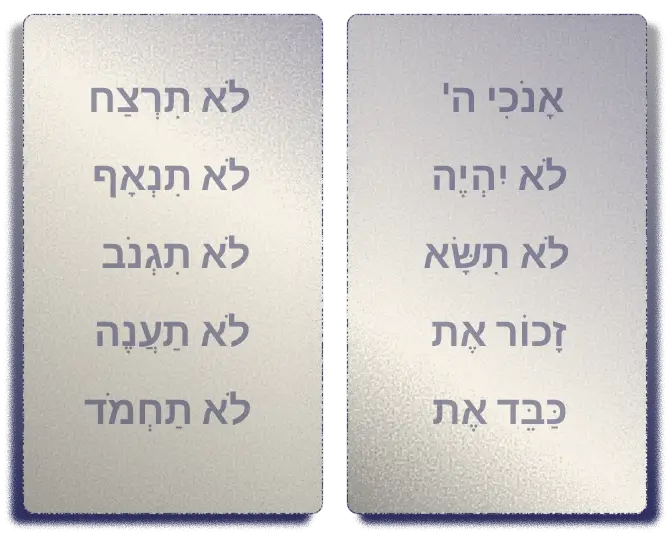
Explore the 613 mitzvos and uncover the meaning behind each one. Discover practical ways to integrate them into your daily life with insights, sources, and guided reflection.
Learn the structure, depth, and spiritual intent behind Jewish prayer. Dive into morning blessings, Shema, Amidah, and more—with tools to enrich your daily connection.
Each week’s parsha offers timeless wisdom and modern relevance. Explore summaries, key themes, and mitzvah connections to deepen your understanding of the Torah cycle.