5.1 — Leadership Under Pressure: Orientation, Humility, and Delegation
Parshas Beshalach introduces leadership not in moments of clarity, but under pressure. Amalek attacks at the edge of exhaustion, when the people are newly redeemed yet spiritually unsteady. The Torah does not respond by showcasing miraculous dominance, but by revealing how leadership must function when certainty fades and responsibility intensifies.
In this moment, leadership is not embodied by a single figure. It is distributed, supported, and oriented—a system rather than a hero.
The Torah emphasizes an unusual detail:
[וְהָיָה כַּאֲשֶׁר יָרִים מֹשֶׁה יָדוֹ וְגָבַר יִשְׂרָאֵל — “When Moshe raised his hand, Israel prevailed.”]
Chazal, as developed by Ramban, insist that Moshe’s hands did not cause victory. Rather, they redirected the people’s awareness upward. When Israel oriented themselves toward Hashem, they prevailed; when orientation faltered, Amalek gained ground.
This establishes the first principle of Torah leadership: direction matters more than force. Leadership is not about producing outcomes directly, but about sustaining the axis around which action becomes meaningful.
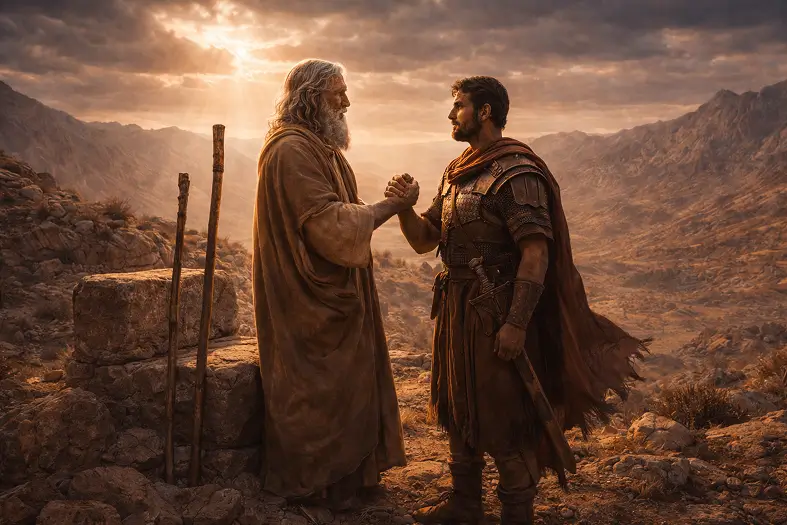
The Torah immediately destabilizes any notion of solitary greatness. Moshe’s hands grow heavy. He cannot maintain orientation alone. A stone is placed beneath him, and Aharon and Chur support his arms.
This is not incidental. Leadership that refuses support collapses into illusion. The Torah teaches that even Moshe Rabbeinu—the most exalted leader—requires reinforcement.
Humility here is not self-effacement; it is structural honesty. A leader who pretends to carry everything alone eventually drops everything.
By involving Aharon and Chur, the Torah reframes leadership as a shared burden. Orientation is no longer private; it becomes communal responsibility. Meaning survives not because one person remains strong, but because others step in when strength fails.
This moment quietly teaches how covenant survives history. Leadership is sustained not by exceptional endurance, but by mutual responsibility.
While Moshe stands above the battlefield maintaining orientation, Yehoshua fights below. This is the Torah’s first presentation of delegated leadership.
Yehoshua does not receive prophecy here. He receives responsibility. Moshe entrusts him with selection, execution, and endurance—without spectacle or guarantees.
Leadership within history requires this handoff. Orientation without execution is sterile; execution without orientation is dangerous. The Torah insists on both simultaneously.
The war with Amalek is intentionally non-miraculous. There is no sea splitting, no Divine intervention overriding human effort. Leadership must function inside uncertainty.
This teaches that redemption matures when leaders can:
These are not crisis skills; they are covenantal skills.
Charismatic leadership dazzles in moments of inspiration. Torah leadership endures through fatigue. The stone beneath Moshe, the hands that support him, and the leader who fights unseen below all testify to the same truth:
Leadership is not the absence of weakness. It is the organization of responsibility around it.
Parshas Beshalach does not present leadership as domination or heroism. It presents it as alignment, humility, and delegation—woven together under pressure.
Moshe’s raised hands teach orientation.
The stone teaches limits.
Aharon and Chur teach shared burden.
Yehoshua teaches execution within reality.
Together, they form a leadership system capable of carrying covenant forward when miracles recede and responsibility remains.
This is not leadership that conquers history.
It is leadership that survives it.
📖 Sources


5.1 — Leadership Under Pressure: Orientation, Humility, and Delegation
Parshas Beshalach introduces leadership not in moments of clarity, but under pressure. Amalek attacks at the edge of exhaustion, when the people are newly redeemed yet spiritually unsteady. The Torah does not respond by showcasing miraculous dominance, but by revealing how leadership must function when certainty fades and responsibility intensifies.
In this moment, leadership is not embodied by a single figure. It is distributed, supported, and oriented—a system rather than a hero.
The Torah emphasizes an unusual detail:
[וְהָיָה כַּאֲשֶׁר יָרִים מֹשֶׁה יָדוֹ וְגָבַר יִשְׂרָאֵל — “When Moshe raised his hand, Israel prevailed.”]
Chazal, as developed by Ramban, insist that Moshe’s hands did not cause victory. Rather, they redirected the people’s awareness upward. When Israel oriented themselves toward Hashem, they prevailed; when orientation faltered, Amalek gained ground.
This establishes the first principle of Torah leadership: direction matters more than force. Leadership is not about producing outcomes directly, but about sustaining the axis around which action becomes meaningful.
The Torah immediately destabilizes any notion of solitary greatness. Moshe’s hands grow heavy. He cannot maintain orientation alone. A stone is placed beneath him, and Aharon and Chur support his arms.
This is not incidental. Leadership that refuses support collapses into illusion. The Torah teaches that even Moshe Rabbeinu—the most exalted leader—requires reinforcement.
Humility here is not self-effacement; it is structural honesty. A leader who pretends to carry everything alone eventually drops everything.
By involving Aharon and Chur, the Torah reframes leadership as a shared burden. Orientation is no longer private; it becomes communal responsibility. Meaning survives not because one person remains strong, but because others step in when strength fails.
This moment quietly teaches how covenant survives history. Leadership is sustained not by exceptional endurance, but by mutual responsibility.
While Moshe stands above the battlefield maintaining orientation, Yehoshua fights below. This is the Torah’s first presentation of delegated leadership.
Yehoshua does not receive prophecy here. He receives responsibility. Moshe entrusts him with selection, execution, and endurance—without spectacle or guarantees.
Leadership within history requires this handoff. Orientation without execution is sterile; execution without orientation is dangerous. The Torah insists on both simultaneously.
The war with Amalek is intentionally non-miraculous. There is no sea splitting, no Divine intervention overriding human effort. Leadership must function inside uncertainty.
This teaches that redemption matures when leaders can:
These are not crisis skills; they are covenantal skills.
Charismatic leadership dazzles in moments of inspiration. Torah leadership endures through fatigue. The stone beneath Moshe, the hands that support him, and the leader who fights unseen below all testify to the same truth:
Leadership is not the absence of weakness. It is the organization of responsibility around it.
Parshas Beshalach does not present leadership as domination or heroism. It presents it as alignment, humility, and delegation—woven together under pressure.
Moshe’s raised hands teach orientation.
The stone teaches limits.
Aharon and Chur teach shared burden.
Yehoshua teaches execution within reality.
Together, they form a leadership system capable of carrying covenant forward when miracles recede and responsibility remains.
This is not leadership that conquers history.
It is leadership that survives it.
📖 Sources


Leadership Under Pressure: Orientation, Humility, and Delegation
(Devarim 10:20)
Moshe’s raised hands embody yiras Shamayim as orientation. Leadership in Torah is not value-neutral management; it requires directing action toward Divine accountability. When fear of Hashem weakens, Amalek advances. This mitzvah anchors leadership in reverence rather than authority.
(Devarim 28:9)
Hashem governs with order, patience, and restraint. Moshe’s willingness to accept support, and his delegation to Yehoshua, model leadership that imitates Divine governance rather than dominating it. Walking in His ways here means structuring responsibility realistically and humbly.
(Devarim 18:15)
Although Yehoshua executes the war, victory depends on attentiveness to Moshe’s orientation. This mitzvah underlies the relationship between direction and action: leadership must remain aligned with prophetic truth even when operating within human effort and uncertainty.
(Devarim 25:19)
The first confrontation with Amalek reveals that erasing Amalek requires more than force. It demands leadership capable of sustaining seriousness, orientation, and responsibility under strain. Without this leadership structure, the mitzvah cannot be fulfilled across generations.


Leadership Under Pressure: Orientation, Humility, and Delegation
The war with Amalek introduces a new leadership structure at the very moment when miracles recede. Moshe does not descend to the battlefield, nor does he command victory directly. Instead, the Torah emphasizes orientation:
[וְהָיָה כַּאֲשֶׁר יָרִים מֹשֶׁה יָדוֹ וְגָבַר יִשְׂרָאֵל]
“When Moshe raised his hand, Israel prevailed.”
Chazal, as explained by Ramban, teach that Moshe’s hands did not cause victory, but directed the people’s attention toward Hashem. The Torah then highlights Moshe’s fatigue and the response of Aharon and Chur, who support his hands and seat him upon a stone. This moment reframes leadership as shared responsibility rather than solitary strength.
Simultaneously, Yehoshua is entrusted with fighting Amalek on the ground. He receives no prophecy or spectacle—only delegated responsibility. The Torah thus presents leadership as a system: orientation above, execution below, and communal support sustaining both. This structure becomes the prototype for covenantal leadership under pressure.

Dive into mitzvos, tefillah, and Torah study—each section curated to help you learn, reflect, and live with intention. New insights are added regularly, creating an evolving space for spiritual growth.

Explore the 613 mitzvos and uncover the meaning behind each one. Discover practical ways to integrate them into your daily life with insights, sources, and guided reflection.

Learn the structure, depth, and spiritual intent behind Jewish prayer. Dive into morning blessings, Shema, Amidah, and more—with tools to enrich your daily connection.

Each week’s parsha offers timeless wisdom and modern relevance. Explore summaries, key themes, and mitzvah connections to deepen your understanding of the Torah cycle.