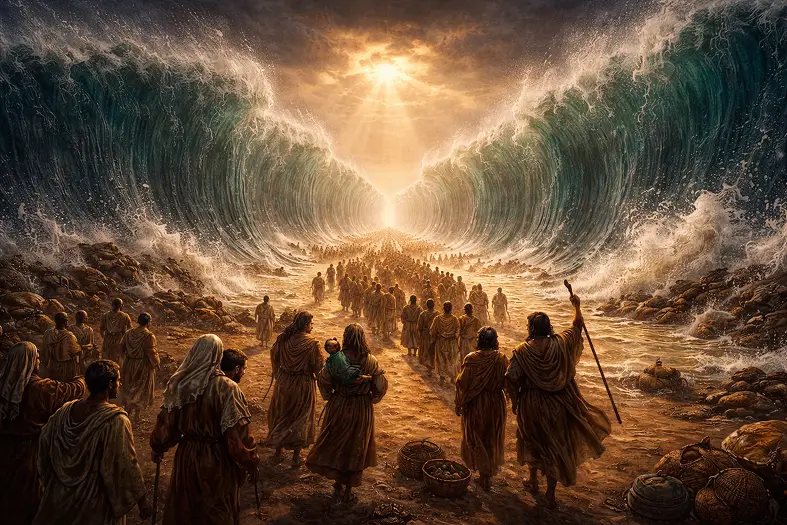
Each Parsha page on Mitzvah Minute is designed as a guided, three-level journey through the weekly Torah reading—integrating the narrative, the mitzvos, and the classical commentaries into one unified experience.
Begin with the foundations of the Parsha:
This level gives you the storyline, the key mitzvos, and the essential connections between them.
A complete journey through the parsha—moving from clarity and depth to inner connection and real-world meaning, culminating in a way to live its ideas in everyday life.
These sections show how the Parsha speaks to the mind, the heart, and the real world — offering wisdom rooted in enduring Torah.
A complete, structured commentary on the parsha—presented pasuk by pasuk, with chapter and overall summaries for clarity and flow.
This level reveals the structural depth of the Parsha and the classical underpinnings of each theme.
Together, these layers create a complete Parsha journey —
narrative, mitzvah, and commentary — all flowing toward deeper understanding, spiritual insight, and meaningful growth.
Tap the Page Navigation tab on the right side of your screen anytime to access quick-links to the entire Parsha page.

The quick-link panel gives instant access to every section — Parsha Summary, Mitzvos, Divrei Torah, Insights, and Commentaries.

“Every word of Torah and every mitzvah lifts us higher — may your learning bring you closer to Hashem.”

Parshas Beshalach traces the fragile transition from physical redemption to spiritual formation. Newly freed from Egypt, Bnei Yisrael are guided deliberately into uncertainty—away from familiar paths and toward dependence on Hashem alone. At Yam Suf, fear gives way to faith as the sea splits and Egypt is destroyed, culminating in Shirat HaYam, the nation’s first collective song of belief and destiny. Yet immediately afterward, faith is tested through thirst, hunger, and complaint in the wilderness, answered by healing waters and the daily gift of manna. The parsha reveals that redemption is not secured by miracles alone, but by learning to trust, obey, and walk with Hashem step by step through the desert of becoming a nation.


From Rescue to Responsibility: Living After the Sea
אָנֹכִי ה׳ אֱלֹקֶיךָ
Krias Yam Suf transforms belief into knowledge. Beshalach marks the moment when Hashem’s existence is no longer inferred but witnessed. Shirat HaYam emerges not from tradition but from direct recognition: “זה א-לי.” This mitzvah anchors the parsha’s claim that true emunah begins when fear gives way to clarity and lived awareness.
אֶת־ה׳ אֱלֹקֶיךָ תִּירָא
Fear in Beshalach is refined from panic into reverence. The destruction of Egypt instills yir’ah that stabilizes faith, while the failures at Marah and Rephidim reveal what happens when fear collapses into complaint. The mitzvah defines the emotional posture required to sustain freedom without returning to servitude.
אֵלָיו תִּשְׁמָעוּן
Moshe’s command at the Sea — to move forward — establishes prophetic authority precisely when instinct demands retreat. Beshalach teaches that redemption survives only when Divine instruction overrides fear-driven logic.
וְהָלַכְתָּ בִּדְרָכָיו
Hashem leads patiently, sustains daily, and educates gradually. The wilderness journey models Divine forbearance and measured guidance, obligating Israel to mirror those traits in human conduct.
וְשִׁנַּנְתָּם לְבָנֶיךָ
Beshalach introduces law at Marah before Sinai, teaching that inspiration must be anchored in instruction. Torah study here functions as preservation of clarity after revelation.
בְּשָׁכְבְּךָ וּבְקוּמֶךָ
The daily affirmation of Divine unity reflects Beshalach’s demand for continual awareness. Faith that appears only at miracles is insufficient; it must be renewed morning and night.
וַעֲבַדְתֶּם אֵת ה׳ אֱלֹקֵיכֶם
The parsha distinguishes between prayer that deepens trust and prayer that replaces responsibility. “מַה תִּצְעַק אֵלָי” teaches that tefillah must culminate in action.
וּבַיּוֹם הַשְּׁבִיעִי תִּשְׁבֹּת
Shabbos appears in Beshalach as lived experience before formal command. It trains Israel to trust sustenance without control and to recognize creation beyond effort.
לֹא תַעֲשֶׂה כָל־מְלָאכָה
The manna narrative teaches restraint, boundaries, and obedience even when survival feels threatened. Shabbos becomes the discipline that preserves freedom.
אַל־יֵצֵא אִישׁ מִמְּקֹמוֹ
The Torah links spatial restraint with spiritual trust. Beshalach frames limitation not as confinement but as covenantal alignment.
וְהִגַּדְתָּ לְבִנְךָ
Memory safeguards redemption. Beshalach demonstrates how quickly clarity erodes without transmission. This mitzvah preserves identity when miracles fade.
וַהֲרֵעֹתֶם בַּחֲצֹצְרוֹת
This mitzvah is Beshalach’s heartbeat. Crisis reveals orientation: toward Hashem or toward accusation. The parsha defines proper response to fear, thirst, hunger, and attack — not silence, not despair, but directed turning toward Hashem that leads to action.
תִּמְחֶה אֶת זֵכֶר עֲמָלֵק
Amalek’s appearance at the end of Parshas Beshalach marks the Torah’s first confrontation with an enemy who attacks not territory or power, but faith itself. Amalek strikes specifically when Israel is weary, disoriented, and questioning Hashem’s presence. This mitzvah does not describe vengeance for past violence alone; it commands the eradication of an ideology that denies Divine providence and moral order. Beshalach teaches that redemption remains incomplete as long as such denial persists. The obligation to wipe out Amalek expresses the Torah’s insistence that faith must ultimately shape history, not merely survive it.
זָכוֹר אֵת אֲשֶׁר עָשָׂה לְךָ עֲמָלֵק
Memory in Beshalach is fragile. The generation that sang at the Sea quickly falters when hunger, thirst, and fear return. Amalek exploits this erosion. This mitzvah commands active remembrance—not historical curiosity, but moral awareness. Remembering Amalek means recognizing how spiritual fatigue and doubt create vulnerability. The Torah obligates Israel to preserve clarity about the conditions under which faith weakens, so that redemption is not naïvely assumed to be permanent.
לֹא תִּשְׁכָּח
Forgetting Amalek is not simple amnesia; it is the loss of vigilance. Beshalach reveals how quickly clarity fades once miracles recede into routine. This mitzvah guards against that erosion by forbidding complacency. It demands sustained awareness that denial of Hashem’s presence can resurface whenever trust weakens. By commanding Israel never to forget Amalek, the Torah ensures that freedom is preserved not only through memory of redemption, but through continuous resistance to the forces that seek to hollow it out.

Rashi reads the opening of Beshalach as a study in Divine pedagogy shaped around human limitation. Hashem does not lead Israel by the shortest route, not because of geographic concerns alone, but because of psychological reality. Immediate exposure to war would undo redemption by triggering fear and retreat. Rashi consistently emphasizes that Hashem’s guidance accounts for emotional readiness as much as spiritual destiny. Redemption must unfold along a path the people can endure, not merely one that is efficient.
For Rashi, the wilderness route is not a postponement of destiny but a safeguard of it. The circuitous path prevents Israel from seeing an easy way back to Egypt and allows time for identity to form before confrontation. Rashi repeatedly highlights that Hashem’s apparent detours are deliberate acts of care, ensuring that freedom is not surrendered the moment it is tested.
Rashi treats the pillars of cloud and fire not as dramatic signs, but as continuous guidance systems. They exist to reassure, orient, and protect at every moment. The fact that one pillar never departs before the other arrives teaches uninterrupted Divine accompaniment. For Rashi, faith is not sustained by rare miracles, but by reliable presence — Hashem does not abandon Israel even for a moment of uncertainty.
At the Sea, Rashi traces a precise sequence: fear leads to prayer, prayer leads to command, and command demands action. Moshe’s cry is genuine, but Hashem teaches that there is a moment when prayer must give way to movement. Rashi stresses that salvation does not come through panic or paralysis, but through obedience under pressure. Israel’s forward motion into the sea becomes the ultimate act of trust.
Rashi emphasizes that Krias Yam Suf is not only salvation, but judgment. Egypt is destroyed publicly so that Israel will no longer fear pursuit or doubt finality. Even the return of the bodies serves a psychological purpose: closure. Rashi consistently reads Divine judgment as educational — its goal is clarity, not vengeance. Fear gives way to recognition of Hashem’s “great hand,” grounding emunah in witnessed reality.
Rashi understands Shirat HaYam not as poetic flourish, but as prophetic testimony. The song emerges because the people finally see — not merely experience — Hashem’s sovereignty. Linguistic precision matters here: repetition, future tense, and imagery all signal that this song speaks beyond the moment, reaching toward resurrection, the Mikdash, and eternal kingship. Song, for Rashi, is the natural response when truth becomes undeniable.
Immediately after song comes testing. Rashi highlights this transition sharply. At Marah and with the manna, Israel learns that revelation does not exempt them from discipline. Laws are given precisely when faith is high, to anchor inspiration into obedience. Rashi consistently teaches that emunah which survives only miracles is incomplete; it must persist through routine, restraint, and trust.
Rashi presents the manna as a daily lesson in measured desire. Gathering only what is needed, refraining from hoarding, and honoring Shabbat transform food into instruction. Bread is given with favor because it is necessary; meat is given begrudgingly because it is desired without need. Through this contrast, Rashi teaches derech eretz — spiritual maturity includes learning how and why we ask.
At Rephidim, Rashi identifies the core sin not as thirst, but as testing Hashem. Asking whether Hashem can provide crosses a boundary from distress into doubt. Rashi’s reading draws a firm line: suffering may provoke complaint, but questioning Divine presence itself undermines covenantal trust. The narrative exposes the danger of conditional faith.
Rashi portrays Amalek as the embodiment of cynical interruption. Attacking a weary people sustained by miracles, Amalek seeks to undermine the moral meaning of history. Rashi’s emphasis on Amalek’s timing and method reveals that this war is not territorial, but ideological. Amalek denies providence, and therefore must be remembered and opposed across generations.
For Rashi, Beshalach does not end with freedom secured, but with responsibility imposed. Guidance, song, sustenance, law, and struggle all serve one purpose: transforming rescued slaves into a disciplined people capable of living with Hashem’s presence. Redemption is not completed at the sea; it is sustained through obedience, trust, and memory.
📖 Source
Ramban frames Beshalach as a decisive shift from miraculous rescue to sustained reliance. The splitting of the sea proves Hashem’s absolute sovereignty, but it does not complete redemption. True freedom begins only once Israel must live daily without natural security. Ramban stresses that Hashem deliberately leads the people away from settled routes and familiar resources so that redemption will not be mistaken for independence. The wilderness is not a punishment; it is the classroom in which trust must be learned.
Throughout the parsha, Ramban distinguishes between spectacle and structure. One-time miracles, like the sea’s splitting, inspire awe. Ongoing miracles, like manna and water, educate character. Ramban explains that sustained miracles require a higher level of Divine presence because they form patterns of life, not moments of astonishment. Manna is not merely food; it is a new mode of existence that trains Israel to receive each day directly from Hashem without accumulation or control.
Ramban carefully differentiates between Israel’s early complaints and their later quarrels. Complaining reflects distress and fear; quarrelling reflects confrontation and testing Hashem. At Rephidim, Ramban identifies a turning point: Israel no longer asks how Hashem will provide, but whether He is present at all. This distinction reveals Ramban’s broader theology — suffering becomes spiritually dangerous not when it provokes fear, but when it hardens into challenge rather than prayer.
One of Ramban’s most profound insights emerges in his analysis of the manna. Unlike quail, which arrives through natural mechanisms, manna represents new creation. Ramban repeatedly emphasizes that human or intermediary power can manipulate existing forces, but only Hashem creates reality itself. The manna therefore becomes the ultimate proof of Divine kingship: not control of nature, but authorship of existence. This principle quietly governs the entire parsha.
Ramban presents emunah not as belief secured by memory, but as trust renewed each morning. The prohibition against storing manna is not a test of obedience alone; it is a test of psychology. Ramban explains that faith collapses when people attempt to preserve tomorrow on their own terms. True trust exists only when sustenance is accepted daily, without surplus or certainty. The wilderness thus trains Israel to live in ongoing dependence rather than retrospective gratitude.
Ramban views Amalek not merely as an enemy nation, but as a theological position. Amalek attacks precisely where Divine provision appears most vulnerable — when Israel is tired, thirsty, and uncertain. By denying providence and attacking a people sustained by miracles, Amalek challenges Hashem’s throne itself. Ramban explains that this is why the war with Amalek is eternal: it represents the ongoing human impulse to deny moral meaning in history.
Ramban’s reading of “כִּי יָד עַל כֵּס יָהּ” reveals the cosmic stakes of Beshalach. As long as Amalek exists, Divine kingship remains incomplete in the world. Hashem’s Name and Throne are only fully revealed when providence is universally acknowledged. Ramban thus links battlefield events to metaphysical reality: history itself is the arena in which Divine sovereignty is clarified.
By the end of Beshalach, Ramban shows that Israel has witnessed overwhelming proof of Hashem’s presence — yet proof alone does not produce maturity. Miracles introduce truth; responsibility sustains it. Beshalach therefore becomes the bridge between revelation and covenantal obligation. The people are no longer deciding whether Hashem exists, but whether they are willing to live accordingly.
📖 Source
Parshas Beshalach marks the transition from physical liberation to the disciplined formation of the human soul. From a Rambamian perspective, this parsha is not primarily about miracles, but about the re-education of human intellect, desire, and moral responsibility after long habituation to servitude.
Rambam consistently distinguishes between the removal of external constraint and the attainment of internal freedom. Leaving Mitzrayim removes coercion, but does not yet produce free human beings in the philosophical sense. True freedom, for Rambam, is the ability of the intellect to govern desire and fear. This explains why Bnei Yisrael are deliberately led away from the direct route to Eretz Yisrael. A people shaped by fear cannot yet exercise rational moral choice. Sudden exposure to conflict would overwhelm the intellect and return them to instinctive submission. This reflects Rambam’s broader principle that human perfection requires gradual habituation rather than abrupt transformation (Moreh Nevuchim III).
The splitting of the Yam Suf occupies a central place in the parsha, yet Rambam would caution against understanding miracles as spectacles meant to suspend natural order for their own sake. In his framework, miracles serve a pedagogical function: they redirect human recognition toward Hashem’s governance of reality. The purpose is not amazement, but clarity. Shirat HaYam is therefore not merely emotional celebration; it is an intellectual breakthrough in which the nation articulates, for the first time, a structured recognition of Hashem’s sovereignty, permanence, and moral authority. The song reflects a momentary alignment of intellect and emotion — a glimpse of what perfected awareness could look like.
Immediately after this peak, the parsha introduces hunger, thirst, and complaint. Rambam’s psychology explains this regression not as failure, but as exposure of unrefined character traits. The complaints at Marah and in the wilderness reveal that belief has not yet been internalized as stable knowledge. Rambam emphasizes that moral and intellectual traits are acquired through repeated action and discipline, not through isolated moments of insight (Hilchos De’os). The manna functions within this system as a tool of habituation: daily dependence trains the nation to align trust, restraint, and obedience with reasoned awareness rather than impulse.
The presentation of early mitzvos at Marah is philosophically decisive. Rambam understands law not as a restriction imposed on freedom, but as the framework that makes freedom possible. Without structured obligation, emotion dominates action. Law disciplines desire, orders time, and channels fear into responsibility. The parsha thus demonstrates Rambam’s principle that Torah is the instrument through which human beings are educated toward intellectual and moral perfection, not merely restrained from wrongdoing (Moreh Nevuchim III; Mishneh Torah, Hilchos Teshuvah).
Finally, the parsha balances Divine provision with human effort. The manna descends from Heaven, yet its collection follows strict rules. Amalek is defeated through both Divine aid and human action. Rambam’s view of hashgachah emerges clearly here: Divine providence operates in proportion to human intellectual and moral development. Miracles do not eliminate responsibility; they heighten it. The more Hashem is revealed, the more demanding human accountability becomes.
Through the lens of Rambam, Beshalach teaches that redemption is not measured by the suspension of nature, but by the cultivation of disciplined intellect, ordered emotion, and lawful living. The parsha charts the earliest stages of human perfection — not yet achieved, but deliberately and rationally begun.
📖 Sources
This section presents Rabbeinu Levi ben Gershom’s (Ralbag) philosophical analysis of Parshas Beshalach, following the uploaded source text in full, with no omissions and preserving his rationalist structure. Ralbag organizes the parsha around “to‘alos” (constructive outcomes), divided between mitzvos, de‘os (beliefs), and middos (character refinement). His method consistently frames mitzvos and miracles as instruments for intellectual clarity, proper belief in hashgachah, and preparation for kabbalas haTorah.
Ralbag explains that the opening parshiyos establish a system of mitzvos whose primary purpose is to perpetuate awareness of Yetzias Mitzrayim as a rational foundation for emunah and hashgachah.
The first to‘eles concerns the mitzvah of the firstborn. The dedication of the bechor of kosher animals, the redemption of the firstborn donkey, and the redemption of the firstborn son are designed to engrave in Israel’s consciousness the unprecedented miracle of makas bechoros, in which Egyptian firstborn were struck while Israel was completely spared. This miracle demonstrated that there is an Elokim who judges, governs, and exercises individual providence over those who cleave to Him. Ralbag enumerates six halachic roots of this mitzvah, defining who qualifies as a bechor, which animals are included, geographic limitations, ownership status, and exclusions such as partnership with a non-Jew, grounding philosophical meaning in precise legal structure.
The second to‘eles addresses the prohibition of chametz on Pesach. Ralbag defines its two roots: liability applies only to eating a kezayis, and chametz is forbidden even for benefit during Pesach. These prohibitions are framed as safeguards to preserve the integrity of the Exodus narrative and its cognitive impact, preventing dilution of the mitzvah’s educational purpose.
The third to‘eles is the obligation to recount the miracles of the Exodus on the night of the fifteenth of Nissan. Its purpose mirrors that of the mitzvah of the firstborn: reinforcing belief in Divine justice and providence through transmitted historical consciousness.
The fourth to‘eles explains the prohibition of owning or seeing chametz during Pesach. Ralbag emphasizes that this applies only to one’s own chametz, since human psychology inclines one to eat what belongs to him. Chazal nonetheless instituted additional safeguards regarding a non-Jew’s chametz to prevent rationalization and moral laxity.
The fifth to‘eles establishes that the multiplication of miracles in Egypt was intended not only for immediate redemption but to ensure perpetual transmission of emunah to future generations, and to reinforce trust that Hashem fulfills His promises, just as He fulfilled the promise of redemption from Egypt.
The sixth to‘eles concerns tefillin. Ralbag explains that tefillin serve as a constant intellectual reminder of Yetzias Mitzrayim and Divine intervention. He offers a philosophical symbolism: tefillin shel yad correspond to the heart, the primary faculty, while tefillin shel rosh correspond to the mind, which receives influence from the heart. The unity of the single compartment of the arm-tefillin versus the multiplicity of the head-tefillin reflects Hashem’s absolute unity and the multiplicity of effects perceived by created beings. Ralbag details nine halachic roots of tefillin, including materials, order of parshiyos, placement, time of wearing, and the conceptual exclusion of Shabbos and Yom Tov as independent “os.”
The seventh to‘eles analyzes the mitzvah of redeeming or breaking the neck of the firstborn donkey. Ralbag explains that the Torah structured this mitzvah to encourage redemption rather than destruction, and he details ten halachic principles governing its fulfillment. The philosophical aim is again educational: channeling human behavior toward meaningful remembrance rather than wasteful destruction.
Ralbag’s analysis of Shirat HaYam is among the most philosophically dense sections. He explains that poetic metaphor is necessary because Hashem’s essence transcends literal description. Anthropomorphic language functions as intellectual accommodation, not ontological statement.
He interprets “עזי וזמרת י־ה ויהי לי לישועה” as teaching that while evil may arise incidentally from the natural order, Hashem’s providence protects those who cleave to Him. The destruction of Egypt and salvation of Israel occurred through the same Divine act, illustrating that what appears as “evil” is in fact an outgrowth of Divine good directed toward moral ends.
Ralbag explains that Hashem is described as “איש מלחמה” because He brings defeat upon enemies through wisdom and orchestration rather than brute force. Pharaoh’s psychological miscalculations and pursuit were themselves guided by Divine providence to culminate in his destruction.
He emphasizes that the miracles at the sea served multiple ends: solidifying Israel’s emunah, instilling fear among the nations to facilitate conquest of the land, and orienting Israel toward the true purpose of Eretz Yisrael. The Torah highlights Har HaMoriah specifically to teach that the land’s ultimate value lies not in agricultural abundance but in its unique capacity for Divine influence and spiritual perfection.
Ralbag enumerates ten to‘alos from the Shira. These include the obligation of gratitude to Hashem, recognition of His transcendence, understanding the nature of Divine good and incidental evil, acknowledgment of measure-for-measure justice, awareness that no created intellect compares to Hashem, recognition of the role of Krias Yam Suf in enabling inheritance of the land, and affirmation of Hashem’s eternal kingship. He concludes with a sharply rationalist assertion that the brevity of the women’s song reflects their exclusion from deep theological discourse, which underlies the exemption of women from Talmud Torah.
Ralbag explains that the post-Shira narratives demonstrate intensified Divine pedagogy. The miracles of water, manna, and Shabbos were designed to prepare Israel intellectually and morally for receiving the Torah. The manna trained Israel in moderation, dependence, and restraint, cultivating the middah of הסתפקות. Shabbos was introduced experientially before formal command to anchor belief in creation ex nihilo.
He enumerates six to‘alos here, including reinforcement of emunah through repeated miracles, assurance of healing and protection for those who follow Hashem’s ways, philosophical grounding of Shabbos, ethical moderation in sustenance, derivation of the prohibition of carrying on Shabbos, and preservation of the manna as an eternal proof of Divine providence.
Ralbag opens with a series of penetrating questions: why Amalek attacked despite overwhelming evidence of Divine power; why Yehoshua led the battle rather than Moshe; why victory depended on Moshe’s raised hands; and why Moshe chose a high place for prayer.
He explains that Amalek acted based on astrological determinism and Esav’s legacy of martial dominance, calculating that Israel’s physical weakness made them vulnerable. Additionally, Israel’s spiritual state was deficient, as indicated by their testing of Hashem, making them susceptible absent special providence.
Moshe structured the battle as a visible miracle to reorient Israel’s belief. The raised hands symbolized that victory depended solely on Divine assistance, not military strength. Chazal’s teaching that Moshe’s hands themselves did not defeat Amalek is integrated into Ralbag’s philosophical framework of redirected cognition and emunah.
He concludes that Amalek’s existence represents a persistent metaphysical threat when Israel is spiritually unworthy. The command to remember and erase Amalek is therefore both historical and existential. The narrative also prepares Israel psychologically for future exile among Esav’s descendants, ensuring that despair does not extinguish hope in ultimate redemption.
Ralbag concludes that the entire parsha demonstrates the layered structure of Divine hashgachah, whose ultimate goal is not survival alone, but the intellectual and moral perfection required for receiving the Torah and sustaining faith across history.
📖 Source
Parshas Beshalach marks the moment when redemption turns inward. Egypt has been left behind, yet its imprint still lives within the human soul. Chassidus reads the parsha not only as a national miracle, but as a map of inner avodah: how freedom is formed slowly, how faith matures, how nature itself bends in response to consciousness, and how song emerges only when concealment gives way to revealed Divine life.
On the opening words, (“וַיְהִי בְּשַׁלַּח פַּרְעֹה אֶת הָעָם” (שמות י״ג:י״ז, the Baal Shem Tov teaches that Pharaoh is not merely a tyrant of history, but the force of forgetfulness embedded within the human being. Every person is an “olam katan,” containing both Egypt and Pharaoh within. Redemption, therefore, cannot occur all at once. Were the Divine light to overwhelm the person suddenly, the self would collapse rather than heal.
This is why Hashem does not lead them by “derech eretz Pelishtim,” the near path. The Baal Shem Tov explains that “derech” alludes to a lofty spiritual channel (שם ס״ג and שם אהי״ה), a level even the wicked can draw from, since human sin does not reach there. But that very closeness is dangerous. Exposure to such heights without inner readiness leads back to Pharaoh—back to spiritual amnesia. Therefore, Hashem turns them aside, teaching that teshuvah and growth must proceed in stages, building stable inner vessels rather than dramatic but fragile breakthroughs.
The Baal Shem Tov further reveals that a person’s thoughts actively shape the worlds above him. Drawing on the Zohar and Chazal’s descriptions of tzaddikim over whom no impure creature could pass, he explains that reality mirrors consciousness. Pure thought generates pure worlds; corrupted thought generates distorted worlds. What one encounters in the physical realm—purity or impurity—is an echo of the inner mental and spiritual state.
This principle reaches beyond ethics into ontology: there are levels of reality—pure, impure, intermediate—and above them all, a realm of pure intellect beyond grasp. Human avodah determines which layers are activated. Redemption, then, is not only something Hashem performs for man, but something man precipitates through refined awareness.
On (“וַיִּקַּח מֹשֶׁה אֶת עַצְמוֹת יוֹסֵף עִמּוֹ” (שמות י״ג:י״ט, the Baal Shem Tov interprets חָכַם לֵב יִקַּח מִצְוֹת משלי י׳:ח׳ with precision. The plural “mitzvos” teaches that a mitzvah is never singular. Each act contains a lower mitzvah—the physical deed—and a higher mitzvah—the intention and thought that unite the deed with its Divine source. True wisdom lies in binding the two together. This is why we bless Hashem “אֲשֶׁר קִדְּשָׁנוּ בְּמִצְוֹתָיו,” in the plural: every mitzvah done properly is a cosmic unification.
At the splitting of the sea, the Kedushas Levi notes a radical inversion. Angels, normally higher than Israel, are moved behind them: (“וַיִּסַּע מַלְאַךְ הָאֱלֹקִים… וַיַּעֲמֹד מֵאַחֲרֵיהֶם” (שמות י״ד:י״ט. This reversal occurs because Hashem reveals His love for Israel. When Divine love is manifest, Israel rises above even the loftiest spiritual beings. Redemption is not only power, but intimacy.
The Kedushas Levi’s reading of the Midrash where the sea resists Moshe—claiming superiority—is not about obstinacy, but about nature’s illusion of independence. Over time, nature forgets it is merely a conduit for Divine flow. When it asserts autonomy, Hashem withdraws that flow, and nature collapses instantly. Thus the sea splits precisely because of its arrogance: “כִּי גָאָה גָּאָה” (שמות ט״ו:א׳) becomes a statement about Hashem’s supremacy over all self-assertion, whether human or cosmic.
This explains why the Torah emphasizes the “רוח קדים עזה.” The word “עזה” reflects the sea’s brazenness, and its punishment is measure for measure: the greater the perceived solidity, the more absolute its undoing.
The Kedushas Levi unfolds the mystical structure of קריעת ים סוף through the three verses “וַיִּסַּע,” “וַיָּבֹא,” and (“וַיֵּט” (שמות י״ד:י״ט–כ״א, which generate the seventy-two-letter Divine Name. The first represents אור ישר—Divine beneficence flowing downward. The second, written in reverse, represents אור חוזר—the created world’s return upward in response. The third restores אור ישר once the response has been completed.
This rhythm explains why the sea could return to its state only after splitting, why Shabbos functions as אור חוזר, and why manna—pure heavenly flow—does not descend on Shabbos, while earthly crops continue to grow. Shabbos is not reception but return; not production but elevation.
On (“וַיָּשָׁב הַיָּם לְאֵיתָנוֹ” (שמות י״ד:כ״ז, the Kedushas Levi explains that the sea wished to remain dry forever, having witnessed how much pleasure its splitting brought to Hashem through the song of Israel. Only a condition—“לְאֵיתָנוֹ” as “לִתְּנָאוֹ”—persuaded it to return: that only Moshe would ever command it again. This also resolves why later rivers splitting were less remarkable: they already knew the joy such obedience would bring. The sea split without precedent or incentive.
Chassidus distinguishes between the Exodus and future redemption. The Exodus occurred in “darkness of mind”—Israel lacked merit and was redeemed by sheer Divine mercy. The future redemption will occur in full “daylight,” when Israel possesses Torah, mitzvos, and inner illumination. This distinction is not chronological but psychological: night and day describe states of consciousness.
On (“וַיּוֹשַׁע ה׳ בַּיּוֹם הַהוּא” (שמות י״ד:ל׳, the Kedushas Levi explains that “ההוא” points to the hidden realm above all worlds. This salvation was not mediated by angels or natural systems, but emerged directly from the concealed Divine source—“לא על ידי מלאך… אלא הקדוש ברוך הוא בכבודו ובעצמו.” The miracle was supra-cosmic, not merely supernatural.
The Sfas Emes frames שירת הים as the moment when Divine providence becomes settled and known within creation. At creation, Hashem’s governance was hidden; at the sea, it became revealed. Song is not emotional overflow, but alignment—everything returning in a straight line to its source. When Israel sang, all creation sang with them. Every being possesses a note in this cosmic song, but only when human action clarifies Divine life does the song emerge.
This explains why Chazal say Chizkiyahu did not sing: his awareness of Hashem was so constant that miracle and nature were equal to him. Song requires the lifting of concealment. Hence, Shirah is fixed daily and tied to Shabbos—the weekly restoration of inner clarity.
The Sfas Emes distinguishes two faiths. One believes without knowledge; the other believes through knowledge that true comprehension is impossible. Crying to Hashem expresses the first; silence expresses the second. “מַה תִּצְעַק אֵלָי” does not negate prayer—it signals arrival at a deeper trust where even silence speaks. Both are necessary stages, and both appear in Beshalach.
True freedom, teaches the Sfas Emes, is not escape from constraint but attachment to the root beyond nature. “אין לך בן חורין אלא מי שעוסק בתורה” means liberation from the determinism of natural forces. Krias Yam Suf reveals that Israel can, through avodah, operate above the natural order itself.
Chassidus thus reads Beshalach as the transformation of redemption from spectacle into structure. The sea splits not only once, but continually—whenever thought is refined, intention unites with action, nature yields to humility, and song rises from clarity. Redemption endures only when it reshapes the inner world, until even concealment itself begins to sing.
📖 Sources
Rabbi Jonathan Sacks reads Parshas Beshalach as the moment Judaism first articulates a mature vision of freedom, responsibility, leadership, and moral growth. The parsha is not only about redemption from Egypt, but about the difficult transition from dependency to responsibility, from miracles performed for a people to strength cultivated within a people. Across all twelve essays, a single arc emerges: freedom is not achieved in a moment of power, but through time, courage, discipline, memory, song, and moral choice.
Beshalach is framed by conflict. It begins with fear of war and ends with war. At its center stands the crossing of the Sea, the decisive turning point of Jewish history. Before the Sea, Bnei Yisrael are still psychologically within Egypt, under Pharaoh’s imagined sovereignty. After the Sea, they enter the midbar, a space without human rulers, where Hashem’s sovereignty can be experienced with clarity. The Sea functions as a liminal boundary: once crossed, there is no return.
The crossing is not merely geographical. It is covenantal. Just as Avraham passed “between the pieces” at the brit bein habesarim (בראשית ט״ו), so Bnei Yisrael pass between divided waters. They move from being avadim to Pharaoh to avadim to Hashem. This is not a change of masters but a change of meaning: slavery to humans destroys freedom; service to Hashem creates it.
Crucially, Rabbi Sacks emphasizes that the miracle at the Sea is followed immediately by a withdrawal of overt miracles. At the Sea, Hashem fights for the people while they stand silent (שמות י״ד:י״ג–י״ד). At Refidim, against Amalek, the people must fight for themselves (שמות י״ז:ח–י״ג). This transition is not a failure of divine protection but its deepest expression. Hashem moves from doing to teaching, from intervention to empowerment.
The opening verses of the parsha raise a profound question: why does Hashem lead the people on a longer, indirect route, rather than the shorter road to Eretz Yisrael? Rabbi Sacks, following Rambam (Moreh Nevuchim ג:ל״ב), explains that human beings live within time, and moral transformation cannot be rushed.
Hashem never intervenes to change human nature, only nature itself. To force instant moral growth would destroy free will. That is why slavery is restricted rather than immediately abolished, why korbanos were permitted as a transitional form of avodah, and why the generation that left Egypt could not enter the Land. Freedom requires a people born into freedom.
This insight becomes a general law of history. Genuine social change is evolutionary, not revolutionary. Rabbi Sacks contrasts revolutions shaped by Tanach, such as the British and American revolutions, with those shaped by abstract philosophy, such as the French and Russian revolutions. The former respected time and moral development; the latter attempted to impose change instantly and collapsed into terror. Even Hashem does not force the pace of history.
The splitting of the Sea can be read in two ways. On one level, it is a suspension of natural law: waters stand like walls and dry land appears (שמות י״ד:כ״ב; ט״ו:ח). On another level, it unfolds through natural forces: a strong east wind blows all night (שמות י״ד:כ״א), chariots become stuck in mud, and Egypt’s military strength becomes its downfall.
Rabbi Sacks insists that these readings are not contradictions. A miracle is not necessarily a violation of nature, but an event whose timing, context, and moral clarity reveal the hand of Hashem. Hidden miracles are no less wondrous than open ones. This duality reflects a deep Jewish intuition, echoed by Rambam, Ramban, Chazal, and even modern thinkers: faith does not depend on spectacle, but on meaning.
The Sea teaches moral irony. The proud are humbled, the weak are saved, and hubris collapses under its own weight. History itself becomes a vehicle of justice.
Why did Hashem lead Bnei Yisrael into a terrifying confrontation at the Sea if He wished to spare them fear? Rabbi Sacks answers with a radical insight: the purpose was not to prevent fear, but to eliminate retreat.
Crossing the Sea is likened to Caesar crossing the Rubicon or Cortés burning his ships. Once across, there is no way back. Fear remains, complaints continue, but escape is no longer possible. Only then can courage emerge. This explains the contrast between panic at the Sea and confidence against Amalek. After the Sea, the people have crossed the line of no return.
Great transformations, personal or national, often require this moment. Growth begins when retreat is no longer an option.
The battle against Amalek introduces a new model of leadership. Moshe does not fight; Yehoshua does. Moshe’s raised hands do not perform miracles. The Mishnah teaches that they direct the people’s hearts upward, toward Hashem (משנה ראש השנה ג:ח).
Leadership, Rabbi Sacks explains, is not about doing the work for others, but about giving them the confidence to do it themselves. Leaders shape morale, not outcomes alone. They inspire resilience, hope, and emotional strength. Even Moshe requires support from Aharon and Chur, reminding us that leaders, too, need sustaining relationships.
Faith here is internal. Hashem is not “among” the people but “within” them (ה׳ בקרבנו). Victory flows from inner alignment, not external intervention.
Beshalach also introduces Amalek, the archetype of gratuitous, ideologically driven evil. Rabbi Sacks connects Amalek to modern expressions of hatred that cannot be explained by grievance or rational interest. Such evil seeks destruction for its own sake.
The Torah’s response is not naïveté but moral clarity. Evil must be named, resisted, and remembered. Forgetting invites repetition. This is why Amalek becomes an enduring moral category, not merely a historical enemy.
The parsha moves from physical sustenance (manna, water) to spiritual sustenance. True endurance, Rabbi Sacks argues, requires renewable spiritual energy. Societies collapse not from lack of power but from loss of meaning.
Ruach, spirit, is what renews the human capacity to persevere. Faith supplies moral energy that does not deplete. It allows a people to survive setbacks without despair and success without arrogance.
The Song at the Sea marks the first moment of collective Jewish song. Music, Rabbi Sacks explains, integrates time: past, present, and future are held together in a single melody. Faith is more like music than science. It connects episodes into a meaningful whole.
Jewish history is written in song. Each generation sings the same words with new melodies. Song transforms memory into identity and experience into continuity. When the soul sings, the spirit soars.
Leadership in Judaism is neither autocratic nor passive. It is the art of helping people internalize Hashem’s will until they can act courageously on their own. Authority gives way to responsibility. Dependency gives way to partnership.
The journey from Egypt to freedom teaches that Hashem does not want subjects who obey blindly, but servants who choose faithfully. True freedom is not the absence of constraint, but the presence of moral purpose.
Parshas Beshalach thus becomes the Torah’s foundational meditation on freedom: slow, demanding, courageous, and dignified. Redemption begins with miracles, but it is completed through human growth.
📖 Source
Rav Kook reads Parshas Beshalach as the moment when the inner soul of Am Yisrael first comes fully into view. Redemption is not only an external rescue from Egypt, nor merely a sequence of miracles, but a deep unveiling of the Jewish people’s inner holiness, their national mission, and the redemptive song embedded within the soul itself. Across these teachings, Rav Kook traces how innate holiness, acquired holiness, moral refinement, Torah, Shabbat, song, and the struggle with Amalek all converge into a single spiritual process: the gradual revelation of the Divine light already planted within the nation.
The Song at the Sea looks forward beyond Yam Suf to a future crossing of the Jordan River: (“עַד־יַעֲבֹר עַמְּךָ ה׳, עַד־יַעֲבֹר עַם־זוּ קָנִיתָ” (שמות ט״ו:ט״ז. Rav Kook explains that this double expression reflects two distinct historical crossings and, more deeply, two forms of holiness.
There is an innate holiness, a segulah rooted in the Jewish soul, inherited from the Avot and unchangeable in essence. Alongside it stands acquired holiness, developed through Torah, mitzvos, and moral choice. The First Beit HaMikdash expressed the power of innate holiness, with open Shechinah, prophecy, and constant miracles. The Second Beit HaMikdash, lacking those overt signs, revealed the strength of acquired holiness through Torah sheba’al peh, rabbinic creativity, and disciplined spiritual effort.
Rav Kook extends this framework to later generations, including the era preceding Mashiach. Even when external observance appears weak, the inner segulah may burn intensely. A generation may be “good on the inside and flawed on the outside,” yet still carry the hidden light needed for redemption. Redemption therefore unfolds not by erasing inner holiness, but by gradually giving it proper expression.
At Marah, the Torah commands: (“שָׁמוֹעַ תִּשְׁמַע לְקוֹל ה׳” (שמות ט״ו:כ״ו. Chazal interpret the repetition to mean: if one listens to the old, one will merit hearing the new (ברכות מ׳ ע״א). Rav Kook explains that Torah study has two possible motivations. One is intellectual curiosity; the other is Torah lishmah, rooted in love of Torah’s intrinsic holiness.
The difference becomes clear when reviewing what one already knows. If Torah is pursued only as an intellectual pursuit, review feels stale. But when Torah is studied for its Divine essence, even the old is endlessly meaningful. The learner internalizes Torah until it becomes part of his being, and from that internalization new insights emerge organically. True chiddush flows not from novelty-seeking, but from deep attachment to what already exists.
Rav Kook interprets the Talmudic discussion of when to light Shabbat candles through the imagery of the pillars of fire and cloud (שמות י״ג:כ״ב). Each pillar completed the other’s role, creating continuity between day and night. Shabbat, too, must illuminate the weekdays without erasing them.
Lighting too late denies the influence of Shabbat beyond its formal boundaries; lighting too early erases the necessary contrast between weekday labor and sacred rest. The holiness of Shabbat gains clarity precisely because it stands against six days of human striving. Rav Kook applies this principle to redemption itself: exile and redemption are opposites, yet each has its proper time. Redemption arriving too early would overwhelm and blind; arriving too late would crush hope. Divine light must appear in measured stages.
Shirat HaYam culminates in the vision of the Mikdash: “מָכוֹן לְשִׁבְתְּךָ… מִקְּדָשׁ ה׳ כּוֹנְנוּ יָדֶיךָ” (שמות ט״ו:י״ז). Chazal note that the word Mikdash is framed by Divine Names (ברכות ל״ג ע״א). Rav Kook explains that spatial holiness contains two dimensions.
One is intrinsic and unfathomable: a place prepared by Hashem Himself, stirring deep emotional and imaginative longing for holiness. The other is functional and collective: a central location that unites the nation around shared spiritual goals. The Mikdash sanctifies not because Hashem is limited to space, but because human beings require focal points to elevate moral and spiritual life.
“This is my G-d and I will glorify Him; my father’s G-d and I will exalt Him” (שמות ט״ו:ב׳) expresses two distinct loves. The first is natural love, an instinctive attachment to Hashem as Creator and Source of life, corresponding to the Divine Name El. This love is steady and constant.
The second is contemplative love, developed through reflection on Divine providence and history, corresponding to Elokim. This love fluctuates and must be continually elevated. Rav Kook explains that innate love can be enshrined permanently in the heart, while contemplative love must be constantly renewed and exalted through effort.
The Midrash teaches that at the Sea even simple Jews perceived what Moshe later requested in vain (שמו״ר כ״ג:ט״ו). Rav Kook explains that this does not diminish Moshe’s prophecy. Rather, the splitting of the Sea was unique because it suspended the entire system of natural causality. When nature itself fell silent, Divine will stood exposed without mediation.
Prophecy normally works through nature, perceiving Hashem through cause and effect. At Yam Suf, Hashem ruled directly. The people’s recognition was immediate, unfiltered by analysis. Hence their spontaneous cry: “זה א-לי.” It was not intellectual comprehension, but direct awareness.
Chazal describe even unborn children singing at the Sea (ברכות נ׳ ע״א). Rav Kook explains that song emerged not from learning or merit, but from the deepest source of Jewish identity. At the Sea, the nation experienced its root — “מִמְּקוֹר יִשְׂרָאֵל” (תהלים ס״ח:כ״ז). The joy was fetal in nature, arising from pure belonging rather than cultivated understanding.
Scholars and simple people alike sang together because the source of holiness lies equally within all Jewish souls.
Before Sinai, the people were tested at Marah through Shabbat and other mitzvos (סנהדרין נ״ו ע״ב). Rav Kook explains that Shabbat tests whether moral behavior persists even without practical incentives. During the workweek, cooperation is often driven by self-interest. Shabbat removes that incentive, revealing whether kindness flows from innate goodness.
This refinement was necessary for receiving the Torah. The Torah demands not merely avoidance of evil, but elevation of character. Marah prepared the nation to taste the sweetness of Torah by purifying the soul.
Amalek attacked both Israel’s physical weakness and its spiritual mission. Rav Kook explains that Israel has two roles: to be a mamlechet kohanim, uplifting humanity, and a goy kadosh, cultivating its own unique sanctity (שמות י״ט:ו׳). Amalek denies both.
Accordingly, Hashem commands the obliteration of Amalek in both writing and speech (שמות י״ז:י״ד). Written Torah addresses Israel’s universal mission; Oral Torah expresses its unique inner life. Amalek seeks to fracture both. Redemption requires restoring unity between these dimensions.
Rav Kook explains why Torah writing must remain erasable in this world: even holiness may be contaminated by evil and must retain the possibility of correction. Rabbi Meir, whose Torah belonged to a future redeemed state, alone used permanent ink, reflecting a reality in which Amalek’s influence is gone.
The split between Written and Oral Torah is itself a symptom of Amalek’s influence. Complete redemption will reunite them into a single, luminous Torah.
Finally, Rav Kook distinguishes between knowing Hashem and honoring Hashem. The Exodus taught yedi’at Hashem; the Sea revealed kevod Hashem. Knowledge operates within defined frameworks. Honor erupts from the deepest life-force, beyond measurement.
That is why Shirat HaYam becomes the source for hiddur mitzvah and spontaneous song. Honoring Hashem flows from the throat, from the essence of life itself. It cannot be mandated or quantified. It is the inner song of the soul, awakened when the Jewish people encounter their deepest truth.
Parshas Beshalach, in Rav Kook’s vision, is the birth of that song — a song that begins with redemption, deepens through struggle, and unfolds fully only with the final redemption.
📖 Sources
Parshas Beshalach — Lessons for Today
Parshas Beshalach teaches that redemption does not end when danger passes. It begins when a person learns how to live after rescue, without certainty, without control, and without returning to old dependencies. The Torah’s movement from the Sea into the wilderness is deliberate. It trains a people to exchange spectacle for structure, inspiration for discipline, and fear-driven survival for conscious responsibility.
Hashem does not lead Bnei Yisrael by the shortest path because freedom cannot be sustained by momentum alone. Sudden confrontation would have returned them emotionally to Mitzrayim. In life, growth often requires indirect routes that feel inefficient but protect the soul from retreat. When progress feels slower than expected, Beshalach teaches that delay may be protection rather than failure. Trust matures not by eliminating fear, but by moving forward despite it.
Practically, this demands patience with personal and spiritual development. Avoid forcing outcomes before inner readiness exists. True change unfolds through consistency rather than urgency.
At the Sea, Bnei Yisrael cry out to Hashem, yet are told to move forward. Prayer is essential, but it does not replace action. There are moments when faith is expressed not by words, but by decisive movement into uncertainty. Beshalach rejects passive spirituality. It teaches that trust becomes real only when it shapes behavior.
In daily life, this means recognizing when hesitation hides behind piety. Prayer should lead to responsibility, not paralysis.
Shirat HaYam is followed immediately by hunger, thirst, and law. The Torah insists that spiritual highs must be anchored in structure. Inspiration fades unless it is converted into habits, boundaries, and obligation. The manna trains restraint, Shabbos trains sanctified time, and Marah introduces law before Sinai to ensure that faith survives routine.
For the modern Jew, this means building fixed practices that preserve clarity after moments of insight. Emotion alone cannot sustain emunah. Structure carries it forward.
The prohibition against storing manna reveals a central psychological truth: anxiety grows when one tries to secure tomorrow independently of Hashem. Dependence is not weakness; it is the condition for daily renewal of trust. The wilderness trains Israel to live without surplus certainty.
Applied today, this teaches restraint in both material planning and emotional forecasting. Responsibility is required, but hoarding control erodes faith. Live responsibly in the present rather than anxiously preserving imagined futures.
Complaints born of pain are human. Challenges that question Hashem’s presence cross a dangerous line. Beshalach distinguishes between distress and testing Hashem. When suffering becomes accusation rather than prayer, emunah fractures.
The application is vigilance over inner language. Pain may be voiced honestly, but trust must not become conditional.
Amalek attacks precisely when faith weakens. The war with Amalek is not only historical; it is existential. Cynicism, moral relativism, and denial of meaning emerge when trust erodes. Moshe’s raised hands teach that victory depends on orientation, not strength.
In practical terms, Amalek is resisted by maintaining perspective during fatigue. When ideals feel distant, look upward. Renew purpose rather than surrender to exhaustion.
Shirah emerges when clarity replaces confusion. The highest song does not require dramatic intervention, but settled recognition of Hashem’s presence. Beshalach teaches that song rooted only in miracles fades. Song rooted in disciplined awareness endures.
The goal of spiritual life is not constant exhilaration, but steady alignment. When daily life itself becomes a place of trust, the inner song continues even without parted seas.
Beshalach calls the reader to grow beyond rescue into responsibility, beyond inspiration into structure, and beyond fear into faithful movement. Redemption continues wherever a person chooses trust over retreat and discipline over despair.
Rashi’s commentary on Parshas Beshalach traces the transformation of Bnei Yisrael from a people rescued by miracles into a nation trained through responsibility, trust, and disciplined faith. Moving from the splitting of the Sea to the manna, Shabbat, and the war with Amalek, Rashi consistently anchors the narrative in moral causality: Divine intervention responds to human posture — gratitude or complaint, trust or doubt. Each episode becomes not merely historical, but instructional, revealing how Hashem educates Israel step by step in emunah, obedience, and awareness of His constant presence.
Rashi’s commentary on the opening section of Parshas Beshalach focuses on Divine guidance, human psychology, and the pedagogical wisdom behind Hashem’s chosen path for Bnei Yisrael. These pesukim address why the nation was not led directly into Eretz Yisrael, how their physical and spiritual preparedness was shaped by the route they traveled, and how Hashem’s Presence accompanied them continuously. Rashi moves carefully, phrase by phrase, explaining linguistic nuances, midrashic foundations, and historical foresight embedded in the Torah’s wording.
וְלֹא נָחָם
Rashi explains that the word נָחָם here does not mean “to regret,” but rather “to guide.” He brings parallels from other pesukim where נחה clearly means leading or guiding, such as “לֵךְ נְחֵה אֶת הָעָם” (שמות ל״ב:ל״ד) and “בְּהִתְהַלֶּכְךָ תַּנְחֶה אוֹתָךְ” (משלי ו׳:כ״ב). The pasuk therefore means that Hashem did not guide them along the way of the Philistines.
כִּי קָרוֹב הוּא
Rashi explains this simply: that route was physically close, and therefore it would be easy for the people to return to Egypt along the same path. He notes that there are many Midrashic explanations offered for this phrase (מכילתא), but he first establishes the straightforward concern of proximity and ease of retreat.
בִּרְאֹתָם מִלְחָמָה
Rashi clarifies that “seeing war” refers to encountering an actual military confrontation, such as the war described later with Amalek and the Canaanites (במדבר י״ד:מ״ה). His argument is logical and historical: if Bnei Yisrael, after being led by a circuitous route, still declared “נִתְּנָה רֹאשׁ וְנָשׁוּבָה מִצְרָיְמָה” (במדבר י״ד:ד׳), how much more likely would they have been to turn back had they faced war immediately upon leaving Egypt by the direct route.
פֶּן יִנָּחֵם הָעָם
Rashi explains that this means the people might change their minds about having left Egypt. The term יִנָּחֵם is understood as reconsideration or reversal of intent — that they would “set their hearts” on returning to Egypt. Rashi references his explanation of a similar usage in בראשית ו׳:ו׳.
וַיַּסֵּב
Rashi explains that Hashem diverted them from the direct route and led them instead by a winding, indirect path through the wilderness.
יַם סוּף
Rashi clarifies that “Yam Suf” means a marshy area where reeds grow. He supports this by citing “וַתָּשֶׂם בַּסּוּף” (שמות ב׳:ג׳) and “קָנֶה וָסוּף קָמֵלוּ” (ישעיהו י״ט:ו׳), showing that סוּף refers to reeds rather than merely a proper geographic name.
וַחֲמֻשִׁים עָלוּ בְּנֵי יִשְׂרָאֵל
Rashi gives two explanations.
First explanation: חֲמֻשִׁים means armed. Because Hashem led them through the wilderness, they prepared fully with weapons and supplies. Had they traveled through inhabited areas, they would have relied on acquiring provisions along the way. Rashi explains that this pasuk is written to “prepare the ear,” so that one should not later wonder how Bnei Yisrael possessed weapons during the wars with Amalek, Sichon, Og, and Midian. He supports this usage with “וְאַתֶּם תַּעַבְרוּ חֲמֻשִׁים” (יהושע א׳:י״ד) and Onkelos’s translation מְזָרְזִין, comparable to “וַיָּרֶק אֶת חֲנִיכָיו” (בראשית י״ד:י״ד), meaning armed and ready.
Second explanation: חֲמֻשִׁים means one out of five. Only one-fifth of Bnei Yisrael left Egypt, while four-fifths died during the three days of darkness because they were unworthy of redemption (מכילתא; see also Rashi on שמות י׳:כ״ב).
הַשְׁבֵּעַ הִשְׁבִּיעַ
Rashi explains that Yosef made the people swear not only themselves, but that they would impose the oath upon their children. He addresses why Yosef did not require his sons to bring him immediately to Eretz Canaan, as Yaakov had done. Yosef reasoned that he himself had authority in Egypt, but his sons would not be permitted by the Egyptians to remove his body. Therefore, he arranged that his bones be taken when the nation would ultimately be redeemed (מכילתא).
וְהַעֲלִיתֶם אֶת עַצְמוֹתַי מִזֶּה אִתְּכֶם
Rashi explains that Yosef administered this oath to his brothers, teaching that not only Yosef’s bones were taken out of Egypt, but the bones of all the tribes. This is derived from the word אִתְּכֶם, implying that they would carry the remains of the other sons of Yaakov as well (מכילתא).
וַיִּסְעוּ מִסֻּכֹּת
Rashi explains the chronology: this journey occurred on the second day after leaving Egypt. On the first day, they traveled from Raamses to Succos (שמות י״ב:ל״ז).
לַנְחֹתָם
Rashi explains the grammatical form of לַנְחֹתָם, noting the patach vowel, indicating it functions like לְהַנְחוֹתָם — “to guide them.” He compares this to “לַרְאֹתְכֶם” (דברים א׳:ל״ג), which similarly means “to show you.”
Rashi explains that Hashem guided them through an agent — the pillar of cloud. Although Hashem Himself went before them in His glory, He established the pillar of cloud as the means through which they were guided. The pillar of cloud was not meant to provide light, but to show them the way.
לֹא יָמִישׁ
Rashi explains that Hashem never removed the pillar of cloud by day nor the pillar of fire by night. This teaches that the two pillars functioned in perfect continuity: the pillar of cloud completed the role of the pillar of fire, and the pillar of fire completed the role of the pillar of cloud. One would rise before the other departed, ensuring uninterrupted Divine guidance (שבת כ״ג ע״ב).
Through these pesukim, Rashi reveals a consistent theme: Hashem’s guidance of Bnei Yisrael was deliberate, patient, and protective. Every detour, delay, and visible sign of Divine Presence was calibrated to human weakness, spiritual readiness, and future necessity. The path away from Egypt was not only a physical journey, but a carefully structured process of transformation, in which Hashem remained constantly present, guiding the nation step by step toward its destiny.
Rashi’s commentary on Chapter 14 traces the dramatic arc from strategic Divine misdirection through Pharaoh’s renewed pursuit, Israel’s fear and prayer, the splitting of the Sea, and the total downfall of Egypt. Throughout, Rashi highlights Hashem’s mastery of psychology, nature, and justice, revealing how every movement — geographic, emotional, and spiritual — is calibrated toward both salvation and judgment. The chapter culminates in Israel’s clear recognition of Hashem’s “great hand,” transforming fear into emunah.
וְיָשֻׁבוּ
Rashi explains that Bnei Yisrael turned back toward Egypt. For the entire third day they moved closer to Egypt in order to mislead Pharaoh, so that he would conclude they had lost their way, as foretold in the pasuk “וְאָמַר פַּרְעֹה לִבְנֵי יִשְׂרָאֵל…” (14:3).
וְיַחֲנוּ לִפְנֵי פִי הַחִירֹת
Rashi identifies Pi HaChiros with Pithom. It received this new name because there Bnei Yisrael became free people (בני חורין). The site consisted of two tall, steep rocks with a valley between them, called “the mouth of the rocks.”
לִפְנֵי בַּעַל צְפֹן
Rashi explains that Baal Tzefon was the only Egyptian idol that Hashem left intact, in order to mislead the Egyptians into believing that their god remained powerful. This is what Iyov refers to when he says, “מַשְׂגִּיא לַגּוֹיִם וַיְאַבְּדֵם” (איוב י״ב), meaning that Hashem causes nations to err and then destroys them.
וְאָמַר פַּרְעֹה
Rashi explains that Pharaoh would say this once he heard that Bnei Yisrael had turned back.
לִבְנֵי יִשְׂרָאֵל
Rashi clarifies that this means “about the Children of Israel,” similar to other usages such as “ה׳ יִלָּחֵם לָכֶם” meaning “for you,” and comparable grammatical constructions elsewhere in Tanach.
נְבֻכִים הֵם
Rashi explains the term as meaning trapped and sunk in confusion. He supports this with parallel usages in Iyov and Tehillim. He further explains that they were enclosed in the wilderness, unsure how to exit or where to go.
וְאִכָּבְדָה בְּפַרְעֹה
Rashi teaches that when Hashem takes vengeance on the wicked, His Name is magnified and honored. He cites multiple pesukim showing that Divine judgment leads to public recognition of Hashem, including Yechezkel ל״ח and Tehillim ע״ו and ט׳.
בְּפַרְעֹה וּבְכָל חֵילוֹ
Pharaoh initiated the wrongdoing, and therefore punishment began with him (מכילתא).
וַיַּעֲשׂוּ כֵן
This is stated to praise Bnei Yisrael. They obeyed Moshe without protest and did not question the danger of drawing closer to their pursuers, declaring instead that their role was only to obey the words of Moshe Rabbeinu (מכילתא).
וַיֻּגַּד לְמֶלֶךְ מִצְרַיִם
Rashi provides a detailed chronology. Pharaoh had sent officers with Bnei Yisrael. When three days passed and they did not return, the officers reported back on the fourth day. On the fifth and sixth days the Egyptians pursued. On the night of the seventh day they entered the Sea, and on the morning of that day Israel sang the Shirah. This is why Shirat HaYam is read on the seventh day of Pesach (מגילה ל״א; סדר עולם ה׳).
וַיֵּהָפֵךְ לְבַב פַּרְעֹה
Pharaoh’s heart was reversed from his earlier command to expel Israel. His servants’ hearts also reversed, driven by regret over the wealth they had lent to Bnei Yisrael (מכילתא).
מֵעָבְדֵנוּ
Rashi explains the grammatical form as meaning “from serving us,” not “from our service.”
וַיֶּאְסֹר אֶת רִכְבּוֹ
Pharaoh himself prepared his chariot (מכילתא).
וְאֶת עַמּוֹ לָקַח עִמּוֹ
Rashi explains that Pharaoh persuaded the people with promises: he would lead from the front, unlike other kings, and would divide the spoils equally. This is hinted at later when Pharaoh says, “אֲחַלֵּק שָׁלָל” (שמות ט״ו:ט׳).
בָּחוּר
Rashi explains that each chariot was individually chosen and elite.
וְכֹל רֶכֶב מִצְרַיִם
Rashi asks where the horses came from, since Egypt’s livestock had died and Israel’s cattle left with them. He answers that they belonged to Egyptians who feared Hashem and saved their animals. From here R’ Shimon derived the severe maxim about the danger of even the “best” among the Egyptians (מכילתא).
וְשָׁלִשִׁים עַל כֻּלּוֹ
This refers to military officers, as rendered by the Targum.
14:8 — “וַיְחַזֵּק ה׳ אֶת לֵב פַּרְעֹה”
וַיְחַזֵּק ה׳
Pharaoh hesitated whether to pursue, and Hashem strengthened his heart to do so (מכילתא).
בְּיָד רָמָה
This means with openly displayed strength and boldness.
וּפַרְעֹה הִקְרִיב
Rashi notes the unusual verb form, explaining that Pharaoh forced himself forward to lead, fulfilling his promise.
נֹסֵעַ אַחֲרֵיהֶם
Rashi gives two explanations: either Egypt pursued as one unified force, or Israel saw the heavenly guardian of Egypt advancing to assist them (תנחומא).
וַיִּצְעֲקוּ
Bnei Yisrael adopted the craft of their forefathers — prayer — as seen with Avraham, Yitzchok, and Yaakov.
הַמִּבְלִי אֵין קְבָרִים
Rashi explains that this is a sarcastic complaint: was it because Egypt lacked graves — as though there were no burial places there — that Moshe took them out to die in the wilderness? He notes the expression in Old French (ש"י פו"ר פלינ"צא ד"י נו"ן פוש"יש), conveying irony and accusation.
אֲשֶׁר דִּבַּרְנוּ אֵלֶיךָ
Rashi asks: where did they say this? He answers that they referred to their earlier rebuke: “יֵרֶא ה׳ עֲלֵיכֶם וְיִשְׁפֹּט” (שמות ה׳:כ״א), where they accused Moshe and Aharon of worsening their situation.
מִמֶּתְנוּ
Rashi gives a precise grammatical explanation. The word means “than that we should die.” If it had been vocalized differently (with a melopum / cholam), it would mean “from our death,” but since it is vocalized with a shuruk, it denotes an infinitive — “that we should die.”
He supports this with parallel usages:
כִּי אֲשֶׁר רְאִיתֶם
Rashi explains that Moshe was saying: what you are seeing of the Egyptians is only today. Today is the last time you will see them — but never again thereafter.
יִלָּחֵם לָכֶם
Rashi explains that this means Hashem will fight on your behalf. He brings parallel constructions where a similar grammatical form means “for” or “on behalf of,” including:
מַה תִּצְעַק אֵלַי
Rashi teaches that although the Torah does not explicitly say Moshe prayed, this verse reveals that he was standing in prayer. Hashem told him that this was not the time for prolonged prayer, because Yisrael was in distress (מכילתא).
דָּבָר אַחֵר
Another explanation: “Why do you cry to Me?” — the matter depends on Me, not on you. Rashi connects this to the verse “עַל בָּנַי וְעַל פֹּעַל יָדַי תְּצַוֻּנִי” (ישעיה מ״ה).
דַּבֵּר אֶל בְּנֵי יִשְׂרָאֵל וְיִסָּעוּ
Rashi explains that there was nothing for them to do except move forward. The sea would not block them, because the merit of the Avos and the faith Bnei Yisrael displayed by leaving Egypt were sufficient to split the sea (מכילתא).
וַיֵּלֶךְ מֵאַחֲרֵיהֶם
The Angel went behind Israel to separate the Egyptian camp from the Israelite camp and to absorb the arrows and missiles of Egypt.
מַלְאַךְ הָאֱלֹקִים
Rashi notes that elsewhere the Torah says “מַלְאַךְ ה׳,” but here it says “מַלְאַךְ הָאֱלֹקִים.” Since אֱלֹקִים denotes judgment, this teaches that at that moment Israel was being judged — whether they deserved salvation or destruction along with Egypt (מכילתא).
וַיִּסַּע עַמּוּד הֶעָנָן
When night fell, the pillar of cloud normally withdrew entirely. Here it did not; instead, it moved behind Israel to darken the Egyptians.
וַיָּבֹא בֵּין מַחֲנֵה מִצְרַיִם
Rashi presents a mashal: a father walking with his son shifts positions to protect him from robbers and wolves, finally holding the child in his arms and fighting both sides. So too Hashem protected Israel, as stated: “וְאָנֹכִי תִּרְגַּלְתִּי לְאֶפְרַיִם קָחָם עַל זְרוֹעֹתָיו” (הושע י״א).
וַיְהִי הֶעָנָן וְהַחֹשֶׁךְ
For Egypt, the cloud brought darkness.
וַיָּאֶר אֶת הַלַּיְלָה
For Israel, the pillar of fire illuminated the night and continued to lead them forward.
וְלֹא קָרַב זֶה אֶל זֶה
This means that one camp did not approach the other camp (מכילתא).
בְּרוּחַ קָדִים עַזָּה
Rashi explains that the east wind is the strongest of winds, and that Hashem uses it to punish the wicked. He cites:
וַיִּבָּקְעוּ הַמָּיִם
Rashi explains that all the waters in the world split at that moment (מכילתא).
כֹּל סוּס פַּרְעֹה
Although written in the singular, Rashi explains that all the horses were considered as insignificant as one before Hashem (מכילתא).
בְּאַשְׁמֹרֶת הַבֹּקֶר
Rashi explains that the night is divided into three watches, and the final one is called the morning watch. He adds that these divisions correspond to the shifts of song by the ministering angels, which is why Onkelos translates the term as “מַטְרָת”.
וַיַּשְׁקֵף
Hashem “looked” — meaning He turned toward Egypt to destroy them. Onkelos’s translation also means looking.
בְּעַמּוּד אֵשׁ וְעָנָן
The pillar of cloud turned the seabed to mud, and the pillar of fire heated it so that the horses’ hooves slipped off (מכילתא).
וַיְהֻמֵּם
Rashi explains this as confusion and terror, accompanied by thunder. He cites the rule that whenever “מהומה” appears, it involves a thunderous sound, as in שמואל א ז׳.
וַיָּסַר אֵת אֹפַן
The wheels burned, the chariots dragged, and their riders were violently tossed, limbs dislocating (מכילתא).
וַיְנַהֲגֵהוּ בִּכְבֵדוּת
Hashem punished them measure-for-measure, just as Pharaoh had hardened his heart earlier (שמות ט׳).
נִלְחָם לָהֶם בְּמִצְרָיִם
Either this means “against the Egyptians,” or that punishment also struck those Egyptians who remained behind in Egypt (מכילתא).
וַיָּשֻׁבוּ הַמַּיִם
The waters that had stood like a wall returned to their place and covered the Egyptians.
לִפְנוֹת בֹּקֶר
At the moment the morning turned to arrive.
לְאֵיתָנוֹ
The sea returned to its original strength (מכילתא).
נָסִים לִקְרָאתוֹ
The Egyptians, confused and panicked, fled toward the water.
וַיְנַעֵר ה׳
Rashi compares this to shaking out a pot. The Egyptians were violently overturned, repeatedly rising and falling, and Hashem gave them vitality so they could endure prolonged suffering (מכילתא).
לְכָל חֵיל פַּרְעֹה
Rashi explains that the extra ל is a stylistic feature of Biblical Hebrew and cites parallel verses.
וַיַּרְא יִשְׂרָאֵל
The sea expelled the bodies so Israel would not fear that the Egyptians had escaped elsewhere and would pursue them (פסחים קי״ח).
אֶת הַיָּד הַגְּדֹלָה
Rashi explains that “hand” refers to real power. While the word has many usages, all ultimately denote actual force, interpreted according to context.
Rashi’s reading of Chapter 14 presents Krias Yam Suf not merely as a miracle of nature, but as a moment of judgment, revelation, and transformation. Through fear, prayer, motion, and finally clarity, Israel comes to recognize Hashem’s absolute control. The chapter closes with the emergence of emunah grounded not in abstraction, but in witnessed Divine action — the great hand of Hashem revealed before the eyes of the nation.
Rashi’s commentary on Shirat HaYam and the events that immediately follow focuses on precise linguistic readings, Midrashic tradition, and theological clarification. The song is treated not as poetic embellishment but as prophetic testimony, spoken with clarity of emunah following witnessed salvation. Rashi explains unusual verb forms, repetitions, metaphors, and future-oriented prophecies embedded within the song, and then turns to the immediate post-Song experiences — Marah and Elim — revealing how faith is tested and instructed even after revelation.
אָז יָשִׁיר
“Then Moshe sang.”
Rashi explains that אָז introduces a new action arising from what preceded it: when Moshe saw the miracle, it entered his heart that he would sing a song. Similar constructions appear elsewhere:
Likewise here: his heart told him to sing, and he sang, as confirmed by the continuation: “וַיֹּאמְרוּ לֵאמֹר אָשִׁירָה לַה׳”.
Rashi adds further parallels, including Shirat HaBe’er (Bamidbar 21:17), and notes that אז יבנה שלמה במה (I Kings 11:7) is interpreted by Chazal as intending to build but not actually doing so.
This explains the peshat: the future tense expresses intentional resolve.
Midrashic layer:
Chazal derive from the future tense יָשִׁיר an allusion to Techiyat HaMeitim, resurrection of the dead (Sanhedrin 91b).
Rashi rejects explaining this usage like other future-tense verbs describing ongoing actions (e.g. Iyov 1, Bamidbar 9), because this song occurred only once, not continuously.
כִּי גָאֹה גָּאָה
Rendered like the Targum: He is supremely exalted.
Midrashic explanation:
The repetition teaches that Hashem performed something impossible for flesh and blood. A human victor may cast a rider from a horse — but here horse and rider together were hurled into the sea. Such acts warrant the language of גֵּאוּת (exalted power).
Rashi notes that repetition characterizes the entire song:
Alternative explanation:
No matter how much praise is offered, Hashem always exceeds it — unlike human kings, whose praises often exaggerate.
סוּס וְרֹכְבוֹ
Both horse and rider were bound together; the waters lifted them upward and cast them down into the depths, without separating them (Mekhilta).
רָמָה
Means He cast, as in “וּרְמִיו לְגוֹא אַתּוּן נוּרָא” (Daniel 3).
Midrash Aggadah:
One verse says רָמָה (raised), another יָרָה (cast downward). This teaches that they were thrown upward and then plunged downward, as in Iyov 38:6.
Onkelos translates: my strength and my praise.
Rashi challenges this based on nikud, grammar, and rarity.
He demonstrates that:
Rather, עָזִּי is a noun (like “הַיֹּשְׁבִי”, “שֹׁכְנִי”), and וְזִמְרָת is in construct with the Divine Name.
Thus the meaning:
“The strength and the cutting-down (vengeance) of Hashem became my salvation.”
Rashi explains זמרת as “pruning / cutting”, citing:
He also addresses the unusual verb וַיְהִי, noting many parallel constructions in Tanach.
זֶה אֵלִי
Hashem revealed Himself in glory, and they pointed with a finger, saying “This is my G-d.”
A maidservant at the Sea saw what prophets never saw (Mekhilta).
וְאַנְוֵהוּ
Onkelos: I will make Him a dwelling (a Sanctuary).
Alternative explanation: from נוי (beauty) — I will proclaim His splendor to the world, as Israel later does in Shir HaShirim.
אֱלֹהֵי אָבִי
Not newly discovered faith — Hashem’s sanctity and G-dliness were already established from the days of the Avot.
אִישׁ מִלְחָמָה
Means Master of war, like “אִישׁ נָעֳמִי” — the master of Naomi.
ה׳ שְׁמוֹ
Hashem fights not with weapons, but with His Name, as David said: “אָנֹכִי בָא אֵלֶיךָ בְּשֵׁם ה׳”.
Alternative: even while waging war, He retains the attribute of רחמים, unlike human kings who must abandon all else during war (Mekhilta).
יָרָה
Means cast, rendered by Onkelos as שְׁדָא.
וּמִבְחַר שָׁלִשָׁיו
A noun form, like מֶרְכָּב and מִשְׁכָּב.
טֻבְּעוּ
Sinking implies mud, teaching that the sea became mire — measure for measure for brick-labor imposed on Israel (Mekhilta).
יְכַסְיֻמוּ
Equivalent to יְכַסּוּם; the extra י is stylistic.
כְּמוֹ אָבֶן
Rashi reconciles:
יְמִינְךָ יְמִינְךָ
When Israel fulfills Hashem’s will, even the left becomes right (Mekhilta).
נֶאְדָּרִי
The extra י is stylistic.
תִּרְעַץ אוֹיֵב
Hashem continually crushes Israel’s enemies.
Even the raising of His hand destroys enemies — all the more so when His wrath is unleashed.
קָמֶיךָ
Those who rise against Israel are called Hashem’s enemies (Tehillim 83).
וּבְרוּחַ אַפֶּיךָ
Rashi explains that “the wind of Your nostrils” refers to anger, as in many places where אַף denotes wrath.
נֶעֶרְמוּ מַיִם
The waters were piled up, standing erect like a wall.
נִצְּבוּ כְמוֹ נֵד
Rashi explains נֵד as a heap or mound, similar to “כְּנֵד נֹזְלִים” (Tehillim 33).
קָפְאוּ תְהֹמֹת
The depths congealed and hardened, becoming like stone.
בְּלֶב יָם
In the very heart of the sea — not at the edges.
אָמַר אוֹיֵב
Rashi explains that the enemy boasted and planned aloud.
אֶרְדֹּף אַשִּׂיג
“I will pursue, I will overtake.”
אֲחַלֵּק שָׁלָל
Rashi notes that Pharaoh had promised his soldiers equal division of the spoils — which is why he said earlier “וְאֶת עַמּוֹ לָקַח עִמּוֹ” (14:6).
תִּמְלָאֵמוֹ נַפְשִׁי
“My soul will be satisfied upon them.”
אָרִיק חַרְבִּי
“I will draw out my sword.”
תּוֹרִישֵׁמוֹ יָדִי
“My hand will dispossess them” — drive them out and destroy them.
נָשַׁפְתָּ בְרוּחֲךָ
Rashi explains that Hashem required only a breath to overturn all of Egypt’s plans.
כִּסָּמוֹ יָם
The sea covered them.
צָלְלוּ כַּעוֹפֶרֶת
“They sank like lead.”
Rashi reconciles this with earlier metaphors:
בְּמַיִם אַדִּירִים
In mighty waters.
מִי כָמֹכָה בָּאֵלִם
Rashi explains אֵלִם as the mighty, meaning: Who is like You among the powerful beings?
נֶאְדָּר בַּקֹּדֶשׁ
You are exalted through sanctity — You are feared because of Your holiness.
נוֹרָא תְהִלֹּת
Awesome in praises — even praises inspire fear.
עֹשֵׂה פֶלֶא
You perform wonders beyond human comprehension.
נָטִיתָ יְמִינְךָ
You extended Your right hand — decisive action.
תִּבְלָעֵמוֹ אָרֶץ
“The earth swallowed them.”
Rashi explains that this refers to the Egyptians who died on land, not those drowned at sea.
Midrashic teaching:
They merited burial as a reward for Pharaoh’s statement, “ה׳ הַצַּדִּיק” (Shemos 9:27). Even partial acknowledgment of Hashem earns recompense (Mekhilta).
נָחִיתָ
Rashi explains that נָחִיתָ is of the same root and conjugation as מְנַהֵל — to lead.
Onkelos translated it as bearing / carrying, but Rashi notes that Onkelos was not exacting to translate according to the precise Hebrew expression here.
בְּחַסְדְּךָ
You led them with kindness, not merely with power.
עַם זוּ גָּאָלְתָּ
This refers specifically to the people whom Hashem redeemed from Egypt.
נֵהַלְתָּ
Again from the root ניהול / הנהגה — guiding steadily and deliberately.
בְּעָזְּךָ
With strength.
אֶל נְוֵה קָדְשֶׁךָ
Toward the dwelling place of Your holiness — this refers to the Beis HaMikdash.
שָׁמְעוּ עַמִּים
The nations heard of the splitting of the Sea.
יִרְגָּזוּן
Rashi explains that this is present tense — they tremble, not they will tremble.
יֹשְׁבֵי פְלָשֶׁת
Rashi explains why the Philistines were seized with fear:
Because they had killed the sons of Ephraim, who miscalculated the end of the exile and left Egypt prematurely, as recorded in Divrei HaYamim I (7:21), where the men of Gat slew them (Mekhilta).
Their fear now was retribution for that earlier act.
אַלּוּפֵי אֱדוֹם אֵילֵי מוֹאָב
Rashi asks: Why should Edom and Moav fear at all?
Israel was not marching against them.
Answer:
They were distressed not from fear of attack, but from pain and resentment over the glory and honor that Israel had attained (Yalkut Shimoni).
נָמֹגוּ
Means they melted, as in “בִּרְבִיבִים תְּמוֹגְגֶנָּה” (Tehillim 65).
Unlike Edom and Moav, the Canaanites truly feared, saying:
“They are coming to destroy us and to take possession of our land”
(Mekhilta)
תִּפֹּל עֲלֵיהֶם אֵימָתָה
Rashi explains this refers to the distant nations — those far removed from Israel.
וָפַחַד
Terror seized them.
בִּגְדֹל זְרוֹעֲךָ יִדְּמוּ כָּאָבֶן
They became silent and motionless like stone.
תְּבִאֵמוֹ
Rashi explains that Moshe spoke prophetically. He foresaw that he himself would not enter Eretz Yisrael, and therefore the verse does not say “תְּבִיאֵנוּ” (“You will bring us”), but rather “תְּבִאֵמוֹ” — “You will bring them” (Bava Basra 119b).
וְתִטָּעֵמוֹ
“You will plant them” — establishing them permanently, like a planted tree.
בְּהַר נַחֲלָתֶךָ
The mountain of Your inheritance — referring to Har HaMoriah.
מָכוֹן לְשִׁבְתְּךָ
Rashi explains that this refers to the Beis HaMikdash below, which is aligned exactly opposite the Divine Throne above.
פָּעַלְתָּ
“You have made” — the Heavenly counterpart already exists (Mekhilta).
מִקְּדָשׁ
Refers again to the earthly Sanctuary.
כּוֹנְנוּ יָדֶיךָ
Established by Hashem Himself — not by human strength alone.
ה׳ יִמְלֹךְ
Rashi explains that this proclaims Hashem’s eternal kingship, extending beyond this moment of salvation.
Rashi explains that this verse returns to the narrative, clarifying how the Egyptians entered the Sea.
וַיָּשֶׁב ה׳ עֲלֵהֶם אֶת מֵי הַיָּם
Hashem returned the waters upon them.
וּבְנֵי יִשְׂרָאֵל הָלְכוּ בַיַּבָּשָׁה
Israel walked on dry land — unharmed and protected.
מִרְיָם הַנְּבִיאָה
Rashi asks: Where did Miriam prophesy?
When she was the sister of Aharon alone, before Moshe was born, she said:
“My mother will give birth to a son who will save Israel,”
as taught in Sotah 12b and Megillah 14a.
אֲחוֹת אַהֲרֹן
Why is she identified as Aharon’s sister and not Moshe’s?
Rashi gives an additional explanation: Aharon risked his life by pleading for her when she was struck with tzara’at, possibly incurring Divine displeasure. Therefore, she is called by his name (Mekhilta).
אֶת הַתֹּף
A musical instrument, a timbrel.
בְּתֻפִּים וּבִמְחֹלֹת
Rashi explains that the righteous women of that generation were confident that Hashem would perform miracles for them. Because of this faith, they brought timbrels with them from Egypt in anticipation of future praise (Mekhilta).
וַתַּעַן לָהֶם
Rashi explains the structure of the song:
This parallel structure is derived from Sotah 30a and the Mekhilta.
וַיַּסַּע מֹשֶׁה
Rashi explains that Moshe had to lead them away against their will.
Why?
Because Israel was preoccupied with collecting the spoils of Egypt that had washed ashore.
מָרָה
So named because the waters were bitter.
וַיִּלֹּנוּ
They complained.
לֵאמֹר מַה נִּשְׁתֶּה
“What shall we drink?”
וַיּוֹרֵהוּ ה׳ עֵץ
Hashem showed Moshe a tree.
Rashi explains that the tree itself was bitter, and by casting bitterness into bitterness, the waters became sweet — a miracle within a miracle.
שָׁם שָׂם לוֹ חֹק וּמִשְׁפָּט
At Marah, Hashem gave Israel some of the Torah’s laws:
These were given so Israel would occupy themselves with Torah.
וְשָׁם נִסָּהוּ
Hashem tested them — whether they would accept these commands.
אִם שָׁמוֹעַ תִּשְׁמַע
Rashi explains the double expression:
If you listen now, you will be enabled to listen again in the future.
כָּל הַמַּחֲלָה אֲשֶׁר שַׂמְתִּי בְּמִצְרַיִם לֹא אָשִׂים עָלֶיךָ
The plagues inflicted on Egypt will not befall Israel — if they obey Hashem.
כִּי אֲנִי ה׳ רֹפְאֶךָ
Hashem is Israel’s physician.
אֵילִמָה
Rashi explains the symbolism:
• Twelve springs of water — corresponding to the twelve tribes
• Seventy date palms — corresponding to the seventy elders
וַיַּחֲנוּ שָׁם עַל הַמָּיִם
They encamped peacefully by the water.
Rashi presents Shirat HaYam as prophetic testimony grounded in clarity, vision, and linguistic precision. The song proclaims Hashem’s sovereignty across time, while the immediate post-Song narratives reveal that emunah must be sustained through obedience and trust even after revelation. Salvation leads to song — but song must be followed by discipline, instruction, and continued reliance on Hashem’s guidance.
Rashi frames Parashat HaMan as the transition from miraculous salvation to daily dependence. The splitting of the Sea demanded faith once; the manna demands faith every single day. The chapter introduces a new form of Divine test — not danger, but sustenance — where Israel must learn restraint, trust, obedience, and proper desire. Complaints are no longer about survival from enemies, but about expectation, appetite, and habit, setting the stage for mitzvot tied to time, discipline, and Shabbat.
בַּחֲמִשָּׁה עָשָׂר יוֹם
Rashi explains that the day of this encampment is specified because on that very day the provisions they had taken out of Egypt were exhausted, and they now required the manna.
This teaches that from the dough they had prepared in Egypt, they ate sixty-one meals.
The manna first descended on the sixteenth of Iyar, which was the first day of the week, as stated in Masechet Shabbat 87b.
וַיִּלֹּנוּ
Rashi explains:
They murmured because the bread had come to an end.
מִי יִתֵּן מוּתֵנוּ
Rashi explains that מוּתֵנוּ means “that we should die”.
It is not a noun like מיתתנו (“our death”), but an infinitive, like:
Meaning: that we should die.
The Targum renders it לוי דמיתנא, corresponding to לוּ מַתְנוּ (Bamidbar 14:2) — “Would that we had died.”
דְּבַר יוֹם בְּיוֹמוֹ
Rashi explains:
They are to gather only what is needed for that day, on that day — not today for tomorrow (Mekhilta).
לְמַעַן אֲנַסֶּנּוּ הֲיֵלֵךְ בְּתוֹרָתִי
Rashi explains that this test concerns the mitzvot attached to the manna:
וְהָיָה מִשְׁנֶה
It shall be double — for today and tomorrow.
מִשְׁנֶה
Rashi explains:
Relative to what they were accustomed to gathering each weekday, they would discover double when they measured it at home.
This explains:
עֶרֶב
Means לָעֶרֶב — in the evening.
וִידַעְתֶּם כִּי ה׳ הוֹצִיא אֶתְכֶם
Since they had said:
“You brought us out”
they would now know that not Moshe and Aharon, but Hashem, brought them out — proven by His bringing the quail.
וּבֹקֶר וּרְאִיתֶם
Rashi clarifies:
This does not refer to the later verse where the Glory appears in the cloud.
Rather, Moshe meant:
• In the evening, you will know that Hashem has the power to fulfill desire — He will give meat,
but not with a radiant countenance, because you asked improperly, from fullness.
• In the morning, when the bread descends — which you requested out of necessity — you will see the radiance of Hashem’s favor, for it will fall lovingly:
אֶת תְּלֻנֹּתֵיכֶם עַל ה׳
Means:
Your complaints are against Hashem, not against Moshe and Aharon.
וְנַחְנוּ מָה
Means:
“What are we?” — of what significance are we?
כִּי תַלִּינוּ עָלֵינוּ
Rashi explains this grammatically as causative:
You cause others — your families and the mixed multitude — to murmur against us.
He explains why the form must be understood this way based on:
בָּשָׂר לֶאֱכֹל
Rashi explains:
It does not say “to satisfaction”.
This teaches derech eretz — one should not eat meat to satiety.
Why bread in the morning and meat at night?
Therefore:
אֲשֶׁר אַתֶּם מַלִּינִים עָלָיו
Means:
The murmuring which you cause others to direct against Him.
קִרְבוּ
Rashi explains:
Approach the place where the cloud will descend.
הַשְּׂלָו
Rashi explains:
A species of bird, very fat, as stated in Yoma 75b.
הָיְתָה שִׁכְבַת הַטַּל
The dew lay upon the manna.
In another place it says (Bamidbar 11:9):
“When the dew descended…”
From here we learn that:
Thus, the manna was enclosed between two layers of dew, like something placed in a chest (Yoma 75b).
וַתַּעַל שִׁכְבַת הַטַּל
When the sun rose, the dew ascended upward, as is the nature of dew.
Rashi illustrates:
Even if one fills an eggshell with dew, seals it, and places it in the sun — it will rise on its own.
The Sages explain that the dew rose from the earth into the air, and when it rose, the manna was revealed.
דַּק
A thin substance.
מְחֻסְפָּס
Means uncovered.
This word has no parallel elsewhere in Scripture.
It may also relate to חפיסה and דלוסקמא (a valise or chest, Mishnaic Hebrew), meaning that the manna was enclosed between the layers of dew.
Onkelos translates it as מְקַלֵּף — peeled or flaky — related to מַחְשֹׂף הַלָּבָן.
כַּכְּפֹר
Hoarfrost.
Rashi explains:
Onkelos’ addition of כְגִיר is explanatory and not present in the Hebrew text.
מָן הוּא
Means: prepared food, as in
“וַיְמַן לָהֶם הַמֶּלֶךְ” (Daniel 1:5)
כִּי לֹא יָדְעוּ מַה הוּא
They did not know what to call it, since they did not recognize it.
עֹמֶר
The name of a measure.
מִסְפַּר נַפְשֹׁתֵיכֶם
According to the number of persons in each tent.
Each person collected one omer per head.
Some gathered much, some little.
When measured:
This was a great miracle of the manna.
וַיּוֹתִרוּ אֲנָשִׁים
These were Datan and Aviram.
וַיָּרֻם תּוֹלָעִים
It bred worms — from the root רִמָּה.
וַיִּבְאַשׁ
This verse is inverted.
Normally, something:
As stated later (16:24):
“It did not stink, and there was no worm in it.”
Such is the way of things that rot (Mekhilta).
What remained in the field melted into streams.
וְנָמָס
Onkelos: פָּשַׁר — became tepid.
Through the sun, it warmed and dissolved.
When measured in their tents, they found double — two omers per person.
Midrash Aggadah:
מִשְׁנֶה also means changed —
That day, the manna was improved in taste and aroma.
וַיַּגִּידוּ לְמֹשֶׁה
They asked: “How is this day different?”
From here we learn:
Moshe had not yet taught them the laws of Shabbat, though commanded earlier.
Only when they asked did he say:
“This is what Hashem spoke.”
Because he delayed, Scripture later includes him in:
“How long will you refuse…”
and does not exclude him.
Whatever you wish to bake — bake today.
Whatever you wish to cook — cook today.
Baking applies to bread; cooking applies to dishes.
לְמִשְׁמֶרֶת
For storage / safekeeping.
וַיֹּאמֶר מֹשֶׁה אִכְלֻהוּ הַיּוֹם
In the morning, when they had been accustomed to go out and gather, they came to ask him: “Shall we go out or not?”
He said to them: Eat what you have in your possession.
In the evening they returned before him and asked: “What is the law about going out?”
He said to them: Today is Shabbat.
He saw that they were worried, thinking that perhaps the manna had ceased and would no longer descend.
He therefore said to them: Today you will not find it.
Why does Scripture say today?
Today you will not find it — but tomorrow you will find it (Mekhilta).
וּבַיּוֹם הַשְּׁבִיעִי שַׁבָּת
It means: It is Shabbat; the manna will not be on it.
This verse was written only to include Yom Kippur and the Festivals, teaching that manna did not fall on those days either (Mekhilta).
עַד אָנָה מֵאַנְתֶּם
This is a common proverb:
“With the thorn, the cabbage beside it is also struck.”
Through the wicked, the righteous are disgraced (Bava Kamma 92a; cf. Rashi to verse 22).
רְאוּ
See with your own eyes that Hashem Himself, in His glory, warns you regarding Shabbat.
For behold, a miracle is performed for you every Friday: He gives you bread for two days.
שְׁבוּ אִישׁ תַּחְתָּיו
From here the Sages derived support for the rule that one who goes beyond the Shabbat boundary may move within four cubits (Eruvin 51a).
אַל יֵצֵא אִישׁ מִמְּקֹמוֹ
This refers to the two thousand cubits of the Shabbat boundary (Mekhilta).
This is not explicit in the verse, because the laws of Shabbat boundaries are rabbinic.
The primary meaning of the verse refers to those who went out to gather the manna.
וְהוּא כְּזֶרַע גַּד לָבָן
Coriander is a herb whose seed is round but not white.
The manna was white.
Therefore, it is compared to coriander seed only regarding its roundness — like coriander seed it was round, and it was white (Yoma 75a).
כְּצַפִּיחִת בִּדְבַשׁ
כְּצַפִּיחִת
Dough fried in honey.
In Mishnaic Hebrew it is called iskeritīn (Pesachim 37a).
This is the translation of Onkelos.
לְמִשְׁמֶרֶת
For storage.
לְדֹרֹתֵיכֶם
In the days of Jeremiah, when he rebuked Israel for neglecting Torah and they said, “If we engage in Torah, from where will we earn a living?” — he showed them the jar of manna and said: See the word of Hashem.
It does not say hear, but see.
Just as your fathers were sustained by this, Hashem has many messengers to provide sustenance for those who fear Him (Mekhilta).
צִנְצֶנֶת
An earthenware flask, as translated by the Targum.
וְהַנַּח אֹתוֹ לִפְנֵי ה׳
Before the Ark.
This verse was not spoken until the Mishkan was built, but it is written here because it belongs to the narrative of the manna.
אַרְבָּעִים שָׁנָה
But is this not lacking thirty days?
The manna first descended on the sixteenth of Iyar and ceased on the fifteenth of Nisan, as it says: “The manna ceased on the morrow” (Yehoshua 5).
Rather, this teaches that the cakes Israel brought out of Egypt tasted like manna, completing the forty years (Kiddushin 38a).
אֶל אֶרֶץ נוֹשָׁבֶת
After crossing the Jordan, for that land was settled and good, as Onkelos translates noshavet as yatevta — settled.
אֶל קְצֵה אֶרֶץ כְּנָעַן
At the beginning of the border, before crossing the Jordan — the plains of Moav.
The explanation is that when Moshe died on the seventh of Adar, the manna stopped falling, but they lived off what they had gathered until the Omer was brought on the sixteenth of Nisan (Yehoshua 5).
עֲשִׂירִית הָאֵיפָה
An ephah is three se’ah; a se’ah is six kav; a kav is four log; a log is six eggs.
Thus, one-tenth of an ephah equals 43⅕ eggs, which is the minimum measure for:
After the splitting of the Sea, Bnei Yisrael face a new test: daily sustenance. Through the manna, Hashem teaches trust without hoarding, discipline without deprivation, and dependence without fear. Each person gathers only what is needed, learning that security comes from Hashem, not accumulation. Shabbat is introduced as a rhythm of faith, with double provision before rest and none on the day itself. The manna sustains Israel physically while training them spiritually, shaping a people who live by trust, restraint, and sanctified time.
מַה תְּנַסּוּן
Why do you test Hashem — by saying: Will He be able to give us water in an arid land?
עוֹד מְעַט
If I wait a little longer, they will stone me.
עֲבֹר לִפְנֵי הָעָם
Go before the people and see whether they will stone you.
Why did you speak slander against My children? (Midrash)
וְקַח אִתְּךָ מִזִּקְנֵי יִשְׂרָאֵל
As witnesses — so they may see that the water comes from the rock through you, and people will not say that there were ancient springs there (Mekhilta).
וּמַטְּךָ אֲשֶׁר הִכִּיתָ בּוֹ אֶת הַיְאֹר
Why is this stated?
Because Israel said the staff was intended only for punishment — Pharaoh and Egypt were struck with it in Egypt and at the Sea.
Therefore it says: the staff with which you struck the river — now they will see that it is prepared for good as well (Mekhilta).
וְהִכִּיתָ בַצּוּר
It does not say upon the rock, but into the rock.
From here we learn that the staff was made of a hard substance called sapphire, and the rock split before it (Mekhilta).
וַיָּבֹא עֲמָלֵק
This section follows immediately after “Is Hashem among us or not?” to teach:
I am always among you and ready for all your needs — yet you question My presence.
By your lives, the dog will come and bite you, and you will cry out to Me and know where I am.
A parable:
A man carried his son on his shoulders. Whenever the son asked for something, the father gave it.
They met a man, and the son asked him, “Have you seen my father?”
The father said, “Do you not know where I am?”
He cast him down, and a dog came and bit him (Midrash Tanchuma).
בְּחַר לָנוּ
For me and for you — Moshe equated Yehoshua with himself.
From here the Sages derived: let your student’s honor be as dear to you as your own.
וְצֵא הִלָּחֵם
Go out from the cloud and fight (Mekhilta).
מָחָר
At the time of battle, I will stand.
בְּחַר לָנוּ אֲנָשִׁים
Brave men and G-d-fearing men, so that their merit will assist them.
Another explanation:
Men who know how to nullify witchcraft, for Amalek practiced sorcery (Mekhilta).
וּמֹשֶׁה אַהֲרֹן וְחוּר
From here we learn that during a communal fast, three must pass before the ark, for Israel was fasting then (Mekhilta).
חוּר
The son of Miriam; Caleb was his father (Sotah 11b).
כַּאֲשֶׁר יָרִים מֹשֶׁה יָדוֹ
Did Moshe’s hands win the war?
See the explanation in Rosh Hashanah 29a.
וִידֵי מֹשֶׁה כְּבֵדִים
Because Moshe delayed and appointed another in his place, his hands became heavy (Mekhilta).
אֶבֶן וַיָּשִׂימוּ תַחְתָּיו
He did not sit on a cushion or pillow.
He said: Israel is in suffering — I will suffer with them (Ta’anit 11a).
וַיְהִי יָדָיו אֱמוּנָה
His hands were spread heavenward in faithful, steadfast prayer.
עַד בֹּא הַשָּׁמֶשׁ
Amalek calculated victory by astrology.
Moshe delayed the sun and confused the hours (Midrash Tanchuma).
וַיַּחֲלֹשׁ יְהוֹשֻׁעַ
He cut down Amalek’s mighty men and left only the weak.
He did not kill them all — showing that they acted according to the command of the Shechinah (Mekhilta).
כְּתֹב זֹאת זִכָּרוֹן
Because Amalek was the first to attack Israel.
וְשִׂים בְּאָזְנֵי יְהוֹשֻׁעַ
He will bring Israel into the Land and command them to repay Amalek.
Here Moshe was hinted that Yehoshua would lead Israel into the Land (Mekhilta).
כִּי מָחֹה אֶמְחֶה
I warn you thus because I desire to blot out Amalek entirely.
וַיִּקְרָא שְׁמוֹ
The name of the altar.
ה׳ נִסִּי
Hashem performed a miracle for us.
The altar is not called Hashem; rather, one who mentions its name remembers the miracle — Hashem is our banner (cf. Genesis 33:20).
כִּי יָד עַל כֵּס יָהּ
Hashem raised His hand to swear by His throne to wage eternal war against Amalek.
Why is כס written incomplete, and the Name shortened to יָהּ?
Hashem swore that His Name and throne are not complete until Amalek is erased entirely.
When Amalek is blotted out, the Name will be whole and the throne complete, as Scripture teaches (Midrash Tanchuma).
Across Beshalach, Rashi presents redemption as a process that demands refinement after salvation. Song follows deliverance, but faith must be sustained through daily dependence, measured desire, and sanctified time. The manna teaches trust without hoarding; Shabbat teaches reliance without fear; Amalek emerges when doubt replaces certainty. Rashi’s Parsha closes by showing that Hashem’s relationship with Israel is shaped not only by miracles performed, but by how Israel responds to them — with humility, discipline, and enduring faith.
📖 Source
Parshas Beshalach marks the moment when redemption moves from event to formation—from the collapse of Egypt to the construction of a people capable of living with Hashem in history. Ramban approaches this parsha as the Torah’s most sustained study of emunah under pressure: how faith is taught, tested, repaired, and refined when miracles alone do not suffice. Across the splitting of the sea, the manna, the waters of Marah and Rephidim, and the war with Amalek, Ramban reveals a consistent framework: Hashem deliberately leads Israel into vulnerability so that trust may be learned as a lived discipline. Miracles here are not displays of power, but instruments of education—measured, repeated, sometimes withheld, always purposeful. Ramban reads Beshalach as the blueprint for covenantal life in the wilderness and beyond: dependence without passivity, testing without abandonment, and Divine closeness that demands human responsibility.
כִּי קָרוֹב הוּא וְנֹחַ לָשׁוּב בְּאוֹתוֹ הַדֶּרֶךְ לְמִצְרַיִם
Ramban opens by citing Rashi’s explanation, which understands the phrase “כִּי קָרוֹב הוּא” to mean that the route through the land of the Philistines was close and therefore made return to Egypt easy. Ramban notes that there are many Midrashic explanations on this verse, but Rashi presents the peshat. Ramban further records that this explanation is also the position of Rabbeinu Avraham ibn Ezra, who similarly explains that Hashem avoided this route because its closeness would lead the people to regret leaving Egypt upon encountering war and immediately return.
Ramban then explicitly rejects this grammatical and structural reading of the verse. He argues that if Rashi and Ibn Ezra were correct, the Torah’s syntax would have placed the phrase “כִּי אָמַר אֱלֹקִים” earlier in the verse. The verse would then read as a direct causal statement: Hashem did not lead them because He said it was near and they would regret it. Since the Torah does not phrase it this way, Ramban insists that this interpretation cannot be correct.
According to Ramban, the correct understanding is more precise and subtle. The Torah is not saying that Hashem avoided the Philistine route because it was near. Rather, it is saying that Hashem did not lead them by that route even though it was near and even though it would have been advantageous and appropriate to guide them that way. The closeness of the route is not the reason for avoiding it; it is the counterpoint that sharpens the decision. Despite the fact that it was the shortest and most direct path, Hashem deliberately chose otherwise.
The true reason, Ramban explains, is explicitly stated later in the verse: “פֶּן יִנָּחֵם הָעָם בִּרְאֹתָם מִלְחָמָה וְשָׁבוּ מִצְרָיְמָה.” The concern was not distance but confrontation. Travel through Philistine territory would necessarily entail war, because the Philistines would not allow Bnei Yisrael to pass peacefully through their land. Faced with such opposition so soon after leaving Egypt, the people would retreat.
Ramban contrasts this with the wilderness route. By traveling through the midbar, Bnei Yisrael would not encounter war until much later, when they would confront Sichon and Og, kings of the Emori. By that time, the people would already be far from Egypt, firmly committed to their journey, and fighting wars over land that was explicitly destined for them. The psychological conditions would be entirely different.
Ramban then addresses an apparent contradiction: the war with Amalek at Refidim. He explains that this battle does not undermine the logic of Hashem’s plan. Amalek did not block Israel’s passage through its land. Rather, Amalek came out of hatred and attacked them aggressively. Even had Bnei Yisrael attempted to return to Egypt at that point, it would not have helped, because Amalek would have pursued and fought them regardless. Moreover, by then they were already far removed from Egypt due to the circuitous route they had taken, and they no longer knew an alternative path back.
Ramban then returns to Rashi’s own elaboration, citing Rashi’s explanation that “when they see war” refers to wars such as those against the Canaanites and Amalekites. Rashi argues that if they had been led by a straight road, they would have turned back immediately. Since even after being led by a roundabout route they later said “נִתְּנָה רֹאשׁ וְנָשׁוּבָה מִצְרָיְמָה,” how much more so would this have occurred had the route been direct. Ramban records this Midrashic framing as reinforcing the psychological danger Hashem sought to avoid (מכילתא).
Finally, Ramban explains the practical unfolding of the verse. The Torah’s statement “וַיַּסֵּב אֱלֹקִים אֶת הָעָם דֶּרֶךְ הַמִּדְבָּר” describes not merely a conceptual decision but an enacted reality. When Bnei Yisrael traveled from Sukkos, the Pillar of Cloud began to move before them. It did not proceed toward the land of the Philistines. Instead, it led them toward the Wilderness of Eitam. Bnei Yisrael followed the cloud, encamped where it rested, and thus physically arrived at the edge of the wilderness. Their route was not chosen by human deliberation but by visible Divine guidance.
וְטַעַם וַחֲמֻשִׁים עָלוּ בְּנֵי יִשְׂרָאֵל
Ramban explains that the phrase “וַחֲמֻשִׁים עָלוּ” teaches that even though Hashem led Bnei Yisrael by the circuitous route of the wilderness, they nonetheless feared that the Philistines living in nearby cities might come out against them. For this reason, they traveled armed, in the manner of people who go out prepared for war.
The arming of the people does not contradict Hashem’s decision to avoid immediate conflict. Rather, Ramban understands it as a realistic precaution taken by the nation itself. Although the chosen route minimized the likelihood of war, the threat of nearby hostile populations still existed, and Bnei Yisrael prepared accordingly.
Ramban then records an alternative explanation attributed to Rabbeinu Avraham ibn Ezra. According to this view, the Torah is emphasizing not military readiness but psychological posture. “וַחֲמֻשִׁים” is understood as an expression of dignity and confidence: they left Egypt “בְּיָד רָמָה,” regarding themselves as redeemed people. They did not flee Egypt like runaway slaves but departed openly, with the self-awareness of a freed nation.
Ramban does not explicitly reject Ibn Ezra’s explanation here. Instead, he presents both interpretations as legitimate readings of the verse, one emphasizing preparedness in the face of danger, the other emphasizing the internal transformation from servitude to redemption.
וַה' הֹלֵךְ לִפְנֵיהֶם יוֹמָם
Ramban begins by citing the teaching of Chazal that wherever the phrase “וַה'” appears, it signifies not only Hashem Himself but also His Beis Din, His Celestial Court (בראשית רבה נא:ב). Based on this principle, Ramban explains that the verse means Hashem Himself was present with Bnei Yisrael by day, while His Beis Din was present with them by night.
Accordingly, the verse is to be understood as follows: Hashem dwelled within the pillar of cloud and went before them during the day. At night, His Beis Din dwelled within the pillar of fire, illuminating the way for them. Ramban anchors this explanation by citing the verse, “אֲשֶׁר עַיִן בְּעַיִן נִרְאָה אַתָּה ה'… וּבְעַמּוּד עָנָן אַתָּה הֹלֵךְ לִפְנֵיהֶם יוֹמָם וּבְעַמּוּד אֵשׁ לָיְלָה” (במדבר יד:יד), which explicitly describes Hashem’s manifest Presence within the cloud and fire.
Ramban then brings a Midrash from Shemos Rabbah (י״ט:ו׳) that contrasts the first redemption with the future redemption. On the verse “כִּי לֹא בְחִפָּזוֹן תֵּצֵאוּ… כִּי הֹלֵךְ לִפְנֵיכֶם ה'” (ישעיה נב:יב), the Midrash explains: in the past, Hashem and His Beis Din went before you, as it is written “וַה' הֹלֵךְ לִפְנֵיהֶם יוֹמָם”; but in the future redemption, Hashem Himself alone will go before you.
Ramban then reveals what he calls the “secret” of this Midrash. In the first redemption from Egypt, Hashem’s presence was divided between day and night: Hashem Himself by day, and His Beis Din by night. In the future redemption, however, the attribute associated with Beis Din will be elevated and transformed entirely into mercy. The Divine Name of Hashem alone will lead them, and “אֱלֹקֵי יִשְׂרָאֵל” will gather them in. At that time, night will shine like day, and darkness will be like light, as all Divine conduct will be unified within the attribute of mercy (תהלים קלט:יב).
Ramban then turns to Rabbeinu Avraham ibn Ezra, who explains that the verse speaks in the language of human beings, meaning that the “going” refers to the power of Hashem and His messenger accompanying Israel, similar to the verse “מוֹלִיךְ לִימִין מֹשֶׁה זְרוֹעַ תִּפְאַרְתּוֹ” (ישעיה סג:יב). According to Ibn Ezra, the reference is not to Hashem Himself, but to an emissary acting with Divine power.
Ramban partially accepts the comparison but firmly rejects Ibn Ezra’s conclusion. While the verse here is indeed comparable to “מוֹלִיךְ לִימִין מֹשֶׁה,” it is not in the manner Ibn Ezra understands it. Ramban insists that the Torah’s language indicates that Hashem Himself, not merely an angelic agent, led the people. He concludes by citing the verse “כֵּן נִהַגְתָּ עַמְּךָ לַעֲשׂוֹת לְךָ שֵׁם תִּפְאָרֶת” (שמות יד), emphasizing that the leadership of Israel in the wilderness was an act of direct Divine self-manifestation, establishing Hashem’s glorious Name.
Ramban explains that at the time of Makas Bechoros, Pharaoh was genuinely afraid of Bnei Yisrael. This fear is evident from his plea, “וּבֵרַכְתֶּם גַּם אֹתִי” (שמות י״ב:ל״ב). Because of this fear, Pharaoh had no intention of pursuing them afterward, even if they were to flee. On the contrary, he was prepared to allow Moshe to do with them as he wished.
For this reason, Ramban explains, it was necessary for Hashem to declare explicitly that He would strengthen Pharaoh’s heart in order to cause him to pursue Bnei Yisrael. Without Divine intervention, Pharaoh’s fear would have prevented any pursuit.
Ramban then notes that later the Torah repeats this theme: “הִנְנִי מְחַזֵּק אֶת לֵב מִצְרַיִם וְיָבֹאוּ אַחֲרֵיהֶם” (שמות י״ד:י״ז). This second hardening was even more necessary, because once the Egyptians saw the sea split and Bnei Yisrael walking through on dry land, it would have been inconceivable—indeed irrational—for them to enter after them in order to harm them. Ramban emphasizes that among all miracles, none surpassed this one, and entering the sea afterward was genuine madness.
Nevertheless, Hashem overturned their counsel, deprived them of rational judgment, and strengthened their hearts so that they would enter the sea. This was essential for the completion of the Divine plan and the manifestation of Hashem’s glory.
Ramban first cites Rashi’s explanation, which describes a precise historical timeline. Guards were sent with Bnei Yisrael, and once they reached the three-day journey that had been agreed upon, the guards realized that the people were not returning. They reported this to Pharaoh on the fourth day. On the fifth and sixth days, Egypt pursued them. On the night of the seventh day, they descended into the sea, and on the morning of that day Bnei Yisrael sang the Shira. This, Ramban notes, is why the Song at the Sea is read on the seventh day of Pesach. Ramban affirms that this explanation also appears in the Mechilta.
Ramban then offers the peshat explanation. The report to Pharaoh must be understood in light of Hashem’s earlier statement: “וְאָמַר פַּרְעֹה לִבְנֵי יִשְׂרָאֵל נְבֻכִים הֵם בָּאָרֶץ” (שמות י״ד:ג). When Bnei Yisrael turned back and encamped before Pi HaChiros, opposite Baal Tzefon, this was reported to Pharaoh. From this, Pharaoh concluded that the people had fled, were confused in the wilderness, and were not heading toward a defined destination to bring offerings to Hashem.
This understanding explains the verse “וּבְנֵי יִשְׂרָאֵל יֹצְאִים בְּיָד רָמָה” (שמות י״ד:ח׳). Ramban explains that Bnei Yisrael went out openly and confidently. They made banners and flags, and they departed with joy, song, timbrels, and harps, like a nation redeemed from servitude to freedom—not like slaves who expected to return to bondage. All of this behavior was reported to Pharaoh and contributed to his decision to pursue them.
Ramban opens by rejecting a superficial reading of the verse. It is illogical, he argues, to assume that people who cry out to Hashem for salvation would simultaneously reject the very salvation that had been performed for them and claim it would have been better had they not been redeemed.
Instead, Ramban explains that Bnei Yisrael were divided into distinct groups. Scripture records the actions of all of them together. One group cried out sincerely to Hashem, while another denied Moshe’s prophetic mission and refused to acknowledge the redemption that had already occurred. This latter group declared that it would have been better had they not been saved at all. It is to them that the verse refers: “וַיָּמְרוּ עַל יָם בְּיַם סוּף” (תהלים ק״ו:ז׳).
For this reason, the Torah repeats the phrase “בְּנֵי יִשְׂרָאֵל” within the same verse, indicating that the better among them cried out to Hashem, while the rest rebelled. Ramban explains that this distinction later accounts for the verse, “וַיִּירְאוּ הָעָם אֶת ה' וַיַּאֲמִינוּ בַּה' וּבְמֹשֶׁה עַבְדּוֹ” (שמות י״ד:ל״א). The Torah uses “הָעָם” rather than “יִשְׂרָאֵל,” because “בְּנֵי יִשְׂרָאֵל” refers to the elevated individuals, whereas “הָעָם” refers to the mass. Ramban supports this with multiple examples, including “וַיִּלֹּנוּ הָעָם” (שמות ט״ו:כ״ד) and the teaching of Chazal that whenever “הָעָם” is used, it is a term of reproach, whereas “יִשְׂרָאֵל” is a term of praise (במדבר רבה כ:כ״ג).
Ramban further observes that the people did not complain about dying in war, but about dying in the wilderness. Long before the threat of battle, they feared the desert itself—hunger and thirst. Ramban suggests several possibilities: they may have expressed this fear while still in Egypt when Hashem diverted them toward the wilderness; or they may have argued from the outset that if they went by the Philistine route they would face war, and if by the wilderness they would die anyway—so better to remain enslaved.
Ramban offers an additional explanation: the people may have believed in Hashem and prayed to Him, yet harbored doubts about Moshe. They suspected that Moshe had taken them out in order to rule over them. Despite witnessing signs and wonders, they attributed them to Moshe’s wisdom or to Hashem’s punishment of Egypt for its wickedness, rather than to a Divine will to redeem Israel. From this perspective, Pharaoh’s pursuit seemed to confirm their suspicions.
Ramban then cites Onkelos, who translates “וַיִּצְעֲקוּ” as “וּזְעִיקוּ,” meaning complaint rather than prayer. This usage parallels verses such as “וַיִּצְעֲקוּ אֶל פַּרְעֹה” (שמות ה:ט״ו) and “וַתְּהִי צַעֲקַת הָעָם” (נחמיה ה:א), where the term clearly denotes grievance rather than supplication.
Finally, Ramban brings the Mechilta, which explains that at first the people seized the occupation of their forefathers and prayed properly. But once “leaven entered the dough”—a metaphor for the evil inclination—they turned against Moshe. Initially they prayed that Pharaoh would turn back. When they saw that he continued advancing, they concluded that their prayers had been rejected, and their hearts turned toward resentment and suspicion, just as they had done earlier.
Ramban explains that according to Chazal, this verse is not merely reassurance but a binding negative commandment for all generations (מכילתא כאן). Moshe is not only calming the people in the moment; he is conveying a Divine prohibition.
Accordingly, the verse should be understood as follows: Moshe instructs the people not to fear, to stand firm, and to witness Hashem’s salvation that day. At the same time, Hashem commands them that the Egyptians they see now must never again be sought out or returned to of their own will—forever. This prohibition is transmitted through Moshe as a commandment, even though the Torah does not record Hashem explicitly saying it earlier.
Ramban reinforces this by citing a parallel mitzvah: “וְלֹא יָשִׁיב אֶת הָעָם מִצְרַיְמָה… וַה' אָמַר לָכֶם לֹא תֹסִפוּן לָשׁוּב בַּדֶּרֶךְ הַזֶּה עוֹד” (דברים י״ז:ט״ז). That verse, Ramban emphasizes, is likewise a true prohibition and not a promise. Thus, “לֹא תֹסִיפוּ לִרְאֹתָם” establishes an enduring Torah restriction against returning to Egypt or restoring its relationship.
Ramban first records Ibn Ezra’s interpretation: Moshe represents all of Israel, who were crying out to Hashem, as stated earlier, “וַיִּצְעֲקוּ בְּנֵי יִשְׂרָאֵל אֶל ה'.” If so, Ibn Ezra suggests that Hashem’s words mean: Why do you allow them to cry out? Instead, instruct them to move forward, since Hashem had already declared, “וְאִכָּבְדָה בְּפַרְעֹה” (שמות י״ד:ד׳).
Ramban rejects this explanation and sides with Chazal (מכילתא כאן), stating unequivocally that Moshe himself was crying and praying. This, Ramban insists, is the correct interpretation.
Moshe did not know how to proceed. Although Hashem had promised that He would be glorified through Pharaoh, Moshe had not been told how events would unfold. He stood at the edge of the sea, with the enemy pursuing and overtaking the people. In that moment of uncertainty, Moshe prayed that Hashem would instruct him which path to choose.
This explains Hashem’s response: “מַה תִּצְעַק אֵלָי.” Ramban understands this not as rebuke for prayer, but as guidance. Hashem was telling Moshe that instead of crying out, he should ask what action to take. There was no need for prolonged supplication, since Hashem had already revealed the overarching purpose—“וְאִכָּבְדָה בְּפַרְעֹה.”
The Torah does not explicitly record Moshe’s prayer, Ramban explains, because Moshe is included within “בְּנֵי יִשְׂרָאֵל,” of whom it was already stated that they cried out to Hashem.
Ramban begins by citing Ibn Ezra, who explains that “מַלְאַךְ הָאֱלֹהִים” refers to the great heavenly prince who traveled within the cloud, the same entity referenced earlier in “וַה' הֹלֵךְ לִפְנֵיהֶם יוֹמָם.” When this angel moved from before the camp of Israel to behind them, the pillar of cloud moved with him. The cloud and darkness then stood between the Egyptian and Israelite camps, while Israel continued to receive light at night through the pillar of fire, enabling them to cross the sea, since the crossing occurred at night.
Ramban then presents his own interpretation. He explains that this movement occurred at the beginning of the night. The “angel of G-d” alludes not to a created angel but to the Beis Din of Hashem, the Divine attribute of justice, which Scripture sometimes calls “malach.” This is why the verse uses the Name “אֱלֹהִים,” denoting judgment. This Divine attribute resided in the pillar of fire and illuminated Israel at night.
Ramban supports this reading with a teaching from the Mechilta of Rabbi Shimon bar Yochai. Rabbi Yonasan asked why Scripture usually says “מַלְאַךְ ה'” but here says “מַלְאַךְ הָאֱלֹהִים.” The answer given is that “אֱלֹהִים” signifies judgment—precisely the point Ramban has made.
Ramban then carefully reconstructs the physical arrangement of the pillars. First, the pillar of fire moved from in front of Israel to behind them. Then the pillar of cloud also moved from before them to behind them. Thus, both pillars stood behind Israel. The Torah then clarifies that the pillar of cloud stood between Egypt and Israel, not between Israel and the pillar of fire. As a result, Israel received light from the elevated pillar of fire, while Egypt was enveloped in darkness, since the cloud blocked the light from reaching them.
This explains the phrase “וַיָּאֶר אֶת הַלָּיְלָה.” The night was illuminated for Israel—but not in the usual manner of leading them forward, since the pillar of fire was stationary rather than guiding them from ahead.
Ramban explains the necessity of this arrangement. Had the pillar of fire gone before Israel as on other nights, Israel would have crossed quickly, the Egyptians would not have seen them, and pursuit would have ceased. Instead, Israel advanced slowly. The Egyptians could see the fire through the cloud and thus continued pursuing, yet they were unable to approach because the two pillars formed a barrier. This is the meaning of “וְלֹא קָרַב זֶה אֶל זֶה כָּל הַלָּיְלָה.”
In the morning watch, Hashem removed the pillar of fire from Israel’s camp, as was customary by day, and positioned it to overlook the Egyptian camp. Through this, Hashem confounded Egypt. The intense heat and flame overwhelmed them, fulfilling the verse “לֶהָבָה תְּלַהֵט רְשָׁעִים” (תהלים ק״ו:י״ח).
Ramban notes, as he explained earlier in Ma’aseh Bereishis (בראשית א:ד), that fire is associated with darkness. Thus, the cloud and darkness together refer to the interplay of the two pillars. To Israel, the pillar of fire brought light; to Egypt, covered by cloud, it brought darkness. Everything at the sea unfolded through the precise orchestration of these two pillars. Ramban concludes: this is the correct interpretation of these verses.
Ramban explains that it was Hashem’s will, may He be blessed, to split the sea specifically through a powerful east wind that dries. The miracle was structured so that it would appear as though the wind itself caused the sea to dry, similar to the verse, “יָבֹא קָדִים רוּחַ ה' וְיֵבוֹשׁ מְקוֹרוֹ וְיֶחֱרַב מַעְיָנוֹ” (הושע י״ג:ט״ו).
This design was intentional. Hashem caused Egypt to err and thereby destroyed them. Seeing the strong wind, the Egyptians reasoned that perhaps it was merely a natural phenomenon that dried the sea, and not the direct Hand of Hashem acting for Israel. Even though a wind does not split a sea into distinct sections, they did not reflect on this. Their overwhelming desire to pursue and harm Israel blinded them to the impossibility of what they were witnessing.
This explains the verse “וְחִזַּקְתִּי אֶת לֵב פַּרְעֹה וְיָבֹאוּ אַחֲרֵיהֶם.” Hashem strengthened their hearts so that each one would say, “אֶרְדֹּף אוֹיְבַי וְאַשִּׂיגֵם בַּיָּם וְאֵין מִיָּדִי מַצִּיל.” At that moment they forgot entirely that Hashem had fought for Israel in Egypt.
Ramban first cites Rashi, who explains that the phrase “לְכֹל” reflects a common Scriptural style in which an extra lamed is used merely as an idiomatic elegance, similar to “לְכֹל כְּלֵי הַמִּשְׁכָּן” (שמות כ״ז:י״ט).
Ramban rejects this explanation in this context. Here, the lamed is not stylistic but substantive. The correct reading is: the waters covered the chariots and the horsemen and all the host of Pharaoh who came after them into the sea. The “host” is not identical to the chariots and horsemen; rather, it refers to Pharaoh’s broader forces—the people he brought with him—as is stated earlier: “כָּל סוּס רֶכֶב פַּרְעֹה וּפָרָשָׁיו וְחֵילוֹ” (שמות י״ד:ט׳).
Ramban supports this grammatical structure by citing parallel usages where the lamed accompanies the verb “covering,” such as “כַּמַּיִם לַיָּם מְכַסִּים” (ישעיה י״א:ט׳) and “וְעָשִׂיתָ מִכְסֶה לָאֹהֶל” (שמות כ״ו:י״ד). The Torah sometimes uses “ל” and sometimes “עַל” with the same meaning, as in “הַמְכַסֶּה עַל הַקֶּרֶב” (ויקרא ד׳:ח׳). Many such examples exist. Thus, the verse teaches total annihilation: every component of Pharaoh’s pursuing force was destroyed.
Ramban first records Rashi’s explanation: “הַיָּד הַגְּדֹלָה” refers to the great power exercised by the Hand of the Holy One, blessed be He. The word “hand” has many meanings, but all are grounded in the metaphor of an actual hand, and its interpretation follows the context (רש"י על שמות י״ד:ל״א).
Ramban then contrasts this with Onkelos, who does not translate “hand” as “power,” but rather as “יָת גְּבוּרַת יְדָא רַבְּתָא”—the might of the great hand. Ibn Ezra, in turn, explains it as “the great blow,” similar to verses such as “הִנֵּה יַד ה' הוֹיָה בְּמִקְנְךָ” (שמות ט׳:ג׳) and “כָּבְדָה מְאֹד יַד הָאֱלֹהִים שָׁם” (שמואל א׳ ה׳:י״א), where “hand” clearly denotes destructive punishment.
Ramban then presents his own explanation על דרך האמת. The verse teaches that Israel beheld the revelation of the Great Hand itself, which is the attribute of Divine judgment that Hashem exercised against Egypt. This attribute was manifest in Egypt through punishment and destruction. Ramban compares this to the verse “וְעַל הָאָרֶץ הֶרְאֲךָ אֶת אִשּׁוֹ הַגְּדוֹלָה” (דברים ד׳:ל״ו).
This “hand” is the right hand that crushes the enemy, the Arm of Hashem referenced in the verse “עוּרִי עוּרִי לִבְשִׁי עֹז זְרוֹעַ ה'” (ישעיה נ״א:ט׳), followed immediately by “הֲלֹא אַתְּ הִיא הַמַּחֲרֶבֶת יָם” (שם י׳). Ramban notes that this understanding is inseparable from what he explained earlier regarding “מִידֵי אֲבִיר יַעֲקֹב” (בראשית מ״ט:כ״ד): the same revealed Divine strength stands at the heart of redemption.
Ramban opens by citing Rashi, who explains that the expression “אָז יָשִׁיר” does not mean that Moshe will sing in the future, but that when he saw the miracle, the thought arose in his heart to sing—and he did so. Ramban demonstrates that this linguistic construction appears throughout Tanakh. Examples include “אָז יְדַבֵּר יְהוֹשֻׁעַ” (Yehoshua 10:12), “אָז יָשִׁיר יִשְׂרָאֵל” (Bamidbar 21:17), and even narrative cases like “וּבַיִת יַעֲשֶׂה לְבַת פַּרְעֹה” (Melachim I 7:8), where the verb describes an intention that was then realized.
Ramban then challenges a simplistic grammatical reading by pointing out that Tanakh frequently uses future tense to describe past events, and sometimes the reverse. Entire chapters in Tehillim are written this way, describing known historical events in future form. The reason, Ramban explains, is literary: Scripture places the narrator at a chosen moment in time. Sometimes the narrator positions himself at the beginning of the event and describes it as though it is unfolding before him (“Israel is singing”); other times, he stands afterward and recounts it as completed. This stylistic flexibility is especially common in prophecy.
Ramban then addresses the phrase “כִּי גָאֹה גָּאָה.” Rashi understands it as meaning that Hashem is exalted beyond all praise—no matter how much one glorifies Him, more praise remains. Ramban concedes that such usage exists in Tanakh, where terms of ga’ah denote power, elevation, and greatness.
However, Ramban rules that Onkelos’s interpretation is more precise: ga’oh ga’ah is literal pride or majesty. Hashem revealed His majesty over the horse that exults in battle and over the warrior who rides it—both of whom were cast into the sea. All related usages in the song (“וּבְרֹב גְּאוֹנְךָ”) follow this same meaning: the one who exalts himself raises himself in stature, and Hashem demonstrated His supremacy over all such arrogance.
Ramban first presents Ibn Ezra’s peshat: the word עָזִּי is grammatically linked forward—“My strength and the song of my strength is Hashem.” The verse expresses gratitude that all strength, victory, and song originate from Him. “זֶה אֵלִי וְאַנְוֵהוּ” means: I will establish Him a dwelling (נָוֶה), while “וַאֲרֹמְמֶנְהוּ” means I will exalt Him by recounting His mighty deeds. Ramban affirms that this is the straightforward meaning of the verse.
But Ramban immediately raises a profound question: Why does Moshe not use the full Divine Name, as he does throughout the Torah, but instead refers only to “יָהּ”? Chazal already addressed this through the verse “כִּי יָד עַל כֵּס יָהּ” (Shemos 17:16), teaching that Hashem’s Name and Throne are incomplete until Amalek is erased.
Ramban then moves על דרך האמת. The entire salvation at the Sea occurred through the Malach HaElokim, of whom it is written “כִּי שְׁמִי בְּקִרְבּוֹ.” This corresponds to “וַיַּרְא יִשְׂרָאֵל אֶת הַיָּד הַגְּדֹלָה” (14:31). The “Hand” represents Midat HaDin, the Great Hand of judgment and vengeance—the same force that split the sea. Ramban anchors this in the words of the prophet: “עוּרִי עוּרִי לִבְשִׁי עֹז… הֲלֹא אַתְּ הִיא הַמַּחֲרֶבֶת יָם” (Yeshayah 51).
For this reason, Moshe says that his strength and song are this Name—“יָהּ”—because “בְּיָהּ ה' צוּר עוֹלָמִים” (Yeshayah 26:4). The Sea fled “מִלִּפְנֵי אֱלוֹהַּ יַעֲקֹב” (Tehillim 114). Chazal teach that when Israel descended into the sea, the Shechinah descended with them, as indicated by “וַיִּסַּע מַלְאַךְ הָאֱלֹהִים.”
Ramban further cites Shemos Rabbah: “עֹז” always denotes judgment, as in “וְעֹז מֶלֶךְ מִשְׁפָּט אָהֵב” (Tehillim 99). “זֶה אֵלִי וְאַנְוֵהוּ” thus means that Hashem elevated this attribute to dwell in the supernal abode. “אֱלֹהֵי אֲבֹתַי” refers to the manner in which Hashem appeared to the Avot as Kel Shakai. Now, however, He is exalted through the complete Name, for from this point onward “ה' אִישׁ מִלְחָמָה.”
Ramban notes the possibility that the word “זֶה” hints to the seven sefirot, as suggested by “זֶה שְּׁמִי… וְזֶה זִכְרִי.” He concludes with the teaching of the Mechilta: with Israel, Hashem acted through Midat HaRachamim, while with the fathers He acted through Midat HaDin—and even within judgment, Hashem elevated mercy so that His justice itself became compassionate.
Ramban first cites Rashi, who understands the verse as a rhetorical repetition: Your right hand, glorious in power—what does it do? Your right hand, Hashem, smashes the enemy. Rashi supports this by pointing to similar poetic structures throughout Tehillim.
Ramban rejects this explanation. He argues that repetition in Tanakh normally establishes a general principle before specifying its application. Had the verse said simply “יְמִינְךָ ה' יְמִינְךָ ה' תִּרְעַץ אוֹיֵב,” it would fit Rashi’s model. But the insertion of “נֶאְדָּר בַּכֹּחַ” changes the structure and demands interpretation.
Ramban cites Ibn Ezra, who reads the verse as an address: Your right hand, Hashem—You who are glorious in power—may Your right hand smash the enemy. Ramban then offers what he considers the most accurate explanation:
Hashem’s right hand is glorious in power to humble all who are arrogant and exalted, and that same right hand smashes the enemy with overwhelming force. The verse therefore expresses two related but distinct functions of the Divine right hand.
Ramban notes the grammatical shift between masculine and feminine forms of “ימין,” explaining that such doubling is common in prophetic poetry.
On דרך האמת, Ramban alludes to the deeper mystical meaning already developed earlier: the same Divine power that drowned the Egyptians also saved Israel. Chazal express this as: With the very hand with which He sank them, He saved them. This reflects the verse “וְעַתָּה יִגְדַּל נָא כֹּחַ אֲדֹנָי” (Bamidbar 14:17), emphasizing that the power which judges is the power which redeems.
Ramban again begins with Rashi, who explains that Pharaoh spoke these words to his people, persuading them with promises of pursuit, victory, and spoils.
Ramban then cites a Midrash (Chazita, Rabbi Yishmael) which asks why this verse does not appear at the beginning of the Song, since it describes the enemy’s intent. The answer given is that there is no strict chronological order in the Torah. Onkelos follows this approach and translates the verse in the past tense, referring to Pharaoh’s original plan.
Ramban rejects both approaches on peshat grounds. He explains that the Song is carefully structured. First, it states the result: the Egyptians sank into the depths. Then it explains how this happened. The waters were piled up by the strong east wind, the depths congealed—and because of this apparent stability, Pharaoh reasoned that he could safely pursue Israel into the sea and divide their spoils.
This thought itself was part of Hashem’s plan. Pharaoh’s confidence was not merely arrogance but Divinely induced blindness, as Hashem strengthened their hearts and confounded their judgment, causing them to enter the sea. Ramban notes that this exact dynamic was explained earlier (14:4, 14:21).
For this reason, the Song continues immediately with “מִי כָמֹכָה בָּאֵלִים ה'”—Who is like You among the mighty—because Hashem performs wonders through contradiction, using the same act to destroy one nation and redeem another.
Ramban records Ibn Ezra’s view that the word נָשַׁפְתָּ derives from נֶשֶׁף (twilight), meaning that the wind which drowned the Egyptians came at twilight.
He then records Rashi’s interpretation, which understands the word as blowing, based on verses such as “וְגַם נָשַׁף בָּהֶם וַיִּבָשׁוּ” (Yeshayah 40:24). Ramban affirms that Rashi’s explanation is sound.
Ramban then adds his own linguistic analysis. He argues that נָשַׁפְתָּ functions like נָשַׁבְתָּ—“You blew”—and that the letters פ and ב often interchange in Hebrew. He brings extensive examples from Tanakh, rabbinic language, and even proper names to demonstrate this phenomenon.
Accordingly, the verse means: with Your fierce and powerful wind, the waters were piled up; when You blew with the wind by which You govern the sea, the sea covered them. This aligns with the verse “וַיָּשָׁב הַיָּם לִפְנוֹת בֹּקֶר לְאֵיתָנוֹ” (14:27), meaning that the sea returned to its natural strength as the wind resumed its usual force.
Ramban then explains the phrase “צָלְלוּ כַּעוֹפֶרֶת”. The Song repeats this imagery—like stone, like lead—to emphasize that the drowning was entirely miraculous. Many Egyptians knew how to swim, were near dry land, rode horses capable of swimming, and carried shields that aid flotation. Yet not a single one escaped.
This fulfills the verse “וַיְנַעֵר ה' אֶת מִצְרַיִם” (14:27): Hashem lifted them with His harsh wind and then hurled them down into the sea, just as refuse is shaken loose and discarded. Judgment was total and inescapable.
Ramban begins by citing Rashi, who explains בָּאֵלִים as “among the mighty,” using parallels such as “אֵילֵי הָאָרֶץ” and “אֱיָלוּתִי לְעֶזְרָתִי.” Ramban acknowledges that the term אֵלִים indeed denotes strength and power.
However, Ramban insists that the phrase must be understood more precisely. “מִי כָמֹכָה בָּאֵלִים” refers to the supernal beings, the angels of heaven, who are called אֵלִים and בְּנֵי אֵלִים. Hashem is called אֵל עֶלְיוֹן—the Supreme G-d—above all of them. Ramban supports this reading with numerous verses: “אֱלֹהֵי הָאֱלֹהִים,” “וְעַל אֵל אֵלִים יְדַבֵּר נִפְלָאוֹת,” “הָבוּ לַה' בְּנֵי אֵלִים,” and “וַיָּבֹאוּ בְנֵי הָאֱלֹהִים.”
Ramban notes an alternative grammatical approach recorded by the Radak, that בְּנֵי is not in construct form in certain expressions. Even so, Ramban affirms his understanding that the verse proclaims Hashem’s uniqueness among all celestial powers.
He then explains the continuation, “נֶאְדָּר בַּקֹּדֶשׁ,” meaning that there is none as exalted as Hashem in the holy, supernal abode of heaven. Ramban cites the Mechilta, which interprets the verse as: “Who is like You among those who serve before You on high,” supported by Tehillim’s description of Hashem as incomparable even among the heavenly hosts.
Ramban then turns to the phrase “נוֹרָא תְהִלּוֹת.” Rashi explains that Hashem is feared by those who praise Him, lest they fail to recount all His praise. Ibn Ezra similarly explains that all who praise Him fear inadequacy, yet are obligated to praise Him because He alone performs wonders.
Ramban offers his own explanation: Hashem is fearful through the very deeds for which He is praised. Unlike human kings, who are feared for oppression and cruelty, Hashem is feared because His wondrous acts include both vengeance against the wicked and salvation of His servants. Thus, His praise itself inspires awe.
Ramban further explains “לְךָ דוּמִיָּה תְהִלָּה” to mean that hope and trust in Hashem constitute praise, as all who hope in Him ultimately praise His Name when their prayers are answered. He supports this with verses in Tehillim and Yehoshua where דומיה means waiting or hoping. He notes that while others interpret the phrase as meaning that praise falls silent before Hashem’s greatness, the correct interpretation is that hope itself is praise.
Ramban explains that after Hashem blew with His wind and the sea covered the Egyptians, He stretched out His right hand and His arm, and the earth swallowed them. After drowning, the sea cast their bodies onto the shore, as is the way of seas, fulfilling the verse “וַיַּרְא יִשְׂרָאֵל אֶת מִצְרַיִם מֵת עַל שְׂפַת הַיָּם.” There, their bodies decomposed and returned to dust.
Ramban clarifies that the word תִּבְלָעֵמוֹ does not necessarily mean literal swallowing, but destruction, as in verses from Iyov, Eichah, and Yeshayah where בלע signifies ruin and annihilation.
Ramban then cites the Mechilta, which teaches that the earth literally opened and swallowed the Egyptians, granting them burial as a reward for Pharaoh’s declaration, “ה' הַצַּדִּיק.” Ramban notes the difficulty with this Midrash, since “יָמִין” and “יָד נְטוּיָה” consistently signify vengeance and destruction. He therefore suggests that the Midrash may be read as follows: Hashem stretched out His right hand to kill them in the sea, and afterward the earth swallowed them—this being the burial they merited.
Ramban records Ibn Ezra’s explanation that the verse uses past tense in place of future, as is common in prophecy.
Ramban then offers his own interpretation. He understands the verse as a continuation of the previous one: Hashem stretched out His right hand against the enemy and destroyed them, but in contrast, He lovingly led the redeemed people. This guidance occurred through the pillar of cloud, which directed them on the way.
“נֵהַלְתָּ בְעָזְּךָ” refers to Hashem guiding Israel with the strength of His hands toward “נְוֵה קָדְשֶׁךָ”, which Ramban identifies unequivocally as the Beit HaMikdash. He supports this with the later verse, “מִקְדָּשׁ אֲדֹנָי כּוֹנְנוּ יָדֶיךָ,” and with the Mechilta, which states that נָוֶה refers only to the Sanctuary, as confirmed by Yeshayah’s description of Jerusalem as a peaceful habitation.
Ramban explains that when the nations hear of Hashem’s deeds in Egypt, they will tremble from the blow of His hand. Specifically, terror will seize the inhabitants of Philistia upon hearing of Israel’s redemption.
Ramban suggests that the verse may indicate that the nations had already heard of Hashem’s wonders and would henceforth tremble continuously from the “disease” He placed upon Egypt. Moshe therefore prays that fear and dread fall upon them so that they will not go out to wage war against Israel.
Ramban then cites Ibn Ezra, who limits the phrase “אֵימָתָה וָפַחַד” to Philistia, Edom, and Moab—but not Canaan. This is because Israel passed by those lands before entering Canaan, and indeed they did not wage war against Israel. Even when Edom emerged with a strong force, it was only to prevent passage through his land, not to attack Israel outright.
Ramban adds that Ammon is not mentioned because it is regarded as one nation with Moab. He concludes that it is possible that fear also fell upon the Canaanites, preventing them from fighting Israel until after the crossing of the Jordan. The Canaanite king of Arad, who later fought Israel, was not a true Canaanite by lineage, according to Chazal.
Ramban explains that Moshe is declaring that Hashem has now revealed Himself as King and sovereign over all, by saving His servants and destroying those who rebelled against Him. This verse is therefore not merely a statement of fact, but also a prayerful affirmation: just as Hashem acted this way now, so may it be His will to act this way in every generation, forever.
Ramban emphasizes that this kingship is expressed through moral governance: Hashem does not remove His watchful eye from the righteous, nor does He conceal Himself from the wicked who perpetrate evil. Ramban notes that many verses in Tanakh follow this same pattern—future-tense declarations that function as affirmations and supplications, such as “ה' יִמְלֹךְ לְעוֹלָם אֱלֹהַיִךְ צִיּוֹן לְדֹר וָדֹר,” “יְהִי שֵׁם ה' מְבֹרָךְ מֵעַתָּה וְעַד עוֹלָם,” and “וְהָיָה ה' לְמֶלֶךְ עַל כָּל הָאָרֶץ.”
Ramban then turns to Onkelos, who translated the verse in the present tense—“The Kingdom of Hashem endures forever”—because he was hesitant to render Divine kingship as something that requires continuation or renewal. Ramban, however, expresses difficulty with Onkelos’s approach, noting that Scripture frequently speaks this way even about eternal truths: “יְהִי כְבוֹד ה' לְעוֹלָם,” “וְיִמָּלֵא כְבוֹדוֹ אֶת כֹּל הָאָרֶץ,” and liturgical expressions such as “יִתְגַּדַּל וְיִתְקַדַּשׁ.”
Ramban concludes that these formulations operate on the same principle as blessings—they articulate eternal realities through aspirational language, affirming and invoking the continued revelation of Divine kingship.
Ramban first cites Ibn Ezra, who maintains that this verse is part of the Song itself, expressing that Pharaoh’s horses entered the sea, the waters returned upon them, and Israel walked safely on dry land—constituting a “miracle within a miracle.”
Ramban firmly rejects this explanation. He points out that the verse is not written in the poetic or prophetic style of the Song. Instead, Ramban explains that the verse serves to situate the timing of the Song.
The meaning is therefore: Then Moshe sang—when Pharaoh’s horses entered the sea. The Song was sung that very day, immediately, not the next day or afterward. Alternatively, the verse teaches that Moshe and Israel sang while they were still walking within the sea on dry land, even as the Egyptians were being destroyed behind them.
Ramban adds that the verse further clarifies the sequence: only then did Miriam the prophetess take the timbrel in her hand and respond with the opening verse of the Song, which the women repeated after Moshe and the men of Israel.
Ramban explains why the Torah identifies Miriam as “the sister of Aaron” rather than the sister of Moshe. Since Moshe and Miriam were already mentioned in the Song but Aaron was not, Scripture deliberately mentions Aaron here as a mark of honor.
By identifying Miriam through Aaron, the Torah emphasizes Aaron’s stature: he was her older brother, himself a prophet and a holy servant of Hashem, and Miriam’s prophetic identity is associated with him. Ramban notes that Scripture often traces lineage or identification through the eldest sibling as a form of respect.
Ramban supports this with a parallel example: “וּבְנֵי כָלֵב אֲחִי יְרַחְמְאֵל,” where the genealogy is traced through the eldest brother, as explained explicitly elsewhere in Tanakh.
Ramban first cites Rashi, who explains—following the view of Chazal (Sanhedrin 56b)—that at Marah Hashem gave Israel some portions of the Torah so that they would engage in them: Shabbat, Parah Adumah, and Dinim. “And there He tested them” refers to the people themselves.
Ramban then raises a powerful question: Why does the Torah not specify these statutes and ordinances here, as it does elsewhere, by introducing them with explicit Divine speech—“And Hashem spoke to Moshe, saying: Command the children of Israel…”—as is consistently done throughout the Torah, whether in Egypt, the Ohel Moed, the Plains of Moav, or regarding Pesach in the wilderness?
From Rashi’s wording—“parashiyot she’yit’asku bahem”—Ramban deduces that Moshe did not formally command these mitzvot at Marah. Rather, he taught them as preparatory instruction, explaining that in the future Hashem would command them. This parallels the tradition that Avraham Avinu learned and practiced the Torah before it was formally given. The purpose was habituation: to accustom the people to mitzvot and to test whether they would accept them with joy and a good heart. This, Ramban explains, is the meaning of “וְשָׁם נִסָּהוּ”—Hashem was testing their receptivity to future command.
This interpretation aligns with the verse that follows: “אִם שָׁמוֹעַ תִּשְׁמַע לְקוֹל ה'… לְמִצְוֹתָיו אֲשֶׁר יְצַוֶּךָ”—commandments that would yet be given.
Ramban then offers a peshat-based explanation. As Israel entered the great and dreadful wilderness—a place of thirst and danger—Moshe established systems of communal regulation to sustain life until they reached settled land.
Here, חֹק refers to customary practices necessary for survival, as in “לֶחֶם חֻקִּי” (customary sustenance) and “חֻקּוֹת שָׁמַיִם וָאָרֶץ.”
מִשְׁפָּט refers to measured, orderly conduct—fairness, proportion, and structured living—as in “כַּמִּשְׁפָּט הָרִאשׁוֹן.”
Ramban elaborates that Moshe instructed them:
Ramban supports this reading by citing Yehoshua 24:25, where Yehoshua likewise establishes chok u’mishpat in Shechem—clearly referring to civic norms rather than formal Torah law. Chazal similarly interpret Yehoshua’s enactments as conditions of civilized settlement (Bava Kamma 80b).
The phrase “וְשָׁם נִסָּהוּ” thus refers to Hashem’s decision to lead Israel into waterless terrain and to bitter waters, testing whether they would trust Him and conduct themselves faithfully—just as the Torah later states, “לְנַסֹּתְךָ לְהֵיטִיבְךָ בְּאַחֲרִיתֶךָ” (Devarim 8:16).
Ramban then explains the phrase “וַיּוֹרֵהוּ ה' עֵץ”. Hashem showed Moshe a tree and instructed him to cast it into the waters to sweeten them.
Ramban notes that the root ירה consistently denotes instruction, not mere visual indication. Therefore, on the level of peshat, this tree possessed a natural property capable of sweetening water, and Hashem taught Moshe this knowledge.
Chazal, however, teach that the tree itself was bitter, making this a miracle within a miracle, akin to Elisha’s use of salt to heal water (Melachim II 2:21). If so, Ramban explains, Hashem either showed Moshe where to find the tree or caused it to appear miraculously.
Ramban concludes with a teaching from Midrash Yelamdeinu: the Torah deliberately says וַיּוֹרֵהוּ (“He taught him”), not וַיַּרְאֵהוּ (“He showed him”), because Hashem was teaching Moshe His way—that the bitter is sweetened through bitterness. This moment at Marah thus becomes a profound spiritual lesson: Hashem heals bitterness not by negating it, but by transforming it from within.
Ramban begins with Rabbi Abraham ibn Ezra, who explains that “שָׁמוֹעַ תִּשְׁמַע” means to understand the reason for what Hashem commands. The verse then delineates categories of mitzvot:
“וְהַיָּשָׁר בְּעֵינָיו תַּעֲשֶׂה” refers to positive commandments, and “וְהַאֲזַנְתָּ לְמִצְוֹתָיו” refers to negative commandments.
Ramban then cites the Mechilta, which interprets “וְהַיָּשָׁר בְּעֵינָיו תַּעֲשֶׂה” as honest business dealings (massa u’mattan). The Mechilta teaches that one who conducts business faithfully, such that people are pleased with his conduct, is considered as though he fulfilled the entire Torah. Ramban notes that he will elaborate on this principle later when explaining “וְעָשִׂיתָ הַיָּשָׁר וְהַטּוֹב” (Devarim 6:18).
Ramban then addresses the promise, “כָּל הַמַּחֲלָה… לֹא אָשִׂים עָלֶיךָ כִּי אֲנִי ה' רֹפְאֶךָ.” He records Rashi’s Midrashic explanation: even if Hashem were to place disease upon Israel, it would be as though it had not been placed, because Hashem heals them.
Ramban rejects reading “רֹפְאֶךָ” as a descriptive title in the peshat sense. It is not the manner of Torah promises, he argues, to say: If you obey Me, I will not afflict you with terrible illness. Rather, the verse is an admonition, warning Israel not to rebel as Egypt did. By heeding Hashem’s voice, Israel will be spared diseases that naturally befall those who rebel against Divine will—just as those diseases befell Egypt.
At the same time, the verse does contain a promise: Hashem will remove illnesses that arise through the normal course of nature, just as He healed the waters of Marah. Ramban supports this with Ibn Ezra’s observation that this miracle was the inverse of the first plague in Egypt. There, sweet water was turned bitter; here, bitter water was healed. This reversal teaches both fear and love of Hashem—fear lest one rebel, and love because Hashem bestows goodness.
Ramban then explains the verse’s shifts in grammatical voice—from third person (“His commandments”) to first person (“for I am Hashem”). He notes that he has already explained this phenomenon several times. The meaning is that if we listen to the voice of our G-d and keep His mitzvot and statutes, then the Glorious Name itself becomes our healer.
From here, Ramban derives the structure of berachot instituted by Chazal: “אֲשֶׁר קִדְּשָׁנוּ בְּמִצְוֹתָיו וְצִוָּנוּ.” Blessings that include Malchut speak in the third person, honoring the Sovereign of the universe; blessings that follow them speak directly in the second person (“אַתָּה גִּבּוֹר,” “אַתָּה קָדוֹשׁ”). He explains that Aleinu is phrased in the third person because it explicitly references standing before the King of kings. Ramban concludes: the discerning student will understand.
Ramban opens by noting that, on its own, finding seventy palm trees or numerous springs is not remarkable; such things exist in many lowlands, yet Scripture does not normally record them. Why, then, are these details emphasized?
He cites Ibn Ezra, who explains that the Torah is highlighting the contrast with Marah. Elim was a good place: its waters were sweet and plentiful, and palm trees—unable to thrive in bitter water—flourished there. This explains why the Torah says “וַיַּחֲנוּ שָׁם”: Israel encamped there for more days than at other stations. Ramban adds that in Parashat Eileh Mas’ei, the Torah again singles out Elim with this extended description, unlike other encampments—underscoring its significance.
Ramban then brings Rashi’s explanation: the twelve springs correspond to the twelve tribes, and the seventy palm trees correspond to the seventy elders. Ramban questions how this “preparation” occurred—whether by miracle at that moment.
He then cites the Mechilta, which resolves the issue: from the very creation of the world, Hashem prepared twelve springs corresponding to the twelve tribes and seventy palm trees corresponding to the seventy elders. Scripture records this so that each tribe encamped by its own spring, while the elders sat in the shade of the palms, praising Hashem for preparing such rest for them in a desolate land.
Ramban concludes by noting that Rabbi Nechunya ben HaKanah offers yet another Midrashic explanation of this verse—one that Ramban describes as “wonderful in our eyes.”
Ramban explains that Scripture speaks concisely here. Although the verse states that they journeyed from Elim and came to the Wilderness of Sin, the actual route included additional stages. As detailed later in Bamidbar 33, after leaving Elim they camped by the Sea of Reeds, then entered the great wilderness that extends from Elim to Sinai, making intermediate journeys at Dophkah and Alush, before later reaching Rephidim.
Ramban emphasizes that the Wilderness of Sin is a vast region, and Scripture abbreviates its description here because the Torah later supplies the full itinerary. According to Shemos Rabbah (25:5), the episode of the manna occurred in Alush. When Israel saw that they were repeatedly camping and journeying—at Dophkah and Alush—without exiting the wilderness, they became frightened and began to complain. This explains the phrase “וַיִּלֹּנוּ בַּמִּדְבָּר”: their complaint did not arise immediately upon arrival, but only after they had been in the wilderness for some time and realized it was not a brief passage.
Ramban then clarifies the geographic phrase “בֵּין אֵילִם וּבֵין סִינָי”. Scripture specifies this to distinguish Midbar Sin (with a samech) from Midbar Tzin (with a tzadi), mentioned later in Bamidbar 20, where Miriam died in the fortieth year. The Torah therefore carefully differentiates the two wildernesses to avoid confusion.
Ramban notes that Scripture normally introduces the content of a complaint before stating that the people murmured, as it does at Marah and Rephidim. Here, however, the Torah first reports the murmuring itself and only afterward describes its cause.
Ramban cites Rashi, who explains that Scripture emphasizes the date—the fifteenth day of the second month—to teach that on that day the provisions Israel brought from Egypt were exhausted, and they now required the manna. According to the received tradition of Chazal, they had eaten sixty-one meals from the remaining dough. Because this miracle occurred quietly, without overt supernatural display, Scripture does not elaborate on it here—consistent with the Torah’s tendency to minimize discussion of hidden miracles (as Ramban explained earlier in Vayigash).
Ibn Ezra offers another explanation: the verse teaches that a full month had elapsed since leaving Egypt. During that time, Israel consumed the bread they brought and even their livestock, given the size of the nation. Once these resources ran out, the people complained.
Ramban then presents his own understanding. The Torah emphasizes that they came to the Wilderness of Sin to explain the essence of the complaint. By this point, Israel was far from Egypt and deep within a vast, desolate wilderness. They began to ask: What will we eat? What can sustain us in this immense wilderness? Initially, they may have assumed that after a few days they would reach inhabited areas. But after a month had passed with no city in sight, they concluded that the entire assembly would perish from hunger.
This explains the wording of their complaint: “כִּי הוֹצֵאתֶם אֹתָנוּ אֶל הַמִּדְבָּר הַזֶּה לְהָמִית… בָּרָעָב.” They repeatedly mention both “the wilderness” and “the assembly”—arguing that a nation of such size cannot survive in such a place. Hashem heard them, and from this point onward began to set a table for them in the wilderness, sustaining them until they would reach inhabited land.
Ramban first cites Ibn Ezra, who explains that the verb מַמְטִיר (“cause to rain”) is used because the manna descended from heaven in a manner resembling rainfall. Ramban challenges the necessity of this explanation, noting that Scripture also uses the language of matar for brimstone and fire at Sodom—items that do not fall like rain. Perhaps, Ramban suggests, those punishments accompanied actual rainfall.
Onkelos, however, translates the term simply as “cause to bring down,” disconnecting it from rain altogether. Ramban allows that mamtir can refer broadly to anything that comes down from above, citing usages where flesh or birds are said to be “rained” down. The term thus denotes descent from heaven, not meteorological rain specifically.
Ramban explains why the manna is called “lechem” (bread). Although it was not wheat or barley, Israel made bread from it, as Scripture states: “וְעָשׂוּ אֹתוֹ עֻגוֹת.” Any baked staple qualifies as lechem. Thus, “raining bread” means that Hashem caused a substance to descend from which bread would be made—just as Scripture says the earth “brings forth bread,” meaning grain from which bread is produced. While some interpret lechem as a general term for food, Ramban maintains that its core meaning remains bread as sustenance, and even metaphorical uses depend on that primary sense.
Ramban then addresses the phrase “לְמַעַן אֲנַסֶּנּוּ”. He rejects Rashi’s explanation that the test concerned only the technical laws attached to the manna (such as not leaving leftovers or refraining from collecting on Shabbat). Rather, the manna itself constituted the test.
Israel had no food source at all except for a substance unknown to them and their ancestors, arriving day by day. They were required to depend entirely on Hashem, following Him into a land devoid of natural sustenance. This daily dependence tested whether they would trust Him continuously. Ramban anchors this explanation in Devarim 8, where the Torah explicitly states that the manna was given to afflict and test Israel, ultimately for their benefit—so that they would believe in Hashem forever.
Ramban reiterates that Hashem could have led them by settled routes, but instead chose a wilderness filled with danger, providing food only from heaven, in order to test them and refine their faith. He refers the reader to his earlier explanation of “וְהָאֱלֹהִים נִסָּה אֶת אַבְרָהָם” for the theological meaning of such tests.
Ramban then addresses Rambam’s view in Moreh Nevuchim that a test demonstrates the value of serving Hashem to observers. Ramban notes that if this were the intent here, Scripture would have said explicitly “to know”. Instead, the focus is Israel’s lived dependence.
Finally, Ramban explains why Scripture here mentions only the manna, even though quail was also provided. Moshe later clarifies that meat would be given in the evening and bread in the morning. Scripture often abbreviates repeated material, sometimes omitting either the command or its narrative entirely, as Ramban has explained elsewhere. According to those who interpret lechem broadly as “food,” the phrase may indeed encompass both manna and quail, fulfilling Israel’s request for bread and meat—each provided at its proper time.
וּבֹקֶר וּרְאִיתֶם אֶת כְּבוֹד ה'
Ramban explains that Moshe’s words distinguish two different revelations, each occurring at a different time of day and serving a different purpose.
He first rejects the interpretation that “וּרְאִיתֶם אֶת כְּבוֹד ה'” refers to the visible Divine Presence in the cloud, since that manifestation occurred later the same day when Aharon addressed the people (v. 10). Therefore, the verse cannot be referring to that appearance.
Rashi, citing Chazal, explains that Moshe meant the following:
In the evening, the people would know that Hashem had the power to give them meat (the quail), but it would not be given with a “bright countenance,” because their request was improper—they desired meat not out of necessity but indulgence, and while they still possessed livestock. In contrast, the bread, which they requested legitimately out of need, would be given in the morning, in a manner of love, allowing time to prepare it. Through the manna they would “see the Glory of Hashem.”
Ramban challenges this explanation as a direct reading of the phrase “וּרְאִיתֶם אֶת כְּבוֹד ה'.” The mere fact that manna was given in the morning does not, by itself, constitute a manifestation of Divine glory, nor does it connect smoothly with the following words “בְּשָׁמְעוֹ אֶת תְּלוּנֹתֵיכֶם.” Rather, Ramban explains, Chazal’s teaching addresses why sustenance was divided into two times of day, not the literal meaning of “seeing the Glory of Hashem.”
Ibn Ezra proposes that “וּבֹקֶר” continues the previous idea: Hashem would perform two signs—one in the evening and one in the morning—to prove that He, not Moshe and Aharon, brought Israel out of Egypt. Ramban rejects this as well, since the Glory of Hashem was already seen that very day, making the grammatical structure forced.
Ramban then presents his definitive explanation:
The quail was brought by a natural mechanism—a wind carrying it from the sea, in accordance with the ways of the world. The manna, however, was something entirely different: a new creation, formed in the heavens specifically for Israel, comparable to an act of Creation itself. This is why Chazal taught that the manna was created between the suns at the end of the Six Days of Creation.
Therefore:
Ramban supports this understanding with verses that describe Divine glory being revealed specifically through great and wondrous acts, such as “וְבָאוּ וְרָאוּ אֶת כְּבוֹדִי.” Accordingly, Onkelos translates the phrase simply as “you will see the Glory of Hashem,” avoiding language of visible manifestation.
Ramban then launches into a profound theological discussion of the manna. Chazal describe it as “לֶחֶם אַבִּירִים”—bread of the mighty. Rabbi Akiva explains this as sustenance akin to that of the ministering angels, whose existence is maintained by the radiance of the Divine Presence. Rabbi Yishmael objects, explaining that angels are sustained directly by Divine light, not by something tangible.
Ramban reconciles these views:
The manna was a condensation of the supernal light, made tangible by the will of Hashem. Therefore, Israel in the wilderness and the angels are sustained from the same source, albeit in different forms. This is why the manna could assume any taste the eater desired—because the soul, through its thought, cleaves to the upper worlds.
Ramban further explains Midrashic statements that the manna will be found in the World to Come, meaning that some souls will require a refined, tangible sustenance derived from Divine radiance, while others will subsist directly on the radiance itself—“צַדִּיקִים יוֹשְׁבִים וְנֶהֱנִין מִזִּיו הַשְּׁכִינָה.” The manna thus serves as a bridge between physical nourishment and spiritual existence, hinting at the nature of eternal life.
Ibn Ezra interprets the phrase as meaning: What power do we have to act?—that Moshe and Aharon merely carried out commands.
Ramban rejects this. The phrase “וְנַחְנוּ מָה” is an expression of humility, parallel to verses such as “מָה אֱנוֹשׁ כִּי תִזְכְּרֶנּוּ” and “כִּי בַמֶּה נֶחְשָׁב הוּא.” Moshe and Aharon are saying:
What are we, that you should attribute to us the act of bringing you out of Egypt? We are nothing, our actions are nothing. Your complaints are not against us—they are against Hashem, Who brought you out.
The Mechilta echoes this: Are we so significant that you stand and complain against us?
Ramban explains that this verse is simply Moshe clarifying his earlier statement. Its meaning is:
The verse does not introduce a new idea, but restates and organizes the message of verses 6–7 into a clear causal sequence.
Ramban explains that the content of this communication—“בֵּין הָעַרְבַּיִם תֹּאכְלוּ בָשָׂר”—had already been conveyed by Moshe earlier (16:8). It is repeated here specifically because Hashem now says, “I have heard the murmurings of the children of Israel.” At first (16:4), Hashem presented the manna as an act of chesed, given willingly, as though by favor or merit. Now, however, Hashem clarifies that their complaint is reckoned to them as sin; nevertheless, because of the complaint itself, He will provide sustenance so that they will know, through this very response, “I am Hashem your G-d.” Until now, Ramban says, they have not fully believed in Hashem; this lack of faith is precisely why they complain against His prophets.
Ramban adds that initially Hashem may not have promised manna for the entire duration of the wilderness. The people could have thought it would last a day or two while encamped there, and that upon traveling onward they would reach a place with food. Now Hashem states explicitly: meat will be given at dusk continually, and bread every morning, for all the days of the wilderness.
Ramban notes that this accords with the view of Chazal: the quail accompanied them from that day onward, like the manna. This is logically necessary, since they complained about both bread and meat, and Hashem heeded them on both counts. What purpose would be served by supplying meat for only a day or two?
Ramban explains why the Torah elaborates at length on the manna but treats the quail briefly (“וַיְהִי בָעֶרֶב וַתַּעַל הַשְּׂלָו”): the manna was wholly wondrous, whereas the quail arrived by natural means. The later episode of quail at Kivrot HaTa’avah (Bamidbar 11) is singled out because there, unlike here, the people received meat to excess for a prolonged period.
Ramban suggests that in this first instance, perhaps only the elders gathered quail, or it was providentially available to the pious; the young, however, craved it and remained hungry—hence Scripture does not say of the quail “the one who gathered much and the one who gathered little,” as it does with the manna. This explains why, later, the asafsuf lusted and some of Israel wept—not all. Then Hashem gave meat in great abundance for a month, after which matters returned to their prior state.
On peshat, Ramban concludes: the quail occurred intermittently, while the manna—being their primary sustenance—was given continually, because the core of their complaint was famine: “לְהָמִית אֶת כָּל הַקָּהָל הַזֶּה בָּרָעָב.”
Ramban turns to the description of the manna’s appearance and undertakes a careful philological analysis.
According to Onkelos, מְחֻסְפָּס is related to terms meaning “peeled/bared” (e.g., “מַחְשֹׂף הַלָּבָן,” “חָשַׂף ה'”), with an interchange of letters and a doubled root. Onkelos renders the phrase as “da’adak k’gir kig’lida al ar’a”—fine like gir and congealed like frost upon the ground.
Rashi, explaining Onkelos, understood gir as a kind of pigment and took the phrase to mean thin like chalk and lying frozen like ice. Ramban rejects this. He insists that gir is white earth/plaster used for coating walls (as in Daniel 5:5), not a dark pigment. This better fits the manna, which was white and spread over the ground like crushed white plaster.
Ramban then analyzes the term כְּפוֹר. Onkelos translates it in two senses across Tanakh:
Ramban notes that in carefully edited manuscripts of Onkelos, the reading is “da’adak d’gir kig’lida al ar’a”, whose meaning is that the manna lay in fine, congealed heaps like ice upon the ground. This, Ramban says, is the correct understanding. If the intent were powdered plaster per se, the Aramaic construction would differ. Hence, the verse depicts the manna as very fine, white, spread out, and congealed like hoar-frost upon the earth.
Ramban begins by citing Rashi, who explains that this verse is a mikra hafuch—a transposed verse. In the natural order of decay, an item first emits a foul odor and only afterward becomes worm-infested. Rashi supports this by pointing to the later verse regarding the manna kept for Shabbat: “וְלֹא הִבְאִישׁ וְרִמָּה לֹא הָיְתָה בּוֹ,” which follows the natural order.
Ramban disagrees. He argues that since the manna’s corruption was miraculous, not natural, it is entirely plausible that worms appeared first, followed by stench. There is therefore no need to invert the verse.
Ramban offers a decisive textual proof. If the manna had followed the natural order—first stinking and only later producing worms—then the statement “וְלֹא הִבְאִישׁ” would already imply that no worms developed, making the additional phrase “וְרִמָּה לֹא הָיְתָה בּוֹ” redundant. The Torah’s explicit double negation proves that, in the weekday case, worms arose before stench.
Ramban strengthens this with an observation from nature: even naturally worm-infested items do not stink unless they are warm and moist. Dry objects—such as wood or fruit while still growing—often become wormy without emitting any odor. Scripture therefore emphasizes that this manna both bred worms and stank, indicating a double miracle.
Ramban cites Shemot Rabbah (25:14), which teaches that Hashem intentionally delayed the stench so the offenders would not discard the manna at night and conceal their disobedience. Instead, throughout the night it produced rows upon rows of worms, so that in the morning their act would be publicly exposed. Upon seeing this, Moshe became angry with them.
Ramban first presents Rashi’s interpretation: Moshe instructed the people to prepare all cooking and baking on Friday—both what they would eat that day and what they would need for Shabbat. Thus, the verse means: bake and cook today everything you intend to eat over the two days, and leave whatever remains from today’s satisfaction to be kept until morning.
Ramban explains the sequence carefully:
Ramban adds that the phrase “וְאֵת כָּל הָעוֹדֵף” suggests that Moshe did not prescribe a fixed measure for consumption on Friday. Rather, the people could eat freely, trusting that whatever remained would suffice for Shabbat by virtue of Hashem’s blessing.
Ramban then records Ibn Ezra’s alternative view, which holds that only the first omer was prepared on Friday, while the second omer was set aside unprepared and eaten raw on Shabbat. Ramban rejects this reading as implausible, since it would require Israel to eat the manna on Shabbat in a manner contrary to their established practice.
Ramban concludes that Rashi’s interpretation is correct, and he notes that Onkelos agrees with this understanding.
Ramban explains that Scripture here speaks briefly, compressing a longer journey into a single verse. When Israel departed from the Wilderness of Sin (where they had camped after leaving Elim), they did not arrive at Rephidim immediately. Rather, they traveled through multiple encampments, all according to the word of Hashem, and only afterward did they camp at Rephidim.
The Torah hints to this with the phrase “לְמַסְעֵיהֶם”, indicating many stages. As detailed later in Bamidbar 33, they first camped at Dophkah, then Alush, and only then reached Rephidim. The Torah omits these intermediate stages here because its present concern is not the itinerary, but the nature of the people’s response at each stage.
Ramban explains the thematic progression:
At the beginning of their arrival in the wilderness, they complained about bread. Now, at Rephidim, they escalate and quarrel over water.
When they reached Rephidim and found no water, they immediately entered into actual conflict with Moshe. This explains the shift in language from “וַיִּלֹּנוּ” (complained) to “וַיָּרֶב” (quarreled). Ramban defines the difference precisely:
Moshe responds: “Why do you quarrel with me? Why do you test Hashem?” Ramban explains that the essence of their quarrel was a test of Hashem—Can He give water? Moshe tells them that if they would stop attacking him and instead pray to Hashem, perhaps He would answer them.
Indeed, Ramban notes, this was their true intent—to test Hashem—as the Torah later states explicitly: “Is Hashem among us or not?” (17:7).
After this initial confrontation, their fury subsided. For a day or two, they managed with the water they had brought in their vessels. Only afterward did the people again thirst for water, at which point they reverted to their familiar pattern of complaint, murmuring against Moshe as they had done elsewhere: “Why did you bring us up from Egypt?”
Seeing that the people were now truly parched, Moshe turned to Hashem in prayer and described before Him the distress caused by the earlier quarrel.
Ramban cites Rabbi Abraham ibn Ezra, who suggests that there were two groups: one that quarreled with Moshe, and another that tested Hashem. Ramban rejects this division and concludes emphatically:
“וְהַנָּכוֹן מַה שֶׁאָמַרְתִּי” — the correct explanation is as he has presented: one continuous progression from complaint, to quarrel, to testing Hashem.
Ramban explains that in their complaint, the people deliberately included their cattle, emphasizing that they required vast quantities of water. By mentioning the animals, they were pressing Moshe to take immediate and comprehensive action on behalf of all living dependents.
This explains why, in the later account of the waters of Meribah (Bamidbar 20:11), the Torah explicitly states: “וַיֵּצְאוּ מַיִם רַבִּים וַתֵּשְׁתְּ הָעֵדָה וּבְעִירָם”—abundant water emerged so that both the congregation and their cattle drank.
Ramban cites the Mechilta, which teaches that the people equated their cattle with their own lives. They argued: A person’s animal is his life; one who travels without his animal suffers greatly. In the wilderness, loss of livestock meant loss of survival.
Ramban then addresses the specific wording of their complaint. They did not say generally “to kill us with thirst” or “to kill this whole assembly”, formulations they had used elsewhere. Instead, they said “me, my children, and my cattle.”
The reason, Ramban explains, is rhetorical urgency. By invoking their children, they intensified the complaint to force Moshe to act quickly. Young children cannot endure thirst at all; they would perish before their parents’ eyes. This image heightens emotional pressure and explains the phrasing.
Ramban supports this with a verse from Eichah:
“דָּבַק לְשׁוֹן יוֹנֵק אֶל חִכּוֹ בַּצָּמָא” — “The tongue of the nursing child cleaves to the roof of his mouth for thirst.”
Ramban explains the phrase “עֲבֹר לִפְנֵי הָעָם” by surveying its biblical usage. It can mean to pass away from them to another place, as in “הֶעֱבִיר אוֹתוֹ לֶעָרִים” (Bereishis 47:21) and “וְהַעֲבַרְתִּי אֶת אֹיְבֶיךָ” (Yirmiyahu 15:14). It can also mean to go ahead of them, as in “וַיַּעֲבֹר אֶת הַכּוּשִׁי” (II Shmuel 18:23) and “וְהוּא עָבַר לִפְנֵיהֶם” (Bereishis 33:3).
Ramban applies both senses here. The people were encamped in Rephidim, while the rock from which the waters were to emerge was in Horeb—identified by the earlier authorities as Har Sinai, or, in Ramban’s view, a settlement near the mountain, close to it. Moshe therefore had to go ahead of the people, leaving the camp and traveling from Rephidim toward Horeb—a distance of a parsah or more—before them.
This explains the Divine command: “עֲבֹר לִפְנֵי הָעָם וְקַח אִתְּךָ מִזִּקְנֵי יִשְׂרָאֵל וְהָלָכְתָּ”—that Moshe should proceed until he would see the Divine Presence standing before him upon the rock in Horeb.
Ramban then addresses the narrative omission. Scripture does not state here, as it does later (Bamidbar 20:11), “וַתֵּשְׁתְּ הָעֵדָה וּבְעִירָם.” This is because it is self-evident that they drank. The people did not go to Horeb to drink—since they did not arrive at Sinai until the third month—but instead sent their youths and animals to draw water and bring it back to the camp, as is customary in encampments.
Ramban proposes that cold, flowing waters emerged from the rock at Horeb and flowed toward Rephidim, where the people drank. This is the plain meaning of the verses in Tehillim:
“וַיּוֹצִא נוֹזְלִים מִסָּלַע וַיּוֹרֶד כַּנְּהָרוֹת מָיִם” (Tehillim 78:16),
“פָּתַח צוּר וַיָּזוּבוּ מָיִם הָלְכוּ בַּצִּיּוֹת נָהָר” (Tehillim 105:41), and
“הֵן הִכָּה צוּר וַיָּזוּבוּ מַיִם וּנְחָלִים יִשְׁטֹפוּ” (Tehillim 78:20).
Ramban contrasts this with the second rock at Kadesh, which opened like a dug well producing spring water. Hence Scripture there says, “וַתֵּשְׁתְּ הָעֵדָה וּבְעִירָם”—they drank on the spot. Here, however, the waters flowed as rivers, and the people drank in their dwellings.
Although all of this was part of Miriam’s Well, Ramban suggests that the first time—and throughout the forty years—the water flowed abundantly like rivers. The second time, at Kadesh, as a consequence of the sin there, it was reduced to a well filled with living water rather than a flowing torrent.
Ramban then explains why Hashem specifies “וּמַטְּךָ אֲשֶׁר הִכִּיתָ בּוֹ אֶת הַיְאֹר.” This refers to the staff with which Moshe had commanded Aharon to strike the Nile. Scripture does not identify it as the staff turned into a serpent or the staff of signs, but specifically recalls the plague of blood—to emphasize the reversal of nature. Then, the staff turned water into blood; now, it brings water forth from flint, demonstrating a wonder of opposite effect.
Ramban explains that the Divine Presence appeared here because this miracle was now being fixed as a permanent reality. From this point onward, the water would accompany Israel throughout the wilderness, as taught by Chazal.
Because this miracle was to be continuous, the Shechinah was revealed at this place—just as it was regarding the manna, where Scripture says: “וּבֹקֶר וּרְאִיתֶם אֶת כְּבוֹד ה'” (Shemos 16:7). In both cases, the manifestation of Divine Glory corresponds to a sustained, ongoing miracle, not a one-time event.
Ramban derives from this verse that from the day Yehoshua entered Moshe’s service, Moshe already called him Yehoshua. This is evident from later verses such as “וַיִּשְׁמַע יְהוֹשֻׁעַ אֶת קוֹל הָעָם” (שמות ל״ב:י״ז). The verse that says, in the context of the spies, “וַיִּקְרָא מֹשֶׁה לְהוֹשֵׁעַ בִּן נוּן יְהוֹשֻׁעַ” (במדבר י״ג:ט״ז) is therefore not describing the first time the name was given, but is clarifying that the Hoshea ben Nun chosen as a spy is the same individual whom Moshe had long since called Yehoshua.
Ramban cites Chazal (סוטה ל״ד:) who explain that Moshe added the letter י״ה as a prayer—“יָהּ יוֹשִׁיעֲךָ מֵעֲצַת מְרַגְּלִים”. Ramban explains that Moshe knew prophetically that Yehoshua would one day be among the spies, and therefore gave him this name already at the outset. Alternatively, Ramban suggests, Moshe formally fixed the name Yehoshua publicly only at the time of the spies, declaring that it would permanently replace Hoshea.
Ramban then explains why Moshe appointed Yehoshua to fight Amalek. Moshe’s intention was to ascend the hill and pray with uplifted hands, so that he could look upon Israel as they fought, fix his gaze upon them for blessing, and intercede on their behalf. Seeing Moshe with hands outstretched heavenward, engaged in intense prayer, Israel would be strengthened in faith and courage.
Ramban brings Pirkei d’Rabbi Eliezer (ch. 44), which teaches that all Israel emerged from their tents and mirrored Moshe’s posture: when he knelt, they knelt; when he fell on his face, they did likewise; when he spread his hands to heaven, they followed. Just as a shaliach tzibbur prays and the congregation responds, so too Moshe prayed and the people followed—until Hashem caused Amalek to fall by the hand of Yehoshua.
Ramban then explains the phrase “וּמַטֵּה הָאֱלֹהִים בְּיָדִי”. While Moshe was actively praying, his hands were raised and empty. But when he ascended the hill and beheld Amalek, he initially extended the staff to bring down Divine punishment—pestilence, sword, and destruction—similar to Yehoshua’s act at Ai: “נְטֵה בַכִּידוֹן… כִּי בְיָדְךָ אֶתְּנֶנָּה” (יהושע ח׳:י״ח).
Ramban concludes that this extraordinary effort was necessary because Amalek was a powerful and seasoned nation, while Israel was untrained in warfare and exhausted, as the Torah itself says: “פֶּן יִנָּחֵם הָעָם בִּרְאֹתָם מִלְחָמָה” (שמות י״ג:י״ז), and later, “וְאַתָּה עָיֵף וְיָגֵעַ” (דברים כ״ה:י״ח).
Moshe feared Amalek particularly because he inherits the sword—“וְעַל חַרְבְּךָ תִחְיֶה” (בראשית כ״ז:מ׳). Amalek, a descendant of Esav, represents the first and final enemy of Israel. From Esav comes both the first war and the final exile (Edom/Rome). When Amalek is ultimately subdued, redemption will be eternal, as the prophet declares:
“וְעָלוּ מוֹשִׁעִים בְּהַר צִיּוֹן לִשְׁפֹּט אֶת הַר עֵשָׂו וְהָיְתָה לַה' הַמְּלוּכָה” (עובדיה א׳:כ״א).
Ramban concludes that everything Moshe and Yehoshua did here foreshadows the actions of Eliyahu and Mashiach ben Yosef at the end of days. This is why Moshe exerted himself with such intensity.
On the level of peshat, Ramban explains that when Moshe’s hands fell due to physical exhaustion, Amalek prevailed. Realizing this, Moshe instructed Aharon and Chur to support his hands so that they would not fall again.
Ramban cites a Midrash (ספר הבהיר, אות קל״ח), which clarifies that Moshe was not the cause of Amalek’s success or failure. Rather, it is forbidden for a person to keep his hands spread heavenward for three continuous hours. The physical limitation necessitated assistance, not any spiritual deficiency.
Ramban explains that “אֱמוּנָה” here means steadfastness and firmness. Moshe’s hands remained fixed and upheld, as in:
Thus, the verse means that Moshe’s hands were held steadily aloft until sunset.
On the way of truth (על דרך האמת), Ramban reveals a profound secret: Moshe raised his ten fingers toward heaven, alluding to the ten sefirot, in order to cleave through faith to the One who fights for Israel. From here, Ramban says, is explained the secret of raising the hands in Birkat Kohanim, and its deeper mystical significance.
Ramban first records Rabbi Avraham ibn Ezra’s interpretation, who suggests that “the book” refers to a known historical work, namely Sefer Milchamot Hashem (“The Book of the Wars of Hashem,” Bamidbar 21:14), which allegedly recorded the wars Hashem fought on behalf of those who fear Him, possibly dating back to the era of Avraham.
Ramban firmly rejects this reading, stating that there is nothing substantive in this explanation, only an opportunity for speculation without grounding.
Ramban’s own explanation is decisive:
The phrase “בַּסֵּפֶר” refers explicitly to the Torah itself, just as the Torah later says, “Take this Book of the Torah” (Devarim 31:26). Hashem is commanding Moshe:
Write this in My Torah, so that the Children of Israel will forever remember what Amalek did—because I will utterly erase his memory and exact My vengeance upon him through the hand of Israel.
This, Ramban explains, is the root of the mitzvah later codified explicitly in Mishneh Torah:
“זָכוֹר אֵת אֲשֶׁר עָשָׂה לְךָ עֲמָלֵק” (Devarim 25:17).
The command “וְשִׂים בְּאָזְנֵי יְהוֹשֻׁעַ” is directed at Yehoshua because:
Ramban explains that this phrase also hints prophetically to the future. Amalek’s annihilation was not immediate, because Israel’s first obligation upon entering the Land was:
Only afterward, once Hashem granted Israel rest from their enemies, would the command to wipe out Amalek become operative—exactly as stated in Devarim 25:19.
Ramban emphasizes that had the time been ripe during Yehoshua’s lifetime, he would have urged Israel to destroy Amalek. However, much of the Land still remained unconquered during his era (Yehoshua 13:1), and therefore the mitzvah could not yet be fulfilled. Its execution was delayed until the reign of King Shaul.
Ramban explains that this verse means:
The hand of the Holy One, blessed be He, is raised in oath upon His throne, declaring eternal war against Amalek.
He immediately addresses the unusual phrasing:
Citing Rashi and Midrash, Ramban explains that Hashem swore:
Once Amalek is destroyed:
Ramban supports this with verses from Tehillim 9, showing that once Esav/Amalek is erased, the verse immediately declares:
“וַה' לְעוֹלָם יֵשֵׁב” — Hashem is enthroned forever,
“כּוֹנֵן לַמִּשְׁפָּט כִּסְאוֹ” — His throne is established in perfection.
Ramban then records an alternative Midrashic interpretation:
When there is a “hand upon the throne of Hashem”—meaning a king in Israel—then war against Amalek becomes a standing obligation. Thus:
This is reinforced by the Gemara (Sanhedrin 20b), which learns from this verse that appointing a king precedes the war with Amalek, since “the throne of Hashem” refers to kingship, as in “Shlomo sat upon the throne of Hashem” (Divrei HaYamim I 29:23).
Ramban affirms that on the level of peshat, this explanation is sound.
Ramban then reveals the Kabbalistic dimension:
The “Hand upon the Throne of Y-ah” refers to the Attribute of Divine Justice operating from above. This attribute wages perpetual war against Amalek from generation to generation, ensuring his eventual obliteration.
The Midrashic language of the “complete Name” and “complete Throne” alludes to this cosmic reality: Amalek represents a metaphysical assault on Divine sovereignty itself.
Ramban concludes by explaining why Amalek was punished more severely than all other nations:
Therefore, the Torah says of Amalek:
“וְלֹא יָרֵא אֱלֹהִים” — he did not fear G-d.
Additionally, Amalek’s guilt is magnified because:
Throughout Parshas Beshalach, Ramban traces a single unifying arc: Hashem forms Israel through sustained, daily dependence rather than one-time salvation. The splitting of the sea establishes belief in Divine kingship; the manna trains Israel to live without security except trust in Hashem; the water crises expose the dangers of testing G-d rather than turning to Him in prayer; and the war with Amalek introduces history’s enduring struggle against those who deny Divine providence altogether. Ramban repeatedly emphasizes that the greatest miracles—manna and water—are accompanied by the revelation of the Shechinah because they are permanent structures, not momentary wonders. Even Israel’s failures become part of their education, revealing the difference between complaint and rebellion, between prayer and quarrel. The parsha concludes with Amalek, whose existence represents a cosmic challenge to Hashem’s throne itself, ensuring that the struggle for faith continues “from generation to generation.” For Ramban, Beshalach is not a story of instability in the desert—it is the Torah’s deepest lesson on how faith is built when certainty is removed and Hashem alone must be trusted, daily, without reserve.
📖 Source
Sforno reads Parshas Beshalach as a sustained lesson in Divine pedagogy — how Hashem educates a newly freed nation through carefully structured experiences that balance human free will with unmistakable Providence. Redemption, in his view, is never impulsive or theatrical; it is deliberate, measured, and morally purposeful. The detours through the wilderness, the concealment of Pharaoh’s pursuit, the splitting of the sea, the song that follows, the tests of water, food, Shabbos, and war — all are stages in forming a people capable of covenantal responsibility. Throughout the parsha, Sforno emphasizes that Hashem does not coerce belief. Instead, He creates conditions that guide human choices toward irreversible clarity, ensuring that faith emerges not from compulsion, but from recognition shaped by experience, discipline, and trust.
Although the ultimate Divine intention was to lead Yisrael to Har Sinai to receive the Torah and afterward bring them into Eretz Yisrael, as stated earlier, “וְלָקַחְתִּי אֶתְכֶם לִי לְעָם… וְהֵבֵאתִי אֶתְכֶם אֶל הָאָרֶץ” (שמות ו:ז–ח), Hashem’s immediate plan at this stage was different. He intended first to lead them toward Yam Suf, a route that was neither the path to Sinai nor to the land of the Pelishtim.
The purpose of this deviation was to bring about the drowning of Pharaoh and his army. Since human beings possess free will, Hashem does not act upon them as He does upon inanimate objects or animals. Instead, He creates circumstances that allow people to misjudge reality and act in ways that ultimately bring about the fulfillment of the Divine plan. Pharaoh had to be given the illusion of opportunity and control in order to pursue Yisrael into destruction.
Sforno illustrates this Divine method through a parallel case: Hashem’s description of how Sisera was drawn to Nachal Kishon, where he met defeat, as stated, “וּמָשַׁכְתִּי אֵלֶיךָ… אֶת סִיסְרָא” (שופטים ד:ז). In the same way, Pharaoh was maneuvered into a position where his own decisions sealed his fate.
Although the most direct and shortest route from Mitzrayim to Yam Suf was in fact through the land of the Pelishtim, Hashem deliberately avoided leading them that way.
כי קרוב הוא
This route was considered “close” not merely in distance, but because it remained too connected to Mitzrayim. It was a heavily trafficked passage, allowing frequent communication between Egypt and those traveling along the way. News would easily reach Pharaoh, and likewise, Yisrael would remain psychologically tethered to Egypt through constant reports of events there. Such proximity would leave open an easy path of retreat.
וְהִנֵּה בִּרְאוֹתָם מִלְחָמָה
If Yisrael were to hear that Pharaoh was preparing his army to pursue them, they would undoubtedly repent of their decision to leave out of fear of war and return to Egypt. Their fear would not be abstract; it would be triggered by credible reports of military mobilization. Therefore, Hashem diverted them onto a route that no travelers frequented, cutting off all advance warning.
Hashem redirected the people through the desert toward Yam Suf. On this route, no travelers from Egypt would be encountered, and no information about Pharaoh’s pursuit would reach them until the Egyptians were already upon them, as later described: “וַיִּשְׂאוּ בְנֵי־יִשְׂרָאֵל אֶת־עֵינֵיהֶם וְהִנֵּה מִצְרַיִם נֹסֵעַ אַחֲרֵיהֶם” (שמות י״ד:י).
At that point, returning to Egypt would no longer be an option. Pharaoh and his army would not accept their surrender, rendering retreat meaningless and impossible.
וַחֲמֻשִׁים עָלוּ בְנֵי־יִשְׂרָאֵל
Despite the fact that Yisrael left Egypt armed, all these precautions were still necessary. Even with weapons in hand, they lacked the courage to face the Egyptians in battle or to escape through warfare. They were inexperienced and untested, and their arms did not translate into confidence or military resolve.
Moshe took the bones of Yosef with him because he was now the nasi of the generation. As the leader, it was his responsibility to fulfill the oath that Yosef had imposed upon the children of Yisrael.
כִּי הַשְׁבֵּעַ הִשְׁבִּיעַ אֶת בְּנֵי יִשְׂרָאֵל
Any obligation accepted collectively by a generation becomes the responsibility of its leader when the opportunity arises to fulfill it. Leadership carries not only authority but also the duty to discharge the communal pledges of the past.
From the moment Yisrael reached Sukkos, which lay just beyond the border of Egypt, Hashem’s presence began to lead them. As soon as they entered the desert, this Divine guidance manifested itself openly, accompanying them on their journey forward.
The expression “סָגַר עֲלֵיהֶם הַמִּדְבָּר” is understood by Pharaoh as an act attributed to the Egyptian deity Baal Tzefon. Pharaoh believed that Baal Tzefon had successfully closed the wilderness upon the Israelites, trapping them and preventing further escape. This interpretation strengthened Pharaoh’s confidence that Divine forces opposing Hashem were still operative and effective.
Pharaoh interpreted the Israelites’ movement as flight. They had not proceeded straight into the wilderness in the manner they had originally requested, namely, “דֶּרֶךְ שְׁלֹשֶׁת יָמִים נֵלֵךְ בַּמִּדְבָּר” (שמות ח:כג). Instead, they changed direction and doubled back in a way that appeared confused and unplanned. Their route suggested the behavior of fugitives who did not know where they were going, reinforcing the impression that they were fleeing rather than following a deliberate course.
וַיֵּהָפֵךְ לְבַב פַּרְעֹה
Pharaoh’s heart turned because he concluded that Baal Tzefon possessed power equal to Hashem and could counteract the Divine plan. This theological error led him to reassess the situation.
מַה זֹּאת עָשִׂינוּ כִּי שִׁלַּחְנוּ
Pharaoh lamented the decision to release the Israelites. In his view, the mistake was not merely political but religious: they had failed to consult Baal Tzefon, who could have assisted them, thereby making it unnecessary to allow Yisrael to leave at all.
Pharaoh took with him the elite core of his forces, selecting the finest of his cavalry and chariotry to pursue the Israelites.
In addition to the elite units, Pharaoh mobilized the mass of Egypt’s standard chariots, which were numerous though of average quality.
וְשָׁלִשִׁים עַל כֻּלּוֹ
Even over this secondary force, Pharaoh appointed experienced officers trained in warfare. The effectiveness of an army depends not only on numbers or equipment, but on its command structure, strategic wisdom, and tactical planning. Pharaoh ensured that every division was led by capable military professionals.
The phrase “בְּיָד רָמָה” parallels “יָדֵינוּ רָמָה” (דברים לב:כז), meaning a sense of self-assured strength. At the time of their departure, Yisrael believed they could overcome Pharaoh and his army due to their numerical superiority.
This confidence itself revealed their lack of military understanding. They relied on numbers rather than experience, failing to recognize that a small, well-trained force poses a greater threat than an untrained multitude. In reality, they should have feared the experienced Egyptian troops more than the later mass of pursuers.
The Egyptians pursued those Israelites who had left with such confidence in their own perceived superiority.
Pharaoh brought the full weight of Egypt’s military force close to the Israelites, positioning the entire army directly before them.
The people argued that even without an actual battle, Pharaoh’s mere presence would seal their fate. By blocking their path, the Egyptians would cause them to die in the wilderness from hunger, thirst, exposure, and total deprivation.
Although Moshe was included in the verse “וַיִּצְעֲקוּ בְנֵי יִשְׂרָאֵל אֶל ה׳” (שמות יד:י), his cry was not motivated by fear of Pharaoh or his army. He had already assured the people that the Egyptians would fall completely and that they would never again be seen, declaring, “ה׳ יִלָּחֵם לָכֶם” (שמות יד:יג–יד).
Moshe’s distress stemmed instead from the conduct of the leaders of Yisrael, who had spoken with sarcasm and defiance, saying, “הַמִּבְּלִי אֵין קְבָרִים” (שמות יד:יא). He feared that their insolence indicated they might refuse to enter the sea when commanded.
Hashem therefore rebuked Moshe, saying “מַה תִּצְעַק אֵלָי,” indicating that Moshe was unjustly suspecting faithful people of rebellion and lack of trust.
דַּבֵּר אֶל בְּנֵי יִשְׂרָאֵל וְיִסָּעוּ
Hashem instructed Moshe to command the people to advance, assuring him that they would obey immediately and without resistance.
Moshe was told to raise his staff toward the east wind, which would cause the seabed to dry.
וּנְטֵה אֶת יָדְךָ עַל הַיָּם
By stretching out his hand over the sea, the waters would divide to either side, in a manner comparable to the act later performed by Eliyahu at the Jordan River (מלכים ב ב:ח).
The Egyptians who remained behind in Egypt—primarily women, children, and the elderly—would come to recognize Hashem. Observing these events would lead them to repentance, as Hashem does not desire the death of the sinner, but his return and rehabilitation.
The Angel who had been going before the camp of Yisrael—manifest within the pillar of fire—now moved from in front of them to a position behind them. This change of position served a new purpose: to melt and dissolve the frozen masses of water that had previously congealed in the heart of the sea in order to allow Yisrael to cross on dry land. When the Egyptians would later enter, this dissolution would turn the seabed into heavy mud, ensuring their downfall.
At this stage, there was no longer a need for the pillar to guide Yisrael from the front, because the path created through the split sea itself directed them. Therefore, the pillar repositioned to operate from behind.
וַיַּעֲמֹד מֵאַחֲרֵיהֶם
The Angel stood behind the Israelites and behind the pillar of fire, forming a protective barrier between Yisrael and Mitzrayim.
The Angel came between the Egyptian camp and the Israelite camp in order to guide and coordinate the two pillars.
וַיְהִי הֶעָנָן וְהַחֹשֶׁךְ
The cloud together with the darkness of night positioned itself behind Yisrael and the pillar of fire, obscuring them from Egyptian view.
וַיָּאֶר אֶת הַלָּיְלָה
The Angel illuminated the night through the pillar of fire, removing the darkness only in the area facing Yisrael. There was no cloud separating Yisrael from the light, whereas the Egyptians remained enveloped in darkness.
וְלֹא קָרַב זֶה אֶל זֶה כָּל הַלַּיְלָה
Because the Egyptians were forced to advance through darkness, they were compelled to move slowly, unsure of where they might stumble. As a result, they lost the advantage of speed they normally had over Yisrael, who traveled on foot.
The east wind froze the muddy seabed, rendering it dry and passable.
וַיִּבָּקְעוּ הַמָּיִם
The waters split when Moshe extended his hand over the sea in obedience to Hashem’s command.
The Israelites walked on dry ground because the depths of the sea had frozen under the influence of the east wind, enabling them to cross over hardened mud.
The two pillars, which had been positioned midway between the two camps, were now brought close to the Egyptian camp.
וַיָּהָם
Hashem afflicted the Egyptians with various illnesses, similar to what He did to the Pelishtim when they captured the Aron, as described in שמואל א ה:ט. These afflictions are referred to as “מַדְוֵי מִצְרַיִם הָרָעִים” (דברים ז:טו) and form part of “הַיָּד הַגְּדוֹלָה אֲשֶׁר עָשָׂה ה' בְּמִצְרַיִם” (שמות יד:לא).
Although among the Ten Makkos only the plague of shechin directly inflicted bodily disease, the Torah distinguishes between “שְׁחִין מִצְרַיִם” (דברים כח:כז) and the broader category of “מַדְוֵי מִצְרַיִם,” indicating additional illnesses suffered here at the sea—illnesses which Yisrael had previously feared (דברים כח:ס).
By means of the pillar of fire, Hashem caused the wheels of the Egyptian chariots to become stuck.
בִּכְבֵדוּת
They sank into the heavy mud of the seabed.
כִּי ה' נִלְחָם לָהֶם
The Egyptians reasoned that Hashem was fighting for Yisrael and hoped that if they fled, He would cease opposing them.
The sea returned to its natural strength by surging back into the trough formed by its splitting.
וּמִצְרַיִם נָסִים לִקְרָאתוֹ
From the beginning of the morning watch, Hashem actively confused the Egyptians. They decided to flee and continued running through the sea corridor until dawn. At the moment of dawn, the sea returned to its full force just as the Egyptians reached the opposite end, causing them to flee directly into the advancing waters.
וַיְנַעֵר ה' אֶת מִצְרַיִם
Hashem shook the Egyptians—king and people—from their chariots down onto the seabed, as expressed by the verb ניער, used similarly in נחמיה ה:יג and ישעיהו נב:ב.
The waters returned in great waves to the split area.
וַיְכַסּוּ אֶת הָרֶכֶב וְאֶת הַפָּרָשִׁים
After the riders had been shaken off, the waters covered the chariots and the cavalry.
לְכֹל חֵיל פַּרְעֹה
This included the entire Egyptian force—both elite units and the large masses of ordinary chariots and soldiers who followed them into battle.
While the Egyptians drowned, the Israelites continued walking through the sea as on dry land. The waters did not revert to their original state in any area still being traversed by Yisrael.
Salvation was completed through the death of those who had brutally oppressed Yisrael. Only with the destruction of their pursuers did Yisrael truly become free; until that moment, they had been like slaves fleeing their masters.
The “great hand” refers to the afflictions of “מַדְוֵי מִצְרַיִם” described in דברים ז:טו, which struck the Egyptians at the sea.
וַיִּירְאוּ הָעָם
The people experienced an immediate, visceral fear, as described in דברים כח:ס — “אֲשֶׁר יָגֹרְתָּ מִפְּנֵיהֶם.”
The phrase “אָז יָשִׁיר” indicates Moshe’s conscious agreement to sing this song. It was a deliberate and voluntary act of recognition and thanksgiving.
כִּי גָאֹה גָּאָה
True exaltation and superiority belong exclusively to Hashem, for He alone is the source of all good that exists. This stands in direct contrast to Pharaoh, who arrogantly claimed authorship over the Nile and Egypt’s prosperity, declaring, “לִי יְאֹרִי וַאֲנִי עֲשִׂיתִנִי” (יחזקאל כט:ג). Such claims are fundamentally false, as all greatness derives solely from Hashem.
סוּס וְרֹכְבוֹ רָמָה בַיָּם
This refers specifically to Pharaoh and his horse. The verse echoes the description “וְנִעֵר פַּרְעֹה וְחֵילוֹ בְיַם סוּף” (תהלים קלו:טו), emphasizing the decisive overthrow of Egypt’s ruler and military might.
Hashem’s might and glory are what cast Pharaoh’s power into the sea. Through this act, Hashem revealed Himself as the supreme King over all kings. Those who were saved are therefore obligated to praise Him through song, rejoicing in having become servants of the eternal Master, the King of the universe.
וַיְהִי לִי לִישׁוּעָה
Salvation itself consisted of the destruction of the enemy in the sea, as described: “וְנוֹדְעָה יַד ה' אֶת עֲבָדָיו וְזָעַם אֶת אוֹיְבָיו” (ישעיהו סו:יד).
זֶה אֵלִי
Hashem is the eternal and primordial Being. All perishable phenomena originate from Him, and anything that endures does so only through His will. Endurance and existence are entirely dependent upon Him.
וְאַנְוֵהוּ
This expresses the resolve to establish a dwelling for Hashem among the people, to serve and pray to Him exclusively. Service and prayer are directed toward finding favor before Hashem, acknowledging Him as the One who rewards and punishes appropriately, as expressed in “וַיִּתְפַּלֵּל אֵלָיו… כִּי אֵלִי אָתָּה” (ישעיהו מד:יז).
אֱלֹקֵי אָבִי
This refers to the G-d of Yaakov, who proclaimed “אֵל אֱלֹקֵי יִשְׂרָאֵל” (בראשית לג:כ), emphasizing Hashem’s awe-inspiring greatness and His providence over individuals, integrating both mercy and justice.
וַאֲרוֹמְמֶנְהוּ
Hashem is exalted through humility, submission, and the commitment to fulfill His will as the highest purpose of life. Recognizing His will as the ultimate good elevates Him beyond all blessing and praise, as reflected in “לַמְּדֵנִי לַעֲשׂוֹת רְצוֹנֶךָ כִּי אַתָּה אֱלוֹקָי” (תהלים קמג:י).
Although Hashem appears as a warrior who destroys the wicked through strict justice, His defining attribute remains mercy. Through mercy, He sustains the world’s existence. The destruction of the wicked is likened to removing thorns from a vineyard so that productive growth may flourish.
After acknowledging the downfall of Pharaoh and his horse, the song turns to Hashem’s war against the Egyptian army and the elite officers who constituted the core of Egypt’s military strength.
The power glorified here is not that of Pharaoh’s forces, who relied on human strength, but the right hand of Hashem. This verse acknowledges Hashem’s second war against Egypt, distinct from the earlier overthrow of Pharaoh himself.
יְמִינְךָ ה' תִּרְעַץ אוֹיֵב
This repetition becomes a prayer for the future, expressing the hope that Hashem will continue to crush all enemies of Yisrael, as in “כֵּן יֹאבְדוּ כָּל אוֹיְבֶיךָ ה'” (שופטים ה:לא). Similar repetition appears in Devorah’s song following Sisera’s defeat.
Moshe now describes the third Divine battle, waged against the multitudes of Egypt. By Hashem’s breath, the sea split and the waters stood like frozen towers, allowing Yisrael to cross safely over the hardened seabed.
The enemy resolved to pursue Yisrael into the sea, seeking to overtake them and divide the spoils. This refers to the masses of Egyptian chariots that entered solely with the intent of plundering Yisrael’s possessions.
The same wind that had frozen the seabed and created a path for the redeemed now reversed its effect, covering the pursuers and destroying them.
אַדִּירִים צָלְלוּ כַּעוֹפֶרֶת בְּמַיִם
The term “אַדִּירִים” refers not to the waters but to the mighty men themselves—leaders and nobles—who sank like lead. These were the officers described earlier as “שָׁלִישִׁים עַל כֻּלּוֹ” (שמות יד:ז), once regarded as invincible, now utterly undone.
Moshe praises Hashem for the third Divine war, this time against the masses of Egypt’s chariot forces. He declares that there is none like Hashem among the mighty, for only He possesses the ability to alter the nature of created phenomena that are otherwise considered indestructible and immutable.
נֶאְדָּר בַּקֹּדֶשׁ
Holiness denotes absolute indestructibility. Chazal teach that the righteous who will be resurrected will never again return to dust, deriving this from “הַנִּשְׁאָר בִּירוּשָׁלַיִם… קָדוֹשׁ יֵאָמֵר לוֹ” (ישעיהו ד:ג; סנהדרין צב.). Hashem alone is known as eternal and King even over all other holy and enduring beings. Since all eternity derives solely from Him, only Hashem has the authority to alter the nature of anything that is otherwise imperishable.
נוֹרָא תְהִלֹּת
One who truly comprehends the greatness of Hashem’s praises fears Him not out of concern for punishment, but out of awe inspired by His very essence.
עוֹשֵׂה פֶלֶא
Hashem performs wonders that transcend the natural order, such as the uniquely fashioned pillar of cloud and pillar of fire that were created to meet Yisrael’s needs.
From the moment Hashem redeemed Yisrael and led them beyond the border of Egypt at Sukkos, He began guiding them directly, as described earlier: “וַה' הֹלֵךְ לִפְנֵיהֶם” (שמות יג:כ–כא).
נָהַלְתָּ בְעָזְּךָ
Hashem led them calmly across the dry seabed within the sea, fulfilling the description, “מוֹלִיכָם בַּתְּהֹמוֹת כַּסּוּס בַּמִּדְבָּר” (ישעיהו סג:יג).
אֶל נְוֵה קָדְשֶׁךָ
He guided them along the correct path toward a place where they would sanctify His Name through devoted service.
The leaders of Edom and the nobles of Moav were seized with terror upon witnessing these miracles. Even though they knew Yisrael did not intend to wage war against them, the sheer display of Divine power filled them with fear.
יֹאחֲזֵמוֹ רָעַד
This phrase expresses a prayer that fear should overtake them so completely that they would never attempt to rise against Yisrael.
נָמֹגוּ כָּל יֹשְׁבֵי כְנָעַן
The inhabitants of Canaan melted with dread when they heard of these events, knowing that Yisrael was coming to dispossess them. This fear persisted for decades, as testified by Rachav: “וַיִּמַּס לְבָבֵנוּ” (יהושע ב:יא).
Moshe prays that overwhelming fear will fall upon the nations, causing them to flee in terror of Hashem’s mighty arm, just as the Egyptians declared, “אָנֻסָה מִפְּנֵי בְּנֵי יִשְׂרָאֵל כִּי ה' נִלְחָם לָהֶם” (שמות יד:כה).
יִדְּמוּ כָאָבֶן עַד יַעֲבֹר עַמְּךָ ה'
Moshe further prays that these nations remain paralyzed and inactive until Yisrael has safely crossed the rivers ahead—the Arnon and the Jordan. Warfare at river crossings is especially difficult and requires extraordinary miracles, and Yisrael might not yet be worthy of such miracles.
Moshe prays that Hashem bring Yisrael into the land in such a manner that they will never again be exiled from it.
בְּהַר נַחֲלָתְךָ
This refers to Har HaBayis, the Temple Mount, concerning which it is said, “בְּהַר ה' יֵרָאֶה” (בראשית כב:יד).
מָכוֹן לְשִׁבְתְּךָ פָּעַלְתָּ ה'
This echoes the verse, “פֹּה אֵשֵׁב כִּי אִוִּתִיהָ” (תהלים קלב:יד), expressing Hashem’s desire to dwell there permanently.
מִקְדָּש ה' כּוֹנְנוּ יָדֶיךָ
This is an allusion to the Sanctuary that Hashem would later command Yisrael to build, “וְעָשׂוּ לִי מִקְדָּשׁ” (שמות כה:ח–ט). Since Hashem dictated the blueprint and all its details, it is considered as though He Himself constructed it. David likewise testified that the design of the Beis HaMikdash was given to him directly by Hashem (דברי הימים א כח:יט), affirming it as Hashem’s chosen dwelling on earth.
This statement is also a prayer, expressing Moshe’s wish that Hashem alone reign forever, without any rival or false deity claiming authority alongside Him.
The song began while Pharaoh, his chariots, and horsemen were drowning in the sea, even as Yisrael continued walking calmly on dry land within the sea. They began singing before all had fully emerged onto the shore, highlighting the immediacy and certainty of their recognition of Hashem’s salvation.
At Marah, Hashem tested Yisrael to see whether they would accept both statutes and social laws as binding, not merely in moments of crisis when miracles were needed, but as a permanent way of life.
Hashem taught that wholehearted acceptance of His statutes and attentive obedience to what is right in His eyes would protect Yisrael from the afflictions that befell Egypt. Acceptance must be sincere and enduring; betrayal after commitment would inevitably lead to punishment.
Sforno compares this process to the way Chazal instruct a prospective convert (יבמות מז.): one is first informed of the weight and obligations of mitzvos, including their penalties, before being welcomed fully. What occurred at Marah served as preparation for the full acceptance of Torah at Sinai. Without this stage, Yisrael might not have reached the declaration of “נַעֲשֶׂה וְנִשְׁמָע.”
כִּי אֲנִי ה' רֹפְאֶךָ
Hashem explains that all His commandments are designed to heal the soul from corrupt desires and flawed beliefs, enabling holiness and separation from the nations, as stated, “וָאַבְדִּל אֶתְכֶם מִן הָעַמִּים לִהְיוֹת לִי” (ויקרא כ:כו). Failure to uphold these commitments results in spiritual illness and desecration, deserving punishment.
The episode of sweetening the waters demonstrated Hashem’s healing power: just as He can make undrinkable water potable, so too His commandments have the power to heal life itself. The Torah deliberately withholds the identity of the wood used, emphasizing that the result was entirely Divine and not natural.
Despite arriving at Elim, a place with twelve springs of water, the people did not remain there but continued onward, underscoring that their journey was guided by Divine purpose rather than comfort alone.
The journey from Elim into the Wilderness of Sin exemplifies Yisrael’s willingness to follow Hashem into an inhospitable land, fulfilling the prophetic remembrance, “לֶכְתֵּךְ אַחֲרַי בַּמִּדְבָּר” (ירמיהו ב:ב). This act itself testifies to their trust and devotion at this stage.
The people did not express a desire to die; rather, they lamented the manner of death. If Hashem intended them to die, they argued, it would have been preferable to die while satiated, echoing the sentiment, “טוֹבִים הָיוּ חַלְלֵי חֶרֶב מֵחַלְלֵי רָעָב” (איכה ד:ט). Their complaint reflects despair rooted in hunger, not rebellion.
The “bread” promised here refers broadly to sustenance. Hashem’s purpose was to test Yisrael: if they would observe His Torah when provided with food effortlessly, they would have no justification for neglecting mitzvos. Chazal teach that Torah was given specifically to those who ate the manna, for such a generation was free from the distractions of material struggle.
לְמַעַן אֲנַסֶּנּוּ הֲיֵלֵךְ בְּתוֹרָתִי
The test lay in obedience under conditions of ease rather than hardship.
Even after preparation, the food would remain double in quantity on the sixth day. The command to “prepare” was intended to encourage honor of Shabbos through advance effort and the preparation of enjoyable food, emphasizing that all such activity should occur before Shabbos begins.
The evening provision would make clear that Hashem had not only removed Yisrael physically from Egypt but had also liberated them from its degrading lifestyle. In Egypt, they ate irregularly and hurriedly, like animals without dignity or routine. Through Moshe, Hashem established structured times for sustenance, restoring human order and dignity to their lives.
In the morning, bread would be given, and Hashem’s glory would become visible by the establishment of defined times. This would teach Yisrael that their complaints were ultimately directed at Hashem, not Moshe and Aharon, and that only Hashem could resolve them.
Moshe clarifies that the request for evening food would be met with meat for eating but not for indulgent satiation, in contrast to Egyptian excess. True satisfaction would come from the morning bread. This distinction underscored a refined relationship with physical needs rather than submission to them.
בִּשְׁמֹעַ ה' אֶת תְּלוּנֹתֵיכֶם
Hashem’s response would demonstrate that He heard their complaints and that these grievances were truly addressed to Him alone.
Moshe instructed Aharon to gather the people, confident that their prayer had been accepted. This certainty parallels the experience of great tzaddikim who sensed Divine response during prayer.
קִרְבוּ לִפְנֵי ה'
The people were told to approach the Divine presence, represented by the pillar of cloud that led them.
The Israelites turned toward the wilderness, following the direction of the pillar of cloud, which signified Hashem’s presence and guidance on their journey.
The manna appeared as very fine granules, each kernel delicate in texture, as described elsewhere: “כִּזְרַע גַּד הוּא” (במדבר יא:ז). It lay evenly upon the ground, not piled grain upon grain, resembling a thin crystalline layer spread across the desert floor.
The instruction that they would eat bread in the morning establishes manna as full sustenance. Each person was to gather according to his needs—some collecting more, others less—yet when measured, each individual ultimately possessed exactly one omer per person.
אִישׁ לְפִי אָכְלוֹ
Although the quantity was equalized, the manna satisfied each person according to his habitual appetite. Those accustomed to eating little could not overindulge, and those accustomed to eating more would feel fully satisfied without excess. Divine provision preserved balance without altering human nature.
Moshe’s anger was not due to surplus manna, but because the people intentionally left some over to test whether Hashem’s warning would truly be fulfilled. Their behavior reflected doubt rather than necessity.
The manna was gathered every morning. The repetition underscores regularity and discipline, and explains why the people collected it early—once the sun heated the ground, the manna would melt.
The portions designated for baking or cooking were to be prepared on Friday. The double portion given on that day would not diminish through preparation. This instruction encouraged advance preparation in honor of Shabbos, concentrating all culinary labor before its onset.
The entire day of Shabbos was sanctified. All manna left from Friday could be eaten throughout Shabbos, but none could remain beyond it. No manna would be found on the ground during any Shabbos.
Some people left the camp on Shabbos, hoping to find manna beyond the usual area. This demonstrated a lack of trust in Hashem’s word. Had they found manna and gathered it, this would have constituted a full desecration of Shabbos—both harvesting and carrying—activities prohibited under Shabbos law.
Hashem’s rebuke extended even to Moshe. Although Moshe did not personally violate Shabbos, he bore partial responsibility for failing to teach the people the full scope of Shabbos law in advance. He told them there would be no manna on the seventh day, but did not explain that even searching for it was forbidden labor.
וְתוֹרֹתָי
This refers broadly to Shabbos law, its rationale, its reward, and its punishment—knowledge which instills reverence and careful observance.
Shabbos is not merely a commandment but a precious gift given exclusively to Yisrael. Chazal describe it as a treasured possession from Hashem’s storehouse, not granted to any other nation. Proper observance ensures continuity across generations and participation in ultimate redemption.
The manna served as the Israelites’ sustenance in place of regular grain bread throughout the wilderness journey. They themselves acknowledged this dependency.
עַד בֹּאָם אֶל אֶרֶץ נוֹשָׁבֶת
Once they entered inhabited lands—first the territories of Sichon and Og, and later Canaan—they began eating produce of the land. For a period, manna and natural food overlapped, until the manna ceased entirely after they crossed the Jordan, as recorded in Yehoshua 5:11–12.
The phrase means “that the people could drink.” The grammatical construction is unusual, paralleling “לְשֶׁבֶת אַבְרָם” (בראשית טז:ג), where the infinitive form describes the purpose or function rather than a simple action.
Moshe rebukes the people: Why do you quarrel with me? They should have known that Moshe acts only as a messenger, executing Hashem’s will and not acting independently.
If their quarrel with Moshe is truly an attempt to test Hashem, then they are endangering themselves. This kind of test is exceedingly dangerous: if Hashem becomes angry, He may demonstrate His power in a destructive manner. This is a far graver trial than one conducted by people who have never witnessed Divine acts. Here, the people had already seen Hashem’s deeds, as reflected later in “בְּחָנוּנִי גַּם רָאוּ פָעֳלִי” (תהלים צה:ט). Testing Hashem after such revelation can only bring harm.
Moshe is instructed to pass before the people so that their complaints will subside when they see his effort to secure their needs.
The staff with which Moshe struck the Nile—thereby depriving Egypt of drinkable water—will now be used to produce the opposite effect: to provide water. This contrast emphasizes Hashem’s mastery over nature, using the same instrument for opposing outcomes.
Moshe is then told to go from the camp to the rock.
Striking the rock will demonstrate that the staff has no inherent natural power. Natural instruments operate consistently in one manner; this staff performs contradictory actions because it functions solely as an instrument of the Divine will. Hashem, who wills opposing outcomes, is the true source of the miracle.
Amalek attacked upon hearing the people’s distress from thirst and strife. This accords with Moshe’s later description: “וְאַתָּה עָיֵף וְיָגֵעַ” (דברים כה:יח). The term עיף is associated with thirst and exhaustion, as in “לֹא מַיִם עָיֵף תַּשְׁקֶה” (איוב כב:ז) and “בְּאֶרֶץ עֲיֵפָה” (ישעיהו לב:ב). Amalek preyed upon Yisrael precisely at their moment of physical and spiritual weakness.
Moshe carried the staff to signal to the people the times at which he would pray, enabling them to align their own prayers with his. The power of synchronized communal prayer is illustrated by the Talmudic account of the great synagogue in Alexandria, where flags were waved so that worshippers could pray in unison despite not hearing the cantor (סוכה נא).
This refers not only to Amalek proper, but also to the allied fighters from other nations who joined Amalek in attacking Yisrael.
The command to record this event refers to the future commandment of Zachor (דברים כה:יז–יט). Moshe was also instructed to ensure Yehoshua would remember it. He fulfilled this through building the altar and through his prayer, declaring “כִּי יָד עַל כֵּס יָהּ.”
“Mָחֹה אֶמְחֶה אֶת זֵכֶר עֲמָלֵק” means total eradication—not only of the people but even their livestock, as later commanded to Shaul (שמואל א טו:ג).
Moshe invoked Hashem’s Name in prayer, addressing Him through the attribute relevant to this moment. Hashem Nissi means that Hashem is Yisrael’s exaltation and banner—He elevates them above all adversaries. This parallels “נָתַתָּה לִּירֵאֶיךָ נֵס לְהִתְנוֹסֵס” (תהלים ס:ו) and “וּבְשִׁמְךָ נָבוּס קָמֵינוּ” (תהלים מד:ו).
Moshe explains the foundation of his prayer: Hashem Himself has sworn eternal war against Amalek, generation after generation. Consequently, Yisrael—Hashem’s representatives—are obligated to fight this war in every era.
This aligns with the teaching that three commandments await full realization upon settling the Land: appointing a king, eradicating Amalek, and building the Beis HaMikdash (סנהדרין כ). Moshe’s prayer sought the time when Hashem would be Yisrael’s banner and exaltation, enabling the fulfillment of these enduring pillars of Jewish destiny.
Across Parshas Beshalach, Sforno presents redemption as a transition from dependence to responsibility. The downfall of Egypt is orchestrated through Pharaoh’s own misjudgments, preserving free will even as Divine justice unfolds. At the sea, Hashem reveals mastery over nature, illness, fear, and history itself, while teaching Yisrael that salvation is completed only when the oppressor is fully removed. Shirat HaYam becomes not merely praise, but a theological declaration: Hashem alone is eternal, sovereign, and incomparable. Yet immediately afterward, the nation is tested — through thirst, hunger, Shabbos, and Amalek — to determine whether faith will endure without spectacle. The manna disciplines desire, Shabbos sanctifies time, and Amalek exposes the danger of spiritual weakness. By the end of the parsha, Sforno shows that true geulah is not the absence of struggle, but the ability to meet struggle with obedience, humility, and aligned prayer — a people learning to walk forward with Hashem even when miracles recede and responsibility begins.
📖 Source
Abarbanel approaches Parshas Beshalach not as a sequence of miracles, but as the Torah’s first sustained account of nation-formation through testing, perception, and divine pedagogy. From the moment Bnei Yisrael are sent forth from Egypt, every movement, delay, and confrontation is treated not as incidental geography but as deliberate instruction. Abarbanel therefore structures his commentary around probing questions — psychological, theological, linguistic, and political — asking not only what occurred, but why it had to unfold this way, at this pace, and under these conditions. His method refuses superficial readings: miracles are never reduced to spectacle, and human failure is never dismissed as simple ingratitude. Instead, Abarbanel reveals Beshalach as the crucible in which faith is redirected from fear to trust, leadership is tested under pressure, and divine sovereignty is established not through coercion alone, but through the slow re-education of a newly freed people learning how to walk with Hashem in history.
Abarbanel opens his commentary by framing the narrative not as a simple travel log, but as a carefully justified divine strategy. His first three questions address why the Torah introduces the episode the way it does, why it conceals the “true” reason for avoiding the Philistine route, and why seemingly out-of-place details are inserted here.
Why does the Torah say “וַיְהִי בְּשַׁלַּח פַּרְעֹה אֶת־הָעָם” — “when Pharaoh sent the people” — instead of simply stating that Yisrael departed Egypt? Pharaoh’s consent had already been established earlier, so what is gained by repeating it here?
Abarbanel answers that this phrase is essential, not redundant. The Torah anticipates a possible misunderstanding: one might assume that Yisrael avoided the Philistine route because they were fleeing secretly or evasively, as escaped slaves often do. Therefore, the Torah emphasizes that Pharaoh himself sent them, and they left openly and with permission — not as fugitives.
This framing establishes that the chosen route was not dictated by fear of pursuit or stealth, but by deliberate divine guidance. The phrase “בְּשַׁלַּח פַּרְעֹה” removes any suspicion that the detour through the wilderness was a human survival tactic. It sets the stage for a theological explanation, not a political one.
Why does the Torah give what appears to be a weak reason for avoiding the Philistine route — “פֶּן־יִנָּחֵם הָעָם בִּרְאֹתָם מִלְחָמָה” — fear of war — instead of the far more profound reason: the need for Keri’as Yam Suf and the destruction of Egypt there? After all, the splitting of the sea was clearly part of the divine plan from the beginning.
Abarbanel explains that the Torah is teaching multiple layers of causation, and it begins with the one most accessible to human understanding. The fear of immediate war was a real and valid concern. Yisrael had just emerged from slavery; they were not trained soldiers, nor emotionally prepared for conflict. If they encountered war within days of leaving Egypt, they would choose the “lesser evil” — returning to bondage rather than risking death.
This explanation does not negate the deeper divine intention of Keri’as Yam Suf. Rather, the Torah withholds that ultimate reason at this stage because the narrative is unfolding progressively. The sea is not yet the reader’s focus; the psychological formation of the nation is.
Abarbanel later makes clear that the sea was indeed essential, but here the Torah speaks in the language of human readiness and national development. Divine goals are often achieved through causes that appear mundane, yet are indispensable.
Why are two details inserted here that seem out of place in the flow of miracles — “וַחֲמֻשִׁים עָלוּ בְנֵי יִשְׂרָאֵל” and Moshe taking the bones of Yosef? These facts appear more appropriate earlier, during the description of the Exodus itself, not in the lead-up to the splitting of the sea.
Abarbanel explains that these details are placed precisely here to sharpen the question, not resolve it superficially.
The Torah emphasizes that Bnei Yisrael were armed, organized, and even meritorious — carrying the bones of Yosef in fulfillment of a sacred oath. One might think these factors should have made them worthy of the shorter, direct route and capable of facing war.
Yet despite all this — military readiness, leadership structure, and ancestral merit — Hashem still does not lead them through Philistine territory. This teaches that neither weapons nor merit alone can substitute for inner readiness. National strength requires time, process, and formation. The desert was not a detour despite their preparedness; it was necessary because of it.
By placing these details here, the Torah highlights the contrast between external readiness and internal fragility, reinforcing why divine guidance chose the longer path.
Why does the Torah say “וַה׳ הֹלֵךְ לִפְנֵיהֶם” — “Hashem goes before them” — a term implying movement, when Hashem is neither physical nor spatial? It should have said “Hashem guides them,” not “goes.”
Further, what does it mean “לָלֶכֶת יוֹמָם וָלָיְלָה”? Did Yisrael travel day and night like fugitives?
Abarbanel rejects several incorrect interpretations. He dismisses the claim that “Hashem” here refers to the Active Intellect, for the Divine Name used is the ineffable Name unique to the Creator. He likewise rejects identifying Hashem with the pillar itself, since the verse clearly distinguishes between Hashem and the cloud. He also forcefully rejects the idea that this refers to Moshe, calling such readings an affront to the text, especially since the Torah immediately says “וַיְדַבֵּר ה׳ אֶל־מֹשֶׁה” — Hashem speaking to Moshe.
The correct understanding, Abarbanel explains, is that “הולך” refers to hashgachah. The Torah speaks in human language to convey that Hashem’s providential oversight actively preceded them, protecting and arranging all needs. This usage parallels other verses describing divine leadership metaphorically (ישעיהו נ״ב:י״ב; מיכה ב:י״ג).
The pillars themselves were created phenomena within the element of air:
“לָלֶכֶת יוֹמָם וָלָיְלָה” does not mean that Yisrael traveled continuously. Rather, it refers to the continuous presence of divine guidance — cloud by day, fire by night — as the Torah immediately clarifies: “לֹא־יָמִישׁ עַמּוּד הֶעָנָן… וְעַמּוּד הָאֵשׁ לָיְלָה”.
Why does Hashem orchestrate a scheme that deliberately misleads Pharaoh — commanding Yisrael to camp in a vulnerable location, causing Pharaoh to believe they are confused — only to harden his heart and draw him into pursuit? Pharaoh had already sent them out willingly and even blessed them. Was Egypt not sufficiently punished already through the plagues?
Abarbanel explains that Egypt’s punishment was not yet complete. The plagues punished Egypt materially, but did not publicly vindicate Hashem’s mastery over military power, kingship, and human arrogance. As long as Pharaoh remained alive with his army intact, the moral reckoning was unfinished.
Furthermore, Pharaoh’s earlier consent was conditional. He believed Yisrael were leaving temporarily to worship and would return. The moment he realized they were not coming back, his sense of betrayal combined with greed for their borrowed wealth reignited his resolve.
The deception was not immoral trickery; it was a measured act of justice, drawing Pharaoh into a situation where his own arrogance would bring about his downfall and Hashem’s glory would be revealed openly, as promised: “וְאִכָּבְדָה בְּפַרְעֹה”.
How can the Torah say “וַיֵּהָפֵךְ לְבַב פַּרְעֹה” — that Pharaoh’s heart changed — when he never released them permanently? He had explicitly granted permission only for a three-day journey, as Ibn Ezra notes. There should be no “reversal” at all.
Abarbanel answers that the reversal was psychological, not legal. Pharaoh initially believed Yisrael would return promptly. Once he understood that they had decisively left, taking their wealth with them, his sense of control shattered. What changed was not policy, but illusion. He now realized that his authority had been undermined, and his response was a desperate attempt to restore dominance.
Thus, “וַיֵּהָפֵךְ” refers to the collapse of Pharaoh’s imagined mastery, not a contradiction of prior terms.
How could Bnei Yisrael panic and cry out after Hashem explicitly told them to camp there and promised to harden Pharaoh’s heart? And how can their prayer to Hashem coexist with bitter accusations against Moshe?
Abarbanel explains that their reaction reflects human duality under terror. Faith and fear can coexist. Their cry to Hashem was sincere, but their emotional distress overflowed into complaint against Moshe as the visible agent of their suffering.
Their words do not contradict their prayer; they reveal the inner struggle of a newly freed people whose faith had not yet matured into calm trust. The Torah records this honestly to show that redemption is not instantaneous emotional perfection, but a gradual process of spiritual formation.
Why do Bnei Yisrael speak in a grammatically strange way — “הֲמִבְּלִי אֵין קְבָרִים” — a double negative? Why do they accuse Moshe of “taking us out of Egypt,” as though forgetting that Hashem redeemed them? And where did they ever say in Egypt, “Let us serve Egypt,” as they now claim?
Abarbanel explains that their language reflects emotional chaos, not logical precision. In moments of terror, speech becomes distorted. The double negative is not stylistic elegance; it is the cry of panic — disbelief layered upon disbelief.
Their accusation against Moshe does not deny Hashem’s role; rather, it assigns blame to the human intermediary who represents divine action in their lived experience. This is how frightened people speak: abstract faith collapses into concrete grievance.
As for their claim that they had previously asked to remain in Egypt, Abarbanel explains that this refers not to a formal statement recorded in the Torah, but to a recurring sentiment expressed during their suffering — a despairing preference for familiar bondage over unknown danger. The Torah records their words now not as historical quotation, but as psychological truth.
How could Moshe promise with certainty that they would never see Egypt again? Yisrael could respond that if they die now, of course they will not see Egypt — nor any other nation. What kind of reassurance is this?
Abarbanel explains that Moshe’s words were not rhetorical comfort, but prophetic certainty. He was not contrasting life with death, but freedom with oppression. His assurance meant: the Egyptian power structure — military, political, and psychological — will never again dominate you.
Moshe speaks with clarity because he knows that this confrontation will end definitively. Egypt as a persecuting force will be erased from Yisrael’s future. This was not encouragement through abstraction, but revelation of destiny.
Why does Hashem say to Moshe, “Why do you cry to Me,” when Moshe did not cry out? And why command Moshe to tell Yisrael to travel, when Hashem Himself had instructed them to camp there? Additionally, why does the command “Lift your staff and stretch out your hand” appear reversed?
Abarbanel explains that Moshe’s cry was internal, not verbal. A prophet does not always need words for prayer; the distress of leadership itself constitutes a plea. Hashem’s response teaches that there are moments when prayer must give way to action.
The command to travel does not contradict the earlier command to camp. The encampment was preparatory; now the moment for movement had arrived. As for the phrasing of lifting the staff and stretching the hand, Abarbanel explains that the Torah emphasizes the instrument of authority (the staff) before the physical gesture, because the miracle was rooted in divine command, not human motion.
Why does Hashem say that Egypt will know Him, when the ultimate goal is that Yisrael know Hashem? And if Egypt is destroyed, what knowledge remains?
Abarbanel answers that this knowledge is not contemplative faith, but demonstrative recognition. Egypt’s downfall itself constitutes knowledge — the public collapse of arrogance before divine justice. Even in destruction, the world learns who truly rules history.
This recognition is essential not for Egypt’s spiritual growth, but for the moral architecture of the world. Tyranny must be visibly humbled so that divine sovereignty is established openly, not only privately within Yisrael.
Who is “מַלְאַךְ הָאֱלֹקִים” here? Earlier the Torah said “וַה׳ הֹלֵךְ לִפְנֵיהֶם” in the pillar of cloud, and now it speaks of an angel moving. The commentators who identify the angel with the pillar itself are contradicted by the text, which later says both “וַיִּסַּע מַלְאַךְ הָאֱלֹקִים” and “וַיִּסַּע עַמּוּד הֶעָנָן” — clearly two distinct entities. Others suggest this refers to Moshe, but Moshe is never called “מַלְאַךְ הָאֱלֹקִים” explicitly anywhere.
Abarbanel explains that the angel here is a created messenger of divine governance, separate from the physical phenomenon of the pillar. Hashem’s providence operated through multiple channels simultaneously:
The Torah distinguishes them deliberately to teach that divine action is not limited to one mode. Hashem governs through agents, forces, and visible signs — each with its own role.
How can the verse say “there was cloud and darkness, and it illuminated the night”? Darkness does not illuminate. Ramban explains that this “darkness” refers to the elemental darkness associated with fire, but Abarbanel rejects this interpretation entirely. Fire is never called darkness in Tanach.
Moreover, the Torah later states explicitly that the pillar of fire did not appear to Egypt until the morning watch, when they were being drowned. Therefore, this illumination cannot be attributed to fire at this stage.
Abarbanel explains that the illumination described here refers only to Yisrael, while the darkness enveloped Egypt. The same cloud functioned differently depending on its audience:
The verse “וְלֹא־קָרַב זֶה אֶל־זֶה כָּל־הַלָּיְלָה” confirms this, as the separation resulted from darkness, not light. This was not a contradiction, but a dual-purpose act of divine control — one reality producing opposite effects.
If the sea was split by a strong east wind, why does the Torah emphasize Moshe stretching his hand over the sea, rather than over the wind itself? Should not the wind be the focal point of the miracle?
Abarbanel explains that the wind was not the miracle — it was the instrument. The miracle lay in the timing, direction, strength, and duration of the wind, all perfectly aligned to divine will. The Torah therefore attributes the act to Hashem acting upon the sea, not to the natural force itself.
Moshe’s gesture toward the sea symbolizes authority over the situation, not causation. The Torah teaches that nature obeys command; it is not an independent power. By focusing on the sea rather than the wind, the Torah prevents the reader from attributing the event to meteorology rather than providence.
How could the Egyptians be so foolish as to enter the sea? They saw the waters standing like walls on both sides. They knew how Hashem distinguished between Egypt and Yisrael during the plagues. Why did they not flee instead of pursuing?
Abarbanel explains that this was not ignorance — it was delusion born of arrogance. Pharaoh’s officers had already surrendered their judgment through repeated defiance. Once Hashem resolved to destroy them, He removed their capacity for sober evaluation.
They misread the miracle as a temporary natural anomaly, believing that what worked for Yisrael would work for them as well. Their confidence was fueled by desperation, pride, and the illusion of parity with divine power.
This fulfills the principle that when judgment is sealed, intellect itself becomes corrupted. Their entry into the sea was not bravery — it was the final expression of moral blindness.
Abarbanel explicitly declares that he will now explain the pesukim in a way that resolves all of the previously raised questions together, not individually. This marks a shift from interrogation to synthesis.
Abarbanel explains that the Torah begins by emphasizing that Pharaoh sent the people because the destination of the Exodus was known from the outset: Eretz Kena’an. Ordinarily, one traveling to a chosen destination takes the shortest route. The most direct road from Egypt to Eretz Yisrael was through the land of the Pelishtim, a route known and documented as short and well traveled.
The Torah therefore anticipates confusion: why, if the goal was Kena’an, did Hashem not lead them along the direct route?
To prevent the mistaken assumption that Yisrael took a circuitous path as escaped fugitives trying to evade pursuit, the Torah stresses that Pharaoh released them openly. Their path was not chosen out of fear or secrecy, but out of divine intent.
Abarbanel now lays out three distinct causes for avoiding Derech Pelishtim — and he stresses that all three are true simultaneously.
First cause — Pharaoh’s permission framework
Yisrael left Egypt under Pharaoh’s explicit consent to go into the wilderness to serve their G-d, as Moshe had repeatedly stated (שמות ג:י״ח; ה:ג). Had Hashem led them directly toward Pelishtim and Kena’an, Pharaoh would immediately have concluded that Moshe had deceived him and that the people never intended a temporary religious journey.
Therefore, because they left with Pharaoh’s consent, Hashem did not lead them on a path that would expose the deception prematurely. Abarbanel notes that the phrase “וְלֹא נָחָם אֱלֹקִים” is grammatically connected to “וַיְהִי בְּשַׁלַּח פַּרְעֹה” — the very fact of Pharaoh’s sending necessitated the indirect route.
Second cause — psychological unreadiness for war
Even if Pharaoh were not a factor, Derech Pelishtim posed an immediate danger. Nations do not allow massive populations to pass freely through their lands, especially armed multitudes. Conflict with the Pelishtim was inevitable.
Yisrael, newly freed slaves, were not trained for war. If confronted with battle immediately, they would choose what seemed the lesser evil: return to Egypt rather than face death. This is the meaning of “פֶּן יִנָּחֵם הָעָם בִּרְאֹתָם מִלְחָמָה”.
Abarbanel cites the Midrashic tradition regarding the sons of Ephraim who prematurely left Egypt and were slaughtered by the Pelishtim (תהלים ע״ח). Seeing such a fate would have shattered the people’s resolve.
Third cause — the essential necessity of Yam Suf
This is the primary and deepest cause, though it is mentioned last. Derech Pelishtim contains no sea. Hashem intended from the outset to split the sea and destroy Egypt there. This act was not incidental; it was essential to the completion of redemption.
Therefore, Hashem led them specifically toward the Midbar and Yam Suf, because only there could the final act of divine justice and revelation occur.
Abarbanel explains that the word “וַיַּסֵּב” does not merely mean “He led around,” but implies purposeful redirection. He notes that the vav here functions causally — as though the verse said: in order that Hashem might bring them to Yam Suf.
The wilderness route was not a delay; it was the necessary path to the redemptive climax.
Although Yisrael were armed — either literally with weapons or organized in military formation — Hashem did not rely on this preparedness. Human readiness without inner courage and trust is insufficient. Even merit, such as Moshe carrying the bones of Yosef in fulfillment of his oath (בראשית נ:כ״ה), could not substitute for national formation.
Redemption required process, not shortcuts.
Abarbanel now returns to the pillars and expands decisively.
He rejects all allegorical interpretations:
Rather, Hashem’s hashgachah preceded them, and that providence manifested in two created phenomena within the element of air:
These provisions were given in advance, because Hashem knew they would journey for many years. Divine care anticipates need; it does not merely respond to crisis.
This does not mean that Yisrael traveled day and night. Rather, it refers to the constant availability of guidance: cloud by day, fire by night. This is confirmed by the verse’s conclusion: “לֹא־יָמִישׁ עַמּוּד הֶעָנָן… וְעַמּוּד הָאֵשׁ”.
Abarbanel notes explicitly that the ontological nature of these pillars — whether natural or miraculous, newly created or primordial — will be addressed later, in Parshas Pekudei, as part of the discussion of the Mishkan. Their function here is what matters.
Abarbanel explains that Hashem commanded Moshe to instruct Bnei Yisrael to turn back from Eitam and encamp before Pi-HaChiros, the narrow outlet where Yam Suf empties into a long inlet. The name “פי החירות” reflects its geography: a constricted mouth through which the sea flows.
Their encampment was to be:
This positioning was deliberate. From Pharaoh’s perspective, Yisrael appeared militarily trapped:
Pharaoh would conclude that they could be annihilated “as one man,” either by assault from land or by drowning in the sea. This perception was essential to strengthen Pharaoh’s resolve to pursue them.
Had Yisrael continued steadily forward, Pharaoh would have despaired of catching them, especially given:
Therefore Hashem ordered this encampment so Pharaoh would believe:
“נבוכים הם בארץ… סגר עליהם המדבר” — they are confused, enclosed, and helpless.
Abarbanel emphasizes that Hashem does not remove human free will. “Strengthening Pharaoh’s heart” means arranging circumstances that encourage Pharaoh’s arrogance to express itself fully.
Pharaoh interpreted the reversal as proof of deception:
From this Pharaoh concluded that the entire request to worship was a ruse. His anger reignited, not despite the plagues — but because he believed himself deceived.
Hashem’s purpose was now twofold:
In earlier plagues Pharaoh himself was not bodily harmed. At Yam Suf, Hashem would be “אכבדה בפרעה ובכל חילו” — glorified through Pharaoh’s own downfall — so that the world would know there is a Judge over nations (ישעיה מ״ה:י״ז).
Abarbanel notes Pharaoh’s obsessive rage:
The Torah emphasizes this to show Pharaoh’s contempt for Yisrael: he believed a small, disciplined force would suffice.
When Bnei Yisrael saw Egypt approaching, they were terrified — not only because of numbers, but because:
Here Abarbanel directly rejects Ramban’s explanation that the nation split into two groups — believers who prayed, and cynics who complained.
The text states explicitly:
“ויצעקו בני ישראל אל ה׳ ויאמרו אל משה”
— the same people cried out and complained.
Abarbanel explains:
The word “ויצעקו” here does not mean prayer.
It means protest, outcry, complaint, as in:
Their cry expressed confusion and accusation, not faith.
They reasoned tragically:
Thus they accused Moshe:
Their language “המבלי אין קברים” is not illogical rhetoric; it reflects a real fear:
In populated lands, the dead are buried for public sanitation.
In desolate wilderness, corpses lie exposed.
Thus their accusation was existential, not sarcastic.
Moshe answers every strand of their fear:
Rather:
“אשר ראיתם את מצרים היום” means:
The Egyptians you see now will perish now — this day.
“You will be silent” does not mean emotional suppression, but intellectual stillness — cease misguided reasoning and watch divine justice unfold (איוב י״ג:ה).
Abarbanel concludes by citing the Midrash of the four factions at the sea, but stresses that the Torah’s plain meaning shows one confused nation, not two ideological camps.
He rejects the idea that Israel expected salvation as a legal obligation of Hashem. They cried out precisely because they feared salvation was not owed, only possible through mercy.
Abarbanel ends by stating clearly:
The earlier interpretation (that they assumed deception or divine hostility) is less correct than the first explanation he presented — reaffirming his preferred reading and closing the marker decisively
Abarbanel opens by rejecting the explanation of the commentators who assume that Moshe was literally crying out to Hashem in prayer for salvation. He argues this cannot be correct. Hashem had already told Moshe explicitly, “וְחִזַּקְתִּי אֶת־לֵב פַּרְעֹה… וְאִכָּבְדָה,” so what purpose would there be for Moshe now to cry out in uncertainty? Such an interpretation contradicts Moshe’s prophetic clarity.
Rather, Abarbanel explains that Hashem’s words “מַה־תִּצְעַק אֵלָי” are directed at Moshe’s public engagement with the people, not prayer. Moshe was raising his voice, responding to the complaints of Bnei Yisrael, rebuking them and defending Hashem’s justice. Hashem therefore tells Moshe that this is not a time for argument or moral explanation, but a time for decisive action. There is no room now to debate, to justify divine justice, or to rebuke Israel. Action must replace words.
Thus, “מַה־תִּצְעַק אֵלָי” means:
Why are you raising your voice on My behalf in debate with them?
“דַּבֵּר אֶל־בְּנֵי יִשְׂרָאֵל וְיִסָּעוּ” — instruct them to move, not to stand and speak.
Alternatively, Abarbanel offers a second interpretation: Hashem is telling Moshe that there is no need to cry out for salvation at all, because the power to save Israel in this moment is being placed directly in Moshe’s hands. Moshe is commanded to lift his staff and stretch out his hand, because the prophet possesses authority over the material world. Through prophetic mastery, the physical elements respond to him and are transformed.
Accordingly, Hashem distinguishes between two roles:
Moshe’s role does not extend to punishing the Egyptians; that remains exclusively in Hashem’s hands. Therefore, Hashem says: you act for your people, and I will act against their enemies. This also explains why the Egyptians are not destroyed passively, as in the plague of the firstborn, but while armed and pursuing — so that the divine victory will be unmistakable.
Abarbanel now explains why the command is phrased as “הָרֵם אֶת־מַטְּךָ וּנְטֵה אֶת־יָדְךָ.” This miracle required two distinct operations:
The staff operates in the realm of air, initiating the wind. The hand operates directly upon the sea, causing the waters to split. Thus, the miracle involves both the agent (wind) and the recipient (water), and Moshe is commanded to act upon each appropriately.
Abarbanel then cites the Midrash (שמות רבה כ״א) that interprets “הָרֵם אֶת־מַטְּךָ” differently: Hashem tells Moshe to remove the staff from the scene so that Egypt will not claim that the miracle occurred only through the staff. According to this reading, the sea is split directly through Moshe’s hand, demonstrating that this miracle surpasses all previous ones.
Hashem then declares that He will strengthen the heart of Pharaoh and Egypt, not by coercion, but by granting them boldness to act according to their own will. The purpose of Egypt’s “knowledge” — “וְיָדְעוּ מִצְרַיִם כִּי אֲנִי ה׳” — is not spiritual enlightenment. It is political and historical: Egypt must recognize Hashem’s power so that they will never again pursue Israel or demand repayment of borrowed wealth. Thus, their knowledge is instrumental, not redemptive, resolving question eleven.
Abarbanel now addresses the movement of the angel and the pillars. He rejects all interpretations that identify the angel as:
An abstract intellect cannot move spatially. Moshe is never called “מַלְאַךְ הָאֱלֹקִים.” And the cloud is explicitly mentioned separately.
The correct identification, Abarbanel argues, is that the angel is the pillar of fire. Fire is called a “messenger” in Tehillim (ק״ד:ד), and it represents divine judgment. This is consistent with the destructive role fire plays elsewhere in the Torah.
Normally, the pillar of fire traveled before Israel at night, and the cloud withdrew. But here Hashem altered their positions strategically. If the pillar of fire had remained in front, Egypt would have feared the divine presence and retreated. Therefore, Hashem moved the pillar of fire behind Israel and brought the cloud as well, positioning them between Israel and Egypt.
This produced a dual effect:
The Egyptians mistook the fire’s glow for ordinary moonlight and were blinded by the cloud behind it, like a person standing before a lamp who cannot see beyond it. Thus, “וְלֹא קָרַב זֶה אֶל־זֶה כָּל־הַלָּיְלָה” — Egypt could not advance.
Moshe stretches his hand over the sea while Hashem sends the east wind. The wind dries the ground; the waters themselves split and stand. The sea crossing becomes a temporary bridge, with waters gathered on both sides, restrained by the wind.
The Egyptians, moving in darkness, never realize they have entered the sea. They simply follow the path of Israel’s footsteps. Only at dawn, when the wind reverses, do they recognize the catastrophe they are in.
At that moment, Hashem reveals Himself through fire and cloud, terrifying the Egyptian camp. The sea floor turns to mud, the chariots collapse, and the Egyptians finally recognize that Hashem fought for Israel not only at the sea, but throughout all the plagues. They cry, “אָנֻסָה מִפְּנֵי יִשְׂרָאֵל.”
But it is too late. The waters return, meeting the Egyptians face to face, and Hashem “shakes” them into the sea — a metaphor, as the Mekhilta notes, for complete annihilation. Not one survives.
Abarbanel emphasizes that Israel is saved only when the enemy is dead. True salvation is not escape, but final removal of threat. This explains why Moshe named his son Eliezer only after Pharaoh’s death.
The Torah then explains that Israel’s faith deepened. The “great hand” they saw was not the divine essence, which cannot be seen, but the impression of divine action, just as footprints reveal the size of the foot that made them. Sensory experience becomes the gateway to intellectual knowledge.
Abarbanel concludes by explaining the phrase “וַיַּאֲמִינוּ בַּה׳ וּבְמֹשֶׁה עַבְדּוֹ.” Faith “with” Hashem (בי״ת) refers to trust in future promises; faith “to” someone (לַמ״ד) refers to belief in present testimony. After seeing Hashem fulfill His promise, Israel’s trust in future promises — and in Moshe as Hashem’s servant — was firmly established.
Finally, Abarbanel notes that this miracle is called “הַיָּד הַגְּדֹלָה” because it contained all previous plagues within it: water, blood, frogs, darkness, wind, death. The plagues began with water and ended with water — completing the cycle of judgment.
אז ישיר משה ובני ישראל את השירה הזאת
Before explaining the words of Shirat HaYam themselves, Abarbanel states that it is necessary to clarify what kind of song this is, for only by understanding the genre of the song can its language, structure, and imagery be interpreted correctly. He therefore opens with a systematic classification of three distinct types of song found among Israel.
The first type of song consists of carefully measured compositions, structured by meter, rhythm, and rhyme. In this genre, the essence of the song lies not in melody, but in the symmetry of speech:
These poems are called חרוזים, a term borrowed from “צוארך בחרוזים” — necklaces made of pearls and precious stones strung together in orderly rows. Just as pearls are aligned one after another, so too these poems are built of matched phrases, joined by sound and form. Chazal use the same imagery when they speak of מחרוזות של דגים — rows of fish bound together (בבא מציעא י״ח).
Abarbanel emphasizes that this form of poetry reached its greatest refinement in the Hebrew language, far exceeding what exists in other tongues. However, he makes a crucial historical observation:
This genre did not exist in the time of the prophets or Chazal. It emerged much later, during the exile, when Jewish sages living among the Ishmaelites learned poetic techniques from their surrounding cultures and elevated them within Lashon HaKodesh. From there it spread through Provence, Catalonia, Aragon, and Castile.
Because this form of poetry is historically late and post-biblical, Abarbanel states explicitly:
Shirat HaYam cannot belong to this first type, and there is therefore no reason to discuss it further in this context.
The second type of song consists of words that are designated to be sung, even if they are not metrically balanced or rhymed. What defines this genre is not poetic symmetry, but melody and musical arrangement.
Abarbanel explains that this type of song differs from ordinary prose in two fundamental ways:
First — in essence (בעצם):
These songs deal with Divine, intellectual themes — praise, exaltation, and recognition of Hashem’s actions. They are commonly found among the righteous and the wise, as expressed in Tehillim:
“קול רנה וישועה באהלי צדיקים” (תהלים קי״ח)
“רננו צדיקים בה׳ לישרים נאוה תהלה”
These ideas are sung repeatedly so that they become ingrained in the heart, awakening continual awareness of divine truths. For this reason, Chazal declared: כל השירים קודש.
Second — in structure (בהנחה):
These songs follow a precise architectural layout designed to align with melody. Chazal described this structure as:
Abarbanel explains this in technical detail. Melodies have varying lengths:
The verses are therefore arranged so that corresponding lines match one another in duration and musical weight — first with third, second with fourth, and so on. This system governs the placement and even the number of letters in each line.
He notes that classic biblical songs follow this structure, including:
Originally, these songs were accompanied by known melodies, instruments, and musical systems — lyres, harps, flutes, drums, and varied tunings. Over time, the specific melodies were lost, but the textual structure remains, testifying to their original musical design.
Abarbanel adds a sharp insight:
Prose is easily forgotten, even when studied regularly. Song, however, lodges itself in memory through melody. This is why the Torah says of song:
“וענתה השירה הזאת לפניו לעד… כי לא תשכח מפי זרעו” (דברים ל״א)
He cites Chazal’s striking statement:
כל הקורא בלא נעימה ושונה בלא זמרה — עליו הכתוב אומר: גם אני נתתי להם חוקים לא טובים
meaning that learning without melody weakens retention and internalization.
The third type of song consists of poetic exaggeration, metaphor, and imaginative depiction, used to praise or denounce, to rejoice or lament, to arouse emotion and transform character.
In this genre, the statements are not meant literally. Their power lies precisely in their distance from plain reality. The song uses abundant imagery, hyperbole, and metaphor to move the soul.
Abarbanel notes that Aristotle himself devoted a section of his logical works to this form of poetry, explaining that its greatness lies in exaggeration and imaginative force. Chazal expressed the same idea succinctly:
מיטב השיר הוא כזבו — the finest poetry departs from literal truth in order to heal the heart, awaken the dull, strengthen the weak, and stir the indifferent.
He gives multiple biblical examples of this genre:
In all these cases, the song is true in meaning, not in literal depiction.
Having established the three genres of song, Abarbanel now addresses a necessary question:
If Shirat HaYam employs metaphor and poetic exaggeration, why are similar metaphors used throughout prophetic books not themselves called “song”? Why are only certain passages designated as shira?
To answer this, Abarbanel draws a sharp and principled distinction between Nevuah and Ruach HaKodesh, following the framework of the Rambam in Moreh Nevuchim (II:45).
Nevuah is a direct overflow of divine influence upon the prophet’s intellect and imaginative faculty. During true prophecy:
Accordingly, when prophets speak in metaphor during prophecy, those metaphors are part of what they were shown, not literary constructions of their own choosing. This is why prophetic visions, though rich in imagery, are not called shira. They are transmissions, not compositions.
Abarbanel cites the prophets’ own testimony to this passivity:
The prophet reports what he was shown, regardless of personal intention or stylistic choice.
Ruach HaKodesh, by contrast, does not involve prophetic vision. There is:
Instead, the individual chooses to speak, praise, warn, or teach — but does so with divine assistance that elevates clarity, expression, and truth. The words are actively composed, not passively received.
Because Ruach HaKodesh operates through the human will and intellect, compositions produced under it can rightly be called shira — artistic, intentional works shaped by metaphor, rhythm, and structure.
This distinction explains why:
Abarbanel strengthens his argument by examining the structure of Tanach.
Shmuel, he notes, wrote:
Yirmiyahu wrote:
Thus, genre follows mode of inspiration, not author. The same individual can produce both prophetic and non-prophetic works, depending on the spiritual state at the time of composition.
Abarbanel now resolves a critical issue:
If Shirat HaYam appears in the Torah, how can it be Moshe’s composition?
He explains:
This dual authorship explains why the Torah consistently attributes songs to their composers:
Even Ha’azinu, though commanded by Hashem, is written entirely in Moshe’s voice — “האזינו השמים ואדברה” — showing that Moshe composed it as a human act under divine instruction (דברים ל״א:י״ט).
Songs are therefore:
With this framework in place, Abarbanel states decisively:
Shirat HaYam was:
It was not a prophetic vision of the future, but a chosen act of praise responding to salvation. For this reason, Miriam also composed a parallel song with instruments and dance, as will be explained later.
Abarbanel concludes:
אז ישיר משה ובני ישראל את השירה הזאת לה׳
Abarbanel begins by clarifying the precise meaning of the phrase “אז ישיר.” Although the verb appears in the future tense, the particle “אז” converts it to the past, as in other biblical examples: “אז ישיר ישראל,” “אז ידבר יהושע,” “אז אמר דוד,” all of which describe events that already occurred. Chazal note that “אז” can refer either to past or future, but here it is unquestionably past, describing the immediate response to the drowning of Egypt at Yam Suf (מכילתא).
The verse states “Moshe and the children of Israel,” but this does not mean that all composed the song equally. Abarbanel insists on a clear hierarchy:
The wording reflects participation in performance, not authorship.
ויאמרו לאמר אשירה לה׳
Abarbanel explains that the double expression “ויאמרו לאמר” signals a responsive structure. Moshe would pronounce each verse of the song, and the people would answer him with a fixed refrain. That refrain was:
“אשירה לה׳ כי גאה גאה סוס ורוכבו רמה בים”
This single line was repeated after every verse Moshe recited. The people did not improvise nor add additional lines; they reinforced Moshe’s composition through repetition and affirmation.
This structure parallels the recitation of Hallel, where a leader reads and the congregation responds, a model explicitly cited by Chazal. Rabbi Akiva derives this from the verse itself (סוטה ל ע״ב), explaining that Israel responded to Moshe “על כל דיבור ודיבור” with the same refrain.
Thus, “Moshe and the children of Israel sang” means:
This preserves both Moshe’s prophetic stature and the people’s experiential participation.
Abarbanel then turns to Miriam’s role. Miriam the prophetess, sister of Aharon, led the women with timbrels and dance. She did not introduce a new song; she mirrored the same refrain used by the men:
“שירו לה׳ כי גאה גאה סוס ורוכבו רמה בים”
The women’s song was therefore not an independent composition, but a parallel enactment of the same praise, expressed through instruments and movement rather than extended verses.
Abarbanel notes the Torah’s phrasing: “ותען להם מרים.” Miriam “answered them,” meaning she echoed and reinforced the song already established by Moshe and the people.
The Torah describes Miriam as “אחות אהרן” rather than “אחות משה.” Abarbanel explains that this is deliberate. Since Moshe is central to the song and explicitly named, emphasizing Miriam’s relationship to Moshe would be redundant. By identifying her as Aharon’s sister, the Torah subtly honors Aharon, who otherwise would not appear in the context of the shira and might seem diminished.
This avoids any implication that Aharon was excluded or secondary in the moment of praise, preserving his dignity within the narrative.
Abarbanel concludes this section by emphasizing the communal dynamic of the shira:
This design allowed the entire nation to participate in gratitude while maintaining the unique authority of Moshe’s voice and composition.
אָשִׁירָה לַה׳ כִּי גָאֹה גָּאָה סוּס וְרֹכְבוֹ רָמָה בַיָּם
Abarbanel explains that the opening declaration, “I shall sing to Hashem,” is itself an act of humility. Moshe announces that he can only praise Hashem through song and metaphor, not through literal description, because Hashem’s exaltedness surpasses all accurate language. This is the meaning of “כי גאה גאה” — Hashem is exalted beyond exaltation, elevated above every form of praise.
Abarbanel notes that Ramban, following Onkelos, interprets “גאה גאה” as Hashem overpowering the proud — the horse and its rider who exalt themselves in war. While this reading is valid, Abarbanel prefers the broader poetic sense: Hashem’s greatness exceeds all human categories, necessitating poetic expression.
“SUS VE-ROCHVO RAMAH BAYAM” expresses two distinct wonders:
Chazal reconcile the verses “רמה בים” and “ירה בים” by explaining that the Egyptians were repeatedly lifted and cast down — raised and slammed — until fully destroyed (מכילתא).
עָזִּי וְזִמְרָת יָהּ וַיְהִי לִי לִישׁוּעָה
Moshe declares that Hashem is both his strength in battle and the subject of his song. The name “יָהּ” is used because Keriat Yam Suf testifies to creation itself — mastery over wind, water, and land — which reflects Hashem as “צור עולמים,” Creator of worlds.
Abarbanel stresses: Moshe does not rejoice in the Egyptians’ death. His song flows from personal salvation, not from the downfall of enemies. “ויהי לי לישועה” — He became salvation to me.
זֶה אֵלִי וְאַנְוֵהוּ אֱלֹקֵי אָבִי וַאֲרֹמְמֶנְהוּ
“This is my G-d” expresses immediacy — experiential recognition through salvation. “Elokei avi” recalls ancestral faith, knowledge transmitted from Avraham, Yitzchak, and Yaakov.
“ואנוהו” may mean:
Both are true: verbal praise and physical sanctuary are complementary responses to redemption.
ה׳ אִישׁ מִלְחָמָה ה׳ שְׁמוֹ
Abarbanel finds the literal reading — that Hashem is a “man of war” — philosophically troubling. He therefore offers two alternative explanations:
First explanation (preferred):
The phrase is rhetorical irony. Hashem is not a warrior; He does not delight in battle. The destruction of Egypt resulted from their own actions. Pharaoh “threw” his forces into the sea. Nature then followed its course. Evil is self-generated; Hashem merely allows justice to unfold.
Second explanation:
The phrase mocks Pharaoh. Pharaoh, who styled himself as a warrior and defied Hashem (“מי ה׳”), now encounters the true power he denied. “ה׳ שמו” — this is the Hashem you refused to recognize.
מַרְכְּבוֹת פַּרְעֹה וְחֵילוֹ יָרָה בַיָּם
“ירה” does not mean Hashem shot them like arrows. Pharaoh himself hurled his army into the sea. The elite commanders (“מבחר שלישיו”) were not spared; leadership fell first.
תְּהֹמֹת יְכַסְיֻמוּ יָרְדוּ בִמְצוֹלוֹת כְּמוֹ אָבֶן
The waters behaved unnaturally, not floating bodies upward but pulling them down with force. This contradicts natural buoyancy and confirms divine judgment.
יְמִינְךָ ה׳ נֶאְדָּרִי בַּכֹּחַ … יְמִינְךָ ה׳ תִּרְעַץ אוֹיֵב
Hashem’s “right hand” is metaphorical, describing two simultaneous acts:
Both derive from the same divine power.
וּבְרֹב גְּאוֹנְךָ תַּהֲרֹס קָמֶיךָ
Pharaoh did not merely oppose Israel — he rose against Hashem’s will. His arrogance triggered his destruction.
וּבְרוּחַ אַפֶּיךָ נֶעֶרְמוּ מָיִם
Abarbanel identifies three miracles here:
Each defied a different natural law.
אוֹיֵב אָמַר אֶרְדֹּף אַשִּׂיג אֲחַלֵּק שָׁלָל
Pharaoh pursued not to reclaim slaves, but to annihilate Israel and seize their wealth. “תּוֹרִישֵׁמוֹ יָדִי” — to erase them entirely.
Because his intent was total destruction, divine judgment was total.
מִי כָמֹכָה בָּאֵלִם ה׳
Abarbanel explains:
“נורא תהלות” means both:
נָטִיתָ יְמִינְךָ תִּבְלָעֵמוֹ אָרֶץ
Abarbanel suggests the earth swallowed the bodies after the sea cast them ashore, granting burial and final erasure.
נָחִיתָ בְחַסְדְּךָ עַם זוּ גָּאַלְתָּ
Hashem guided Israel gently — not merely rescued them.
נֵהַלְתָּ בְעָזְּךָ אֶל נְוֵה קָדְשֶׁךָ
This anticipates Sinai and Torah, the ultimate goal of redemption.
שָׁמְעוּ עַמִּים יִרְגָּזוּן … נָמֹגוּ כָּל יֹשְׁבֵי כְנָעַן
The miracle reshaped geopolitics. Fear preceded Israel, as later confirmed by Rahav.
תְּפֹל עֲלֵיהֶם אֵימָתָה וָפַחַד
A prayer for safe passage and conquest.
תְּבִיאֵמוֹ וְתִטָּעֵמוֹ בְּהַר נַחֲלָתֶךָ
Israel is likened to a tree planted securely in its land.
ה׳ יִמְלֹךְ לְעוֹלָם וָעֶד
Kingship follows salvation. As Gideon and Yiftach were offered rule after deliverance, Hashem’s eternal sovereignty is affirmed here.
כִּי בָא סוּס פַּרְעֹה בְּרִכְבּוֹ וּבְפָרָשָׁיו בַּיָּם…
Abarbanel addresses an apparent difficulty. After the shira has already described at length the downfall of Egypt, why does the Torah return once more to the simple narrative fact that Pharaoh’s horse, chariot, and horsemen entered the sea and were drowned? At first glance, this appears repetitive or extraneous.
He rejects two common explanations:
Both, Abarbanel insists, are incorrect.
Rather, this verse is essential to the theological conclusion of the song and is inseparably bound to the final declaration:
ה׳ יִמְלֹךְ לְעֹלָם וָעֶד
Abarbanel explains that kingship follows salvation. This is a fundamental political and moral principle recognized even among human beings. When a leader rescues a people from oppression, gratitude naturally transforms into acceptance of authority.
He cites biblical precedents:
Thus, the conclusion of the shira is not poetic flourish but logical necessity. Because Hashem personally destroyed Pharaoh’s military power at the very moment Israel stood helpless, Hashem is now rightfully acknowledged as eternal King over the nation.
The return to “כי בא סוס פרעה” is therefore not repetition, but legal grounding. It states the factual basis upon which kingship is accepted:
Kingship is not abstract belief; it is established through historical action.
וּבְנֵי יִשְׂרָאֵל הָלְכוּ בַיַּבָּשָׁה בְּתוֹךְ הַיָּם
Abarbanel notes the precision of the Torah’s language. Israel’s salvation is emphasized as occurring simultaneously with Egypt’s destruction. Redemption is not complete until danger is fully removed. Escape alone is insufficient; threat must be eliminated.
This principle explains why Moshe later named his son Eliezer only after Pharaoh’s defeat: salvation is defined by the absence of future danger, not by momentary relief.
The Torah then turns to Miriam:
וַתִּקַּח מִרְיָם הַנְּבִיאָה אֲחוֹת אַהֲרֹן…
Abarbanel explains that Miriam’s role completes the national response to redemption. Moshe’s shira was verbal and intellectual, suited to leadership and instruction. Miriam’s shira was expressive and embodied, using instruments and dance to draw the women into full participation.
Her shira does not introduce new content. She repeats the core refrain:
“שִׁירוּ לַה׳ כִּי גָאֹה גָּאָה סוּס וְרֹכְבוֹ רָמָה בַיָּם”
This repetition is deliberate. It signals that the essence of the shira is not its length, but its central truth. All praise, analysis, and metaphor ultimately collapse into one reality: Hashem’s sovereignty revealed through action.
Abarbanel reiterates why Miriam is called “אחות אהרן.” Since Moshe dominates the shira, the Torah preserves Aharon’s honor by associating Miriam with him. The shira thus becomes inclusive of all leadership roles: Moshe, Aharon, Miriam — intellect, avodah, and inspiration.
Abarbanel concludes that Shirat HaYam is not merely a response to past salvation but a foundation for future faith:
With Miriam’s shira, the episode reaches full closure. Israel has moved from fear, to rescue, to praise, to acceptance of divine rule — completing the transformation that began at Yam Suf.
Abarbanel opens this unit by raising twenty-five questions on the narrative spanning from the departure from Yam Suf through Marah and into the introduction of sustenance. These questions are not random; they are tightly organized around recurring themes of testing, dependence, justice, and instruction.
Question 1
Why does the Torah omit the mention of the pillar of cloud and fire when describing Israel’s journey from Yam Suf to the wilderness of Shur, even though it was previously emphasized as constant?
Question 2
Why does the Torah state “וַיַּסַּע מֹשֶׁה אֶת־יִשְׂרָאֵל” — that Moshe caused Israel to journey — rather than attributing the movement to Hashem as elsewhere?
Question 3
Why does the Torah immediately describe three days without water, rather than recounting other stages of travel, camps, or divine guidance?
Question 4
What is the meaning of “שָׁם שָׂם לוֹ חֹק וּמִשְׁפָּט וְשָׁם נִסָּהוּ”?
Question 5
Why did the people complain against Moshe rather than cry out to Hashem directly, especially after having just witnessed such overwhelming miracles?
Question 6
Why were the people not punished here for their complaint, whereas later complaints (for water or food) resulted in severe consequences?
Question 7
Why does Hashem say, “הִנְנִי מַמְטִיר לָכֶם לֶחֶם מִן הַשָּׁמָיִם”?
Why describe food as “raining,” and why emphasize its heavenly origin?
Question 8
What does Hashem mean by “לְמַעַן אֲנַסֶּנּוּ”?
What is the nature of this test, and how is food a test of faith?
Question 9
Why is the test specifically daily collection, rather than weekly or monthly provision?
Question 10
Why was the quail provided at all, if manna was sufficient?
And why is the quail mentioned here with minimal detail?
Question 11
Why was the manna not introduced immediately after Egypt, but only after hunger set in?
Question 12
If Israel experienced manna here without complaint, why do they later complain again about food in Bamidbar?
Question 13
Why does Hashem say, “וְיָדְעוּ כִּי אֲנִי ה׳” in the context of food, as opposed to miracles or punishment?
Question 14
Why does the Torah emphasize “וְיָצָא הָעָם וְלָקְטוּ דְּבַר־יוֹם בְּיוֹמוֹ”?
Why insist on daily effort rather than passive receipt?
Question 15
Why does Hashem permit double collection on the sixth day, rather than suspending collection entirely for Shabbat?
Question 16
Why does the Torah describe manna as appearing on the dew, rather than falling directly from the sky?
Question 17
Why do the people say “מָן הוּא” — “What is it?” — if they had already been told to expect bread from heaven?
Question 18
Why is each person limited to one omer, regardless of age, strength, or appetite?
Question 19
Why does leftover manna spoil and rot, if it is a divine gift?
Question 20
Why does manna melt in the sun, instead of remaining intact like other foods?
Question 21
Why is there no manna on Shabbat, rather than a miracle allowing collection without labor?
Question 22
Why does Hashem rebuke Israel with the phrase “עַד־אָנָה מֵאַנְתֶּם,” implying stubborn refusal, when the people appear confused rather than rebellious?
Question 23
Why are there multiple descriptions of the manna’s taste elsewhere in the Torah, some of which seem contradictory?
Question 24
Why is a portion of manna commanded to be preserved for future generations, rather than letting the miracle stand on its own?
Question 25
Why does the Torah emphasize repeatedly that Israel ate manna for forty years, and why does it end precisely upon entry into settled land?
וַיַּסַּע מֹשֶׁה אֶת־יִשְׂרָאֵל מִיַּם־סוּף וַיֵּצְאוּ אֶל־מִדְבַּר שׁוּר…
Abarbanel begins by addressing why the Torah states that Moshe caused Israel to journey, rather than attributing their movement to Hashem, as it had done repeatedly earlier. He explains that after the splitting of the sea and the drowning of Egypt, the people were emotionally overwhelmed. Some wished to remain by the sea, gazing at the miracle and collecting spoils; others feared continuing forward into the unknown wilderness.
Moshe therefore had to actively urge and compel the nation to move on. The phrase “וַיַּסַּע מֹשֶׁה” reflects leadership under hesitation — not divine absence, but human inertia after awe.
Abarbanel adds that at this point the pillar of cloud is not mentioned deliberately. The Torah wishes to emphasize that Israel’s movement now depended on Moshe’s leadership, not on visible miracles. This marks the first transition from miraculous compulsion to human-guided obedience.
The Torah then states succinctly that they traveled three days in the wilderness without finding water. Abarbanel explains that the Torah omits other journeys because this deprivation was the central educational moment. All other travel details are secondary.
Why begin Israel’s wilderness experience with thirst?
Abarbanel answers: because water is the most immediate necessity of life. Hunger can be endured; thirst cannot. Hashem therefore began the process of national formation by confronting Israel with the most elemental form of dependence.
This was not punishment, but training. Israel had just witnessed supernatural salvation. Now they had to learn whether they could trust Hashem without spectacle, when discomfort arose gradually rather than catastrophically.
When the people arrive at Marah and find bitter water, their disappointment intensifies. Abarbanel explains that this was not coincidental. Had the water simply been absent, Israel could still hope to find another source nearby. Bitter water, however, is more psychologically crushing: salvation appears present but unusable.
This sharpened the test. The people now experienced frustrated hope, not mere lack.
They complain against Moshe, not Hashem. Abarbanel explains this as misplaced blame born of fear. Moshe was the visible leader; Hashem’s presence was no longer overtly miraculous. Their complaint reflects confusion, not rebellion.
Abarbanel now addresses a critical contrast:
Why are Israel not punished here, whereas later complaints result in harsh consequences?
His answer is foundational: this was their first test after redemption.
A teacher does not punish a student for failing the first lesson. Israel had not yet been instructed how to respond to deprivation. They were being introduced to a new mode of relationship with Hashem — one based on trust rather than coercion.
Only after expectations are established does accountability follow.
Abarbanel devotes special attention to this verse.
He rejects interpretations that claim:
Rather, Abarbanel explains:
חֹק refers to a practice without apparent rational basis, accepted through obedience.
מִשְׁפָּט refers to a principle of justice, intelligible to human reason.
At Marah, Hashem introduced Israel to the concept of obligation itself, not to a legal corpus.
What was given?
This was not legislation; it was orientation.
The test (“וְשָׁם נִסָּהוּ”) was therefore simple:
Would Israel turn to Hashem when deprived, or collapse into grievance?
When Moshe casts the tree into the water and it becomes sweet, Abarbanel emphasizes that the miracle itself is secondary to its lesson.
The tree did not heal by natural properties; it healed by command. The act teaches that obedience precedes understanding. Only after Moshe follows instruction does the water become drinkable.
This reinforces the lesson of חֹק — acting first, comprehending later.
Hashem’s concluding statement at Marah is conditional. Abarbanel explains that this is not a threat, but a framework:
“כִּי אֲנִי ה׳ רֹפְאֶךָ” means that Hashem positions Himself as Israel’s physician, not merely ruler. Illness and healing become metaphors for national condition.
This closes the Marah episode: Israel is not punished, but taught how consequences work.
וַיִּלֹּנוּ כָּל־עֲדַת בְּנֵי־יִשְׂרָאֵל עַל־מֹשֶׁה וְעַל־אַהֲרֹן בַּמִּדְבָּר
Abarbanel begins by explaining why the complaint over food is described as universal (“כָּל־עֲדָה”), whereas the complaint at Marah was more limited. Hunger spreads fear more widely than thirst, because it threatens not only survival but continuity. A nation can endure thirst briefly; hunger threatens families, children, and the future.
Unlike at Marah, the people now speak nostalgically of Egypt’s food. Abarbanel stresses that this is not ingratitude but psychological regression: when security disappears, memory idealizes the past, even if that past was cruel.
Abarbanel explains why Hashem describes the manna as “raining” bread.
Rain is:
By calling manna “rain,” Hashem signals that sustenance will now follow the logic of rainfall, not agriculture. Israel will no longer secure food through ownership or planning, but through daily dependence.
This answers why the manna is explicitly called “from heaven”: not to indicate its physical origin alone, but to sever the illusion of human self-sufficiency.
Abarbanel insists that this test is not about hunger, but about obedience under uncertainty.
The test consisted of several layers:
Thus, food becomes the medium of testing, not the object.
Abarbanel rejects interpretations that see the manna merely as kindness. It is kindness, but structured kindness, designed to shape character and discipline.
Abarbanel emphasizes that daily collection is essential to the test.
If food were provided weekly or monthly, Israel could lapse into false security. Daily provision forces constant awareness that survival is renewed each morning by divine will.
This answers why Hashem insists on:
“וְיָצָא הָעָם וְלָקְטוּ דְּבַר־יוֹם בְּיוֹמוֹ”
Human effort is required — going out, gathering — but only within divinely set limits. Effort without trust becomes anxiety; trust without effort becomes passivity. The manna teaches the balance.
Abarbanel explains why quail appear here at all, and why they are described briefly.
The manna provided nourishment but lacked variety. Hashem therefore granted meat in moderation, not as a staple. The quail were given in the evening — satisfying immediate desire — while the manna sustained long-term life.
This explains why quail are mentioned only briefly here and later become a focal point of sin in Bamidbar. Here, the quail are a supplement; later, they become an obsession. The same gift becomes destructive when desire overtakes discipline.
Abarbanel returns to an earlier question: why no punishment for this complaint?
The answer parallels Marah:
Only after Israel repeatedly violates known boundaries will punishment appear.
Abarbanel explains the logic of double collection on the sixth day.
Hashem does not suspend collection entirely on Shabbat because the lesson is not miracle without effort, but obedience with preparation. Israel must act differently on Friday in anticipation of holiness.
Shabbat thus becomes:
Those who go out on Shabbat fail not because they lack food, but because they fail to internalize limits.
Abarbanel explains that Hashem’s rebuke is not excessive. The language of refusal (“מֵאַנְתֶּם”) refers not to conscious rebellion, but to persistent hesitation. Israel is slow to accept that divine instruction applies even when no immediate danger exists.
The rebuke marks a turning point: Israel is now expected to know better.
זֶה הַדָּבָר אֲשֶׁר צִוָּה ה׳ מְלֹא הָעֹמֶר מִמֶּנּוּ לְמִשְׁמֶרֶת לְדֹרֹתֵיכֶם
Abarbanel opens this closing section by explaining why Hashem commands that a portion of the manna be preserved for generations, rather than allowing the miracle to remain an event remembered only through narrative.
Miracles, he explains, fade in memory as time passes. Later generations did not experience hunger in the wilderness, nor did they collect manna daily. Without a tangible reminder, the lesson of absolute dependence would become abstract.
The stored omer therefore serves as embodied testimony:
It teaches future generations that Israel’s survival once depended entirely on Hashem’s daily will, not on land, tools, or planning.
Abarbanel addresses the contradiction directly. Manna normally spoiled if kept overnight; how could it remain preserved indefinitely?
He explains that the manna spoiled only when Israel violated instruction. When preserved by command, it remained intact. This demonstrates that the manna was never governed by intrinsic properties; it obeyed divine will alone.
Thus, the same substance could rot or endure eternally, depending solely on command — reinforcing the lesson of חֹק introduced at Marah.
Abarbanel now resolves the apparent contradictions regarding the manna’s taste:
He explains that manna had no fixed taste. It adapted to the eater:
Each description is therefore accurate, reflecting subjective experience, not inconsistency.
This adaptability taught Israel that Hashem responds not only to physical need, but to human condition — age, strength, and temperament.
Abarbanel explains that the Torah emphasizes repeatedly that Israel ate manna for forty years because this duration was educationally necessary.
A shorter period would have been insufficient to:
Forty years represents a complete generational cycle. Those who entered the wilderness as adults died there. Those who entered the land were raised entirely under divine provision.
Thus, the manna did not merely sustain Israel; it recreated them.
Abarbanel stresses that the cessation of manna is not a withdrawal of divine care, but a transition of mode.
In the wilderness:
In the land:
The manna therefore ended not because Israel no longer needed Hashem, but because they were now capable of partnered dependence — working the land while trusting divine blessing.
Abarbanel concludes by tying all threads together:
Israel was trained for Torah not through instruction alone, but through lived dependence.
Only a nation that knows it survives by Hashem’s will can accept Hashem’s law freely.
The Torah states that Bnei Yisrael came to Elim, where there were twelve springs of water and seventy date palms, and that they encamped there by the waters. Abarbanel opens by identifying a textual difficulty.
Normally, when describing journeys, the Torah says explicitly:
“וַיִּסְעוּ מִמָּרָה וַיַּחֲנוּ בְאֵילִם,”
as it does later in Parshas Massei. Here, however, the Torah simply says “וַיָּבֹאוּ אֵילִמָה.”
From this Abarbanel concludes that the journey from Marah to Elim was a very short journey, almost an extension of the previous encampment. This insight retroactively explains why, when Israel went three days without water earlier, they stopped specifically at Marah despite its bitter water. They could have continued a little farther and reached Elim, a land of abundant sweet water — but Hashem deliberately brought them to Marah first in order to test them and accustom them to complete faith and trust.
Abarbanel reiterates a foundational principle he has emphasized repeatedly:
All of Israel’s journeys from Yam Suf until Sinai were designed for one purpose — spiritual training and perfection of faith, not geographic necessity.
The Torah emphasizes that Elim had:
Abarbanel explains that this detail is recorded to teach a striking fact:
Throughout the entire forty years in the wilderness, Israel found no naturally sustaining environment — no vineyards, fig trees, fruit trees, or abundant water sources — except in Elim alone.
This makes Elim exceptional, and that is why the Torah records it in detail.
The numbers are not incidental:
By this, Hashem alluded that Israel’s survival in the wilderness was not dependent on natural resources, but on collective spiritual merit — the unity of tribes and leadership.
Abarbanel explains why the Torah specifies that they encamped by the water.
It is to clarify that they did not encamp there for the sake of the date palms. Upon arriving, they immediately consumed the dates. The palms were not a lasting resource. The encampment was for the water alone, which alone could sustain life.
This reinforces the larger lesson: even in Elim, Israel’s survival was temporary and limited, not self-sufficient.
The Torah then states that Israel traveled to the Wilderness of Sin on the fifteenth day of the second month after leaving Egypt — the month of Iyar.
Abarbanel explains why this date matters.
By this point:
In addition, by now:
Thus, every natural food source was exhausted.
When the Torah says that Israel complained “בַּמִּדְבָּר,” Abarbanel explains that this does not mean merely that the complaint occurred geographically in the desert — that is obvious.
Rather, it means that their complaint concerned the very idea of the wilderness.
They reflected on the future:
And they asked:
How can a massive nation survive here?
Their complaint was therefore conceptual and rational, not impulsive hunger.
Abarbanel stresses a critical theological correction.
Israel is not rejecting Hashem. On the contrary, they say:
“מי יתן מותנו ביד ה׳”
They express willingness to die by Hashem’s hand, in faith and service, rather than perish in the wilderness.
They recall Egypt not as a place of dignity, but of predictability:
This explains the phrase:
“בשבתנו על סיר הבשר באכלנו לחם לשובע”
They did not eat meat regularly. They gathered around the pot waiting for it to cook, while sustaining themselves primarily on bread. Their memory is not indulgent fantasy, but fear-driven realism.
Israel says:
“כי הוצאתם אותנו”
Abarbanel explains that they believed Moshe and Aharon had acted on their own initiative, not by divine command. They viewed the desert route as human error, not divine wisdom.
To them, leading a massive population into a barren desert was reckless, because starvation is a worse death than the sword. From their perspective, the complaint was reasonable and necessary.
Abarbanel now resolves the final questions.
At this stage:
Their request was existentially justified.
Later, at Kivrot HaTa’avah, the situation was entirely different:
There, punishment was appropriate.
Here, it was not.
Thus, Abarbanel concludes:
Israel’s complaint in the Wilderness of Sin was understandable, compelled by circumstance, and therefore not punished — even though their language contained errors and exaggerations.
With this, Abarbanel states explicitly:
“והותרו בזה השאלות הה׳ והו׳”
The questions are resolved.
הִנְנִי מַמְטִיר לָכֶם לֶחֶם מִן הַשָּׁמָיִם
Abarbanel opens by addressing the most basic question of the passage:
Why does Hashem immediately promise bread, rather than meat, even though the people explicitly complained about meat and recalled the “pot of meat” in Egypt?
He rejects the assumption that manna was a compromise or emergency response. On the contrary, Abarbanel insists that manna was Hashem’s original intent, independent of the complaint. Meat was never meant to be Israel’s primary sustenance in the wilderness.
Abarbanel establishes a foundational anthropological principle:
Human life does not require meat.
Bread is essential. Meat is supplementary. A person can live healthfully without meat, but cannot survive without basic nourishment. Hashem therefore provides what sustains life, not what indulges desire.
This distinction explains why the Torah calls the manna:
Meat addresses appetite; bread addresses existence.
Abarbanel then advances a striking claim:
Meat consumption coarsens the human soul.
Drawing on philosophical and prophetic tradition, he argues that carnivorous behavior fosters cruelty, aggression, and moral dullness. Those who habitually consume flesh become desensitized to suffering.
He supports this by pointing to the prophetic vision of the future, when:
“וְאַרְיֵה כַּבָּקָר יֹאכַל תֶּבֶן”
The ideal world is one in which violence — even dietary violence — recedes. The closer humanity is to its perfected state, the less it requires domination over living creatures.
Thus, Hashem’s provision of manna reflects not scarcity, but spiritual aspiration.
Abarbanel explains Israel’s memory of meat in Egypt. Meat existed there because Egypt was a corrupt society that thrived on indulgence and exploitation. Meat was available, but only rarely and at high cost — hence the imagery of sitting around the pot, waiting.
The wilderness, by contrast, was meant to refine, not indulge.
Hashem therefore withholds meat initially, not as punishment, but as moral education.
Abarbanel explains that the phrase “bread from heaven” is not a spatial description but a qualitative one.
Heavenly bread means:
Unlike grain agriculture, which requires land, labor, tools, and inequality, manna is distributed equally — one omer per person — reinforcing dignity and dependence on Hashem alone.
Abarbanel now introduces a critical thesis:
The Torah could only be given to a people sustained by manna.
Why? Because Torah requires:
A nation obsessed with storage, profit, and scarcity cannot receive Torah. Manna strips Israel of those instincts and reshapes them into a people capable of covenant.
This explains the Chazal:
“לא ניתנה תורה אלא לאוכלי המן”
Abarbanel closes Part A by clarifying that meat does eventually appear — but only as a concession, not as an ideal.
It is given:
Unlike bread, meat never becomes a foundation of Israel’s spiritual life.
וְיָצָא הָעָם וְלָקְטוּ דְּבַר־יוֹם בְּיוֹמוֹ לְמַעַן אֲנַסֶּנּוּ הֲיֵלֵךְ בְּתוֹרָתִי אִם־לֹא
Abarbanel now turns to the heart of the passage: the purpose of the manna as a test. He insists that this test is not about physical endurance or hunger, but about discipline of the soul.
The test consists of a single question:
Will Israel live according to Hashem’s command, even when doing so conflicts with instinctive human behavior?
Abarbanel explains that Hashem deliberately restricts the manna to daily collection in order to uproot the human impulse toward hoarding and false security.
Human beings naturally seek:
Hashem dismantles this instinct by forcing Israel to confront uncertainty every morning anew. Survival becomes an act of faith renewed daily, not a one-time leap of belief.
This is the meaning of “לְמַעַן אֲנַסֶּנּוּ” — the test is continuous, not momentary.
Abarbanel stresses that the manna does not fall directly into Israel’s mouths. They must:
This prevents passivity. Hashem does not want Israel to become idle or dependent in a degrading way. Rather, He teaches the proper balance:
Human action is required, but outcomes remain beyond human ownership.
Abarbanel explains why each person receives exactly one omer, regardless of age, strength, or appetite.
The purpose is not caloric equality, but spiritual equality. No one can claim advantage, foresight, or superiority. Survival is standardized so that all know they live by the same divine decree.
This also prevents commerce, class stratification, and exploitation — conditions incompatible with Torah life.
Abarbanel highlights the phrase “בְּתוֹרָתִי” — My Torah — even though the Torah has not yet been given.
He explains that Hashem is not referring to a body of law, but to a mode of life:
The manna is therefore pre-Torah Torah — training Israel in obedience before instruction.
Only a people that can live by limits can later receive commandments.
When some attempt to save manna overnight, it rots. Abarbanel explains that this is not punishment, but exposure. Their inner lack of trust becomes visible through spoilage.
The rotting manna teaches publicly what private doubt produces.
This answers why the manna did not simply disappear or remain neutral; it had to fail visibly, so the lesson could be internalized.
Abarbanel explains why the double portion appears on the sixth day rather than suspending collection entirely on Shabbat.
The test here is anticipatory obedience:
Torah life, Abarbanel emphasizes, is not reactive but intentional. Shabbat requires foresight, not improvisation.
Shabbat is not an additional law layered onto the manna; it is the completion of the lesson.
Daily dependence teaches trust.
Shabbat teaches restraint within trust.
Together, they train Israel for covenantal life — where faith is expressed not in miracles, but in disciplined routine.
וַיֹּאמֶר מֹשֶׁה וְאַהֲרֹן אֶל כָּל־בְּנֵי יִשְׂרָאֵל
Abarbanel begins by explaining why Moshe and Aharon speak together here, whereas earlier Moshe often speaks alone.
The complaint was directed against both of them — “עַל מֹשֶׁה וְעַל אַהֲרֹן” — and therefore the response must also come jointly. This teaches that leadership accountability requires shared response, not deflection.
Moshe speaks first because he is the primary messenger, but Aharon’s presence affirms unity and legitimacy. The people must see that leadership is not fractured, even under pressure.
Abarbanel now addresses the deliberate sequencing:
“וִידַעְתֶּם כִּי ה׳ הוֹצִיא אֶתְכֶם… וּבַבֹּקֶר וּרְאִיתֶם אֶת כְּבוֹד ה׳”
Meat is given in the evening. Bread (manna) appears in the morning.
This distinction is essential.
Hashem calms desire at night, when fear intensifies, but reveals His kavod in the morning, when the mind is settled and capable of reflection.
Thus:
Abarbanel emphasizes that the quail are given:
They satisfy desire but teach nothing lasting.
Bread, by contrast:
This explains why no mitzvot are attached to meat, while manna becomes a vehicle for:
Abarbanel explains that Kavod Hashem here is not a reward, but a response to complaint.
The people demanded proof that Hashem was aware of their suffering. The revelation of kavod demonstrates:
But it also subtly rebukes them:
If Hashem’s presence fills the camp, then their complaint against Moshe and Aharon is misplaced.
Moshe and Aharon insist that they are nothing — mere conduits.
Abarbanel explains that this is not humility rhetoric. It is a theological correction. Complaining against leadership for divine conditions misunderstands the structure of covenantal life.
Leaders transmit; Hashem determines.
This re-centers authority where it belongs.
Abarbanel notes the sequence:
True faith begins with understanding, not spectacle. Vision confirms knowledge; it does not replace it.
This is why the kavod appears only after explanation.
Abarbanel concludes 16:4 by tying together all parts:
Israel is not being fed — they are being formed.
וַתַּעַל שִׁכְבַת הַטַּל וְהִנֵּה עַל־פְּנֵי הַמִּדְבָּר דַּק מְחֻסְפָּס…
Abarbanel opens by examining the precise wording of the verse and the difficulties it raises. The Torah states that the layer of dew ascended, and then—behold—there was a fine, flaky substance upon the surface of the wilderness. The order of description is critical and demands clarification.
“וַתַּעַל שִׁכְבַת הַטַּל”
Abarbanel cites Rashi, who offers two explanations:
Abarbanel notes that Rashi’s second explanation is preferable, because it preserves the broader biblical description elsewhere that the manna was sandwiched between layers of dew—dew above and dew below—protecting it from dirt and contamination.
However, Abarbanel raises a grammatical concern: if the dew merely disappeared or evaporated, the verse should have said “ויסר” or “וילך”. Why, then, does the Torah say “וַתַּעַל” — it ascended?
He answers that “וַתַּעַל” refers not to evaporation, but to lifting. The upper layer of dew rose upward, like a cover being removed, revealing what lay beneath. This preserves both linguistic precision and the physical description of the miracle.
Abarbanel emphasizes that the manna did not fall directly onto bare ground. It rested on dew, was covered by dew, and only afterward revealed. This explains why the Torah describes the manna as appearing “על פני המדבר”—upon the surface of the wilderness—yet remaining pure and edible.
This layered structure serves two purposes:
The manna is not wild produce; it is deliberately prepared sustenance.
Abarbanel analyzes the unusual phrase “דק מחספס”.
The description appears contradictory: how can something be both fine and rough?
Abarbanel explains that the manna was thin and delicate in substance, yet granular in texture, like frost or fine crystals. This accounts for later descriptions that it melted in the sun and could be ground or baked.
The Torah’s precision here prevents misidentification with any known grain or plant.
Abarbanel explains that frost (כפור) is used as a visual analogy, not a chemical one. The Torah does not say the manna was frost, but that it resembled frost in appearance—white, light, spread thinly over the ground.
This comparison emphasizes:
Abarbanel now turns to the phrase “מן הוא”.
He rejects the simplistic reading that the people were merely asking “What is it?” He explains that the phrase expresses uncertainty, not ignorance of Hashem’s promise. They had been told that bread would come from heaven, but they did not know in what form.
“מן” therefore means:
The people recognized that this substance was intentionally given, but unfamiliar in form. Their question was not skepticism, but astonishment.
This also explains Moshe’s response:
“הוּא הַלֶּחֶם אֲשֶׁר נָתַן ה׳ לָכֶם לְאָכְלָה”
Moshe identifies function before substance: this is the bread Hashem promised, regardless of appearance.
Abarbanel notes that some interpreters (already in earlier generations) attempted to identify the manna as a known medicinal substance found in eastern lands. He rejects this approach at the textual level, even before philosophical arguments.
The Torah’s description—daily appearance, even distribution, dependence on dew, melting in the sun, and strict temporal limits—cannot be reconciled with a naturally occurring substance.
This sets the stage for the deeper inquiry that follows, but Abarbanel is careful here to limit himself to textual inconsistency, not yet polemic.
Abarbanel concludes this section by stating explicitly that, through this clarification, the earlier linguistic and descriptive difficulties have now been resolved.
“והותרו בזה השאלות הט״ז והי״ז”
The grammatical and textual questions have been answered.
After resolving the textual and linguistic questions of the verse, Abarbanel turns explicitly to a conceptual investigation, introduced with deliberate care. He signals a methodological shift, indicating that what follows is not mere commentary on words, but an inquiry into the nature of the phenomenon itself.
He opens with a formulation equivalent to:
“והנה ראיתי לחקור במקום הזה…”
— “I have seen fit to investigate this matter here.”
This language marks a transition from peshat to theological analysis.
Abarbanel presents a view held by certain philosophers and interpreters: that the manna described in the Torah was not a unique miracle, but a naturally occurring substance found in eastern lands, known in Arabic and Persian as man.
According to this claim:
Abarbanel stresses that this position is not held by the ignorant, but by people who:
Proponents of this view often cite the Rambam, especially passages in Moreh Nevuchim (notably II:29), where Rambam discusses miracles that operate through natural means rather than absolute suspension of nature.
They argue:
Abarbanel is careful here:
He does not accuse Rambam himself of denying the miraculous nature of the manna. Rather, he notes that others misappropriate Rambam’s framework to support a conclusion Rambam did not necessarily hold.
This distinction is crucial and will be decisive later.
Abarbanel then introduces Ibn Ezra, who was aware of the same naturalistic identification and rejected it.
Ibn Ezra argues that:
However, at this stage, Abarbanel does not yet present Ibn Ezra’s proofs in full. He merely establishes that Ibn Ezra:
This prepares the reader for the detailed enumeration of Ibn Ezra’s arguments that will follow in Part 3.
Abarbanel now explains why this inquiry is not academic, but foundational.
If the manna were merely natural:
In other words, the manna is not only food — it is the backbone of Israel’s formation. To naturalize it is to hollow out the wilderness experience entirely.
Thus, Abarbanel insists:
This question must be answered fully, carefully, and decisively.
Abarbanel closes Part 2 by stating that:
Only then, he says, can the matter be resolved honestly.
He therefore transitions explicitly to argumentation, not assertion.
Abarbanel now records Ibn Ezra’s systematic refutation of the naturalistic claim. Ibn Ezra does not deny that a substance called man exists in eastern lands; he denies that the Torah’s manna can possibly be that substance. His proof is cumulative: even if one similarity exists, the totality of features is irreconcilable with nature.
Below are Ibn Ezra’s ten arguments, as preserved and explained by Abarbanel.
The known man appears in limited regions.
The Torah’s manna appeared throughout the wilderness, wherever Israel camped, regardless of terrain.
A natural substance tied to specific flora or climate cannot follow a traveling nation.
Natural man appears in small amounts, suitable for medicine or flavoring.
The manna sustained hundreds of thousands daily.
A substance that feeds a nation for decades cannot be medicinal residue.
Natural man appears sporadically.
The manna appeared every morning, without interruption, for forty years (except Shabbat).
Nature does not operate with covenantal calendars.
Natural man can be stored.
The manna spoiled overnight if hoarded—except when commanded otherwise.
Spoilage that responds to obedience is not chemistry; it is instruction.
Natural man does not nourish fully.
The manna sustained life entirely, replacing all food sources.
Medicine does not replace agriculture.
Natural substances do not cease on specific days.
The manna did not fall on Shabbat and doubled on Friday.
Nature does not observe sanctified time.
Natural man is unaffected by sun or dew in Torah-like ways.
The manna melted in the sun, rested between layers of dew, and appeared only after dew lifted.
These are ritualized conditions, not environmental happenstance.
The manna appeared wherever the camp rested, including barren regions.
Natural secretion does not accompany nomads through deserts devoid of source plants.
Natural man appears seasonally.
The manna persisted forty years, then ceased instantly upon entry into settled land.
Nature does not align with historical milestones.
Natural man does not stop because a people crossed a river.
The manna ended when Israel entered the land and began to eat its produce.
This demonstrates purposeful closure, not environmental exhaustion.
Even if:
Identity cannot be inferred from resemblance.
Similarity of appearance is not equivalence of essence.
The Torah’s manna behaves as a teaching system, not a plant secretion.
Abarbanel emphasizes that Ibn Ezra’s argument is not mystical but empirical and logical: the manna violates too many natural constraints simultaneously to be natural.
After recording Ibn Ezra’s ten arguments, Abarbanel states explicitly that even these do not exhaust the evidence. He therefore adds two further proofs of his own, each independent and conclusive.
The Torah commands that an omer of manna be set aside “לְמִשְׁמֶרֶת לְדֹרֹתֵיכֶם” and placed before Hashem, where it remained intact for generations.
Abarbanel emphasizes what this implies:
If the manna were a natural secretion, its preservation would require:
Yet none of this is mentioned or permitted. The same substance that rotted overnight when hoarded unlawfully endured indefinitely when preserved by command.
Abarbanel concludes:
This is impossible under natural law. The manna obeyed instruction, not environment. Its behavior shifted according to divine will, not material properties.
This proof is decisive because it relies not on quantity or distribution, but on ontological responsiveness: the manna changes nature when commanded to do so.
Abarbanel now turns to Moshe’s own words later in the Torah:
“וַיְעַנְּךָ וַיַּרְעִבֶךָ וַיַּאֲכִלְךָ אֶת הַמָּן… לְמַעַן הוֹדִיעֲךָ כִּי לֹא עַל־הַלֶּחֶם לְבַדּוֹ יִחְיֶה הָאָדָם”
Abarbanel stresses that Moshe speaks here as a witness, not as a poet or metaphorist. He testifies that the manna was given to teach a truth that contradicts natural expectation: life is sustained by divine will, not by material substance alone.
If the manna were a natural product:
But the Torah presents it as historical instruction, not allegory.
Moreover, Moshe states explicitly that the manna was:
This cannot apply to a known medicinal resin used by surrounding cultures.
Abarbanel therefore concludes:
Moshe himself testifies that the manna was ontologically new, not a repurposed natural substance.
Having presented Ibn Ezra’s ten proofs and added two of his own, Abarbanel now turns to dismantle the philosophical strategy underlying the naturalistic claim and to restore the Rambam’s position to its proper meaning.
Abarbanel opens with a methodological correction: resemblance is not identity. The fact that two phenomena share outward features does not permit the conclusion that they are the same in essence.
He gives the general rule: when a thing exhibits systematic behaviors that contradict natural law, superficial similarities are irrelevant. A natural substance may resemble the manna in color or texture, but it cannot replicate its temporal discipline, ethical responsiveness, or covenantal function.
Thus, the argument “this looks like that” is philosophically insufficient.
Abarbanel identifies the core error of the naturalists: they assume that if Hashem uses any natural medium, the event ceases to be miraculous. This is false.
He distinguishes sharply between:
A miracle is defined not by the absence of material, but by the subordination of material to will. When matter behaves according to command rather than nature—appearing, ceasing, spoiling, preserving, doubling, or resting on Shabbat—it is miraculous, even if it passes through physical channels.
Abarbanel now addresses the appeal to the Rambam head-on. He insists that the Rambam never denied the miraculous nature of the manna.
What the Rambam teaches is a distinction between:
The manna belongs to the second category. It is miraculous precisely because it operates reliably while remaining obedient to command rather than to law.
Abarbanel adds that the Rambam himself uses analogous examples:
These are not denials of miracle; they are structured miracles.
Thus, those who invoke the Rambam to naturalize the manna have misread him.
Abarbanel presses the theological consequence:
If the manna were natural, then:
The manna must therefore be miraculous, not as a spectacle, but as a didactic system—a daily curriculum of trust, restraint, equality, and obedience.
Abarbanel closes by reframing miracle itself. The highest miracle is not a momentary rupture, but a sustained moral education embedded in daily life.
The manna:
Only such a miracle could form a covenantal people.
He concludes that the naturalistic reading is not merely mistaken, but destructive to Torah meaning, and must therefore be rejected decisively.
זֶה הַדָּבָר אֲשֶׁר צִוָּה ה׳ לִקְטוּ מִמֶּנּוּ אִישׁ לְפִי אָכְלוֹ עֹמֶר לַגֻּלְגֹּלֶת
Abarbanel opens by clarifying that this command is not a logistical instruction alone; it is an ethical constitution for the wilderness. Hashem does not merely provide food—He reorders economic instinct.
Abarbanel explains that the Torah frames collection by need, not by capacity or ambition. The goal is satiation, not surplus. This uproots the instinct to equate success with accumulation.
The phrase teaches a discipline of enough:
Anything beyond that is not provision but distraction.
Why one omer per person?
Abarbanel emphasizes that the omer is not chosen for nutritional science but for social meaning. A single, uniform measure abolishes hierarchy:
Even differences in appetite do not translate into inequality. Survival is standardized so that no one can claim ownership over tomorrow.
This prevents the formation of markets, hoarding, lending, or power through food—structures incompatible with a people being prepared for Torah.
Abarbanel notes the Torah’s precision: the measure is per individual, not per family unit. This ensures that:
Provision is personal; responsibility is individual.
By fixing a daily measure and forbidding storage, Hashem eliminates:
Abarbanel underscores that Torah cannot be given to a society already stratified by wealth anxiety. The manna creates a non-commercial economy, freeing Israel to learn trust before law.
The people must gather; food is not delivered passively. Abarbanel insists this preserves dignity and responsibility. But gathering does not translate into ownership. What one gathers is what one is allowed, no more.
Effort is human; outcome is divine.
Abarbanel notes the Torah’s attention to domestic order: collection occurs outside; eating and use are within the tent. This preserves:
Provision does not dissolve boundaries; it stabilizes them.
Abarbanel concludes this movement by crystallizing its purpose:
This section establishes the moral soil in which the later miracles make sense.
וַיָּמֹדּוּ בָעֹמֶר וְלֹא הֶעְדִּיף הַמַּרְבֶּה וְהַמַּמְעִיט לֹא הֶחְסִיר
Abarbanel now turns from ethical design to miraculous execution. The Torah testifies that after gathering, the manna was measured—and only then did the wonder appear: those who gathered much had no surplus; those who gathered little lacked nothing.
Abarbanel stresses the sequence. The miracle does not prevent unequal gathering. People still differ in speed, strength, diligence, and circumstance. The miracle occurs at the point of measurement, not at the point of effort.
This teaches a foundational doctrine of providence:
In other words, endeavor does not equal entitlement. The final allotment is divine.
Abarbanel reads these phrases as archetypes:
Both are corrected by the same miracle. Abundance does not increase one’s portion; scarcity does not diminish it. Providence overrides both anxiety and pride.
Why insist on measurement at all?
Abarbanel explains that measurement exposes illusion. If manna had simply appeared equally, people could attribute equality to chance. By showing visible inequality in gathering and invisible equality in outcome, Hashem reveals His hand.
Only after counting does providence become unmistakable.
Abarbanel connects this to a broader Torah principle: each person’s sustenance is apportioned, not earned in the final sense.
He alludes to the teaching expressed elsewhere (e.g., in Tehillim) that wealth added beyond what Hashem decrees does not truly enrich, and lack does not truly impoverish. What appears as gain or loss often masks a fixed measure determined above.
The manna therefore functions as a visible parable for all livelihood.
Abarbanel emphasizes that Torah presumes this worldview. A people who believe survival depends solely on accumulation will inevitably bend law to secure advantage. A people trained to see provision as apportioned can accept restraint, generosity, and command.
Thus, the miracle of measurement is not ancillary—it is preparatory.
Abarbanel closes Part B by noting the tragic irony: despite witnessing this daily miracle, some still attempted to hoard overnight. This is not ignorance but habitual demonstration of קטני אמנה—smallness of faith.
The narrative now turns from providence demonstrated to providence resisted.
וְלֹא שָׁמְעוּ אֶל־מֹשֶׁה וַיּוֹתִרוּ אֲנָשִׁים מִמֶּנּוּ עַד־בֹּקֶר וַיָּרֻם תּוֹלָעִים וַיִּבְאַשׁ
Abarbanel turns now from providence displayed to providence resisted. Despite daily demonstration that no one gains by excess, some leave manna overnight. This act is not curiosity or mistake; it is moral failure rooted in fear.
Abarbanel stresses that the Torah frames the act as disobedience, not misunderstanding. They had heard the command clearly. Their violation reveals ketanei emunah—smallness of faith—an inability to release control even after proof.
This is why the Torah names Moshe explicitly: they disobeyed not a rumor, but a messenger whose word had already been vindicated repeatedly.
Abarbanel pauses on the precise sequence:
“וַיָּרֻם תּוֹלָעִים וַיִּבְאַשׁ”
He notes that decay usually produces odor before infestation. Here, the Torah reverses expectation. Abarbanel contrasts approaches and clarifies:
The corruption begins within and then becomes publicly evident.
Abarbanel deepens the symbolism. Worms (תּוֹלָעִים) are not merely biological agents; they are moral mirrors. Excess meant to secure life instead breeds what consumes it.
He connects this to the broader Torah imagery of rot and worms as the destiny of misplaced attachment to materiality—what is grasped too tightly degrades most quickly.
Hoarding is thus shown to be self-defeating: what is saved to protect the future destroys the present.
Abarbanel explains why the consequence is not delayed. The manna was designed as instruction, not retribution. Immediate spoilage ensures the lesson is unmistakable and cannot be rationalized away.
Delay would invite reinterpretation; immediacy forces recognition.
The Torah records:
“וַיִּקְצֹף עֲלֵיהֶם מֹשֶׁה”
Abarbanel explains that Moshe’s anger is not personal frustration but educational severity. This moment threatens the entire pedagogical system of the manna. If hoarding succeeds even once, the structure collapses.
Moshe therefore reacts sharply—not to shame, but to preserve the lesson.
Abarbanel adds a penetrating psychological insight: knowing the truth does not automatically uproot habit. Slavery trained Israel to store, fear, and cling. The manna confronts this habit daily, but transformation is gradual.
This explains why failure occurs even after revelation.
Abarbanel closes this section by noting the contrast that follows immediately in the narrative: manna spoils when hoarded unlawfully, yet does not spoil when kept for Shabbat by command.
The same substance obeys intention and instruction, not time or chemistry.
וַיְהִי בַּיּוֹם הַשִּׁשִּׁי לָקְטוּ לֶחֶם מִשְׁנֶה…
Abarbanel opens by highlighting a striking feature of the narrative: the double portion appears before the explanation of Shabbat. The people gather twice as much, yet do not initially understand why.
This sequencing is deliberate. Hashem first alters reality, then explains meaning. Experience precedes instruction so that Shabbat will be received not as theory, but as lived truth.
The Torah notes that the leaders come to Moshe to report the anomaly. Abarbanel explains that this is not mere curiosity; it reflects responsible leadership. When communal norms shift, leaders seek clarification before issuing guidance.
This preserves order and prevents private interpretation from fracturing communal practice.
Abarbanel explains that Shabbat is not upheld by passivity, but by preparation. The command to bake and cook in advance teaches that holiness requires foresight.
Shabbat is not sustained by miracles alone; it is sustained by disciplined anticipation. This principle becomes foundational to later halachah: one who prepares before Shabbat eats on Shabbat.
Abarbanel emphasizes the contrast with the previous failure. The same manna that bred worms when hoarded unlawfully now remains fresh when kept for Shabbat.
This demonstrates conclusively that:
Time itself becomes obedient to sanctity.
Abarbanel considers whether Moshe explains Shabbat on Friday night or Shabbat morning and notes the pedagogical logic of each possibility. Either way, the point is clear: instruction follows preparation, reinforcing the lesson that Shabbat reshapes behavior before it reshapes consciousness.
Although some err later regarding Shabbat, here there is no punishment. Abarbanel explains that this moment marks initial instruction, not willful violation. Shabbat is being introduced experientially before being legislated formally.
Expectation precedes accountability.
Abarbanel closes this section by asserting that Shabbat is not an addition to the manna narrative; it is its completion.
Daily manna teaches trust.
Measurement teaches providence.
Spoilage teaches restraint.
Double portion teaches anticipation.
Shabbat teaches sanctified time.
Only a people trained in all five can live covenantally.
Abarbanel now steps back and summarizes the manna as a complete system, not a single miracle. He explains that the Torah deliberately lingers here in order to engrave the lesson permanently, because the manna was the spiritual infrastructure of the wilderness.
He therefore enumerates the wonders of the manna, not as scattered marvels, but as an integrated whole.
Abarbanel lists (in substance) the following wonders, each serving a distinct educational purpose:
These wonders together establish that the manna was not food alone, but Torah-in-formation.
Abarbanel returns to the command to place an omer of manna before Hashem as a memorial. This preserved portion serves as testimony for later generations that Israel once lived entirely by divine provision.
He emphasizes that this is not nostalgia, but instruction: future generations must know that possession of land and agriculture does not replace dependence on Hashem; it conceals it.
Abarbanel recalls the tradition that the prophet Yirmiyahu later showed Israel the jar of manna, rebuking them for claiming they could not study Torah due to livelihood concerns.
The lesson is direct: if Hashem once sustained an entire nation without agriculture, He can sustain those who prioritize Torah now.
Abarbanel addresses why the Torah includes the verse:
“וּבְנֵי יִשְׂרָאֵל אָכְלוּ אֶת הַמָּן אַרְבָּעִים שָׁנָה…”
He explains that this verse was written later, after the manna ceased, to seal the historical account. Its placement here is thematic, not chronological: the Torah closes the manna narrative once its lessons have been fully delivered.
Abarbanel notes that the omer is one-tenth of an ephah, echoing the language of consecration and sanctity. Israel, sustained by the manna, becomes like a tithe to Hashem — separated, designated, and elevated.
This symbolism reinforces the wilderness as a period of national sanctification.
Abarbanel concludes by stating explicitly that all outstanding questions raised earlier in the section — ethical, narrative, theological, and practical — have now been resolved.
Part A — Anti-accumulation & equality
Part B — Measurement & providence
Part C — Hoarding, worms, and moral decay
Part D — Shabbat & sanctified time
Part E — Eight wonders & narrative closure
The manna narrative is complete.
Abarbanel opens this section by formulating seven foundational questions on the narrative of Rephidim. These questions probe leadership, theology, language, and symbolism, and set the stage for the long explanatory treatment that follows.
Question 1 — “עַל־פִּי ה׳”
Why does the Torah emphasize that Israel’s journeys were “by the word of Hashem” at this point, when this has already been implied earlier? What theological concern is this phrase addressing here specifically?
Question 2 — “וְאֵין מַיִם לִשְׁתּוֹת הָעָם”
Why does the Torah state “the people” have no water, rather than simply stating there was no water? What does this phrasing add to the narrative?
Question 3 — “תְּנוּ לָנוּ מַיִם”
Why do the people demand water in the plural imperative (“give us water”), rather than phrasing their need humbly or individually? What does this tone indicate about the nature of the complaint?
Question 4 — “מַה תְּרִיבוּן עִמָּדִי”
Why does Moshe define the people’s action as contention (ריב), and why does he immediately escalate it into a test of Hashem (“מַה תְּנַסּוּן אֶת ה׳”) rather than addressing the practical problem of thirst?
Question 5 — “מַה אֶעֱשֶׂה לָעָם הַזֶּה”
Why does Moshe express fear for his life—“עוד מעט וסקלוני”—when the people are thirsty but not yet violent? What leadership crisis is being signaled here?
Question 6 — “עֲבֹר לִפְנֵי הָעָם… וּזְקֵנֵי יִשְׂרָאֵל”
Why is Moshe commanded to pass before the people, and why must the elders accompany him? Are they witnesses, protectors, representatives, or something else?
Question 7 — “וְהִכִּיתָ בַצּוּר”
Why does the Torah specify a צור here, while later water miracles involve a סלע? Are these the same or different? And how does this relate to the later episode in Bamidbar and to Chazal’s teachings?
וַיִּסְעוּ כָּל־עֲדַת בְּנֵי־יִשְׂרָאֵל מִמִּדְבַּר־סִין לְמַסְעֵיהֶם עַל־פִּי ה׳ וַיַּחֲנוּ בִּרְפִידִים וְאֵין מַיִם לִשְׁתֹּת הָעָם
Abarbanel opens by explaining why the Torah stresses “עַל־פִּי ה׳” at this moment. This phrase is not informational; it is defensive theology. The narrative anticipates a charge: How could Moshe lead the people into a place with no water? The Torah preempts that accusation by declaring that the journey itself was commanded by Hashem. Any apparent misjudgment is therefore not human error but divine design.
This framing protects both Moshe’s leadership and the integrity of providence.
Abarbanel explains the unusual phrasing—“the people” have no water—as indicating collective vulnerability. The lack of water is not an abstract condition of the land; it is a crisis that threatens the entire body of Israel at once. This heightens the tension and explains the intensity of the reaction that follows.
The people’s demand uses the plural imperative—“give us water”—which Abarbanel reads as a confrontational posture, not a request. The tone signals that the people view Moshe as responsible for outcome, not merely messenger.
This marks an escalation from earlier complaints. At Marah, the people murmured; here, they contend. The stress of thirst, combined with the absence of an immediate solution, transforms anxiety into accusation.
Moshe replies:
“מַה תְּרִיבוּן עִמָּדִי מַה תְּנַסּוּן אֶת ה׳”
Abarbanel explains that Moshe reframes the dispute deliberately. What appears to be a practical demand is, at its core, a theological test. By treating Moshe as the source of provision, the people implicitly question whether Hashem is present among them.
This is why Moshe calls it נסיון. The people are not merely thirsty; they are probing the limits of divine accompaniment—“הֲיֵשׁ ה׳ בְּקִרְבֵּנוּ אִם אָיִן.”
Abarbanel addresses a subtlety: Moshe does not initially pray for water. He first rebukes the people. Only later does he cry out to Hashem:
“מַה אֶעֱשֶׂה לָעָם הַזֶּה”
This sequence reflects leadership judgment. A miracle granted before confronting the spiritual failure would validate the test. Moshe therefore first identifies the moral issue; only then does he seek divine intervention.
Moshe’s fear of stoning is not hyperbole. Abarbanel explains that thirst destabilizes crowds rapidly. When survival feels immediately threatened, reverence collapses. Moshe senses that leadership authority is eroding and that panic could turn violent.
His cry to Hashem is thus not only for water, but for containment of chaos.
Hashem responds:
“עֲבֹר לִפְנֵי הָעָם… וּזְקֵנֵי יִשְׂרָאֵל”
Abarbanel explains that the miracle must occur in full view, with the elders present as authoritative witnesses. This ensures that:
The elders’ presence anchors the event in communal legitimacy.
Hashem commands Moshe to take the staff with which he struck the Nile. Abarbanel notes that this choice is symbolic: the same instrument that once brought judgment now brings life. The message is clear—power flows from obedience, not from inherent force.
At this stage, Abarbanel intentionally does not yet resolve the צור / סלע distinction. That issue belongs to the later אופנים and final synthesis.
In this first interpretive framework, Abarbanel explains the episode primarily as a public restoration of leadership authority under extreme pressure. The miracle’s structure, witnesses, and symbols are designed to defuse accusation, protect Moshe, and re-anchor trust.
Abarbanel rejects the notion that Moshe is told to pass before the people to protect himself. On the contrary: moving before the people exposes Moshe. The command is meant to dissolve suspicion by removing secrecy.
If Moshe were hiding manipulation or staging a private act, public visibility would end it. By placing himself in front of the nation, Moshe demonstrates confidence that the outcome depends solely on Hashem’s command.
The elders are not guards; they are authoritative witnesses. Abarbanel stresses that miracles affecting national survival must be verified by recognized leadership so that no later claims of deception can arise.
The elders’ presence ensures:
This is especially critical here, where the people are already verging on violence.
Hashem instructs Moshe to take the staff with which he struck the Nile. Abarbanel explains the symbolism:
This reversal teaches that power is not inherent in the staff, but in obedience to command. The people see that Moshe does not wield force arbitrarily; he transmits divine will.
Abarbanel emphasizes that a hidden miracle would have failed its purpose. The people’s accusation was public; therefore, the response must be public.
The miracle is staged not for spectacle, but for legitimacy:
Within this model, Moshe’s fear of stoning is explained as a realistic assessment of mob psychology. Abarbanel notes that when authority collapses, even a righteous leader becomes vulnerable.
The miracle therefore functions as crisis management, stabilizing leadership long enough for the people to survive physically and spiritually.
Abarbanel concludes this option by acknowledging that while it explains:
…it does not yet account fully for:
Those elements belong to the second framework.
In this second framework, Abarbanel shifts the axis of interpretation. The episode at Rephidim is not primarily about leadership defense or crowd control, but about preparing Israel for Sinai. The lack of water, the location of the rock, and the manner of the miracle all point forward to Torah revelation.
Abarbanel explains that Israel had already experienced hunger and manna, but not yet water in a sustained way. This delay is intentional. Water, unlike bread, is a symbol of Torah throughout Tanakh:
By withholding water until Israel approaches Sinai, Hashem creates a lived metaphor: physical thirst awakens spiritual readiness. The people’s cry for water parallels the coming need for Torah.
Abarbanel focuses on the phrase “הַצּוּר בְּחֹרֵב”. The definite article (the rock) signals a known, designated place, not an incidental stone.
This rock is bound to Chorev/Sinai, the site of revelation. The water that sustains Israel does not emerge randomly in the wilderness; it flows from the source of Torah itself.
Abarbanel highlights Hashem’s declaration:
“הִנְנִי עֹמֵד לְפָנֶיךָ שָׁם עַל־הַצּוּר”
Hashem does not say, “I will come,” but “I am standing.” This indicates an already-present Shechinah at Sinai, even before the formal revelation.
The miracle is therefore not merely provision; it is a disclosure of presence. Israel’s question—“הֲיֵשׁ ה׳ בְּקִרְבֵּנוּ אִם אָיִן”—is answered not only with water, but with standing Presence.
Within this model, the elders are not witnesses to protect Moshe’s authority (as in Option One), but anticipatory participants in revelation.
Just as elders later ascend Sinai with Moshe:
This episode thus rehearses Sinai before it occurs.
Abarbanel explains the symbolism: Torah is not obvious or exposed like a spring. It must be drawn out through effort, discipline, and command. The rock conceals water just as reality conceals meaning.
Only when struck by divine instruction, transmitted through Moshe, does sustenance emerge.
This mirrors Torah itself: hidden, demanding, yet life-giving.
In this pre-Sinai moment, the people are not yet prepared for speech alone. Action precedes articulation. The striking of the rock corresponds to the pre-Torah stage, where forceful demonstration awakens understanding.
This explains why later, when Israel stands at a different spiritual level, the instruction changes.
Abarbanel concludes this option with a clear thesis:
The miracle is not ancillary to Sinai; it is Sinai in miniature.
Having presented two complete explanatory frameworks, Abarbanel now integrates them and resolves the outstanding textual and conceptual tensions that neither option alone fully closes.
Abarbanel explains that צור and סלע do not necessarily denote two different physical rocks, but two modes of interaction with the same source.
In Beshalach, the rock is called צור because the water is still concealed, requiring forceful intervention. In later narratives, the terminology shifts because Israel’s spiritual posture—and Hashem’s expectation—has changed.
Thus, Chazal are correct to treat them as conceptually one source, even if the textual terms differ.
Abarbanel stresses that context determines method.
Here, at Rephidim:
Later, in Bamidbar:
The difference is not the rock—it is the people.
Abarbanel explains that Miriam’s well is not a separate miracle, but a continuation of the same divine source first revealed here.
The water drawn from the rock at Chorev becomes a traveling accompaniment, sustaining Israel throughout the wilderness. This explains why later episodes refer back implicitly to the same source, even when the narrative context differs.
The well’s disappearance at Miriam’s death confirms that the miracle was not natural infrastructure, but merit-based provision.
Abarbanel now clarifies the naming of the place:
These are not redundant labels. They describe two layers of failure:
The people’s question:
“הֲיֵשׁ ה׳ בְּקִרְבֵּנוּ אִם אָיִן”
is not intellectual skepticism; it is existential panic. After repeated miracles, Israel still equates absence of comfort with absence of Hashem.
This is why the Torah records the question explicitly—it marks a threshold doubt, not a passing complaint.
Abarbanel distinguishes Rephidim from Marah.
At Marah:
At Rephidim:
This explains why Moshe’s fear is sharper, the language harsher, and the naming more severe.
Abarbanel now ties the two frameworks together:
Together they show that:
The miracle serves both survival and formation.
Abarbanel concludes by stating explicitly that all seven questions posed at the outset have now been resolved:
Nothing remains unresolved.
Abarbanel opens the war with Amalek by formulating ten foundational questions, probing causation, leadership, symbolism, language, and the enduring theological meaning of this conflict.
Question 1 — Why Amalek Attacked
Why does Amalek choose this moment—immediately after Masah and Merivah—to attack Israel? What provokes the assault now, and not earlier or later?
Question 2 — Why Hashem Does Not Fight Directly
Why does Hashem not defeat Amalek Himself, as at the Sea, but instead allows Israel to engage in physical warfare?
Question 3 — Why Yehoshua Is Chosen
Why does Moshe appoint Yehoshua specifically to lead the battle, rather than another figure—or Moshe himself?
Question 4 — “בְּחַר־לָנוּ אֲנָשִׁים”
Why does Moshe instruct Yehoshua to select men, rather than drafting the nation broadly? What criteria govern this selection?
Question 5 — Why Moshe Ascends the Hill
Why does Moshe separate himself from the battlefield and ascend the hill instead of participating directly in combat?
Question 6 — The Meaning of Raised Hands
Why does the outcome of the battle depend on Moshe’s raised hands? Is this causal, symbolic, or instructional—and why is it structured this way?
Question 7 — “וַיַּחֲלֹשׁ”
Why does the Torah describe Yehoshua’s success with the term “ויחלוש” (weakened) rather than language of total defeat or annihilation?
Question 8 — “כְּתֹב זֹאת זִכָּרוֹן”
Why is Moshe commanded to write this event specifically, and why is it directed into Yehoshua’s ears?
Question 9 — Who Bears Responsibility for Amalek’s Eradication
Is the obliteration of Amalek the responsibility of Hashem or of Israel? How can both appear in the text?
Question 10 — Apparent Contradictions with Devarim
How does this account reconcile with the description of Amalek in Devarim—especially regarding timing, motive, and the command to remember and erase?
Abarbanel opens this stage by explaining the deliberate proximity between Masah u’Merivah and the war with Amalek. This is not narrative coincidence; it is causation.
He cites the Midrash that frames the connection with a parable: a child carried by his father, fully protected and provided for, nevertheless asks strangers, “Have you seen my father?” The father, aggrieved, sets the child down—immediately exposing him to danger. So too here: Israel, having just asked “הֲיֵשׁ ה׳ בְּקִרְבֵּנוּ אִם אָיִן”, momentarily forfeits the shield of open providence. Amalek is the consequence.
Abarbanel emphasizes that Amalek’s victory potential does not stem from military prowess alone, but from spiritual breach. As long as Israel is enveloped by overt divine protection, no enemy can approach. The question at Masah—casting doubt on Hashem’s presence—creates a fissure through which attack becomes possible.
This explains timing: Amalek does not attack earlier, despite Egypt’s defeat, because Israel’s faith was intact. He attacks precisely now, when doubt is spoken aloud.
Abarbanel explains Amalek’s motivation with precision. Amalek is not reckless; he is strategic. He reasons as follows:
This makes Israel vulnerable psychologically before they are vulnerable physically.
Thus Amalek’s sin is not merely cruelty; it is theological audacity—testing whether doubt weakens covenant.
Abarbanel connects Amalek’s aggression to Esav’s unresolved grievance over the blessings. Amalek fears that Israel’s survival and trajectory will validate Yaakov’s inheritance of spiritual primacy. By striking Israel at a moment of doubt, Amalek attempts to invalidate the blessing retroactively.
This is why Amalek’s war is ideological, not territorial.
Abarbanel notes that Amalek is described as one who “לא ירא אלקים”. This does not mean ignorance of miracles; Amalek knows them well. Rather, Amalek believes that miracles are conditional and that human fear can sever divine protection.
Amalek attacks to prove that even a redeemed nation can be reduced to prey.
Abarbanel underscores the moral symmetry: Israel questioned Hashem’s nearness; Hashem responds by allowing distance—not abandonment, but concealment. The attack is not Hashem’s punishment; it is the natural consequence of weakened trust.
This preserves divine justice while affirming human responsibility.
Abarbanel now addresses the heart of the narrative tension: why Amalek is fought by Israel at all, rather than being defeated directly by Hashem as Egypt was at the Sea.
Abarbanel explains that Amalek’s attack occurs after Israel’s failure at Masah. The goal now is education, not spectacle. If Hashem were to destroy Amalek without Israel’s participation, the lesson would be lost: Israel must learn that when faith weakens, human responsibility increases.
Divine protection is not withdrawn, but it is restructured. Victory will come only through a partnership of effort and dependence.
Moshe does not descend into combat because his role is not military. Abarbanel emphasizes that Moshe represents Torah leadership, not physical might. If Moshe were to fight with the sword, the people might believe victory stems from charisma or strength.
By separating roles:
…the structure of reliance is preserved.
Abarbanel explains that Yehoshua is selected precisely because he is:
This ensures that victory cannot be attributed to supernatural aura or prophetic authority. Yehoshua represents the future norm of Jewish warfare: bravery guided by faith.
This is also Yehoshua’s initiation into leadership, preparing him for future responsibility.
Moshe instructs Yehoshua to choose men, not to mobilize indiscriminately. Abarbanel explains that victory against Amalek requires:
Sending the entire camp—women, children, the fearful—would weaken resolve. A smaller, righteous force strengthens trust and coordination.
Abarbanel highlights the intentional design of two simultaneous fronts:
Neither front succeeds alone. Military skill without prayer fails; prayer without action invites passivity. Amalek is defeated only when both operate in harmony.
This partnership models how Israel must live in history: acting fully while knowing that success flows from Hashem.
Abarbanel concludes this stage by clarifying the balance: Hashem does not abandon Israel to chance, nor does He remove their agency. He demands responsible participation without self-sufficiency.
The war with Amalek thus inaugurates a new mode of divine interaction—hidden providence—which will characterize Israel’s future struggles.
Abarbanel now clarifies that the Torah’s description of Moshe’s posture and setting is instructional, not mechanical. Victory does not flow from physical gestures; it flows from directed consciousness.
The Torah states:
“וְהָיָה כַּאֲשֶׁר יָרִים מֹשֶׁה יָדוֹ וְגָבַר יִשְׂרָאֵל”
Abarbanel insists that Moshe’s hands are not causal instruments. The Mishnah already rejects the idea that hands wage war. Rather, raised hands orient the people upward—toward Hashem.
When Moshe’s hands are raised:
When his hands fall:
Thus, the hands function as collective alignment, not supernatural levers.
Moshe ascends a hill so that:
Abarbanel explains that elevation does not bring Moshe closer to heaven; it brings heaven into human awareness. The hill is pedagogical space, not sacred altitude.
Moshe holds the staff of Hashem, the same staff used in Egypt and at the Sea. Abarbanel explains that the staff represents:
The staff reassures the people that this battle is not rogue warfare, but sanctioned struggle under divine instruction.
The Torah records that Moshe sits on a stone when his hands grow heavy. Abarbanel notes the humility here. Moshe does not transcend fatigue; he admits it.
The stone represents:
Leadership is not endless strength; it is enduring responsibility.
Aharon and Chur support Moshe’s hands, one on each side. Abarbanel emphasizes that this is not assistance for victory, but preservation of constancy.
This teaches:
Abarbanel notes the symmetry: Moshe alone cannot hold both heaven and earth indefinitely. Leadership must be communal to be durable.
Abarbanel explains this phrase as steadiness, not belief alone. Moshe’s hands remain faithful—constant, unwavering—until sunset.
Victory does not come from moments of intensity, but from consistency of orientation over time.
The battle concludes at sunset because:
Abarbanel underscores that Amalek is not defeated quickly; endurance is the test.
Abarbanel now closes the narrative by explaining how the battle ends, why it ends only partially, and what this war becomes in Torah history.
Abarbanel focuses on the Torah’s precise language: Yehoshua weakens Amalek; he does not annihilate them.
This is intentional. Amalek is not meant to be eradicated here because:
The battle establishes precedent, not conclusion. Amalek must remain long enough for Israel to learn how to confront him again—under different spiritual conditions.
Abarbanel explains that the war unfolds in two movements:
The Torah records success without total destruction to show that Israel can repel Amalek—but not yet erase him.
Hashem commands:
“כְּתֹב זֹאת זִכָּרוֹן… וְשִׂים בְּאָזְנֵי יְהוֹשֻׁעַ”
Abarbanel explains:
This is not vengeance; it is vigilance.
Abarbanel resolves the apparent contradiction:
Both are true, but at different levels:
Divine promise does not cancel human obligation. Amalek’s defeat requires ethical readiness, not brute force.
In Devarim, Amalek attacks the stragglers and the weary. Abarbanel explains that this does not contradict Shemos; it deepens it.
Here, the Torah establishes:
Later, Devarim adds:
Together, they form one indictment.
Abarbanel addresses the cryptic phrase describing Hashem’s oath. He explains that Amalek’s existence represents cosmic opposition to divine sovereignty.
As long as Amalek persists:
Amalek is not merely Israel’s enemy; he is Hashem’s challenger.
Abarbanel concludes with a decisive distinction:
He attacks:
For this reason alone, Amalek is singled out for eradication—not for hatred, but for the protection of covenantal truth.
Abarbanel states implicitly that all ten questions raised at the outset are now resolved:
Nothing remains unresolved.
Across Parshas Beshalach, Abarbanel demonstrates that redemption is not completed at the moment of escape, but only through a sustained process of clarification, endurance, and alignment. The detour from the Philistine road, the pursuit of Pharaoh, the terror at the Sea, the structure of Moshe’s prayer and action, the pedagogy of song, the bitterness of Marah, the discipline of manna, and the war with Amalek all serve a single unifying purpose: to transform a people shaped by slavery into a nation capable of covenantal responsibility. Abarbanel shows that divine intervention never bypasses human growth — faith must be stabilized, leadership must be supported, memory must be institutionalized, and victory must be understood as incomplete until threat is fully removed. By the end of Beshalach, Israel has not yet reached Sinai, but they have crossed a more subtle threshold: they have begun to recognize that Hashem’s kingship is revealed not only in moments of wonder, but in the demands of consistency, obedience, and moral endurance. Beshalach thus stands, in Abarbanel’s reading, as the Torah’s foundational lesson that freedom without formation is fragile — and redemption without responsibility is unfinished.
📖 Source
Parshas Beshalach marks the moment when redemption ceases to be an event and becomes a lifelong responsibility. Until now, the story of yetzias Mitzrayim unfolded through overwhelming miracles imposed upon history from Above. In Beshalach, Rav Avigdor Miller explains, Hakadosh Baruch Hu begins the far more demanding task of forming a people who must learn how to live with Hashem after the miracles end. The splitting of the Yam Suf is not the conclusion of geulah; it is the opening lesson in how human beings are meant to think, feel, choose, and persevere in Hashem’s world.
Rav Miller approaches Beshalach as a training ground for emunah. The parsha deliberately alternates between exaltation and testing: shirah followed immediately by thirst, bread from Heaven followed by complaint, Shabbos presented as a priceless gift followed by violations of discipline, spiritual clarity confronted by the corrosive presence of Amalek. These are not narrative fluctuations; they are the curriculum. Rav Miller insists that Hashem did not redeem the nation merely to rescue them from slavery, but to educate them into becoming ovdei Hashem who can maintain loyalty, gratitude, patience, and seriousness even when inspiration fades.
A central thread throughout Rav Miller’s Beshalach teachings is that emunah is not an emotion but a practiced way of thinking. The mann trains the mind to recognize daily dependence on Hashem. Shabbos trains the soul to enjoy holiness consciously rather than mechanically. Shirah at the sea is interpreted not as a spontaneous outburst but as a binding commitment — Zeh Keili v’anveihu — to imitate Hashem’s ways in patience, kindness, restraint, and dignity. Even love of Hashem itself is presented as a disciplined avodah that cannot coexist with disdain for Hashem’s people, regardless of their differences in temperament, background, or derech in avodas Hashem.
At the same time, Rav Miller emphasizes that Beshalach introduces the great dangers that threaten spiritual life after redemption. Amalek appears not as a military problem alone, but as a philosophy — leitzanus, scoffing, and the refusal to take holiness seriously. Rav Miller treats this threat as perennial, warning that the erosion of seriousness is often more destructive than open opposition. Alongside this, he presents Jewish diversity — the persistence of shevatim, kehillos, and varied paths of service — not as a weakness, but as Hashem’s design for cultivating completeness, humility, and mutual responsibility within Klal Yisroel.
Taken together, Rav Avigdor Miller’s commentary on Parshas Beshalach portrays a nation standing at the shoreline between miracle and maturity. Redemption has occurred, but success is not guaranteed. Everything now depends on whether the people will learn to think correctly, love responsibly, discipline themselves joyfully, and guard their seriousness against cynicism. Beshalach, in Rav Miller’s hands, becomes the foundational parsha of post-redemptive life — teaching how to walk with Hashem not only when the sea splits, but when the desert stretches on.
Rav Avigdor Miller opens this teaching by dismantling a common misunderstanding about Jewish unity. Klal Yisroel, he explains, did not emerge from Mitzrayim as a homogenous mass. For two hundred and ten years in exile, the children of Yaakov developed into a nation while stubbornly retaining their identities as distinct shevatim. Yehudah remained Yehudah, Reuven remained Reuven; the boundaries were preserved deliberately. This persistence was not an accident of history but a manifestation of Hashem’s plan, evident already in the Torah’s attention to detail when it records that at Eilim there were twelve springs of water for the twelve tribes (שמות ט״ו:כ״ז). The number is purposeful. Hashem Himself prepared separate sources so that unity would never require erasure of difference.
Rav Miller challenges the modern assumption that spiritual harmony requires sameness. He argues that true unity is forged when people learn to love those who serve Hashem differently from themselves. The Torah’s vision is not a single derech imposed upon all, but a symphony of avodah, each shevet and kehillah contributing something essential. Differences in minhagim, temperament, language, and emphasis are not failures; they are opportunities for shleimus. Just as variety enhances the enjoyment of food, so too variety in avodas Hashem enriches the spiritual life of the nation. Each path brings a distinct sweetness, and a Jew who learns properly can benefit from many without abandoning his own place.
Rav Miller illustrates this principle through the post-war convergence of Jewish communities in America. Hashem arranged for chassidim, litvish Jews, sefardim, and others to live side by side, not to erase their distinctions but to force growth through respectful coexistence. The Lubavitcher Rebbe and the Satmar Rav were each sent not only to rebuild their own communities but to benefit one another. Exposure to difference, Rav Miller teaches, is not a threat to identity but a crucible for refinement. Machlokes l’shem Shamayim, when rooted in sincere desire to serve Hashem, is not destructive; it is essential. Even the historic disputes of Beis Hillel and Beis Shammai were part of Hashem’s design, training Klal Yisroel to argue passionately while remaining one people .
From this Rav Miller derives a practical directive. Every Jew must know his place in the “army of Hashem” and remain faithful to it, while refusing to cultivate animosity toward others. One is not charged with judging or fixing another’s derech. The obligation is to serve Hashem with integrity where one stands, while loving fellow Jews precisely because they, too, are servants of Hashem, even when their service looks unfamiliar or uncomfortable.
Rav Miller deepens this teaching by revealing its theological foundation. In Shaar Ahavas Hashem, the Chovos Halevavos identifies one of the greatest obstacles to loving Hashem as harboring dislike toward even a single servant of Hashem. At first glance this seems puzzling. Loving Hashem and loving people appear to be separate avodos. Rav Miller insists they are inseparable. Disdain for Hashem’s people fractures the very capacity to love Hashem Himself.
To explain this, Rav Miller turns to Shirat HaYam. When the Torah describes the destruction of the Egyptians, it states, “וּבְרֹב גְּאוֹנְךָ תַּהֲרֹס קָמֶיךָ — In the greatness of Your majesty You overthrew those who rose up against You” (שמות ט״ו:ז). The Mechilta asks: Pharaoh pursued the Jews, not Hashem. Why are the Egyptians called Hashem’s enemies? The answer establishes a fundamental principle: anyone who rises against the people of Yisroel rises against Hashem Himself. Opposition to the Am Yisroel is, by definition, opposition to Hashem.
Rav Miller explains that this is not poetic exaggeration. Hashem’s presence in the world rests uniquely upon Klal Yisroel. From the opening words of Bereishis, the רוח אֱלֹקִים seeks a resting place, and it finds that מקום only within the Jewish people. “וְשָׁכַנְתִּי בְּתוֹךְ בְּנֵי יִשְׂרָאֵל” is not metaphorical; it is the address of the Shechinah. To harm or despise Hashem’s people is to strike at the locus of His revelation in the world.
This idea is embedded in daily tefillah. In emes v’emunah, immediately after affirming that Hashem alone is our G-d, we declare, “וַאֲנַחְנוּ יִשְׂרָאֵל עַמּוֹ.” These are not two separate beliefs but a single truth expressed in two clauses. Hashem chose a nation, and that nation chose Him. From Avraham onward, the destiny of the world became bound to this relationship. Hashem’s love for Klal Yisroel is exclusive in function, not because others lack value, but because this people accepted the mission of making Him known.
From here Rav Miller reaches a demanding conclusion. Loving Hashem requires loving His people — all of them. Not merely those who resemble us, agree with us, or validate our identity. Even a single pocket of animosity toward fellow Jews erodes ahavas Hashem at its root. Rav Miller does not minimize ideological differences or pretend that disagreements vanish. He insists, however, that they must exist within an overarching loyalty and affection born of shared purpose. Hashem tolerates disagreement among His servants; He does not tolerate hatred of them.
Together, these two teachings establish a single, uncompromising principle of Beshalach: Jewish difference is Hashem’s design, and Jewish love is Hashem’s demand. Unity is not achieved by flattening distinctions, but by recognizing that every sincere servant of Hashem is part of His dwelling place in the world. Only a nation that learns to love its own complexity can truly love the One Who chose it.
Rav Avigdor Miller presents the mann not as a solution to hunger, but as a re-education of the Jewish mind. After the miracles of the makkos and Kriyas Yam Suf, Klal Yisroel might have concluded that Hashem’s involvement is dramatic, rare, and reserved for moments of crisis. The mann comes to correct that error. Bread from Heaven, arriving daily and quietly, teaches that Hashem’s presence is most fundamental not in spectacle but in constancy.
Rav Miller emphasizes that the mann removed every illusion of self-sufficiency. There were no fields to plow, no professions to master, no economic strategies to refine. Each morning required renewed trust. Even storing extra was forbidden. A Jew had to wake up every day knowing that parnassah is not something one “has,” but something one receives. This daily dependence was not meant to infantilize the nation, but to train it. Emunah, Rav Miller insists, is not learned through philosophy alone; it is formed through repeated recognition of reliance on Hashem.
The complaints about food, therefore, were not trivial grievances. They revealed resistance to this training. The desire for “normal” bread represented a longing to return to a world where Hashem could be forgotten behind natural processes. The mann shattered that comfort. It forced awareness. Every bite was a reminder that life itself flows directly from Hashem’s will.
Rav Miller notes that the mann also trained gratitude and restraint. It tasted as each person needed it to taste, but never encouraged indulgence. Satisfaction replaced excess. The lesson was subtle but profound: pleasure is legitimate when received as a gift, not seized as an entitlement. In this way, the mann prepared the nation not only to survive, but to think correctly about enjoyment, need, and trust.
Rav Miller turns from the daily lesson of the mann to its weekly culmination: Shabbos. He begins with the Torah’s unusual language when introducing this mitzvah: “רְאוּ כִּי ה׳ נָתַן לָכֶם הַשַּׁבָּת — See that Hashem has given you the Shabbos” (שמות ט״ז:כ״ט). No other mitzvah is introduced with such insistence on conscious recognition. Hashem does not merely command; He points and says, “Look.”
This language reveals Shabbos as a treasure that can be squandered if misunderstood. Rav Miller compares it to someone unknowingly living atop immense wealth, unaware of its value. A gift unrecognized becomes a gift unused. Shabbos, he explains, is not self-evident. Its power depends entirely on whether a Jew understands what he has been given.
The Gemara in Beitzah teaches that Hashem told Moshe Rabbeinu, “I have a precious gift in My treasure house, and Shabbos is its name; go and inform them.” Rav Miller explains that the Jewish people would certainly learn the laws of Shabbos. They were a nation of learners, immersed in Torah for forty years in the Midbar. What they would not automatically grasp was Shabbos’s reward — its inner benefit, its capacity to reshape the soul. That knowledge required explicit instruction.
Shabbos, Rav Miller teaches, is the weekly reorientation of reality. For six days the world trains a person to believe in effort, productivity, and control. Shabbos retrains the mind to experience existence without manipulation. One does not improve the world on Shabbos; one receives it. In that reception lies serenity, clarity, and deepened emunah. Shabbos teaches that value is not created only through action, but through presence before Hashem.
Rav Miller stresses that misuse of Shabbos is not limited to violation of melachah. A Shabbos spent without thought, without awareness of its gift-nature, is a missed opportunity. Hashem’s command of “רְאוּ” demands study, reflection, and intentional enjoyment. Only when Shabbos is consciously treasured does it deliver what Hashem embedded within it.
Together, the mann and Shabbos form a unified system of emunah education. The mann trains daily dependence; Shabbos trains weekly delight in dependence. One removes anxiety about survival, the other removes illusion about control. Rav Avigdor Miller presents them as Hashem’s antidote to spiritual amnesia — ensuring that even after redemption, the Jewish people never forget Who sustains them, and why life itself is a gift meant to be recognized, not merely consumed.
Rav Avigdor Miller turns in this teaching to a moment that appears almost discordant with the triumph of redemption. The Jewish people have witnessed the downfall of their enemies, the ten makkos, and the drowning of the Egyptian army. They are free, wealthy, and elevated. It is precisely then that Hakadosh Baruch Hu issues a warning: if Klal Yisroel listens to His voice, does what is upright in His eyes, and guards His commandments, then the diseases that struck Mitzrayim will not come upon them (שמות ט״ו:כ״ו). Rav Miller asks why such a warning is necessary. The Jews were not the oppressors. They did not enslave or torture anyone. Why should the fate of Egypt even be relevant to them?
The answer, Rav Miller explains, is that the makkos were never intended only as punishment for the Egyptians. They were lessons — carefully calibrated demonstrations meant to educate the Jewish people. History is not a spectacle; it is a classroom. Hashem does not show His power merely to terrify enemies but to train observers. Every plague contained instruction about justice, restraint, accountability, and the consequences of cruelty. The Jews were commanded to study what they had seen and to internalize it.
Rav Miller stresses that suffering is not automatically transformative. A person can witness catastrophe and remain unchanged. Learning requires intention. Hashem therefore tells the nation explicitly: if you learn from what you observed, you will be protected from repeating it. If not, there is no immunity. Moral blindness, not victimhood, is what invites punishment. The Torah demands that the redeemed study the downfall of their oppressors and extract enduring lessons about human behavior.
This principle reshapes how Rav Miller understands Jewish history. The Torah does not recount events to glorify survival but to demand introspection. The makkos demonstrate what happens when power is divorced from responsibility, when authority is exercised without fear of Hashem. The warning to Klal Yisroel is not hypothetical. It insists that Jews are capable of corruption if they ignore the ethical teachings embedded in history.
Rav Miller highlights the danger of emotional intoxication after success. Triumph breeds forgetfulness. When enemies fall and prosperity follows, people assume the story has ended. Hashem interrupts that illusion. He reminds the nation that redemption does not suspend moral law. Observing punishment without absorbing its meaning is itself a failure. To learn nothing is to invite repetition.
The parsha therefore frames obedience not as arbitrary command, but as learned wisdom. Hashem says, in effect: everything you saw was meant for you. If you listen, remember, and act accordingly, the afflictions will remain where they belong — in the past, as warnings fulfilled rather than threats renewed.
In this teaching, Rav Avigdor Miller reveals a sobering truth: salvation does not exempt a nation from accountability. The purpose of witnessing evil’s collapse is not vindication but education. Beshalach demands that Klal Yisroel become students of history — extracting lessons from what Hashem does to others so that they never require those lessons to be taught again upon themselves.
Rav Avigdor Miller teaches that the climax of Kriyas Yam Suf was not the miracle itself, but the obligation that emerged from it. When Klal Yisroel stood on the shore and sang, they did more than express gratitude. They bound themselves to a lifelong task. The words “זֶה קֵלִי וְאַנְוֵהוּ” (שמות ט״ו:ב) are not poetic flourish; they are a vow. Rav Miller explains that v’anveihu does not merely mean beautifying mitzvos externally, but becoming like Him — shaping one’s character to resemble the ways of Hashem.
This commitment transforms inspiration into responsibility. Rav Miller insists that emotional elevation, no matter how intense, is fleeting unless it crystallizes into conduct. Shirah without imitation is incomplete. The Jewish people therefore accepted upon themselves a singular obligation: to study Hashem’s ways and to practice them deliberately in daily life. Emunah is not fulfilled by belief alone, but by disciplined character.
Rav Miller focuses particularly on patience as a central attribute of Hashem that must be emulated. Hashem tolerates failure, listens repeatedly, and does not abandon His creations despite their flaws. To emulate Hashem means practicing erech apayim — patience — in the most trying circumstances. Rav Miller applies this to parenting, education, business, and interpersonal friction. A parent must persist with a difficult child, speaking again and again, confident that words eventually penetrate. A teacher must restrain frustration, remembering that Hashem Himself does not give up easily. Even casual interactions become arenas of avodas Hashem when patience replaces impulse.
Crucially, Rav Miller warns that imitation cannot be improvised. One cannot emulate Hashem based on intuition alone. Just as halachah requires rigorous study, so too do middos. The Torah reveals Hashem’s attributes explicitly — the thirteen middos of rachamim — and these must be learned, reviewed, and practiced systematically. Character perfection is not spontaneous; it is acquired through conscious effort and repetition.
Rav Miller returns to Shirat HaYam to ask a penetrating question: what, precisely, did Klal Yisroel take upon themselves at that moment of overwhelming salvation? When great deliverance occurs, people often respond with promises and commitments. Examining the text of the shirah, Rav Miller observes that the nation accepted only one obligation. There was no list of new practices, no catalogue of reforms. There was a single vow: “זֶה קֵלִי וְאַנְוֵהוּ.”
Rav Miller explains that this singularity is deliberate. The Jewish people understood that all avodah flows from one root — becoming an אדם הדומה לקונו, a person who resembles his Creator. Beautifying Hashem means making His presence attractive in the world through one’s behavior. A Jew’s honesty, restraint, kindness, and dignity become expressions of Hashem’s beauty when they reflect His ways.
Rav Miller stresses that shirah itself is not an endpoint. Song marks the beginning of obligation, not its fulfillment. The danger of spiritual highs is that they dissipate into memory. The oath of Shirat HaYam prevents that dissipation by converting emotion into a binding mission. Every subsequent moment becomes an opportunity to either honor or neglect that vow.
He further emphasizes that this commitment is universal and personal. Each Jew, regardless of role or status, participates in the vow. Emulation is not reserved for scholars or leaders. In every interaction — especially in moments of irritation or disappointment — a Jew reenacts the choice made at the sea: to respond as Hashem responds, or to abandon the standard he once embraced.
In these teachings, Rav Avigdor Miller reveals the inner engine of Beshalach. Redemption culminates not in song, but in resemblance. Zeh Keili v’anveihu transforms miracle into mandate, demanding that inspiration be translated into disciplined character. The sea split once; the obligation to emulate Hashem renews itself daily. Shirah becomes meaningful only when it continues long after the music fades.
Rav Avigdor Miller identifies Amalek not merely as a nation or an army, but as a worldview. Amalek represents leitzanus — scoffing, cynicism, and the systematic refusal to take holiness seriously. Unlike overt enemies who oppose Hashem through force, Amalek attacks meaning itself. Rav Miller emphasizes that this makes Amalek uniquely dangerous. Mockery corrodes commitment quietly, dissolving awe without confronting it directly.
Amalek’s timing reveals its essence. The attack occurs immediately after the greatest spiritual elevation in Jewish history — Kriyas Yam Suf and Shirat HaYam. Rav Miller explains that inspiration, when unguarded, creates vulnerability. The scoffer does not challenge belief head-on; he trivializes it. He reduces miracles to coincidence, devotion to naivety, and discipline to fanaticism. In doing so, he cools enthusiasm and drains resolve.
Rav Miller teaches that leitzanus is not limited to external enemies. Its most destructive form operates internally. A person who treats Torah lightly, who jokes away obligation, or who dismisses seriousness as extremism is already yielding ground to Amalek. Cynicism masquerades as sophistication. Rav Miller insists that nothing is more anti-Torah. Judaism requires earnestness — not gloom, but gravity. A Jew must recognize that life is charged with consequence and that avodas Hashem is not a game.
He explains that Amalek’s war is perpetual because the temptation to trivialize holiness never disappears. Even after redemption, even after miracles, the human mind seeks comfort in detachment. Scoffing provides emotional distance, allowing a person to avoid the demands of responsibility. Rav Miller therefore frames the mitzvah to erase Amalek as an internal avodah as much as a historical one: the eradication of mockery, sarcasm, and spiritual laziness from one’s own thinking.
Rav Miller contrasts Amalek with the posture demanded by Beshalach. Emunah requires seriousness. Gratitude demands memory. Imitation of Hashem demands effort. Amalek mocks all three. Where Beshalach trains the Jew to live attentively, Amalek trains him to disengage. The war is waged not only on battlefields, but in conversation, humor, and attitude.
Rav Avigdor Miller presents Parshas Beshalach as the blueprint for life after redemption. Miracles initiate freedom, but they do not sustain it. Hashem therefore educates His people through a carefully structured program: daily dependence through the mann, weekly delight through Shabbos, moral vigilance through historical memory, and lifelong obligation through Zeh Keili v’anveihu.
Central to this program is the formation of character. Emunah is not a moment of conviction but a habit of mind. Love of Hashem is inseparable from love of His people, even across deep difference. Shirah is not an emotional peak but a binding commitment to emulate Hashem’s ways in patience, dignity, and restraint. Every Jew, in every role, is charged with making Hashem beautiful through conduct.
Standing opposite this vision is Amalek — the scoffer who seeks to drain life of seriousness. Rav Miller warns that redemption is endangered not primarily by persecution, but by cynicism. A nation that forgets to take holiness seriously forfeits the gains of salvation even while remembering its miracles.
Beshalach, in Rav Avigdor Miller’s teaching, is therefore the parsha of maintenance. It teaches how to preserve faith after inspiration, love after disagreement, and responsibility after song. The sea may split only once, but the work that follows must endure for a lifetime.
📖 Sources

Dive into mitzvos, tefillah, and Torah study—each section curated to help you learn, reflect, and live with intention. New insights are added regularly, creating an evolving space for spiritual growth.

Explore the 613 mitzvos and uncover the meaning behind each one. Discover practical ways to integrate them into your daily life with insights, sources, and guided reflection.

Learn the structure, depth, and spiritual intent behind Jewish prayer. Dive into morning blessings, Shema, Amidah, and more—with tools to enrich your daily connection.
Each week’s parsha offers timeless wisdom and modern relevance. Explore summaries, key themes, and mitzvah connections to deepen your understanding of the Torah cycle.