www.Mitzvah-Minute.com
"Ki Sisa — Part IV — Moshe Rabbeinu: Defender of the Covenant"
4.1 — Breaking the Luchos
The Moment at the Foot of the Mountain
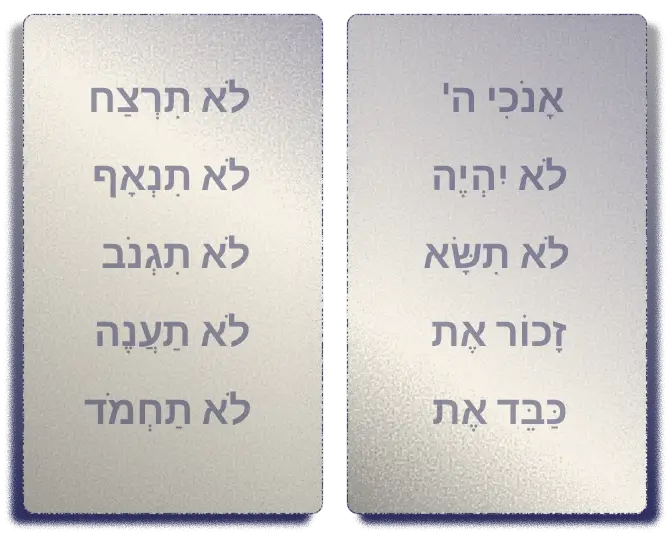
Moshe descends from Sinai carrying the Luchos, the physical embodiment of the covenant between Hashem and Israel. The Tablets were not merely written commandments but the visible testimony of the Divine relationship that had been established at Sinai.
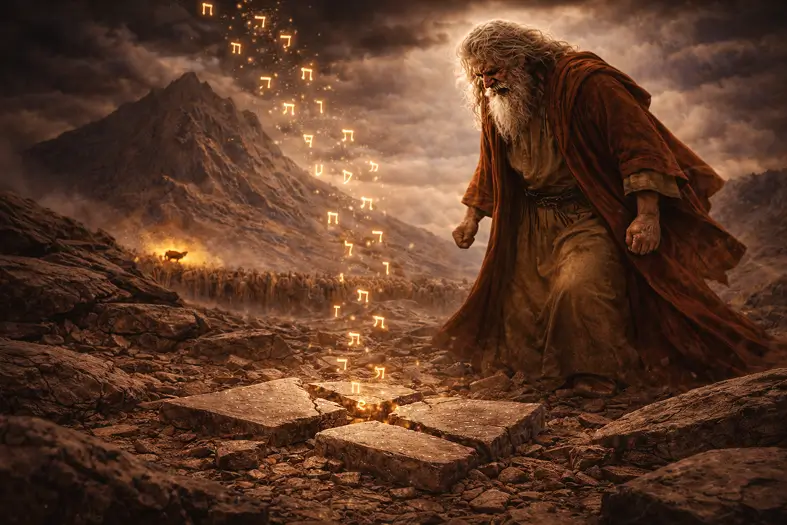
As Moshe approaches the camp, he encounters a devastating sight:
שמות לב:יט
“וַיְהִי כַּאֲשֶׁר קָרַב אֶל־הַמַּחֲנֶה וַיַּרְא אֶת־הָעֵגֶל וּמְחֹלֹת וַיִּחַר־אַף מֹשֶׁה וַיַּשְׁלֵךְ מִיָּדָיו אֶת־הַלֻּחֹת וַיְשַׁבֵּר אֹתָם תַּחַת הָהָר.”
Moshe sees the Golden Calf and the dancing around it. In response, he casts the Tablets from his hands and shatters them at the foot of the mountain.
At first glance, this act appears to be an expression of overwhelming anger. Moshe has witnessed the destruction of everything he labored to build, and in a moment of fury he destroys the Tablets.
Yet the commentators explain that Moshe’s act was not a loss of control but a deliberate decision.
Breaking the Luchos preserved the covenant by preventing Torah from coexisting with idolatry.
Rashi: A Calculated Act
Rashi explains Moshe’s reasoning through a powerful analogy. If the Torah warns that an apostate may not partake of the Korban Pesach, then Israel in its present state — engaged in idolatry — could not receive the Torah.
Moshe reasoned:
If a single commandment cannot be entrusted to those who rebel, how can the entire Torah be entrusted to them?
The breaking of the Luchos therefore becomes a calculated act rather than an emotional outburst.
Moshe acts to prevent a contradiction. The covenant cannot be formally delivered to a nation actively violating its most fundamental principle.
Rashi’s interpretation reveals Moshe as a leader thinking clearly in a moment of crisis. His decision preserves the integrity of the covenant even while its external form is destroyed.
Abarbanel: Protecting the Covenant
The Abarbanel emphasizes that Moshe did not abandon the covenant by breaking the Luchos. He protected it.
The Tablets represented the formal bond between Hashem and Israel. If they had been delivered unchanged, the covenant might have stood as testimony against the people rather than as a foundation for renewal.
By breaking the Tablets, Moshe prevented the covenant from becoming a document of condemnation.
The destruction of the Luchos created the possibility of a second covenant that could be established after repentance.
According to Abarbanel, Moshe acted not as a destroyer but as a defender of Israel’s future.
The breaking of the Tablets preserved the relationship by suspending its formal expression.
The Covenant Cannot Be Divided
Moshe’s action expresses a fundamental principle: Torah cannot coexist with idolatry.
The Tablets represented the unity of the covenant. Accepting part of the covenant while rejecting its foundation would have created a contradiction at the heart of Torah life.
Moshe therefore refused to allow the Tablets to remain intact in a moment when the covenant had been violated.
His action declared that the Torah must remain whole.
The covenant would either be restored in its integrity or not at all.
Rabbi Sacks: Leadership and Moral Courage
Rabbi Jonathan Sacks emphasized that leadership sometimes requires actions that appear destructive in the moment but preserve what matters most in the long term.
Moshe’s breaking of the Luchos represents an act of moral courage. He does not attempt to preserve appearances by delivering the Tablets despite the people’s sin. Instead he acts decisively to defend the truth of the covenant.
Rabbi Sacks noted that great leaders understand the difference between preserving forms and preserving principles.
Moshe sacrifices the physical Tablets in order to preserve the spiritual covenant.
The act demonstrates a profound clarity about what must endure and what may be relinquished.
True leadership protects essentials even at the cost of visible loss.
Destroying in Order to Rebuild
The breaking of the Luchos creates the possibility of renewal. Later in the parsha Moshe ascends Sinai again, and a second set of Tablets is given.
The second Luchos represent a covenant that has survived crisis and repentance.
The first Tablets descend into a world untested by failure. The second Tablets emerge from a world that has confronted its weakness and begun to recover.
Moshe’s decision makes that transition possible.
The covenant that follows becomes stronger because it has passed through destruction and renewal.
Rav Miller: Loyalty to Truth
Rav Avigdor Miller emphasized that loyalty to Torah sometimes requires difficult decisions. A person committed to truth must be prepared to defend it even when doing so appears costly.
Moshe’s breaking of the Tablets illustrates such loyalty. He does not allow the Torah to become associated with idolatry or compromise.
Rav Miller stressed that preserving Torah clarity requires the willingness to act decisively when principles are threatened.
The destruction of the Luchos shows that the preservation of truth sometimes demands courage that goes beyond ordinary leadership.
Moshe demonstrates that fidelity to Hashem stands above all other considerations.
Application for Today — The Courage to Protect What Matters
There are moments when preserving what is most important requires difficult decisions. It is often tempting to protect appearances or avoid conflict by allowing small compromises to pass unchallenged. Yet over time, essential principles can weaken when they are not clearly defended.
Moshe’s breaking of the Luchos teaches that true preservation sometimes requires decisive action. By refusing to allow the Tablets to coexist with idolatry, Moshe protected the integrity of the covenant and made renewal possible. His courage ensured that Torah would remain whole rather than partially accepted and gradually distorted.
In personal life as well, clarity about essential values provides direction during moments of uncertainty. When a person understands what must never be surrendered, difficult choices become clearer. Commitment to Torah principles creates a steady center from which decisions can be made with confidence.
Ki Sisa teaches that protecting truth requires courage. What appears to be loss in the moment can become the foundation for lasting strength when it preserves what matters most.
📖 Sources
- Full sources available on the Mitzvah Minute Parshas Ki Sisa page under insights and commentaries