www.Mitzvah-Minute.com
"Mishpatim — Part VII — Moshe’s Ascent & the Structure of Creation"
7.5 — The Four Realms of Creation
How the forty days mirror the structure of existence
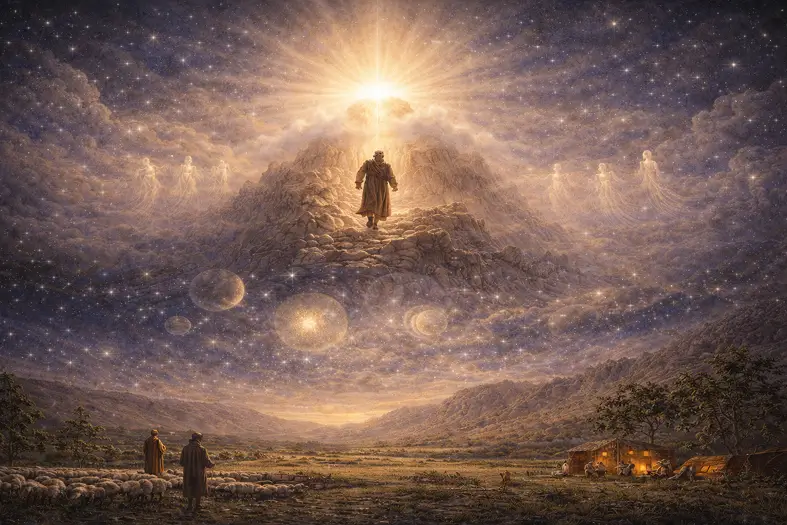
Moshe’s ascent at the end of Parshas Mishpatim is described not only as a historical event, but as a spiritual process. He enters the cloud, remains on the mountain for forty days and forty nights, and emerges transformed. Many commentators see this ascent as more than a preparation for receiving the tablets. It reflects the structure of existence itself.
The Torah states:
שמות כ״ד:י״ב–י״ח
“עֲלֵה אֵלַי הָהָרָה… וַיָּבֹא מֹשֶׁה בְּתוֹךְ הֶעָנָן… וַיְהִי מֹשֶׁה בָּהָר אַרְבָּעִים יוֹם וְאַרְבָּעִים לָיְלָה.”
“Ascend to Me on the mountain… Moshe entered the cloud… and Moshe was on the mountain forty days and forty nights.”
Abarbanel and later philosophical traditions explain that the forty-day ascent represents a journey through the different layers of reality. The mountain is not only a physical location. It is a symbolic axis connecting earth and heaven. As Moshe ascends, he passes through successive realms of existence.
The Four Realms of Creation
Jewish philosophical and mystical traditions often describe creation as composed of four ascending levels. These are not separate worlds in a physical sense, but different degrees of existence and consciousness.
They are commonly described as:
- The mineral realm — inanimate matter.
- The plant realm — living but rooted life.
- The animal realm — life with movement and instinct.
- The human or intellectual realm — life capable of thought, morality, and spiritual awareness.
Each realm builds upon the one before it. The plant contains the mineral. The animal contains the plant. The human contains all three, and adds intellect and moral consciousness.
Moshe’s ascent represents the movement upward through these levels. He begins as a physical being on the mountain, but through the forty days, he transcends ordinary human limitations and becomes a vessel for Divine wisdom.
Abarbanel: Ascent Through the Structure of Existence
Abarbanel himself presents a more cosmic version of this structure. He describes four realms of existence: the physical world, the celestial spheres, the world of intellects (angels), and the Divine emanations through which Hashem’s will flows into creation. Each realm contains ten categories, forming the complete architecture of existence. Moshe’s ascent, in this view, is not only personal or national, but cosmic—an ascent through the very structure of the universe.
Abarbanel explains that Moshe’s forty days were not simply a waiting period. They were a transformation through the layers of existence.
At the beginning of the ascent, Moshe still belongs to the physical world. He stands on the mountain, a place of earth and stone. But as he enters the cloud and remains there without food or drink, his existence becomes less physical and more spiritual.
This process reflects a movement:
- From the physical to the living.
- From the living to the conscious.
- From the conscious to the prophetic.
Moshe becomes the human being who rises above the lower levels of existence and connects directly to the Divine intellect. His ascent mirrors the structure of the universe, where higher levels emerge from and elevate the lower ones.
The Forty Days as a Journey Through the Realms
The number forty, which appears repeatedly in the Torah, often signals a period of transformation. In this context, it represents the passage through the layers of creation.
The ascent can be understood as a symbolic progression:
- The first stage: detachment from purely physical existence.
- The second stage: refinement of the life forces and instincts.
- The third stage: elevation of the intellect.
- The fourth stage: union with Divine wisdom through prophecy.
Moshe does not abandon the lower realms. Instead, he integrates them and rises above them, becoming a complete vessel for the Torah.
Torah as the Architecture of the Cosmos
In many philosophical traditions, the Torah is not only a set of commandments. It is the blueprint of creation. The structure of the universe reflects the structure of the Torah, and the structure of the Torah reflects the structure of the universe.
Moshe’s ascent reveals this connection. As he rises through the levels of existence, he receives the Torah, which corresponds to those same levels.
The mishpatim regulate physical society.
The covenant shapes the moral world.
The tablets embody Divine wisdom itself.
Through Moshe, the Torah descends from the highest realm into the lowest, structuring reality from top to bottom.
The Mountain as the Axis of Creation
Har Sinai becomes a symbolic center of the universe. It stands at the meeting point between heaven and earth.
At its base, the people stand in the physical world.
On its slopes, the elders ascend partway.
At its summit, Moshe enters the cloud and the Divine presence.
The mountain thus reflects the layered structure of creation. It is an axis through which the Torah descends and humanity ascends.
Moshe’s journey up the mountain is therefore the journey of the human soul: rising from material existence toward spiritual clarity.
Application for Today — Living Across the Four Realms
The four realms of creation are not only philosophical categories. They exist within every human life.
Each person contains:
- The mineral aspect — the physical body.
- The plant aspect — growth, nourishment, and stability.
- The animal aspect — emotion, instinct, and movement.
- The human aspect — intellect, morality, and spirituality.
The Torah’s purpose is not to destroy the lower realms, but to elevate them. Physical life becomes holy when it is directed by moral and spiritual purpose.
A practical way to apply this teaching includes:
- Caring for the body as a vessel for higher purpose.
- Channeling emotions toward compassion and discipline.
- Developing the intellect through Torah study.
- Aligning daily actions with spiritual values.
Moshe’s ascent teaches that the human being is meant to rise through the layers of existence. The Torah provides the path upward, transforming the physical world into a place of covenant and holiness.
📖 Sources
- Full sources available on the Mitzvah Minute Parshas Mishpatim page under insights and commentaries.