www.Mitzvah-Minute.com
"Mishpatim — Part VII — Moshe’s Ascent & the Structure of Creation"
7.6 — Torah as the Blueprint of the Universe
Why the Torah precedes creation
At the close of Parshas Mishpatim, Moshe ascends the mountain to receive the tablets. The Torah describes this moment as more than the delivery of laws. It is the transmission of something deeper: the Divine pattern according to which the world itself is structured.
The Torah states:
שמות כ״ד:י״ב
“עֲלֵה אֵלַי הָהָרָה… וְאֶתְּנָה לְךָ אֶת־לֻחֹת הָאֶבֶן, וְהַתּוֹרָה וְהַמִּצְוָה.”
“Ascend to Me on the mountain… and I will give you the tablets of stone, and the Torah and the commandment.”
This verse does not speak only of commandments. It speaks of the Torah—a complete structure of Divine wisdom. The mefarshim and Midrashic tradition explain that the Torah is not merely a guide for human behavior. It is the blueprint of creation itself.
The Midrash: Torah Before the World
Chazal teach a foundational principle:
“Hashem looked into the Torah and created the world.”
— Bereishis Rabbah 1:1
The Midrash presents the Torah as the plan from which the universe was built. Just as an architect designs a building before laying its foundation, so too the world was formed according to the structure of the Torah.
This means:
- The laws of the Torah reflect the laws of existence.
- Moral order is not arbitrary.
- Reality itself is aligned with Divine wisdom.
The Torah does not impose meaning on a chaotic world. It reveals the meaning already built into creation.
Abarbanel: Torah as the Structure of Existence
Abarbanel explains that the Torah reflects the layered structure of the universe. Just as creation is composed of ascending realms, the Torah contains levels that correspond to them.
The Torah includes:
- Laws governing physical life.
- Moral laws shaping society.
- Spiritual teachings guiding the soul.
- Divine wisdom that transcends human understanding.
These layers correspond to the different realms of existence:
- The physical world.
- The celestial order.
- The world of intellects.
- The Divine emanations.
In this view, the Torah is not simply a legal code. It is a map of reality. It describes the structure of the cosmos and the path through it.
The Tablets: Stone and Spirit
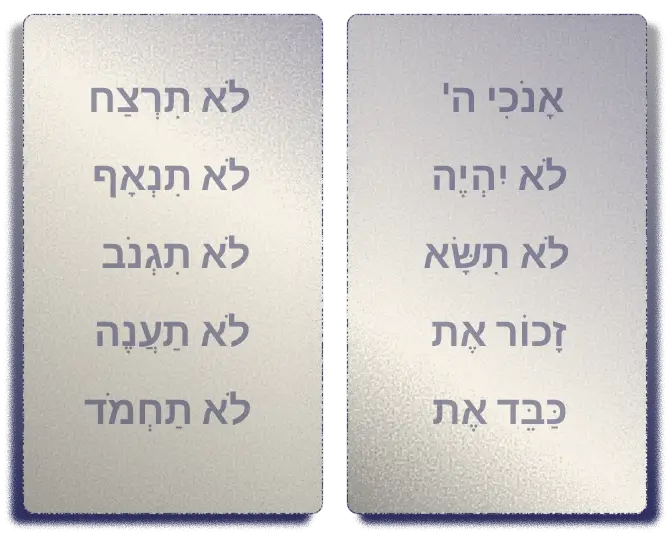
The verse in Mishpatim mentions the “tablets of stone.” This detail is significant. The Torah is given not in abstract speech alone, but engraved into physical matter.
Stone represents:
- The lowest level of existence.
- The mineral realm.
- The physical foundation of the world.
When the Torah is engraved into stone, it symbolizes the descent of Divine wisdom into the lowest realm of creation. The highest truth becomes inscribed into the most material substance.
This reflects the Torah’s role:
- To connect heaven and earth.
- To infuse the physical world with spiritual meaning.
- To transform matter into a vessel of holiness.
Torah and the Architecture of Life
If the Torah is the blueprint of creation, then living according to the Torah means living in harmony with reality itself.
A building constructed according to its blueprint stands firm.
A building constructed against its design eventually collapses.
So too:
- A society aligned with the Torah’s principles becomes stable.
- A life aligned with its moral structure becomes meaningful.
- A world aligned with its Divine purpose becomes holy.
The Torah is not an external system imposed upon the world. It is the inner logic of the world itself.
The Covenant and the Cosmic Order
Parshas Mishpatim begins with civil laws—damages, servants, property, and justice. It ends with Moshe ascending the mountain to receive the Torah.
This structure is deliberate. The parsha moves:
- From society,
- To covenant,
- To cosmic revelation.
The same Torah that governs the behavior of an ox or a borrower also reflects the structure of the universe. The smallest legal detail and the highest spiritual truth are part of one unified system.
This is the Torah’s claim: the laws of everyday life are rooted in the architecture of creation.
Application for Today — Living According to the Design of Reality
If the Torah is the blueprint of the universe, then mitzvos are not arbitrary rules. They are instructions for living in harmony with reality.
Modern culture often assumes:
- Morality is subjective.
- Meaning is self-created.
- Truth is relative.
The Torah presents a different vision. It teaches that:
- The world has a structure.
- Human life has a purpose.
- The Torah reveals that structure and purpose.
A practical way to apply this teaching includes:
- Viewing mitzvos as alignment with reality, not restriction.
- Studying Torah as a way of understanding the design of existence.
- Building personal habits that reflect Torah values.
- Recognizing that spiritual growth means living in harmony with the Divine blueprint.
When a person lives according to the Torah, he is not bending reality to his will. He is aligning himself with the design that was present from the beginning.
📖 Sources
- Full sources available on the Mitzvah Minute Parshas Mishpatim page under insights and commentaries.