www.Mitzvah-Minute.com
"Pekudei — Part III — “וַיָּקֶם מֹשֶׁה אֶת הַמִּשְׁכָּן”: Human Effort and Divine Completion"
3.5 — Building the House Where G-d Can Dwell
Ramban — Preparing a Dwelling for the Divine Presence
As Parshas Pekudei approaches its climax, the Torah describes the final assembly of the Mishkan. Moshe raises the structure, places each vessel in its proper location, arranges the courtyard, and completes the work of establishing the sanctuary:
שמות מ׳:י״ח–ל״ג
Every component now stands in its designated place. The Ark rests within the Holy of Holies, the Menorah illuminates the sanctuary, the table holds the sacred bread, and the altar stands ready for offerings.
Ramban explains that the Mishkan represents the continuation of the revelation at Sinai. At the mountain, the Divine Presence descended openly before the entire nation. The Mishkan now becomes the permanent location where that presence will dwell within the life of Israel.
Yet the Torah emphasizes that this dwelling place does not appear spontaneously. It emerges through the efforts of the people.
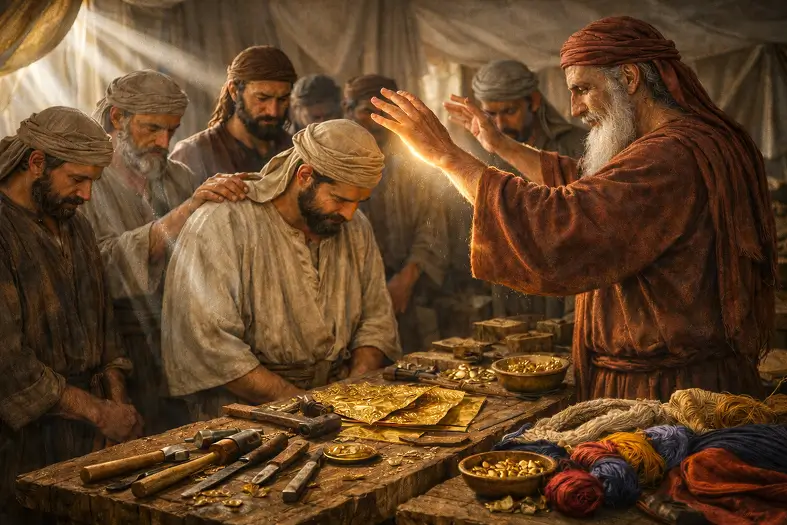
The donations of the nation, the craftsmanship of the artisans, the leadership of Moshe, and the careful obedience to the Divine command all contribute to the creation of the sanctuary.
The Mishkan therefore represents the moment when human initiative prepares the conditions in which the Divine Presence can dwell among the people.
Rav Kook — The Harmony of Human Creativity and Divine Grace
Rav Kook saw in the Mishkan a profound expression of harmony between human creativity and Divine guidance. The sanctuary arises through the labor of human hands—through design, craftsmanship, generosity, and leadership.
Yet its ultimate purpose transcends human accomplishment.
The Mishkan exists so that the Divine Presence may dwell within the world. Human effort alone cannot produce that presence. It can only prepare the conditions that invite it.
Rav Kook understood this relationship as a model for spiritual life itself. Human beings are called upon to cultivate environments that reflect holiness—through ethical conduct, devotion, and creativity.
When such environments are created, the Divine Presence finds a place to dwell.
The Mishkan thus symbolizes the partnership between human initiative and Divine grace.
The Sfas Emes — Making Space for Holiness
The Sfas Emes emphasizes that the Mishkan teaches a deeper spiritual principle. Holiness does not descend into the world arbitrarily. It appears where human beings create space for it.
The people of Israel prepared that space through their actions. They gave generously from their possessions, devoted their talents to the construction of the sanctuary, and followed the Divine instructions with discipline and care.
Through these efforts, they transformed ordinary materials—wood, metal, and fabric—into a place dedicated to divine service.
The Mishkan therefore demonstrates that holiness becomes visible when human beings shape their world in a way that reflects their relationship with Hashem.
Rabbi Jonathan Sacks — Communities That Invite the Divine
Rabbi Jonathan Sacks often wrote that one of the central themes of the Torah is the creation of communities capable of sustaining the Divine presence within the world.
The Mishkan represents the first great example of such a community project.
Every segment of the nation participates in its creation. Some contribute wealth, others offer craftsmanship, and still others provide leadership and guidance. Each role becomes part of a shared effort to build a sanctuary that belongs to the entire people.
Through this collective endeavor, the Mishkan becomes more than a structure.
It becomes the visible expression of a covenant society.
Communities that unite around shared values and sacred purpose create environments where holiness can flourish.
Rav Avigdor Miller — Preparing a Place for Hashem
Rav Avigdor Miller often emphasized that the Torah teaches individuals to prepare their lives for the presence of Hashem. Just as the Mishkan was constructed carefully and intentionally, human beings are called upon to shape their lives in ways that invite holiness.
The sanctuary demonstrates that divine presence does not appear randomly.
It rests where individuals and communities cultivate integrity, discipline, and devotion.
The builders of the Mishkan did not simply complete a remarkable project. They prepared a place where the Divine Presence could dwell among them.
Their achievement reflects the profound partnership between human effort and Divine grace.
The Union of Human Initiative and Divine Presence
The story of the Mishkan reveals the Torah’s vision of how holiness enters the world.
Human beings are called upon to act—to build, to give, to create, and to lead. Through these efforts they shape the physical and moral environment of their communities.
Yet the ultimate transformation of that environment occurs when the Divine Presence enters it.
The Mishkan therefore represents the meeting point between human initiative and Divine grace.
The people build the sanctuary, but Hashem fills it with His presence.
Application for Today
The lessons of the Mishkan remain deeply relevant in every generation.
Communities often seek ways to cultivate meaning and spiritual vitality within their lives. The Torah teaches that such vitality does not emerge spontaneously. It arises when individuals work together to build institutions and environments shaped by shared values.
Generosity, discipline, craftsmanship, and leadership all play a role in this process.
When individuals contribute their talents and resources toward purposes that reflect holiness, they create spaces where the Divine presence can be felt.
The Mishkan reminds us that spiritual life is not confined to moments of inspiration.
It grows wherever people dedicate their efforts to building a world that reflects their relationship with Hashem.
📖 Sources
- Full sources available on the Mitzvah Minute Parshas Pekudei page under insights and commentaries