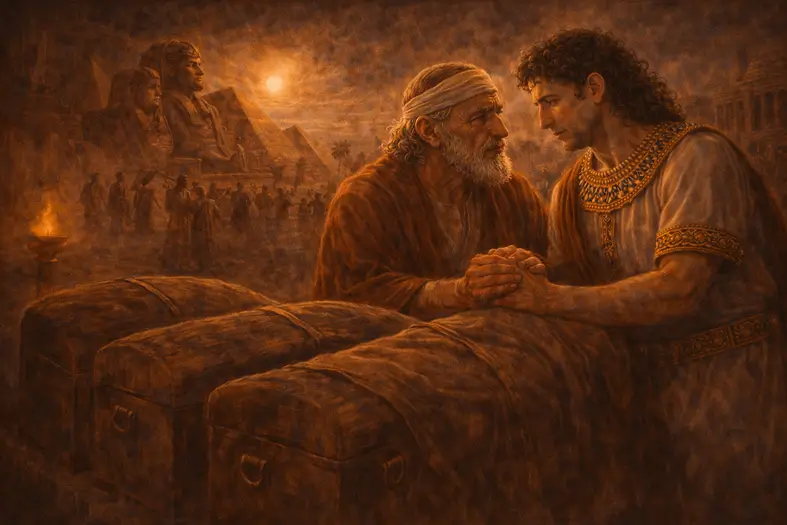
Parshas Vayechi
Parshas Vayechi closes Sefer Bereishis not with fulfillment, but with waiting. The family of Yaakov stands intact, yet rooted in Egypt. The covenant has survived betrayal, famine, and exile, but redemption remains unseen. No miracles erupt. No prophecy announces the timetable of deliverance. Instead, the Torah ends with an oath, a coffin, and bones that will not yet be buried.
This ending is deliberate. Vayechi teaches that redemption does not begin when history changes, but when responsibility does. Long before geulah is revealed, it is prepared — quietly, patiently, and often invisibly — through fulfilled promises and disciplined faith.
Rashi frames the end of Vayechi as the Torah’s lesson in how covenant survives when vision is withheld. The parsha is setumah, sealed, because the End of Days is concealed. Yet Rashi emphasizes that concealment does not suspend obligation. On the contrary, it intensifies it.
Yaakov insists that Yosef swear to bury him in the ancestral land. This is not symbolic. It is binding speech — חֶסֶד וֶאֱמֶת, kindness devoid of self-interest. When prophecy recedes, Rashi teaches, the future is carried by oaths that outlive the speaker.
Yosef, in turn, mirrors this act at the end of his life. His final words are not comfort or explanation, but command:
פָּקֹד יִפְקֹד אֱלֹקִים אֶתְכֶם
[“Elokim will surely remember you.”]
He binds the nation to a promise not yet fulfilled. His bones remain in Egypt as testimony that redemption has been pledged even if it is postponed. For Rashi, Bereishis ends not with resolution, but with responsibility transferred forward.
Ramban reads Vayechi as the Torah’s architectural blueprint for exile. Yaakov descends to Egypt expecting return, yet dies there. This pattern, Ramban insists, defines Jewish history: exile begins through human action, unfolds under Divine supervision, and ends only through covenantal fidelity.
Burial becomes the anchor of identity. Though Yaakov lives in Egypt, his destiny is located elsewhere. His insistence on burial in the land of his fathers affirms that exile does not redefine purpose. Even when life ends in foreign soil, identity remains oriented toward redemption.
For Ramban, geulah does not arrive through rupture but through continuity. The nations themselves will one day escort Israel home, just as Egypt escorted Yaakov’s coffin. Redemption is not sudden reversal; it is the unveiling of commitments already honored. History turns when promises are kept long enough.
Chassidus, following the Baal Shem Tov, reads Vayechi’s concealment as spiritual necessity. Redemption does not announce itself. If the End of Days were revealed, emunah would collapse into calculation. Therefore, geulah must grow unseen, embedded within ordinary life.
This is why Yaakov is prevented from revealing the future. Exile exists to cultivate faith without illumination. Holiness matures not through spectacle, but through persistence in darkness. The deepest Divine light is hidden precisely where it cannot be claimed or displayed.
Yosef’s bones embody this truth. They lie silently in Egypt, neither decayed nor redeemed, awaiting a future moment. Chassidus teaches that nothing bound to Hashem is ever lost. What appears dormant is often growing beneath the surface. Redemption is already present — concealed within fidelity.
Rav Sacks describes Vayechi as Judaism’s defining statement about time. Bereishis ends without closure because Jewish history is not tragic or cyclical, but covenantal. The future is open because human responsibility remains active.
Yaakov wishes to predict the End of Days, but prophecy ends where freedom begins. If the future were known, moral choice would be diminished. Judaism therefore refuses final chapters. The story remains unfinished so that it can still be written.
Yosef understands this deeply. He forgives without erasing the past, reframes suffering without denying it, and prepares redemption without demanding to see it. His final act is not escape, but trust. Rav Sacks teaches that hope is not optimism; it is responsibility carried forward despite uncertainty.
Parshas Vayechi teaches that redemption begins long before it arrives. It begins with speech honored, memory preserved, restraint practiced, and faith lived without guarantees. Yaakov dies without seeing the future he prepared. Yosef dies without leaving exile. Yet both shape redemption precisely because they do not abandon it.
The Torah closes Bereishis with bones that wait, oaths that bind, and a future left deliberately open. We are not asked to finish history. We are asked to carry it faithfully.
Redemption is not summoned by prediction.
It is prepared by lives lived as if the promise is real — even when it is still unseen.
📖 Sources


Parshas Vayechi
Parshas Vayechi closes Sefer Bereishis not with fulfillment, but with waiting. The family of Yaakov stands intact, yet rooted in Egypt. The covenant has survived betrayal, famine, and exile, but redemption remains unseen. No miracles erupt. No prophecy announces the timetable of deliverance. Instead, the Torah ends with an oath, a coffin, and bones that will not yet be buried.
This ending is deliberate. Vayechi teaches that redemption does not begin when history changes, but when responsibility does. Long before geulah is revealed, it is prepared — quietly, patiently, and often invisibly — through fulfilled promises and disciplined faith.
Rashi frames the end of Vayechi as the Torah’s lesson in how covenant survives when vision is withheld. The parsha is setumah, sealed, because the End of Days is concealed. Yet Rashi emphasizes that concealment does not suspend obligation. On the contrary, it intensifies it.
Yaakov insists that Yosef swear to bury him in the ancestral land. This is not symbolic. It is binding speech — חֶסֶד וֶאֱמֶת, kindness devoid of self-interest. When prophecy recedes, Rashi teaches, the future is carried by oaths that outlive the speaker.
Yosef, in turn, mirrors this act at the end of his life. His final words are not comfort or explanation, but command:
פָּקֹד יִפְקֹד אֱלֹקִים אֶתְכֶם
[“Elokim will surely remember you.”]
He binds the nation to a promise not yet fulfilled. His bones remain in Egypt as testimony that redemption has been pledged even if it is postponed. For Rashi, Bereishis ends not with resolution, but with responsibility transferred forward.
Ramban reads Vayechi as the Torah’s architectural blueprint for exile. Yaakov descends to Egypt expecting return, yet dies there. This pattern, Ramban insists, defines Jewish history: exile begins through human action, unfolds under Divine supervision, and ends only through covenantal fidelity.
Burial becomes the anchor of identity. Though Yaakov lives in Egypt, his destiny is located elsewhere. His insistence on burial in the land of his fathers affirms that exile does not redefine purpose. Even when life ends in foreign soil, identity remains oriented toward redemption.
For Ramban, geulah does not arrive through rupture but through continuity. The nations themselves will one day escort Israel home, just as Egypt escorted Yaakov’s coffin. Redemption is not sudden reversal; it is the unveiling of commitments already honored. History turns when promises are kept long enough.
Chassidus, following the Baal Shem Tov, reads Vayechi’s concealment as spiritual necessity. Redemption does not announce itself. If the End of Days were revealed, emunah would collapse into calculation. Therefore, geulah must grow unseen, embedded within ordinary life.
This is why Yaakov is prevented from revealing the future. Exile exists to cultivate faith without illumination. Holiness matures not through spectacle, but through persistence in darkness. The deepest Divine light is hidden precisely where it cannot be claimed or displayed.
Yosef’s bones embody this truth. They lie silently in Egypt, neither decayed nor redeemed, awaiting a future moment. Chassidus teaches that nothing bound to Hashem is ever lost. What appears dormant is often growing beneath the surface. Redemption is already present — concealed within fidelity.
Rav Sacks describes Vayechi as Judaism’s defining statement about time. Bereishis ends without closure because Jewish history is not tragic or cyclical, but covenantal. The future is open because human responsibility remains active.
Yaakov wishes to predict the End of Days, but prophecy ends where freedom begins. If the future were known, moral choice would be diminished. Judaism therefore refuses final chapters. The story remains unfinished so that it can still be written.
Yosef understands this deeply. He forgives without erasing the past, reframes suffering without denying it, and prepares redemption without demanding to see it. His final act is not escape, but trust. Rav Sacks teaches that hope is not optimism; it is responsibility carried forward despite uncertainty.
Parshas Vayechi teaches that redemption begins long before it arrives. It begins with speech honored, memory preserved, restraint practiced, and faith lived without guarantees. Yaakov dies without seeing the future he prepared. Yosef dies without leaving exile. Yet both shape redemption precisely because they do not abandon it.
The Torah closes Bereishis with bones that wait, oaths that bind, and a future left deliberately open. We are not asked to finish history. We are asked to carry it faithfully.
Redemption is not summoned by prediction.
It is prepared by lives lived as if the promise is real — even when it is still unseen.
📖 Sources


“Preparing Redemption in Advance”
אֶת־ה׳ אֱלֹקֶיךָ תִּירָא
Vayechi presents yirat Hashem as fidelity practiced without revelation. Yaakov’s inability to disclose the End of Days teaches that fear of Hashem does not depend on knowing outcomes, but on acting responsibly when the future is concealed. Preparing redemption requires reverence that persists even when Divine direction is no longer explicit.
וְהָלַכְתָּ בִדְרָכָיו
Hashem governs history patiently, allowing redemption to unfold gradually rather than abruptly. Yaakov and Yosef model this Divine attribute by acting with restraint, continuity, and trust across generations. Emulating Hashem here means sustaining covenantal behavior even when fulfillment is delayed.
מוֹצָא שְׂפָתֶיךָ תִּשְׁמֹר וְעָשִׂיתָ
This mitzvah stands at the heart of the parsha. Yaakov’s burial oath and Yosef’s command regarding his bones transform hope into obligation. Vayechi teaches that redemption is prepared through promises honored long after the speaker’s death, binding generations through disciplined speech.
לֹא יַחֵל דְּבָרוֹ
Yosef’s final words do not console — they obligate. By insisting that his bones be carried from Egypt, he ensures that exile never becomes spiritual permanence. This mitzvah frames redemption as trust sustained through reliability: the refusal to abandon commitments even when fulfillment lies beyond one’s lifetime.
וְלֹא יַשִּׁיב אֶת־הָעָם מִצְרַיְמָה
Although articulated later in the Torah, this mitzvah is foreshadowed in Vayechi. Yaakov’s insistence on burial in Eretz Yisrael and Yosef’s demand to leave Egypt posthumously affirm that exile may be endured but never embraced as final. Preparing redemption requires maintaining spiritual orientation toward return, even when departure is postponed.


“Preparing Redemption in Advance”
Parshas Vayechi concludes Sefer Bereishis not with revealed redemption, but with responsibility entrusted to the future. Yaakov seeks to disclose the End of Days and is prevented, teaching that covenantal life must continue without prophetic timetables. Instead, the parsha emphasizes binding speech and fulfilled promise: Yaakov demands an oath regarding his burial, and Yosef closes the book of Bereishis by binding the nation to a future redemption he himself will not witness. Yosef’s insistence that his bones be carried from Egypt affirms that exile does not redefine destiny; it merely postpones its realization. Vayechi thus frames redemption as a process prepared quietly through faithfulness, continuity, and disciplined trust. The parsha teaches that geulah does not begin when history changes, but when individuals live in exile as custodians of promises whose fulfillment lies beyond their lifetime.

Dive into mitzvos, tefillah, and Torah study—each section curated to help you learn, reflect, and live with intention. New insights are added regularly, creating an evolving space for spiritual growth.

Explore the 613 mitzvos and uncover the meaning behind each one. Discover practical ways to integrate them into your daily life with insights, sources, and guided reflection.

Learn the structure, depth, and spiritual intent behind Jewish prayer. Dive into morning blessings, Shema, Amidah, and more—with tools to enrich your daily connection.

Each week’s parsha offers timeless wisdom and modern relevance. Explore summaries, key themes, and mitzvah connections to deepen your understanding of the Torah cycle.