1.1 — Sinai Was an Event; the Mishkan Was a System
At the climax of Parshas Yisro, the Jewish people stood at Har Sinai and experienced the most intense revelation in human history. The Torah describes:
וַיִּשְׁכֹּן כְּבוֹד ה׳ עַל הַר סִינַי
“The glory of Hashem rested upon Mount Sinai” (Shemos 24:16)
The mountain was enveloped in cloud, fire, thunder, and the sound of the shofar. The people saw the voices. The heavens opened. The distance between earth and heaven seemed to vanish. It was an overwhelming encounter with the Divine.
Yet that moment did not last.
The cloud lifted. The fire subsided. The people descended the mountain. Sinai was an event—an experience, a moment of revelation. But an event, no matter how powerful, cannot sustain a nation over time. A people cannot live forever at the peak of a mountain.
Parshas Terumah introduces a radical shift. Instead of a one-time revelation from heaven, the Torah commands:
וְעָשׂוּ לִי מִקְדָּשׁ
“And they shall make for Me a sanctuary” (Shemos 25:8)
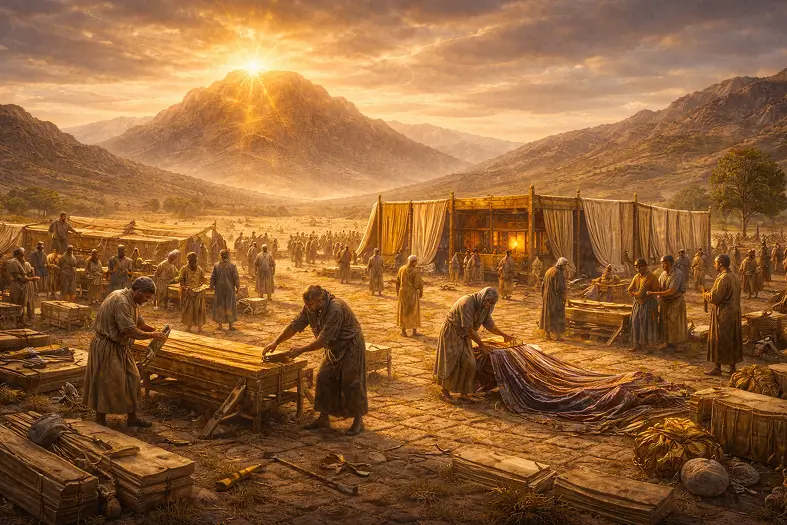
Now, instead of Hashem descending upon a mountain, the people are asked to build a dwelling place for the Shechinah among them.
Sinai was a moment.
The Mishkan would be a system.
The Ramban explains that the Mishkan is not a separate concept from Sinai. It is its continuation. The same Divine glory that rested upon the mountain now rests within the sanctuary.
At Sinai it says:
וַיִּשְׁכֹּן כְּבוֹד ה׳ עַל הַר סִינַי
“The glory of Hashem rested upon Mount Sinai” (24:16)
And at the completion of the Mishkan:
וּכְבוֹד ה׳ מָלֵא אֶת הַמִּשְׁכָּן
“The glory of Hashem filled the Mishkan” (40:34)
The language is nearly identical. The message is clear: the Mishkan is a portable Sinai. The revelation that appeared in one place at one time now becomes a permanent presence among the people.
But there is a crucial difference. Sinai was a Divine initiative. The Mishkan is a human project.
At Sinai, the people stood passively and received. In the Mishkan, they donate, craft, build, and construct. Sinai was given from above. The Mishkan is created from below. Revelation becomes residence.
Abarbanel explains that a nation cannot survive on miracles alone. The early stages of the Exodus were filled with dramatic interventions: the plagues, the splitting of the sea, manna from heaven, water from the rock, and the revelation at Sinai.
But miracles create dependence. They inspire awe, but they do not create stability. A society cannot be built on moments of shock and wonder alone.
The Mishkan marks the beginning of institutional life. Instead of dramatic, one-time experiences, the people are given a permanent structure: a sanctuary, a priesthood, a daily service, and a rhythm of holiness.
Sinai creates faith.
The Mishkan creates continuity.
Rabbi Jonathan Sacks emphasizes that until this point, the Israelites were largely spectators in their own story. Hashem fought their battles, fed them, protected them, and revealed Himself to them.
With the command to build the Mishkan, everything changes. The people are no longer passive recipients. They are asked to become creators. The sanctuary will rise from their generosity, their skills, and their labor.
The verse emphasizes this transformation:
מֵאֵת כָּל־אִישׁ אֲשֶׁר יִדְּבֶנּוּ לִבּוֹ
“From every person whose heart inspires him” (25:2)
The Mishkan is not built through taxation or coercion. It is built through willing hearts. This is the moment when a group of former slaves becomes a nation of builders.
A crowd shares an experience.
A nation builds a future.
Sinai represents a peak experience—sudden, overwhelming, and unforgettable. But peak experiences are, by nature, temporary.
Human beings cannot live at the summit of spiritual intensity. They must return to ordinary life: homes, work, food, relationships, and responsibilities.
The Mishkan translates the moment of Sinai into a daily structure. The one-time thunder of revelation becomes a steady rhythm of service. Instead of a single moment of fire on a mountain, there is a sanctuary in the center of the camp. Instead of a single Divine voice heard once, there is a place from which the word of Hashem continues to emerge.
Sinai was a spiritual explosion.
The Mishkan was a spiritual ecosystem.
There is a profound truth hidden in this transition. Inspiration is powerful, but it fades. Emotion rises and falls. Even the greatest spiritual experience eventually becomes a memory.
Institutions, however, endure. A school continues after the excitement of its founding fades. A community continues after the enthusiasm of its first gathering. A family continues long after the joy of the wedding day.
The Torah is teaching a national lesson: revelation without structure disappears, while structure without revelation becomes empty. The Mishkan combines the two. It preserves the fire of Sinai within a stable, daily framework.
The Mishkan is not simply a building. It is a system—a defined space, a hierarchy of holiness, a structure of vessels, and a rhythm of service repeated every day.
Every part of the Mishkan is measured, ordered, and purposeful. The Torah describes its dimensions, materials, and arrangement in painstaking detail. This teaches that holiness is not only found in moments of ecstasy. It is found in structure, discipline, and routine.
The Divine presence is not limited to mountains. It can dwell within systems—if those systems are built with intention.
The Torah does not say, “I will make a sanctuary for them.” It says:
וְעָשׂוּ לִי מִקְדָּשׁ
“And they shall make for Me a sanctuary” (25:8)
The dwelling place of the Shechinah depends on human action. Hashem reveals Himself at Sinai, but He dwells among the people only when they build a space for Him.
The Mishkan teaches that holiness is not only received. It is constructed.
Every person experiences moments of inspiration: a powerful tefillah, a moving shiur, a meaningful Shabbos, or a life-changing conversation. In those moments, we feel clarity, closeness, and purpose. But those feelings do not last on their own.
Sinai-moments must become Mishkan-systems.
If a person is inspired by learning, he must build a fixed time for Torah. If he feels uplifted on Shabbos, he must structure his week around its preparation. If he experiences a moment of gratitude, he must create habits of brachos and reflection.
The real test of inspiration is not how high we rise in a moment, but what structures we build afterward. A moving lecture is a Sinai, but a daily study schedule is a Mishkan. A moment of resolve is a Sinai, but a life of consistent action is a Mishkan.
Jewish history reflects this truth. The nation did not survive because of dramatic moments alone. It survived because of systems: Shabbos every week, tefillah every day, Torah in every generation, and homes and communities built with intention.
The message of Terumah is simple and profound:
Do not live only for the peak experiences.
Build structures that allow the Divine to dwell in your daily life.
📖 Sources


1.1 — Sinai Was an Event; the Mishkan Was a System
At the climax of Parshas Yisro, the Jewish people stood at Har Sinai and experienced the most intense revelation in human history. The Torah describes:
וַיִּשְׁכֹּן כְּבוֹד ה׳ עַל הַר סִינַי
“The glory of Hashem rested upon Mount Sinai” (Shemos 24:16)
The mountain was enveloped in cloud, fire, thunder, and the sound of the shofar. The people saw the voices. The heavens opened. The distance between earth and heaven seemed to vanish. It was an overwhelming encounter with the Divine.
Yet that moment did not last.
The cloud lifted. The fire subsided. The people descended the mountain. Sinai was an event—an experience, a moment of revelation. But an event, no matter how powerful, cannot sustain a nation over time. A people cannot live forever at the peak of a mountain.
Parshas Terumah introduces a radical shift. Instead of a one-time revelation from heaven, the Torah commands:
וְעָשׂוּ לִי מִקְדָּשׁ
“And they shall make for Me a sanctuary” (Shemos 25:8)
Now, instead of Hashem descending upon a mountain, the people are asked to build a dwelling place for the Shechinah among them.
Sinai was a moment.
The Mishkan would be a system.
The Ramban explains that the Mishkan is not a separate concept from Sinai. It is its continuation. The same Divine glory that rested upon the mountain now rests within the sanctuary.
At Sinai it says:
וַיִּשְׁכֹּן כְּבוֹד ה׳ עַל הַר סִינַי
“The glory of Hashem rested upon Mount Sinai” (24:16)
And at the completion of the Mishkan:
וּכְבוֹד ה׳ מָלֵא אֶת הַמִּשְׁכָּן
“The glory of Hashem filled the Mishkan” (40:34)
The language is nearly identical. The message is clear: the Mishkan is a portable Sinai. The revelation that appeared in one place at one time now becomes a permanent presence among the people.
But there is a crucial difference. Sinai was a Divine initiative. The Mishkan is a human project.
At Sinai, the people stood passively and received. In the Mishkan, they donate, craft, build, and construct. Sinai was given from above. The Mishkan is created from below. Revelation becomes residence.
Abarbanel explains that a nation cannot survive on miracles alone. The early stages of the Exodus were filled with dramatic interventions: the plagues, the splitting of the sea, manna from heaven, water from the rock, and the revelation at Sinai.
But miracles create dependence. They inspire awe, but they do not create stability. A society cannot be built on moments of shock and wonder alone.
The Mishkan marks the beginning of institutional life. Instead of dramatic, one-time experiences, the people are given a permanent structure: a sanctuary, a priesthood, a daily service, and a rhythm of holiness.
Sinai creates faith.
The Mishkan creates continuity.
Rabbi Jonathan Sacks emphasizes that until this point, the Israelites were largely spectators in their own story. Hashem fought their battles, fed them, protected them, and revealed Himself to them.
With the command to build the Mishkan, everything changes. The people are no longer passive recipients. They are asked to become creators. The sanctuary will rise from their generosity, their skills, and their labor.
The verse emphasizes this transformation:
מֵאֵת כָּל־אִישׁ אֲשֶׁר יִדְּבֶנּוּ לִבּוֹ
“From every person whose heart inspires him” (25:2)
The Mishkan is not built through taxation or coercion. It is built through willing hearts. This is the moment when a group of former slaves becomes a nation of builders.
A crowd shares an experience.
A nation builds a future.
Sinai represents a peak experience—sudden, overwhelming, and unforgettable. But peak experiences are, by nature, temporary.
Human beings cannot live at the summit of spiritual intensity. They must return to ordinary life: homes, work, food, relationships, and responsibilities.
The Mishkan translates the moment of Sinai into a daily structure. The one-time thunder of revelation becomes a steady rhythm of service. Instead of a single moment of fire on a mountain, there is a sanctuary in the center of the camp. Instead of a single Divine voice heard once, there is a place from which the word of Hashem continues to emerge.
Sinai was a spiritual explosion.
The Mishkan was a spiritual ecosystem.
There is a profound truth hidden in this transition. Inspiration is powerful, but it fades. Emotion rises and falls. Even the greatest spiritual experience eventually becomes a memory.
Institutions, however, endure. A school continues after the excitement of its founding fades. A community continues after the enthusiasm of its first gathering. A family continues long after the joy of the wedding day.
The Torah is teaching a national lesson: revelation without structure disappears, while structure without revelation becomes empty. The Mishkan combines the two. It preserves the fire of Sinai within a stable, daily framework.
The Mishkan is not simply a building. It is a system—a defined space, a hierarchy of holiness, a structure of vessels, and a rhythm of service repeated every day.
Every part of the Mishkan is measured, ordered, and purposeful. The Torah describes its dimensions, materials, and arrangement in painstaking detail. This teaches that holiness is not only found in moments of ecstasy. It is found in structure, discipline, and routine.
The Divine presence is not limited to mountains. It can dwell within systems—if those systems are built with intention.
The Torah does not say, “I will make a sanctuary for them.” It says:
וְעָשׂוּ לִי מִקְדָּשׁ
“And they shall make for Me a sanctuary” (25:8)
The dwelling place of the Shechinah depends on human action. Hashem reveals Himself at Sinai, but He dwells among the people only when they build a space for Him.
The Mishkan teaches that holiness is not only received. It is constructed.
Every person experiences moments of inspiration: a powerful tefillah, a moving shiur, a meaningful Shabbos, or a life-changing conversation. In those moments, we feel clarity, closeness, and purpose. But those feelings do not last on their own.
Sinai-moments must become Mishkan-systems.
If a person is inspired by learning, he must build a fixed time for Torah. If he feels uplifted on Shabbos, he must structure his week around its preparation. If he experiences a moment of gratitude, he must create habits of brachos and reflection.
The real test of inspiration is not how high we rise in a moment, but what structures we build afterward. A moving lecture is a Sinai, but a daily study schedule is a Mishkan. A moment of resolve is a Sinai, but a life of consistent action is a Mishkan.
Jewish history reflects this truth. The nation did not survive because of dramatic moments alone. It survived because of systems: Shabbos every week, tefillah every day, Torah in every generation, and homes and communities built with intention.
The message of Terumah is simple and profound:
Do not live only for the peak experiences.
Build structures that allow the Divine to dwell in your daily life.
📖 Sources


“Sinai Was an Event; the Mishkan Was a System”
וְעָשׂוּ לִי מִקְדָּשׁ
This mitzvah commands the construction of a sacred sanctuary for the dwelling of the Shechinah. It transforms the one-time revelation at Sinai into an enduring structure within the life of the nation. Through building the Mishkan, the people become partners in creating a space for Divine presence, turning spiritual inspiration into a permanent institution of holiness.
וְשִׁנַּנְתָּם לְבָנֶיךָ
The Mishkan houses the Aron, which contains the Luchos—the embodiment of Torah. This mitzvah reflects the same principle: the revelation at Sinai must become a continuous system of learning and teaching. Torah is not a one-time event, but an enduring structure that sustains the covenant.
וְאָהַבְתָּ אֵת ה׳ אֱלֹקֶיךָ
The voluntary contributions for the Mishkan, given by those “whose hearts inspire them,” express love of Hashem through action. Love is not only an emotion experienced at moments of revelation; it is sustained through acts of giving, building, and serving in everyday life.


“Sinai Was an Event; the Mishkan Was a System”
Parshas Terumah marks the transition from the revelation at Sinai to the construction of the Mishkan. Instead of a one-time Divine manifestation on a mountain, the Torah commands the people to build a sanctuary where the Shechinah will dwell among them. The Mishkan becomes a portable Sinai, transforming revelation into a daily system of service, structure, and Divine presence within the camp of Israel.

Dive into mitzvos, tefillah, and Torah study—each section curated to help you learn, reflect, and live with intention. New insights are added regularly, creating an evolving space for spiritual growth.

Explore the 613 mitzvos and uncover the meaning behind each one. Discover practical ways to integrate them into your daily life with insights, sources, and guided reflection.

Learn the structure, depth, and spiritual intent behind Jewish prayer. Dive into morning blessings, Shema, Amidah, and more—with tools to enrich your daily connection.

Each week’s parsha offers timeless wisdom and modern relevance. Explore summaries, key themes, and mitzvah connections to deepen your understanding of the Torah cycle.