www.Mitzvah-Minute.com
"Terumah — Part I — “וְיִקְחוּ־לִי תְּרוּמָה”: From Revelation to Responsibility"
1.2 — From Miracles to Institutions
A New Phase in the Story of Israel
The opening chapters of the Torah’s redemption narrative are filled with miracles. Egypt is struck with plagues. The sea splits. Manna falls from heaven. Water emerges from a rock. The mountain trembles with fire and thunder. At every stage, the people are sustained directly by Divine intervention.
These experiences were necessary. A nation broken by centuries of slavery needed to witness the power of Hashem. They needed to see that the world is not governed by Pharaoh, nature, or chance, but by the will of the Creator.
But miracles alone cannot build a civilization.
Parshas Terumah marks a quiet but revolutionary turning point. Instead of another dramatic intervention, Hashem commands:
וְיִקְחוּ־לִי תְּרוּמָה
“They shall take for Me an offering” (Shemos 25:2)
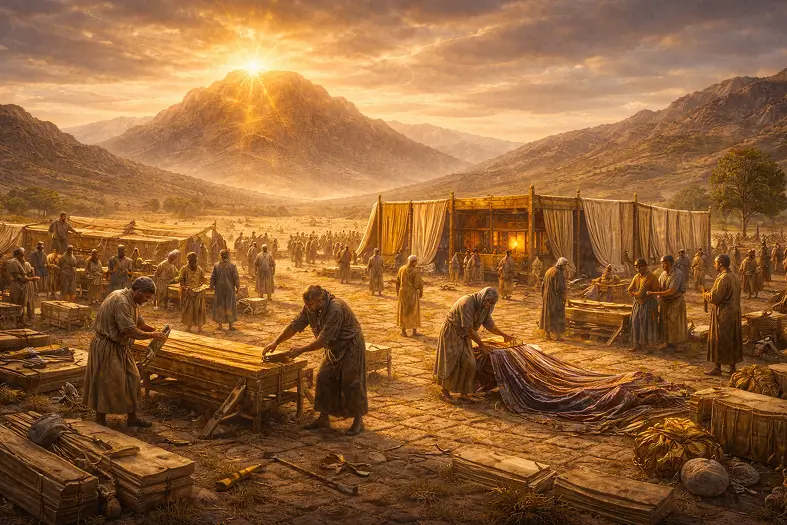
For the first time since the Exodus began, the people are not being saved, fed, or protected. They are being asked to build.
The End of the Age of Spectacle
Until this point, the Israelites lived in a world of spectacle. Each stage of their journey was marked by visible, undeniable Divine action.
- Egypt was struck by ten plagues.
- The sea split before them.
- Manna descended daily from heaven.
- Water flowed from a rock.
- The mountain burned with fire at Sinai.
These events created faith, but they also created passivity. When everything is done for a people, they do not yet experience the dignity of responsibility.
A nation cannot remain forever in a state of dependency. Miracles may create belief, but institutions create continuity.
Abarbanel: From Dependence to Stability
Abarbanel explains that the early stages of the Exodus were designed to uproot the people from Egypt and establish their faith. But a people cannot live forever on miracles. A functioning society requires structure, law, leadership, and sacred institutions.
The Mishkan represents the beginning of that transformation. Instead of dramatic, one-time events, the people are given:
- A permanent sanctuary.
- A defined priesthood.
- A daily service.
- A structured rhythm of holiness.
The shift is subtle but profound. The Torah moves from supernatural intervention to organized religious life. The nation is being prepared not just to believe, but to live.
Rambam: The Mishkan as an Educational Institution
The Rambam offers a philosophical explanation for the command of the Mishkan. Humanity, he explains, was accustomed to physical forms of worship—temples, sacrifices, incense, and visible rituals. These practices were deeply embedded in the human psyche.
The Torah did not abolish those instincts immediately. Instead, it redirected them.
Rather than:
- Many temples, there would be one sanctuary.
- Many gods, there would be one G-d.
- Idolatrous rituals, there would be sacred service.
The Mishkan becomes a Divine educational system. It takes the familiar forms of worship and transforms their meaning, guiding the people gradually toward intellectual and moral perfection.
The sanctuary is not only a place of ritual. It is a school of the spirit, training the nation in discipline, reverence, and awareness of Hashem.
Rabbi Jonathan Sacks: The Birth of Institutions
Rabbi Jonathan Sacks emphasizes that Parshas Terumah marks the birth of Jewish institutions. Until this moment, the Israelites were the recipients of miracles. Now they are asked to create something lasting.
The Mishkan is the first national project of Israel. It requires:
- Collective participation.
- Shared responsibility.
- Skilled craftsmanship.
- Generous contribution.
It is not imposed from above. It is built from the willing hearts of the people:
מֵאֵת כָּל־אִישׁ אֲשֶׁר יִדְּבֶנּוּ לִבּוֹ
“From every person whose heart inspires him” (25:2)
Through this process, the Israelites move from being passive witnesses of miracles to active builders of a sacred society.
Miracles create awe.
Institutions create endurance.
The Difference Between a Miracle and an Institution
A miracle is immediate and overwhelming. It changes reality in a moment. But it does not create habits, systems, or continuity.
An institution, by contrast, works quietly. It shapes behavior over time. It creates patterns of life that endure long after the original inspiration fades.
Consider the difference:
- A miraculous rescue saves a person once.
- A hospital saves thousands over generations.
- A single inspiring speech moves hearts for a day.
- A school shapes minds for decades.
The Mishkan represents this second model. It is not a dramatic event. It is a structured, ongoing system that trains the people in daily holiness.
The Rhythm of Institutional Life
Once the Mishkan is built, spiritual life no longer depends on sudden, overwhelming experiences. Instead, it becomes woven into the rhythm of everyday existence.
There are:
- Daily offerings in the morning and evening.
- Regular lighting of the Menorah.
- Structured service of the kohanim.
- Appointed times for national pilgrimage.
Holiness becomes part of the calendar, the routine, and the national structure. The people no longer rely on extraordinary moments. They live within an ordered system that continually reminds them of the Divine presence.
This is the essence of an institution: it carries the spirit of inspiration into the routines of life.
From a Crowd to a Covenant
A crowd can witness miracles together. But a covenantal nation is built through shared responsibility.
At Sinai, the people experienced revelation. In Terumah, they are asked to translate that revelation into a structure that will endure. They must gather materials, offer their skills, and participate in a project larger than themselves.
This act of collective building transforms identity. Former slaves, accustomed to receiving commands, now become partners in a sacred mission.
They are no longer merely a people who experienced miracles.
They are a people who build institutions.
The Moral Message of the Mishkan
The Mishkan teaches a fundamental principle about spiritual life and about civilization as a whole:
Faith begins with miracles.
But it survives through institutions.
Without institutions, inspiration fades. Without structure, ideals dissolve into memory. A nation, a community, or a family cannot survive on emotional peaks alone. It requires systems, habits, and frameworks that preserve meaning across time.
The Mishkan is the Torah’s first great institution. It takes the fire of Sinai and gives it a home.
Application for Today — Building What Outlives Inspiration
Every generation experiences moments of inspiration. A powerful speech, a moving tefillah, a transformative event, or a moment of crisis can awaken deep faith and emotion.
But those moments, by themselves, do not last.
A person may feel inspired to learn after a shiur. But without a fixed schedule, the inspiration fades. A community may feel united after a powerful event. But without institutions—schools, shuls, organizations—the unity dissolves.
The lesson of Terumah is that spiritual life must be institutionalized.
Instead of relying only on emotional moments, a person must build structures that carry those moments forward:
- Fixed times for Torah learning.
- Regular tefillah with a community.
- Shabbos observance as a weekly anchor.
- Acts of chesed built into daily life.
These are the personal equivalents of the Mishkan. They transform faith from an occasional feeling into a permanent structure.
Jewish survival itself is the greatest proof of this principle. The Jewish people endured not because of miracles alone, but because of institutions:
- The beis midrash.
- The synagogue.
- The Jewish home.
- The rhythm of Shabbos and the festivals.
These structures carried the memory of Sinai across deserts, exiles, and centuries.
The message of Terumah is therefore timeless: do not rely only on moments of inspiration. Build systems that allow holiness to endure.
📖 Sources
- Full sources available on the Mitzvah Minute Parshas Terumah page under insights and commentaries.