www.Mitzvah-Minute.com
"Terumah — Part II — “וְעָשׂוּ לִי מִקְדָּשׁ”: Creation and the Architecture of Holiness"
2.3 — The Courtyard and the Human Condition
The First Space of Encounter
The Torah’s description of the Mishkan begins with the innermost vessels, but the actual experience of the sanctuary begins outside—in the courtyard.
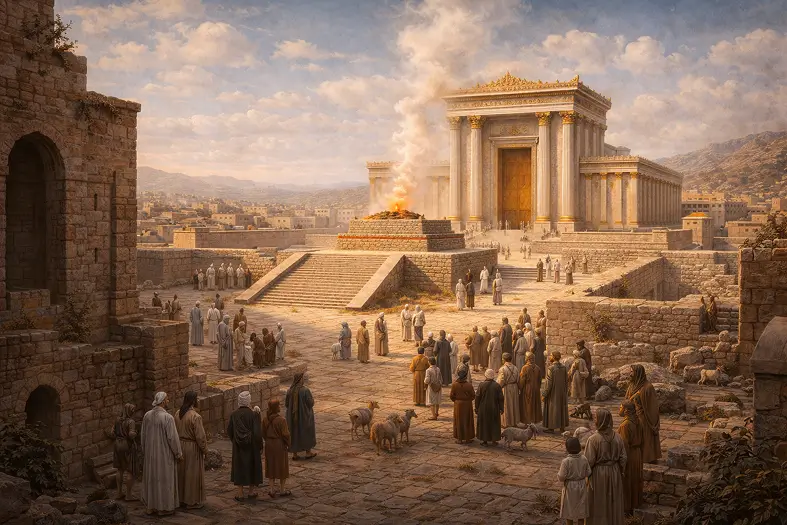
The courtyard surrounds the Mishkan and forms the outermost sacred space. It is here that the people approach. It is here that offerings are brought. It is here that the encounter between human beings and the Divine begins.
The Torah describes the courtyard in precise detail:
וְעָשִׂיתָ אֵת חֲצַר הַמִּשְׁכָּן
“And you shall make the courtyard of the Mishkan” (Shemos 27:9)
The verses that follow outline its dimensions, its materials, its pillars, its sockets, and its entrance. At first glance, these seem like technical architectural instructions. But Abarbanel reveals that the courtyard is deeply symbolic. Its structure reflects the human condition itself.
Abarbanel: The Courtyard as a Symbol of Existence
Abarbanel explains that every part of the Mishkan corresponds to aspects of the world and the human journey within it. The courtyard, as the outermost space, represents the physical world—the realm of action, struggle, and material existence.
This is the space where offerings are brought, where transformation occurs, and where the raw materials of life are elevated toward holiness.
The courtyard is not the ultimate destination. It is the starting point.
It represents the world as we experience it: a place of labor, sacrifice, and growth.
The Dimensions of the Courtyard
The Torah describes the courtyard as measuring one hundred cubits in length and fifty cubits in width. These numbers are not arbitrary.
Abarbanel explains that the structure of the courtyard reflects proportion and limitation. Unlike the open wilderness, the courtyard is bounded. It has fixed measurements and defined edges.
This teaches that human existence is not infinite or unbounded. Life is measured. Time is limited. Strength is finite. Every person lives within the boundaries of a physical world.
The courtyard’s dimensions therefore reflect the reality of human life:
- We live within limits of time.
- We live within limits of strength.
- We live within limits of physical existence.
The courtyard is a symbolic world of boundaries.
Materials: Linen, Copper, and Earthly Reality
The materials of the courtyard also carry symbolic meaning. The structure is composed of linen hangings supported by copper sockets and pillars.
Unlike the inner sanctuary, which is filled with gold, the courtyard is built from more ordinary materials. Copper is strong, durable, and functional, but it lacks the brilliance of gold.
Abarbanel explains that this reflects the nature of the physical world. The outer realm of existence is practical, heavy, and bound to material concerns. It is the place of work, effort, and transformation.
Gold belongs to the inner sanctuary, the realm of higher spiritual awareness. Copper belongs to the courtyard, the realm of action and physical reality.
The courtyard teaches that the path to holiness begins in the material world, not outside of it.
The Gate of the Courtyard
At the eastern side of the courtyard stands its entrance:
וְשַׁעַר הֶחָצֵר
“The gate of the courtyard” (27:16)
This gate is the only way in. It is covered with a woven screen of blue, purple, and red threads, along with fine linen.
Abarbanel explains that this entrance represents the transition from ordinary life into sacred space. One does not simply wander into the sanctuary. There is a threshold, a boundary, a point of entry.
The gate symbolizes the reality that spiritual growth requires passage. A person must move from one level of existence to another. He must cross a boundary between the purely physical and the sacred.
The presence of a single gate teaches that there is a path inward, but it must be entered intentionally.
The Courtyard as the Arena of Transformation
The central feature of the courtyard is the Mizbeach—the altar. This is where offerings are brought and transformed through fire.
Symbolically, this reflects the human condition. Life in the physical world is not static. It is a process of transformation.
The courtyard is the place where:
- Physical offerings are elevated into spiritual service.
- Raw materials become sacred acts.
- Human effort becomes a vehicle for holiness.
The fire of the altar represents the process through which the material world is lifted toward the Divine.
From the Courtyard to the Inner Sanctuary
The structure of the Mishkan reflects a journey. A person begins in the courtyard—the realm of action, struggle, and material existence. From there, he moves inward toward greater sanctity.
The progression is clear:
- The courtyard represents the physical world.
- The inner chamber represents spiritual awareness.
- The Holy of Holies represents the hidden Divine core.
The Mishkan therefore maps the journey of the human soul. One begins in the outer world, engages in effort and transformation, and gradually moves toward the inner sanctum of holiness.
The courtyard is not a place to remain.
It is a place to begin.
The Meaning of Barriers
The courtyard is enclosed by hangings on all sides. These boundaries serve a practical purpose, but they also carry symbolic meaning.
They teach that not every space is the same. There is a distinction between the ordinary world and the sacred domain. Holiness requires separation, definition, and protection.
At the same time, the presence of the gate shows that the sacred is not sealed off. It is accessible—but only through a deliberate path.
Life is full of barriers: limitations, struggles, distractions, and obstacles. The courtyard reminds us that these barriers are not merely constraints. They are part of the journey toward inner holiness.
Application for Today — The Journey from the Outer Court to the Inner Life
The symbolism of the courtyard speaks directly to the human experience. Every person begins life in the outer courtyard—the world of physical needs, responsibilities, and limitations.
We live in a world of:
- Work and livelihood.
- Time pressures.
- Physical concerns.
- Emotional struggles.
These realities are not obstacles to holiness. They are the starting point of it.
The Mishkan teaches that spiritual growth does not begin by escaping the physical world. It begins by transforming it. Just as offerings are brought to the altar and elevated through fire, so too the actions of daily life can be elevated.
When a person:
- Earns honestly,
- Speaks kindly,
- Helps another,
- Observes Shabbos,
- Sets aside time for Torah,
he is moving from the courtyard toward the inner sanctuary.
Life is a journey inward. It begins in the outer court of material existence, but it does not end there. Each act of discipline, kindness, and faith moves a person closer to the sacred center.
The message of the courtyard is simple but profound:
The physical world is not the end of the journey.
It is the beginning of it.
📖 Sources
- Full sources available on the Mitzvah Minute Parshas Terumah page under insights and commentaries