www.Mitzvah-Minute.com
"Terumah — Part II — “וְעָשׂוּ לִי מִקְדָּשׁ”: Creation and the Architecture of Holiness"
2.4 — Building Order in a Chaotic World
The World Without Structure
Human life, left to itself, tends toward disorder. Emotions rise and fall. Desires conflict. Societies experience upheaval. Economies fluctuate. Health, security, and stability are never guaranteed. From the earliest days of history, the human condition has been marked by uncertainty and fragility.
The wilderness through which the Jewish people traveled after the Exodus embodied this reality. It was a place without cities, without agriculture, without permanent structures. The desert represents a world without stability—an environment where survival depends on constant vigilance.
Into that unstable world, the Torah introduces the Mishkan.
The command to build the sanctuary is not only about ritual. It is about creating order in the midst of chaos.
Rabbi Jonathan Sacks: Order as the Foundation of Meaning
Rabbi Jonathan Sacks explains that one of the Torah’s central messages is that meaning is created through structure. The world of Bereishis begins with chaos—תֹהוּ וָבֹהוּ—formlessness and void. Creation itself is the process of imposing order on that chaos.
Light is separated from darkness.
Waters are divided.
Land emerges from the sea.
Life is organized into patterns and systems.
The Mishkan reflects this same process on a human scale. Just as Hashem created a structured world, the people are commanded to create a structured space for the Divine presence.
The sanctuary is therefore an act of imitation. By building the Mishkan, the people are doing in miniature what Hashem did in creation: transforming chaos into order.
In this sense, sacred architecture becomes an expression of faith. It proclaims that the world is not random, and that human beings are capable of shaping it into a place of meaning.
Rav Avigdor Miller: Stability Through Sacred Routine
Rav Avigdor Miller emphasizes a complementary idea. He teaches that spiritual greatness is not achieved through occasional moments of inspiration, but through consistent structure and routine.
A person who relies on emotional highs will rise and fall with them. But a person who builds steady habits—daily prayer, regular Torah study, acts of kindness, and disciplined living—creates a stable inner world.
The Mishkan embodies this principle on a national level. It introduces a rhythm of service:
- Daily offerings in the morning and evening.
- Regular lighting of the Menorah.
- Structured roles for the kohanim.
- Appointed times for national gathering.
Instead of a life driven by dramatic miracles, the nation enters a life of steady service. This rhythm creates spiritual stability.
Rav Miller explains that such structure is not a limitation. It is the source of strength. When life is anchored in sacred routines, a person gains clarity, discipline, and inner peace.
The Sanctuary as an Island of Order
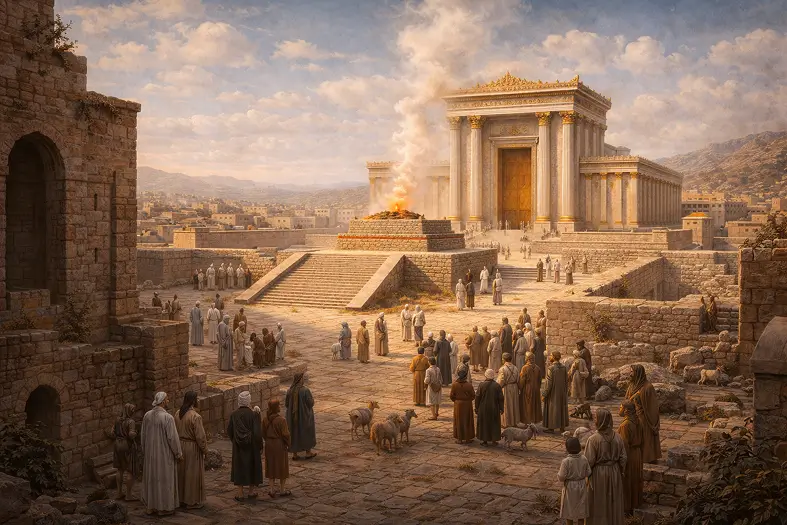
The Mishkan stands in the center of the desert—a carefully measured, beautifully arranged structure surrounded by an endless wilderness. The contrast is striking.
Outside the camp lies the chaos of the desert.
Inside the camp stands the ordered sanctuary.
Every measurement is precise. Every vessel has its place. Every action follows a pattern. The Mishkan becomes an island of order in a sea of uncertainty.
This image carries a powerful message. The Torah does not promise a world free of chaos. Instead, it teaches that human beings can build spaces of order within it.
The Mishkan is the prototype of that effort.
Moral Architecture
The order of the Mishkan is not only physical. It reflects a deeper moral structure. Just as the sanctuary is built with measurements, boundaries, and hierarchy, so too the Torah builds a moral world with laws, obligations, and responsibilities.
Without moral structure, human society descends into chaos. Desires clash. Power dominates. Justice disappears. The Torah’s system of mitzvos creates a framework that channels human behavior into patterns of holiness.
In this sense, the mitzvos themselves are a kind of spiritual architecture. They build order into the fabric of daily life.
The Mishkan is the physical symbol of that idea.
The mitzvos are its moral counterpart.
Freedom Requires Structure
One of the paradoxes of freedom is that it cannot survive without structure. A society without rules collapses into disorder. A person without discipline becomes a slave to impulse.
The Israelites were freed from Egypt, but freedom alone was not enough. Without structure, the wilderness could become a place of confusion and moral drift.
The Mishkan provides a center, a focus, and a system. It teaches the people how to live with order, rhythm, and purpose.
True freedom is not the absence of structure.
It is the presence of the right structure.
The Lesson of the Desert Sanctuary
The setting of the Mishkan amplifies its message. It is not built in a city, a palace, or a stable homeland. It is built in the wilderness, the most unstable environment imaginable.
This teaches that sacred order is not dependent on perfect conditions. Holiness is not reserved for ideal circumstances. It can be built even in the midst of uncertainty.
The Mishkan shows that stability is not found only in the world around us. It is created through the structures we build.
Application for Today — Creating Islands of Order
Modern life is filled with noise, distraction, and instability. Technology accelerates the pace of life. News cycles bring constant anxiety. Schedules shift. Plans change. The world often feels like a desert of uncertainty.
The message of the Mishkan is that we do not need to eliminate chaos in order to live with meaning. We need to build islands of order within it.
This can be done through simple but powerful structures:
- Fixed times for Torah learning.
- Daily tefillah.
- A Shabbos-centered home.
- Regular acts of kindness.
- Consistent moral boundaries.
These structures create stability in a shifting world. They become the personal Mishkanim of everyday life.
A person who builds such patterns creates an inner sanctuary. Even when the world outside is unstable, the inner world remains anchored.
Communities function the same way. A synagogue, a school, or a beis midrash becomes an island of order in the chaos of modern society. It offers rhythm, stability, and meaning.
The lesson of Terumah is therefore timeless:
We cannot always control the chaos around us.
But we can build structures of holiness within it.
📖 Sources
- Full sources available on the Mitzvah Minute Parshas Terumah page under insights and commentaries