www.Mitzvah-Minute.com
"Terumah — Part VI — “כְּכֹל אֲשֶׁר אֲנִי מַרְאֶה אוֹתְךָ”: Order, Structure, and Discipline"
6.1 — The Moral Meaning of Measurement
A Sanctuary of Exact Dimensions
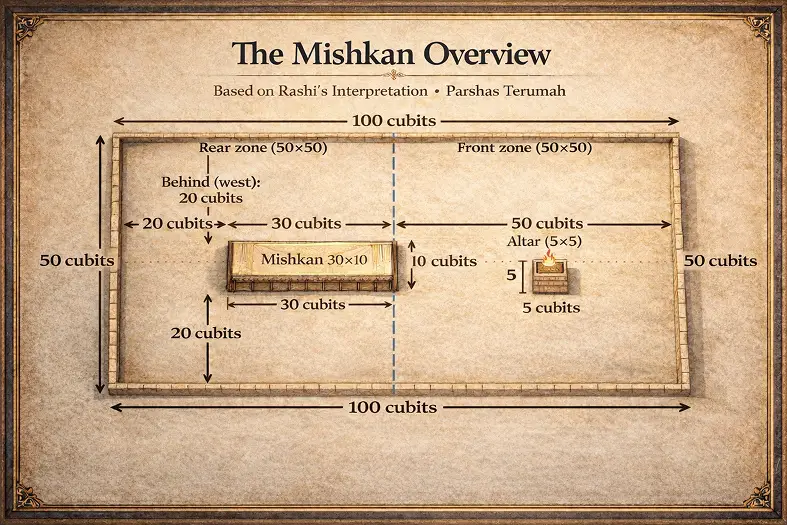
Much of Parshas Terumah is devoted to measurements. The Torah describes the Mishkan and its vessels with remarkable precision:
- The Ark is two and a half cubits long, one and a half cubits wide, and one and a half cubits high.
- The Table has its own exact dimensions.
- The Menorah must be shaped in a specific way.
- The boards, curtains, sockets, and courtyard are all measured precisely.
Every element is defined. Nothing is left to improvisation. The sanctuary is not built according to personal taste or creative impulse. It is built “כְּכֹל אֲשֶׁר אֲנִי מַרְאֶה אוֹתְךָ”—according to the pattern that Hashem shows to Moshe.
This precision carries a deeper message. The Mishkan is not only a physical structure. It is a model of spiritual order.
Rashi: According to the Divine Pattern
Rashi explains that Moshe was shown a heavenly pattern of the Mishkan and its vessels. The command is not simply to build a sanctuary, but to build it exactly as shown.
This teaches that holiness is not arbitrary. It is not defined by personal preference or subjective feeling. It follows a Divine order.
The Mishkan is holy because it conforms to a higher design. Its sanctity emerges from obedience to the pattern that Hashem reveals.
The same principle applies to life itself. Holiness is not created through impulse alone. It is shaped by alignment with Divine instruction.
The Difference Between Chaos and Order
Without measurement, there is chaos. A building without dimensions collapses. A structure without proportion becomes unstable.
Measurement creates stability. It defines boundaries. It establishes relationships between parts. It allows the structure to stand.
The Mishkan’s precise dimensions therefore represent more than technical details. They symbolize the transition from chaos to order.
The wilderness around the Mishkan is vast, unmeasured, and unpredictable. At its center stands a structure of exact proportions, a symbol of harmony and discipline.
The sanctuary is an island of order in a world of uncertainty.
Rambam: Discipline Shapes the Soul
Rambam teaches that moral character is formed through disciplined behavior. In his discussion of character development, he explains that a person must train himself through consistent, measured actions.
Virtue is not the result of spontaneous emotion. It is the result of structured practice.
For example:
- Generosity is formed through repeated acts of giving.
- Patience is formed through repeated restraint.
- Courage is formed through repeated acts of resolve.
Each virtue emerges through measured action. Over time, these actions shape the personality.
This idea parallels the structure of the Mishkan. Just as the sanctuary is built according to precise dimensions, the human character is built through precise, disciplined habits.
The Geometry of Holiness
The Mishkan’s measurements create harmony. Each part relates to the others. The proportions of the vessels match the proportions of the structure. The dimensions of the courtyard align with the dimensions of the sanctuary.
This geometric order reflects moral order. Holiness is not chaotic. It is balanced, proportionate, and structured.
The Torah’s laws follow a similar pattern. They create boundaries, rhythms, and proportions in life:
- Times for work and times for rest.
- Limits on speech and behavior.
- Rhythms of days, weeks, months, and years.
These structures create harmony within the human soul.
Why Precision Matters
One might ask: why does holiness require such precision? Why can the Mishkan not be built approximately, according to general guidelines?
The answer lies in the nature of discipline. Precision trains the mind and the heart. It teaches attention, care, and responsibility.
When a person must follow exact measurements, he cannot act casually. He must focus. He must align himself with a standard beyond his own preferences.
In this way, the structure of the Mishkan becomes a form of moral education. It trains the people to live in an ordered, disciplined way.
The Sanctuary as a Model for Life
The Mishkan is not only a building. It is a blueprint for life. Its measurements reflect the structure that human life must also possess.
A person’s day requires structure.
His speech requires boundaries.
His behavior requires discipline.
Without these measurements, life becomes chaotic. With them, it becomes harmonious.
The Mishkan teaches that holiness is built through order. It is not an accident. It is the result of careful design.
Application for Today — Structure as Moral Training
In modern life, structure is often seen as restrictive. Many people prefer spontaneity and freedom from rules. Schedules, boundaries, and disciplines are sometimes viewed as limitations.
But the Mishkan teaches the opposite. Structure is not the enemy of holiness. It is the foundation of it.
A person who builds structure into his life creates the conditions for growth:
- Fixed times for prayer.
- Regular moments for Torah study.
- Boundaries around speech and behavior.
- Rhythms of work and rest.
These structures shape the soul. They train the mind to focus and the heart to grow.
Just as the Mishkan’s precise measurements create a sacred structure, the measured habits of daily life create a sacred personality.
Holiness is not built through random inspiration.
It is built through ordered living.
📖 Sources
- Full sources available on the Mitzvah Minute Parshas Terumah page under insights and commentaries