www.Mitzvah-Minute.com
"Terumah — Part VI — “כְּכֹל אֲשֶׁר אֲנִי מַרְאֶה אוֹתְךָ”: Order, Structure, and Discipline"
6.2 — The Choreography of Holiness
A Sanctuary in Motion
When we think of the Mishkan, we often imagine a structure—curtains, boards, vessels, and sacred spaces. But the Mishkan was not only a building. It was a system of movement, rhythm, and repeated action.
The Menorah was lit daily.
The incense was offered at set times.
The offerings were brought in the morning and evening.
The kohanim followed specific patterns of service.
Nothing was random. Every act had its time, its place, and its procedure.
The Mishkan was a choreography—a structured system of movements that shaped the senses and the will of those who participated in it.
Rambam: Habit as the Builder of Character
Rambam teaches that human character is formed through repeated actions. A person becomes what he repeatedly does.
In his discussion of character development, he explains that virtues are acquired through practice. A person becomes generous by giving, patient by restraining anger, and disciplined by consistent behavior.
The Mishkan reflects this principle on a national scale. It introduces a structured system of daily and seasonal service. Through repeated acts of holiness, the people are trained to develop refined character.
The rituals of the sanctuary are not only symbolic.
They are educational.
They shape the habits of the nation and create a disciplined spiritual culture.
Sforno: A System That Directs the Mind
Sforno explains that the Mishkan and its service were designed to direct the thoughts of the people toward higher awareness. The physical actions of the sanctuary were meant to influence the inner world.
Each vessel, each placement, and each act of service carried meaning. The arrangement of the Menorah, the Table, and the Ark was not arbitrary. It created a spatial language that guided the mind.
The light of the Menorah illuminated the inner chamber.
The bread of the Table represented sustenance.
The incense rose toward the hidden Ark.
This arrangement trained the senses. Sight, smell, and movement all became part of a structured spiritual experience.
The Mishkan was not only a place of ritual.
It was a school for the soul.
Rav Avigdor Miller: Training the Mind Through Action
Rav Avigdor Miller emphasizes that spiritual growth comes through repeated, concrete acts. A person who waits for inspiration will grow slowly. But a person who builds structured habits will transform himself.
He explains that the mitzvos are designed to train the mind. Each action—washing hands, reciting a blessing, observing Shabbos—shapes awareness.
The Mishkan’s service functioned in the same way. The daily routines of lighting, offering, and incense were not only obligations. They were exercises in awareness.
Through repetition, the people learned to think in sacred patterns. Their senses became accustomed to holiness.
The sanctuary trained them, day after day, to live with intention.
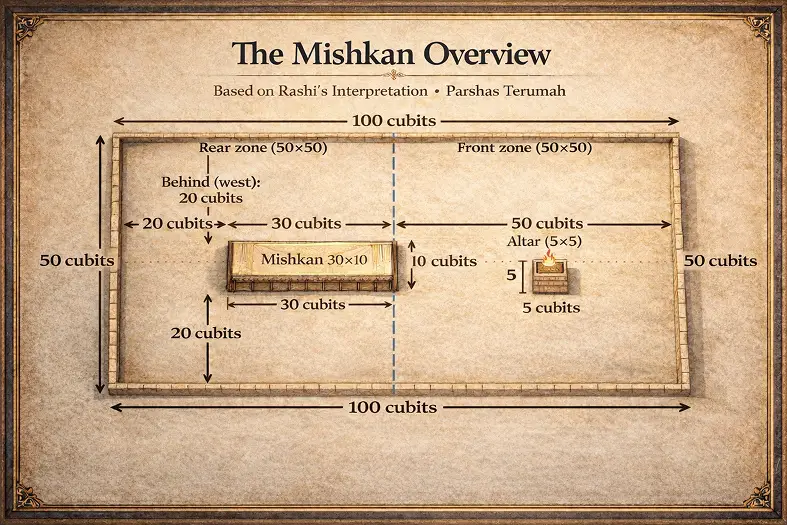
The Placement of the Vessels
The arrangement of the vessels within the Mishkan reflects this choreography.
- The Ark stands in the innermost chamber, hidden and silent.
- The Menorah gives light in the inner sanctuary.
- The Table holds bread, symbolizing sustenance.
- The altar stands in the courtyard, the place of transformation.
Each vessel has its place. Each movement has its direction. The kohen walks through a sequence of actions that move from the outer world toward the inner sanctum.
This physical movement reflects an inner journey:
- From action to awareness.
- From the external to the internal.
- From the physical to the spiritual.
The structure of the Mishkan trains both body and soul.
Discipline as a Path to Freedom
To an outside observer, the Mishkan’s system may seem restrictive. Every action is regulated. Every movement follows a rule.
But the Torah sees discipline differently. Discipline is not a cage. It is a path to freedom.
A person without discipline is ruled by impulse. He is pulled in every direction by desire, distraction, and habit. But a person who lives with structured routines gains mastery over himself.
The Mishkan’s choreography trains this mastery. Through repeated acts of service, the will becomes stronger. The senses become more refined. The personality becomes more ordered.
Holiness emerges not from spontaneity alone, but from disciplined repetition.
A System That Shapes a Nation
The Mishkan’s choreography does not shape only the kohanim. It shapes the entire nation. The people see the service. They hear about its rhythms. They organize their lives around the sanctuary’s schedule.
The presence of the Mishkan creates a shared rhythm:
- Daily offerings.
- Weekly Shabbos.
- Seasonal festivals.
- Cycles of purification and renewal.
These rhythms transform the people into a community of discipline and purpose.
The sanctuary becomes the heartbeat of the nation.
Application for Today — Daily Routines as Spiritual Training
Modern life often lacks structure. Days blur together. Schedules change constantly. Many people live without consistent routines, moving from one distraction to another.
The Mishkan offers a different model. It teaches that spiritual growth comes through structured habits.
A person can create a personal choreography of holiness:
- A fixed time for morning prayer.
- A regular session of Torah study.
- Blessings said with attention before and after eating.
- A weekly Shabbos rhythm that reshapes time.
These routines may seem small, but they have great power. Over time, they shape the senses and the will. They create patterns of awareness.
A person who builds such routines does not live randomly. His life develops a rhythm, a structure, and a direction.
The Mishkan teaches that holiness is not only a place.
It is a pattern of living.
📖 Sources
- Full sources available on the Mitzvah Minute Parshas Terumah page under insights and commentaries