www.Mitzvah-Minute.com
"Terumah — Part VI — “כְּכֹל אֲשֶׁר אֲנִי מַרְאֶה אוֹתְךָ”: Order, Structure, and Discipline"
6.4 — The Discipline of a Sacred Life
Holiness Is Not an Accident
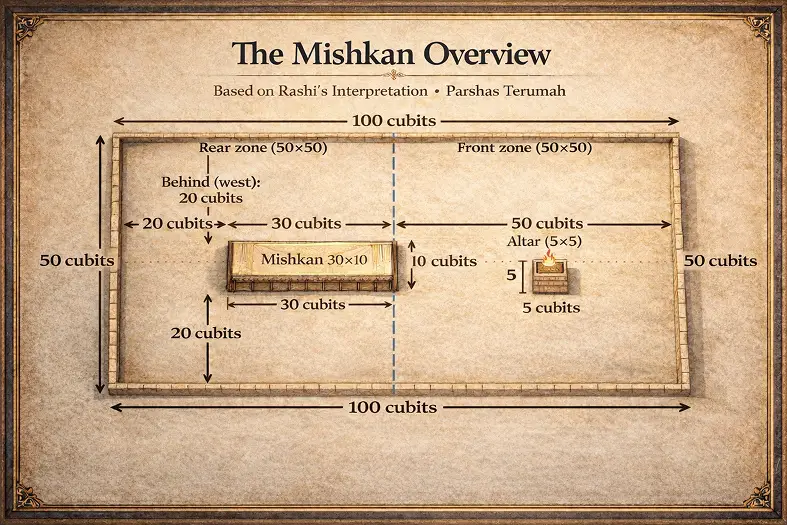
Parshas Terumah describes a sanctuary built with extraordinary precision. Every board, every curtain, every vessel, and every measurement is specified. Nothing is left to improvisation.
The Mishkan is not the result of inspiration alone. It is the result of instruction, structure, and discipline.
This teaches a fundamental truth about spiritual life: holiness is not accidental. It is built.
Just as the Mishkan required planning, measurement, and faithful execution, a sacred life requires structure, habit, and routine.
Rabbi Jonathan Sacks: Freedom Needs Form
Rabbi Jonathan Sacks often emphasized that freedom without structure does not produce greatness. It produces chaos.
The Israelites left Egypt as free people, but freedom alone was not enough. Without a framework, freedom dissolves into confusion and conflict. What transforms freedom into purpose is structure.
The Torah provides that structure:
- Fixed times for prayer.
- Rhythms of Shabbos and festivals.
- Systems of charity and justice.
- Daily and seasonal commandments.
These structures give shape to freedom. They turn a liberated nation into a purposeful people.
The Mishkan reflects this same principle. It transforms the open wilderness into a place of order, proportion, and meaning.
Freedom becomes sacred when it is guided by form.
Rav Avigdor Miller: Greatness Comes from Habits
Rav Avigdor Miller taught that greatness is not achieved through occasional inspiration. It is built through daily habits.
A person does not become wise in a single moment of insight. He becomes wise through years of study. A person does not become kind through one emotional gesture. He becomes kind through repeated acts of generosity.
Holiness grows in the same way. It is cultivated through consistent actions:
- Saying blessings before eating.
- Praying at fixed times.
- Speaking carefully.
- Observing Shabbos each week.
- Learning Torah every day.
These habits may seem small, but they shape the personality. Over time, they create a life of awareness and refinement.
Rav Miller often emphasized that the Torah’s system is designed to train the individual. The mitzvos are exercises in greatness. Each one builds a small piece of the soul.
The Mishkan as a Model of Routine
The Mishkan was not only built with precision. It functioned with precision as well.
Every day followed a rhythm:
- The morning offering.
- The lighting of the Menorah.
- The offering of the incense.
- The evening service.
Nothing was random. The sanctuary lived by a schedule.
This rhythm transformed the Mishkan into more than a structure. It became a living system of discipline.
The people saw this rhythm. They knew that holiness required consistency. It was not only about special moments. It was about daily patterns.
The sanctuary taught that sacredness grows through repetition.
The Structure of a Sacred Life
The Torah extends the Mishkan’s model into the life of every individual.
A sacred life has structure:
- Morning prayers that begin the day with awareness.
- Blessings that frame the act of eating.
- Honest speech that shapes relationships.
- Shabbos that reshapes the week.
- Torah study that shapes the mind.
Each of these elements is like a measurement in the Mishkan. They create boundaries and rhythms. Together, they form the architecture of a holy life.
Without these structures, life becomes scattered. With them, it becomes purposeful.
Routine as a Path to Meaning
Many people associate routine with boredom. They imagine that structure limits creativity or spontaneity.
But the Torah presents routine differently. Routine is not the enemy of meaning. It is the path to meaning.
A musician becomes great through daily practice.
An athlete becomes strong through repeated training.
A scholar becomes wise through consistent study.
Spiritual greatness follows the same pattern. The routines of mitzvos are the training exercises of the soul.
Through repetition, awareness deepens.
Through structure, character strengthens.
Through discipline, holiness emerges.
The Sanctuary Within Time
The Mishkan was a sanctuary in space. But the Torah also creates sanctuaries in time—Shabbos, festivals, and daily rhythms of prayer and study.
These structures bring the lesson of the Mishkan into everyday life. They turn ordinary time into sacred time.
The sanctuary is no longer only a physical place. It becomes a pattern of living.
Wherever a person lives with structure, habit, and discipline, he creates a small Mishkan in his life.
Application for Today — Building Sacred Habits
Modern life often prizes spontaneity and flexibility. Schedules change, routines break down, and attention is scattered across countless distractions.
But the lesson of the Mishkan remains powerful: holiness grows from structure.
A person who wants to build a sacred life can begin with simple, consistent habits:
- Setting fixed times for prayer.
- Learning a small portion of Torah each day.
- Observing Shabbos with care and joy.
- Speaking with greater thoughtfulness.
- Giving charity regularly.
These practices may seem ordinary. But over time, they shape the soul.
A life filled with sacred routines becomes a life filled with sacred awareness.
Holiness is not built in a moment.
It is built in a lifetime of disciplined habits.
📖 Sources
- Full sources available on the Mitzvah Minute Parshas Terumah page under insights and commentaries