www.Mitzvah-Minute.com
"Terumah — Part VI — “כְּכֹל אֲשֶׁר אֲנִי מַרְאֶה אוֹתְךָ”: Order, Structure, and Discipline"
6.3 — Why the Pattern Is Repeated
A Command Stated Again and Again
Throughout the instructions for the Mishkan, the Torah repeats a striking phrase. After describing the structure or a vessel, it reminds Moshe:
כְּכֹל אֲשֶׁר אֲנִי מַרְאֶה אוֹתְךָ
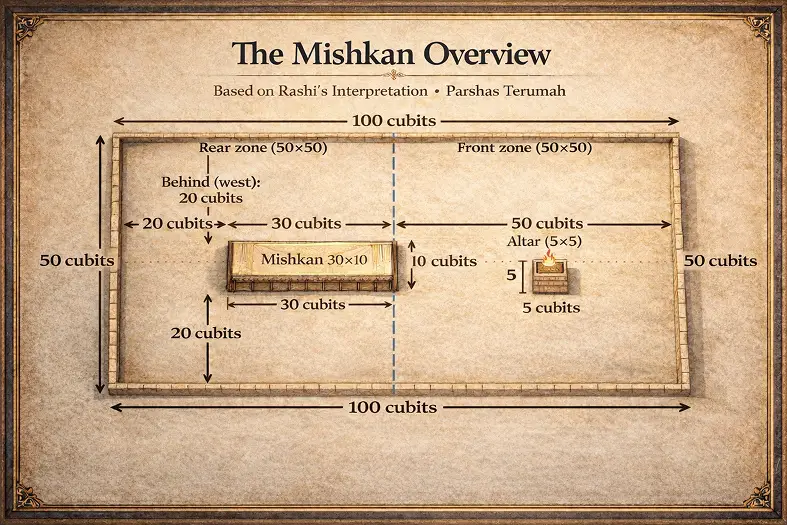
אֵת תַּבְנִית הַמִּשְׁכָּן
וְאֵת תַּבְנִית כָּל כֵּלָיו
וְכֵן תַּעֲשׂוּ
“According to all that I show you—the pattern of the Mishkan and the pattern of all its vessels—so shall you make” (Shemos 25:9)
Later, the Torah repeats the instruction:
וּרְאֵה וַעֲשֵׂה
בְּתַבְנִיתָם
אֲשֶׁר אַתָּה מָרְאֶה בָּהָר
“See and make them according to their pattern, which you are shown on the mountain” (25:40)
And again:
כַּאֲשֶׁר הֶרְאָה אֹתְךָ בָּהָר
כֵּן יַעֲשׂוּ
“As it was shown to you on the mountain, so shall they make it” (27:8)
The repetition is unmistakable. The Torah insists again and again: the Mishkan must be built according to a pattern revealed on the mountain.
Why does the Torah repeat this command so many times?
Abarbanel: Not Human Design, but Divine Blueprint
Abarbanel explains that this repetition is deliberate and meaningful. The Torah wants to emphasize that the Mishkan is not a human creation. It is not the product of artistic imagination or cultural style.
It is a structure based on a Divine blueprint.
The sanctuary is not built according to what people think is beautiful or meaningful. It is built according to what Hashem reveals.
This is why the Torah repeats the phrase. The people must understand that holiness is not invented. It is received.
The Mishkan is not an expression of human creativity alone. It is an act of faithful obedience to a higher design.
The Mountain as the Source
The phrase “as shown on the mountain” points back to Har Sinai. The same mountain where the Torah was given becomes the source of the Mishkan’s design.
This connection is significant. The Mishkan is not a separate institution from Sinai. It is the continuation of Sinai in physical form.
At Sinai, the people received the Torah.
In the Mishkan, they build a structure that embodies it.
The pattern revealed on the mountain becomes the pattern for sacred life.
The Danger of Improvised Holiness
Without a fixed pattern, holiness can easily become distorted. People may follow their emotions, their tastes, or their cultural habits. Over time, the original purpose of the sanctuary could be lost.
The repeated command protects against this danger. It establishes a standard that does not change with mood or fashion.
Holiness must follow a pattern.
And the pattern must come from above.
This principle applies not only to the Mishkan, but to all areas of spiritual life.
The Pattern as a Moral Structure
Abarbanel suggests that the Mishkan’s design reflects deeper truths about existence. Its proportions, its arrangement, and its functions are not arbitrary. They reflect a moral and spiritual order.
By following this pattern, the people align themselves with a higher reality.
The Mishkan becomes more than a building.
It becomes a model of a life lived according to Divine instruction.
Just as the sanctuary is built according to a revealed pattern, so too the human life must be shaped according to the Torah’s guidance.
Repetition as Emphasis
In the Torah, repetition is rarely accidental. When a command is repeated, it signals importance.
Here, the repetition teaches that adherence to the pattern is not a minor detail. It is central to the sanctity of the Mishkan.
If the structure were built according to human preference, it would lose its unique holiness. Its sanctity comes from its faithfulness to the Divine model.
The same is true of the mitzvos. Their meaning lies not only in their ethical or symbolic value, but in their origin. They are expressions of the Divine will.
The Enduring Pattern
Human cultures change. Styles shift. Societies evolve. But the Torah’s pattern remains constant.
The Mishkan’s design was fixed. Its dimensions did not change from generation to generation. The same is true of the mitzvos. Their structure endures across time.
This constancy creates stability. It provides a reliable framework for life, even in times of upheaval.
A person who lives according to enduring spiritual patterns does not need to reinvent himself each day. He lives within a structure that has already been revealed.
The Pattern Within the Soul
The Mishkan is built according to a pattern shown on the mountain. But that pattern is not meant to remain in the desert.
It becomes a pattern for the human soul.
Just as the sanctuary is built according to a Divine design, so too the human personality is meant to be shaped according to the Torah.
The commandments become the measurements of the soul.
The rhythms of prayer and study become its structure.
The moral teachings of the Torah become its inner architecture.
The repeated phrase “as shown on the mountain” is therefore not only about a building. It is about a way of life.
Application for Today — Living by Enduring Patterns
Modern culture often celebrates originality and self-expression. People are encouraged to invent their own paths and define their own values.
While creativity has its place, the Torah offers a different foundation. It teaches that a meaningful life is built according to a pattern that has already been revealed.
This does not limit freedom. It provides direction.
A life shaped by enduring spiritual patterns includes:
- Fixed times for prayer.
- Regular Torah study.
- Observance of Shabbos and the festivals.
- Ethical conduct guided by Torah values.
These patterns create stability. They anchor a person in something larger than himself.
Instead of constantly searching for meaning, he lives within a framework that already contains it.
The Mishkan was built according to a pattern shown on the mountain.
A holy life is built according to that same enduring design.
📖 Sources
- Full sources available on the Mitzvah Minute Parshas Terumah page under insights and commentaries