www.Mitzvah-Minute.com
"Terumah — Part VIII — “וְשָׁכַנְתִּי בְּתוֹכָם”: Living with the Presence of Hashem Today"
8.1 — The Portable Sanctuary
A Sanctuary That Moves
The Mishkan was unlike any other sanctuary in the ancient world. Most temples were built of stone and anchored to a specific location. They were fixed structures, tied to a particular city or mountain.
The Mishkan was different.
It was made to be taken apart. Its boards could be removed. Its curtains could be folded. Its vessels could be carried. Whenever the people traveled, the Mishkan traveled with them.
It was a sanctuary on the move.
This was not only a practical design for a people wandering in the desert. It carried a deeper message. The Divine presence was not tied to a single place. It moved with the people.
וְעָשׂוּ לִי מִקְדָּשׁ
וְשָׁכַנְתִּי בְּתוֹכָם
“And they shall make for Me a sanctuary, and I shall dwell among them” (Shemos 25:8)
The verse does not say, “I shall dwell in it,” but “I shall dwell among them.” The Mishkan is a structure, but the dwelling is within the people themselves.
Rabbi Jonathan Sacks: A G-d Who Travels with His People
Rabbi Jonathan Sacks points out that this idea is revolutionary. In the ancient world, gods were tied to territories. Each nation had its own land and its own deity. If a people lost its land, it often lost its god as well.
The Torah introduces a different vision. The G-d of Israel is not confined to a territory. He travels with His people.
The Mishkan embodies this idea. It is a portable sanctuary, carried through the desert. Wherever the people go, the presence of Hashem goes with them.
This idea becomes the secret of Jewish survival. When the people later lose their land and their Temple, they do not lose their connection to Hashem. They carry the covenant with them.
The sanctuary becomes portable.
And so does holiness.
Rav Avigdor Miller: A Dwelling in the Heart
Rav Avigdor Miller emphasizes the wording of the verse: “I shall dwell among them.” The ultimate dwelling place of the Divine presence is not a building. It is the human heart.
The Mishkan is a training ground. It teaches the people how to live with awareness of Hashem. But the goal is not the structure itself. The goal is the inner sanctuary within each person.
A person who lives with Torah, prayer, and awareness carries the Mishkan within him.
Wherever he goes, the Divine presence goes with him.
From Mishkan to Mikdash to Synagogue
The Mishkan eventually gave way to the Beis HaMikdash in Jerusalem. The sanctuary became a permanent structure, built of stone instead of wood and fabric.
But history did not stop there. The Temple was destroyed. The physical center of national worship was lost.
Yet Jewish life did not disappear. Instead, the idea of the portable sanctuary re-emerged.
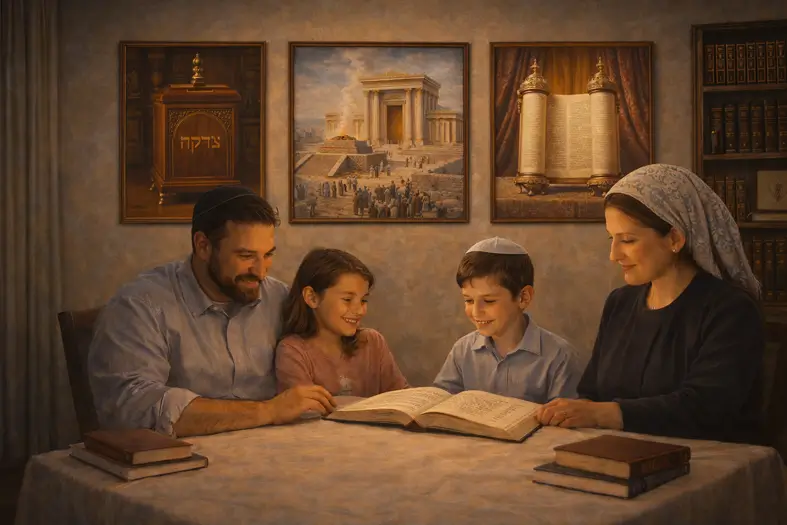
Synagogues were built in every community. Homes became places of prayer and learning. The beis midrash became the new center of Jewish life.
The Mishkan’s message proved true: holiness could travel.
Wherever Jews lived, they built:
- A synagogue.
- A school.
- A place of study.
These became the new sanctuaries of the Jewish people.
Holiness Beyond Geography
The Mishkan teaches that holiness is not tied to geography alone. It is tied to covenant, practice, and awareness.
A person does not need to stand in a particular building to experience the Divine presence. He can encounter it:
- In his home.
- In his workplace.
- In a quiet moment of prayer.
- In an act of kindness.
- In a page of Torah study.
The sanctuary becomes a pattern for life, not only a place in space.
The Community as a Sanctuary
The Mishkan stood at the center of the camp. The tribes arranged themselves around it. The sanctuary became the heart of the community.
This model continues in Jewish life. The synagogue often stands at the center of the neighborhood. The rhythms of prayer and study shape communal life.
A community built around Torah and mitzvos becomes a living sanctuary. Its homes, schools, and institutions form a network of holiness.
The Mishkan’s structure spreads outward into the entire community.
Application for Today — Holiness Beyond Geography
Many people search for holiness in special places—holy cities, famous synagogues, or inspiring retreats. These places can be powerful. But the Mishkan teaches that holiness is not confined to them.
Holiness can travel with a person.
A person creates a portable sanctuary when he:
- Establishes a corner of his home for prayer or study.
- Brings Torah learning into his daily routine.
- Conducts his business with integrity.
- Speaks with kindness and restraint.
- Observes Shabbos and the festivals with care.
These practices transform ordinary environments into sacred spaces.
A kitchen becomes a place of blessing.
A table becomes an altar of gratitude.
A conversation becomes an act of kindness.
The Mishkan teaches that the Divine presence is not locked inside a building. It dwells among the people—wherever they carry it.
📖 Sources
- Full sources available on the Mitzvah Minute Parshas Terumah page under insights and commentaries