www.Mitzvah-Minute.com
"Tetzaveh — Part I — “וְאַתָּה תְּצַוֶּה”: Hidden Leadership and the Birth of Sacred Institutions"
1.1 — The Name That Vanishes
The Leader Who Disappears
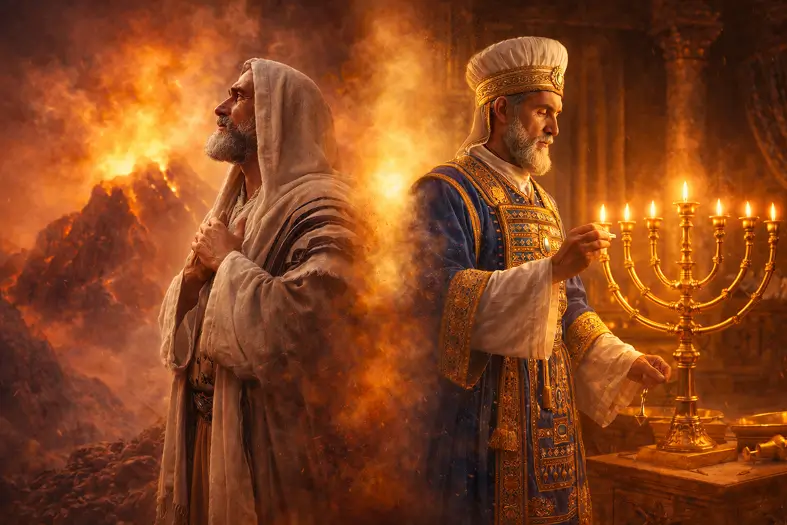
From the moment Moshe first appears in Sefer Shemos, his presence defines the narrative. He confronts Pharaoh, splits the sea, ascends Sinai, and brings down the Torah. His name echoes across redemption.
And then, in Parshas Tetzaveh, at the very height of the Mishkan’s construction, his name vanishes.
The parsha opens:
שמות כ״ז:כ׳
“וְאַתָּה תְּצַוֶּה אֶת בְּנֵי יִשְׂרָאֵל”
“And you shall command the children of Israel.”
Moshe is addressed directly — “וְאַתָּה” — yet his name does not appear anywhere in the parsha. From 27:20 through 30:10, the Torah never once says “Moshe.”
The omission is deliberate. The Torah does not forget names.
It withholds them.
And it withholds Moshe’s name precisely when the Mishkan is transitioning from vision to institution — when garments are designed, offices are installed, daily rhythms are defined, and sacred continuity is being engineered.
Holiness is being built to survive the hero.
From Charisma to Continuity
Until now, Sefer Shemos has unfolded through dramatic events: the burning bush, the plagues, the splitting of the sea, the thunder of Sinai. Moshe stands at the center of each.
But Tetzaveh marks a subtle shift. The Torah turns away from moments of revelation and begins constructing mechanisms of permanence. The Menorah must be lit every evening. The Kohanim must wear precise garments. The service must follow structured order.
Covenantal life is no longer sustained by miracles. It is sustained by rhythm.
There are two kinds of leadership in history. One ignites revolutions. The other builds institutions. The first awakens a people. The second ensures they endure.
Moshe, the greatest prophet, becomes in this parsha something even greater: invisible.
His absence signals that the covenant must now function without dependence on personality. The system must outlive the spark.
“וְאַתָּה”: Presence Without Spotlight
The opening phrase is striking: “וְאַתָּה תְּצַוֶּה.” Not “Moshe said,” but “And you shall command.”
The Torah addresses him personally, yet erases his name. The paradox is powerful. Moshe is more directly involved than ever — the oil is brought “אֵלֶיךָ,” to him — and yet he recedes from textual visibility.
Leadership here is not theatrical. It is structural.
The Menorah must burn with “שֶׁמֶן זַיִת זָךְ” — pure, sediment-free oil — and it must be lit “לְהַעֲלֹת נֵר תָּמִיד” — to raise a continual flame.
Rashi explains that the wick must be kindled until the flame rises on its own. That small halachic detail becomes a blueprint for covenantal continuity. The goal of lighting is not dependence but self-sustaining fire.
Moshe’s disappearance from the text mirrors that process. The leader ignites. The structure sustains.
Bitul: The Greatness of Self-Nullification
The Chassidic masters offer a deeper reading. Moshe’s name disappears because he has reached the highest form of spiritual leadership: bitul — self-nullification before Hashem.
At this stage of the Mishkan’s construction, Moshe is not expressing personality. He is channeling Divine will. His identity becomes transparent. Like white light that contains all colors yet asserts none of its own, he becomes a vessel.
This is not erasure. It is transcendence.
The greatest leader is not the one whose name is remembered, but the one whose influence becomes embedded in the fabric of daily life.
Moshe vanishes because he has succeeded.
The Menorah as Leadership Model
The highlighted mitzvah of this section — Mitzvah #378 — the daily lighting of the Menorah, embodies this shift from charisma to continuity.
The Menorah does not blaze once in dramatic brilliance. It burns every night. The same measure of oil is used throughout the year. The service repeats with precision. Constancy replaces spectacle.
The Menorah teaches three quiet principles of enduring leadership:
- Purity precedes illumination.
- Structure protects inspiration.
- Repetition creates permanence.
The covenant survives not through peaks of ecstasy but through disciplined recurrence.
Moshe’s name disappears exactly where the Torah introduces daily light.
The leader withdraws so the lamp can remain.
The Birth of Sacred Institutions
Parshas Tetzaveh installs the kehunah. It defines garments. It structures ritual. It establishes consecration. The priesthood emerges as an institution designed to preserve sanctity across generations.
The prophet brings fire from heaven. The priest tends the flame each night.
Without prophetic ignition, a people never awakens. Without priestly maintenance, a people never endures.
This is the quiet revolution of Tetzaveh. The Torah transitions from the drama of redemption to the architecture of continuity.
And architecture does not depend on applause.
Moshe’s absence from the text becomes a theological statement: holiness must not rely on the personality of one man. It must be woven into habit, rhythm, and structure.
The covenant must be livable without the prophet standing in the room.
Application for Today — The Leadership No One Sees
Parshas Tetzaveh opens without Moshe’s name. The greatest leader in Jewish history disappears from the text, and yet the work continues. The oil is brought. The lamps are arranged. The flame rises each evening.
The Torah is teaching something profound: the covenant does not depend on visibility. It depends on faithfulness.
We live in a culture that measures worth by exposure. Influence is counted in followers. Impact is measured by applause. But the Menorah was lit inside the Mishkan, behind curtains, away from public acclaim. Its light mattered not because it was seen, but because it endured.
There are builders of holiness whose names rarely appear in headlines.
A parent who returns each night to learn with a child.
A teacher who patiently repeats the fundamentals until they take root.
A community member who shows up again and again so that prayer begins on time.
A Jew who keeps a quiet commitment long after the excitement fades.
These are the hidden architects of covenantal life.
Ask yourself where your spiritual life leans too heavily on inspiration. What practice would remain if the mood vanished? What light would still burn if no one noticed?
True leadership begins when rhythm replaces emotion. When something sacred is anchored in time rather than feeling. When the flame is tended whether or not anyone is watching.
“וְאַתָּה תְּצַוֶּה” — and you shall command.
Not with spectacle, but with constancy.
Not with visibility, but with devotion.
The world stands on those who light the Menorah every evening, quietly and without recognition.
Become one of them.
📖 Sources
- Full sources available on the Mitzvah Minute Parshas Tetzaveh page under insights and commentaries