www.Mitzvah-Minute.com
"Tetzaveh — Part I — “וְאַתָּה תְּצַוֶּה”: Hidden Leadership and the Birth of Sacred Institutions"
1.2 — “אֵלֶיךָ”: Moshe as Guardian of Purity
The Oil Must Pass Through Moshe
Parshas Tetzaveh opens with an unusual formulation:
שמות כ״ז:כ׳
“וְיִקְחוּ אֵלֶיךָ שֶׁמֶן זַיִת זָךְ כָּתִית לַמָּאוֹר”
“And they shall take to you pure, crushed olive oil for illumination.”
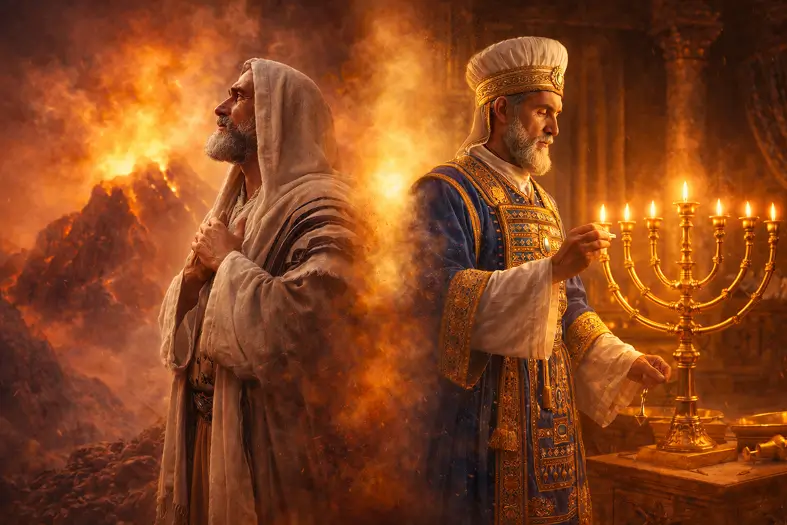
The phrase “אֵלֶיךָ”—“to you”—demands attention. The oil is not simply delivered to the Mishkan. It does not go directly to Aharon. It must first pass through Moshe.
Ramban explains that this language indicates personal oversight. Moshe must examine the oil, ensure its refinement, and approve it before it enters the sacred system. He becomes the examiner of kedushah at its point of entry.
Before there is light, there is scrutiny.
Before there is ritual, there is filtration.
The Torah begins Tetzaveh not with garments or titles, but with quality control.
Standards Before Roles
Immediately after the oil, the Torah introduces the priesthood:
שמות כ״ח:א
“וְאַתָּה הַקְרֵב אֵלֶיךָ אֶת אַהֲרֹן אָחִיךָ”
Only once the oil is defined does the institution begin.
The order is deliberate. The Torah establishes a structural principle: purity precedes office. The fuel must be refined before the system can function.
Moshe’s role at this moment is not prophetic spectacle. He does not perform a miracle. He does not deliver a speech. He stands at the gate of the system and guards its standards.
This is the hidden work of enduring leadership.
The Meaning of “שֶׁמֶן זַיִת זָךְ”
Rashi teaches that the oil had to be the first, clearest drop extracted from the olive—produced by pounding, not grinding. It had to be sediment-free, pristine, uncompromised.
The Menorah represents wisdom and Divine illumination. Therefore its fuel cannot be second-tier. Sacred light cannot burn on leftovers.
The Torah’s message is subtle but powerful: holiness begins long before the flame is visible. It begins in the unseen preparation of the oil.
If the fuel is cloudy, the flame will falter.
If the source is compromised, the structure cannot endure.
Moshe stands at precisely that invisible stage—the stage before light.
Ramban: The Examiner of Kedushah
Ramban emphasizes that Moshe’s responsibility here is administrative as much as spiritual. The oil must be brought to him because he is the organizer of sacred life. He ensures that what enters the Mishkan meets the highest standard.
This is a different form of leadership from the one we have seen until now.
Earlier, Moshe confronted Pharaoh, split seas, and ascended Sinai. Now he inspects oil.
The shift is profound. Revelation has given way to regulation. The covenant must move from dramatic beginnings to sustainable structure.
Enduring systems depend on guarded entrances. Once impurity enters, it spreads. A small compromise at the beginning reverberates through everything that follows.
Moshe becomes the covenant’s gatekeeper.
Sforno: Purity and Inner Clarity
Sforno reads the oil symbolically. The Menorah represents intellectual and spiritual illumination. Its fuel must therefore reflect clarity.
Oil that is pure, refined, and free of sediment mirrors a mind that is disciplined, focused, and directed toward Hashem.
The physical requirement reflects an inner truth. Light emerges from clarity.
The Torah is not only regulating materials. It is shaping consciousness. The purity of the oil models the purity of thought required for avodah.
The Entrance Determines the Outcome
Every enduring structure depends most heavily on its point of entry. Once something is allowed in, it influences everything downstream.
The Torah’s opening move in Tetzaveh is therefore architectural. It places Moshe not at the center of ceremony, but at the threshold of filtration.
Leadership, at its deepest level, is not about visible accomplishment. It is about guarding standards quietly and consistently.
Sacred systems collapse not from lack of inspiration, but from erosion at the gate.
From Prophet to Guardian
Until now, Moshe has functioned as the prophet of revelation. In Tetzaveh, he becomes the guardian of structure. His task is no longer to ignite fire from heaven, but to ensure that the daily lamp will burn steadily.
The transformation is subtle but decisive.
The covenant cannot remain dependent on dramatic moments. It must now depend on discipline, structure, and protected inputs.
The oil must pass through Moshe before it becomes light.
Application for Today — What You Let Into the Lamp
Before the flame ever touched the wick, the oil had to pass through a gate. It was not enough that oil existed. It had to be brought, examined, and accepted. Only what was pure enough could enter the Menorah.
The Torah is quietly teaching that the light of a life is decided long before the flame appears. It is shaped by what we allow into the vessel.
Much of the modern world trains us to think about results—what we produce, what we achieve, how we appear to others. But the Menorah begins somewhere deeper. It begins with the oil. With the inputs. With what flows into the inner chamber of the soul.
Every word we speak leaves a trace.
Every image we absorb settles into the mind.
Every environment we inhabit shapes the heart in subtle ways.
These are the oils that feed the inner lamp. When they are clear, the flame rises gently and steadily. When they are clouded, the light flickers, no matter how strong the wick may be.
Moshe stands at the entrance in this parsha as the guardian of the oil. Nothing enters the sanctuary without passing through him. In every generation, a person is asked to play that role within their own life—to become the gatekeeper of what fuels the soul.
Perhaps it is the choice to soften one’s speech.
Perhaps it is the quiet refusal to let certain noise enter the mind.
Perhaps it is the creation of a small space where only Torah is allowed to dwell.
The brilliance of the Menorah does not begin with the match.
It begins with the oil that was worthy to enter.
Guard what flows into your lamp,
and the light will take care of itself.
📖 Sources
- Full sources available on the Mitzvah Minute Parshas Tetzaveh page under insights and commentaries