www.Mitzvah-Minute.com
"Tetzaveh — Part I — “וְאַתָּה תְּצַוֶּה”: Hidden Leadership and the Birth of Sacred Institutions"
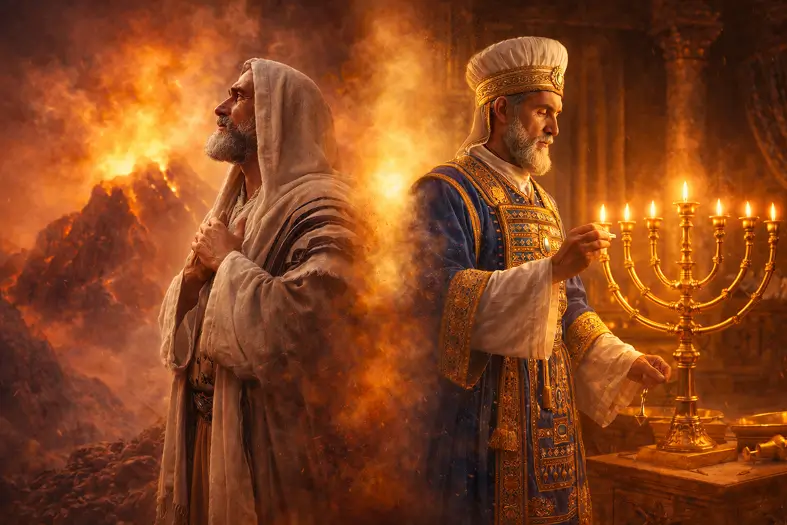
1.4 — Prophet and Priest: Fire vs Flame
Two Forms of Sacred Leadership
With the words:
שמות כ״ח:א
“וְאַתָּה הַקְרֵב אֵלֶיךָ אֶת אַהֲרֹן אָחִיךָ… לְכַהֲנוֹ־לִי”
“And you shall bring near to yourself Aharon your brother… to serve Me as Kohen,”
the Torah formally introduces the priesthood.
The shift is subtle but monumental. Until now, Moshe has stood at the center of redemption: prophet, liberator, lawgiver. Now the Torah establishes a different form of leadership — the Kohen.
Rabbi Jonathan Sacks explains that Judaism requires two distinct spiritual energies. One is revolutionary. The other is preservational. One ignites change. The other sustains continuity.
The prophet is fire.
The priest is flame.
Without fire, nothing begins.
Without flame, nothing endures.
The Prophet: Ignition
Moshe embodies the prophetic force. Prophets disrupt stagnation. They confront injustice. They awaken sleeping consciences. They bring new vision into the world.
Redemption from Egypt required confrontation and miracle. Revelation at Sinai required thunder and flame. Without prophetic ignition, Israel would never have been formed as a nation.
Prophetic leadership is intense, disruptive, transformative. It demands courage and often unsettles established order. It pulls history forward.
But fire, by its nature, cannot burn constantly at its highest intensity. It blazes, then recedes.
A society built only on prophetic energy would exhaust itself.
The Priest: Maintenance
The Kohen represents a different form of holiness. He does not split seas. He does not rebuke kings. He lights the Menorah each evening. He offers korbanos daily. He wears garments that transform repetition into sanctity.
The priest’s work is structured, rhythmic, and precise.
Where the prophet brings revelation, the priest brings routine. Where the prophet shouts, the priest tends quietly.
The Rambam, in describing the purpose of avodah, emphasizes that repeated acts shape the soul. Discipline, constancy, and structure refine human character over time. The Mishkan is not a stage for spectacle. It is a system for daily formation.
The priest sustains what the prophet begins.
Why Tetzaveh Installs the Priesthood
Parshas Tetzaveh follows Sinai and the construction of the Mishkan’s architecture. The dramatic moment has passed. Now the Torah must answer a pressing question: how does revelation survive once the thunder fades?
The answer is the kehunah.
The Kohanim will ensure that holiness becomes woven into the fabric of daily life. They will light the Menorah, maintain the altar, guard the sanctuary. They transform Divine encounter into enduring practice.
This is why the Torah says, “לְכַהֲנוֹ־לִי” — to serve Me. The priesthood is not an honorary office. It is a disciplined vocation of maintenance.
Without priests, the covenant would burn brightly once and then disappear.
The Covenant Needs Both
A nation built only on priests risks stagnation. A nation built only on prophets risks chaos.
The Torah therefore establishes both roles within its sacred system:
- The prophet awakens.
- The priest sustains.
- The prophet calls for transformation.
- The priest guards continuity.
The covenant collapses if either force is missing. Fire without flame dies quickly. Flame without fire never ignites.
Tetzaveh marks the moment when Judaism transitions from revolutionary birth to sustainable civilization.
Rambam: Structure as Spiritual Formation
The Rambam teaches that mitzvos are not random acts of devotion but a structured program of human refinement. Repetition forms character. Discipline trains the heart. Habit builds holiness.
The priesthood embodies this philosophy.
The Menorah is lit every evening.
The korbanos follow exact procedures.
The garments are worn in precise order.
The priest represents the conviction that spirituality must be lived daily, not experienced occasionally.
The prophetic moment at Sinai cannot be relived every day. But the priestly service can be repeated every day.
Through structure, the extraordinary becomes sustainable.
The Psychological Danger of Spiritual Highs
Human beings are naturally drawn to peaks. We remember dramatic moments of inspiration: a powerful shiur, an emotional tefillah, a transformative experience.
But those moments fade.
If a person builds his religious life only around spiritual highs, he will constantly chase intensity. When the emotional fire dims, he may feel empty.
The priestly model teaches a different approach. Holiness is not measured by intensity alone. It is measured by steadiness.
The Menorah burns through the night not because it flares dramatically, but because it is tended consistently.
Fire into Flame
Moshe and Aharon represent a sacred partnership. Moshe brings the fire of revelation. Aharon sustains it through daily service.
The Torah installs Aharon in Tetzaveh because the covenant must move from ignition to preservation.
Revelation gave Israel identity. Routine will preserve it.
The prophet opens history.
The priest keeps it alive.
This is not a demotion of prophetic greatness. It is a recognition that continuity requires structure.
Application for Today — Becoming a Flame That Lasts
There are moments in life when the heart catches fire. A powerful shiur, a stirring tefillah, a sudden clarity in learning—these are sparks of inspiration, flashes of light that lift the soul upward. They are precious, and the Torah never dismisses them.
But a spark is not a life.
A spark burns bright for a moment and then disappears. A flame, tended day after day, becomes a steady light that can illuminate a home, a sanctuary, even a generation.
The prophet brings fire.
The kohen keeps the flame alive.
Every Jew needs both. There are moments meant to ignite us, to awaken us from routine, to remind us that the soul can burn with love for Hashem. But the covenant does not survive on sparks alone. It survives on the quiet flame—the practice that returns each day, the rhythm that does not depend on emotion, the service that continues even when the heart feels ordinary.
Somewhere in your life, there is a small flame waiting to be guarded. A moment of Torah that could become a daily light. A prayer that could become a fixed meeting place with Hashem. A quiet act of kindness that could turn into a steady glow within the day.
It may not feel dramatic. It may not look impressive. But a single steady flame can outlast a hundred sparks.
Fire ignites.
Flame endures.
And the covenant lives wherever a person becomes a light that does not go out.
📖 Sources
- Full sources available on the Mitzvah Minute Parshas Tetzaveh page under insights and commentaries