www.Mitzvah-Minute.com
"Tetzaveh — Part I — “וְאַתָּה תְּצַוֶּה”: Hidden Leadership and the Birth of Sacred Institutions"
1.5 — “הַקְרֵב אֵלֶיךָ”: Leadership as Mentorship
The Command to Elevate Others
At the opening of the priestly section, the Torah instructs Moshe:
שמות כ״ח:א
“וְאַתָּה הַקְרֵב אֵלֶיךָ אֶת אַהֲרֹן אָחִיךָ וְאֶת־בָּנָיו אִתּוֹ… לְכַהֲנוֹ־לִי”
“And you shall bring near to yourself Aharon your brother and his sons with him… to serve Me as Kohanim.”
The phrase “הַקְרֵב אֵלֶיךָ” is deeply personal. Moshe is not merely told to appoint Aharon. He is told to bring him near, to draw him close, to elevate him into sacred service.
The Torah could have described the priesthood in impersonal terms: “Aharon and his sons shall serve.” Instead, it frames the moment as an act of mentorship. Moshe must personally raise Aharon and his sons into their roles.
The priesthood is not just an institution. It is a transmission.
The Leader Who Creates Leaders
This moment reveals a quiet truth about Moshe’s greatness. His ultimate achievement is not the miracles he performed or the revelations he received. It is the people he raised.
Moshe does not cling to power. He does not build a system that depends on him alone. Instead, he actively installs others into sacred responsibility.
He elevates:
- Aharon into the kehunah.
- Yehoshua into future leadership.
- The elders into judicial authority.
His leadership is not self-preserving. It is self-diffusing.
True leadership does not concentrate holiness in one figure. It multiplies it across a nation.
Ramban: Bringing Close, Not Just Appointing
Ramban explains that the phrase “הַקְרֵב אֵלֶיךָ” means Moshe must draw Aharon close in spirit and responsibility. This is not a cold administrative act. It is a relational one.
Moshe must:
- Prepare Aharon for the role.
- Guide him into sacred service.
- Initiate him into the rhythms of avodah.
The priesthood does not emerge from lineage alone. It requires spiritual formation.
Moshe becomes the one who shapes the inner life of the Kohen. He is not only the prophet of revelation, but the mentor of the institution that will preserve it.
Rambam: Structure Requires Human Formation
The Rambam, in describing the Mishkan and its service, emphasizes that the system is designed to shape the people who operate within it. The rituals, garments, and procedures are tools of formation.
But structure alone cannot produce holiness. Human beings must be trained into the system.
The priesthood therefore requires initiation, instruction, and mentorship. The garments must be worn properly. The service must be performed precisely. The rhythm of avodah must be learned and internalized.
Moshe is the architect of this human formation.
He does not simply build the Mishkan.
He builds the people who will serve within it.
Leadership as Spiritual Architecture
We often think of leadership in terms of buildings, programs, or achievements. We measure greatness by what someone constructs.
But the Torah suggests a different measure. Leadership is not only about what you build. It is about whom you raise.
Moshe’s legacy is not only the Mishkan. It is Aharon and his sons serving within it. It is Yehoshua leading the people into the land. It is the elders judging, teaching, and guiding the nation.
His greatest creation is not a structure. It is a generation of servants of Hashem.
Leadership, in this sense, is a form of spiritual architecture. Instead of shaping wood and gold, the leader shapes souls.
The Transfer of Holiness
The command “הַקְרֵב אֵלֶיךָ” also implies a transfer. Moshe, the prophet who stands closest to Hashem, is asked to draw others into that proximity.
Holiness is not meant to remain isolated in one individual. It must be transmitted outward.
The Torah’s model of leadership is therefore expansive, not exclusive. It assumes that sanctity grows when it is shared.
The covenant does not depend on a single towering personality. It depends on a network of people elevated into responsibility.
Moshe’s role in Tetzaveh is to begin that network.
The Courage to Step Aside
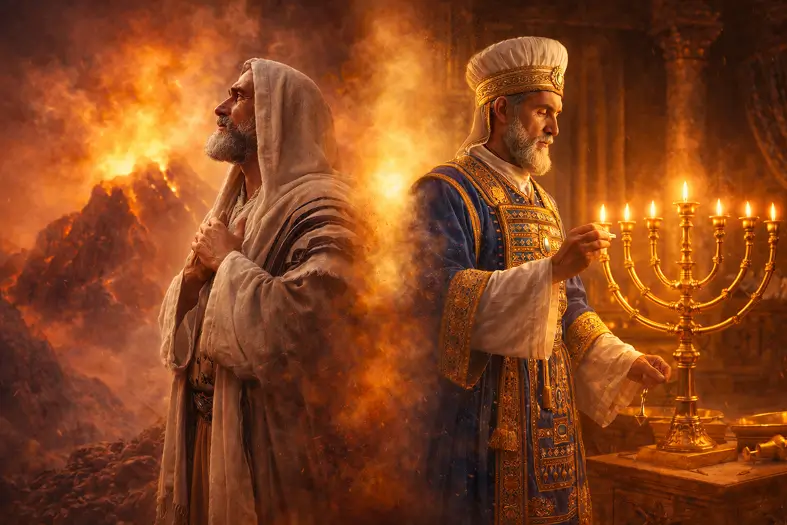
There is a quiet heroism in this moment. Moshe is installing his older brother as the High Priest. The central visible role in the Mishkan will belong to Aharon, not to him.
Moshe could have claimed the priesthood. He is the prophet, the redeemer, the one who ascended Sinai. No one would have questioned his authority.
But instead, he raises Aharon.
He does not grasp at honor. He distributes it.
This is one of the Torah’s deepest teachings about leadership: the ability to step aside so that others may rise.
A Covenant of Mentors
Seen through this lens, the entire Torah becomes a chain of mentorship.
Avraham raises Yitzchak.
Yitzchak raises Yaakov.
Moshe raises Yehoshua.
The prophets raise their students.
The sages raise their disciples.
Jewish continuity is not sustained by monuments alone. It is sustained by relationships of transmission.
The covenant survives because each generation brings the next generation close — הַקְרֵב אֵלֶיךָ.
Application for Today — The Light You Leave Behind
When the Torah tells Moshe, “הַקְרֵב אֵלֶיךָ… אַהֲרֹן וּבָנָיו”, it reveals a quiet truth about leadership. Moshe, the greatest of prophets, is not asked to build a monument to himself. He is asked to draw others close, to prepare them for sacred service, to raise a generation that will carry the light forward.
True leadership is not measured by visibility. It is measured by continuity.
In the world around us, success is often defined by scale—how large the project is, how many people are watching, how much influence one appears to hold. But the Torah looks for something more enduring: a human being whose light was kindled because of you.
Perhaps it is a child who learned to love a mitzvah at your side.
Perhaps it is a student who discovered Torah through your patience.
Perhaps it is a friend who took one step closer to Hashem because you believed in them.
Perhaps it is a colleague who saw what integrity looks like in quiet, daily action.
These are the lamps that remain after a person is gone.
Every soul is placed among others for a reason. Not only to grow, but to help others grow. Not only to receive light, but to pass it forward. You do not need a title to do this. Influence begins in the smallest interactions—one word of encouragement, one shared teaching, one act of quiet example.
Moshe’s greatness was not only that he stood at Sinai.
It was that he prepared others to stand in the Sanctuary.
When a person helps another come closer to Hashem, that light does not fade. It travels onward, from soul to soul, generation to generation.
At the end of a life, the truest measure is not only what you built,
but who still carries your flame.
📖 Sources
- Full sources available on the Mitzvah Minute Parshas Tetzaveh page under insights and commentaries