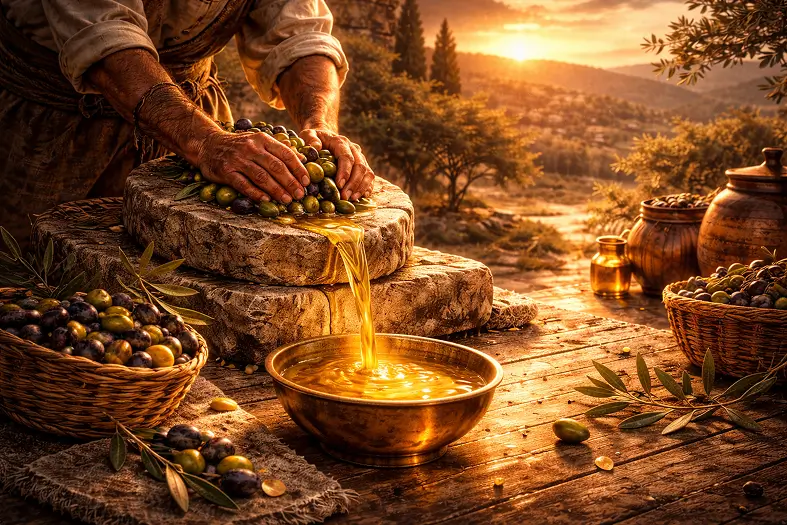
2.3 — Oil That Doesn’t Mix
The Torah commands that the Menorah be fueled with:
שמות כ״ז:כ׳
“שֶׁמֶן זַיִת זָךְ”
“Pure olive oil.”
The word זָךְ means clear, refined, without sediment. But oil possesses another defining quality beyond clarity: it does not mix.
Oil can sit within water, surrounded by it, even shaken within it — but eventually it rises back to the surface. Its essence resists dilution.
Chassidic masters see in this physical property a profound spiritual metaphor. The Jewish soul, like oil, carries an inner distinctness. It may enter complex environments, engage in material life, interact with broader culture — but at its core, it remains separate.
The spark of kedushah does not dissolve unless we force it to.
The Sfas Emes speaks often of the נקודה פנימית, the inner point of holiness embedded within every Jew. That point is not erased by external conditions. It may be obscured, but it remains intact.
Oil may be shaken violently into water, temporarily appearing mixed. Yet once agitation ceases, it rises again.
The problem, then, is not the existence of surrounding waters. The problem is constant agitation.
When a person continually throws his identity into every environment without boundary, without pause, without reflection, he stirs the oil into dispersion. But if he allows stillness, if he permits the soul to settle, the distinctness re-emerges naturally.
The Torah does not fear environment. It insists on purity.
The Menorah’s oil must be זָךְ — free from admixture. It cannot be cloudy or blended with sediment.
This does not mean the olive grew in isolation. It grew in soil, among other trees, under the same sun. But its essence remained itself.
Jewish life has always existed within larger civilizations. From Egypt to Babylon to Rome to modernity, Jews have lived within powerful surrounding cultures.
The Torah’s metaphor of oil suggests that distinctness is not maintained by isolation alone. It is maintained by essence.
Oil rises because it is oil.
The Jewish soul remains distinct because it carries covenantal identity within it.
Chassidic thought emphasizes that the neshama is literally a “chelek Eloka mima’al,” a spark of the Divine. That spark cannot truly merge into something foreign to its nature.
However, there is a difference between dilution and concealment.
A spark can be hidden under layers of distraction. It can be ignored. It can be numbed. But it cannot be transformed into something else.
Like oil in water, it may appear submerged — but its nature is to rise.
The Torah’s demand for שֶׁמֶן זָךְ reminds us that holiness requires preserving that distinctness.
In our era, the greatest spiritual risk is not persecution. It is diffusion.
We are immersed in information, noise, opinion, and constant stimulation. The soul is rarely allowed to settle. The oil is constantly agitated.
When there is no pause, no boundary, no moment of stillness, the oil cannot rise.
The Torah does not command the oil to escape the water. It commands it to remain pure.
Purity, in this sense, means refusing to be fully absorbed into every surrounding influence.
It means knowing who you are before entering the mixture.
The Menorah’s flame rises upward. Chazal note that oil fuels a flame that ascends.
This upward pull reflects the soul’s natural inclination. When undisturbed, it seeks elevation.
The requirement of pure oil for the Menorah therefore symbolizes an identity that remains directed upward even when surrounded by the ordinary.
The Mishkan does not remove Israel from the desert. It creates a distinct center within it.
The oil does not deny the existence of water. It simply does not become water.
The Torah’s vision is not one of total separation from the world. The olive tree grows in soil and weather. The Jew lives in society, works, builds, and contributes.
But distinctness must be protected internally.
The difference lies not in geography, but in boundaries.
A Jew can participate in culture without surrendering covenantal identity. But that requires conscious preservation of the inner נקודה.
Oil rises naturally — unless we continually stir it downward.
Oil has a quiet dignity. Even when it is poured into a mixture, it does not fully dissolve. It rises. It gathers itself. It remembers its nature.
The Jewish soul is meant to be like that oil—present in the world, active within it, yet never completely absorbed by it. But when life becomes too agitated, too noisy, too crowded with impressions, the oil is constantly stirred. The spark is still there, but it struggles to rise.
Distinctness does not require escape from the world. It requires moments of stillness within it. Small spaces in time where the soul is not pulled in ten directions, where the inner spark is allowed to settle and float back to the surface.
Perhaps it is a stretch of the day when the phone is silent.
Perhaps it is a few minutes before sleep, sitting quietly with one honest thought.
Perhaps it is a regular return to Torah that reminds the heart who it is.
Perhaps it is the careful guarding of speech, so the tongue does not carry the noise of the world into the soul.
These boundaries are not walls. They are vessels. They give the oil a place to gather, to clear, to become itself again.
The Torah calls for שֶׁמֶן זַיִת זָךְ—oil that remains clear, oil that remembers its nature. When the agitation settles, the spark rises on its own.
Let the world swirl around you if it must.
But give the soul a quiet place to rise,
and the oil will remember what it is.
📖 Sources


2.3 — Oil That Doesn’t Mix
The Torah commands that the Menorah be fueled with:
שמות כ״ז:כ׳
“שֶׁמֶן זַיִת זָךְ”
“Pure olive oil.”
The word זָךְ means clear, refined, without sediment. But oil possesses another defining quality beyond clarity: it does not mix.
Oil can sit within water, surrounded by it, even shaken within it — but eventually it rises back to the surface. Its essence resists dilution.
Chassidic masters see in this physical property a profound spiritual metaphor. The Jewish soul, like oil, carries an inner distinctness. It may enter complex environments, engage in material life, interact with broader culture — but at its core, it remains separate.
The spark of kedushah does not dissolve unless we force it to.
The Sfas Emes speaks often of the נקודה פנימית, the inner point of holiness embedded within every Jew. That point is not erased by external conditions. It may be obscured, but it remains intact.
Oil may be shaken violently into water, temporarily appearing mixed. Yet once agitation ceases, it rises again.
The problem, then, is not the existence of surrounding waters. The problem is constant agitation.
When a person continually throws his identity into every environment without boundary, without pause, without reflection, he stirs the oil into dispersion. But if he allows stillness, if he permits the soul to settle, the distinctness re-emerges naturally.
The Torah does not fear environment. It insists on purity.
The Menorah’s oil must be זָךְ — free from admixture. It cannot be cloudy or blended with sediment.
This does not mean the olive grew in isolation. It grew in soil, among other trees, under the same sun. But its essence remained itself.
Jewish life has always existed within larger civilizations. From Egypt to Babylon to Rome to modernity, Jews have lived within powerful surrounding cultures.
The Torah’s metaphor of oil suggests that distinctness is not maintained by isolation alone. It is maintained by essence.
Oil rises because it is oil.
The Jewish soul remains distinct because it carries covenantal identity within it.
Chassidic thought emphasizes that the neshama is literally a “chelek Eloka mima’al,” a spark of the Divine. That spark cannot truly merge into something foreign to its nature.
However, there is a difference between dilution and concealment.
A spark can be hidden under layers of distraction. It can be ignored. It can be numbed. But it cannot be transformed into something else.
Like oil in water, it may appear submerged — but its nature is to rise.
The Torah’s demand for שֶׁמֶן זָךְ reminds us that holiness requires preserving that distinctness.
In our era, the greatest spiritual risk is not persecution. It is diffusion.
We are immersed in information, noise, opinion, and constant stimulation. The soul is rarely allowed to settle. The oil is constantly agitated.
When there is no pause, no boundary, no moment of stillness, the oil cannot rise.
The Torah does not command the oil to escape the water. It commands it to remain pure.
Purity, in this sense, means refusing to be fully absorbed into every surrounding influence.
It means knowing who you are before entering the mixture.
The Menorah’s flame rises upward. Chazal note that oil fuels a flame that ascends.
This upward pull reflects the soul’s natural inclination. When undisturbed, it seeks elevation.
The requirement of pure oil for the Menorah therefore symbolizes an identity that remains directed upward even when surrounded by the ordinary.
The Mishkan does not remove Israel from the desert. It creates a distinct center within it.
The oil does not deny the existence of water. It simply does not become water.
The Torah’s vision is not one of total separation from the world. The olive tree grows in soil and weather. The Jew lives in society, works, builds, and contributes.
But distinctness must be protected internally.
The difference lies not in geography, but in boundaries.
A Jew can participate in culture without surrendering covenantal identity. But that requires conscious preservation of the inner נקודה.
Oil rises naturally — unless we continually stir it downward.
Oil has a quiet dignity. Even when it is poured into a mixture, it does not fully dissolve. It rises. It gathers itself. It remembers its nature.
The Jewish soul is meant to be like that oil—present in the world, active within it, yet never completely absorbed by it. But when life becomes too agitated, too noisy, too crowded with impressions, the oil is constantly stirred. The spark is still there, but it struggles to rise.
Distinctness does not require escape from the world. It requires moments of stillness within it. Small spaces in time where the soul is not pulled in ten directions, where the inner spark is allowed to settle and float back to the surface.
Perhaps it is a stretch of the day when the phone is silent.
Perhaps it is a few minutes before sleep, sitting quietly with one honest thought.
Perhaps it is a regular return to Torah that reminds the heart who it is.
Perhaps it is the careful guarding of speech, so the tongue does not carry the noise of the world into the soul.
These boundaries are not walls. They are vessels. They give the oil a place to gather, to clear, to become itself again.
The Torah calls for שֶׁמֶן זַיִת זָךְ—oil that remains clear, oil that remembers its nature. When the agitation settles, the spark rises on its own.
Let the world swirl around you if it must.
But give the soul a quiet place to rise,
and the oil will remember what it is.
📖 Sources


“2.3 — Oil That Doesn’t Mix”
שֶׁמֶן זַיִת זָךְ
The Menorah’s oil must be pure and unmixed. This mitzvah reflects the need for spiritual clarity and distinctness in sustaining Divine light.
וְלֹא־תָתוּרוּ אַחֲרֵי לְבַבְכֶם וְאַחֲרֵי עֵינֵיכֶם
This mitzvah commands guarding the inner and outer senses from full immersion in unfiltered influence. It preserves the soul’s distinctness within complex environments.
וְשִׁנַּנְתָּם לְבָנֶיךָ
Consistent Torah study anchors identity. It allows the oil of the soul to settle and rise above surrounding distraction.
וְהָלַכְתָּ בִּדְרָכָיו
Just as Hashem remains distinct and transcendent while sustaining the world, so too a Jew must remain spiritually distinct while living within it.
וְעָשִׂיתָ אֹתוֹ שֶׁמֶן מִשְׁחַת קֹדֶשׁ
The Torah commands the preparation of the sacred anointing oil used to consecrate the Mishkan, its vessels, and the kohanim. This mitzvah reflects the theme of refinement and sanctified substance: holiness begins with carefully prepared, purified materials that become the source of sacred service. In the context of the Menorah and the oil imagery of Tetzaveh, it reinforces the principle that consecrated light depends on consecrated fuel.


“2.3 — Oil That Doesn’t Mix”
The command for “שֶׁמֶן זַיִת זָךְ” emphasizes purity and clarity of the oil used for the Menorah. Beyond technical refinement, this phrase symbolizes distinctness and spiritual clarity. The oil must remain pure and unmixed, reflecting the covenantal identity of Israel within broader environments.

Dive into mitzvos, tefillah, and Torah study—each section curated to help you learn, reflect, and live with intention. New insights are added regularly, creating an evolving space for spiritual growth.

Explore the 613 mitzvos and uncover the meaning behind each one. Discover practical ways to integrate them into your daily life with insights, sources, and guided reflection.

Learn the structure, depth, and spiritual intent behind Jewish prayer. Dive into morning blessings, Shema, Amidah, and more—with tools to enrich your daily connection.

Each week’s parsha offers timeless wisdom and modern relevance. Explore summaries, key themes, and mitzvah connections to deepen your understanding of the Torah cycle.