www.Mitzvah-Minute.com
"Tetzaveh — Part V — “וְנָשָׂא אַהֲרֹן”: National Memory, Judgment, and Carried Responsibility"
5.1 — Twelve Stones, One Choshen
The Breastplate of the Nation
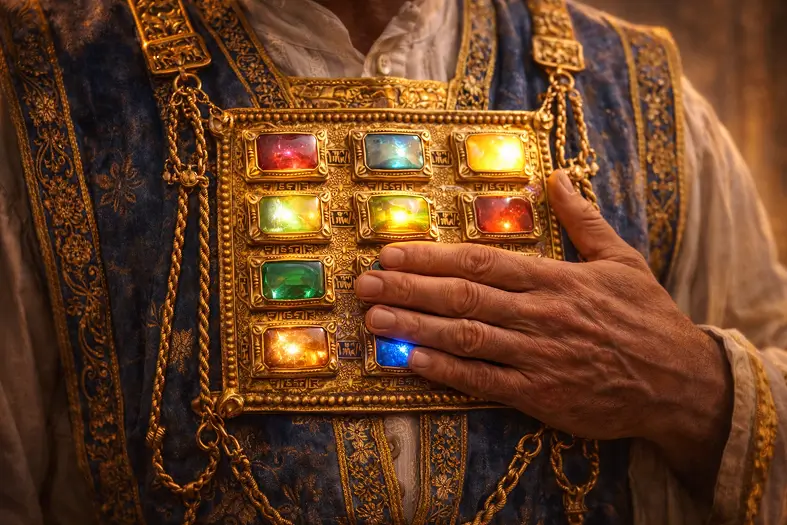
At the center of the High Priest’s garments rests the choshen, the breastplate of judgment. It is not a single ornament, nor a single stone. Instead, the Torah describes it as a structure of twelve distinct stones:
שמות כ״ח:ט״ו–כ״א
“אַבְנֵי מִלֻּאִים… שְׁנֵים עָשָׂר… אִישׁ עַל־שְׁמוֹ.”
“Stones of setting… twelve… each according to his name.”
Each tribe is represented by its own stone. Each stone bears a name. Each name has its place.
The choshen is not a symbol of uniformity. It is a symbol of unity structured through distinction.
Rashi: Each Tribe, Its Own Light
Rashi emphasizes that each stone corresponds to a specific tribe. The stones are not interchangeable. Each one has its own color, its own placement, its own engraving.
Reuven is not Shimon.
Yehudah is not Zevulun.
Yosef is not Binyamin.
The choshen does not erase these differences. It preserves them.
But it does something more. It gathers them into one ordered structure. The twelve stones are arranged in rows. They form a single breastplate. They rest together over the heart of the High Priest.
Distinct, yet unified.
Separate, yet carried together.
The Heart That Holds the Nation
The Torah places the choshen over the heart:
שמות כ״ח:כ״ט
“וְנָשָׂא אַהֲרֹן אֶת־שְׁמוֹת בְּנֵי־יִשְׂרָאֵל… עַל־לִבּוֹ.”
“Aharon shall carry the names of the children of Israel… over his heart.”
The High Priest does not carry abstract symbols. He carries names. Real tribes. Real histories. Real differences.
And he carries them on his heart.
Leadership, in this model, is not about standing above the people. It is about carrying them within oneself.
Rav Sacks: Unity Without Uniformity
Rav Jonathan Sacks often described the Jewish people as a symphony rather than a choir. In a choir, everyone sings the same note. In a symphony, different instruments play different parts, yet the music forms a single harmony.
The choshen is a visual symphony.
Each tribe has its own stone.
Each stone has its own color.
Each color has its own place.
But all are set into one breastplate.
Unity, in the Torah, does not come from sameness. It comes from ordered difference.
The High Priest does not erase distinctions. He sanctifies them.
The Danger of Flattened Identity
Many systems attempt to create unity by flattening differences. They demand conformity, hoping that sameness will produce peace.
But the Torah’s model is different.
Reuven’s temperament, Yehudah’s leadership, Yissachar’s scholarship, and Zevulun’s commerce are not problems to be solved. They are parts of a greater structure.
The choshen teaches that diversity becomes holy when it is arranged within sacred order.
Without order, difference becomes division.
With order, difference becomes harmony.
Stones That Remember
The stones of the choshen are not blank. Each one bears a name. The High Priest cannot forget who he carries.
The stones are memory.
Every time he enters the Sanctuary, he feels the weight of the tribes. He remembers their struggles, their strengths, their failures, and their hopes.
Leadership, then, is not about personal elevation. It is about national memory.
The leader becomes the bearer of names.
Judgment from the Heart
The choshen is called the “חֹשֶׁן מִשְׁפָּט”—the breastplate of judgment. It is connected to decisions, guidance, and the Urim and Tumim.
But the place of judgment is not the head. It is the heart.
The Torah places the instrument of judgment over the emotional center. This suggests that true judgment is not cold calculation. It is compassionate awareness. It is memory guided by responsibility.
The High Priest judges with the names of the tribes resting on his heart.
Justice is not abstract. It is personal.
One Structure, Many Stones
The choshen offers a powerful vision of national unity.
It does not blend the stones into one color.
It does not erase the names.
It does not dissolve the differences.
Instead, it gives each stone a place. It arranges them in order. It binds them into one sacred form.
Unity, in the Torah, is not about becoming the same. It is about belonging to the same structure.
Application for Today — Building a Choshen Community
Every community contains different stones.
Different personalities.
Different backgrounds.
Different strengths.
Different ways of serving Hashem.
Sometimes those differences create tension. One group emphasizes learning. Another emphasizes chesed. One values tradition. Another seeks innovation. One moves slowly. Another moves quickly.
The instinct is often to flatten these differences—to insist that everyone think the same, act the same, and value the same things.
But the choshen teaches a different path.
True unity is not achieved by erasing distinctions. It is achieved by arranging them into a shared structure.
Imagine a community where the scholar, the organizer, the giver, and the dreamer all have their place. Where differences are not threats, but stones in a larger design. Where each person’s strength is recognized as part of the national breastplate.
That is the vision of the choshen.
When a person looks at another Jew and sees not a rival, but a different stone in the same sacred structure, unity begins to form.
The goal is not to become identical.
The goal is to belong to the same heart.
📖 Sources
- Full sources available on the Mitzvah Minute Parshas Tetzaveh page under insights and commentaries