"Va’eira — Part I — Redemption as Process, Not Escape"

Mitzvah Minute Logo Icon

1.1 - Geulah as Clarification, Not Escape

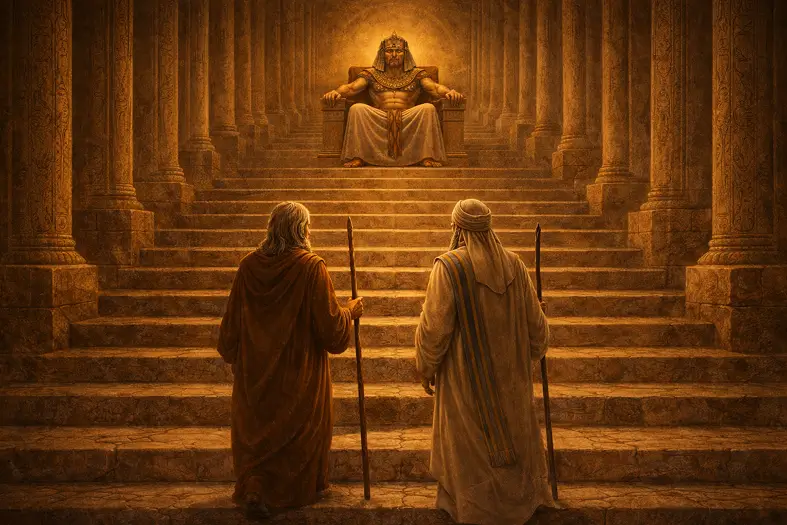
Moshe and Aaron, long staircase, Pharoah blocking path, Redemption is a process. Not an escape.
Redemption in Va’eira does not begin with escape—but with clarity. Before chains can fall, illusions must be dismantled. This essay reframes geulah as a slow unveiling of truth: Who truly governs reality, what power really is, and why freedom cannot endure without discipline. Through Pharaoh’s resistance and the measured unfolding of the plagues, the Torah teaches that redemption is not a sudden rupture of history, but its moral clarification. Va’eira reveals that lasting freedom begins not when suffering ends—but when reality becomes legible.

"Va’eira — Part I — Redemption as Process, Not Escape"

1.1 - Geulah as Clarification, Not Escape

Parshas Va’eira opens not with release, but with resistance. Not with freedom, but with intensification. Moshe appears before Pharaoh bearing the word of Hashem—and the immediate result is not redemption, but suffering multiplied. Labor is increased. Straw is withheld. Hope seems naïve. The Torah could have told this story differently. It chooses not to.

This choice reveals a foundational truth: geulah is not an escape from reality but a clarification of it.

Redemption in Va’eira does not arrive as a sudden collapse of Egypt. It arrives as a slow unveiling of what Egypt truly is, what Pharaoh truly represents, and what Hashem’s sovereignty truly means. Before chains can fall, illusions must be dismantled. Before bodies are freed, minds must be reoriented. Geulah begins not when oppression ends, but when confusion does.

Redemption Begins With Language, Not Motion

Hashem introduces Himself to Moshe with a new register of Divine speech:
וָאֵרָא אֶל־אַבְרָהָם… וּשְׁמִי ה׳ לֹא נוֹדַעְתִּי לָהֶם
“I appeared to Avraham… but by My Name Hashem I was not known to them.”

This is not a statement about information withheld; it is a statement about relationship. The Avos knew Hashem as promise. The generation of the Exodus will know Him as fulfillment—but fulfillment requires time, resistance, and confrontation. A promise can be believed in silence. Fulfillment must be tested in history.

Redemption therefore begins with clarification of Divine identity, not with political upheaval. Hashem does not yet act; He redefines reality. Only afterward does history begin to move.

Pharaoh Is Not Ignorant—He Is Misaligned

Pharaoh’s famous declaration—מִי ה׳ אֲשֶׁר אֶשְׁמַע בְּקֹלוֹ (“Who is Hashem that I should listen to Him?”)—is often misread as theological ignorance. Va’eira reveals something far more unsettling: Pharaoh is not confused about power. He is committed to a worldview in which power is manipulable, divinity is localized, and authority bends to will.

This is why the plagues do not begin with annihilation. They begin with exposure. Each makah strips away another layer of Egypt’s metaphysical assumptions. The Nile is not a god. Nature is not autonomous. Magic is not creative. Power does not equal sovereignty.

Pharaoh resists not because he lacks evidence, but because clarity threatens identity. Redemption does not merely remove Pharaoh from power; it unmasks him as a fraud. And frauds do not collapse easily—they fight revelation.

The Delay Is the Message

Why does Hashem not redeem Israel immediately? Because immediate rescue would confirm Egypt’s deepest lie: that reality is arbitrary, that strength wins, and that meaning is imposed by force. A sudden Exodus would save bodies while leaving frameworks intact.

Instead, Hashem chooses process.

Each stage of resistance clarifies something new. Each refusal reveals another boundary. Each plague is not only an act of judgment but an act of communication. Egypt is being taught—not through lecture, but through lived contradiction—that the world has moral structure.

Through the plagues, Hashem exposes foundational falsehoods:

  • Power is not sovereignty
  • Nature is not autonomous
  • Magic can imitate but cannot create
  • Authority does not bend to will
  • Moral order is not negotiable

Redemption therefore proceeds at the pace required for truth to become undeniable. Not to Pharaoh alone, but to Israel as well.

Israel Must Be Redeemed From Egypt, Not Merely Out of It

The Torah emphasizes that the people could not hear Moshe מִקֹּצֶר רוּחַ וּמֵעֲבֹדָה קָשָׁה—from shortness of breath and crushing labor. This is not a psychological footnote. It is the inner exile that must be addressed before physical freedom can endure.

A nation trained under absolute power does not immediately understand covenantal freedom. Redemption must therefore clarify what authority means, what obedience means, and what trust means. Without this clarification, freedom would collapse into chaos.

Hashem does not simply remove Israel from Egypt. He removes Egypt from Israel—slowly, deliberately, and sometimes painfully.

Geulah as Exposure, Not Escape

The plagues function as revelations before they function as punishments. They expose distinctions: between Goshen and Egypt, between nature and command, between imitation and creation, between acknowledgment and fear.

This is why the Torah repeatedly emphasizes וְיָדְעוּ מִצְרַיִם כִּי אֲנִי ה׳—“Egypt shall know that I am Hashem.” Knowledge here does not mean awareness. It means alignment with truth, whether willingly or through collapse.

Redemption is not a tunnel out of darkness. It is a light turned on inside it.

Process Is Not a Delay—It Is the Redemption

The process of redemption accomplishes what instant rescue cannot:

  • It dismantles false worldviews before removing oppressors
  • It transforms perception before granting freedom
  • It distinguishes between acknowledgment and submission
  • It prepares Israel for covenant, not merely survival

Modern readers often experience impatience with Va’eira. Why does it take so long? Why the repetition? Why the back-and-forth? The Torah answers by refusing to hurry. Because hurried redemption would not be redemption at all.

True geulah must reorder perception. It must clarify who commands history, what power really is, and why freedom requires discipline. Escape ends suffering; clarification ends falsehood. Only the latter can last.

This is why Va’eira insists on process. Why resistance precedes release. Why Pharaoh is allowed to speak, refuse, and expose himself. Why Israel must wait, struggle, and learn.

Redemption is not when chains break.
It is when reality becomes legible.

Only then can freedom endure.

📖 Sources

  • Full sources available on the Mitzvah Minute Parshas Va'eira page under insights and commentaries.

Organized by:
Boaz Solowitch
January 7, 2026
Mitzvah Minute Logo Icon

Connections

Mitzvah Minute Logo Icon

Mitzvah Links

Mitzvah 1

To know there is a G‑d
A Siddur
Learn this Mitzvah

Mitzvah 1

1
To know there is a G‑d

Mitzvah 5

To fear Him
A Siddur
Learn this Mitzvah

Mitzvah 5

5
To fear Him

Mitzvah 9

To listen to the prophet speaking in His Name
A Siddur
Learn this Mitzvah

Mitzvah 9

9
To listen to the prophet speaking in His Name

Mitzvah 11

To emulate His ways
A Siddur
Learn this Mitzvah

Mitzvah 11

11
To emulate His ways
The Luchos - Ten Commandments
View Mitzvah Notes

Mitzvah Reference Notes

"x" close page navigation button

Mitzvah Reference Notes

“Geulah as Clarification, Not Escape”

Mitzvah #1 — To Know There Is a G-d (Exodus 20:2)

אָנֹכִי ה׳ אֱלֹקֶיךָ

Parshas Va’eira frames redemption as the deepening of da’at Elokim. Hashem’s self-revelation to Moshe through a new Divine Name does not introduce new information but demands a fuller recognition of Divine sovereignty as lived reality. The plagues clarify that the world is not governed by nature, power, or magic, but by Hashem alone. Redemption therefore begins with knowledge—not abstract belief, but awareness that orders perception, authority, and history itself.

Mitzvah #5 — To Fear Him (Deuteronomy 10:20)

אֶת־ה׳ אֱלֹקֶיךָ תִּירָא

Va’eira distinguishes between recognition and fear. Pharaoh repeatedly acknowledges Hashem’s power yet refuses submission, revealing that knowledge without yirah leaves the will unchanged. The plagues expose that true fear of Hashem is not emotional terror, but acceptance of Divine authority. Geulah requires that truth penetrate beyond intellect into obedience, transforming how power, freedom, and responsibility are understood.

Mitzvah #9 — To Listen to the Prophet Speaking in His Name (Deuteronomy 18:15)

אֵלָיו תִּשְׁמָעוּן

Moshe speaks faithfully in the Name of Hashem, yet both Pharaoh and Israel initially resist his message. Va’eira demonstrates that listening to a prophet is not passive hearing but willingness to realign one’s worldview and expectations. Redemption is delayed not because the message is unclear, but because submission to prophetic truth requires dismantling entrenched assumptions about power and control.

Mitzvah #11 — To Emulate His Ways (Deuteronomy 28:9)

וְהָלַכְתָּ בִּדְרָכָיו

Hashem’s measured, patient unfolding of redemption models Divine governance rooted in justice, restraint, and moral clarity. The gradual exposure of Egypt’s falsehoods teaches that true power does not erupt chaotically but acts with purpose. Va’eira thus frames redemption as an invitation to Israel to emulate Hashem’s ways—acting with discipline, discernment, and fidelity to moral order rather than impulsive force.

Parsha Links

וָאֵרָא – Va’eira

Haftarah: Ezekiel 28:25 - 29:21
A Siddur
Learn this Parsha

וָאֵרָא – Va’eira

וָאֵרָא – Va’eira
The Luchos - Ten Commandments
View Parsha Notes
"x" close page navigation button

Parsha Reference Notes

“Geulah as Clarification, Not Escape”

Parshas Va’eira (Shemos 6:2–8:19)

Parshas Va’eira reframes redemption as a deliberate process of revelation rather than an abrupt rescue. Hashem introduces Himself to Moshe through a new Divine Name—Hashem—signaling not a change in essence, but a shift from promise to fulfillment. This transition unfolds gradually, through resistance rather than release, as Pharaoh’s refusal exposes the false metaphysics of Egypt: power without sovereignty, nature without command, and authority without moral legitimacy.

The parsha emphasizes that the plagues function first as acts of disclosure before they serve as punishment. Distinctions between Goshen and Egypt, the failure of Egyptian magicians, and the measured escalation of the makkos clarify that the world operates under Divine order rather than arbitrary force. Pharaoh’s repeated acknowledgments without submission reveal that recognition alone does not constitute redemption; clarity must penetrate will, not merely intellect.

Va’eira further establishes that Israel’s redemption cannot occur solely through external change. The Torah notes that the people cannot yet hear Moshe מִקֹּצֶר רוּחַ וּמֵעֲבֹדָה קָשָׁה, indicating an inner exile that must be addressed before freedom can endure. Redemption therefore proceeds through process: dismantling illusion, redefining authority, and preparing a nation to live within covenantal responsibility. Va’eira teaches that geulah begins not when oppression ends, but when reality itself becomes legible.

Mitzvah Minute
Mitzvah Minute Logo

Learn more.

Dive into mitzvos, tefillah, and Torah study—each section curated to help you learn, reflect, and live with intention. New insights are added regularly, creating an evolving space for spiritual growth.

Luchos
Live a commandment-driven life

Mitzvah

Explore the 613 mitzvos and uncover the meaning behind each one. Discover practical ways to integrate them into your daily life with insights, sources, and guided reflection.

Learn more

Mitzvah #

5

To fear Him
The Luchos - Ten Commandments
Learn this Mitzvah

Mitzvah Highlight

Siddur
Connection through Davening

Tefillah

Learn the structure, depth, and spiritual intent behind Jewish prayer. Dive into morning blessings, Shema, Amidah, and more—with tools to enrich your daily connection.

Learn more

Tefillah

COMING SOON.
A Siddur
Learn this Tefillah

Tefillah Focus

A Sefer Torah
Study the weekly Torah portion

Parsha

Each week’s parsha offers timeless wisdom and modern relevance. Explore summaries, key themes, and mitzvah connections to deepen your understanding of the Torah cycle.

Learn more

וָאֵרָא – Va’eira

Haftarah: Ezekiel 28:25 - 29:21
A Sefer Torah
Learn this Parsha

Weekly Parsha