www.Mitzvah-Minute.com
"Yisro — Part VI — Two Tablets, Two Realms: Torah as Moral Architecture"
6.2 — Mekhilta’s Pairings: From “Anochi” to “Lo Tirtzach”
The Tablets Speak to Each Other
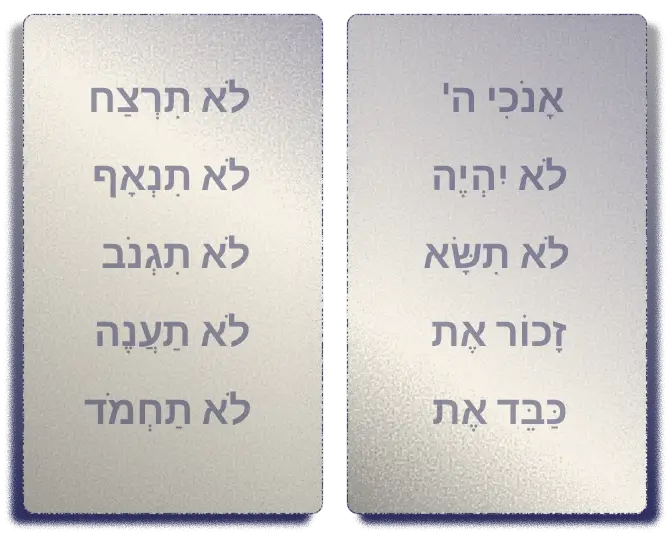
The Mekhilta makes a striking claim: the Aseres HaDibros are not merely divided into two lists; they are paired across the tablets. Each commandment between man and G-d stands opposite a commandment between man and man. This is not symmetry for beauty’s sake. It is theology in moral form.
Each interpersonal sin, the Mekhilta teaches, is a statement about G-d.
Anochi and Murder: The Image at Stake
The first pairing is the most unsettling:
- [אָנֹכִי ה׳ אֱלֹקֶיךָ — “I am Hashem your G-d”]
- [לֹא תִרְצָח — “You shall not murder”]
Why does murder oppose Anochi?
Because to deny the sanctity of human life is to deny the Divine image. If man is created b’tzelem Elokim, then murder is not only a crime against a person—it is a theological denial. To destroy a bearer of G-d’s image is to assault the reality proclaimed by Anochi itself.
Belief in G-d that tolerates violence against His image is incoherent.
Idolatry and Adultery: Betrayal of Covenant
The Mekhilta pairs:
- [לֹא יִהְיֶה לְךָ אֱלֹקִים אֲחֵרִים — “You shall have no other gods”]
- [לֹא תִנְאָף — “You shall not commit adultery”]
Both are acts of betrayal. Idolatry is spiritual adultery—abandoning exclusive covenantal loyalty. Adultery is covenantal betrayal in human terms. The Torah insists that fidelity is one concept, expressed in two realms.
A society that normalizes betrayal below will eventually tolerate it above.
The Name and Theft: Undermining Trust
Another pairing links:
- [לֹא תִשָּׂא אֶת שֵׁם ה׳ לַשָּׁוְא — “Do not take the Name in vain”]
- [לֹא תִגְנֹב — “You shall not steal”]
Both acts corrode trust. False invocation of the Divine Name empties language of meaning; theft empties ownership of security. When words cannot be trusted, neither can property. Society depends on sanctity of speech and respect for boundaries.
Desecration in one realm destabilizes the other.
Shabbos and False Testimony: Witnessing Truth
The Mekhilta pairs Shabbos with truthfulness. Shabbos testifies to Creation and Providence; false testimony denies truth within human systems. One proclaims that the world has meaning; the other insists that justice must reflect it.
A culture that falsifies truth cannot truly rest. Shabbos without integrity becomes ritual theater.
Parents and Desire: Origins and Limits
Honoring parents stands opposite coveting. Gratitude for one’s origin restrains endless desire. When people recognize where they come from, they learn limits. When origin is denied, appetite becomes infinite.
The Torah teaches that ethics begins with acknowledgment—of G-d above and of parents below.
The Core Claim of the Mekhilta
The Mekhilta’s genius lies here: ethics is theology lived horizontally. One cannot affirm G-d while denying His imprint in people. Every interpersonal violation is also a metaphysical claim—usually a false one.
This is why Torah refuses to separate ritual from morality. Each tablet interprets the other.
Ramban and Abarbanel: Public Law Requires This Structure
Ramban emphasizes that Torah law addresses public life. Abarbanel adds that public law must educate belief indirectly. The Mekhilta’s pairings ensure that theology is not confined to the sanctuary—it is enacted in the street.
What you do to people reveals what you believe about G-d.
Chassidic Insight: One Light, Two Mirrors
Chassidic masters describe the two tablets as mirrors reflecting one light. When one mirror is cracked, the image distorts everywhere. A fracture in ethics clouds faith; a fracture in faith erodes ethics.
Unity demands coherence across realms.
Application for Today
Modern culture often insists that morality and belief can be separated. The Mekhilta answers unequivocally: they cannot. Every ethical choice expresses a theology; every theology eventually produces ethics.
If we want faith to be real, it must show itself in how we treat others.
If we want ethics to endure, it must answer to something higher than preference.
The tablets speak across the mountain. We are meant to hear both.
📖 Sources
- Full sources available on the Mitzvah Minute Parshas Yisro page under insights and commentaries.