"Yisro — Part VI — Two Tablets, Two Realms: Torah as Moral Architecture"

Mitzvah Minute Logo Icon

6.1 — Five Opposite Five: Why Two Luchos at All?

Between a person and G-d - בֵּין אָדָם לְמָקוֹם   Between a person and their fellow - בֵּין אָדָם לַחֲבֵרוֹ
Why two tablets? The Torah structures covenant across two realms—between humanity and G-d, and between people themselves. Five commandments stand opposite five, insisting on equivalence, not hierarchy. Ritual cannot excuse injustice; ethics cannot replace transcendence. The two tablets preserve distinction without division, forming Torah’s moral architecture—one covenant expressed through two coordinated domains.

"Yisro — Part VI — Two Tablets, Two Realms: Torah as Moral Architecture"

6.1 — Five Opposite Five: Why Two Luchos at All?

One Covenant, Two Tablets

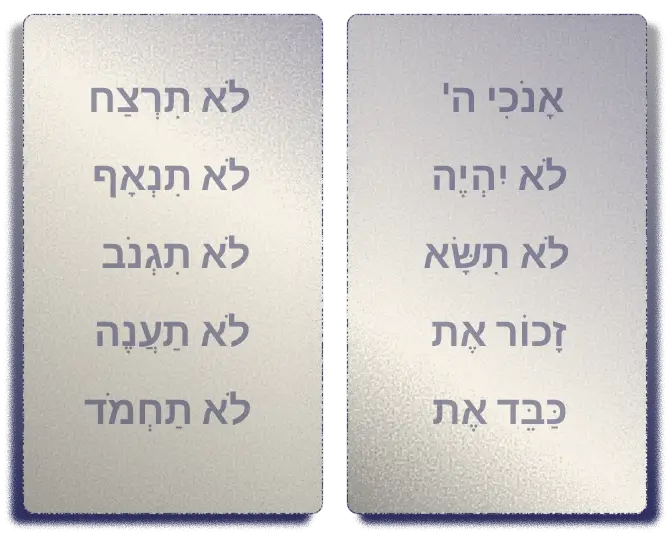
The Aseres HaDibros could have been written on one tablet. Instead, the Torah insists on two—[שְׁנֵי לֻחוֹת הָעֵדוּת — “two tablets of testimony”]. This is not a technical choice. It is moral architecture.

Five commandments stand opposite five. The covenant is unified, yet it speaks in two realms. The question is not merely what is written, but how it is structured.

The Architecture of Obligation

Chazal and the mefarshim identify the two realms clearly:

  • Between a person and Hashem (bein adam laMakom)
  • Between a person and another person (bein adam laChavero)

The tablets do not divide holiness from ethics. They insist that both are expressions of the same covenant. The separation is pedagogical, not theological.

One G-d. Two domains. No escape.

Why “Opposite” Matters

The Midrash emphasizes that the commandments were arranged five opposite five, not merely five and five. Each command on the first tablet corresponds to one on the second. The Torah is signaling equivalence, not hierarchy.

  • Loyalty to Hashem stands opposite loyalty to parents.
  • Sanctity of Shabbos stands opposite the sanctity of life.
  • Reverence for the Divine Name stands opposite reverence for truth and property.

The covenant refuses to allow piety to excuse cruelty—or ethics to replace reverence.

Unity Without Collapse

Why not merge the realms entirely? Because collapse breeds distortion.

If everything is “religious,” ethics can be spiritualized away.
If everything is “ethical,” G-d can be reduced to humanism.

Two tablets preserve distinction without division. The same Divine will speaks in both registers.

Ramban: Law as Structure, Not Sentiment

Ramban explains that the Dibros are not a list of virtues; they are the load-bearing beams of Torah law. The two tablets are like two pillars holding one structure. Remove either, and the building fails.

This is why covenant is not emotion-driven. It is architected.

Abarbanel: Public Law Requires Moral Symmetry

Abarbanel adds that a society grounded only in ritual collapses morally, while a society grounded only in ethics loses authority. The two tablets ensure symmetry: G-d stands present in the marketplace, and human dignity stands present in the sanctuary.

This balance is the Torah’s answer to tyranny and relativism alike.

Why Shabbos Bridges the Tablets

Shabbos sits at the hinge. It is commanded on the first tablet, yet it creates social equality on the second. Rest equalizes master and servant, rich and poor. Shabbos proves that ritual is meant to humanize, not withdraw.

The tablets touch at Shabbos because the realms meet there.

Chassidic Insight: One Light, Two Vessels

Chassidic masters describe the tablets as two vessels receiving one light. The light is indivisible; the vessels shape how it appears. Avodah toward Hashem and responsibility toward others are not competing paths—they are coordinated expressions of the same truth.

Application for Today

Modern moral systems often fracture: spirituality without ethics, ethics without transcendence. The two tablets refuse both errors. Torah insists that covenant must be lived upward and outward simultaneously.

If holiness does not refine how we treat people, it is false.
If ethics do not answer to something higher than consensus, they are fragile.

The two tablets stand as Torah’s permanent architecture for moral life.

📖 Sources

  • Full sources available on the Mitzvah Minute Parshas Yisro page under insights and commentaries.

Organized by:
Boaz Solowitch
February 3, 2026
Mitzvah Minute Logo Icon

Connections

Mitzvah Minute Logo Icon

Mitzvah Links

Mitzvah 1

To know there is a G‑d
A Siddur
Learn this Mitzvah

Mitzvah 1

1
To know there is a G‑d

Mitzvah 5

To fear Him
A Siddur
Learn this Mitzvah

Mitzvah 5

5
To fear Him

Mitzvah 6

To sanctify His Name
A Siddur
Learn this Mitzvah

Mitzvah 6

6
To sanctify His Name

Mitzvah 7

Not to profane His Name
A Siddur
Learn this Mitzvah

Mitzvah 7

7
Not to profane His Name
The Luchos - Ten Commandments
View Mitzvah Notes

Mitzvah Reference Notes

"x" close page navigation button

Mitzvah Reference Notes

“Five Opposite Five: Why Two Luchos at All?”

Mitzvah #1 — To know there is a G-d (Exodus 20:2)

אָנֹכִי ה׳ אֱלֹקֶיךָ

Knowledge of Hashem establishes the covenantal source from which both realms flow. The first tablet anchors moral life in Divine authority.

Mitzvah #5 — To fear Hashem (Deuteronomy 6:13)

אֶת ה׳ אֱלֹקֶיךָ תִּירָא

Yirah grounds obedience in accountability to a higher authority, preventing ethics from dissolving into convenience.

Mitzvah #6 — To sanctify His Name (Leviticus 22:32)

וְנִקְדַּשְׁתִּי בְּתוֹךְ בְּנֵי יִשְׂרָאֵל

Sanctification occurs publicly—through behavior toward others—demonstrating that reverence for Hashem must be visible in human society.

Mitzvah #7 — Not to profane His Name (Leviticus 22:32)

וְלֹא תְחַלְּלוּ אֶת שֵׁם קָדְשִׁי

Profanation often arises when religious behavior contradicts ethical conduct. The two tablets prevent this rupture by binding both realms together.

Parsha Links

יִתְרוֹ - Yisro

Haftarah: Isaiah 6:1-13
A Siddur
Learn this Parsha

יִתְרוֹ - Yisro

יִתְרוֹ - Yisro
The Luchos - Ten Commandments
View Parsha Notes
"x" close page navigation button

Parsha Reference Notes

“Five Opposite Five: Why Two Luchos at All?”

Parshas Yisro (Shemos 18:1–20:23)

Parshas Yisro presents the Aseres HaDibros on two tablets, revealing a covenant that spans both Divine service and human responsibility. The structure teaches that Torah integrates reverence and ethics into a single moral framework.

Mitzvah Minute
Mitzvah Minute Logo

Learn more.

Dive into mitzvos, tefillah, and Torah study—each section curated to help you learn, reflect, and live with intention. New insights are added regularly, creating an evolving space for spiritual growth.

Luchos
Live a commandment-driven life

Mitzvah

Explore the 613 mitzvos and uncover the meaning behind each one. Discover practical ways to integrate them into your daily life with insights, sources, and guided reflection.

Learn more

Mitzvah #

1

To know there is a G‑d
The Luchos - Ten Commandments
Learn this Mitzvah

Mitzvah Highlight

Siddur
Connection through Davening

Tefillah

Learn the structure, depth, and spiritual intent behind Jewish prayer. Dive into morning blessings, Shema, Amidah, and more—with tools to enrich your daily connection.

Learn more

Tefillah

COMING SOON.
A Siddur
Learn this Tefillah

Tefillah Focus

A Sefer Torah
Study the weekly Torah portion

Parsha

Each week’s parsha offers timeless wisdom and modern relevance. Explore summaries, key themes, and mitzvah connections to deepen your understanding of the Torah cycle.

Learn more

יִתְרוֹ - Yisro

Haftarah: Isaiah 6:1-13
A Sefer Torah
Learn this Parsha

Weekly Parsha