"Beshalach — Part V — Leadership, Responsibility, and Shared Burden"

Mitzvah Minute Logo Icon

5.3 — Part V Application: From Rescue to Responsibility (Leadership Lens)

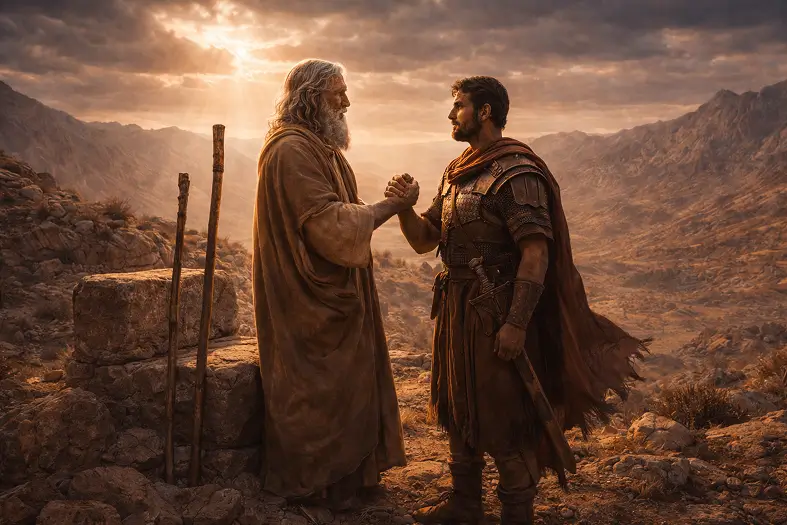
Moshe and Yehoshua
Part V’s application reframes leadership as the moment when rescue gives way to responsibility. Parshas Beshalach teaches that covenant cannot be sustained by miracles alone; it requires leaders who maintain orientation without control, accept support without weakness, and delegate authority without fear. Drawing on Moshe, Yehoshua, and Rav Avigdor Miller’s vision of trained emunah, this essay shows that true leadership is quiet, shared, and disciplined—capable of carrying covenant forward when Divine intervention becomes less visible.

"Beshalach — Part V — Leadership, Responsibility, and Shared Burden"

5.3 — Part V Application: From Rescue to Responsibility (Leadership Lens)

When Leadership Replaces Rescue

Part V of Beshalach marks a decisive transition. Up to this point, salvation arrives through unmistakable Divine intervention—plagues, the Sea, manna from heaven. But leadership is forged precisely when rescue recedes. Amalek appears not to threaten survival alone, but to test whether responsibility has truly taken root.

The Torah’s message is subtle and demanding: a people cannot remain dependent on miracles and still become mature leaders. At some point, leadership must replace rescue.

Leadership as Orientation, Not Control

Moshe’s raised hands, Yehoshua’s endurance on the battlefield, and the visible fatigue of leadership all converge on one application: leadership does not mean controlling outcomes. It means maintaining direction when outcomes are uncertain.

In lived terms, this reframes leadership away from charisma and certainty. Torah leadership does not promise resolution; it preserves orientation. When people know where they are facing—even when they do not know what will happen—they can act responsibly without panic.

This is the first demand placed on leaders emerging from redemption: resist the temptation to replace Hashem as savior.

The Courage to Accept Support

The Torah deliberately exposes Moshe’s weakness. His hands grow heavy. He must sit. He must be supported.

The application here is radical. Leadership that refuses support is not strong—it is fragile. Torah leadership requires the courage to be seen as limited, to allow others to carry weight without surrendering direction.

In communal life, this becomes a defining criterion: leaders who cannot share burden eventually collapse under it—or transfer it downward in destructive ways.

Delegation as Covenant Preservation

Yehoshua’s role completes the leadership picture. He does not replace Moshe; he operationalizes Moshe’s orientation within reality. This delegation ensures continuity beyond any single figure.

The application is clear: covenant survives transition only when responsibility is distributed. Leaders who hoard authority may win moments; leaders who entrust others secure futures.

This is why Yehoshua’s emergence occurs here, not later. Leadership capable of confronting Amalek must already be capable of succession.

Trained Emunah as Inner Leadership

Rav Avigdor Miller’s insistence that emunah is trained thinking becomes the internal counterpart to external leadership. Without disciplined cognition, leaders react emotionally, overcorrect, or withdraw under pressure.

The Torah demands leaders who can think clearly when tired, frightened, or opposed. This is not temperament—it is practice. Leaders are not born calm; they are trained to remain oriented when pressure distorts perception.

This inner discipline is what allows responsibility to replace rescue without despair.

Leadership Without Spectacle

One of the most striking applications of Part V is what does not happen. There is no miracle ending the war. No dramatic revelation resolving uncertainty. No applause for leadership.

The Torah is teaching that true leadership often unfolds without spectacle. It looks like:

  • consistency rather than brilliance
  • steadiness rather than inspiration
  • shared burden rather than singular heroism

Leadership formed this way is quiet—but durable.

Carrying Covenant Forward

Part V ultimately asks a sobering question: Who carries covenant when miracles stop? The answer is not “the strongest,” but those who can:

  • maintain orientation
  • accept limitation
  • delegate responsibility
  • think clearly under strain

This is leadership capable of sustaining a people across time.

Conclusion: Becoming Worthy of Trust

Parshas Beshalach teaches that Hashem does not merely save Israel—He entrusts them with responsibility. Leadership is the mechanism through which that trust is carried forward.

From Moshe’s hands to Yehoshua’s steps, from shared burden to trained emunah, the Torah sketches a leadership model fit for a world where Hashem is present but not performative.

This is not leadership that replaces Divine involvement.
It is leadership that proves itself worthy of it.

📖 Sources

  • Full sources available on the Mitzvah Minute Parshas Beshalach page under insights and commentaries.

Organized by:
Boaz Solowitch
January 28, 2026
Mitzvah Minute Logo Icon

Connections

Mitzvah Minute Logo Icon

Mitzvah Links

Mitzvah 5

To fear Him
A Siddur
Learn this Mitzvah

Mitzvah 5

5
To fear Him

Mitzvah 11

To emulate His ways
A Siddur
Learn this Mitzvah

Mitzvah 11

11
To emulate His ways

Mitzvah 9

To listen to the prophet speaking in His Name
A Siddur
Learn this Mitzvah

Mitzvah 9

9
To listen to the prophet speaking in His Name

Mitzvah 25

Not to follow the whims of your heart or what your eyes see
A Siddur
Learn this Mitzvah

Mitzvah 25

25
Not to follow the whims of your heart or what your eyes see

Mitzvah 598

Wipe out the descendants of Amalek
A Siddur
Learn this Mitzvah

Mitzvah 598

598
Wipe out the descendants of Amalek

Mitzvah 599

Remember what Amalek did to the Jewish people
A Siddur
Learn this Mitzvah

Mitzvah 599

599
Remember what Amalek did to the Jewish people

Mitzvah 600

Not to forget Amalek's atrocities and ambush on our journey from Egypt in the desert
A Siddur
Learn this Mitzvah

Mitzvah 600

600
Not to forget Amalek's atrocities and ambush on our journey from Egypt in the desert
The Luchos - Ten Commandments
View Mitzvah Notes

Mitzvah Reference Notes

"x" close page navigation button

Mitzvah Reference Notes

From Rescue to Responsibility (Leadership Lens)

Mitzvah #5 — To Fear Him

(Devarim 10:20)

Leadership in Part V is anchored in yiras Shamayim. Moshe’s raised hands embody reverent orientation rather than control. Fear of Hashem here is not anxiety but lived accountability—guiding leaders to act responsibly without assuming Divine authority for themselves.

Mitzvah #11 — To Walk in His Ways

(Devarim 28:9)

Hashem governs the world with patience, order, and restraint. Leadership that replaces rescue must emulate these traits. Accepting limits, sharing burden, and delegating authority reflect Divine governance more faithfully than domination or spectacle.

Mitzvah #9 — To Listen to the Prophet

(Devarim 18:15)

Although Yehoshua fights independently, victory depends on attentiveness to Moshe’s orientation. This mitzvah reinforces the relationship between direction and execution: leadership remains effective only when action stays aligned with prophetic truth.

Mitzvah #25 — Not to Follow After One’s Heart and Eyes

(Bamidbar 15:39)

Untrained emotion leads leaders to overreact, withdraw, or seize control. This mitzvah demands disciplined judgment, supporting Rav Avigdor Miller’s teaching that leadership begins with governing one’s own perception under pressure.

Mitzvah #598 — To Wipe Out the Descendants of Amalek

(Devarim 25:19)

The obligation to confront Amalek cannot be fulfilled through miracles alone. Part V shows that only leadership capable of sustaining seriousness, clarity, and responsibility can address Amalek across generations.

Mitzvah #599 — To Remember What Amalek Did

(Devarim 25:17)

Memory preserves vigilance. Leaders must remember how Amalek exploits fatigue and transition, ensuring that covenantal responsibility does not erode once inspiration fades.

Mitzvah #600 — Not to Forget Amalek’s Atrocities

(Devarim 25:19)

Forgetting Amalek allows complacency to masquerade as peace. This mitzvah demands sustained awareness that leadership must remain alert even when immediate danger subsides.

Parsha Links

בְּשַׁלַּח – Beshalach

Haftarah: Judges 4:4 - 5:31
A Siddur
Learn this Parsha

בְּשַׁלַּח – Beshalach

בְּשַׁלַּח – Beshalach
The Luchos - Ten Commandments
View Parsha Notes
"x" close page navigation button

Parsha Reference Notes

From Rescue to Responsibility (Leadership Lens)

Parshas Beshalach — Shemos 17:8–16

The closing section of Parshas Beshalach presents a war that unfolds without spectacle. Amalek attacks, yet the Torah records no miraculous intervention. Instead, leadership emerges as the decisive factor. Moshe raises his hands to maintain orientation toward Hashem, yet his fatigue is emphasized. Aharon and Chur support him, revealing leadership as a shared burden rather than solitary strength.

Below, Yehoshua leads the battle through human effort alone. This division of roles teaches that redemption matures when responsibility replaces rescue. Hashem does not remove Israel from danger; He entrusts them with leadership capable of functioning within uncertainty. The Torah’s refusal to conclude the war decisively reinforces the lesson: covenantal life demands vigilance, delegation, and sustained orientation even when outcomes remain unresolved.

Mitzvah Minute
Mitzvah Minute Logo

Learn more.

Dive into mitzvos, tefillah, and Torah study—each section curated to help you learn, reflect, and live with intention. New insights are added regularly, creating an evolving space for spiritual growth.

Luchos
Live a commandment-driven life

Mitzvah

Explore the 613 mitzvos and uncover the meaning behind each one. Discover practical ways to integrate them into your daily life with insights, sources, and guided reflection.

Learn more

Mitzvah #

1

To know there is a G‑d
The Luchos - Ten Commandments
Learn this Mitzvah

Mitzvah Highlight

Siddur
Connection through Davening

Tefillah

Learn the structure, depth, and spiritual intent behind Jewish prayer. Dive into morning blessings, Shema, Amidah, and more—with tools to enrich your daily connection.

Learn more

Tefillah

COMING SOON.
A Siddur
Learn this Tefillah

Tefillah Focus

A Sefer Torah
Study the weekly Torah portion

Parsha

Each week’s parsha offers timeless wisdom and modern relevance. Explore summaries, key themes, and mitzvah connections to deepen your understanding of the Torah cycle.

Learn more

יִתְרוֹ - Yisro

Haftarah: Isaiah 6:1-13
A Sefer Torah
Learn this Parsha

Weekly Parsha