"Parshas Beshalach — Part VIII — Application for Today"

Mitzvah Minute Logo Icon

From Redemption to Responsibility

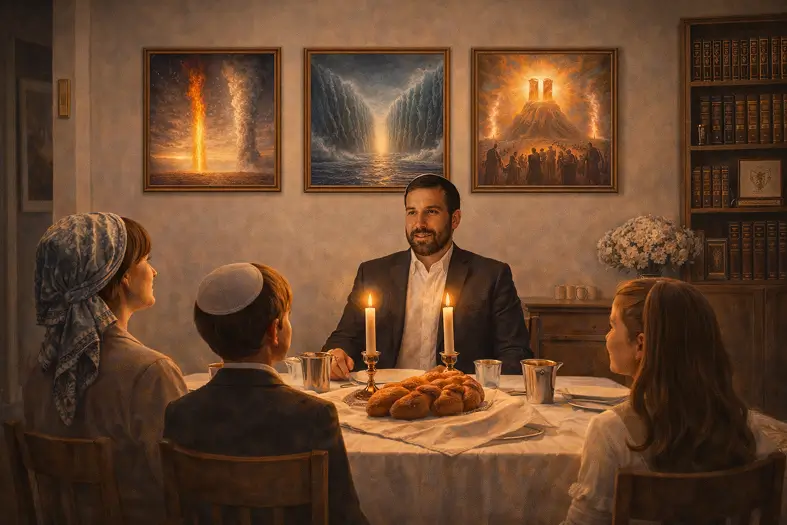
Shabbat dinner with family: Beshalach lessons in the wall art
Parshas Beshalach teaches that redemption is not complete when danger disappears, but when responsibility begins. Moving from crisis to trust, discipline, moral seriousness, leadership, clarity, and inner vigilance, this master essay shows how freedom matures only when miracles give way to obligation. True redemption endures when faith thinks clearly, leadership shares burden, desire is disciplined, and inner freedom is guarded daily. Beshalach calls the modern reader to live covenantally after inspiration fades.

"Parshas Beshalach — Part VIII — Application for Today"

From Redemption to Responsibility

Freedom Is Not the End of the Story

Parshas Beshalach teaches one of the Torah’s most counterintuitive truths: redemption does not conclude with salvation. It begins there.

The people cross the Sea, sing, and watch their enemies vanish. Yet the Torah refuses to linger in triumph. Immediately, it leads them into uncertainty—thirst, hunger, discipline, war, leadership strain, and inner instability. This is not anticlimax. It is instruction.

The Torah is teaching that freedom is not secured by miracles alone. It is secured only when a people learns how to live responsibly after miracles fade.

Crying Out Is the First Step—Not the Last

The opening movements of Beshalach legitimize crisis. Fear, confusion, and the instinct to cry out are not condemned; they are recognized as human. But the Torah does not allow suffering to become a permanent posture.

Crying out must mature into action. Prayer must give rise to movement. Dependence must evolve into responsibility.

A people that only cries out remains spiritually adolescent. A redeemed people learns how to stand.

Trust Without Certainty

The detour through the wilderness teaches that redemption does not follow the shortest route. Faith is not forged in certainty, but in forward motion without guarantees.

At the Sea, Israel steps forward before it splits. In the desert, they gather manna without storing it. Against Amalek, they fight without spectacle. Each stage trains the same muscle: trust expressed through disciplined action.

Freedom that cannot tolerate uncertainty will eventually retreat into fear.

Discipline Is the Price of Freedom

The manna and Shabbos reveal a deeper truth: freedom without structure collapses into desire. The Torah retrains a slave-nation to live with restraint, rhythm, and limits.

True freedom is not the absence of obligation; it is the ability to live within it without resentment.

A society that cannot restrain appetite will not preserve liberty.

Moral Seriousness Is Non-Negotiable

Amalek appears not when Israel is weak, but when it is transitioning—tired, distracted, between miracles and maturity. The Torah insists that cynicism, moral erosion, and meaninglessness are existential threats.

The war with Amalek teaches that freedom must be guarded morally, not only militarily. A people that loses seriousness about purpose will eventually lose purpose itself.

Leadership Is Shared, Not Spectacular

Beshalach offers a model of leadership radically unlike charisma culture. Moshe’s hands grow heavy. He must sit. Others must support him. Yehoshua fights below while Moshe orients above.

Leadership here is not dominance; it is direction under pressure, humility under strain, and delegation without abdication.

A community that waits for perfect leaders will never mature. A community that shares burden will endure.

Faith Must Think Clearly

The philosophical heart of Beshalach insists that miracles are not meant to replace understanding. Creation is ongoing. Providence is ordered. Responsibility remains human.

Faith that depends on spectacle collapses when spectacle disappears. Faith that understands structure endures.

Redemption matures when people stop asking, “Will Hashem act?” and begin asking, “What does Hashem expect of me now?”

Inner Freedom Requires Vigilance

Chassidic wisdom exposes the final layer of redemption: inner Egypt does not leave on its own. Inspiration fades. Old habits return. Without conscious return, the soul re-enters bondage even while the body walks free.

Song awakens freedom.
Practice preserves it.
Daily return guards it.

Freedom that is not watched over is lost quietly.

The Covenant After the Sea

Parshas Beshalach ultimately answers a single, enduring question:

What kind of people emerge after redemption?

Not miracle-chasers.
Not passive believers.
But a people trained to live responsibly in a world where Hashem is present—but not performative.

This is the covenant Beshalach offers the modern reader. A freedom that demands maturity. A faith that thinks. A leadership that shares burden. An inner life that must be guarded daily.

Redemption is not what happened at the Sea.

Redemption is what happens after—when a people chooses, again and again, to live as though freedom is a responsibility worth carrying.

📖 Sources

  • Full sources available on the Mitzvah Minute Parshas Beshalach page under insights and commentaries.

Organized by:
Boaz Solowitch
January 28, 2026
Mitzvah Minute Logo Icon

Connections

Mitzvah Minute Logo Icon

Mitzvah Links

Mitzvah 1

To know there is a G‑d
A Siddur
Learn this Mitzvah

Mitzvah 1

1
To know there is a G‑d

Mitzvah 5

To fear Him
A Siddur
Learn this Mitzvah

Mitzvah 5

5
To fear Him

Mitzvah 11

To emulate His ways
A Siddur
Learn this Mitzvah

Mitzvah 11

11
To emulate His ways

Mitzvah 25

Not to follow the whims of your heart or what your eyes see
A Siddur
Learn this Mitzvah

Mitzvah 25

25
Not to follow the whims of your heart or what your eyes see

Mitzvah 77

To serve the Almighty with prayer daily
A Siddur
Learn this Mitzvah

Mitzvah 77

77
To serve the Almighty with prayer daily

Mitzvah 87

To rest on the seventh day
A Siddur
Learn this Mitzvah

Mitzvah 87

87
To rest on the seventh day

Mitzvah 598

Wipe out the descendants of Amalek
A Siddur
Learn this Mitzvah

Mitzvah 598

598
Wipe out the descendants of Amalek
The Luchos - Ten Commandments
View Mitzvah Notes

Mitzvah Reference Notes

"x" close page navigation button

Mitzvah Reference Notes

Application for Today — From Redemption to Responsibility

Mitzvah #1 — To Know That There Is a G-d

(Shemos 20:2)

Beshalach transforms knowledge of Hashem from spectacle into lived awareness. Redemption reveals Divine power, but covenant requires sustained recognition of Hashem’s presence even when miracles cease.

Mitzvah #5 — To Fear Him

(Devarim 10:20)

Yiras Shamayim anchors freedom in accountability. Fear of Hashem prevents redemption from decaying into entitlement and preserves moral seriousness after salvation.

Mitzvah #11 — To Walk in His Ways

(Devarim 28:9)

Walking in Hashem’s ways demands restraint, patience, and responsibility. Beshalach teaches imitation of Divine governance through disciplined living rather than reliance on intervention.

Mitzvah #25 — Not to Follow After One’s Heart and Eyes

(Bamidbar 15:39)

Inner freedom is lost when impulse replaces judgment. This mitzvah guards redemption by demanding reflective choice rather than reactive desire.

Mitzvah #77 — To Serve Hashem with Prayer

(Shemos 23:25)

Prayer in Beshalach is orientation, not escape. It aligns human action with Divine purpose while preserving responsibility within the world.

Mitzvah #87 — To Rest on the Seventh Day

(Shemos 23:12)

Shabbos embodies disciplined freedom. It affirms trust in Hashem while structuring time around covenant rather than appetite or fear.

Mitzvah #598 — To Wipe Out the Descendants of Amalek

(Devarim 25:19)

Amalek represents the erosion of meaning and seriousness. Guarding redemption requires moral vigilance long after miracles fade.

Parsha Links

בְּשַׁלַּח – Beshalach

Haftarah: Judges 4:4 - 5:31
A Siddur
Learn this Parsha

בְּשַׁלַּח – Beshalach

בְּשַׁלַּח – Beshalach
The Luchos - Ten Commandments
View Parsha Notes
"x" close page navigation button

Parsha Reference Notes

Application for Today — From Redemption to Responsibility

Parshas Beshalach — Shemos 13:17–17:16

Parshas Beshalach traces the transformation of Israel from a rescued people into a responsible nation. The parsha begins with Divine protection and guidance, moves through the splitting of the Sea and national song, and then deliberately withdraws spectacle. Thirst, hunger, discipline through manna and Shabbos, the war with Amalek, and visible leadership strain all follow immediately after redemption.

This structure reveals the Torah’s intention: miracles are not endpoints, but catalysts. Crying out in crisis is legitimized, yet prayer must mature into action. Trust is forged through uncertainty, not certainty. Freedom is retrained through discipline rather than indulgence. Moral seriousness is demanded in the confrontation with Amalek. Leadership is shown to be shared, humble, and sustained by delegation. Finally, the parsha exposes the fragility of inner freedom, teaching that without daily vigilance, old patterns of fear and passivity return.

Beshalach therefore stands as the Torah’s definitive lesson on post-redemption life: Hashem remains present, but responsibility is transferred to the people. Redemption endures only when covenant becomes lived practice.

Mitzvah Minute
Mitzvah Minute Logo

Learn more.

Dive into mitzvos, tefillah, and Torah study—each section curated to help you learn, reflect, and live with intention. New insights are added regularly, creating an evolving space for spiritual growth.

Luchos
Live a commandment-driven life

Mitzvah

Explore the 613 mitzvos and uncover the meaning behind each one. Discover practical ways to integrate them into your daily life with insights, sources, and guided reflection.

Learn more

Mitzvah #

1

To know there is a G‑d
The Luchos - Ten Commandments
Learn this Mitzvah

Mitzvah Highlight

Siddur
Connection through Davening

Tefillah

Learn the structure, depth, and spiritual intent behind Jewish prayer. Dive into morning blessings, Shema, Amidah, and more—with tools to enrich your daily connection.

Learn more

Tefillah

COMING SOON.
A Siddur
Learn this Tefillah

Tefillah Focus

A Sefer Torah
Study the weekly Torah portion

Parsha

Each week’s parsha offers timeless wisdom and modern relevance. Explore summaries, key themes, and mitzvah connections to deepen your understanding of the Torah cycle.

Learn more

יִתְרוֹ - Yisro

Haftarah: Isaiah 6:1-13
A Sefer Torah
Learn this Parsha

Weekly Parsha