"Speech, Leadership, and Responsibility — Part I"

Mitzvah Minute Logo Icon

Shemos — Speech vs. Power — Moshe’s Heavy Mouth and the Moral Limits of Authority

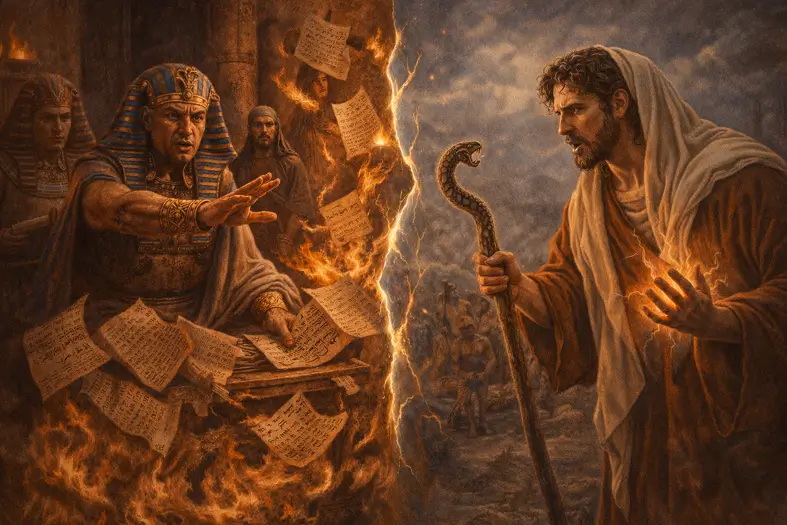
Pharaoh and Moses: tyranny vs truth
Parshas Shemos opens with a confrontation not only between slaves and empire, but between two forms of speech. Pharaoh rules through fluent language that normalizes cruelty and converts violence into policy. Moshe Rabbeinu, by contrast, hesitates—“heavy of mouth”—revealing that true leadership begins with moral restraint, not rhetorical power. Drawing on Ramban, Rav Kook, and Chazal, this essay explores why redemption cannot be carried by persuasive speech divorced from truth, and how Torah leadership sanctifies authority by fearing the misuse of words.

"Speech, Leadership, and Responsibility — Part I"

Shemos — Speech vs. Power — Moshe’s Heavy Mouth and the Moral Limits of Authority

Introduction — Two Kinds of Speech

Parshas Shemos introduces two radically different uses of language.

Pharaoh speaks fluently. His decrees are precise, efficient, and devastating. With carefully calibrated words, he transforms fear into policy, cruelty into law, and murder into administrative routine. His power is linguistic before it is physical.

Moshe Rabbeinu, by contrast, hesitates. When called to confront empire, he does not boast eloquence. He confesses incapacity:

“כִּי כְבַד־פֶּה וּכְבַד לָשׁוֹן אָנֹכִי”
[“For I am heavy of mouth and heavy of speech.”]

This is not a footnote. It is the Torah’s opening meditation on leadership, authority, and redemption. Before miracles. Before plagues. Before law. The Torah stages a confrontation between speech used to dominate and speech restrained by truth.

Redemption, Shemos teaches, does not begin with persuasive language. It begins with moral limits placed upon speech itself.

Pharaoh’s Language: Power Without Conscience

Pharaoh does not erupt into violence all at once. He speaks first. He reframes reality.

Ramban observes that Egyptian oppression unfolds through systems, not spectacle. The danger is not rage but administration. Language is weaponized to normalize evil. Bureaucracy replaces brutality; policy replaces passion.

Pharaoh’s decrees are designed to sound reasonable:

  • National security
  • Demographic fear
  • Economic control

Through language, Pharaoh removes the human face of suffering. When speech is severed from moral accountability, cruelty becomes efficient—and therefore invisible.

This is the Torah’s earliest warning: when power controls language, conscience is the first casualty.

Moshe’s Silence: Moral Sensitivity, Not Weakness

Against this backdrop, Moshe’s reluctance emerges as a theological statement.

Rav Kook explains that Moshe’s speech difficulty is not merely technical. It reflects a moral sensitivity so acute that words themselves feel dangerous. Moshe senses what Pharaoh does not: speech shapes reality, and misused language can deform truth.

Moshe refuses to speak easily because:

  • He will not manipulate
  • He will not exaggerate
  • He will not coerce belief through charisma

This is not insecurity. It is restraint.

Moshe understands that redemption cannot be carried by rhetoric divorced from truth. Authority that flows from ego—even spiritual ego—corrupts the very message it delivers.

Thus, Hashem’s response is not to “fix” Moshe, but to partner him:

“וְאַהֲרֹן אָחִיךָ יִהְיֶה נְבִיאֶךָ”
[“And Aharon your brother shall be your spokesman.”]

Redemption will require speech—but speech disciplined by humility.

Rav Kook: When Speech Is Too Clean, Be Suspicious

Rav Kook offers a profound inversion: sometimes fluency is a liability.

Smooth speech can anesthetize conscience. It can replace truth with persuasion, integrity with effectiveness. When words flow too easily, one must ask: what resistance has been bypassed?

Moshe’s “heavy mouth” preserves friction between thought and expression. That friction guards truth.

In a world corrupted by propaganda, redemption must emerge from voices that tremble before what they say.

The Torah’s Model of Leadership

Parshas Shemos establishes a lasting Torah principle:

Authority does not sanctify speech.
Speech sanctifies authority.

Moshe does not dominate Pharaoh linguistically. He does not win debates. He does not dazzle. He speaks when commanded, pauses when unsure, and remains accountable to truth beyond himself.

This is why Moshe—not Pharaoh—becomes the vehicle of geulah.

Application for Today — Speaking Without Becoming Pharaoh

We live in an age of relentless speech:

  • Commentary without responsibility
  • Outrage without accountability
  • Persuasion without truth

Parshas Shemos teaches that redemption—personal and collective—begins when we restore moral weight to words.

Before speaking, ask:

  • Am I clarifying reality—or controlling it?
  • Am I expressing truth—or protecting ego?
  • Am I using language to serve conscience—or to silence it?

Sometimes the most redemptive speech is hesitant. Sometimes silence is not avoidance, but reverence.

Moshe teaches us that the voice worthy of redemption is the one that fears misuse more than failure.

Pharaoh spoke to rule.
Moshe spoke to serve.

And history followed the voice that knew when not to speak.

📖 Sources

  • Full sources available on the Mitzvah Minute Parshas Shemos page under insights and commentaries.

Organized by:
Boaz Solowitch
January 1, 2026
Mitzvah Minute Logo Icon

Connections

Mitzvah Minute Logo Icon

Mitzvah Links

Mitzvah 501

Not to insult or harm anybody with words
A Siddur
Learn this Mitzvah

Mitzvah 501

501
Not to insult or harm anybody with words

Mitzvah 26

Not to blaspheme
A Siddur
Learn this Mitzvah

Mitzvah 26

26
Not to blaspheme

Mitzvah 11

To emulate His ways
A Siddur
Learn this Mitzvah

Mitzvah 11

11
To emulate His ways
The Luchos - Ten Commandments
View Mitzvah Notes

Mitzvah Reference Notes

"x" close page navigation button

Mitzvah Reference Notes

“Speech, Leadership, and Responsibility — Part I
Shemos — Speech vs. Power — Moshe’s Heavy Mouth and the Moral Limits of Authority”

Mitzvah #501 — Not to insult or harm anybody with words (Leviticus 25:17)

וְלֹא תוֹנוּ אִישׁ אֶת־עֲמִיתוֹ וְיָרֵאתָ מֵאֱלֹקֶיךָ

Parshas Shemos presents speech as a moral force capable of either preserving human dignity or enabling cruelty. Pharaoh’s decrees exemplify verbal oppression on a societal scale—language used to erase individual worth and legitimize suffering. Against this, Moshe Rabbeinu’s reluctance to speak reflects Torah’s insistence that words are not neutral tools of power. This mitzvah establishes that speech itself is a moral domain governed by yirat Shamayim. Harmful language, whether public or institutional, violates the sanctity of the human being created b’tzelem Elokim. Moshe’s “heavy mouth” thus embodies fidelity to this mitzvah: leadership that fears misuse of words more than loss of authority.

Mitzvah #26 — Not to blaspheme (Exodus 22:27)

וְנָשִׂיא בְּעַמְּךָ לֹא תָאֹר

The Torah’s prohibition against blasphemous or degrading speech extends beyond theology into the realm of authority and leadership. Parshas Shemos contrasts Pharaoh’s self-deifying language—speech that elevates power above moral accountability—with Moshe’s submission to Hashem’s command even when speech feels inadequate. This mitzvah teaches that words severed from reverence inevitably corrupt authority. Moshe’s restraint preserves the sanctity of Divine truth by refusing to speak beyond what is commanded. Leadership, the parsha teaches, must guard language so that speech remains a vessel for truth rather than a tool of domination.

Mitzvah #11 — To emulate His ways (Deuteronomy 28:9)

וְהָלַכְתָּ בִּדְרָכָיו

Hashem’s revelation at the Burning Bush models presence without coercion—speech that reveals without overwhelming. Moshe’s leadership mirrors this Divine mode by embracing humility, patience, and moral restraint. This mitzvah frames speech not as a means of control but as an expression of Divine attributes: compassion, truth, and responsibility. Parshas Shemos thus teaches that redemption advances when human leaders emulate Hashem’s measured communication, ensuring that authority flows from integrity rather than eloquence. Moshe’s reluctance becomes an act of walking in Hashem’s ways, sanctifying speech through restraint.

Parsha Links

שְׁמוֹת – Shemos

Haftarah: Isaiah 27:6 - 28:13; Isaiah 29:22-23
A Siddur
Learn this Parsha

שְׁמוֹת – Shemos

שְׁמוֹת – Shemos
The Luchos - Ten Commandments
View Parsha Notes
"x" close page navigation button

Parsha Reference Notes

“Speech, Leadership, and Responsibility — Part I
Shemos — Speech vs. Power — Moshe’s Heavy Mouth and the Moral Limits of Authority”

Parshas Shemos (Exodus 1:1–6:1)

Parshas Shemos frames redemption as a moral confrontation long before it becomes a miraculous one. Pharaoh’s rule is established through language that transforms fear into policy and cruelty into administrative order, using speech to normalize oppression and erase moral responsibility. Against this backdrop, Moshe Rabbeinu’s reluctance to speak—his confession of being “כְבַד־פֶּה וּכְבַד לָשׁוֹן”—emerges as a defining feature of Torah leadership. Rather than charismatic persuasion, Moshe embodies moral restraint: a refusal to manipulate truth through eloquence. The parsha thus contrasts two models of authority—speech wielded to dominate versus speech constrained by responsibility—teaching that true geulah cannot be carried by rhetoric divorced from conscience. Redemption begins when leadership fears the misuse of words more than the loss of power.

Mitzvah Minute
Mitzvah Minute Logo

Learn more.

Dive into mitzvos, tefillah, and Torah study—each section curated to help you learn, reflect, and live with intention. New insights are added regularly, creating an evolving space for spiritual growth.

Luchos
Live a commandment-driven life

Mitzvah

Explore the 613 mitzvos and uncover the meaning behind each one. Discover practical ways to integrate them into your daily life with insights, sources, and guided reflection.

Learn more

Mitzvah #

378

To light the Menorah every day
The Luchos - Ten Commandments
Learn this Mitzvah

Mitzvah Highlight

Siddur
Connection through Davening

Tefillah

Learn the structure, depth, and spiritual intent behind Jewish prayer. Dive into morning blessings, Shema, Amidah, and more—with tools to enrich your daily connection.

Learn more

Tefillah

COMING SOON.
A Siddur
Learn this Tefillah

Tefillah Focus

A Sefer Torah
Study the weekly Torah portion

Parsha

Each week’s parsha offers timeless wisdom and modern relevance. Explore summaries, key themes, and mitzvah connections to deepen your understanding of the Torah cycle.

Learn more

תְּצַוֶּה – Tetzaveh

Haftarah: Samuel I 15:1-34
A Sefer Torah
Learn this Parsha

Weekly Parsha