Each Parsha page on Mitzvah Minute is designed as a guided, three-level journey through the weekly Torah reading—integrating the narrative, the mitzvos, and the classical commentaries into one unified experience.
Begin with the foundations of the Parsha:
This level gives you the storyline, the key mitzvos, and the essential connections between them.
A complete journey through the parsha—moving from clarity and depth to inner connection and real-world meaning, culminating in a way to live its ideas in everyday life.
These sections show how the Parsha speaks to the mind, the heart, and the real world — offering wisdom rooted in enduring Torah.
A complete, structured commentary on the parsha—presented pasuk by pasuk, with chapter and overall summaries for clarity and flow.
This level reveals the structural depth of the Parsha and the classical underpinnings of each theme.
Together, these layers create a complete Parsha journey —
narrative, mitzvah, and commentary — all flowing toward deeper understanding, spiritual insight, and meaningful growth.
Tap the Page Navigation tab on the right side of your screen anytime to access quick-links to the entire Parsha page.
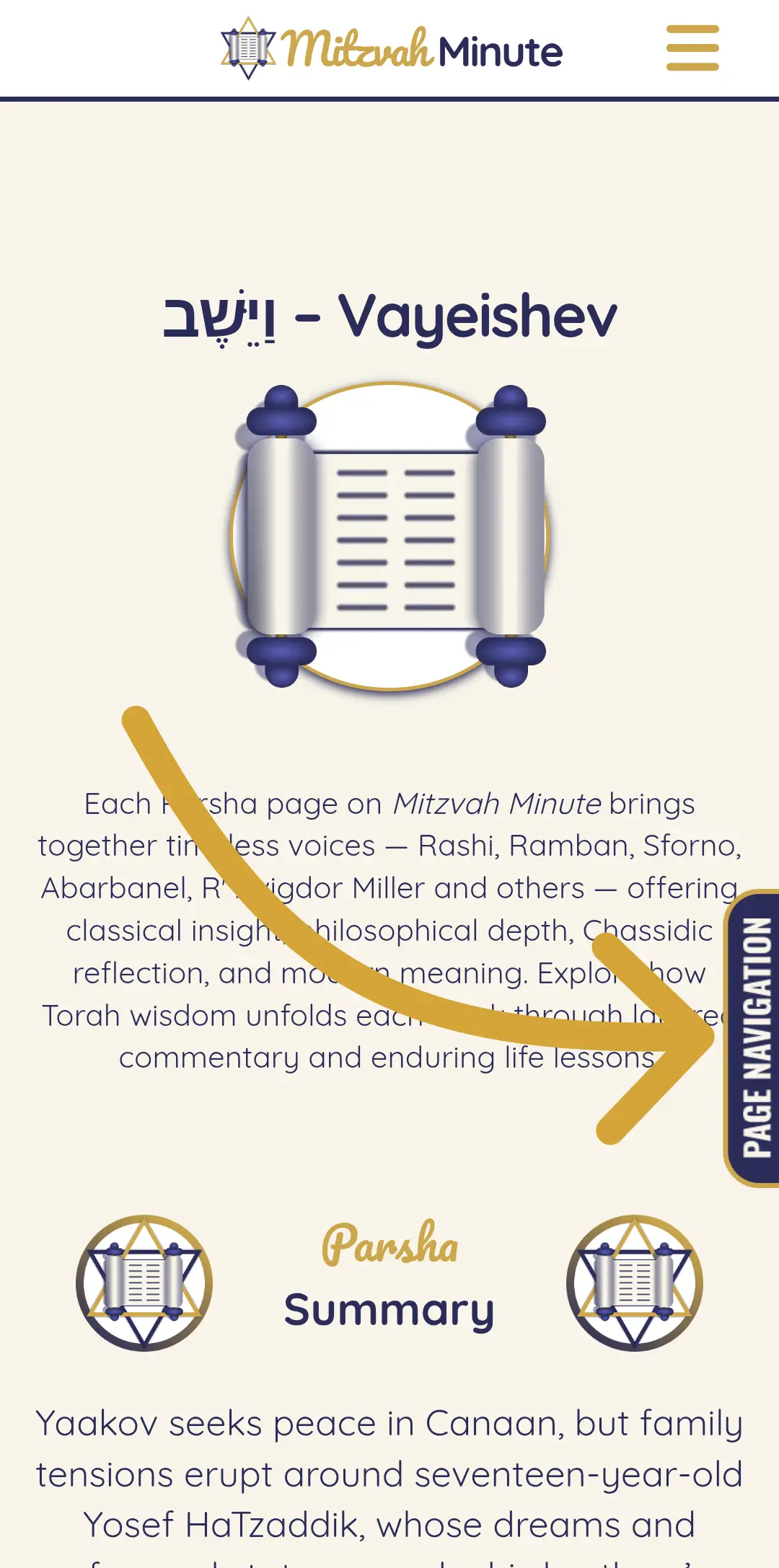
The quick-link panel gives instant access to every section — Parsha Summary, Mitzvos, Divrei Torah, Insights, and Commentaries.
“Every word of Torah and every mitzvah lifts us higher — may your learning bring you closer to Hashem.”

Parshas Shemos marks the transition from family to nation, as Israel descends from memory into bondage. What begins with names and continuity quickly gives way to oppression, fear, and enforced suffering. Yet within the darkness of Egypt, moral courage emerges — through the midwives, through quiet acts of defiance, and through the birth of Moshe. As Israel cries out, Hashem hears, remembers the covenant, and reveals Himself at the burning bush. Redemption does not yet arrive, but its call is unmistakable. Exile deepens — and with it, the first summons toward freedom.


Parshas Shemos — From Dehumanization to Da’as Hashem
אָנֹכִי ה' אֱלֹקֶיךָ
Parshas Shemos is the Torah’s extended introduction to this mitzvah. Before Sinai can command knowledge of Hashem, Shemos must teach what such knowledge means. Hashem reveals Himself not as an abstract idea, but as a Presence who sees suffering, hears cries, remembers covenant, and intervenes in history. The name Ehyeh Asher Ehyeh defines this mitzvah not as philosophical awareness alone, but as lived recognition of a G-d who is present within becoming, struggle, and redemption.
לֹא יִהְיֶה לְךָ אֱלֹקִים אֲחֵרִים עַל פָּנָי
Egypt is the Torah’s archetype of false power. Pharaoh presents himself as sovereign, Nile-god, and lawgiver — a living embodiment of competing “divinity.” Parshas Shemos exposes the danger of misplaced belief: when authority, productivity, or empire becomes absolute, human life becomes expendable. This mitzvah is therefore not only theological; it is moral resistance against any force that claims ultimate authority over man.
לְיִרְאָה אֶת ה' אֱלֹקֶיךָ
Parshas Shemos is the Torah’s primary narrative foundation for yirat Hashem. Fear of Hashem here is not terror, but moral awe — the recognition that human actions are seen, weighed, and judged. Pharaoh’s defining sin is not ignorance, but the absence of yirah: “Who is Hashem that I should listen to His voice?” His denial of accountability enables cruelty, while Moshe’s hesitation reflects profound reverence before Divine mission.
Throughout Shemos, fear operates as the boundary that restrains power. The midwives fear Hashem and therefore refuse to murder. Moshe fears misrepresenting Hashem and therefore resists leadership until commanded. Even revelation itself begins with fear — “Do not come closer… remove your shoes” — teaching that closeness to Hashem requires humility, restraint, and submission.
וְכָל־אַלְמָנָה וְיָתוֹם לֹא תְעַנּוּן
Parshas Shemos is the Torah’s anatomy of oppression: a state turns a human being into a unit of production, and then turns birth itself into a threat. The issur of afflicting the vulnerable crystallizes the Torah’s refusal to treat those without power as expendable. The opening chapters present the moral root-system of this mitzvah: the moment a society permits the weak to be pressured, quotas become cruelty, and bureaucracy becomes bloodless violence.
לֹא תֵלֵךְ רָכִיל בְּעַמֶּיךָ
Shemos begins with a regime that manufactures fear through narrative: “they are too many,” “they are a threat,” “let us outsmart them.” Lashon hara is not only personal sin; it is the first building block of social evil—language that dehumanizes, labels, and legitimizes harm. Pharaoh’s propaganda is the macro-form of the same moral failure: using speech to dissolve empathy.
אֱלֹקִים לֹא תְקַלֵּל
Parshas Shemos is the reappearance of Hashem’s authority in a world that denies it. Pharaoh’s defining posture is not only tyranny but theological defiance: “Who is Hashem that I should listen?” In that climate, the Torah’s ban on cursing the Divine Name is not technical—it is the preservation of moral reality itself: when Heaven is mocked, human dignity is next.
וְנִקְדַּשְׁתִּי בְּתוֹךְ בְּנֵי יִשְׂרָאֵל
Shemos is where Kiddush Hashem begins in history’s harshest arena: exile. The first “sanctifiers” are not only miracle-workers; they are quiet resisters—Shifrah and Pu’ah, Bas Par’oh (in Chazal’s memory), and those who preserve covenantal identity when everything pressures assimilation. The parsha’s message is that Kiddush Hashem is often the courage to obey Hashem when the world punishes obedience.
וְלֹא תְחַלְּלוּ אֶת שֵׁם קָדְשִׁי
The inverse of Kiddush Hashem is not only explicit חילול, but living as though Hashem is absent. Shemos shows how exile tempts a person into that spiritual numbness: endless work can crush prayer, identity, and hope. The parsha therefore frames redemption as a reawakening of Shem Shamayim within the Jewish inner life—so that Jewish existence itself no longer communicates abandonment or despair.
אֵלָיו תִּשְׁמָעוּן
Shemos is the birth of nevuah as national direction: Moshe Rabbeinu is sent not as a charismatic leader but as Hashem’s mouthpiece. Yet the parsha also makes clear how difficult this mitzvah is emotionally: the people’s suffering makes them unable to hear (“shortness of spirit”), and Moshe’s reluctance highlights that true prophecy is not self-expression but submission to Divine mission.
לֹא תְנַסּוּ אֶת ה׳ אֱלֹקֵיכֶם
A core tension in Shemos is the demand for certainty: “How will they believe me?” “What if they do not listen?” The Torah acknowledges signs—but warns against turning spiritual life into a constant demand for proof. The parsha’s movement teaches: emunah grows through fidelity across ambiguity, not through endless tests that reduce Hashem’s guidance to a performance demanded on our schedule.
לְהִתְעַנּוֹת וְלִזְעֹק לִפְנֵי ה' בְּעֵת צָרָה
Parshas Shemos establishes the Torah’s foundational model for responding to collective suffering. Before redemption begins, the Torah records not action, strategy, or revolt — but crying out: “And the children of Israel sighed from the labor, and they cried out, and their cry ascended to Hashem.” This mitzvah defines suffering as a summons to relationship, not resignation.
According to this mitzvah, catastrophe is not meant to be endured silently or explained away as historical inevitability. The Jewish response is active: affliction that awakens conscience, and crying out that affirms Divine accountability. In Shemos, redemption begins not when conditions improve, but when pain is brought into speech before Hashem. Silence perpetuates exile; tefillah breaks it.
This mitzvah also draws a sharp contrast with Pharaoh. Pharaoh responds to crisis by hardening systems, increasing quotas, and suppressing cries. Israel responds by crying out to Hashem — and that distinction alone marks who stands within redemption and who stands outside it.
לֹא תַעֲמֹד עַל־דַּם רֵעֶךָ
Parshas Shemos is a sequence of refusals to stand by: the midwives, Yocheved, Miriam, Bas Par’oh, and Moshe all step into danger to save life. The parsha thereby frames redemption as an ethic: a society is redeemed when its members intervene for the threatened, rather than watching harm as “someone else’s problem.”
לֹא תִּרְצָח
Even before Sinai states “לא תרצח” explicitly, Shemos is already the Torah’s war against murder: Pharaoh legislates infanticide; Egypt turns human beings into disposable bodies; and Moshe is thrust into the moral crisis of lethal violence. By placing attempted genocide at the start of Israel’s national story, the Torah teaches that murder is not only a private crime—it is the endpoint of a worldview that denies the Image of Hashem within man.
וְהָלַכְתָּ בִּדְרָכָיו
Shemos teaches imitatio Dei in action: Hashem “sees,” “hears,” “remembers,” and “knows” the suffering of His people—and therefore acts to redeem. The human analogue is the refusal to be a bystander to pain. The midwives and Moshe himself embody this: they see a threatened life and intervene. Emulating Hashem means training the self to respond to human distress with moral urgency.
וְאָהַבְתָּ לְרֵעֲךָ כָּמוֹךָ
The exile of Shemos is not only political; it threatens internal fracture: fear turns people inward, and suffering breeds suspicion. Yet geulah emerges through mutual responsibility—Am Yisrael as a single body. The parsha’s trajectory is from scattered slaves to a people capable of receiving Torah, and that transition depends on the restoration of Jewish solidarity.
לֹא תִשְׂנָא אֶת אָחִיךָ בִּלְבָבֶךָ
Oppression creates spiritual toxins: resentment, blame, rage that seeks a nearby target. Shemos hints at this dynamic when the pressure intensifies and the people lash out at Moshe and Aharon. The Torah’s prohibition of hatred is therefore part of redemption’s inner work: refusing to let pain mutate into internal destruction.
הוֹכֵחַ תּוֹכִיחַ אֶת עֲמִיתֶךָ
Shemos is filled with moral confrontation: the midwives defy Pharaoh; Moshe confronts an Egyptian striking a Jew; later he confronts conflict among Jews. The mitzvah of tochachah is not anger—it is responsibility for moral order. Shemos teaches that redemption requires voices willing to oppose wrongdoing even when the system calls it “normal.”
וְלֹא תִשָּׂא עָלָיו חֵטְא
In Shemos, the slave is stripped of dignity; humiliation becomes part of the machinery. The Torah’s prohibition against shaming highlights that dignity is not a social luxury—it is a religious value. Redemption is not only “leaving Egypt,” but leaving the culture of degradation: rebuilding the human being as someone who bears tzelem Elokim.
וְלֹא תוֹנוּ אִישׁ אֶת עֲמִיתוֹ
Shemos is a parsha of speech: Pharaoh’s decrees, Moshe’s reluctance, Aharon’s role as spokesman, the people’s crushed רוח. Ona’as devarim is therefore a central “application mitzvah”: words can either reinforce slavery (defining people as “nothing”) or begin redemption (calling them back to identity and hope). The parsha reveals how verbal harm becomes a tool of tyranny—and how holy speech becomes a כלי לגאולה.
לֶאֱהֹב אֶת הַגֵּר
Parshas Shemos provides the experiential foundation for this mitzvah before it is ever commanded explicitly. The Torah introduces Israel not as a nation born into security, but as a people formed through alienation, vulnerability, and exclusion. The memory of being strangers in Egypt is not historical background — it is moral preparation.
This mitzvah does not command tolerance alone, but love: an active commitment to draw the convert into dignity, belonging, and covenantal warmth. In Shemos, the danger of being “other” is shown through forced labor, dehumanization, and erasure of identity. The Torah therefore insists that the Jewish people become the opposite of Egypt — a society where the stranger is protected precisely because power is remembered.
The command to love the convert also reflects Moshe’s own formation. Raised between worlds — Hebrew by birth, Egyptian by culture, Midianite by refuge — Moshe embodies the soul shaped by displacement. His leadership emerges from sensitivity to the outsider, not distance from them.
Parshas Shemos teaches that a people forged through exile must never recreate it.
וְגֵר לֹא־תוֹנֶה
וְלֹא תִלְחָצֶנּוּ
Shemos is the Torah’s central empathy-school: “you know the soul of the ger.” The narrative forces Israel to internalize what it means to be powerless, vulnerable, and dependent on the conscience of others. These mitzvos translate that historical memory into law: never recreate Egypt inside Jewish society, especially toward one who stands alone socially.
Rashi reads Parshas Shemos as the Torah’s anatomy of how redemption is born from moral collapse and quiet fidelity. The parsha does not open with miracles or prophecy, but with names, fear, and deliberate cruelty. Rashi exposes how exile deepens through human choice—through ingratitude, denial of Hashem, and the weaponization of power—while redemption begins invisibly, through conscience, restraint, and responsibility.
Rashi emphasizes that Israel’s names are repeated to affirm individual worth just as Egypt begins to treat them as an anonymous threat. Pharaoh’s rise marks a shift from memory to erasure, where fear replaces gratitude and policy replaces humanity. Yet the more Egypt seeks to diminish Israel, the more Hashem causes them to grow, revealing the futility of power opposed to covenant.
At the heart of Shemos, Rashi highlights the midwives’ יִרְאַת אֱלֹקִים as the moral axis of the parsha. Their refusal to kill—and their active preservation of life—demonstrates that redemption begins not with rebellion, but with loyalty to Hashem that overrides royal decree. Against institutionalized murder, quiet acts of compassion become the first blows against tyranny.
Rashi portrays Moshe not as a triumphant hero, but as a leader shaped through doubt, correction, and covenantal discipline. His hesitation, affliction, and loss of priesthood underscore that closeness to Hashem demands accountability. Even at the burning bush, redemption is framed as partnership, not spectacle—Hashem promises presence, not ease.
Across Shemos, Rashi teaches that geulah does not erupt suddenly; it ripens. It begins when suffering is fully seen, when life is defended despite danger, and when leadership submits itself to obligation. Redemption accelerates only after moral clarity has been established—when Hashem’s justice answers human cruelty with decisive strength.
📖 Source
Ramban approaches Parshas Shemos as the continuation of a single unfolding destiny, where the private lives of the Avos become the national history of Israel. For him, the Exodus is not merely an escape from suffering, but the slow restoration of Divine presence that was lost with descent into exile. Shemos traces how redemption emerges through concealment, moral formation, and covenantal return—culminating not in freedom alone, but in Hashem dwelling once again among His people.
Ramban reads Sefer Shemos not as a new story, but as the realization of what was already encoded in Sefer Bereishis. The lives of the Avos were not isolated biographies; they were prophetic templates. Their journeys, descents, and covenants formed the spiritual blueprint that now unfolds on a national scale. Shemos begins by returning to the names of those who descended to Egypt to signal that exile does not begin with enslavement, but with displacement from one’s destined place.
For Ramban, exile is not measured by suffering alone, nor does redemption begin with physical freedom. Even after leaving Egypt, Israel remains in exile so long as they wander without the revealed Presence of Hashem in their midst. True redemption occurs only when the spiritual stature of the Avos is restored—when the Shechinah once again dwells openly among Israel. This is why Shemos does not culminate at the sea or even at Sinai, but with the completion of the Mishkan.
Ramban exposes Pharaoh’s cruelty as calculated rather than impulsive. His policies are staged, concealed, and legally masked—taxation before enslavement, secret decrees before public violence. Oppression advances through bureaucracy, not spectacle. Yet embedded within this strategy is its undoing: the more Egypt attempts to suppress Israel through hidden force, the more Divine blessing asserts itself beyond human control.
Ramban emphasizes that Moshe’s leadership is forged not through miracles, but through moral perception. Raised in power, Moshe chooses to turn toward suffering. His defining trait is not authority, but seeing—bearing the weight of injustice without averting his gaze. His long years of flight and obscurity are not narrative gaps, but essential preparation: redemption requires patience, endurance, and inner formation long before public mission.
At the burning bush, Ramban stresses that Divine revelation unfolds gradually. Moshe is first met by an angel, then by the Presence itself, as his readiness deepens. Holiness demands distance before closeness. Even the command not to approach reflects Moshe’s current spiritual station, not limitation. Redemption, like prophecy, emerges through disciplined ascent rather than instant access.
Ramban’s final frame reshapes the entire Parsha: the Exodus is not the climax, but the passage. Redemption is completed only when Hashem’s Presence returns to dwell among Israel as it once rested with the Avos. Shemos is therefore the book of return—return to land, return to purpose, and return to Presence. Freedom from Pharaoh is only meaningful when it culminates in covenantal life with Hashem in their midst.
📖 Source
Rambam’s philosophy frames Parshas Shemos as the Torah’s transition from familial survival to national responsibility. Unlike the narratives of Bereishis, Shemos does not introduce Israel through miracles alone, but through law, obligation, and moral formation under pressure. For Rambam, this parsha marks the moment when Divine providence begins to operate not merely through individuals, but through a people disciplined by intellect, command, and covenant.
Rambam consistently teaches that hashgachah pratit operates most fully where human intellect aligns with Divine truth (Moreh Nevuchim III:17–18). Parshas Shemos introduces redemption not with immediate deliverance, but with commands, resistance, and delay.
Moshe’s mission unfolds slowly:
For Rambam, this reflects a core principle: Divine providence does not suspend natural or political processes, but directs them toward moral ends. Redemption is intelligible only to those trained to perceive it.
In Rambam’s thought, leadership is defined by self-discipline, restraint, and obedience to law, not rhetorical power or emotional force (Hilchot De’ot 1:4).
Moshe’s reluctance to speak, his resistance to leadership, and his dependence on Aaron are not flaws but qualifications. Rambam would read Moshe’s hesitation as evidence that prophecy does not override human limitation. Instead:
Shemos therefore introduces a leader who governs by command and truth, not dominance—anticipating Rambam’s model of Torah-bound kingship.
Rambam rejects the notion that holiness requires withdrawal from history (Moreh Nevuchim III:51). Parshas Shemos depicts Israel’s identity forming within exile itself.
Egypt is not merely a place of suffering, but a crucible:
For Rambam, redemption is not an escape from exile, but the result of intellectual and ethical maturation within it.
The signs given to Moshe—the staff, the hand, the blood—are not theatrical demonstrations. Rambam would view them as didactic tools, each addressing a different failure of understanding:
Miracles here do not compel belief; they educate perception. Faith develops through comprehension, not coercion.
Rambam’s view of redemption emphasizes knowledge over emotion (Hilchot Teshuvah 9:1–2). Parshas Shemos reflects this in its pacing: belief grows incrementally, leadership matures gradually, and freedom arrives only after understanding is forged.
Hope is transmitted not through immediacy, but through covenantal memory, law, and disciplined expectation.
Through Rambam’s lens, Parshas Shemos teaches that redemption begins when a people learn to think covenantally, obey law faithfully, and act responsibly within history. Freedom is not the starting point—it is the outcome.
Shemos does not merely narrate liberation; it educates Israel into the intellectual and moral conditions necessary to deserve it.
📖 Sources
Ralbag reads Parshas Shemos as the Torah’s most systematic exposition of Divine governance operating through moral law, human effort, and rational causality. Redemption does not erupt suddenly through spectacle alone; it unfolds through disciplined ethics, gradual providence, and human responsibility. Shemos marks the transition from family narrative to national formation, where suffering, leadership, and redemption are all governed by intelligible principles rather than arbitrariness.
Ralbag emphasizes that Hashem’s providence does not suspend nature, but works through it. Israel’s miraculous population growth in Egypt does not contradict natural law; it represents Divine influence within the natural order. Even oppression itself becomes a causal instrument for growth—“when they were afflicted, so they multiplied.”
Providence, in Ralbag’s view, is not reactive but structured:
Ralbag is explicit that Israel’s internal moral failures contribute to the severity of exile. The Torah does not conceal Israel’s flaws: internal violence, rejection of rebuke, and communal discord weaken the nation and prolong suffering. Moshes early intervention among quarreling Israelites reveals that redemption requires ethical repair, not merely Divine promise.
Exile, therefore, is not only imposed from without — it is sustained from within.
Moshe becomes worthy of prophecy and leadership not through birth or power, but through consistent moral action:
Ralbag presents these acts as training grounds for prophecy. A prophet must possess moral courage, emotional responsiveness to injustice, and disciplined restraint. Without these traits, intellectual greatness alone is insufficient.
Ralbag repeatedly stresses that one may not rely on miracles, even when acting under Divine command. This principle governs:
Hashem Himself models this principle by directing events through the most plausible human pathways first, escalating only when necessary.
Moshes prophecy does not begin at its highest level. Ralbag teaches that:
This explains why Moshe initially struggles with speech: his intellect is so deeply attached to Divine contemplation that articulation among people becomes difficult. Prophetic perfection refines thought before expression.
Ralbag explains that the signs given to Moshe are not meant to force belief but to verify prophecy rationally. The critical proof is not the miracle itself, but Moshes ability to foretell it accurately in advance. Multiple signs are required to eliminate the possibility of coincidence.
Belief, therefore, is grounded in reasoned trust, not emotional shock.
Hashem’s strategy in Egypt follows a rational progression:
Ralbag teaches that Divine justice prefers persuasion to force, and restraint to domination.
One of Ralbag’s most important insights is that conditions may worsen after the redeemer appears. This does not signal failure, but preparation. Increased oppression creates moral clarity, separates truth from false hope, and readies the nation for irreversible redemption.
Moshes anguish after Pharaoh’s retaliation is answered by Hashem: the suffering is temporary, purposeful, and will soon be redirected against Egypt itself.
For Ralbag, Parshas Shemos teaches that redemption emerges through ethical discipline, rational trust, and sustained human effort. Miracles confirm truth, but do not replace responsibility. Leadership is earned through justice, humility, and perseverance. Exile refines character, and Divine salvation unfolds through intelligible law, not arbitrary intervention.
Shemos does not begin with freedom — it begins with the formation of a people capable of sustaining it.
📖 Source
Parshas Shemos marks the Torah’s transition from familial history to spiritual crisis: the descent into exile and the birth of redemption consciousness. Chassidus reads this passage not merely as national history, but as a map of the inner life—how spiritual distortion arises, how Divine awareness is lost, and how it is restored through daʿas, humility, and avodah peshutah. Across the teachings of the Baal Shem Tov, the Kedushas Levi, and the Sfas Emes, Shemos becomes the paradigm for inner exile and inner geulah.
The Baal Shem Tov locates the root of exile not first in oppression, but in misdirected religious consciousness. “וְאֵלֶּה שְׁמוֹת” is read as shemomon—desolation—caused when spiritual attainment becomes self-referential. When fear of Hashem or fulfillment in mitzvos produces inner arrogance, avodah loses its inner truth and becomes external performance.
This distortion expresses itself in several ways:
From this perspective, Egypt (Mitzrayim) is not merely a place, but a state of constriction born of corrupted daʿas. The Baal Shem Tov repeatedly teaches that exile occurs when awareness of Hashem’s constant renewal of creation is lost. Redemption begins when that awareness is restored.
Key Chassidic principles articulated here include:
Moshe Rabbeinu emerges as the embodiment of restored daʿas. His role is not only to confront Pharaoh, but to reintroduce consciousness of Divine renewal and hashgachah pratis into the world. The miracles of Egypt serve not merely to overpower Egypt, but to re-educate reality.
The Kedushas Levi reads Parshas Shemos through the prism of desire and sublimation. The repetition of the tribes’ names is not historical redundancy, but theological declaration: the names of the shevatim testify that all human desire can be elevated toward Hashem.
Accordingly:
The Kedushas Levi emphasizes that Hashem’s providence is intimate and immanent. The matriarchs named their children to testify that nothing in the lower world—emotion, relationship, or suffering—is outside Divine awareness.
Several key applications emerge:
For the Kedushas Levi, exile is not only imposed from without—it occurs when human desire remains fragmented. Redemption is the re-alignment of desire with its Divine source.
The Sfas Emes develops the Chassidic reading of Shemos as the exile of consciousness itself. Egyptian exile is defined as the withdrawal of daʿas—the capacity to perceive Hashem as the One who renews creation at every moment.
This loss produces cascading effects:
Moshe Rabbeinu, as bechinas ha-daʿas, restores this inner faculty. His encounter at the burning bush reflects not only revelation, but reorientation—learning how holiness can exist within the lowliest material forms.
Central teachings emphasized by the Sfas Emes include:
True freedom, therefore, is not political autonomy but clarity of perception—the ability to see Hashem within every motion, word, and event.
Together, these Chassidic masters present a unified vision of Parshas Shemos:
Parshas Shemos thus teaches that geulah is not imposed from above alone—it is cultivated from within. When daʿas is restored, speech is redeemed, desire is elevated, and history itself becomes transparent to Hashem’s presence.
This is the Chassidic reading of Shemos: the birth of freedom through consciousness.
📖 Sources
Leadership, Language, and the Moral Birth of a Free People
Parshas Shemos is not simply the opening chapter of the Exodus story; it is the Torah’s most sustained reflection on how moral freedom comes into being. Rabbi Jonathan Sacks reads Sefer Shemos not as a narrative of supernatural escape, but as a study in human responsibility — how individuals and nations learn to resist oppression without becoming its mirror image, and how freedom must be cultivated long before it can be sustained.
The emergence of Moshe Rabbeinu as leader defines the Torah’s understanding of authority from its very inception. Moshe does not seek leadership, doubts his own suitability, and repeatedly resists the call to power. Rabbi Sacks emphasizes that this reluctance is not a weakness but the foundation of Moshe’s greatness. True leadership, in the Torah’s vision, does not flow from confidence or charisma, but from humility and moral seriousness.
Moshe’s hesitation reveals that authority is not a personal entitlement but a burden carried on behalf of others. The Torah thus establishes a radical principle: the greatest leaders are those who do not desire to rule, but accept responsibility because they cannot turn away from suffering. Leadership begins not with ambition, but with conscience.
A central contrast in Parshas Shemos lies between Moshe and Pharaoh — not only in power, but in language. Pharaoh speaks fluently, but his speech commands rather than communicates. His words enforce systems, quotas, and obedience, while silencing moral appeal. Moshe, by contrast, struggles to speak at all.
Rabbi Sacks highlights the deep irony: the man chosen to transmit the Divine word is unsure of his own voice. Redemption therefore begins with the recovery of truthful speech. When language becomes an instrument of control, injustice becomes normal. When speech is restored to honesty and moral meaning, resistance becomes possible. The Exodus begins not with miracles, but with the reawakening of language that can name suffering and call it wrong.
Rabbi Sacks consistently stresses that the Torah does not equate freedom with the absence of restraint. Leaving Egypt is not the culmination of redemption, but its beginning. A slave obeys Pharaoh out of compulsion; a free person serves Hashem out of choice.
This distinction explains why covenant follows liberation. Freedom without obligation collapses into chaos or is replaced by a new tyranny. The Torah’s vision of liberty is inseparable from responsibility, law, and moral self-restraint. The Exodus is therefore incomplete until the people learn not only how to leave Egypt, but how to live without becoming Egypt themselves.
The bricks of Egypt symbolize more than forced labor; they represent a worldview in which human beings are reduced to outputs and quotas. Rabbi Sacks repeatedly returns to this image to illustrate how tyranny functions through depersonalization. Once people become numbers, their suffering disappears from moral consciousness.
This, he argues, is not only an ancient danger. Any society that prioritizes efficiency, ideology, or power over dignity risks recreating Egypt in new forms. Tyranny is not defined solely by cruelty, but by the erasure of moral imagination — the inability to see individuals as bearers of infinite value.
Despite his clear-eyed realism, Rabbi Sacks’ reading of Shemos is not despairing. Redemption, he insists, does not emerge from sudden perfection, but from accumulated acts of moral courage. Midwives who refuse unjust commands. A princess who saves a child. A shepherd who cannot ignore injustice.
Faith, in the Torah’s vision, matures not in moments of clarity but in darkness. Hashem’s presence in Shemos is often concealed, guiding history quietly through human choices. The Exodus begins long before the sea splits — it begins when people rediscover the courage to act as moral agents.
In this sense, Parshas Shemos is not only the story of the Jewish people’s birth, but an enduring challenge to every generation: to build freedom on responsibility, power on humility, and hope on truth — even when redemption is still far away.
📖 Source
Inner Light, Moral Leadership, and Redemption from Within
Rav Kook reads Parshas Shemos not primarily as a political liberation narrative, but as the birth of inner spiritual leadership — a slow unveiling of the soul’s deepest resources under conditions of darkness, fear, and moral collapse. Egypt is not merely a place of exile; it is a spiritual environment that conceals goodness, distorts perception, and challenges faith itself. Redemption, therefore, must begin not with external change, but with the reawakening of the inner life.
Moshe Rabbeinu stands at the center of this transformation. Rav Kook consistently emphasizes that Moshe’s greatness lies not in charisma, confidence, or authority, but in his interiority — his humility, moral sensitivity, and profound love for Israel. These traits are not incidental; they are the very instruments through which redemption becomes possible.
The revelation at the burning bush occurs not in a mighty cedar, but in a lowly thornbush. Rav Kook explains that this symbolizes true humility, not the humility imposed by circumstance (poverty, weakness, fear), but the humility that arises from clear awareness of one’s place in existence. The thornbush teaches that genuine spiritual receptivity emerges when a person strips away illusions of self-importance and confronts reality honestly.
Moshe’s act of hiding his face at the burning bush reflects this deeper humility. While some view it as a missed opportunity for intellectual ascent, Rav Kook argues that ethical perfection precedes intellectual illumination. The radiance of Moshe’s face after Sinai is not a reward for knowledge alone, but the outward manifestation of inner moral refinement. Holiness, in Rav Kook’s vision, flows from character before cognition.
When Moshe doubts whether Israel will believe him, Rav Kook identifies this as Moshe’s critical misjudgment. Faith (emunah), he explains, is not an intellectual position or a visible behavior; it is a hidden, indestructible quality of the soul. Even when Israel appears spiritually degraded, outwardly indistinguishable from Egypt, their inner faith remains intact.
The signs given to Moshe — particularly the hand afflicted with tzara’at and then immediately healed — dramatize this truth. Corruption appears only on the surface. The inner essence remains pure. Divine goodness operates faster and more naturally than punishment because it is closer to the root of existence. Suffering is corrective and temporary; goodness is foundational and eternal.
Rav Kook distinguishes between two types of leadership:
one that organizes existing strengths, and another that elevates a people beyond their current capacity. Moshe initially sees himself as the former, unworthy of initiating a radical spiritual transformation. Hashem’s response — “I will be with you” — is not reassurance alone, but a declaration that Moshe himself will become the conduit of transformation.
This explains why Moshe temporarily embodies kingship and priesthood without passing them to his descendants. His leadership is revolutionary, not institutional. It is meant to ignite a moment of spiritual birth, not establish a dynasty.
Moshe’s difficulty with speech is not merely technical. Rav Kook understands it as a reflection of deep moral sensitivity. Language in Egypt has been corrupted — emptied of truth, weaponized by power. Moshe, attuned to truth at its root, struggles to translate inner clarity into compromised public speech. Redemption therefore requires not rhetorical brilliance, but moral integrity.
Moshe’s anguished protest after Pharaoh intensifies the oppression is not a failure of faith. Rav Kook likens it to the cry of one who feels another’s pain as his own. Strict justice may object, but Divine compassion recognizes that Moshe speaks מתוך אהבת ישראל — from unbearable love.
True leadership, Rav Kook teaches, is not detached management. It is shared suffering. The leader does not stand above the people; he stands within their pain. This love, more than miracles or authority, is what ultimately qualifies Moshe as the faithful shepherd of Israel.
Throughout Parshas Shemos, Rav Kook returns to a single foundational insight:
redemption does not begin when chains fall, but when inner goodness reasserts itself against despair. Egypt collapses not only through plagues, but through the quiet, resilient reemergence of faith, humility, and moral truth.
Parshas Shemos thus teaches that history is redeemed from the inside out. The soul awakens first. Only then does the world follow.
📖 Sources
Parshas Shemos speaks to moments when life feels narrow, pressured, and morally confusing — when responsibility grows heavier before relief appears, and clarity seems delayed rather than granted. The Torah does not present redemption as an escape from reality, but as a transformation that begins within it. Long before the sea splits, the work of geulah is already underway in quiet decisions, disciplined faith, and moral courage exercised under strain.
Shemos teaches that the first stage of redemption is not external freedom, but inner alignment. Israel does not leave Egypt because conditions improve; conditions worsen. Brick quotas increase, hope is mocked, and leadership itself becomes a source of disappointment. Yet it is precisely here that the Torah locates growth: faith that survives pressure, leadership that matures through humility, and responsibility that deepens when outcomes are uncertain.
One of the most striking lessons of Shemos is that doing the right thing may initially make life harder. Moshe speaks in Hashem’s Name, and suffering intensifies. Pharaoh tightens control. The people protest. From a surface perspective, obedience appears counterproductive. From the Torah’s perspective, this is the necessary refining stage before true change can occur.
Applied to life today, Shemos teaches that:
Faith that depends on visible progress cannot survive prolonged challenge. Faith that persists despite delay becomes resilient and transformative.
Shemos emphasizes the act of seeing. Moshe goes out to see the burdens of his brothers. Hashem declares that He has seen the affliction of His people. Redemption begins when suffering is neither ignored nor explained away.
This carries a powerful application:
The Torah does not require us to fix everything — but it does require us not to look away. Moral vision is itself a form of action.
Another defining theme of Shemos is speech under pressure. Pharaoh speaks with authority but without truth. Moshe struggles to speak, precisely because he refuses to distort language. The Torah teaches that corrupted speech sustains oppression, while honest speech — even when halting — begins to dismantle it.
In daily life, this translates into care with words:
Speech rooted in yiras Shamayim may not be eloquent, but it carries moral weight.
Shemos reframes leadership entirely. Moshe does not seek prominence; he resists it. He doubts himself, fears failure, and carries the pain of the people personally. Leadership, in the Torah’s vision, is not self-expression — it is self-obligation.
For parents, educators, community members, and professionals, Shemos teaches that leadership means:
True leadership is measured not by control, but by willingness to remain committed when conditions are unrewarding.
Perhaps the most enduring application of Shemos is learning how to live faithfully without knowing when relief will come. Hashem reveals His Name as ongoing presence, not predictable outcome. “I will be with you” replaces guarantees of ease.
This reshapes how we approach uncertainty:
Shemos trains us to build lives anchored in obligation, emunah, and moral steadiness, even when the horizon remains unclear.
Shemos ends without resolution. Egypt still stands. Pharaoh still resists. Yet something irreversible has already begun. Awareness has shifted. Responsibility has deepened. Faith has been articulated aloud.
The Torah’s message is subtle but demanding: redemption is prepared long before it arrives.
Through choosing integrity under pressure
Through sustaining faith without reassurance
Through speaking truth without dominance
Through seeing suffering and refusing to normalize it
Parshas Shemos teaches that when we live this way — patiently, responsibly, and with emunah — we do not merely wait for redemption. We quietly help bring it closer.
Rashi’s commentary on Parshas Shemos reads the birth of the Exodus not as a sudden rupture, but as a morally charged process unfolding through names, suffering, resistance, and Divine response. From the repetition of Israel’s names to the calculated cruelty of Pharaoh, Rashi reveals how exile intensifies through human fear and ingratitude, even as Divine providence quietly advances beneath the surface. Redemption begins not with miracles, but with conscience—with midwives who fear Hashem, leaders forged through humility, and a people whose cries finally rise in full measure. Rashi’s lens insists that the Exodus story is as much about moral clarity and responsibility as it is about power and deliverance.
[“And these are the names of the children of Israel”]
Although the Torah already enumerated the sons of Yaakov by name during their lifetime, it repeats their names again after their death. Rashi explains that this repetition is an expression of affection. Israel is compared to the stars, which Hashem brings forth and gathers back by number and by name. Just as the stars are counted individually despite their multitude, so too every member of Israel remains individually cherished. The repetition of the names affirms that even as the narrative transitions from family history to national destiny, each soul retains its unique worth.
[“And Yosef was in Egypt”]
Rashi questions why this verse is necessary, since Yosef and his sons were already included among the seventy who descended to Egypt. The Torah emphasizes that Yosef’s righteousness remained intact. He was the same Yosef who shepherded his father’s flock, and he was the same Yosef who rose to kingship in Egypt. Neither power nor environment altered his moral character. The verse highlights Yosef as the paradigm of spiritual constancy within exile.
[“They were fruitful, they multiplied, they increased, and they grew very strong”]
Rashi explains that Israelite women did not miscarry, and their children did not die young. The term וַיִּשְׁרְצוּ indicates extraordinary fertility, teaching that women would give birth to six children at one time. The Torah’s language conveys not merely population growth but Divine blessing that accelerates precisely as oppression looms, foreshadowing the tension between human cruelty and Divine increase.
[“A new king arose over Egypt”]
Rashi records a dispute among the sages. One opinion holds that this was literally a new king. The other maintains that it was the same king who issued new decrees. Either way, the verse signals a radical shift in policy. The phrase אֲשֶׁר לֹא יָדַע אֶת־יוֹסֵף does not imply ignorance, but deliberate disregard. Pharaoh chose to act as though Yosef’s contributions never existed. Gratitude was erased in service of fear.
[“Come, let us deal wisely with him”]
Rashi explains that the word הָבָה always denotes preparation and deliberate planning. Pharaoh’s strategy is calculated, not impulsive. The phrase נִתְחַכְּמָה לוֹ is interpreted on two levels. On its plain meaning, it refers to devising a strategy against the nation. On a deeper level, the sages explain that Pharaoh intended to outmaneuver Hashem by choosing a punishment through water, reasoning that Hashem had sworn never again to bring a flood upon the world. Pharaoh’s arrogance lies in believing that Divine justice could be manipulated.
[“Taskmasters were set over them to afflict them with their burdens”]
Rashi explains that שָׂרֵי מִסִּים refers to officers who imposed forced labor. The affliction consisted of compelling Israel to build store-cities for Pharaoh. These burdens were Egyptian burdens, imposed upon Israel to break their bodies and spirits. The cities of Pitom and Raamses were not originally designed as storehouses; they were fortified and repurposed solely to exhaust the enslaved population.
[“But the more they afflicted them, the more they multiplied”]
Rashi explains that in every area where Egypt focused its efforts to oppress Israel, Hashem directed His will to increase them. The phrase כֵּן יִרְבֶּה is read not only as description but as Divine response. Egypt says “lest they increase,” and Hashem answers, “thus they will increase.” Human intent is overturned by Divine determination.
[“Egypt enslaved the Children of Israel with crushing labor”]
Rashi defines פָּרֶךְ as labor that shatters the body. It is work designed not merely to extract productivity but to degrade and exhaust. The verse emphasizes the brutality of the servitude rather than its economic function.
[“Shifrah and Puah”]
Rashi identifies Shifrah as Yocheved, who was called by this name because she would improve and tend to the newborn infants. Puah is identified as Miriam, who would speak gently and soothe the babies. Their names reflect their acts of compassion. Rashi also explains the linguistic form לַמְיַלְּדֹת, showing that Scripture uses both lighter and heavier verb forms to describe those who assist in childbirth.
[“Upon the birthstool”]
Rashi explains that this refers to the seat upon which a woman gives birth, elsewhere called a מַשְׁבֵּר. Pharaoh instructed the midwives to murder male infants at the moment of birth. He targeted males specifically because his astrologers foresaw the birth of Israel’s future redeemer.
[“The midwives feared Hashem”]
Rashi explains that the midwives did not merely refrain from killing the infants; they actively sustained them by providing food and water. Their fear of Hashem translated into concrete action. Rashi analyzes the verb וַתְּחַיֶּיןָ grammatically, explaining how the Hebrew form can function both as “they preserved” and “you preserved,” depending on context.
[“For they are vigorous”]
Rashi explains that the midwives described the Israelite women as skilled and independent in childbirth. The sages interpret this more deeply, explaining that Israel is likened to animals of the field who do not require assistance to give birth. Each tribe is associated with an animal, and even those not explicitly compared are included collectively in Yaakov’s blessings.
[“Hashem dealt well with the midwives… and He made them houses”]
Rashi explains in detail the grammatical distinction between verbs indicating causation and those indicating result. The “good” Hashem bestowed was the establishment of enduring dynasties. From Yocheved came the priesthood and the Levites. From Miriam came royalty. These are called “houses” because they form lasting spiritual structures within Israel.
[“Every son that is born you shall cast into the river”]
Rashi explains that Pharaoh extended the decree even to the Egyptians themselves because his astrologers foresaw that Israel’s redeemer would suffer through water. Pharaoh misunderstood the vision, not knowing that Moshe’s future ordeal would be at the waters of Mei Merivah, not the Nile. His decree thus ensnared his own people in cruelty born of fear and miscalculation.
Rashi’s commentary on Chapter 1 of Parshas Shemos frames the descent into Egyptian bondage not as a sudden collapse, but as a deliberate moral inversion driven by fear, ingratitude, and calculated cruelty. He emphasizes that Israel’s names are repeated to affirm their individual worth even as they become a nation, and that Yosef’s righteousness remains intact despite exile and power. Egypt’s oppression is portrayed as intentional and strategic, escalating from forced labor to infanticide in an attempt to outmaneuver Divine justice. Yet at every stage, Hashem’s response mirrors Egypt’s intent in reverse: affliction produces multiplication, fear gives rise to moral courage, and decrees of death are answered by acts of life. Through the midwives’ יִרְאַת אֱלֹקִים, compassion becomes resistance, and reward takes the form of enduring spiritual dynasties. Rashi thus presents the opening of Shemos as the Torah’s declaration that history is not shaped by power alone, but by fidelity to Hashem, where human schemes are ultimately overturned by Divine purpose.
[“A man from the house of Levi went and took a daughter of Levi”]
Rashi explains that Amram had separated from his wife because of Pharaoh’s decree to kill the newborn boys. He then took her back and remarried her publicly, performing a second marriage. At that moment, Yocheved miraculously returned to youthful appearance, though she was already one hundred and thirty years old. She is nevertheless called a “daughter of Levi,” emphasizing renewal and continuity. The verse signals that Moshe’s birth emerges from an act of moral defiance and restored faith.
[“That he was good”]
Rashi explains that when Moshe was born, the entire house filled with light. His “goodness” is not merely physical beauty but a sign of spiritual destiny. The verse hints at an extraordinary presence accompanying his birth, marking him as distinct from the outset.
[“She could no longer conceal him”]
Rashi explains that the Egyptians calculated Yocheved’s pregnancy from the time Amram remarried her. Although Moshe was born after six months and one day, the Egyptians searched at the end of nine months, making concealment impossible. The ark of reeds was made of flexible papyrus, capable of withstanding pressure. It was sealed with pitch on the outside and clay on the inside so that the righteous child would not be exposed to the foul smell of pitch. The placement among the reeds concealed him naturally, blending protection with concealment.
[“The daughter of Pharaoh went down to bathe by the river”]
Rashi rearranges the verse syntactically, explaining that she went down to the river in order to bathe. The phrase “her maidens were walking” is interpreted by the sages as indicating that they were going toward death, since they attempted to stop her from rescuing the child. The Torah includes this detail to show that their resistance had consequence.
[“She sent her maidservant”]
On the plain level, this refers to her handmaid. Midrashically, Rashi explains that the Torah intentionally uses a form that can also mean “her arm.” Her arm miraculously extended many cubits to reach the basket. Compassion drew beyond natural limitation.
[“She opened it and saw him”]
Rashi explains that the literal meaning is that she saw the child. Midrashically, the verse is read to mean that she saw the Divine Presence with him. Though still an infant, his cry was like that of a grown boy, signaling abnormal strength and destiny.
[“From the Hebrew women”]
Rashi explains that Pharaoh’s daughter requested a Hebrew nurse because Moshe refused to nurse from Egyptian women. Since he was destined to speak with the Divine Presence, his mouth would not draw sustenance from impurity. This refusal safeguards his future role even in infancy.
[“The young woman went”]
Rashi explains that Miriam went with eagerness and vigor, described as the strength of youth. Her alacrity reflects confidence in the unfolding salvation she had already foreseen.
[“Take this child”]
Rashi explains that Pharaoh’s daughter unknowingly prophesied when she said “this child is yours.” Her words carried truth beyond her awareness, for Moshe was indeed returned to his own mother.
[“For I drew him from the water”]
Rashi analyzes the word מְשִׁיתִהוּ linguistically and rejects derivations that do not fit Hebrew grammar. He concludes that the name Moshe derives from the root משה, meaning “to draw out.” His very name encodes his mission: to draw others out of danger and ultimately out of Egypt.
[“Moshe grew”]
Rashi explains that the Torah records Moshe’s growth twice to distinguish between physical maturity and greatness. The second instance refers to Moshe’s rise to authority within Pharaoh’s household. Despite royal status, Moshe goes out to see the suffering of his people, setting his eyes and heart to share their pain.
[“An Egyptian was striking a Hebrew man”]
Rashi explains that this Egyptian was a taskmaster who abused his authority. He had violated the Hebrew man’s wife during the night and beat the husband afterward to silence him. The cruelty was sustained and deliberate, not momentary.
[“He turned this way and that”]
Rashi explains that Moshe examined the situation thoroughly, seeing both what had been done inside the house and outside in the field. According to the plain meaning, he checked whether any person was present who might intervene. Seeing that no future righteous descendant would emerge from the Egyptian, Moshe struck him down.
[“Two Hebrew men were quarreling”]
Rashi identifies them as Dasan and Aviram. Moshe rebukes the aggressor, calling him wicked even before the blow is struck, for merely raising one’s hand against another is itself an act of wickedness.
[“Who made you a ruler and judge?”]
Rashi explains that Moshe was still young, and the accusation exposes Israel’s internal fracture. The sages teach that Moshe had killed the Egyptian using the Explicit Name, and when Moshe realizes there are informers among Israel, he fears they may not yet be worthy of redemption.
[“Pharaoh sought to kill Moshe”]
Rashi explains that Moshe was handed to the executioner, but the sword could not harm him. This miraculous rescue is later recalled by Moshe as Hashem saving him from Pharaoh’s sword.
[“He dwelled in the land of Midian”]
Rashi explains that Moshe remained there, lingering rather than passing through. He sat by a well, following the pattern of the patriarchs, from whom unions were formed at wells. This moment marks Moshe’s transition into quiet preparation.
[“The priest of Midian”]
Rashi explains that Yisro was the chief among them. He had abandoned idolatry and was therefore ostracized. His daughters suffered harassment as a result, revealing the moral cost of truth even outside Egypt.
[“They drove them away”]
Rashi explains that the shepherds expelled Yisro’s daughters because of the ban placed upon their father. Moshe intervenes, continuing his pattern of defending the vulnerable.
[“Why did you leave the man?”]
Rashi explains that Yisro recognized Moshe as a descendant of Yaakov because the water rose toward him, just as it had for Yaakov. Moshe is invited to eat, a euphemism hinting at marriage.
[“Moshe agreed”]
Rashi explains that Moshe agreed to stay and, according to Midrash, swore an oath not to leave Midian without Yisro’s permission. Commitment precedes mission.
[“It happened in those many days”]
Rashi explains that these verses are juxtaposed to teach that while Moshe shepherded in Midian, Israel’s suffering intensified. Pharaoh became afflicted, and Israel’s need for salvation ripened. Redemption arrives only when both leader and people are prepared.
[“Hashem heard their groaning”]
Rashi explains that Hashem heard, remembered the covenant, and turned His attention toward Israel’s pain. The response is not sudden intervention but deliberate remembrance.
[“Hashem saw the Children of Israel, and He knew”]
Rashi explains that “knowing” signifies intimate awareness and readiness to act. The chapter closes not with redemption itself, but with Divine attention fully engaged.
Rashi’s commentary on Chapter 2 presents Moshe’s emergence as leader as a process shaped by compassion, moral courage, and hidden preparation rather than immediate authority. From his miraculous birth, marked by light and protection, Moshe is preserved through acts of faith that quietly defy Pharaoh’s decrees. Raised in the palace yet refusing its moral blindness, he instinctively identifies with suffering and intervenes against injustice, even at great personal cost. Rashi emphasizes that Moshe’s flight to Midian is not failure but formation, placing him among the vulnerable, the ostracized, and the righteous outsider. Through wells, shepherding, and covenantal restraint, Moshe is refined into a leader capable of responsibility rather than power. The chapter closes with Israel’s cries rising to Hashem and Divine awareness awakening toward redemption, teaching that salvation begins long before revelation, in the slow alignment of human compassion and Divine readiness.
[“Moshe was shepherding the flock of Yisro”]
Rashi explains that Moshe was leading the flock far into the wilderness in order to distance it from theft, demonstrating integrity even in exile. He brought the flock to Chorev, the mountain of Hashem. This location is not incidental; the mountain destined for revelation is first introduced as a place of quiet responsibility and ethical labor.
[“An angel of Hashem appeared to him in a flame of fire”]
Rashi explains that the Divine revelation first appears through an angel. The fire burns within a thornbush yet does not consume it. The bush symbolizes Israel in Egypt, afflicted but not destroyed. Hashem chooses a lowly bush rather than a mighty tree to teach that He is present with Israel in their suffering.
[“Let me turn aside and see”]
Rashi explains that Moshe’s decision to turn aside demonstrates attentiveness rather than curiosity. Because Moshe pauses to observe suffering rather than pass it by, Hashem calls to him. Leadership begins with the willingness to stop.
[“Hashem called to him from within the bush”]
Rashi explains that Hashem called Moshe by name twice, “Moshe, Moshe,” an expression of affection and urgency. Moshe responds, “Here I am,” signaling readiness without presumption.
[“Remove your shoes from upon your feet”]
Rashi explains that the ground is holy because of Divine presence. Moshe is commanded to remove his shoes as a sign of reverence. The holiness is situational, not inherent to the land, teaching that sanctity emerges where Hashem reveals Himself.
[“I am the G-d of your father”]
Rashi explains that Hashem identifies Himself as the G-d of the patriarchs to reassure Moshe. Moshe hides his face out of fear and humility, unworthy to gaze upon the Divine. This restraint is itself evidence of Moshe’s suitability.
[“I have surely seen the affliction of My people”]
Rashi explains the doubled expression as emphasizing complete awareness. Hashem has seen, heard, and knows Israel’s pain. The suffering is not abstract; it is personally attended to.
[“I have descended to rescue them”]
Rashi explains that Hashem speaks in human language to communicate closeness. The descent signifies Divine involvement, not spatial movement. Redemption is framed as active intervention rather than distant decree.
[“Now go, and I will send you”]
Rashi explains that Hashem sends Moshe not merely as messenger but as partner in redemption. Moshe’s mission is to bring Israel out of Egypt, anchoring redemption in human leadership guided by Divine command.
[“Who am I that I should go to Pharaoh?”]
Rashi explains that Moshe expresses humility rather than refusal. He questions both his worthiness and Israel’s merit. Redemption, Moshe fears, may be undeserved.
[“For I will be with you”]
Rashi explains that Hashem does not remove Moshe’s limitations but promises presence. The sign given is future-oriented: Israel will worship Hashem on this mountain. Faith precedes proof.
[“What is His Name? What shall I say to them?”]
Rashi explains that Moshe anticipates Israel’s skepticism. They will ask not for proof of existence but for the meaning of redemption in a world of suffering.
[“I will be what I will be”]
Rashi explains that this Name conveys Hashem’s presence through suffering. Hashem assures Moshe that just as He is with Israel in this bondage, He will be with them in future hardships. Moshe asks that only this suffering be mentioned, not future ones, and Hashem agrees.
[“This is My Name forever”]
Rashi explains that the Name is to be concealed in writing, teaching reverence and restraint. The Divine Name is eternal, but its articulation is limited.
[“I have surely remembered you”]
Rashi explains that this phrase is the sign of authentic redemption passed down from Yosef. Its repetition confirms continuity with the covenantal promise.
[“I will bring you up from the affliction of Egypt”]
Rashi explains that redemption is described as ascent, affirming dignity restored alongside freedom.
[“They will listen to your voice”]
Rashi explains that Moshe is reassured Israel will believe him, countering his fear that they are unworthy.
[“I know that the king of Egypt will not let you go”]
Rashi explains that Pharaoh’s resistance is anticipated and integrated into the Divine plan. Redemption will unfold through confrontation, not persuasion.
[“I will stretch out My hand”]
Rashi explains that Hashem’s “hand” refers to plagues that will compel Egypt to release Israel. Divine power responds measure for measure.
[“I will grant the people favor”]
Rashi explains that Israel will leave Egypt not as fugitives but with dignity, receiving wealth as compensation for enslavement.
Rashi’s commentary on Chapter 3 presents the revelation at the burning bush as the quiet convergence of human attentiveness and Divine compassion. Moshe is shown to merit prophecy not through status or power, but through integrity, humility, and his willingness to turn aside to notice suffering. The burning bush itself becomes a living symbol of Israel in affliction — consumed by fire yet not destroyed — revealing a Hashem who is present within pain rather than distant from it. Rashi emphasizes that redemption is framed not as sudden escape but as a partnership, with Hashem promising presence rather than removing difficulty. The revelation of the Divine Name teaches that Hashem accompanies Israel through suffering across history, not only in moments of deliverance. Chapter 3 thus establishes that geulah begins with awareness, humility, and the assurance that Hashem is with His people even before redemption is fully realized.
[“Moshe answered and said”]
Rashi explains that Moshe’s response is not defiance but concern. He fears that Israel will not believe him. According to Rashi, this doubt constitutes a subtle failing, as Hashem had already assured Moshe that the people would listen. Because Moshe suspects Israel unjustly, he will later be punished with physical affliction. Leadership requires faith not only in Hashem, but in the people themselves.
[“What is this in your hand?”]
Rashi explains that Hashem already knows the answer, but asks in order to draw Moshe into the sign. The staff is chosen deliberately, for it had previously been a shepherd’s tool and will now become an instrument of Divine power.
[“And it became a serpent”]
Rashi explains that the transformation into a snake alludes to Moshe’s slander of Israel. Just as the serpent sinned through speech, so too Moshe’s doubt reflects improper speech. The sign is corrective, not merely demonstrative.
[“Stretch out your hand and grasp it by its tail”]
Rashi explains that Hashem commands Moshe to seize the snake in a dangerous manner to demonstrate that Divine command overrides natural fear. The staff returns to its original form, showing that harm is contained within Divine will.
[“Bring your hand into your bosom”]
Rashi explains that Moshe’s hand becomes leprous, symbolizing punishment for speaking ill. The affliction is temporary, reinforcing that correction is the goal, not disgrace.
[“And it returned like his flesh”]
Rashi explains that Moshe’s healing demonstrates Divine mercy. Just as affliction comes from Hashem, so does restoration.
[“They will believe the voice of the latter sign”]
Rashi explains that Hashem concedes Moshe’s concern and provides additional signs, accommodating human doubt without endorsing it.
[“I am not a man of words”]
Rashi explains that Moshe suffered from a speech impediment, struggling with articulation. His humility is genuine, but his repeated refusals test the limits of patience.
[“Who gave man a mouth?”]
Rashi explains that Hashem reminds Moshe that all faculties are Divine gifts. Limitations do not negate mission.
[“Send, please, through whom You will send”]
Rashi explains that Moshe is asking Hashem to send someone else. This final refusal triggers Divine anger.
[“The anger of Hashem burned against Moshe”]
Rashi explains that Moshe’s insistence results in the loss of a privilege: he was originally destined to serve as Kohen Gadol, but this role is transferred to Aharon. Leadership roles are redistributed due to hesitation.
[“He will speak for you to the people”]
Rashi explains that Aharon will serve as Moshe’s spokesman, allowing Moshe to remain the source of Divine transmission while Aharon communicates it.
[“Moshe went and returned to Yeter, his father-in-law”]
Rashi explains that Moshe seeks permission out of respect and fidelity to his oath. Responsibility does not override obligation.
[“For all the men who sought your life have died”]
Rashi explains that Dasan and Aviram were impoverished, which is likened to death. The danger has passed.
[“He placed them upon the donkey”]
Rashi explains that this donkey is the same one used by Avraham and will later be used by Mashiach. It symbolizes continuity of redemptive mission.
[“When you go to return to Egypt”]
Rashi explains that Hashem informs Moshe of Pharaoh’s hardened heart in advance. Resistance is not failure; it is part of the process.
[“My firstborn son, Israel”]
Rashi explains that Israel is called Hashem’s firstborn due to its role and priority, not chronology. Pharaoh’s refusal will therefore be met measure for measure.
[“Hashem encountered him and sought to kill him”]
Rashi explains that Moshe was punished for delaying the circumcision of his son. The angel appears as a serpent swallowing him, signaling mortal danger.
[“Tzipporah took a sharp stone”]
Rashi explains that Tzipporah immediately understands the cause and circumcises the child. Her decisiveness saves Moshe’s life.
[“You are a bridegroom of blood to me”]
Rashi explains that this phrase expresses release from danger. The blood of the covenant restores order.
[“Go meet Moshe”]
Rashi explains that Aharon goes to greet Moshe, rejoicing in his brother’s greatness without jealousy.
[“Moshe and Aharon went”]
Rashi explains that they gather the elders first, establishing legitimacy and continuity.
[“The people believed”]
Rashi explains that belief follows recognition that Hashem has seen their suffering. Faith arises from being seen.
Rashi’s commentary on Chapter 4 portrays Moshe’s mission as emerging through resistance, correction, and disciplined obedience rather than unbroken confidence. Moshe’s repeated doubts—about Israel, about himself, and about speech—are treated seriously, revealing that leadership requires trust in the people as well as humility before Hashem. The signs given are not only proofs for Israel, but rebukes that refine Moshe’s character, teaching him the consequences of improper speech and hesitation. Rashi emphasizes that roles and privileges are altered through choice, as Moshe’s reluctance transfers the priesthood to Aharon, while preserving Moshe’s unique prophetic authority. The chapter’s dramatic interruption at the lodging place underscores that redemption cannot bypass covenantal obligation, and that even Hashem’s chosen messenger is accountable to mitzvah. Chapter 4 thus presents geulah as a process that demands inner alignment, discipline, and responsibility before public deliverance can unfold.
[“So said Hashem, the G-d of Israel”]
Rashi explains that Moshe and Aharon speak with the language of a messenger delivering a royal decree. Pharaoh immediately challenges the authority behind the command. The encounter establishes the core conflict of the Exodus: Pharaoh denies recognition of Hashem’s sovereignty and refuses to acknowledge Israel’s right to serve Him.
[“Who is Hashem that I should heed His voice?”]
Rashi explains that Pharaoh arrogantly claims ignorance of Hashem, asserting that he recognizes only the gods recorded in his royal archives. This denial is not intellectual but ideological. Pharaoh rejects the very premise of Divine authority over him, positioning himself as supreme.
[“Lest He strike us with pestilence or sword”]
Rashi explains that Moshe and Aharon speak cautiously, presenting the demand as concern for Divine punishment rather than open rebellion. They adopt language Pharaoh might tolerate, demonstrating strategic humility in their first confrontation.
[“Why do you, Moshe and Aharon, disrupt the people?”]
Rashi explains that Pharaoh accuses them of causing idleness and unrest. He reframes spiritual service as economic sabotage, revealing how tyranny labels moral awakening as disorder.
[“Behold, the people of the land are many”]
Rashi explains that Pharaoh emphasizes Israel’s population to justify harsh measures. Their growth, once tolerated, is now treated as threat and burden.
[“Make the labor heavier upon the men”]
Rashi explains that Pharaoh increases the workload deliberately to suppress hope. The removal of straw is not merely logistical cruelty but psychological warfare, designed to crush the spirit and prevent reflection.
[“You shall no longer give straw”]
Rashi explains that straw was essential for brickmaking. By withholding it while maintaining quotas, Pharaoh engineers inevitable failure and despair.
[“The quota of bricks”]
Rashi explains that Pharaoh demands unchanged output despite harsher conditions, framing Israel’s spiritual request as laziness. Freedom is caricatured as idleness.
[“Let them not pay attention to false words”]
Rashi explains that Pharaoh labels Hashem’s promise as deception. This reflects the tyrant’s need to discredit hope in order to maintain control.
[“So said Pharaoh: I will not give you straw”]
Rashi explains that the decree is delivered publicly to humiliate and demoralize Israel, reinforcing dominance through spectacle.
[“You go and take straw for yourselves”]
Rashi explains that the burden is shifted entirely onto the laborers, while expectations remain unchanged. Responsibility without provision becomes punishment.
[“The people scattered”]
Rashi explains that Israel is forced to gather stubble instead of straw, exhausting themselves before even beginning their assigned labor.
[“Complete your work, the daily amount”]
Rashi explains that daily quotas are enforced without leniency, transforming impossibility into crime.
[“The Israelite foremen were beaten”]
Rashi explains that the foremen were Israelites placed over their own people. They absorbed punishment rather than betray their brethren, revealing internal solidarity under oppression.
[“Why do you act thus to your servants?”]
Rashi explains that the foremen appeal respectfully, still calling themselves Pharaoh’s servants. Their loyalty is met with contempt.
[“The fault is with your people”]
Rashi explains that Pharaoh deflects blame, accusing Israel of wrongdoing rather than acknowledging injustice.
[“You are lazy, lazy”]
Rashi explains that Pharaoh repeats the accusation to reinforce it. Spiritual longing is rebranded as sloth.
[“The Israelite foremen saw that they were in trouble”]
Rashi explains that they recognized the trap: impossible demands with guaranteed punishment.
[“They encountered Moshe and Aharon”]
Rashi explains that Datan and Aviram confront Moshe, accusing him of worsening their condition. Redemption now appears as betrayal.
[“May Hashem look upon you and judge”]
Rashi explains that they blame Moshe and Aharon for placing Israel in danger. Moshe internalizes the pain of this rejection.
[“Why have You done evil to this people?”]
Rashi explains that Moshe speaks candidly to Hashem, questioning the worsening of Israel’s suffering. This is not rebellion but anguished fidelity.
[“From the time I came to Pharaoh”]
Rashi explains that Moshe expresses despair at the apparent failure of his mission. Redemption seems further away than before it began.
Rashi’s commentary on Chapter 5 presents the first confrontation with Pharaoh as a necessary descent before redemption can begin. Pharaoh’s denial of Hashem is not ignorance but ideological defiance, reframing spiritual service as rebellion and hope as deception. By intensifying the labor and removing straw while maintaining quotas, Pharaoh weaponizes despair, seeking to crush both body and spirit. Rashi highlights the quiet heroism of the Israelite foremen, who accept beatings rather than betray their people, revealing moral strength even as conditions worsen. The people’s anger turns toward Moshe, and Moshe himself cries out in anguish, questioning why the mission has only deepened suffering. Chapter 5 thus establishes a central truth of geulah: the path to redemption may initially intensify darkness, testing faith, leadership, and endurance before deliverance can unfold.
[“Hashem said to Moshe: Now you will see”]
Rashi explains that the word עַתָּה, “now,” marks a decisive turning point. Moshe will witness what Pharaoh will do when compelled by Divine force. However, Rashi emphasizes a limitation embedded in Hashem’s words. Moshe will see Pharaoh’s eventual capitulation, but he will not see the full fulfillment of redemption in the Land. Because Moshe questioned the Divine plan earlier with the words “Why have You done evil to this people?”, his vision is confined to the immediate redemption from Egypt, not the ultimate inheritance of the land.
Rashi contrasts Moshe with the Avos. The patriarchs faced promises that were delayed, unfulfilled within their lifetimes, and surrounded by hardship, yet they never questioned Hashem’s justice or truth. Avraham was promised land yet buried his wife in purchased soil. Yitzchak endured famine despite blessing. Yaakov was promised protection yet suffered exile and loss. Still, they did not challenge Hashem. Moshe, by contrast, spoke from pain and solidarity with Israel, but his words nevertheless carried consequence.
The phrase בְּיָד חֲזָקָה, “with a strong hand,” is explained by Rashi to mean that Pharaoh will be forced to release Israel against his will. The same power that compels release will also compel expulsion. Pharaoh will not merely permit Israel to leave; he will drive them out. Redemption, Rashi teaches, will not come through persuasion or gradual reform, but through undeniable Divine authority.
This verse thus closes the parsha by resolving Moshe’s anguish without negating it. Hashem affirms that the suffering Moshe protested was not meaningless, and that decisive action is imminent. At the same time, Rashi frames leadership as accountable even in intimacy with Hashem. Moshe’s closeness allows honest speech, but honesty does not erase consequence. The redemption is about to accelerate — and Moshe will see it unfold.
By the close of Parshas Shemos, Rashi leaves us standing at the threshold of redemption, where suffering has deepened, leadership has been tested, and Divine intervention is about to accelerate. Moshe emerges not as an unchallenged hero, but as a servant refined through doubt, consequence, and unwavering commitment to covenantal obligation. Pharaoh’s defiance has clarified the stakes, Israel’s pain has been fully acknowledged, and Hashem’s response is now decisive. Rashi thus frames Shemos as the essential beginning of geulah: a moment when history turns not because humanity is ready, but because Hashem has seen, heard, and now acts—with strength, justice, and fidelity to His promises.
📖 Source
From Creation to Redemption
Ramban opens Sefer Shemos by redefining its purpose not as a continuation of narrative history, but as the unfolding of destiny already embedded within Sefer Bereishis. Bereishis, he explains, is the book of creation — not only of the world itself, but of the spiritual blueprint of Israel. The lives of the Avos were not isolated biographies; they were formative acts whose events functioned as prophetic symbols for everything that would later befall their descendants. Every journey, conflict, descent, and covenantal encounter was a living foreshadowing. With the completion of Bereishis, creation is finished — and Sefer Shemos begins the realization of what was already encoded.
For Ramban, Shemos is therefore not merely the story of exile and redemption, but the execution of a design long ago established. This book is set apart to describe the first explicitly decreed exile and its corresponding redemption. For this reason, the Torah deliberately returns to the names of those who descended to Egypt, despite the fact that they were already enumerated previously. Their descent marks the true beginning of exile — not the moment of enslavement, but the moment of displacement. Exile begins when a people is no longer in its destined place, even if conditions initially appear secure.
Ramban introduces a crucial theological principle: exile does not end with physical liberation alone. Even after leaving Egypt and escaping the house of bondage, Israel remains in exile while wandering in a land not their own, unsettled and incomplete. Redemption, in its full sense, is only achieved when Israel returns to the spiritual stature of the Avos — when Hashem’s Presence once again rests among them openly. This occurs not at the sea, nor at Sinai alone, but with the construction of the Mishkan, when the Shechinah dwells among Israel as it once rested upon the tents of the patriarchs. Only then are they truly redeemed.
This framework explains why Sefer Shemos concludes not with the Exodus itself, but with the completion of the Mishkan and the filling of it with the Glory of Hashem. Redemption is not defined by escape from oppression, but by restored intimacy with the Divine. Israel becomes once again what the Avos were — a living dwelling place for Hashem in this world. Thus, Ramban presents Sefer Shemos as the book of return: return to place, return to purpose, and return to Presence.
In Ramban’s vision, the Exodus is not the climax but the passage. The true end of exile is not freedom from Pharaoh, but the reestablishment of covenantal life. Sefer Shemos therefore stands as the bridge between promise and fulfillment — the movement from symbolic destiny to lived reality, from ancestral vision to national embodiment.
Ramban begins by explaining that the Torah could have opened simply with “These are the names of the children of Israel,” without the connective vav. The inclusion of וְאֵלֶּה indicates that the Torah intends to link this book to what precedes it and to return to an earlier subject already introduced.
Ramban explains that the Torah wishes to reckon and re-open the subject of exile from the moment Israel descended to Egypt. Although Sefer Bereishis already recorded that descent, Sefer Shemos now develops its consequences. Therefore, the Torah returns to the beginning of that subject as it appeared in Bereishis.
Ramban anchors this explicitly in the verse describing Yaakov’s descent:
Ramban explains that immediately following this verse, the Torah lists the names of the children of Israel who came to Egypt. Shemos opens by repeating that same naming formula in order to signal that the narrative has returned to the starting point of exile.
Ramban notes that although Bereishis and Shemos are separate books, the Torah treats them as a continuous narrative. Once the Torah completed the account of the sons of Yaakov and their descent, it later alluded to them more concisely, grouping descendants together rather than enumerating every individual again. The purpose here is not genealogical detail, but the framing of exile as a national process.
Ramban then brings a parallel example from later Tanach to demonstrate that this technique is standard:
Ramban explains that Ezra repeats the language to show continuity, even though the books are distinct. He states that the same phenomenon occurs with Bereishis and Shemos.
Ramban then cites Rabbi Avraham ibn Ezra’s explanation:
Ramban explicitly rejects this explanation, stating that it is incorrect. He argues that the Torah had already enumerated Israel earlier, and that this does not account for the structure or language of the opening verse.
Ramban then explicitly cites Rashi:
Ramban acknowledges that these words of Rashi are homiletic exposition and that they truthfully express Hashem’s love for the tribes.
Ramban supports this with a verse from the Prophets:
However, Ramban clarifies that while Rashi’s explanation is true in meaning, the primary purpose of the verse lies elsewhere. The essential matter, Ramban explains, is the structural connection created by the connective vav — וְאֵלֶּה שְׁמוֹת — which links the books and signals the Torah’s return to the exile narrative begun in Bereishis.
In this opening verse, Ramban establishes that Sefer Shemos deliberately reopens the exile narrative from its original entry point in Bereishis. While acknowledging both Ibn Ezra’s and Rashi’s explanations, Ramban defines the verse’s core function as structural: binding the books together and framing exile as the next covenantal stage in Israel’s history.
Ramban explains that Pharaoh’s declaration of “wisdom” reflects a calculated political strategy rather than impulsive cruelty. Pharaoh and his counselors did not consider killing Israel outright by the sword, because such an act would constitute blatant treachery against a people who had entered the land with royal permission under an earlier king. Open slaughter would also provoke resistance from the Egyptian populace, with whom Pharaoh consulted, and could lead to war against a numerous and powerful nation.
Political calculation and gradual oppression
Ramban explains that Pharaoh’s plan was to weaken Israel without making the hostility obvious.
Taxation as a customary policy toward foreigners
Ramban explains that Pharaoh first imposed a levy, because it was customary for resident foreigners to pay taxes to the king.
Escalation to secret decrees
Ramban explains that after taxation failed to curb Israel’s growth, Pharaoh escalated his strategy in stages, each more concealed than the last.
Ramban explains the legal cunning of this approach.
Connection to the hiding of Moshe
Ramban explains that once the king’s restraint was loosened, Egyptians began searching houses at night, removing children forcibly.
Duration and revocation of the decree
Ramban explains that the decree to drown the children lasted only a short time.
Ramban cites Midrash:
Explanation of Israel’s complaint to Moshe
Ramban explains that this strategy clarifies Israel’s later complaint:
Ramban explains that Israel feared Moshe’s intervention would remove the need for deception, giving the Egyptians justification to kill openly under the claim of rebellion.
“And he will go up out of the land” — Rashi and Ramban
Ramban turns to the phrase:
He cites Rashi explicitly.
Ramban challenges this explanation grammatically.
Ramban supports this with multiple proofs:
Ramban suggests an alternative understanding within Rashi’s approach.
Ramban’s preferred explanation
Ramban offers a broader interpretation.
Ramban supports this with parallel usages of “going up” meaning departure and return to one’s land:
Ramban demonstrates that Pharaoh’s “wisdom” consisted of a layered, deceptive strategy designed to suppress Israel without public accountability. By analyzing political practice, social custom, midrashic tradition, and precise biblical language, Ramban exposes the internal logic — and ultimate failure — of Pharaoh’s attempt to resist Israel’s covenantal destiny.
Ramban explains that this verse describes the first formal stage of Pharaoh’s policy against Israel. The appointment of taskmasters was not merely to extract labor, but to institutionalize subjugation under the appearance of lawful administration. Pharaoh did not enslave Israel openly at the outset; instead, he imposed burdens that could be framed as civic obligation.
The nature of the tribute and forced labor
Ramban explains that the term מִסִּים refers to a levy or tribute, a practice commonly imposed upon resident foreigners.
Ramban emphasizes that this stage was part of Pharaoh’s broader “wisdom.” By avoiding overt violence, Pharaoh sought to weaken Israel gradually while maintaining plausible legitimacy.
The purpose of affliction
Ramban explains the phrase:
The intent was not productivity alone, but suffering. Pharaoh’s goal was to break Israel’s physical strength and spirit through exhaustion. Ramban explains that oppression was used as a demographic weapon, intended to slow growth and sap vitality.
The cities of storage
Ramban turns to the verse’s mention of the store cities:
Ramban explains that these were cities designated for storage of royal supplies, not residential centers. The work assigned to Israel was heavy, monotonous, and strategically meaningless to them, reinforcing humiliation and futility.
Ramban notes that Pharaoh did not merely use Israel for labor, but deliberately assigned them to projects that symbolized state control and dominance.
Divine reversal embedded in the verse
Ramban explains that the verse itself hints at the failure of Pharaoh’s plan. Although the stated purpose was affliction, the next verse reveals that oppression produced the opposite result. The Torah introduces this contrast deliberately, to demonstrate that human strategies cannot negate Divine blessing.
In this verse, Ramban establishes forced labor as the first institutional expression of Pharaoh’s calculated opposition to Israel. What appears as administrative policy is revealed as a deliberate attempt to suppress covenantal growth, setting the stage for the Torah’s demonstration that affliction cannot overcome Divine promise.
Ramban presents Chapter 1 as a deliberate reopening of the exile narrative begun in Sefer Bereishis, emphasizing continuity rather than rupture between the books. The connective opening וְאֵלֶּה שְׁמוֹת signals that Shemos returns to the moment Israel entered Egypt in order to unfold the covenantal consequences of that descent. Ramban explains that the Torah’s repetition of names is not genealogical but structural, framing exile as a national process rather than a family episode. He rejects Ibn Ezra’s explanation as insufficient and acknowledges Rashi’s homiletic teaching about Israel’s belovedness before Hashem, while insisting that the verse’s primary function is narrative linkage. Ramban then exposes the inner logic of Pharaoh’s oppression: not impulsive cruelty, but calculated political “wisdom” designed to weaken Israel without provoking resistance or moral outrage. Taxation, forced labor, and eventually secret decrees are shown as stages of concealed violence masquerading as governance. Ramban carefully traces how Pharaoh diffused responsibility, manipulated legal norms, and relied on deception to sustain oppression. Yet embedded within the narrative, Ramban highlights the Torah’s reversal: the very strategies meant to suppress Israel only hasten their growth and reveal the futility of opposing Divine promise. Chapter 1 thus establishes exile as intentional, oppression as deceptive, and redemption as already latent within the failure of human power to outmaneuver Hashem’s covenant.
Ramban opens by questioning the Torah’s use of the verb וַיֵּלֶךְ, which ordinarily denotes movement. He asks why the Torah did not simply state that the man took a wife, as it does elsewhere, and what is added by the expression “went.”
Ibn Ezra’s explanation
Ramban first cites Rabbi Avraham ibn Ezra, who explains that the word “went” indicates physical relocation. According to Ibn Ezra, Amram went from one place to another in Egypt in order to marry Yocheved, because the Israelites were dispersed throughout the land and did not dwell together in a single location.
Ramban rejects this explanation.
Ramban’s explanation of “וַיֵּלֶךְ”
Ramban explains that “וַיֵּלֶךְ” here signifies an act of resolve rather than physical movement. The Torah uses the language of “going” in many places to describe a person who arouses himself to action, strengthens his will, and undertakes a decisive step.
Ramban explains that Amram had separated from his wife because of Pharaoh’s decree, and now “went” in the sense that he overcame despair and fear. The verb signals moral courage and renewed commitment rather than travel.
Ramban supports this interpretation by noting that Scripture often introduces purposeful resolve with verbs of motion, even when no geographic movement occurs.
The anonymity of Amram and Yocheved
Ramban explains why the Torah does not name Amram or Yocheved at this point.
Ramban explains that this stylistic choice is common when Scripture moves quickly toward a pivotal event.
The absence of Miriam and Aharon
Ramban notes that Miriam and Aharon are not mentioned, even though they were already alive.
Rabbinic tradition regarding remarriage
Ramban cites the tradition of the Sages that this verse refers to Amram remarrying Yocheved after having separated from her because of Pharaoh’s decree.
In this verse, Ramban establishes that Moshe’s birth is preceded by an act of moral resolve that defies despair. The Torah’s language and omissions are deliberate, directing attention away from genealogy and toward the decisive human action that initiates redemption.
Ramban explains that the phrase כִּי־טוֹב הוּא should not be understood merely as a statement of physical beauty. While the Sages expound that Moshe was born circumcised or that the house filled with light, Ramban emphasizes that even on the level of Scripture itself, the expression “good” is laden with meaning.
Ramban notes that this language deliberately echoes the terminology of creation, where Hashem repeatedly declares creation “good.” The Torah signals that this child’s birth is aligned with Divine purpose. The goodness is not explained or elaborated upon because the Torah immediately moves into concealment and danger; redemption begins quietly and without outward display.
Ramban explains that the brevity of the verse itself is intentional. The Torah affirms Moshe’s fitness for his role without interrupting the narrative with praise, emphasizing that destiny is revealed through action and survival rather than proclamation.
In this verse, Ramban establishes Moshe’s intrinsic suitability for redemption through restrained language that echoes creation itself, signaling Divine intent without spectacle.
Ramban explains that Pharaoh’s daughter’s descent to the Nile is not incidental. The Nile was the instrument of Pharaoh’s decree, and yet it becomes the setting for the undoing of that decree. Ramban emphasizes the irony that the redeemer of Israel is preserved through the household of Pharaoh himself.
Ramban explains that the Torah describes her descent deliberately. Whether she came for bathing or another purpose, the emphasis lies in the moral movement implicit in the verse. By approaching the river, she becomes the agent through whom the decree is subverted.
Ramban notes that her actions are portrayed without explicit motivation, because the Torah’s focus is not on her psychology but on the reversal of power. Redemption enters history through unexpected channels, and oppression contains within itself the seeds of its undoing.
In this verse, Ramban highlights the irony that Pharaoh’s own domain becomes the means by which Israel’s redeemer is preserved, reinforcing the Torah’s pattern of Divine reversal.
Ramban explains that the Torah’s description is deliberate and layered. Although the child is called a יֶלֶד, the verse then refers to him as a נַעַר. Ramban notes that this shift in language is not accidental, and it reflects the Torah’s tendency to use terms flexibly to convey stature or impression rather than strict age classification.
Ramban explains that the sight of the child crying is the central element of the verse. The Torah emphasizes the cry because it awakens compassion. The emotional response of Pharaoh’s daughter is not portrayed as spontaneous sentiment alone, but as a reaction deliberately elicited by the situation itself. The cry pierces the concealment and transforms discovery into moral encounter.
Ramban explains that the Torah immediately records her compassion:
This compassion is presented as decisive. Pharaoh’s daughter recognizes that the child is one of the Hebrews and nevertheless chooses to preserve him. Ramban emphasizes that this recognition heightens, rather than diminishes, the moral weight of her decision.
Ramban explains that the Torah does not ascribe her action to ignorance or confusion. She knows exactly what she is doing. The verse underscores that redemption advances not only through the righteousness of Israel, but through moments when conscience overrides decree within the heart of the oppressor’s household.
Ramban notes that the Torah does not linger on Pharaoh’s daughter’s deliberation. Her compassion leads immediately to action, demonstrating that moral clarity manifests itself through decisiveness rather than prolonged calculation.
In this verse, Ramban establishes compassion as the human catalyst through which Divine providence operates, showing that redemption enters history when moral recognition is followed by immediate action.
Ramban explains that the Torah’s statement that Moshe “grew” refers not merely to physical maturation, but to the completion of his upbringing in Pharaoh’s house and his emergence into independent awareness. The verse marks the transition from Moshe as a protected child of the palace to Moshe as a man capable of moral perception and responsibility.
Ramban explains that Moshe’s act of “going out” was deliberate. Although he lived among the Egyptians and enjoyed royal status, he chose to leave that environment and turn toward his brothers. The expression “אֶל־אֶחָיו” establishes that Moshe recognized Israel as his people and identified himself with them consciously and intentionally.
Ramban emphasizes that Moshe did not merely pass by or observe casually. The verse states that he “saw their burdens,” meaning that he directed his attention to the nature of their labor and the suffering imposed upon them. Ramban explains that this seeing involved understanding and internalizing the injustice of their condition.
Ramban notes that the Torah introduces Moshe’s leadership through perception rather than speech or command. His first defining act is not prophecy, confrontation, or miracle, but the willingness to look directly at the suffering of Israel and to bear awareness of it.
In this verse, Ramban establishes Moshe’s transition from palace-raised prince to a man who consciously identifies with Israel and perceives their suffering, laying the moral foundation for his later actions and leadership.
Ramban opens by citing the explanation of Rashi. Rashi explains that from this verse we learn that Moshe killed the Egyptian by means of the Explicit Divine Name. Ramban notes that this interpretation is not Rashi’s alone, but is also found in Midrash Rabbah.
Ramban then raises a fundamental difficulty with this explanation. If Moshe indeed killed the Egyptian solely by uttering the Divine Name, Ramban asks how the wicked Israelite knew that Moshe was the one who caused the Egyptian’s death. There was no visible act of killing that would clearly identify Moshe as the killer.
Ramban proposes several possibilities to address this problem.
First possibility:
Moshe may have placed his hands upon the Egyptian and cursed him using the Name of Hashem. In that case, the Israelite may have witnessed this act, and this would explain the Torah’s wording:
According to this explanation, “smiting” refers not to a physical blow, but to an act involving the Divine Name accompanied by gesture.
Second possibility:
The Egyptian may have fallen dead before Moshe without an obvious cause. Moshe, fearing that others might accuse him of murder, buried the Egyptian in the sand. The Israelite who later spoke to Moshe may have seen him burying the body and concluded that Moshe was responsible for the death, even if he did not know the precise means.
Third possibility:
The Israelite may have assumed that Moshe killed the Egyptian with a sword. Since he only saw the burial and not the act itself, he inferred a conventional act of killing.
Ramban then turns to an alternative explanation offered by other commentators, explicitly identifying them.
According to these mefarshim, the word אוֹמֵר in the phrase הַלְהָרְגֵנִי אַתָּה אוֹמֵר does not mean “speak,” but “think” or “intend.” They argue that the verb אמירה can refer to thought of the heart.
Ramban supports the linguistic possibility by citing Koheles:
These verses demonstrate that אמירה can denote internal thought rather than spoken words.
However, Ramban rejects the need for this explanation in the present verse. He explains that the plain meaning of the Israelite’s words does not require reinterpreting אוֹמֵר as “think.”
Ramban explains the straightforward intent of the Israelite’s statement as follows:
The Israelite is challenging Moshe’s authority and accusing him of hypocrisy. His meaning is:
“Who appointed you as a ruler and judge over us? Is it because you desire to kill me, just as you killed the Egyptian, that you rebuke me and say, ‘Why do you strike your fellow?’”
In this reading, אוֹמֵר retains its normal meaning of “speak,” and the verse reflects accusation and defiance rather than linguistic subtlety.
Ramban carefully evaluates Midrashic and linguistic explanations of the verse, raises objections where evidence is lacking, and ultimately affirms a plain-sense reading that preserves the force of the Israelite’s accusation. By doing so, Ramban demonstrates his method of weighing Midrash against peshat and retaining interpretive restraint where the text itself suffices.
Ramban explains that Scripture deliberately does not mention the name of the priest of Midian at this point. He is identified only by his role and honor as a priest, because he is not yet known to the reader by name. The Torah introduces him through his office rather than his identity.
Ramban identifies this priest as Yisro. He supports this identification by citing later verses where the same individual is referred to explicitly:
Ramban explains that variations in name such as יֶתֶר and יִתְרוֹ follow a known biblical pattern, just as we find:
Ramban continues that after Yisro converted, he was called חֹבָב, as Scripture states:
Ramban explains that this reflects a broader pattern: converts often receive a new name within Israel.
Ramban further clarifies that Yisro was the son of Reuel, citing:
Regarding the verse here which states:
Ramban explains that Reuel was their grandfather, not their father. He demonstrates that Scripture often uses the term “father” to mean ancestor, citing multiple examples:
Ramban explains that the daughters came to Reuel rather than to the priest himself because the priest was not present in the home. He was occupied with his priestly service in his temple, and therefore the daughters approached the elder of the household.
Ramban adds that it is possible that the verse:
refers to the priest mentioned earlier, namely Yisro, since he was the one who gave Moshe his daughter Tzipporah as a wife.
Continuation within the same Ramban marker
Ramban then explains the sequence:
He explains the customary practice at the wells:
On this day, the daughters arrived early, intending to water their flocks before the shepherds arrived. However, when the shepherds came, they forcibly drove the women away, insisting on following their usual practice.
Ramban explains that Moshe became angered by this injustice.
Ramban further explains that Moshe also drew additional water for them because the troughs were insufficient for all their flocks.
This explains the later dialogue:
And the daughters’ response:
Ramban clarifies that this was not a one-time incident. The shepherds regularly expelled them from the troughs when they arrived early, and Moshe’s intervention broke that pattern.
Ramban clarifies the identity of the priest of Midian through name variation, lineage, and conversion, explains Scriptural usage of familial terms, and portrays Moshe as a man of justice whose instinctive response to oppression extends beyond Israel to all victims of wrongdoing.
2:23 — וַיְהִי בַיָּמִים הָרַבִּים הָהֵם
[“And it came to pass in the course of those many days.”]
Ramban opens with a linguistic principle. He explains that Scripture typically uses expressions like “בַּיָּמִים הָהֵם” and “בַּיּוֹם הַהוּא” for an event presented as current within the narrative frame, when the text is still “standing” in that time. But when recounting something that occurred later relative to a prior episode, Scripture more commonly says “וַיְהִי אַחֲרֵי כֵן” or “וַיְהִי אַחֲרֵי יָמִים”.
On that basis, Ramban says that the straightforward phrasing here should have been:
Since the Torah instead says “בַּיָּמִים הָרַבִּים הָהֵם”, Ramban cites the explanation of the Sages.
Midrash Rabbah: “many” as the weight of suffering
Ramban cites Midrash Rabbah that these were called “many” not because the span itself was necessarily long in calendar time, but because they were days of pain and suffering, and such days feel “many” and heavy.
Ramban adds that the Sages applied a similar interpretive move earlier, to the verse:
They explained that his growth was unusual, meaning rapid, occurring in a compressed span.
Ramban then notes an additional point. Even if one reads the phrase “בַּיָּמִים הָהֵם” as referring to the period from the death of the king of Egypt through Israel’s cry and the rising of their plea to Hashem, that particular sequence seems brief. Nonetheless, Ramban offers an alternate peshat reading that preserves the phrase “many days” in a different way.
Peshat alternative: “many days” as the long era of affliction
Ramban suggests that the phrase “בַּיָּמִים הָהֵם” can refer broadly to the long years of oppression and harsh labor.
These were indeed exceedingly many, because the exile had become long and protracted. It was precisely the accumulation of those long years that brought Israel to cry out and for their plea to rise to Hashem.
Ramban supports this usage by citing a parallel verse:
Ramban explains that the phrase “many days” there refers to the extended distress of famine, and then a pivotal event occurs afterward within that frame.
Ramban’s own view: “many days” refers to Moshe’s long flight
Ramban then presents his own preferred explanation.
He explains that “בַּיָּמִים הָרַבִּים הָהֵם” hints primarily to the many years during which Moshe was a fugitive from Pharaoh.
Ramban reconstructs the timeline.
Ramban adds a tradition regarding Moshe’s age at that time:
He reports that Moshe was approximately twelve years old then, and in any case had not yet reached twenty. Since Moshe stood before Pharaoh at age eighty, Ramban concludes that Moshe spent roughly sixty years as a fugitive from Pharaoh.
This reading gives real meaning to “many days” in a literal sense: it refers to the extended hidden stretch of Moshe’s life between his flight and his return to Egypt as redeemer.
Moshe’s journey and delayed settling in Midian
Ramban explains that it is likely Moshe came to Midian and married Tzipporah only toward the end of that long period. He argues this from the chronology implied later: when the Divine command to return to Egypt came to Moshe, he had only one son, Gershom, while Eliezer was born later.
Ramban then explains why the Torah says regarding Moshe’s flight only:
and does not describe the many years in between. Ramban explains that nothing occurred during those intervening years that Scripture needed to record. Moreover, it is logical that a fugitive does not remain in one settled place or nearby environs. He flees from place to place, far away, hiding and presenting as a stranger, moving from nation to nation and from kingdom to another people, until ultimately he arrives in Midian and settles.
Ramban says that this is the deeper meaning of “וַיֵּשֶׁב בְּאֶרֶץ מִדְיָן”. It would have been natural to write “וַיֵּלֶךְ אֶל אֶרֶץ מִדְיָן” [“and he went to the land of Midian”], but instead the verse hints that he did not truly “dwell” in a fixed way until the end, when he reached Midian and remained there.
Why the Torah inserts “many days” here
Ramban explains the narrative necessity. Since Scripture mentions Moshe’s flight and dwelling in Midian and then immediately proceeds to describe his return to Egypt by the command of the Holy One, it might appear to the reader that all of these events occurred rapidly, clustered within a single year. Therefore the Torah hints to the truth by inserting:
meaning: during those many years when Moshe was fleeing Pharaoh, and during part of which he was in Midian. At the end of that span, the king of Egypt died, Divine revelation came to Moshe concerning the redemption, and Moshe returned to Egypt and redeemed Israel.
Ramban concludes that this is why the Torah did not say “וַיְהִי אַחֲרֵי יָמִים רַבִּים”, because that would imply the king died long after Moshe had already settled in Midian. Instead, the Torah uses “בַּיָּמִים הָרַבִּים הָהֵם” to encompass the whole prior story as one extended era.
Continuation within the same marker
וַיָּמָת מֶלֶךְ מִצְרַיִם וַיֵּאָנְחוּ
[“And the king of Egypt died, and the children of Israel sighed.”]
Ramban cites Rashi’s Midrashic explanation:
Rashi states that the king was stricken with leprosy, and that he would slaughter Israelite infants and bathe in their blood.
Ramban then gives the peshat explanation.
He explains that it is the nature of all oppressed subjects under a wicked tyrant to yearn for and await the day of his death. However, when the king died, Israel groaned bitterly out of fear that a new ruler might arise who would be even more wicked than the previous one. They felt their hope collapse, and they chose death rather than life.
Ramban explains that this is the meaning of:
It was a groaning like that of a mortally wounded person. Ramban supports this usage by citing:
Ramban resolves the Torah’s unusual time-language by offering layered readings: Midrashic sensitivity to “many” as the weight of suffering, a peshat framing of prolonged bondage, and his own historical reconstruction that “many days” refers to Moshe’s decades-long flight. He then contrasts Midrash and peshat in explaining Israel’s groaning after the king’s death, showing how despair and fear of worse tyranny intensified their cry until it rose to Hashem.
Ramban begins by citing Rabbi Avraham ibn Ezra’s explanation. Ibn Ezra distinguishes between “seeing” and “knowing” as referring to two realms of oppression: what was done openly and what was done secretly.
Ramban then cites Rashi’s explanation:
Ramban affirms that this is correct on the level of peshat. He explains that the Torah is describing a change in Divine concealment. Initially, the framework is one of הֶסְתֵּר פָּנִים, as though Hashem “hid His face” from them and they were subject to being “devoured.” Now, however, Hashem heard their groaning and “saw” them, meaning that He no longer concealed His face from them.
Ramban explains what “knowing” includes here:
Ramban then explains why the Torah extends the narrative with multiple expressions, each adding a distinct ground for redemption. He lists the sequence as intentional:
Ramban explains the deeper theological reason for this prolonged wording. Even though the decreed time of bondage had been completed, Israel was not fully worthy of redemption. This is stated explicitly in the prophet Yechezkel’s description of Israel in Egypt.
Therefore, redemption came not merely because “time was up,” but because of Hashem’s mercy in accepting their prayer due to their cry.
Sod: “Derech ha’Emes”
Ramban then shifts from peshat to sod:
He states that this verse contains a great hidden mystery from the secrets of the Torah. He explains that their affliction ascended to the “light of His countenance” and drew them near to דַּעַת, a deeper kind of Divine knowledge and relationship.
Ramban supports this with a citation from Chavakuk:
Ramban explains that this is why the Torah continues to elaborate “וַיַּרְא… וַיֵּדַע” even after it already stated “וַיִּשְׁמַע” and “וַיִּזְכֹּר.” The repetition is not redundancy; it signals an additional inner dimension.
Finally, Ramban notes that this verse is explained in the Midrash of Rabbi Nechunya ben HaKanah, directing the reader to that source for fuller understanding:
Ramban first weighs Ibn Ezra and Rashi on the peshat level, explaining that “seeing” and “knowing” describe the end of Divine concealment and the beginning of merciful attention to Israel’s pain. He then explains why the Torah multiplies expressions of redemption: although the time was complete, Israel was not fully worthy, and redemption came through mercy in response to their cry (Yechezkel 20:8). Finally, Ramban opens the sod dimension: affliction itself brought Israel closer to da’at, hinted through Chavakuk 3:2 and expanded in Sefer HaBahir (Ot 76).
Ramban presents Chapter 2 as the quiet forging of redemption through concealment, justice, and moral awakening. Moshe’s survival is framed not as spectacle but as providence operating through compassion, irony, and restraint: Pharaoh’s decree collapses from within his own household, and Moshe is raised in power yet drawn inexorably toward the suffering of his people. Ramban emphasizes Moshe’s growth as moral maturation rather than mere age, showing that leadership begins with the willingness to see injustice and act decisively. Moshe’s interventions—defending the Hebrew, rescuing the daughters of Midian, and rejecting violence against the vulnerable—reveal a consistent ethic of justice that transcends tribal boundaries. Ramban further explains Moshe’s long, hidden years of flight as essential preparation, teaching that redemption requires patience, obscurity, and endurance. The chapter closes with Hashem’s renewed “seeing” and “knowing,” marking the end of concealment: although Israel was not yet worthy, their cry pierced the silence, and Divine mercy was stirred. Chapter 2 thus portrays redemption not as sudden deliverance, but as the slow alignment of human responsibility with Divine compassion.
[“And an angel of Hashem appeared to him in a flame of fire”]
Ramban begins by noting a deliberate progression in the Torah’s wording. Scripture first states that an angel of Hashem appeared to Moshe, and only afterward says that Hashem saw that he turned aside to see, and that Elokim called to him from within the bush. Ramban emphasizes that this is not stylistic variation but a meaningful shift that demands explanation.
This linguistic progression is anchored directly in the verses themselves.
On the basis of this shift, Rabbi Avraham ibn Ezra explains that the term Elokim in this context refers not to Hashem directly, but to the angel already mentioned. According to Ibn Ezra, Scripture sometimes applies the name Elokim to an angelic encounter, and a messenger may speak in the language of the One who sent him. Thus, when the speaker says “I am the Elokim of your father,” this reflects agency rather than identity, with the angel speaking on Hashem’s behalf.
Ibn Ezra supports this approach by citing verses in which Elokim is used in a context of direct encounter without implying essential Divine presence.
Ramban rejects this explanation unequivocally. He argues that Moshe, who attained the highest level of prophecy, would not have hidden his face from an angel alone. The act of concealing one’s face indicates confrontation with the Divine Presence itself, not merely with a messenger. Therefore, Ibn Ezra’s explanation cannot account for Moshe’s response.
Ramban then turns to the words of Chazal, citing Bereshis Rabbah and Shemos Rabbah, which identify the angel as Michael. Rabbi Yosi Ha’arukh taught that wherever people would see him, they would say, “There is Rabbeinu HaKadosh,” and similarly, wherever Michael appears, the Glory of the Shechinah is present with him.
The intent of this teaching, Ramban explains, is that initially Michael appeared to Moshe, and the Glory of the Divine Presence was there as well. However, Moshe did not perceive the Glory at first, because he had not yet prepared his mind for prophecy. Only after he directed his heart properly and turned aside to see did the vision of the Shechinah reveal itself to him, at which point Elokim called to him from within the bush.
Ramban then advances to the level he calls derech ha’emet. According to this approach, the angel seen here is the Malach HaGo’el, the redeeming angel, about whom it is said, “For My Name is within him.” This is the same being who said to Yaakov, “I am the El of Beit El,” and it is with reference to him that Scripture says, “And Elokim called to him.”
Although this being is referred to as an angel with respect to the governance of the world, Scripture nevertheless attributes acts of redemption to Hashem directly, and elsewhere attributes the same acts to an angel, demonstrating that both descriptions refer to a single Divine mode of action.
Ramban supports this identification through a series of parallel verses.
This is further reinforced by the prophecy, “And suddenly the Master whom you seek shall come to His Temple, and the angel of the covenant whom you desire, behold, he comes.” Ramban notes that further clarification of this matter will appear in later verses, with Hashem’s help.
Ramban then addresses the description of the bush itself. The phrase “the bush was burning with fire” uses the term bo’er in the sense of doleik, meaning actively aflame, indicating that the bush stood within burning fire. Ramban compares this usage to verses that describe the kindling and burning of fire.
Ramban explains that the question “why the bush is not yiv’ar” means why it is not consumed, destroyed, or eaten away by the fire, as in the verse describing flax consumed by flame.
Ramban notes that this understanding aligns with the view of Onkelos, who translates the first term as “burning” and the second as “consumed.”
Alternatively, Ramban explains that yiv’ar may be understood in the sense of removal or elimination, as in the verses “you shall remove the evil from your midst” and “a man uses it for burning,” reflecting the refined idiom of the holy language, which sometimes uses a single term in one context with two distinct meanings.
Through this linguistic analysis, Ramban shows that the miracle of the bush lies not merely in its being aflame, but in its resistance to consumption, expressed through the Torah’s precise and layered use of language.
[“Approach not hither”]
Ramban explains that Moshe is warned not to draw nearer because he has not yet reached the highest level of prophetic attainment. Although Moshe will eventually be capable of approaching the Divine Presence directly, at this moment he has not yet ascended to that level. Ramban proves this from Moshe’s later experience at Mount Sinai, where Scripture explicitly states that he drew near to the thick darkness where Elokim was.
The command “Do not approach” therefore reflects Moshe’s present spiritual station, not a permanent limitation. At this stage of his development, Moshe must maintain distance.
Ramban explains that this same principle accounts for Moshe’s hiding of his face earlier in the episode. The concealment of his face indicates that he had not yet attained the level described later in the Torah, where Moshe is distinguished from all other prophets by his direct perception of the Divine.
Since Moshe had not yet risen to this level, he could not yet approach fully, nor could he behold without concealment.
Ramban then turns to the phrase “for the place upon which you stand is holy ground.” He explains that even though Moshe was physically distant from the bush, he was nevertheless warned because the entire mountain had become sanctified. When the Shechinah descended to the top of the mountain, holiness spread throughout the site, just as it did at the time of the Giving of the Torah.
Moshe was already upon the mountain, having ascended it earlier.
Ramban explains that the bush itself was located at the top of the mountain, and therefore the entire area was rendered holy. As a result, wearing shoes was forbidden, since footwear is incompatible with standing on sanctified ground.
Ramban notes that this principle is not unique to this episode, but reflects a broader rule articulated by Chazal.
Ramban supports this rule with parallel examples from Scripture and Temple practice.
Through this explanation, Ramban clarifies that the command not to approach, and the command to remove footwear, both emerge from the same underlying reality. Moshe is standing within a sanctified space created by the descent of the Shechinah, yet he himself has not yet attained the prophetic level that would permit unrestricted approach. The Torah therefore balances sanctity of place with the spiritual readiness of the individual standing within it.
[“I am the G-d of your father”]
Ramban begins by explaining that, on the level of peshat, the phrase “I am the G-d of your father” is equivalent to saying “the G-d of your fathers.” Scripture uses the singular “father” in place of the plural because it intends to denote the G-d of each individual ancestor. Collectively, all ancestors are referred to as fathers, and the singular can stand in for the group.
Ramban supports this linguistic usage by citing parallel expressions in Tanach, where “father” clearly carries a collective meaning.
Ramban then presents the explanation of Rabbi Avraham ibn Ezra. Ibn Ezra understands the phrase “the G-d of your father” as referring specifically to Avraham. According to Ibn Ezra, Avraham is singled out because he was the first to call upon the Name of Hashem. After this initial reference, the Torah explicitly names Avraham and then joins Yitzchak and Yaakov to him.
Ramban next brings the opinion of Chazal, which offers a different identification. According to the Midrash, “the G-d of your father” refers to Amram, Moshe’s biological father.
Ramban explains that according to this view, the phrase functions as if Hashem had said directly, “I am your G-d.” However, Hashem chose instead to associate His Name with a righteous individual who had already died, rather than with one who was still alive. For this reason, Hashem identifies Himself as the G-d of Amram rather than directly as Moshe’s G-d.
After this initial identification, the Torah then states “the G-d of Avraham, the G-d of Yitzchak, and the G-d of Yaakov,” clarifying that Hashem is the G-d of all of Israel.
Ramban then addresses a further nuance in the verse’s formulation. The Torah does not say “the G-d of Avraham, Yitzchak, and Yaakov” in a single phrase. Instead, it repeats “the G-d of” with each patriarch individually.
Ramban explains that this repetition is deliberate. By invoking the Divine Name separately with each patriarch, the Torah alludes to the distinct manner in which Hashem’s Name and remembrance were revealed, known, and magnified through each one. Each patriarch embodied a unique relationship with Hashem, and the repetition preserves those distinctions rather than collapsing them into a single formulation.
Ramban notes that this idea relates to deeper theological principles concerning the Divine Name and its manifestation, and he states explicitly that he will explain this matter further later in the parashah.
Through this verse, Ramban shows how a single phrase carries multiple layers of meaning. On the level of language, it reflects standard biblical usage. On the interpretive level, it accommodates Ibn Ezra’s historical focus, Chazal’s relational theology, and the Torah’s careful articulation of Hashem’s unique relationship with each patriarch and with Israel as a whole.
Ramban explains that the Torah’s choice of the Divine Name here is precise and intentional. The verse uses Hashem, the Name associated with the attribute of mercy, because the speech that follows arises from Divine compassion for Israel’s suffering. This marks the moment in which the Divine response to affliction begins to be articulated.
Ramban emphasizes that this usage is striking because the broader section of the parashah consistently employs the Name Elokim, which reflects the attribute of judgment. The sudden appearance of Hashem does not displace judgment, but introduces mercy within it. The Torah signals that redemption does not begin by suspending justice, but by allowing compassion to operate through it.
Ramban’s point is therefore theological rather than stylistic. The verse represents a transition from Divine observation to empathetic engagement. Divine speech now proceeds from rachamim, responding directly to the suffering of the people, even as the surrounding narrative framework remains governed by din.
[“And I have come down to deliver them”]
Ramban explains that the phrase “I have come down” does not indicate physical movement, but Divine revelation. The meaning is that Hashem has revealed Himself in fire upon this mountain in order to begin the process of redemption. “Descent” here describes manifestation, not location.
Ramban supports this understanding by pointing to parallel verses where Divine “descent” refers explicitly to revelation in fire:
In both cases, the Torah describes Hashem as “descending” when His Presence becomes revealed, particularly through fire. Ramban understands our verse in the same way: Hashem has revealed Himself here in order to save Israel.
Ramban then presents an alternative parallel usage, in which “descent” describes Divine investigation rather than manifestation. He cites the verse from Bereishis:
According to this model, “I have come down” expresses Hashem’s direct engagement with human suffering and injustice. Ramban notes that he has already explained the deeper meaning of this expression in its original context there.
אֶל אֶרֶץ זָבַת חָלָב וּדְבָשׁ
Ramban turns to the description of the land and notes that the Torah lists six nations while omitting the seventh. He suggests that the omitted nation may not have inhabited land that was “flowing with milk and honey” to the same degree as the others.
He observes that this same grouping of six nations appears again in another verse:
Ramban proposes that this may allude to the historical sequence of conquest, since these six nations were the first to gather against Yehoshua and were delivered into his hand:
He then cites the tradition of the Sages that the Girgashite removed himself voluntarily:
For this reason, the Girgashite is not mentioned among those explicitly destined for destruction, as indicated by the phrase:
Ramban explains that the Torah here hints specifically to those nations with whom Israel would wage war and whom they would actively conquer.
זָבַת חָלָב וּדְבָשׁ — The Praise of the Land
Ramban explains that the Torah praises the land in stages. First, it is described as “good,” meaning that its climate is healthy and pleasant for human beings and that all forms of goodness are found there. It is then described as “large,” meaning that it provides ample space for all of Israel to dwell comfortably.
He explains that “large” may also refer to geographical diversity and spaciousness, including lowlands, valleys, plains, and expanses both great and small, rather than a land dominated by mountains and ravines.
Ramban then explains the meaning of “flowing with milk and honey” as a further level of praise. The land is suitable for cattle, with abundant pasture and good water, producing healthy livestock rich in milk. He notes that such abundance is found only where air, vegetation, and water are all of high quality.
Because rich pasture alone is usually limited to lowlands, Ramban explains that the Torah adds that even the fruits of the higher regions are rich and sweet. The land is therefore described as flowing entirely with honey, meaning that its produce is universally abundant and luscious.
Ramban summarizes that the Torah praises the land for all forms of Divine goodness:
He identifies this with the verse:
אֶל מְקוֹם הַכְּנַעֲנִי
Finally, Ramban explains why the Torah says “to the place of the Canaanite” rather than “to the land of the Canaanite,” as it does elsewhere. This wording alludes to Israel inheriting the land fully, destroying the nations inhabiting it, and settling in their place.
The Torah emphasizes that Israel will not dwell among the nations as their ancestors once did, but will replace them entirely.
[“And now, behold, the cry of the children of Israel has come to Me”]
Ramban opens by noting that this verse appears redundant. Hashem already said earlier, “and I have heard their cry” (Shemos 3:7), so why does the Torah repeat that the cry has now “come to Me”? Ramban explains that the repetition is deliberate and signals escalation, not repetition.
The first statement indicates awareness. This second statement indicates arrival. Their cry has now reached its final threshold. Ramban explains that the meaning is that the cry of Israel has ascended all the way to the Throne of Divine Glory, and that Hashem will no longer continue to forbear Pharaoh.
Ramban supports this understanding by citing a parallel expression that describes transgression or outrage reaching an ultimate limit:
Just as that verse describes excess that can no longer be ignored, so too here the oppression has exceeded all bounds. Egypt is now pressing Israel beyond what can be endured, and the time for restraint has ended.
וְעַל דֶּרֶךְ הָאֱמֶת — The Mystical Dimension
Ramban then introduces a deeper layer of interpretation. On the level of sod, “the cry of the children of Israel” does not refer merely to human voices. It refers to Knesset Yisrael itself, the collective spiritual entity of Israel, which rises and cries out before Hashem.
Ramban explains that this usage follows the same pattern as a verse he cited elsewhere:
There, too, the “cry” is not merely sound, but a metaphysical outcry that reaches the Divine Presence. Ramban notes that he has already hinted to this concept in that earlier passage.
וְגַם רָאִיתִי אֶת הַלַּחַץ
Ramban then turns to the continuation of the verse: “and also I have seen the oppression.” He explains that this phrase introduces the basis for punishment. Egypt is not being punished merely for enslaving Israel, but for exceeding the decree.
Hashem decreed servitude, but Egypt intensified the oppression beyond what was ordained. Because they pressed Israel with excessive force and cruelty, they are now liable for vengeance.
Ramban explicitly links this principle to his earlier explanation in another section of the Torah:
There, Ramban established that although exile was decreed, the nation that inflicted suffering beyond the decree would be held accountable. Egypt’s downfall is therefore not a reversal of Divine justice, but its fulfillment.
[“And He said: For I will be with you”]
Ramban opens by noting that this verse has been explained in many ways, but insists that the correct interpretation follows the plain meaning of Scripture (derech ha-peshat). Hashem is responding directly to Moshe’s fear by addressing two distinct promises that Moshe had understood — and feared — as separate challenges.
Hashem had already said that He would descend to rescue Israel from Egypt. That rescue, Ramban explains, could theoretically have occurred within Egypt itself, or nearby in the land of Goshen. Therefore, Hashem now adds a second, greater promise: not merely rescue, but ascent — bringing Israel up entirely from Egypt to the land of Canaan.
Moshe’s Twofold Fear
Ramban explains that Moshe’s famous question, “Who am I?”, reflects two separate fears, corresponding exactly to the two promises.
1. Fear of Pharaoh
Moshe fears approaching Pharaoh himself:
Ramban supports this fear by citing a parallel expression:
2. Fear of the People
Moshe also fears that Israel will not follow him to Canaan:
Ramban emphasizes that this fear was justified and historically accurate:
Why Rescue Is Easier Than Ascent
Ramban draws a sharp distinction between the two processes:
This distinction explains Moshe’s hesitation more deeply than fear alone.
Hashem’s Twofold Answer
Hashem responds directly to both fears, each with a distinct reassurance.
Response to Pharaoh
Response to Israel
Hashem reminds Moshe that just as he now sees revelation on this mountain in fire, so too will the entire nation experience Divine revelation here.
The Dual Nature of the Sign
Ramban clarifies that the sign functions differently for Moshe and for Israel.
For Moshe
For Israel
וְעַל דֶּרֶךְ הָאֱמֶת — The Deeper Meaning
On the level of sod, Ramban reinterprets the phrase “And this shall be the sign” as a covenantal expression, not merely a future event.
He compares it to a linguistic structure elsewhere:
Here, “this” signifies ongoing presence, not a single marker.
Thus, “I will be with you” is itself the sign — the sign of the covenant.
Ramban connects this to additional covenantal language:
The ultimate meaning is that Hashem Himself accompanies Israel — not only to Sinai, but onward into the land.
[“And they will say to me: What is His Name?”]
Ramban opens by stating that this verse demands explanation, because Moshe’s question cannot mean that knowledge of a Divine Name would function as an ote (proof) for belief. If Israel already know the Name, then Moshe’s knowing it proves nothing; and if they do not know it, merely hearing a Name would not generate faith in his mission at all.
Ramban reinforces this from the narrative sequence itself: even after Moshe is informed of the Great Name, he immediately says, “וְהֵן לֹא יַאֲמִינוּ לִי” — “They will not believe me” — and only then is he given actual signs. This demonstrates that the Name was never intended to function as the proof.
Ramban then addresses Ibn Ezra’s explanation that Moshe was asking which Divine Name to invoke, since E-l Shaddai does not indicate miraculous signs, whereas the Great Name does. Ramban rejects this: at this point Moshe has not yet been told that the Exodus will involve extraordinary wonders. He has been told that Hashem will save Israel from Egypt and bring them to the Land, and for such deliverance E-l Shaddai would suffice — just as it did for the Avos.
Ramban’s own explanation is that Moshe’s question concerns the nature of the shlichut itself. Moshe is asking who is sending him — meaning, in which Divine attribute this redemption is now being conducted.
Is the redemption proceeding in the same mode known to the Avos, through E-l Shaddai operating within history? Or is it unfolding through an elevated attribute of mercy that will introduce new acts in creation, especially since Moshe has been promised Maamad Har Sinai and Matan Torah, which cannot occur under the Avos’ framework?
Ramban anchors this in the language of the revelation:
Thus, “What is His Name?” is not a request for information and not a test of belief.
It is Moshe asking: How is this redemption to be understood and presented — as continuation, or as transformation in Divine revelation?
“Ehyeh Asher Ehyeh” as the Answer to the Question
Ramban explains that Hashem’s response — “אֶהְיֶה אֲשֶׁר אֶהְיֶה” — directly addresses Moshe’s question, but not in the way Moshe initially framed it. Moshe asked for a Name that would fully define Divine existence and providence. Hashem answers instead by questioning the need for such a definition at all.
Drawing on Rashi, Ramban cites the teaching of Chazal that Ehyeh means:
“I will be with them in this suffering, and I will be with them in future sufferings.”
Moshe responds that it is sufficient to speak of the present affliction alone, and Hashem agrees, instructing him to say simply: “Ehyeh sent me to you.”
Ramban explains the intent of this aggadah: Moshe sought a Name that would demonstrate complete metaphysical clarity — existence, providence, and authority. Hashem responds that the proof is not conceptual but experiential. Israel does not require another philosophical demonstration, because Divine presence itself will be manifest in their suffering.
This, Ramban says, is the true meaning of the Name in this context: nearness, response, and judgment within history, not abstraction.
Ehyeh as Reciprocal Presence
Ramban then cites a Midrash from Menorat HaMa’or which interprets Ehyeh Asher Ehyeh as reciprocity:
Just as you are with Me, so I am with you.
If Israel opens their hands in tzedakah, Hashem opens His. If they do not, restraint follows.
Here, Ehyeh signifies responsive governance, not static being.
Ehyeh and Absolute Existence
Ramban then presents the teaching of Rabbi Yitzchak:
Hashem tells Moshe:
“I am the One who was, who is, and who will be.”
This is why Ehyeh appears three times.
Ramban explains that past and future do not apply to the Creator as they do to created beings. All time exists equally before Him. Therefore, a single Name encompasses all temporal states, expressing necessary existence — chiyuv ha-metziut.
Onkelos and the Meaning of the Name
Ramban notes that Onkelos translates Ehyeh Asher Ehyeh as:
But Onkelos does not translate the later phrase Ehyeh sent me to you. Ramban infers that Onkelos understands the revealed Name to be the Four-Letter Name, while Ehyeh explains its mode of action, not its pronunciation.
Ramban links this to Moshe’s later request:
Just as there, Hashem teaches that mercy and judgment flow through the Name beyond human comprehension, so here Ehyeh conveys how Hashem relates, not what He is.
Saadia Gaon and the Rambam
Ramban records two philosophical approaches:
But Ramban stresses that this is not the peshat of the verse. Moshe was not commanded to teach metaphysics to Israel. The Name itself was meant to serve as the sign — not an argument, but a reality.
Ramban’s Final Resolution
Ramban concludes that Israel never doubted the Creator’s existence. Moshe’s question concerned the mode of redemption.
Hashem answers:
Ramban closes with a symbolic note on the letters of the Names, showing how Divine unity encompasses beginning, end, and governance, concluding with:
[“And this is My memorial unto all generations.”]
Ramban explains that the phrase “וְזֶה זִכְרִי לְדֹר דֹּר” returns explicitly to the designation אֱלֹקֵי אַבְרָהָם אֱלֹקֵי יִצְחָק אֱלֹקֵי יַעֲקֹב. The Torah is teaching that the covenant with the Avot is never forgotten, and that across all generations, Divine responsiveness is rooted in that eternal bond.
Whenever Israel invokes “Elokei Avraham, Elokei Yitzchak, ve’Elokei Yaakov,” Hashem hears and answers them. This remembrance is not symbolic or historical alone; it is an active mode of calling upon the enduring brit of the patriarchs.
On the Way of Truth (Derech Ha’Emet)
On the mystical level, Ramban explains a deliberate structural division in the verse:
For this reason, the Torah adds a ו׳ in וְזֶה זִכְרִי, indicating a joining and completion of the Divine manifestation through Yaakov.
Ramban notes that “זִכְרִי לְדֹר דֹּר” is written defectively (חָסֵר), and this omission itself signals a deeper mystical structure. The discerning reader, Ramban concludes, will understand the allusion.
Ramban explains, following Rashi, that this verse promises immediate recognition rather than persuasion. Moshe will not need to convince the elders through argument or signs. The moment he speaks using a specific inherited expression, they will listen instinctively, because that language itself serves as a transmitted סימן גאולה.
This sign had already been entrusted to Israel from the days of the Avot, preserved as a verbal covenant marking the true moment of redemption.
שֶׁכְּבָר סִימָן זֶה מָסוּר בְּיָדָם מִיַּעֲקֹב וּמִיּוֹסֵף, שֶׁבַּלָּשׁוֹן הַזֶּה נִגְאָלִין
Redemption is therefore authenticated not through wonders or displays of power, but through fidelity to a precise formulation handed down across generations.
The Torah itself records the origin of this language in the final words of Yaakov and Yosef.
וֵאלֹקִים פָּקֹד יִפְקֹד אֶתְכֶם
[“And Elokim will surely remember you.”]
(בראשית נ:כ״ד)
פָּקֹד יִפְקֹד אֱלֹקִים אֶתְכֶם
[“Elokim will surely remember you.”]
(בראשית נ:כ״ה)
Ramban notes Rashi’s inference that Yosef’s repetition of the phrase פָּקֹד יִפְקֹד was intentional. The doubled language signals that Yosef was not speaking prophetically on his own, but transmitting a received tradition from his father.
This repetition functions as a seal of continuity, ensuring that the language of redemption remains intact across exile.
Ramban then brings explicit support from Shemos Rabbah, which frames this formulation as a known and guarded tradition among Israel.
מִיָּד וְשָׁמְעוּ לְקוֹלֶךָ — לָמָּה? שֶׁמָּסֹרֶת גְּאֻלָּה הִיא בְּיָדָם, שֶׁכָּל גּוֹאֵל שֶׁיָּבֹא וְיֹאמַר לָהֶם פְּקִידָה כְּפוּלָה הוּא גּוֹאֵל שֶׁל אֱמֶת
(שמות רבה ג:ח)
The Midrash teaches that Israel possessed a fixed criterion for redemption.
Ramban now raises a penetrating difficulty. If the elders themselves already knew this tradition, what distinguishes Moshe? Why should they believe him rather than assume he merely repeated a known formula?
Ramban answers that the tradition itself included a Divine safeguard. Israel received from Yosef — who heard it from Yaakov the prophet — that the first person who would come and announce redemption using this language would be the true redeemer.
This promise rested on Divine foreknowledge.
Ramban then introduces a second Midrashic tradition that deepens this structure.
אָמַר ר' חַמָא בְּרַבִּי חֲנִינָא, בֶּן שְׁתֵּים עֶשְׂרֵה נִתְלַשׁ מֹשֶׁה מִבֵּית אָבִיו
(שמות רבה ה:א)
The Midrash explains that Moshe was removed from his father’s home at the age of twelve to preserve the credibility of redemption.
Had Moshe grown up within his family, Israel might have suspected that he received the secret directly through lineage rather than Divine appointment.
The Midrash traces the guarded transmission of the tradition.
Because of this chain, Moshe had to be removed from his father’s household. Only then could his proclamation be recognized as authentic rather than inherited.
The Torah testifies to the success of this Divine design.
וַיַּאֲמֵן הָעָם
[“And the people believed.”]
(שמות ד:ל״א)
Ramban concludes by clarifying the Midrash’s statement that Yosef transmitted the secret specifically to Levi. Yaakov revealed the matter to Yosef out of love, and Yosef then bound all his brothers by oath using this exact language. He disclosed it to Levi as custodian, instructing that the matter remain concealed.
Ramban begins by citing Rashi’s interpretation of the verse. According to Rashi, the phrase teaches that Pharaoh will not release Israel so long as Hashem has not yet revealed His mighty hand. The refusal is temporary and conditional upon the absence of overt Divine power.
וְלֹא בְּיָד חֲזָקָה כָּל עוֹד שֶׁאֵין אֲנִי מוֹדִיעוֹ יָדִי הַחֲזָקָה לֹא יִתֵּן אֶתְכֶם לַהֲלֹךְ
(רש״י על שמות ג:י״ט)
Ramban, however, rejects this explanation and presents what he calls the correct interpretation of the verse.
In Ramban’s reading, the Torah is not contrasting weakness with strength. Rather, it is negating both diplomatic persuasion and partial coercion. Pharaoh will not release Israel through speech, nor even through an initial display of force. Only a complete and overwhelming manifestation of Divine power will bring about redemption.
וְהַנָּכוֹן בְּעֵינַי, לֹא יִתֵּן אֶתְכֶם לַהֲלֹךְ בְּדִבּוּר וְלֹא בְּיָד חֲזָקָה עַד שֶׁאֶשְׁלַח יָדִי בְּכֹל נִפְלְאֹתַי אֲשֶׁר אֶעֱשֶׂה בְּקִרְבּוֹ
Ramban explains that Pharaoh’s resistance will persist until Hashem extends His hand with the full spectrum of His wonders. The Torah deliberately accumulates multiple expressions of Divine intervention to indicate total domination rather than incremental pressure.
בְּיָד חֲזָקָה וּבִזְרֹעַ נְטוּיָה וּבְמֹרָא גָּדֹל וּבְאֹתוֹת וּבְמֹפְתִים
These terms describe distinct but complementary dimensions of redemption:
Only after the totality of these manifestations will Pharaoh relent.
וְאַחֲרֵי כֵן יְשַׁלַּח אֶתְכֶם
[“And after that, he will send you forth.”]
Ramban concludes by emphasizing that this interpretation is confirmed by the historical reality of the Exodus. Every one of these Divine acts occurred before Pharaoh granted permission for Israel to leave.
כִּי כֻלָּם בָּאוּ עָלָיו טֶרֶם נָתְנוֹ אוֹתָם לַהֲלֹךְ
The verse thus teaches that redemption from entrenched oppression does not come through negotiation or partial force, but only through the full revelation of Hashem’s mastery over power, nature, and history.
Shemos 3, as read by Ramban, is the chapter in which redemption is born through revelation, yet disciplined by structure, language, and covenantal continuity. Moshe’s first encounter at the burning bush unfolds in deliberate stages: an initial angelic manifestation that matures into the revelation of the Shechinah as Moshe prepares his mind for prophecy, and then, on derech ha’emet, the disclosure of the Malach HaGo’el — the redeeming Presence through whom Hashem acts in history, simultaneously described in Scripture as Hashem Himself and as His messenger. Ramban shows that even the miracle of the bush is expressed through refined lashon ha’kodesh: it burns actively yet is not consumed, a precision that becomes a model for how Torah language carries layered meaning. The sanctity of the place and the spiritual station of the individual are held together: Moshe must not draw near, must remove his shoes, and must hide his face, not because the revelation is distant, but because he has not yet attained the level of direct prophetic beholding that will later distinguish him above all prophets. The Divine Names in the chapter are likewise exact: Hashem appears where rachamim begins to speak within din, and “I will come down” signifies Divine revelation rather than movement, while the promise of the Land is unpacked in stages that praise its human health, spaciousness, and agricultural abundance, and also hint to historical conquest and the nations Israel will actually confront. Ramban then frames the moment of redemption as reaching a threshold: the cry of Israel has “come” before the Throne of Glory, and Egypt is judged not merely for enslaving Israel, but for exceeding the decree. Moshe’s mission is clarified as twofold — confronting Pharaoh and leading Israel upward to Canaan — and Hashem answers both fears with Presence and with a future sign rooted in Ma’amad Har Sinai, while on derech ha’emet “I will be with you” itself becomes the covenantal sign. Moshe’s question “What is His Name?” is read not as curiosity or a proof-text, but as a request to understand the mode of redemption and the Divine attribute through which it will unfold; “Ehyeh Asher Ehyeh” therefore teaches experiential Divine nearness, responsive governance, and the unity of Hashem’s mastery over time, without turning the shlichut into metaphysical instruction. Finally, the chapter closes by returning redemption to its deepest anchor: the covenant of the Avot, the memorial of “Elokei Avraham, Elokei Yitzchak, ve’Elokei Yaakov,” and the guarded tradition of geulah itself — the double language of פָּקֹד יִפְקֹד preserved as a סימן, ensuring that truth will be recognized when it arrives, and that Pharaoh will not yield through negotiation or partial force, but only after the full revelation of Hashem’s mighty hand, outstretched arm, awe, signs, and wonders.
Ramban opens by bringing the Midrashic critique that Moshe’s statement was spoken שלא כהוגן. Hashem had already told him “וְשָׁמְעוּ לְקוֹלֶךָ,” yet Moshe responds, “וְהֵן לֹא יַאֲמִינוּ לִי.” Therefore Hashem immediately answers him within his own framing, granting him אותות commensurate with his concern.
"וְשָׁמְעוּ לְקוֹלֶךָ"
[“And they shall hearken to your voice.”]
(שמות ג:י״ח)
לְשׁוֹן וְאֵלֶּה שְׁמוֹת רַבָּה (ג:י״ב)
Ramban then presents Ibn Ezra’s peshat explanation. Ibn Ezra argues that Hashem only promised that the elders would believe Moshe, not necessarily the people, or that perhaps the people might listen outwardly without believing wholeheartedly.
ור"א אָמַר (אבן עזרא על שמות ד:א')
Ramban rejects Ibn Ezra’s explanation as not correct.
וְאֵינֶנּוּ נָכוֹן
Ramban then offers a possible interpretive path: perhaps “וְשָׁמְעוּ לְקוֹלֶךָ” was never a promise at all, but a command — meaning, it is fitting and proper that they should listen, and Moshe is instructed to come with the elders to Pharaoh. Ramban supports this grammatical possibility by pointing to multiple verses where similar language expresses what is ראוי — what ought to be — rather than what will necessarily occur.
"וְשָׁמְעוּ מִצְרַיִם כִּי הֶעֱלִיתָ בְכֹחֲךָ וְאָמְרוּ אֶל יוֹשֵׁב הָאָרֶץ"
[“And the Egyptians will hear… and they will say to the inhabitants of this land…”]
(במדבר יד:י״ג–י״ד)
"בְּזֹאת תֵּדַע כִּי אֲנִי ה'"
[“By this you shall know that I am Hashem.”]
(שמות ז:י״ז)
"וְהֶאֱמִינוּ לְקֹל הָאֹת הָאַחֲרוֹן"
[“And they will believe the voice of the latter sign.”]
(שמות ד:ח׳)
However, Ramban then states explicitly that the correct interpretation in his view is different.
וְהַנָּכוֹן בְּעֵינַי
Ramban explains that “וְשָׁמְעוּ לְקוֹלֶךָ” means something narrower and more practical: the elders will listen to Moshe in the sense that they will agree to accompany him to Pharaoh and deliver the initial request — “אֱלֹהֵי הָעִבְרִים נִקְרָא עָלֵינוּ” — because there is no loss in doing so.
אֱלֹהֵי הָעִבְרִים נִקְרָא עָלֵינוּ
Ramban then ties Moshe’s fear in 4:1 to what Hashem had already revealed in 3:19 — that Pharaoh would not let them go. Moshe anticipates the psychological and theological fallout once Pharaoh refuses.
Ramban then adds a second possible accusation Moshe anticipates from the people: that Hashem did not appear to him with the Great Name in the attribute of mercy to perform signs and wonders, because Moshe is not greater than the Avot.
Ramban concludes this unit by framing Moshe’s fear as a fear of national disillusionment. If Pharaoh had believed Moshe’s words, Israel would have gone out regardless, and the continued bondage would appear to them as proof that either Moshe was not sent, or that the promised mercy and wonders were not real.
Ramban opens with a fundamental question. He does not understand why Hashem performs signs for Moshe himself. Moshe already believes fully that Hashem is speaking with him, and therefore the signs do not appear necessary for Moshe’s own conviction.
לֹא הֲבִינוֹתִי לָמָּה עָשָׂה הָאֹתוֹת לְמֹשֶׁה, כִּי מַאֲמִין הָיָה מֹשֶׁה שֶׁהַקָּבָ״ה מְדַבֵּר עִמּוֹ
From a structural perspective, Ramban argues that it would have been more fitting for Hashem to command Moshe to perform the signs only before the people, just as He explicitly does with the third sign.
וְהָרָאוּי שֶׁיֹּאמַר הַמַּטֶּה אֲשֶׁר בְּיָדְךָ תַּשְׁלֵךְ אַרְצָה לִפְנֵיהֶם וְהָיָה לְנָחָשׁ
Ramban notes that this formulation appears explicitly by the third sign.
"וְלָקַחְתָּ מִמֵּימֵי הַיְאוֹר"
[“And you shall take of the waters of the river.”]
(שמות ד:ט)
Because the first two signs are nevertheless performed before Moshe alone, Ramban concludes that the explanation given by Chazal must be accepted.
וְלָכֵן נֶאֶמְנוּ דִּבְרֵי רַבּוֹתֵינוּ
(שמות רבה ג:ט״ז)
According to the Midrash, the signs were not performed to convince Moshe of Hashem’s presence, but to address Moshe’s earlier failure in speech.
Ramban explains that this interpretation accounts for Moshe’s reaction to the serpent.
וְזֶה טַעַם וַיָּנָס מֹשֶׁה מִפָּנָיו
Moshe fled because he feared punishment. He worried that the serpent might bite him, not merely as a natural danger, but as an instrument of Divine retribution.
Ramban then offers an additional possibility that complements, rather than replaces, the Midrashic explanation.
וְאוּלַי אע״פ שֶׁהוֹדִיעוֹ הַשֵּׁם הַגָּדוֹל שֶׁבּוֹ נִבְרָא הָעוֹלָם
Even though Hashem had already revealed to Moshe the Great Name by which the world was created and through which all existence comes into being, He wished to demonstrate something further.
The purpose of these signs was therefore to strengthen the matter firmly within Moshe’s heart.
Ramban concludes that for Moshe personally, two signs were sufficient. Since there was no water present at that moment, the third sign was deferred.
וְדַי לְמֹשֶׁה בִּשְׁנֵי הָאֹתוֹת
Therefore, Hashem commanded that the third sign — the transformation of water into blood — be performed later, in the sight of the people.
וְלֹא הָיוּ שָׁם מַיִם, עַל כֵּן צִוָּהוּ שֶׁיַּעֲשֶׂה הָאוֹת הַשְּׁלִישִׁי לְעֵינֵי הָעָם
Through this, Ramban shows that the signs at the bush serve a dual function: moral correction and spiritual formation. They discipline Moshe’s speech, deepen his awareness of Divine power, and prepare him inwardly for the role he is about to assume as the agent of redemption and transformation in the world.
Ramban explains that the intent of this verse is not that belief should arise from hearing Moshe’s claim alone, but from witnessing the performance of the sign before their eyes. The phrase “that Hashem has appeared to you” is therefore realized through action, not through assertion.
פִּתְרוֹנוֹ שֶׁיַּאֲמִינוּ בַּעֲשׂוֹתְךָ כֵּן לִפְנֵיהֶם
Belief is generated when Moshe performs the sign in their presence. The sign functions as visible confirmation that Moshe’s encounter with Hashem was real and operative.
Ramban notes that the Torah is deliberately concise at this point.
וִיקַצֵּר הַכָּתוּב בָּזֶה
Scripture abbreviates the explanation because the implication is obvious and requires no elaboration. It is already understood that Hashem showed Moshe wonders for the express purpose that Moshe would later perform them before the people.
Ramban emphasizes that the sequence is intentional.
Thus, the verse “that they may believe that Hashem has appeared to you” is not describing an internal realization, but a practical outcome of visible miracles.
וְיַאֲמִינוּ בּוֹ יַרְאֶנּוּ נִפְלָאוֹת
Ramban concludes that belief here is inseparable from sight. Hashem’s appearance to Moshe is validated through wonders that can be seen, recognized, and accepted by the nation as a whole.
Ramban opens by addressing the doubled expression “וְהָיוּ” that appears twice in the verse. He first presents Rashi’s interpretation, which reads the repetition as legally and temporally significant.
According to Rashi, had the verse stated only once that the water would become blood, it could be understood to mean that the transformation would occur immediately in Moshe’s hand, and that the water would then remain blood when poured out. The Torah therefore repeats “וְהָיוּ” to teach that the transformation does not occur until the water reaches the dry land.
"וְהָיוּ" שְׁנֵי פְּעָמִים
לְשׁוֹן רַבִּי שְׁלֹמֹה
Ramban rejects this explanation.
וְאֵין הַמַּשְׁמָעוּת הַזֶּה כֵּן כְּדִבְרֵי הָרַב
וְאֵין צָרִיךְ לְמִדְרָשׁוֹ
He argues that there is no need to invoke a special Midrashic reading to explain the repetition. Rather, the repetition reflects a standard linguistic feature of Biblical Hebrew, already identified by the masters of language.
Ramban cites Radak, who explains that Scripture frequently repeats words either to strengthen emphasis or because a lengthy phrase intervenes between the initial verb and its completion.
בַּעֲלֵי הַלָּשׁוֹן
הרד״ק בספר המכלול סא א
To demonstrate this principle, Ramban brings multiple parallel examples where verbs or phrases are repeated due to intervening material, without implying a change in meaning.
"וְהָיָה עֶרְכְּךָ מִבֶּן עֶשְׂרִים שָׁנָה וְעַד בֶּן שִׁשִּׁים שָׁנָה וְהָיָה עֶרְכְּךָ הַזָּכָר חֲמִשִּׁים שֶׁקֶל כֶּסֶף"
(ויקרא כז:ג)
"וְכִי יָבֹא הַלֵּוִי מֵאַחַד שְׁעָרֶיךָ מִכָּל יִשְׂרָאֵל אֲשֶׁר הוּא גָּר שָׁם וּבָא בְּכָל אַוַּת נַפְשׁוֹ"
(דברים יח:ו)
In this verse, the verb “וּבָא” is repeated because the intervening clause extends the sentence.
Ramban adds further examples where repetition arises naturally from narrative structure rather than semantic intent.
"וַיֹּאמֶר מֶלֶךְ מִצְרַיִם לַמְיַלְּדֹת הָעִבְרִיֹּת אֲשֶׁר שֵׁם הָאַחַת שִׁפְרָה וְשֵׁם הַשֵּׁנִית פּוּעָה וַיֹּאמֶר בְּיַלְדְּכֶן"
(שמות א:טו–טז)
"וַיֹּאמֶר אֱלֹהִים לְיִשְׂרָאֵל בְּמַרְאֹת הַלַּיְלָה וַיֹּאמֶר יַעֲקֹב יַעֲקֹב"
(בראשית מו:ב)
Ramban concludes that the doubled “וְהָיוּ” in our verse follows this same stylistic pattern.
Therefore, the verse simply teaches that the water taken from the river will become blood upon the dry land, without implying that the transformation is delayed until that moment or that it occurs in stages.
וְכָעִנְיָן הַזֶּה רַבִּים
Ramban’s conclusion here reinforces his broader methodological principle: when a phenomenon can be explained through the normal rules of Biblical language, there is no need to impose an additional Midrashic mechanism. The miracle lies in the transformation itself, not in the grammatical structure that conveys it.
Ramban opens by citing Rashi, who derives from Moshe’s language a chronological teaching. The repeated temporal expressions are understood as marking the duration of Hashem’s persuasion of Moshe.
לְשׁוֹן רַשִׁ״י (רש״י על שמות ד:י)
According to this reading, for a full seven days Hashem urged Moshe to accept the mission, and Moshe continued to resist.
Ramban then turns to the explanation according to derech ha-peshat. Moshe is not speaking in coded chronology, but describing a lifelong condition.
וְעַל דֶּרֶךְ הַפְּשָׁט
Moshe’s claim is that he has always been heavy of speech.
Moshe’s argument is therefore direct: since his impediment has not been healed at the moment of command, how can he be sent to speak before Pharaoh in Hashem’s Name?
Ramban emphasizes that Moshe, out of his strong desire not to go, did not pray to Hashem to remove the defect. Instead, he presents it as an argument against the mission itself.
Because Moshe did not pray for healing, Hashem does not heal him.
וְהַקָּבָ״ה כֵּיוָן שֶׁלֹּא הִתְפַּלֵּל בְּכָךְ לֹא רָצָה לְרַפְּאוֹתוֹ
Instead, Hashem answers by redefining the nature of Moshe’s speech.
אָנֹכִי אֶהְיֶה עִם פִּיךָ וְהֹרֵתִיךָ אֲשֶׁר תְּדַבֵּר
(שמות ד:י״ב)
Ramban explains that this means the words placed in Moshe’s mouth will be formed in such a way that he can articulate them properly. The miracle is not the removal of the defect, but the success of speech despite it.
Ramban then brings Shemos Rabbah, which frames Hashem’s response more broadly.
וּבְאֵלֶּה שְׁמוֹת רַבָּה (ג:ט״ו)
In this Midrash, Hashem declares His absolute sovereignty over human faculties.
Hashem therefore states that it is His will that Moshe remain as he is, and that success will come through Divine accompaniment rather than natural eloquence.
Ramban understands from this Midrash that Moshe’s speech impediment was not removed because it was connected to a miracle that occurred to him earlier in Pharaoh’s palace, as related by Chazal.
וּלְפִי זֶה נִרְאֶה בְּעֵינַי שֶׁלֹּא רָצָה לְהָסִיר מִמֶּנּוּ כֹּבֶד הַפֶּה
Ramban then presents what he considers the correct interpretation.
וְהַנָּכוֹן בְּעֵינַי
Hashem tells Moshe that He alone creates speech and silence, and that healing is entirely within His power.
Therefore, Hashem commands Moshe to go as he is, promising Divine assistance rather than physical correction.
וְאָנֹכִי אֶהְיֶה עִם פִּיךָ וְאַצְלִיחַ שְׁלִיחוּתִי
Ramban adds that the verse “וַיִּחַר אַף ה' בְּמֹשֶׁה” may hint that Hashem deliberately refrained from healing Moshe and sent him on the mission against his will.
Through this passage, Ramban presents Moshe’s speech limitation not as a flaw to be erased, but as an arena for Divine mastery. Redemption will not proceed through natural eloquence, but through a mouth accompanied by Hashem Himself.
Ramban explains that the verse refers specifically to man’s faculty of speech, which resides in the mouth. The Torah therefore attributes speech to the mouth as its physical locus, even though speech itself is an expression of the speaking soul.
Ramban supports this usage by pointing to parallel expressions in Tanach, where “lip” or “mouth” clearly signifies language rather than a physical organ alone.
"שָׂפָה אֶחָת"
[“One lip” — meaning one language.]
(בראשית יא:א)
"מְדַבְּרוֹת שְׂפַת כְּנַעַן"
[“Speaking the language of Canaan.”]
(ישעיה יט:יח)
In all these cases, the physical term serves as a stand-in for the faculty of speech itself.
אוֹ מִי יָשׂוּם אִלֵּם
[“Or who makes a man mute?”]
Ramban then turns to the second clause of the verse and addresses a philosophical difficulty. Muteness is not a positive entity, but an absence — the lack of speech. How, then, can the Torah speak of “making” muteness?
He presents the explanation cited in the Moreh Nevuchim.
הרמב"ם, מורה נבוכים ג:י
According to this approach, the phrase means not “who makes muteness,” but rather “who makes a man who is mute.” That is, Hashem creates a human being whose nature lacks the faculty of speech. The “making” refers to the creation of the person, not to the creation of a deficiency as a thing in itself.
Ramban notes the conceptual difficulty in this formulation.
He therefore suggests an additional possibility. Since man possesses a speaking soul by nature, and muteness often results from a physical obstruction in the organs of speech, it is possible to speak of “making muteness” insofar as the obstruction itself required an act.
Ramban then returns to the explanation of the Rambam and expands it conceptually. The Rambam holds that one who removes a positive property can be said to have produced its absence.
This linguistic convention allows Scripture to attribute absences to Divine action without implying that they are created entities.
Ramban supports this with a prophetic verse.
"יֹצֵר אוֹר וּבוֹרֵא חֹשֶׁךְ, עֹשֶׂה שָׁלוֹם וּבוֹרֵא רָע"
[“Who forms light and creates darkness, makes peace and creates evil.”]
(ישעיה מה:ז)
In this verse as well, darkness and evil are not substances, but privations. Nevertheless, Scripture attributes them to Hashem in order to assert that even absence, limitation, and deficiency fall under His absolute sovereignty.
Through this analysis, Ramban clarifies Hashem’s response to Moshe. The Creator Who grants speech, withholds it, removes it, or allows it to be obstructed, governs both presence and absence alike. Therefore, Moshe’s limitation does not disqualify his mission; it stands fully within Divine will and control.
Ramban opens by citing Rashi, who explains Moshe’s words as a request that Hashem send the mission through the agent He is accustomed to send.
לְשׁוֹן רַשִׁ״י (רש״י על שמות ד:י״ג)
According to Rashi, Moshe is referring specifically to Aharon.
Rashi then offers an alternative explanation. Moshe is not necessarily requesting Aharon, but any other agent whom Hashem chooses.
Ramban next brings the interpretation of Onkelos.
וְאוּנְקְלוֹס (תרגום אונקלוס על שמות ד:י״ג)
Onkelos translates Moshe’s request as a plea to send the mission through one who is fit and proper.
"בְּיַד מַאן דְּכָשַׁר דְּתִשְׁלַח"
According to this reading, Moshe is arguing on grounds of dignity and propriety.
Moshe therefore asks that Hashem not send someone who is heavy of speech and heavy of tongue, even if Hashem promises to be with his mouth.
Ramban then presents what he considers the correct interpretation.
וְהַנָּכוֹן בְּעֵינַי
According to Ramban, Moshe’s words are not a technical objection, nor a strategic critique, nor a proposal of an alternative candidate. Rather, they are an expression of radical self-effacement.
Moshe is saying:
Ramban explains that the root of Moshe’s repeated refusal lies in his extraordinary humility.
This humility extended beyond Pharaoh to Israel themselves.
Ramban concludes that Moshe’s resistance does not arise from fear, doubt, or incapacity. It arises from his unparalleled anavah — a humility so complete that he could not accept the role for which he alone was chosen.
Through this verse, Ramban reveals that Moshe’s final refusal is not disobedience, but self-nullification. It is precisely this quality that will later define him as “the most humble of all men upon the face of the earth,” and make him fit, despite himself, to serve as the ultimate shaliach of Hashem.
Ramban explains that Hashem’s statement does not merely acknowledge Aharon’s ability of speech. Rather, it reveals Divine foreknowledge of Aharon’s character and disposition toward Moshe.
גָּלוּי לְפָנַי שֶׁיְּדַבֵּר בַּעֲבוּרְךָ בִּרְצוֹנוֹ לְאַהֲבָתְךָ, וַאֲפִלּוּ לֹא צִוִּיתִיו
Hashem is saying that Aharon will willingly speak on Moshe’s behalf out of love and devotion, even without being commanded to do so.
Ramban then emphasizes a further dimension of Aharon’s response.
וְגַם הִנֵּה הוּא מֵעַצְמוֹ יֹצֵא לִקְרָאתֶךָ
Aharon is not merely compliant. He is proactive. He goes out on his own initiative to meet Moshe.
וְרָאֲךָ וְשָׂמַח בְּלִבּוֹ
Ramban stresses that Aharon’s joy is genuine and untainted.
This inner joy stands in contrast to what might be expected in a situation where one brother is chosen for a uniquely exalted role.
וְלֹא יְקַנֵּא בְּךָ לְמַעֲלָתְךָ עַל הַשְּׁלִיחוּת הַנִּכְבֶּדֶת הַזֹּאת
Ramban then addresses why it was nevertheless necessary for Hashem to command Aharon explicitly to go out and meet Moshe.
וּמַה שֶׁהֻצְרַךְ לוֹמַר לוֹ
"לֵךְ לִקְרַאת מֹשֶׁה הַמִּדְבָּרָה"
(שמות ד:כ״ז)
The command was not issued to compel Aharon, but to direct him.
Ramban then offers an alternative possibility.
וְיִתָּכֵן שֶׁשָּׁמַע אַהֲרֹן בְּצֵאת מֹשֶׁה מִמִּדְיָן
It is possible that Aharon had already heard of Moshe’s departure from Midyan and set out on his own to meet him.
According to Ramban, this passage highlights not only Moshe’s humility, but Aharon’s greatness. Aharon’s willingness to serve as Moshe’s spokesman, his joy at Moshe’s elevation, and his complete absence of jealousy form a crucial foundation for their partnership.
Through this verse, Ramban reveals that the leadership of redemption rests not on rivalry or ambition, but on love, humility, and harmony between brothers — a prerequisite for the mission that will bring Israel out of Egypt.
Ramban clarifies that at this stage, Hashem does not transfer Moshe’s role entirely to Aharon. Rather, a careful division of responsibility is being established.
This distinction is explicit when compared to the earlier verse:
Ramban suggests that this arrangement may have been motivated by kavod ha-malchut.
However, Ramban notes that this structure does not remain fixed.
Moshe later reiterates his inability to speak effectively:
At that point, Hashem permits Moshe not to speak even to Pharaoh.
Ramban emphasizes that this concession is not a diminishment, but an elevation.
This explains the later formulation:
Ramban understands this as a qualitative change in Moshe’s standing.
Finally, Ramban explains the concluding phrase of our verse:
וְעִם פִּיהוּ
This does not merely mean assistance in articulation.
Thus, Ramban presents a progression:
The verse therefore marks a transition point in Moshe’s mission — from reluctant messenger to divinely empowered leader whose authority no longer depends on words at all.
Ramban opens by noting a textual difficulty. Up to this point, only one sign associated with the staff has been explicitly described:
Yet the verse now speaks in the plural — “the signs” — implying a broader function for the staff than has yet been recorded.
Ramban explains that the phrase:
does not refer merely to the single sign already mentioned, but to additional signs that have not yet been written explicitly.
The meaning is therefore:
Ramban then connects this verse to Hashem’s earlier statement:
He explains that when Hashem said this to Moshe, He did inform him of the wonders in detail at that time. However, the Torah does not record that full disclosure.
This explains the formulation here.
Ramban’s principle here reflects a broader stylistic rule:
Thus, the verse does not introduce new content, but confirms scope.
Ramban concludes that the phrase:
serves as a narrative shorthand, signaling that the signs of the Exodus are already conceptually complete, even if their full description will unfold only later in the text.
Ramban opens by addressing the interpretation of Rabbi Avraham ibn Ezra. Ibn Ezra explains this verse by invoking the principle that there is no strict chronological order in the Torah, understanding the verse to mean “Hashem had already said” earlier. Ramban rejects this explanation outright.
Therefore, Ramban insists that the verse must be understood as describing a new and distinct Divine command, not a retrospective reference.
Ramban explains the background to this moment. After Moshe accepted the mission from Hashem, he returned to Midian to request permission from his father-in-law. At that stage, Moshe intended to go to Egypt alone and in disguise.
This intent is reflected in Moshe’s words to Yisro:
Ramban explains that Moshe was presenting his journey as a temporary visit.
At this point, Hashem intervenes again in Midian and issues a decisive directive.
Ramban emphasizes that this command reshapes Moshe’s understanding of his mission.
This explains Moshe’s next action.
Ramban explains that this was not incidental, but deliberate and wise.
Ramban adds that this had an important psychological effect on Israel.
Such a man would not lead Israel into harsher slavery and suffering unless he was certain of imminent redemption and ascent to Eretz Canaan.
Ramban concludes that Moshe’s decision removed any suspicion that he was acting recklessly or self-servingly.
Thus, the verse records not a repetition, but a turning point: the moment when Moshe’s mission shifts from private acceptance to public, irreversible commitment.
Ramban begins by clarifying the Torah’s phrasing. The expression “his sons” does not imply that both children were already fully present and named at the time, but follows a biblical idiom similar to:
At the time referenced earlier in the Torah, Moshe had only one son, Gershom, as explicitly stated:
Ramban explains that Eliezer was conceived later.
Two possibilities are offered:
Ramban then proposes a more detailed reconstruction.
Because the king’s mission was urgent, Moshe did not circumcise the child at that moment and did not give him a name.
Only then did Moshe name the child Eliezer, saying:
Ramban notes that Chazal explicitly identify the circumcised child in the episode of the angel as Eliezer:
וַיָּשָׁב אַרְצָה מִצְרָיִם
Ramban now turns to the continuation of the verse: “and he returned to the land of Egypt.”
Rabbi Avraham ibn Ezra understands this to mean that Moshe returned alone.
According to Ibn Ezra:
Ramban acknowledges that this explanation is possible.
This would explain the later verse:
Ramban then offers an alternative.
According to this reading, the phrase “שִׁלּוּחֶיהָ” refers not to divorce, but to a respectful sending away. Ramban notes that Yisro may have feared otherwise, hence the Torah’s careful wording.
Ramban then brings the Midrash in Shemos Rabbah:
Ramban concludes that according to this Midrash, once Moshe and Yisro agreed, Hashem confirmed Moshe’s plan.
Thus, Ramban presents a carefully layered account.
The verse therefore records not merely travel, but Moshe’s full transition from private shepherd to public redeemer, bringing his household into the destiny of Israel.
וַיֹּאמֶר ה' אֶל מֹשֶׁה בְּלֶכְתְּךָ לָשׁוּב מִצְרַיְמָה רְאֵה אֶת כָּל הַמֹּפְתִים אֲשֶׁר שַׂמְתִּי בְיָדֶךָ וַעֲשִׂיתָם לִפְנֵי פַרְעֹה וַאֲנִי אֲחַזֵּק אֶת לִבּוֹ וְלֹא יְשַׁלַּח אֶת הָעָם
Ramban opens by addressing the explanation of Rabbi Avraham ibn Ezra.
According to Ibn Ezra:
Ramban rejects this explanation.
Ramban therefore offers a different explanation.
When Moshe took the staff of G-d in his hand and set out from Midyan:
The meaning of the command is as follows:
Ramban explains the phrase “which I have placed in your hand”:
All of this functions as encouragement and preparation:
Ramban then addresses the phrase:
“and you shall say to Pharaoh”
This, he explains, may be informational rather than immediate:
Ramban then offers another possible interpretation.
Ramban notes:
He then explains the verse later:
“When Pharaoh speaks to you saying, ‘Give a wonder’”
Finally, Ramban cites a Midrash from Shemos Rabbah.
The Midrash asks:
The Midrash answers:
According to this reading:
Thus, Ramban presents multiple layered readings:
וַיִּפְגְּשֵׁהוּ בְּהַר הָאֱלֹהִים
“And he met him at the mountain of Elokim.”
The verse clarifies the location of the meeting with intent, not as a travel detail but as a meaningful placement.
This also frames the reunion as covenantal rather than merely familial.
וַיִּשַּׁק לוֹ
“And he kissed him.”
The Torah’s wording is precise.
Ramban explains that this reflects Moshe’s anavah and kavod.
The phrase “all the words” is deliberate and inclusive.
The word kol (“all”) teaches that nothing was withheld.
This establishes their partnership as one rooted in truth and transparency.
וּבְמִדְרַשׁ חָזִיתָ (שיר השירים רבה ד:יב)
The Midrash adds an additional layer.
The intent of the Midrash is explanatory, not technical.
Thus, Moshe transmits more than information.
Chapter 4 records the final shaping of Moshe’s shlichut before it enters history. The chapter traces Moshe’s remaining hesitation, not as disbelief but as humility, fear of unfitness, and moral restraint. Through signs, dialogue, and Divine insistence, Hashem does not remove Moshe’s limitations but reframes them, teaching that redemption proceeds through human weakness accompanied by Divine presence. Moshe is shown that signs are not for persuasion alone but for trust, that speech is not the source of authority but obedience, and that leadership does not require self-assurance, only submission. Aharon’s inclusion is not a concession but a partnership rooted in love, joy, and absence of jealousy. The journey back to Mitzrayim introduces themes of danger, covenantal obligation, and life-and-death seriousness, underscoring that redemption demands alignment with the covenant at every level. By the chapter’s end, Moshe and Aharon stand united, fully informed, and transparent with one another, carrying not only a mission but its inner weight. Chapter 4 thus completes the transformation of Moshe from a reluctant individual into a humbled, prepared emissary, ready to confront Pharaoh not with confidence, but with truth, obedience, and the presence of Hashem.
Rashi explains the phrasing as an act of derech eretz toward malchut.
This formulation softens the warning without altering its force.
Rabbi Avraham ibn Ezra offers a broader reading, which Ramban rejects.
The rejection is precise and principled.
Ramban then turns to derech ha-emet, revealing a deeper layer.
The warning is not political but metaphysical.
Ramban explains the careful language Moshe and Aharon use before Pharaoh.
Pharaoh’s knowledge is partial, not absent.
Moshe and Aharon therefore adjust their phrasing, not the content.
They explain the consequence of the encounter.
Ramban concludes by anchoring this pattern elsewhere in Torah.
Thus the verse teaches multiple truths simultaneously.
Pharaoh’s Response to Moshe and Aharon
Pharaoh’s words are deliberate and layered. He neither explodes in anger nor engages the theological claim being made. Instead, he reframes the encounter entirely within the language of power, labor, and control.
“Why, Moshe and Aharon…?”
By naming them, Pharaoh asserts dominance over the conversation, defining its terms as political rather than spiritual.
“You are disrupting the people from their work”
The demand to serve Hashem is reduced to a threat against state order.
“Go to your burdens”
Later, when signs and plagues begin, Pharaoh’s posture will shift from dismissal to fear — but here, he asserts control by enforcing normalcy.
Underlying this exchange is a deeper structure:
In Midrash, Pharaoh accuses them: because you are free, you speak of sacrifice.
The encounter reveals Pharaoh’s core strategy:
deny transcendence, preserve labor, and redefine holiness as disruption.
Moshe’s appeal after Pharaoh’s decree reflects not disbelief, but a profound struggle with the apparent gap between divine promise and lived reality. He addresses Hashem using the Name written א–ד–נ–י, a Name associated with authority and judgment rather than the newly revealed Divine Name identified with mercy. Moshe had already used this Name earlier when pleading that divine anger not be directed at him personally; here, he again refrains from invoking the Name of mercy, perhaps out of awe, hesitation, or fear of misusing what has only just been revealed to him.
The core of Moshe’s question is timing. Hashem had already told him twice that Pharaoh would not release the people immediately, yet Moshe assumed that once the confrontation began, redemption would unfold swiftly through signs and plagues in rapid succession. Instead, days passed, conditions worsened, and no divine response was revealed to him. From Moshe’s perspective, the suffering intensified without explanation, and the promised salvation seemed distant. His protest emerges not from surprise at resistance, but from the unexpected prolongation of pain.
Ramban suggests that significant time may have elapsed during this episode. The officers of Israel endured beatings and oppression over many days before gaining access to Pharaoh, and Moshe’s complaint may have come only after this extended period. Midrashic traditions deepen this picture, describing Moshe withdrawing for months, returning only later when Hashem again commanded him to go back to Egypt. Redemption, like the gazelle of Shir HaShirim, appears, disappears, and reappears—testing faith through concealment.
Hashem’s response, beginning with “now,” addresses precisely this tension. The delay was not abandonment, and the suffering was not purposeless. The moment Moshe feared had come too early was, in truth, about to unfold with decisive force. The exile would not be prolonged as Moshe feared; Pharaoh’s end was near, and the process that seemed stalled was in fact approaching its turning point.
Chapter 5 marks the collision between divine command and human power, as Moshe and Aharon’s first confrontation with Pharaoh produces not redemption but intensified suffering. Pharaoh dismisses the demand to serve Hashem by reframing it as economic disruption, increasing the burden on the people and stripping away even minimal dignity. The officers of Israel, crushed by the new decrees, turn their anger toward Moshe and Aharon, while Moshe himself is drawn into crisis, questioning why the mission has led to greater harm rather than relief. Ramban reveals that this chapter unfolds over an extended period, emphasizing the agony of delay and the spiritual danger of premature hope. Chapter 5 thus establishes a central theme of the Exodus: redemption does not begin with visible salvation, but with concealment, resistance, and the painful testing of faith before divine intervention is finally revealed.
In Ramban’s vision, Parshas Shemos does not culminate in triumph, miracles, or resolution, but in orientation. The parsha ends with confrontation still unresolved, Pharaoh still defiant, and Israel still crushed beneath labor — because redemption, for Ramban, does not begin with escape but with alignment. By the close of Shemos, the Divine Name has been revealed, the covenant has been recalled, the redeemer has been forged through concealment and failure, and Israel’s cry has finally risen without illusion. Yet the process has not yet turned outward. This is deliberate. Ramban teaches that exile ends only when Hashem’s Presence is restored among Israel, and that restoration requires more than power — it requires knowledge, patience, and the slow dismantling of human arrogance. Shemos therefore concludes with tension intact, because the true work of redemption has only just begun. The stage is set: Pharaoh will soon learn the limits of kingship, Moshe will learn the tempo of Divine action, and Israel will learn that salvation unfolds not at human pace, but at the rhythm of covenant. Parshas Shemos thus closes not with relief, but with inevitability — the certainty that once Hashem has seen and known, history itself can no longer remain unchanged.
📖 Source
Sforno’s commentary on Parshas Shemos reads the Exodus not as a sudden rupture, but as a disciplined unfolding of Divine governance within human history. He follows the Torah’s sequence closely, showing how exile deepens through moral decay, political calculation, and spiritual disorientation—yet how geulah begins to take shape through measured providence, covenantal identity, and the slow training of a nation and its redeemer. Along the way, Sforno consistently highlights the difference between what appears to be “natural” causality and what is, in truth, Hashem’s guiding hand: demographic growth, policy shifts, suffering, and even delay all function as instruments through which Israel is prepared for revelation. His tone is linear and clarifying—each pasuk becomes a step in the Torah’s anatomy of oppression, mission, and the first stirrings of deliverance.
Sforno explains that the individuals named here were themselves worthy of distinction, and the Torah therefore records their names to emphasize their inherent importance. These were not merely ancestors of future greatness, but people of stature in their own right, esteemed both in the eyes of Hashem and of mankind. By naming them explicitly, the Torah establishes that the foundations of Israel’s national destiny rest upon individuals of spiritual worth, not anonymous masses.
This refers to the original seventy souls who descended to Egypt. Sforno emphasizes that throughout their lifetimes, this entire generation did not succumb to full moral or cultural corruption. Despite living in Egypt, they maintained their identity and did not assimilate into Egyptian society. Their presence served as a stabilizing spiritual influence, preventing total decay during their era.
After the passing of the original seventy, a qualitative shift occurred. Sforno reads this verse not merely as biological proliferation, but as a change in behavior and social posture. The Israelites began to resemble “creeping creatures,” rushing headlong into material existence and social expansion without restraint or spiritual discipline. This excessive immersion in physical life made them appear strange and threatening to Egyptian observers and contributed to the conditions that would provoke oppression.
Sforno understands this as a genuine political and moral transformation. Even if this Pharaoh was the same ruler in name or lineage, his governing principles were entirely new. Despite benefiting from Yosef’s leadership and being obligated to show gratitude toward his people, this king chose expedience over justice. His failure was not ignorance, but moral refusal — the abandonment of obligation despite clear knowledge.
Pharaoh’s strategy was indirect and calculated. Sforno stresses that the Egyptians did not seek open confrontation but chose manipulation and gradual pressure. The goal was to induce Israel’s departure “on its own,” without overt violence that might provoke moral or political backlash. This reflects a form of cunning oppression that disguises cruelty as prudence.
וְעָלָה מִן הָאָרֶץ
The Egyptians hoped Israel would leave voluntarily, driven by despair rather than force. Sforno explains that this reflects an attempt to avoid accountability — removing a population without appearing to expel it. Pharaoh’s plan was psychologically coercive rather than openly tyrannical.
וַיַּעֲבִידוּ
When the Egyptians observed that the Israelites degraded themselves by submitting too readily to forced labor, they escalated their oppression. Sforno highlights a tragic dynamic: when Israel internalized humiliation instead of resisting moral erosion, Egyptian cruelty intensified. Their initial compliance emboldened their oppressors, leading from one evil to a worse one.
The bitterness of life was not only imposed externally. Sforno teaches that Israel’s suffering deepened as they adopted corrupted beliefs and failed to abandon Egyptian idolatry. As spiritual confusion increased, so too did oppression. The harshness of their bondage mirrored their internal disorientation, and the power of their enemies grew correspondingly.
Pharaoh addressed only the midwives residing in the capital, not those throughout the land. Sforno notes that Pharaoh neither trusted nor controlled the broader population of midwives and therefore attempted a limited, centralized scheme. Its narrow scope contributed to its eventual failure.
Pharaoh accuses the midwives of betrayal. Sforno reads this as a personal grievance: Pharaoh believed he had entrusted them with a mission and that they deliberately violated his confidence. His language reflects not only anger but wounded expectation.
וַתְּחַיֶּיןָ אֶת הַיְלָדִים
The midwives’ offense was not merely passive disobedience. Sforno emphasizes that they actively worked to preserve life, offering guidance and assistance that ensured the children’s survival. Their actions went beyond refusal; they were constructive acts of moral courage.
The midwives’ explanation points to the Hebrew women’s expertise and resilience in childbirth. Sforno adds that Pharaoh recognized the futility of killing only a few infants sporadically; such limited success was not worth the political or moral cost. As a result, this particular scheme was abandoned.
Chapter 1 of Sforno’s commentary on Parshas Shemos presents the descent into Egyptian bondage as a moral and spiritual unraveling rather than a sudden political tragedy. The original generation that entered Egypt preserved its identity and integrity, but once that stabilizing presence passed, Israel expanded rapidly and became increasingly immersed in material life, provoking Egyptian fear and hostility. Pharaoh’s oppression was deliberate, calculated, and morally culpable, rooted not in ignorance of Yosef or Israel’s contributions, but in a willful rejection of obligation and gratitude. Sforno traces a tragic feedback loop in which Israel’s spiritual weakening and passive submission intensified Egyptian cruelty, transforming economic pressure into crushing servitude. Even so, the chapter closes with moral resistance: the midwives’ active preservation of life demonstrates that redemption begins quietly, through principled human action that refuses to cooperate with injustice even under absolute power.
Sforno explains that the “goodness” perceived in the infant was not merely physical, but an evident sign of uncommon human quality—an early indication of fitness for a higher destiny. The mother’s response is therefore not sentimental, but responsible: once such goodness is recognized, it must be guarded with wisdom and restraint.
Sforno reads the shift from hiding to placing Moshe in the teivah as a deliberate calculation within the bounds of hishtadlus. When concealment is no longer possible, preservation takes a different form: not surrender, but a controlled entrusting of the child into circumstances where Hashgachah can guide what human hands can no longer manage.
Miriam’s standing “from afar” is, for Sforno, purposeful supervision. This is not passive watching, but a strategic posture—near enough to respond, distant enough not to arouse suspicion. The first stages of geulah are thus marked by disciplined vigilance rather than public display.
Sforno emphasizes the layered providence in the scene: Bas Paroh arrives for her own purposes, her attendants create the conditions for discovery, and the dispatching of the amah is the decisive human step that brings the hidden child into the open. The unfolding suggests how Hashem advances salvation through ordinary motion—timing, proximity, and a single chosen act.
Sforno notes that the crying itself serves as the catalyst for compassion. The child’s vulnerability awakens rachmanus, and that moral reaction becomes the instrument through which the decree begins to collapse. Tyranny is not only resisted by strength; it is undermined when conscience is stirred.
Miriam’s proposal, in Sforno’s reading, is careful and tactful: she speaks in a way that offers a practical solution without provoking threat. Her wisdom lies in advancing the rescue while maintaining the dignity and agency of Bas Paroh, enabling the plan to succeed without confrontation.
Sforno understands the naming as an act that fixes identity through lived experience: Moshe’s very name bears the imprint of being “drawn out,” saved from the waters. The biography of the redeemer begins not with power but with rescue—and that origin becomes part of his mission-consciousness.
Sforno reads Moshe’s “seeing” as deep moral perception, not mere observation. He looks with understanding—taking in the meaning of suffering—and that comprehension produces responsibility. Leadership begins where one can no longer remain indifferent to the burden of others.
For Sforno, this phrase indicates that Moshe recognized the absence of any defender—no one was prepared to act. Moshe therefore steps into the vacuum of moral courage. The verse frames his action as compelled by necessity: in a place where “there is no man,” one must become the man.
Sforno explains that Moshe’s sitting by the well reflects exhaustion and displacement, but also providential positioning. The well becomes the meeting-point where his character will again be revealed—not by words, but by response to injustice. Exile itself becomes the corridor through which Hashem shapes the redeemer.
Sforno highlights that Moshe’s instinctive justice is universal: he intervenes to save the daughters of Midyan from oppression even when the victims are not Israelites. This is a crucial feature of his leadership—he cannot tolerate wrongful force against the vulnerable, whoever they are.
Sforno reads Reuel’s question as a rebuke to missed hachnasas orchim. If a stranger acted righteously and assisted you, you are obligated to respond with kindness and recognition. Moral debt is created by benefit received, and it demands concrete reciprocity.
Sforno understands this as an outcome of perceived integrity: Moshe’s character earns trust and incorporation into the household. The future redeemer is formed through a life of quiet righteousness long before public mission begins.
Sforno explains that this naming expresses Moshe’s inner state: even in safety he experiences himself as a ger—unsettled and displaced. The redeemer carries exile inwardly; he does not become “at home” in Midyan, because his identity remains bound to his people’s condition.
Sforno notes that the death of this king is significant because it was the same Paroh who sought Moshe’s life, and its passing clarifies Moshe’s later sense of deliverance. The people’s cry, however, is described as a cry of pain and frustration under crushing labor. Sforno adds a sharp theological point: Hashem’s response is not presented here as arising from national teshuvah and tefillah, but from Divine outrage at the excessive cruelty of the oppressors—hence the emphasis on the pressure Egypt continued to impose.
Sforno explains that “hearing” includes the tefillah of a minority—the tzaddikei hador—who did in fact cry out to Hashem, as later recalled in the Torah’s retrospective language. The national turning may not yet be complete, but the prayers of the righteous few enter the record of redemption.
Sforno teaches that the covenant with the Avos remains operative regardless of changing historical conditions; redemption is rooted in Hashem’s enduring commitment. “And Elokim saw” means that Hashem now took direct, personal interest in their fate and no longer concealed His face from them. The chapter ends with the transition from hidden suffering to Divine attention that is active and engaged.
Sforno presents Chapter 2 as the hidden formation of the redeemer and the quiet reawakening of Divine attention. Moshe is preserved through disciplined hishtadlus, discovered through compassion, and shaped through a life that repeatedly refuses to tolerate oppression—first among his brothers, then among strangers in Midyan. His identity is marked by gerus even in refuge, signaling that his inner world remains bound to the exile he must ultimately uproot. The chapter then widens from Moshe’s private development to Klal Yisrael’s collective cry, portraying Hashem’s response as rooted in covenantal memory, moral outrage at cruelty, and the tefillah of the righteous few—until “seeing” returns, and hester panim begins to lift.
Sforno treats Moshe’s being “a shepherd” as the quiet training ground for leadership: before he is charged with guiding a nation, he is formed through steady responsibility, watchfulness, and care for the vulnerable.
Sforno understands this appearance as coming through a mal’ach as the medium of revelation—Hashem’s communication entering the world through an appointed messenger, in a form Moshe can bear and receive.
Sforno frames Moshe’s “turning aside” as the posture of a seeker: he does not dismiss the anomaly, but pauses his path to pursue truth.
Sforno highlights the spiritual principle that revelation meets moral readiness: Moshe’s decision to “turn aside” becomes the opening through which the call is addressed to him.
Sforno notes that the demand of reverence applies “even on the spot you are standing on now” —the very ground of encounter becomes sanctified by the Divine presence, requiring an embodied yirah.
Sforno reads this as the cry of the tzaddikei ha’dor who groan over the sins of their generation, over the suffering of the poor, and who daven—corresponding to them, the mal’ach of Hashem appears within the sneh . He adds that the doubled language “רָאֹה רָאִיתִי” functions like other כפלי־מקור (“עָלֹה נַעֲלֶה,” “יָכֹל נוּכַל”): it means “אָמְנָם”—a declaration of unshakable truth even against objection .
Hashem’s “descending” is understood as decisive intervention into history: not merely awareness, but active turning toward rescue—geulah as Hashem entering the arena of human suffering.
Sforno emphasizes that the cry itself has “come before” Hashem—tefillah and outcry become part of the causal chain of redemption.
The shlichus is framed as Hashem’s sending: Moshe is not self-appointed. The mission derives its authority from the Sender.
Moshe’s humility is not rhetorical; it is the recognition that geulah cannot rest on personal power, only on Hashem’s backing.
Sforno explains the “sign” as Moshe’s Divinely-enabled efficacy: “you will decree a matter and it will stand” wherever you turn, and this success will itself convince everyone that Hashem sent you—therefore they will esteem you and your words .
Sforno defines the question of “Name” as: a name describes what makes a being distinctive; Bnei Yisrael could reasonably ask in what manner this G-d differs from other “gods” that cultures speak of .
Sforno reads “Ehyeh” as independent, uncaused existence—“the One who is” from Himself—and therefore as the One who loves existence and hates loss and destruction . From this follows a moral theology: Hashem loves mishpat and tzedakah (which uphold existence) and hates avel and achzariyus (which bend reality toward ruin) —and thus stands opposed to Egyptian chamas and cruelty.
Sforno frames “זִכְרִי לְדֹר דֹּר” as what wise men, across the ages, can arrive at: that there must be a prime Cause—eternal, unchanging, not subject to weakening .
Sforno explains the double “פקד” as grounded in zechus Avos: Hashem acts “because you are their descendants” .
Sforno adds a second axis: Hashem acts “because I hate violence and cruelty” —geulah as a moral response to chamas.
Sforno reads this expansively: they will heed you “in all that you command them” —not selective listening, but full acceptance of Moshe’s authority.
Sforno defines “Ivrim” as those who hold to the teachings of Ever; thus “Elokei ha’Ivrim” is the G-d of those faithful to the mesorah of Ever (the grandson of Shem) .
Sforno explains: this encounter came at a time when they were not preparing for nevuah and were not seeking anything from Him; rather, to elicit His will, He commanded that they bring a zevach .
Sforno stresses that Pharaoh’s refusal is not a misunderstanding but entrenched resistance; it will not yield to request alone, because the obstinacy is part of the moral structure of the trial.
Sforno frames the “nifla’os” as the necessary breaking of a regime founded on cruelty: only acts that overturn nature’s expectations can overturn Egypt’s hardened will.
Sforno reads this as part of the restorative justice of geulah: the very social proximity (“neighbor” and “dweller in her house”) becomes the channel through which Egypt’s wealth is transferred, so the redeemed do not depart as emptied slaves but as a nation whose degradation is publicly reversed.
Sforno presents Chapter 3 as the formal transition from hidden preparation to open mission. Moshe’s leadership emerges from humility, attentiveness, and moral sensitivity developed long before prophecy. The burning bush reveals a G-d present within suffering, bound to covenant, yet adaptive in governance. Redemption is framed as deliberate, gradual, and covenant-driven—executed through human agency, sustained by Divine presence, and oriented toward spiritual ascent rather than mere escape. The chapter establishes that geulah begins not with power, but with awareness, responsibility, and disciplined obedience.
Sforno explains Moshe’s worry as follows: once the people actually see that Pharaoh refuses to let them go, they will lose confidence in Moshe and stop listening to his assurances. Since they know that when Hashem truly decrees something it is fulfilled (“כִּי הוּא אָמַר וַיֶּהִי”), they will interpret the lack of immediate success as proof that Moshe is not truly sent—claiming “לֹא נִרְאָה אֵלֶיךָ ה׳,” and branding him, in their eyes, as an impostor.
Sforno frames the staff and the hand as two opposing categories: the staff is inanimate, devoid of life, while the hand is living and animated by רוח חיים. Hashem is teaching: “I can kill what is alive and give life to what is dead”—demonstrating that Moshe’s living hand can be struck into uselessness through tzara’at, while the “dead” staff can suddenly “come alive.” The point is to reveal mastery over life and death, beyond nature.
Sforno emphasizes that Moshe fled because the staff had become a genuine, living נָחָשׁ—threatening and pursuing. This differed entirely from the “snakes” of the Egyptian chartumim, which only appeared like living creatures but had no real movement or life. Kishuf cannot truly generate authentic living nature. Chazal express this limitation sharply: even something as large as a camel is beyond their power to create. This is why the Torah later calls Moshe’s staff “הַמַּטֶּה אֲשֶׁר נֶהְפַּךְ לְנָחָשׁ” and does not label it a תַּנִּין—the latter term fitting the magicians’ lifeless imitation.
Sforno teaches that the later sign would be more convincing because, in the order of nature, healing severe tzara’at—white “like snow,” akin to death for the affected limb—is a greater wonder than the earlier transformation. רפואת הצרעת is portrayed as a restoration of what is essentially lifeless back into life, and therefore it strikes the human mind as the more powerful proof.
Sforno adds another dimension of פלא: water is a fundamental, simple element. To transform an entire “simple” substance into a “complex” one—blood—without mixing in any additive is something the imagination cannot naturally conceive. The sign therefore demonstrates a level of שינוי הטבע that is utterly beyond human artifice.
Moshe says he is not practiced in the craft of “learned speech,” and not trained in orderly address before a king. It is not merely modesty; it is a real lack of rhetorical training and composure in royal settings.
גַּם מִתְּמוֹל
Sforno explains: neither during the years Moshe lived as a stranger in a foreign land did he develop that facility.
גַּם מִשִּׁלְשֹׁם
Nor during the time he was raised within Pharaoh’s palace.
גַּם מֵאָז דַּבֶּרְךָ אֶל עַבְדֶּךָ
Nor even since Hashem began speaking with him now—despite standing, so to speak, “before the face of the King,” he still has not acquired “לשון לימודים.”
כִּי כְבַד פֶּה וּכְבַד לָשׁוֹן אָנֹכִי
Sforno states plainly that Moshe’s impediment is rooted in the כלי הדיבור themselves—his physical instruments of speech are not prepared properly. Therefore, he never trained himself to develop refined, timely expression—what Yeshayahu calls “לָדַעַת לָעוּת אֶת יָעֵף דָּבָר,” knowing how to speak a fitting word to the weary.
Hashem’s response, as Sforno explains, is: Who placed within human nature the very “infrastructure” that equips a person with the capacity for speech? The Creator who formed the טבע of the human being can certainly address and repair its functions.
Sforno explains: Hashem will be “with your mouth” to prepare and enable the כלי הדיבור—so Moshe can make full use of the human tools of speech.
וְהוֹרֵיתִיךָ
Beyond enabling speech, Hashem will also teach Moshe “לשון לימודים”—how to speak effectively, with discipline and form, before a king like Pharaoh.
Sforno reads Moshe’s request as: send someone already naturally ready for such a mission, rather than someone like me who needs special Divine training—so that, in effect, You would be the One doing the speaking.
Hashem replies: if the intention were to appoint someone already prepared in speech, then Aharon—your brother, a Levi, and thus (as Sforno notes) a בעל חכמה like his Levitic brethren—fits that description.
יָדַעְתִּי כִּי דַבֵּר יְדַבֵּר הוּא
Hashem testifies that Aharon is, on his own, “בעל לשון לימודים”—an excellent speaker without needing the training Moshe describes.
וְגַם הִנֵּה הוּא יוֹצֵא לִקְרָאתֶךָ וְרָאֲךָ וְשָׂמַח בְּלִבּוֹ
And Aharon’s character will not be a barrier: he comes to honor Moshe, and will rejoice wholeheartedly in Moshe’s higher appointment—serving as an interpreter with a full heart.
Sforno stresses that even if Moshe places the words in Aharon’s mouth, that alone is not enough. Hashem’s active assistance must accompany both of them so that Pharaoh absorbs the words internally—otherwise Pharaoh’s autocratic arrogance may simply rise against them and expel them.
Sforno explains this as: Aharon will function in a role that results in “nifla’ot” being done at Moshe’s command—miracles carried out through the Divinely structured partnership.
Even though the staff is not made of a prestigious wood, Hashem has sanctified it to serve as an אות.
תִּקַּח בְּיָדֶךָ
It will serve as a שבט מושל—a ruler’s staff—symbolizing that Moshe has been appointed to command changes in nature by Hashem’s command.
אֲשֶׁר תַּעֲשֶׂה בּוֹ אֶת הָאוֹתוֹת
Meaning: you will “command nature” in the performance of signs, precisely because you were appointed for this.
Sforno reads Moshe’s words to Yisro as practical and respectful: in the meantime, his wife and children will remain with Yisro.
לֵךְ לְשָׁלוֹם
Yisro’s answer, as Sforno renders it, is assent: go without fear; I will do as you request.
Sforno explains this as reassurance: the king and those servants who sought Moshe’s life have died—linking it to the earlier notice of Pharaoh’s death (2:23).
Sforno explains the travel route detail: Moshe conveys them toward Midyan—back toward Tzipporah’s father’s home—from the desert region where he shepherded.
וַיָּשָׁב אַרְצָה מִצְרָיִם
After sending them off, Moshe proceeds alone back toward Egypt.
Sforno explains this as an ongoing instruction: at each stage Hashem will send Moshe from his “tent” outside the city into Egypt to speak with Pharaoh—since the capital’s abominations make תפילה there ineffective, as Moshe later says (9:29) that he must go out of the city to spread his hands to Hashem.
רְאֵה כָּל הַמּוֹפְתִים אֲשֶׁר שַׂמְתִּי בְיָדֶךָ
Each time Moshe goes in, he must review and attend carefully to the miracles placed in his hand—performing them exactly as commanded, in the correct manner and order.
וַעֲשִׂיתָם לִפְנֵי פַרְעֹה
Sforno teaches a foundational rule: success depends on not deviating—neither adding nor subtracting. Doing “less or more” corrupts the intended outcome, as seen later at Mei Merivah. This is also why the Torah commands generally: “לֹא תֹסִפוּ וְלֹא תִגְרְעוּ” (Devarim 4:2).
וַאֲנִי אֲחַזֵּק אֶת לִבּוֹ
Sforno explains Hashem’s strengthening of Pharaoh’s heart as follows: if Pharaoh lacked the stamina to endure the plagues, he would release Israel merely for relief, not out of submission to Hashem’s will. Therefore Hashem reinforces his obstinacy so that the unfolding will not be reduced to coercion alone.
Sforno offers a broad theological framing: even though, at the End of Days, Hashem will “turn to the nations a clear language” so all call upon Hashem and serve Him with one shoulder (Tzefaniah 3:9), Israel remains uniquely “My son”—serving not like a servant motivated by reward or fear, but like a child serving from love. And “My firstborn” means Israel was first to Hashem’s service when other nations strayed—echoed in “כִּי כָל הָעַמִּים יֵלְכוּ… וַאֲנַחְנוּ נֵלֵךְ בְּשֵׁם ה׳” (Michah 4:5).
Sforno distinguishes between punishments that are “judgment” and plagues that function as signs meant to awaken repentance. Makas Bechoros, and later Pharaoh’s drowning with his army, are framed as מדה כנגד מדה—Divine judgments. The other plagues serve as אות ומופת to open the way for teshuvah, for Hashem does not desire the death of the wicked. Had they repented from love and awe—the teshuvah that reaches the Kisei HaKavod—sins could be transformed into merits (Yoma 86), or at least repented from fear. But Makas Bechoros and the Sea are presented as משפטים אלוהיים to fulfill measure-for-measure justice.
Sforno situates this episode on Moshe’s travel from the desert toward Midyan with his wife and children, and notes that the Torah inserts it after completing the account of Hashem’s commands regarding the mission.
וַיִּפְגְּשֵׁהוּ ה׳
Sforno explains: the day of his son’s milah arrived—a time when the Shechinah “stands over the covenant,” as seen with Avraham (“נִמּוֹלוּ אִתּוֹ וַיֵּרָא אֵלָיו ה׳”). He suggests this may underlie the custom of preparing a “chair of honor” at the place of milah.
וַיְבַקֵּשׁ הֲמִיתוֹ
Because Moshe delayed, the מלאך appointed over this matter sought to kill him for negligence in milah.
Sforno explains Tzipporah’s defense: she reminds that when Moshe married her, he stipulated their sons would be circumcised and covenantal blood would be drawn. She says this to “vindicate Moshe” before the one seeking to kill him—showing it was not deliberate rebellion, but a failing that is now being corrected.
Sforno says the release was not total at first, because until פריעה is done the milah is incomplete and invalid.
אָז אָמְרָה חֲתַן דָּמִים לַמּוּלֹת
She then clarifies that the “blood of the covenant” occurs in “two milos”—the cutting of the milah and the act of priah.
Sforno depicts Aharon going out like a תלמיד welcoming his רב—consistent with “וְאַתָּה תִּהְיֶה לּוֹ לֵאלֹהִים,” where Moshe is the superior instructor in the mission.
וַיִּפְגְּשֵׁהוּ בְּהַר הָאֱלֹהִים
Sforno places the meeting while Moshe is on his return from Midyan toward Egypt, at the Mountain of Hashem.
וַיִּשַּׁק לוֹ
Sforno explains the kiss as one gives to something sacred—like Shmuel’s kiss when anointing Shaul, expressing recognition of a Divinely conferred role.
Sforno presents Chapter 4 as the chapter of formation, resistance, and readiness. Moshe is refined through hesitation, correction, and partnership, while Israel is prepared for redemption through signs that address fear, decay, and despair. Leadership emerges as collaborative, accountable, and grounded in covenantal obligation. Redemption does not erase human limitation but works through it, transforming weakness into disciplined service.
אֱלֹהֵי הָעִבְרִים נִקְרָא עָלֵינוּ
Sforno explains that Moshe and Aharon deliberately describe Hashem as “אֱלֹהֵי הָעִבְרִים” — the G-d of the Ivrim, meaning those who maintain the mesorah of Ever. Their claim is precise: Pharaoh may say “לֹא יָדַעְתִּי אֶת ה׳,” but he has encountered a people defined by inherited knowledge of the Divine. The warning “פֶּן יִפְגָּעֵנוּ” is therefore inclusive — the danger of ignoring this command threatens both Israel and Egypt alike.
הֵן רַבִּים עַתָּה עַם הָאָרֶץ
Pharaoh responds dismissively, arguing that the masses — “the people of the land” — will not be swayed by Moshe and Aharon’s message. Sforno reads this as Pharaoh’s claim that thoughtful, productive society will not follow spiritual agitation. In his view, Moshe and Aharon represent disruption, not leadership.
וְהִנֵּה עֲבָדֶיךָ מֻכִּים וְחָטָאת עַמֶּךָ
The Israelite officers protest with moral clarity. They emphasize that although they are being beaten, the wrongdoing belongs to Pharaoh’s people. Sforno notes the precision of their language: they are not rebelling, but pointing out an injustice internal to Egyptian governance itself — the cruelty is self-inflicted corruption.
נִרְפִּים אַתֶּם נִרְפִּים
Pharaoh accuses the people of laziness, framing their desire to serve Hashem as an excuse to escape labor. According to Sforno, this is not ignorance but strategy: Pharaoh weaponizes productivity rhetoric to delegitimize spiritual obligation, claiming that religious aspiration is merely idleness disguised as devotion.
לָמָּה זֶּה שְׁלַחְתָּנִי
Moshe turns to Hashem with anguish, questioning his role in triggering further suffering. Sforno explains that Moshe is not challenging Divine justice, but struggling with his function as the apparent catalyst for worsening conditions. If punishment was inevitable, why must redemption begin through increased pain?
וְהַצֵּל לֹא הִצַּלְתָּ
The failure Moshe identifies is tangible: the officers — righteous representatives of the people — have been beaten precisely because they cared for Israel’s welfare. Sforno highlights this as the deepest wound: moral leadership has been punished rather than protected.
עַתָּה תִרְאֶה אֲשֶׁר אֶעֱשֶׂה לְפַרְעֹה
Hashem’s response reframes the moment. Now that Pharaoh’s cruelty has fully revealed itself, the process can reverse. Sforno emphasizes that Pharaoh will not merely permit Israel to leave — he will be driven to expel them forcefully, compelled by the very oppression he intensified.
Sforno presents Chapter 5 as the chapter of apparent failure. The first confrontation with Pharaoh worsens Israel’s suffering, shatters morale, and redirects anger toward Moshe. Pharaoh’s cruelty is calculated, psychological, and destabilizing, while Israel’s hope collapses under impossible demands. Moshe, absorbing the people’s pain, turns back to Hashem in anguish and confusion. Redemption does not advance in straight lines; it begins with resistance, misinterpretation, and delay. Chapter 5 establishes the essential Sforno principle that Divine redemption often deepens darkness before light is revealed, refining both leader and nation in the process.
Taken as a whole, Sforno frames Shemos as the parsha of formation: the shaping of Israel into Hashem’s firstborn, and the shaping of Moshe into the faithful agent who must act with precision, humility, and total obedience. The signs and wonders are not theatrical; they are proofs meant to restore credibility, awaken awareness, and establish that nature itself bends only to the Will of Hashem. Even Pharaoh’s hardening is explained as part of a morally intelligible process—ensuring that submission will not be merely coerced, but that the conflict will reveal אמת to the world. By the end of this section, the reader is left with Sforno’s central impression: redemption is not only an event, but a curriculum—where Hashem educates a broken people, confronts a corrupt empire, and prepares history for the moment when freedom will emerge not by chance, but by covenant, justice, and purposeful Divine action.
📖 Source
Abarbanel opens Sefer Shemos by reframing the book not merely as the story of Israel’s physical redemption, but as the Torah’s foundational treatment of national becoming. Bereishis traces the formation of individuals and a family; Shemos records the emergence of a people forged through oppression, revelation, and covenant. Exile, in Abarbanel’s reading, is not an incidental backdrop but the crucible through which Israel’s identity is clarified—historically, theologically, and morally.
Accordingly, Abarbanel emphasizes that redemption unfolds on multiple planes at once. The plagues, the Exodus, and the splitting of the sea are not only acts of deliverance but demonstrations of Divine governance over nature, history, and empire. Egypt represents a closed system—political absolutism, theological denial, and human self-deification—while Shemos introduces a world ordered by Hashem’s will, justice, and mercy. The confrontation with Pharaoh is therefore not a duel of power alone; it is a clash of worldviews in which freedom is inseparable from obedience to G-d.
Central to Abarbanel’s introduction is Moshe Rabbeinu’s role as the paradigmatic leader of redemption. Moshe’s reluctance, moral sensitivity, and dependence on Divine speech are not weaknesses but qualifications. Redemption cannot be achieved through charisma or force; it requires a servant whose authority flows entirely from Hashem. Thus, prophecy, law, and covenant become the instruments through which a slave nation is transformed into a sanctified people.
In this way, Abarbanel presents Sefer Shemos as the Torah’s bridge between creation and commandment. It teaches that true freedom is not the absence of constraint but entry into a binding relationship with the Divine—one that redeems history by giving it purpose, direction, and moral meaning.
Abarbanel understands the opening verse of Sefer Shemos as a deliberate act of continuity rather than a simple narrative transition. The Torah could have resumed the story with Israel’s oppression, yet it begins instead by restating the names of Yaakov’s sons. This repetition is purposeful: it establishes that the people now entering exile are not an anonymous mass, but a continuation of the covenantal family formed in Bereishis. Even as they descend into servitude, they remain defined by identity, lineage, and name.
He explains that names signify permanence and moral individuality. By enumerating the sons of Yaakov once again, the Torah signals that exile does not dissolve spiritual identity. On the contrary, the descent to Egypt occurs with full consciousness of who Israel is and where it comes from. This stands in contrast to other nations, whose national origins emerge organically from land or power; Israel’s nationhood is preserved through memory, ancestry, and Divine promise even while physically displaced.
Abarbanel further notes the phrase “הַבָּאִים מִצְרָיְמָה” is written in the present tense, though the descent had already occurred in Bereishis. He explains that the Torah views Israel as continually “entering” Egypt for as long as the effects of exile persist. Exile is not a single historical event but an ongoing condition whose spiritual implications unfold over time. This framing prepares the reader to understand redemption not as an abrupt reversal, but as a gradual Divine process responding to a prolonged state of concealment.
Finally, Abarbanel emphasizes that Shemos opens not with Pharaoh, suffering, or bondage, but with Israel’s names because redemption begins with self-recognition. Before Hashem reveals His power, issues commands, or confronts empire, the Torah affirms the enduring identity of the people who will be redeemed. The foundation of geulah, in Abarbanel’s view, is the refusal of exile to erase who Israel truly is.
Abarbanel reads this verse as the quiet turning point of the entire redemption narrative. The Torah introduces Moshe’s birth not with drama or prophecy, but with a seemingly ordinary marital act. Yet precisely this simplicity, he explains, is the Torah’s message: redemption begins not through overt miracles, but through human choice made in the face of despair. At a moment when Pharaoh’s decree rendered childbirth an act of danger and futility, a man from the house of Levi chose to build rather than retreat.
He emphasizes that the Torah does not name Amram or Yocheved here, describing them instead by tribal identity. This, Abarbanel explains, is deliberate. Levi represents spiritual continuity, moral courage, and resistance to assimilation. By framing the union as “a man of the house of Levi” and “a daughter of Levi,” the Torah teaches that Moshe’s emergence is rooted in fidelity to spiritual lineage rather than personal distinction. The redeemer is born not merely from individuals, but from a tribe defined by devotion and inner strength.
Abarbanel further notes the verb וַיֵּלֶךְ — “he went.” This movement is unnecessary on a literal level, yet deeply symbolic. Amram “went” against the prevailing despair of his generation. While others withdrew from marriage to avoid tragedy, he advanced toward responsibility. In Abarbanel’s framework, this act constitutes moral rebellion against Pharaoh’s attempt to extinguish the future. The verse thus presents marriage itself as an act of faith.
Finally, Abarbanel stresses that the Torah begins Moshe’s story with concealment rather than revelation to underscore the nature of true leadership. Redemption does not announce itself. It gestates quietly within courageous human decisions long before it reshapes history. The birth of Moshe is therefore not only the beginning of a life, but the reawakening of hope within exile itself.
Abarbanel sees this verse as the most paradoxical moment in the formation of Moshe’s identity. The child destined to destroy Pharaoh’s regime is raised within Pharaoh’s own palace, nurtured by the very power that sought his annihilation. This is not coincidence but deliberate Divine irony. Redemption, Abarbanel argues, is often cultivated within the structures of exile itself, not outside them.
He focuses first on the phrase וַיְהִי לָהּ לְבֵן. Bat Pharaoh does not merely rescue the child; she adopts him fully. Abarbanel explains that this legal and emotional adoption granted Moshe access to royal education, political awareness, and intimate knowledge of Egyptian power. Hashem prepared the redeemer not only spiritually, but strategically. Moshe would later confront Pharaoh not as a stranger, but as one who understood the inner workings of kingship and tyranny from within.
Abarbanel then turns to the naming of Moshe. Although Bat Pharaoh attributes the name to being drawn from the water, Abarbanel emphasizes that the Torah records her words not to endorse her etymology alone, but to reveal a deeper truth. Water throughout Tanach symbolizes instability, chaos, and threat. Moshe’s very name encodes his destiny: one who is drawn out from danger in order to draw others out. His personal salvation becomes the template for national redemption.
Crucially, Abarbanel notes that Moshe receives an Egyptian-given name that becomes sanctified within Torah. This teaches that holiness is not limited to origins of purity. Even elements born within foreign culture can be elevated and transformed when directed toward Divine purpose. Moshe’s identity is thus forged at the intersection of two worlds — Hebrew destiny and Egyptian reality — enabling him to bridge them in leadership.
Finally, Abarbanel underscores that Moshe’s growth, וַיִּגְדַּל הַיֶּלֶד, is intentionally understated. The Torah omits miraculous childhood signs to emphasize that Moshe’s greatness emerged through moral awareness and responsibility, not spectacle. Redemption does not require a superhuman savior, but a human being refined by circumstance, conscience, and calling.
In this verse, Abarbanel teaches, the Torah reveals a foundational principle of geulah: Hashem prepares deliverance long before it is visible, embedding it quietly within the heart of exile itself.
Abarbanel understands this verse as the first conscious emergence of Moshe’s prophetic mission, not through revelation, but through moral awakening. The Torah’s repetition of וַיִּגְדַּל מֹשֶׁה signals not physical maturity alone, but the development of דעת and אחריות. Moshe grows into awareness — awareness of identity, injustice, and obligation.
Abarbanel stresses the phrase וַיֵּצֵא אֶל אֶחָיו. This departure is ideological before it is geographical. Moshe leaves the insulated world of the palace and chooses to identify with the suffering of his people. Although raised as the son of Bat Pharaoh, Moshe does not hesitate to call the enslaved Hebrews “his brothers.” Abarbanel highlights this as a decisive rejection of assimilation. Moshe could have remained silent, detached, and secure. Instead, he steps outward toward pain that is not imposed upon him.
The words וַיַּרְא בְּסִבְלֹתָם are central to Abarbanel’s reading. Seeing, here, is not passive observation. It is empathetic perception. Moshe internalizes their suffering until it becomes intolerable. Abarbanel teaches that true leadership begins not with authority or appointment, but with the inability to ignore injustice once it is truly seen.
When the Torah states וַיַּרְא אִישׁ מִצְרִי מַכֶּה אִישׁ עִבְרִי, Abarbanel explains that Moshe recognizes the act not merely as violence, but as systemic oppression. This is not a personal dispute; it is an embodiment of Egypt’s moral corruption. The verse concludes with מֵאֶחָיו to emphasize that Moshe’s response is rooted in kinship and covenant, not abstract ethics alone.
Abarbanel underscores that Moshe’s first act of leadership is not speech, miracle, or command, but moral positioning. He chooses sides. He aligns himself with the oppressed, even before he knows how to redeem them. This moment establishes the inner foundation of Moshe’s role: a redeemer who acts not because he was sent, but because he could not stand otherwise.
Thus, Abarbanel reads this verse as the birth of Moshe’s mission in human terms. Before Hashem speaks to him from the fire, Moshe has already learned to see, to feel, and to stand with his brothers. Redemption begins here — with vision that refuses to remain neutral.
Abarbanel reads this verse as a decisive turning point in the narrative of exile, not because conditions immediately improve, but because the spiritual posture of the people finally changes. The Torah emphasizes וַיְהִי בַיָּמִים הָרַבִּים to teach that redemption does not emerge quickly or impulsively. Long years of suffering pass before anything visibly shifts, underscoring that geulah unfolds through process, not spectacle.
Abarbanel focuses on the death of the king of Egypt as symbolically significant yet practically insufficient. One might assume that the passing of a tyrant would bring relief, but the verse immediately contradicts that expectation. The oppression does not lessen; instead, the suffering deepens. Abarbanel explains that exile rooted in spiritual decree cannot be undone by political change alone. Pharaoh’s death does not heal the condition, because the problem is not one ruler, but an entrenched system sustained by Divine concealment.
The progression of verbs in the verse is central to Abarbanel’s interpretation. First וַיֵּאָנְחוּ — the people groan inwardly. Then וַיִּזְעָקוּ — they cry out audibly. Finally וַתַּעַל שַׁוְעָתָם — their cry ascends. Abarbanel notes that this sequence reflects a maturation of prayer. At first, suffering produces pain without direction. Only later does that pain become articulated, and only then does it rise toward Hashem with intent.
Abarbanel stresses the repeated phrase מִן הָעֲבֹדָה. Their cry is not merely about physical pain, but about the crushing loss of dignity and purpose. This specificity matters. The Torah teaches that prayer rooted in clarity — knowing what one is crying about and why — is what ascends. Until this point, Israel suffered silently or despairingly; now they direct their anguish upward.
The verse does not yet say that Hashem responded — only that their cry reached Him. Abarbanel explains that this is deliberate. The moment of being heard precedes the moment of redemption. The people are not yet redeemed, but they are now spiritually positioned to be redeemed. Their suffering has transformed into supplication.
For Abarbanel, this verse marks the true beginning of the Exodus narrative. Not with Moshe’s return, not with miracles, but with the collective awakening of a broken people who finally turn their pain into prayer. Only once Israel cries out from within the exile itself does the process of geulah become possible.
Chapter 2 traces the quiet formation of redemption beneath the surface of exile. It presents Moshe’s emergence not as a public redeemer, but as a figure shaped through concealment, displacement, and moral sensitivity. From his rescue in infancy and upbringing within Pharaoh’s house to his instinctive intervention on behalf of the oppressed and his subsequent flight into Midian, the chapter emphasizes that leadership is forged through hidden growth rather than immediate authority. Moshe learns responsibility before power, compassion before command, and patience before action. The chapter closes with Israel’s suffering reaching a new depth, culminating in their collective cry rising to Hashem — marking the moment when silent endurance transforms into conscious supplication, and the conditions for redemption are finally set in place.
Abarbanel opens this verse by raising a comprehensive series of questions addressing narrative logic, prophetic development, geography, symbolism, and theological consistency. These questions are not stylistic; they are the analytical engine of his commentary.
Abarbanel explains that the Torah’s extended framing of Moshe’s shepherding is not incidental but essential to understanding the nature of his prophetic calling. Moshe is not summoned from a palace, a בית מדרש, or a life of contemplation, but from an existence defined by humility, distance from power, and responsibility for vulnerable creatures. Shepherding is not merely an occupation; it is the moral training ground for leadership. One who faithfully guards sheep in desolation is fit to shepherd a nation in exile.
For this reason, the Torah emphasizes that Moshe was tending the flock of Yisro, identified here as כֹּהֵן מִדְיָן. Abarbanel explains that this title underscores Moshe’s total separation from Israelite society and from any inherited spiritual authority. His prophecy does not emerge from lineage, status, or institutional holiness. It arises while he is embedded among non-Israelites, serving faithfully without expectation of greatness. This is deliberate: Moshe’s authority will derive solely from Divine mission, not from social position or spiritual ambition.
Moshe’s leading the flock “אַחַר הַמִּדְבָּר” reflects not aimless wandering but spiritual displacement. The wilderness represents removal from civilization, honor, distraction, and inherited frameworks. Abarbanel stresses that prophecy requires such stripping away. Only when a person stands outside systems of power and identity can he receive a mission meant to overturn them. The geulah cannot begin in Egypt, nor even in settled Midian, but in a place of nothingness.
This also explains why Moshe arrives at Har HaElokim without knowing it as such. Abarbanel insists that Moshe did not seek revelation, nor did he know the sanctity of the place. The mountain is called Har HaElokim not because Moshe recognized it, but because Hashem had designated it for future revelation. The sanctity precedes human awareness. This is a foundational principle: Divine election is not dependent on human intent, preparation, or insight.
The name Chorev, Abarbanel notes, emphasizes desolation rather than grandeur. Hashem chooses a barren mountain to initiate redemption to teach that geulah does not emerge from strength, abundance, or readiness, but from חסרון. Just as Israel is redeemed from the depths of slavery, so the Torah is destined to be given in a place devoid of human achievement.
Moshe’s prophecy therefore begins not with command but with encounter. Hashem does not summon him directly; He allows Moshe to arrive naturally through the rhythms of his labor. This teaches that Moshe is not coerced into leadership, nor driven by ambition. Leadership is imposed upon him by reality shaped by Hashem, not by personal aspiration.
Abarbanel contrasts Moshe with earlier prophets. Avraham receives command through explicit speech; Yaakov through dreams and visions during transition; Moshe through interruption of daily life. This difference is critical. Moshe’s prophecy will not be episodic or symbolic; it will be continuous, public, and legislative. It therefore begins not with inner preparation, but with Divine interruption of the ordinary.
The delay of Moshe’s calling until this moment is likewise intentional. Abarbanel explains that Moshe’s years in Midian were not punishment or exile, but formation. Only after he has lived without power, without people, without honor, and without identity as a Hebrew leader is he capable of representing Hashem alone. Redemption requires a leader who does not see himself as the redeemer.
Finally, Abarbanel resolves why the verse dwells on Moshe’s movement rather than his emotions. The Torah does not describe Moshe’s anticipation, fear, or readiness because none of these are prerequisites for prophecy. Hashem’s revelation is not a response to Moshe’s inner state; it is the initiation of a covenantal mission whose timing has arrived. Moshe’s inner world will be shaped by prophecy, not the other way around.
Thus, Shemos 3:1 serves as the threshold between private righteousness and public destiny. Moshe is transformed from shepherd to redeemer not through aspiration, but through Divine encounter in a place of emptiness. The verse teaches that true geulah begins when human strength ends, when leadership emerges from humility, and when Hashem chooses His servant not because he seeks greatness, but because he has fled from it.
Abarbanel opens by asking why the revelation begins through a מַלְאַךְ rather than directly from Hashem, and why this vision is conveyed through a physical symbol rather than immediate speech. He explains that this moment is not yet Moshe’s full prophetic commission, but a gradual preparation. Moshe must first be drawn into awareness, attention, and contemplation before direct Divine speech is possible. The appearance through an angel serves as an intermediate stage, allowing Moshe to engage the phenomenon with perception and intellect before being addressed with command.
The choice of fire is central. Fire represents action, power, and transformation, yet here it appears in a paradoxical form: intense, consuming in nature, yet unable to destroy its vessel. Abarbanel explains that this is not merely symbolic of Israel’s suffering, but of the Divine mode of interaction with the world. Hashem can enter the material realm without overwhelming it, act within nature without nullifying it, and impose judgment without annihilation. The fire reveals presence without destruction.
The sneh, the lowly thornbush, is equally deliberate. Abarbanel emphasizes that Hashem does not choose a cedar, palm, or lofty tree to reveal Himself. The sneh represents smallness, pain, and entanglement. It is a bush that wounds those who approach it, just as exile wounds those trapped within it. This teaches that the Shechinah dwells not with grandeur, but with affliction. Hashem reveals Himself from within the suffering of Israel, not from above it.
The fact that the bush burns without being consumed is, according to Abarbanel, the central message Moshe must grasp before accepting leadership. Israel will endure oppression, fire, and prolonged suffering, yet they will not be destroyed. The miracle is not the fire itself, but the endurance. Redemption is not immediate rescue, but sustained survival under unbearable conditions.
Abarbanel also notes Moshe’s role as observer. The verse says “וַיַּרְא וְהִנֵּה” — Moshe looks and contemplates. This vision is meant to provoke reflection, not fear. Unlike later prophetic visions that overwhelm the prophet, this one invites inquiry. Moshe is meant to understand the nature of the mission intellectually before he is commanded emotionally or practically.
The angel’s presence within the fire teaches another critical principle: Divine action in history is often mediated. Hashem governs the world through layers — angels, forces, processes — so that human beings can endure His presence. Immediate, unmediated revelation would be intolerable. Just as the bush survives the fire because the fire is constrained, so Moshe can approach prophecy gradually.
Finally, Abarbanel explains that this vision establishes the tone of the entire redemption. The Exodus will not be a quiet or gentle process; it will be fiery, disruptive, and terrifying. Yet it will be precise, bounded, and purposeful. Egypt will burn; Israel will not be consumed. Nature will convulse; creation will endure. The sneh is the blueprint for the plagues, the exile, and the geulah itself.
Thus, Shemos 3:2 is not merely an introduction to revelation, but a theological foundation. It teaches Moshe how Hashem acts in history, how suffering and presence coexist, and why endurance precedes redemption. Only after Moshe internalizes this vision can he be entrusted with leading a people who must survive fire before they can leave it.
Abarbanel notes the precise transition in this verse: until this point, the revelation is mediated through a mal’ach and a visual phenomenon, but here the Torah states explicitly “וַיַּרְא ה'” — Hashem Himself sees. This marks the shift from a preparatory sign to direct prophetic encounter. Only once Moshe actively turns aside to contemplate does Divine speech begin. Prophecy, Abarbanel emphasizes, is not imposed upon a passive observer; it requires human attentiveness, intellectual engagement, and moral readiness. Moshe’s act of “סָר לִרְאוֹת” is therefore decisive.
This turning aside is not idle curiosity. Moshe interrupts his path and suspends practical concern in order to understand what he has seen. Abarbanel explains that this pause reveals the defining quality of a redeemer: the ability to stop, reflect, and seek meaning rather than efficiency. Moshe does not treat the vision as spectacle; he seeks comprehension. Only then does Hashem respond.
The alternation of Divine names is deliberate. Hashem, the Name associated with mercy and covenant, perceives Moshe’s readiness. Elohim, the Name associated with authority, law, and governance, issues the call. The mission Moshe is about to receive will require both dimensions: compassion toward Israel and firmness in executing judgment upon Egypt.
The repetition “מֹשֶׁה מֹשֶׁה” signals intimacy and selection. Abarbanel explains that such repetition conveys affection, urgency, and long-term designation. This is not a momentary instruction but the beginning of a lifelong relationship of command and responsibility. The doubling of Moshe’s name also reflects the unification of his roles — private shepherd and national redeemer — into a single prophetic identity.
Moshe’s response, “הִנֵּנִי,” is central. It is not merely an acknowledgment of presence but a declaration of readiness. Moshe does not yet know what will be demanded of him, yet he offers himself without condition. Abarbanel stresses that this reflects humility and submission without passivity: Moshe presents himself fully available to receive instruction.
At this stage, no command has yet been given. The encounter is still relational. Hashem establishes responsiveness before mission. Redemption begins not with power or miracles, but with attentiveness, willingness, and the human capacity to answer the Divine call.
Abarbanel reads this verse as a carefully constructed declaration that establishes the moral and theological foundation of the redemption. The doubling “רָאֹה רָאִיתִי” is not stylistic emphasis alone; it signals completeness of Divine awareness. Hashem is not merely aware of Israel’s suffering in a general sense, nor only observing its external manifestations. He sees both the visible oppression and the hidden interior anguish that accompanies it.
Abarbanel explains that the verse unfolds in stages, each addressing a different dimension of suffering. “עֳנִי” refers to the objective condition of affliction — forced labor, degradation, and physical hardship. “צַעֲקָתָם” refers to the subjective response — prayer, protest, and the breaking point of endurance. “מִפְּנֵי נֹגְשָׂיו” identifies the cause as human cruelty, not natural circumstance or impersonal fate. Finally, “יָדַעְתִּי אֶת־מַכְאֹבָיו” conveys intimate knowledge, meaning that Hashem fully comprehends the emotional and psychological toll exacted by prolonged bondage.
Abarbanel emphasizes that this layered description refutes any notion that redemption is triggered merely by numerical growth, covenantal obligation, or historical timing. Rather, it arises from Divine justice responding to human suffering that has reached moral intolerability. Hashem’s knowledge here is relational and evaluative, not abstract. It establishes that the impending redemption is an act of דין tempered by רחמים, justice grounded in compassion.
This verse also addresses Moshe’s implicit concern: why redemption is occurring now and not earlier. Abarbanel explains that Hashem is teaching Moshe that there is a threshold beyond which oppression becomes an offense demanding intervention. Until this point, suffering was borne; now it is witnessed, heard, and known in its fullness. The language reassures Moshe that the mission he is about to undertake is neither premature nor arbitrary, but rooted in a complete moral reckoning.
Finally, Abarbanel notes that the verse frames Israel not merely as victims, but as “עַמִּי” — My people. This designation precedes action. Redemption begins not with power, but with recognition. By affirming ownership and intimacy before promising deliverance, Hashem establishes that the Exodus will be an expression of relationship, not rescue alone.
Abarbanel explains that Moshe’s question “מִי אָנֹכִי” is not an expression of self-doubt, fear, or lack of confidence. Rather, it is a precise and principled inquiry into suitability, legitimacy, and representational authority. Moshe is asking by what right and through which qualification he should stand before Pharaoh as an emissary empowered to overturn an entire political order.
According to Abarbanel, Moshe raises two distinct concerns embedded within the verse. The first is political and personal: “כִּי אֵלֵךְ אֶל־פַּרְעֹה” — how can a fugitive shepherd, formerly rejected by his own people and long absent from Egypt, appear before the king of the most powerful empire in the world as a credible envoy? The second is national and historical: “וְכִי אוֹצִיא אֶת־בְּנֵי יִשְׂרָאֵל” — by what authority can he lead a nation whose spirit is crushed, whose leadership structure has been dismantled, and whose identity has been shaped by generations of servitude?
Abarbanel stresses that Moshe does not question Hashem’s ability to redeem Israel. He questions his own role within the Divine plan. This distinguishes Moshe from false humility or hesitation. His concern is not whether redemption will occur, but whether he is the appropriate vessel through whom it should occur.
Abarbanel further notes that Moshe’s question reflects a deep understanding of how redemption must unfold. Liberation cannot be imposed merely through force or miracles; it requires a messenger whose presence is morally and socially intelligible to both oppressor and oppressed. Moshe therefore asks whether his personal history — raised in Pharaoh’s palace, rejected by the Hebrews, and exiled to Midian — disqualifies him from serving as that bridge.
This verse, Abarbanel concludes, reveals Moshe’s greatness rather than weakness. True leadership begins with an awareness of the weight of responsibility and the dangers of misrepresentation. Moshe does not rush to assume authority; he interrogates its foundations. In doing so, he demonstrates the very humility and seriousness that make him fit to become the instrument of redemption.
Abarbanel explains that Moshe’s question here is not a technical inquiry about nomenclature, nor a philosophical curiosity about Divine essence. Rather, it is a strategic and educational concern rooted in the spiritual condition of Bnei Yisrael after prolonged exile. Moshe anticipates a crisis of recognition: the people will not merely ask who sent him, but what mode of Divine relationship is now being activated.
According to Abarbanel, the question “מַה־שְּׁמוֹ” reflects the fractured religious memory of Israel in Egypt. Centuries of servitude under an idolatrous regime have dulled their clarity about Hashem’s modes of action. They remember the G-d of their forefathers in tradition, but they no longer grasp how that G-d manifests Himself in history. Moshe therefore asks: which Divine attribute am I meant to present to them now — mercy, justice, covenant, or power?
Abarbanel emphasizes that different Divine Names signify different modes of governance. The Avot experienced Hashem primarily through promises and private revelation, whereas redemption from Egypt will unfold through public intervention, judgment, and transformation of nature. Moshe understands that the people will demand to know not merely who sent him, but what kind of redemption this is and by what Divine logic it operates.
Moshe’s concern, Abarbanel adds, is pedagogical. If he presents the wrong framing of Hashem’s identity, the people may either despair when redemption is delayed or misunderstand the process when suffering intensifies before relief. The Name he conveys will shape their expectations, patience, and faith.
Thus, Moshe’s question is an act of leadership foresight. He seeks a Name that will anchor Israel’s trust during a redemption that will unfold gradually, through confrontation, judgment, and escalating signs. Abarbanel concludes that Moshe is not asking for information for himself, but for language capable of sustaining a broken nation through the long and demanding path from slavery to covenantal freedom.
Abarbanel explains that this command establishes the method of redemption before its execution. Moshe is instructed to begin not with the masses, nor with Pharaoh, but with the elders—those who still preserve communal memory, authority, and continuity. Redemption, Abarbanel stresses, must first be anchored in leadership and tradition before it can be absorbed by the nation.
The emphasis on “זִקְנֵי יִשְׂרָאֵל” reflects Abarbanel’s view that even in spiritual decline, Israel retained a hierarchical structure capable of transmitting truth. The elders function as the bridge between ancestral faith and present suffering. By addressing them first, Moshe ensures that the message of redemption will be validated, interpreted correctly, and conveyed responsibly to the people.
Abarbanel highlights the precision of the wording “נִרְאָה אֵלַי.” This is not merely a report of prophecy, but a claim of continuity. Moshe does not present a new G-d or a new theology; he invokes the G-d of Avraham, Yitzchak, and Yaakov—the same Divine presence who bound Himself to Israel through covenant. Redemption is thus framed not as innovation, but as fulfillment.
The phrase “פָּקֹד פָּקַדְתִּי” is central to Abarbanel’s interpretation. He explains that this double expression signals deliberate remembrance that has now reached the stage of action. It affirms that Israel’s suffering was never forgotten, nor was it accidental. Rather, it existed within a Divine timetable now coming to its appointed moment.
Abarbanel also notes the inclusion of “וְאֶת־הֶעָשׂוּי לָכֶם בְּמִצְרָיִם.” Moshe is instructed to acknowledge not only future redemption but present pain. This validates the people’s experience and prevents redemption from sounding dismissive of their suffering. Hashem’s remembrance encompasses both the covenant and the cruelty inflicted upon them.
In sum, Abarbanel reads this verse as the blueprint for credible redemption: it begins with recognized authority, invokes ancestral covenant, affirms Divine awareness of suffering, and frames deliverance as the maturation of a long-standing promise rather than a sudden interruption of history.
Abarbanel opens his commentary here by explaining why Moshe speaks this way at all, after Hashem has already assured him repeatedly that the redemption will occur. Moshe is not doubting Hashem’s power, nor denying the promise of redemption. Rather, Moshe is raising a methodological and psychological objection: How will the people receive the message when reality appears to contradict it?
According to Abarbanel, Moshe anticipates the following reaction from Israel:
Once the people see that Pharaoh does not release them immediately, and that conditions even worsen, they will conclude that Moshe is a false messenger. Since Hashem’s word is absolute and effective the moment it is spoken, the people will reason: If redemption has not begun at once, then Hashem never appeared to Moshe at all.
This is the meaning of:
“כִּי יֹאמְרוּ לֹא נִרְאָה אֵלֶיךָ ה'”
— They will say: Hashem did not appear to you.
Moshe’s fear is not theological failure, but loss of credibility.
Abarbanel explicitly states that this verse gives rise to כ״ד שאלות — twenty-four questions.
What this means in Abarbanel’s system is the following:
Abarbanel therefore does not resolve this verse immediately. Instead, he flags it as a conceptual knot that can only be untangled by examining the coming signs, the structure of the plagues, and the gradual unfolding of redemption.
In his style, announcing “24 questions” means:
This verse cannot be understood locally. Its meaning depends on everything that follows.
Abarbanel strongly defends Moshe here.
Moshe is not weak in faith. On the contrary, he understands human nature deeply. He knows that:
Moshe therefore asks: What will sustain belief during the delay?
This is why Hashem responds not with rebuke, but with signs.
Abarbanel explains that the signs in Chapter 4 are not for Pharaoh first, but for Israel.
Each sign addresses a different failure of belief:
Together, they answer Moshe’s concern: belief will not rest on timing alone, but on demonstrated Divine authority.
This verse is not resistance — it is responsibility.
Moshe is asking how faith survives between promise and fulfillment.
Abarbanel frames this as one of the deepest questions of redemption itself:
How does a nation believe while history still looks unchanged?
That question, Abarbanel tells us, unfolds across the rest of the chapter — and far beyond it.
Abarbanel explains that this verse is not a repetition of Moshe’s earlier reluctance, nor a simple claim of a speech defect. It is a carefully structured argument that addresses deeper questions raised earlier in the section, especially what Abarbanel identifies as שאלות כ״ז–כ״ח — the final questions of the unit.
Abarbanel notes that the verse is layered and deliberate.
This leads to Abarbanel’s central remez.
Abarbanel strengthens this idea through Tanachic parallels.
Moshe’s claim of “כבד פה וכבד לשון” is therefore precise.
Abarbanel emphasizes that this moment reveals Moshe’s exceptional humility.
The verse thus reframes leadership itself.
According to Abarbanel, Moshe’s words here are not resistance, but integrity: a refusal to confuse prophecy with persuasion, and a demand that the mission of redemption be carried out with clarity, responsibility, and אמת.
Abarbanel opens this verse with a focused set of questions, probing Moshe’s conduct after the revelation at the burning bush:
Abarbanel treats these questions as essential to understanding Moshe’s moral posture, not as narrative curiosities.
Abarbanel explains that Moshe’s conduct here reflects not hesitation, but halachic and ethical responsibility.
Moshe was bound by an obligation toward Yisro. Having entered Midian as a refugee and accepted hospitality, livelihood, and marriage into Yisro’s household, Moshe was not free to depart unilaterally. The Gemara in Nedarim teaches that one who benefits from another’s hospitality assumes a form of moral and sometimes verbal obligation. Abarbanel understands Moshe’s request as fulfilling this duty with integrity.
Moshe therefore does not seek “permission” in a political sense, but discharge of obligation. This aligns with Rashi, who explains that Moshe had sworn an oath to Yisro not to leave Midian without consent. Until that obligation was released, Moshe could not proceed — even for a Divine mission.
Moshe’s concealment of the full purpose of his journey is likewise deliberate. Abarbanel stresses that Moshe is not permitted to disclose a Divine secret without authorization. Hashem commanded Moshe to go to Pharaoh, not to broadcast prophecy prematurely. Silence here reflects fidelity, not deception.
The phrase “to see whether they are still alive” does not express doubt in Hashem’s promise. Rather, Abarbanel explains that Moshe speaks in human terms appropriate for Yisro’s understanding. Redemption unfolds through natural steps, not prophetic declarations imposed on unwilling listeners.
Moshe’s humility is central. Despite knowing he has been chosen as redeemer, he does not assert authority, invoke revelation, or override social bonds. Leadership, Abarbanel teaches, does not dissolve human responsibility — it intensifies it.
Abarbanel draws a foundational lesson from this verse:
Moshe’s greatness lies not only in hearing Hashem’s voice, but in how carefully he walks among people after hearing it.
This moment teaches that redemption advances only when spiritual calling and ethical responsibility move in harmony — a theme that will define Moshe’s leadership from this point forward.
Abarbanel reads the closing section of this unit as the Torah’s most sobering lesson about redemption: the first movement toward geulah often makes exile feel worse, not better. What unfolds here is not failure, but exposure — of Pharaoh, of the people, and even of Moshe himself.
Moshe and Aharon meet not by coincidence, but by Divine orchestration. Both are awakened by prophecy and guided to the same sacred point, revealing that redemption begins when separate agents are aligned by a single Divine will. Moshe then transmits everything to Aharon: the Divine Names, the nature of the mission, Moshe’s own resistance and humility, and the signs that are to be performed. Abarbanel stresses that nothing was withheld — leadership here is transparent, not theatrical.
A deliberate division of roles follows.
Aharon speaks; Moshe performs.
This distinction is essential: speech conveys authority, but signs establish credibility. When the Torah says that the signs were performed before the people, Abarbanel clarifies that this refers to Moshe, not Aharon. The leader bears the burden of proof.
The people believe — but only partially. They accept Hashem as the Necessary Being, as taught through the Name Ehyeh Asher Ehyeh, and they hear that Hashem has “remembered” them. They bow. Yet Abarbanel detects hesitation beneath the surface. The Torah says vayishme’u, not vaya’aminu. Faith has been awakened, but not secured.
That uncertainty soon proves decisive. The elders refuse to accompany Moshe and Aharon to Pharaoh, despite the explicit command that they should do so. Fear paralyzes them. Redemption advances without its natural intermediaries.
Standing before Pharaoh, Moshe and Aharon speak briefly and strategically. They frame Hashem in terms Pharaoh can understand: the Necessary Being, the Overseer of Israel, and the One who demands sacrifice. Worship is described not abstractly, but concretely — as festal offering — because Pharaoh can only grasp divinity through ritual power, not covenantal obedience.
Pharaoh’s response is theological defiance, not ignorance.
“Who is Hashem?” means: Why should I be obligated?
He rejects both the command and the Commander.
Moshe and Aharon escalate the argument. They invoke Hashem as the G-d of the Hebrews — the G-d of Avraham, Yitzchak, and Yaakov — grounding their claim in historical precedent and demonstrated power. Even now, they ask only for a limited journey, framing obedience as being in Pharaoh’s own interest, lest disaster strike.
Pharaoh, however, interprets everything as manipulation. Today three days; tomorrow permanent freedom. He concludes that Moshe and Aharon are not prophets, but agitators. Their words, he claims, are causing labor disruption — especially dangerous because the tribe of Levi is not enslaved and therefore has time to stir unrest.
His policy is cruelty disguised as administration. He removes straw, but keeps quotas unchanged — a calculated trap. The people are sent wandering for materials, only to be punished later for failing impossible demands. This is oppression through deception, not force.
Abarbanel carefully distinguishes between Egyptian overseers and Israelite officers. The officers — themselves beaten — initially believe the cruelty is unauthorized. They appeal to Pharaoh, hoping for justice. Pharaoh’s response shatters that illusion. The system itself is corrupt.
At this moment, hope collapses. The very people who once bowed now confront Moshe and Aharon:
Abarbanel compares it to a man who hated his enemy but lacked a weapon — until someone else placed a sword in his hand.
Moshe does not answer them. Abarbanel insists this silence is moral, not evasive. A person crushed by suffering is not held accountable for what he says. Moshe turns inward and cries out to Hashem.
His complaint is precise and restrained.
He does not protest Pharaoh’s refusal — Hashem foretold that.
He does not protest the delay of redemption — Hashem warned him.
His anguish is over one thing only: why suffering intensified.
Abarbanel likens it to a doctor whose arrival worsens the patient’s pain. When relief was promised, added agony breaks trust. Moshe asks: if the exile was not yet meant to end, why begin the mission at all?
Hashem’s response reframes everything. The worsening was not against Israel — it was against Pharaoh. His cruelty is the mechanism through which Divine power will be magnified. The added suffering is temporary; its purpose is revelatory. Pharaoh’s hand will be forced not by persuasion, but by judgment.
Thus Abarbanel resolves the final question: the collapse, the despair, the accusations — all are part of the anatomy of redemption. Faith is tested not by waiting, but by disappointment. Leadership is tested not by success, but by blame. And geulah, paradoxically, begins at the moment it seems most betrayed.
Abarbanel reads Parshas Shemos as the Torah’s foundational study of redemption as a historical, moral, and psychological process rather than a sudden miracle. Shemos does not merely describe Israel’s exit from Egypt; it explains how a people becomes capable of redemption at all. Exile, in his framework, is not incidental but formative. It clarifies identity, exposes power, and reveals the conditions under which Divine intervention becomes both just and necessary. The parsha therefore unfolds slowly, deliberately, and often painfully, teaching that geulah emerges through confrontation with reality rather than escape from it.
Central to Abarbanel’s approach is Moshe Rabbeinu’s development as a leader whose authority flows entirely from Hashem rather than personal force, charisma, or status. Moshe is shaped through concealment, displacement, and moral sensitivity long before he is given a public role. Raised within Pharaoh’s house yet instinctively aligned with his enslaved brothers, Moshe embodies the tension between power and responsibility that defines redemption itself. His reluctance is not weakness, but integrity: he repeatedly interrogates the legitimacy, timing, psychology, and communication of redemption, insisting that Divine truth must be conveyed in a way human beings can bear.
Abarbanel emphasizes that the crisis of redemption is not Pharaoh alone, but belief under delay. Israel’s suffering deepens after Moshe’s arrival, exposing the fragile nature of faith when promise and fulfillment diverge. Moshe’s objections, the elders’ hesitation, and the people’s despair are not failures but necessary stages in revealing the anatomy of exile. Redemption must first expose cruelty, collapse false hope, and force moral clarity before it can proceed. Even Moshe himself is tested, blamed, and silenced, learning that leadership means bearing accusation without retreat.
Throughout the parsha, Abarbanel shows that Divine revelation does not override human nature or ethical obligation. Prophecy does not cancel derech eretz, and mission does not excuse responsibility. Moshe honors personal commitments, accepts human limitation, and refuses to rely on miracles to mask inadequacy. In doing so, he models the kind of leadership capable of carrying redemption without corrupting it. Hashem’s power is revealed not through bypassing human reality, but through working within it.
Ultimately, Abarbanel presents Shemos as the Torah’s bridge between promise and commandment. It teaches that true freedom is not release from obligation, but entry into covenantal responsibility. Geulah does not begin when suffering ends, but when suffering is seen, named, and morally confronted. Parshas Shemos therefore prepares Israel—and the reader—not only to leave Egypt, but to understand why redemption unfolds as it does, and what kind of people can sustain it.
📖 Source
Rav Avigdor Miller’s approach to Parshas Shemos is not commentary in the conventional sense. It is moral training. Shemos, in Rav Miller’s worldview, is the sefer in which a nation learns how to think, how to see Hashem in history, and how to live with disciplined emunah inside a hostile world. The Torah here is not recounting ancient oppression for historical interest; it is educating the Jew of every generation how to remain loyal, grateful, purposeful, and mentally clear while surrounded by confusion, pressure, and spiritual darkness.
For Rav Miller, Shemos is the birthplace of Jewish responsibility. Galus is not merely a punishment, and geulah is not merely escape. Egypt is a classroom. Every decree, every delay, every confrontation with Paroh is an opportunity to train the Jewish mind to recognize Hashem’s constant involvement, to reject the illusions of power and nature, and to build a life of conscious service. Moshe Rabbeinu’s reluctance, the silence of Heaven, the suffering of the people, and the gradual unfolding of redemption are all deliberate educational tools designed to shape a nation capable of living with Hashem in history.
Rav Miller consistently emphasizes that the greatest danger in Egypt was not physical bondage but mental distortion. Slavery dulls gratitude, erodes identity, and trains people to think small. Therefore, the Torah spends so much time teaching us how Moshe thought, how righteous women acted, how encouragement was preserved, how gratitude was cultivated, and how emunah was made practical. Redemption begins long before the sea splits; it begins when Jews learn how to interpret reality correctly.
This Master Introduction sets the tone for everything that follows. Rav Avigdor Miller does not read Shemos as a sequence of events, but as a carefully structured program for building great people. His insights move deliberately from identity, to aspiration, to encouragement, to gratitude, to the hidden builders of redemption, and finally to the deepest goal of all: knowing Hashem’s Name not as information, but as lived awareness. What follows is not inspiration alone, but a demanding and empowering vision of what it means to be a Jew who lives with Hashem every day.
(Booklets: Shemos 5779 – A Life Apart; Shemos 5785 – This People I Created)
Rav Avigdor Miller opens Parshas Shemos by framing both Moshe Rabbeinu and Klal Yisrael as products of deliberate separation. Redemption does not begin with miracles, confrontation, or national awakening. It begins with withdrawal, discipline, and moral distance from a corrupt civilization. Before a nation can be redeemed, it must first be formed; before a leader can redeem, he must first be made unfit for Egypt.
Moshe’s greatness is not born at the burning bush. It is formed quietly, over decades, through distance from society, power, and acclaim.
Rav Miller stresses that true gadlus requires insulation from social pressure. Moshe’s reluctance to lead is not weakness; it is evidence that ambition never drove him. Only someone who does not seek authority can be trusted with it.
Egypt trained administrators. Hashem trained a servant.
Parallel to Moshe’s formation is the shaping of Klal Yisrael itself. Rav Miller emphasizes that slavery was not merely suffering; it was construction.
“This people I created for Myself” does not refer to political liberation. It refers to spiritual engineering. Hashem was forming a nation capable of covenant, not merely freedom.
Rav Miller explains that a people raised in comfort would never accept obligation. Only a people forged in pressure could later accept Torah, discipline, and moral restraint.
The shared axis of both booklets is separation.
Rav Miller repeatedly warns that geulah is not escape. It is redefinition. A people redeemed without inner change simply rebuilds its exile elsewhere.
Rav Miller’s reading of Shemos is not historical; it is instructional.
The first chapter of redemption, Rav Miller teaches, is not action but formation. Hashem creates leaders and nations slowly, quietly, and away from applause — until they are ready to stand before Pharaoh without becoming him.
Rav Avigdor Miller frames Parshas Shemos as a study in direction. Long before freedom is achieved, a life must be aimed correctly. Redemption depends not only on endurance, but on aspiration — and aspiration, Rav Miller insists, survives only when it is actively encouraged. These two booklets form a deliberate pair: one defines what a Jew must aim for; the other explains how such aiming is sustained under pressure.
(Booklets: Shemos 5780 – Career of Aspirations; Shemos 5782 – Career of Encouragement)
Rav Miller uses the word “career” not to describe employment, but trajectory. Every person, whether consciously or not, is building a life toward something.
In Egypt, Klal Yisrael’s suffering alone could not guarantee redemption. What preserved them was that they still wanted something higher — dignity, meaning, covenant, and a future defined by Hashem rather than by taskmasters. Rav Miller emphasizes that aspiration is an inner orientation, not a reaction to circumstances. A slave can aspire; a free person can stagnate.
Moshe Rabbeinu embodies this truth. Even in obscurity, even as a shepherd, his life is pointed upward. He does not wait for a role to give him purpose; his purpose qualifies him for a role.
Aspiration, Rav Miller warns, is fragile. Without encouragement, it erodes under fatigue, disappointment, and delay. This is why Parshas Shemos repeatedly records moments of collapse, complaint, and despair — not as failures, but as realities that require response.
Rav Miller notes that Moshe himself repeatedly requires encouragement. His reluctance, fear, and self-doubt are not flaws; they are signs of moral seriousness. Hashem’s reassurance is not “you will succeed,” but “I will be with you.” The encouragement is relational, not outcome-based.
For Klal Yisrael, encouragement comes through memory and promise: Hashem sees, Hashem remembers, Hashem has not abandoned them — even when circumstances worsen.
Together, the two booklets establish a principle Rav Miller returns to often: high aspirations without encouragement collapse; encouragement without aspiration trivializes life.
Parshas Shemos teaches that the distance between promise and fulfillment is not empty time. It is the arena in which aspiration is tested and encouragement becomes essential.
Rav Miller’s message is sharply contemporary.
Redemption, Rav Miller teaches, begins when people refuse to downgrade their dreams — and when they help one another remember why those dreams matter.
(Booklets: Shemos 5781 – Ladder of Gratitude; Shemos 5783 – In the Merit of Righteous Women)
Rav Avigdor Miller teaches that redemption is never driven only by public miracles or visible leadership. Parshas Shemos reveals that the most decisive forces in history are often quiet, internal, and unseen. These two booklets expose the hidden engines that carry redemption forward even when outward reality suggests stagnation or decline: gratitude and righteous faith expressed through daily courage.
Rav Miller describes gratitude not as a moral courtesy, but as a spiritual engine. A person who recognizes good does not merely respond to reality — he reshapes it.
In Egypt, Klal Yisrael possessed almost nothing outwardly, yet they still had breath, family, continuity, and the memory of Hashem’s promises. Rav Miller stresses that the failure to notice good is not neutral; it erodes emunah. Gratitude, by contrast, builds a ladder — step by step — from survival to trust, from trust to hope, and from hope to redemption.
Moshe Rabbeinu’s refusal to strike the Nile or the dust is, for Rav Miller, a foundational lesson. Gratitude does not disappear when circumstances change. One who remembers benefit never becomes spiritually coarse. That refinement, Rav Miller explains, is itself a qualification for leadership and for redemption.
Rav Miller highlights a radical idea: gratitude in exile is an act of resistance.
Even small acknowledgments of Hashem’s kindness preserve inner freedom. Redemption, Rav Miller insists, does not begin when chains break, but when awareness survives pressure.
If gratitude preserves inner life, the righteous women of Egypt preserve the future. Rav Miller emphasizes that redemption is attributed not to power or protest, but to faith expressed through ordinary, courageous acts.
Rav Miller notes that these women did not possess prophecy, armies, or authority. What they possessed was clarity: Hashem’s promises were real enough to act upon. That clarity, expressed quietly and consistently, outweighed Pharaoh’s decrees.
Rav Miller draws a sharp distinction between knowing facts and living truths.
Their greatness lay not in dramatic gestures, but in refusing to let despair dictate behavior. They chose continuity when annihilation seemed rational.
Together, these two booklets reveal Rav Miller’s core insight: redemption is powered by people history barely names.
Miracles appear later. First come awareness, loyalty, and faith practiced in private.
Rav Miller’s message is uncompromising and deeply practical.
Parshas Shemos teaches that Hashem does not wait for perfect conditions to redeem His people. He waits for hearts that still notice, still thank, and still believe enough to act.
(Booklet: Shemos 5784 – Knowing His Name)
Rav Avigdor Miller teaches that one of the most misunderstood ideas in Parshas Shemos is the concept of “knowing” Hashem’s Name. When the Torah speaks of Hashem revealing His Name, it is not describing a transfer of information. It is describing a transformation of consciousness. Many people can speak about Hashem; few truly live with Him. Redemption begins when emunah moves from the mind into lived reality.
Rav Miller draws a sharp distinction between two types of knowledge:
Egypt, Rav Miller explains, was filled with religious information. Pharaoh himself spoke about gods, power, destiny, and control. What Egypt lacked was yedi‘ah — intimate recognition. Hashem’s Name was not absent from the world; it was absent from how people experienced the world.
Thus, when Hashem tells Moshe that Egypt will “know” Him, this does not mean they will learn a name. It means their illusions of autonomy will collapse.
Rav Miller emphasizes that emunah is never measured by speech, but by reaction.
A person who truly “knows” Hashem does not live in constant surprise. Events may be painful, but they are not random. Rav Miller stresses that the greatest difference between Egypt and Klal Yisrael is not suffering — both suffer — but interpretation. One sees chaos; the other sees a plan unfolding.
Even Moshe Rabbeinu, Rav Miller explains, undergoes a process of learning what it means to know Hashem’s Name. Moshe asks questions not because he doubts, but because leadership requires clarity that can withstand prolonged frustration. Hashem does not silence Moshe’s questions; He deepens Moshe’s perception.
True knowledge of Hashem includes:
This is why redemption begins with concealment. Only emunah that survives confusion becomes permanent.
Rav Miller points out that Pharaoh’s famous question — “Who is Hashem that I should listen to Him?” — is not ignorance. It is refusal. Pharaoh knows of Hashem, but he does not accept Him as the defining authority of reality. This is the essence of exile: not lack of data, but lack of submission.
Plagues do not educate Pharaoh philosophically; they reorder his perception. Each blow dismantles a false certainty until Hashem’s sovereignty is no longer theoretical.
Rav Miller insists that knowing Hashem’s Name is not a one-time revelation. It is a lifelong discipline.
A person who lives this way develops inner stability. Such a person cannot be fully shaken by politics, economics, or social collapse, because reality itself is anchored in Hashem.
This booklet completes Rav Miller’s vision of redemption in Shemos. Before plagues, before miracles, before freedom, there must be a people capable of recognizing Hashem when He acts.
Redemption does not arrive to those who merely believe Hashem exists. It arrives to those who live as if nothing exists without Him.
Rav Avigdor Miller’s teachings on Parshas Shemos converge into a single, uncompromising vision of Jewish existence: a life lived consciously before Hashem, shaped by discipline, gratitude, moral clarity, and constant awareness of purpose. Shemos is not merely the story of national beginnings; it is the blueprint for how a Jew is formed under pressure. From a people crushed by slavery emerges a nation trained in emunah not through comfort, but through attentiveness — learning to recognize Hashem’s hand in history, in suffering, and in the smallest details of daily life. Redemption, in Rav Miller’s reading, is never accidental or sudden; it is patiently constructed through character, restraint, and reverence.
Across these sections, Rav Miller repeatedly returns to the idea that greatness is built quietly. Moshe Rabbeinu does not rise through charisma or power, but through humility, separation, and responsibility. The Jewish people are not redeemed because they are strong, but because they are capable of loyalty, gratitude, and moral endurance even when unseen. Whether emphasizing aspiration, encouragement, the merit of righteous women, or the slow cultivation of emunah, Rav Miller insists that Hashem’s plan advances through human attentiveness — through people who notice, who care, who refuse to live mechanically. Freedom is not escape from obligation; it is the acceptance of a higher one.
Knowing Hashem’s Name, in Rav Miller’s sense, is not intellectual familiarity but lived recognition — the ability to see reality as charged with purpose and oversight. Parshas Shemos teaches that exile dulls this vision, and redemption restores it. Rav Miller leaves the reader with a challenge rather than a comfort: to live as if Hashem is truly present, watching, guiding, and expecting growth. In this way, Shemos does not end in Egypt, nor even at the sea. It continues wherever a Jew chooses awareness over habit, gratitude over entitlement, and emunah over inertia.
📖 Sources

Dive into mitzvos, tefillah, and Torah study—each section curated to help you learn, reflect, and live with intention. New insights are added regularly, creating an evolving space for spiritual growth.

Explore the 613 mitzvos and uncover the meaning behind each one. Discover practical ways to integrate them into your daily life with insights, sources, and guided reflection.

Learn the structure, depth, and spiritual intent behind Jewish prayer. Dive into morning blessings, Shema, Amidah, and more—with tools to enrich your daily connection.
Each week’s parsha offers timeless wisdom and modern relevance. Explore summaries, key themes, and mitzvah connections to deepen your understanding of the Torah cycle.