1.3 — The First National Project of Israel
The opening of Parshas Terumah introduces a new type of command—one unlike anything the Jewish people had experienced until this point. They are told:
דַּבֵּר אֶל־בְּנֵי יִשְׂרָאֵל וְיִקְחוּ־לִי תְּרוּמָה
“Speak to the children of Israel, and they shall take for Me an offering” (Shemos 25:2)
This instruction is striking not only because of its content, but because of its tone. It is not a command to fight, to flee, to witness, or to receive. It is a command to build.
Until this moment, the people of Israel had experienced redemption largely as observers. Hashem struck Egypt with plagues. Hashem split the sea. Hashem provided food and water. Hashem descended upon the mountain in fire and thunder. The nation was carried by miracles.
Now, for the first time, they are asked to participate in the creation of something sacred.
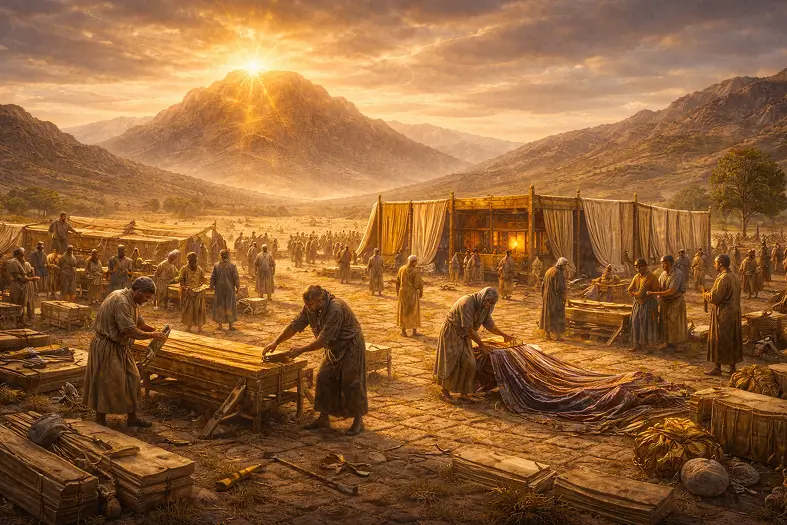
The Mishkan becomes the first national project of Israel.
Rabbi Jonathan Sacks explains that shared construction is one of the most powerful forces in the formation of a people. A group of individuals becomes a community when they work together toward a common goal.
Until this point, the Israelites were bound by shared suffering and shared miracles. They had experienced slavery together. They had witnessed redemption together. But those experiences, powerful as they were, did not yet create a functioning national identity.
A people is not defined only by what happens to it.
A people is defined by what it builds together.
The Mishkan becomes the first collective act of the nation. Every person is invited to contribute. The Torah emphasizes that the donations must come from the heart:
מֵאֵת כָּל־אִישׁ אֲשֶׁר יִדְּבֶנּוּ לִבּוֹ
“From every person whose heart inspires him” (25:2)
This is not a tax. It is not a forced labor project. It is a voluntary national undertaking.
Each person gives what he can. One brings gold. Another brings silver. Another brings copper, wood, cloth, or skill. The sanctuary rises not from a single hand, but from the contributions of the entire nation.
Rashi explains that the phrase “אשר ידבנו לבו” teaches that the Mishkan is built upon the willing heart. The sanctuary that will house the Shechinah is not only constructed from physical materials, but from generosity, devotion, and intention.
The physical structure reflects the inner state of the people. The Mishkan is not merely a building project. It is the embodiment of the nation’s collective desire to create a dwelling place for Hashem.
In this way, the sanctuary becomes a mirror of the people themselves. The quality of the structure reflects the quality of the heart that builds it.
The Rambam teaches that character is formed through repeated action. A person becomes generous not by thinking generous thoughts, but by performing acts of giving again and again.
The Mishkan becomes a national school of character. By donating their possessions and offering their skills, the people are trained in generosity, responsibility, and partnership.
This is especially significant for a nation that had just emerged from slavery. Slaves do not own their time, their labor, or their property. They are receivers of commands, not givers of gifts.
The Mishkan transforms this identity. The people are no longer merely freed slaves. They become donors, builders, artisans, and contributors to a sacred cause.
Giving reshapes their self-understanding. They move from being a people defined by what was done to them, to a people defined by what they choose to create.
The Torah’s wording reinforces this collective dimension. When the Aron is described, the verse states:
וְעָשׂוּ אֲרוֹן
“And they shall make an ark” (25:10)
Ramban notes that this command is written in the plural form, unlike many other instructions in the parsha. The Midrash explains that this was intentional, so that every Jew would have a share in the making of the Ark, which houses the Torah.
The message is profound. Torah does not belong to a single individual or class. It is the inheritance of the entire nation. By participating in the construction of the Ark, the people symbolically claim ownership of the Torah itself.
The Mishkan is therefore not only a physical project. It is a covenantal one. It binds the people together through shared labor and shared purpose.
There is a psychological transformation embedded in this process. People feel differently about what they help create. What is given to them, they may appreciate. What they build, they cherish.
A gift produces gratitude.
A project produces belonging.
The Israelites had received miracles, food, protection, and revelation. But now they are asked to invest themselves—materially, emotionally, and spiritually—into a sacred enterprise.
Through the Mishkan, they become stakeholders in the Divine presence among them. The sanctuary is not merely placed in their midst. It is raised by their own hands.
The Mishkan marks the moment when Israel becomes a covenant community in the fullest sense. A covenant is not only a set of beliefs or experiences. It is a shared commitment expressed through action.
The sanctuary embodies this commitment:
The people are no longer defined only by the memory of Egypt or the drama of Sinai. They are defined by the sacred structure they have built together.
This is the beginning of Jewish nationhood in its practical form.
Throughout Jewish history, this pattern repeats itself. The Jewish people become a nation not only through revelation, but through construction.
They build:
Each of these becomes a continuation of the original national project that began in the desert.
The Mishkan is the prototype for every sacred structure the Jewish people will ever build.
Communities are not created by slogans, speeches, or even shared experiences alone. They are built through shared responsibility.
When people contribute—time, resources, effort, and care—they develop a sense of ownership. A synagogue built by the hands and donations of its members feels different from one that simply appears. A school supported by the sacrifices of parents becomes a living institution, not just a building.
The same is true in personal life. Relationships grow deeper when both sides invest effort. Families become stronger when each member contributes. A life of Torah becomes real when a person builds it through daily choices and commitments.
The lesson of the Mishkan is that holiness is built collectively. It emerges when individuals take responsibility for something larger than themselves.
Instead of waiting for inspiration or dramatic moments, a person should ask: What am I building? What am I contributing to? What structure of holiness am I helping create?
A meaningful Jewish life is not only something we experience. It is something we construct—together.
📖 Sources


1.3 — The First National Project of Israel
The opening of Parshas Terumah introduces a new type of command—one unlike anything the Jewish people had experienced until this point. They are told:
דַּבֵּר אֶל־בְּנֵי יִשְׂרָאֵל וְיִקְחוּ־לִי תְּרוּמָה
“Speak to the children of Israel, and they shall take for Me an offering” (Shemos 25:2)
This instruction is striking not only because of its content, but because of its tone. It is not a command to fight, to flee, to witness, or to receive. It is a command to build.
Until this moment, the people of Israel had experienced redemption largely as observers. Hashem struck Egypt with plagues. Hashem split the sea. Hashem provided food and water. Hashem descended upon the mountain in fire and thunder. The nation was carried by miracles.
Now, for the first time, they are asked to participate in the creation of something sacred.
The Mishkan becomes the first national project of Israel.
Rabbi Jonathan Sacks explains that shared construction is one of the most powerful forces in the formation of a people. A group of individuals becomes a community when they work together toward a common goal.
Until this point, the Israelites were bound by shared suffering and shared miracles. They had experienced slavery together. They had witnessed redemption together. But those experiences, powerful as they were, did not yet create a functioning national identity.
A people is not defined only by what happens to it.
A people is defined by what it builds together.
The Mishkan becomes the first collective act of the nation. Every person is invited to contribute. The Torah emphasizes that the donations must come from the heart:
מֵאֵת כָּל־אִישׁ אֲשֶׁר יִדְּבֶנּוּ לִבּוֹ
“From every person whose heart inspires him” (25:2)
This is not a tax. It is not a forced labor project. It is a voluntary national undertaking.
Each person gives what he can. One brings gold. Another brings silver. Another brings copper, wood, cloth, or skill. The sanctuary rises not from a single hand, but from the contributions of the entire nation.
Rashi explains that the phrase “אשר ידבנו לבו” teaches that the Mishkan is built upon the willing heart. The sanctuary that will house the Shechinah is not only constructed from physical materials, but from generosity, devotion, and intention.
The physical structure reflects the inner state of the people. The Mishkan is not merely a building project. It is the embodiment of the nation’s collective desire to create a dwelling place for Hashem.
In this way, the sanctuary becomes a mirror of the people themselves. The quality of the structure reflects the quality of the heart that builds it.
The Rambam teaches that character is formed through repeated action. A person becomes generous not by thinking generous thoughts, but by performing acts of giving again and again.
The Mishkan becomes a national school of character. By donating their possessions and offering their skills, the people are trained in generosity, responsibility, and partnership.
This is especially significant for a nation that had just emerged from slavery. Slaves do not own their time, their labor, or their property. They are receivers of commands, not givers of gifts.
The Mishkan transforms this identity. The people are no longer merely freed slaves. They become donors, builders, artisans, and contributors to a sacred cause.
Giving reshapes their self-understanding. They move from being a people defined by what was done to them, to a people defined by what they choose to create.
The Torah’s wording reinforces this collective dimension. When the Aron is described, the verse states:
וְעָשׂוּ אֲרוֹן
“And they shall make an ark” (25:10)
Ramban notes that this command is written in the plural form, unlike many other instructions in the parsha. The Midrash explains that this was intentional, so that every Jew would have a share in the making of the Ark, which houses the Torah.
The message is profound. Torah does not belong to a single individual or class. It is the inheritance of the entire nation. By participating in the construction of the Ark, the people symbolically claim ownership of the Torah itself.
The Mishkan is therefore not only a physical project. It is a covenantal one. It binds the people together through shared labor and shared purpose.
There is a psychological transformation embedded in this process. People feel differently about what they help create. What is given to them, they may appreciate. What they build, they cherish.
A gift produces gratitude.
A project produces belonging.
The Israelites had received miracles, food, protection, and revelation. But now they are asked to invest themselves—materially, emotionally, and spiritually—into a sacred enterprise.
Through the Mishkan, they become stakeholders in the Divine presence among them. The sanctuary is not merely placed in their midst. It is raised by their own hands.
The Mishkan marks the moment when Israel becomes a covenant community in the fullest sense. A covenant is not only a set of beliefs or experiences. It is a shared commitment expressed through action.
The sanctuary embodies this commitment:
The people are no longer defined only by the memory of Egypt or the drama of Sinai. They are defined by the sacred structure they have built together.
This is the beginning of Jewish nationhood in its practical form.
Throughout Jewish history, this pattern repeats itself. The Jewish people become a nation not only through revelation, but through construction.
They build:
Each of these becomes a continuation of the original national project that began in the desert.
The Mishkan is the prototype for every sacred structure the Jewish people will ever build.
Communities are not created by slogans, speeches, or even shared experiences alone. They are built through shared responsibility.
When people contribute—time, resources, effort, and care—they develop a sense of ownership. A synagogue built by the hands and donations of its members feels different from one that simply appears. A school supported by the sacrifices of parents becomes a living institution, not just a building.
The same is true in personal life. Relationships grow deeper when both sides invest effort. Families become stronger when each member contributes. A life of Torah becomes real when a person builds it through daily choices and commitments.
The lesson of the Mishkan is that holiness is built collectively. It emerges when individuals take responsibility for something larger than themselves.
Instead of waiting for inspiration or dramatic moments, a person should ask: What am I building? What am I contributing to? What structure of holiness am I helping create?
A meaningful Jewish life is not only something we experience. It is something we construct—together.
📖 Sources


“The First National Project of Israel”
וְעָשׂוּ לִי מִקְדָּשׁ
This mitzvah commands the construction of the Mishkan, the first collective national project of Israel. Through shared donations and labor, the people create a dwelling place for the Shechinah, transforming themselves from passive recipients of miracles into active builders of a covenantal society.
וְשִׁנַּנְתָּם לְבָנֶיךָ
The Ark, built by the collective effort of the nation, houses the Luchos and represents the shared inheritance of Torah. This mitzvah reflects the same principle: Torah is sustained through communal effort, teaching, and transmission across generations.
וְאָהַבְתָּ לְרֵעֲךָ כָּמוֹךָ
The construction of the Mishkan requires cooperation, generosity, and mutual responsibility. The shared national project fosters unity and love among the people, as each person contributes to a structure that serves the entire community.


“The First National Project of Israel”
Parshas Terumah commands the people to bring voluntary offerings and construct the Mishkan. This becomes the first collective national project of Israel, uniting the people through shared responsibility, generosity, and craftsmanship. The sanctuary stands at the center of the camp, transforming a group of freed slaves into a covenantal nation defined by what they build together.

Dive into mitzvos, tefillah, and Torah study—each section curated to help you learn, reflect, and live with intention. New insights are added regularly, creating an evolving space for spiritual growth.

Explore the 613 mitzvos and uncover the meaning behind each one. Discover practical ways to integrate them into your daily life with insights, sources, and guided reflection.

Learn the structure, depth, and spiritual intent behind Jewish prayer. Dive into morning blessings, Shema, Amidah, and more—with tools to enrich your daily connection.

Each week’s parsha offers timeless wisdom and modern relevance. Explore summaries, key themes, and mitzvah connections to deepen your understanding of the Torah cycle.