www.Mitzvah-Minute.com
"Terumah — Part I — “וְיִקְחוּ־לִי תְּרוּמָה”: From Revelation to Responsibility"
1.4 — From Spectators to Builders
The Turning Point of Terumah
The opening command of Parshas Terumah seems simple:
וְיִקְחוּ־לִי תְּרוּמָה
“They shall take for Me an offering” (Shemos 25:2)
Yet this verse marks one of the most profound transitions in the entire Torah. Until this moment, the story of Israel was defined by what happened to them. In Egypt, they suffered slavery. During the redemption, they witnessed miracles. At the sea, they were saved. In the wilderness, they were fed and protected. At Sinai, they stood and heard the Divine voice.
They were the recipients of history, not its builders.
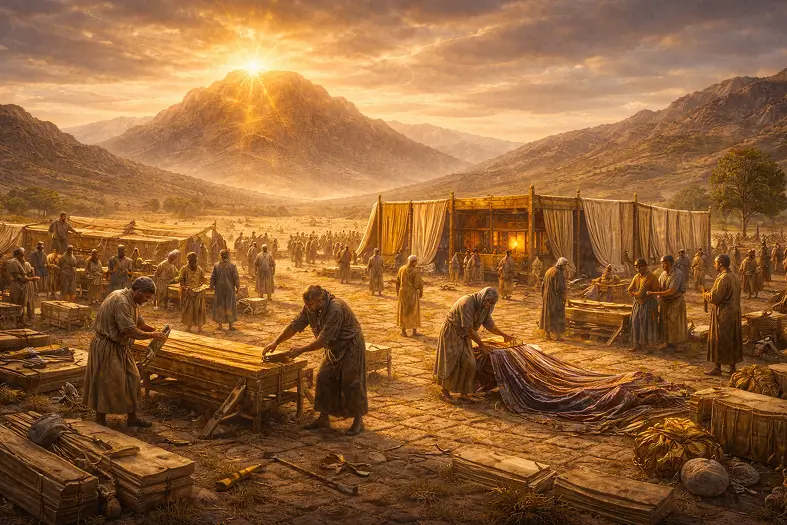
Parshas Terumah changes that relationship. The people are no longer asked merely to witness revelation. They are asked to construct a dwelling place for it.
The command is not: “I will descend to you.”
The command is: “You shall build for Me.”
This is the birth of responsibility.
The Limits of Spectacle
Miracles are powerful. They shake the heart, awaken the spirit, and create faith. But they are, by nature, temporary. A miracle happens, astonishes, and then passes. It leaves behind memory, but not necessarily structure.
The early stages of the Exodus were filled with spectacle:
- The ten plagues.
- The splitting of the sea.
- The descent of manna.
- The revelation at Sinai.
Each of these events created faith. But none of them, by themselves, created a stable society. A nation cannot live forever on dramatic moments. It requires systems, structures, and responsibilities.
Spectatorship may create belief.
But building creates continuity.
Ramban: Sinai Must Become a Dwelling
The Ramban explains that the Mishkan is the continuation of Sinai. The same Divine presence that rested upon the mountain now rests within the sanctuary. The revelation of the mountain is transformed into the residence of the Mishkan.
But this transformation requires human participation. Sinai was given from heaven. The Mishkan must be built from earth.
The people must gather materials, offer their possessions, and use their skills. The Divine presence will dwell among them only when they create a space for it.
This is the covenantal principle at the heart of the parsha: Hashem reveals Himself, but man must prepare the dwelling.
Rabbi Jonathan Sacks: The Dignity of Contribution
Rabbi Jonathan Sacks emphasizes that the Mishkan marks the moment when the Israelites move from being passive recipients of miracles to active participants in their destiny.
Until now, everything was done for them. Now they are asked to do something for Hashem.
They must:
- Give from their own possessions.
- Offer their talents and craftsmanship.
- Work together toward a shared sacred goal.
This shift creates dignity. A person values what he helps build. A community bonds through shared effort. A nation takes shape when its members contribute to a common purpose.
The Mishkan is therefore more than a sanctuary. It is the first act of collective national responsibility.
From Emotional Peaks to Moral Structures
Sinai was an emotional peak. It was a moment of overwhelming spiritual intensity. But such peaks cannot be sustained indefinitely. Human life is lived not on mountaintops, but in the routines of everyday existence.
The Mishkan translates the intensity of Sinai into structure. It creates a system:
- A defined sacred space.
- A daily rhythm of offerings.
- A structured priesthood.
- Appointed times of gathering.
Instead of a single moment of revelation, there is a continuous relationship. Instead of thunder and fire, there is routine, discipline, and order.
The Mishkan teaches that holiness must be organized, not only experienced.
The Birth of a Covenant Society
A covenant is not only a belief. It is a shared responsibility. It binds people together through obligation and purpose.
The Mishkan becomes the physical expression of the covenant. It stands at the center of the camp. It is built from the contributions of the people. It becomes the focus of national service.
Through this shared project, the people become a true covenantal society.
They are no longer defined only by what they witnessed.
They are defined by what they build.
The Pattern for All of Jewish History
The transformation that begins in Terumah repeats itself throughout Jewish history.
The Jewish people survive not only through faith, but through the structures they build:
- The Mishkan in the wilderness.
- The Beis HaMikdash in Jerusalem.
- Synagogues in exile.
- Schools and batei midrash in every land.
- Homes shaped by Torah and mitzvos.
Each of these is a continuation of the same principle. The Divine presence rests where human beings create space for it.
Jewish survival is not a miracle alone. It is the result of generations who built institutions of holiness.
Responsibility as the Core of Freedom
The people who build the Mishkan are the same people who were slaves in Egypt. Slavery is defined by passivity. A slave owns nothing, chooses nothing, and builds nothing for himself.
Freedom, by contrast, is defined by responsibility. A free person contributes, creates, and takes ownership of his world.
The Mishkan is therefore the first true expression of freedom. It is the moment when former slaves become builders of a sacred society.
They are no longer merely a redeemed people.
They are a responsible people.
Application for Today — Building the Structures That Sustain Faith
Every generation experiences moments of inspiration. A powerful speech, a moving Shabbos, a life event, or a moment of crisis can awaken deep spiritual awareness.
But those moments do not last by themselves.
If inspiration is not translated into structure, it fades. Emotion rises and falls. What remains are the systems we build.
A person may feel inspired to learn, but without a fixed time for Torah, the feeling disappears. A community may feel united after a powerful event, but without institutions—schools, shuls, and organizations—the unity dissolves.
The lesson of Terumah is that faith must be built into the architecture of life.
This means creating:
- Fixed times for Torah learning.
- Regular tefillah.
- A home centered around Shabbos.
- Structures of chesed and responsibility.
These are the personal Mishkanim of daily life. They transform inspiration into continuity.
The same is true on a communal level. Jewish life survives where there are institutions—schools, synagogues, and centers of learning. Without them, even the most powerful moments fade into memory.
The question of Terumah is not only, “What did you experience?”
It is, “What are you building?”
Holiness is not only something we feel.
It is something we construct.
📖 Sources
- Full sources available on the Mitzvah Minute Parshas Terumah page under insights and commentaries.