www.Mitzvah-Minute.com
"Terumah — Part III — “וְשָׁכַנְתִּי בְּתוֹכָם”: The Sanctuary Within the Human Soul"
3.1 — Not “Within It,” but “Within Them”
The Torah’s Most Revealing Word
Parshas Terumah contains a verse that changes the way we understand the Mishkan entirely:
וְעָשׂוּ לִי מִקְדָּשׁ
וְשָׁכַנְתִּי בְּתוֹכָם
“And they shall make for Me a sanctuary, and I shall dwell among them” (Shemos 25:8)
The Torah could have said: “I will dwell within it”—within the Mishkan. That would have sounded logical. After all, the whole parsha is describing a physical structure.
But the Torah chooses a different word: בְּתוֹכָם — within them.
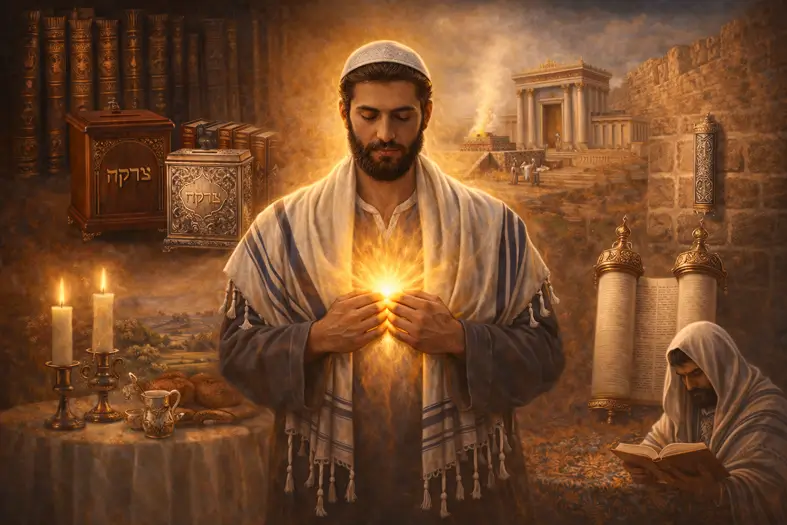
This single word reveals the inner purpose of the Mishkan. The sanctuary is not meant to be only a location in the desert. It is meant to become a reality inside the human being.
The Mishkan is built outside.
But the dwelling is meant to happen within.
Kedushas Levi: The Mishkan as a Mirror
The Kedushas Levi teaches that the physical Mishkan is a reflection of an inner spiritual reality. The external structure is not the destination—it is the instrument.
Hashem does not “need” a building. The Divine presence cannot be confined to wood, gold, and fabric. The purpose of the Mishkan is to train the people to become a sanctuary themselves.
The phrase “וְשָׁכַנְתִּי בְּתוֹכָם” therefore means: the Shechinah rests where a person makes room for it within his inner world—his thoughts, desires, choices, and character.
The Mishkan becomes a kind of spiritual mirror. When a person looks at it, he is meant to recognize something about himself: that he, too, is designed to be an מקום השראה—an abode for holiness.
Sfas Emes: “Within Them” Means Within Every One
The Sfas Emes sharpens the point. The Torah does not say, “I will dwell among the nation” in a vague collective sense. It speaks in a way that implies individuals. The Shechinah is meant to rest within each person.
In this reading, the Mishkan is not the sole dwelling place of Hashem; it is the model that awakens the deeper truth: that every Jew can become a Mishkan.
That means the Mishkan is both:
- A physical structure in the world, built according to Divine command, and
- A spiritual structure within the human being, built through avodah, refinement, and devotion.
The Mishkan teaches a person how to live so that holiness is not something he visits occasionally—but something he carries.
Why Build a Physical Mishkan at All?
If the real sanctuary is inside the person, why does the Torah command the building of an external sanctuary?
The answer lies in the nature of human beings. We are shaped by what we see, by what we touch, and by what we build. A physical Mishkan helps the inner Mishkan emerge.
The physical structure:
- Creates a center for the nation’s consciousness.
- Establishes a language of holiness in space, order, and beauty.
- Trains the heart to recognize that holiness is not accidental—it is constructed.
The outer Mishkan is the teacher.
The inner Mishkan is the goal.
The Inner Meaning of “Make for Me”
The verse begins:
וְעָשׂוּ לִי מִקְדָּשׁ
“And they shall make for Me a sanctuary…”
The phrasing implies more than construction. It is not just “make a sanctuary.” It is “make for Me”—create something oriented toward Hashem.
The Kedushas Levi explains that when a person’s inner life is oriented toward Hashem—his desires, motivations, and choices—then that person becomes the מקום of “ושכנתי בתוכם.”
The sanctuary begins as a building.
But it completes itself as a person.
From Space to Soul
The Mishkan is described with boundaries and layers. There is an outer courtyard, an inner chamber, and the Kodesh HaKodashim. The Torah teaches that holiness intensifies as one moves inward.
This is not only a map of space. It is a map of the human soul.
A person also has “outer layers” and “inner chambers”:
- External life: action, speech, daily responsibility.
- Inner life: thought, intention, desire.
- The deepest core: faith, awe, and the quiet place where a person stands before Hashem.
The Mishkan teaches that spiritual life is a journey inward. Holiness is built by moving from the superficial toward the essential, from the outer to the inner, from noise to sacred focus.
The Heart as Sanctuary
When the Torah says “within them,” it is not speaking poetically. It is giving a definition of what holiness is meant to become.
Holiness is not confined to the extraordinary. It is meant to enter the ordinary: how a person speaks, how he chooses, how he restrains himself, how he gives, how he thinks.
A person becomes a Mishkan when he builds an inner life that can hold the Shechinah.
This is why the parsha begins with תרומה—giving. Giving is not merely a financial act. It is a spiritual posture: making room for something beyond the self.
The one who gives learns how to become a vessel.
And vessels are made to contain holiness.
Application for Today — Building Personal Sanctity
The Torah’s message is that holiness is not only “out there,” located in sacred buildings or rare moments. Holiness is meant to be “within them”—within the daily inner world of each person.
Building personal sanctity begins by treating your inner life like a sanctuary that must be constructed intentionally. A Mishkan does not happen by accident; it is built with design, care, and boundaries.
That can look like:
- Setting a fixed time each day for Torah learning, even if brief, so that holiness has a stable place in your schedule.
- Creating moments of silence and intention in tefillah, so that prayer is not only words, but presence.
- Guarding speech, because the sanctuary cannot be built with careless words.
- Making space for giving—time, attention, kindness—so that the self is not the center of everything.
The physical Mishkan was built once.
But the inner Mishkan must be built continually.
The question Parshas Terumah places in front of us is not only: “Do you have a sanctuary?”
It is: “Are you becoming one?”
📖 Sources
- Full sources available on the Mitzvah Minute Parshas Terumah page under insights and commentaries