www.Mitzvah-Minute.com
"Terumah — Part III — “וְשָׁכַנְתִּי בְּתוֹכָם”: The Sanctuary Within the Human Soul"
3.2 — The Heart as the True Altar
The Center of the Courtyard
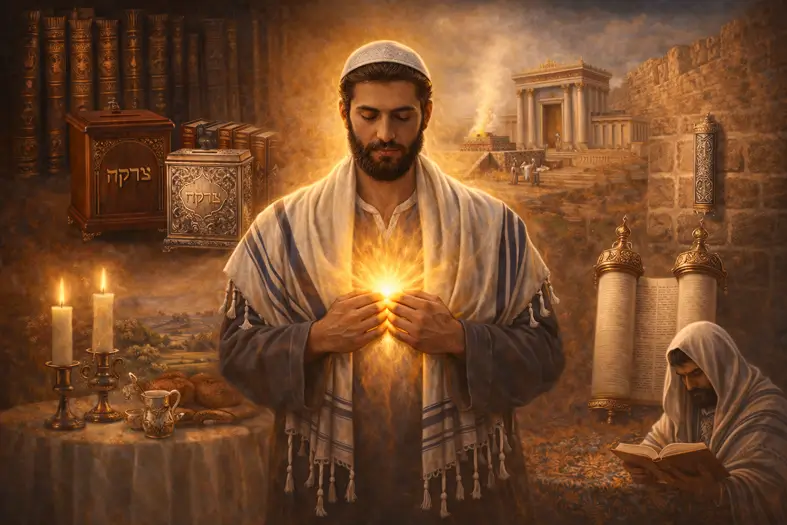
In the physical Mishkan, the most prominent feature of the outer courtyard is the Mizbeach—the altar. It stands at the center of the courtyard, visible to all, and it is the place where offerings are brought and transformed through fire.
Animals, grain, oil, and incense are placed upon the altar. What begins as something physical is elevated through the flames into something spiritual. The offering ascends, symbolizing the movement from earth toward heaven.
But the Chassidic masters teach that this process is not only about animals or offerings. It is about the human heart.
Kedushas Levi: The Inner Altar
The Kedushas Levi explains that the altar represents the inner emotional life of a person. Just as offerings are brought to the physical altar, so too a person must bring his own desires, impulses, and emotions before Hashem.
The true sacrifice is not the animal.
The true sacrifice is the ego, the anger, the selfishness, and the distractions that separate a person from holiness.
When the Torah describes offerings ascending in fire, the deeper meaning is the burning away of the lower impulses within the human heart. The altar represents the place where the raw material of the personality is refined and elevated.
The courtyard, therefore, is not only a physical space. It is the arena of the human emotional world. And at its center stands the inner altar—the place of transformation.
Sfas Emes: The Fire Within
The Sfas Emes teaches that every person carries an inner flame. This is the spark of the Divine soul, the part of a person that longs for connection with Hashem.
But that flame is often covered by layers of distraction, habit, and physical desire. The purpose of avodah is to reveal that inner fire.
In the Mishkan, the altar’s fire is constant. It is not lit only occasionally. It must burn continuously. The Torah commands:
אֵשׁ תָּמִיד תּוּקַד עַל הַמִּזְבֵּחַ
“A constant fire shall burn upon the altar” (Vayikra 6:6)
The Sfas Emes explains that this fire represents the inner yearning of the soul. It must be guarded, nourished, and kept alive. If it is neglected, it grows weak. If it is fed, it grows strong and illuminates the entire inner world.
The Nature of an Offering
The Hebrew word for offering is korban, from the root קרב, meaning “to come close.” The purpose of a korban is not destruction, but closeness.
This idea applies to the inner altar as well. When a person sacrifices his anger, his arrogance, or his selfish impulses, he is not losing something. He is coming closer to Hashem.
Each inner offering creates a moment of transformation:
- Anger becomes patience.
- Envy becomes gratitude.
- Selfishness becomes generosity.
- Distraction becomes focus.
The altar is therefore not a place of loss.
It is a place of elevation.
The Heart as the Center of Avodah
Just as the physical altar stands at the center of the courtyard, the emotional life stands at the center of the human experience.
A person may possess knowledge, skills, and resources, but it is the heart that determines direction. The heart chooses what to love, what to pursue, and what to resist.
If the heart is unrefined, even the most sacred structures remain external. But when the heart becomes an altar—when it is a place of transformation and offering—then holiness enters the entire person.
The Mishkan teaches that the true center of avodah is not a building. It is the inner world of feeling, desire, and intention.
Continuous Transformation
One of the most striking features of the altar is that its service never truly ends. Offerings are brought daily. The fire is kept burning constantly. The work is ongoing.
This reflects the nature of the human heart. Inner work is never finished. Each day brings new challenges, new impulses, and new opportunities for growth.
The altar teaches that transformation is not a one-time event. It is a daily process.
A person does not become refined in a single moment. He becomes refined through repeated acts of self-offering—small choices that gradually shape the heart.
From Outer Fire to Inner Flame
In the physical Mishkan, the fire consumes the offering and sends its smoke upward. In the inner Mishkan, the “fire” of devotion and awareness consumes the lower impulses and transforms them into spiritual growth.
The process is the same:
- Something physical is placed upon the altar.
- It passes through the fire.
- It emerges in a more elevated form.
In life, the raw material is our experience—our emotions, desires, and struggles. When these are brought into the service of Hashem, they become the fuel for spiritual ascent.
The altar teaches that nothing in life is wasted. Even struggle can become an offering.
Application for Today — Feeding the Inner Fire
Every person carries an inner altar, but not everyone tends its fire.
In modern life, it is easy for the inner flame to grow dim. Distraction, pressure, and routine can cover the soul’s natural yearning. The fire is still there, but it may be buried beneath layers of noise.
The lesson of the altar is to keep the inner fire alive.
This does not require dramatic sacrifices. It requires steady, consistent acts of inner offering:
- Choosing patience instead of anger.
- Giving time to another person when it is inconvenient.
- Speaking kindly when it would be easier to speak harshly.
- Setting aside time for Torah or tefillah even when busy.
Each of these is a small korban—a moment where something personal is placed upon the inner altar.
Over time, these acts create a steady flame. The heart becomes a place of warmth, clarity, and connection.
The Mishkan teaches that the true altar is not made of copper or stone.
It is made of the human heart.
📖 Sources
- Full sources available on the Mitzvah Minute Parshas Terumah page under insights and commentaries