"Va’eira — Part I — Redemption as Process, Not Escape"

Mitzvah Minute Logo Icon

1.3 - Lineage of Levi: Authority Before Action

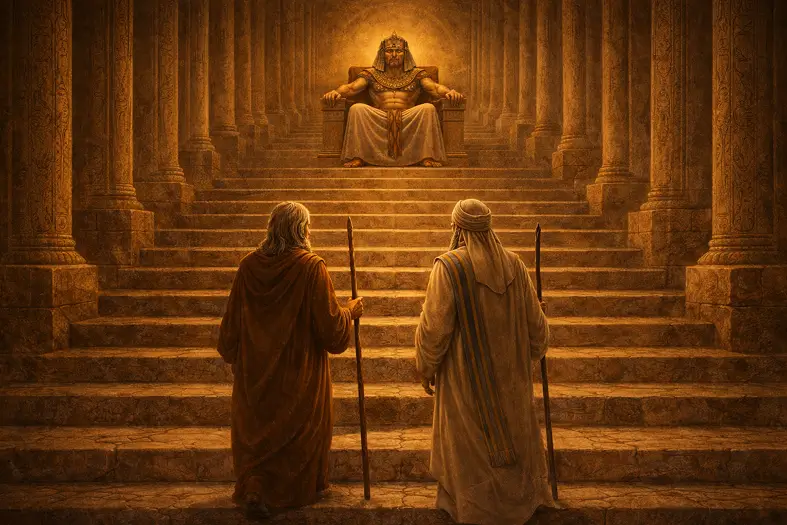
Moshe and Aaron, long staircase, Pharoah blocking path, Redemption is a process. Not an escape.
At the height of redemption’s drama, the Torah pauses for genealogy. Abarbanel reveals that this interruption is essential: redemption cannot proceed without legitimate authority. Before miracles escalate and Pharaoh is judged, the Torah establishes who is authorized to speak and act in Hashem’s Name. By tracing the lineage of Levi, Va’eira contrasts power rooted in force with authority rooted in covenant. This essay shows why Pharaoh resists Moshe, why imitation fails, and why true redemption must establish standing before action.

"Va’eira — Part I — Redemption as Process, Not Escape"

1.3 - Lineage of Levi: Authority Before Action

In the middle of Parshas Va’eira—at the very moment when the plagues are about to intensify—the Torah interrupts the drama with genealogy. Names. Fathers. Sons. Tribal lines. For a narrative racing toward redemption, this pause feels jarring. Abarbanel insists it is anything but incidental. It is essential.

וְאֵלֶּה רָאשֵׁי בֵית־אֲבֹתָם… וּבְנֵי לֵוִי גֵּרְשׁוֹן קְהָת וּמְרָרִי “These are the heads of their fathers’ houses… and the sons of Levi were Gershon, Kehat, and Merari.”

The Torah does not introduce power before legitimacy. It establishes authority before action.

Redemption Cannot Outrun Legitimacy

Moshe and Aharon confront Pharaoh not merely as miracle-workers or political liberators, but as representatives of a Divine order. Before the plagues can escalate, before Pharaoh can be judged, before Egypt can be dismantled, the Torah must answer a prior question:

Who is authorized to speak, to command, and to redeem?

The genealogy establishes four prerequisites for redemption:

  • Authority precedes effectiveness
  • Appointment outweighs charisma
  • Continuity outweighs spontaneity
  • Responsibility outweighs power

Genealogy is the Torah’s way of grounding authority in continuity rather than charisma. Redemption is not driven by talent, passion, or revolutionary energy. It proceeds through designated channels—lineage, responsibility, and transmission.

By tracing the lineage of Levi, and specifically of Kehat, Amram, Moshe, and Aharon, the Torah establishes that leadership emerges from covenantal structure, not circumstance.

Why Levi, and Why Here?

Abarbanel notes that this genealogy appears precisely when Moshe’s mission seems to falter. Pharaoh has rejected him. The people cannot yet hear him. The plagues have begun, but redemption is incomplete. At such a moment, the Torah reasserts legitimacy.

This teaches a critical principle: resistance does not invalidate authority.

Moshe’s rejection does not diminish his role. On the contrary, it necessitates clarification. The Torah responds not by amplifying spectacle, but by grounding leadership in origin. Redemption requires patience because legitimacy must withstand challenge before it can transform reality.

Authority Is Not Power

Egyptian authority rests on force, fear, and immediacy. Pharaoh rules because he dominates. Moshe leads because he is appointed.

This contrast is not incidental—it is the heart of the conflict.

Pharaoh cannot recognize Moshe because:

  • Authority that answers upward threatens absolute rule
  • Leadership rooted in covenant cannot be negotiated
  • Power that cannot be seized cannot be respected
  • A system without lineage cannot tolerate continuity

Egypt understands authority as control. The Torah defines authority as responsibility rooted in command.

The magicians can imitate signs. They cannot transmit law. Pharaoh can command labor. He cannot generate covenant. Authority in Torah is not the ability to compel action, but the mandate to represent Divine will faithfully across generations.

This is why the Torah lists names rather than deeds. Authority precedes effectiveness.

The Tribe Without Land

Levi’s role foreshadows its future destiny. A tribe defined not by territory, production, or power, but by service and instruction. Redemption will not culminate in Levi’s dominance, but in its restraint.

By anchoring Moshe and Aharon within Levi’s lineage, the Torah signals that leadership in Israel will never be absolute. Even the redeemers stand within a system greater than themselves.

This prevents redemption from becoming tyranny in new clothing.

Why Pharaoh Resists—and Why He Must Lose

Pharaoh resists Moshe not because he doubts miracles, but because he rejects the concept of legitimate authority that does not originate in power. Moshe represents an order in which authority answers upward—to Hashem—rather than downward to force.

The genealogy teaches that Pharaoh’s defeat is not merely political. It is conceptual. His worldview cannot accommodate a leader whose authority is inherited through covenant rather than seized through dominance.

That is why Egypt collapses gradually. False authority cannot survive prolonged exposure to true legitimacy.

Redemption Begins with Standing, Not Striking

Before Moshe raises his staff, he must stand as an authorized agent. Before miracles can compel belief, legitimacy must sustain resistance. The Torah therefore pauses to establish lineage—not to delay redemption, but to make it possible.

Abarbanel’s insight reframes the interruption: this is not a digression. It is the foundation.

Redemption that ignores authority becomes chaos.
Power without legitimacy becomes oppression.
Action without structure becomes collapse.

Va’eira teaches that before history moves forward, it must know who is allowed to speak in its name.

וְאַהֲרֹן וּמֹשֶׁה אֲשֶׁר אָמַר ה׳ לָהֶם…“These are the Aharon and Moshe to whom Hashem spoke…”

The Torah names them after establishing lineage, reminding us that legitimacy is the condition for command.

Only authority that precedes action can redeem without destroying.

📖 Sources

  • Full sources available on the Mitzvah Minute Parshas Va'eira page under insights and commentaries.

Organized by:
Boaz Solowitch
January 7, 2026
Mitzvah Minute Logo Icon

Connections

Mitzvah Minute Logo Icon

Mitzvah Links

Mitzvah 1

To know there is a G‑d
A Siddur
Learn this Mitzvah

Mitzvah 1

1
To know there is a G‑d

Mitzvah 9

To listen to the prophet speaking in His Name
A Siddur
Learn this Mitzvah

Mitzvah 9

9
To listen to the prophet speaking in His Name

Mitzvah 11

To emulate His ways
A Siddur
Learn this Mitzvah

Mitzvah 11

11
To emulate His ways

Mitzvah 12

To cleave to those who know Him
A Siddur
Learn this Mitzvah

Mitzvah 12

12
To cleave to those who know Him

Mitzvah 23

To honor those who teach and know Torah
A Siddur
Learn this Mitzvah

Mitzvah 23

23
To honor those who teach and know Torah
The Luchos - Ten Commandments
View Mitzvah Notes

Mitzvah Reference Notes

"x" close page navigation button

Mitzvah Reference Notes

“Lineage of Levi: Authority Before Action”

Mitzvah #1 — To Know There Is a G-d (Exodus 20:2)

אָנֹכִי ה׳ אֱלֹקֶיךָ

The genealogical interruption in Va’eira establishes that Divine authority is not abstract power but covenantal reality. By rooting Moshe and Aharon within Levi’s lineage, the Torah clarifies that knowing Hashem means recognizing His ordered governance of leadership, responsibility, and transmission. Redemption proceeds from clear recognition of Who authorizes action in history.

Mitzvah #9 — To Listen to the Prophet Speaking in His Name (Deuteronomy 18:15)

אֵלָיו תִּשְׁמָעוּן

Moshe’s legitimacy is affirmed through lineage before his words are accepted. Va’eira teaches that listening to the prophet requires acknowledging authorized standing even when the message meets resistance. Prophetic truth depends not on popular reception or immediate success, but on faithful transmission from Hashem through His appointed servant.

Mitzvah #11 — To Emulate His Ways (Deuteronomy 28:9)

וְהָלַכְתָּ בִּדְרָכָיו

Hashem models governance that privileges structure over spectacle and legitimacy over force. By pausing to establish lineage before action, the Torah teaches that Divine ways are deliberate, ordered, and restrained. Israel is called to emulate this pattern—acting with discipline and responsibility rather than impulsive displays of power.

Mitzvah #12 — To Cleave to Those Who Know Him (Deuteronomy 10:20)

וּבוֹ תִדְבָּק

The elevation of Levi as the tribe of service and instruction frames cleaving to Hashem as attachment to those entrusted with His word. Va’eira emphasizes that redemption matures through sustained connection to legitimate teachers and leaders, ensuring continuity of covenant beyond moments of crisis.

Mitzvah #23 — To Honor Those Who Teach and Know Torah (Leviticus 19:32)

וְהָדַרְתָּ פְּנֵי זָקֵן

By foregrounding lineage, the Torah affirms that Torah authority deserves honor independent of immediate effectiveness. Va’eira teaches that honoring those who teach and transmit Torah safeguards redemption from devolving into charisma-driven rule, preserving reverence for wisdom, continuity, and responsibility.

Parsha Links

וָאֵרָא – Va’eira

Haftarah: Ezekiel 28:25 - 29:21
A Siddur
Learn this Parsha

וָאֵרָא – Va’eira

וָאֵרָא – Va’eira
The Luchos - Ten Commandments
View Parsha Notes
"x" close page navigation button

Parsha Reference Notes

“Lineage of Levi: Authority Before Action”

Parshas Va’eira (Shemos 6:13–27)

At the critical moment when redemption appears stalled and Pharaoh’s resistance intensifies, Parshas Va’eira interrupts the narrative with a detailed genealogy of Levi. Far from a historical digression, this interruption establishes legitimacy before escalation. By tracing the lineage from Levi through Kehat and Amram to Moshe and Aharon, the Torah clarifies who is authorized to confront Pharaoh and act in Hashem’s Name. Redemption cannot proceed through spectacle or force alone; it must be grounded in covenantal authority.

This genealogical passage reframes leadership as responsibility rather than power. Egypt’s authority is rooted in domination and immediacy, while Moshe’s authority emerges from appointment, continuity, and obligation to Divine command. The Torah emphasizes that rejection and resistance do not invalidate legitimate leadership; they necessitate its clarification. By anchoring redemption in lineage before action, Va’eira teaches that lasting transformation requires authority that precedes effectiveness, ensuring that redemption dismantles false power without reproducing it in new form.

Mitzvah Minute
Mitzvah Minute Logo

Learn more.

Dive into mitzvos, tefillah, and Torah study—each section curated to help you learn, reflect, and live with intention. New insights are added regularly, creating an evolving space for spiritual growth.

Luchos
Live a commandment-driven life

Mitzvah

Explore the 613 mitzvos and uncover the meaning behind each one. Discover practical ways to integrate them into your daily life with insights, sources, and guided reflection.

Learn more

Mitzvah #

5

To fear Him
The Luchos - Ten Commandments
Learn this Mitzvah

Mitzvah Highlight

Siddur
Connection through Davening

Tefillah

Learn the structure, depth, and spiritual intent behind Jewish prayer. Dive into morning blessings, Shema, Amidah, and more—with tools to enrich your daily connection.

Learn more

Tefillah

COMING SOON.
A Siddur
Learn this Tefillah

Tefillah Focus

A Sefer Torah
Study the weekly Torah portion

Parsha

Each week’s parsha offers timeless wisdom and modern relevance. Explore summaries, key themes, and mitzvah connections to deepen your understanding of the Torah cycle.

Learn more

וָאֵרָא – Va’eira

Haftarah: Ezekiel 28:25 - 29:21
A Sefer Torah
Learn this Parsha

Weekly Parsha