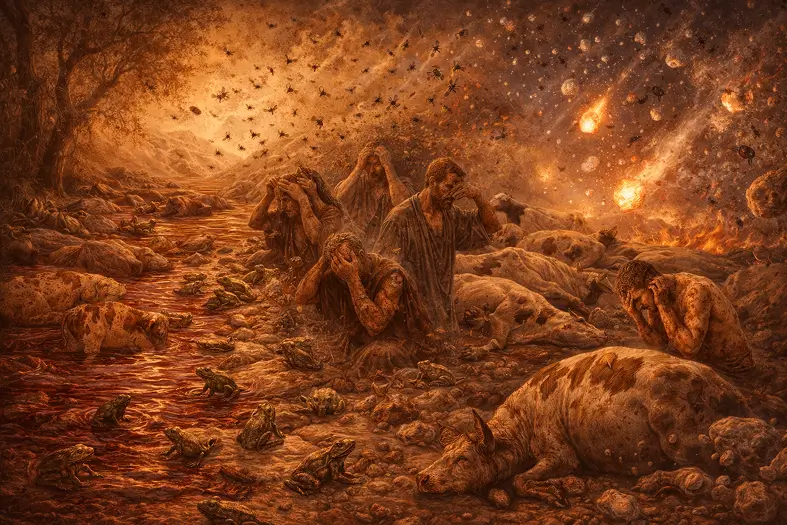
"Va’eira — Part II — The Plagues as Divine Instruction"

Mitzvah Minute Logo Icon

2.1 - Distinction, Not Chaos: Goshen and Egypt

The 7 plagues in Va'eira
The plagues do not reveal Divine power through chaos, but through precision. By sparing Goshen while Egypt collapses, the Torah teaches that sovereignty is expressed through distinction, restraint, and moral clarity—not indiscriminate force. This essay shows how the separation between Goshen and Egypt dismantles Egypt’s worldview, redefines justice, and teaches both nations that authority is proven through discernment. Va’eira reveals that redemption restores order to the world, reaffirming that Hashem rules not by overwhelming creation, but by structuring it.

"Va’eira — Part II — The Plagues as Divine Instruction"

2.1 - Distinction, Not Chaos: Goshen and Egypt

One of the most striking features of the plagues is not their force, but their precision. Egypt descends into disorder, yet Goshen remains untouched. Nature unravels—but only where it is meant to. Life becomes unbearable in Egypt while normalcy persists among Israel. This is not mercy alone. It is instruction.

The Torah is teaching that Divine power does not resemble chaos.

The Torah Emphasizes Separation

The distinction between Egypt and Israel is stated explicitly:

וְהִפְלֵיתִי בַיּוֹם הַהוּא אֶת־אֶרֶץ גֹּשֶׁן… לְמַעַן תֵּדַע כִּי אֲנִי ה׳ בְּקֶרֶב הָאָרֶץ
“On that day I will set apart the land of Goshen… so that you shall know that I am Hashem in the midst of the land.”

This separation is not geographic coincidence. It is theological declaration. Hashem’s sovereignty is revealed not by indiscriminate destruction, but by discernment.

Chaos Destroys Randomly. Sovereignty Differentiates.

Egypt’s worldview assumed that power overwhelms. When forces erupt, they do so without boundary. The plagues invert this assumption. They strike with limits, borders, and intention.

Through the distinction between Goshen and Egypt, the plagues teach that:

  • Divine judgment is targeted, not arbitrary
  • Power follows moral lines, not physical proximity
  • Sovereignty is expressed through control, not excess
  • Justice requires discernment

If destruction were random, it would prove only strength. Because it is selective, it proves authority.

Goshen Is Not a Shelter — It Is a Lesson

Goshen’s protection is not primarily for Israel’s comfort. It is for Egypt’s education. The visible contrast forces Egypt to confront a destabilizing reality: suffering is not natural, and relief is not accidental.

Egypt must reckon with a world in which:

  • Nature obeys command
  • Geography does not limit authority
  • Moral alignment affects lived reality

This is why the Torah repeatedly emphasizes וְהִפְלֵיתִי—“I will distinguish.” The distinction is the message.

The Plagues Redefine Justice

In human systems, punishment often spills beyond its target. Innocents suffer. Collateral damage is accepted as inevitable. The plagues reject this model.

The Divine model revealed in Va’eira insists:

  • Judgment is measured
  • Boundaries are real
  • Innocence is not ignored
  • Authority includes restraint

By sparing Goshen, Hashem teaches that justice is not merely the application of force, but the exercise of discernment.

Israel Is Also Being Taught

Israel must learn that redemption is not an explosion that consumes everything in its path. Freedom emerges from a world governed by order. A people destined to receive Torah must first witness a reality in which distinction is foundational.

Without this lesson, freedom would be confused with lawlessness, and power with entitlement. Goshen teaches Israel that Divine closeness is not arbitrary favor—it is covenantal alignment.

Pharaoh’s Crisis Is Conceptual

Pharaoh is shaken not simply because Egypt suffers, but because his worldview collapses. A ruler who believes power is absolute cannot tolerate a system in which power is bounded.

The distinction between Goshen and Egypt exposes the fatal weakness of tyranny: it cannot explain restraint.

Distinction Is the Heart of Creation

The plagues echo the language of creation itself, where Hashem separates light from darkness, water from land, sacred from profane. Redemption is not a break from creation—it is its restoration.

Chaos unravels distinctions.
Sovereignty restores them.

Va’eira therefore teaches that redemption does not arrive through indiscriminate force, but through clarified boundaries. Goshen is spared not as an exception, but as a demonstration.

Hashem rules not by overwhelming the world—but by ordering it.

📖 Sources

  • Full sources available on the Mitzvah Minute Parshas Va'eira page under insights and commentaries.

Organized by:
Boaz Solowitch
January 7, 2026
Mitzvah Minute Logo Icon

Connections

Mitzvah Minute Logo Icon

Mitzvah Links

Mitzvah 1

To know there is a G‑d
A Siddur
Learn this Mitzvah

Mitzvah 1

1
To know there is a G‑d

Mitzvah 5

To fear Him
A Siddur
Learn this Mitzvah

Mitzvah 5

5
To fear Him

Mitzvah 11

To emulate His ways
A Siddur
Learn this Mitzvah

Mitzvah 11

11
To emulate His ways

Mitzvah 24

Not to inquire into idolatry
A Siddur
Learn this Mitzvah

Mitzvah 24

24
Not to inquire into idolatry

Mitzvah 121

To afflict and cry out before G‑d in times of catastrophe
A Siddur
Learn this Mitzvah

Mitzvah 121

121
To afflict and cry out before G‑d in times of catastrophe
The Luchos - Ten Commandments
View Mitzvah Notes

Mitzvah Reference Notes

"x" close page navigation button

Mitzvah Reference Notes

“Distinction, Not Chaos: Goshen and Egypt”

Mitzvah #1 — To Know There Is a G-d (Exodus 20:2)

אָנֹכִי ה׳ אֱלֹקֶיךָ

The distinction between Goshen and Egypt teaches that knowledge of Hashem means recognizing His precise governance of reality. The plagues demonstrate that nature and judgment are not autonomous forces but instruments of Divine sovereignty, applied with discernment. Knowing Hashem thus entails understanding that power operates within moral boundaries established by Him.

Mitzvah #5 — To Fear Him (Deuteronomy 10:20)

אֶת־ה׳ אֱלֹקֶיךָ תִּירָא

Fear of Hashem emerges not from chaos but from order. By sparing Goshen while Egypt suffers, the plagues cultivate reverent awe grounded in discernment and justice. Yirah is formed when power is revealed as controlled, purposeful, and accountable—not arbitrary or destructive.

Mitzvah #11 — To Emulate His Ways (Deuteronomy 28:9)

וְהָלַכְתָּ בִּדְרָכָיו

Hashem’s conduct during the plagues models restraint and moral clarity. The deliberate separation between Egypt and Israel teaches that true authority acts with discrimination rather than excess. Israel is commanded to emulate these Divine ways, exercising power with boundaries, justice, and intentionality.

Mitzvah #24 — Not to Inquire into Idolatry (Leviticus 19:4)

אַל־תִּפְנוּ אֶל־הָאֱלִילִים

Egypt’s worldview treats natural forces as independent powers worthy of reverence. The plagues—and especially the sparing of Goshen—expose the falsehood of this belief. This mitzvah aligns with Va’eira’s lesson that seeking meaning or authority in autonomous forces leads to confusion; only Divine sovereignty orders reality truthfully.

Mitzvah #121 — To Afflict and Cry Out Before G-d in Times of Catastrophe (Numbers 10:9)

וַהֲרֵעֹתֶם בַּחֲצֹצְרוֹת

The selective nature of the plagues teaches that catastrophe is communicative, not random. Egypt’s suffering demands recognition and response, while Goshen’s protection highlights the moral dimension of crisis. This mitzvah channels calamity toward reflection and return, reinforcing that Divine judgment invites discernment and repentance rather than despair.

Parsha Links

וָאֵרָא – Va’eira

Haftarah: Ezekiel 28:25 - 29:21
A Siddur
Learn this Parsha

וָאֵרָא – Va’eira

וָאֵרָא – Va’eira
The Luchos - Ten Commandments
View Parsha Notes
"x" close page navigation button

Parsha Reference Notes

“Distinction, Not Chaos: Goshen and Egypt”

Parshas Va’eira (Shemos 8:18–19; 9:4; 9:26)

Parshas Va’eira repeatedly emphasizes the separation between Egypt and Israel during the plagues, framing redemption as an act of discernment rather than indiscriminate destruction. Hashem declares וְהִפְלֵיתִי—“I will set apart”—establishing that Goshen is spared not by coincidence but by deliberate Divine choice. This distinction teaches that judgment follows moral boundaries, not geographic proximity, and that sovereignty is expressed through control and restraint.

The Torah underscores this theme across multiple plagues: wild animals, pestilence, and hail devastate Egypt while Goshen remains untouched. By preserving Israel amid national collapse, Va’eira reframes power as ordered authority rather than chaotic force. The contrast destabilizes Egypt’s worldview, which assumes that nature and power operate without boundary, and prepares Israel to understand redemption as restoration of creation’s original separations—light and darkness, sacred and profane, justice and oppression.

Mitzvah Minute
Mitzvah Minute Logo

Learn more.

Dive into mitzvos, tefillah, and Torah study—each section curated to help you learn, reflect, and live with intention. New insights are added regularly, creating an evolving space for spiritual growth.

Luchos
Live a commandment-driven life

Mitzvah

Explore the 613 mitzvos and uncover the meaning behind each one. Discover practical ways to integrate them into your daily life with insights, sources, and guided reflection.

Learn more

Mitzvah #

5

To fear Him
The Luchos - Ten Commandments
Learn this Mitzvah

Mitzvah Highlight

Siddur
Connection through Davening

Tefillah

Learn the structure, depth, and spiritual intent behind Jewish prayer. Dive into morning blessings, Shema, Amidah, and more—with tools to enrich your daily connection.

Learn more

Tefillah

COMING SOON.
A Siddur
Learn this Tefillah

Tefillah Focus

A Sefer Torah
Study the weekly Torah portion

Parsha

Each week’s parsha offers timeless wisdom and modern relevance. Explore summaries, key themes, and mitzvah connections to deepen your understanding of the Torah cycle.

Learn more

וָאֵרָא – Va’eira

Haftarah: Ezekiel 28:25 - 29:21
A Sefer Torah
Learn this Parsha

Weekly Parsha