www.Mitzvah-Minute.com
"Vayakhel — Part III — “נְדִיב לִבּוֹ”: The Spiritual Power of Generous Hearts"
3.4 — The Mirrors: Beauty Transformed into Holiness
Abarbanel — The Surprising Material of the Laver
After the Torah describes the construction of the Mishkan and its vessels, it records a brief but remarkable detail about the laver used by the Kohanim:
“וַיַּעַשׂ אֶת הַכִּיּוֹר נְחֹשֶׁת… בְּמַרְאֹת הַצֹּבְאֹת.”
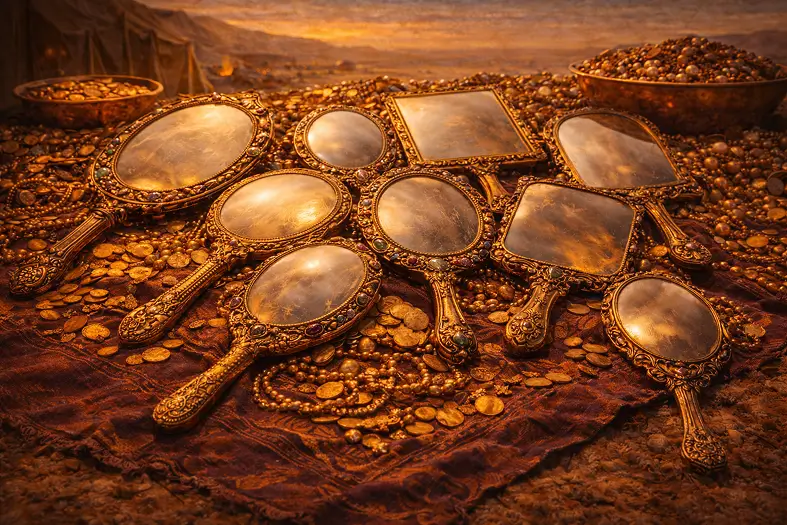
“He made the laver of copper… from the mirrors of the women who assembled.”
At first glance, the verse appears to offer a technical description of the materials used to construct the כיור, the basin from which the Kohanim would wash their hands and feet before performing the sacred service. Yet Abarbanel notes that the Torah rarely specifies the origin of materials in such personal terms. When it does so, the narrative is signaling that the material itself carries symbolic significance.
The mirrors contributed by the women were objects associated with personal beauty and physical appearance. Unlike gold or silver, which easily evoke images of sacred vessels and ritual splendor, mirrors seem connected to the ordinary rhythms of human life.
By identifying the mirrors as the material of the laver, the Torah reveals that even objects associated with physical life can be transformed into instruments of holiness.
The sanctuary therefore incorporates not only precious metals and fine craftsmanship but also elements drawn from the intimate experiences of everyday human existence.
Rashi — Precious in the Eyes of Hashem
Rashi preserves a striking tradition about the mirrors of the women. When these mirrors were first brought as contributions, Moshe hesitated to accept them. Because mirrors were used to enhance physical appearance, he wondered whether they were appropriate materials for the Mishkan.
Hashem responded differently.
According to the Midrash cited by Rashi, Hashem declared that these mirrors were among the most beloved of all the donations. The women of Israel had used them during the difficult years of Egyptian slavery to sustain hope and family life. Through these mirrors, they encouraged their husbands and preserved the continuity of the Jewish people despite oppression.
The mirrors therefore symbolized something far deeper than vanity. They represented resilience, dignity, and the determination to nurture life even in the darkest circumstances.
By accepting these mirrors as the material of the laver, the Torah affirms that the instruments that once helped sustain Jewish life in Egypt now become instruments of purification in the service of the Mishkan.
Ramban — The Elevation of the Physical World
Ramban often emphasizes that the Mishkan reveals how the physical world can become a vehicle for Divine service. The sanctuary is constructed from materials drawn entirely from ordinary life—wood, metal, fabric, and oil—yet these materials are transformed into sacred vessels through their dedication to the service of Hashem.
The mirrors illustrate this principle in a particularly powerful way.
They are objects associated with the physical self, with the human desire to appear beautiful and dignified. Rather than rejecting this dimension of human experience, the Torah elevates it.
When the mirrors are melted and fashioned into the laver, they become part of the process through which the Kohanim prepare themselves for sacred service. The basin filled with water reflects the faces of the priests as they purify their hands and feet, reminding them that holiness involves both the body and the soul.
The transformation of the mirrors therefore demonstrates that the Torah does not seek to deny human physicality but to refine and sanctify it.
Rabbi Jonathan Sacks — Dignity and the Continuity of Life
Rabbi Jonathan Sacks often observed that Judaism does not regard the physical dimension of human life as something to be escaped. Instead, the Torah sees the physical world as the arena in which holiness can be realized.
The story of the mirrors captures this idea beautifully.
The women who brought these mirrors understood that dignity and hope were essential to the survival of the Jewish people during their years in Egypt. By preserving family life and nurturing relationships, they ensured that the covenant would continue into the next generation.
When these mirrors later become part of the Mishkan, the Torah symbolically connects the continuity of Jewish life with the presence of holiness in the sanctuary.
The basin used by the Kohanim to prepare for service is therefore built from the instruments that once helped sustain the people through hardship.
Rav Avigdor Miller — Holiness Within Human Life
Rav Avigdor Miller often emphasized that the Torah does not demand that human beings withdraw from the normal experiences of life. Instead, it teaches how those experiences can become pathways to holiness.
The mirrors illustrate this principle vividly.
An object used in daily life becomes part of the sacred service of the Mishkan. The same mirror that once reflected the face of a woman caring for her family now contributes to the vessel through which the Kohanim prepare themselves to serve Hashem.
This transformation reflects the Torah’s broader vision. Holiness does not emerge by rejecting the physical world but by elevating it.
When human desires are guided by the values of the covenant, even ordinary objects can become instruments of sacred purpose.
Beauty Redirected Toward Holiness
The story of the mirrors reveals a profound truth about the spiritual life. The Torah does not attempt to suppress the natural dimensions of human existence—beauty, dignity, family life, and physical presence. Instead, it seeks to redirect them.
The mirrors that once reflected the daily lives of the women of Israel become the material from which the laver is fashioned. Water fills the basin, and the Kohanim use it to purify themselves before entering the sacred service.
In this transformation, the Torah demonstrates that holiness does not lie beyond human experience but within it.
Objects associated with the ordinary rhythms of life can become vessels of sanctification when they are dedicated to the service of Hashem.
Application for Today
Modern culture often presents a false choice between spiritual life and the realities of ordinary human experience. Physical life—work, relationships, appearance, and personal dignity—can sometimes appear disconnected from religious aspiration.
The Torah offers a different vision.
The mirrors of the Mishkan teach that the elements of everyday life can themselves become pathways to holiness. When human desires are guided by values of dignity, responsibility, and covenant commitment, they become part of the spiritual fabric of life.
Marriage, family relationships, and the cultivation of personal dignity are not distractions from holiness. They are among the most powerful ways in which holiness enters the world.
The mirrors that once sustained hope in Egypt ultimately helped shape the vessel of purification in the Mishkan. In the same way, the ordinary experiences of life can become the very materials from which a sacred life is built.
📖 Sources
- Full sources available on the Mitzvah Minute Parshas Vayakhel page under insights and commentaries