
Each Parsha page on Mitzvah Minute is designed as a guided, three-level journey through the weekly Torah reading—integrating the narrative, the mitzvos, and the classical commentaries into one unified experience.
Begin with the foundations of the Parsha:
This level gives you the storyline, the key mitzvos, and the essential connections between them.
A complete journey through the parsha—moving from clarity and depth to inner connection and real-world meaning, culminating in a way to live its ideas in everyday life.
These sections show how the Parsha speaks to the mind, the heart, and the real world — offering wisdom rooted in enduring Torah.
A complete, structured commentary on the parsha—presented pasuk by pasuk, with chapter and overall summaries for clarity and flow.
This level reveals the structural depth of the Parsha and the classical underpinnings of each theme.
Together, these layers create a complete Parsha journey —
narrative, mitzvah, and commentary — all flowing toward deeper understanding, spiritual insight, and meaningful growth.
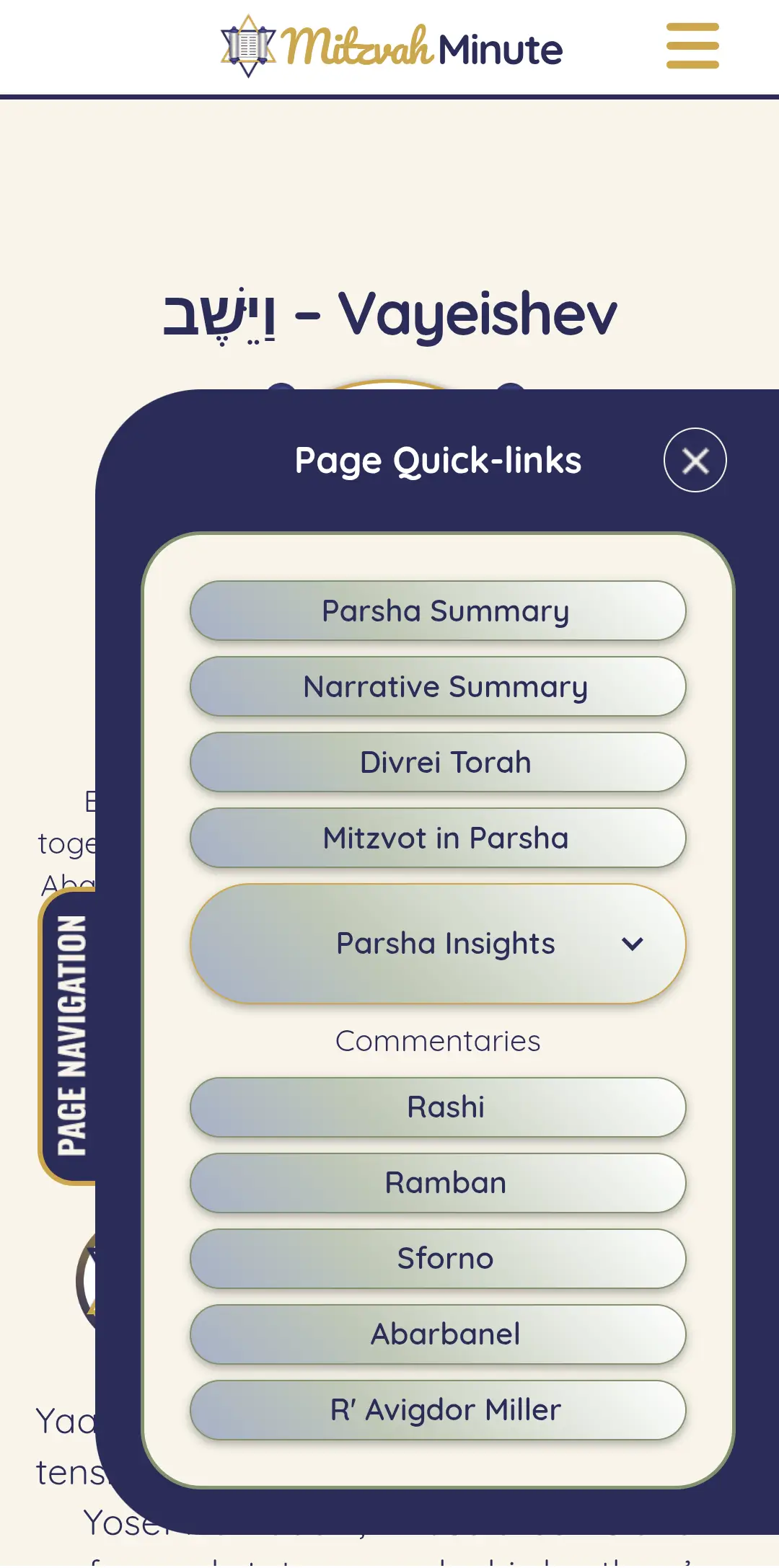
Tap the Page Navigation tab on the right side of your screen anytime to access quick-links to the entire Parsha page.
The quick-link panel gives instant access to every section — Parsha Summary, Mitzvos, Divrei Torah, Insights, and Commentaries.
“Every word of Torah and every mitzvah lifts us higher — may your learning bring you closer to Hashem.”

Parshas Emor presents a vision of structured קדושה — holiness that flows from the Mikdash into every layer of life. It begins with the מיוחדות — distinct responsibilities of the כהנים — kohanim, whose lives are shaped by higher standards in purity, marriage, and service, and rises further with the Kohen Gadol, whose role demands complete devotion. It then defines how קדשים — sacred offerings and foods must be treated, emphasizing wholeness, dignity, and careful boundaries. At the heart of the parsha, the מועדי ה׳ — appointed festivals establish a sacred calendar, guiding the nation through cycles of redemption, growth, awe, and joy. The parsha concludes by grounding holiness in daily constancy — through the menorah and lechem hapanim — and in moral responsibility, with laws of justice and the safeguarding of Hashem’s Name. Together, Emor teaches that holiness is not a moment, but a system — expressed in people, time, service, and society.

Parshas Emor
וְנִקְדַּשְׁתִּי בְּתוֹךְ בְּנֵי יִשְׂרָאֵל
Kiddush Hashem defines the purpose of a Jewish life. In Emor, this mitzvah is not limited to rare acts of martyrdom, but expands into the daily responsibility of making Hashem visible through conduct. A Jew’s honesty, restraint, dignity, and moral clarity all become expressions of sanctification. The parsha teaches that Yetziyas Mitzrayim was given on this condition—that Bnei Yisrael would become a people whose public life reflects Divine presence.
וְלֹא תְחַלְּלוּ אֶת שֵׁם קׇדְשִׁי
Chillul Hashem occurs when a person’s actions diminish the perception of Hashem in the world. Emor frames this not only as rebellion, but as carelessness in how one lives. When behavior contradicts Torah values—especially in visible settings—the result is a distortion of holiness itself. This mitzvah reveals that spiritual responsibility extends beyond belief into reputation, influence, and public presence.
אֱלֹקִים לֹא תְקַלֵּל
The blasphemer at the end of Emor shows that speech can tear down what holiness builds. Words are not neutral—they shape perception, reverence, and inner reality. This mitzvah forbids using speech to degrade Hashem, but its deeper message is that the mouth must become a כלי — vessel for truth, respect, and awareness. When speech collapses, kedushah collapses with it.
שַׁבַּת שַׁבָּתוֹן הוּא לָכֶם
Yom Kippur removes a person from physical productivity and places him entirely before Hashem. This rest is not leisure—it is a reorientation of identity. By stepping away from action, a person confronts who he is without distraction. Emor presents Yom Kippur as a day where life is defined not by doing, but by standing before Hashem in אמת — truth.
וְעִנִּיתֶם אֶת נַפְשֹׁתֵיכֶם
The affliction of Yom Kippur is not self-denial for its own sake. It is the removal of physical dominance so the soul can emerge. Emor teaches that when bodily needs are quieted, clarity becomes possible. The person is no longer pulled outward, and can return inward toward teshuvah — realignment with Hashem.
מִקְרָא קֹדֶשׁ יִהְיֶה לָכֶם
Shavuos represents completion—the end of the Omer journey. The rest of this day reflects arrival at purpose: Torah. Emor presents this as a culmination, where growth pauses not from exhaustion, but from fulfillment. Rest here means integration—what has been built internally now becomes part of who the person is.
זִכְרוֹן תְּרוּעָה מִקְרָא קֹדֶשׁ
Rosh Hashanah interrupts routine and demands awareness. The day calls a person to recognize that life is being evaluated. Emor frames this as sacred time that awakens—not frightens—the individual. Rest here creates space for recognition: life is not random, and choices carry meaning.
בַּיּוֹם הָרִאשׁוֹן מִקְרָא קֹדֶשׁ
Sukkos channels joy into avodas Hashem. It is not uncontrolled celebration, but joy placed within halachah. Emor teaches that simchah becomes holy when it is directed—when gratitude replaces ownership and awareness replaces indulgence.
עֲצֶרֶת הִוא לָכֶם
Shemini Atzeres represents closeness without structure. After the full system of festivals, this day stands alone. Emor presents it as a pause of intimacy between Hashem and Yisrael—where relationship continues beyond obligation.
בַּסֻּכּוֹת תֵּשְׁבוּ שִׁבְעַת יָמִים
The sukkah removes physical security and replaces it with trust. A person leaves permanence and enters vulnerability. Emor teaches that stability is not found in walls, but in dependence on Hashem. The sukkah becomes a lived expression of emunah — trust.
וּלְקַחְתֶּם לָכֶם בַּיּוֹם הָרִאשׁוֹן
The ארבעת המינים — four species, represent the fullness of blessing. Holding them gathers diversity into unity. Emor teaches that gratitude is not abstract—it is expressed physically. The act transforms appreciation into פעולה — action.
וְלֶחֶם וְקָלִי וְכַרְמֶל לֹא תֹאכְלוּ
This mitzvah introduces restraint into success. Even when produce is ready, a person must wait. Emor teaches that growth is not owned—it is received. By delaying consumption, a person acknowledges that blessing comes from Hashem, not from effort alone.
וּסְפַרְתֶּם לָכֶם
Sefiras HaOmer turns time into movement. Each day becomes part of a process rather than an isolated moment. Emor teaches that growth is gradual and deliberate. Counting creates awareness that transformation does not happen instantly—it is built step by step.
וְכׇל זָר לֹא יֹאכַל קֹדֶשׁ
Holiness is not universal access—it requires status and preparation. Terumah belongs to the Kohen, and crossing that boundary distorts kedushah. Emor teaches that closeness to holiness must be earned or assigned, not assumed.
וְקִדַּשְׁתּוֹ
The Kohen is elevated by the community, not himself. This mitzvah teaches that those who represent holiness must be treated accordingly. Emor shows that leadership in Torah is not personal honor—it is recognition of responsibility.
תָּמִים יִהְיֶה לְרָצוֹן
A korban must be complete. This reflects a deeper idea: what is brought before Hashem should reflect dignity and care. Emor teaches that spiritual service requires intentionality. What is broken or careless cannot represent reverence.
וְלָקַחְתָּ סֹלֶת וְאָפִיתָ אֹתָהּ
The Lechem HaPanim represents constant presence. Every week, the bread is renewed. Emor teaches that holiness is not created once—it must be maintained. Continuity becomes its own form of kedushah, where consistency sustains connection.
פְּאַת שָׂדְךָ לֹא תְכַלֶּה
Even in celebration and abundance, a portion must remain for others. Emor places this mitzvah among the festivals to teach that joy without responsibility is incomplete. Holiness is not only how one rises—it is how one leaves space for those who need.

Rashi reads Parshas Emor as a parsha about kedushah — holiness — that must be carefully defined before it can be lived. The parsha begins with the Kohanim, but Rashi immediately shows that Kehunah — priesthood — is not only a family status or spiritual honor. It is a halachic responsibility guarded by boundaries: whom a Kohen may marry, when he may become tamei — ritually impure, how he mourns, and whether he may perform avodah — Divine service in the Mikdash.
This is why Rashi gives so much attention to exact wording. “בְּנֵי אַהֲרֹן” includes male Kohanim, but not daughters of Aharon. It includes בעלי מומין — blemished Kohanim — in some laws, but not חללים — disqualified Kohanim — in others. The Torah’s holiness is not vague. It depends on precise categories, because each category determines how kedushah is protected in real life.
One of Rashi’s strongest themes is that the Kohen’s kedushah is not his private possession. When the Torah says “וְקִדַּשְׁתּוֹ” — “you shall sanctify him,” Rashi explains that Beis Din must enforce the Kohen’s sanctity even against his will. If a Kohen violates the marriage boundaries of Kehunah, the community cannot simply say that it is his personal matter. His role belongs to the sanctity of the nation.
At the same time, “קָדֹשׁ יִהְיֶה לָּךְ” teaches that the Kohen is given honor in communal life. He is called first to the Torah and given precedence in berachos. For Rashi, these two sides belong together. The Kohen is honored because he serves Hashem, but he is also held accountable because his kedushah represents more than himself.
In Chapter 22, Rashi extends the same principle from the person of the Kohen to the קדשים — sacred foods and offerings. A Kohen who is tamei — ritually impure — must separate from holy foods, and Rashi carefully explains that the Torah’s language of “approaching” often means eating. Holiness is violated not only by disrespect, but by crossing a boundary at the wrong time, in the wrong state, or before the korban — offering — is halachically ready.
Rashi also shows that access to תרומה — heave-offering — follows a precise household structure. A born Kohen, his acquired servants, and certain members of his household may eat, while a זר — non-Kohen — may not. Even a Kohen’s daughter can move in and out of eligibility depending on marriage, widowhood, divorce, and whether she has children. Holiness is therefore not only a feeling of closeness to Hashem. It is a system of access, status, timing, and discipline.
When the Torah turns to the moadim — appointed festivals, Rashi shows that time itself becomes holy through halachic order. Shabbos is fixed by Hashem, while the festivals depend on קידוש החודש — sanctifying the new month — and עיבור השנה — intercalating the year — through Beis Din. This means Klal Yisrael is entrusted with shaping the calendar of holiness.
Rashi’s reading of the festival cycle is deeply structured. Pesach begins with the korban Pesach. The Omer permits the new grain. Sefiras HaOmer — counting the Omer — moves toward Shavuos and the שתי הלחם — two loaves. The gifts to the poor appear in the middle of the festival laws, teaching that service of Hashem cannot be separated from care for the vulnerable. Rosh Hashanah, Yom Kippur, and Sukkos then form a movement from remembrance, to atonement, to joy under the ענני כבוד — Clouds of Glory.
Near the end of Chapter 22, Rashi brings the parsha’s inner demand into full view. “וְנִקְדַּשְׁתִּי בְּתוֹךְ בְּנֵי יִשְׂרָאֵל” teaches Kiddush Hashem — sanctifying Hashem’s Name — in public, even to the point of giving one’s life when required. Rashi stresses that this must be done without relying on a miracle, as seen from Chananyah, Mishael, and Azaryah.
This leads directly into “הַמּוֹצִיא אֶתְכֶם מֵאֶרֶץ מִצְרַיִם.” Rashi explains that Hashem took Bnei Yisrael out of Mitzrayim on this condition: that they sanctify His Name. Freedom from Egypt was not only liberation from slavery. It was the creation of a people whose public life must reveal Hashem’s holiness.
In Chapter 24, Rashi shows that kedushah must be sustained constantly. The Menorah, the Lechem HaPanim — showbread, and the exact order of service create a steady rhythm of avodah. The נר מערבי — western lamp becomes testimony that the Shechinah — Divine Presence rests among Yisrael.
Against that background, the blasphemer represents the collapse of sacred speech and respect for halachic order. Rashi traces his story through lineage, conflict, mockery, and punishment, showing how rejection of Torah structure can become חילול השם — desecration of Hashem’s Name. The parsha then broadens into laws of murder, injury, damages, and “מִשְׁפַּט אֶחָד” — one law for all. Holiness is not complete unless justice is exact and equal.
Rashi’s Emor is a vision of ordered holiness. Kedushah lives in the Kohen’s body, the korban’s status, the calendar’s rhythm, the poor person’s dignity, the sanctity of speech, and the fairness of law. Nothing is left abstract. Holiness becomes real when it is guarded by clear halachah, communal responsibility, and faithful action before Hashem.
📖 Source
Ramban reads Parshas Emor as a parsha about guarded kedushah — holiness. The Kohen’s holiness is not limited to the moment he serves in the Mikdash. It becomes part of his personal life: how he relates to death, whom he may marry, how he carries grief, and how his body must be suited for avodah — sacred service. For Ramban, the Kohen is not simply a functionary of the Mikdash. He is a person whose life must visibly carry כבוד וגדולה — honor and greatness before Hashem.
This is why Ramban explains that the Torah calls them “הַכֹּהֲנִים” — the Kohanim, and not only “Aharon and his sons.” These laws are not only about technical Temple service. A Kohen may not become tamei — ritually impure from the dead, even when he is not serving. His identity itself requires פרישות — separation, dignity, and purity. Holiness begins as avodah, but it extends into the full shape of the Kohen’s life.
Ramban develops this most sharply by the Kohen Gadol. When the Torah says, “וּמִן הַמִּקְדָּשׁ לֹא יֵצֵא” — he shall not leave the Mikdash, Ramban explains that this is not merely a statement that his service remains valid while he is an אונן — mourner before burial. It is also a true prohibition: he may not abandon the avodah — sacred service, even for the death of a close relative.
This reveals a powerful idea. The honor of the Mikdash must stand above even the strongest personal grief. The Kohen Gadol is not cold or detached; rather, his role demands total constancy before Hashem. His life teaches that kedushah sometimes requires a person to remain anchored when emotion pulls him away. In Ramban’s reading, the Kohen Gadol becomes the image of unwavering service.
Ramban’s discussion of מומים — blemishes, shows that avodah requires visible completeness. The disqualification of a blemished Kohen is not a denial of his Kehunah — priesthood. He remains a Kohen. But the act of service before Hashem requires a form of bodily dignity that reflects the honor of the One being served.
Ramban explains the Torah’s list of blemishes as a structured set of categories. It begins with missing or failed function, moves to unusual distortion, then to brokenness, eye defects, skin conditions, and other physical conditions. The point is not cruelty toward the Kohen. It is that the Mikdash demands נקיות — cleanliness, dignity, and external form that matches the inner greatness of avodah. In Ramban’s language, the listed blemishes are אבות — primary categories, from which Chazal derive many more.
In Chapter 22, Ramban shifts from the Kohen’s personal dignity to the integrity of קדשים — sacred offerings. Holiness is not automatic once something is consecrated. It must be guarded from misuse. A Kohen who is tamei — ritually impure, must separate from holy foods. Terumah — priestly gifts, and korbanos — offerings, require awareness, restraint, and correct status.
Ramban also emphasizes that נדר — vow-offerings, and נדבה — freewill-offerings, must be תמים — whole and complete. Whether a korban comes from obligation or generosity, it must be worthy of the One to Whom it is brought. This continues the same theme from the Kohen himself: what comes before Hashem must be treated with wholeness, dignity, and care.
When Ramban reaches the moadim — appointed festivals, he shows that kedushah extends beyond the Kohen and korban into time itself. The festivals belong to all of Klal Yisrael, not only to the Kohanim. Yet they appear here in Toras Kohanim because they are also days of korbanos and public sanctity. Sacred time is not private inspiration. It is proclaimed, gathered around, and lived by the nation.
Ramban presents the festivals as a full architecture of time. Pesach begins the movement of redemption. Shavuos becomes its Atzeres — completion. Sukkos gathers the year’s blessing into joy before Hashem. Shemini Atzeres becomes a moment of special closeness, where Hashem holds Yisrael near after the long season of service and celebration. Through rest, korbanos, lulav, sukkah, and simchah — joy, time itself becomes a form of avodah.
Ramban closes the parsha by moving from the Menorah and Lechem HaPanim — showbread, to the blasphemer. This final movement is important. Kedushah does not remain inside the Mikdash. It must also shape the moral life of the camp. The Menorah and bread require exact sacred order; the nation must also respond to blasphemy, violence, and injustice with exact discipline.
Ramban stresses that Bnei Yisrael did not stone the blasphemer out of hatred or personal anger. They acted because Moshe transmitted Hashem’s command, and they obeyed. Their goal was “לְבַעֵר הַפָּגוּם מִתּוֹכָם” — to remove the spiritually damaged one from their midst. Even justice must be an act of obedience to Hashem, not revenge.
Ramban’s Emor teaches that kedushah is a disciplined way of life. It requires separation from the Kohen, wholeness from the korban, dignity from the Mikdash, sacred rhythm from the calendar, memory from the sukkah, and moral restraint from the nation. Holiness is preserved when every part of life — body, speech, time, offering, harvest, and community — is brought under the honor of Hashem.
📖 Source
Parshas Emor presents kedushah — holiness, not as a vague feeling, but as a disciplined way of living. The kohanim — priests, the korbanos — offerings, the moadim — appointed holy days, the Menorah, the Lechem HaPanim — showbread, and the laws of Kiddush Hashem — sanctifying Hashem’s Name, all teach that holiness must enter the structure of life. It is not enough for a person to feel inspired. A Torah life requires boundaries, times, actions, speech, family conduct, and public responsibility.
This fits deeply with Rambam’s worldview. In the Mishneh Torah, Rambam often presents Torah as a system that forms the human being. The mitzvos do not only command behavior; they train the mind, refine the emotions, and shape a person into an עובד ה׳ — servant of Hashem. Emor shows that kedushah is built through order: who may serve, how offerings are brought, how holy time is counted, and how Hashem’s Name is carried in public life.
The opening laws of the parsha place special demands on the kohanim. A kohen does not live only as a private person. His life represents the Mikdash — Sanctuary, the avodah — service, and the honor of Hashem’s presence among Yisrael. Therefore, his personal conduct, marriage, mourning, and physical wholeness become part of his public religious role.
Rambam’s approach helps frame this with precision. Leadership in Torah is not merely influence or status. It is the responsibility to embody the truths one represents. A person who stands before the people in avodas Hashem — service of Hashem, must show that Torah is not divided between belief and behavior. The kohen’s restrictions are therefore not a rejection of his humanity. They teach that public holiness requires public discipline.
The moadim — appointed holy days, are not simply dates on a calendar. They form the rhythm of Jewish consciousness. Pesach trains memory and freedom. Sefiras HaOmer — the Counting of the Omer, trains anticipation and gradual ascent. Shavuos centers life around Torah. Rosh Hashanah awakens judgment and kingship. Yom Kippur opens the path of teshuvah — repentance. Sukkos teaches trust, joy, and living under Hashem’s shelter.
For Rambam, time is not spiritually neutral. Human beings are shaped by what they repeat, remember, and celebrate. The Torah therefore sanctifies time so that the mind and heart return again and again to the foundations of emunah — faith, gratitude, responsibility, and avodas Hashem. Emor teaches that a Jew does not wait for inspiration to arrive. The calendar itself becomes a teacher.
Emor is filled with precise halachic detail: which korbanos — offerings, may be brought, which blemishes disqualify, when each festival is observed, and how sacred items are arranged. At first glance, this may seem technical. But Rambam would see this precision as essential. Emotion alone cannot carry avodas Hashem. Love, awe, joy, gratitude, and repentance must be given form through mitzvah.
This is one of the central philosophical lessons of the parsha. Torah does not erase emotion; it educates emotion. Simchah — joy, appears on Sukkos, awe appears in the Yamim Noraim — Days of Awe, and gratitude appears in the offerings and festivals. But each feeling is placed inside halachah — Torah law. That structure protects the feeling from becoming self-centered, unstable, or vague.
The command of Kiddush Hashem — sanctifying Hashem’s Name, stands at the heart of Emor. Rambam treats this mitzvah with great seriousness in Hilchos Yesodei HaTorah. A Jew’s conduct can reveal honor for Hashem, and tragically, it can also create chillul Hashem — desecration of Hashem’s Name. This means that religious life is never only private. The way a person speaks, does business, handles pressure, and treats others becomes part of how Hashem’s Name is perceived in the world.
In Emor, this idea belongs naturally with the laws of the kohanim and the Mikdash. The kohen represents holiness in the Beis HaMikdash, but every Jew carries a form of representation in daily life. Rambam’s framework makes the point clear: the highest truths must become visible in conduct. Kedushah must be seen in dignity, restraint, honesty, and courage.
The parsha ends with the episode of the blasphemer. This is not a random closing story. After teaching about holy people, holy offerings, holy time, and holy service, the Torah shows the destructive power of speech when it turns against Hashem’s Name. Speech is not treated as light or accidental. Words can build reverence, or they can tear down the very foundation of reverence.
Rambam’s view of human perfection places great weight on the mind and on speech. A person’s words reveal what he honors, what he understands, and what kind of inner world he has built. Emor therefore closes with a sharp lesson: holiness cannot remain in the Mikdash alone. It must govern the mouth, the street, and the public square.
Through Rambam’s lens, Parshas Emor teaches that kedushah is not one isolated religious experience. It is a complete system for forming a human being and a nation. The body is disciplined, time is sanctified, offerings are regulated, leadership is elevated, speech is guarded, and Hashem’s Name is carried with responsibility.
The parsha’s message is therefore both lofty and practical. Holiness is not escape from ordinary life. It is the ordering of ordinary life around Hashem. Emor teaches that when law, time, speech, service, and moral conduct are all aligned, a person’s life becomes a vessel for Kiddush Hashem.
📖 Sources
Ralbag reads the opening laws of Emor through one of his central philosophical lenses: the human being is not meant to be ruled by חומר — physical matter, but to perfect the צורה — higher form or spiritual-intellectual identity. This is why the Torah begins with the restrictions on kohanim becoming tamei — ritually impure, through contact with the dead. Death exposes the weakness of the body when the living form has departed. The kohen, who is set apart to serve Hashem and teach His Torah to Yisrael, must be especially trained to recognize that human greatness is not the body alone, but the higher form that gives the body its true purpose.
For this reason, Ralbag also connects the prohibitions of baldness and cutting the flesh over the dead to the same idea. These were practices of earlier nations, and they express a grief that becomes overwhelmed by physical loss. The Torah does not deny mourning, but it refuses to let mourning become a denial of the soul’s higher reality. Since the kohanim serve in the Mikdash and guide the people toward knowledge of Hashem, they must be even more careful not to act as though death is the collapse of the whole person.
Ralbag explains that the kohen’s family life, appearance, purity, and service are all part of one system. The kohen is not only an individual. He represents avodah — Divine service, and his honor helps the people recognize the honor of Hashem. This is why the Torah restricts whom a kohen may marry. A זונה — forbidden woman, חללה — woman disqualified from kehunal status, and גרושה — divorced woman, each represents a different level of unsuitability for the kehunal home. The order is precise: the Torah begins with the more severe moral disqualification, then moves to the one created by the added sanctity of kehunah, and then to divorce, which is not itself an issur in relations but may indicate lack of fittingness for this elevated role.
This also explains why the daughter of a kohen who commits zenus — immoral relations, receives a more severe punishment. Her actions do not remain private. They disgrace a home that carries added public honor. For Ralbag, this is not about status as vanity. It is about the Torah’s concern that those who represent avodas Hashem should strengthen, not weaken, the people’s reverence for Hashem.
Ralbag sees the Kohen Gadol as the highest example of this principle. Because of his greater level, the Torah distances him even more from impurity, from public mourning practices, and from marriage that does not fit his sanctity. He may not become tamei even for close relatives. He may not let his hair grow wild or tear his garments. He continues the avodah even as an אונן — one in the first stage of mourning.
Ralbag is careful, though, not to turn this into emotional coldness. A person should feel some grief over the death of relatives. The living should take death to heart. But the more perfected a person is in da’as — spiritual understanding, the less he is overwhelmed by the failures and losses of חומר — physical existence. The Kohen Gadol’s greatness is that grief does not break his ability to stand before Hashem with proper כוונה — focused intention. Ordinary kohanim are not on that level, and therefore they do not serve while they are אוננים — mourners before burial. The parsha is teaching a measured truth: Torah does not erase emotion, but it trains emotion not to defeat avodas Hashem.
Ralbag explains the laws of blemishes in kohanim and korbanos — offerings, through the same framework. The Torah commands garments of honor and beauty for the kohanim because the avodah must inspire reverence for Hashem. If a kohen with a visible מום — blemish, would serve, people might look down on him and, through that, look down on the service itself. The same applies to a blemished korban. The offering must point toward honor, order, and completeness, not toward disgrace or brokenness.
This does not mean that a person with a blemish has less human worth. Ralbag’s point is about the symbolic structure of Mikdash service. The Mikdash trains the people through sight, order, beauty, and reverence. Since the avodah is meant to direct the heart and mind toward Hashem, whatever weakens that reverence is kept outside the act of service.
Ralbag then extends this idea to the korbanos themselves. Animals that are not born naturally, animals too young, and animals with damaged reproductive organs are not fitting for the mizbeach — altar, because the korban must reflect ordered life. The prohibition of סירוס — castration, also teaches that destroying the powers of generation is deeply improper. The Torah values the continuity of species and the natural order Hashem placed in creation.
This also explains the law of אותו ואת בנו — not slaughtering an animal and its offspring on the same day. Ralbag says the Torah does not want anyone to think that korbanos express hatred of animals or a desire to wipe them out. Even though animals serve human needs, their existence has purpose in the created order. The mitzvah protects the meaning of korbanos: they are acts of service to Hashem, not acts of cruelty or destruction.
Ralbag gives special importance to the inner thought behind korbanos. When the Torah says that a קרבן תודה — thanksgiving-offering, must be eaten that day, Ralbag understands this as part of the larger law that the owner’s thought must not corrupt the offering. If one plans to eat it outside its proper time, it becomes פיגול — an offering invalidated by improper intent.
This is a major philosophical point in Ralbag. Avodah is not only external action. The mind must match the deed. A korban is meant to direct a person toward Hashem. If the act is performed while the thought moves against its halachic purpose, the act itself is damaged.
After the laws of kohanim, korbanos, purity, and sacred service, the Torah commands Kiddush Hashem — sanctifying Hashem’s Name, and forbids Chillul Hashem — desecrating Hashem’s Name. Ralbag reads this as the inner goal of all the previous laws. The Mikdash, the avodah, tumah — impurity, taharah — purity, and the korbanos all guide a person toward knowledge of Hashem and recognition of His greatness.
Therefore, a Jew must be ready to give up life rather than rebel against Hashem in a way that desecrates His Name. Kiddush Hashem shows the depth of one’s love and surrender to Hashem’s command. It also protects the Torah’s survival among Yisrael. If Jews would abandon Torah whenever enemies pressured them, the Torah could disappear from the nation. Kiddush Hashem preserves the public reality of Torah in history.
Ralbag sees the moadim — appointed holy days, as serving the same goal as the Mikdash and korbanos. They are not only commemorations. They are structured times that teach emunah — faith, hashgachah — Divine providence, and the order of creation. Shabbos comes first because it points to Maaseh Bereishis — Creation, and to the way Hashem continues to sustain existence after creating the world.
Pesach begins the cycle of festivals because it was the first festival given to Yisrael and because it stands at the beginning of the natural year. Ralbag explains that the true natural beginning of the year is in spring, when the sun’s power begins to strengthen growth. Yet the Torah also treats Tishrei as a beginning for agricultural matters, because planting belongs to the yearly cycle of the land. This shows Ralbag’s careful method: the Torah’s calendar carries several kinds of order at once — historical, natural, agricultural, and spiritual.
Ralbag gives a deep explanation of matzah and chametz. Matzah recalls Yetziyas Mitzrayim — the Exodus from Egypt, when Hashem forced events so quickly that the dough did not rise. But it also carries a second lesson. Before a person’s actions and beliefs are corrected by Torah, he is like matzah, lacking the fuller completion of chametz. On Shavuos, the offering is specifically chametz to show that Torah completes the human being.
For Ralbag, Torah is not against nature. It completes nature. Just as farming develops the earth’s natural power and brings it to fruit, Torah develops the human being’s natural ability for perfection. A person has free choice and can resist lower desire. That is why reward and punishment are just. Sin is not forced upon him. Torah gives him the path to bring his human potential into full form.
Ralbag connects Sefiras HaOmer — the Counting of the Omer, to his broader view of the heavens, human desire, and intellect. He explains that various heavenly forces can be associated with human tendencies, some of which may be improper. But the human being has שכל — intellect, which can stand against unworthy desires. Torah guides that intellect and completes what the human being lacks.
The forty-nine days of counting point to levels of order beneath Hashem, while the fiftieth day points to Hashem as the first source above them all. Torah comes from that highest source and perfects the human being. This is why the Omer is brought from barley and matzah, while the Shavuos offering is brought from wheat and chametz. Barley and matzah point to the lower and unfinished state. Wheat and chametz point to the completion gained through Torah.
Ralbag also connects the Omer, the שתי הלחם — Two Loaves, and the gifts to the poor. The Omer teaches that the blessings of this world come from Hashem, and therefore the new grain may not be eaten before this korban. The Two Loaves teach that even the higher grain-offerings of wheat must come after Torah has directed the person toward the purpose of korbanos.
The Torah then places מתנות עניים — gifts to the poor, such as פאה — leaving the corner of the field, and לקט — fallen stalks, near these laws because they share the same root. A person must recognize that produce is not merely his private achievement. Hashem gives blessing, and that blessing must create responsibility toward others.
Ralbag sees the seventh month as a time when the power of the sun begins to weaken. This corresponds to the later stage of human life, when physical strength declines but the intellect can become clearer. The shofar on the first day awakens the sleeping person to think about this. Yom Kippur, the tenth day, points to Hashem’s exaltedness beyond all lower causes and forces.
This is why Yom Kippur is a day of עינוי — affliction, when eating and drinking are forbidden. Ralbag explains that the day teaches Hashem’s complete separation from חומר — physical matter. The person therefore distances himself from bodily actions as much as possible. He also notes that Chazal praise one who eats and drinks on the ninth day, because the ninth still represents a created level far beneath Hashem. The tenth day is set apart to point to Hashem’s unique level above all. Ralbag connects this to the teaching in Midrash Tehillim on “תודיעני אורח חיים” — “You make known to me the path of life,” referring to the ten days between Rosh Hashanah and Yom Kippur, because this knowledge leads toward eternal life.
Ralbag gives several reasons for Sukkos. First, it recalls the great wonder Hashem did for our ancestors in the wilderness, guiding them with the pillar of fire and cloud. This strengthens belief in Hashem and in His hashgachah — providence over those attached to Him.
Second, Sukkos comes at the time of gathered produce. Abundance can cause a person to rebel, as the pasuk says, “וַיִּשְׁמַן יְשֻׁרוּן וַיִּבְעָט” — “Yeshurun grew fat and rebelled.” Therefore, Hashem commands us to leave our houses and sit in sukkos. We remember that we once had no houses, fields, or produce in the wilderness, and that Hashem brought us into the good land. The four minim — species, display the beauty and variety of the land’s blessing, especially after the wilderness where there was no plant life and even water was lacking.
Third, Sukkos teaches the person to study creation in order to know Hashem. The weak covering of the sukkah, through which sunlight can enter, hints that when the body’s force weakens, the intellect can shine more clearly. The lulav, esrog, hadasim, and aravos all show differences in form, smell, fruit, and structure. For Ralbag, these differences point to the reality of צורה — form, the inner principle that makes each thing what it is. If there were no form, created things would not have such distinct identities. The study of even plants can lead a person toward knowledge of the First Cause, because the more one understands the order of creation, the stronger one’s knowledge of Hashem becomes.
After the moadim, the Torah speaks about the Menorah and the Lechem HaPanim — showbread. Ralbag understands this order philosophically. The festivals guide the person toward intellectual completion, and the Menorah points to the way knowledge moves from potential to actual through the senses and the intellect. The light of the Menorah symbolizes the process by which the human mind receives and develops understanding.
The Lechem HaPanim points to the נפש הזנה — nutritive soul, the life-force that supports physical nourishment. The levonah — frankincense, placed with the bread points to the higher role of this force when it serves the נפש המדברת — rational soul. In man, physical life is not an end in itself. It supports sensation, thought, and ultimately knowledge of Hashem.
Ralbag explains that the episode of the מקלל — blasphemer, follows these mitzvos because the whole section has been guiding man toward knowledge and fear of Hashem. One who does the opposite and curses Hashem receives the most severe punishment. The Torah then discusses killing a person, killing an animal, and bodily injury because the punishment of the blasphemer depends on witnesses, and the Torah wants to warn against false testimony. Ralbag recalls the case of Navos, where false witnesses claimed he blessed Elokim and the king, leading to his unjust death.
The Torah also places these laws here because anger can lead a person into terrible actions, including blasphemy, murder, damage, and injury. The order teaches moral control. It also shows the deep difference between human and animal life. Killing an animal creates financial liability. Killing a person brings death penalty because man has a higher form and greater dignity.
Ralbag closes by listing eighteen תועלות — practical and philosophical benefits, from the parsha. These include the laws of kohanim avoiding impurity, the bans on mourning practices copied from other nations, the prohibition of shaving the corners of the beard, the marriage restrictions of kohanim and the Kohen Gadol, the punishment of a bas kohen who commits adultery, the Kohen Gadol’s constant readiness for avodah, his service despite אנינות — first-stage mourning, the exclusion of blemished kohanim from service, the exclusion of tamei kohanim from avodah and from eating sacred foods, the rules of who may eat terumah and sacred foods, the law of accidental eating of terumah by a non-kohen, the ban on blemished korbanos, the prohibition of damaging reproductive organs, the exclusion of animals not fit for korbanos, the prohibition of אותו ואת בנו — slaughtering mother and offspring on one day, the mitzvah of Kiddush Hashem and prohibition of Chillul Hashem, the laws and benefits of the moadim, and the law of one who blesses Hashem in the forbidden sense.
Together, these benefits show Ralbag’s full reading of Emor. The parsha is not a collection of separate laws. It is a system of human elevation. It trains the kohen, the nation, the body, the emotions, the calendar, the table, the field, the mouth, and the mind to point toward Hashem. The whole parsha moves from the weakness of matter to the perfection of form, from physical life to intellectual clarity, and from private conduct to the public sanctification of Hashem’s Name.
📖 Source
(Baal Shem Tov · Kedushas Levi · Sfas Emes)
Parshas Emor begins with speech: אֱמֹר וְאָמַרְתָּ — “Speak, and say.” For Chassidus, this is not only the language of instruction. It is the inner key to the whole parsha. Hashem creates with speech, sustains the world with speech, purifies through speech, and gives Bnei Yisrael the task of lifting speech back to its holy root.
The Baal Shem Tov reads “יוֹם לְיוֹם יַבִּיעַ אֹמֶר” — “day to day pours forth speech” as a summons. Every day speaks. Every day testifies. A person may think that the pressure of earning a living excuses the loss of Torah by day, and that exhaustion excuses the loss of Torah by night. But the changing seasons answer back: long winter nights and long summer days show that every Jew is given some doorway into Torah. Time itself becomes a witness.
Yet the Baal Shem Tov adds something even warmer: each day praises itself before the next day with the deeds of the tzaddik — the righteous person. A day is not empty space. It becomes proud of what a Jew does inside it. Emor teaches that holiness begins when a person realizes that today is not just passing. Today is speaking.
The Sfas Emes deepens this into one of the central themes of the parsha. The Midrash says: “אִמְרוֹת ה׳ אֲמָרוֹת טְהֹרוֹת” — “the words of Hashem are pure words.” But if Hashem’s words are pure, how can a human being living in a mixed and confusing world become pure? The answer is that everything was created through the עשרה מאמרות — the ten utterances of creation. Beneath every layer of concealment, there is a pure word of Hashem giving life to the thing.
The work of a Jew is to find that inner word. This is why the Sfas Emes connects Emor to the forty-nine facets of Torah, the forty-nine days of Sefiras HaOmer — the Counting of the Omer, and the refinement of speech. The human mouth becomes like a כור — a furnace. Just as silver is purified in fire, words of Torah and tefillah — prayer purify the hidden “silver” inside the world. Speech can lower life, or speech can restore life to its root.
This is why לשון הרע — evil speech blocks purity. It turns the mouth away from its purpose. The mouth was created to reveal Torah, prayer, praise, and truth. When speech is guarded, the person becomes a vessel through which Hashem’s pure words enter the heart.
Kedushas Levi places this same idea across the four worlds: עשיה — action, יצירה — formation and speech, בריאה — thought, and אצילות — awe and bittul. In each world, there is life and its opposite. In action, we see physical life and death. In speech, good words create life, while empty or harmful words damage life. In thought, thoughts of avodas Hashem — service of Hashem are life, while dark or corrupt thoughts pull a person away from life. Even in the highest world of awe, there is a form of life and its opposite.
Therefore, when the Torah says אֱמֹר אֶל הַכֹּהֲנִים — “Speak to the Kohanim,” it is teaching that everything depends on speech. The Kohen must avoid טומאה — impurity, but Chassidus hears a broader warning: do not let your speech become spiritually dead. A Jew’s words are not small. They touch the worlds.
The Baal Shem Tov also reads Rashi’s phrase “להזהיר גדולים על הקטנים” — to warn the adults concerning the children — as an inner structure of influence. There are גדולים — greater ones, and קטנים — smaller ones. There are givers and receivers. When the smaller ones listen, receive, and connect upward, the “small light” and “great light” are joined. Then there is שלום — peace.
This is not only about adults and children. It is about every relationship in kedushah — holiness. A teacher and student. A parent and child. A leader and community. A higher part of the soul and a lower part of the soul. Peace comes when receiving is not passive and giving is not domination. The lower listens upward, the higher gives downward, and both become part of one light.
But Emor also warns that holiness can be misunderstood. Kedushas Levi explains that the Kohanim might think their special laws prove personal superiority. Therefore the Torah first calls them “בְּנֵי אַהֲרֹן” — the sons of Aharon. Their kedushah is not self-made. It is inherited from Aharon. It is a gift, and a gift must create humility, not pride.
This becomes a wider rule for spiritual life. A person should never climb into levels that are not yet his. קדשים — sacred foods are holy, but not everyone may eat them. Kedushas Levi compares this to entering the palace of the King. A person who does not yet know how to stand in the palace can cause greater damage inside than outside. Holiness is not only opportunity. It is responsibility.
Therefore, in ruchniyus — spiritual matters, a person should look upward, toward those greater than him, and feel humility. In material matters, he should look downward, toward those who have less, and feel gratitude. This balance protects kedushah from becoming ego.
The Kedushas Levi gives a powerful inner reading of “וּבַת כֹּהֵן” — the daughter of a Kohen. The “daughter” can refer to the neshamah — soul. When the soul falls into dark thoughts or wrong desires, it creates a blemish above and gives strength to the קליפות — forces that conceal holiness. But the repair is “בָּאֵשׁ תִּשָּׂרֵף” — through fire.
This does not remove the simple halachic meaning of the pasuk. But inwardly, it means that the very fall can awaken a deeper fire of return. A person who feels the pain of distance can become aflame with new longing for Hashem. That fire burns away the concealment. The sin does not become good, but the brokenness can become the cause of a more passionate return.
The Omer stands at the center of this Chassidic reading. The Baal Shem Tov explains the Zohar’s comparison between the Omer and the מנחת סוטה — Sotah offering through a mashal: a king knew that some citizens had rebelled, but he did not know who. He made a banquet, and through the joy of the feast everything became revealed.
The Omer is that kind of revelation. Not every hidden problem is revealed through pressure. Some things emerge through simchah — joy. After Pesach, Hashem draws us into a process where hidden loyalties, mixed desires, and buried resistance come to the surface so they can be purified. Sefirah is not only counting days. It is allowing the inner life to become honest.
Kedushas Levi explains that Pesach is called “Shabbos” because at יציאת מצרים — the Exodus from Egypt, the purpose of creation was revealed. The world had existed before, but the love of Hashem for Yisrael had not yet become clear to all. Pesach revealed why the world was created. Then Sefirah begins: the higher awakening of Pesach must become our own desire. Each week draws another middah — soul-trait toward Hashem: love, awe, beauty, trust, connection, and kingship. “וּסְפַרְתֶּם לָכֶם” — “you shall count for yourselves” means that the work now depends on us.
The Sfas Emes says this is the journey from freedom to refinement. In Mitzrayim, we were freed from foreign desire. During Sefirah, we draw Hashem’s life into our middos — character traits. The infinite light of Hashem enters measured human life. That is how desire becomes pure.
The Baal Shem Tov’s teachings about חדש — new grain add another important texture. In one account, he relied on the Bach’s lenient ruling, saying that the Bach was worthy to rely upon. In another account, after seeing Reb Yechiel act stringently, he too began to be stringent. This is not presented as inconsistency. It shows living halachic reverence.
A Jew does not relate to halachah as a cold system. There is respect for great poskim — halachic authorities, trust in their rulings, and also sensitivity to the avodah — service of another tzaddik whose stringency reveals a different fear of Heaven. Emor’s kedushah is not only law as rule. It is law as living closeness to Hashem.
Again and again, the Sfas Emes returns to “וְנִקְדַּשְׁתִּי בְּתוֹךְ בְּנֵי יִשְׂרָאֵל” — “I will be sanctified among Bnei Yisrael.” Kiddush Hashem — sanctifying Hashem’s Name is not only for rare moments of public trial. The mitzvah exists always. A Jew must prepare his heart to give himself to Hashem, even in hidden places.
This hidden מסירות נפש — self-sacrifice sanctifies the inner person. The Sfas Emes notes that if Chillul Hashem — desecrating Hashem’s Name in private can become revealed publicly, then the opposite is also true. Hidden Kiddush Hashem can become revealed kedushah. A quiet choice, made only in the heart, can bring a person into open holiness.
This is why the Exodus is attached to Kiddush Hashem. When a Jew gives himself beyond nature, he awakens the power of יציאת מצרים — the Exodus from Egypt. Hashem took us out on condition that we would become His witnesses in the world. Mesirus nefesh does not only mean dying for Hashem. It means breaking the rule of the body, the ego, and nature so that Hashem’s Name can be seen.
The Sfas Emes emphasizes that this kedushah lives “בתוך בני ישראל” — inside Bnei Yisrael. Kedushah is not only individual. It rests in the Klal — the collective body of Yisrael. A minyan reveals this because ten Jews joined with one heart become a vessel for the Shechinah — Divine Presence.
This also explains the holiness of the Kohen. “וְקִדַּשְׁתּוֹ” — “you shall sanctify him” means that the Kohen’s kedushah depends on the people. Even a Jew who has only a small measure of holiness strengthens the holiness of the Kohen. The Kohen lifts the people, but the people also empower the Kohen.
The same pattern appears in נפש, שנה, עולם — soul, time, and space. There are holy people, holy times, and holy places. The Kohen, the moed — festival, and the Mikdash — Sanctuary all reveal that Bnei Yisrael are able to draw kedushah into the world.
The Baal Shem Tov reads “בַּסֻּכֹּת תֵּשְׁבוּ שִׁבְעַת יָמִים” — “in sukkos you shall dwell seven days” in a striking way. The order could have been “seven days you shall dwell in sukkos.” Instead, he explains: through your deeds, cause the seven upper days, the seven אושפיזין — supernal guests, to dwell in the sukkah.
The Sfas Emes adds that the lulav points toward חיים — life. Bnei Yisrael want true inner life, and on Sukkos Hashem gives the light of the sukkah like a King inviting guests and giving them what their hearts desire. The mitzvah is not only that we enter the sukkah. It is that we make our lives into a place where higher life can enter.
This world is a פרוזדור — entrance hall, but hidden inside it is light from the טרקלין — inner palace. The work is not to despise the physical world, but to peel away its outer covering and find the hidden light within it. That is teshuvah — return: returning each thing to its inner source.
The end of Emor moves from the moadim — festivals to the Menorah and the לחם הפנים — showbread. The Sfas Emes sees this as one flow. Just as the Menorah gives light from the Mikdash to the world, Shabbos and Yom Tov give light to all time. The sacred days are not isolated dates. They illuminate the entire year.
The lechem hapanim reveals the same truth through blessing. Hashem feeds the whole world, but Bnei Yisrael receive “face to face.” The bread stayed warm, showing Hashem’s love for Yisrael and teaching that when physical sustenance is attached to its root, it is lifted beyond decay and change. A table with Torah becomes a שולחן לפני ה׳ — a table before Hashem. Food becomes connected to the עץ חיים — Tree of Life.
Shabbos is the root of blessing. The weekday gates may feel closed, requiring tefillah as “the prayer of the poor,” but Shabbos opens the source. The twelve loaves correspond to the channels of blessing, and Bnei Yisrael, through Shabbos and Mikdash, draw nourishment from the root.
The Chassidic heart of Emor is that holiness is not escape from the world. It is the discovery of Hashem’s pure word inside the world. Speech can purify. Time can testify. The body can be trained. Desire can be refined. Hidden struggle can become fire. The Klal can carry kedushah. Shabbos can light the week. Sukkos can draw heavenly guests into earthly walls. Bread can become face-to-face blessing.
Emor begins with “Speak,” because the world itself is Hashem’s speech. The avodah is to let our lives become an echo of that Divine word.
📖 Sources
Sacred Time, Fragile Life, and the Courage to Sanctify G-d’s Name
Parshas Emor reveals one of the most radical ideas in all of Torah: that holiness is not confined to places or moments of transcendence, but is woven into the very structure of time itself. Here, the Torah lays out Shabbos, the moadim — appointed festivals, the counting of the Omer, and the rhythms that shape Jewish life across weeks, months, and generations. Rabbi Jonathan Sacks reads this not as a list of observances, but as a profound system — a Divine architecture through which time becomes the medium of meaning, identity, and encounter with G-d.
In Emor, time is no longer something that simply passes. It is something that calls, that gathers, that shapes. The Torah uses language of mikra kodesh — sacred calling, and mo’ed — appointed meeting, to describe these ימים טובים — holy days. Time itself becomes a מקום מפגש — meeting place between the human being and G-d. Holiness is no longer only something we enter; it is something that enters our lives, structuring how we live, remember, celebrate, and grow.
Across his essays, Rabbi Sacks uncovers a unifying theme: Judaism transforms abstract truths into lived time. Freedom is not only a concept; it is counted day by day from Pesach to Shavuos. Identity is not only remembered; it is relived annually through the festivals. Mortality is not ignored; it is confronted and elevated through sacred rhythms. Even uncertainty — the fragility of life itself — becomes a מקום אמונה — space of faith, most powerfully embodied in the succah.
What emerges is a vision of Torah as a discipline of time. The Jewish calendar is not a backdrop to life; it is the framework that gives life meaning. It ensures that the most important truths — freedom, responsibility, humility, joy, repentance, and covenant — are not left to chance or memory alone, but are encountered, lived, and renewed in real time.
Emor, in Rabbi Sacks’ reading, is therefore not only about holiness. It is about how a people builds a holy life within time — and through that, how they make G-d’s presence visible in the world.
At the heart of Parshas Emor lies one of the most deceptively simple mitzvos: counting the Omer. Yet, as Rabbi Jonathan Sacks reveals, this act of counting opens a window into one of the deepest structures of Jewish thought — the nature of time itself, and the journey from freedom to purpose.
The Torah describes the mitzvah in two distinct ways: “וספרתם לכם… שבע שבתות תמימות תהיינה — You shall count… seven complete weeks,” and “תספרו חמישים יום — you shall count fifty days” (ויקרא כ״ג:ט״ו–ט״ז). These are not merely two descriptions of the same act. They reflect two fundamentally different ways of understanding time. Is the Omer one continuous journey that must remain whole and unbroken, or is it a series of individual days, each with its own independent significance?
This question is reflected in a classic halachic debate. According to the Halachot Gedolot, missing even a single day disrupts the integrity of the entire count — because the mitzvah is one complete unit, “תמימות — whole.” According to Rabbi Hai Gaon, each day stands on its own; even if one day is missed, the remaining days retain their full value. The final halachah preserves both perspectives: we continue counting, but without a berachah — a delicate synthesis of continuity and individuality.
Beneath this legal discussion lies a profound philosophical insight. Judaism recognizes two distinct modes of time.
The first is cyclical time — the time of nature. Days, weeks, seasons, and harvests repeat themselves in predictable rhythms. Each day stands alone, complete in itself. This is the world of “ברוך ה׳ יום יום — Blessed is G-d day by day” (תהילים ס״ח:כ׳). It is the perspective of Hillel, who lived each day as a self-contained act of service, finding holiness in the present moment.
The second is covenantal time — time as a journey, a narrative moving toward a destination. This is the perspective of Shammai, who from the beginning of the week was already preparing for Shabbos. Time here is not a collection of moments, but a structured progression, where each stage depends on the one before it. It is not repetition; it is development.
The counting of the Omer uniquely holds both forms together.
On the one hand, it reflects cyclical time. Each day corresponds to the agricultural cycle of the harvest, a moment of gratitude for the blessings of the natural world. Every day is counted separately, honored individually, a recognition that each moment of life carries its own significance.
But on the other hand, it is a single unfolding journey — from Pesach to Shavuos, from יציאת מצרים — the Exodus, to מתן תורה — the giving of the Torah. This is the movement from chofesh — freedom from constraint, to cherut — freedom grounded in responsibility and covenant. It is not enough to be free from oppression; one must grow into a life of purpose, law, and moral structure.
This duality explains why the Torah itself presents the mitzvah in two voices. It is teaching that time is both something we live through and something we build. Each day matters, but so does the direction in which those days are moving.
This insight carries enormous implications. A society that understands only cyclical time will preserve the present but struggle to change the future. A society that understands only linear time may pursue progress but lose the sanctity of the present moment. Judaism insists on both: to live each day fully, and to know that each day is part of a larger journey.
The Omer, then, is not just a count. It is a discipline of becoming. Each day is a step, and each step matters. Miss the journey, and freedom remains empty. Miss the day, and life loses its texture. The greatness of the mitzvah is that it refuses to choose between the two.
Through the simple act of counting, the Torah teaches that freedom is not a moment, but a process — a carefully structured passage through time, leading from liberation to revelation, from being released to becoming transformed.
If the counting of the Omer teaches that time is a journey, Parshas Emor expands that insight into an entire way of life. The Torah does not leave meaning to chance, inspiration, or memory. Instead, it builds a calendar — a structured system of sacred time — through which the deepest truths of life are not merely known, but lived. Rabbi Jonathan Sacks sees in this not a schedule of observances, but a profound response to one of the central challenges of the human condition: how to ensure that what matters most is not forgotten.
Human beings live within the constraint of time. We are given a finite number of days, and how we use them determines the shape and meaning of our lives. Yet there is a tension at the heart of existence. We know what is important — relationships, identity, growth, responsibility — but the urgent so often overwhelms the important. Without structure, life drifts. Without discipline, meaning fades into abstraction.
The Torah’s answer is radical in its simplicity: write meaning into time itself.
Parshas Emor presents the moadim — appointed times, not as occasional religious moments, but as a carefully constructed diary for the soul. Just as a person who wishes to accomplish something meaningful must schedule it, so too the Torah schedules the essential experiences of life. These are not left to inspiration; they are embedded into the calendar.
Each moment of the Jewish year carries a distinct dimension of human and spiritual life.
Pesach becomes the time when identity is remembered and renewed — when a people relives its origin story of יציאת מצרים — the Exodus, and reconnects to the meaning of freedom. Shavuos becomes the time when freedom is given direction — when law, covenant, and responsibility enter the story. Rosh Hashanah becomes the moment of confrontation with life’s fragility — a day when האדם — the human being stands before G-d in judgment. Yom Kippur becomes the time of repair — when failure is neither denied nor final, but transformed through תשובה — return and renewal. Succos becomes the lived experience of journey and vulnerability — when we leave the security of our homes and dwell in a סוכה — temporary shelter, rediscovering faith within fragility. And Shabbos becomes the weekly return to wholeness — a cessation from creation that allows us to rediscover blessing, relationship, and presence.
These are not isolated religious rituals. They are the essential pillars of a meaningful life, translated into time.
What makes this system transformative is that it is shared. The calendar is not private; it is communal. It binds individuals into a collective rhythm of meaning. We do not confront mortality alone. We do not repair relationships alone. We do not remember our identity alone. The Jewish people lives these truths together, in synchronized sacred time.
This stands in stark contrast to a world in which time is unstructured and meaning is left to personal initiative alone. Without a shared calendar, identity weakens, memory fades, and moral responsibility becomes fragmented. When there is no designated time to remember, to reflect, to repair, or to reconnect, these essential acts are endlessly postponed.
The power of Emor is that it refuses to allow that to happen.
The Torah understands that knowing is not enough. Human beings do not change through ideas alone. They change through repeated, embodied experience. By placing the most important truths of life into the calendar, Judaism ensures that they are not occasional insights, but recurring realities.
Time itself becomes a teacher.
Through this lens, the moadim are not interruptions of ordinary life. They are what make ordinary life meaningful. They are the moments when we step out of distraction and re-enter purpose. They anchor us in identity, guide us through growth, and reconnect us to G-d, to one another, and to ourselves.
Emor, as Rabbi Sacks reveals, is therefore not simply about holy days. It is about how a people takes the most fragile resource — time — and transforms it into the most powerful vehicle for living a life of depth, purpose, and connection.
Among all the sacred times outlined in Parshas Emor, one stands apart: Shabbos. It is listed alongside the festivals, described with the same language of mo’ed — appointed meeting, and mikra kodesh — sacred calling, yet it does not seem to belong there. Shabbos has no fixed date in the calendar. It is not dependent on human proclamation. It is קדוש — holy, from the very beginning of creation itself. Why, then, does the Torah place it within the framework of the moadim?
Rabbi Jonathan Sacks uncovers a profound insight. In Parshas Emor, the Torah is not simply listing holy days. It is redefining holiness itself. Holiness is no longer limited to what G-d creates. It extends to what human beings are invited to create — sacred spaces and sacred times that mirror the Divine.
This is why the Torah uses the language of calling and meeting. Mikra — calling, and mo’ed — meeting, evoke not only fixed times, but encounters. Time becomes the arena in which G-d and humanity meet. Shabbos, in this context, is not only a remembrance of creation or redemption. It is the lived experience of revelation — the moment in which G-d calls, and the human being responds.
To understand this fully, Rabbi Sacks points to a deeper structure within Torah itself. There are three distinct ways in which G-d is encountered: in creation, in revelation, and in redemption. These are not abstract categories. They are lived realities, each expressed through a different dimension of Shabbos.
The first is the Shabbos of creation. In the version of the Aseres HaDibros — Ten Commandments in Sefer Shemos, Shabbos is rooted in the creation of the world: “כי ששת ימים עשה ה׳ את השמים ואת הארץ… וינח ביום השביעי — For in six days G-d made the heavens and the earth… and rested on the seventh day” (שמות כ׳:י״א). Shabbos here is testimony to a created universe, a world that is not random, but purposeful and ordered. To keep Shabbos is to recognize that existence itself is a gift.
The second is the Shabbos of redemption. In the parallel account in Sefer Devarim, Shabbos is linked not to creation, but to history: “וזכרת כי עבד היית בארץ מצרים… ויוציאך ה׳ אלוקיך משם — Remember that you were a slave in the land of Egypt… and G-d brought you out” (דברים ה׳:ט״ו). Here, Shabbos becomes a declaration of freedom. It affirms that no human being is meant to live in perpetual servitude. One day a week, all hierarchy dissolves — master, servant, and even animal share in rest. Shabbos becomes the weekly embodiment of human dignity.
Parshas Emor introduces a third dimension: the Shabbos of revelation.
Here, the Torah describes Shabbos using the language of mikra kodesh — a sacred calling. This echoes the opening of Sefer Vayikra itself: “ויקרא אל משה — And He called to Moshe.” Shabbos is the day of that call. It is the moment when, in the stillness created by rest, the human being becomes capable of hearing G-d’s voice. If creation is about seeing the world as G-d’s work, and redemption is about understanding history as G-d’s act, revelation is about listening — about entering into a relationship.
Shabbos, then, is not only about what happened in the past. It is about what happens in the present. It is a זמן מפגש — a meeting time, in which G-d and האדם — the human being, turn toward one another.
This is why the Torah places Shabbos among the festivals. The festivals are times that we sanctify. Shabbos is a time that sanctifies us. Yet in Emor, the distinction begins to blur. G-d invites human beings into the process of sanctification itself. Just as we declare the חודשים — months, and set the calendar, so too we are called to respond to the holiness embedded in time.
This triad — creation, revelation, and redemption — is not only a structure of theology. It is a structure of life.
To live only in creation is to see the world, but not to know how to act within it. To live only in redemption is to pursue justice, but without grounding in something eternal. To live only in revelation is to hear the call, but without context. Judaism insists on holding all three together.
Shabbos becomes the place where they meet.
It is the weekly reminder that the universe has a Creator, that history has a direction, and that our lives have a calling. It is the day when we step out of the noise of the world and enter into the presence of something larger than ourselves — not in theory, but in lived experience.
In Emor, Shabbos is no longer simply a day of rest. It is the central encounter of Jewish time — the moment in which creation, redemption, and revelation converge, and in that convergence, the human being rediscovers both G-d and self.
If the Omer teaches us that time is a journey, and Shabbos teaches us that time is an encounter, Succos teaches us something even more difficult: that joy can exist within uncertainty. Rabbi Jonathan Sacks shows that no festival embodies paradox more deeply than Succos. It is called זמן שמחתנו — the season of our joy, yet it asks us to leave the security of our homes and dwell in a סוכה — a temporary, fragile shelter. It is both the most universal and the most particular of all the moadim.
On the one hand, Succos is rooted in the natural world. The mitzvah of the ארבעת המינים — the Four Kinds, taken from the produce of the land, reflects dependence on rain, climate, and the fragile ecology that sustains all human life. The Torah commands: “ושמחתם לפני ה׳ אלוקיכם שבעת ימים — You shall rejoice before G-d for seven days” (ויקרא כ״ג:מ׳). The joy here is not individual; it is cosmic. It is the recognition that all humanity shares a common dependence on the world G-d created. Chazal deepen this idea by linking Succos to judgment for rain, a reminder that no nation stands outside the laws of nature.
Yet at the very same time, Succos is intensely particular. The mitzvah to dwell in the succah recalls a specific historical experience: “למען ידעו דורותיכם כי בסוכות הושבתי את בני ישראל — So that your generations will know that I caused the children of Israel to dwell in booths when I took them out of Egypt” (ויקרא כ״ג:מ״ג). The succah is not merely a structure; it is a memory. It embodies the forty-year journey through the wilderness, a life without permanence, without physical security, sustained only by trust in G-d.
These two dimensions are not easily reconciled. One points outward — to humanity and nature; the other inward — to Jewish history and identity. One reflects stability — the cycles of harvest and rain; the other reflects instability — wandering, exile, vulnerability.
Succos is both.
Rabbi Sacks explains that this duality is not incidental. It reflects two distinct cycles within the Torah itself. The festivals of Pesach, Shavuos, and Succos tell the story of Jewish history — redemption, revelation, and journey. But the festivals of the seventh month — Rosh Hashanah, Yom Kippur, and Succos — speak to the condition of humanity as a whole: judgment, repentance, and dependence on G-d. Succos alone belongs to both cycles. It is the meeting point between the universal and the particular.
This is why its joy is doubled.
But the deepest dimension of Succos lies in what Rabbi Sacks calls radical uncertainty. The succah is defined as a דירת עראי — temporary dwelling. It is intentionally unstable. Its roof — made of natural materials — must be sufficient to provide shade, yet porous enough to allow one to see the sky. It protects, but only partially. It shelters, but without illusion of permanence.
In this way, the succah becomes a powerful symbol of the human condition.
Life itself is uncertain. Security is never absolute. Structures we build — homes, institutions, systems — can never fully protect us from the unpredictability of existence. Most cultures respond to this reality by denying it, surrounding themselves with permanence and control. The Torah responds differently. It asks us to leave our homes and enter uncertainty consciously, deliberately, and with joy.
This is the spiritual audacity of Succos.
Joy, in this context, is not the result of comfort. It is the result of faith. It is the ability to live without guarantees, yet still rejoice. It is the confidence that even in fragility, we are not alone. The succah does not protect us in the conventional sense. It reminds us that we have always been protected — not by walls, but by the presence of G-d.
This is why Succos follows immediately after Yom Kippur. Having confronted our mortality and our failures, we emerge not into fear, but into joy. Not because life has become secure, but because we have rediscovered the deeper ground of security — our relationship with G-d.
Succos teaches that faith is not certainty. It is the courage to live with uncertainty.
It is also the story of the Jewish people. No other nation has lived so long without stable structures — land, sovereignty, or protection — and yet survived. The succah becomes the enduring symbol of that history: a fragile structure that outlasts empires. It is a testimony that strength does not always lie in permanence. Sometimes it lies in the ability to endure, to adapt, and to trust.
In Emor, then, Succos becomes more than a festival. It becomes a statement about life itself.
We are all, in some sense, dwellers in a succah.
The question is not whether life is fragile. It is whether we can find joy within that fragility. Whether we can recognize that beneath uncertainty lies a deeper certainty — that our lives are held within a larger story, guided by a presence that does not disappear when structures fall.
Succos answers that question with a resounding yes.
It invites us to step out of illusion, into reality — and to discover that even there, joy is possible.
Parshas Emor is not only about sacred time. It is also about the fragile nature of human life. The parsha opens with laws governing the כהנים — the priests, restricting their contact with death, and setting higher standards for those who serve in the presence of G-d. It continues with laws about physical wholeness, קדושה — holiness, and ultimately, the responsibility to sanctify G-d’s Name. Beneath these halachos lies a deeper question that Rabbi Jonathan Sacks brings to the surface: how does a mortal being live a life that touches eternity?
Human beings are finite. Time is limited. Strength fades. Life, no matter how long, is bounded. Yet the Torah does not see this as a limitation alone. It sees it as the very condition that gives life its urgency and its greatness.
Emor teaches that holiness is not achieved by escaping mortality, but by confronting it and responding to it with purpose.
This idea appears in several layers throughout the parsha. The כהנים — priests, are commanded to avoid ritual contact with the dead, except in the closest familial relationships. This is not a denial of death, but a structuring of how it is encountered. Those who stand in the presence of life — in the Beis HaMikdash — must embody life, order, and continuity. Death is real, but it cannot become the defining reality.
At the same time, the Torah insists on physical integrity for those who serve. A כהן with certain visible blemishes may not perform the avodah — Temple service. Rabbi Sacks explains that this is not about human worth, but about symbolic representation. The Mikdash — Sanctuary, is a place that reflects wholeness, harmony, and the ideal. It is a vision of the world as it ought to be, not merely as it is.
Here, Emor introduces a critical distinction. There is the world as we experience it — marked by imperfection, loss, and limitation. And there is the world as it is meant to be — a world of order, dignity, and Divine presence. The laws of the כהנים hold these two realities in tension. They acknowledge the brokenness of life, while insisting that human beings must orient themselves toward wholeness.
This tension becomes even more powerful when we consider the broader message of Rabbi Sacks across these essays.
Life is short. “ימי שנותינו בהם שבעים שנה — The span of our years is seventy” (תהילים צ׳:י׳). Time passes quickly, and the opportunity to live meaningfully is limited. Yet precisely because life is finite, it can be filled with significance. Every day matters. Every action carries weight. Every choice contributes to the kind of person we become and the kind of world we build.
Greatness, in this sense, is not about power or permanence. It is about alignment with something eternal.
Rabbi Sacks emphasizes that Judaism offers a way for human beings to transcend their own mortality — not by escaping it, but by connecting to structures that endure beyond the individual. Torah, mitzvos, covenant, and the Jewish people itself become vehicles through which a finite life participates in an infinite story.
A person who lives only for themselves remains bounded by their own lifespan. A person who lives for something larger — for truth, for justice, for G-d — becomes part of a narrative that continues long after they are gone.
This is the deeper meaning of קדושה — holiness. It is the act of lifting life beyond the immediate, the temporary, the self-contained, and connecting it to something enduring.
But there is another dimension as well — the courage not to shrink from greatness.
Rabbi Sacks often speaks about the human tendency to avoid responsibility, to retreat from the demands of a meaningful life because they are difficult, demanding, and uncertain. Greatness requires commitment. It requires discipline. It requires the willingness to live with purpose even when it is challenging.
Emor does not present holiness as effortless. It sets high standards — for the כהנים, for the festivals, for the sanctification of G-d’s Name. It calls upon the Jewish people to live in a way that reflects something beyond themselves.
This is not a burden. It is an invitation.
To be part of a covenant is to be entrusted with responsibility. To live a life of תורה — Torah, is to recognize that our actions matter, that they shape not only our own lives, but the moral and spiritual landscape of the world.
The awareness of mortality sharpens this responsibility. It reminds us that time is not infinite. That opportunities, once lost, may not return. That the question is not whether life will end, but what will fill it before it does.
In this way, Emor reframes mortality itself. It is not simply the end of life. It is what gives life its urgency, its depth, and its possibility for greatness.
A finite life, lived with purpose, becomes a bridge to the infinite.
Rabbi Sacks’ reading of Emor calls upon us to embrace that truth. Not to fear mortality, but to respond to it. Not to avoid responsibility, but to rise to it. Not to live passively within time, but to shape time through meaningful action.
Greatness, in the end, is not reserved for the few. It is the calling placed before every individual and every generation — to take the limited days we are given, and fill them with something that lasts beyond them.
Parshas Emor reaches its moral and spiritual climax with a command that gathers all the themes of the parsha into a single, demanding idea: “ולא תחללו את שם קדשי ונקדשתי בתוך בני ישראל — Do not desecrate My holy Name; I shall be sanctified among the children of Israel” (ויקרא כ״ב:ל״ב). Rabbi Jonathan Sacks reads this not as one mitzvah among many, but as the ultimate expression of what it means to live a life of קדושה — holiness.
Until this point, Emor has taught us how to sanctify time — through Shabbos and the festivals. It has taught us how to live within fragility — through the experience of Succos. It has shown us how to respond to mortality with purpose and responsibility. Now it turns outward, from the inner structure of Jewish life to its public expression in the world.
Kiddush Hashem — sanctifying G-d’s Name, means that the way a Jew lives becomes a reflection of G-d’s presence.
This idea carries a weight that is both profound and demanding. In other areas of life, actions are judged in isolation. Here, they are not. The behavior of the Jewish people is seen as representing something beyond itself. When a Jew acts with integrity, compassion, and dignity, it creates a קידוש השם — sanctification of G-d’s Name. When a Jew acts dishonestly or cruelly, it creates a חילול השם — desecration of that Name.
This is not merely a matter of personal morality. It is a matter of public responsibility.
Rabbi Sacks emphasizes that Kiddush Hashem is often misunderstood as something that occurs only in extreme situations — moments of martyrdom, where one is called upon to give their life rather than betray their faith. While that is indeed one dimension, it is not the primary one. The Torah’s vision is broader and more continuous. Kiddush Hashem is meant to be lived daily, through ordinary actions that reflect extraordinary values.
It is found in how we conduct business, how we speak to others, how we respond to those who are vulnerable, how we carry ourselves in public and private alike. It is expressed through honesty, fairness, kindness, and the consistent alignment between belief and behavior.
In this sense, Kiddush Hashem transforms the entire scope of life into a stage of meaning.
There is no division between the sacred and the secular. Every interaction becomes an opportunity to reveal something of G-d’s presence in the world. The marketplace, the home, the street — all become arenas of sanctification.
This idea connects deeply with the broader themes Rabbi Sacks develops throughout these essays. Time has been sanctified through the calendar. Life has been structured through meaningful rhythms. Mortality has been reframed as a call to purpose. Now, all of that must express itself outwardly.
Holiness is not complete until it is visible.
This is why the pasuk emphasizes “בתוך בני ישראל — among the children of Israel.” Sanctification happens in the ציבור — the community, within the collective life of the Jewish people. It is not only about individual righteousness, but about the character of a nation. A society built on justice, compassion, and dignity becomes a living Kiddush Hashem.
At the same time, this calling requires courage.
To live in a way that consistently reflects higher values is not easy. It often means resisting the norms of the surrounding culture. It means choosing integrity over convenience, responsibility over comfort, principle over popularity. It demands a willingness to stand for something, even when that comes at a cost.
Rabbi Sacks frames this as the courage not to be afraid of greatness.
Greatness, in the Torah’s sense, is not power or dominance. It is the ability to live in alignment with G-d’s will, and to bring that alignment into the public sphere. It is to become, as the Torah envisions, “ממלכת כהנים וגוי קדוש — a kingdom of priests and a holy nation” (שמות י״ט:ו׳), a people whose very existence points beyond itself.
Kiddush Hashem, then, is the culmination of everything Emor has built.
It begins with time — with the sanctification of days and seasons. It continues with life — with the acceptance of fragility and the embrace of purpose. And it ends with action — with the visible embodiment of those values in the world.
In this way, the parsha answers a fundamental question: How does holiness move from idea to reality?
It moves through people.
Through individuals and communities who take the truths of Torah and live them in such a way that others can see, feel, and be inspired by them. Through lives that reflect not only belief, but transformation.
Kiddush Hashem is not an isolated mitzvah. It is the goal toward which all the others lead.
It is the moment when a life shaped by sacred time, guided by purpose, and grounded in faith becomes a source of light — revealing G-d’s presence in a world that so often struggles to see it.
Parshas Emor, as illuminated by Rabbi Jonathan Sacks, is not simply a collection of laws about priests and festivals. It is a blueprint for how a people transforms existence itself. Across its mitzvos and rhythms, Emor constructs a vision in which holiness is no longer distant or abstract, but embedded within the very flow of life — within time, memory, vulnerability, responsibility, and action.
The journey begins with time. Through the counting of the Omer, we learn that freedom is not a single moment, but a process — a movement from liberation to purpose, from chofesh — release, to cherut — covenantal responsibility. Time is not something that merely passes; it is something we build, step by step, day by day.
It deepens through the calendar. The moadim — appointed times, become a diary for the soul, ensuring that the most important truths of life are not forgotten. Identity, moral direction, mortality, repair, joy, and rest are not left to chance. They are lived, revisited, and renewed through sacred time that binds individuals into a shared story.
It reaches its center in Shabbos. There, creation, revelation, and redemption converge. The universe has a Creator, history has a direction, and human life has a calling. Shabbos becomes the weekly encounter — a זמן מפגש — meeting point, where G-d and האדם — the human being, turn toward one another in presence and relationship.
It expands through Succos. Beneath the fragile roof of the succah, we discover that joy does not require certainty. Life is inherently unstable, yet faith allows us to dwell within that instability with confidence and gratitude. The Jewish people’s history itself becomes testimony that fragility and endurance can coexist.
It sharpens through mortality. Emor reminds us that life is finite, and therefore urgent. Greatness is not found in escaping that limitation, but in using it — in filling limited days with meaning that extends beyond them. Through Torah, mitzvos, and covenant, the finite human being touches the infinite.
And it culminates in Kiddush Hashem. All that is built inwardly must be expressed outwardly. The sanctification of time and life finds its completion in the sanctification of G-d’s Name — in the way a Jew lives, acts, and shapes the world. Holiness becomes visible. It becomes embodied in a people.
Taken together, these ideas form a single, powerful vision.
Judaism is not a system of beliefs alone. It is a way of living in time — a discipline that transforms days into meaning, memory into identity, vulnerability into faith, and action into revelation.
Emor teaches that holiness is not found by stepping outside of life. It is found by entering life more deeply — by structuring it, elevating it, and aligning it with a higher purpose.
In the end, the message is both simple and demanding.
Time will pass regardless. The question is what we will do with it.
Will it remain empty, a sequence of moments without direction? Or will it become, as the Torah envisions, a living covenant — a space in which G-d’s presence is not only believed, but experienced, built, and revealed through the way we live?
Emor calls upon us to choose the latter.
To take the most fleeting gift we are given — time — and turn it into something eternal.
📖 Source
Hidden Holiness, Living Souls, and the Future Light of Israel
Parshas Emor, in the vision of Abraham Isaac Kook, is not only a parsha about laws of כהנים — priests, festivals, and sacred conduct. It is a parsha about something deeper and more subtle: the presence of קדושה — holiness, that exists beneath the surface of life, waiting to be revealed. Again and again, the Torah speaks of distinctions — between kohen and Yisrael, between life and death, between weekday and holy day. Rav Kook reads these distinctions not as separations alone, but as windows into layers of hidden sanctity that run through the individual, the nation, and existence itself.
At the opening of the parsha, the Torah addresses “הכהנים בני אהרן — the kohanim, the sons of Aharon” (ויקרא כ״א:א׳). Rav Kook sees in this seemingly repetitive phrase a fundamental duality. There is a holiness that is inherited — an inner potential rooted in identity, and there is a holiness that is lived — an actualized state expressed through עבודה — service. This distinction becomes a key that unlocks the entire parsha. Holiness is not only what is visible. It is what is latent, what is possible, what is planted within the soul even before it is expressed.
This idea expands far beyond the kohen. The Torah itself describes the entire Jewish people as “ממלכת כהנים — a kingdom of priests” (שמות י״ט:ו׳). What appears in the kohanim in revealed form exists, in hidden form, within all of ישראל — the Jewish people. The visible holiness of the few is meant to awaken the concealed holiness of the many. Emor, in this sense, is not only about a spiritual elite. It is about the future state of the entire nation.
From this foundation, Rav Kook develops a sweeping vision that touches every theme of the parsha.
Death itself, which appears to negate life, is revealed as a distortion of perception — an illusion created by the limits of human understanding. True life continues beyond what the eye can see. The kohen, who must preserve clarity of spiritual vision, is therefore commanded to distance himself from the powerful imagery of death, which can cloud the soul with false impressions.
Teshuvah — return to G-d, is also reframed. It is not only achieved through withdrawal from the physical, as on Yom Kippur, but also through engagement with it. The Torah’s command to eat on the ninth of Tishrei reveals that holiness must penetrate ordinary life. The goal is not to escape the world, but to refine it from within.
Even the structure of the Jewish people is redefined. The debates surrounding the Omer, the calendar, and the nature of communal offerings are not merely technical disagreements. They reflect a deeper question: is Israel simply a collection of individuals, or does it possess a unified נשמה כללית — collective soul? Rav Kook insists on the latter. The holiness of Israel is not reducible to its parts. It is an organic, living reality that expresses itself through the Oral Torah, through communal life, and through sacred time.
What unites all of these teachings is a single, powerful idea.
Holiness is always greater than it appears.
It exists in potential before it becomes actual. It exists beneath the surface before it is revealed. It exists within the individual, within the nation, and within reality itself, even when it is hidden or obscured.
Emor, in Rav Kook’s reading, is the parsha that teaches us to see that hidden light — and to draw it outward.
It calls upon us to recognize that the world is not divided between the sacred and the mundane, the living and the lost, the individual and the collective. Rather, all of these are stages in a process of revelation. The task of Torah is to uncover the קדושה — holiness, that is already there, and to bring it into visible, lived expression.
In this way, Emor becomes not only a set of laws, but a vision of redemption itself — a world in which the hidden holiness of Israel, of humanity, and of existence, gradually comes to light.
Parshas Emor opens with a phrase that appears, at first glance, repetitive: “אמור אל הכהנים בני אהרן — Speak to the kohanim, the sons of Aharon” (ויקרא כ״א:א׳). Rav Abraham Isaac Kook reads this not as repetition, but as revelation. Within these two terms — “כהנים — kohanim” and “בני אהרן — sons of Aharon,” the Torah is describing two distinct dimensions of holiness: what a person is, and what a person becomes.
“בני אהרן — sons of Aharon” refers to inherited קדושה — holiness. It is an inner potential, passed down through lineage, independent of action. A person born into the priesthood carries within him a latent sanctity, a spiritual identity that exists whether or not it is expressed.
By contrast, “כהנים — kohanim” refers to realized holiness — the active state of עבודה — Divine service. The very word כהן is tied to the verb לכהן — to serve. It describes not what one is by nature, but what one becomes through action. Holiness here is not only inherited; it is lived.
This distinction between potential and actual becomes the key to understanding one of the more surprising halachic categories in the parsha: the חלל — chalal, a kohen who has lost the ability to serve due to a violation of priestly law, such as being born from a prohibited union. Although the chalal may not perform the avodah — Temple service, Rav Kook points out that his offerings, if brought, are nonetheless accepted after the fact. This seems difficult to understand. If he is no longer a functioning kohen, why should his service carry any validity?
The answer lies in the distinction established at the beginning. The chalal has lost his status as a “כהן — kohen” in the sense of active service, but he has not lost his identity as a “בן אהרן — son of Aharon.” His inner holiness remains intact. That קדושה — sanctity, cannot be erased, even if it is no longer fully expressed.
This idea opens a much broader perspective. The role of the kohanim is described by Chazal as שלוחי דידן — our agents, acting on behalf of the Jewish people in the Beis HaMikdash — Temple. Yet this seems difficult. How can they act as our agents if we ourselves are not permitted to perform the avodah? An agent can only do what the one who appoints him is authorized to do.
Rav Kook resolves this by expanding the definition of priesthood itself. The Torah declares: “ואתם תהיו לי ממלכת כהנים — You shall be to Me a kingdom of kohanim” (שמות י״ט:ו׳). This is not metaphor alone. It reflects a deep truth about the nature of ישראל — the Jewish people.
Every Jew possesses a form of כהונה — priesthood, not in its actualized, halachic sense, but in its potential form. The kohanim serve as the visible expression of a deeper, universal reality within the nation. They act on behalf of the people because they reveal, in concrete form, what exists within all of Israel in hidden form.
This is why the kohanim can serve as our agents. Their actions are not foreign to us. They are the realization of something that belongs, in essence, to all of us.
This idea reaches its fullest expression in the mitzvah of ברכת כהנים — the priestly blessing. When the kohanim raise their hands to bless the people, Rav Kook explains that they are not merely conveying blessing from above. They are awakening the dormant holiness within the nation itself. Their outstretched arms point forward — toward a future state in which the hidden קדושה of Israel will be fully revealed.
The blessing is not only for the present. It is a call to the future.
In this way, Emor reframes the concept of holiness entirely. It is not the possession of a select few. It is the destiny of an entire people. The distinction between kohen and Yisrael is not a division between sacred and ordinary, but between revealed and concealed sanctity.
Holiness, then, must be understood as a process.
It begins as potential — something planted within identity. It moves toward actualization — expressed through action, service, and commitment. And it ultimately points toward a future in which what is now hidden will become fully manifest.
Rav Kook’s reading transforms the opening of Emor into a statement about every Jew.
We are not defined only by what we have already become. We are defined by what we carry within us — a קדושה — holiness, that may not yet be visible, but is no less real. The task of life is to bring that hidden light into expression.
The kohen, standing in the Mikdash, is not only serving G-d.
He is showing us who we are meant to become.
The Torah commands: “לנפש לא יטמא בעמיו — A kohen shall not defile himself for a soul among his people” (ויקרא כ״א:א׳). At first glance, the instruction is clear: a כהן — priest, must avoid contact with the dead. Yet Rav Abraham Isaac Kook lingers on an unexpected phrase within the pasuk — “נפש — soul.” It is not the soul that dies, but the body. Why, then, does the Torah describe the dead as a “dead soul”?
This question opens a profound rethinking of what death itself is.
Rav Kook explains that the verse is not speaking about the soul of the deceased. It is speaking about the soul of the כהן — the kohen. The Torah is teaching: for the sake of his own נפש — soul, the kohen must not become defiled through contact with death. The prohibition is not only about ritual purity. It is about protecting the clarity of the inner life.
To understand this, Rav Kook introduces a striking idea: what we call “death” is, in truth, an illusion.
This does not mean that physical death is unreal. The body ceases to function. The familiar presence of a person is gone. But the deeper reality of life — the נשמה — soul, does not end. On the contrary, Rav Kook describes death as an intensification of life, a transition into a fuller, less constrained form of existence. What we perceive as darkness is, in reality, the limitation of our own perspective.
Human beings, bound by physical perception, interpret what they cannot see as absence. When life is no longer visible in the body, we imagine that it has disappeared. This misperception gives rise to the sense of finality, loss, and negation that we associate with death.
But from a higher vantage point, life continues.
Rav Kook illustrates this with a powerful משל — parable. Two brothers exist within the womb. One believes that their current world is all that exists. The other senses that there is something beyond. When birth begins, the skeptic sees only destruction — the collapse of the only world he knows. But what he calls “death” is, in truth, birth into a far greater reality.
So too with death.
What appears to us as an end is, from a deeper perspective, a transition. The apparent loss is not annihilation, but transformation. The illusion lies not in the event itself, but in how it is perceived.
Why, then, must the kohen distance himself from death?
Because the power of illusion is real, even when the illusion itself is false.
The imagery of death — the stillness of the body, the absence of movement, the silence — leaves a deep impression on the human soul. It can obscure the inner truth of life’s continuity, replacing it with a sense of despair or negation. The kohen, whose role is to embody קדושה — holiness, must preserve a clear and elevated perception of reality. He must remain anchored in the truth of life, not overwhelmed by the appearance of its cessation.
This is why the Torah frames the prohibition in terms of the kohen’s own soul. Exposure to death is not only a physical state of טומאה — ritual impurity. It is an encounter with a powerful distortion, one that can shape how a person understands existence itself.
The kohen, standing in the Mikdash — Sanctuary, represents a vision of life aligned with its highest truth. To maintain that vision, he must guard himself from influences that obscure it.
Yet Rav Kook’s teaching extends far beyond the kohen.
Every human being lives with the tension between appearance and reality. We encounter loss, limitation, and endings, and we are tempted to interpret them as final. We see what is visible, and we struggle to perceive what lies beyond.
The Torah, through the kohen, teaches us to resist that conclusion.
Life is larger than what we can see. The נשמה — soul, is not confined to the body. Existence does not end where our perception ends. What appears as darkness may conceal a deeper light.
This does not remove the pain of loss. It does not deny the reality of grief. But it reframes it. It places it within a broader horizon, where what seems like an ending is part of a larger unfolding.
In this way, Emor transforms the concept of death itself.
It is no longer the negation of life. It is a moment that challenges perception — an invitation to see beyond the surface, to recognize that reality is deeper than it appears.
For the kohen, this requires distance.
For the rest of us, it requires faith.
Faith that life continues. Faith that what is hidden is not lost. Faith that beneath the appearance of endings lies a deeper continuity — one that the Torah calls life.
The Torah describes the fast of Yom Kippur in a way that seems, at first glance, puzzling: “בתשעה לחודש בערב… תענו את נפשותיכם — On the ninth of the month in the evening… you shall afflict yourselves” (ויקרא כ״ג:ל״ב). Yet Yom Kippur is observed on the tenth of Tishrei, not the ninth. Why, then, does the Torah associate the fast with the ninth?
Chazal explain that this teaches a remarkable principle: one who eats and drinks on the ninth of Tishrei is considered as if he fasted on both the ninth and the tenth (ברכות ח׳ ע״ב). Rav Abraham Isaac Kook asks: how can eating be equivalent to fasting? What is the deeper meaning of this unusual pairing?
To answer this, Rav Kook reframes the entire concept of תשובה — return. Yom Kippur is not a day of escape from the physical world. It is a day of realignment, of restoring the soul to its natural clarity. But this process, he explains, unfolds in two distinct yet complementary dimensions.
The first is inward. Over the course of the year, the human being becomes immersed in the material — in desire, distraction, and constant activity. This immersion can dull the sensitivity of the נשמה — soul, making it harder to perceive truth and respond to G-d. The fast of Yom Kippur addresses this directly. By abstaining from physical pleasure, we temporarily step back from the material world, creating space for reflection, prayer, and inner purification. This is a movement of withdrawal, a return to the core of the self.
But this alone is not the goal.
Judaism does not seek to deny the physical. As Rav Kook emphasizes, following the path outlined by the Rambam, the Torah rejects asceticism — the idea that holiness is found in abandoning the world. The ultimate purpose is not to escape physical life, but to sanctify it.
This leads to the second dimension of תשובה.
True return is achieved not only in moments of withdrawal, but in moments of engagement. A person must be able to live בתוך העולם — within the world, to eat, to work, to act — and still remain aligned with spiritual truth. This is the deeper test of holiness: not what one is in isolation, but what one becomes in the midst of ordinary life.
This is why the Torah commands eating on the ninth of Tishrei.
On this day, a person actively engages in physical life — eating and drinking — yet does so as part of a sacred process. The act itself becomes elevated, transformed into an expression of preparation and alignment. It demonstrates that even within the material, the soul can remain faithful to its higher purpose.
The ninth and the tenth of Tishrei thus form a single, unified movement.
The ninth represents engagement — the ability to live within the physical world without losing spiritual integrity. The tenth represents withdrawal — the ability to step back, reflect, and purify. Together, they create a complete model of תשובה.
Only when the two are joined does teshuvah become whole.
Rav Kook’s insight transforms the meaning of Yom Kippur. It is not a day that stands apart from the rest of life. It is the center of a process that extends into the entire year. The purpose of the fast is not to create a temporary state of holiness, but to reshape how a person lives afterward — to carry that clarity back into everyday existence.
The eating of the ninth ensures that this will happen.
It anchors the spiritual work of Yom Kippur within the reality of the physical world. It declares that holiness does not belong only to moments of elevation, but to the ordinary acts that fill our days.
In this way, Emor teaches that the goal of Torah is not to divide life into sacred and mundane, but to unify them.
Teshuvah is not only a return away from the world.
It is a return into the world — with greater clarity, greater integrity, and a renewed ability to reveal the קדושה — holiness, that lies within it.
The Torah commands that the עומר — Omer offering, be brought “ממחרת השבת — on the day after the Sabbath” (ויקרא כ״ג:י״א). This phrase became the center of a major dispute in the Second Temple period. Should “Shabbos” be understood literally — the weekly Sabbath, as the Boethusians claimed, or as the first day of Pesach, as preserved in the Oral Torah?
Rav Abraham Isaac Kook reveals that this was not merely a technical disagreement about the calendar. It reflected a fundamental question about the very nature of ישראל — the Jewish people.
At the surface level, the debate concerns when the Omer is brought, and therefore when Shavuos is celebrated. But beneath that lies a deeper issue: how holiness enters time, and through whom.
The Boethusians rejected the Oral Torah and insisted on a literal reading of the text. For them, the word “Shabbos” could only mean the seventh day of the week. Their position reflects a broader worldview: that holiness is fixed, external, and independent of human participation.
Chazal, however, understood that the Torah is not only a text, but a living covenant, interpreted and applied through the nation itself. The Oral Torah is not an addition to the Written Torah; it is the expression of the נשמה כללית — collective soul, of ישראל. It is through this living tradition that the Torah’s meaning unfolds within history.
This leads Rav Kook to a deeper distinction: the difference between ציבור — a true collective, and שותפות — a partnership.
A partnership is simply the sum of its parts. Individuals come together for mutual benefit, but the group has no identity beyond its members. A ציבור, however, is something fundamentally different. It possesses its own קדושה — holiness, its own inner reality that transcends any individual.
This distinction appears in another dispute of the same period. The daily קרבן תמיד — communal offering, must be purchased from public funds. The Boethusians argued that individuals could donate it. But Chazal insisted that only the ציבור — the collective, can bring a korban that represents the entire nation.
Why?
Because a korban ציבור — communal offering, is not merely the combined act of many individuals. It is the expression of a unified national soul. No matter how many individuals contribute, their combined offering cannot replace the intrinsic קדושה of the ציבור itself.
This same principle underlies the interpretation of “ממחרת השבת.”
Shabbos represents a holiness that is קבוע וקיים — fixed and eternal, established directly by G-d at creation. The מועדים — festivals, by contrast, are sanctified through ישראל — the Jewish people. Their dates are determined by the Beis Din — the Jewish court, which declares the new month and sets the calendar.
This is why the blessing over the festivals concludes: “מקדש ישראל והזמנים — Who sanctifies Israel and the times.” G-d sanctifies Israel, and Israel, in turn, sanctifies time.
The Torah’s reference to Pesach as “Shabbos” is therefore deeply intentional. It teaches that the holiness of the מועדים is rooted in the holiness of Shabbos. The fixed sanctity of creation becomes the foundation for the dynamic sanctity that emerges through the life of the nation.
The Boethusians could not accept this.
For them, a nation is no more than a social structure, a framework for individual existence. Holiness, accordingly, must come from above alone, not from within the collective life of a people. The Oral Torah, the authority of Chazal, and the sanctification of time through ישראל all challenge this view.
Rav Kook sees in this dispute a defining feature of Jewish identity.
ישראל is not merely a collection of individuals. It is a living organism, a unified spiritual reality whose קדושה expresses itself through Torah, through communal life, and through the shaping of time itself.
The Omer, then, becomes more than an agricultural offering or a calendrical marker.
It becomes a symbol of the relationship between G-d, Torah, and the nation of Israel.
It marks the point at which the physical world — the harvest — is lifted into sacred meaning. It connects Pesach to Shavuos, liberation to revelation. And it expresses the partnership between Divine holiness and human participation — not as equals, but as a process in which G-d sanctifies Israel, and Israel sanctifies time.
In this way, the controversy over the Omer reveals something essential.
Holiness is not only given.
It is also received, developed, and revealed through the life of a people.
Emor, through Rav Kook’s lens, teaches that the sanctity of time, the authority of Torah, and the identity of ישראל are all bound together. The calendar is not imposed upon the nation from the outside. It emerges from within — from a collective soul that carries within it the light of Torah.
And through that light, time itself becomes holy.
Parshas Emor, as illuminated by Abraham Isaac Kook, unfolds as a single, continuous movement: from what is hidden to what is revealed, from potential קדושה — holiness, to its full expression in life, nation, and history.
It begins with the כהנים — priests. At first, they appear as a distinct group, separated by special laws and elevated status. But Rav Kook reveals that their role is not to stand apart, but to stand ahead. The distinction between “בני אהרן — sons of Aharon” and “כהנים — kohanim” teaches that holiness exists in two stages — potential and actual. What is revealed in the kohen exists, in concealed form, within every Jew. The visible priesthood is a window into a deeper, universal calling.
It continues with the mystery of death. What appears to be an end is revealed as a limitation of perception. Life does not cease; it expands beyond what the eye can see. The kohen, whose task is to live with clarity of spiritual vision, must therefore guard himself from the powerful illusion that death represents. Beneath the appearance of loss lies a deeper continuity of חיים — life.
It deepens through teshuvah. The Torah’s command to eat on the ninth of Tishrei reframes the entire process of return. Holiness is not achieved only by withdrawing from the world, but by entering it correctly. The fast of Yom Kippur refines the soul, but the eating that precedes it ensures that this refinement will extend into ordinary life. True תשובה — return, is not escape from the physical, but its elevation.
It expands into the structure of the nation itself. The debates surrounding the Omer, the calendar, and the nature of communal offerings reveal that ישראל — the Jewish people, is not merely a collection of individuals. It is a ציבור — a unified collective, a living spiritual organism with its own intrinsic קדושה. The Oral Torah, the sanctification of time, and the rhythm of the festivals all emerge from this collective soul.
What binds all of these teachings together is a single, unifying vision.
Holiness is never absent. It is only hidden.
It exists within the individual before it is expressed in action. It exists within life even when obscured by the illusion of death. It exists within the physical world, waiting to be elevated. It exists within the nation as a collective reality that transcends its parts.
The task of Torah is to reveal that holiness.
Emor teaches that this revelation does not happen all at once. It unfolds through stages — through עבודה — service, through clarity of perception, through disciplined living, through communal life, and through sacred time. Each layer draws the hidden light outward, bringing it closer to full expression.
This is, ultimately, a vision of גאולה — redemption.
Redemption is not the creation of something entirely new. It is the unveiling of what has always been present beneath the surface. The inner holiness of Israel, the enduring life of the soul, the sanctity embedded within the world — all of these move gradually from concealment to revelation.
In that future state, the distinction between potential and actual will fade. What is now hidden will become visible. What is now fragmented will become whole. The calling of “ממלכת כהנים — a kingdom of priests” will no longer be an aspiration, but a lived reality.
Emor, in Rav Kook’s reading, is therefore not only a parsha of laws. It is a map of transformation.
It calls upon us to recognize the קדושה — holiness, already within us, within our people, and within the world — and to participate in its revelation. To live in such a way that what is hidden becomes seen, what is potential becomes real, and what is distant becomes present.
Through that process, life itself becomes a vessel for Divine light.
And the world, slowly, becomes what it was always meant to be.
📖 Source
Parshas Emor speaks powerfully to modern life because we live in a world that often treats feeling as the measure of truth. If something feels inspiring, it is meaningful. If it feels difficult, it is avoided. If it feels restrictive, it is questioned. Emor teaches a different language. Kedushah — holiness is not built only from emotional highs. It is built through structure, boundaries, rhythm, and responsibility.
This is one of the parsha’s most practical messages. A person does not become holy by waiting to feel holy. A person becomes shaped by what he does consistently: how he speaks, how he keeps time, how he honors commitments, how he handles pressure, how he protects the dignity of others, and how he carries Hashem’s Name in public. In today’s world, where attention is scattered and life is always pulling in many directions, Emor reminds us that a Torah life needs form. Without form, even good intentions dissolve.
The Kohen in Emor does not live only for himself. His marriage, mourning, body, conduct, and service all carry public meaning. That does not mean every Jew has the exact laws of Kehunah — priesthood, but it does mean that every Jew represents something beyond the self.
This is deeply relevant today. A person may think his private behavior is only personal. But the way a Jew speaks in business, responds online, treats employees, drives in traffic, handles disappointment, or speaks at the Shabbos table all creates a picture of Torah in the eyes of others. Kiddush Hashem — sanctifying Hashem’s Name is not limited to rare heroic moments. It is also formed through ordinary dignity.
The question Emor places before a person is not only, “What do I want?” It is, “Who am I becoming, and what does my life make visible?” A Jew becomes someone whose presence should bring more honesty, more calm, more refinement, and more awareness of Hashem into the world.
The moadim — appointed festivals, teach that time itself can become holy. This may be one of the most needed messages for our generation. Modern life often turns time into something to manage, fill, monetize, or scroll away. Emor teaches that time is not empty space. It is a vessel.
Shabbos, Pesach, Sefiras HaOmer — the Counting of the Omer, Shavuos, Rosh Hashanah, Yom Kippur, and Sukkos give life a rhythm that does not depend on mood. The calendar keeps calling us back: to freedom, to growth, to Torah, to teshuvah — return, to joy, to trust, and to gratitude. A person may feel distracted, tired, uninspired, or emotionally distant, but sacred time still arrives. It carries him when his own motivation is weak.
This is the systems lens of Emor. Torah builds a life where meaning does not depend on whether a person woke up inspired. The day, the week, and the year are already shaped toward Hashem. The calendar becomes a quiet teacher, training the soul through repetition.
Emor does not deny emotion. It speaks about mourning, grief, joy, awe, gratitude, fear, longing, and pressure. But it teaches that emotion must be guided. The Kohen Gadol continues his avodah — sacred service even when grief could pull him away. The korban — offering must be whole. The festival must be observed in its proper time. Speech must be guarded even when anger rises.
This speaks directly to real life. People today carry stress, disappointment, loneliness, pressure, and emotional exhaustion. Emor does not tell a person to pretend those feelings are not real. It teaches that feelings are real, but they are not always meant to rule. Torah gives emotion a vessel so it can become growth instead of collapse.
Anger can become restraint. Grief can become depth. Joy can become gratitude. Anxiety can become tefillah — prayer. Desire can become discipline. The goal is not to become emotionless. The goal is to become steady enough that emotion serves avodas Hashem — service of Hashem, instead of breaking it.
The parsha begins with “Emor” — speak, and later ends with the blasphemer. That movement is not accidental. Emor is a parsha about speech: holy speech, destructive speech, public speech, private speech, and the way words shape reality.
This is especially powerful today, when words travel farther and faster than ever. A comment, post, message, joke, review, or reaction can lift another person or wound him. Speech has become one of the main places where modern kedushah is tested.
Emor teaches that the mouth is not a small part of religious life. It is one of its central instruments. Words can create Kiddush Hashem, or they can create chillul Hashem — desecration of Hashem’s Name. A Torah life is recognizable not only by what a person refuses to eat or when he davens, but by how he speaks when he is frustrated, anonymous, tired, or right.
One of Emor’s most striking lessons is that gifts to the poor appear in the middle of the festival laws. The Torah does not allow spiritual celebration to become private. Joy before Hashem must leave room for the vulnerable.
That is a direct challenge to modern comfort. A person can build a beautiful home, meaningful meals, inspiring Yom Tov experiences, and a full religious life, yet forget the person outside the circle. Emor teaches that kedushah is incomplete when it does not become responsibility. The field must have a corner. The celebration must have an opening. The community must have room.
A holy society is not measured only by its most elevated moments, but by whether its joy includes those who could easily be unseen.
Rav Kook’s vision deepens the application. Emor is not only about creating holiness from the outside. It is about revealing holiness that is already hidden within the soul, within Klal Yisrael, and within the world. A person’s task is not to escape ordinary life, but to uncover the kedushah already waiting inside it.
This changes the way a person looks at daily life. Work can become honest service. Food can become gratitude. Time can become covenant. Family can become responsibility. Speech can become blessing. Even struggle can become the place where hidden strength is revealed.
Emor teaches that holiness is not somewhere else. It is hidden inside today’s choices.
The final message of Emor is that a Jewish life is meant to reveal Hashem. Not only in shul. Not only on Yom Tov. Not only in moments of obvious spirituality. Rather in everyday speech, business, time, family, grief, joy, community, and justice.
The modern world often asks people to fragment themselves: a religious self, a work self, a social self, an online self, a private self. Emor asks for wholeness. The same person who stands before Hashem must also speak with dignity, use time with purpose, care for the vulnerable, honor boundaries, and live with moral steadiness.
That is the application of Emor today. Holiness becomes real when life is arranged around Hashem. Not perfectly, not without struggle, but faithfully. A person becomes a vessel for Kiddush Hashem when ordinary life begins to carry sacred form.
Rashi’s commentary on Parshas Emor presents a unified system in which kedushah — holiness — is not an abstract ideal, but a structured halachic reality expressed through the body, speech, lineage, and communal responsibility. Beginning with the Kohanim, Rashi shows how sanctity is guarded through precise boundaries: who may serve, who may marry, when one may become tamei — ritually impure, and how even physical blemishes affect avodah — Divine service. As the parsha progresses, this system expands outward—from the sanctity of the Kohen, to the sanctity of korbanos — offerings, to the sanctity of time through the moadim — festivals, and finally to the sanctity of Hashem’s Name itself. Across all sections, Rashi consistently anchors halachah in textual precision, revealing that holiness in Torah is preserved through exact definition, disciplined action, and communal enforcement.
Rashi opens Parshas Emor by showing that the kedushah — holiness — of the Kohanim is not only a private spiritual level. It is a halachic structure guarded by speech, education, marriage boundaries, mourning laws, bodily dignity, and communal enforcement. These pesukim define who is included in Kehunah — priesthood, who is excluded, when a Kohen may become tamei — ritually impure, and how Klal Yisrael must preserve the sanctity of the Kohen even when he resists it.
English Translation: Hashem said to Moshe: Say to the Kohanim, the sons of Aharon, and say to them: None shall become ritually impure through contact with a dead person among his people.
Rashi explains the double expression, “אֱמֹר” and “וְאָמַרְתָּ” — “say” and “you shall say,” as a command to warn the adults regarding the minors. The Kohanim are not only commanded to guard their own purity. The adult Kohanim must also train and protect their children from becoming tamei — ritually impure through contact with the dead. This is learned from Yevamos 114a.
Rashi first reads “בְּנֵי אַהֲרֹן” — the sons of Aharon — together with “הַכֹּהֲנִים” — the Kohanim. One might have thought that even חללים — Kohanim who lost priestly status because of invalid birth or marriage — are included in the prohibition against becoming tamei for the dead. Therefore the Torah says “הַכֹּהֲנִים,” teaching that only those sons of Aharon who still possess valid Kehunah — priestly status — are included. חללים — disqualified Kohanim — are excluded from this prohibition, as taught in Sifra, Emor, Section 1.
Rashi then explains that “בְּנֵי אַהֲרֹן” also includes בעלי מומין — Kohanim with physical blemishes. Even though a בעל מום — physically blemished Kohen — may be limited in serving in the Mikdash, he still remains a Kohen in this halachic area. Therefore, he is included in the command not to become tamei for the dead.
Rashi adds that “בְּנֵי אַהֲרֹן” means the sons of Aharon, but not the daughters of Aharon. The prohibition against becoming tamei for the dead applies to male Kohanim, not to female descendants of Aharon. This is from Sifra, Emor, Section 1.
Rashi explains “בְּעַמָּיו” — among his people — to mean that the prohibition applies while the dead person is “among his people,” meaning there are others available to bury him. This excludes a מת מצוה — an unattended corpse with no one available to bury it. In such a case, the Kohen is permitted, and even required, to become tamei in order to bury the dead. This follows Sifra, Emor, Section 1, and the halachic category discussed in Nazir 43b.
English Translation: Except for his close relative who is near to him: for his mother, for his father, for his son, for his daughter, and for his brother.
Rashi explains that “שְׁאֵרוֹ” — his close kin — refers specifically to his wife. The Torah permits, and later defines, the relatives for whom a Kohen may become tamei. Rashi teaches that the word “שְׁאֵרוֹ” includes his wife within that permitted circle, based on Sifra, Emor, Section 1, and Yevamos 22b.
English Translation: And for his virgin sister who is near to him, who has not been with a man; for her he shall become ritually impure.
Rashi explains that “הַקְּרוֹבָה” — who is near to him — includes an ארוסה — a betrothed woman. Even if the Kohen’s sister was already betrothed, she has not yet fully left her father’s house through nisuin — marriage. She is still considered “near to him,” and the Kohen may become tamei for her. This is taught in Sifra, Emor, Section 1, and Yevamos 60a.
Rashi explains “אֲשֶׁר לֹא הָיְתָה לְאִישׁ” — who has not been with a man — as referring to physical marital relations. The Torah is not merely describing her legal status, but clarifying that she has not entered into marital relations with her husband.
Rashi stresses that “לָהּ יִטַּמָּא” — for her he shall become tamei — is a mitzvah, not merely permission. The Kohen is commanded to become tamei for these close relatives. The verse should therefore be understood as “for her he shall defile himself,” not simply “he may defile himself.” This is from Sifra, Emor, Section 1, and Zevachim 100a.
English Translation: A husband shall not become ritually impure among his people, to profane himself.
Rashi explains that this pasuk limits the permission for a Kohen to become tamei for his wife. If the woman is פסולה — invalid for him to marry as a Kohen — then he may not become tamei for her. Since she is a wife through whom he becomes מחולל — profaned or disqualified from his Kehunah — priestly status — he is not given the normal permission of tumah — ritual impurity — for a wife.
Rashi then gives the straightforward reading of the pasuk. “לֹא יִטַּמָּא בַּעַל” means that a husband may not become tamei for his wife “בְּעַמָּיו” — while she is among her people, meaning when others are available to bury her and she is not a מת מצוה — unattended corpse. Which wife is the pasuk speaking about? “לְהֵחַלּוֹ” — one who causes him to become profaned from his Kehunah. As long as she remains with him, he is disqualified from his priestly service. This follows Sifra, Emor, Section 1, and Yevamos 90b.
English Translation: They shall not make a bald patch on their head, they shall not shave the corner of their beard, and in their flesh they shall not make an incision.
Rashi explains that this prohibition refers to making a bald patch for the dead. He asks why the Torah states this specifically by Kohanim, since ordinary Yisraelim were already warned against this in Devarim 14:1: “בֵּין עֵינֵיכֶם” — between your eyes.
The answer is that each pasuk teaches what the other might not have taught alone. From the pasuk by Yisraelim, one might think liability applies only when the baldness is made between the eyes. Therefore, the Torah says here “בְּרֹאשָׁם” — on their head — teaching that the prohibition applies anywhere on the head. Then, through a גזירה שוה — verbal comparison — from the shared word “קָרְחָה” — baldness — the law of Kohanim and the law of Yisraelim teach each other. Just as here the whole head is included, so too by Yisraelim the whole head is included. And just as there the prohibition is specifically for the dead, so too here the prohibition applies only to baldness made for the dead. This is from Makkos 20a and Kiddushin 36a.
Rashi explains that this pasuk clarifies the beard prohibition stated earlier by Yisraelim in Vayikra 19:27, “לֹא תַשְׁחִית” — you shall not destroy the corners of your beard. From that earlier phrase alone, one might think that removing beard hair with a מלקט — tweezers, or רהיטני — a plane-like scraping tool, would also make a person liable, since those tools can destroy the hair.
Therefore, the Torah says here “לֹא יְגַלֵּחוּ” — they shall not shave. The two expressions define the prohibition together. Liability applies only when the act is called גילוח — shaving, and also involves השחתה — destruction of the hair. That combination is found specifically with a razor. This is from Makkos 21a.
Rashi explains that this pasuk adds detail to the earlier prohibition in Vayikra 19:28, where Yisraelim are told not to make a cutting in the flesh for the dead. Without this pasuk, one might think that if a person made five incisions at one time, he would receive only one punishment of lashes.
Therefore, the Torah writes “לֹא יִשְׂרְטוּ שָׂרָטֶת” — they shall not incise an incision. The extra word “שָׂרָטֶת” — incision — teaches liability for each separate cut. Rashi explains that the word is extra for derashah — halachic interpretation, because the Torah could have written only “לֹא יִשְׂרְטוּ,” and we would already know that it means making an incision. The added wording therefore teaches that each incision creates its own liability. This follows Sifra, Emor, Chapter 1.
English Translation: They shall be holy to their G-d, and they shall not profane the Name of their G-d, for the fire-offerings of Hashem, the bread of their G-d, they offer; therefore they shall be holy.
Rashi explains “קְדֹשִׁים יִהְיוּ” — they shall be holy — as an enforced obligation. Even against their will, Beis Din — the court — must sanctify them in this matter. The kedushah — holiness — of Kohanim is not left only to personal choice. The court must require them to live within the boundaries of Kehunah. This is from Sifra, Emor, Chapter 1.
English Translation: They shall not marry a woman who is a zonah or a chalalah, and they shall not marry a woman divorced from her husband, for he is holy to his G-d.
Rashi defines זונה — a woman forbidden under this halachic category — as a woman who had relations with a Yisrael who is forbidden to her as a husband. Examples include חייבי כריתות — relationships punishable by spiritual excision, a נתין — descendant of the Gibeonites, or a ממזר — someone born from a union forbidden by כרת — excision. This definition is from Sifra, Emor, Chapter 1, and Yevamos 61b.
Rashi defines חללה — a woman disqualified from marrying a Kohen — in two ways. First, it can mean a woman born from a union forbidden specifically to Kehunah — priesthood. Examples include the daughter of an אלמנה — widow — and a Kohen Gadol, or the daughter of a גרושה — divorced woman — or חלוצה — woman released from levirate marriage — and an ordinary Kohen.
Second, חללה can also refer to a woman who became profaned from Kehunah through relations with one of the men forbidden to her under the laws of Kehunah. In both cases, her status is connected specifically to violations of priestly marriage boundaries. This follows Sifra and Kiddushin 77a.
English Translation: You shall sanctify him, for he offers the bread of your G-d; he shall be holy to you, for I, Hashem Who sanctifies you, am holy.
Rashi explains “וְקִדַּשְׁתּוֹ” — you shall sanctify him — as an obligation even against the Kohen’s will. If he does not want to divorce a woman whom he married unlawfully, Beis Din must punish and discipline him until he divorces her. Rashi mentions both מלקות ארבעים — formal lashes, and מכות מרדות — rabbinic disciplinary lashes. The sanctity of Kehunah must be enforced when the Kohen violates its marriage laws. This is from Sifra, Emor, Chapter 1, and Yevamos 88b.
Rashi explains “קָדֹשׁ יִהְיֶה לָּךְ” — he shall be holy to you — as a command to treat the Kohen with kedushah — sanctity. This includes giving him precedence in matters of holiness, such as being called first to read from the Torah, and giving him the first right to recite the berachos — blessings — at a meal, including hamotzi — the blessing over bread — and birkas hamazon — grace after meals. This is based on Gittin 59b and the related discussion in Nedarim 62b.
English Translation: The daughter of a Kohen, if she begins to act immorally, she profanes her father; she shall be burned with fire.
Rashi explains “כִּי תֵחֵל לִזְנוֹת” — if she begins to act immorally — as referring to a daughter of a Kohen who profanes herself through znus — forbidden immoral relations. Rashi clarifies that the pasuk speaks about a woman who already had a זיקת בעל — marital bond — whether through אירוסין — betrothal, or נישואין — full marriage.
The Sages disagree about the exact case: whether the pasuk refers to an ארוסה — betrothed woman, or a נשואה — married woman. But all agree that the pasuk is not speaking about a פנויה — unmarried woman with no betrothal or marriage bond. This is discussed in Sanhedrin 51b.
Rashi explains that “אֶת אָבִיהָ הִיא מְחַלֶּלֶת” — she profanes her father — does not mean that she makes him a חלל — someone disqualified from priestly service. Rather, she disgraces and cheapens his honor. People speak about him with contempt, saying, “Cursed is the one who fathered this woman; cursed is the one who raised this woman.” Her sin becomes a public disgrace to her father’s honor. This is from Sanhedrin 52a.
English Translation: The Kohen who is greatest among his brothers, upon whose head the anointing oil was poured and whose hand was filled to wear the garments, shall not let the hair of his head grow wild and shall not tear his garments.
Rashi explains “לֹא יִפְרָע” — he shall not let his hair grow wild — as a prohibition against growing his hair in the manner of mourning. The Kohen Gadol — High Priest — may not express aveilus — mourning — by allowing his hair to grow uncut and disheveled because of the death of a close relative. Rashi then defines גידול פרע — growing wild hair — as leaving the hair uncut for more than thirty days. This is from Sifra and Sanhedrin 22b.
English Translation: He shall not come upon any dead souls; for his father and for his mother he shall not become ritually impure.
Rashi explains that “וְעַל כָּל נַפְשֹׁת מֵת לֹא יָבֹא” — he shall not come upon any dead souls — means that the Kohen Gadol may not enter an ohel hameis — a tent or covered space containing a corpse. The prohibition is not only touching the dead. Even entering the same covered space creates tumah — ritual impurity — through the corpse.
Rashi explains that the word “נַפְשֹׁת” — souls — comes to include a revi’is dam — a quarter-log of blood — from a corpse. Even this amount of blood has the power to create tumas ohel — impurity through being under the same covering — just as a corpse does. It makes people and vessels impure when they are in the same ohel — tented space — with it. This is from Sanhedrin 4a.
Rashi explains that the phrase “לְאָבִיו וּלְאִמּוֹ לֹא יִטַּמָּא” — for his father and for his mother he shall not become impure — seems unnecessary, because father and mother are already included in “כָּל נַפְשֹׁת מֵת” — any dead souls. Therefore, Rashi says the phrase is not coming simply to forbid tumah — impurity — for a parent. Rather, it teaches the exception of a מת מצוה — an unattended corpse with no one available to bury it. Even the Kohen Gadol must become tamei — ritually impure — for a מת מצוה. This follows Sifra, Emor, Section 2, and Nazir 47b.
English Translation: He shall not leave the Sanctuary, and he shall not profane the Sanctuary of his G-d, for the crown of the anointing oil of his G-d is upon him; I am Hashem.
Rashi explains “וּמִן הַמִּקְדָּשׁ לֹא יֵצֵא” — he shall not leave the Sanctuary — to mean that the Kohen Gadol may not follow the bier at a funeral, even for his father or mother. He may not leave his elevated avodah — Temple service — to accompany the dead in the normal way of mourning. This is from Sanhedrin 18a.
Rashi adds that Chazal derive another halachah from this pasuk: a Kohen Gadol may bring korbanos — offerings — while he is an onen — a mourner before burial. The meaning is that even if his father or mother died, he does not need to leave the Mikdash — Sanctuary. Rather, he may continue serving. This is derived in Sanhedrin 84a.
Rashi explains “וְלֹא יְחַלֵּל אֵת מִקְדַּשׁ” — he shall not profane the Sanctuary — to mean that when the Kohen Gadol serves as an onen — mourner before burial — he does not profane the avodah — Temple service. The Torah itself permits him to remain and serve, so his service remains valid.
From this, Rashi draws the contrast: if a Kohen hedyot — ordinary Kohen — serves while he is an onen, he does profane the avodah, and that service becomes invalid. This is from Zevachim 16a and Sanhedrin 84a.
English Translation: A widow, a divorced woman, a chalalah, or a zonah — these he shall not marry; rather, only a virgin from his people shall he take as a wife.
Rashi explains חללה — a profaned woman disqualified from marrying a Kohen — as a woman born from פסולי כהונה — unions forbidden specifically to the priesthood. This follows the same basic definition given earlier in pasuk 7. A חללה is not simply a woman of low status; her disqualification comes from a priestly marriage violation. This is from Sifra, Emor, Chapter 2, and Kiddushin 77a.
English Translation: He shall not profane his offspring among his people, for I am Hashem Who sanctifies him.
Rashi explains that if the Kohen Gadol marries one of the women forbidden to him, his children from that union become חללים — profaned from priestly status. They are removed from the normal kedushas Kehunah — holiness of priesthood. The phrase “וְלֹא יְחַלֵּל זַרְעוֹ” — he shall not profane his seed — teaches that the violation affects the status of the offspring born from her. This is from Kiddushin 77a.
English Translation: Speak to Aharon, saying: Any man from your offspring throughout their generations who has a blemish shall not approach to offer the bread of his G-d.
Rashi explains “לֶחֶם אֱלֹקָיו” — the bread of his G-d — as “מַאֲכַל אֱלֹקָיו,” meaning the food of his G-d. The word “לֶחֶם” does not mean only bread. It can refer to an entire meal or food generally. Rashi brings a proof from Daniel 5:1, “עֲבַד לְחֶם רַב” — he made a great banquet. So too here, “bread” refers to the korbanos — offerings — brought as sacred food upon the mizbeach — altar.
English Translation: For any man who has a blemish shall not approach: a blind man, a lame man, one with a sunken nose, or one with a limb too long.
Rashi explains that “לֹא יִקְרָב” — he shall not approach — means that it is not fitting for a blemished Kohen to approach for avodah — Temple service. Rashi compares this idea to Malachi 1:8, where the Navi rebukes those who offer flawed animals and says, “הַקְרִיבֵהוּ נָא לְפֶחָתֶךָ” — offer it now to your governor. If such a gift would be improper before a human ruler, it is certainly improper in the service of Hashem.
Rashi defines “חָרֻם” — a flat-nosed man — as one whose nose is sunken between his two eyes. His nose is so recessed that he could apply kohl or eye-paint to both eyes with one stroke. This definition comes from Sifra, Emor, Section 3, and Mishnah Bechoros 7:3.
Rashi defines “שָׂרוּעַ” — one with a limb too large or extended — as a person whose paired limbs are uneven, with one larger or longer than the other. Examples include one eye larger than the other, or one leg longer than the other. This follows Sifra, Emor, Section 3, and Bechoros 40b.
English Translation: Or one with overhanging eyebrows, or a membrane in his eye, or a mingling defect in his eye, or a dry boil, or a moist boil, or crushed testicles.
Rashi explains “גִבֵּן” as a person whose eyebrows have long hair that lies down over his eyes. Rashi gives the Old French word “sourcils,” meaning eyebrows. The blemish is not merely thick eyebrows, but hair long enough to cover or hang over the eyes. This is from Bechoros 43b.
Rashi explains “דַק” as a person who has a thin membrane in the eye. He identifies it with the Old French word “toile,” meaning a web or veil-like covering. Rashi connects the word to Yeshayah 40:22, “הַנּוֹטֶה כַדֹּק” — Who stretches out the heavens like a thin web. The blemish is therefore a film or membrane that covers the eye, as discussed in Bechoros 48a.
Rashi explains “תְּבַלֻּל” from the root meaning mixture. It refers to something that causes mingling in the eye. His example is a white line extending from the white of the eye into the סירא — the iris, the ring around the black of the eye. This white line breaks into the circle and enters the black area, causing the white and black parts of the eye to appear mixed.
Rashi adds that the Targum renders “תְּבַלֻּל” as “חִילִיז,” a word connected to חילזון — a worm-like creature. The reason is that the white line resembles a worm. Rashi notes that Chazal use similar names for such eye blemishes in the laws of מומי הבכור — blemishes of a firstborn animal: חילזון — worm, נחש — snake, and עינב — grape-like growth. This is from Bechoros 38a–b.
Rashi explains that “גָרָב” and “יַלֶּפֶת” are types of שחין — boils or skin disease. In this pasuk, גרב is identified with חרס — a dry skin disease, dry both inside and outside. ילפת is identified with חזזית המצרית — Egyptian lichen, a skin condition that clings to the body. It is called ילפת because it is מלפפת — it wraps around or clings — and continues until the day of death. This condition is moist outside and dry inside.
Rashi then notes that in another pasuk, Devarim 28:27, the Torah says “וּבַגָּרָב וּבֶחָרֶס” — with garav and cheres. There, since חרס means the dry type, גרב must refer to the moist type. Rashi resolves this by explaining that חרס always means the dry skin disease, and ילפת always means the moist one. The word גרב changes depending on what it is paired with. When גרב appears next to חרס, it refers to ילפת — the moist type. When גרב appears next to ילפת, as it does here, it refers to חרס — the dry type. This is explained in Bechoros 41a.
Rashi explains “מְרוֹחַ אָשֶׁךְ” according to the Targum as “מְרַס פַּחֲדִין,” meaning one whose testicles are crushed. The word פחדין means testicles, as in Iyov 40:17, “גִּידֵי פַחֲדָו יְשֹׂרָגוּ” — the sinews of his stones are wrapped together. Rashi is defining the physical blemish through the language of the Targum and the parallel usage in Iyov.
English Translation: Any man from the offspring of Aharon the Kohen who has a blemish shall not come near to offer the fire-offerings of Hashem; he has a blemish; he shall not come near to offer the bread of his G-d.
Rashi explains that “כָּל אִישׁ אֲשֶׁר בּוֹ מוּם” — any man who has a blemish — comes to include other bodily blemishes beyond those listed explicitly in pesukim 18–20. The Torah’s list is not the full limit of the law. Other מומים — physical blemishes — are also included in the prohibition against performing the avodah — Temple service. This is from Sifra, Emor, Chapter 3.
Rashi explains that “מוּם בּוֹ” — a blemish is in him — teaches that the Kohen is disqualified only while the blemish remains in him. If the blemish passes or heals, he becomes fit again for avodah — Temple service. The disqualification is tied to the present condition, not to a permanent loss of Kehunah. This is from Sifra, Emor, Chapter 3.
Rashi repeats here that “לֶחֶם אֱלֹקָיו” — the bread of his G-d — means any sacred food, not bread alone. As above in pasuk 17, “לֶחֶם” can refer broadly to food or a meal, and here it refers to the korbanos — offerings — brought in the service of Hashem.
English Translation: From the bread of his G-d, from the most holy offerings and from the holy offerings, he may eat.
Rashi explains “מִקָּדְשֵׁי הַקֳּדָשִׁים” — from the most holy offerings — as referring to what are technically called קדשי קדשים — offerings of the highest sanctity. Even though a בעל מום — blemished Kohen — may not perform the avodah — Temple service, he may still eat from these offerings.
Rashi explains “וּמִן הַקֳּדָשִׁים יֹאכֵל” — and from the holy offerings he may eat — as referring to קדשים קלים — offerings of lesser sanctity. Rashi asks why the Torah needs to state this. If a בעל מום — blemished Kohen — may eat קדשי קדשים — offerings of the highest sanctity, would it not be obvious that he may eat קדשים קלים — offerings of lesser sanctity?
Rashi answers that without this phrase, one might have argued the opposite. Perhaps he may eat קדשי קדשים because we once find that even a zar — non-Kohen — ate from them: Moshe ate from the בשר המילואים — flesh of the inauguration offering, as described in Vayikra 8:29. That offering had the status of קדשי קדשים, since it was eaten at the entrance of the Ohel Moed — Tent of Meeting. But perhaps a בעל מום could not eat from the חזה ושוק — breast and thigh — of קדשים קלים, because we do not find a zar receiving a share in them.
Therefore, the Torah explicitly says that he may eat from קדשים קלים as well. The בעל מום remains a Kohen with the right to eat from both categories, even though he may not serve. This is explained in Zevachim 101b and Sifra, Emor, Chapter 3.
English Translation: But he shall not come to the curtain, and he shall not approach the altar, for he has a blemish; he shall not profane My holy places, for I am Hashem Who sanctifies them.
Rashi explains “אַךְ אֶל הַפָּרֹכֶת” — but to the curtain — as referring to the paroches — partition curtain — for the purpose of sprinkling the seven sprinklings that are applied toward or upon the curtain. This refers to a specific inner avodah — Temple service — connected with the paroches, as in Vayikra 16:17.
Rashi explains “וְאֶל הַמִּזְבֵּחַ” — and to the altar — as referring to the outer mizbeach — altar. Rashi notes that both “פָּרֹכֶת” — curtain — and “מִזְבֵּחַ” — altar — had to be written. Each teaches its own area of forbidden service for a בעל מום — blemished Kohen. The reason for needing both is explained in Toras Kohanim, Sifra, Emor, Chapter 3.
Rashi explains “וְלֹא יְחַלֵּל אֶת מִקְדָּשַׁי” — that he shall not profane My holy places — to mean that if a בעל מום — blemished Kohen — performs the avodah — Temple service, his service becomes מחוללת — profaned — and is invalid. His blemish does not remove his identity as a Kohen, but it does invalidate the avodah he performs. This is from Sifra, Emor, Chapter 3.
English Translation: Moshe spoke to Aharon, to his sons, and to all the children of Israel.
Rashi explains “וַיְדַבֵּר מֹשֶׁה” — Moshe spoke — as meaning that Moshe told over this mitzvah. The phrase closes the section by showing that these laws were not left as private knowledge. They were communicated as binding Torah instruction.
Rashi explains that Moshe told these laws not only to Aharon and his sons, but also to all Bnei Yisrael, even though Yisraelim are not directly commanded in the priestly restrictions themselves. The reason is “לְהַזְהִיר בֵּית דִּין עַל הַכֹּהֲנִים” — to warn Beis Din regarding the Kohanim. The court and communal authorities must guard the sanctity of the Mikdash — Sanctuary — and prevent blemished Kohanim from performing the avodah — Temple service. This is from Sifra, Emor, Chapter 3.
Rashi presents Chapter 21 as the foundation of kedushas Kehunah — the holiness of the priesthood — defined through binding halachic structure rather than personal spirituality alone. The Kohen’s life is governed by laws of tumah — ritual impurity, restricted mourning, controlled expression of grief, and carefully defined marriage boundaries that preserve the integrity of priestly lineage. Even physical appearance becomes part of this system, as מומים — blemishes — do not remove a Kohen’s identity but do limit his role in avodah — Temple service. At every point, Rashi emphasizes that this kedushah is not self-regulated; Beis Din — the court — and Klal Yisrael are commanded to enforce it, giving the Kohen precedence and guarding his sanctity even against his will. The result is a model of holiness that is public, structured, and protected through law, where the individual Kohen becomes a vessel for a sanctity that belongs to the entire nation.
English Translation: Speak to Aharon and to his sons, that they shall separate themselves from the holy things of Bnei Yisrael, and they shall not profane My holy Name, which they sanctify to Me; I am Hashem.
Rashi explains that נזירה — separation — always means פרישה — keeping away. He brings proofs from Yechezkel 14:7, “וַיִּנָּזֵר מֵאַחֲרַי” — he separates himself from following Me, and Yeshayah 1:4, “נָזֹרוּ אָחוֹר” — they have gone backward. Here too, “וְיִנָּזְרוּ” means that the Kohanim must separate from קדשים — holy foods — during the days of their tumah — ritual impurity. This is from Sifra, Emor, Section 4.
Rashi says to rearrange the order of the pasuk and explain it accordingly: “וְיִנָּזְרוּ מִקָּדְשֵׁי בְנֵי יִשְׂרָאֵל אֲשֶׁר הֵם מַקְדִּשִׁים לִי, וְלֹא יְחַלְּלוּ אֶת שֵׁם קָדְשִׁי” — they shall separate from the holy things of Bnei Yisrael that they sanctify to Me, and they shall not profane My holy Name. Rashi is teaching that the phrase must be read in a clarified order so the halachic meaning is not confused.
Rashi explains that “אֲשֶׁר הֵם מַקְדִּשִׁים לִי” — which they sanctify to Me — comes to include even קדשי כהנים עצמן — the holy things of the Kohanim themselves. The word “הֵם” refers to Aharon and his sons, not only to Bnei Yisrael. Therefore, a tamei — ritually impure — Kohen must separate not only from the sacred offerings brought by Yisraelim, but also from sacred items that Kohanim themselves consecrate. This is from Sifra, Emor, Section 4.
English Translation: Say to them: Throughout your generations, any man from all your offspring who approaches the holy things that Bnei Yisrael sanctify to Hashem while his impurity is upon him, that soul shall be cut off from before Me; I am Hashem.
Rashi explains that “יִקְרַב” — approaches — here means eating, not merely touching or coming physically close. The Torah sometimes expresses the prohibition of eating קדשים — holy foods — in a state of tumah — ritual impurity — with language of touching or approaching. Rashi compares this to Vayikra 12:4, “בְּכָל קֹדֶשׁ לֹא תִגָּע” — she shall not touch anything holy — which Chazal explain as a warning against eating holy foods while impure, learned through a גזירה שוה — verbal comparison.
Rashi proves that the pasuk cannot mean liability for mere touching. In Vayikra 7:20–21, the Torah already gives כרת — spiritual excision — for eating קדשים while tamei, and mentions כרת twice there. If touching alone made one liable, there would be no need to state liability for eating, since eating cannot happen without touching.
Rashi then explains why the Torah still uses the word “יִקְרַב” rather than “יֹאכַל” — he shall eat. It teaches that liability applies only after the korban — offering — has become fit “לִקָּרֵב” — to be offered. In other words, one is not liable for eating it in tumah until its מתירין — permitting portions — have been offered. Rashi adds that the three mentions of כרת regarding priestly impurity are interpreted in Shevuos 7a: one as a כלל — general statement, one as a פרט — specific statement, and so forth. This follows Toras Kohanim, Sifra, Emor, Section 4, and Zevachim 45b.
Rashi explains “וְטֻמְאָתוֹ עָלָיו” — and his impurity is upon him — as referring to the person’s impurity, not the impurity of the meat. One might have thought the pasuk speaks about a tahor — ritually pure — person who ate sacred meat that had become tamei — impure. According to that reading, “its impurity is upon it” would refer to the meat.
Rashi rejects that reading from the phrase itself. The pasuk speaks about someone whose tumah — impurity — can pass away. That fits a person, because a person can become tahor — purified — through tevilah — immersion in a mikvah. Food that became tamei, however, cannot become tahor again. Therefore, “וְטֻמְאָתוֹ עָלָיו” means that the person’s impurity is still upon him at the time he eats. This is from Sifra, Emor, Section 4, and Zevachim 43b.
Rashi explains “וְנִכְרְתָה” — that soul shall be cut off — as true כרת — spiritual excision — not merely relocation. One might have thought it means being cut off from one place and forced to settle elsewhere. Therefore, the pasuk concludes “אֲנִי ה׳” — I am Hashem. Since Hashem is everywhere, being “cut off from before Me” cannot mean moving from one region to another. It refers to a deeper punishment before Hashem. This is from Sifra, Emor, Section 4.
English Translation: Any man from the offspring of Aharon who has tzara’as or is a zav shall not eat of the holy things until he becomes purified; and one who touches anyone impure from a dead person, or a man from whom seed issues.
Rashi explains that “מִזֶּרַע אַהֲרֹן” — from the offspring of Aharon — might sound like it includes only Aharon’s descendants, but not Aharon himself. Therefore, the pasuk says “וְהוּא צָרוּעַ” — and he has tzara’as — to include Aharon himself.
Rashi explains why this inclusion is necessary. One might have thought that since Aharon, as Kohen Gadol — High Priest, may offer korbanos — offerings — while he is an onen — a mourner before burial, perhaps he may also serve or partake while he has tzara’as — a spiritual skin affliction — or while he is a zav — one with an impure bodily discharge. Therefore the Torah says “וְהוּא” — he — to include even Aharon in this restriction.
Rashi explains “עַד אֲשֶׁר יִטְהָר” — until he becomes purified — as referring to sunset, not merely immersion. One might have thought that once the Kohen immerses in a mikvah — ritual bath — he may eat קדשים — holy foods. Rashi shows otherwise through a comparison: here the pasuk says “וְטָהֵר” — and he shall become pure, and below in pasuk 7 it says “וּבָא הַשֶּׁמֶשׁ וְטָהֵר” — the sun shall set and he shall become pure. Just as below purification is completed at sunset, so too here “until he becomes purified” means after sunset.
Rashi explains “בְּכָל טְמֵא נֶפֶשׁ” — anyone impure from a soul — as someone who became tamei — ritually impure — through contact with a dead body. The pasuk is describing a person who touched one who had corpse impurity.
English Translation: Or a man who touches any creeping creature through which he becomes impure, or a person through whom he becomes impure, whatever his impurity may be.
Rashi explains that “בְּכָל שֶׁרֶץ אֲשֶׁר יִטְמָא לוֹ” — any creeping creature through which he becomes impure — refers only to a שרץ — creeping creature — of the minimum size that can transmit tumah — ritual impurity. That size is כעדשה — the size of a lentil. This is from Sifra, Emor, Chapter 4, and Chagigah 11a.
Rashi explains “אוֹ בְאָדָם” — or a human being — as referring to a dead person. Here the word “אָדָם” is not speaking about any living person, but about human corpse impurity.
Rashi explains “אֲשֶׁר יִטְמָא לוֹ” — through whom he becomes impure — as referring to the minimum amount of a corpse that transmits tumah — impurity. That amount is כזית — the size of an olive, as taught in Mishnah Oholos 2:1.
Rashi explains “לְכֹל טֻמְאָתוֹ” — whatever his impurity may be — as coming to include additional sources of impurity: one who touches a zav — man with an impure discharge, a zavah — woman with an impure discharge, a niddah — menstruant woman, or a yoledes — woman after childbirth. These contacts also create a state that forbids eating sacred foods until purification.
English Translation: A soul who touches it shall be impure until evening, and he shall not eat from the holy things unless he has washed his flesh in water.
Rashi explains “נֶפֶשׁ אֲשֶׁר תִּגַּע בּוֹ” — a soul who touches it — as referring to someone who touches any one of the impure persons or things listed in the previous pesukim. The pasuk gathers those earlier cases and teaches that contact with them creates tumah — ritual impurity — until evening.
English Translation: The sun shall set and he shall become pure; afterward he may eat from the holy things, for it is his food.
Rashi explains that “וְאַחַר יֹאכַל מִן הַקֳּדָשִׁים” — afterward he may eat from the holy things — is interpreted in Yevamos 74b as referring to תרומה — the heave-offering. A Kohen who was tamei — ritually impure — and immersed may eat תרומה once the sun has set. This pasuk is not granting permission to eat every type of sacred food immediately at nightfall; it is speaking specifically about תרומה.
Rashi explains the word “מִן” — from — as partitive, meaning “some of.” Therefore, “מִן הַקֳּדָשִׁים” means from some holy things, but not all holy things. This reinforces that the pasuk refers to תרומה — heave-offering — but not to every category of קדשים — sacred foods.
English Translation: Carrion or a torn animal he shall not eat, to become impure through it; I am Hashem.
Rashi explains that this pasuk is speaking about tumah — ritual impurity — not the basic food prohibition. It teaches that if a Kohen eats נבלת עוף טהור — carrion of a kosher bird — he becomes tamei in a special way. Such a bird does not transmit tumah by touch or by carrying. It transmits tumah only through eating, once it reaches the בית הבליעה — throat or swallowing passage. Once the Kohen becomes tamei in that way, he is forbidden to eat קדשים — holy foods.
Rashi adds that the Torah needed to mention “טְרֵפָה” — torn animal — to define what kind of נבלה — carcass — is meant here. The pasuk refers to a species in which the category of טרפה can apply. This excludes נבלת עוף טמא — the carcass of a non-kosher bird — because in that class, the halachic category of טרפה does not apply. This follows Sifra, Acharei Mos, Chapter 12, and Rashi’s explanation to Vayikra 17:15.
English Translation: They shall keep My charge, and they shall not bear sin because of it and die through it if they profane it; I am Hashem Who sanctifies them.
Rashi explains “וְשָׁמְרוּ אֶת מִשְׁמַרְתִּי” — they shall keep My charge — as a warning not to eat תרומה — heave-offering — while in a state of טומאת הגוף — bodily impurity. The section has been focused on when a Kohen may eat sacred foods, and here Rashi identifies the specific violation as eating תרומה while personally tamei — ritually impure. This is from Sanhedrin 83a.
Rashi explains “וּמֵתוּ בוֹ” — and they shall die through it — as מיתה בידי שמים — death by Heaven. This is not a death penalty carried out by Beis Din — the court. The phrase teaches that the punishment for profaning תרומה through bodily impurity is a Heavenly death penalty. This is from Sanhedrin 83a.
English Translation: No non-Kohen shall eat holy food; a resident of a Kohen or a hired servant shall not eat holy food.
Rashi explains that “לֹא יֹאכַל קֹדֶשׁ” — he shall not eat holy food — refers here specifically to תרומה — heave-offering. It does not mean every sacred food, because the entire section has been speaking about תרומה, as Rashi showed in the earlier pesukim.
Rashi explains that “תּוֹשַׁב כֹּהֵן וְשָׂכִיר” means the תושב — resident servant — of a Kohen and the שכיר — hired servant — of a Kohen, not a Kohen who is himself a resident or hired worker. The word “תּוֹשַׁב” is therefore vocalized with a patach because it is in סמיכות — construct form, connected to “Kohen.”
Rashi then defines the two cases. A תושב — resident servant — is a Hebrew servant whose ear was pierced and who remains owned by his master until Yovel — the Jubilee year. A שכיר — hired servant — is a Hebrew servant acquired for a set term of years, who goes free after six years.
Rashi explains that the Torah teaches that neither of these servants may eat the Kohen’s תרומה — heave-offering. Although their labor is acquired, their bodies are not fully acquired by the Kohen in the way needed to permit eating תרומה. This is unlike a קנין כספו — one acquired as monetary property — mentioned in the next pasuk. This follows Sifra, Emor, Section 5, and Yevamos 70b.
English Translation: If a Kohen acquires a person as a monetary acquisition, he may eat of it; and those born in his house may eat of his bread.
Rashi explains that “כִּי יִקְנֶה נֶפֶשׁ” — if he acquires a person — refers to an עבד כנעני — Canaanite servant, whose body is acquired by the Kohen. This is different from a hired worker or Hebrew servant whose labor is acquired only for a limited time. Since this servant is a true קנין כספו — acquisition of his money — he becomes part of the Kohen’s household for the purpose of eating תרומה — heave-offering.
Rashi explains “וִילִיד בֵּיתוֹ” — one born in his house — as referring to the children of the Kohen’s maidservants. They too are included in the Kohen’s household and may eat his תרומה — heave-offering.
Rashi adds that the wife of a Kohen may also eat תרומה from this pasuk, because she too is considered a קנין כספו — acquisition through money. This follows the halachic model that marriage can be effected through כסף — money or its equivalent, as taught in Kiddushin. Rashi also notes that this law is learned from another pasuk as well, Bamidbar 18:11: “כָּל טָהוֹר בְּבֵיתְךָ יֹאכַל אֹתוֹ” — every pure person in your house may eat it, as expounded in Sifrei Bamidbar.
English Translation: If the daughter of a Kohen becomes married to a non-Kohen man, she may not eat of the separated holy gifts.
Rashi explains “לְאִישׁ זָר” — to a layman — as referring to a Levi or a Yisrael, meaning anyone who is not a Kohen. Once the daughter of a Kohen marries a non-Kohen, she leaves the eating rights of her father’s Kehunah — priesthood — and may no longer eat תרומה — heave-offering. This is from Sifra, Emor, Section 5.
English Translation: If the daughter of a Kohen becomes widowed or divorced, and she has no offspring, and she returns to her father’s house as in her youth, she may eat from her father’s bread; but no non-Kohen may eat of it.
Rashi explains that “אַלְמָנָה וּגְרוּשָׁה” — widowed or divorced — refers to a daughter of a Kohen who was widowed or divorced from the זר — non-Kohen — mentioned in the previous pasuk. The pasuk is not speaking about any widow or divorcee in isolation, but about the Kohen’s daughter who had left her father’s priestly household through marriage to a non-Kohen.
Rashi explains “וְזֶרַע אֵין לָהּ” — and she has no offspring — to mean she has no offspring from him, from the non-Kohen husband. If she has no living descendants from that marriage, the bond that removed her from her father’s תרומה — heave-offering — rights is no longer present in that way, and she may return to eat from her father’s food. This is from Sifra and Yevamos 87a.
Rashi explains “וְשָׁבָה” — she returns — by drawing the opposite case. If she does have offspring from the non-Kohen husband, she remains forbidden to eat תרומה — heave-offering — as long as that offspring is alive. Her child from the non-Kohen marriage keeps her connected to that non-priestly household, so she does not fully return to the eating status of her youth. This is from Yevamos 87a.
Rashi explains that the repeated warning, “וְכָל זָר לֹא יֹאכַל בּוֹ” — no layman shall eat of it — comes to exclude an אונן — a mourner before burial — from the prohibition. In other words, the Torah is saying that זרות — being a non-Kohen — prevents one from eating תרומה, but אנינות — the state of mourning before burial — does not prevent a Kohen from eating תרומה. This follows Yevamos 68b.
English Translation: If a man eats holy food unintentionally, he shall add its fifth upon it and give the holy thing to the Kohen.
Rashi explains that “קֹדֶשׁ” — holy food — here means תרומה — heave-offering. The pasuk speaks about a non-Kohen who mistakenly ate תרומה, not about every kind of sacred offering.
Rashi explains that “וְנָתַן לַכֹּהֵן אֶת הַקֹּדֶשׁ” — he shall give the holy thing to the Kohen — means that he must repay with something capable of becoming קודש — holy. He does not pay with money. Rather, he gives פירות של חולין — non-sacred produce — and that produce then becomes תרומה — heave-offering. This is from Sifra, Emor, Chapter 6, and Pesachim 32b.
English Translation: They shall not profane the holy things of Bnei Yisrael, that which they separate to Hashem.
Rashi explains “וְלֹא יְחַלְּלוּ” — they shall not profane — as a warning not to feed תרומה — heave-offering — to זרים — non-Kohanim. The sanctity of תרומה is profaned when those who are not permitted to eat it are given access to it.
English Translation: They would cause themselves to bear the sin of guilt when they eat their holy things, for I am Hashem Who sanctifies them.
Rashi explains “וְהִשִּׂיאוּ אוֹתָם” as reflexive: the Kohanim would burden themselves with sin when the non-Kohanim eat their sacred gifts. The phrase “בְּאָכְלָם אֶת קָדְשֵׁיהֶם” — when they eat their holy things — refers to the זרים — non-Kohanim — eating items that had been separated as תרומה — heave-offering. Once separated, those foods became holy and forbidden to non-Kohanim.
Rashi also notes that Onkelos translates the phrase as referring to the Kohanim eating them in impurity. Rashi says this translation is unnecessary here, because the plain structure is speaking about the sin caused when non-Kohanim eat the sacred gifts set aside as תרומה.
Rashi adds that this is one of three places where Rabbi Yishmael explains the word “אותם” — them — as referring back to the person himself, meaning reflexively. Here, “וְהִשִּׂיאוּ אוֹתָם” means they cause themselves to bear sin.
Rashi gives two other examples. In Bamidbar 6:13, regarding the Nazir — Nazirite, the pasuk says “יָבִיא אֹתוֹ” — he shall bring him — which Rabbi Yishmael reads as “he shall bring himself,” meaning he presents himself at the entrance of the Ohel Moed — Tent of Meeting. Similarly, in Devarim 34:6, “וַיִּקְבֹּר אֹתוֹ בַגַּי” — he buried him in the valley — is read as Moshe burying himself, meaning he entered the place where he died and was buried. This is explained in Sifrei Bamidbar.
English Translation: Speak to Aharon, to his sons, and to all Bnei Yisrael, and say to them: Any man from the House of Yisrael or from the convert in Yisrael who brings his offering, for any of their vows or any of their free-will offerings that they bring to Hashem as an olah.
Rashi explains “נִדְרֵיהֶם” — their vows — as a case where a person says, “הרי עלי” — behold, it is upon me. This means he accepts personal responsibility to bring a korban — offering. The obligation rests on him, even if a particular animal is not yet designated.
Rashi explains “נִדְבוֹתָם” — their free-will offerings — as a case where a person says, “הרי זו” — behold, this animal is designated. Here the obligation is attached to the specific animal itself. This distinction between נדר — vow — and נדבה — free-will designation — is taught in Megillah 8a.
English Translation: For your acceptance, it shall be an unblemished male from cattle, sheep, or goats.
Rashi explains “לִרְצֹנְכֶם” — for your acceptance — as a command to bring an animal fit to bring רצון — acceptance or appeasement — before Hashem. The korban must be the kind of offering that can be accepted for the one who brings it. Rashi gives the Old French term “apaisement,” meaning appeasement, and then asks: Which animal is fit to bring such acceptance?
Rashi answers from the continuation of the pasuk: “תָּמִים זָכָר” — an unblemished male — from cattle, sheep, or goats. These requirements apply to an animal olah — burnt-offering. But for an עולת העוף — bird burnt-offering, the requirements of being unblemished and male are not necessary. A bird offering is not disqualified by an ordinary מום — physical blemish — but only by חסרון אבר — the loss of a limb. This is from Sifra, Emor, Section 7.
English Translation: If a man brings a shelamim-offering to Hashem, expressing a vow or a free-will offering, from cattle or from sheep, it shall be unblemished for acceptance; no blemish shall be in it.
Rashi explains “לְפַלֵּא נֶדֶר” — expressing a vow — as separating the offering through speech. The vow must be expressed verbally, not merely formed in one’s mind. The korban — offering — becomes defined through articulated commitment.
English Translation: Blind, broken, split, warted, with garav, or with yalefes — you shall not offer these to Hashem, and you shall not place from them a fire-offering upon the altar to Hashem.
Rashi explains “עַוֶּרֶת” as a noun form referring to the blemish of blindness. It is the feminine form of עִוָּרוֹן — blindness. The pasuk means that the animal may not have a מום — blemish — of blindness.
Rashi explains “אוֹ שָׁבוּר” — or broken — to mean that the animal may not be a broken animal. A broken limb or similar break makes the animal unfit as a korban — offering.
Rashi explains “חָרוּץ” — split or notched — as referring to an eyelid that is split or missing a piece from its edge. The same applies to the animal’s lip if it is split or missing a piece. This is from Sifra, Emor, Section 7, and Bechoros 38a.
Rashi explains “יַבֶּלֶת” as a wart. He gives the Old French word “verrue,” meaning wart.
Rashi explains “גָרָב” as a kind of חזזית — lichen-like skin disease, and says that ילפת — another clinging skin disease — is also in that category. He connects the word ילפת to Shoftim 16:29, “וַיִּלְפֹּת שִׁמְשׁוֹן” — Shimshon took hold of the pillars. The condition is called ילפת because it clings to the body until death, since it has no cure. Rashi refers back to the related explanation in Vayikra 21:20.
Rashi explains that the phrase “לֹא תַקְרִיבוּ” — you shall not offer — appears three times in this section: here, in pasuk 20, and in pasuk 24. These three appearances create three separate prohibitions regarding blemished animals: one against consecrating them as korbanos — offerings, one against slaughtering them, and one against sprinkling their blood. This is from Temurah 6b.
Rashi explains “וְאִשֶּׁה לֹא תִתְּנוּ” — you shall not place them as a fire-offering — as a separate warning against burning parts of these blemished animals on the mizbeach — altar. Even beyond consecrating, slaughtering, or sprinkling the blood, the act of הקטרה — burning on the altar — is itself forbidden for such animals. This is from Temurah 6b.
English Translation: An ox or sheep that has an overgrown limb or uncloven hooves, you may make it a free-will offering, but for a vow it shall not be accepted.
Rashi explains “שָׂרוּעַ” — having an overgrown limb — as an animal whose one limb is larger than its matching limb. The blemish is a visible lack of balance in paired body parts, as taught in Bechoros 40a.
Rashi explains “קָלוּט” — uncloven — as an animal whose hooves are not split. This is normally a sign of a non-kosher animal, as in Vayikra 11:4–6. Here, however, the case is a שור — ox — or שה — sheep or goat — which is normally a kosher species and fit for korbanos, but this animal has the abnormal defect of uncloven hooves. This is from Bechoros 40a.
Rashi explains “נְדָבָה תַּעֲשֶׂה אֹתוֹ” — you may make it a free-will offering — as referring to בדק הבית — Temple maintenance. The animal itself is not offered on the mizbeach — altar. Rather, it may be consecrated so it can be sold, and its proceeds used for repairing the Beis Hamikdash.
Rashi explains “וּלְנֵדֶר” — but as a vow — as referring to a vow for the mizbeach — altar. Such an animal may not be accepted as a korban — offering — to be brought upon the altar.
Rashi explains “לֹא יֵרָצֶה” — it shall not be accepted — by asking: What kind of hekdesh — consecrated item — comes to create רצוי — acceptance or atonement? It must be hekdesh hamizbeach — consecration for the altar. Therefore, “נדר” here means an animal vowed as an altar-offering, not an item dedicated merely for Temple maintenance. This is from Sifra, Emor, Chapter 7, and Temurah 7a.
English Translation: An animal with organs pressed, crushed, torn, or cut you shall not offer to Hashem; and in your land you shall not do this.
Rashi explains that these four terms refer to mutilation either in the ביצים — testicles — or in the גיד — male organ. Such animals may not be brought as korbanos — offerings.
Rashi explains “מָעוּךְ” — pressed — as an animal whose testicles were pressed by hand. This is a form of physical damage that disqualifies the animal from being offered.
Rashi explains “כָתוּת” — crushed — as a more severe crushing than “מָעוּךְ.” The term indicates a stronger level of damage, beyond pressing.
Rashi explains “נָתוּק” — torn loose — as a case where the testicles were torn off by hand so that the connecting strands snapped, but they remain inside the scrotum. The scrotum itself was not torn away.
Rashi explains “כָרוּת” — cut — as a case where the testicles were cut off with an instrument, but still remain inside the scrotum. This follows Sifra, Emor, Chapter 7, and Bechoros 39b.
Rashi adds a linguistic note that Onkelos translates “מָעוּךְ” as “וְדִי מְרִיס,” which is the proper Aramaic expression for pounding or pressing. Rashi is clarifying that the Targum’s word matches the meaning of crushing by pressure.
Rashi explains that Onkelos translates “כָתוּת” as “וְדִי רְסִיס,” meaning smashed into pieces. This is a stronger term than “מְרִיס.” Rashi compares it to Amos 6:11, “הַבַּיִת הַגָּדוֹל רְסִיסִים” — the great house shall be smashed into small fragments. He also cites the Talmudic phrase in Shabbos 80b, “קָנֶה הַמְרֻסָּס” — a reed crushed to pieces.
Rashi explains “וּבְאַרְצְכֶם לֹא תַעֲשׂוּ” — in your land you shall not do this — as a prohibition against castrating any animal, including a בהמה — domestic animal, חיה — wild animal, and even a טמאה — non-kosher animal. The phrase “in your land” comes to include every animal found in your land.
Rashi rejects the idea that the prohibition applies only in Eretz Yisrael. Castration is a חובת הגוף — personal obligation, meaning a mitzvah that rests on the person wherever he is. All such personal obligations apply both in Eretz Yisrael and outside Eretz Yisrael. Therefore, “בְאַרְצְכֶם” cannot limit the law geographically; it broadens the category of animals included. This follows Kiddushin 36b and Sifra, Emor, Chapter 7.
English Translation: From the hand of a foreigner you shall not offer the bread of your G-d from any of these, for their corruption is in them; a blemish is in them; they shall not be accepted for you.
Rashi explains “וּמִיַּד בֶּן נֵכָר” — from the hand of a foreigner — as a case where a non-Jew brings a korban through a Kohen to offer it to Hashem. The Torah says that even on his behalf, a blemished animal may not be offered on the mizbeach — altar.
Rashi clarifies an important distinction. For Bnei Noach — non-Jews — blemished animals are not generally forbidden as offerings unless they are missing a limb. That rule applies when they bring offerings on a bamah — private altar — in the open field. But on the mizbeach of the Mishkan — Tabernacle — the Kohanim may not offer blemished animals for them. A complete, unblemished animal may be accepted from them. This is why the Torah earlier said “אִישׁ אִישׁ” — any man — in Vayikra 22:18, to include non-Jews who bring נדרים — vow offerings — and נדבות — free-will offerings — like Yisraelim. This follows Chullin 13b and Temurah 7a.
Rashi explains “מָשְׁחָתָם” — their corruption — according to the Targum as “חַבּוּלְהוֹן,” meaning their wound or defect. The word points to the animal’s damaged state.
Rashi explains “לֹא יֵרָצוּ לָכֶם” — they shall not be accepted for you — as meaning they will not create כפרה — atonement — for you. A blemished korban cannot serve the purpose of acceptance before Hashem.
English Translation: When an ox, sheep, or goat is born, it shall remain seven days under its mother; from the eighth day and onward it shall be accepted as a fire-offering to Hashem.
Rashi explains that “כִּי יִוָּלֵד” — when it is born — excludes יוצא דופן — an animal delivered through the abdominal wall, meaning by Caesarean section. Such an animal is not included in the ordinary birth described by the pasuk and is excluded from this law of acceptance as a korban. This is from Chullin 38b.
English Translation: An ox or sheep — it and its offspring you shall not slaughter on one day.
Rashi explains that the law of “אֹתוֹ וְאֶת בְּנוֹ” — it and its offspring — applies to the female parent. It is forbidden to slaughter the mother and her son or daughter on the same day. It does not apply to the male parent, and it is permitted to slaughter the father and its offspring on one day. This is from Chullin 78b.
Rashi adds that the phrase also includes the reverse order. Not only is it forbidden to slaughter the mother first and then the child on the same day, but it is also forbidden to slaughter the child first and then the mother. “אֹתוֹ וְאֶת בְּנוֹ” includes בנו ואותו — its child and then it — as well. This is from Chullin 82a.
English Translation: When you slaughter a thanksgiving offering to Hashem, you shall slaughter it for your acceptance.
Rashi explains “לִרְצֹנְכֶם תִּזְבָּחוּ” — you shall slaughter it for your acceptance — as a warning that from the very start of the shechitah — slaughtering — one must be careful that the korban should be fit for acceptance. Rashi then asks: What is the condition that ensures this acceptance?
Rashi answers that the korban must be slaughtered with intent that “בַּיּוֹם הַהוּא יֵאָכֵל” — it will be eaten that same day. The warning is not merely about the eating time after the fact. It teaches that one may not slaughter it with intent to eat it tomorrow. If the person has a מחשבת פסול — disqualifying thought — during the avodah, the korban will not be accepted.
Rashi gives another explanation of “לִרְצֹנְכֶם”: it means “לְדַעְתְּכֶם” — with your awareness. From here Chazal derive that מתעסק — one who performs the act without proper intent or awareness — is invalid for the shechitah of קדשים — sacred offerings.
Rashi adds that although the Torah already stated this rule for offerings eaten over two days in Vayikra 7:18, it repeats it here for offerings eaten for only one day. The shechitah — slaughtering — must be done with the clear intention to eat the korban within its proper time.
English Translation: It shall be eaten on that day; you shall not leave any of it until morning; I am Hashem.
Rashi explains again that “בַּיּוֹם הַהוּא יֵאָכֵל” — it shall be eaten on that day — comes to teach that the shechitah — slaughtering — must be done with this intent. If the Torah only wanted to set the time limit for eating the korban todah — thanksgiving offering — the phrase would be unnecessary, because that time limit was already stated in Vayikra 7:15: “וּבְשַׂר זֶבַח תּוֹדַת שְׁלָמָיו” — the flesh of his thanksgiving peace-offering must be eaten the same day. Therefore, here it teaches the required intent during slaughter. This is from Sifra, Emor, Chapter 9.
Rashi explains “אֲנִי ה׳” — I am Hashem — as a warning: Know Who decreed this matter, and do not treat it lightly. The command is not a technical detail to dismiss. It comes from Hashem and must be taken with seriousness.
English Translation: You shall guard My commandments and perform them; I am Hashem.
Rashi explains “וּשְׁמַרְתֶּם” — you shall guard — as referring to Mishnah — study of the commandments. Guarding the mitzvos begins with learning them, knowing their details, and preserving them through Torah study.
Rashi explains “וַעֲשִׂיתֶם” — and you shall perform — as referring to maaseh — actual practice. The mitzvos require both study and action. This is from Sifra, Emor, Chapter 9.
Rashi explains “וַעֲשִׂיתֶם” — and you shall perform — as the actual doing of the mitzvos. The Torah joins study and action: the commandments must be learned and then fulfilled. This is from Sifra, Emor, Chapter 9.
English Translation: You shall not profane My holy Name, and I shall be sanctified among Bnei Yisrael; I am Hashem Who sanctifies you.
Rashi explains “וְלֹא תְחַלְּלוּ” — you shall not profane — as a warning against willfully transgressing Hashem’s words. Since the Torah already says not to profane His Name, the next phrase “וְנִקְדַּשְׁתִּי” — I shall be sanctified — teaches a positive command: a Jew must be ready to give himself over for Kiddush Hashem — sanctification of Hashem’s Name.
Rashi then limits the setting from the phrase “בְּתוֹךְ בְּנֵי יִשְׂרָאֵל” — among Bnei Yisrael. One might have thought the command of martyrdom applies even when a Jew is alone. Therefore the pasuk teaches that this form of public sanctification applies when it is “among Bnei Yisrael.”
Rashi adds that when a person gives himself over for Kiddush Hashem, he must do so with willingness to die if needed, not on condition that a miracle will save him. Someone who gives himself over while relying on a miracle will not have a miracle performed for him. Rashi proves this from Chananyah, Mishael, and Azaryah in Daniel 3:17–18. They told the king that Hashem could save them, but even if He would not, they would still refuse to worship his gods. They did not enter the furnace expecting rescue; they entered with complete loyalty to Hashem. This is from Sifra, Emor, Chapter 9.
English Translation: Who brought you out of the land of Egypt to be your G-d; I am Hashem.
Rashi explains “הַמּוֹצִיא אֶתְכֶם” — Who brought you out — as meaning that Hashem took Bnei Yisrael out of Mitzrayim on this condition: that they would sanctify His Name. Yetzias Mitzrayim — the Exodus from Egypt — was not only freedom from slavery. It created a people whose lives must reveal Hashem’s holiness in the world.
Hashem is faithful in paying you your reward (Sifra, Emor, Chapter 9 6).
Rashi explains Chapter 22 as the extension of kedushah from the Kohen himself to the קדשים — sacred foods and offerings he handles and consumes. The central theme is separation — נזירה — requiring the Kohen to withdraw from holy things whenever he is in a state of tumah — ritual impurity. Rashi carefully defines that the Torah’s warnings about “approaching” קדשים refer primarily to eating, and that liability depends on both the status of the person and the readiness of the korban — offering. The chapter then maps the boundaries of who may and may not partake of תרומה — heave-offering, establishing a precise system of access based on lineage, household structure, and acquisition. Through these laws, Rashi shows that sanctity is not only created by consecration, but preserved through restriction. קדשים demand constant awareness, because their holiness can be violated through improper contact, consumption, or distribution. The chapter culminates in the principle that even permitted eating must occur within exact conditions, reinforcing that holiness in the realm of sacred food is maintained through disciplined separation and careful adherence to halachic detail.
English Translation: Speak to Bnei Yisrael and say to them: The appointed festivals of Hashem, which you shall proclaim as holy convocations; these are My appointed festivals.
Rashi explains that “מוֹעֲדֵי ה׳” — the appointed festivals of Hashem — means that Beis Din must arrange the festival calendar in a way that allows all Yisrael to become accustomed to and prepared for their observance. This includes the power to make a leap year for the sake of Jews in the diaspora who already left their homes to go up to Yerushalayim for the regel — pilgrimage festival — but have not yet arrived. If needed, Beis Din may add a second Adar so the festival will come at a time when the people can properly gather and observe it. This is from Sifra, Emor, Section 9, and Sanhedrin 11a.
English Translation: Six days work may be done, but on the seventh day it is a Shabbos of complete rest, a holy convocation; you shall not do any work. It is Shabbos to Hashem in all your dwellings.
Rashi asks why Shabbos is placed next to the moadim — festivals. Shabbos is fixed by Hashem and comes every seventh day, while the festivals depend on the proclamation of Beis Din. Rashi answers that the Torah places them together to teach the seriousness of Yom Tov. One who desecrates the festivals is considered as though he desecrated Shabbos, and one who observes the festivals is considered as though he observed Shabbos. This is from Sifra, Emor, Section 9.
English Translation: These are the appointed festivals of Hashem, holy convocations, which you shall proclaim in their appointed time.
Rashi explains that the earlier phrase about “מוֹעֲדֵי ה׳” in pasuk 2 speaks about עיבור שנה — intercalating the year by adding a leap month. Here, however, the pasuk speaks about קידוש החודש — sanctifying the new month, meaning Beis Din’s proclamation of the new moon and the beginning of the month. Both determine the festival calendar, but they are separate powers of Beis Din. This is from Sifra, Emor, Chapter 10.
English Translation: In the first month, on the fourteenth of the month, in the afternoon, is the Pesach-offering to Hashem.
Rashi explains “בֵּין הָעַרְבָּיִם” — in the afternoon/evening period — as beginning from six hours of the day and onward, meaning after midday when counting the day from morning. This is from Sifra, Emor, Chapter 11, and follows Rashi’s explanation in Shemos 12:6.
Rashi explains “פֶּסַח לַה׳” — Pesach to Hashem — as the offering of the korban — sacrifice — that is called Pesach. The pasuk is not yet speaking about the full festival of Pesach, but about the korban Pesach — Passover offering — brought on the fourteenth of Nisan.
English Translation: You shall bring a fire-offering to Hashem for seven days; on the seventh day there shall be a holy convocation; you shall not do any servile work.
Rashi explains that “וְהִקְרַבְתֶּם אִשֶּׁה” — you shall bring a fire-offering — refers to the musafim — additional festival offerings — stated in Parshas Pinchas, Bamidbar 28:19. Rashi asks why they are mentioned here if their details are written there. He answers that the Torah mentions them here to teach that the musafim do not prevent one another. If one of the required animals is unavailable, the others are still brought. This is from Menachos 49a.
Rashi explains the phrase “וְהִקְרַבְתֶּם אִשֶּׁה לַה׳” — you shall bring a fire-offering to Hashem — as teaching that the available offerings should be brought under any circumstances. If there are no bulls, they should bring the rams. If there are no bulls or rams, they should bring the lambs. The lack of one category does not cancel the others. This is from Sifra, Emor, Chapter 11.
Rashi explains “שִׁבְעַת יָמִים” — seven days — as a noun form, meaning a unit or period of seven days. He notes that wherever the form “שבעת” appears, it functions this way, not merely as a simple number. The same is true of forms like “שמנת,” “ששת,” “חמשת,” and “שלשת,” which point to grouped units of eight, six, five, or three.
Rashi explains “מְלֶאכֶת עֲבֹדָה” — servile work — as including even work that a person considers necessary because delaying it could cause financial loss, such as דבר האבד — a matter that may be lost if not handled. Rashi says he understands this from Toras Kohanim on pasuk 36.
There, Chazal ask whether “מְלֶאכֶת עֲבֹדָה” might be forbidden even on Chol HaMoed — the intermediate days of Pesach and Sukkos. The Torah’s wording teaches that the full prohibition applies on a day called a festival, but not in the same way on the intermediate days. Since Chazal even ask whether דבר האבד might be forbidden under the phrase “מְלֶאכֶת עֲבֹדָה,” Rashi concludes that this term includes necessary work whose neglect would cause loss. On Yom Tov itself it is forbidden; on Chol HaMoed, דבר האבד may be permitted.
English Translation: Speak to Bnei Yisrael and say to them: When you come to the land that I give you and you harvest its harvest, you shall bring the Omer, the first of your harvest, to the Kohen.
Rashi explains “רֵאשִׁית קְצִירְכֶם” — the first of your harvest — to mean that the Omer must be the first harvested grain. The new crop is not to be harvested for ordinary use before the Omer. This is from Sifra, Emor, Section 10.
Rashi explains that “עֹמֶר” here does not mean a sheaf, as it does in other places such as Devarim 24:19. Here it means a measure: one-tenth of an eifah. Rashi brings the proof from Shemos 16, where the manna was measured “בָּעֹמֶר” — with the Omer. The word therefore names the specific measure used for this offering.
English Translation: He shall wave the Omer before Hashem for your acceptance; on the day after the rest day the Kohen shall wave it.
Rashi explains that every תנופה — waving — connected with offerings means moving the item in two directions: מוליך ומביא — bringing it forward and back horizontally, and מעלה ומוריד — raising and lowering it vertically. The horizontal motion symbolizes holding back harmful winds, and the vertical motion symbolizes holding back harmful dews. This is from Menachos 62a.
Rashi explains “לִרְצֹנְכֶם” — for your acceptance — to mean that if the Omer is offered according to this law, it will bring Divine acceptance for you. The acceptance depends on bringing it in the proper way.
Rashi explains “מִמָּחֳרַת הַשַּׁבָּת” — the day after the rest day — as the day after the first Yom Tov of Pesach, meaning the sixteenth of Nisan. It does not mean the day after the weekly Shabbos, because if it meant a regular Shabbos, the Torah would not make clear which Shabbos it was referring to. This is from Sifra and Menachos 66a.
English Translation: On the day you wave the Omer, you shall offer an unblemished lamb in its first year as an olah to Hashem.
Rashi explains that the lamb brought on this day is a חובה לעומר — an obligatory offering connected to the Omer. It is not optional or separate from the Omer service; it comes as part of the required avodah — Temple service — of that day.
English Translation: Its meal-offering shall be two-tenths of fine flour mixed with oil, a fire-offering to Hashem, a pleasing aroma; and its drink-offering shall be wine, one-fourth of a hin.
Rashi explains “וּמִנְחָתוֹ” — its meal-offering — as referring to the מנחת נסכים — meal-offering brought together with the drink-offering. It is the standard companion offering that comes with the lamb.
Rashi explains “שְׁנֵי עֶשְׂרֹנִים” — two-tenths — as double the usual amount brought with a lamb. Normally a lamb’s meal-offering is one-tenth, but the Omer lamb receives two-tenths.
Rashi explains that although the lamb’s meal-offering is doubled, its נסכים — drink-offering — are not doubled. Its wine remains a quarter of a hin, the normal amount for a lamb. This is from Menachos 89b.
English Translation: You shall not eat bread, roasted grain, or fresh kernels until this very day, until you bring the offering of your G-d; it is an eternal statute for your generations in all your dwellings.
Rashi explains “קָלִי” — roasted grain — as flour made from tender ears of grain, called כרמל — fresh soft grain. It is called קלי because the tender grain is dried in an oven and becomes roasted or scorched.
Rashi explains “כַרְמֶל” as the fresh ears of grain themselves. He gives the Old French word “grenailles,” meaning kernels or grain ears. This is from Menachos 66a–b.
Rashi explains that Chazal disagree about “בְּכֹל מֹשְׁבֹתֵיכֶם” — in all your dwellings. Some learn from this phrase that the prohibition of חדש — new crop before the Omer — applies even outside Eretz Yisrael. Others explain that the phrase teaches when the mitzvah began: Bnei Yisrael were not commanded in חדש until after ירושה וישיבה — inheritance and settlement — meaning after they conquered and divided Eretz Yisrael among the tribes. This is from Kiddushin 37a.
English Translation: You shall count for yourselves from the day after the rest day, from the day you bring the Omer of waving; seven complete weeks they shall be.
Rashi explains again that “מִמָּחֳרַת הַשַּׁבָּת” — from the day after the rest day — means from the day after the first Yom Tov of Pesach. The counting begins on the sixteenth of Nisan, not on the day after a weekly Shabbos. This is from Menachos 65b.
Rashi explains “תְּמִימֹת תִּהְיֶינָה” — they shall be complete — to teach that the counting must begin at night. If one began counting only by day, the weeks would not be complete. Therefore, Sefiras HaOmer — counting the Omer — begins in the evening. This is from Sifra and Menachos 66a.
English Translation: Until the day after the seventh week you shall count fifty days, and you shall offer a new meal-offering to Hashem.
Rashi explains “הַשַּׁבָּת הַשְּׁבִיעִת” — the seventh Shabbos — according to the Targum as “שבועתא שביעתא,” meaning the seventh week. Here “Shabbos” means a week, not the weekly Shabbos day.
Rashi explains that “עַד” — until — does not include the endpoint. Therefore, the counting goes until the day after the seventh week, but does not count that day as part of the forty-nine. The count is forty-nine days, seven complete weeks.
Rashi explains the phrase midrashically as: on the fiftieth day, you shall bring the new meal-offering. He then adds that the plain meaning is that the verse is written with inverted wording. It should be read as: “Until the day after the seventh week, which is the fiftieth day, you shall count.” The phrase order is unusual, and Rashi identifies it as a מקרא מסורס — a verse whose words are arranged out of expected order.
Rashi explains “מִנְחָה חֲדָשָׁה” — a new meal-offering — as the first meal-offering brought from the new crop. If one asks that the Omer offering was already brought from the new crop on the sixteenth of Nisan, Rashi answers that the Omer is not like other מנחות — meal-offerings, because it is brought from barley. Most meal-offerings are brought from wheat, except for the מנחת קנאות — jealousy offering — in Bamidbar 5:15. Therefore the two loaves of Shavuos are called the first “new meal-offering” from the wheat crop. This is from Menachos 84b.
English Translation: From your dwellings you shall bring two wave-loaves, two-tenths of fine flour they shall be; they shall be baked chametz, first offerings to Hashem.
Rashi explains “מִמּוֹשְׁבֹתֵיכֶם” — from your dwellings — to mean from Eretz Yisrael, but not from outside the Land. The two הלחם — two loaves — must come from produce of the Land. This is from Sifra, Emor, Chapter 13, and Menachos 83b.
Rashi explains “לֶחֶם תְּנוּפָה” — wave-loaves — as לחם תרומה — lifted or separated loaves — raised in honor of Hashem. These two loaves are the מנחה חדשה — new meal-offering — mentioned in the previous pasuk.
Rashi explains “בִּכּוּרִים” — first offerings — as meaning that the two loaves come first before all other meal-offerings from the new crop. This includes even the מנחת קנאות — jealousy offering — which is brought from barley. Even that may not be brought from the new crop before the שתי הלחם — two loaves. Although the Omer, also barley, was already brought on Pesach, the two loaves still function as the first permission for new-crop meal-offerings. This is from Menachos 84b.
English Translation: You shall bring with the bread seven unblemished lambs in their first year, one young bull, and two rams; they shall be an olah to Hashem, with their meal-offerings and drink-offerings, a fire-offering, a pleasing aroma to Hashem.
Rashi explains “עַל הַלֶּחֶם” — with the bread — as “because of the bread.” These korbanos — offerings — are not separate from the שתי הלחם — two loaves. They are a חובה ללחם — an obligation connected to the bread. The loaves generate the requirement for these offerings. This is from Sifra, Emor, Chapter 13, and Menachos 45b.
Rashi explains “וּמִנְחָתָם וְנִסְכֵּיהֶם” — with their meal-offerings and drink-offerings — according to the normal laws of מנחה ונסכים — meal-offering and drink-offering — stated for animal offerings in the section of נסכים — libations. The meal-offering amounts are three עשרונים — tenths of an eifah — for each bull, two עשרונים for each ram, and one עשרון for each lamb.
The drink-offerings follow the same graduated structure: a half-hin of wine for each bull, a third-hin for each ram, and a quarter-hin for each lamb. Rashi is showing that although these offerings come because of the two loaves, their accompanying מנחות ונסכים — meal-offerings and drink-offerings — follow the regular korban structure.
English Translation: You shall offer one male goat as a chatas, and two lambs in their first year as a shelamim-offering.
Rashi explains that one might have thought the seven lambs and the goat mentioned here are the same as the seven lambs and goat mentioned in Sefer Bamidbar, in the musafim — additional offerings — of Shavuos. But when one compares the bulls and rams, the two lists cannot be identical. Here the Torah speaks of one bull and two rams, while in Bamidbar 28:27–30 the musafim include two bulls and one ram.
Therefore, Rashi concludes that the offerings here form their own group, and the offerings in Bamidbar form their own group. The offerings here are brought because of the שתי הלחם — two loaves, while the offerings in Bamidbar are the musafim — additional offerings — of the day itself. This is from Sifra, Emor, Chapter 13, and Menachos 45b.
English Translation: The Kohen shall wave them with the bread of the first offerings as a waving before Hashem, with the two lambs; they shall be holy to Hashem for the Kohen.
Rashi explains that the words “וְהֵנִיף הַכֹּהֵן אֹתָם” and “תְּנוּפָה” — the Kohen shall wave them as a waving — teach that the offerings require תנופה — waving — while the animals are still alive. One might have thought that all seven lambs mentioned earlier must be waved alive. Therefore, the pasuk says “עַל שְׁנֵי כְבָשִׂים” — with the two lambs — teaching that the live waving applies specifically to the two lambs of the shelamim — peace-offerings. This follows Menachos 62a.
Rashi explains “קֹדֶשׁ יִהְיוּ” — they shall be holy — because ordinary שלמי יחיד — private peace-offerings — have the status of קדשים קלים — offerings of lesser sanctity. Since these two lambs are שלמי ציבור — communal peace-offerings, the Torah must state that they are קדשי קדשים — offerings of the highest sanctity. Their communal status raises their level of kedushah — holiness.
English Translation: When you reap the harvest of your land, you shall not completely cut the corner of your field when you reap, and the gleaning of your harvest you shall not gather; you shall leave them for the poor and the convert. I am Hashem your G-d.
Rashi explains that the Torah repeats here the mitzvos of פאה — leaving the corner of the field, and לקט — gleanings, even though they were already stated earlier in Vayikra 19:9. The repetition creates two negative commandments for one who violates them.
Rashi then brings the teaching of Rabbi Avdimi bar Rabbi Yosef. Why did the Torah place these agricultural gifts to the poor in the middle of the festival offerings, with Pesach and Shavuos before them, and Rosh Hashanah, Yom Kippur, and Sukkos after them? To teach that one who gives לקט — gleanings, שכחה — forgotten sheaves, and פאה — the corner of the field — to the poor properly is considered as though he built the Beis Hamikdash and offered his korbanos — offerings — inside it. This is from Sifra, Emor, Chapter 13.
Rashi explains “תַּעֲזֹב” — you shall leave — as an instruction to leave the gifts before the poor and allow them to collect. The owner may not help one poor person in a way that harms or disadvantages another poor person. The mitzvah is not only to give, but to leave the field-gifts in a fair way, so the poor can gather them themselves. This is from Sifra, Kedoshim, Chapter 3, and Mishnah Peah 5:6.
Rashi explains “אֲנִי ה׳ אֱלֹקֵיכֶם” — I am Hashem your G-d — as Hashem’s assurance that He is faithful to pay reward. The farmer may lose produce by leaving these gifts, but Hashem promises that the mitzvah is seen and rewarded.
English Translation: Speak to Bnei Yisrael, saying: In the seventh month, on the first of the month, it shall be for you a rest day, a remembrance through shofar-blowing, a holy convocation.
Rashi explains “זִכְרוֹן תְּרוּעָה” — a remembrance of shofar-sounding — as a remembrance through pesukim of זכרונות — verses of Divine remembrance — and pesukim of שופרות — verses connected to shofar-blowing. These verses are recited so that Hashem should remember for us עקידת יצחק — the binding of Yitzchok, where a ram was brought in his place. The shofar, made from a ram’s horn, recalls that ram. This is from Sifra and Rosh Hashanah 32a, with the connection to the עקידה — binding — from Rosh Hashanah 16a.
English Translation: You shall not do any servile work, and you shall bring a fire-offering to Hashem.
Rashi explains “וְהִקְרַבְתֶּם אִשֶּׁה” — you shall bring a fire-offering — as referring to the musafim — additional offerings — stated in Sefer Bamidbar, Bamidbar 29:2 and onward. The details are not written here because they are given in Chumash HaPekudim — the Book of Numbers.
English Translation: But on the tenth of this seventh month, it is Yom Kippur; it shall be a holy convocation for you, and you shall afflict yourselves, and you shall bring a fire-offering to Hashem.
Rashi explains that wherever the Torah uses “אַךְ” or “רַק” — but/only — it comes to limit. Here the word “אַךְ” teaches that Yom Kippur brings כפרה — atonement — for those who do teshuvah — repent, but it does not bring כפרה for those who do not do teshuvah. The holiness of the day is powerful, but it requires a person to return to Hashem. This is from Sifra and Shevuos 13a.
English Translation: Any soul that does any work on this very day, I will destroy that soul from among its people.
Rashi explains that the Torah uses “וְהַאֲבַדְתִּי” — I will destroy — here to clarify the meaning of כרת — being cut off. Since the Torah often uses the word כרת without defining exactly what it means, this pasuk teaches that כרת means אבדון — destruction or being lost. This is from Sifra, Emor, Chapter 14.
English Translation: You shall not do any work; it is an eternal statute for your generations in all your dwellings.
Rashi explains that the prohibition against work on Yom Kippur is repeated either to make one who works on Yom Kippur transgress multiple negative commandments, or to teach that work is forbidden at night just as it is forbidden during the day. This is from Yoma 81a.
English Translation: On the first day there shall be a holy convocation; you shall not do any servile work.
Rashi explains “מִקְרָא קֹדֶשׁ” — a holy convocation — as a command to sanctify the day and make it distinct. For this day, that means honoring it with clean clothing and tefillah — prayer. For other Yamim Tovim where the same phrase appears, “מִקְרָא קֹדֶשׁ” includes honoring the day with food, drink, clean clothing, and tefillah. This is based on Sifra.
English Translation: For seven days you shall bring a fire-offering to Hashem; on the eighth day there shall be a holy convocation for you, and you shall bring a fire-offering to Hashem. It is an assembly of holding back; you shall not do any servile work.
Rashi explains “עֲצֶרֶת הִוא” from the root עצר — to hold back. Hashem is saying, “I have held you back with Me.” Rashi gives the mashal — parable — of a king who invited his children to a banquet for a set number of days. When the time came for them to leave, he said, “My children, please stay with me one more day. Your departure is difficult for me.” So too, after the days of Sukkos, Hashem keeps Klal Yisrael close for one more day. This is the inner meaning of Shemini Atzeres, as taught also in Sukkah 55b.
Rashi explains “כָּל מְלֶאכֶת עֲבֹדָה” — any servile work — as even work that is necessary for a person, where not doing it would cause financial loss. This is the same meaning Rashi gave earlier in pasuk 8: the phrase includes important, loss-preventing labor.
Rashi explains “לֹא תַעֲשׂוּ” — you shall not do — by asking whether this prohibition might also apply to Chol HaMoed — the intermediate days of Pesach and Sukkos. The Torah therefore says “הִוא” — it is — meaning that this specific eighth day has the full prohibition of מלאכת עבודה — servile work, but the intermediate days do not share that same full prohibition. This is from Sifra, Emor, Section 12.
English Translation: These are the appointed festivals of Hashem, which you shall proclaim as holy convocations, to bring a fire-offering to Hashem: an olah, a meal-offering, a feast-offering, and drink-offerings, each day’s matter on its day.
Rashi explains “עֹלָה וּמִנְחָה” — a burnt-offering and a meal-offering — as referring to the מנחת נסכים — the meal-offering that comes together with the drink-offering — brought with the olah — burnt-offering. The pasuk is listing the offerings and their accompanying components. This is from Menachos 44b.
Rashi first explains “דְּבַר יוֹם בְּיוֹמוֹ” — each day’s matter on its day — as the fixed amount assigned to each festival day in Chumash HaPekudim — the Book of Numbers. Each day has its own required set of korbanos — offerings — as detailed there.
Rashi then gives a second explanation: “דְּבַר יוֹם בְּיוֹמוֹ” teaches that each day’s offering belongs to that day. If the day passes, its korban — offering — is lost and cannot be made up later. The avodah — Temple service — of sacred time must be brought in its proper time. This follows Sifra, Emor, Section 12.
English Translation: But on the fifteenth day of the seventh month, when you gather in the produce of the land, you shall celebrate the festival of Hashem for seven days; on the first day there shall be rest, and on the eighth day there shall be rest.
Rashi explains “תָּחֹגּוּ” — you shall celebrate — as bringing a קרבן שלמים — peace-offering — for the חגיגה — festival offering. Since the pasuk says this is on the fifteenth day of the month, one might think the חגיגה — festival offering — overrides Shabbos if the fifteenth falls on Shabbos. Therefore, the Torah says “אַךְ” — but/only — a limiting word, teaching that it does not override Shabbos.
Rashi explains the reason: the חגיגה has תשלומין — a makeup period — for all seven days of the festival. Since it can be brought later during Sukkos, it does not push aside Shabbos. This is from Chagigah 9a.
Rashi explains “בְּאָסְפְּכֶם אֶת תְּבוּאַת הָאָרֶץ” — when you gather in the produce of the land — as teaching that the seventh month must arrive during the season of gathering. From here we learn the obligation to intercalate the years when necessary, adding a leap month so that Sukkos remains in the proper harvest season.
Without עיבור השנה — intercalating the year — the seventh month could eventually fall in the middle of summer or winter. The calendar must therefore be adjusted so Sukkos comes at the time of אסיפה — ingathering. This is from Sifra, Emor, Chapter 15.
Rashi explains again that “תָּחֹגּוּ” means offering שלמי חגיגה — peace-offerings of the festival. The celebration is expressed through bringing the required festival korban — offering.
Rashi explains “שִׁבְעַת יָמִים” — seven days — as teaching תשלומין — a makeup period. If one did not bring the חגיגה — festival offering — on one day, he may bring it on another day during the seven days.
However, one might have thought that the חגיגה must be brought every day of the seven days. Therefore, the Torah says later, “וְחַגֹּתֶם אֹתוֹ” — you shall celebrate it — which implies one day, not more. Why then does the Torah say “seven days”? To teach that all seven days are available as a makeup period for the one festival offering. This is from Chagigah 9a.
English Translation: You shall take for yourselves on the first day the fruit of a hadar tree, branches of date-palms, a branch of a thick-leaved tree, and willows of the brook, and you shall rejoice before Hashem your G-d for seven days.
Rashi explains “פְּרִי עֵץ הָדָר” — fruit of a hadar tree — as a fruit whose tree has the same taste as its fruit. This identifies the esrog — citron — because its wood and fruit share the same taste. This is from Sifra, Emor, Chapter 16, and Sukkah 35a.
Rashi gives another explanation of “הָדָר.” It refers to a fruit that is הדר באילנו — remains on its tree — from year to year. This too identifies the esrog — citron, which can remain on the tree for a long time across seasons. This is from Sukkah 35a.
Rashi explains “כַּפֹּת תְּמָרִים” — branch of date-palms — from the way the word is written. It is written חסר וי״ו — lacking a vav — as “כפת,” not “כפות.” This teaches that only one lulav — palm branch — is required. This is from Sukkah 32a.
Rashi explains “עֲנַף עֵץ עָבֹת” — branch of a thick or braided tree — as a tree whose branches are woven or braided like ropes and cords. This is the hadas — myrtle. Its leaves grow in a braided pattern, with groups of leaves emerging from the same point and covering the branch. This is from Sukkah 32b.
English Translation: You shall dwell in sukkos for seven days; every native in Israel shall dwell in sukkos.
Rashi explains “הָאֶזְרָח” — the native-born — as referring to a native Jew. The added phrase “בְּיִשְׂרָאֵל” — in Israel — comes to include גרים — converts. They too are obligated in the mitzvah of sukkah. This is from Sifra, Emor, Chapter 17.
English Translation: So that your generations shall know that I caused Bnei Yisrael to dwell in sukkos when I brought them out of the land of Egypt; I am Hashem your G-d.
Rashi explains “כִּי בַסֻּכּוֹת הוֹשַׁבְתִּי” — that I caused them to dwell in sukkos — not as ordinary physical huts, but as the ענני כבוד — Clouds of Glory. The sukkah remembers the miraculous protection with which Hashem surrounded Bnei Yisrael in the wilderness after Yetzias Mitzrayim — the Exodus from Egypt. This follows Onkelos, Sifra, Mekhilta, and Sukkah 11b.
Rashi presents Chapter 23 as the sanctification of time, where kedushah — holiness — is structured not only in space and people, but in the calendar itself. He emphasizes that while Shabbos is fixed by Hashem, the moadim — appointed festivals — are entrusted to Beis Din, whose authority over קידוש החודש — sanctifying the new month and עיבור השנה — intercalating the year determines when sacred time occurs. Through this, Rashi reveals that Klal Yisrael becomes an active partner in shaping the rhythm of holiness. The chapter then unfolds the festival cycle: Pesach begins with the korban Pesach and leads into the Omer, which opens the new harvest and initiates Sefiras HaOmer — the counting toward Shavuos. Shavuos culminates with the שתי הלחם — two loaves, marking the first wheat offering of the new crop. In the center, the Torah places gifts to the poor, teaching that care for others stands alongside korbanos — offerings as an expression of avodah — Divine service. The cycle continues through Rosh Hashanah, Yom Kippur, and Sukkos, where remembrance, atonement, and joy unfold in ordered progression. Rashi’s consistent message is that sacred time is not symbolic—it is governed by exact halachic definition, precise intention, and properly timed avodah, transforming the calendar into a structured system of ongoing encounter with Hashem.
English Translation: Command Bnei Yisrael, and they shall take to you pure olive oil, crushed for lighting, to kindle a continual lamp.
Rashi explains that this is the actual parsha of the mitzvah of the נרות — lamps. The earlier section in Shemos beginning “וְאַתָּה תְּצַוֶּה” was not the main command of the lamps. It appeared there as part of the orderly description of the work of the Mishkan — Tabernacle, to explain the purpose of the Menorah — Candelabrum. According to Rashi, the wording there means: “You will later command Bnei Yisrael about this.” Here, in Emor, the mitzvah itself is given as a direct command.
Rashi explains “שֶׁמֶן זַיִת זָךְ” — pure olive oil — as the first and clearest quality of oil extracted from the olive. Three levels of oil come from the olive, and the first is called זך — clear or pure. Rashi notes that these categories are explained fully in Menachos 86a and in Toras Kohanim, Sifra, Emor.
Rashi explains “תָּמִיד” — continual — as meaning from night to night, not literally without interruption every moment. It is like the phrase “עֹלַת תָּמִיד” — continual burnt-offering — which means the regular daily offering brought from day to day, not an offering burning every moment without break. Here too, the Menorah is called continual because it is kindled regularly each night.
English Translation: Outside the curtain of testimony, in the Ohel Moed, Aharon shall arrange it from evening until morning before Hashem continually, an eternal statute for your generations.
Rashi explains “לְפָרֹכֶת הָעֵדֻת” — the curtain of testimony — as the curtain before the Aron — Ark, which is called עדות — testimony — because it contains the לוחות העדות — Tablets of Testimony.
Rashi then brings Chazal’s deeper explanation. “הָעֵדֻת” also refers to the נר מערבי — western lamp — of the Menorah. That lamp served as עדות — testimony — to all people that the Shechinah — Divine Presence — rests among Yisrael. The Kohen placed the same amount of oil in that lamp as in the others, yet he began lighting from it and ended cleaning with it, because it continued to burn miraculously. This is from Sifra, Shabbos 22b, and Menachos 86b.
Rashi explains that “יַעֲרֹךְ אֹתוֹ אַהֲרֹן מֵעֶרֶב עַד בֹּקֶר” — Aharon shall arrange it from evening until morning — does not mean that Aharon spent the whole night arranging the lamps. Rather, he arranged them with enough oil to last through the whole night.
Chazal measured this amount as a half-log of oil for each lamp. They determined that this amount was enough even for the long nights of the winter season, during Tekufas Teves — the winter quarter. Once established, this became the fixed amount for every night of the year. This is from Menachos 89a.
English Translation: Upon the pure Menorah he shall arrange the lamps before Hashem continually.
Rashi first explains “הַמְּנֹרָה הַטְּהֹרָה” — the pure Menorah — as meaning the Menorah made from pure gold.
He then gives another explanation: the lamps must be arranged upon the purity of the Menorah, meaning that the Kohen must first clean it and remove its ashes. The Menorah must be מטוהרת — cleansed — before the lamps are arranged.
English Translation: You shall place them in two rows, six in each row, upon the pure Table before Hashem.
Rashi explains “שֵׁשׁ הַמַּעֲרָכֶת” — six in the row — to mean that each row contains six loaves. The Lechem HaPanim — showbread — is arranged as two rows, with six loaves in each row.
Rashi first explains “הַשֻּׁלְחָן הַטָּהֹר” — the pure Table — as the Table made of pure gold, parallel to his explanation of the Menorah.
He then gives another explanation. “עַל הַשֻּׁלְחָן הַטָּהֹר” means the bread must rest directly upon the clear top of the Table. The supporting rods or pillars may not raise the bread so that the lower loaves are suspended above the Table rather than resting on its surface. This is from Sifra and Menachos 97a.
English Translation: You shall place pure frankincense upon the row, and it shall be for the bread as a memorial, a fire-offering to Hashem.
Rashi explains “וְנָתַתָּ עַל הַמַּעֲרֶכֶת” — you shall place upon the row — as referring to each of the two rows. There were two bowls of levonah — frankincense, each filled with a קומץ — handful — placed for one of the rows.
Rashi explains “וְהָיְתָה” — and it shall be — as referring specifically to this levonah — frankincense. The continuation of the pasuk is describing what the frankincense becomes for the bread.
Rashi explains “לַלֶּחֶם לְאַזְכָּרָה” — for the bread as a memorial — because none of the bread itself is offered to Hashem on the mizbeach — altar. Instead, the frankincense is burned when the bread is removed from the Shulchan — Table each Shabbos. The frankincense serves as the bread’s אזכרה — memorial portion — causing the bread to be remembered Above.
Rashi compares this to a מנחה — meal-offering, where the קומץ — handful — is burned as the memorial portion, while the rest is eaten by the Kohanim. So too here, the bread is eaten by the Kohanim, and the frankincense is the part offered to Hashem.
English Translation: It shall belong to Aharon and his sons, and they shall eat it in a holy place, for it is most holy to him from the fire-offerings of Hashem, an eternal statute.
Rashi explains “וְהָיְתָה” — and it shall be — as referring to this מנחה — meal-offering. Even though the word מנחה is not written explicitly, the Lechem HaPanim — showbread — is included in that category because anything brought from grain is called a מנחה — meal-offering.
Rashi explains “וַאֲכָלֻהוּ” — and they shall eat it — as referring to the לחם — bread. The suffix is masculine because לחם is a masculine noun.
English Translation: The son of an Israelite woman went out, and he was the son of an Egyptian man, among Bnei Yisrael; they quarreled in the camp, the son of the Israelite woman and an Israelite man.
Rashi asks: From where did he go out? It cannot simply mean he left the camp, because the pasuk itself says they quarreled “בַּמַּחֲנֶה” — in the camp.
Rashi brings three explanations. Rabbi Levi says he went out from his world, meaning he lost his eternal life through his blasphemous act. Rabbi Berachyah says he “went out” from the section above, meaning his argument began from the parsha of the Lechem HaPanim — showbread. He mocked the pasuk “בְּיוֹם הַשַּׁבָּת יַעַרְכֶנּוּ” — on Shabbos it shall be arranged — and said: “Is it the way of a king to eat fresh warm bread every day, or cold bread nine days old?” In other words, he ridiculed the idea that the bread remained on the Shulchan for a full week.
Rashi then brings the Baraisa’s explanation. He left the Beis Din — court — of Moshe after being ruled against. He had tried to pitch his tent in the camp of Dan, because his mother was from Dan. The tribe challenged him and said, “What right do you have here?” He answered, “I am from the children of Dan.” They replied from Bamidbar 2:2, “אִישׁ עַל דִּגְלוֹ בְאֹתֹת לְבֵית אֲבֹתָם” — each man camps by his banner according to his father’s house. Since tribal placement follows the father, and his father was Egyptian, he did not belong in Dan’s camp. He went to Moshe’s Beis Din, lost the case, left guilty, stood up, and blasphemed. This is from Sifra and Vayikra Rabbah 32:3.
Rashi explains “בֶּן אִישׁ מִצְרִי” — the son of an Egyptian man — as the son of the Egyptian whom Moshe killed in Shemos 2:11. The same expression, “אִישׁ מִצְרִי” — Egyptian man — connects the two passages. This is from Vayikra Rabbah 32:4.
Rashi explains “בְּתוֹךְ בְּנֵי יִשְׂרָאֵל” — among Bnei Yisrael — as teaching that he had become a גר — convert. Though his father was Egyptian, he had entered the Jewish people.
Rashi explains “וַיִּנָּצוּ בַּמַּחֲנֶה” — they quarreled in the camp — as meaning they fought about matters of the camp. The argument was about where he had the right to pitch his tent and whether he could settle in the camp of Dan.
Rashi explains “וְאִישׁ הַיִּשְׂרְאֵלִי” — the Israelite man — as the person who opposed him and prevented him from planting his tent in the camp of Dan. This was the immediate dispute that led to the case before Moshe’s court and, after he lost, to his blasphemy.
English Translation: The son of the Israelite woman pronounced the Name and cursed, and they brought him to Moshe. His mother’s name was Shlomis bas Divri, from the tribe of Dan.
Rashi explains “וַיִּקֹּב” according to the Targum as “וּפָרֵשׁ” — he pronounced. This means he pronounced the unique Divine Name and then cursed. Rashi identifies this as the שם המפורש — Explicit Name — that he had heard at Sinai. This is from Sifra, Emor.
Rashi explains that the Torah publicizes the name of his mother, “שְׁלֹמִית בַּת דִּבְרִי,” to show the praise of Klal Yisrael. By naming her, the Torah implies that she alone was involved in such immoral conduct. Her exposure highlights the general modesty and purity of the rest of the women of Yisrael. This is from Vayikra Rabbah 32:5.
Rashi explains the name “שְׁלֹמִית” from שלום — peace. She was called this because she would constantly chatter, saying “שְׁלָם עֲלָךְ” — peace upon you, and “שְׁלָם עֲלֵיכוֹן” — peace upon you all. Rashi presents her as someone who spoke freely and greeted everyone excessively.
Rashi explains “בַּת דִּבְרִי” from דיבור — speech. She was דברנית — overly talkative, speaking with every person. Because of this unguarded speech and overfamiliarity, she came to ruin.
Rashi explains that the mention of “לְמַטֵּה דָן” — from the tribe of Dan — teaches that a wicked person brings disgrace on himself, on his parent, and on his tribe. Rashi compares this to a positive example: “אָהֳלִיאָב בֶּן אֲחִיסָמָךְ לְמַטֵּה דָן” in Shemos 31:6. There, the mention of lineage brings praise to Oholiav, praise to his father, and praise to his tribe. Here, the lineage records shame; there, it records honor. This is from Sifra, Emor.
English Translation: They placed him in custody, so that it would be clarified for them by the word of Hashem.
Rashi explains “וַיַּנִּיחֻהוּ” — they placed him — as meaning they placed him alone. They did not place him together with the מקושש — the man who gathered wood on Shabbos, even though both cases occurred during the same period.
Rashi explains the difference. In the case of the מקושש — wood-gatherer, they already knew he was liable to death, but they did not yet know which death penalty applied. Therefore, Bamidbar 15:34 says, “כִּי לֹא פֹרַשׁ מַה יֵּעָשֶׂה לוֹ” — it had not been explained what should be done to him. In the case of the blasphemer, however, they did not yet know whether he was liable to death at all. Therefore, here it says “לִפְרֹשׁ לָהֶם” — so it could be clarified for them. This is from Sifra and Sanhedrin 78b.
English Translation: Take the blasphemer outside the camp, and all who heard shall place their hands upon his head, and the entire congregation shall stone him.
Rashi explains “הַשֹּׁמְעִים” — those who heard — as the witnesses who heard the curse.
Rashi explains that “כָּל” — all — comes to include the דיינים — judges. Not only the witnesses, but also the judges are included in the group connected to the legal process. This is from Sifra.
Rashi explains that when the witnesses and judges place their hands on the blasphemer’s head, they say to him: “דמך בראשך” — your blood is on your own head. They declare that they are not responsible for his death, because he brought it upon himself through his sin. This is from Sifra.
Rashi explains that “כָּל הָעֵדָה” — the entire congregation — does not mean every individual must personally stone him. Rather, the witnesses perform the stoning in the presence of the entire congregation. From here Rashi notes the principle that שלוחו של אדם כמותו — a person’s agent is like himself. The action of those appointed to carry it out is legally considered the action of the broader community. This is from Sifra.
English Translation: Speak to Bnei Yisrael, saying: Any man who curses his G-d shall bear his sin.
Rashi explains “וְנָשָׂא חֶטְאוֹ” — he shall bear his sin — as כרת — spiritual excision — when there was no התראה — formal legal warning before the offense. Without the full court warning needed for execution, the sinner still bears a severe Heavenly punishment. This is from Sifra.
English Translation: One who blasphemously pronounces the Name of Hashem shall surely be put to death; the entire congregation shall stone him. Convert and native alike, when he pronounces the Name, shall be put to death.
Rashi explains that a person is not liable to the court death penalty unless he explicitly pronounces the Divine Name itself while cursing. If he curses using only a כינוי — substitute Divine title, such as רחום — Merciful, חנון — Gracious, or similar names, he is not liable to this death penalty. This is from Sifra and Sanhedrin 56a.
Rashi explains “וְנֹקֵב” here as an expression of קללה — cursing. He compares it to Bamidbar 23:8, “מָה אֶקֹּב” — how can I curse? There too, the root נקב means cursing. This is from Sanhedrin 56a.
English Translation: If a man strikes any human life, he shall surely be put to death.
Rashi explains that Shemos 21:12 already says, “מַכֵּה אִישׁ וָמֵת” — one who strikes a man and he dies. From there, one might think the death penalty applies only to killing an adult man. Therefore, the Torah says here “כָּל נֶפֶשׁ אָדָם” — any human life — to include one who kills a woman or a child. This is from Sifra and Rashi to Shemos 21:12.
English Translation: A break for a break, an eye for an eye, a tooth for a tooth; as he causes a blemish in a person, so shall it be given through him.
Rashi explains that Chazal interpreted “כֵּן יִנָּתֶן בּוֹ” — so shall it be given through him — not as the court physically inflicting the same injury. Rather, it means תשלומי ממון — monetary payment. The court estimates the injured person’s value as an עבד — servant — before and after the injury, and the offender pays the difference.
Rashi notes that this is why the pasuk uses the language of נתינה — giving. It points to something passed from hand to hand, namely money. This is from Bava Kamma 84a and Kesubos 32b.
English Translation: One who strikes an animal shall pay for it, and one who strikes a person shall be put to death.
Rashi explains that earlier, in pasuk 18, the Torah spoke about one who kills an animal. Here, “וּמַכֵּה בְהֵמָה” — one who strikes an animal — refers to someone who wounds an animal. The payment here is for injury, not only for killing.
Rashi explains that “וּמַכֵּה אָדָם יוּמָת” — one who strikes a person shall be put to death — does not refer to ordinary assault. Since the pasuk does not say “נֶפֶשׁ” — life — it means a case where he wounded someone but did not kill him. Rashi identifies this as one who strikes his father or mother, where the Torah gives the death penalty for wounding a parent.
Rashi explains why the Torah places this next to striking an animal. Just as the law of striking an animal applies only while the animal is alive, so too the death penalty for striking one’s parent applies only if the parent is alive. If someone strikes a parent after death, he is exempt from this death penalty. This clarification is needed because one who curses a parent after death is liable, so the Torah must teach that striking is different.
Rashi adds a second comparison. Just as striking an animal creates payment only when it causes a חבורה — wound, so too one who strikes his father or mother is liable to death only if he makes a wound. This is from Sifra and Sanhedrin 84a–85b.
English Translation: One law shall be for you, for the convert and for the native alike, for I am Hashem your G-d.
Rashi explains “אֲנִי ה׳ אֱלֹקֵיכֶם” — I am Hashem your G-d — as “the G-d of all of you.” Just as Hashem attaches His Name to native-born Yisrael, He also attaches His Name to גרים — converts. The convert stands fully within the Divine legal order of Klal Yisrael.
English Translation: Moshe spoke to Bnei Yisrael, and they took the blasphemer outside the camp and stoned him with stone; Bnei Yisrael did as Hashem commanded Moshe.
Rashi explains “וּבְנֵי יִשְׂרָאֵל עָשׂוּ” — Bnei Yisrael did — as meaning they fulfilled all the details of the stoning procedure taught elsewhere. This includes דחייה — pushing the condemned person down from a height, רגימה — stoning, and תלייה — hanging after execution. This is from Sifra and Sanhedrin 43a.
Rashi presents Chapter 24 as a transition from the sanctity of time to the sanctity of ongoing service and speech, showing how kedushah must be sustained daily and protected absolutely. The Menorah and Lechem HaPanim — showbread — establish a model of constant avodah — Divine service, defined by exact measures, pure materials, and precise placement. The נר מערבי — western lamp stands as עדות — testimony that the Shechinah — Divine Presence rests among Yisrael, while the weekly arrangement of the bread reflects a continuous covenant expressed through order and renewal. From this world of disciplined service, the Torah moves to the blasphemer, whose downfall emerges from rejection of that very structure—mockery of sacred service, refusal to accept halachic boundaries, and ultimately חילול השם — desecration of the Divine Name. Rashi then broadens the section into a system of משפט — law, establishing that speech, life, bodily harm, and property all fall under one unified framework of justice. The laws of cursing Hashem, murder, injury, and damages culminate in the principle of משפט אחד — one law for all, native and convert alike. Rashi’s through-line is clear: the presence of Hashem rests where avodah is precise, speech is guarded, and justice is applied with exact equality and clarity.
Rashi’s teachings of Parshas Emor closes by drawing all its threads into one integrated vision of Torah life. The kedushah of the Kohen, the integrity of korbanos — offerings, the structure of the moadim — festivals, and the severity of chilul Hashem — desecration of the Divine Name all belong to a single system governed by precise halachah. Through his explanations, Rashi shows that sanctity is not maintained by intention alone, but by exact adherence to defined categories: who may act, when they may act, and how those actions are carried out. The parsha ends with משפט אחד — one law — applied equally to all, teaching that the presence of Hashem rests where justice, discipline, and clarity are upheld. In this way, Rashi reveals that the holiness of Klal Yisrael is sustained through a חיים של סדר — a life of ordered, faithful structure before Hashem.
📖 Source
Ramban reads Parshas Emor as a parsha about guarded kedushah — holiness. The sanctity of the Kohanim, the purity of korbanos — offerings, the sacred structure of the moadim — festivals, and the final episode of the blasphemer all revolve around one theme: holiness must be carried with dignity, precision, and responsibility. For Ramban, Emor does not separate Mikdash life from national life. The Kohen’s body, the korban’s wholeness, the calendar’s sacred time, the sukkah’s memory, and the camp’s moral order all reveal that Hashem’s presence rests where kedushah is protected in both service and daily conduct.
Ramban opens Parshas Emor by showing that the laws of the Kohanim are not only rules for the Mikdash. They define the personal dignity of the Kohen himself. The Kohen’s distance from טומאת מת — impurity of the dead, his marriage restrictions, and his special קדושה — holiness, all express one larger idea: because he serves before Hashem, his entire life must carry a visible form of honor, separation, and purity.
And Hashem said to Moshe: Say to the Kohanim, the sons of Aharon, and say to them: He shall not become impure for a dead person among his people.
Ramban begins with Rashi’s explanation, based on Chazal, that the double language “אֱמֹר וְאָמַרְתָּ” teaches “לְהַזְהִיר גְּדוֹלִים עַל הַקְּטַנִּים” — to warn the adults concerning the children (יבמות קיד; רש"י על ויקרא כ"א:א׳). Ramban clarifies that this warning does not mean adults must always stop young children from becoming טמא — ritually impure, when the children act on their own. Rather, it means adults may not actively help them become טמא — ritually impure. The Torah forbids adults from placing the child into the act of violation with their own hands.
Ramban explains that Chazal find this kind of warning in several areas of the Torah: דם — blood, שרצים — creeping creatures, and טומאה — impurity. From these cases, we learn a broader rule for all איסורין — Torah prohibitions: an adult may not assist a child in violating any Torah prohibition. But if the child acts on his own, and the adult did not cause or assist the violation, we are not commanded through this pasuk to separate him from it.
According to this Midrashic reading, the pasuk means: “Say to the Kohanim, and then say again to them that they must not become טמא — ritually impure.” The repeated warning teaches that all of Aharon’s descendants must be guarded from this טומאה — impurity, even the קטנים — minors.
Ramban then cites Ibn Ezra’s פשט — plain reading. Ibn Ezra explains that “אֱמֹר אֶל הַכֹּהֲנִים” refers back to the previous parsha, because the Kohanim are מורי התורה — teachers of Torah, who warn the people. Then “וְאָמַרְתָּ אֲלֵהֶם” introduces the special mitzvos that apply only to the Kohanim. Ramban rejects this reading, saying “וְאֵינוֹ נָכוֹן” — it is not correct. In his view, two adjacent phrases should not be split into two separate subjects in this way.
Ramban’s own פשט — plain reading is that “אֱמֹר” functions like “דַּבֵּר” — speak. He proves this from several pesukim where אמירה — saying and דיבור — speaking overlap. “אֲמָרַי הַאֲזִינָה ה׳” means “listen to my words” (תהלים ה:ב׳). “אֲמָרִים אֱמֶת” also means true words (משלי כ"ב:כ"א). So too, “כִּי הִיא שָׁמְעָה אֵת כָּל אִמְרֵי ה׳” means that it heard all the words of Hashem (יהושע כ"ד:כ"ז). In the same way, “בֹּא אֶל פַּרְעֹה וְדִבַּרְתָּ אֵלָיו” is parallel to “וְאָמַרְתָּ” (שמות ט:א׳), and “וַיְדַבֵּר מֹשֶׁה... קְחוּ אֶת הַמִּנְחָה” functions like “וַיֹּאמֶר” (ויקרא י׳:י״ב).
Ramban explains that this pattern appears often: “דַּבֵּר אֶל בְּנֵי יִשְׂרָאֵל וְאָמַרְתָּ אֲלֵהֶם.” The Torah uses this doubled style when Hashem wants to warn strongly, either because the matter is severe or because people are likely to stumble in it. Therefore, “אֱמֹר אֶל הַכֹּהֲנִים וְאָמַרְתָּ אֲלֵהֶם” means: speak to the Kohanim in My Name, and tell them these words.
Ramban supports this from other verses with doubled speech language. “כֹּה אָמַר ה׳ אֱלֹקֵי יִשְׂרָאֵל הָלֹךְ וְאָמַרְתָּ אֶל צִדְקִיָּהוּ... וְאָמַרְתָּ אֵלָיו” means that the prophet should go speak to Tzidkiyahu and then deliver Hashem’s message (ירמיהו ל"ד:ב׳). Similarly, by the woman of Tekoa, “וַתֹּאמֶר... וַתֹּאמֶר הוֹשִׁעָה הַמֶּלֶךְ” means she spoke to the king and then said her request (שמואל ב י"ד:ד׳).
Ramban adds that many explain “דַּבֵּר אֶל בְּנֵי יִשְׂרָאֵל” as a לשון קריאה — language of calling. It means to gather the people so they can hear the message. Likewise, “אֱמֹר אֶל הַכֹּהֲנִים” may mean: call the Kohanim together so they will assemble and listen.
Ramban asks why the Torah here calls them “הַכֹּהֲנִים” — the Kohanim, rather than using the more common expression “אַהֲרֹן וּבָנָיו” — Aharon and his sons. In matters of קרבנות — offerings, the Torah usually says “Aharon and his sons,” because those mitzvos relate to the actual service of the offerings or the levels of קדושה — holiness inside the Mikdash. But here the Torah calls them “Kohanim” because the command is not limited to service in the Mikdash.
The Kohen may not become טמא למת — impure through contact with the dead, even when he is not entering the Mikdash and not performing the avodah — Temple service. This is a personal מעלה — elevated status, belonging to the Kohen himself. Because they are “כֹּהֲנֵי ה׳ וּמְשָׁרְתֵי אֱלֹקֵינוּ” — the priests of Hashem and the servants of our G-d, they must conduct themselves with כבוד וגדולה — honor and greatness. Their identity requires a higher form of personal dignity.
Ramban adds that חללים — Kohanim disqualified from the Kehunah because of invalid priestly lineage, are excluded from this rule. Since their priestly status has been removed, they are not included in this special personal elevation.
Ramban explains the singular phrase “לֹא יִטַּמָּא” — he shall not become impure. One possibility is that Moshe is commanded to tell the Kohanim that each individual Kohen may not become impure “לְנֶפֶשׁ בְּעַמָּיו” — for a dead person among his people. The singular language addresses each Kohen personally.
A second possibility is that “לֹא יִטַּמָּא” connects to the phrase later in the section, “בַּעַל בְּעַמָּיו” — a chief or honored man among his people. According to this reading, the pasuk means: the honored one among his people may not become impure for the dead.
Ramban explains that “בַּעַל” here means an honored person, a dignitary, or a master. He compares it to “מִבַּעֲלֵי יְהוּדָה” (שמואל א ו:ב׳) and “בַּעֲלֵי גוֹיִם” (ישעיהו ט"ז:ח׳), where the word refers to important people. It also relates to “בְּעָלָיו אֵין עִמּוֹ” and “בַּעַל הַבַּיִת,” where בעל means owner or master (שמות כ"ב:י״ג; שם כ"ב:ז׳). Important people are called “lords” because of their status.
According to Ramban, the Torah is saying: the honored one among his people may not become impure in a way that profanes his honor. The Kohen is fit to be the גדול ונכבד — great and honored one among his people, even potentially rising to the level of Kohen Gadol. Therefore, the Torah warns him not to desecrate his מעלה — elevated status, through טומאת מתים — impurity from the dead.
This also prevents a mistaken reading. One might have thought that the Kohen is warned against טומאת מת — impurity of the dead, only when entering the Ohel Moed to serve in the sacred service. Ramban says the Torah teaches otherwise. The restriction applies because of the Kohen’s own personal distinction. This theme continues through the parsha: “אֶת אָבִיהָ הִיא מְחַלֶּלֶת” — she profanes her father (ויקרא כ"א:ט׳), and “וְלֹא יְחַלֵּל זַרְעוֹ” — he shall not profane his offspring (ויקרא כ"א:ט"ו). The repeated language of חילול — profanation, shows that these laws protect the sanctified dignity of the Kohen.
Ramban notes that Onkelos translates the phrase in this direction: “לָא יִסְתָּאַב רַבָּא בְּעַמֵּהּ לְאַחָלוּתֵיהּ” — the great one among his people shall not become impure, to profane himself. However, Toras Kohanim reads “בַּעַל” literally as a husband in relation to his wife, as Rashi explains (תורת כהנים, אמור פרשה א:ט״ו; רש"י על ויקרא כ"א:ד׳).
They shall be holy to their G-d, and they shall not profane the Name of their G-d, for they offer the fire-offerings of Hashem, the bread of their G-d; therefore they shall be holy.
Ramban explains that קדושה — holiness means פרישות — separation, as he already explained earlier in Parshas Kedoshim (רמב"ן על ויקרא י"ט:ב׳). Here the Torah teaches that Kohanim must be separate even from things that are permitted to ordinary Yisraelim. Their קדושה — holiness is not only about avoiding what is forbidden to everyone. It requires a higher restraint in areas where the Torah gives others more room.
For that reason, the Kohanim must separate from טומאת מתים — impurity of the dead, and from marrying women who are not fitting for them. Ramban describes this as living “בְּטָהֳרָה וּבִנְקִיּוּת” — with purity and cleanliness. Their priestly role demands a more refined form of life, because they stand before Hashem in service.
You shall sanctify him, for he offers the bread of your G-d; he shall be holy to you, for I, Hashem, Who sanctifies you, am holy.
Ramban explains the phrase “מְקַדִּשְׁכֶם” — Who sanctifies you, in two possible ways. First, it may still be speaking directly to the Kohanim, as the parsha began: “אֱמֹר אֶל הַכֹּהֲנִים” — say to the Kohanim. According to this, Hashem is telling the Kohanim that they must be holy because He sanctifies them for their special service.
Second, “מְקַדִּשְׁכֶם” may refer to all of Klal Yisrael — both the Kohanim and the people. The meaning would be: since the Kohen offers “לֶחֶם אֱלֹקֶיךָ” — the bread of your G-d, he must be holy to you, because through him Hashem sanctifies all of you and causes His שכינה — Divine Presence, to dwell in your Mikdash.
This makes the Kohen’s sanctity communal, not only personal. His holiness affects the people because his avodah — sacred service, is one of the ways Hashem brings קדושה — holiness into the nation and rests His presence among them.
Ramban then adds that “עַל דֶּרֶךְ הָאֱמֶת” — according to the way of Truth, meaning the inner mystical reading, the phrase may refer back to the beginning of the pasuk. He does not expand it here, because he says it has already been explained.
And the Kohen who is greater than his brothers, upon whose head the anointing oil has been poured, and who has been inaugurated to wear the garments, shall not let the hair of his head grow wild, and shall not tear his garments.
Ramban explains that the phrase “אֶת רֹאשׁוֹ לֹא יִפְרָע” — he shall not let the hair of his head grow wild, is connected to the next pasuk’s phrase “עַל כָּל נַפְשֹׁת מֵת” — for any dead body. The Torah is not only giving a general rule about the Kohen Gadol’s appearance. It is teaching that even in the face of death, he may not express mourning in the usual outward forms.
According to Ramban, the structure of the pesukim should be read together: the Kohen Gadol may not let his hair grow loose and may not tear his garments for any dead person, and he may not enter a place of טומאת מת — impurity from the dead. His public state of sanctity does not yield to the normal signs of mourning.
And he shall not go out from the Mikdash, and he shall not profane the Mikdash of his G-d, for the crown of the anointing oil of his G-d is upon him; I am Hashem.
Ramban begins by citing Rashi. Rashi explains that “וּמִן הַמִּקְדָּשׁ לֹא יֵצֵא” — he shall not go out from the Mikdash, means that the Kohen Gadol does not follow the מיטה — funeral bier, of a close relative, based on Toras Kohanim and Sanhedrin (תורת כהנים כאן; סנהדרין יט). Rashi also brings another teaching from Chazal: from here we learn that a Kohen Gadol may perform the עבודה — sacred service, while he is an אונן — a mourner before burial (הוריות יב).
Rashi reads the pasuk this way: even if the Kohen Gadol’s father or mother dies, he does not need to leave the Mikdash. Rather, he continues the עבודה — sacred service. The phrase “וְלֹא יְחַלֵּל אֵת מִקְדַּשׁ אֱלֹקָיו” — he shall not profane the Mikdash of his G-d, means that his עבודה — sacred service, is not invalidated even though he is an אונן — mourner before burial. Since the Torah permits him to serve in that state, his service remains valid. From here one can infer that a Kohen Hedyot — ordinary Kohen, who serves as an אונן — mourner before burial, does invalidate the עבודה — sacred service. This is the language of Rashi.
Ramban then objects that these two Midrashic readings do not fit together simply. If the pasuk is teaching that the Kohen Gadol may stay in the Mikdash and serve even while he is an אונן — mourner before burial, then the pasuk is not really warning him not to follow the funeral bier. It is teaching permission and validity of service, not an independent prohibition. Likewise, “וְלֹא יְחַלֵּל” would mean only that his service is not profaned. That would make the pasuk a שלילות — negative statement of non-invalidity, not an אזהרה — prohibition.
This creates a problem, because the Baalei HaHalachos counted this pasuk as a לאו — negative commandment, in Halachos Pesukos and Halachos Gedolos. Ramban also notes that he already quoted, on Vayikra 10:6, a Baraisa in Toras Kohanim that clearly treats this as a full prohibition. The Baraisa discusses the earlier command, “וּמִפֶּתַח אֹהֶל מוֹעֵד לֹא תֵצְאוּ” — do not go out from the entrance of the Ohel Moed (ויקרא ח:ל״ג). One might think this applies whether during service or not during service. Therefore the Torah says here, “וּמִן הַמִּקְדָּשׁ לֹא יֵצֵא וְלֹא יְחַלֵּל” — he shall not go out from the Mikdash and shall not profane. When does leaving create חילול — profanation? During the עבודה — sacred service.
The same Toras Kohanim continues: one might have thought this applies only to Aharon and his sons, who were anointed with שמן המשחה — the anointing oil, and who would be liable to death if they left during service. How do we know it applies to all Kohanim in all generations? The Baraisa continues from there. Ramban’s point is that this source treats the pasuk as a real לאו גמור — complete negative commandment, warning the Kohen not to abandon the עבודה — sacred service, and leave.
Ramban therefore gives his own resolution, in order to uphold all the words of Chazal. The main meaning of the pasuk is that the Kohen Gadol may not leave the Mikdash during the עבודה — sacred service, even when he hears of the death of a close relative. He may not profane the Mikdash by abandoning the עבודה — sacred service, for the honor of the dead. The כבוד המקדש — honor of the Mikdash, and its עבודה — sacred service, must be greater to him than the honor of the dead and even greater than his love for that person.
From this, Ramban adds, it is certainly true that if he leaves his עבודה — sacred service, for no reason at all, he violates this לאו — negative commandment. The Torah mentions the case of death specifically because it also teaches that the Kohen Gadol is permitted to serve while he is an אונן — mourner before burial. Since the עבודה — sacred service, is permitted to him in that state, leaving it voluntarily would be a חילול המקדש — profanation of the Mikdash. Ramban says this is the true meaning of the pasuk, and he already explained it in Parshas Shemini.
Ramban then brings the Gemara in Zevachim, where Chazal debate how we know that an אונן — mourner before burial, invalidates the עבודה — sacred service (זבחים טז). One opinion derives it from our pasuk: “וּמִן הַמִּקְדָּשׁ לֹא יֵצֵא וְלֹא יְחַלֵּל” — the Kohen Gadol shall not go out and shall not profane. This implies that another Kohen, meaning a Kohen Hedyot — ordinary Kohen, who does not go out but instead serves as an אונן — mourner before burial, does profane the service.
Rabbi Ila’i disagrees and derives the law from Aharon’s words after the death of Nadav and Avihu: “הֵן הַיּוֹם הִקְרִיבוּ אֶת חַטָּאתָם וְאֶת עֹלָתָם” — behold, today they offered their sin-offering and burnt-offering (ויקרא י:י״ט). Rabbi Ila’i reads Aharon as saying: I was the one who offered. This implies that if Aharon’s sons, who were ordinary Kohanim in that setting, had offered while in אנינות — mourning before burial, their service would not have been proper.
The Gemara asks why Rabbi Ila’i does not learn the law from “וּמִן הַמִּקְדָּשׁ לֹא יֵצֵא.” He answers that the pasuk does not explicitly say: another Kohen who does not leave has profaned the service. Ramban explains that according to Rabbi Ila’i, the pasuk is mainly an אזהרה — warning, to the Kohen Gadol not to leave and thereby profane the service by abandoning it. It does not directly imply that an ordinary Kohen who serves as an אונן — mourner before burial, invalidates the עבודה — sacred service.
Ramban says this strengthens his point. If the pasuk were only giving the Kohen Gadol permission to serve as an אונן — mourner before burial, and telling us that his עבודה — sacred service, is valid, then it would clearly imply that an ordinary Kohen’s service is invalid. But Rabbi Ila’i does not accept that inference from this pasuk. This shows that the pasuk is not only a statement of permission. It is primarily a prohibition against the Kohen Gadol leaving the עבודה — sacred service.
Still, Ramban acknowledges that according to the first view in Zevachim, the pasuk can be read like Rashi: it teaches that the Kohen Gadol’s service is not profaned when he serves as an אונן — mourner before burial. But because the Baraisa clearly calls it an אזהרה — prohibition, Ramban explains that this view must hold both ideas together. Since the prohibition applies only to the Kohen Gadol, and an ordinary Kohen is allowed to leave the עבודה — sacred service, in אנינות — mourning before burial, we learn that if the ordinary Kohen had stayed and served, his service would be invalid. If his service were valid, the Torah would not have allowed him to leave it.
Ramban then cites Toras Kohanim in this parsha, which says: how do we know that if the Kohen Gadol served while an אונן — mourner before burial, his עבודה — sacred service, is valid? The pasuk says, “וְלֹא יְחַלֵּל אֵת מִקְדַּשׁ אֱלֹקָיו” — he shall not profane the Mikdash of his G-d. But if a Kohen Hedyot — ordinary Kohen, served while an אונן — mourner before burial, his עבודה — sacred service, is invalid (תורת כהנים, אמור פרשה ב:ו).
Ramban then returns to the Gemara in Sanhedrin, which seems at first to read the pasuk differently. The Gemara says that “וּמִן הַמִּקְדָּשׁ לֹא יֵצֵא” means the Kohen Gadol may not follow the funeral bier in the normal way. According to Rabbi Meir, he may go out only in a guarded manner: when the funeral procession is hidden, he appears; when they appear, he hides. According to Rabbi Yehudah, he may not leave the Mikdash at all, because the pasuk says, “וּמִן הַמִּקְדָּשׁ לֹא יֵצֵא” (סנהדרין יט).
The Gemara explains Rabbi Meir’s reasoning: “וּמִן הַמִּקְדָּשׁ” means he may not leave his קדושה — sanctity. Since he has a היכר — visible reminder, by not being seen together with the funeral procession, he will not come to touch the dead body. Rabbi Yehudah is stricter because, in the bitterness of grief, he might accidentally touch it.
Ramban explains that this entire discussion is an אסמכתא — rabbinic law supported by a verse, not the main Torah-level meaning of the pasuk. Chazal instituted a special dignity for the Kohen Gadol, that he should not follow the bier, because he may not become טמא — ritually impure, even for close relatives. A person is emotionally unsettled over his dead, and Chazal feared he might touch the body, like the pasuk says, “וַיִּפֹּל יוֹסֵף עַל פְּנֵי אָבִיו” — Yosef fell upon his father’s face (בראשית נ:א׳).
This concern does not apply in the same way to a Kohen Hedyot — ordinary Kohen. For his close relatives, he is actually commanded or permitted to become טמא — ritually impure. For unrelated people, he is not overwhelmed in the same way, so there is less concern that he will touch the body. Therefore, the special restriction not to follow the funeral bier is a rabbinic מעלה — elevated safeguard, for the Kohen Gadol, and Chazal attached it to this pasuk in the normal way of Talmudic אסמכתות — rabbinic supports from Scripture.
Ramban concludes by noting that he found this explicitly in the Tosefta in Sanhedrin. The Sages said to Rabbi Yehudah that “וּמִן הַמִּקְדָּשׁ לֹא יֵצֵא” applies only during the time of עבודה — sacred service (תוספתא סנהדרין ד:א). Ramban adds that there are further proofs in the Yerushalmi there, but this is not the place to mention them.
And he shall take a woman in her virginity.
Ramban explains that the phrase “בִבְתוּלֶיהָ” — in her virginity, means that the Kohen Gadol may not marry a בעולה — a woman who is not a virgin. This is a לאו הבא מכלל עשה — a prohibition derived from a positive command. The Torah does not state it here as a direct “do not,” but by commanding him to take a wife specifically in her virginity, it excludes one who does not have that status.
Afterward, the Torah gives a direct לאו — negative commandment, against marrying an אלמנה — widow, and the other פסולות — disqualified women. Then it says, “כִּי אִם בְּתוּלָה מֵעַמָּיו יִקַּח אִשָּׁה” — only a virgin from his people shall he take as a wife. Ramban explains that this final phrase is not merely a repeat of the first phrase. It is a positive command that the Kohen Gadol marry a בתולה — virgin.
This is what Chazal mean when they say: “מֻזְהָר עַל הָאַלְמָנָה וּמְצֻוֶּה עַל הַבְּתוּלָה” — he is warned against marrying a widow, and he is commanded to marry a virgin (הוריות יא). Toras Kohanim teaches the same from “כִּי אִם בְּתוּלָה” — this teaches that he is commanded regarding a virgin (תורת כהנים, אמור פרק ב:ו).
And he shall not profane his offspring among his people, for I am Hashem Who sanctifies him.
Ramban first cites Rashi, who explains that if the Kohen Gadol marries one of the women disqualified to him, his child from that union becomes חלל — profaned or disqualified from the sanctity of Kehunah. According to Rashi’s wording, Ramban says, the phrase is being read as a result: “Do not marry these women, so that your offspring will not become profaned.”
Ramban then explains that according to Chazal, “וְלֹא יְחַלֵּל” is not only a statement of consequence. It is a second לאו — negative commandment. The Gemara teaches that if a Kohen betroths and then has relations with a woman forbidden to him, he receives two sets of מלקות — lashes: one for “לֹא יִקָּח” — he shall not take, and one for “לֹא יְחַלֵּל” — he shall not profane (קידושין עח).
Chazal further say that if he had relations without קידושין — betrothal, he receives מלקות — lashes, because of “לֹא יְחַלֵּל.” This proves that the Torah gives two distinct prohibitions. “לֹא יִקָּח” forbids the act of taking her as a wife in a halachic marriage framework, while “לֹא יְחַלֵּל” forbids the act that creates profaned offspring.
Ramban also explains why קידושין — betrothal, without relations does not bring מלקות — lashes. The Torah’s wording connects the two phrases: why may he not “take” her? Because he must not profane his offspring. If the marriage has not been consummated, no offspring can yet result, so the act has not reached the point of “לֹא יְחַלֵּל.” Therefore, the phrase means: “Do not take these women, because I am warning him not to profane his seed.” From this, we also learn that children born from these פסולות — disqualified women, become חללים — disqualified from Kehunah.
Speak to Aharon, saying: Any man from your offspring, throughout their generations, who has a blemish shall not approach to offer the bread of his G-d.
Ramban notes that the Torah does not say here, “דַּבֵּר אֶל אַהֲרֹן וְאֶל בָּנָיו” — speak to Aharon and to his sons, as it does in many other parshiyos. In the sections about קרבנות — offerings, the Torah says “Aharon and his sons,” because those laws apply directly to all Kohanim serving with the offerings. There the Torah says, “זֹאת תּוֹרַת הָעוֹלָה” — this is the law of the burnt-offering, “זֹאת תּוֹרַת הַחַטָּאת” — this is the law of the sin-offering, and similar phrases for the אשם — guilt-offering, and other offerings (ויקרא ו:ב; ויקרא ו:יח).
Here, however, if the Torah had said “Aharon and his sons,” it would have had to continue, “אִישׁ מִכֶּם לְדֹרֹתֵיכֶם” — any man from among you throughout your generations. That wording would include Aharon himself in the warning about מומים — blemishes. Ramban says the Torah did not want to warn Aharon personally in that way, because Aharon is “קְדוֹשׁ ה׳” — the holy one of Hashem, “כֻּלּוֹ יָפֶה” — entirely beautiful, and no blemish would be in him.
Instead, Hashem warns Aharon about his descendants. Aharon is to teach them and warn them throughout their generations. The command is addressed to him as the teacher and root of the Kehunah, but the active warning is directed toward his seed.
Ramban contrasts this with the next section about טומאה — impurity, where the Torah does say, “דַּבֵּר אֶל אַהֲרֹן וְאֶל בָּנָיו וְיִנָּזְרוּ מִקָּדְשֵׁי בְנֵי יִשְׂרָאֵל” — speak to Aharon and his sons, that they separate from the holy things of Bnei Yisrael (ויקרא כ"ב:ב׳). There, Aharon himself can be included, because even Aharon could possibly become טמא — ritually impure, through touching a corpse or a שרץ — dead creeping creature.
But when the Torah later mentions צרעת — tzaraas, and זוב — bodily flow impurity, it again says, “אִישׁ אִישׁ מִזֶּרַע אַהֲרֹן” — any man from the seed of Aharon (ויקרא כ"ב:ד׳). Ramban explains that such a condition would not happen to Aharon’s own body, because he is “מַלְאַךְ ה׳ צְבָאוֹת” — a messenger of Hashem of Hosts.
At the end of the parsha, however, the Torah says, “וַיְדַבֵּר מֹשֶׁה אֶל אַהֲרֹן וְאֶל בָּנָיו” — Moshe spoke to Aharon and to his sons (ויקרא כ"א:כ"ד). Ramban explains that Moshe wanted to warn Aharon’s sons directly as well, so they would receive Torah from his mouth. Moshe also spoke to Bnei Yisrael, meaning he warned the Beis Din of Yisrael — the Jewish court, to enforce and guard these laws.
Ramban then brings Toras Kohanim. It asks why the Torah later says “כָּל אִישׁ” — any man, when it already said “זֶרַע אַהֲרֹן” — the seed of Aharon. Toras Kohanim answers that if the Torah had only said “the seed of Aharon,” one might think the law applies only to Aharon’s descendants, but not to Aharon himself. Therefore the Torah says, “כִּי כָל אִישׁ אֲשֶׁר בּוֹ מוּם” — for any man who has a blemish (ויקרא כ"א:י״ח; תורת כהנים, אמור פרשה ג:ה).
Ramban also cites a parallel teaching in Toras Kohanim about the phrase “זֶרַע אַהֲרֹן.” One might think it applies only to Aharon’s offspring. How do we know it includes Aharon himself? The Torah says, “וְהוּא צָרוּעַ אוֹ זָב” — and he is a metzora or has a zav impurity (ויקרא כ"ב:ד׳; תורת כהנים, אמור פרק ד:א).
Ramban explains that “Aharon himself” in these Midrashim can mean the Kohen Gadol who stands in Aharon’s place from among his descendants. Since the Torah permitted the Kohen Gadol to serve while he is an אונן — mourner before burial, one might mistakenly think that it also permits him to serve with a מום — blemish, or with צרעת — tzaraas. Therefore, the Torah needed to include him.
Ramban then offers another possibility: the Midrash may truly allude to Aharon himself. Even though such a blemish or condition would not happen to him, the Torah does not base its prohibitions on miracles. Still, in Aharon’s honor, the Torah concealed the warning and only hinted to it, showing that in fact this would not occur to him.
For any man who has a blemish shall not approach: a man who is blind, or lame, or whose nose is sunken, or whose limb is extended.
Ramban cites Rashi’s definition of חָרֻם — one whose nose is sunken. Rashi explains that it refers to a person whose nose is sunk between his two eyes, to the point that he can apply eye-paint to both eyes at once. Ramban then brings Toras Kohanim and the Gemara in Bechoros, which define the category more broadly (תורת כהנים, אמור פרשה ג:ז; בכורות מג).
Chazal teach that חָרֻם — sunken-nosed, means one whose nose is sunk. From the extra word “אוֹ” — or, they include other nose-related blemishes as well: a nose that is blocked, a nose that turns upward, or a nose that hangs downward. Abba Yosei says חָרֻם refers only to one who can apply eye-paint to both eyes at once. The Chachamim respond that he has overstated the matter. Even if the person cannot apply eye-paint to both eyes at once, he may still be included in חָרֻם — the category of a sunken or deformed nose.
Ramban then explains the word itself. חָרֻם comes from the language of חורבן — destruction, as in “כָּל חֵרֶם אֲשֶׁר יָחֳרַם” — anything doomed that is doomed (ויקרא כ"ז:כ"ט), and “וְהַחֲרַמְתִּי אֶת עָרֵיהֶם” — I will destroy their cities (במדבר כ"א:ב׳). A person with this blemish is called חָרֻם because the nose is central to הדרת פנים — the beauty and form of the face.
Ramban supports this from Chazal, who say that testimony identifying a dead body is accepted only when the face is recognized together with the nose (יבמות קכ). Since the nose is so central to human facial form, when the nose does not have the normal shape of human beings, the person’s facial form is considered “destroyed” in appearance.
Ramban then explains the next phrase, “אוֹ גִבֵּן אוֹ דַק אוֹ תְּבַלֻּל בְּעֵינוֹ” — or gibein, or dak, or tevalul in his eye (ויקרא כ"א:כ׳). The word “גִבֵּן” is connected to “בְּעֵינוֹ” — in his eye. It means that the blemish is in the eye area, just as דַק — a thin membrane, and תְּבַלֻּל — a speck or mixture in the eye, are eye blemishes. גִבֵּן refers to one whose eyebrows are so long that they lie over his eyes. Ramban connects the word to “גַּב הַמִּזְבֵּחַ” — the side or back of the mizbeach (יחזקאל מ"ג:י״ג), and “עַל גַּבִּי חָרְשׁוּ חֹרְשִׁים” — plowers plowed upon my back (תהלים קכ"ט:ג׳). The shared root points to something raised or arched over.
Ramban then explains the order of the Torah’s blemishes. The Torah first lists missing or failed limbs, such as עִוֵּר — blind, and פִסֵּחַ — lame. Then it lists blemishes of unusual smallness, such as חָרֻם — a sunken or shortened nose, and unusual largeness, such as שָׂרוּעַ — an extended or oversized limb. After that, the Torah lists broken bones. Even if all the limbs are present, a broken bone disqualifies the Kohen from service.
Next, the Torah disqualifies even because of כיעור התואר — an unattractive or distorted appearance, such as גִבֵּן — overhanging eyebrows, or growths in the eyes. Then it mentions blemishes in the flesh of the body, because the Kohen must be נקי וחלק — clean and smooth. Finally, it adds “מְרוֹחַ אָשֶׁךְ” — one with swollen testicles due to a wind-like swelling, even though this is a common illness among the elderly and is not a blemish in the bone or the flesh.
Ramban concludes that Chazal explain many additional מומים — blemishes, from these examples in Bechoros chapters six and seven. The blemishes listed in the Torah are אבות — primary categories, from which other related blemishes are derived.
Ramban presents Chapter 21 as the foundation of כהונה — priesthood, as a lived identity of kedushah — holiness. The Kohen’s restrictions in טומאת מת — impurity of the dead, marriage, and physical wholeness are not limited to the Mikdash. They define his personal dignity. Holiness here means פרישות — separation, even from what is technically permitted, because the Kohen represents honor before Hashem. This reaches its highest expression in the Kohen Gadol, whose life cannot be interrupted even by death, and whose role demands total constancy. The chapter culminates with the laws of מומים — blemishes, teaching that the avodah — sacred service, requires visible completeness, because the external form reflects the inner dignity of serving before Hashem.
Speak to Aharon and to his sons, that they separate themselves from the holy things of Bnei Yisrael, and not profane My holy Name, which they sanctify to Me; I am Hashem.
Ramban begins with Rashi’s reading. Rashi says the pasuk should be rearranged and interpreted this way: “וְיִנָּזְרוּ מִקָּדְשֵׁי בְנֵי יִשְׂרָאֵל אֲשֶׁר הֵם מַקְדִּשִׁים לִי” — they shall separate from the holy things of Bnei Yisrael which they sanctify to Me, “וְלֹא יְחַלְּלוּ אֶת שֵׁם קָדְשִׁי” — and they shall not profane My holy Name. Rashi adds that “אֲשֶׁר הֵם מַקְדִּשִׁים לִי” — which they sanctify to Me, comes to include קדשי כהנים עצמן — holy things sanctified by the Kohanim themselves.
Ramban then challenges the need for this rearrangement. If “אֲשֶׁר הֵם מַקְדִּשִׁים לִי” refers to the Kohanim themselves, there is no need to transpose the pasuk. The pasuk can be read in its natural order: the Kohanim must separate from the קדשי בני ישראל — holy things of Bnei Yisrael, and they must not profane Hashem’s holy Name through them. And they must also not profane “אֲשֶׁר הֵם מַקְדִּשִׁים לִי” — that which they themselves sanctify to Hashem.
Ramban supports this from Toras Kohanim. Toras Kohanim teaches that from “קדשי בני ישראל” — holy things of Bnei Yisrael, Kohanim are liable for eating פיגול — a korban invalidated by improper intent, נותר — sacrificial meat left beyond its allowed time, or קדשים בטומאה — holy food eaten in impurity, when the offerings belong to Bnei Yisrael. But they are not liable in the same way for קדשי גויים — holy offerings brought by non-Jews. Then Toras Kohanim asks: I know only קדשי ישראל — holy things of Yisrael; how do I know קדשי עצמן — holy things sanctified by the Kohanim themselves? The pasuk says, “אֲשֶׁר הֵם מַקְדִּשִׁים לִי אֲנִי ה׳” — which they sanctify to Me, I am Hashem, to include all of them (תורת כהנים, אמור פרשה ד:א).
Ramban emphasizes that Toras Kohanim does not mention any סירוס המקרא — rearranging of the verse. This supports Ramban’s point that the pasuk may be read in order: it warns Kohanim against profaning both the holy things of Bnei Yisrael and the holy things they themselves sanctify.
Ramban then adds a דרך האמת — inner mystical reading. “אֲשֶׁר הֵם מַקְדִּשִׁים לִי אֲנִי ה׳” means that they must not profane the Name that is sanctified to Him, because His Name rests in the Mikdash of Hashem. Ramban says he already alluded to this in Parshas Terumah, on “וְיִקְחוּ לִי תְּרוּמָה.”
He shall not eat a neveilah or a treifah, to become impure through it; I am Hashem.
Ramban explains that the Torah warns the Kohen not to eat נבילה — an animal that died without proper shechitah, or טריפה — an animal torn by beasts, because eating them can make him טמא — ritually impure. If he becomes טמא — ritually impure, he must separate from קדשים — holy foods, and may not eat them until he immerses and waits until sunset, as the pasuk says earlier: “וְרָחַץ בְּשָׂרוֹ בַּמָּיִם... וּבָא הַשֶּׁמֶשׁ וְטָהֵר” — he shall wash his flesh in water, and when the sun sets he becomes pure.
Ramban explains why the Torah mentions this here. The section has already listed the main forms of טומאת אדם — human impurity: צרעת — tzaraas, זוב — bodily flow impurity, including both male and female forms, טומאת מת — impurity from the dead, שכבת זרע — seminal emission, and שרץ — creeping creature impurity. After listing these, the Torah returns to warn about קדשים — holy foods, in relation to טומאת נבילות — impurity from carcasses. It gives that warning through the practical case of eating them.
Ramban adds that the Torah specifically warns about נבילה וטריפה — neveilah and treifah, rather than focusing here on שרצים — creeping creatures, because a person naturally finds שרצים — creeping creatures, disgusting and is less likely to eat them. But people do not necessarily feel the same disgust toward נבילה וטריפה — neveilah and treifah. Since those are more common foods for a person to be drawn toward, the Torah warns about the impurity that comes through them.
Ramban clarifies that the טריפה — torn animal, mentioned here means an animal torn and killed by a lion, bear, or similar beast in the field. If the animal was torn while alive but then properly slaughtered, it does not transmit טומאה — impurity, even though it may be forbidden to eat. Still, from the moment the animal is torn by the lion, it is called טריפה — torn, whether it is still alive or after it dies.
According to the פשוטו — plain meaning, Ramban says the Torah has now mentioned all forms of impurity. Although a בהמה טמאה — non-kosher animal, is not named separately here, Ramban says it is included in נבילה — carcass, because, as he explained in Parshas Shemini, an animal of a forbidden species has no valid shechitah to remove its status. Therefore, after death, it is naturally included in the category of נבילה — carcass.
Ramban then gives the Midrashic reading from Toras Kohanim. According to the derashah — halachic interpretation, this pasuk is also warning about קדשים בטומאה — holy foods eaten in impurity. The pasuk speaks specifically about נבלת עוף טהור — the carcass of a kosher bird. Such a bird does not transmit טומאה — impurity, through touching or carrying. Its טומאה — impurity, comes only through בית הבליעה — the throat, when it is swallowed. The Torah therefore forbids the Kohen who becomes impure through this eating from eating קדשים — holy foods afterward.
Ramban explains why the Torah must also say “טריפה” — torn. In this reading, the word teaches that this law applies only to a species in which טריפה — torn status, is possible, meaning a kosher bird species that would normally become permitted through proper shechitah but becomes forbidden if it is a טריפה — torn or fatally damaged animal. This excludes נבלת עוף טמא — the carcass of a non-kosher bird, because in that species there is no halachic category of טריפה — torn status, since it would never be permitted even through shechitah. Ramban notes that this follows Rashi’s language.
Finally, Ramban adds that Toras Kohanim includes the טומאה — impurity, of other נבילות — carcasses, from the phrase “אֲשֶׁר יִגַּע בְּשֶׁרֶץ” — whoever touches a creeping creature (ויקרא כ"ב:ה׳). Toras Kohanim asks: I know only שרץ — creeping creature; how do I include נבילה — carcass? The Torah says “בְּכָל” — any, to include it (תורת כהנים, אמור פרק ד:ד).
And if a man eats holy food unintentionally, he shall add its fifth to it, and give the holy thing to the Kohen.
Ramban begins with Rashi. Rashi explains that the person who ate תרומה — terumah, unintentionally must repay the Kohen with something fit to become קודש — holy. He may not pay money. Rather, he pays with פירות של חולין — non-sacred produce, and that produce becomes תרומה — terumah, in place of what he ate.
Ramban explains the pasuk this way: if a person eats קודש — holy food, he must add a fifth to that holy food and give the Kohen this קודש — holy repayment, meaning both the קרן — principal amount, and the חומש — added fifth. Since the Torah calls the repayment “קֹדֶשׁ” — holy, we learn that the repayment itself becomes like תרומה — terumah. Therefore it must be paid with something fit to become תרומה — terumah, such as produce, not money.
Ramban says this is the correct explanation both according to פשוטו — plain meaning, and according to מדרשו — the halachic interpretation.
Ramban then cites Ibn Ezra, who explains “וְנָתַן לַכֹּהֵן אֶת הַקֹּדֶשׁ” as meaning “with the holy thing.” In other words, the added fifth is given together with the principal. Ibn Ezra also suggests that the word “וְנָתַן” — he shall give, carries forward another unstated “he shall give,” so the pasuk would mean: he shall add the fifth to it and give it to the Kohen, and he shall give the holy thing.
Ramban concludes that, in his opinion, this extra grammatical step is unnecessary because of the word “עָלָיו” — upon it. Since the pasuk already says the fifth is added “upon it,” the phrase naturally means that both the principal and the added fifth are given together as the holy repayment.
And they shall not profane the holy things of Bnei Yisrael, that which they set aside for Hashem.
Ramban begins with Rashi’s reading. Rashi explains that the warning is directed to the Kohanim: they must not profane the קדשי בני ישראל — holy things of Bnei Yisrael, by feeding them to זרים — non-Kohanim. On the next phrase, “וְהִשִּׂיאוּ אוֹתָם עֲוֹן אַשְׁמָה” — and they shall cause them to bear an iniquity of guilt, Rashi explains “אותם” as “themselves.” Meaning, the Kohanim bring guilt upon themselves when זרים — non-Kohanim, eat the sacred foods that were separated as תרומה — terumah, became holy, and are forbidden to them. Rashi also notes that Onkelos translates the phrase as referring to eating them בטומאה — in impurity, and Rashi says this was unnecessary.
Ramban says he does not understand Rashi’s view. If the לאו — negative commandment, is truly a warning to the Kohanim not to feed תרומה — terumah, to זרים — non-Kohanim, then “וְהִשִּׂיאוּ אוֹתָם” should refer to Yisrael. The meaning would be that the Kohanim cause the Yisraelim to bear guilt when they eat the sacred foods. If so, Ramban asks, why did Rabbi Yishmael need to interpret “אותם” as “themselves” (ספרי נשא לב)? Also, Ramban notes that this לאו — negative commandment, is not mentioned in the Talmud as a separate prohibition on Kohanim feeding תרומה — terumah, to זרים — non-Kohanim. Rather, it is forbidden like any other case of helping someone violate an איסור — prohibition.
Ramban therefore explains the pasuk differently. The phrase “בְּנֵי יִשְׂרָאֵל” connects back to the subject of the pasuk. The meaning is: “Bnei Yisrael shall not profane the holy things of Bnei Yisrael, that which they set aside for Hashem.” According to Ramban, this is a second warning to the זר — non-Kohen, not to eat קודש — holy food. The Torah repeats the warning here because it wants to mention the punishment: they cause themselves to bear עוון אשמה — guilt-bearing sin, when they eat their sacred foods.
Chazal explain this repeated warning as referring to טבל — untithed produce. The Gemara asks: from where do we know that one who eats טבל — untithed produce, is liable to מיתה בידי שמים — death by the hand of Heaven? It learns from the phrase, “וְלֹא יְחַלְּלוּ אֶת קָדְשֵׁי בְּנֵי יִשְׂרָאֵל אֵת אֲשֶׁר יָרִימוּ לַה׳” — they shall not profane the holy things of Bnei Yisrael which they will set aside for Hashem. The word “יָרִימוּ” — they will set aside, points to what is still destined to be separated. The Torah is therefore speaking about produce before תרומה — terumah, has actually been removed. Chazal then learn חילול חילול — a shared language of profanation, from תרומה — terumah: just as eating תרומה — terumah, improperly can carry מיתה בידי שמים — death by the hand of Heaven, so too eating טבל — untithed produce, can carry that punishment (סנהדרין פג).
Ramban then brings Toras Kohanim, which develops the pasuk differently. Toras Kohanim reads “וְלֹא יְחַלְּלוּ” — they shall not profane, to include one who anoints himself with sacred oil and one who drinks it. It then teaches that for קדשי בני ישראל — holy things of Bnei Yisrael, a non-Kohen who eats them by mistake must pay קרן וחומש — the principal and added fifth, but for קדשי גויים — holy things sanctified by non-Jews, he does not pay קרן וחומש — principal and added fifth. It then asks whether one might also pay the added fifth for the תרומה שבטבל — terumah portion still inside untithed produce. The pasuk says “אֵת אֲשֶׁר יָרִימוּ לַה׳” — that which they will set aside for Hashem. Toras Kohanim reads this to mean that payment of the added fifth applies only to what has already been separated, not to תרומה שבטבל — terumah still inside untithed produce. Finally, from “וְהִשִּׂיאוּ אוֹתָם עֲוֹן אַשְׁמָה,” Toras Kohanim learns that even for eating טבל — untithed produce, one is liable to מיתה — death by the hand of Heaven (תורת כהנים, אמור פרק ו:ח–י).
Ramban notes that this Toras Kohanim does not follow the Gemara’s path exactly. He explains that the inclusion of drinking and anointing is an אסמכתא — scriptural support for a rabbinic law. Drinking is already included in אכילה — eating, while סיכה — anointing, is rabbinic. Ramban says this is explicit in the Yerushalmi (ירושלמי מעשר שני ב:א).
Ramban then explains the logic of the Toras Kohanim. Since the Torah speaks about טבל — untithed produce, using the phrase “וְלֹא יְחַלְּלוּ אֶת קָדְשֵׁי בְּנֵי יִשְׂרָאֵל,” because terumah will later be separated from it for Hashem, Chazal learn that only the portion already separated is called קודש — holy. The טבל — untithed produce itself is not yet called קודש — holy. Therefore, eating טבל — untithed produce, is not included in the earlier law of “כִּי יֹאכַל קֹדֶשׁ בִּשְׁגָגָה” — when a man eats holy food by mistake, which requires payment of חומש — an added fifth (ויקרא כ"ב:י״ד).
That is why the Torah repeats “וְהִשִּׂיאוּ אוֹתָם עֲוֹן אַשְׁמָה” — they shall cause themselves to bear guilt. It teaches that although טבל — untithed produce, is not treated as קודש — holy food, for payment of חומש — the added fifth, eating it still carries מיתה — death by the hand of Heaven, because the תרומה שבטבל — terumah inside the untithed produce, is the sacred element being addressed here.
Ramban concludes the rule: this pasuk speaks about טבל — untithed produce. The Torah first warned and punished regarding קודש המורם — sanctified produce already separated, and then it returned to warn regarding what will be separated in the future, according to the teaching of Chazal.
Speak to Aharon and to his sons and to all Bnei Yisrael, and say to them: Any man from the house of Yisrael or from the convert in Yisrael who brings his offering, for all their vow-offerings and for all their freewill-offerings, which they bring to Hashem as a burnt-offering.
Ramban begins with Rashi’s distinction. נדריהם — their vow-offerings, means a person says, “הרי עלי” — it is upon me, meaning he accepts personal responsibility to bring an offering. נדבותם — their freewill-offerings, means a person says, “הרי זו” — this animal is designated as an offering. In the first case, the obligation rests on the person. In the second, the sanctity rests on the specific animal.
Ramban then gives his own explanation. The Torah often uses the language of פלא — clear or wondrous utterance, in connection with vows: “לְפַלֵּא נֶדֶר אוֹ לִנְדָבָה” — to clearly utter a vow or freewill-offering (ויקרא כ"ב:כ״א), the parsha of נסכים — libations (במדבר ט"ו:ג, ח), “כִּי יַפְלִא נֶדֶר בְּעֶרְכְּךָ נְפָשֹׁת” — when a man clearly utters a vow regarding the valuation of persons (ויקרא כ"ז:ב׳), and the parsha of Nazir (במדבר ו:ב׳).
Ramban explains that a נדר — vow, often comes from something beyond a person’s control. A person is in צרה — distress, and vows to Hashem: if You do something wondrous for me and save me from this trouble, I will bring an עולה — burnt-offering, or שלמים — peace-offering. This is the pattern found by Yaakov, who vowed, “אִם יִהְיֶה אֱלֹקִים עִמָּדִי” — if G-d will be with me (בראשית כ"ח:כ׳). It is also found when Yisrael vowed, “אִם נָתוֹן תִּתֵּן” — if You will surely deliver this people into my hand (במדבר כ"א:ב׳), and by the sailors in Yonah, “וַיִּדְּרוּ נְדָרִים” — they vowed vows (יונה א:ט״ז). Ramban says all similar verses follow this model.
Ramban then cites Chazal’s halachic definition. A נדר — vow-offering, is when one says, “הרי עלי עולה” — I accept upon myself to bring a burnt-offering. A נדבה — freewill-offering, is when one says, “הרי זו עולה” — this animal is a burnt-offering. The practical difference is responsibility. By a נדר — vow-offering, if the animal dies or is stolen, he remains responsible to replace it. By a נדבה — freewill-offering, if that animal dies or is stolen, he is not responsible to replace it, because he never accepted a general obligation upon himself (קנים א:א).
Ramban explains that this halachic difference matches the normal nature of these offerings. Those who vow in distress usually say: if Hashem will be with me in this trouble, then I accept upon myself to bring an עולה — burnt-offering, or זבח — offering. Since no specific animal has yet been set aside, it is not called a plain נדבה — freewill gift. But when a person separates an animal immediately and gives it, that is a נדבה — freewill-offering, because at the moment of giving, “נדבה רוחו אותו” — his spirit moved him willingly.
Therefore, the pasuk teaches that whether a person brings an עולה — burnt-offering, or שלמים — peace-offering, because he vowed it in distress, or whether he brings it from the generosity of his spirit, the offering must be תמים — whole and unblemished. Ramban adds that one might have thought that the נדר — vow-offering, should require greater perfection than the נדבה — freewill-offering. The Torah therefore teaches that both require the same standard of wholeness before Hashem.
And an ox or sheep with a limb too long or too short, you may make it as a freewill gift; but for a vow it shall not be accepted.
Ramban begins with Rashi’s explanation. Rashi says that “נְדָבָה תַּעֲשֶׂה אֹתוֹ” — you may make it as a freewill gift, means that a blemished animal may be given for בדק הבית — Temple upkeep. But “וּלְנֵדֶר לֹא יֵרָצֶה” — for a vow it shall not be accepted, means it cannot be offered on the מזבח — altar. Rashi explains that the kind of הקדש — consecration, that brings ריצוי — acceptance or atonement, is הקדש מזבח — consecration for the altar.
Ramban explains that, according to Rashi, we must read the pasuk as saying that the animal may be made either a נדבה — freewill gift, or a נדר — vow, for בדק הבית — Temple upkeep, but not for acceptance on the מזבח — altar. There is no real difference here between נדר — vow, and נדבה — freewill gift, because both are permitted for בדק הבית — Temple upkeep, and both are forbidden for the מזבח — altar. The Torah already mentioned both terms regarding an עולה — burnt-offering, “לְכָל נִדְרֵיהֶם וּלְכָל נִדְבוֹתָם” — for all their vows and all their freewill gifts (ויקרא כ"ב:י״ח), and by שלמים — peace-offerings, “לְפַלֵּא נֶדֶר אוֹ לִנְדָבָה” — to clearly utter a vow or for a freewill gift (ויקרא כ"ב:כ״א). Ramban says this is also the reading of Chazal in Toras Kohanim (תורת כהנים, אמור פרק ז:ו).
Ramban then suggests a way to settle the wording of the pasuk. Most נדבות — freewill gifts, are given to בדק הבית — Temple upkeep. He proves this from the Mishkan, where the Torah says, “כֹּל נְדִיב לֵב הֵבִיאוּ אֵת תְּרוּמַת ה׳” — every willing-hearted person brought Hashem’s offering (שמות ל"ה:ה׳). He brings another proof from the Mikdash, where Dovid says, “אֲנִי בְּיֹשֶׁר לְבָבִי הִתְנַדַּבְתִּי” — in the uprightness of my heart I donated willingly (דברי הימים א כ"ט:י״ז). He also cites the Second Beis Hamikdash, “עִם הַנְּדָבָה לְבֵית הָאֱלֹקִים” — together with the freewill gift for the House of G-d (עזרא א:ד׳), and the language of בדק הבית — Temple upkeep, “כָּל כֶּסֶף אֲשֶׁר יַעֲלֶה עַל לֶב אִישׁ לְהָבִיא בֵית ה׳” — all money that enters a man’s heart to bring to the House of Hashem (מלכים ב י"ב:ה׳).
Ramban explains the reason: בדק הבית — Temple upkeep, has no fixed obligation by its nature. It comes from נדבת הנפש — the generosity of the soul. Those who donate for the building say, “הרי זו לבנין” — this is for the building. Therefore, whenever the Torah says נדבה — freewill gift, without specifying an עולה — burnt-offering, or שלמים — peace-offering, it naturally points to בדק הבית — Temple upkeep.
By contrast, נדר — vow, when stated without qualification, usually points to קדשי המזבח — altar offerings. Ramban brings pesukim from Tehillim: “לְךָ אֶזְבַּח זֶבַח תּוֹדָה” — to You I will offer a thanksgiving-offering, and “נְדָרַי לַה׳ אֲשַׁלֵּם... בְּחַצְרוֹת בֵּית ה׳” — I will pay my vows to Hashem in the courtyards of the House of Hashem (תהלים קט"ז:י״ז–י״ט). He also cites, “אָבוֹא בֵיתְךָ בְעוֹלוֹת אֲשַׁלֵּם לְךָ נְדָרָי” — I will come to Your House with burnt-offerings; I will pay my vows to You (תהלים ס"ו:י״ג), and “עָלַי אֱלֹקִים נְדָרֶיךָ אֲשַׁלֵּם תּוֹדֹת לָךְ” — Your vows are upon me, G-d; I will pay thanksgiving-offerings to You (תהלים נ"ו:י״ג). People who vow for the מזבח — altar, speak in the language: if Hashem grants me success, I will come before Him with an עולה — burnt-offering.
Therefore, Ramban explains the pasuk this way: an ox or sheep that is שרוע וקלוט — with a limb too long or too short, may be made into a נדבה — freewill gift, for whatever the person’s heart donates toward בדק הבית — Temple upkeep. But for a נדר לה׳ — vow to Hashem for the altar, it is not accepted, as the Torah already said, “לֹא תַקְרִיבוּ כִּי לֹא לְרָצוֹן יִהְיֶה לָכֶם” — you shall not offer it, for it will not be accepted for you (ויקרא כ"ב:כ׳).
Ramban stresses the language. The pasuk does not say “תַּקְרִיב אֹתוֹ” — you may offer it, which would sound like bringing it on the מזבח — altar. It says “תַּעֲשֶׂה אֹתוֹ” — you may make it, meaning: you may use it for whatever proper sacred purpose your hand can make from it. But as a נדר — vow, for altar acceptance, it will not be accepted.
Ramban says Chazal had to read it this way because no other reading works. It is impossible that all other blemishes, such as גרב — scab, ילפת — scurvy, and even מעוך וכתות — crushed or bruised organs, are forbidden for every korban — offering, whether נדר — vow, or נדבה — freewill gift, while שרוע וקלוט — limbs too long or too short, would be forbidden only for some offerings and allowed for others. The Torah does not divide blemishes this way by korban type, just as it does not divide this way regarding מומים — blemishes, in the Kohanim or טומאה — impurity. Therefore, “תַּעֲשֶׂה אֹתוֹ” cannot mean “תַּקְרִיב אֹתוֹ” — you may offer it.
Ramban then raises another possible reading. Perhaps the pasuk means that an animal with שרוע וקלוט — a limb too long or too short, may be made into a נדבה — freewill gift, by saying “הרי זה” — this is consecrated. But if a person made a נדר — vow, saying “הרי עלי שור או שה” — I accept upon myself to bring an ox or sheep, then if he brings a damaged animal, it is not accepted and he is not released from his vow. Still, Ramban says that according to Chazal’s path, both נדר and נדבה here refer to בדק הבית — Temple upkeep, because “תַּעֲשֶׂה אֹתוֹ” is not the same as “תַּקְרִיב אֹתוֹ.” Ramban concludes that this is certainly the truth.
Ramban explains why the Torah specifically mentions שרוע וקלוט — a limb too long or too short. These are מומים ביצירה מן הבטן — congenital blemishes formed from birth. If even these may be given to בדק הבית — Temple upkeep, then certainly smaller מומי מקרה — accidental blemishes, that happen later, may be given. This includes עוורת — blindness caused by the dimming of the eye, שבור — a broken limb, and certainly גרב וילפת — scab and scurvy.
Ramban also suggests that the pasuk may connect back to the previous blemishes. The reading would be: whether the animal is blind, broken, maimed, has a wart, scab, or scurvy, or any ox or sheep with a limb too long or too short, any of these may be made into a נדבה — freewill gift, but none will be accepted as a נדר — vow, for the altar. Even if such animals were brought up onto the altar, they must come down.
Ramban cites Toras Kohanim, which teaches that “וְשׁוֹר וָשֶׂה שָׂרוּעַ וְקָלוּט” comes to include all disqualified animals among oxen and sheep (תורת כהנים, אמור פרק ז:ה). Chazal further include from “נְדָבָה תַּעֲשֶׂה אֹתוֹ” that a blemished animal may be made into a gift for any Temple purpose a person wants. But this does not apply to תמימים — unblemished animals. One who consecrates unblemished animals to בדק הבית — Temple upkeep, violates an עשה — positive commandment, because animals fit for the מזבח — altar, should not be diverted away from it (תמורה ז).
And an ox or sheep, it and its offspring you shall not slaughter on one day.
Ramban begins with Rashi’s ruling. Rashi explains that the law of “אֹתוֹ וְאֶת בְּנוֹ” — it and its offspring, applies only to the female parent. It is forbidden to slaughter the mother and her son, or the mother and her daughter, on the same day. It does not apply to the male parent, so it is permitted to slaughter the father and his offspring on the same day.
Ramban says Rashi rules like the opinion that we do not take זרע האב — paternal lineage, into halachic account for this law (חולין עט). Onkelos also follows this view, translating the pasuk as referring to the mother animal and its young. Ramban says this is the correct conclusion of the Gemara regarding אותו ואת בנו — the law of slaughtering a parent and offspring on the same day.
Ramban then asks a textual question. When the Torah wants to speak specifically about the female of the cattle species, it usually says פרה — cow. If this pasuk is about the mother, it could have said, “וּפָרָה אוֹ כִשְׂבָּה אֹתָהּ וְאֶת בְּנָהּ” — a cow or ewe, her and her young. Why does it say “שׁוֹר אוֹ שֶׂה” — ox or sheep, using broader terms?
Ramban answers that the pasuk continues the language of the earlier section. The Torah had already said, “שׁוֹר אוֹ כֶשֶׂב אוֹ עֵז כִּי יִוָּלֵד” — when an ox, sheep, or goat is born, and then described the mother-child relationship: “וְהָיָה שִׁבְעַת יָמִים תַּחַת אִמּוֹ” — it shall be seven days under its mother. Because the mother and child were just mentioned, the Torah now says that in these same animal categories — cattle and flock — there is another mitzvah: the mother animal and its offspring may not be slaughtered on the same day.
You shall guard My commandments and perform them; I am Hashem.
Ramban explains that this pasuk closes the section by warning Yisrael to guard the mitzvos stated here. They must be careful that korbanos — offerings, not have מומים — blemishes. They must not bring animals that are מחוסרי זמן — lacking the required time, such as animals before the completion of seven days after birth. They must also avoid slaughtering an animal on the same day as its mother. They must offer the זבחים — peace-offerings and the תודה — thanksgiving-offering, properly, and slaughter them לרצון — with intent that they be accepted.
Ramban says the pasuk includes all these mitzvos together. He compares it to what the Torah already said earlier regarding חוקים ומשפטים — statutes and judgments: “וּשְׁמַרְתֶּם אֶת כָּל חֻקֹּתַי וְאֶת כָּל מִשְׁפָּטַי” — you shall guard all My statutes and all My judgments (ויקרא י"ט:ל״ז).
Ramban then explains the next phrase, “לֹא תְחַלְּלוּ אֶת שֵׁם קָדְשִׁי” — do not profane My holy Name. It means that there should not be among you a נוכל — deceitful person, who offers a משחת — damaged or blemished animal, to Hashem. This echoes the warning to Aharon’s sons earlier: “וְלֹא יְחַלְּלוּ אֶת שֵׁם קָדְשִׁי” — they shall not profane My holy Name (ויקרא כ"ב:ב׳), where the Kohanim were warned regarding korbanos — offerings, from טומאה — impurity, or מומים — blemishes.
And you shall not profane My holy Name, and I shall be sanctified among Bnei Yisrael; I am Hashem Who sanctifies you.
Ramban explains that, according to Chazal, “וְנִקְדַּשְׁתִּי” — I shall be sanctified, is a מצות עשה — positive commandment. We are commanded to sanctify Hashem’s Name through mitzvos, even to the point of giving up our lives rather than transgressing them when halachah requires it (תורת כהנים, אמור פרק ט:ד).
This also explains the next pasuk: “הַמּוֹצִיא אֶתְכֶם מֵאֶרֶץ מִצְרַיִם לִהְיוֹת לָכֶם לֵאלֹקִים” — Who brought you out of the land of Egypt to be your G-d. Ramban says this reason includes all the mitzvos. It is fitting that we sanctify Hashem’s Name over them because we are His servants, whom He redeemed from Mitzrayim.
In Chapter 22, Ramban shifts from the identity of the Kohen to the integrity of קדשים — sacred offerings. The central theme is guarding holiness from misuse. Kohanim must separate from sacred foods when they are טמא — ritually impure, and Yisrael must not profane what is designated for Hashem, whether through improper consumption, טבל — untithed produce, or misuse of תרומה — priestly gifts. Ramban emphasizes that קדושה — holiness, is not automatic; it must be preserved through awareness and restraint. The chapter also clarifies the nature of נדר — vow-offerings, and נדבה — freewill-offerings, showing that whether an offering emerges from obligation or generosity, it must be תמים — whole and complete. Holiness demands both proper designation and proper condition.
In this opening pasuk marker, Ramban explains why the Torah turns from the sanctity of Kohanim and korbanos — offerings, to the sanctity of time. The מועדים — festivals, belong to all of Klal Yisrael equally, not only to the Kohanim. Yet they appear here in Toras Kohanim because they are also days of korbanos — offerings, and because their holiness must be publicly proclaimed, gathered around, and lived with visible dignity.
Speak to Bnei Yisrael and say to them: The appointed times of Hashem, which you shall proclaim as holy convocations; these are My appointed times.
Ramban explains that the Torah addresses this section to “בְּנֵי יִשְׂרָאֵל” — Bnei Yisrael, rather than to Aharon and his sons, because the Kohanim have no greater role in the basic mitzvos of the מועדים — festivals, than the rest of Yisrael. These days belong to all of Klal Yisrael together. The Torah is not yet giving the full order of the מוספין — additional festival offerings, so there is no need to single out the Kohanim.
Still, the מועדים — festivals, are mentioned here in Sefer Vayikra, Toras Kohanim, because they are days of korbanos — offerings. The Torah alludes to those offerings by saying, “וְהִקְרַבְתֶּם אִשֶּׁה לַה׳” — you shall bring a fire-offering to Hashem, and at the end of the section, “לְהַקְרִיב אִשֶּׁה לַה׳ עֹלָה וּמִנְחָה זֶבַח וּנְסָכִים” — to offer a fire-offering to Hashem, a burnt-offering, meal-offering, sacrifice, and libations (ויקרא כ"ג:ל״ז). But the Torah does not explain the full מוספין — additional offerings, here because Hashem did not want those offerings to apply in the Midbar.
Only later, after the Torah counts those who will enter Eretz Yisrael and says, “לָאֵלֶּה תֵּחָלֵק הָאָרֶץ” — to these the Land shall be divided (במדבר כ"ו:נ״ג), does the Torah explain all the מוספין — additional offerings, in Parshas Pinchas. Those offerings were to be brought in Eretz Yisrael immediately and then for all generations. Ramban proves this distinction from Yom Kippur, where the Torah says, “וַיַּעַשׂ כַּאֲשֶׁר צִוָּה ה׳ אֶת מֹשֶׁה” — he did as Hashem commanded Moshe (ויקרא ט"ז:ל״ד), meaning that the Yom Kippur avodah — service, was performed already in the Midbar.
Ramban adds that this parsha does mention the כבש העומר — lamb of the Omer, and the כבשי עצרת — lambs of Shavuos, because those clearly apply only in Eretz Yisrael. They are tied to the bread and to harvesting, as the Torah says, “כִּי תָבֹאוּ אֶל הָאָרֶץ וּקְצַרְתֶּם אֶת קְצִירָהּ” — when you come into the Land and reap its harvest (ויקרא כ"ג:י׳). But the days of the festivals themselves apply immediately, even before entering the Land.
Ramban explains that the Torah includes Shabbos among “מוֹעֲדֵי ה׳” — the appointed times of Hashem, because Shabbos is also a fixed sacred day and can also be called a מקרא קודש — holy convocation. However, the Torah then separates the other festivals from Shabbos by saying, “אֲשֶׁר תִּקְרְאוּ אֹתָם בְּמוֹעֲדָם” — which you shall proclaim in their appointed time. This refers to the festivals that fall on different days of the week depending on the calendar. Shabbos is different because it is fixed from creation and does not need Klal Yisrael to proclaim it in its time.
According to Chazal, “אֲשֶׁר תִּקְרְאוּ אֹתָם בְּמוֹעֲדָם” also hints to עיבורים — calendar intercalations, meaning Beis Din has the authority to establish the months and thereby proclaim the festivals in their proper times (תורת כהנים, אמור פרשה ט:ה).
Ramban then gives what he considers the correct reading. The phrase “מוֹעֲדֵי ה׳ אֲשֶׁר תִּקְרְאוּ אֹתָם מִקְרָאֵי קֹדֶשׁ אֵלֶּה הֵם מוֹעֲדָי” refers to the festivals that will be listed later, beginning with “בַּחֹדֶשׁ הָרִאשׁוֹן” — in the first month. The Torah repeats later, “אֵלֶּה מוֹעֲדֵי ה׳” — these are the appointed times of Hashem, because it interrupted the festival list with Shabbos.
According to this, the opening line introduces the festivals and their rule of מלאכת עבודה — laborious work, meaning weekday-type work forbidden on Yom Tov. Shabbos is then inserted separately to teach that it is “שַׁבַּת שַׁבָּתוֹן” — a complete Sabbath of rest, from all מלאכה — creative labor. Ramban adds that this also hints that when Shabbos falls on a festival, the Yom Tov permission of אוכל נפש — food preparation, does not override Shabbos.
Ramban compares this structure to the beginning of Vayakhel. There the Torah first says, “אֵלֶּה הַדְּבָרִים אֲשֶׁר צִוָּה ה׳ לַעֲשֹׂת אֹתָם” — these are the things Hashem commanded to do (שמות ל"ה:א׳), referring to the Mishkan and its vessels, which are explained afterward. But the Torah interrupts first with Shabbos: “שֵׁשֶׁת יָמִים תֵּעָשֶׂה מְלָאכָה” — six days work shall be done (שמות ל"ה:ב׳). Then it returns and says, “זֶה הַדָּבָר אֲשֶׁר צִוָּה ה׳ קְחוּ מֵאִתְּכֶם תְּרוּמָה” — this is the thing Hashem commanded: take from yourselves a contribution (שמות ל"ה:ד׳). Since Shabbos interrupted the topic, the Torah had to begin again.
Ramban brings proofs for his reading. First, by Shabbos in this parsha, the Torah does not say, “וְהִקְרַבְתֶּם אִשֶּׁה לַה׳” — you shall bring a fire-offering to Hashem, as it does by each festival. Second, at the end of the parsha the Torah says, “אֵלֶּה מוֹעֲדֵי ה׳... לְהַקְרִיב אִשֶּׁה לַה׳... מִלְּבַד שַׁבְּתוֹת ה׳” — these are the appointed times of Hashem, to bring a fire-offering to Hashem, aside from the Shabbosos of Hashem (ויקרא כ"ג:ל״ז–ל״ח). This shows that Shabbos is not included in the festival category of “מוֹעֲדֵי ה׳” in this section.
A further proof is that when the Torah resumes the festival list in pasuk 4, it does not begin again with “וַיְדַבֵּר ה׳ אֶל מֹשֶׁה לֵּאמֹר” — Hashem spoke to Moshe, saying, as it does by each separate festival unit. That is because the first speech was already about the festivals. Shabbos was mentioned only to distinguish its law from the law of the festivals, not to explain all the mitzvos of Shabbos. Therefore, the Torah also does not mention a Shabbos fire-offering here, and later includes Shabbos together with vows and freewill offerings, which were also not discussed in detail here.
Ramban says this is the meaning of Chazal’s question: “What is the matter of Shabbos doing next to the festivals?” The answer is that Shabbos is not truly part of the festival list. It is placed next to them for a specific teaching, but it is not included in “מוֹעֲדֵי ה׳” in the same way (תורת כהנים, אמור פרשה ט:ז).
Ramban explains “מִקְרָאֵי קֹדֶשׁ” — holy convocations, as days when everyone is called and gathered to sanctify the day. It is a mitzvah for Yisrael to gather in the House of G-d on the festival day, to sanctify it publicly through תפילה — prayer, הלל — praise to Hashem, clean clothing, and festive eating.
Ramban supports this from Nechemiah: “לְכוּ אִכְלוּ מַשְׁמַנִּים וּשְׁתוּ מַמְתַקִּים וְשִׁלְחוּ מָנוֹת לְאֵין נָכוֹן לוֹ כִּי קָדוֹשׁ הַיּוֹם לַאֲדֹנֵינוּ וְאַל תֵּעָצֵבוּ כִּי חֶדְוַת ה׳ הִיא מָעֻזְּכֶם” — go, eat rich foods, drink sweet drinks, send portions to those who have nothing prepared, for the day is holy to our Master; do not be sad, for the joy of Hashem is your strength (נחמיה ח:י׳).
Ramban explains that “מקרא” comes from the language of being called or gathered, as in “קְרוּאֵי הָעֵדָה” — those called from the congregation (במדבר א:ט״ז), and “אַחֲרֵי כֵן יֹאכְלוּ הַקְּרֻאִים” — afterward those who are called will eat (שמואל א ט:י״ג). He also cites “עַל כָּל מְכוֹן הַר צִיּוֹן וְעַל מִקְרָאֶהָ” — upon every place of Har Tziyon and upon its assemblies (ישעיהו ד:ה׳), meaning the places where people are called to gather.
Ramban then notes that Onkelos understands “מִקְרָאֵי קֹדֶשׁ” differently, from the language of occurrence or event, like “אֲשֶׁר יִקְרָא אֶתְכֶם בְּאַחֲרִית הַיָּמִים” — what will happen to you at the end of days (בראשית מ"ט:א׳). According to this, “מִקְרָאֵי קֹדֶשׁ” means that whenever these days occur, you must make them holy.
Chazal similarly say: “אָרְעֵם בְּמַאֲכָל וּבְמִשְׁתֶּה וּבִכְסוּת נְקִיָּה” — mark them with food, drink, and clean clothing (ספרי פנחס קמז). Ramban explains that the festivals should not be treated like ordinary weekdays. They must be made into occasions of holiness by changing food and clothing from חול — ordinary, to קודש — holy. Ramban concludes that this is also the meaning of Onkelos.
On the first day, there shall be a holy convocation for you; you shall do no manner of servile work.
Ramban begins with Rashi’s explanation. Rashi understands מלאכת עבודה — servile work, as even important work that people consider necessary, where stopping it causes monetary loss, such as דבר האבד — work involving potential loss. Rashi says he understood this from Toras Kohanim, which discusses whether חולו של מועד — Chol HaMoed, should also be forbidden in מלאכת עבודה — servile work.
Ramban rejects this sharply. If the Torah meant to forbid only דבר האבד — work involving loss, then all other work would be forbidden by a קל וחומר — all the more so. But if that were true, the Torah should have used the same language by Shabbos too. Also, according to Rashi’s reading, the Torah would contain a hint that דבר האבד — loss-preventing work, is permitted on Chol HaMoed. But Chazal say the Torah gave the laws of Chol HaMoed to the Sages, meaning the Torah did not specify which work is permitted and which is forbidden (חגיגה יח).
Ramban also argues from language. The word עבודה — labor or service, includes all kinds of work and use, as in “עֹבֵד אַדְמָתוֹ יִשְׂבַּע לָחֶם” — one who works his land will be satisfied with bread (משלי י"ב:י״א), “וַעֲבָדְךָ שֵׁשׁ שָׁנִים” — he shall serve you six years (דברים ט"ו:י״ח), and “וְעָבַדְתָּ אֶת אוֹיְבֶיךָ” — you shall serve your enemies (דברים כ"ח:מ״ח). It never means only work that will be lost if not done today.
Ramban therefore explains that מלאכת עבודה — servile work, means any work not needed for אוכל נפש — food preparation. It is ordinary labor, like “שֵׁשֶׁת יָמִים תַּעֲבֹד וְעָשִׂיתָ כָל מְלַאכְתֶּךָ” — six days you shall labor and do all your work (שמות כ:ט׳), “וּבְכָל עֲבוֹדָה בַּשָּׂדֶה” — with all work in the field (שמות א:י״ד), “וְנֶעֱבַדְתֶּם וְנִזְרַעְתֶּם” — you shall be worked and sown (יחזקאל ל"ו:ט׳), and “וְקַיִן הָיָה עֹבֵד אֲדָמָה” — Kayin was a worker of the ground (בראשית ד:ב׳). By contrast, work done for food preparation is מלאכת הנאה — work of benefit, not מלאכת עבודה — servile work.
Ramban says this is clear from the Torah itself. Regarding Pesach, the Torah first says, “כָּל מְלָאכָה לֹא יֵעָשֶׂה בָהֶם” — no work shall be done on them, and therefore it had to add, “אַךְ אֲשֶׁר יֵאָכֵל לְכָל נֶפֶשׁ הוּא לְבַדּוֹ יֵעָשֶׂה לָכֶם” — only what every person eats may be done for you (שמות י"ב:ט״ז). But by the other Yamim Tovim, the Torah shortens the language and says only “כָּל מְלֶאכֶת עֲבֹדָה לֹא תַעֲשׂוּ” — you shall not do servile work, because that phrase itself teaches that אוכל נפש — food preparation, is permitted.
Ramban notes that the Torah never says by the other Yamim Tovim simply “כָּל מְלָאכָה” — all work, without also explaining that אוכל נפש — food preparation, is permitted. מלאכת עבודה — servile work, already makes that distinction. In Parshas Re’eh, the Torah says regarding the seventh day of Pesach, “לֹא תַעֲשֶׂה מְלָאכָה” — you shall do no work (דברים ט"ז:ח׳), because the Torah already explicitly permitted אוכל נפש — food preparation, in the Pesach section. It says “מלאכה” without “כל מלאכה,” unlike Shabbos and Yom Kippur, because the meaning is: do not do the work that I already warned you about.
Ramban then cites Rabbeinu Chananel, who explains the same way. Rabbeinu Chananel writes that “כָּל מְלֶאכֶת עֲבוֹדָה” teaches that only מלאכת אוכל נפש — food preparation work, is permitted. Since in Shemos the Torah says “כל מלאכה” — all work, it had to explain that food preparation is allowed. מלאכת עבודה — servile work, means labor connected to קניין — property and production, such as planting, harvesting, digging, and similar work. אוכל נפש — food preparation, is not called מלאכת עבודה — servile work.
Ramban then corrects the text and meaning of the Baraisa in Toras Kohanim. In accurate texts, the Baraisa says that the phrase teaches that ימי מועד — Chol HaMoed days, are forbidden in work. One might think they are forbidden in all מלאכת עבודה — servile work, like Yom Tov itself. Therefore the Torah says “הוּא” — it, meaning the eighth day is forbidden in all מלאכת עבודה — servile work, but Chol HaMoed is not forbidden in all מלאכת עבודה — servile work. This is Rabbi Yosei HaGelili’s view. Rabbi Akiva learns from “אֵלֶּה מוֹעֲדֵי ה׳ אֲשֶׁר תִּקְרְאוּ אֹתָם מִקְרָאֵי קֹדֶשׁ” — these are the appointed times of Hashem that you shall proclaim as holy convocations (ויקרא כ"ג:ל״ז), that the verse includes Chol HaMoed in the prohibition of work, but not with the full Yom Tov level of מלאכת עבודה — servile work.
Ramban explains the Baraisa. Rabbi Yosei HaGelili reads the pesukim together: “לֹא תַעֲשׂוּ... אֵלֶּה מוֹעֲדֵי ה׳” — do not do work; these are the appointed times of Hashem. Since a verse may be interpreted with the phrase before it, one might think all the moadim — appointed times, including Chol HaMoed, are equal to the first and eighth days and forbidden in all מלאכת עבודה — servile work. Therefore the Torah limits this with “עֲצֶרֶת הִוא” — it is an assembly, meaning only Shemini Atzeres is fully restricted in מלאכת עבודה — servile work. Chol HaMoed has a work prohibition, but the Torah does not define which work; it leaves that to Chazal.
Ramban notes that the same Baraisa appears in Chagigah (חגיגה יח). There it says, “כָּל מְלֶאכֶת עֲבֹדָה לֹא תַעֲשׂוּ” teaches that Chol HaMoed is forbidden in work according to Rabbi Yosei HaGelili, while Rabbi Akiva learns it from “אֵלֶּה מוֹעֲדֵי ה׳.” The Gemara also teaches that just as the seventh day of Pesach is restricted, so the sixth is restricted; but one might think the sixth is restricted in all work like the seventh, so the Torah says “הַשְּׁבִיעִי” — the seventh, meaning the seventh is fully restricted, but the sixth is not fully restricted. The Torah gave the details of Chol HaMoed to the Sages.
Ramban explains that when the Gemara says “כל מלאכה” — all work, while Toras Kohanim says “כל מלאכת עבודה” — all servile work, they mean the same thing. The Gemara follows the language of the pasuk in Devarim, but since Yom Tov never forbids all work absolutely like Shabbos, the intended meaning is מלאכת עבודה — servile work. Both sources teach one principle: Yom Tov is forbidden in all מלאכת עבודה — servile work, while Chol HaMoed is not. Yet Chol HaMoed is still forbidden in certain work, whose details the Torah gave to Chazal.
Ramban then brings Sifrei, where Rabbi Yishmael learns the Chol HaMoed prohibition from “שֵׁשֶׁת יָמִים תֹּאכַל מַצּוֹת וּבַיּוֹם הַשְּׁבִיעִי עֲצֶרֶת” — six days you shall eat matzah and on the seventh day there shall be an assembly (דברים ט"ז:ח׳). Just as the seventh day is restricted, so the sixth is restricted. But not equally: “הַשְּׁבִיעִי” — the seventh, teaches that the seventh is restricted in all work, while the sixth is not restricted in all work. Ramban says this follows the same approach.
Ramban then acknowledges a difficulty. In another Baraisa in Sifrei, the phrase “כָּל מְלֶאכֶת עֲבֹדָה לֹא תַעֲשׂוּ” teaches that work is forbidden on Yom Tov, and the permission of אוכל נפש — food preparation, is learned through a גזירה שוה — verbal comparison, from “מִקְרָא קֹדֶשׁ” here to “מִקְרָא קֹדֶשׁ” in Shemos, where אוכל נפש — food preparation, is explicitly permitted (ספרי פנחס קמז; שמות י"ב:ט״ז). This seems to challenge Ramban’s claim that מלאכת עבודה — servile work, itself teaches the permission of אוכל נפש — food preparation.
Ramban answers by refining the word עבודה — labor. Chazal understand עבודה — labor, as toil and effort done for another, like “עֲבוֹדַת עָבֶד” — the labor of a servant (ויקרא כ"ה:ל״ט), “עֶבֶד עֲבָדִים” — a servant of servants (בראשית ט:כ״ה), “עָבְדוּ אֶת כְּדָרְלָעֹמֶר” — they served Chedorlaomer (בראשית י"ד:ד׳), and “עֲבֹדַת עֲבֹדָה וַעֲבֹדַת מַשָּׂא” — service work and burden-carrying work (במדבר ד:מ״ז). Based on that meaning, one might think that light work done for one’s own pleasure is permitted even if it is not food preparation, while heavy food preparation done like servant labor is forbidden. Therefore the Sifrei asks how we know the true dividing line is אוכל נפש — food preparation. The גזירה שוה — verbal comparison, teaches that all food preparation is permitted, even when it involves effort, and all other melachos — forms of work, are forbidden, even lighter ones.
Ramban then cites the Mechilta on “אַךְ אֲשֶׁר יֵאָכֵל לְכָל נֶפֶשׁ” — only what every person eats (שמות י"ב:ט״ז). The Mechilta teaches that all אוכל נפש — food preparation, overrides Yom Tov, but not all עבודה — service, overrides Yom Tov. It then considers a kal vachomer: if on Yom Tov, where not every avodah — service, overrides the day, all food preparation overrides the day, then on Shabbos, where some avodah — Temple service, does override the day, should some food preparation override Shabbos? The Torah teaches otherwise: some avodah — Temple service, overrides Shabbos, but no food preparation overrides Shabbos.
Ramban explains that “some avodah” refers to the חובת היום — the required offerings of the day, such as the תמידין — daily offerings, and מוספין — additional offerings. “Not all avodah overrides Yom Tov” refers to נדרים ונדבות — vow and freewill offerings, or voluntary burnt-offerings. Ramban says he is not fully clear what the Mechilta means by “some אוכל נפש — food preparation,” but suggests it may refer to the issue he raised: perhaps difficult food preparation that resembles labor would be forbidden, while easy food preparation done in the normal way for oneself would be permitted. Or perhaps “some” means basic needs, while “all” means many cooked dishes for pleasure.
Ramban concludes with the main rule: מלאכת עבודה — servile work, is the Torah’s way of forbidding ordinary labor on Yom Tov while permitting אוכל נפש — food preparation.
And you shall bring a fire-offering to Hashem for seven days; on the seventh day there shall be a holy convocation; you shall do no manner of servile work.
Ramban explains that the Torah calls all seven days of Pesach a חג — festival, with respect to bringing an אשה לה׳ — fire-offering to Hashem. It does not mean that all seven days are forbidden in מלאכה — work, like the first and seventh days. The seven days share the korban dimension, while only the first and seventh days have the full Yom Tov restriction of מלאכת עבודה — servile work.
The Torah does not specify here which fire-offering must be brought, because it will later explain the festival מוספין — additional offerings, in a separate section dealing with all the fire-offerings of the מועדים — festivals, at the end of Parshas Pinchas. Ramban connects this to what he explained earlier: the full מוספין — additional offerings, were not described here because the Torah wanted to command them when they would become fully binding.
Ramban then brings the Midrash of Chazal. The phrase “וְהִקְרַבְתֶּם אִשֶּׁה” — you shall bring a fire-offering, teaches that an offering should be brought in any case, even if the community does not have all the מוספין — additional offerings, complete. Ramban says this is a correct explanation (תורת כהנים, אמור פרק יא:ה).
Speak to Bnei Yisrael and say to them: When you come into the Land that I give you, and you reap its harvest, you shall bring the Omer, the first of your harvest, to the Kohen.
Ramban explains why the Torah begins a new “דַּבֵּר אֶל בְּנֵי יִשְׂרָאֵל” — speak to Bnei Yisrael, at this point. In this section, the Torah introduces a new mitzvah connected to each festival, beyond the basic שבתון — rest day, and מקרא קודש — holy convocation. Therefore, each festival receives its own distinct parsha, introduced by “speak to Bnei Yisrael.”
Shavuos, however, depends on the Omer. Its date is created by the counting that begins from the Omer offering. Therefore, the Torah includes the Omer and Shavuos together in one parsha. Rosh Hashanah and Yom Kippur are also linked, because they both occur in one month and both relate to דין העוונות וכפרתם לשבים — the judgment of sins and the atonement of those who return in teshuvah. For that reason, the Torah does not repeat “דַּבֵּר אֶל בְּנֵי יִשְׂרָאֵל” by Yom Kippur; the first speech by Yom HaZikaron is enough. Still, they are arranged as two parshiyos because they are different matters.
Ramban explains that “וּקְצַרְתֶּם אֶת קְצִירָהּ” — and you reap its harvest, means that Yisrael may not reap the harvest of Eretz Yisrael until they first reap the Omer and bring it to the Kohen as “רֵאשִׁית קְצִירְכֶם” — the first of your harvest.
He supports this from the pasuk, “מֵהָחֵל חֶרְמֵשׁ בַּקָּמָה תָּחֵל לִסְפֹּר” — from when the sickle begins against the standing grain, you shall begin to count (דברים ט"ז:ט׳). Ramban explains this to mean: from the time you are allowed to place a sickle against any standing grain. Before the Omer day, it is forbidden to lift the sickle over the standing crop.
And he shall wave the Omer before Hashem, for your acceptance; on the morrow after the Shabbos, the Kohen shall wave it.
Ramban begins with Rashi, who explains that “מִמָּחֳרַת הַשַּׁבָּת” — the morrow after the Shabbos, means the day after the first Yom Tov of Pesach. Rashi adds that if it meant the weekly Shabbos, one would not know which Shabbos the Torah meant.
Ramban says this is truly the strongest proof found in the Gemara. If “Shabbos” here meant an ordinary weekly Shabbos, the pasuk would mean that whenever Yisrael enter the Land and reap its harvest, they should bring the Omer on the day after the first weekly Shabbos that follows their arrival. That would make no sense. Shavuos would have no fixed starting point from which to count. Even in later years, we would not know when to begin counting, except from whatever day we chose to begin harvesting. Ramban calls such a reading דברי תוהו — empty words.
But according to the mesorah of Chazal, that “Shabbos” means the first Yom Tov of Pesach, the pesukim fit perfectly. First the Torah commands that in the first month, we observe Chag HaMatzos for seven days, with a שבתון — rest day, on the first day and a שבתון — rest day, on the seventh day. Then the Torah says that when we enter the Land, we bring the Omer on the day after that already-mentioned rest day. This also teaches that the Omer applies only in Eretz Yisrael, not in the Midbar or outside the Land.
Ramban then notes a difficulty. The phrases “מִמָּחֳרַת הַשַּׁבָּת הַשְּׁבִיעִת” — the morrow after the seventh Shabbos, and “שֶׁבַע שַׁבָּתוֹת” — seven Shabbosos, cannot mean festivals. Onkelos translates them as weeks. If so, the word “Shabbos” has two meanings in one passage: first Yom Tov, and then week.
Some explain this as elegant biblical style, where one word can shift meaning in one context. Ramban compares it to “רֹכְבִים עַל שְׁלֹשִׁים עֲיָרִים וּשְׁלֹשִׁים עֲיָרִים לָהֶם” — riding on thirty donkeys and having thirty cities, where the same-sounding word carries different meanings (שופטים י:ד׳). In another place, the Torah explicitly says “שִׁבְעָה שָׁבוּעוֹת” — seven weeks (דברים ט"ז:ט׳). Ramban also cites “בָּאֵי הַשַּׁבָּת עִם יוֹצְאֵי הַשַּׁבָּת” — those entering on the Shabbos with those leaving on the Shabbos, where “Shabbos” means week (מלכים ב י"א:ט׳), and “מָתַי יַעֲבֹר הַחֹדֶשׁ... וְהַשַּׁבָּת” — when will the month pass, and the Shabbos, where it also means week (עמוס ח:ה׳). Since every seven-day unit contains a Shabbos, and the days are counted around it, a week can be called a Shabbos. Ramban notes that this usage is common in Chazal, as in “twice בשבת — in the week, Beis Din sits in the towns” (כתובות ב).
Ramban then suggests another possibility: every “Shabbos” in this parsha may mean week. According to this, “מִמָּחֳרַת הַשַּׁבָּת” means that the Omer day begins the counting of a new week. It is the day after the previous week has passed, and it becomes the first day of the weeks that will be counted until seven complete weeks are finished.
Since the Torah had just mentioned “בַּחֲמִשָּׁה עָשָׂר יוֹם” — on the fifteenth day, Ramban explains that the Omer is waved on the day after the week just mentioned, and the counting begins from there. One cannot mistakenly think this refers to the fourteenth of Nisan, because the Torah mentions the fourteenth only as “בֵּין הָעַרְבָּיִם” — in the afternoon/evening, for the Pesach offering.
Ramban explains “תְּמִימוֹת תִּהְיֶינָה” — they shall be complete, to mean that a Shabbos together with its six days is called a complete Shabbos, meaning a complete week. He also explains that “מִמָּחֳרַת הַשַּׁבָּת” means like “בְּמָחֳרַת הַשַּׁבָּת” — on the morrow of the Shabbos. The same applies to “עַד מִמָּחֳרַת הַשַּׁבָּת הַשְּׁבִיעִת” — until the morrow after the seventh Shabbos (ויקרא כ"ג:ט״ז), and to “בְּיוֹם זִבְחֲכֶם יֵאָכֵל וּמִמָּחֳרָת” — on the day of your offering it shall be eaten and on the next day (ויקרא י"ט:ו׳). Ramban notes that scholars explain that the prefix ב־ does not attach to the words מחר — tomorrow, or מחרת — the morrow, so the Torah uses “מִמָּחֳרָת,” as in “וַיְהִי מִמָּחֳרָת” — and it was on the morrow (שמות י"ח:י״ג), and “וַיַּעַשׂ ה׳ אֶת הַדָּבָר הַזֶּה מִמָּחֳרָת” — Hashem did this thing on the morrow (שמות ט:ו׳).
And you shall count for yourselves from the morrow after the Shabbos, from the day you bring the Omer of waving; seven complete weeks they shall be.
Ramban explains that “וּסְפַרְתֶּם לָכֶם” — you shall count for yourselves, is like “וּלְקַחְתֶּם לָכֶם” — you shall take for yourselves, regarding the ארבעה מינים — four species, on Sukkos (ויקרא כ"ג:מ׳). Just as taking the four species applies to each person individually, so too the counting of the Omer applies to each person individually. Each person must count with his mouth and mention the count, as Chazal received by tradition.
This differs from the phrases “וְסָפַר לוֹ” — he shall count for himself, and “וְסָפְרָה לָּהּ” — she shall count for herself, regarding a zav and zavah — people with bodily flow impurity (ויקרא ט"ו:י״ג, כ״ח). There, counting does not require verbal counting, because they may remain in טומאה — impurity, if they choose. The point is that they must not forget their state.
So too, “וְסָפַרְתָּ לְךָ” — you shall count for yourself, regarding Yovel — Jubilee, means that Beis Din must be careful with the count so they do not forget the Yovel year (ויקרא כ"ה:ח׳). Ramban notes that Toras Kohanim says there: “וְסָפַרְתָּ לְךָ” — in Beis Din. Ramban is unsure whether this means the Great Beis Din must actually count the years and shemittah cycles at the beginning of each year and recite a berachah, like we do for Sefiras HaOmer, or whether it means only that Beis Din must guard the count and sanctify the fiftieth year (תורת כהנים, בהר פרשה ב:א).
Ramban then compares the Omer count to the Yovel count. The number of days from the Omer waving until Shavuos is like the number of years from the Shemittah cycles until Yovel. The meaning is the same. “תִּסְפְּרוּ חֲמִשִּׁים יוֹם” — you shall count fifty days, means that one counts seven weeks, forty-nine days, and then sanctifies the fiftieth day that emerges from the count, just as the Torah commands by Yovel.
Ramban explains “תְּמִימוֹת” — complete, as exact and whole: no less and no more. It is like “תְּמִימִים יִהְיוּ” — they shall be perfect (במדבר כ"ח:י״ט), where anything extra or missing is not תמים — complete.
Ramban then gives the full meaning of the parsha. The count begins at the start of the barley harvest, when Yisrael brings the first of that harvest, כרמל — fresh grain, as a מנחה — meal-offering to Hashem, together with its korban — offering. The count ends at the beginning of the wheat harvest, when the grain pile rises in its proper time, and Yisrael brings from it fine wheat flour as a מנחה — meal-offering to Hashem, together with its korbanos — offerings (ויקרא כ"ג:ט״ז–כ׳).
This is why the Torah mentions these korbanos — offerings, in this parsha. They come because of the מנחות — meal-offerings, which are the main mitzvah of this festival sequence. The Torah does not mention the regular מוספין — additional offerings, here, just as it does not mention them by the other festivals in this parsha.
Until the morrow after the seventh Shabbos you shall count fifty days, and you shall bring a new meal-offering to Hashem.
Ramban explains that “מִנְחָה חֲדָשָׁה” — a new meal-offering, means that no מנחה — meal-offering, from the new crop may be brought into the House of Hashem until this offering is first brought. This follows the explanation of Chazal in Menachos (מנחות פג).
Ramban then explains why the Torah needed to say “חֻקַּת עוֹלָם לְדֹרֹתֵיכֶם בְּכֹל מֹשְׁבֹתֵיכֶם” — an eternal statute for your generations in all your dwellings, both by the איסור חדש — prohibition of eating new grain, and by the שביתה — rest, of Shavuos. Since חדש — new grain, depends on the הנפת העומר — waving of the Omer, and Shavuos is tied to the מנחה חדשה — new meal-offering, one might think these laws apply only when those offerings are actually brought. Therefore the Torah teaches that even in גלות — exile, outside Eretz Yisrael, when there is no Omer and no new meal-offering, חדש — new grain, remains forbidden by Torah law everywhere, and the rest of Shavuos still applies.
Ramban notes that the Torah did not need to say “בְּכֹל מֹשְׁבֹתֵיכֶם” — in all your dwellings, by Yom HaZikaron, meaning Rosh Hashanah, or by Sukkos, because those days are not presented as dependent on offerings in the same way. But the Torah does say it by Yom Kippur, because in Parshas Acharei Mos the Torah tied kapparah — atonement, to the korbanos — offerings, of the day. Therefore, here it teaches that Yom Kippur applies everywhere: its atonement comes through עינוי — affliction or fasting, and שביתת מלאכה — rest from work, and the absence of korbanos — offerings, does not prevent its kapparah — atonement.
Ramban adds that the same pattern appears by Pesach. Here, the Torah does not say by Chag HaMatzos, “חֻקַּת עוֹלָם בְּכָל מוֹשְׁבֹתֵיכֶם לְדֹרֹתֵיכֶם” — an eternal statute in all your dwellings for your generations. But in Parshas HaChodesh, where the Torah connects the mitzvos of Pesach to the Korban Pesach — Pesach offering, saying “עַל מַצּוֹת וּמְרֹרִים יֹאכְלֻהוּ” — they shall eat it with matzah and bitter herbs, it does need to say that the law is eternal and applies in all dwellings (שמות י"ב:ח׳).
Ramban then explains why Shabbos is described as applying “בְּכֹל מוֹשְׁבֹתֵיכֶם” — in all your dwellings. Since certain מלאכות — forms of work, are permitted in the Mikdash for the תמידין — daily offerings, and מוספין — additional offerings, the Torah says the prohibition applies in all your dwellings, meaning in your dwellings but not in the House of Hashem. This is why the Mechilta teaches: “בְּמוֹשְׁבֹתֵיכֶם” — in your dwellings, you may not kindle fire, but you may kindle fire in the Beis Hamikdash (מכילתא, ויקהל א).
Ramban compares this to the prohibition of חלב ודם — forbidden fats and blood, where the Torah says, “חֻקַּת עוֹלָם לְדֹרֹתֵיכֶם בְּכֹל מוֹשְׁבֹתֵיכֶם” — an eternal statute for your generations in all your dwellings (ויקרא ג:י״ז). Since these prohibitions are written in the context of korbanos — offerings, one might think they apply only when korbanos — offerings, are brought. Therefore the Torah teaches that they apply always. The Gemara says this explicitly in Kiddushin: “Why did the Torah write ‘in all your dwellings’ by חלב ודם — forbidden fats and blood? Because one might have thought that since they are written in the section of korbanos — offerings, they apply only when korbanos exist; therefore the Torah teaches otherwise” (קידושין לז).
The Gemara there also asks why the Torah says “בְּכֹל מוֹשְׁבֹתֵיכֶם” — in all your dwellings, by Shabbos. It answers that because Shabbos appears in the section of מועדים — festivals, one might think it requires קידוש בית דין — sanctification by Beis Din, like the festivals. Therefore the Torah teaches that Shabbos is fixed and independent of Beis Din (קידושין לז).
Ramban states the general rule: the Torah does not usually say “בְּכֹל מוֹשְׁבֹתֵיכֶם” — in all your dwellings, by mitzvos that are חובת הגוף — personal obligations, unless there is a special reason to say so.
Finally, Ramban explains that “מִמּוֹשְׁבֹתֵיכֶם תָּבִיאּוּ לֶחֶם תְּנוּפָה” — from your dwellings you shall bring the wave-bread, does not mean “from all your dwellings.” It means “from the land of your dwellings,” excluding grain from outside Eretz Yisrael. This is like the pasuk, “כִּי תָבֹאוּ אֶל אֶרֶץ מוֹשְׁבֹתֵיכֶם אֲשֶׁר אֲנִי נֹתֵן לָכֶם” — when you come into the land of your dwellings that I give you (במדבר ט"ו:ב׳). The Mishnah teaches that all public and private korbanos — offerings, may come from produce of Eretz Yisrael or outside the Land, except the Omer and the שתי הלחם — two loaves (מנחות פג). Even according to the view that the Omer may come from outside the Land, Ramban notes, that view agrees that the שתי הלחם — two loaves, may come only from Eretz Yisrael (מנחות פד).
From your dwellings you shall bring two wave-loaves, two tenths of an ephah; they shall be fine flour; they shall be baked chametz, first-fruits to Hashem.
Ramban explains that the Torah specifically commands the שתי הלחם — two loaves, to be baked as chametz — leavened bread. They are a form of תודה — thanksgiving, to Hashem, because He has guarded for us the laws and seasons of harvest. A korban todah — thanksgiving-offering, is brought with leavened bread, and therefore these loaves are also chametz.
Ramban then offers a deeper explanation. The usual prohibition against bringing chametz — leaven, on the mizbeach may be because chametz hints to מידת הדין — the attribute of strict justice. Chametz shares language with חומץ יין וחומץ שכר — vinegar of wine and vinegar of strong drink (במדבר ו:ג׳). The word also relates to “מְעַוֵּל וְחוֹמֵץ” — crooked and ruthless (תהלים ע"א:ד׳), because the original taste has been taken or “robbed” from the drink, and it is no longer suitable to drink as it was. Similarly, “כִּי יִתְחַמֵּץ לְבָבִי” — when my heart became embittered or inflamed (תהלים ע"ג:כ״א), means the heart becomes angry and loses its proper taste.
Since korbanos — offerings, are brought to be accepted before Hashem’s honored Name, they are not normally brought from things that strongly change the nature of other things, like chametz — leaven. They are also not brought from things that are completely sweet, like honey. Rather, offerings come from things that are blended and balanced. Ramban compares this to Chazal’s teaching about creation: Hashem joined מידת הרחמים — the attribute of mercy, with מידת הדין — the attribute of strict justice, and created the world (בראשית רבה י"ב:ט״ו).
On Shavuos, however, which Ramban identifies as יום מתן תורה — the day of the Giving of the Torah, the korban comes in the pattern of a korban todah — thanksgiving-offering. This is because Shavuos is עצרת — the closing assembly, and Ramban says the one who understands the inner wisdom will understand.
Ramban connects this to the secret meaning of Chazal’s teaching that all korbanos — offerings, will one day cease, but the korban todah — thanksgiving-offering, will never cease (ויקרא רבה ט:ג). The reason is that the korban todah — thanksgiving-offering, contains both matzah — unleavened bread, and chametz — leavened bread, which reflects the reality of the World to Come, where these spiritual forces are held together in their proper harmony.
And when you reap the harvest of your land, you shall not finish the corner of your field when you reap, and the gleanings of your harvest you shall not gather; you shall leave them for the poor and the convert; I am Hashem your G-d.
Ramban begins with Rashi, who explains that the Torah repeats the mitzvos of פאה — leaving the corner of the field, and לקט — leaving fallen gleanings, in order to make one liable for two לאוין — negative commandments, since these prohibitions were already stated earlier (רש"י על ויקרא כ"ג:כ״ב; ויקרא י"ט:ט׳).
Ramban then cites Ibn Ezra, who explains that the repetition appears here because Shavuos is the time of “בִּכּוּרֵי קְצִיר חִטִּים” — first-fruits of the wheat harvest. Therefore, the Torah warns: do not forget what I commanded you to do during those harvest days.
Ramban gives his own explanation. The phrase “וּבְקֻצְרְכֶם אֶת קְצִיר אַרְצְכֶם” — when you reap the harvest of your land, points back to the harvest mentioned at the beginning of this Omer section: “וּקְצַרְתֶּם אֶת קְצִירָהּ” — and you shall reap its harvest (ויקרא כ"ג:י׳). The Torah is saying that when you come into the Land and reap the Omer, the first of your harvest, you may not finish the corner of that field for the sake of the Omer, and you may not gather the לקט — fallen gleanings, for the Omer either.
In other words, the mitzvah of bringing the Omer does not override these לאוין — negative commandments. Even when harvesting for a sacred offering, the obligations to the עני — poor person, and the גר — convert, remain in force.
Speak to Bnei Yisrael, saying: In the seventh month, on the first of the month, it shall be for you a solemn rest, a remembrance of teruah, a holy convocation.
Ramban explains that “שבתון” means that the day must be a day of שביתה — rest, and מנוחה — repose. Chazal say that “שבתון” is an עשה — positive commandment (שבת כד). Therefore, one who does מלאכה — prohibited labor, on Yom Tov violates both a לאו — negative commandment, and an עשה — positive commandment, while one who rests fulfills the positive commandment.
Ramban adds that according to Chazal, all the מועדים — festivals, are compared to one another. Even though “שבתון” is not written explicitly by Chag HaMatzos or Shavuos, the same positive command of rest applies to them.
Ramban then cites the Mechilta on Parshas HaChodesh. The Torah says, “וּשְׁמַרְתֶּם אֶת הַיּוֹם הַזֶּה” — you shall guard this day (שמות י"ב:י״ז). The Mechilta asks why this is needed, since the Torah already says, “כָּל מְלָאכָה לֹא יֵעָשֶׂה בָהֶם” — no work shall be done on them (שמות י"ב:ט״ז). It answers that the prohibition of מלאכה — labor, teaches only the main categories of work, while “guarding the day” includes שבות — rest from activities that are not formal מלאכה. One might think this also applies to Chol HaMoed, so the Torah says “בַּיּוֹם הָרִאשׁוֹן שַׁבָּתוֹן” — on the first day there is solemn rest, excluding Chol HaMoed from that full level of שבתון.
Ramban says the Midrash seems to read “שבתון” as a command to rest completely, even from activities that are not אבות מלאכות — primary categories of prohibited labor, or תולדות — derivative labors. But he says this is not fully clear if it is only an אסמכתא — scriptural support for a rabbinic law. The word שבות — rabbinic rest restriction, usually refers to rabbinic prohibitions, so it is strange to ask, “From where in the Torah do we know rabbinic שבות?” An אסמכתא normally phrases the idea as if the Torah hints to it, not as if a rabbinic category itself is being directly derived.
Ramban therefore explains that the Torah itself commands a real day of rest on Yom Tov even from certain non-melachah activities. A person should not spend the entire day measuring grain, weighing fruits and metals, filling barrels with wine, moving vessels and stones from house to house, loading donkeys with wine, grapes, figs, and other burdens, opening markets, running shops, extending credit, setting up money-changers with coins, and hiring workers as on a weekday. Even if these activities do not technically violate מלאכה — prohibited labor, they would turn Shabbos or Yom Tov into a weekday. Therefore the Torah says “שבתון” — the day must be rest and ease, not טורח ועמל — burden and toil. Ramban calls this a good and beautiful explanation.
Ramban then cites another Mechilta, the Mechilta of Rabbi Shimon bar Yochai. There the Baraisa asks how we know that even activities not carrying a חטאת — sin-offering, on Shabbos are forbidden on Yom Tov, such as climbing a tree, riding an animal, swimming, clapping, or striking the thighs. It learns this from “כָּל מְלָאכָה” — all work. It then asks how we know that even mitzvah-related activities are restricted, such as being מקדיש — consecrating property, מעריך — making an evaluation vow, מחרים — devoting property, or separating תרומה ומעשרות — terumah and tithes. It learns this from “שבתון” as שבות. A similar teaching appears in Toras Kohanim regarding Yom Kippur.
Ramban says that although these Baraisos differ in wording and interpretation, perhaps they all intend only to provide an אסמכתא — scriptural support, for rabbinic שבות — rabbinic rest restrictions. Even so, whether the first Baraisa means what Ramban explained, or whether all these teachings are אסמכתות — scriptural supports, the plain meaning of “שבתון” remains the same: the day must be a day of rest from burden and toil. This is proper and very good.
Ramban then states the practical structure. On Shabbos, the Torah prohibits מלאכה — prohibited labor, with a לאו — negative commandment, and punishes intentional violation with כרת — spiritual excision, or מיתת בית דין — court-imposed death, when applicable. But burdensome weekday-style toil is addressed through the עשה — positive commandment, of שבתון. On Yom Tov, מלאכה — prohibited labor, is forbidden by a לאו — negative commandment, while טורח — burdensome toil, is forbidden by an עשה — positive commandment.
Ramban connects this to the prophet’s words about Shabbos: “מֵעֲשׂוֹת דְּרָכֶיךָ מִמְּצוֹא חֶפְצְךָ וְדַבֵּר דָּבָר” — not doing your usual ways, not seeking your affairs, and not speaking of them (ישעיהו נ"ח:י״ג). He also compares it to Shemittah: “שַׁבַּת שַׁבָּתוֹן יִהְיֶה לָאָרֶץ” — a Sabbath of solemn rest shall be for the Land (ויקרא כ"ה:ד׳), meaning the land must fully rest, without plowing or working it.
Ramban concludes this dibbur by explaining why Chazal say there is no full שבות — rest restriction, on Chol HaMoed from the Torah. If it were only rabbinic, then whatever a Jew may not do himself, he could also not ask a non-Jew to do, because Chazal are strict even with אמירה לנכרי — telling a non-Jew to do work, as a rabbinic שבות. Therefore, the distinction in the Midrash reflects a Torah-level difference between Yom Tov’s שבתון and Chol HaMoed.
Ramban begins with Rashi, who explains “זכרון תרועה” as referring to פסוקי זכרונות — verses of Divine remembrance, and פסוקי שופרות — verses of shofar, so that Hashem will remember the עקידת יצחק — Binding of Yitzchok, where a ram was offered in his place.
Ramban says Rashi should also have brought פסוקי מלכויות — verses of Hashem’s kingship, from the Midrash. It is not reasonable that the Torah would hint to זכרונות — remembrances, and שופרות — shofar verses, but not to מלכויות — kingship verses. Chazal derive this from “וְהָיוּ לָכֶם לְזִכָּרוֹן לִפְנֵי ה׳ אֱלֹקֵיכֶם אֲנִי ה׳ אֱלֹקֵיכֶם” — they shall be for you a remembrance before Hashem your G-d; I am Hashem your G-d (במדבר י:י׳). Since “אֲנִי ה׳ אֱלֹקֵיכֶם” seems extra, Chazal learn that wherever we say זכרונות — remembrances, we attach מלכויות — kingship verses, to them (תורת כהנים, אמור פרשה יא:ב; ראש השנה לב).
However, Ramban stresses that all of this is only an אסמכתא — scriptural support, for a rabbinic enactment. The Gemara says clearly that one should go to a place where they blow shofar rather than a place where they only recite the berachos. The Gemara explains that shofar is דאורייתא — Torah law, while the berachos are דרבנן — rabbinic, and the teaching is needed even when the shofar is uncertain and the berachos are certain (ראש השנה לד).
Ramban therefore explains the plain meaning of “זכרון תרועה” like “יוֹם תְּרוּעָה יִהְיֶה לָכֶם” — it shall be a day of teruah for you (במדבר כ"ט:א׳). The Torah commands us to make a תרועה — shofar blast, on this day, and that blast becomes a זכרון — remembrance, before Hashem. This is like the pasuk about the chatzotzros — trumpets: “וּתְקַעְתֶּם בַּחֲצוֹצְרוֹת... וְהָיוּ לָכֶם לְזִכָּרוֹן לִפְנֵי אֱלֹקֵיכֶם” — you shall blow the trumpets, and they shall be for you a remembrance before your G-d (במדבר י:י׳).
Ramban then distinguishes the Rosh Hashanah teruah from the trumpet blasts over korbanos — offerings. In Bamidbar, the Torah says, “וּבְיוֹם שִׂמְחַתְכֶם וּבְמוֹעֲדֵיכֶם... וּתְקַעְתֶּם בַּחֲצֹצְרֹת עַל עֹלֹתֵיכֶם וְעַל זִבְחֵי שַׁלְמֵיכֶם” — on your days of joy and festivals, you shall blow trumpets over your burnt-offerings and peace-offerings (במדבר י:י׳). But here the Torah commands a plain תרועה — blast, on this festival alone, and only afterward says to bring an אשה — fire-offering. This shows that the Rosh Hashanah teruah is not the trumpet blast over the korban. It is a separate obligation on all of Yisrael, and it is done with a שופר — ram’s horn, not with trumpets. At this point the Torah had not yet commanded Moshe to make the trumpets, and a plain teruah generally means shofar, as in “וְהַעֲבַרְתָּ שׁוֹפַר תְּרוּעָה” — you shall pass a shofar blast (ויקרא כ"ה:ט׳).
Ramban says the Torah does not openly explain why this mitzvah is needed, why this day needs a special remembrance before Hashem more than other days, or why the day is a מקרא קודש — holy convocation. But because it comes at the beginning of the month of Yom Kippur, it appears that this day is a day of דין — judgment, before Hashem. On Rosh Hashanah, Hashem sits on the throne as שופט צדק — righteous Judge, and during the next ten days He forgives the sins of His servants. The Torah hints to this, while the full meaning was known in Yisrael through the prophets and holy fathers.
Ramban then gives the derech ha-emes — inner mystical reading. תרועה — teruah, is what has stood for our fathers and for us, as the pasuk says, “אַשְׁרֵי הָעָם יוֹדְעֵי תְרוּעָה” — fortunate is the nation that knows teruah (תהלים פ"ט:ט״ז). It also relates to “תְּרוּעַת מִלְחָמָה” — the blast of war (ירמיהו ד:י״ט), because “ה׳ אִישׁ מִלְחָמָה” — Hashem is a Man of war. Thus “יוֹם תְּרוּעָה יִהְיֶה לָכֶם” means that the day itself becomes a teruah for us. “זִכְרוֹן תְּרוּעָה מִקְרָא קֹדֶשׁ” means that the remembrance comes through teruah, and therefore the day is a holy convocation.
Ramban says the Torah did not need to mention shofar explicitly because the shofar is hinted in “יום” and the teruah is in it. The day is יום דין ברחמים — a day of judgment in mercy, not a teruah of war. This also explains why the Torah mentions teruah but not the surrounding tekios — straight blasts. Chazal have an unbroken tradition back to Moshe Rabbeinu that every teruah has a straight blast before it and after it. The Torah mentions only teruah because the תקיעה — straight blast, is the זכרון — remembrance, and the shofar itself, while the teruah is as its name implies. Since the teruah is included within mercy, it has a tekiah before it and after it.
Ramban connects this to “יוֹדְעֵי תְרוּעָה” — those who know teruah, where the pasuk continues that they are raised through צדקה — righteousness, because “תִפְאֶרֶת עֻזָּמוֹ אָתָּה” — You are the glory of their strength (תהלים פ"ט:י״ז–י״ח). He explains that everything depends on teshuvah. On Rosh Hashanah, Hashem is revealed through מידת הדין — the attribute of judgment, and governs His world through judgment. On Yom Kippur, He is revealed through מידת הרחמים — the attribute of mercy. This is the meaning of Chazal’s statement that the King sits on the throne of judgment: Rosh Hashanah is דין ברחמים — judgment in mercy, and Yom Kippur is רחמים בדין — mercy within judgment (ראש השנה לב).
Ramban says this also explains the different blasts used in the desert journeys. For travel, the Torah says, “תְּרוּעָה יִתְקְעוּ לְמַסְעֵיהֶם” — they shall blow a teruah for their journeys, but for gathering the assembly it says, “תִּתְקְעוּ וְלֹא תָרִיעוּ” — they shall blow straight blasts and not sound a teruah (במדבר י:ו–ז). Travel involves the movement of Hashem’s power against enemies, as seen in “וַיִּסַּע מַלְאַךְ הָאֱלֹקִים” — the angel of G-d traveled (שמות י"ד:י״ט), and “וְיָפֻצוּ אֹיְבֶיךָ וְיָנֻסוּ מְשַׂנְאֶיךָ מִפָּנֶיךָ” — Your enemies shall scatter and those who hate You shall flee (במדבר י:ל״ה), like “פְּנֵי ה׳ בְּעֹשֵׂי רָע” — the face of Hashem is against evildoers (תהלים ל"ד:י״ז). But gathering the people is different. There the Torah says, “שׁוּבָה ה׳ רִבְבוֹת” — return, Hashem, to the myriads (במדבר י:ל״ו), like “וַיְהִי בִישֻׁרוּן מֶלֶךְ בְּהִתְאַסֵּף רָאשֵׁי עָם יַחַד” — He became King in Yeshurun when the heads of the people gathered together (דברים ל"ג:ה׳).
Ramban concludes that the ten days between Rosh Hashanah and Yom Kippur hint to the עשר ספירות — ten sefirot. On Yom Kippur, Hashem is elevated through them, and “וַיִּגְבַּהּ ה׳ צְבָאוֹת בַּמִּשְׁפָּט” — Hashem of Hosts is exalted through judgment, as known in Kabbalah. He adds that there is also a sign in the heavens: this month’s mazal is מאזנים — scales, because “פֶּלֶס וּמֹאזְנֵי מִשְׁפָּט לַה׳” — balance and scales of justice belong to Hashem.
But on the tenth day of this seventh month, it is the Day of Atonement; it shall be a holy convocation for you, and you shall afflict your souls, and you shall bring a fire-offering to Hashem.
Ramban begins with Rashi, who explains that every “אַךְ” — but/only, and “רַק” — only, in the Torah comes to limit something. Here, “אַךְ” teaches that Yom Kippur brings kapparah — atonement, for those who do teshuvah — return/repentance, but not for those who do not repent. Ramban identifies this as the teaching of Chazal in Toras Kohanim and Shevuos (תורת כהנים כאן; שבועות יג).
According to that reading, Ramban explains the flow of the pesukim. On the first of the month, Rosh Hashanah, all of Yisrael stands before Hashem in judgment through זכרון תרועה — remembrance through shofar blast. But on the tenth of the month, only some receive Yom Kippur as a true day of kapparah — atonement, namely those who return in teshuvah. In this sense, “אַךְ” means “בלבד” — only.
Ramban shows that “אַךְ” often has this limiting meaning. “שָׂא נָא חַטָּאתִי אַךְ הַפַּעַם” means “forgive my sin only this time” (שמות י:י״ז). “הֲרַק אַךְ בְּמֹשֶׁה” means “has Hashem spoken only with Moshe?” (במדבר י"ב:ב׳). So too, “אַךְ בַּחֲמִשָּׁה עָשָׂר יוֹם” means that the chagigah — festival offering, is brought only on days that can receive it, not necessarily seven consecutive days, because the chagigah does not override Shabbos (ויקרא כ"ג:ל״ט). Ramban says this is how the word should be read in mitzvah contexts, according to the mesorah of Chazal.
He brings further examples. “אַךְ טָרֹף טֹרָף” means that Yaakov thought nothing else had happened to Yosef except that he was torn by a beast (בראשית מ"ד:כ״ח). Similarly, “אַךְ עֹשִׂים הָרַע” and “אַךְ מַכְעִסִים אֹתִי” mean that Yisrael and Yehudah were doing only evil and only provoking Hashem (ירמיהו ל"ב:ל׳).
Then Ramban gives the peshat — plain meaning. On the level of peshat, “אַךְ” means “אָכֵן” — surely, confirming the truth of the matter. It is like “אָכֵן נוֹדַע הַדָּבָר” — surely the matter is known (שמות ב:י״ד), and “אָכֵן כְּאָדָם תְּמֻתוּן” — surely you shall die like men (תהלים פ"ב:ז׳). Here too, the Torah means: surely, on the tenth of the month, it is Yom Kippur.
According to this peshat, the Torah is saying: on the first of the month is the day of din — judgment, but surely on the tenth is the day of kapparah — atonement. Therefore, “וְעִנִּיתֶם אֶת נַפְשֹׁתֵיכֶם” — you shall afflict your souls, and “כָּל מְלָאכָה לֹא תַעֲשׂוּ” — you shall not do any work. Ramban compares this use of “אַךְ” to “אַךְ עַצְמִי וּבְשָׂרִי אָתָּה” — surely you are my bone and flesh (בראשית כ"ט:י״ד), “אַךְ מֶלֶךְ יִשְׂרָאֵל הוּא” — surely he is the king of Yisrael (מלכים א כ"ב:ל״ב), and “אַךְ טוֹב לְיִשְׂרָאֵל אֱלֹקִים” — surely G-d is good to Yisrael (תהלים ע"ג:א׳).
Ramban also explains “אַךְ אֶת שַׁבְּתֹתַי תִּשְׁמֹרוּ” in this way. After Hashem commands the work of the Mishkan, the Torah says: surely, My Shabbosos you must keep forever (שמות ל"א:י״ב). Ramban concludes that all appearances of “אַךְ” can be understood this way, if one studies them carefully.
And you shall do no work on this very day, for it is the Day of Atonement, to atone for you before Hashem your G-d.
Ramban begins by citing the mefarshim, who explain “בְּעֶצֶם הַיּוֹם הַזֶּה” as “בגוף היום” — on the very body of the day, meaning the selfsame day. So too, “עַד עֶצֶם הַיּוֹם הַזֶּה” by chadash — new grain, means until the very day itself (ויקרא כ"ג:י״ד), and “וּכְעֶצֶם הַשָּׁמַיִם לָטֹהַר” means like the very body of the heavens in purity (שמות כ"ד:י׳).
Ramban says that here we cannot explain “בְּעֶצֶם הַיּוֹם” the way Chazal explain it by Noach entering the teivah — ark, or by Yetziyas Mitzrayim — the Exodus from Egypt, where it means the strength of the day, in public daylight (בראשית ז:י״ג; שמות י"ב:נ״א; ספרי האזינו שלז). By Yom Kippur, the Torah explicitly says, “בְּתִשְׁעָה לַחֹדֶשׁ בָּעֶרֶב מֵעֶרֶב עַד עֶרֶב” — from evening to evening (ויקרא כ"ג:ל״ב), so the day includes the night. The same applies to Shavuos, where “וּקְרָאתֶם בְּעֶצֶם הַיּוֹם הַזֶּה” includes the night as part of the holy day (ויקרא כ"ג:כ״א).
Ramban notes that this phrase is not used by Shabbos or by the other festivals in this section. It appears only by Shavuos, by Yom Kippur, and by the prohibition of chadash — new grain. He explains why. By Shavuos, the Torah first describes the counting from the Omer, then the new meal-offering, then the two loaves, and then the korbanos — offerings. Since one might think the holiness of Shavuos depends on those offerings, the Torah says “בְּעֶצֶם הַיּוֹם הַזֶּה” — the very day itself is holy and forbidden in melachah — work, independent of the Omer and the korbanos.
The same is true by Yom Kippur. Since the Torah mentions “וְעִנִּיתֶם” — affliction/fasting, and “וְהִקְרַבְתֶּם אִשֶּׁה” — bringing a fire-offering, and since Parshas Acharei Mos ties kapparah — atonement, to the korbanos — offerings, and the שעיר המשתלח — goat sent away to Azazel, the Torah must say here that no work may be done “בְּעֶצֶם הַיּוֹם הַזֶּה.” The day itself is Yom Kippur, and it carries kapparah — atonement, apart from the atonement of the korbanos.
So too by chadash — new grain, “עַד עֶצֶם הַיּוֹם הַזֶּה” teaches that the prohibition lasts until the day itself, the day of bringing the korban. Even if the korban is not brought, the mitzvah still operates through the day itself: the new grain is forbidden before the day and permitted afterward. This is why the Torah says there, “חֻקַּת עוֹלָם לְדֹרֹתֵיכֶם בְּכֹל מוֹשְׁבֹתֵיכֶם” — an eternal statute for your generations in all your dwellings, as Ramban explained earlier (ויקרא כ"ג:י״ד; רמב"ן על ויקרא כ"ג:ט״ז).
Ramban then shows that the Torah also uses “בְּעֶצֶם הַיּוֹם הַזֶּה” for events fixed to an appointed time. It says this by Noach entering the teivah — ark, by all the hosts of Hashem leaving Mitzrayim, and by Moshe being commanded to ascend Har HaAvarim (בראשית ז:י״ג; שמות י"ב:מ״א; דברים ל"ב:מ״ח–מ״ט). In those cases, one might think the event began earlier and was only completed that day. Perhaps Noach had already brought many animals and birds into the teivah beforehand. Perhaps some of Yisrael had already left Mitzrayim earlier, and only the process was completed that day. Perhaps Moshe had already been commanded earlier to ascend the mountain, and only went up that day. Therefore the Torah says “בְּעֶצֶם הַיּוֹם” to teach that the whole matter took place on that very day, not merely that it ended then.
The same applies to Avraham’s bris milah — circumcision. “בְּעֶצֶם הַיּוֹם הַזֶּה נִמּוֹל אַבְרָהָם” teaches that many people were circumcised in one day, showing Avraham’s zerizus — energetic zeal, in mitzvos (בראשית י"ז:כ״ו).
Ramban then adds a deeper language point. The עצם — essence, of a thing means its strength and force, from expressions like “כֹּחִי וְעֹצֶם יָדִי” — my strength and the might of my hand (דברים ח:י״ז), and “עֹז וְתַעֲצוּמוֹת” — strength and power (תהלים ס"ח:ל״ו). So too, “זֶה יָמוּת בְּעֶצֶם תֻּמּוֹ” means he dies in the strength of his wholeness (איוב כ"א:כ״ג). Bones are called עצמות because they are the foundation and strength of the body.
This also explains “כְּעֶצֶם הַשָּׁמַיִם לָטֹהַר” — like the essence of the heavens in purity (שמות כ"ד:י׳). It means that the purity of what they saw was clear and strong like the clear purity of the heavens. Therefore, when the Torah says “עצם היום” by these days, it means that the matter belongs to the essence and force of the day itself, not only to added elements like korbanos — offerings.
Ramban notes that Onkelos translates “בְּעֶצֶם הַיּוֹם” as “בִּקְרַן יוֹמָא” — in the horn/strength of the day. This means the body and force of the day, like “קַרְנֵי רְשָׁעִים” — the horns of the wicked (תהלים ע"ה:י״א), and “קֶרֶן יִשְׁעִי” — the horn of my salvation (תהלים כ"ב:ג׳). Since strength is in the horns, the core substance of a thing can be called its קרן — principal/strength. Chazal use the same language when they say one pays “הקרן” — the principal, but not the added fifth (תרומות ז:א).
Ramban mentions that some texts of Onkelos read “בִּכְרַן” with a kaf, but he says the meaning is the same. He gives examples where letters interchange in usage, such as כובע and קובע, and notes that Chazal use similar shifts in words like עכבה — delay, מתקשט — adorning, and קרסמוה נמלים — ants nibbled it.
Returning to the earlier examples, Ramban says “בְּעֶצֶם הַיּוֹם” there also means “in the force of that day.” These events could not naturally happen in one day. All the animals, birds, and crawling creatures gathered to Noach through the power of that day by Hashem’s decree. Six hundred thousand men, besides children, could not all gather and leave Mitzrayim as one man except by the force of the day decreed by Hashem. So too, Moshe wrote the song, taught it to Bnei Yisrael, finished speaking the words, said Vezos HaBerachah, and ascended the mountain, all in the force and strength of that day. The bris milah — circumcision, of the 318 men of Avraham’s household in one day was also from Hashem.
Ramban adds that Yechezkel’s phrase “עַד עֶצֶם הַיּוֹם הַזֶּה” means the very day itself is included in the statement (יחזקאל ב:ג׳). So too, by chadash — new grain, “until the essence of this day” means until and including the day itself, because the body of a thing is its force and strength.
Finally, Ramban cites Chazal’s derashah. By the festivals, “בְּעֶצֶם הַיּוֹם הַזֶּה” means the actual body of the day, from nightfall until the next nightfall, excluding the added time of tosefes — adding from the weekday onto the holy day (תורת כהנים, אמור פרק יד:ז–ח). But by Noach, Yetziyas Mitzrayim, and Moshe, Chazal interpret “בְּעֶצֶם הַיּוֹם” as midday, in the strength of the day, as taught in Sifrei and brought by Rashi in Ha’azinu (ספרי דברים ל"ב:מ״ח; רש"י שם).
For seven days you shall bring a fire-offering to Hashem; on the eighth day there shall be a holy convocation for you, and you shall bring a fire-offering to Hashem; it is an Atzeres; you shall do no manner of servile work.
Ramban begins with Rashi, who explains “עֲצֶרֶת” as “I have held you back before Me.” It is like a king who invited his children to a meal for a set number of days. When the time came for them to leave, he said: please stay with me one more day, because your departure is difficult for me. Ramban notes that this is the Agadah taught in Vayikra Rabbah.
Ramban then turns to the derech ha-emes — inner mystical reading. The Torah says, “כִּי שֵׁשֶׁת יָמִים עָשָׂה ה׳ אֶת הַשָּׁמַיִם וְאֶת הָאָרֶץ” — for six days Hashem made the heavens and the earth, and the seventh day is Shabbos (שמות כ:י״א). Ramban explains that Shabbos has no partner, and כנסת ישראל — the congregation of Yisrael, is its partner, as hinted in “וְאֶת הָאָרֶץ” — and the earth. In this structure, כנסת ישראל — the congregation of Yisrael, is the eighth, and this is why the pasuk says “עֲצֶרֶת הִיא” — it is Atzeres, because there everything is gathered and held.
Ramban then compares Sukkos and Shavuos. By Chag HaMatzos, the Torah commands seven days, with kedushah — holiness, before and after, because all the days are holy and Hashem is within them. From Pesach, Yisrael counts forty-nine days, seven weeks, corresponding to the days of the world. Then the fiftieth day is sanctified as an “eighth day,” like Shemini Atzeres after Sukkos.
According to this, the counted days between Pesach and Shavuos are like Chol HaMoed — the intermediate days, between the first day and the eighth day of the festival. Shavuos is the true Atzeres of Pesach, the day of Matan Torah — the Giving of the Torah, when Hashem showed Yisrael His great fire and they heard His words from within the fire.
This is why Chazal always call Chag HaShavuos “Atzeres.” It functions like the eighth day of the festival, which the Torah here calls Atzeres. Ramban connects this to the Gemara’s teaching that Shemini Atzeres is רגל בפני עצמו — a festival in its own right, for the matters known as פז״ר קש״ב, yet it also serves as tashlumin — completion, for the first day (חגיגה יז). It is an emanation from the first days, but not identical with their unity.
Ramban adds that this explains why Parshas Re’eh, when listing the שלש רגלים — three pilgrimage festivals, mentions Chag HaMatzos, Chag HaShavuos, and Chag HaSukkos for seven days, but does not mention the eighth day (דברים ט"ז:ט״ו). That section is speaking about “יֵרָאֶה כָל זְכוּרְךָ” — the obligation of appearance by all males, and the eighth day is not listed there as a fourth separate regel.
But on the fifteenth day of the seventh month, when you gather in the produce of the land, you shall celebrate the festival of Hashem for seven days; on the first day is a solemn rest, and on the eighth day is a solemn rest.
Ramban begins with Rashi, who explains that “בְּאָסְפְּכֶם אֶת תְּבוּאַת הָאָרֶץ” — when you gather in the produce of the land, teaches that the seventh month must fall at the time of ingathering. From here we learn that Beis Din must intercalate the years, because without עיבור השנה — adding a leap month to the year, the seventh month could sometimes fall in the middle of summer or winter.
Ramban then brings Toras Kohanim. The Torah teaches that Beis Din should intercalate the year so that Sukkos comes during the אסיפת הפירות — ingathering of fruits. One might think this means all fruits must already be gathered, but the Torah says, “מִגָּרְנְךָ וּמִיִּקְבֶךָ” — from your threshing floor and from your winepress (דברים ט"ז:י״ג), meaning from your threshing floor, but not all your threshing floor; from your winepress, but not all your winepress. On the other hand, if the Torah only said “from your threshing floor,” one might think even a small amount is enough. Therefore our pasuk says “בְּאָסְפְּכֶם אֶת תְּבוּאַת הָאָרֶץ” — when you gather the produce of the land. The conclusion is that Beis Din should try to intercalate the year so the festival falls when most fruits have been gathered (תורת כהנים, אמור פרק טו:ו–ז).
Ramban notes that the need for עיבור השנה — intercalating the year, is already learned from “שָׁמוֹר אֶת חֹדֶשׁ הָאָבִיב” — guard the month of spring (דברים ט"ז:א׳; ראש השנה כא). But that pasuk teaches about aviv — spring ripeness, for Pesach. This pasuk teaches about פירות האילן — fruits of the tree. Chazal therefore teach that the year is intercalated for three things: aviv — the spring crop, פירות האילן — fruits of the tree, and התקופה — the seasonal cycle or solstice (סנהדרין יא).
Ramban then explains the flow of the pesukim. The Torah first says, “אֵלֶּה מוֹעֲדֵי ה׳” — these are the appointed times of Hashem, which must be proclaimed as מקראי קודש — holy convocations, and on which fire-offerings are brought. Then it adds: on the fifteenth day of the seventh month, because it is the time when you gather the produce of the land, you shall celebrate the festival of Hashem for seven days.
The Torah then adds “בַּיּוֹם הָרִאשׁוֹן שַׁבָּתוֹן וּבַיּוֹם הַשְּׁמִינִי שַׁבָּתוֹן” — on the first day is solemn rest and on the eighth day is solemn rest, meaning that Yisrael must cease and rest on those days, as Ramban explained earlier regarding שבתון — solemn rest.
Ramban then explains why the Torah adds the mitzvah of lulav and esrog after this. Since Sukkos is the time of שמחה — joy, when Hashem has blessed a person in all his produce and all the work of his hands, the Torah commands Yisrael to increase simchah before Hashem with lulav and esrog for seven days. This is the meaning of “וְהָיִיתָ אַךְ שָׂמֵחַ” — you shall be only joyful before Him (דברים ט"ז:ט״ו).
Ramban explains “תָּחֹגּוּ אֶת חַג ה׳” — you shall celebrate the festival of Hashem, to mean that Yisrael celebrates before Hashem by giving thanks to His Name for the gathered produce that has arrived. The festival is not only a calendar date. It is thanksgiving for the completion of one’s labor and harvest.
The Torah then repeats later, “וְחַגֹּתֶם אֹתוֹ חַג לַה׳” — you shall celebrate it as a festival to Hashem (ויקרא כ"ג:מ״א), in order to connect it to “בַּסֻּכּוֹת תֵּשְׁבוּ” — you shall dwell in sukkos (ויקרא כ"ג:מ״ב). Ramban explains the flow: you shall celebrate it as a seven-day festival each year by dwelling in sukkos, and every native-born person in Yisrael shall dwell in sukkos. In this way, the festival is made through three elements: lulav, simchah — joy, and sukkah.
Ramban then brings the Midrashic reading from Toras Kohanim. “וְחַגֹּתֶם אֹתוֹ חַג לַה׳” teaches that although the Torah says “שִׁבְעַת יָמִים תָּחֹג לַה׳ אֱלֹקֶיךָ” — seven days you shall celebrate to Hashem your G-d (דברים ט"ז:ט״ו), one might think the chagigah — festival-offering, must be brought on all seven days. Therefore the pasuk says “אֹתוֹ” — it, teaching that the chagigah is required once, not every day (תורת כהנים, אמור פרק יז:א).
And you shall take for yourselves on the first day the fruit of a hadar tree, branches of palm trees, a branch of a thick-leaved tree, and willows of the brook; and you shall rejoice before Hashem your G-d for seven days.
Ramban begins with Rashi, who explains that “פְּרִי עֵץ הָדָר” refers to the esrog. Rashi brings Chazal’s teachings that it is a fruit whose tree and fruit have the same taste, and that “הָדָר” means a fruit that “dwells” on its tree from year to year. Ramban says these are asmachtos — Scriptural supports, which Chazal made for their received tradition that the pasuk refers to the esrog (רש"י על ויקרא כ"ג:מ׳; תורת כהנים כאן; סוכה לה).
Ramban then cites Ibn Ezra, who agrees that the tradition is true, because no fruit is more beautiful and hadar than the esrog. Ibn Ezra explains that the derashah — interpretation, of “הַדָּר בְּאִילָנוֹ” — it remains on its tree, is an asmachta — Scriptural support, rather than the basic meaning.
Ramban gives his own explanation. The tree called “esrog” in Aramaic is called “hadar” in lashon hakodesh — the sacred Hebrew tongue. He explains that esrog means chemdah — desire or beauty. Onkelos translates “נֶחְמָד לְמַרְאֶה” — desirable to see, as “דִּמְרַגַּג לְמִחְזֵי” (בראשית ב:ט׳), and “לֹא תַחְמֹד” — do not covet, as “לֹא תִרֹג” (דברים ה:י״ח). Ramban also cites the phrase “מִכָּל שְׁפַר אֲרַג נִכְסִין” — from all the finest and most desirable property. The words chemdah — desire, and hadar — beauty/majesty, carry the same meaning.
He adds that many fruits use one name for both the tree and the fruit, such as te’enah — fig, egoz — nut, rimon — pomegranate, and zayis — olive. So too, this tree and fruit are both called esrog in Aramaic and hadar in lashon hakodesh.
According to the peshat — plain meaning, Ramban says the pasuk commands each person to take one fruit of the hadar tree, one palm branch, one hadas — myrtle branch, and one aravah — willow branch. The plural “כַּפֹּת תְּמָרִים” — branches of palm trees, attaches back to “וּלְקַחְתֶּם לָכֶם” — you shall take for yourselves, which refers to many people. Each person takes one. This follows the halachah like Rabbi Akiva, who says: just as there is one lulav and one esrog, so too there is one hadas and one aravah (סוכה לד). Ramban explains that Onkelos translates all the species in plural form because the command is addressed to the many people who are taking them.
Ramban then brings the aggadic reason for the mitzvah: these species come לרצות על המים — to seek Hashem’s favor for water, since Sukkos is the time when the world is judged for rain (תענית ב).
Ramban then turns to derech ha-emes — the inner mystical reading. “פְּרִי עֵץ הָדָר” is the fruit of great desire, the fruit through which Adam HaRishon sinned, as the Torah says, “וַתֵּרֶא הָאִשָּׁה כִּי טוֹב הָעֵץ לְמַאֲכָל וְכִי תַאֲוָה הוּא לָעֵינַיִם וְנֶחְמָד הָעֵץ לְהַשְׂכִּיל” — the woman saw that the tree was good for food, desirable to the eyes, and pleasant for wisdom (בראשית ג:ו׳). The original sin was with that fruit alone, and now we seek favor before Hashem with it together with the other species.
He explains the other minim — species, through this inner structure. “כַּפֹּת תְּמָרִים” — palm branches, points to the head of the middle line, doubled and higher than all. “עֲנַף עֵץ עָבֹת” — branch of a thick-leaved tree, hints to three sefirot — Divine channels, joined in one branch, like “מִידֵי אֲבִיר יַעֲקֹב” (בראשית מ"ט:כ״ד). “עַרְבֵי נָחַל” — willows of the brook, relates to “סֹלּוּ לָרֹכֵב בָּעֲרָבוֹת” — exalt the One Who rides upon the heavens (תהלים ס"ח:ה׳), because middas hadin — the attribute of judgment, becomes mixed with middas harachamim — the attribute of mercy.
From this, Ramban explains why the esrog is not bound together in the same אגודה — bundle, with the lulav, hadas, and aravah, yet the mitzvah is invalid without it. The esrog corresponds to Atzeres — the eighth day, which is a regel bifnei atzmo — a festival in its own right, while also serving as tashlumin — completion, for the first days. They are one בכח — in potential, but not בפועל — in actual form, as Ramban already explained on 23:36.
Ramban then gives the inner meaning of the whole parsha. We celebrate the festival of the Great Name for the seven days of creation, and attach to them the eighth day, Atzeres, like the phrase “לַמְנַצֵּחַ עַל הַשְּׁמִינִית” — for the conductor, on the eighth (תהלים ו:א׳). During those seven days, we take the esrog together with the lulav bundle. This is why the Torah mentions the esrog first. But on the eighth day, the four species are no longer needed, because that day itself is hadar — beauty/majesty.
Ramban also explains “וְחַגֹּתֶם אֹתוֹ חַג לַה׳ שִׁבְעַת יָמִים בַּשָּׁנָה” — you shall celebrate it as a festival to Hashem seven days in the year. He reads “בַּשָּׁנָה” as “with the year,” meaning through a circular movement, like the word “חוּג” — circle, in “וְחוּג שָׁמַיִם” (איוב כ"ב:י״ד), “וּבַמְּחוּגָה יְתָאֳרֵהוּ” — he marks it with a compass (ישעיהו מ"ד:י״ג), and “הָמוֹן חוֹגֵג” — a celebrating crowd (תהלים מ"ב:ה׳). This points to the circling and surrounding movement of the festival.
Ramban says Chazal already hinted to this secret in Vayikra Rabbah. There, each of the four species is read as an allusion to Hashem: “פְּרִי עֵץ הָדָר” refers to Hashem, as it says, “הוֹד וְהָדָר לְפָנָיו” — splendor and majesty are before Him (תהלים צ"ו:ו׳); “כַּפֹּת תְּמָרִים” refers to Hashem, as it says, “צַדִּיק כַּתָּמָר יִפְרָח” — the righteous one flourishes like a palm tree (תהלים צ"ב:י״ג); “עֲנַף עֵץ עָבֹת” refers to Hashem, as it says, “וְהוּא עֹמֵד בֵּין הַהֲדַסִּים” — He stood among the myrtles (זכריה א:ח׳); and “עַרְבֵי נָחַל” refers to Hashem, as it says, “סֹלּוּ לָרֹכֵב בָּעֲרָבוֹת” — exalt the One Who rides upon the heavens (תהלים ס"ח:ה׳; ויקרא רבה ל:ט׳).
Ramban then cites the Midrash of Rabbi Nechunya ben HaKanah. It asks what “פְּרִי עֵץ הָדָר” means and connects it to Onkelos’ translation, “ethrogin and lulavin.” It explains “הָדָר” as the majesty of all, linked to Shir HaShirim’s phrase “מִי זֹאת הַנִּשְׁקָפָה כְּמוֹ שָׁחַר” — who is this who appears like the dawn (שיר השירים ו:י׳). It also reads “הָדָר” as “הַדָּר” — the one who dwells, referring to the esrog, which is separate from the lulav bundle but without which the mitzvah is not fulfilled. It is connected to each one and to all of them together.
That Midrash explains that the lulav corresponds to the spinal cord. The hadas — myrtle, whose branches cover most of it, is compared to a person protecting his head with his arms: one branch to the left, the thickness to the right, and the tree in the middle. It is called “עֵץ” — tree, because it is the root of the tree. The arvei nachal — willows of the brook, are named for the place where they are fixed, called nachal — brook/flow, as the pasuk says, “כָּל הַנְּחָלִים הֹלְכִים אֶל הַיָּם” — all rivers go to the sea (קהלת א:ז׳). The “sea,” says the Midrash, is the esrog. It also reads “נַחֲלִיאֵל” as “נַחֲלֵי אֵל” — the brooks of G-d (במדבר כ"א:י״ט).
Ramban concludes that this Midrash follows the view that the mitzvah uses three hadassim — myrtle branches, two aravos — willow branches, one lulav, and one esrog. This is the halachah according to the Geonim and all the Rishonim.
You shall dwell in sukkos for seven days; every native-born person in Yisrael shall dwell in sukkos.
Ramban begins with Rashi. Rashi explains that “אֶזְרָח” means a native-born person. “הָאֶזְרָח” — the native-born, comes to exclude women from the mitzvah of sukkah, so we should not learn from the shared date of the fifteenth that women are obligated in sukkah just as they are obligated in matzah on Pesach. “בְּיִשְׂרָאֵל” — in Yisrael, comes to include geirim — converts (רש"י על ויקרא כ"ג:מ״ב).
Ramban then cites Toras Kohanim, which teaches: “אֶזְרָח” means the native-born; “הָאֶזְרָח” excludes women; and “כָּל הָאֶזְרָח” includes geirim — converts, and avadim meshuchrarim — freed servants (תורת כהנים, אמור פרק יז:ט).
According to the peshat — plain meaning, however, Ramban says there is no need for a new verse here to include geirim. The Torah has already said, “חֻקָּה אַחַת יִהְיֶה לָכֶם וְלַגֵּר וּלְאֶזְרַח הָאָרֶץ” — one statute shall be for you, for the convert and for the native of the land (במדבר ט:י״ד), and “כָּכֶם כַּגֵּר יִהְיֶה לִפְנֵי ה׳” — like you, so shall the convert be before Hashem (במדבר ט"ו:ט״ו). Therefore, the Torah does not need to repeat in every mitzvah that both the native-born and the convert are included.
Rather, “כָּל הָאֶזְרָח בְּיִשְׂרָאֵל” means every person who is part of Yisrael, from the greatest to the smallest. The Torah teaches that it is not enough for one person in the household to dwell in the sukkah while the rest remain in the house. All of them must dwell in sukkos.
Ramban adds another possible peshat. The word “אֶזְרָח” may describe someone settled and rooted in his home, like a fresh native tree. If so, the pasuk teaches that those who are settled at home are obligated, excluding those traveling at sea or walking on the road, who are not in the normal state of dwelling at home.
So that your generations shall know that I caused Bnei Yisrael to dwell in sukkos when I brought them out of the land of Mitzrayim; I am Hashem your G-d.
Ramban cites Rashi, who explains that “סֻּכּוֹת” here means ענני כבוד — Clouds of Glory. Ramban says this is correct even according to the peshat — plain meaning. The Torah commands the generations to know all the great wonders Hashem did for Yisrael, especially that He settled them in the clouds of His glory like a sukkah.
Ramban connects this to the pasuk in Yeshayah: “וּבָרָא ה׳ עַל כָּל מְכוֹן הַר צִיּוֹן... עָנָן יוֹמָם... וְסֻכָּה תִּהְיֶה לְצֵל יוֹמָם מֵחֹרֶב” — Hashem will create over Har Tziyon a cloud by day and fire by night, and a sukkah for shade from heat (ישעיה ד:ה–ו). Since the Torah already explained elsewhere that Hashem’s cloud was over them by day and the pillar of fire by night, here it simply says, “I caused them to dwell in sukkos,” meaning: I made the clouds of My glory into sukkos to protect them.
Ramban then explains the timing of the mitzvah. At the beginning of the warm season, the Torah commands us to remember Yetziyas Mitzrayim — the Exodus from Egypt, in its month and through its festival, Pesach. At the beginning of the rainy season, the Torah commands us to remember the ongoing miracle that protected Yisrael through all their years in the Midbar — wilderness.
Ramban also addresses the view that “sukkos” means literal booths (סוכה יא). According to that view, the reason Sukkos is observed at this time is that the people began making booths at the beginning of winter because of the cold, as is normal in camps. Therefore the Torah commanded the mitzvah at that season.
In either reading, the purpose is memory. The generations must know and remember that Yisrael lived in the wilderness, not in houses, and did not find a settled city for forty years. Yet Hashem was with them, and they lacked nothing.
And Moshe spoke the appointed times of Hashem to Bnei Yisrael.
Ramban explains why the Torah closes by saying that Moshe spoke the moadim — appointed festivals, to Bnei Yisrael. The earlier sections of this parsha were warnings to Aharon and his sons, and Moshe would speak them to Aharon and his sons. Sometimes the Torah also mentions Bnei Yisrael afterward, as it did at the end of the section about blemishes: “וַיְדַבֵּר מֹשֶׁה אֶל אַהֲרֹן וְאֶל בָּנָיו וְאֶל כָּל בְּנֵי יִשְׂרָאֵל” (ויקרא כ"א:כ״ד). Even though Hashem had only commanded, “דַּבֵּר אֶל אַהֲרֹן אִישׁ מִזַּרְעֲךָ” — speak to Aharon, any man from your offspring (ויקרא כ"א:י״ז), Moshe also warned Beis Din — the court of Yisrael, so they would guard the matter.
Ramban suggests that this was especially needed by the laws of מומים — blemishes. A person tends to hide his own blemishes, and a Kohen may not want to become disqualified from the avodah — Temple service, because it is shameful and embarrassing for him. Therefore, Beis Din must be warned to oversee this area.
Here, however, the Torah says Moshe spoke the moadim to all Bnei Yisrael together. He did not single out the sons of Aharon, because the warning of the festivals applies equally to all. The main purpose of this parsha is that everyone must rest on Shabbos and the festivals and proclaim them as מקראי קודש — holy convocations.
Ramban adds that this parsha does not focus mainly on the korbanos — offerings. It mentions only the Korban HaOmer — Omer offering, and the שתי הלחם — two loaves, because these generate the special festival laws discussed here. The main korbanos of Yom Kippur, by contrast, are given in Parshas Acharei Mos, where the Torah says, “דַּבֵּר אֶל אַהֲרֹן אָחִיךָ” — speak to Aharon your brother (ויקרא ט"ז:ב׳).
Ramban then brings Chazal’s derashah from Toras Kohanim. “וַיְדַבֵּר מֹשֶׁה אֶת מֹעֲדֵי ה׳ אֶל בְּנֵי יִשְׂרָאֵל” teaches that Moshe would teach Yisrael the halachos of Pesach on Pesach, the halachos of Atzeres on Atzeres, and the halachos of Chag on Chag. He taught them the parshiyos in the very language in which he heard them from Hashem (תורת כהנים, אמור פרק יז:יב).
Ramban says Onkelos also meant this when he translated the pasuk as Moshe speaking “סִדְרֵי מוֹעֲדַיָּא” — the order of the festivals, to Bnei Yisrael. The closing pasuk therefore teaches not only that the festival laws were delivered, but that they were taught in their proper time, with their proper order, and in the language of the Torah itself.
Ramban reads Chapter 23 as the architecture of sacred time. The moadim — appointed festivals, are not isolated dates but a unified system that reflects creation, redemption, and Divine closeness. Pesach begins the cycle, Shavuos serves as its Atzeres — completion, and Sukkos gathers the year’s physical blessing into joy before Hashem. Shemini Atzeres becomes a רגע של קרבה — a moment of intimate closeness, where Hashem “holds back” Yisrael. The mitzvos of lulav, sukkah, and simchah — joy, express gratitude and alignment with Divine order. Time itself becomes avodah — service, as the nation rests, celebrates, and remembers. Ramban shows that kedushah extends beyond place into time, shaping how Yisrael lives through the rhythm of the year.
Ramban closes Parshas Emor by moving from the light of the Menorah and the Lechem HaPanim to the danger of speech that profanes Hashem’s Name. The parsha begins this final chapter with sacred order inside the Mikdash and ends with judgment in the camp. For Ramban, both belong together: kedushah — holiness, must be guarded in the avodah — Temple service, in the public life of Yisrael, and in the way the nation removes chillul Hashem — profanation of Hashem’s Name, from its midst.
Command Bnei Yisrael, and they shall take to you pure olive oil, crushed for lighting, to raise a constant lamp.
Ramban begins with Rashi, who explains that this is the actual parsha of the mitzvah of the neiros — lamps. The earlier section in “וְאַתָּה תְּצַוֶּה” was stated only as part of the order of building the Mishkan, to explain why the Menorah was needed. According to Rashi, the earlier pasuk means: later, you will command Bnei Yisrael about this matter (רש"י על ויקרא כ"ד:ב׳; שמות כ"ז:כ׳).
Ramban rejects this. He says the earlier section is not directly attached to the making of the Menorah, and the Torah already says, “וַיַּעַל הַנֵּרֹת לִפְנֵי ה׳ כַּאֲשֶׁר צִוָּה ה׳ אֶת מֹשֶׁה” — he lit the lamps before Hashem as Hashem commanded Moshe (שמות מ:כ״ה). That means both the command and the performance had already been stated and fulfilled.
Ramban therefore explains that our parsha is needed for two reasons. First, in Shemos, the oil came as part of the original נדבת המשכן — donation for the Mishkan. Whoever had pure olive oil brought it together with the other materials, and the נשיאים — leaders, brought the oil for lighting, as the Torah says, “וְהַנְּשִׂאִים הֵבִיאוּ... אֶת הַבֹּשֶׂם וְאֶת הַשָּׁמֶן לַמָּאוֹר” (שמות ל"ה:כ״ז–כ״ח). Even though the earlier section says “חֻקַּת עוֹלָם לְדֹרֹתָם” — an eternal statute for their generations, that refers to the lighting itself. Now that the original donated oil was used up, the Torah commands that the oil for future generations must come from the ציבור — public community fund, like “וְיִקְחוּ אֵלֶיךָ פָרָה אֲדֻמָּה” — they shall take to you a red heifer, meaning the public must seek it and bring it (במדבר י"ט:ב׳).
Second, the earlier section said only that Aharon and his sons should arrange the lamps. One might have thought this could be done either on the Menorah or even without the Menorah if it were broken or lost, as happened when Yisrael returned from exile. Therefore, our parsha says explicitly “עַל הַמְּנֹרָה הַטְּהֹרָה” — upon the pure Menorah (ויקרא כ"ד:ד׳), teaching that the lamps may be lit only on the pure Menorah.
Ramban then brings Toras Kohanim. “עַל הַמְּנֹרָה הַטְּהֹרָה” means they must rest on the Menorah itself, not be supported by sticks or pebbles. “יַעֲרֹךְ אֶת הַנֵּרוֹת לִפְנֵי ה׳” teaches that the Kohen may not prepare the lamps outside and then bring them in. “תָּמִיד” — constantly, teaches even on Shabbos, and “תָּמִיד” also teaches even in tumah — ritual impurity, when necessary (תורת כהנים, אמור פרשה יג:יב).
And it shall belong to Aharon and to his sons, and they shall eat it in a holy place, for it is holy of holies for him from the fire-offerings of Hashem, an eternal statute.
Ramban first cites Rashi. Rashi explains that “וְהָיְתָה” — and it shall be, is feminine because it refers to the minchah — meal-offering, since anything that comes from grain is included in the category of minchah. But “וַאֲכָלֻהוּ” — they shall eat it, uses a masculine suffix because it refers to the lechem — bread, meaning the Lechem HaPanim — showbread (רש"י על ויקרא כ"ד:ט׳).
Ramban adds that it is also possible that “וְהָיְתָה” refers to each ma’arachah — row, of the Lechem HaPanim, since there were two rows of loaves and the word ma’arachah is feminine.
Then Ramban gives the derech ha-emes — inner mystical reading. “וְהָיְתָה לְאַהֲרֹן וּלְבָנָיו” refers back to “בְּרִית עוֹלָם” — eternal covenant, because “bris” is feminine. This is like the pasuk, “בְּרִיתִי הָיְתָה אִתּוֹ הַחַיִּים וְהַשָּׁלוֹם” — My covenant was with him, life and peace (מלאכי ב:ה׳).
And the son of an Israelite woman, who was the son of an Egyptian man, went out among Bnei Yisrael; and the son of the Israelite woman and an Israelite man quarreled in the camp.
Ramban explains that “וַיֵּצֵא” means that he went out “בְּתוֹךְ בְּנֵי יִשְׂרָאֵל” — among Bnei Yisrael. This is like “וַיֵּצֵא בְּתוֹךְ הָעִיר” — he went out into the city (אסתר ד:א׳), meaning he left his house or place and entered the city. Here too, the man left his tent or place, came into the people, and the quarrel happened there.
The phrase “בַּמַּחֲנֶה” — in the camp, means the fight took place publicly in the camp. Many people heard, seized him, and brought him to Moshe’s tent.
Ramban explains why this episode appears here. It follows the opinion in Vayikra Rabbah that he “came out” from the previous parsha, meaning he sinned with his lips against the אִשֵּׁי ה׳ — fire-offerings of Hashem. The Israelite man rebuked him, they quarreled, he became angry, and he cursed “בְּנַפְשׁוֹ” — in his soul, meaning he blasphemed from within himself (ויקרא רבה ל"ב:ג׳).
Ramban explains that the Torah’s wording teaches that when a non-Jew has relations with a Jewish woman, the child is not considered a full Israelite in every respect of lineage. Ramban notes that the halachah follows the Gemara that such a child is kosher, whether the mother was unmarried or married (יבמות מה). Still, Chazal say the child is “מְזַהֲמִין” — blemished or impaired, meaning disqualified for Kehunah — priestly marriage status (בכורות מז). Certainly, Ramban says, such a child is not fully Israelite in name for tribal lineage, the camp flags, and inheritance in the Land, because the Torah says inheritance follows “לִשְׁמוֹת מַטּוֹת אֲבֹתָם” — the names of their fathers’ tribes (במדבר כ"ו:נ״ה).
Ramban then explains Toras Kohanim’s statement that “בְּתוֹךְ בְּנֵי יִשְׂרָאֵל” teaches that he became a convert. Ramban says this does not mean he needed conversion like a foreigner. He was like all of Yisrael, who entered the covenant at Matan Torah through milah — circumcision, tevilah — immersion, and offering blood (כריתות ט). Rather, Chazal mean that he followed his mother and attached himself to Yisrael. That is the meaning of “among Bnei Yisrael”: he was with them and did not choose to follow his Egyptian father.
Ramban also addresses Toras Kohanim’s statement that even though there were no mamzerim — halachically illegitimate children, at that time, he was “like a mamzer.” Ramban says that follows an individual opinion, but the halachah is that the child is kosher.
Ramban then cites the French Rabbis, who explain that he did need conversion because he was born before Matan Torah. According to them, before the Torah was given, status followed the father, based on the rule “בָּאֻמּוֹת הַלֵּךְ אַחַר הַזָּכָר” — among the nations, follow the male parent (יבמות עח). Since his father was Egyptian, they did not circumcise him at birth. Later, when he grew up, he converted by choice and was circumcised.
Ramban rejects this. In his view, from the time Avraham entered the covenant, his descendants were Yisrael and were no longer counted among the nations. He proves this from Chazal’s discussion of Esav, where they refer to the possibility of an “Israelite who became apostate,” even though Esav lived before Matan Torah (קידושין יח).
Ramban then makes a kal vachomer — all-the-more-so argument. After Matan Torah, when a non-Jew has relations with a daughter of Avraham, even though he is forbidden to her and kiddushin — halachic betrothal, does not take effect, the Jewish mother still “purifies” the child and gives the child her own kosher status. If so, before Matan Torah, certainly the mother should make the child like her, obligating him in milah as the seed of Avraham and including him among Bnei Yisrael.
And one who strikes the life of an animal shall pay for it, life for life.
Ramban explains that “נֶפֶשׁ תַּחַת נָפֶשׁ” does not mean the damager must literally buy the owner another animal just like the one he killed. Rather, he must pay money equal to the value of the damage he caused.
Ramban adds that the same principle applies to “שֶׁבֶר תַּחַת שֶׁבֶר עַיִן תַּחַת עַיִן” — fracture for fracture, eye for eye (ויקרא כ"ד:כ׳). According to Chazal, these phrases mean monetary compensation, not literal physical retaliation (בבא קמא פג).
And Moshe spoke to Bnei Yisrael; they brought the blasphemer outside the camp and stoned him with stone; and Bnei Yisrael did as Hashem commanded Moshe.
Ramban first brings Toras Kohanim, which explains that this phrase includes all parts of the execution procedure: semichah — leaning of the witnesses’ hands, dechiyah — pushing from a height, teliyah — hanging after execution where applicable, and “לֹא תָלִין נִבְלָתוֹ עַל הָעֵץ” — not leaving the body overnight on the tree (תורת כהנים, אמור פרק כ:י; דברים כ"א:כ״ג).
Ramban then cites Ibn Ezra, who explains the peshat — plain meaning, as saying that from that day onward Bnei Yisrael acted according to the laws of injury stated above. Ramban rejects this, because the pasuk should not be read as referring to the future.
Ramban explains the peshat differently. The phrase means that they stoned him because Bnei Yisrael did the mitzvah that Hashem commanded Moshe. The Torah often repeats this kind of phrase when people keep Hashem’s command, as by the Korban Pesach — Pesach offering, “וַיֵּלְכוּ וַיַּעֲשׂוּ בְּנֵי יִשְׂרָאֵל” (שמות י"ב:כ״ח), by the census, “וַיַּעֲשׂוּ בְּנֵי יִשְׂרָאֵל כְּכֹל אֲשֶׁר צִוָּה ה׳ אֶת מֹשֶׁה כֵּן עָשׂוּ” (במדבר א:נ״ד), and by the staffs of the princes, “וַיַּעַשׂ מֹשֶׁה כַּאֲשֶׁר צִוָּה ה׳ אֹתוֹ כֵּן עָשָׂה” (במדבר י"ז:כ״ו).
Ramban then gives what he sees as the correct reading here. Since the pasuk first says that they stoned him, and then adds that Bnei Yisrael did as Hashem commanded Moshe, the Torah is emphasizing their motive. As soon as Moshe spoke to Bnei Yisrael, they immediately brought out the blasphemer and stoned him. All Bnei Yisrael did this to guard and fulfill Hashem’s command, not out of hatred for the son of the Egyptian who had fought with the Israelite man. Their purpose was “לְבַעֵר הַפָּגוּם מִתּוֹכָם” — to remove the spiritually damaged one from their midst.
Ramban closes Parshas Emor by showing two sides of communal holiness. The Menorah and Lechem HaPanim require exact sacred order: public oil, the pure Menorah, the covenantal bread, and service done properly before Hashem. But holiness also demands a camp that knows how to respond to blasphemy and violence with justice, not personal anger. Even the stoning of the blasphemer is framed as obedience to Hashem’s command, not revenge. The parsha ends by teaching that kedushah — holiness, lives both in the Mikdash and in the moral discipline of the nation.
Across Parshas Emor, Ramban shows that kedushah — holiness, is not a vague feeling but a structured way of life. It demands פרישות — separation, from the Kohen, wholeness from the korban, joy and rest from the festivals, memory from the sukkah, and moral discipline from the nation. The parsha begins with the dignity of those who serve before Hashem and ends with Bnei Yisrael acting not from anger, but from obedience to Hashem’s command. In Ramban’s reading, Emor teaches that holiness is preserved when every part of life — body, speech, time, offering, harvest, and community — is brought under the honor of Hashem.
📖 Source
Sforno reads Parshas Emor as a sustained vision of kedushah — holiness that must be preserved in people, offerings, time, speech, and justice. The Kohen must carry public dignity because he teaches Torah and represents Hashem. The korban — offering must be whole because Hashem’s work is whole. The moadim — appointed times must become sacred assemblies, not ordinary celebrations. And even judgment must be carried out without hatred, because Torah law is not vengeance, but obedience to Hashem. Across the parsha, Sforno shows that holiness is not an abstract feeling. It is a disciplined way of living before Hashem, where every act reflects His honor.
Sforno reads the opening laws of Emor as a careful definition of Kohanic dignity. The Kohen is not only someone who performs the avodah — service in the Mikdash. He is a public teacher, a bearer of daas — sacred knowledge, and a person whose conduct teaches the nation what holiness looks like. For that reason, the Torah places limits even on natural acts of mourning and family life. The Kohen’s private emotions matter, but his public kedushah — holiness carries the honor of Hashem.
Hashem said to Moshe: Speak to the Kohanim, the sons of Aharon, and say to them: none shall become tamei — ritually impure through a dead person among his people.
Sforno explains that the earlier Torah sections about tumah — ritual impurity and taharah — ritual purity were especially directed toward the Kohanim because they are the ones responsible to understand and teach these distinctions. They must know the different forms of impurity and contamination, and they must distinguish between the tahor — ritually pure animal and the tamei — ritually impure animal, and between the tamei bird and the tahor bird.
This is fitting for the Kohanim because their role is not only to serve in the Mikdash — Sanctuary, but also to teach the nation how to separate between kodesh — sacred and chol — ordinary, and between tamei and tahor. Sforno anchors this in the earlier charge to Aharon and his sons: “וּלְהַבְדִּיל בֵּין הַקֹּדֶשׁ וּבֵין הַחֹל וּבֵין הַטָּמֵא וּבֵין הַטָּהוֹר וּלְהוֹרֹת” — “to distinguish between the sacred and the ordinary, between the impure and the pure, and to teach” (ויקרא י:י–יא).
Sforno explains that the phrase “and say to them” adds another layer of caution beyond the earlier laws of purity and impurity. The Kohanim must also be careful about tumas meis — impurity from a dead body, and about chillul hazera — desecration of their offspring through forbidden marriages. These are special levels of kedushah — holiness that apply to Kohanim alone.
The Torah is therefore not only reviewing general laws of purity. It is adding distinct Kohanic responsibilities. A Kohen must guard his own personal sanctity, his readiness for the Mikdash, and the sanctity of his future children.
Sforno explains that no Kohen may become tamei — ritually impure for a nefesh — dead person among his people, meaning an ordinary dead person who is part of the nation but is not his close relative. The Torah later allows the Kohen to become tamei for certain close relatives, but here the restriction applies to someone who is merely “בְּעַמָּיו” — among his people, and not one of those close family members.
A leader among his people shall not become tamei, to profane himself.
Sforno explains the reason a Kohen may become tamei — ritually impure only for close relatives and not for others. The Kohen is a baal b’amav — a distinguished person among his people. His task is “לְהָבִין וּלְהוֹרוֹת” — to understand and to teach. Sforno supports this from the pasuk, “שִׂפְתֵי כֹהֵן יִשְׁמְרוּ דַעַת וְתוֹרָה יְבַקְשׁוּ מִפִּיהוּ” — “the lips of the Kohen shall guard knowledge, and Torah they shall seek from his mouth” (מלאכי ב:ז).
Because the Kohen is a public teacher of Torah, he must conduct himself with nesiyus — elevated dignity, so that his words will be heard. Sforno says that such a person should not weaken his preparedness for the Mikdash — Sanctuary and its kodashim — sacred matters in order to honor the dead who are not his close relatives. Burial and eulogy are indeed forms of kavod hameis — honor for the dead, as Chazal say in Sanhedrin 47, “יְקָרָא דְּשַׁכְבֵי” — honor of those who have passed away. Still, the Kohen’s standing before Hashem requires a higher restraint.
For close relatives, however, the Torah permits him to become tamei, because their honor is also his honor. Their dignity is bound up with his own, so honoring them does not contradict his position in the same way.
They shall not make a bald spot on their heads, they shall not shave the corner of their beard, and they shall not make cuts in their flesh.
Sforno explains that even though the Torah permitted Kohanim to become tamei — ritually impure for their close relatives, this permission does not allow them to exaggerate mourning. They may honor their dead, but they may not turn grief into excessive public display through karchah — making a bald spot, or seritah — cutting the flesh.
Sforno cites Toras Kohanim, which connects this verse back to the earlier discussion of death: “מַה לְּהַלָּן עַל מֵת, אַף כָּאן עַל מֵת” — just as the earlier verses speak about the dead, so too here the Torah is speaking about mourning for the dead (תורת כהנים א:ג). The point is that even legitimate mourning has limits. Kohanic honor must remain shaped by kedushah — holiness, not by uncontrolled grief.
They shall be holy to their G-d and shall not desecrate the Name of their G-d, for they offer the fire-offerings of Hashem, the bread of their G-d; therefore they shall be holy.
Sforno explains that although these acts of mourning may be intended as honor for the dead, the Kohen has no permission to waive his own kavod — honor. His honor is not merely personal. The honor of the Kohanim exists for the honor of Hashem.
Therefore, when Kohanim lower or disregard the dignity required by their status, they are not simply being humble or emotionally expressive. They are causing chillul Hashem — desecration of Hashem’s Name, because their public dignity represents the honor of the One they serve.
They shall not marry a woman who is a zonah or a chalalah, and they shall not marry a woman divorced from her husband, for he is holy to his G-d.
Sforno explains that every member of the Kohanic family is a baal b’amav — a distinguished person among his people, and is therefore mekudash l’Elokav — sanctified to his G-d. His kedushah — holiness is not only an inner status; it must be preserved through the choices that shape his household and future children.
If a Kohen marries one of the women forbidden to him in this verse, he desecrates his own kavod — honor and his zera — offspring. His children would no longer be fit for that same Kohanic kedushah. The marriage prohibition is therefore not only about the Kohen’s personal life. It protects the sanctity of the Kehunah — priesthood across generations.
He shall not leave the Mikdash and shall not desecrate the Mikdash of his G-d, for the crown of the anointing oil of his G-d is upon him; I am Hashem.
Sforno explains, following Rav Saadyah Gaon, that “he shall not leave the Mikdash” means that the Kohen Gadol — High Priest may not leave for the sake of the dead. In particular, it refers to joining the levayah — funeral procession, which would require him to leave the holy area.
The point is not that the dead do not deserve honor. Rather, the Kohen Gadol’s position binds him so strongly to the Mikdash — Sanctuary that even the powerful pull of mourning may not draw him away.
Sforno explains that if the Kohen Gadol were to leave the Mikdash for the dead, it would appear as if he values kavod hameis — honor for the dead more than the kavod of the Mikdash and the kodesh — sacred privilege granted to him. His departure would send the wrong public message: that the honor of the dead can outweigh remaining in the sphere of Hashem’s immediate presence.
This is why the Torah describes such leaving as a form of chillul — desecration. The Kohen Gadol’s nearness to Hashem is an extraordinary privilege, and his conduct must show that the honor of the Mikdash stands above every other honor.
For any man who has a blemish shall not approach: a blind man, a lame man, one with a sunken nose, or one with uneven limbs.
Sforno explains that a Kohen with a mum — physical blemish may not approach to stand and serve in the Name of Hashem. The issue is the dignity of appearing in royal service. Sforno compares this to the rule of a human king’s palace: “כִּי אֵין לָבוֹא אֶל שַׁעַר הַמֶּלֶךְ בִּלְבוּשׁ שָׂק” — “one may not come to the king’s gate dressed in sackcloth” (אסתר ד:ב).
The comparison makes the point clear. The avodah — Temple service is service before the King of Kings. Just as one does not enter a royal court in a degraded appearance, the Kohen who performs the avodah must stand in a form suited to the dignity of that service.
Sforno explains that the blemishes listed here are mumim — physical blemishes that exist from birth, caused by a lack in the physical material of the body or in the forming power that shapes it. These are not injuries that happened later from outside causes. They are built into the person’s physical formation.
Sforno is therefore classifying the Torah’s list. “עִוֵּר” — blind and the related examples here belong to the category of congenital defects, meaning defects rooted in the body’s original formation.
Or a man who has a broken leg or a broken arm.
Sforno explains that “שֶׁבֶר רָגֶל” — a broken leg represents a different category of mumim — physical blemishes. These are not defects rooted in birth or in the body’s original formation. They are blemishes that happen because of causes outside the body.
In this marker, Sforno is continuing his classification of the Torah’s blemishes. A broken limb is an externally caused injury, and for the avodah — Temple service it still creates a disqualification, even though its source is different from a congenital defect.
Or a hunchback, or a dwarf, or one with a blemish in his eye, or one with a dry skin eruption, or a moist skin eruption, or one with crushed testes.
Sforno explains that “גִבֵּן” — hunchback represents another category of mumim — physical blemishes. These are blemishes that come from a mikreh — bodily condition or incident involving the body’s moisture and its breakdown or corruption.
This completes Sforno’s classification across the blemish verses. Some blemishes come from birth and formation, some from outside injury, and some from inner bodily imbalance or deterioration. All are included in the Torah’s rule that the Kohen who serves must appear with the dignity suited for standing before Hashem in the avodah — Temple service.
Across this perek, Sforno presents Kehunah — priesthood as a life of public kedushah. The Kohen must teach the people, preserve purity, limit mourning, guard family sanctity, and serve in a way that reflects the honor of Hashem. Even when human emotion is real and honorable, the Kohen’s role is larger than himself. His dignity belongs to the Mikdash, to Torah instruction, and to the Name of Hashem that he represents.
In this section, Sforno moves from the sanctity of the Kohanim themselves to the sanctity of the korbanos — offerings and sacred items placed into their care. His central concern is that kedushah — holiness is not controlled by human convenience. Once Yisrael sanctifies something to Hashem, Hashem Himself gives it its sacred status. The Kohanim, the donors, and even non-Jewish contributors must relate to that kedushah with wholeness, dignity, and exactness. The same Hashem Whose work is tamim — perfect asks that His people serve Him through offerings, intentions, timing, and conduct that reflect that perfection.
Speak to Aharon and to his sons, and they shall separate themselves from the sacred things of Bnei Yisrael, and they shall not desecrate My holy Name, which they sanctify to Me; I am Hashem.
Sforno explains that the Kohanim must separate themselves from kodshei Bnei Yisrael — the sacred items of Bnei Yisrael, so that they should not think their own high level permits them to treat the people’s korbanos — offerings or sacred donations as ordinary. Their greater status does not make the people’s kedushah — holiness into chol — ordinary matter for them.
Sforno compares this to the principle in Moed Katan 16a: “מְנֻדֶּה לְתַלְמִיד אֵינוֹ מְנֻדֶּה לְרַב” — one who is placed under a ban by a student is not necessarily under that ban in relation to the teacher. One might have thought a similar idea applies here: since the Kohanim are spiritually higher, perhaps the people’s sacred property is less binding upon them. Sforno says the Torah rejects this. The sanctity of what Yisrael dedicates to Hashem must be honored even by the Kohanim.
Sforno explains that the Kohanim must not desecrate “the name” of the hekdesh — consecrated item that Yisrael sanctifies to Hashem. Once the item has been called by a sacred name and dedicated to Hashem, treating it casually is a chillul — desecration of that sanctity.
The point is not only that the object belongs to the Mikdash — Sanctuary. It now carries a shem kodesh — sacred name. Human beings may have declared it holy, but the result is real kedushah before Hashem.
When the sun sets, he becomes pure; afterward he may eat from the sacred things, for it is his bread.
Sforno explains that the Kohen does not need to wait for his kapparah — atonement offering before eating terumah — the sacred portion given to Kohanim, because terumah is considered his regular bread. Once the sun sets after immersion, he may eat it.
Sforno supports this from the teaching of Chazal in the first perek of Berachos: “הֶעֱרִיב שִׁמְשׁוֹ אוֹכֵל בִּתְרוּמָה” — once his sun has set, he may eat terumah. His full kapparah may still be needed before eating higher-level sacrificial meat, but for terumah, which is “לַחְמוֹ” — his bread, sunset is enough.
They shall guard My charge, and they shall not bear sin because of it and die through it if they desecrate it; I am Hashem Who sanctifies them.
Sforno explains that Hashem Himself sanctifies these kodashim — sacred items once Yisrael consecrates them. Because Hashem gives them their kedushah — holiness, the Kohanim deserve punishment if they desecrate them.
This is a major principle in Sforno’s reading. The sacred status does not remain only a human label. Once Yisrael dedicates the item, Hashem sanctifies it, and therefore misuse of it becomes a serious chillul — desecration.
They shall cause them to bear the sin of guilt when they eat their sacred things, for I am Hashem Who sanctifies them.
Sforno explains that when people dedicate something as hekdesh — consecrated property, they themselves create the possibility of guilt if they later misuse it or benefit from it improperly. By making the item holy, they cause themselves to become liable for me’ilah — misuse of sacred property, if they treat it as ordinary.
Sforno stresses that we do not say here, “הַפֶּה שֶׁאָסַר הוּא הַפֶּה שֶׁהִתִּיר” — the mouth that forbade is the mouth that can permit. In some areas, the same person who creates a prohibition may be able to remove it. But that does not apply here. Once the item is sanctified, the donor cannot simply undo it.
The reason is “כִּי אֲנִי ה׳ מְקַדְּשָׁם” — because Hashem sanctifies them. Once the person dedicates the item, Hashem gives it kedushah — holiness, and the person no longer has the power to remove that kedushah by personal choice.
Speak to Aharon, to his sons, and to all Bnei Yisrael, and say to them: any man from the house of Yisrael or from the convert in Yisrael who brings his offering, for any of their vows or voluntary offerings that they bring to Hashem as an olah.
Sforno explains that after the Torah spoke about the Kohanim who offer the korbanos — offerings and about their own kedushah — holiness, it now turns to the conditions required in the korbanos themselves. The sanctity of the servant is not enough. The offering also must be fit.
Sforno explains that even when the korban — offering is voluntary, whether a neder — vow offering or a nedavah — freewill offering, one may not assume that anything given will be accepted. A person might think: since I was not obligated to bring this korban, even a blemished animal should be welcome. Sforno says the Torah rejects this.
He brings the rebuke of Malachi: “וְכִי תַגִּישׁוּן עִוֵּר לִזְבֹּחַ אֵין רָע וְכִי תַגִּישׁוּ פִּסֵּחַ וְחֹלֶה אֵין רָע הַקְרִיבֵהוּ נָא לְפֶחָתֶךָ” — if you offer a blind animal, is that not evil? If you offer a lame or sick animal, is that not evil? Offer it to your governor and see if he accepts it (מלאכי א:ח). If such a gift would be insulting to a human ruler, it is certainly unfit as a gift to Hashem.
For your acceptance, it must be an unblemished male, from the cattle, sheep, or goats.
Sforno explains that “לִרְצֹנְכֶם” means the korban — offering must be brought in a way that brings ratzon — favor and acceptance for you. It refers to a korban for the mizbeach — altar, not to a donation for bedek habayis — the Temple treasury or maintenance fund.
This distinction matters because not every sacred donation has the same halachic status. A blemished animal may have value for the treasury, but an offering meant to bring favor before Hashem must be fit for the mizbeach.
Sforno explains that the korban must be tamim — whole and unblemished, because Hashem’s work is perfect, as the pasuk says, “הַצּוּר תָּמִים פָּעֳלוֹ” — “The Rock, His work is perfect” (דברים לב:ד). Since Hashem’s own action is marked by wholeness, He desires service that reflects wholeness.
The korban must therefore be a fitting expression of the One to Whom it is brought. A perfect G-d is not honored through a damaged gift.
Anything that has a blemish you shall not bring, for it will not be accepted for you.
Sforno explains this through the same idea expressed by Malachi: “הַיִּרְצְךָ אוֹ הֲיִשָּׂא פָנֶיךָ” — will he accept you or show you favor? (מלאכי א:ח). A blemished korban — offering cannot bring Divine favor, because it is not an honorable gift.
Sforno then explains the flow of the pesukim. The Torah first warned about an olah — burnt offering, which is kodshei kodashim — offerings of the highest sanctity, requiring both zachrus — maleness and temimus — wholeness. It also clarifies that these requirements of male and unblemished status apply to cattle, sheep, and goats, but not in the same way to bird offerings. Chazal express this as: “תְּמוּת וּזְכָרוּת בִּבְהֵמָה וְאֵין תְּמוּת וּזְכָרוּת בְּעוֹפוֹת” — wholeness and maleness apply to animals, but not to birds.
When a man brings a zevach shelamim to Hashem, to fulfill a vow or as a freewill offering, from cattle or sheep, it shall be unblemished to be accepted; no blemish shall be in it.
Sforno explains that the Torah now speaks about shelamim — peace-offerings. Even though shelamim are kodashim kalim — offerings of lighter sanctity, and even though they do not require zachrus — maleness, they still require temimus — wholeness. As the Torah taught earlier, “אִם זָכָר אִם נְקֵבָה” — whether male or female may be brought for shelamim (ויקרא ג:א). But blemishes remain disqualifying.
Sforno gives the reason from the later phrase, “לֹא תַקְרִיבוּ אֵלֶּה לַה׳” — do not bring these to Hashem. It is not fitting to bring a baal mum — blemished animal to Hashem. Even for a korban of lighter sanctity, the offering must be worthy of the One to Whom it is brought.
Sforno then adds the second reason from the phrase, “וְאִשֶּׁה לֹא תִתְּנוּ מֵהֶם עַל הַמִּזְבֵּחַ לַה׳” — you shall not place a fire-offering from them upon the mizbeach for Hashem. Even if the animal became blemished only after the owner already sanctified it, its eimurim — sacrificial fats and inner portions may not be placed on the mizbeach. The korban is no longer fit because a blemish that is nim’as — repulsive before Hashem cannot be part of the offering.
An ox or sheep with an overgrown or split limb may be made a voluntary donation, but for a vow it will not be accepted.
Sforno explains that even when the blemishes are very visible, and one might think such an animal is not fit even for bedek habayis — the Temple treasury, the Torah teaches that it may be used as a nedavah — voluntary donation for the treasury. This follows the received tradition.
The reason is that the mizbeach — altar has no share in such an animal. It is not sanctified with kedushas haguf — bodily sanctity for offering. It has only kedushas damim — monetary sanctity, meaning it will be sold, and its value will go to sacred use. Once sold, the animal itself goes out to chullin — ordinary non-sacred status. Therefore, blemishes that disqualify an animal from the mizbeach do not prevent it from being donated for its value.
One that is crushed, smashed, torn, or cut you shall not bring to Hashem, and in your land you shall not do this.
Sforno explains that after the Torah spoke about mikri’im — incidental blemishes that matter specifically for kodashim — sacred offerings, it now speaks about artificial blemishes that may not be caused even in chullin — ordinary non-sacred animals.
The earlier laws taught that one may not bring a baal mum — blemished animal to the mizbeach, and one may not create a blemish in an animal after it was sanctified. Here the Torah adds that certain forms of mutilation, such as crushing or cutting the reproductive organs, are forbidden even outside the world of korbanos. The prohibition is not only about altar fitness. It is also about not damaging the created wholeness of the animal.
From the hand of a foreigner you shall not bring the bread of your G-d from any of these, for their corruption is in them; a blemish is in them; they shall not be accepted for you.
Sforno explains that although nedarim — vow offerings and nedavos — voluntary offerings may be accepted from non-Jews, blemished animals may not be accepted from them. This includes animals blemished through sirus — castration, even though such animals may be considered more valuable or improved in their eyes.
One might have thought that since the non-Jewish donor considers such an animal superior, the criticism of Malachi would not apply: “הַקְרִיבֵהוּ נָא לְפֶחָתֶךָ” — offer it to your governor (מלאכי א:ח). After all, this is not an inferior gift in the donor’s view. Still, the Torah rejects it. Hashem does not accept a korban that has been damaged away from its created purpose.
Sforno explains that the animal’s corruption is within it. Even though this blemish may be hidden, it still corrupts the animal from its intended wholeness. Its natural perfection includes the ability to reproduce its kind. When that ability is destroyed, the animal has been damaged in its very purpose.
This means that the Torah does not reject only visible defects. A hidden defect can be even more serious when it undermines the animal’s created wholeness.
When an ox, sheep, or goat is born, it shall remain seven days under its mother, and from the eighth day onward it shall be accepted as a fire-offering to Hashem.
Sforno explains that after the Torah listed the different blemishes that distance an animal from the mizbeach — altar, it now adds another kind of limit. Even a completely healthy animal may be unfit if it does not fall within the proper time boundaries set by the Torah.
Sforno stresses that value is not the deciding factor. Sometimes a tamim — unblemished animal may be worth one sela, while a baal mum — blemished animal may be worth two because of its size and fatness. Sometimes what counts as a blemish for the mizbeach might even be seen as an enhancement for a human king’s gift. But Hashem is different: “הַצּוּר תָּמִים פָּעֳלוֹ” — “The Rock, His work is perfect” (דברים לב:ד). Hashem desires temimus — wholeness and sheleimus — completeness in both the offered animal and the one who offers it.
The offered animal must retain its natural wholeness, and the person offering it must seek his Divine wholeness by resembling his Creator as much as possible. Therefore, just as the Torah gives boundaries of physical wholeness, it also gives boundaries of time. One may not add to them and may not subtract from them.
Sforno explains that this section includes several time-related limits: mechusar zman — an animal too young to be offered; oso v’es beno — slaughtering an animal and its offspring on the same day; and chutz lizmano — intent to eat the korban outside its proper time, which creates piggul — invalidated offering through improper intent. This applies even to kodashim kalim — offerings of lighter sanctity. The Torah also mentions the todah — thanksgiving offering, which is a type of shelamim — peace-offering, but unlike regular shelamim, its eating time is limited to one day and one night, not two days and one night.
When you slaughter a zevach todah to Hashem, you shall slaughter it for your acceptance.
Sforno explains that “לִרְצֹנְכֶם תִּזְבָּחוּ” means that at the time of shechitah — slaughtering, your will and intention must be that the korban todah — thanksgiving offering be eaten on that same day. The words “בַּיּוֹם הַהוּא יֵאָכֵל” — it shall be eaten on that day are part of the required intention at the time of the avodah.
Sforno connects this to “אֲנִי ה׳” — I am Hashem. Hashem’s work is perfect, and He sets exact boundaries for sheleimus — completeness. He does not accept less than the proper limit, and He does not accept adding beyond it. The korban must be offered with the correct time frame in mind, because Divine service must match the boundaries Hashem set.
You shall not desecrate My holy Name, and I shall be sanctified among Bnei Yisrael; I am Hashem Who sanctifies you.
Sforno explains that because Yisrael sees the perfection of Hashem’s actions, those who are sanctified to walk in His ways must not desecrate His holy Name through deficient or degraded actions. A person who belongs to Hashem must act in a way that reflects His wholeness.
Sforno compares this to the pasuk in Yechezkel: “וַיָּבֹא אֶל הַגּוֹיִם אֲשֶׁר בָּאוּ שָׁמָּה וַיְחַלְּלוּ אֶת שֵׁם קָדְשִׁי” — they came among the nations, and they desecrated My holy Name (יחזקאל לו:כ). When Hashem’s people act in a degraded way, the nations read that behavior as a reflection on Hashem. That is chillul Hashem — desecration of Hashem’s Name.
Sforno explains that Hashem’s Name is sanctified among Bnei Yisrael when He performs wonders for them. This fulfills the promise He made: “הִנֵּה אָנֹכִי כֹּרֵת בְּרִית נֶגֶד כָּל עַמְּךָ אֶעֱשֶׂה נִפְלָאוֹת” — behold, I make a covenant; before all your people I will do wonders (שמות לד:י).
The reason is “אֲנִי ה׳ מְקַדִּשְׁכֶם” — I am Hashem Who sanctifies you. When Yisrael lives in the path of kedushah — holiness, Hashem’s presence among them becomes visible through His wondrous guidance.
Who brought you out of the land of Mitzrayim to be your G-d; I am Hashem.
Sforno explains that Hashem took Yisrael out of Mitzrayim in order to be their direct leader, without intermediaries. He wanted to guide them in an immediate way, like His guidance of beings that are separated from physical matter.
This, however, depends on Yisrael walking in the ways of His kedushah — holiness. Sforno cites Yirmiyahu: “אֶל דֶּרֶךְ הַגּוֹיִם אַל תִּלְמָדוּ וּמֵאֹתוֹת הַשָּׁמַיִם אַל תֵּחָתּוּ” — do not learn the way of the nations, and do not be frightened by the signs of heaven (ירמיהו י:ב). Yisrael’s special relationship with Hashem requires that they not live under the fears, customs, or spiritual systems of the nations.
Sforno explains that “אֲנִי ה׳” means that Hashem has not changed. He will do now as He did then, continuing to perform wonders as in the days of the Exodus, unless Yisrael’s sins create a separation between them and their G-d.
Sforno anchors this in the promise: “כִּימֵי צֵאתְךָ מֵאֶרֶץ מִצְרָיִם אַרְאֶנּוּ נִפְלָאוֹת” — as in the days when you left Mitzrayim, I will show him wonders (מיכה ז:טו). The possibility of open Divine guidance remains. The barrier is not any change in Hashem, but only the sins that separate Yisrael from Him.
Sforno’s reading of this perek centers on sheleimus — wholeness. Sacred food, sacred donations, korbanos, the mizbeach, the Kohanim, and the nation all stand before Hashem’s perfect work. Because “הַצּוּר תָּמִים פָּעֳלוֹ,” service of Hashem cannot be casual, damaged, mistimed, or self-defined. Kedushah begins through human dedication, but once Hashem sanctifies it, it becomes real and binding. When Yisrael honors that kedushah, Hashem’s Name is sanctified among them, and the direct guidance of Yetziyas Mitzrayim remains alive.
In this section, Sforno reads the moadim — appointed times as the continuation of the Torah’s goal that the Shechinah — Divine Presence rest among Yisrael. Korbanos — offerings bring holiness into the Mikdash, and the festivals bring holiness into time. Their purpose is not simply rest, celebration, or memory. They are days set aside for Torah, sacred gathering, tefillah — prayer, and hoda’ah — thanksgiving. When Yisrael keeps them as mikra’ei kodesh — sacred assemblies, they become “מועדי ה׳,” Hashem’s appointed times. When they become only physical pleasure and ordinary gathering, they lose that name.
Speak to Bnei Yisrael and say to them: The appointed times of Hashem, which you shall call sacred assemblies; these are My appointed times.
Sforno explains that after the Torah discussed the korbanos — offerings and those who bring them, whose purpose is to bring the Shechinah — Divine Presence to rest among Yisrael, it now turns to the moadim — appointed times. He supports this earlier purpose of the korbanos from the pasuk, “עֹלַת תָּמִיד לְדֹרֹתֵיכֶם פֶּתַח אֹהֶל מוֹעֵד לִפְנֵי ה׳ אֲשֶׁר אִוָּעֵד לָכֶם שָׁמָּה” — “a continual burnt offering for your generations, at the entrance of the Ohel Moed before Hashem, where I will meet with you there” (שמות כט:מב). The festivals serve the same larger goal: they create appointed times when Yisrael turns away from ordinary activity so that holiness can dwell among them.
Sforno distinguishes between different kinds of sacred rest. On Shabbos and Yom Kippur there is a total shevisah — cessation from melachah — productive labor. These days are meant for Torah and all forms of iskei kodesh — sacred occupation. This is the meaning of “שֵׁשֶׁת יָמִים תַּעֲבֹד... וְיוֹם הַשְּׁבִיעִי שַׁבָּת לַה׳ אֱלֹהֶיךָ” — “six days you shall work... and the seventh day is Shabbos to Hashem your G-d” (שמות כ:ט–י). On Shabbos, one stops his own work so that his occupation becomes fully directed to Hashem.
On other festivals, the Torah forbids only meleches avodah — labor of ordinary work or livelihood. These days include simchas hayom — joy of the day, but that joy must be joined with sacred engagement. Sforno cites Chazal’s rule: “יוֹם טוֹב חֶצְיוֹ לַה׳ וְחֶצְיוֹ לָכֶם” — Yom Tov is half for Hashem and half for you. When Yisrael gathers in this way, combining joy with Torah and holiness, the Shechinah rests among them without doubt, as the pasuk says, “אֱלֹהִים נִצָּב בַּעֲדַת אֵל” — “G-d stands in the Divine assembly” (תהלים פב:א).
Sforno explains that “mikra’ei kodesh” means asifos am — gatherings of the people for sacred matters. The word “mikra” can mean an assembly, as in “חֹדֶשׁ וְשַׁבָּת קְרֹא מִקְרָא” — “new moon and Shabbos, calling an assembly” (ישעיהו א:יג), and “עַל מְכוֹן הַר צִיּוֹן וְעַל מִקְרָאֶיהָ” — “upon the place of Har Tziyon and upon its assemblies” (ישעיהו ד:ה). The moed — appointed time is therefore not only a date. It is a sacred gathering shaped by Torah and avodas Hashem — service of Hashem.
Sforno explains that “these are My appointed times” means these are the moadim — appointed times in which Hashem desires to be present with Yisrael. They are His festivals when Yisrael calls them mikra’ei kodesh — sacred assemblies.
But if Yisrael does not call them mikra’ei kodesh, and instead turns them into mikra’ei chol — ordinary gatherings devoted only to temporary life and human pleasure, then they are no longer “My appointed times.” They become what the Navi calls, “מוֹעֲדֵיכֶם שָׂנְאָה נַפְשִׁי” — “your appointed times My soul hates” (ישעיהו א:יד). The difference between Hashem’s moed and man’s empty festival is not the calendar date, but the purpose and conduct of the day.
Six days work may be done, and on the seventh day is a Shabbos of complete rest, a sacred assembly; you shall not do any work. It is Shabbos to Hashem in all your dwelling places.
Sforno explains that Shabbos belongs to Hashem, the One Who is “יוֹצֵר אוֹר וּבוֹרֵא חֹשֶׁךְ” — forms light and creates darkness. Hashem fixes Shabbos “בְּכֹל מוֹשְׁבֹתֵיכֶם” — in all your dwelling places, wherever Jews live.
This phrase teaches that Shabbos follows the local beginning of day and night in each place. Even though the length of day and night changes by region, and even though the first Shabbos of Creation must have had one definite measure according to one place, each community begins and ends Shabbos according to its own local sunset and nightfall. The Torah is not requiring everyone to follow the time of one central location. Rather, wherever Yisrael dwells, Shabbos enters and leaves according to that place’s day and night.
These are the appointed times of Hashem, sacred assemblies, which you shall call in their appointed time.
Sforno explains that after speaking about Shabbos, whose time is already fixed, the Torah now begins the discussion of the festivals whose dates depend on the declaration of Beis Din — the rabbinic court. Shabbos does not need human declaration. As Chazal say, “שַׁבָּת הִיא דְּקַבְעָה אַנַּפְשַׁהּ” — Shabbos establishes itself.
The other moadim — appointed festivals are different. Their time is set through the calling and sanctification of Beis Din. Sforno cites the received teaching in Rosh Hashanah 25a: “אַתֶּם אֲפִילוּ שׁוֹגְגִין, אַתֶּם אֲפִילוּ מְזִידִין, אַתֶּם אֲפִילוּ מוּטְעִין” — you, even if mistaken unintentionally; you, even if deliberate; you, even if misled. The power to establish the festival calendar is entrusted to Beis Din.
In the first month, on the fourteenth of the month, in the afternoon, is Pesach to Hashem.
Sforno explains that the Torah mentions the Korban Pesach — Pesach offering even though the fourteenth of Nissan is not itself called a mikra kodesh — sacred assembly. It is included here because Pesach is the cause of the calendar structure of the moadim.
The Korban Pesach of all generations must align with the time of the original pesichah — passing over, which took place precisely at midnight on the night of Yetziyas Mitzrayim — the Exodus from Egypt. Therefore, the calendar must be entrusted to Beis Din, with their calculations and leap-year adjustments, so that Pesach remains in the spring. Sforno anchors this in the pasuk, “שָׁמוֹר אֶת חֹדֶשׁ הָאָבִיב וְעָשִׂיתָ פֶסַח לַה׳ אֱלֹהֶיךָ כִּי בְּחֹדֶשׁ הָאָבִיב הוֹצִיאֲךָ ה׳ אֱלֹהֶיךָ מִמִּצְרַיִם לָיְלָה” — “Guard the month of spring and make Pesach to Hashem your G-d, for in the month of spring Hashem your G-d took you out of Mitzrayim at night” (דברים טז:א).
The received tradition teaches that Beis Din must set the renewal of the moon for Pesach so that it occurs in the aviv — spring season. This is not a technical detail alone. Spring itself expresses renewal, like the rebirth of nature after winter, and that theme belongs to the meaning of Pesach and the moadim.
You shall bring a fire-offering to Hashem for seven days; on the seventh day is a sacred assembly; you shall not do any labor of work.
Sforno explains that the Torah mentions the fire-offering for all seven days in order to teach that Chol HaMoed — the intermediate days of the festival are not fully ordinary. Even though only the first and seventh days are called mikra kodesh — sacred assembly, the presence of a korban tzibbur — communal offering in addition to the daily tamid — continual offering shows that the entire period is part of the chag — festival.
Sforno notes that the Torah does not explain the details of the musafim — additional festival offerings here, because that is not the purpose of this section. Their details are given later in Bamidbar. The same is true for the other moadim. Here the Torah is not listing the full sacrificial order, but showing the kedushah — holiness of the festival days.
Sforno explains that this is also why Sukkos is described in the same style: to teach the holiness of Chol HaMoed. By contrast, Rosh Hashanah also mentions “אִשֶּׁה לַה׳” because there is a special musaf beyond the regular Rosh Chodesh offering, as the Torah later says, “מִלְּבַד עֹלַת הַחֹדֶשׁ וּמִנְחָתָהּ” — besides the burnt offering of the month and its meal-offering (במדבר כט:ו).
Sforno further clarifies that when Yom Kippur says, “וְהִקְרַבְתֶּם אִשֶּׁה לַה׳,” it does not refer to the regular musafim in the same way. It refers to the olos — burnt offerings and chatos — sin-offerings of the Kohen Gadol and the people, which are explained in Parshas Acharei Mos.
Sforno then explains the structure of the parshah. Shabbos, Pesach, and Chag HaMatzos are grouped together in one dibbur because all three were commanded before Matan Torah — the Giving of the Torah. The other moadim each receive their own separate dibbur. Chag HaShavuos begins with the Omer because the harvest begins then, and because the counting of the weeks is part of the festival called Chag HaKatzir — the Harvest Festival and Chag Shavuos — the Festival of Weeks.
For Sforno, the regalim — pilgrimage festivals are built around tefillah — prayer and hoda’ah — thanksgiving. In the moed of Chodesh HaAviv — the spring month, Pesach includes prayer to Hashem for the spring and thanksgiving for freedom. Since the success of the harvest depends on the weather from the start of spring until harvest time, as the pasuk says, “שָׁבֻעוֹת חֻקּוֹת קָצִיר יִשְׁמָר לָנוּ” — “He guards for us the appointed weeks of harvest” (ירמיהו ה:כד), the Omer becomes thanksgiving for the spring, like bringing the first produce of the field to its Owner.
The korban — offering brought with the Omer is also a prayer for the future harvest. The counting of the days is a daily reminder to pray. Then Chag HaKatzir — the Harvest Festival becomes thanksgiving for the goodness of the harvest, and Chag HaAsif — the Ingathering Festival becomes thanksgiving for the goodness of the gathering in of produce.
You shall not eat bread, roasted grain, or fresh kernels until this very day, until you bring the offering of your G-d; it is an eternal statute for your generations in all your dwelling places.
Sforno explains that the prohibition of chadash — new grain applies until the actual day of the sixteenth of Nissan, even when there is no Korban Omer — Omer offering and no Mikdash — Temple. The words “בְּכֹל מוֹשְׁבֹתֵיכֶם” teach that this law is not limited to the Temple setting.
Even without the Mikdash, the new harvest may not be eaten before the Torah’s time. The holiness of the date remains binding even when the offering cannot be brought.
From your dwelling places you shall bring two loaves as a waving offering; they shall be of two tenths of an ephah of fine flour; they shall be baked chametz, first-offerings to Hashem.
Sforno explains that the Omer was the bikkurim — first offering of barley, while the two loaves of Shavuos were the bikkurim of the wheat harvest. For this reason Shavuos is called “יוֹם הַבִּכּוּרִים” — the Day of the First-Fruits, as the Torah says, “וּבְיוֹם הַבִּכּוּרִים בְּהַקְרִיבְכֶם מִנְחָה חֲדָשָׁה” — “on the Day of the First-Fruits, when you bring a new meal-offering” (במדבר כח:כו).
Sforno explains that the Torah says “לַה׳” — to Hashem, because through these loaves, the chadash — new grain becomes permitted for korbanos — offerings. The Omer permitted the new grain for ordinary eating, but these two loaves permit the new wheat for sacrificial use.
Since this offering is an act of hoda’ah — thanksgiving for the protected “weeks of harvest,” it is brought as chametz — leavened bread together with the sheep of shelamim — peace-offerings. During the weeks of growth, the crop was in danger from weather or other damage. The two loaves give thanks that the natural order remained stable and the harvest survived. Sforno connects this to the phrase “שָׁבֻעוֹת חֻקּוֹת קָצִיר” — the fixed weeks of harvest (ירמיהו ה:כד), meaning the orderly laws of nature that preserved the crop.
This is why the two loaves are brought in a way similar to the shalmei todah — thanksgiving-offering, which also includes “חַלּוֹת לֶחֶם חָמֵץ” — loaves of leavened bread (ויקרא ז:יג). Shavuos is therefore not only the end of counting. It is the national thanksgiving for the successful wheat harvest and for Hashem’s protection through the fragile weeks of growth.
You shall call this very day a sacred assembly; it shall be for you. You shall not do any labor of work. It is an eternal statute in all your dwelling places for your generations.
Sforno explains that even though korbanos — offerings cannot be brought in the dwelling places of exile, the core matters of this day do not disappear. The sefirah — counting from the Omer to Shavuos and the status of mikra kodesh — sacred assembly continue even outside the Mikdash — Temple.
This means the festival is not dependent only on the sacrificial service. Even when Yisrael is far from the Mikdash and unable to bring the offerings, the day still carries its holy structure. The counting and the sacred assembly remain part of the eternal statute.
When you reap the harvest of your land, you shall not completely harvest the corner of your field when you reap, and the gleanings of your harvest you shall not gather; for the poor and the convert you shall leave them. I am Hashem your G-d.
Sforno explains that after the Torah described thanksgiving for the harvest and its success, it now warns how to preserve the wealth gained through that success. The farmer must leave leket — fallen gleanings and pe’ah — the corner of the field for the poor. Sforno includes the broader field-gifts associated with harvest care, including shichechah — forgotten sheaves, as part of this same moral structure.
He cites Chazal in Kesubos 66b: “מֶלַח מָמוֹן חֶסֶר, וַאֲמָרֵי לַהּ חֶסֶד” — the salt of money is loss; and some say, kindness. The meaning is that wealth is preserved not by hoarding, but by giving. The farmer’s success remains secure when he uses it for chesed — kindness and supports those who need help.
For Sforno, the harvest gifts are not only charity after prosperity. They are the Torah’s protection for prosperity. The farmer who leaves for the poor shows that his wealth is under Hashem’s rule, and that is what keeps blessing in it.
Sforno explains that Hashem is the G-d of both the kotzrim — reapers and the melaktim — those who gather the gleanings for the poor. His providence covers the one who owns the field and the one who depends on what is left in the field.
Hashem says, as it were, that these laws are for the good of both sides. They help the grower, and they help the poor who collect leket — gleanings and pe’ah — the corner of the field. Hashem will do good to those who do good to the poor, because they have fulfilled His will.
Speak to Bnei Yisrael, saying: In the seventh month, on the first of the month, it shall be for you a day of rest, a remembrance of teruah, a sacred assembly.
Sforno explains “זִכְרוֹן תְּרוּעָה” as the remembrance of the royal teruah — shofar blast of the King. The teruah expresses rejoicing before the King, as the pasuk says, “הַרְנִינוּ לֵאלֹהִים עֻזֵּנוּ הָרִיעוּ” — “sing joyfully to G-d our strength; sound the teruah” (תהלים פא:ב).
At the same time, “zichron” — remembrance points to the fact that Hashem sits on the kisei din — throne of judgment on this day, remembering and evaluating the deeds of each person. Sforno connects this to the tradition about Rosh Hashanah and the pasuk, “תִּקְעוּ בַחֹדֶשׁ שׁוֹפָר בַּכֶּסֶה לְיוֹם חַגֵּנוּ, כִּי חֹק לְיִשְׂרָאֵל הוּא מִשְׁפָּט לֵאלֹהֵי יַעֲקֹב” — “blow the shofar at the new moon, at the covered time for our festival day, for it is a statute for Yisrael, a judgment for the G-d of Yaakov” (תהלים פא:ד–ה).
For Sforno, this does not remove joy. It deepens it. We should rejoice even more because Hashem is our King, and He leans toward chesed — kindness, judging us in a way that can bring us merit and salvation. Sforno cites, “כִּי ה׳ שֹׁפְטֵנוּ, ה׳ מְחֹקְקֵנוּ, ה׳ מַלְכֵּנוּ הוּא יוֹשִׁיעֵנוּ” — “Hashem is our Judge, Hashem is our Lawgiver, Hashem is our King; He will save us” (ישעיהו לג:כב).
But on the tenth of this seventh month, it is Yom HaKippurim; it shall be a sacred assembly for you. You shall afflict yourselves, and you shall bring a fire-offering to Hashem.
Sforno explains that although the other mikra’ei kodesh — sacred assemblies are properly celebrated through joy, food, and drink, Yom Kippur is different. On other sacred days, joy may include eating and drinking, as the pasuk says, “אִכְלוּ מַשְׁמַנִּים וּשְׁתוּ מַמְתַקִּים וְשִׁלְחוּ מָנוֹת לְאֵין נָכוֹן לוֹ כִּי קָדוֹשׁ הַיּוֹם לַאֲדֹנֵינוּ” — “eat rich foods, drink sweet drinks, and send portions to those who have nothing prepared, for the day is holy to our Master” (נחמיה ח:י).
But the tenth of the month is Yom HaKippurim — the Day of Atonement. It is a day for vidui — confession and for a person to mourn over his sins. It is not a day of physical simchah — joy and ta’anug — delight, but a day of inui — affliction, as the Torah says, “וְעִנִּיתֶם אֶת נַפְשֹׁתֵיכֶם” — you shall afflict yourselves.
Sforno also explains that “וְהִקְרַבְתֶּם אִשֶּׁה” — you shall bring a fire-offering refers here to the korbanos — offerings of the Kohen Gadol and the public that come for kapparah — atonement. The avodah of the day fits the nature of the day: not ordinary festival delight, but confession, inner brokenness, and the search for forgiveness.
You shall not do any work on this very day, for it is Yom Kippurim, to atone for you before Hashem your G-d.
Sforno explains that on a day like Yom Kippur, a person must turn away from all other involvements in order to focus on gaining mechilah — forgiveness and kapparah — atonement. This is the opposite of what the Navi criticizes: “הֵן בְּיוֹם צוֹמְכֶם תִּמְצְאוּ חֵפֶץ וְכָל עַצְּבֵיכֶם תִּנְגֹּשׂוּ” — “on your fast day you pursue your business and oppress your workers” (ישעיהו נח:ג). Fasting while remaining absorbed in ordinary concerns misses the purpose of the day.
Sforno then explains the difference between the punishments. Most people who fail in the inui — affliction do so because of ta’avah — desire; they are drawn after physical appetite, not necessarily trying to anger Hashem. But most people who do melachah — work on Yom Kippur do so in a more rebellious way, as if showing independence from Hashem’s command. Therefore, eating or drinking brings kareis — spiritual excision, while doing work brings the stronger language of ibud hanefesh — destruction of the soul.
You shall not do any work; it is an eternal statute for your generations in all your dwelling places.
Sforno explains that Yom Kippur applies in all dwelling places even when there is no kapparah through the mizbeach — altar, which is part of the day’s obligation. This became especially relevant in galus — exile, when the altar service could no longer be performed.
The Torah’s phrase teaches that the holiness and prohibitions of Yom Kippur remain binding even without the Mikdash. The day still demands cessation from work, inui — affliction, and the pursuit of forgiveness before Hashem.
For seven days you shall bring a fire-offering to Hashem; on the eighth day there shall be a sacred assembly for you, and you shall bring a fire-offering to Hashem. It is an Atzeres; you shall not do any labor of work.
Sforno explains that atzeres — assembly or restraint is not the same as shevisah — cessation. Shevisah means stopping ordinary weekday work. Atzeres means remaining in sacred places for some time in order to serve Hashem there through Torah, tefillah — prayer, or avodah — service.
Sforno proves this meaning from several pesukim. In Shmuel, a man is described as “נֶעְצָר לִפְנֵי ה׳” — detained before Hashem (שמואל א כא:ח). In Yoel, the Navi says, “קַדְּשׁוּ צוֹם קִרְאוּ עֲצָרָה” — sanctify a fast, call an assembly (יואל א:יד). And even Yehu used the same language when he said, “קַדְּשׁוּ עֲצָרָה לַבָּעַל” — proclaim an assembly for Baal (מלכים ב י:כ). The word therefore means more than rest; it means being gathered and held in place for worship or service.
Sforno explains that the day after Sukkos, after all the simchos haregalim — joys of the festivals are complete, is holy as a day of atzeres. Yisrael remains in the sacred places, and the joy of the day becomes simchah shel Torah u’maasim tovim — joy of Torah and good deeds. This is the kind of joy described in “יִשְׂמַח יִשְׂרָאֵל בְּעוֹשָׂיו” — “Yisrael rejoices in its Maker” (תהלים קמט:ב).
Sforno compares this to Iyov. After the days of his children’s feasting were completed, Iyov would send to sanctify them, rise early, and bring olos — burnt offerings for all of them, because he feared perhaps they had sinned (איוב א:ה). After great celebration, there must be a return to sanctification and closeness to Hashem.
Sforno then explains that the seventh day of Pesach also has the quality of atzeres. On that day, Yisrael gathered with Moshe to sing to Hashem after the final salvation at the sea, as the pasuk says, “אָז יָשִׁיר מֹשֶׁה וּבְנֵי יִשְׂרָאֵל” — “then Moshe and Bnei Yisrael sang” (שמות טו:א). Because of that gathering in song, the Torah later calls the seventh day “עֲצֶרֶת לַה׳ אֱלֹהֶיךָ” — an Atzeres to Hashem your G-d (דברים טז:ח), even though the salvation did not occur at the beginning of the day.
Sforno also notes that the fiftieth day after Yetziyas Mitzrayim — the Exodus from Egypt, the day of Matan Torah — the Giving of the Torah, was a day when Yisrael gathered together for the service of Hashem. For this reason, Chazal call Shavuos “Atzeres.” However, the Torah itself does not call that day by this name because Yisrael damaged what they had achieved in that gathering. After the sin of the eigel — golden calf, they were told to remove the spiritual ornaments they had received at Har Chorev, as it says, “וַיִּתְנַצְּלוּ אֶת עֶדְיָם מֵהַר חוֹרֵב” — “they stripped themselves of their ornaments from Har Chorev” (שמות לג:ו).
But on the fifteenth day of the seventh month, when you gather in the produce of the land, you shall celebrate the festival of Hashem for seven days; on the first day is rest, and on the eighth day is rest.
Sforno explains that after the Torah stated the general features shared by all the moadim — appointed times, namely that they are mikra’ei kodesh — sacred assemblies and require a korban musaf — additional offering, it now shows how Sukkos is different from the other festivals.
First, Sukkos has an eighth day that is itself a mikra kodesh, as the Torah says, “וּבַיּוֹם הַשְּׁמִינִי שַׁבָּתוֹן” — on the eighth day is rest. This is unlike the weekly cycle, Chag HaMatzos — the Festival of Matzos, the months, or the years, where the seventh carries special holiness, not the eighth.
Second, Sukkos requires shinui dirah — a change of dwelling, as the Torah says, “בַּסֻּכֹּת תֵּשְׁבוּ” — you shall dwell in sukkos (ויקרא כג:מב). This makes Sukkos unique. The festival is not only kept through time, offerings, or rest, but through physically leaving the regular home and living in a sukkah.
Third, Sukkos requires the waving of the arba minim — four species, as the Torah says, “וּלְקַחְתֶּם לָכֶם בַּיּוֹם הָרִאשׁוֹן פְּרִי עֵץ הָדָר...” — you shall take for yourselves on the first day the fruit of a beautiful tree (ויקרא כג:מ). These actions distinguish Sukkos as a festival with its own special symbols and forms of avodah.
So that your generations shall know that I caused Bnei Yisrael to dwell in sukkos when I took them out of the land of Mitzrayim; I am Hashem your G-d.
Sforno explains that the repeated phrase “I am Hashem your G-d” teaches that all these symbolic actions are directed toward a good and fitting purpose for us. Hashem commands them because He is our G-d, and He does not turn His eyes away from us.
The mitzvos of the moadim are therefore not empty signs. They are acts through which Yisrael remains under Hashem’s benevolent gaze. By doing them, we keep ourselves attached to the Divine care that guided us from Mitzrayim and continues to watch over us.
Sforno presents Chapter 23 as the sanctification of time. The moadim — appointed times continue the work of the korbanos by bringing the Shechinah — Divine Presence into Jewish life through sacred gathering, Torah, prayer, joy, and thanksgiving. Shabbos is fixed by Hashem in every place; the festivals are entrusted to Beis Din; Pesach anchors the calendar in spring and redemption; the Omer and Shavuos turn harvest into daily tefillah — prayer and hoda’ah — thanksgiving; Rosh Hashanah joins judgment with joy in Hashem’s kingship; Yom Kippur demands total focus on confession and kapparah — atonement; and Sukkos, with Shemini Atzeres, transforms celebration into closeness, Torah, and good deeds. For Sforno, a moed becomes “מועד ה׳” only when Yisrael uses it as a mikra kodesh — sacred assembly, not as an ordinary day of pleasure.
In this closing perek of Emor, Sforno moves from sacred time back into the Mishkan — Tabernacle, and then into the public meaning of justice. The oil and lechem hapanim — showbread show that the daily service must continue for all generations. The story of the blasphemer then shows that holiness is not only protected inside the Mikdash — Sanctuary, but also through speech, law, punishment, and equality before Hashem. For Sforno, even judgment must be carried out not with hatred, but only as obedience to Hashem’s command.
Command Bnei Yisrael that they shall take to you pure olive oil, crushed for lighting, to raise a continual lamp.
Sforno explains that this command came after the oil originally donated for the work of the Mishkan — Tabernacle had been used up. At first, Bnei Yisrael had given oil as part of the donations for constructing and preparing the Mishkan. Now the Torah commands that oil be brought for all future generations.
The point is that the menorah — lamp service is not sustained by the original donation alone. It requires an ongoing national contribution. The light of the Mikdash must be renewed constantly by Yisrael.
Outside the paroches of testimony in the Ohel Moed, Aharon shall arrange it from evening until morning before Hashem continually; an eternal statute for your generations.
Sforno explains that although, for future generations, the lighting of the menorah — lamp and the daily ketores — incense service may be performed by an ordinary Kohen, the Torah still connects both services here to Aharon. Sforno cites the tradition of Chazal that these services are valid through a Kohen hedyot — ordinary Kohen, yet the Torah uses Aharon’s name for a reason.
During the years in the midbar — wilderness, the Mishkan had a special status. Its daily service resembled the later Yom Kippur service, because Hashem’s cloud rested there constantly. Sforno connects this to “כִּי בֶעָנָן אֵרָאֶה עַל הַכַּפֹּרֶת” — “for I appear in the cloud upon the kapores” (ויקרא טז:ב), and to “כִּי עֲנַן ה׳ עַל הַמִּשְׁכָּן יוֹמָם וְאֵשׁ תִּהְיֶה לַיְלָה בּוֹ” — “for the cloud of Hashem was upon the Mishkan by day, and fire was in it by night” (שמות מ:לח).
Because the Shechinah — Divine Presence appeared in that constant and intense way throughout the wilderness years, the inner services performed inside the Mishkan, such as the ketores and menorah, were fittingly done by the Kohen Gadol — High Priest. Later, for future generations, this level appears especially on Yom Kippur, when the inner avodah — service belongs to the Kohen Gadol.
You shall take fine flour and bake it into twelve loaves; two tenths shall be in each loaf.
Sforno explains that this command also seems to have been given after the original supply of flour donated for the Mishkan was completed or used up. That first supply was included in what was brought when “וַיָּבִיאוּ אֶת הַמִּשְׁכָּן אֶל מֹשֶׁה” — “they brought the Mishkan to Moshe” (שמות לט:לג).
Just as with the oil, the lechem hapanim — showbread required ongoing provision. The holiness of the Mishkan is not a one-time achievement. Its service must be maintained continually by the people.
The son of an Israelite woman, who was the son of an Egyptian man, went out among Bnei Yisrael; and the son of the Israelite woman and an Israelite man fought in the camp.
Sforno explains that the Torah notes he was the son of an Egyptian man because this helps explain his brazenness in cursing the Name. In Sforno’s wording, Yisrael are not so hefker — spiritually abandoned or unrestrained as to show such extreme lack of reverence.
The point is not that his punishment is harsher because of his background. Sforno will later stress that ger — convert and ezrach — native-born citizen are equal in law. Here, the Torah explains the spiritual coarseness that made such an act possible.
And to Bnei Yisrael you shall speak, saying: any man who curses his G-d shall bear his sin.
Sforno explains that one who curses “his G-d” violates the negative commandment, “אֱלֹהִים לֹא תְקַלֵּל” — “you shall not curse judges/G-d” (שמות כב:כז). This is the general prohibition against cursing Divine authority.
Sforno is careful to distinguish this from the more severe case in the next pasuk. Here, the Torah speaks about one who curses in a way that falls under the lav — negative commandment, but not the full public act of blaspheming the explicit Name described afterward.
Sforno explains that “he shall bear his sin” means he bears the punishment fitting for him, depending on the specific curser and the one cursed. This applies when he did not curse with the explicit Name, or when he blasphemed in a different way.
Sforno says that in this case the matter is left to Hashem rather than handled through the same public court punishment as the next verse. This is also the meaning of Targum, “דַּיָּינִין לָא תְקַלֵּל” — do not curse judges. The sin is real, but it is not identical to “נֹקֵב שֵׁם ה׳” — pronouncing and cursing the explicit Name.
One who pronounces the Name of Hashem shall surely be put to death; the whole assembly shall surely stone him. Convert and native-born alike, when he pronounces the Name, he shall be put to death.
Sforno explains that one who curses the explicit Name of Hashem is not punished like someone who cursed one of the other Divine names or attributes. The punishment is not merely a more intense version of that lesser punishment. It is a different category entirely: he is liable to death.
This is because “נֹקֵב שֵׁם ה׳” — cursing the explicit Name is not treated like an ordinary verbal offense. It is a direct public attack on the honor of Hashem’s Name, and therefore the Torah gives it the death penalty.
Sforno explains that the punishment of the blasphemer in this story was not harsher because he was a ger — convert or of foreign origin. An ezrach — native-born Jew would receive the same punishment for this same act.
The Torah emphasizes equality in this law. When it comes to blaspheming the Name, ger and ezrach stand equally before Hashem’s judgment.
A man who strikes down any human life shall surely be put to death.
Sforno explains why the Torah now discusses murder, injury, and damages after the law of blasphemy. Among some nations, cursing a deity is treated as a minor matter. Sforno cites, “וְהִתְקַצַּף וְקִלֵּל בְּמַלְכּוֹ וּבֵאלֹהָיו” — “he will become enraged and curse his king and his god” (ישעיהו ח:כא). Chazal also say that one who hears a non-Jew utter a Divine Name in blasphemy does not have to tear his garment, because if that were required, garments would become full of tears from how common such speech is (סנהדרין ס.).
Because of this, one might think the blasphemer’s words are empty speech. After all, no curse can actually affect Hashem. Blasphemy against Him cannot harm Him in reality. Sforno says the Torah therefore explains the deeper principle: the same act can carry different punishments depending on the object or person affected. A bad act is judged not only by the action itself, but by the status of the one against whom it is directed.
Sforno shows this through three comparisons. First, killing a human being brings the death penalty, while killing another person’s animal requires only monetary payment. The action is “taking life,” but the subject is different, and therefore the punishment is different.
Second, injuring a human being would logically deserve bodily punishment, but because we cannot measure and apply the injury exactly, Chazal teach that the Torah converts it into monetary payment, including the five categories of damages discussed in Bava Kamma. By contrast, injuring an animal requires a much smaller monetary payment.
Third, even among human beings, the status of the person matters. One who wounds his father or mother is liable to death, while wounding another person brings monetary payment. Certainly, injuring an animal is lower still.
Sforno adds that the Torah does not mention cursing one’s father or mother here, because that is not fully comparable to blasphemy. Blasphemy, in itself, is speech that cannot harm Hashem. A parent, however, can be hurt by a child’s curse. Therefore, the Torah’s discussion here focuses on showing that even where the words do not “harm” Hashem, the severity depends on the One against Whom the speech is directed.
One law shall be for you; it shall be the same for the convert and the native-born, for I am Hashem your G-d.
Sforno explains that the ger — convert and the ezrach — native-born citizen are equal because Hashem is the G-d of both. He is not only the G-d of those born into the nation. He is equally the G-d of the one who joins it.
Sforno connects this to the idea in Iyov, “לֹא נִכַּר שׂוֹעַ לִפְנֵי דָל” — the noble is not favored over the poor (איוב לד:יט). Before Hashem, status does not distort justice. The same law applies to all.
Moshe spoke to Bnei Yisrael, and they took the blasphemer outside the camp and stoned him with stone; and Bnei Yisrael did as Hashem commanded Moshe.
Sforno explains that Bnei Yisrael did not stone the blasphemer out of hatred or revenge. They did not act because he was a ger — convert, or because he had fought with an ezrach — native-born Israelite. They acted only because Hashem commanded them.
This final detail is essential. Even the carrying out of punishment must be clean from personal anger. Justice in the Torah is not vengeance. It is obedience to the mitzvah of Hashem.
Sforno closes Emor by joining Mishkan service with moral justice. The menorah and lechem hapanim show that sacred service must be continually sustained by Yisrael. The blasphemer’s story shows that the sanctity of Hashem’s Name must be guarded in speech and law. Sforno then explains why words against Hashem are treated with such severity, even though they cannot harm Him: punishment depends on the dignity of the One addressed. Yet the same Torah insists on equal justice for ger and ezrach, and even punishment must be carried out without hatred. Holiness must govern the Mishkan, the mouth, the court, and the heart.
Sforno’s Emor is a commentary on how holiness becomes visible. It begins with the Kohen, whose purity, mourning, family life, and physical readiness must reflect the dignity of serving Hashem. It continues with kodashim — sacred offerings, where human dedication becomes real kedushah because Hashem sanctifies it. It then moves into the moadim, where time itself becomes a place for Torah, joy, prayer, gratitude, judgment, and forgiveness. Finally, it returns to the Mishkan and the blasphemer, teaching that holiness must govern not only the altar, but also speech, law, equality, and the inner motives behind justice. In Sforno’s reading, Emor teaches that Hashem’s people must live with sheleimus — wholeness, so that their bodies, offerings, calendar, speech, and courts all bear witness to His honor.
📖 Source
Abarbanel approaches Parshas Emor as a unified structure of קדושה — holiness — expressed across three interwoven domains: the sanctity of the כהנים — kohanim, the sanctity of הזמן — time through the מועדים — festivals, and the sanctity of כבוד ה׳ — the honor of Hashem as it manifests in human conduct and משפט — law. He opens with a wide framework of שאלות — questions — not as isolated difficulties, but as an intentional method to reveal the deeper architecture of the parsha. Each section builds upon the previous: the kohanim are elevated as guardians of sacred service, the moadim structure sacred time as a national rhythm, and the closing narrative demonstrates how the violation of Hashem’s honor is addressed within a system of דין — justice. Through this layered approach, Abarbanel shows that Emor is not a collection of laws, but a coherent system in which holiness must be preserved in body, time, speech, and communal responsibility.
English Translation: Hashem said to Moshe: Say to the kohanim, the sons of Aharon, and say to them: No one shall become tamei — ritually impure — for a dead person among his people.
Abarbanel’s commentary begins with ten שאלות — questions — on the parshiyos of the kohanim, then begins answering them through the opening section of the parsha. In this marker, Abarbanel resolves שאלות א–ה — Questions 1–5, while שאלות ו–י — Questions 6–10 will be answered later as the pesukim unfold.
Abarbanel first asks why the Torah permits a kohen to become tamei — ritually impure — for some dead relatives but forbids him to become tamei for others. The tumah — impurity — of a corpse is the same whether the body is his father or a stranger, because tumas meis — impurity from the dead — comes from the body after the ruach — spirit — has departed. Therefore, Abarbanel asks, the law should have been consistent: either a kohen should not become tamei for any dead person, or he should be allowed to become tamei for all.
Abarbanel then asks why the Torah permits tumah — impurity — only for the six relatives it lists, but not for other close family members, such as a father’s brother, mother’s brother, paternal grandfather, or maternal grandfather. He also asks why a kohen may become tamei for an unmarried sister but not for a married sister. If she is his sister regarding arayos — forbidden relationships — whether married or unmarried, why should the law of burial differ? He adds a further difficulty: if a kohen may become tamei for a brother, why did Moshe forbid Aharon and his sons from burying Nadav and Avihu and instead command Mishael and Eltzafan to bury them?
Abarbanel asks why the Torah needed to warn the kohanim not to make a bald patch on the head, destroy the corners of the beard, or cut the flesh for the dead. These practices had already been forbidden to all of Klal Yisrael earlier. If every Jew is forbidden to do them, certainly kohanei Hashem — the priests of Hashem — should be forbidden. Why, then, does the Torah repeat the warning here?
Abarbanel asks about the apparent tension between “קְדֹשִׁים יִהְיוּ לֵאלֹקֵיהֶם” — they shall be holy to their G-d — which sounds like the kohanim sanctify themselves through their korbanos — offerings, and “וְקִדַּשְׁתּוֹ” — you shall sanctify him — which sounds like Yisrael must sanctify the kohen. Which is it: does the kohen’s holiness come from his own avodah — Temple service, or from the honor and discipline imposed by Yisrael?
Abarbanel asks why the Torah places the law of “בַּת אִישׁ כֹּהֵן” — the daughter of a kohen — who commits immoral betrayal in this section. He also asks why the Torah speaks only of the daughter and not the son. If a wicked son also disgraces his father, why is the harsher law attached specifically to the daughter?
Abarbanel continues with five more questions that will be resolved later in the parsha structure: why the Torah repeats the prohibition of a blemished kohen serving four times; why the Torah stresses “מִזֶּרַע אַהֲרֹן” — from the seed of Aharon — if the issue is the blemish itself; why kohanim need a special warning about tumah — impurity — of the Mikdash and kodshim — sacred foods — if all Jews were already warned; why kohanim need a special warning about neveilah — an animal carcass — and tereifah — a fatally wounded animal — if all Jews were already warned; and why the law of one who eats kodesh — sacred food — by mistake is repeated here without mentioning the asham — guilt-offering. These questions remain open at this stage.
Abarbanel begins his answer by placing this section inside the larger structure of Sefer Vayikra. He explains that this third sefer of the Torah is about קדושת עמו — the holiness of Hashem’s people. First, the Torah dealt with korbanos — offerings. Then it separated Yisrael from tumah — impurity — of forbidden foods, tzaraas — spiritual skin affliction, zavim and zavos — bodily impurity states, and the tumah of the Mikdash — Sanctuary — and its kodshim — sacred foods. After that, the Torah sanctified the nation through arayos — forbidden relationships — and the mitzvos of Kedoshim. Now, after commanding Yisrael in the ways that make them holy so the Shechinah — Divine Presence — can dwell among them, the Torah turns to the kohanim, the servants of Hashem, and gives them extra mitzvos beyond the rest of the nation.
Abarbanel gives several explanations for the double language “אֱמֹר” — say — and “וְאָמַרְתָּ” — and you shall say. Chazal explain that it comes “לְהַזְהִיר גְּדוֹלִים עַל הַקְּטַנִּים” — to warn the adults regarding the children. According to the peshat — straightforward reading, Abarbanel first suggests that “אֱמֹר” means Moshe should gather the kohanim and speak to them together, while “וְאָמַרְתָּ אֲלֵהֶם” introduces the actual mitzvos that will now be taught to them.
He then adds another possible reading: “אֱמֹר אֶל הַכֹּהֲנִים” is a broad opening that includes both ordinary kohanim and the kohen gadol — high priest. The Torah first explains the mitzvos of the kohanim hedyotos — ordinary priests — through “וְאָמַרְתָּ אֲלֵהֶם,” and afterward turns separately to “וְהַכֹּהֵן הַגָּדוֹל מֵאֶחָיו” — the high priest from among his brothers — with the laws unique to the kohen gadol.
Abarbanel’s preferred explanation is more emotional and human. When a close relative dies, a person’s heart burns within him, and love makes separation almost unbearable. Therefore, the Torah warns the kohanim again and again. The doubled speech teaches that this command needs repeated warning because the natural pull of family love is very strong.
Abarbanel notes that the Torah could have said “לְמֵת” — for a dead person — or “לְאָדָם” — for a person — but instead says “לְנֶפֶשׁ” — for a soul. He explains that this word carries three meanings.
First, the Torah is clarifying the case of Nadav and Avihu. On the eighth day of the Miluim — inauguration — Moshe forbade Aharon and his sons from burying Nadav and Avihu and commanded them, “וּמִפֶּתַח אֹהֶל מוֹעֵד לֹא תֵצְאוּ פֶּן תָּמֻתוּ כִּי שֶׁמֶן מִשְׁחַת ה׳ עֲלֵיכֶם” — do not leave the entrance of the Ohel Moed lest you die, for the anointing oil of Hashem is upon you. Mishael and Eltzafan were commanded instead to carry them out. Abarbanel explains that one might have learned from this that even an ordinary kohen may never become tamei for a father, mother, or brother. Therefore, the Torah clarifies here that the case of Nadav and Avihu was exceptional: they died during the avodah — service, the avodah could not be abandoned, and Aharon’s sons were then anointed with shemen hamishchah — anointing oil. For future generations, however, ordinary kohanim do become tamei for the close relatives listed by the Torah. This resolves the Nadav and Avihu part of שאלה ב — Question 2.
Second, “לְנֶפֶשׁ” teaches that the greatness of the deceased does not change the law. Whether the dead person had been a king of Yisrael, a precious soul, a wise craftsman, or a simple person, once the nefesh — soul — has departed, the kohen does not become tamei for him because of his honor, status, or wisdom in life. After death, the kohen’s law is not determined by the deceased person’s former greatness.
Third, “לְנֶפֶשׁ” points to the kohen’s own soul. Since the kohanim have a nefesh kedoshah — holy soul — attached to Elokim, they must guard themselves with a higher level of care than the rest of the nation. All Yisrael are holy, but the kohanim who serve in the Mikdash — Sanctuary — and draw near to Hashem must be more careful. Abarbanel connects this to “וְנִשְׁמַרְתֶּם מְאֹד לְנַפְשֹׁתֵיכֶם” — you shall guard your souls very much — meaning that the warning is for the sake of the soul’s holiness.
Abarbanel then develops a deeper explanation of tumas meis — impurity from the dead. The ideal death is when the nefesh — soul — and guf — body — separate fully, each returning to its proper place. This is the meaning of “וְיָשֹׁב הֶעָפָר עַל־הָאָרֶץ כְּשֶׁהָיָה וְהָרוּחַ תָּשׁוּב אֶל־הָאֱלֹקִים אֲשֶׁר נְתָנָהּ” — the dust returns to the earth as it was, and the spirit returns to G-d who gave it (קהלת י״ב:ז׳). Chazal explain, “תְּנָה לוֹ כְּמוֹ שֶׁנְּתָנָהּ לָךְ” — return it to Him as He gave it to you — meaning without mixture of bodily lowliness (שבת קנ״ב).
But Abarbanel explains that this clean separation is difficult. For most people, the soul has become strongly attached to the body through years of habit. At death, some damaged trace of that bond remains in the body, producing “רוּחוֹת הַטּוּמְאָה” — spirits of impurity — associated with the dead. This is why Chazal say the soul of a rasha — wicked person — is difficult to separate from the body, like wool caught in thorns. Since this happens, in some measure, to most people, the Torah made tumas adam meis — impurity from a dead human body — the most severe form of tumah. The impurity does not come from the body alone, but from the unresolved mixture of nefesh — soul — and guf — body.
Abarbanel adds that this also explains why human bones transmit tumah but animal bones do not. The tumah depends on the connection between soul and body. In rare cases, however, there are extraordinary tzaddikim — righteous people — whose bodies followed their intellect fully during life, so at death their souls leave cleanly and rise without delay. In such a case, the body has no real tumah, because “the dust returned to the earth” and ordinary dust does not receive tumah. Abarbanel uses this to explain the statement in Perek HaNosei that on the day Rebbe passed away, “בָּטְלָה כְּהֻנָּה” — the restriction of kehunah was suspended — because Rabbeinu HaKadosh was so elevated in soul and deed that his body had no tumah from the soul’s remaining attachment. He notes that this idea will be explained further regarding the burial of Moshe Rabbeinu.
Abarbanel explains that “בְּעַמָּיו” — among his people — means that if the dead person is within his people and has others to bury him, the kohanim, servants of the Mikdash — Sanctuary — should not become tamei through entering the tent of the dead or touching the body. Burial is indeed a great mitzvah, as Chazal teach from “וְהָלַכְתָּ בִּדְרָכָיו” — you shall walk in His ways: just as Hashem buries the dead, so too you should bury the dead. Still, when others can do the burial, the kohen should remain pure for avodas hakodesh — holy service.
But if the dead person has no one to bury him and is not “בְּעַמָּיו” — among his people — then the kohen must bury him. Since man was created “בְּצֶלֶם אֱלֹקִים” — in the image of G-d — it is a dishonor to Hashem for the human body to lie like refuse on the ground. Thus, the kohen avoids tumah when others can perform the burial, but he must act where human dignity and the image of Elokim require it.
Abarbanel explains that the relatives listed by the Torah are not chosen randomly. The Torah permits a kohen to become tamei only for those who are “שְׁאֵרוֹ הַקָּרֹב אֵלָיו” — his flesh-relative who is close to him — meaning those who rely on him directly. If he does not bury them, people from outside may not come to do it.
This includes his wife, because the Torah says, “וְדָבַק בְּאִשְׁתּוֹ וְהָיוּ לְבָשָׂר אֶחָד” — he shall cling to his wife and they shall become one flesh. It includes his mother and father, with the mother mentioned first because he is more constantly in her home, and then his father. It includes his son, daughter, and brother, because these are members of his close household. It also includes his unmarried sister, because she has no husband to rely on. But if she is married, her husband will bury her; and if she is widowed, her husband’s relatives will usually take responsibility. Therefore, the Torah says “אֲשֶׁר לֹא הָיְתָה לְאִישׁ” — who has not belonged to a man — meaning even through kiddushin — betrothal — she is excluded once she has a husband connection.
From here Abarbanel answers why the Torah does not include uncles, grandparents, grandchildren, and other relatives. They have other closer relatives to rely on. The kohen is permitted to become tamei only for those who depend on him without an intermediary. This resolves שאלה א — Question 1 — because the Torah did not permit tumah based on the physical difference between bodies, but based on the human obligation of burial where the relative depends on him. It also resolves שאלה ב — Question 2 — because the specific relatives are those closest and most dependent on him, while Nadav and Avihu were different because their death occurred during the avodah and while Aharon and his sons were under the special status of anointing.
Abarbanel gives two readings of “בַּעַל בְּעַמָּיו” — a leader among his people. First, it may mean that the kohen may not become tamei even for a nasi — prince or leader — whom everyone is obligated to honor. Even the greatness of the deceased does not justify the kohen becoming “מְחֻלָּל” — profaned — because tumah prevents him from serving in the avodas hakodesh — holy service.
Second, “בַּעַל בְּעַמָּיו” may refer to the kohen himself. The kohen is a “בַּעַל” — master or officer — among his people, and if he becomes tamei unnecessarily, he profanes himself. In either reading, Abarbanel’s point is the same: the kohen’s holiness is tied to readiness for avodah, and unnecessary tumah weakens that standing.
After the laws of burial, the Torah warns the kohanim not to follow the practices of the Canaanites by making a bald patch, destroying the beard, or cutting the flesh for the dead. Abarbanel explains that “קָרְחָה” — bald patch — means tearing hair out from the root anywhere on the head, and certainly between the eyes. “פְּאַת זְקָנָם לֹא יְגַלֵּחוּ” — they shall not shave the corner of their beard — refers to destructive shaving. Chazal define “תִּגְלַחַת שֶׁל הַשְׁחָתָה” — shaving that destroys — as shaving with a razor, not scissors, and the same applies to the corner of the head.
Although these acts are forbidden to all Yisrael, Abarbanel explains why the Torah repeats them for kohanim. First, because the kohen’s heart may burn with grief when his relatives die, especially when he may not always become involved in their burial. He might think that if he cannot express mourning through burial, he may express it through cutting, tearing hair, or shaving. Therefore, the Torah warns that even when he may become tamei for permitted relatives, he may not mourn like the nations.
Second, since these practices were ancient idolatrous customs, one might think kohanim are so distant from avodah zarah — idol worship — by virtue of serving in the Mikdash that they do not need this warning. Therefore, the Torah warns them specifically: even kohanei Hashem must remain distant from these practices at all times.
This resolves שאלה ג — Question 3 — because the repetition is not unnecessary. The Torah repeats the warning for kohanim because their grief could push them toward these acts, and because their elevated service might have led one to think they did not need the same warning as ordinary Yisrael.
Abarbanel explains that the Torah gives two reasons here. Regarding the mourning practices, it says “קְדֹשִׁים יִהְיוּ לֵאלֹקֵיהֶם וְלֹא יְחַלְּלוּ שֵׁם אֱלֹקֵיהֶם” — they shall be holy to their G-d and not profane the Name of their G-d. If the kohanim, servants of the Most High, appear with torn hair, ruined beards, and wounded flesh, this profanes the honor of the One whose table they serve. Abarbanel expresses this with the image that one does not come to the gate of the king in sackcloth.
Regarding tumah from the dead, the Torah says “כִּי אֶת אִשֵּׁי ה׳ לֶחֶם אֱלֹקֵיהֶם הֵם מַקְרִיבִם” — for they offer the fire-offerings of Hashem, the bread of their G-d. Since one who is tamei cannot offer korbanos — offerings — the kohen must guard his purity.
Abarbanel explains that the Torah forbids a kohen to marry a zonah — woman of immoral availability, a chalalah — woman with profaned priestly status, or a gerushah — divorced woman. The Torah says “לֹא יִקָּחוּ” — they shall not take — rather than “they shall not lie with,” because the prohibition is not only about physical contact; it is about marriage and formal union.
The reason is “כִּי קָדֹשׁ הוּא לֵאלֹקָיו” — because he is holy to his G-d. The kohen has a greater level of kedushah — holiness — than the rest of the nation, and such a marriage is not fitting for one who serves before the Most High. Abarbanel also offers another reading: “כִּי קָדֹשׁ הוּא לֵאלֹקָיו” may refer to the husband who divorced her. The Torah testifies that he was not cruel or lowly in divorcing her; rather, he found “עֶרְוַת דָּבָר” — a matter of moral shame — and acted properly. From the Torah’s wording, Abarbanel notes that a kohen may marry an almanah — widow.
Abarbanel gives several explanations of “וְקִדַּשְׁתּוֹ” — you shall sanctify him. It may mean that Yisrael must honor the kohen because he offers the “לֶחֶם אֱלֹקֶיךָ” — bread of your G-d — on behalf of all Yisrael, acting as their shaliach — representative. It may also mean that if a kohen tries to become tamei improperly or violate the special prohibitions placed upon him, Yisrael must protest and force him to keep the mitzvah. Others explain that the command is to Moshe, that he should teach the kohanim kedushah — holiness.
Abarbanel explains “קָדֹשׁ יִהְיֶה לָּךְ” — he shall be holy to you — as meaning that through Moshe’s teaching, or through Yisrael’s honoring and enforcing the law, the kohen becomes holy. Hashem says, “אֲנִי ה׳ מְקַדִּשְׁכֶם” — I am Hashem who sanctifies you — meaning Hashem desires holiness and holy people, not what is tamei — impure — or disgraceful.
This resolves שאלה ד — Question 4. There is no contradiction. The kohanim must be holy through their own conduct and avodah, and Yisrael must also sanctify them through honor, instruction, and communal responsibility when needed.
Abarbanel explains that after warning kohanim about whom they may marry, the Torah warns about the daughter of a kohen who betrays her marriage. According to the received tradition, the pasuk speaks about an eshes ish — married woman. Her father may not say, “What do I have to do with this pain? It is her husband’s matter.” He may not have pity in a way that hides the sin, because “אֶת אָבִיהָ הִיא מְחַלֶּלֶת” — she profanes her father. People will say, “Cursed is the one who gave birth to her; cursed is the one who raised her.” Since her father is a kohen of the Most High, her disgrace is a profanation of his standing, and her punishment is therefore more severe.
Abarbanel explains why this law is stated about the daughter and not the son. The Torah had just spoken about the women a kohen may not marry: zonah — immoral woman, chalalah — profaned woman, and gerushah — divorced woman. Since women influence one another and learn from one another’s conduct, the Torah warns the kohen not to marry such women, because a daughter born from such a home may follow that pattern: “כְּאִמָּהּ בִּתָּהּ” — like mother, like daughter. She may become profaned, fall into immorality, and bring shame and anger upon the kohen.
This resolves שאלה ה — Question 5. The law appears here because it continues the Torah’s warning about the household and marriages of the kohen. It speaks specifically of the daughter because the section is following the subject of forbidden women and the influence of the mother’s conduct upon the daughter.
English Translation: The Kohen Gadol, who is greater than his brothers.
Abarbanel explains that after the Torah gave the laws of the כהנים הדיוטים — ordinary kohanim, it now gives the special laws of the כהן גדול — Kohen Gadol. Since he is also a kohen, he is already included in all the earlier mitzvos that apply to ordinary kohanim. However, because his קדושה — holiness — is greater, the Torah adds five further warnings that apply specifically to him.
The first two warnings are that he may not let his hair grow wild like a mourner, and he may not tear his clothing over the dead. Abarbanel explains that these two warnings correspond to the Kohen Gadol’s two added מעלות — elevated qualities. First, he is anointed with שמן המשחה — the anointing oil, as the pasuk says, “אֲשֶׁר יוּצַק עַל רֹאשׁוֹ שֶׁמֶן הַמִּשְׁחָה” — upon whose head the anointing oil was poured. Because the sacred oil rests upon his head, “אֶת רֹאשׁוֹ לֹא יִפְרָע” — he may not let his hair grow unkempt like mourners, for that would profane the holy oil upon him. This is similar to what Moshe told Aharon and his sons, “רָאשֵׁיכֶם אַל תִּפְרָעוּ” — do not let your heads grow wild.
Second, the Kohen Gadol has “מִלֵּא אֶת יָדוֹ לִלְבֹּשׁ אֶת הַבְּגָדִים” — his hand has been filled to wear the garments, meaning the שמונת הבגדים — eight garments with which the Kohen Gadol serves. Since these are בגדי קודש — holy garments, “וּבְגָדָיו לֹא יִפְרֹם” — he may not tear his garments. Just as the anointing oil requires dignity of the head, the holy garments require dignity of the clothing.
The third warning concerns burial and טומאת מת — impurity from the dead. Abarbanel explains that the Kohen Gadol may not be like ordinary kohanim in this area. Because he is the Kohen Gadol, he may not become tamei — ritually impure — for any dead person, not even for his father or mother, even though he is certainly obligated in their כבוד — honor. This is why the Torah mentions specifically father and mother, and does not need to mention son, daughter, brother, or sister. Father and mother are the strongest case, because the Torah separately commands their honor and fear. If even they do not override the Kohen Gadol’s kedushah, then certainly the other relatives do not.
Abarbanel explains that the Kohen Gadol must not leave the Mikdash — Sanctuary, and he must not become emotionally absorbed in another matter. His place is in עבודת אלוקיו — the service of his G-d. If he becomes involved in his mourning, he profanes the Mikdash of his G-d. When the Torah says “אֲנִי ה׳” — I am Hashem, Abarbanel explains it as a sharp statement of priority: one should not be overly concerned with the dead in a place where Hashem’s honor is present, for Hashem is חי וקיים — living and enduring, and everlasting salvation is with Him, not with those who have already died.
The fourth new warning is that the Kohen Gadol may not only avoid a זונה — immoral woman, חללה — profaned woman, and גרושה — divorced woman, as ordinary kohanim do, but may also not marry an אלמנה — widow. He may marry only a בתולה מעמיו — virgin from his people. Abarbanel explains that a בתולה — virgin — has not known another man, and therefore she can be guided in married life according to the Kohen Gadol’s way. An אלמנה — widow, by contrast, may already have been shaped by the habits of her first husband.
Abarbanel adds that the received tradition teaches that both אלמנה — widow — and גרושה — divorced woman — are forbidden to the Kohen Gadol even if the first bond was only מן האירוסין — from betrothal. He also explains the word אלמנה as a compound expression: “שאין לה מנה” — she no longer has her portion, meaning she has lost the marital portion that had belonged to her.
The fifth warning is learned from “בְּתוּלָה מֵעַמָּיו” — a virgin from his people. Abarbanel explains that the Kohen Gadol may not marry a woman from another nation, even if she is a virgin who converted. She remains forbidden to him because the Torah requires the woman to be “מֵעַמָּיו” — from his people.
Abarbanel explains the reason for these marriage laws from the pasuk’s phrase “וְלֹא יְחַלֵּל זַרְעוֹ בְּעַמָּיו” — he shall not profane his offspring among his people. Children resemble the mother, as Abarbanel says, “הַבָּנִים דּוֹמִין לָאֵם” — children resemble the mother, and he adds the image “וּלְמַקֶּבֶת בּוֹר נֻקַּבְתֶּם מִמֶּנּוּ” — from the hollow of the pit from which one is hewn. If the Kohen Gadol marries women not fitting for his level, the children born from such unions may become spiritually damaged, “רָעִים וְחַטָּאִים לַה׳ מְאֹד” — very wicked and sinful before Hashem.
Abarbanel concludes that all these mitzvos are built on כבוד האל יתברך — the honor of Hashem. The honor of the master is recognized through the honor of those who serve him. Therefore, when the Torah says “אֲנִי ה׳” — I am Hashem, it means: do not treat My honor lightly. Hashem is סיבת הסיבות — the Cause of all causes, and His Name is great from the rising of the sun until its setting. It is not fitting for His servants to lessen His honor through conduct, mourning, impurity, or marriage choices that do not match their sacred role.
Hashem spoke to Moshe, saying.
Abarbanel explains that all the mitzvos given to the kohanim in the earlier section were warnings about כבוד השם יתברך — the honor of Hashem, and about avoiding anything that would create חילול — profanation — of His honor. After warning the kohanim about the dead, burial, mourning, and the women they may marry, the Torah now adds another layer: no unfit person may come near the mizbeach — altar — to serve, and no unfit object may be brought there. The honor of Hashem requires dignity in the servants and dignity in the offerings.
Abarbanel says that this is why three parshiyos appear next to one another. The first is the law that a כהן בעל מום — blemished kohen — may not perform the avodah — Temple service. The second is the law that a כהן טמא — ritually impure kohen — may not eat קדשים — sacred foods, together with the question of which members of the kohen’s household may eat from them. The third is the law that a korban — offering — with a מום — blemish — may not be brought on the mizbeach. These three sections form one larger system: Hashem’s service must be guarded from disgrace, whether the issue is the person serving, the person eating, or the offering being brought.
Abarbanel explains that this first parsha now deals with the kohen who has a מום — blemish — and therefore may not serve on the mizbeach. This applies whether he was born with the blemish or whether it developed later through sickness or accident. It applies to a מום קבוע — permanent blemish — and to a מום עובר — temporary blemish, and certainly when the blemish is visible on his face.
The Torah says “אִישׁ מִזַּרְעֲךָ לְדֹרֹתָם” — a man from your seed throughout their generations — and later repeats “כָּל אִישׁ אֲשֶׁר בּוֹ מוּם מִזֶּרַע אַהֲרֹן” — any man who has a blemish from the seed of Aharon. Abarbanel explains that this does not mean that someone not from Aharon’s seed could serve if he had a blemish. A zar — non-kohen — may never serve at all, as the Torah teaches elsewhere that “הַזָּר הַקָּרֵב יוּמָת” — the outsider who comes near shall die. Rather, the Torah stresses “from the seed of Aharon” because Aharon and his descendants were chosen for the avodah. One might therefore think that every descendant of Aharon remains fit for service no matter what physical blemish occurs. The Torah therefore tells Moshe to explain clearly to Aharon: Hashem chose him and his children to serve, but only on condition that the one serving is not a בעל מום — blemished person.
Abarbanel says the reason is that a בעל מום may not come near “לְהַקְרִיב לֶחֶם אֱלֹקָיו” — to offer the bread of his G-d — because this would be a חילול כבוד השכינה — profanation of the honor of the Shechinah. When people see a visibly blemished kohen performing the avodah, their imagination is affected, and the service becomes lowly in their eyes. Abarbanel says that this would be considered disgraceful even in service to a human king; all the more so in the service of Hashem. He connects this to the rebuke of Malachi, “הַקְרִיבֵהוּ נָא לְפֶחָתֶךָ” — offer it now to your governor — meaning that if such a thing would be disrespectful before a human ruler, it is certainly unfit before the King of kings.
Abarbanel addresses why the Torah repeats the warning: “כִּי כָל אִישׁ אֲשֶׁר יִהְיֶה בוֹ מוּם לֹא יִקְרָב” — for any man who has a blemish shall not come near. He compares it to the repeated expression “אָבִיו וְאִמּוֹ קִלֵּל” — he cursed his father and mother — where the Torah repeats for emphasis. He also offers another explanation: the Torah is presenting the idea as a משל — comparison — to royal service. Any man with a blemish would not be brought near to serve before a human king, officer, or ruler. If so, certainly such a person should not serve before מלך מלכי המלכים — the King of kings. This is why the warning is repeated.
Abarbanel then explains the blemishes listed by the Torah. It begins with the visible and open blemishes: “עִוֵּר” — blind — meaning a person whose eye cannot see. Then it mentions “תְּבַלֻּל בְּעֵינוֹ” — a foreign growth or mixture in the eye — which is a visible eye blemish even if the person has not lost sight completely. It also lists “פִּסֵּחַ” — lame — and then separately “שֶׁבֶר רָגֶל” — broken leg, because “פִּסֵּחַ” refers to one born lame, while “שֶׁבֶר רָגֶל” refers to a later injury or illness.
Abarbanel explains “חָרֻם” as someone missing a limb, such as a finger or something similar. This can be from birth or from illness, and it counts as a blemish even if the missing limb is normally covered. “שָׂרוּעַ” is the opposite: an added limb or added flesh, or a swelling from birth or from illness. “גִבֵּן,” according to Ibn Ezra, means one who is too high, while “דַק” means one who is too low. Rashi, however, explains “גִבֵּן” as one whose two eyebrows join together, and “דַק” as a thin film in the eye.
Abarbanel then offers his own possible reading. “גִבֵּן” may mean a hunchback, like a camel’s back, related to “הָרִים גַּבְנֻנִּים” — humped mountains — or to the word גבינה — cheese, which has raised form. “דַק” would then mean the opposite, someone whose chest is thin in an unhealthy way. “תְּבַלֻּל” means something foreign in the eye, related to “תֶּבֶל עָשׂוּ” — they made a perversion — and similar in form to שבלול — a snail-like growth. “גָרָב” is a severe skin affliction. “יַלֶּפֶת” means trembling or disturbance of the limbs, related to “וַיֶּחֱרַד הָאִישׁ וַיִּלָּפֵת” — the man trembled and was seized. “מְרוֹחַ אָשֶׁךְ” means that his testicles are swollen like a skin bottle filled with air.
Abarbanel summarizes the Torah’s point: even though this person is from the seed of Aharon, whom Hashem chose for His service, once he has a מום — blemish — he may not approach to offer “אִשֵּׁי ה׳” — the fire-offerings of Hashem. Since “מוּם בּוֹ” — a blemish is in him — it is proper that he not approach to offer “לֶחֶם אֱלֹקָיו” — the bread of his G-d, because of the honor of the mizbeach and the avodah.
This resolves שאלה ו — Question 6. The Torah repeats the warning several times because it is emphasizing the seriousness of the matter and showing that even royal service would demand external dignity, all the more so service before Hashem. It also resolves שאלה ז — Question 7. The Torah mentions “מִזֶּרַע אַהֲרֹן” not because someone outside Aharon’s seed could serve with a blemish, but because one might think Aharon’s descendants remain automatically fit due to their chosen lineage. The Torah teaches that lineage alone is not enough; the servant of Hashem must be fitting for the honor of the avodah.
After forbidding the בעל מום — blemished kohen — from serving on the mizbeach, the Torah clarifies that he may still eat from the sacred foods. Abarbanel explains “מִקָּדְשֵׁי הַקֳּדָשִׁים” — from the most sacred offerings — as referring to stricter offerings such as אָשָׁם — guilt-offering, חַטָּאת — sin-offering, and מִנְחָה — meal-offering. “וּמִן הַקֳּדָשִׁים” — and from the sacred offerings — refers to קדשים קלים — offerings of lighter sanctity, such as תְּרוּמָה — priestly portion, and שְׁלָמִים — peace-offerings. Even though he has a blemish, he may eat from these because he is still from the seed of Aharon.
Abarbanel explains that “אַךְ אֶל הַפָּרֹכֶת לֹא יָבֹא” — but he shall not come to the curtain — refers to a Kohen Gadol who developed one of these blemishes. Such a Kohen Gadol may not enter “לִפְנַי וְלִפְנִים” — into the innermost place — on the holy day. He also may not approach the outer mizbeach to bring korbanos — offerings. If this is true of a Kohen Gadol, then it is certainly true of a כהן הדיוט — ordinary kohen.
Abarbanel stresses the phrase “כִּי מוּם בּוֹ” — because a blemish is in him — meaning that the restriction applies while the blemish remains. In this way, the kohen does not profane the Mikdash of Hashem. The Mikdash must be honored in the eyes of the people, and the kohen who serves should be fitting in body and in middos — character traits. Abarbanel cites Chazal that the one who serves should be old enough, with a pleasant record, humble, soft-kneed, and accepted by the people. The Torah closes, “כִּי אֲנִי ה׳ מְקַדְּשָׁם” — for I am Hashem who sanctifies them — meaning Hashem sanctifies the serving kohanim to be more complete in every respect than the rest of the congregation of Yisrael.
Abarbanel adds that the blemishes listed in the Torah are not only individual examples. They are broad categories, and many specific cases fall under them. “עִוֵּר” — blind — includes many eye diseases, such as enlargement of the pupil opening, distortion of its form, weakness of sight, and similar conditions. “פִּסֵּחַ” — lame — includes anyone who limps, whose thigh has slipped, whose feet are damaged, or whose walking is disordered. “חָרֻם” — missing or cut — includes any cut in flesh, bone, or limb, and even one who speaks through his nose. “שָׂרוּעַ” — extended or excessive — includes extra flesh, an androgynous condition, and also broken ribs or bones.
“גִבֵּן” includes cases where the skull rises upward like an egg or where the head protrudes backward toward the neck. “דַק” includes one who is unusually low, one whose sinews are weakened in a limb, one whose face hangs down, or one who has excessive or deficient flesh at the edge of the eye. “גָרָב” includes all types of skin affliction. “יַלֶּפֶת” includes all forms of bodily distortion, twisting of the mouth, seizure, trembling, mental disturbance, rolling of the head, and a crooked nose that leans to one side. “מְרוֹחַ אָשֶׁךְ” includes all injuries or defects in the reproductive organs, including crushing, blockage, and castration.
Abarbanel concludes that no one can gather every possible bodily condition that may occur. They are all included under the general phrase “כָּל אִישׁ אֲשֶׁר בּוֹ מוּם” — any man who has a blemish. Chazal counted these blemishes and brought them to ninety, and they also explained some of the Torah’s words differently. Abarbanel says that his own explanation is what appears most correct according to peshat — the plain meaning. From this, he says, one can understand why the Torah did not explicitly mention the mute person, the deaf person, one with seizures, one who trembles, and many other illnesses. They are included under the broader categories.
Abarbanel explains that the Torah then says Moshe spoke all these matters “אֶל אַהֲרֹן וְאֶל בָּנָיו וְאֶל כָּל בְּנֵי יִשְׂרָאֵל” — to Aharon, to his sons, and to all the children of Yisrael. He spoke to Aharon the section of “וְהַכֹּהֵן הַגָּדוֹל מֵאֶחָיו” — the Kohen Gadol from among his brothers — because that section relates especially to him. He spoke to Aharon’s sons the other sections that warned them in their own priestly obligations. And he spoke to all Yisrael so that they would compel the kohanim to preserve their kedushah — holiness. If the kohanim tried to marry women forbidden to them, Yisrael must protest. The same applies to the other matters: the nation must help ensure that the kohanim guard their sanctity.
This resolves Questions 6 and 7 from Abarbanel’s opening questions.
Abarbanel explains that after the Torah taught that a כהן בעל מום — a kohen with a physical blemish — may still eat קדשים — sacred foods, it became necessary to add a qualification. That permission applies only when the kohen is טהור — ritually pure. Therefore, the Torah now warns that a כהן טמא — a ritually impure kohen — must separate himself from קדשי בני ישראל — the sacred offerings of Bnei Yisrael.
The phrase “וְיִנָּזְרוּ מִקָּדְשֵׁי בְנֵי יִשְׂרָאֵל” means that the kohanim must withdraw and distance themselves from these קדשים when they are in a state of טומאה — impurity. Abarbanel notes that the pasuk is somewhat מסורס — syntactically inverted — and should be understood as: they must separate from the sacred offerings that Bnei Yisrael consecrate to Hashem, so that they do not “וְלֹא יְחַלְּלוּ אֶת־שֵׁם קָדְשִׁי” — profane My holy Name.
The core idea is that improper handling of קדשים — sacred items — while impure is not just a technical violation. It is a חילול השם — desecration of Hashem’s Name, because the kohanim are entrusted with guarding the sanctity of these offerings.
Abarbanel explains that the Torah adds “לְדֹרֹתֵיכֶם” — for your generations — to remove any possible misunderstanding that this command applied only to the דור המדבר — the generation in the wilderness. Rather, this חובה — obligation — extends to all generations of kohanim.
Even though earlier sections of the Torah already warned all of Yisrael about טומאת מקדש וקדשיו — impurity in relation to the Mikdash and sacred items — the Torah emphasizes here that this law applies equally, and even more strictly, to kohanim in every generation.
Abarbanel explains that this pasuk can be understood in two different ways, each highlighting a different dimension of the prohibition.
According to the first interpretation, “אֲשֶׁר יִקְרַב אֶל־הַקֳּדָשִׁים” refers to approaching the קדשים in order to eat them or benefit from them. If a kohen does so while “טֻמְאָתוֹ עָלָיו” — his impurity is still upon him — meaning he has not yet undergone the proper purification process, then “וְנִכְרְתָה הַנֶּפֶשׁ הַהִוא” — that soul is cut off. Abarbanel explains this as אבדון נפשיי — spiritual destruction.
The Torah then specifies examples of טומאה — impurity — that disqualify a kohen from eating קדשים. Abarbanel explains that even if a person is “מִזֶּרַע אַהֲרֹן” — from the seed of Aharon, he may not eat from the קדשים while he is a צרוע — afflicted with tzaraas, or a זב — experiencing a certain bodily emission.
This reinforces the central point: lineage alone does not grant unrestricted access. קדושה — holiness — requires conditions, and טומאה blocks access even for those chosen for the avodah.
Abarbanel continues explaining that the Torah expands the list to include all forms of טומאה: contact with a מת — corpse, emission of זרע — semen, contact with one of the שמונת השרצים — the eight creeping creatures, or contact with a person who is a source of impurity, such as a נדה — menstruant, זב — male emission impurity, זבה — female emission impurity, or מצורע — one afflicted with tzaraas.
The Torah summarizes this with “לְכָל טֻמְאָתוֹ” — for any of his impurities — meaning that all such cases are included.
Abarbanel explains that a kohen who becomes טמא — impure — through any of these sources may not eat קדשים until he completes the purification process. This includes remaining in a state of impurity “עַד־הָעָרֶב” — until evening, immersing his body in water, and waiting until “וּבָא הַשֶּׁמֶשׁ וְטָהֵר” — the sun sets and he becomes pure.
Only after this process may he return to eat from the קדשים, “כִּי לַחְמוֹ הוּא” — for it is his bread, his designated portion.
Abarbanel offers a second interpretation that distinguishes between two different prohibitions and their punishments.
According to this reading, the phrase “כָּל אִישׁ אֲשֶׁר יִקְרַב” refers not to eating, but to performing עבודה — Temple service. If a kohen serves while “טֻמְאָתוֹ עָלָיו” — still impure, then his punishment is כרת — spiritual excision.
By contrast, the later pasuk “בַּקֳּדָשִׁים לֹא יֹאכַל” refers specifically to eating קדשים while impure. In that case, the punishment is “וּמֵתוּ בוֹ כִּי יְחַלְּלֻהוּ” — death at the hands of Heaven, not כרת.
Abarbanel emphasizes that these are two distinct עבירות — transgressions — with two different עונשים — punishments:
This distinction clarifies the structure of the pesukim and explains why multiple formulations of punishment appear.
Abarbanel explains that this phrase commands the kohanim to guard themselves with extra care. “מִשְׁמַרְתִּי” refers to Hashem’s sacred matters — the קדשים — and the kohanim must make a protective boundary around them.
This means not only avoiding impurity, but actively creating safeguards to prevent themselves from becoming טמא in the first place. The goal is to avoid reaching a situation where they would violate the sanctity of קדשים.
Abarbanel clarifies that this punishment is not carried out by human courts. It is not “מוֹת יוּמָת” — a judicial death sentence — but rather מיתה בידי שמים — death at the hands of Heaven.
The reason is that the violation is not only against the קדשים themselves, but against Hashem, who sanctifies them. To misuse what Hashem has sanctified is to profane His honor directly, and therefore the punishment comes from Heaven.
Through this section, Abarbanel resolves part of his earlier framework. The Torah repeats laws already given to Yisrael — regarding טומאה, קדשים, and forbidden consumption — specifically for kohanim because their קדושה — holiness — is greater and their responsibility is greater.
This prepares the way for resolving Questions 8 and 9, which deal with why the Torah repeats warnings about impurity and prohibited foods specifically for kohanim, even though those laws already exist for all of Yisrael.
Abarbanel explains that after the Torah warned the kohanim about טומאות — ritual impurities — that come from contact with people and bodies, it now adds a further warning regarding נְבֵלָה — an animal that died without proper slaughter — and טְרֵפָה — an animal that was mortally wounded.
The Torah says that the kohen must not eat these “לְטָמְאָה בָהּ” — so as not to become impure through them. Abarbanel explains that this applies even in cases where the impurity is not from direct external contact, but even where the impurity occurs internally, such as when the food passes through the throat. Even if he did not touch the carcass externally, the very act of eating it brings about טומאה — impurity, and that would prevent him from eating קדשים — sacred foods afterward.
Abarbanel addresses why the Torah repeats this prohibition specifically for kohanim, even though all of Yisrael were already commanded not to eat נְבֵלָה and טְרֵפָה.
He explains that one might have thought that the earlier prohibition for Yisrael applied mainly in the context of entering the Mikdash — Sanctuary while impure. A regular ישראל — Israelite — who becomes טמא must avoid entering the Mikdash or eating קדשים. However, a kohen lives within the framework of the Mikdash and serves there regularly. One might mistakenly think that his constant presence overrides or softens these restrictions, and that he should not interrupt his avodah — Temple service even if he becomes impure.
Therefore, the Torah teaches explicitly that this is not so. Even a kohen must not serve or eat קדשים when he is טמא. His closeness to the Mikdash does not reduce the standard — it increases it.
Abarbanel adds another layer. Although all of Yisrael are prohibited from eating נְבֵלָה and טְרֵפָה, the kohen carries a higher level of קדושה — holiness. Therefore, his responsibility is greater, and the consequences are more severe.
A regular ישראל who eats נְבֵלָה or טְרֵפָה receives מלקות — lashes. However, when a kohen eats in a way that leads to טומאה and then affects his interaction with קדשים, the punishment escalates to מיתה בידי שמים — death at the hands of Heaven, because he has desecrated the sanctity entrusted to him.
The Torah therefore repeats this prohibition specifically for kohanim to emphasize that their conduct must be held to a higher standard, and that they must be especially vigilant in avoiding anything that would bring them into a state of impurity.
Through this section, Abarbanel resolves שאלה ח and שאלה ט — Questions 8 and 9 from his opening framework.
In this way, the Torah reinforces that the closer one stands to עבודת ה׳ — the service of Hashem, the more exacting the standards become.
Abarbanel explains that after the Torah completed the laws of a כהן טמא — a ritually impure kohen — and clarified when he may or may not eat קדשים — sacred foods, it now turns to define who is permitted to partake of those קדשים within the kohen’s household.
The Torah begins with a כלל — general rule: “וְכָל־זָר לֹא־יֹאכַל קֹדֶשׁ” — any זָר — non-kohen — may not eat sacred food. This applies even to תרומה — the priestly portion, which is the lightest form of קדשים and may be eaten outside the Mikdash. Even here, access is restricted exclusively to those who are part of the kohen’s defined domain.
Abarbanel explains that the Torah excludes even those who live or work with the kohen but are not truly part of his possession. A תּוֹשַׁב — resident — refers to a ישראל who lives with the kohen, and a שָׂכִיר — hired worker — refers to one who works for him for a fixed term, whether for a day, a year, or several years.
Even though they are physically present in the kohen’s household and may appear to be connected to him, they remain independent. Since they are not part of his קנין — legal possession — they may not eat from his קדשים.
By contrast, Abarbanel explains that when a kohen acquires a servant through purchase — קנין כספו — acquisition by money — that servant becomes fully part of his domain. This refers to an עבד כנעני — a Canaanite slave — who is considered like the kohen’s property.
Because such a servant is fully integrated into the kohen’s household, “הוּא יֹאכַל בּוֹ” — he may eat from the kohen’s sacred portions. The same applies to “יְלִיד בֵּיתוֹ” — one born in his household — meaning a servant born into the kohen’s household. Even though he was not purchased directly, he is considered part of the kohen’s estate and may therefore eat from his קדשים.
Abarbanel emphasizes that these individuals are described as “נַחֲלָתוֹ” — his inheritance — meaning they are not temporary or external, but fully bound to him in a lasting way.
Abarbanel explains that a daughter of a kohen, as long as she remains in her father’s household, is entitled to eat from תרומה — the priestly portion. However, once she becomes married to a זָר — a non-kohen — she leaves her father’s domain and enters the domain of her husband.
At that point, “בִּתְרוּמַת הַקֳּדָשִׁים לֹא תֹאכֵל” — she may no longer eat from the sacred portions. Even though she is biologically the daughter of a kohen, her legal and household identity has shifted, and with it her entitlement to קדשים.
Abarbanel then explains the case where the daughter of a kohen returns to her father’s home. If she becomes an אַלְמָנָה — widow — or גְרוּשָׁה — divorced — and she has no children from her husband, then she reverts to her earlier status.
In that case, “וְשָׁבָה אֶל־בֵּית אָבִיהָ כִּנְעוּרֶיהָ” — she returns to her father’s house as in her youth, and she may again eat from his תרומה.
However, if she has children — זֶרַע — from her husband, even if she returns physically to her father’s house, she does not regain her prior status. Abarbanel explains that this is because she is now the mother of a זָר — a non-kohen child — and her identity remains tied to that relationship. Therefore, she may not eat from the sacred portions.
Abarbanel returns to the opening rule to reinforce the structure: access to קדשים is not determined merely by proximity or association, but by belonging — legal, familial, and covenantal belonging.
Those who are:
This system reflects a precise definition of קדושה — holiness — as something that is guarded not only through ritual purity, but through clear boundaries of identity and belonging.
Through this section, Abarbanel continues developing the broader theme that the honor of Hashem is preserved through structure, order, and defined roles within the Mikdash and the households that serve it.
Abarbanel explains that after the Torah defined who may and may not eat קדשים — sacred foods — it now addresses the case of one who violates this boundary בשגגה — unintentionally. If a person eats from קדש — sacred food, specifically תרומה — the priestly portion, without realizing that he is forbidden to do so, the Torah does not impose the severe punishments mentioned earlier, such as כרת — spiritual excision or מיתה בידי שמים — death at the hands of Heaven. Instead, the Torah assigns a financial and corrective consequence.
The person must add a חומש — an additional fifth — to what he consumed. Abarbanel explains this concretely: if the value of the תרומה eaten was five units, he must pay six. The additional amount reflects both restitution and recognition of the misuse of something holy.
Abarbanel clarifies that the payment consists of two parts: the קרן — principal — and the חומש — added fifth. Together, they are given to the kohen as replacement for the sacred portion that was consumed improperly.
He notes that the Torah refers to this payment as “אֶת־הַקֹּדֶשׁ” — the sacred item — even though it is money or its equivalent. This teaches that the repayment restores the sanctity that was diminished through the act of improper consumption.
Abarbanel addresses why this law is repeated here, even though it was already taught earlier in Sefer Vayikra. He explains that its placement here is not redundant, but structurally necessary.
In the preceding section, the Torah warned that:
Once all these restrictions are restated and clarified, the Torah must now explain what happens if someone nonetheless eats from קדשים בשגגה — by mistake. The law of adding a חומש is therefore placed here as a direct continuation of those prohibitions.
Abarbanel explains that the Torah then returns to the kohanim themselves and warns them not to allow the קדשים — sacred portions — to be treated lightly. The phrase “וְלֹא יְחַלְּלוּ” — they shall not profane — refers to the kohanim who are responsible for guarding these sacred items.
They must ensure:
The kohanim serve as guardians of קדושה — holiness, and their role includes maintaining the boundaries that the Torah has established.
Abarbanel offers two explanations of this phrase.
First, he explains that if the kohanim fail to guard the קדשים properly, they cause others to incur עֲוֹן אַשְׁמָה — the guilt of transgression. By allowing unauthorized individuals to eat from sacred food, or by allowing improper conditions, they become responsible for the resulting sin.
Second, he explains the phrase in a deeper sense, drawing from the expression “וְנָשָׂא הַשָּׂעִיר עָלָיו אֶת־כָּל־עֲוֹנֹתָם” — the scapegoat carries the sins upon itself. In this reading, Bnei Yisrael place the responsibility for guarding קדשים upon the kohanim. If the kohanim fail, the burden of guilt returns upon them, because they were entrusted with that responsibility.
Abarbanel concludes that the entire system rests on one principle: “כִּי אֲנִי ה׳ מְקַדְּשָׁם” — for I am Hashem who sanctifies them. The קדשים belong to Hashem, and He is the One who gives them their sanctity.
Therefore:
This explains why even an unintentional violation requires restitution, and why the kohanim must guard these matters with such care.
Through this section, Abarbanel resolves שאלה י — Question 10 from his opening framework.
Why is the law of eating קדשים בשגגה — by mistake — repeated here, without explicitly mentioning the asham — guilt-offering that appears elsewhere?
Abarbanel explains that here the Torah’s focus is not on the full sacrificial process, but on the practical consequences of violating the boundaries of קדשים within the kohen’s household system. The emphasis is on restitution and on preserving the sanctity of קדשים in everyday practice.
Thus, the repetition is purposeful. It completes the system of laws governing access to קדשים and clarifies the consequences when those boundaries are crossed, even unintentionally.
Abarbanel explains that after the Torah warned the kohanim who approach the mizbeach — altar — that a כהן בעל מום — blemished kohen — may not serve, and that a כהן טמא — ritually impure kohen — may not eat קדשים — sacred foods, it now extends the system further. The Torah commands Moshe to speak not only to Aharon and his sons, but also to all of Bnei Yisrael, because this next warning applies both to those who serve and to those who bring offerings.
The kohanim are warned not to accept unfit offerings, and Bnei Yisrael are warned not to bring them. The honor of Hashem must be preserved from both sides: from the giver and from the one who performs the avodah — Temple service.
Abarbanel explains that the Torah includes even the גר — convert or resident stranger — in this command. Just as a Jew must bring a proper korban — offering, so too a ger who brings a נדר — vowed offering or נדבה — voluntary offering must bring it in a fitting state.
The Torah is teaching that the standards of the mizbeach are universal. No offering is accepted unless it meets the requirements of wholeness and dignity.
Abarbanel explains that the Torah states “לִרְצֹנְכֶם” — for your acceptance — to teach that if a person desires that his korban be accepted favorably before Hashem, it must be “זָכָר תָּמִים” — a male and unblemished.
This applies particularly to an עולה — burnt-offering, where the ideal form is a male without blemish. Abarbanel emphasizes that the Torah is not only commanding, but also explaining: if one wants his offering to be accepted, it must meet these standards.
Abarbanel explains that any animal with a מום — blemish — may not be brought as a korban. This includes visible defects such as blindness, broken limbs, torn lips, or growths.
He explains that the Torah lists specific blemishes not to limit the rule, but to illustrate it. The requirement is that the korban be תמים — whole and complete. Any deviation from that standard renders it unfit for the mizbeach.
Abarbanel explains that the Torah applies this rule not only to עולה — burnt-offerings, but also to שלמים — peace-offerings, which are קדשים קלים — offerings of lighter sanctity.
He clarifies the difference between נדר — vow — and נדבה — voluntary offering:
The Torah teaches that in both cases, the offering must be free of blemish. However, Abarbanel notes that in certain limited cases, a lesser standard may apply to נדבה if the person has no better option, but not to נדר, where he has obligated himself and must fulfill his word in the most fitting manner.
Abarbanel explains the various blemishes listed in animals in a similar way to how he explained blemishes in kohanim. These include:
All such defects render the animal unfit for offering. The principle is that anything that diminishes the wholeness or dignity of the animal disqualifies it from being brought before Hashem.
Abarbanel explains that even more subtle variations are included. A שָׂרוּעַ — an animal with an extended or excessive limb — and a קָלוּט — one whose limbs are unnaturally compressed or underdeveloped — are also considered blemished.
He notes that such animals may sometimes be accepted for נדבה — voluntary offering if no better option is available, but they are not acceptable for נדר — vowed offerings, where a higher standard is required.
Abarbanel explains that these terms refer to injuries inflicted upon the reproductive organs of the animal:
These are considered blemishes and render the animal unfit for the mizbeach. Abarbanel adds that the Torah also prohibits causing such conditions intentionally, because it interferes with the natural purpose of the species, which is reproduction.
Abarbanel explains that this phrase teaches that one may not intentionally create such blemishes in animals, whether in Eretz Yisrael or outside of it. However, if such blemishes already exist due to natural causes or actions of others, the animal may remain in existence, though it may not be used for korbanos.
Abarbanel explains that the Torah warns kohanim not to accept blemished animals even from בני נכר — foreigners. One might think that since the offering comes from a non-Jew, the standard could be relaxed. The Torah rejects this.
Abarbanel offers two explanations:
Either way, “לֹא יֵרָצוּ לָכֶם” — they will not be accepted.
Abarbanel explains that a newborn animal is not immediately fit for sacrifice. For the first seven days, it is considered incomplete, like a נפל — undeveloped being. Therefore, it must remain “תַּחַת אִמּוֹ” — under its mother — for seven days.
From the eighth day onward, it becomes acceptable as a korban. Abarbanel connects this to the idea that full development and strength are required before something may be brought before Hashem.
Abarbanel explains that the Torah prohibits slaughtering an animal and its offspring on the same day. He emphasizes that the relationship is determined through the mother, since the identity of the father is not known in animals.
The Torah expresses this in a way that evokes compassion: just as a person would recoil from harming a parent and child together, so too one must avoid such an act with animals. The prohibition fosters רחמים — compassion — in the one performing the slaughter.
Abarbanel explains that the korban תודה — thanksgiving offering — must follow the same standards as other offerings. It must be תמים — whole, without blemish, and it must be eaten within its proper time frame.
The Torah emphasizes “לִרְצֹנְכֶם” — for your acceptance — to teach that proper intention and proper execution must align. The offering must be brought in the correct form and consumed in the correct time to maintain its sanctity.
Abarbanel concludes that the Torah returns to the kohanim and commands them to guard these mitzvos carefully. Because Hashem sanctifies them — “אֲנִי ה׳ מְקַדִּשְׁכֶם” — they must not profane His Name.
The kedushah — holiness — of the kohanim must lead to kiddush Hashem — sanctification of Hashem’s Name — in the eyes of Bnei Yisrael. When the kohanim conduct themselves with precision and integrity, the nation recognizes Hashem’s greatness.
Abarbanel explains that the sanctification of Hashem occurs through the visible conduct of His servants. When the kohanim uphold the highest standards, they cause Bnei Yisrael to honor and revere Hashem.
The Torah closes by recalling “הַמּוֹצִיא אֶתְכֶם מֵאֶרֶץ מִצְרַיִם” — the One who took you out of Egypt — to remind the nation that their identity and obligations are rooted in that relationship.
With this section, Abarbanel completes the final layer of the system he introduced:
Through all of this, Abarbanel shows that כבוד השם — the honor of Hashem — is preserved through wholeness, order, and precision in every aspect of עבודת המקדש — the service of the Mikdash.
Abarbanel presents Chapter 21 as the foundation of קדושת העבודה — the sanctity of Divine service — through the כהנים — kohanim, who stand as the human representatives in the Mikdash. He begins by framing ten שאלות — questions, focusing on why the Torah permits tumah — ritual impurity — for certain relatives but not others, why mourning practices are repeated, and how the kohen’s holiness is defined. His central answer reframes the entire מערכת — system: tumah is not determined by the physical state of the dead, but by human obligation and dependence. A kohen may become tamei only for those relatives who rely on him directly for burial — “שארו הקרוב אליו” — his closest flesh — establishing that the Torah’s concern is not biology alone, but responsibility and dignity rooted in צלם אלוקים — the Divine image.
From there, Abarbanel develops a deeper metaphysical understanding of טומאת מת — impurity of the dead, explaining that it emerges from the incomplete separation between גוף — body — and נפש — soul. This insight reinforces why kohanim, who possess a heightened קדושה — holiness, must guard themselves more carefully. He then explains the repetition of mourning prohibitions: not as redundancy, but as necessary reinforcement, since the emotional intensity of loss might lead even a kohen to adopt foreign practices that would diminish כבוד ה׳ — the honor of Hashem.
The chapter then expands into the structure of priestly dignity: prohibited marriages, the sanctification of the kohen by both himself and by Yisrael — “וקדשתו” — and the elevated standards of the כהן גדול — Kohen Gadol, whose life is entirely subordinated to Divine service. Finally, Abarbanel introduces the system of מומים — blemishes, explaining that the exclusion of a blemished kohen from avodah is not a rejection of the individual, but a protection of the dignity of Divine service in the eyes of the people. The chapter as a whole establishes that holiness requires not only inner virtue, but visible order, discipline, and structure that preserve the honor of Hashem in the ציבור — communal sphere.
Abarbanel raises twenty-three questions and then answers them across a long explanation of Shabbos, Pesach, the Omer, Sefiras HaOmer, Shavuos, and the placement of פאה — leaving the corner of the field for the poor.
Abarbanel begins this new unit by saying that the pesukim raise many questions. This is a new question-framework, separate from the earlier questions about kohanim, blemishes, tumah, and korbanos. Here the focus shifts to the structure of the מועדי ה׳ — appointed times of Hashem — and especially to why Shabbos, Pesach, the Omer, and Shavuos are arranged and worded as they are.
Abarbanel asks whether Shabbos is included among the מועדים — appointed festivals — or not. If Shabbos is included, then why, after mentioning it, does the Torah return and say again “מועדי ה׳” — the appointed times of Hashem? It should have moved directly from Shabbos into Pesach, listing the moadim one after another without separating Shabbos from the rest.
But if Shabbos is not part of the moadim, then why is it mentioned here at all? Abarbanel adds that the end of the parsha says “מלבד שבתות ה׳” — aside from the Shabbosos of Hashem — which sounds like Shabbos is not included in the moadim. He also notes that the phrase “אלה הם מועדי” — these are My appointed times — seems repetitive, and that most of the parsha speaks in third person, while this phrase alone is spoken directly in Hashem’s own voice.
Abarbanel cites Rashi, who says Shabbos is not one of the moadim and is mentioned to teach that one who desecrates the moadim is as though he did not keep Shabbos. Abarbanel calls this דרש — midrashic interpretation. He also cites Ramban, who says Shabbos is not one of the moadim but is placed here to teach that even if a festival falls on Shabbos, food preparation does not override Shabbos. Abarbanel says this does not fully answer the wording, because even if Shabbos is near the moadim for that reason, the Torah still should not have said “מועדי ה׳” before and after it.
Abarbanel asks why the Torah does not mention the korban — offering — brought on Shabbos, as it does for the other moadim with the phrase “והקרבתם אשה לה׳” — you shall bring a fire-offering to Hashem. If Shabbos is being mentioned in the moadim section, why is its offering not mentioned here?
Abarbanel asks why the Torah does not say “בעצם היום הזה” — on this very day — regarding Shabbos, as it does regarding several other moadim. If the phrase means that the observance cannot be moved to another day, then Shabbos should certainly have that phrase as well.
Abarbanel asks why the Torah does not introduce Pesach with its own “וידבר ה׳ אל משה לאמר” — Hashem spoke to Moshe, saying — as it does with the other moadim. Pesach is the first of the festivals of Hashem, so why is there no separate divine speech introducing it here?
Abarbanel asks why the Torah says that on the fourteenth of the month, “בין הערבים” — in the afternoon, it is Pesach for Hashem, and then says that on the fifteenth is Chag HaMatzos — the Festival of Matzos. Since the korban Pesach — Pesach offering — is eaten together with matzah and maror, it seems that Pesach and matzah belong on the same day and at the same time.
Abarbanel asks why the Torah does not call Pesach “שבתון” — a rest-day — as it does regarding Yom Teruah and Sukkos. Even though Pesach has the prohibition of “כל מלאכת עבודה לא תעשו” — do not perform laborious work — the Torah does not use the word “שבתון.” He also asks what “פסח לה׳” — Pesach for Hashem — means, since Pesach is observed by Yisrael.
Abarbanel asks why the Torah does not say “בעצם היום הזה” — on this very day — by Pesach, as it does by Shavuos and Yom Kippur. Whatever the precise meaning of that phrase is, it seems it should apply to Pesach as well.
Abarbanel asks why Pesach is not called “עצרת” — a restrained or gathered festival — as Sukkos is. In Parshas Re’eh, the Torah does call the seventh day of Chag HaMatzos “עצרת לה׳ אלקיך” — a restraint for Hashem your G-d. Why is that title not used here?
Abarbanel asks why the Torah does not say “חקת עולם לדורותיכם” — an eternal statute for your generations — by Pesach, as it does by the other moadim. Pesach applies for all generations, in Eretz Yisrael and outside Eretz Yisrael, so why does the Torah not say so here?
Abarbanel asks how the Torah can say “חקת עולם לדורותיכם בכל מושבותיכם” — an eternal statute in all your dwellings — regarding the Omer. The mitzvah of the Omer is not practiced outside Eretz Yisrael, so how can the Torah describe it as applying in all dwellings?
Abarbanel asks why the Torah uses the word “שבת” — Shabbos — in the section of Sefiras HaOmer: “ממחרת השבת” — from the day after the Shabbos, “שבע שבתות תמימות” — seven complete Shabbosos, and “עד ממחרת השבת” — until the day after the seventh Shabbos. It would seem more natural to call them שבוע — week — or שבועות — weeks.
Abarbanel asks why the korban of the Omer consists of only one lamb. The korban musaf — additional offering — of Pesach has seven lambs each day, and the korban of Shavuos, which brings the new minchah — meal-offering, has seven lambs and one bull, aside from the chatas — sin-offering — and shelamim — peace-offerings. Why is the Omer’s korban different, with only one lamb?
Abarbanel asks why the minchah — meal-offering — of the Omer is different from other minachos. Usually, each lamb has one tenth of an ephah of fine flour, but here the minchah has two tenths for the one lamb. Also, the entire minchah is burned as an אשה לה׳ — fire-offering to Hashem, without the usual kemitzah — taking of a handful — and azkarah — memorial portion. Yet its nesach — wine-libation — remains the standard quarter-hin of wine, like other minachos.
Abarbanel asks why the Torah says “תספרו חמשים יום” — you shall count fifty days. In practice, we count only until the forty-ninth day. The fiftieth day itself is not counted.
Abarbanel asks why the Torah says “ממושבותיכם תביאו לחם תנופה שתים” — from your dwellings you shall bring two wave-breads. If “מושבותיכם” means the generations, this korban applies only in Eretz Yisrael. If it means to exclude bringing them from outside Eretz Yisrael, the Torah already said at the beginning of the section, “כי תבואו אל הארץ” — when you come into the land. Also, the Torah does not say “ממושבותיכם” by bikkurim — first fruits, so why say it here?
Abarbanel asks why the Torah commands that the two breads be baked as חמץ — leavened bread. Earlier, the Torah warned that “כל שאור וכל דבש לא תקריבו ממנו אשה לה׳” — no leaven or honey may be offered as a fire-offering to Hashem. Why, then, are the Shavuos breads specifically chametz?
Abarbanel asks why the Torah does not give the reason for Shavuos as זמן מתן תורתנו — the time of the giving of our Torah. The Torah gives reasons for Pesach, Sukkos, and Yom Kippur, so why does it not state this reason for Shavuos?
Abarbanel asks why, by most moadim, the Torah merely says “אשה לה׳” — a fire-offering to Hashem — without detailing the korban. But by Shavuos alone, the Torah lists the korbanos in detail and changes the order followed by the other moadim.
Abarbanel asks what the “אשה לה׳” — fire-offering to Hashem — mentioned by each moed refers to. If it means the musaf offering, as many commentators explain, why is it mentioned here in the second year after leaving Mitzrayim, while the mussafim are detailed in Parshas Pinchas in the fortieth year? Since both concern the same offerings, they should have been taught together.
Abarbanel asks why the Torah inserts “ובקצרכם את קציר ארצכם” — when you reap the harvest of your land — in the middle of the moadim. The mitzvah of פאה — leaving the corner of the field — is not itself one of the moadim, so why is it written here?
Abarbanel asks why the Torah does not call Shavuos “שבתון” — a rest-day — as it does with Sukkos and Yom Teruah. If “שבתון” refers simply to the prohibition of melachah — labor, then all the moadim are equal, and the word should appear by all of them.
Abarbanel asks why the Torah does not introduce Shavuos with its own “וידבר ה׳ אל משה לאמר” — Hashem spoke to Moshe, saying — but instead attaches it to the Omer section. Other moadim receive their own divine speech; why not Shavuos?
Abarbanel asks why Shavuos is not called “עצרת” — restraint or gathering — as Sukkos is. If “עצרת” means the prohibition of melachah, then it should apply to Shavuos like all other moadim.
Abarbanel closes the question section by stating that he will explain the pesukim in a way that resolves all these questions. This establishes the structure for the rest of the marker: first Shabbos and the calendar authority of Beis Din, then Pesach, then the Omer and Sefirah, then Shavuos and the mitzvah of פאה.
Abarbanel begins his explanation by addressing the transition from the previous sections of the parsha — which dealt with kohanim, their קדושה — holiness, their avoidance of טומאה — ritual impurity, and the integrity of korbanos — offerings — to the new topic of מועדי ה׳ — the appointed times of Hashem.
He explains that this transition is not incidental. It is a deliberate continuation of the same theme: כבוד ה׳ — the honor of Hashem. In the previous sections, the Torah commanded that the kohanim preserve Hashem’s honor through their personal conduct and through the perfection of the korbanos brought upon the מזבח — altar. Now, the Torah extends that same responsibility to all of כלל ישראל — the entire nation — through the observance of the moadim.
The moadim are the times when the nation publicly honors Hashem, not only through korbanos, but through collective recognition of His actions in history and His ongoing השגחה — Divine providence.
Abarbanel explains that the purpose of the moadim is “שיכבדו השם בהם בזכרון נפלאותיו” — that the people honor Hashem through remembering His wondrous acts. The festivals are not merely calendrical markers. They are structured moments in time where the nation pauses and recognizes the relationship between Hashem and His people.
These days are designed so that Bnei Yisrael will:
Abarbanel emphasizes that this recognition is not theoretical. It is expressed through action: through gathering, celebrating, giving, and appearing before Hashem.
Abarbanel highlights that one of the central expressions of the moadim is that “יתקבצו כל הזכרים לעלות ולראות לפני ה׳” — all the males gather to ascend and appear before Hashem. This refers to עלייה לרגל — pilgrimage to the Beis HaMikdash.
Through this gathering, the nation demonstrates that their identity is centered around Hashem. They come to His בית — house, bow before Him, and affirm that their success and survival come from Him alone.
This gathering also reinforces national unity. All segments of the people stand together before Hashem, recognizing a shared purpose and a shared covenant.
Abarbanel adds that the moadim include not only korbanos and pilgrimage, but also acts of צדקה — charity — and shared joy. The people are expected “להרבות בצדקה ומתנות לאביונים” — to increase charity and give gifts to the poor.
The joy of the moadim is therefore not private. It is communal. It includes:
This ensures that the celebration reflects Hashem’s kindness and that the honor given to Him is expressed through generosity and inclusion.
Abarbanel then turns to a foundational idea: the moadim depend on human declaration. The Torah says “מועדי ה׳ אשר תקראו אותם מקראי קדש” — the appointed times of Hashem that you shall proclaim as holy convocations.
He explains that this teaches that the sanctity of the moadim depends on the קריאה — proclamation — of בית דין הגדול — the Great Court. The festivals are determined based on the movement of the sun and moon, and therefore require calculation, testimony, and sometimes עיבור השנה — intercalation of the year.
Because of this, the Torah commands that the nation rely on the centralized authority of בית דין. They are responsible to:
Messengers would be sent throughout the land to inform the people of the correct times.
Abarbanel emphasizes the necessity of this system by contrasting it with what would happen if each individual determined the calendar independently. If every person relied on his own observation of the moon, the result would be fragmentation.
He notes that different communities would observe different days:
He alludes to real-world examples of such division, where communities are not aligned in their observance.
This would destroy the unity of Torah: “שלא תהיה תורת ה׳ אחת כי אם רבות” — the Torah would not remain one, but would become many. Therefore, Hashem entrusted the authority to בית דין, ensuring that “לבב ישראל כאחד יעבדו את האלהים” — the heart of Israel serves Hashem as one.
Abarbanel clarifies that the phrase “מועדי ה׳” does not mean that the festivals are independent of human action. Rather, it means that although the sanctity originates from Hashem, it is realized through human proclamation.
The moadim become holy when they are declared by the authorized leadership of the nation. This creates a partnership:
With this framework, Abarbanel prepares to address the first major structural question: the role of Shabbos within the moadim section. He has established that:
This sets up the distinction that will follow: between moadim that depend on human declaration and a day that does not — Shabbos.
Abarbanel now turns to resolve the opening questions regarding Shabbos: whether it is part of the moadim, why it is mentioned here, and why its formulation differs from the festivals.
He explains that Shabbos is fundamentally different from the moadim. The moadim are dependent on human proclamation — “אֲשֶׁר תִּקְרְאוּ אֹתָם” — that you shall declare them. Their sanctity is activated through בית דין — the court — which determines the calendar. Shabbos, however, is “קָבוּעַ וְעוֹמֵד” — fixed and standing — from the time of creation. It does not depend on human declaration at all.
This is why the Torah introduces Shabbos here first. It is not to include it among the moadim, but to contrast it with them. By placing Shabbos before the festivals, the Torah establishes the key distinction: Shabbos is sanctified directly by Hashem, while the moadim are sanctified through the actions of Bnei Yisrael.
This resolves שאלה א — Question 1. Shabbos is not counted among the moadim. It is mentioned here only as a point of comparison. Therefore, after stating the law of Shabbos, the Torah begins again: “אֵלֶּה מוֹעֲדֵי ה׳” — these are the appointed times of Hashem — referring specifically to the festivals that depend on human proclamation.
The phrase “מִקְרָאֵי קֹדֶשׁ אֲשֶׁר תִּקְרְאוּ אֹתָם” — holy convocations that you shall proclaim — applies only to the moadim, not to Shabbos.
Abarbanel explains that the Torah does not mention the korban — offering — of Shabbos in this section because this parsha is not primarily about korbanos. It is about the designation of sacred times — the calendar structure of holiness.
Since Shabbos is not part of the moadim system that depends on proclamation, its korban is not listed here. The korbanos of Shabbos are taught elsewhere, in the section that deals explicitly with offerings.
This resolves שאלה ב — Question 2. The absence of a korban reference for Shabbos is not an omission, but a reflection of the purpose of this section. The focus here is on moadim that are declared, not on all sacred times or their offerings.
Abarbanel explains that the phrase “בְּעֶצֶם הַיּוֹם הַזֶּה” — on this very day — is used in relation to moadim to emphasize that their observance is fixed once the day has been declared. Since the moadim depend on human calculation and proclamation, the Torah stresses that once established, they cannot be shifted.
Shabbos, however, does not require this emphasis. It arrives automatically every seventh day, independent of human involvement. There is no possibility of shifting it, so the phrase is unnecessary.
This resolves שאלה ג — Question 3. The phrase “בעצם היום הזה” is absent from Shabbos because its purpose is only relevant to days whose timing depends on human action.
Abarbanel explains that the Torah calls Shabbos “שַׁבַּת שַׁבָּתוֹן” — a complete rest — to distinguish it from the moadim. Although the festivals also prohibit מלאכה — labor, their prohibition is not identical to that of Shabbos.
On the moadim, certain forms of מלאכה, such as אוכל נפש — preparation of food — are permitted. Shabbos, however, is a fuller form of cessation. Therefore, it is described with the intensified language “שבת שבתון,” indicating a more complete and absolute rest.
Abarbanel explains that the phrase “שַׁבָּת הִוא לַה׳ בְּכָל מוֹשְׁבֹתֵיכֶם” — it is a Shabbos to Hashem in all your dwellings — emphasizes another distinction. Shabbos applies universally, in every place and at all times. It is not tied to the land, to the Mikdash, or to pilgrimage.
By contrast, many aspects of the moadim — especially korbanos and עלייה לרגל — are tied to specific locations and conditions.
Abarbanel summarizes that the Torah introduces Shabbos here to establish a contrast, not an inclusion. The distinction can be framed in three ways:
With this distinction established, Abarbanel prepares to move into the first of the moadim — Pesach. The framework is now clear: the festivals that follow are those that depend on human declaration and serve as structured moments of national recognition and honor of Hashem.
This completes the resolution of the opening Shabbos-related questions and sets the stage for the discussion of Pesach and Chag HaMatzos.
Abarbanel now turns to the section of Pesach and Chag HaMatzos and begins resolving the questions raised about its wording and structure.
He explains that the Torah states: “בַּחֹדֶשׁ הָרִאשׁוֹן… פֶּסַח לַה׳” — in the first month… it is Pesach for Hashem — to indicate that the korban Pesach — the Pesach offering — is fundamentally an act directed toward Hashem. Even though Bnei Yisrael eat the korban, its essence is an offering that expresses recognition of Hashem’s power and His redemption of Yisrael from Mitzrayim.
The phrase “לַה׳” — to Hashem — emphasizes that the act is not merely commemorative, but devotional. It acknowledges that the miracle of the Exodus was performed by Hashem and that the korban is an offering of gratitude and submission to Him.
This resolves part of שאלה ו — Question 6. The phrase “פסח לה׳” does not exclude Yisrael; rather, it defines the nature of the korban. It is for Hashem, even though it is eaten by His people.
Abarbanel explains that the Torah distinguishes between the fourteenth day — when the korban Pesach is slaughtered — and the fifteenth day — when Chag HaMatzos begins — because they are, in fact, two distinct עניינים — matters.
The fourteenth is centered on the korban itself, which is offered “בין הערבים” — in the afternoon. The fifteenth begins the חג — festival — of matzah, which includes:
Although the korban Pesach is eaten together with matzah and maror on the night of the fifteenth, the act of slaughter belongs to the fourteenth, and therefore the Torah separates them.
This resolves שאלה ה — Question 5. The Torah is not dividing one unified event arbitrarily. It is distinguishing between two phases: the offering itself and the festival that follows.
Abarbanel explains that Pesach does not receive its own separate “וידבר ה׳ אל משה לאמר” — Hashem spoke to Moshe, saying — because it is the first in the סדר — sequence — of the moadim following the general introduction.
The Torah already opened the section with a general divine speech introducing the moadim. Since Pesach is the first festival listed under that umbrella, it does not require a new introduction. Later moadim may receive separate formulations due to their distinct features, but Pesach flows directly from the opening statement.
This resolves שאלה ד — Question 4. The absence of a separate “וידבר” is due to Pesach’s position as the first festival in the sequence, not because it is less significant.
Abarbanel explains that although Pesach prohibits מלאכה — labor, the Torah does not use the term “שבתון” here because that term is reserved for moadim that have a particular type of cessation or distinct identity of rest.
Pesach’s primary identity is not defined by rest, but by זכרון הגאולה — remembrance of redemption. The prohibition of labor is part of its observance, but it is not its defining characteristic. Therefore, the Torah does not emphasize “שבתון” in this context.
This resolves the second aspect of שאלה ו — why “שבתון” is not used. The Torah is highlighting the unique theme of Pesach rather than grouping it under the general category of rest-days.
Abarbanel explains that the phrase “בְּעֶצֶם הַיּוֹם הַזֶּה” — on this very day — is used when the Torah wishes to emphasize a specific, non-transferable moment, often connected to a decisive or climactic act.
Pesach, however, is structured across multiple days and actions:
Because its observance is extended and multi-layered, the Torah does not use the phrase “בעצם היום הזה” in the same way it does for more singular events.
This resolves שאלה ז — Question 7. The phrase is not absent by oversight, but because Pesach’s structure does not require that specific emphasis.
Abarbanel explains that the term “עצרת” — restraint or gathering — is used when the Torah wishes to emphasize the closing or concluding nature of a festival. In Parshas Re’eh, the seventh day of Chag HaMatzos is called “עצרת” because it serves as a form of conclusion to the festival.
In this section, however, the Torah is presenting the moadim in a different framework. It focuses on their core identities and does not use the term “עצרת” here for Pesach.
This resolves שאלה ח — Question 8. The absence of “עצרת” is not a contradiction, but a result of the Torah’s different presentation in this context.
Abarbanel explains that the Torah does not repeat “חקת עולם לדורותיכם” — an eternal statute for your generations — here for Pesach because that principle has already been established in earlier sections of the Torah.
Pesach was already commanded as a perpetual mitzvah at the time of Yetziyas Mitzrayim — the Exodus from Egypt. Since its eternal nature is already clear, the Torah does not need to restate it here.
This resolves שאלה ט — Question 9. The omission of “חקת עולם” does not imply limitation; it reflects reliance on earlier teachings.
Abarbanel presents Pesach as a multi-layered system:
Each component has its own identity, and the Torah’s wording reflects that structure. By carefully distinguishing these elements, Abarbanel resolves the apparent inconsistencies and shows that the pesukim are precise and deliberate in their formulation.
With Pesach clarified, Abarbanel prepares to move into the next section: the Omer. The Omer emerges directly from the agricultural and temporal context of Pesach, linking the redemption from Egypt to the ongoing life of the nation in its land and to the counting that leads toward Shavuos.
Abarbanel explains that after the Torah completes the section of Pesach and Chag HaMatzos, it turns to the mitzvah of the עֹמֶר — the Omer offering — which is intrinsically connected to that time of year. The Omer marks the beginning of the harvest cycle in Eretz Yisrael and serves as the first offering from the new grain.
The Torah introduces it with “כִּי־תָבֹאוּ אֶל־הָאָרֶץ” — when you come into the land — to emphasize that this mitzvah is dependent on Eretz Yisrael. It is not practiced in the wilderness or outside the land, because it is tied to the agricultural cycle of the land itself.
Abarbanel now addresses the difficulty: how can the Torah say “חֻקַּת עוֹלָם לְדֹרֹתֵיכֶם בְּכָל מוֹשְׁבֹתֵיכֶם” — an eternal statute in all your dwellings — if the Omer applies only in the land?
He explains that “בְּכָל מוֹשְׁבֹתֵיכֶם” does not mean in every geographic location. Rather, it means in all your settled dwellings within the framework of your national life — namely, in Eretz Yisrael. The Torah often uses this phrase to indicate generational continuity, not universal geography.
Abarbanel explains the phrase “מִמָּחֳרַת הַשַּׁבָּת” — from the day after the Shabbos — as referring to the day after the first day of Pesach. He understands “שבת” here not as literal Shabbos, but as referring to a יום טוב — festival day, which is also a day of rest.
The Torah uses the language of “שבת” in this context to emphasize the concept of cessation and sanctity, not to indicate the weekly Shabbos.
This resolves שאלה יא — Question 11. The Torah uses “שבת” language in the context of counting because it refers to units of sanctified time — complete cycles — rather than the specific day of Shabbos.
Abarbanel explains that “שֶׁבַע שַׁבָּתוֹת תְּמִימֹת” — seven complete Shabbasos — refers to seven complete weeks. The word “שבתות” here emphasizes completeness — תְּמִימוּת — wholeness. Each week must be counted in full, creating a continuous progression from the Omer to Shavuos.
Abarbanel explains that the Omer is waved — תנופה — before Hashem to signify that the produce of the land is under His authority. The act of waving the Omer acknowledges that the harvest is not merely a natural process, but a gift from Hashem.
Only after this act is performed does the new grain become permitted for consumption. Until then, the nation refrains from eating the new produce, recognizing that it must first be dedicated to Hashem.
Abarbanel addresses why the Omer is accompanied by only one lamb — “כֶּבֶשׂ אֶחָד תָּמִים” — rather than multiple offerings like other moadim.
He explains that the Omer is not a full festival offering, but an initial agricultural acknowledgment. It marks the beginning of a process rather than a culmination. Therefore, its korban is minimal — a single lamb — appropriate to its role as a starting point.
Abarbanel explains that the minchah — meal-offering — of the Omer consists of two tenths of an ephah of fine flour, which is unusual compared to other offerings.
He explains that this reflects the unique nature of the Omer. It is not merely accompanying the animal offering, but stands as a central expression of gratitude for the grain itself. The larger measure emphasizes the significance of the produce being offered.
Additionally, the fact that the entire minchah is burned — rather than partially consumed — underscores that this is a complete dedication to Hashem at the beginning of the harvest cycle.
Abarbanel notes that the wine-libation — נסך — remains standard. This shows that even though the minchah is unique, the broader framework of offerings remains consistent.
Abarbanel explains that the Torah forbids eating new grain — whether as bread, roasted grain, or fresh kernels — until the Omer is brought. This reinforces the idea that the produce must first be acknowledged as coming from Hashem.
Here, the Torah uses the phrase “עַד־עֶצֶם הַיּוֹם הַזֶּה” — until this very day — because the Omer establishes a clear boundary. Before the offering, the grain is forbidden; after it, it becomes permitted.
This phrase is appropriate here because it marks a precise transition point.
Abarbanel concludes that the Omer is not an isolated mitzvah. It initiates a process of counting — ספירת העומר — that leads toward Shavuos. The Omer represents the beginning of the agricultural and spiritual journey that culminates in the bringing of the שתי הלחם — the two breads — on Shavuos.
This sets the stage for the next section, which will explain the counting of the days and the festival that concludes this process.
Abarbanel explains that after the Torah commands bringing the Omer — the first offering of the harvest — it immediately commands counting from that moment forward. “וּסְפַרְתֶּם לָכֶם” — you shall count for yourselves — means that the counting is not merely technical, but intentional and directed. It is a conscious progression from the beginning of the harvest toward its completion.
The Torah describes this counting as “שֶׁבַע שַׁבָּתוֹת תְּמִימֹת” — seven complete weeks — emphasizing that the process must be continuous and unbroken. Each week is a complete unit, and together they form a structured ascent from Pesach to Shavuos.
Abarbanel now addresses the apparent contradiction in the wording: the Torah commands counting “חֲמִשִּׁים יוֹם” — fifty days — yet in practice we count only forty-nine days.
He explains that the fiftieth day is not part of the counting; it is the goal toward which the counting leads. The Torah speaks in this way because the counting culminates in the fiftieth day, which is Shavuos. Therefore, the expression “count fifty days” means to count until the fiftieth day arrives, not to include it within the count itself.
This reflects a broader pattern: the Torah often describes a process in terms of its completion rather than its individual steps.
Abarbanel explains that the culmination of the counting is the bringing of a “מִנְחָה חֲדָשָׁה” — a new meal-offering — on Shavuos. Just as the Omer marked the beginning of the grain harvest, this offering marks its completion.
The term “חֲדָשָׁה” — new — refers to the fact that this offering comes from the new grain of the current year, now fully developed and ready to be presented before Hashem.
Abarbanel explains that the Torah commands bringing two loaves of bread — “שְׁתַּיִם” — as a תנופה — wave-offering. These loaves represent the culmination of the agricultural cycle that began with the Omer.
He explains that “מִמּוֹשְׁבֹתֵיכֶם” — from your dwellings — refers to the settled life of the nation in its land. It emphasizes that the offering comes from the produce of their own fields, not from outside sources. It is not meant to indicate universal geographic application, but to highlight the connection between the land, the people, and the offering.
Abarbanel now addresses the striking feature that the two loaves must be baked as חמץ — leavened bread.
He explains that this does not contradict the earlier prohibition against offering leaven on the mizbeach, because these loaves are not burned as a fire-offering. They are waved and then eaten by the kohanim. Therefore, the prohibition does not apply in the same way.
Beyond this technical distinction, Abarbanel explains that the use of חמץ reflects the stage of development represented by Shavuos. At the beginning of the harvest, the Omer is offered as simple grain. By the time of Shavuos, the grain has been fully processed into bread. The presence of חמץ — which requires time and development — symbolizes completion and maturity.
Abarbanel addresses the question of why the Torah does not explicitly state that Shavuos commemorates מתן תורה — the giving of the Torah.
He explains that the Torah focuses here on the agricultural and experiential aspects of the festival, not on historical narration. The connection to Matan Torah is known through tradition and the broader structure of the calendar, but the Torah itself presents Shavuos through its observable practices.
This reflects a pattern: some meanings are embedded in the timing and structure of the mitzvos rather than stated explicitly.
Abarbanel explains why the Torah lists the korbanos of Shavuos in detail in this section.
He explains that Shavuos stands apart because it represents a culmination. As the endpoint of the counting process, it brings together multiple elements — the two loaves, the animal offerings, and the communal celebration. Therefore, the Torah elaborates on its korbanos to highlight its completeness.
Abarbanel addresses the repeated phrase “אִשֶּׁה לַה׳” — a fire-offering to Hashem — used throughout the moadim.
He explains that this phrase refers generally to offerings brought on the mizbeach. Even though the detailed list of korbanos appears later in the Torah, the phrase is used here as a summary reference. It indicates that each moed includes offerings, even if they are not specified in this section.
Abarbanel explains that Shavuos is described with “בְּעֶצֶם הַיּוֹם הַזֶּה” — on this very day — because it marks a precise culmination point. The counting leads directly to this day, and its sanctity is fixed once reached.
Abarbanel notes that although Shavuos prohibits מלאכה — labor, it is not called “שבתון.”
He explains that “שבתון” is used in contexts where the emphasis is on rest itself. Shavuos, however, is defined primarily by its role as a culmination and offering. Its prohibition of labor is secondary to its central meaning, and therefore the Torah does not use the term “שבתון” here.
Abarbanel explains that Shavuos does not receive its own separate introduction because it is a direct continuation of the Omer section.
Since Shavuos is the endpoint of the counting that began with the Omer, the Torah presents them as a single unit. Therefore, no new “וידבר” is necessary.
Abarbanel explains that although Shavuos functions as a culmination, the Torah does not use the term “עצרת” here.
He explains that “עצרת” is used in other contexts to emphasize restraint or conclusion, but here the Torah focuses on the process leading to Shavuos rather than labeling it as a concluding day. Its identity is defined through the counting and the offerings rather than through a specific title.
Abarbanel concludes that Shavuos represents the completion of the agricultural and temporal journey that began with Pesach and the Omer. It brings together:
This prepares the final section, where Abarbanel will address the placement of פאה — leaving the corner of the field — and complete the resolution of the remaining structural questions.
Abarbanel now addresses the final structural question: why the Torah inserts the mitzvah of פֵּאָה — leaving the corner of the field for the poor — in the middle of the moadim section.
He explains that this is not an interruption, but a deliberate conclusion to the entire system that has been built. The moadim are times of joy, gathering, and recognition of Hashem’s goodness. However, that recognition cannot remain theoretical or limited to korbanos — offerings — and celebration. It must express itself in action — specifically, in חסד — kindness and צדקה — charity.
The Torah therefore commands: when you reap your harvest, “לֹא תְכַלֶּה פְּאַת שָׂדְךָ” — do not completely harvest the corner of your field, and do not gather the gleanings. Leave them “לֶעָנִי וְלַגֵּר” — for the poor and the stranger.
This teaches that the true completion of the moadim is not only in honoring Hashem through ritual, but in imitating His ways through generosity.
This resolves שאלה כ — Question 20. The mitzvah of פֵּאָה is placed here because it is the practical expression of the joy and recognition that the moadim are meant to produce. Without it, the celebration would remain incomplete.
Abarbanel explains that the entire sequence from the Omer to Shavuos is agricultural:
The mitzvah of פֵּאָה completes this system by directing how the harvest should be used. It ensures that the bounty of the land is shared, and that the holiness of the moadim extends into everyday life.
In this way, the Torah links:
Abarbanel emphasizes that the moadim are not only times of rest or celebration. They are moments of transformation. They shape how a person relates to:
The insertion of פֵּאָה shows that קדושה — holiness — must flow outward into human relationships.
Abarbanel returns briefly to the remaining questions about terminology.
He explains again that the Torah does not call Shavuos “שבתון” because its defining feature is not cessation of labor, but completion of a process — both agricultural and spiritual. The prohibition of מלאכה exists, but it is not the primary focus.
This reinforces the earlier resolution: “שבתון” is used where rest is central; here, completion and offering are central.
Abarbanel also explains why Shavuos is not called “עצרת” in this section. Although it functions as a culmination, the Torah emphasizes the process leading to it rather than labeling it as a conclusion.
This resolves שאלה כג — Question 23. The Torah’s presentation highlights continuity rather than closure.
Abarbanel concludes that the section of moadim forms a complete and integrated system:
Through this structure, the Torah teaches that כבוד ה׳ — the honor of Hashem — is not limited to the Mikdash or to specific acts of worship. It is expressed through:
The moadim therefore become not only sacred days, but a framework for חיים של קדושה — a life of holiness.
Arabanel opens with fifteen questions, but the first five are not just textual questions; they form a deep theological analysis of ראש השנה — Rosh Hashanah, יום הדין — the Day of Judgment, יום הכפורים — Yom Kippur, and the meaning of כפרה — atonement. The later questions move into the pesukim themselves: שבתון — rest, מקרא קדש — holy convocation, מלאכה — work, אך — however/only, כרת — spiritual excision, repetition, and the ninth/tenth day tension.
Abarbanel introduces this marker by saying that he will first raise questions about the core topic itself — namely יום תרועה — the Day of Teruah, which Chazal identify as יום הדין — the Day of Judgment, and יום הכפורים — Yom Kippur, when that judgment is sealed. Only afterward does he raise the more local textual questions in the pesukim. This means the marker begins with a major theological structure before moving into the wording of the Torah.
Abarbanel asks why there should be one fixed day for Hashem’s judgment and another fixed day for teshuvah — repentance — and כפרת עונות — atonement of sins. A human judge needs set times because he cannot judge constantly. He must hear claims, investigate witnesses, and gather information. But Hashem sees all hidden things, judges the world every day and every moment, and needs no witnesses or testimony. If so, what does it mean that judgment is specifically on Rosh Hashanah and sealed on Yom Kippur?
He deepens the question by asking the same about teshuvah. Why should repentance and forgiveness be tied to a specific day and month? Whenever a sinner returns to Hashem with all his heart and soul, Hashem can forgive him. This is true even outside the Beis HaMikdash and even in exile, as the Torah says, “וּבִקַּשְׁתֶּם מִשָּׁם אֶת ה׳ אֱלֹקֶיךָ וּמָצָאתָ” — from there you will seek Hashem your G-d and you will find Him. Abarbanel also cites the idea that “אֱלֹקִים שׁוֹפֵט צַדִּיק וְאֵל זֹעֵם בְּכָל יוֹם” — G-d judges the righteous, and G-d is angered every day (תהלים ז׳:י״ב). If so, what is the special meaning of Rosh Hashanah judgment and Yom Kippur forgiveness?
Abarbanel asks what the חתימה — sealing — of Yom Kippur means. If it means that the decree of Rosh Hashanah comes into actual effect on Yom Kippur, that cannot be right, because not every wicked person decreed for death on Rosh Hashanah dies on Yom Kippur, and not every righteous person decreed for life receives all his good on Yom Kippur.
If the sealing means only that the decree is finalized and written, then Rosh Hashanah judgment seems unnecessary, because no new information becomes known to Hashem between Rosh Hashanah and Yom Kippur. Abarbanel also asks that if judgment happens only then, a person who sins in Cheshvan would not be judged until the next Rosh Hashanah, which is very difficult to accept. Korach and his group were punished immediately, not delayed until Rosh Hashanah or Yom Kippur.
Abarbanel asks how Chazal can say that all human beings are judged equally on Rosh Hashanah. Yisrael are Hashem’s portion, governed by His special השגחה — providence, not by the heavenly bodies. The Torah says that Hashem assigned the sun, moon, and stars to the nations, “וְאֶתְכֶם לָקַח ה׳” — but Hashem took you. If Yisrael’s reward and punishment depend on Torah, mitzvos, and direct Divine providence, how can their judgment be the same as the judgment of the nations?
Abarbanel asks that if Rosh Hashanah judgment prepares for the sealing of Yom Kippur, how can Rosh Hashanah be universal for all nations while Yom Kippur atonement is only for Yisrael? The Torah says about Yom Kippur, “כִּי בַיּוֹם הַזֶּה יְכַפֵּר עֲלֵיכֶם” — on this day He will atone for you, and “לְכַפֵּר עַל בְּנֵי יִשְׂרָאֵל אַחַת בַּשָּׁנָה” — to atone for Bnei Yisrael once a year. If the judgment is universal, the sealing should also be universal. But if the sealing is only for Yisrael, how can the judgment be universal?
Abarbanel cites the Gemara that three books are opened on Rosh Hashanah: one for צדיקים גמורים — completely righteous people, one for רשעים גמורים — completely wicked people, and one for בינונים — intermediate people. The righteous are written and sealed immediately for life; the wicked are written and sealed immediately for death; the intermediate remain suspended until Yom Kippur.
He asks that according to the common explanation, בינונים means people whose merits and sins are exactly equal. Such people are extremely rare. If so, Yom Kippur would be useful only for a tiny number of people, which contradicts the Torah’s presentation of Yom Kippur as atonement for the kohanim and all of Yisrael. It also contradicts the broader statement that a person is judged on Rosh Hashanah and sealed on Yom Kippur, which sounds like it applies to everyone.
Abarbanel asks why both Yom Teruah and Yom Kippur use three expressions: שבתון — rest, מקרא קדש — holy convocation, and “כָּל מְלֶאכֶת עֲבֹדָה לֹא תַעֲשׂוּ” — do not do any laborious work. All three seem to mean the same thing: the prohibition of work.
He rejects the explanation that שבתון refers to rabbinic restrictions while “כל מלאכת עבודה” refers to Torah-level prohibitions. If the Torah commands the rabbinic restrictions, then they are no longer merely rabbinic. He also questions Ibn Ezra’s explanation that “שבת שבתון” means rest for body and soul, because work is done by the body, while the soul’s work is wisdom and contemplation, which are never forbidden.
Abarbanel asks why the Torah does not state the reason for Yom Teruah. The Torah gives reasons for Pesach, Shavuos, Yom Kippur, and Sukkos. Since Yom Teruah is the day when Hashem stands in judgment over His people, the Torah should have explained its reason.
Abarbanel asks why the Torah does not say “בְּעֶצֶם הַיּוֹם הַזֶּה” — on this very day — by Yom Teruah, as it does by Shavuos and Yom Kippur. Every festival is fixed to its own specific day, so why is this phrase missing here?
Abarbanel asks why the Torah does not say “חֻקַּת עוֹלָם לְדֹרֹתֵיכֶם בְּכָל מוֹשְׁבֹתֵיכֶם” — an eternal statute for your generations in all your dwellings — by Yom Teruah, even though the mitzvah applies both in Eretz Yisrael and outside Eretz Yisrael.
Abarbanel asks why the Torah says by Yom Kippur, “וַיְדַבֵּר ה׳ אֶל מֹשֶׁה לֵּאמֹר” — Hashem spoke to Moshe, saying — but does not add “דַּבֵּר אֶל בְּנֵי יִשְׂרָאֵל” — speak to Bnei Yisrael, as it does by Yom Teruah and the other moadim.
Abarbanel asks why the Torah introduces Yom Kippur with “אַךְ בֶּעָשׂוֹר לַחֹדֶשׁ” — but/on the tenth of the month. The word אך usually limits, excludes, or specifies something already mentioned. Here, however, Yom Kippur begins a new section. He cites Rashi from Toras Kohanim that אך teaches Yom Kippur atones only for those who repent, but says this is derash. He also rejects Ramban’s explanation that אך means certainty or affirmation, because in Abarbanel’s view אך does not confirm; it limits or specifies.
Abarbanel asks why the Torah states the punishment for doing work on Yom Kippur, while it does not mention such punishment by the other moadim. If all festivals share a prohibition of work, why does the Torah mention the punishment only here?
Abarbanel asks why, if the punishment for eating on Yom Kippur and doing work on Yom Kippur is כרת — spiritual excision — the Torah uses two different expressions. By failure to afflict oneself it says “וְנִכְרְתָה” — that soul shall be cut off. By doing work it says “וְהַאֲבַדְתִּי” — I will destroy that soul. Even if Toras Kohanim teaches that “והאבדתי” explains כרת as destruction, why does the Torah use different wording in the two cases?
Abarbanel asks why the Torah repeats the commands of עינוי נפש — afflicting the soul — and איסור מלאכה — prohibition of work — by Yom Kippur. First it says “וְעִנִּיתֶם אֶת נַפְשֹׁתֵיכֶם וְכָל מְלָאכָה לֹא תַעֲשׂוּ” — you shall afflict your souls and do no work, and then after explaining the punishments, it repeats “כָּל מְלָאכָה לֹא תַעֲשׂוּ… שַׁבַּת שַׁבָּתוֹן הוּא לָכֶם וְעִנִּיתֶם אֶת נַפְשֹׁתֵיכֶם” — do no work… it is a complete rest for you, and you shall afflict your souls. Abarbanel rejects explanations that the repetition merely adds more prohibitions or includes nighttime, because those issues apply to other moadim as well.
Abarbanel asks why the Torah first places the עינוי — affliction — on the tenth day, saying “בֶּעָשׂוֹר לַחֹדֶשׁ… וְעִנִּיתֶם אֶת נַפְשֹׁתֵיכֶם” — on the tenth of the month you shall afflict your souls, and “כִּי כָל הַנֶּפֶשׁ אֲשֶׁר לֹא תְעֻנֶּה בְּעֶצֶם הַיּוֹם הַזֶּה” — any soul that is not afflicted on this very day. But later it says “וְעִנִּיתֶם אֶת נַפְשֹׁתֵיכֶם בְּתִשְׁעָה לַחֹדֶשׁ” — you shall afflict your souls on the ninth of the month. This seems contradictory. Chazal explain that one who eats and drinks on the ninth is considered as though he fasted on the ninth and tenth, but Abarbanel says the wording still needs explanation.
Abarbanel now turns to explain the whole matter and the pesukim in a way that resolves all fifteen questions. The answers will begin with the nature of Rosh Chodesh Tishrei as the beginning of the year and the meaning of Rosh Hashanah as judgment.
Abarbanel begins by explaining that ראש חודש תשרי — the first day of Tishrei — is truly ראש השנה — the beginning of the year, according to the natural order of existence. He says this is true from the perspective of הויה והפסד — coming into being and passing away, and from the movements of the sun, moon, and mazalos — constellational order. Because the beginning of anything gives indication about what will unfold from it, the beginning of the year indicates the general character of the year that follows.
Just as the heavenly arrangement at a person’s birth can indicate the direction of his life, so too the heavenly arrangement at the birth of the year indicates the events of that year. This applies to broad world-events, such as plenty or famine, health or illness, life or death, war or peace. It also applies to particular lands and regions, each according to its own mazal — heavenly influence — and even to individuals, according to the relationship between their personal birth-pattern and the pattern of the new year.
Because Rosh Chodesh Tishrei is the beginning of the year and indicates what will happen during the year, it is called יום הדין — the Day of Judgment. Abarbanel is careful to explain that this does not mean Hashem sits in judgment like a human judge who needs witnesses, claims, or new information. Rather, the “judgment” refers to the heavenly indication and decree that emerges at the beginning of the year through the natural order Hashem established in creation.
This is why Chazal established three themes in the tefillah — prayer — of Yom Teruah. For the judgment of the world as a whole, they say, “אַתָּה זוֹכֵר מַעֲשֵׂה עוֹלָם וּפוֹקֵד כָּל יְצוּרֵי קֶדֶם” — You remember the deeds of the world and recall all creatures from the beginning. For the judgment of lands and regions, they say, “וְעַל הַמְּדִינוֹת בּוֹ יֵאָמֵר” — regarding the countries it is said on this day, which one will have famine and which one will have plenty. For the judgment of each individual, they say, “וּבְרִיּוֹת בּוֹ יִפָּקֵדוּ” — creatures are remembered on it, for life and for death.
Abarbanel explains that this first level of Rosh Hashanah judgment is not yet the unique השגחה פרטית — individual Divine providence — that Hashem gives to those who love Him and keep His mitzvos. Rather, it is השגחה כוללת — general providence, arranged through the heavenly bodies and the order of nature. This judgment applies to all created beings and to the entire lower world.
This is the meaning of the Mishnah that “כל באי עולם עוברים לפניו כבני מרון” — all who enter the world pass before Him like sheep. Abarbanel explains that the “passing” refers to the way all beings are included in one heavenly picture at the opening of the year. The same general heavenly state affects the whole world, though each person and place receives it differently according to its own situation.
Abarbanel describes three levels included in this universal judgment.
The first is the judgment of the world as a whole: whether the year will be marked by plenty or shortage, health or illness, death or life, war or peace.
The second is the judgment of each region and nation: each land receives influence according to its own heavenly relation to the new year.
The third is the judgment of each individual person: one may live, another may die; one may gain, another may lose; one may rise, another may fall.
All of this belongs to the natural order of the world as Hashem created and governs it through the heavenly system.
Abarbanel adds that ancient astronomers described the beginning of מזל מאזנים — Libra — with the image of an angry man holding scales in his right hand and open written books in his left hand. Abarbanel uses this image to explain the language of Chazal: “שלשה ספרים נפתחים בראש השנה” — three books are opened on Rosh Hashanah.
The scales symbolize משפט — judgment, because the events of the year are weighed. The open books symbolize גזירות — decrees, because the outcomes indicated at the beginning of the year are like written decisions. This does not mean Hashem learns something new. It means that the beginning of the year carries the full pattern of what the year is naturally prepared to bring.
Abarbanel explains that because the year has one beginning, it has one general yearly judgment. This helps explain the view of Rabbi Yehudah that all things are judged on Rosh Hashanah, but their גזר דין — decree — is sealed or actualized at their proper time: grain at Pesach, fruits at Shavuos, water at Sukkos, and man at Yom Kippur.
Abarbanel says this does not mean each of those times is a totally separate judgment. Rather, the main judgment is rooted in Rosh Hashanah, because that is the year’s beginning. Each matter then comes into actual expression in its proper season.
At this stage, Abarbanel has established the first layer of Rosh Hashanah: it is the day of universal judgment because it is the natural beginning of the year. Its “judgment” is the yearly indication and decree that flows through the heavenly order for the world, the nations, the lands, and individual people.
This prepares the next step of his explanation: although this universal judgment applies to all humanity, Yisrael has an additional and higher relationship with Hashem. The nations are under the general heavenly order, but Yisrael can rise above that order through Torah, mitzvos, teshuvah — repentance, and the special mitzvah of תרועה — shofar-blast.
Abarbanel now explains the meaning of יום תרועה — the Day of Teruah — and why the Torah commands the sounding of the שופר — shofar — specifically at the moment when the year begins and the general judgment of the world is established.
He explains that although the natural order of the year is determined at its beginning, Yisrael is not bound entirely by that order. Through Torah, mitzvos, and especially through acts that awaken Divine mercy, Yisrael can rise above the general heavenly system. The mitzvah of תרועה is therefore not merely symbolic. It is a deliberate act meant to transform the דין — judgment — into רחמים — mercy.
Abarbanel explains that the shofar serves this purpose through several interconnected meanings. These are not separate explanations, but a unified system through which the sound of the shofar reorients the relationship between Yisrael and Hashem at the moment of judgment.
First, Abarbanel explains that the shofar reminds us that Yisrael is not ultimately governed by the כוחות השמים — the forces of the heavens. While the nations are guided through the system of mazalos — constellational influence — Yisrael has a direct relationship with Hashem.
The sound of the shofar proclaims that Hashem alone rules, and that He can override the natural decree established at the beginning of the year. Through this recognition, Yisrael is lifted above the general judgment that applies to the rest of the world.
Second, Abarbanel explains that the shofar functions as a coronation — המלכה — of Hashem as King. Just as kings are announced with trumpet blasts, so too the shofar proclaims Hashem’s מלכות — kingship.
This idea is reflected in the verses recited on this day: “עָלָה אֱלֹקִים בִּתְרוּעָה” — Hashem ascends with a blast, and “ה׳ בְּקוֹל שׁוֹפָר” — Hashem with the sound of the shofar. By declaring Hashem as King, Yisrael places itself under His direct rule, which is a rule of justice tempered with mercy.
Third, Abarbanel explains that the shofar serves to awaken the heart. Its sound is simple, piercing, and without words. It stirs a person from spiritual sleep and calls him to reflect on his actions.
This awakening leads to תשובה — repentance. When a person returns to Hashem sincerely, he changes his standing before Him. The decree that might have applied to him under the natural order is no longer fitting for who he has become.
Fourth, Abarbanel explains that the shofar recalls the עקדת יצחק — the binding of Yitzchak. The ram that was offered in place of Yitzchak represents ultimate devotion and willingness to serve Hashem.
When the shofar is sounded, it evokes that moment and brings it before Hashem as a זכות — merit. This merit stands for Yisrael and calls forth Divine compassion.
Fifth, Abarbanel explains that the shofar recalls מעמד הר סיני — the revelation at Sinai, where “קוֹל שׁוֹפָר חָזָק מְאֹד” — the sound of the shofar was exceedingly strong. At that moment, Yisrael entered into a covenant with Hashem.
The remembrance of Sinai reinforces that relationship. It reminds both Yisrael and, so to speak, the heavenly court, that Yisrael is bound to Hashem through Torah and mitzvos, and therefore should be judged within that special relationship.
Sixth, Abarbanel explains that the shofar alludes to the future redemption, when “יִתָּקַע בְּשׁוֹפָר גָּדוֹל” — a great shofar will be sounded to gather the exiles. This future promise strengthens hope and faith.
By recalling the ultimate redemption, the shofar connects the present moment of judgment to the final purpose of history. It reminds that Hashem’s plan is one of restoration and mercy.
Seventh, Abarbanel explains that the shofar alludes to תחיית המתים — the resurrection of the dead, when the shofar will again be sounded. This emphasizes that Hashem’s power extends beyond life and death.
In the face of judgment, this idea expands the perspective of the individual. Life is not limited to the immediate outcome of the year. There is a broader Divine plan that transcends the present.
Abarbanel concludes that all these meanings work together. The shofar:
Through all of this, it transforms the moment of judgment. The decree that emerges at the beginning of the year is no longer governed solely by the natural order, but is influenced by the relationship between Hashem and Yisrael.
At this point, Abarbanel has explained how the general judgment of Rosh Hashanah operates and how the shofar serves as a response that can elevate Yisrael above that judgment.
He now prepares to resolve the deeper questions: how Rosh Hashanah can be a universal judgment while Yom Kippur serves specifically for Yisrael, and how the process of judgment and atonement unfolds across these days.
Abarbanel now resolves the foundational questions about the relationship between ראש השנה — Rosh Hashanah — and יום הכפורים — Yom Kippur, and how judgment can be both universal and particular.
Abarbanel explains that the judgment of Rosh Hashanah operates on the level of the natural order. As established earlier, the beginning of the year sets the pattern for what will unfold through the heavenly system — mazalos, seasons, and the structure of creation.
This judgment applies to all בני העולם — inhabitants of the world:
It determines the general conditions of the year: abundance or scarcity, health or illness, peace or conflict. This is the judgment described by Chazal when they say that all pass before Hashem.
However, Abarbanel emphasizes that this is not the deepest level of judgment. It is a framework — a natural structure established at the beginning of the year.
Abarbanel then explains that Yisrael is not confined to this system. Through their relationship with Hashem — through Torah, mitzvos, and teshuvah — they are governed by השגחה פרטית — direct Divine providence.
This creates a second level of judgment, one that is not determined by the heavenly order, but by Hashem’s direct involvement. This judgment considers:
This is the judgment that unfolds between Rosh Hashanah and Yom Kippur.
This resolves שאלה ג — how Rosh Hashanah can be universal while Yisrael remains distinct. The universal judgment applies at the level of nature, but Yisrael has access to a higher level of judgment that can override that framework.
Abarbanel explains that the days between Rosh Hashanah and Yom Kippur are not a delay in judgment due to lack of knowledge. Hashem already knows all outcomes.
Rather, these days are a period of opportunity — a window in which Yisrael can transform their standing. Through teshuvah — repentance, tefillah — prayer, and acts of righteousness, they can move from the general decree to a more favorable outcome under direct Divine providence.
Abarbanel explains that Yom Kippur is the day when this second level of judgment reaches completion for Yisrael.
The Torah says:
This shows that Yom Kippur is not universal. It is specific to Yisrael, because it operates within their unique covenant with Hashem.
This resolves שאלה ד — how Rosh Hashanah can be universal while Yom Kippur is particular. Rosh Hashanah establishes the general order of the year for all creation. Yom Kippur refines and, where necessary, overrides that order for Yisrael through teshuvah and atonement.
Abarbanel now explains the concept of חתימה — sealing.
It does not mean that the decree becomes real only on Yom Kippur, nor that Hashem learns new information between the two days. Rather, it refers to the completion of the process of judgment for Yisrael.
On Rosh Hashanah:
During the Ten Days:
On Yom Kippur:
This resolves שאלה ב — what the sealing means. It is not the beginning of action, nor a correction of ignorance, but the completion of a process that includes both Divine decree and human response.
Abarbanel returns to the first question: why judgment and atonement are tied to specific days at all.
He explains that these days correspond to structural points in the order of creation:
These are not arbitrary times, but moments built into the fabric of the year.
This resolves שאלה א — why there is a specific day of judgment and a specific day of atonement. The structure reflects the nature of time itself as Hashem created it, not a limitation in Divine knowledge.
Abarbanel now brings the pieces together:
Through this system, judgment is not static. It is dynamic, allowing for change, growth, and return.
Abarbanel now prepares to resolve the question of the three books — צדיקים, רשעים, and בינונים — and to redefine who truly requires Yom Kippur.
This will deepen the understanding of how judgment applies to different types of people within Yisrael.
Abarbanel now turns to resolve the famous teaching of Chazal regarding the three books opened on Rosh Hashanah, and the difficulty it creates for understanding the role of Yom Kippur.
Chazal teach that on Rosh Hashanah, three books are opened:
The righteous are written and sealed immediately for life, the wicked immediately for death, and the בינונים remain suspended until Yom Kippur.
Abarbanel explains that if this is taken in the simplest sense — that בינונים are those whose merits and sins are exactly equal — then the category would be extremely rare. Most people are not perfectly balanced between merit and sin.
If so, Yom Kippur would apply only to a tiny fraction of people, which contradicts the Torah’s presentation of Yom Kippur as atonement for כלל ישראל — the entire people of Israel.
Abarbanel therefore reinterprets these categories in a broader and more realistic way.
צדיקים גמורים are those whose overall orientation is toward good. Their lives are characterized by righteousness, even if they have occasional failings.
רשעים גמורים are those whose overall orientation is toward evil. Their lives are defined by wrongdoing, even if they occasionally perform good acts.
בינונים are not those who are perfectly balanced numerically, but those whose lives are mixed and unsettled. They are people whose direction is not yet fixed — who may incline toward good or toward evil depending on their choices.
In this sense, the category of בינונים includes a large portion of humanity, not a rare minority.
This resolves שאלה ה — Question 5. The Gemara’s teaching does not limit Yom Kippur to a narrow group. Rather, it describes three broad categories of people, and the בינונים — those still in flux — are precisely those for whom Yom Kippur is most relevant.
Abarbanel explains that when Chazal say that the righteous and wicked are “sealed” immediately, this does not necessarily mean that their fate is absolutely final in a simple, mechanical sense.
Rather, it means that their general direction is already clear. A person who is firmly established in righteousness or wickedness is already aligned with the outcome that follows from that orientation.
The בינונים, however, are still in a state of potential. Their direction has not yet solidified, and therefore they remain open to change.
Abarbanel explains that Yom Kippur is essential because it provides a moment of transformation for those whose lives are not yet fixed.
Through teshuvah — repentance, tefillah — prayer, and עינוי נפש — self-affliction, a person can:
Yom Kippur is therefore not only about forgiveness. It is about identity — about determining who a person truly is.
Abarbanel integrates this explanation with the broader system he has already established.
On Rosh Hashanah:
During the Ten Days:
On Yom Kippur:
Abarbanel emphasizes that judgment is not a mechanical calculation of merits versus sins. It is an evaluation of the person as a whole.
A person’s identity — the direction of his life — matters more than the exact numerical balance of his actions. This is why the categories of צדיק, רשע, and בינוני must be understood qualitatively rather than quantitatively.
Abarbanel concludes that Yom Kippur applies to all of Yisrael because:
Thus, Yom Kippur is a day that encompasses the entire nation, providing atonement, renewal, and the possibility of שינוי — change.
Abarbanel now prepares to return to the language of the pesukim themselves. Having established the theological framework of judgment, teshuvah, and atonement, he will now explain the specific expressions used by the Torah — שבתון, מקרא קדש, and מלאכת עבודה — and how they reflect the structure of human life.
Abarbanel now returns to the language of the pesukim and explains why the Torah uses three distinct expressions regarding Yom Teruah and Yom Kippur: “שבתון,” “מקרא קדש,” and “כל מלאכת עבודה לא תעשו.” He rejects the view that these are simply repetitive or stylistic variations. Instead, he explains that they correspond to three fundamental domains of human existence.
The first is שבתון — rest. Abarbanel explains that this does not refer only to physical cessation from labor. Rather, it refers to מנוחת הלב — rest of the heart and inner life. A person must withdraw from the constant agitation of worldly concerns — ambition, desire, distraction — and bring his inner world to stillness.
This inner rest allows a person to reflect, to examine his actions, and to turn toward Hashem. Without this inward quiet, teshuvah — repentance — cannot take place in a meaningful way.
The second expression is מקרא קדש — a holy convocation. Abarbanel explains that this refers to the domain of דיבור — speech. On these days, a person engages in public acts of sanctification: prayer, proclamation, and gathering.
Through speech, holiness becomes shared and visible. The individual joins with the community to declare Hashem’s greatness, to pray, and to elevate the day. The sanctity of the moed is not only internal; it is expressed outwardly through collective recognition.
The third expression is “כל מלאכת עבודה לא תעשו” — do not perform any laborious work. Abarbanel explains that this refers to the domain of מעשה — action. The person refrains from engaging in the activities that define ordinary life: work, production, and physical striving.
This restraint creates space for the other two domains — inner reflection and communal sanctification — to take place. Without removing oneself from ordinary activity, it would be difficult to achieve the depth required for teshuvah and spiritual elevation.
This resolves שאלה ו — Question 6. The three expressions are not redundant. They correspond to:
Together, they encompass the totality of human life. The Torah is teaching that the sanctity of these ימים נוראים — awe-filled days — must engage the whole person.
Abarbanel emphasizes that these three domains are interdependent. If a person ceases from work but does not quiet his heart, he has not truly observed שבתון. If he participates in communal prayer but remains internally distracted, he has not fulfilled מקרא קדש in its fullest sense.
True observance requires alignment:
Only when all three are present does the day achieve its full meaning.
Abarbanel explains that this threefold structure applies to both Yom Teruah and Yom Kippur, though each emphasizes it differently.
On Yom Teruah:
On Yom Kippur:
Abarbanel now prepares to resolve the remaining textual questions: why the Torah does not explicitly state the reason for Yom Teruah, why certain phrases are absent or present, why Yom Kippur is introduced with “אך,” why punishments are stated differently, and why the commands are repeated.
These questions will complete the explanation of the pesukim and bring the entire marker to its conclusion.
Abarbanel now returns to the remaining textual questions and resolves them in light of the framework he has already established regarding ראש השנה — Rosh Hashanah, יום תרועה — the Day of Teruah, and יום הכפורים — Yom Kippur.
Abarbanel explains that the Torah does not explicitly state the reason for יום תרועה because its purpose is not a single historical event like יציאת מצרים — the Exodus — or סוכות — dwelling in booths. Rather, its purpose is rooted in the structure of the year itself — the beginning of time’s cycle and the moment of judgment.
This idea has already been implied through the placement of the day at the beginning of the seventh month and through the command of תרועה — the shofar-blast. The Torah relies on this structure rather than stating the reason directly.
This resolves שאלה ז — Question 7. The reason is embedded in the nature of the day itself, not in a separate historical explanation.
Abarbanel explains that the phrase “בְּעֶצֶם הַיּוֹם הַזֶּה” is used when the Torah wishes to emphasize a decisive and singular moment. Yom Teruah, however, is the beginning of a process — the opening of judgment — rather than its completion.
Therefore, the Torah does not use this phrase here. It reserves it for Yom Kippur, which represents the culmination of that process.
This resolves שאלה ח — Question 8. The absence of the phrase reflects the role of the day as a beginning rather than an endpoint.
Abarbanel explains that the Torah does not repeat “חוקת עולם לדורותיכם” here because the eternal nature of the moadim has already been established earlier in the section. Once the principle is clear, it is not restated for every individual festival.
This resolves שאלה ט — Question 9. The omission is stylistic and structural, not substantive.
Abarbanel explains that the Torah introduces Yom Kippur with “וַיְדַבֵּר ה׳ אֶל מֹשֶׁה לֵּאמֹר” but does not repeat “דַּבֵּר אֶל בְּנֵי יִשְׂרָאֵל” because the subject has already been established. The section continues the same audience without needing to restate it.
This resolves שאלה י — Question 10. The omission reflects continuity, not a change in audience.
Abarbanel explains that the word “אַךְ” introduces a specification or limitation. In this context, it highlights the unique nature of Yom Kippur within the broader system of moadim.
While other moadim involve joy and celebration, Yom Kippur is defined by עינוי נפש — affliction of the soul. The word “אך” distinguishes it from the others and focuses attention on its singular character.
This resolves שאלה יא — Question 11. The word “אך” serves to set Yom Kippur apart as a different type of day.
Abarbanel explains that the Torah specifies the punishment for performing work on Yom Kippur because of the gravity of the day. Since it is the culmination of judgment and atonement, violating its sanctity is particularly severe.
The other moadim also prohibit work, but Yom Kippur stands apart in its intensity, and therefore the Torah emphasizes its punishment explicitly.
This resolves שאלה יב — Question 12. The difference reflects the unique severity of Yom Kippur.
Abarbanel explains that the Torah uses different expressions — “וְנִכְרְתָה” — shall be cut off, and “וְהַאֲבַדְתִּי” — I will destroy — to convey different aspects of the same punishment.
“וְנִכְרְתָה” emphasizes the removal of the soul from its place, while “וְהַאֲבַדְתִּי” emphasizes the active destruction by Hashem. Together, they describe the full severity of the consequence.
This resolves שאלה יג — Question 13. The variation in language adds depth rather than contradiction.
Abarbanel explains that the Torah repeats the commands of affliction and cessation of work to emphasize their importance and to address different aspects of their observance.
The repetition reinforces:
This resolves שאלה יד — Question 14. The repetition is purposeful emphasis, not redundancy.
Abarbanel explains the apparent contradiction between the ninth and tenth days. The Torah commands affliction on the tenth, but mentions the ninth to indicate preparation.
The day of the ninth is a time of preparation — eating and strengthening oneself — so that one can properly observe the fast on the tenth. In this way, the preparation becomes part of the mitzvah.
This resolves שאלה טו — Question 15. The ninth and tenth are not in conflict, but form a continuous process of preparation and fulfillment.
Abarbanel concludes that the entire section forms a unified system:
Through this structure, the Torah teaches that judgment is not merely a decree, but a process that allows for human participation, change, and return.
This completes the resolution of all fifteen questions and closes the marker of 23:26 as a complete conceptual and textual unit.
Abarbanel opens this marker by saying that this section too raises questions. The new framework focuses on the structure of the Sukkos pesukim and why the Torah seems to close the moadim section before returning to more Sukkos material. It also asks why the Menorah and Lechem HaPanim appear after the moadim.
Abarbanel asks why the Torah does not say “בְּעֶצֶם הַיּוֹם הַזֶּה” — on this very day — by חג הסוכות — the festival of Sukkos, as it says by other moadim. Since Sukkos also has a fixed date, it would seem that this phrase should appear here as well.
Abarbanel asks why the Torah says in the middle of the Sukkos passage, “אֵלֶּה מוֹעֲדֵי ה׳” — these are the appointed times of Hashem — and then adds “מִלְּבַד שַׁבְּתוֹת ה׳” — aside from the Shabbosos of Hashem, as though the whole list of Hashem’s commands has already been completed. But immediately afterward, the Torah continues with more Sukkos laws: “אַךְ בַּחֲמִשָּׁה עָשָׂר יוֹם” — but on the fifteenth day, and the pesukim that follow. Those later pesukim seem like they should have appeared before the apparent closing formula.
Abarbanel asks why the Torah says again, “אַךְ בַּחֲמִשָּׁה עָשָׂר יוֹם לַחֹדֶשׁ הַשְּׁבִיעִי בְּאָסְפְּכֶם אֶת תְּבוּאַת הָאָרֶץ תָּחֹגּוּ אֶת חַג ה׳ שִׁבְעַת יָמִים” — but on the fifteenth day of the seventh month, when you gather the produce of the land, you shall celebrate the festival of Hashem for seven days. The Torah already said earlier, “חַג הַסֻּכּוֹת שִׁבְעַת יָמִים לַה׳” — the festival of Sukkos for seven days to Hashem. Why repeat the date and seven-day structure?
Abarbanel asks why the Torah repeats, “בַּיּוֹם הָרִאשׁוֹן שַׁבָּתוֹן וּבַיּוֹם הַשְּׁמִינִי שַׁבָּתוֹן” — on the first day is a rest-day and on the eighth day is a rest-day. Earlier, the Torah already said that on the first day there is a “מִקְרָא קֹדֶשׁ” — holy convocation, and on the eighth day there is a “מִקְרָא קֹדֶשׁ.” Why repeat the same idea?
Abarbanel asks why the Torah adds again, “וְחַגֹּתֶם אֹתוֹ חַג לַה׳ שִׁבְעַת יָמִים בַּשָּׁנָה חֻקַּת עוֹלָם לְדֹרֹתֵיכֶם בַּחֹדֶשׁ הַשְּׁבִיעִי תָּחֹגּוּ אֹתוֹ” — you shall celebrate it as a festival to Hashem seven days in the year, an eternal statute for your generations; in the seventh month you shall celebrate it. This seems entirely extra, since the Torah already stated that the festival is seven days and takes place in the seventh month.
Abarbanel asks why the Torah again says, “בַּסֻּכֹּת תֵּשְׁבוּ שִׁבְעַת יָמִים” — you shall dwell in Sukkos seven days. This already seems included in the opening phrase “חַג הַסֻּכּוֹת שִׁבְעַת יָמִים לַה׳” — the festival of Sukkos for seven days to Hashem. Why does the Torah return to it?
Abarbanel asks why, after the moadim, the Torah gives the mitzvah of lighting the Menorah and the mitzvah of Lechem HaPanim — the showbread. The Menorah was already mentioned at the beginning of Parshas Tetzaveh, and Lechem HaPanim was already mentioned in Parshas Terumah in the description of the Shulchan — table. Why are they repeated here, after the section of the festivals?
Abarbanel now turns to explain the pesukim in a way that resolves all seven questions. The answer begins with the place of Sukkos in the calendar and the two different mitzvos contained in the festival: Sukkah, which remembers the past, and Lulav, which thanks Hashem for the present harvest.
Abarbanel begins by situating חג הסוכות — the festival of Sukkos — within the סדר המועדים — the order of the festivals. After the Torah listed:
it now concludes with Sukkos, which falls in the middle of that same seventh month.
He explains that Sukkos contains two distinct mitzvos that are not identical in purpose:
Because the mitzvah of Sukkah reflects the foundational memory of Yetziyas Mitzrayim — the Exodus — the Torah first names the festival חג הסוכות — the festival of Sukkos, not “חג הלולב.”
Abarbanel explains that the Torah commands that the first day be a “מִקְרָא קֹדֶשׁ” — holy convocation — meaning that the day itself is designated as holy, and therefore “כָּל מְלֶאכֶת עֲבֹדָה לֹא תַעֲשׂוּ” — no laborious work is done.
However, unlike other moadim where the focus is on the first day alone, Sukkos extends across all seven days. The Torah emphasizes that throughout these seven days, “שִׁבְעַת יָמִים תַּקְרִיבוּ אִשֶּׁה לַה׳” — for seven days offerings are brought to Hashem.
Abarbanel then explains why the Torah adds an eighth day — שמיני עצרת — Shemini Atzeres — even though it has already said that the festival is seven days.
He explains that this day is not part of the seven-day Sukkos cycle, but an additional קדושה — sanctity — that follows it. The Torah states “וּבַיּוֹם הַשְּׁמִינִי מִקְרָא קֹדֶשׁ” — and on the eighth day there shall be a holy convocation — to show that after the seven days, a new sacred day is established.
Because of this, Chazal say that Shemini Atzeres is “רֶגֶל בִּפְנֵי עַצְמוֹ” — a festival in its own right. Abarbanel explains that it has its own korban — offering — distinct from the offerings of Sukkos, and therefore stands independently.
He also explains the term “עֲצֶרֶת” — restraint or holding back — as indicating that the people remain — עוצרים — in Yerushalayim one more day. After the seven days of Sukkos, they “hold back” and stay to continue their connection to Hashem.
He compares this to Shavuos in relation to Pesach:
Abarbanel adds that Shemini Atzeres also reflects the state of the people after the harvest has been fully gathered. Since “נאספו כל התבואות מן השדה” — all the produce has already been gathered into their homes — they are free from the burden of fieldwork.
Because of this, they are able to remain in Yerushalayim and rejoice without distraction. This contributes to the designation of the day as a “מִקְרָא קֹדֶשׁ” and a day free from labor.
Abarbanel now explains why the Torah says “אֵלֶּה מוֹעֲדֵי ה׳” — these are the appointed times of Hashem — at this point, even though more Sukkos material follows later.
He explains that up to this point, the Torah has completed the סדר המועדים — the structured listing of the festivals in their calendar order:
Therefore, the Torah gives a closing formula: “אֵלֶּה מוֹעֲדֵי ה׳… עֹלָה וּמִנְחָה זֶבַח וּנְסָכִים דְּבַר יוֹם בְּיוֹמוֹ” — these are the festivals of Hashem… offerings, meal-offerings, sacrifices, and libations, each day according to its day.
This statement concludes the system of moadim as a whole.
This resolves שאלה ב — Question 2. The Torah is not prematurely closing the section. It is concluding the ordered list of the moadim before turning to additional aspects of Sukkos that require separate explanation.
Abarbanel explains that the phrase “בְּעֶצֶם הַיּוֹם הַזֶּה” is used for festivals that are defined by a singular, specific event tied to that exact day.
Sukkos, however, is primarily “זֵכֶר לֶעָבָר” — a remembrance of the past — recalling that Bnei Yisrael dwelled in Sukkos after leaving Mitzrayim. Because it commemorates an ongoing מצב — condition — rather than a single moment, the Torah does not use the phrase “בעצם היום הזה.”
This resolves שאלה א — Question 1. The absence of the phrase reflects the nature of the festival as a remembrance rather than a singular event.
Abarbanel explains that when the Torah says “מִלְּבַד שַׁבְּתוֹת ה׳ וּמִלְּבַד מַתְּנוֹתֵיכֶם” — aside from the Shabbosos of Hashem and aside from your gifts — it is teaching that the offerings of the festivals are not the only offerings.
Additional offerings include:
These are added on top of the festival offerings.
Abarbanel shows that the Torah’s first presentation of Sukkos is complete as a calendar unit:
Only after completing this structured presentation does the Torah return to explain additional dimensions of the festival.
Abarbanel now prepares to explain the second Sukkos section, beginning with “אַךְ בַּחֲמִשָּׁה עָשָׂר יוֹם,” which will clarify the meaning of the repetition, the role of the harvest, and the mitzvos of the four species and dwelling in the Sukkah.
Abarbanel now turns to the second presentation of Sukkos, beginning with “אַךְ בַּחֲמִשָּׁה עָשָׂר יוֹם” — but on the fifteenth day — and explains that this is not a repetition of the first section, but a new dimension of the festival.
The first section described the calendar structure of the moadim — their timing, sanctity, and korbanos — offerings. This second section shifts focus to the experiential and agricultural meaning of Sukkos.
The Torah now adds the phrase “בְּאָסְפְּכֶם אֶת תְּבוּאַת הָאָרֶץ” — when you gather the produce of the land — to emphasize that this part of Sukkos is connected to the completion of the harvest.
This resolves שאלה ג — Question 3. The repetition of “בַּחֲמִשָּׁה עָשָׂר” is not redundant. The first mention establishes the festival in the calendar. The second introduces its agricultural and experiential dimension.
Abarbanel explains that Sukkos uniquely combines two themes:
The first section of the Torah emphasized the historical remembrance — סוכה. The second section emphasizes gratitude for the present — לולב and the harvest.
Abarbanel explains that the mitzvah of the ארבעה מינים — four species — represents joy and thanksgiving. These species are:
They are taken “לָכֶם” — for yourselves — indicating that they are meant to be held, displayed, and used in rejoicing before Hashem.
The Torah commands, “וּשְׂמַחְתֶּם לִפְנֵי ה׳ אֱלֹקֵיכֶם” — you shall rejoice before Hashem your G-d. Abarbanel explains that this joy is tied to the completion of the agricultural cycle.
After months of labor in the fields, the produce has been gathered. Now the people stand before Hashem with the fruits of their labor and recognize that all success comes from Him.
This resolves שאלה ה — Question 5. The repetition of “וְחַגֹּתֶם אֹתוֹ חַג לַה׳” emphasizes the חגיגה — celebration — aspect of the day. It highlights the joy and thanksgiving that define this second dimension of Sukkos.
Abarbanel explains that the Torah repeats “שבתון” — rest — for the first and eighth days in this second section to connect the experiential dimension to the halachic structure.
The first section established the prohibition of work as part of the calendar. The second section reiterates it within the context of joy and celebration, showing that even in rejoicing, the day retains its sanctity.
This resolves שאלה ד — Question 4. The repetition is not redundant; it integrates the themes of sanctity and joy.
Abarbanel explains that the Torah returns to the mitzvah of dwelling in Sukkos — “בַּסֻּכֹּת תֵּשְׁבוּ” — to connect it explicitly with its meaning: “לְמַעַן יֵדְעוּ דֹּרֹתֵיכֶם” — so that your generations will know.
The mitzvah is not merely to sit in a structure. It is to internalize the memory that Hashem sustained Bnei Yisrael in the wilderness.
This resolves שאלה ו — Question 6. The repetition of “בסוכות תשבו” is not unnecessary. It clarifies the purpose of the mitzvah and connects it to the broader theme of the festival.
Abarbanel explains that the word “אַךְ” at the beginning of this section serves to narrow and focus the discussion. It indicates that this second presentation is not about the general structure of the moadim, but specifically about the unique aspects of Sukkos.
Abarbanel now shows how the two presentations of Sukkos fit together:
Together, they form a complete picture of the festival.
Abarbanel now prepares to address the meaning of “כִּי בַסֻּכּוֹת הוֹשַׁבְתִּי” — for I caused them to dwell in Sukkos — including the views of Chazal and the interpretation of those who understand the Sukkos differently, which he will analyze and critique.
Abarbanel now turns to the pasuk: “כִּי בַסֻּכּוֹת הוֹשַׁבְתִּי אֶת בְּנֵי יִשְׂרָאֵל” — for I caused Bnei Yisrael to dwell in Sukkos when I took them out of Mitzrayim — and examines how to understand these Sukkos.
He notes that Chazal offer two explanations:
Abarbanel explains that both interpretations express the same underlying idea: that Hashem provided protection and sustenance in a manner that was not dependent on ordinary human structures. Whether through simple dwellings or through miraculous clouds, the message is that survival in the wilderness came directly from Hashem.
Abarbanel emphasizes that the mitzvah of dwelling in a Sukkah is meant to instill the recognition that human security is not rooted in permanent structures. A person leaves his stable home and enters a temporary dwelling to remember that:
This connects the remembrance of the past to the present experience of the mitzvah.
Abarbanel now addresses an interpretation associated with the Karaites — a group that rejects the Oral Torah — who explain that the ארבעה מינים — four species — listed in the Torah are materials used to construct the Sukkah itself.
According to this view:
are all building materials for the Sukkah, not items taken and held.
Abarbanel strongly rejects this interpretation.
Abarbanel presents several reasons:
First, the Torah says “וּלְקַחְתֶּם לָכֶם” — you shall take for yourselves — which implies taking the species in hand, not using them as construction materials.
Second, the Torah already commands “בַּסֻּכֹּת תֵּשְׁבוּ” — you shall dwell in Sukkos. If the ארבעה מינים were meant for building the Sukkah, the Torah would have included them in that earlier command, not separated them into a distinct mitzvah.
Third, the command “וּשְׂמַחְתֶּם לִפְנֵי ה׳” — you shall rejoice before Hashem — indicates that the four species are used in an act of rejoicing, not construction.
Fourth, the nature of the species themselves — beautiful, varied, and symbolic — fits an act of celebration and thanksgiving, not a purely functional building process.
Abarbanel clarifies that the Torah intentionally separates the mitzvos:
The Sukkah teaches dependence on Hashem for survival. The Lulav expresses joy and gratitude for current blessings.
By separating these mitzvos, the Torah creates a festival that connects past and present:
Abarbanel shows that the festival of Sukkos is not only a historical commemoration or an agricultural celebration, but a synthesis of both.
The Sukkah reminds a person that even when he had nothing, Hashem sustained him. The Lulav reminds him that even when he has abundance, it still comes from Hashem.
Together, they create a complete spiritual perspective:
Abarbanel now prepares to address the final structural question: why the Torah places the mitzvos of the Menorah and Lechem HaPanim after the section of the moadim, and what connection they have to the festivals.
Abarbanel now turns to the final structural question: why, after completing the section of the מועדי ה׳ — the appointed times of Hashem — the Torah immediately presents the mitzvah of the מנורה — the Menorah — and the מצות לחם הפנים — the showbread.
He notes that both of these mitzvos were already given earlier:
If so, why are they repeated here, specifically after the moadim?
Abarbanel explains that the moadim are not complete in themselves. Their ultimate expression is in the בית המקדש — the Beis HaMikdash. It is there that:
After describing the moadim as a system of sacred time, the Torah now returns to the elements of sacred space that sustain that system.
The Menorah and the Shulchan represent the ongoing עבודת המקדש — service of the Mikdash — which continues daily, not only on festivals.
Abarbanel draws a contrast:
The Torah therefore places these mitzvos here to show that the sanctity of the moadim is supported by a continuous foundation.
The festivals are peaks in the spiritual life of the nation. The Menorah and the Shulchan represent the steady light and sustenance that underlie those peaks.
Abarbanel explains that the Menorah symbolizes אור — light — specifically the light of wisdom and Divine awareness.
Its continuous lighting represents the ongoing presence of spiritual illumination in the Mikdash and in the life of the nation. Even when the festivals are not taking place, this light remains.
The Shulchan, with its לחם הפנים — showbread — represents פרנסה — sustenance and blessing.
The bread is renewed regularly, showing that material provision is also part of Hashem’s ongoing relationship with His people. Just as the Menorah represents spiritual light, the Shulchan represents physical sustenance.
This resolves שאלה ז — Question 7. The Torah places the Menorah and Lechem HaPanim here to connect sacred time with sacred space.
After presenting the moadim — the appointed times — it returns to the Mikdash to show that these times are rooted in a continuous relationship with Hashem, expressed through daily service.
Abarbanel now completes the structural vision:
Together, they form a complete system in which:
Abarbanel now prepares to present a deeper layer — a רמז — symbolic reading of the entire סדר המועדים. In this reading, the festivals will correspond to stages in human life and the spiritual journey of the individual.
Abarbanel concludes this marker with a רמז — a symbolic layer — in which the סדר המועדים — order of the festivals — is read as a reflection of the human journey through life. This is not the primary pshat — plain meaning — but a deeper interpretive layer that integrates the entire system into a single conceptual arc.
Abarbanel explains that Pesach corresponds to the beginning of human life. Just as Pesach marks the birth of the nation through יציאת מצרים — the Exodus from Egypt, so too it symbolizes the emergence of a person into the world.
At this stage, a person is formed and brought into existence, much as the nation was brought out of bondage into a new identity.
Abarbanel explains that the counting of the Omer — ספירת העומר — represents the span of a person’s active life.
He describes this period as consisting of approximately fifty years, which he divides into seven cycles of seven years — paralleling the “שבע שבתות תמימות” — seven complete weeks — of the Omer. These are the years in which a person is most engaged in:
The counting reflects the structured progression of life, moving step by step toward its culmination.
Abarbanel explains that Shavuos represents the stage in which a person turns toward דבקות — attachment to Hashem.
After the active years of life, a person seeks deeper connection, wisdom, and spiritual fulfillment. Just as Shavuos culminates the counting process with the bringing of the “מנחה חדשה” — new offering, so too this stage represents a new level of awareness and relationship with Hashem.
Abarbanel explains that Rosh Hashanah corresponds to the stage when a person’s life begins to be evaluated.
As one reaches later stages of life, reflection becomes more prominent. A person begins to consider the meaning of his actions and the direction of his life. This corresponds to יום הדין — the Day of Judgment.
Abarbanel explains that Yom Kippur represents the stage of purification — טהרה — and completion.
At this point, a person seeks to remove the stains of sin and to return fully to Hashem. The process of teshuvah reaches its height, and the person prepares for the final stage of his existence.
Abarbanel explains that Sukkos represents the recognition that human life in this world is temporary.
Just as a person leaves his permanent home to dwell in a Sukkah — a temporary structure — so too he recognizes that his existence in this world is not permanent. This awareness shifts his focus toward what is lasting and eternal.
Abarbanel explains that the ארבעה מינים — four species — represent the beauty and pleasures of youth and material life.
Rather than rejecting these elements, the Torah teaches that they should be taken “לִפְנֵי ה׳” — before Hashem. They are to be integrated into a חיים של קדושה — life of holiness, not pursued for their own sake.
In this way, physical beauty and enjoyment become part of serving Hashem rather than distractions from it.
Abarbanel explains that Shemini Atzeres represents the final stage — the gathering of the soul.
After the journey of life, after judgment and purification, the person is gathered — נעצר — into closeness with Hashem. This stage reflects a state beyond the temporary structures of the world, a return to a more enduring relationship.
Abarbanel shows that the moadim form a complete symbolic cycle:
Through this lens, the Torah’s calendar is not only a system of sacred time, but a map of human existence.
With this symbolic layer, Abarbanel completes the explanation of this marker. He has:
Abarbanel presents Chapter 23 as the Torah’s systematic construction of קדושת הזמן — the sanctification of time — through the מועדי ה׳ — the appointed festivals of Hashem. He frames the chapter through a new set of שאלות — questions, focusing on repetition, structure, and the apparent duplication of the Sukkos section. His answer reveals a two-layered architecture: the first presentation of the moadim establishes their סדר — order, calendar placement, and korbanos — offerings, while the second presentation develops their experiential meaning — שמחה — joy, זכרון — remembrance, and הודאה — gratitude.
Within this framework, Abarbanel explains that each festival contributes a distinct dimension. Pesach represents beginnings, Shavuos culmination and connection, and the seventh month gathers the cycle into a period of דין — judgment, כפרה — atonement, and ultimately שמחה — joy through Sukkos. He emphasizes that Sukkos uniquely integrates two axes: זכר לעבר — remembrance of the wilderness through the סוכה — Sukkah, and הודאה על ההווה — gratitude for present abundance through the ארבעה מינים — four species. The repetition of Sukkos in the Torah is therefore not duplication, but completion — first structural, then experiential.
Abarbanel further explains the role of שמיני עצרת — Shemini Atzeres, as both a continuation and a distinct culmination — “רגל בפני עצמו” — a festival in its own right — representing a final closeness between Hashem and Yisrael after the full cycle of moadim. He then broadens the chapter by connecting it to the מנורה — Menorah and לחם הפנים — showbread, showing that sacred time depends on a constant foundation of sacred service. Finally, he offers a רמז — symbolic reading — mapping the moadim onto the stages of human life, transforming the calendar into a model of existence itself. Through this, Chapter 23 becomes not only a schedule of festivals, but a comprehensive system that integrates time, experience, and spiritual development into one unified structure of קדושה.
“The son of an Israelite woman went out”
Abarbanel opens this final marker by saying that these pesukim also raise questions. The section is no longer about the moadim or the Mikdash service directly, but about a concrete event: a man blasphemes the Name, is brought before Moshe, and receives a ruling from Hashem. Abarbanel reads this story as the practical outcome of the parsha’s repeated concern for כבוד השם — the honor of Hashem.
Abarbanel asks about the phrase “וַיֵּצֵא בֶּן־אִשָּׁה יִשְׂרְאֵלִית” — the son of an Israelite woman went out. The Torah does not say from where he went out. Some explain it like “אַל תֵּצֵא לָרִיב מַהֵר” — do not go out quickly to quarrel, or like “יָצְאוּ אֲנָשִׁים בְּנֵי בְלִיַּעַל” — men of worthlessness went out. But Abarbanel says the comparison is difficult, because in those places “going out” usually means leaving a house, city, or place. Here, the Torah leaves the point unclear.
Abarbanel asks why this story appears here, after the mitzvos of the moadim, the lighting of the Menorah, and Lechem HaPanim — the showbread. This question is even stronger according to the view that the blasphemer and the מקושש — wood-gatherer — occurred in the same period. If so, why were they not recorded together?
Abarbanel asks about the phrase “בְּתוֹךְ בְּנֵי יִשְׂרָאֵל” — among Bnei Yisrael. If it means that he went out among Bnei Yisrael in the camp, and there he fought and blasphemed, the Torah should have said earlier, “וַיֵּצֵא… בְּתוֹךְ בְּנֵי יִשְׂרָאֵל” — he went out among Bnei Yisrael. Why is the phrase placed after mentioning that his father was Egyptian?
Abarbanel asks why the Torah waits to say, “וְשֵׁם אִמּוֹ שְׁלֹמִית בַּת דִּבְרִי” — and his mother’s name was Shelomis daughter of Divri. This information seems like it should have been given at the beginning: “וַיֵּצֵא בֶּן־אִשָּׁה יִשְׂרְאֵלִית וּשְׁמָהּ שְׁלֹמִית בַּת דִּבְרִי” — the son of an Israelite woman, whose name was Shelomis daughter of Divri.
Abarbanel asks why they placed him in custody “לִפְרֹשׁ לָהֶם עַל פִּי ה׳” — to clarify for them by the word of Hashem. Why did they not execute him immediately? The Torah had already commanded “אֱלֹקִים לֹא תְקַלֵּל” — do not curse judges/G-d, and if one who curses father or mother is liable, then certainly one who curses the Shechinah — Divine Presence — should be liable.
Abarbanel asks about the phrases “אִישׁ אִישׁ כִּי יְקַלֵּל אֱלֹקָיו וְנָשָׂא חֶטְאוֹ” — any man who curses his god shall bear his sin, and “וְנֹקֵב שֵׁם ה׳ מוֹת יוּמָת” — one who pronounces/blasphemes the Name of Hashem shall surely die. These statements appear to conflict. Chazal distinguish between one who curses using a substitute name and one who curses the explicit Name, but Abarbanel notes that the honored Name is the G-d of Yisrael.
Abarbanel asks why the Torah brings the laws of “אִישׁ כִּי יַכֶּה כָּל נֶפֶשׁ אָדָם” — one who strikes a human life, and “מַכֵּה נֶפֶשׁ בְּהֵמָה” — one who strikes an animal life. These laws were already commanded earlier. Why are they repeated in this story?
Abarbanel asks why the Torah then repeats the same ideas again: “וּמַכֵּה בְהֵמָה יְשַׁלְּמֶנָּה וּמַכֵּה אָדָם יוּמָת” — one who strikes an animal shall pay, and one who strikes a person shall die. Rashi explains that the first reference to animal injury means killing the animal, while the second means merely wounding it. Abarbanel asks that this does not solve the problem regarding man, because in both the first and second mention, the punishment is death.
Abarbanel asks why the Torah says again, “מִשְׁפַּט אֶחָד יִהְיֶה לָכֶם כַּגֵּר כָּאֶזְרָח” — one law shall be for you, for the ger and for the citizen. This seems repetitive, because the Torah already said earlier, “כַּגֵּר כָּאֶזְרָח בְּנָקְבוֹ שֵׁם יוּמָת” — the ger and the citizen alike shall die when he blasphemes the Name.
Abarbanel asks why the Torah closes with “וּבְנֵי יִשְׂרָאֵל עָשׂוּ כַּאֲשֶׁר צִוָּה ה׳ אֶת מֹשֶׁה” — and Bnei Yisrael did as Hashem commanded Moshe. Once the Torah already says that Moshe spoke to Bnei Yisrael, they took the blasphemer outside the camp, and they stoned him, why does it need to add that they did as Hashem commanded Moshe?
Abarbanel now turns to explain the entire story. His answer begins by connecting this case to the whole parsha: after so many laws preserving Hashem’s honor, the Torah records a real man who violated that honor and teaches how Yisrael had to respond.
Abarbanel begins his explanation by anchoring this story to everything that preceded it in the parsha. He explains that the Torah had just commanded multiple systems designed to preserve כבוד ה׳ — the honor of Hashem:
All of these mitzvos share a single underlying purpose: to ensure that Hashem’s Name is honored and not profaned.
Therefore, the Torah now brings a concrete case — הלכה למעשה — a real event — in which a person violated that very principle by cursing the Name. This is not a separate story, but the practical consequence of failing to uphold everything the Torah has just established.
This resolves שאלה ב — Question 2. The story is placed here intentionally, as the lived example of what happens when the honor of Hashem is violated after all the warnings and structures meant to protect it.
Abarbanel now explains the phrase “וַיֵּצֵא” — and he went out.
He rejects the forced explanations that treat it as merely “going out to quarrel” or leaving a physical location. Instead, he explains that the phrase carries a deeper meaning: this individual “went out” from the framework that the Torah had just built.
He “went out” in multiple senses:
In this sense, his “going out” is not geographic, but moral and spiritual — a departure from the identity expected of Yisrael.
Abarbanel adds another possible meaning. The phrase may indicate that this young man “went out” from the world of youth into the world of adults.
He had been among נערים — youths — and now entered into the realm of אנשים — men — engaging in public life and social interaction. It is precisely at this stage that his character was revealed, leading to conflict and ultimately to the act of blasphemy.
Abarbanel cites Chazal who say that he “went out from the previous section” — יצא מפרשה של מעלה.
They explain that he mocked the לחם הפנים — the showbread — mentioned earlier in the parsha. According to this view, he ridiculed the idea that the bread remained for days before being eaten by the kohanim, comparing it unfavorably to Egyptian practices of fresh bread.
This interpretation reinforces the connection between this story and the preceding mitzvos: his disrespect began with the sacred service and culminated in outright blasphemy.
This resolves שאלה א — Question 1. The phrase “וַיֵּצֵא” does not refer to a simple physical departure, but to a deeper exit from the framework of sanctity and honor that defines Yisrael.
Abarbanel now establishes the core perspective for the entire narrative:
This framing transforms the episode from a simple legal case into a continuation of the parsha’s central theme.
Abarbanel now turns to explain the identity of this individual — why the Torah emphasizes that he was the son of an Israelite woman and an Egyptian man, what “בתוך בני ישראל” means in this context, and why there was uncertainty about how to judge him.
Abarbanel now explains why the Torah emphasizes that this individual was “בֶּן־אִשָּׁה יִשְׂרְאֵלִית” — the son of an Israelite woman — and “בֶּן־אִישׁ מִצְרִי” — the son of an Egyptian man.
He explains that this detail is not incidental. It is central to understanding the entire case. Because his father was Egyptian, his identity within Bnei Yisrael was not fully settled. His lineage raised a question: to what extent was he considered part of the people in matters of law and punishment?
This ambiguity affected how others related to him and how he related to the community.
Abarbanel explains that the dispute described in the pasuk — “וַיִּנָּצוּ בַּמַּחֲנֶה” — they fought in the camp — likely arose from this very issue.
Because his paternal lineage was Egyptian, others may have challenged his place among Bnei Yisrael. This tension led to conflict, and in the course of that conflict, he uttered the blasphemy.
Abarbanel now explains the phrase “בְּתוֹךְ בְּנֵי יִשְׂרָאֵל.”
He rejects the simple reading that it merely describes location — that the fight took place in the camp. Instead, he explains that the phrase highlights his uncertain status:
He was “among” Bnei Yisrael, but not fully integrated. His presence within the people was visible and contested.
This placement of the phrase — after mentioning his Egyptian father — emphasizes that his identity was the subject of scrutiny.
This resolves שאלה ג — Question 3. The phrase “בְּתוֹךְ בְּנֵי יִשְׂרָאֵל” is not about geography, but about social and legal standing.
Abarbanel explains why the Torah delays naming his mother — “וְשֵׁם אִמּוֹ שְׁלֹמִית בַּת דִּבְרִי.”
At the beginning of the story, the Torah focuses on the legal issue: his mixed lineage and the resulting conflict. Only after the blasphemy is described does the Torah provide the full identification of the individual.
This mirrors how such cases unfold in reality:
The naming of his mother serves to fully identify him once the seriousness of the act is established.
This resolves שאלה ד — Question 4. The placement of his mother’s name reflects the narrative progression, not an oversight.
Abarbanel now explains why they placed him “בַּמִּשְׁמָר” — in custody — “לִפְרֹשׁ לָהֶם עַל פִּי ה׳” — to clarify for them by the word of Hashem.
He explains that the uncertainty was not about whether blasphemy is a grave offense. That was already known. Rather, the doubt concerned how to apply the law in this specific case.
Two issues created uncertainty:
Because of these uncertainties, Moshe did not act immediately. Instead, he sought a direct ruling from Hashem.
This resolves שאלה ה — Question 5. The delay was not due to ignorance of the prohibition, but due to uncertainty in its application.
Abarbanel now shows how identity and law are intertwined in this case:
This progression explains why the Torah presents the identity details alongside the legal case.
Abarbanel now prepares to present the Divine ruling and to explain the broader legal framework that follows — including the laws of blasphemy, murder, injury, and equality between the גר — convert/stranger — and the אזרח — citizen.
Abarbanel now presents the Divine response to Moshe. Hashem commands that the blasphemer be taken outside the camp and executed. This establishes that the prohibition of blasphemy is absolute and carries the most severe consequence.
However, Abarbanel emphasizes that the ruling is not limited to this individual case. The Torah uses this moment to articulate general laws that apply beyond the immediate incident.
Abarbanel explains that the Torah distinguishes between two expressions:
He explains that the first refers to a more general act of cursing, possibly using substitute names or indirect expressions. Such a person “וְנָשָׂא חֶטְאוֹ” — bears his sin — meaning he is liable and accountable.
The second expression refers to the explicit use of the Divine Name in blasphemy. This constitutes a direct violation of כבוד ה׳ — the honor of Hashem — and therefore carries the punishment of death.
This resolves שאלה ו — Question 6. The Torah is not contradicting itself, but distinguishing between levels of severity in the offense.
Abarbanel explains that the Torah explicitly states: “כַּגֵּר כָּאֶזְרָח… בְּנָקְבוֹ שֵׁם יוּמָת” — the ger and the citizen alike shall be put to death when he blasphemes the Name.
This addresses the uncertainty raised earlier about the blasphemer’s identity. Even though his father was Egyptian, once he is within the framework of Bnei Yisrael, the same law applies to him.
The Torah emphasizes that the law of blasphemy is universal within the covenantal community.
This resolves שאלה ט — Question 9. The repetition of equality between ger and citizen is deliberate. It reinforces that no distinction is made in matters of honoring Hashem.
Abarbanel now explains why the Torah introduces laws of:
He explains that these laws establish a broader legal principle: justice must be consistent and proportionate.
The Torah uses this moment to reaffirm that:
By placing these laws here, the Torah situates the case of blasphemy within the broader system of משפט — justice.
This resolves שאלה ז — Question 7. The laws are not unrelated; they form part of a unified legal framework.
Abarbanel explains that the Torah repeats certain formulations to clarify distinctions:
The repetition ensures that each category is clearly defined and applied correctly.
This resolves שאלה ח — Question 8. The repetition is for precision, not redundancy.
Abarbanel explains that the blasphemer is taken outside the camp to be executed. This reflects the idea that one who has violated the sanctity of the community cannot remain within it.
The act of execution outside the camp symbolizes removal from the space of קדושה — holiness.
Those who heard the blasphemy place their hands upon his head. Abarbanel explains that this act transfers responsibility, affirming that the witnesses testify to what they heard and that the judgment is carried out justly.
The entire community participates in the execution. This emphasizes that the preservation of Hashem’s honor is not the responsibility of a few individuals, but of the entire nation.
Abarbanel explains why the Torah concludes with this statement.
It is not merely a summary of events. It emphasizes that Bnei Yisrael acted in full accordance with the command of Hashem, without deviation.
This reinforces:
This resolves שאלה י — Question 10. The closing statement affirms that the law was carried out exactly as commanded.
Abarbanel now completes the entire section:
With this, Abarbanel concludes his commentary on Parshas Emor. The parsha as a whole has developed a unified theme:
Abarbanel presents Chapter 24 as the culmination of the parsha’s theme: the protection of כבוד ה׳ — the honor of Hashem — through משפט — law in action. He begins by asking why the narrative of the מקלל — the blasphemer — appears here, and what its connection is to the preceding sections. His answer reframes the entire chapter: after establishing systems that elevate holiness — כהנים, מועדים, מנורה, and לחם הפנים — the Torah now presents a real case in which that honor is violated.
Abarbanel explains the identity of the blasphemer — the son of an Israelite woman and an Egyptian man — as central to the narrative, highlighting tensions of belonging, identity, and communal integration. The phrase “בתוך בני ישראל” reflects not merely location, but contested status, which contributes to the conflict that leads to the act of blasphemy. The delay in judgment and the placement in custody reflect not uncertainty about the severity of the act, but the need to clarify its legal application.
From there, Abarbanel shows that the Torah uses this moment to articulate a broader legal system. The distinction between “יקלל אלקיו” and “נוקב שם ה׳” establishes levels of severity in speech against the Divine. The inclusion of laws of murder, injury, and property damage situates the case within a unified framework of justice, where proportionality and consistency govern all areas of law. The repeated emphasis that “כגר כאזרח” — the ger and the citizen are equal — resolves the identity question and affirms that the law applies universally within the covenantal community.
The chapter concludes with the execution carried out “כאשר צוה ה׳” — as Hashem commanded, emphasizing that holiness is preserved through exact obedience, not approximation. Abarbanel shows that this narrative is not an interruption, but the lived expression of the parsha’s entire system: when כבוד ה׳ is violated, the response must be clear, just, and faithful. In this way, Chapter 24 completes the arc of Emor, demonstrating that קדושה is sustained not only through structure and ritual, but through the consistent and uncompromising application of Divine law.
Abarbanel concludes his commentary by returning to the central thread that runs through the entire parsha: the preservation of כבוד ה׳ — the honor of Hashem — through structure, discipline, and faithful application of law. From the kohen who must guard his purity and dignity, to the festivals that elevate time into sacred encounter, to the משפט — legal system that responds to desecration, each layer reinforces that קדושה — holiness — is not abstract, but lived and protected in concrete ways. The final narrative of the מקלל — the blasphemer — is not an isolated story, but the real-world test of everything that precedes it. The Torah ends by emphasizing that “ובני ישראל עשו כאשר צוה ה׳” — Bnei Yisrael acted exactly as Hashem commanded — demonstrating that holiness is sustained not only through ideals, but through precise and faithful action. In this way, Abarbanel frames Emor as a complete system: sacred identity, sacred time, and sacred justice, all aligned to uphold the presence of Hashem within the life of the nation.
📖 Source
Rav Avigdor Miller approaches Parshas Emor not as a collection of isolated mitzvos, but as a unified system for shaping the way a Jew thinks, feels, and lives. The parsha is teaching a האדם — a human being — how to see the world correctly. It is not merely instructing behavior; it is training perception. What appears to be a series of technical commands — the laws of the Kohanim, the מועדים — appointed times, the Omer, the lechem hapanim — showbread, and the imperative of kiddush Hashem — sanctifying Hashem’s Name — is, in Rav Miller’s reading, a structured program for building a Torah mind.
At the center of this training is a single principle: awareness of Hashem expressed through gratitude. The Torah is not given to a mind that is distracted, entitled, or numb to kindness. It is given to a mind that notices, that counts, that reflects. That is why Emor places such emphasis on counting days, on displaying bread, on marking time, and on elevating conduct in public. Each of these is a כלי — a vessel — for cultivating daas — awareness — of Hashem in the ordinary flow of life.
The parsha begins to reveal that קדושה — holiness — does not reside only in dramatic moments or sacred locations. It is found in the daily experience of eating, in the passage of time, in the restraint of anger, and in the way a person carries himself among others. A Kohen walking past the שולחן — table — of the lechem hapanim is not merely performing a ritual; he is being trained to see bread as a miracle. A Jew counting the Omer is not marking time; he is learning to recognize that each day is a gift. A person restraining anger is not just improving his character; he is aligning his mind with the reality that everything comes from Hashem.
Rav Miller reveals that the failure to live this way is not a small deficiency — it is a fundamental distortion. A person can perform mitzvos and yet remain distant from true avodas Hashem if he sees himself as the giver and Hashem as the recipient. Emor comes to overturn that error. It builds a worldview in which a person recognizes that he is constantly receiving — life, breath, sustenance, opportunity — and that all avodah is a response, a humble attempt to repay what can never truly be repaid.
This is why the parsha moves through such varied domains. It begins with the structure of sacred time, moves into the sanctity of physical sustenance, addresses the discipline of inner character, and culminates in the public expression of Jewish identity. Each step expands the האדם’s awareness — from the private recognition of daily gifts to the collective mission of being part of an eternal עם — people.
In this way, Parshas Emor becomes a training ground for living consciously before Hashem. It teaches a Jew to count what others ignore, to value what others take for granted, and to transform the ordinary into a continuous awareness of divine kindness. Only such a mind is prepared for קבלת התורה — receiving the Torah — because only such a mind understands that the Torah itself is not a burden, but the greatest opportunity to respond to the endless חסדי ה׳ — kindnesses of Hashem — that fill every moment of life.
(Based on: Emor 5780 – Preparing for Kabolas Hatorah)
The mitzvah of ספירת העומר — counting the Omer — appears at first glance to be a simple act of marking time. A Jew counts forty-nine days from Pesach until Shavuos, preparing for קבלת התורה — receiving the Torah. But Rav Avigdor Miller reveals that the Torah deliberately commands us to count in a surprising way. We do not count down toward Shavuos — “forty-nine days until Matan Torah, forty-eight days…” — which would seem the natural method of anticipation. Instead, the Torah commands: וּסְפַרְתֶּם לָכֶם… מִיּוֹם הֲבִיאֲכֶם אֶת עֹמֶר הַתְּנוּפָה — “You shall count for yourselves… from the day you bring the Omer offering.” We count upward from the Omer, not forward toward Sinai.
This shift is not incidental; it reveals the entire foundation of how a Jew becomes worthy of Torah. The counting is not about approaching an event. It is about building a consciousness. Each day is not merely another step closer to Shavuos; it is another day of recognizing what Hashem has already given. The Omer, a מנחה — meal offering — brought from the first grain of the harvest, is a declaration that sustenance comes from Hashem. By counting from that moment, a Jew is counting days of receiving, days of being sustained, days of חיים — life — granted continuously.
Rav Miller reframes the count in striking terms: these are not just days; they are “food days.” Each count is a recognition: “Today Hashem fed me again.” One day of bread, two days of bread, ten days of bread — an accumulation of חסד — kindness — that should awaken a growing sense of gratitude. The אדם is meant to arrive at Shavuos not merely informed, but transformed — filled with an awareness that he is entirely supported by Hashem at every moment.
This explains a deeper truth about קבלת התורה. The acceptance of Torah at Har Sinai was not an isolated act of obedience. It was the natural outcome of overwhelming gratitude. When the Am Yisroel left מצרים — Egypt — they experienced liberation, protection, and provision at every step. They witnessed the destruction of their oppressors, the splitting of the ים סוף — Sea of Reeds, and the continuous care of Hashem in the wilderness. Their response — נַעֲשֶׂה וְנִשְׁמָע — “We will do and we will hear” — was not blind submission. It was the expression of a people whose hearts were full.
Gratitude created willingness. Gratitude created love. Gratitude created the readiness to accept a life of תורה ומצוות — Torah and commandments. This is the meaning of תַּעַבְדוּן אֶת הָאֱלֹקִים — “you will serve Elokim” — at Har Sinai: service born not of coercion, but of recognition. The אדם who feels that everything he has comes from Hashem naturally seeks to respond.
This principle reshapes the very definition of עבודת ה׳ — service of Hashem. It is not primarily about what a person gives. It begins with what a person sees. If one imagines that he is the benefactor — that he is “doing for Hashem” — then his entire avodah rests on a distortion. Rav Miller sharply critiques this mindset: a person may keep mitzvos and still feel that Hashem owes him. Such a person has reversed reality. True avodah begins when a person recognizes that he is constantly receiving and that even a lifetime of mitzvos cannot repay a single day of existence.
The sefirah period, therefore, is not a countdown but a buildup. Each day adds another layer of awareness, another measure of appreciation. Like a cup being filled drop by drop, the אדם gathers recognition of Hashem’s goodness until it overflows. Only then can he stand at Shavuos with a לב שלם — a complete heart — ready to accept the Torah not as a burden, but as the natural response to a life sustained by divine kindness.
In this way, ספירת העומר becomes the gateway to everything that follows. It teaches that Torah is not acquired through intellect alone, nor through discipline alone, but through a cultivated awareness of gratitude. A Jew does not arrive at Sinai by counting the days remaining. He arrives by counting the gifts already received — until gratitude itself carries him there.
(Based on: Emor 5782 – Pleasure and Shabbos)
Parshas Emor introduces one of the most striking images in the Beis Hamikdash: the לחם הפנים — showbread — twelve loaves placed on the שולחן — table — before Hashem, remaining there all week in the holiest place in the world. At first glance, this avodah is perplexing. In the מקום השכינה — place of the Divine Presence — one would expect lofty acts: prayer, meditation, profound spiritual service. Yet here, the Kohanim are commanded to bake bread and display it. Rav Avigdor Miller teaches that this is not a contradiction; it is the very essence of holiness.
The לחם הפנים is not merely an offering. It is an education. It trains the mind to understand that bread — the most ordinary and overlooked element of life — is in truth one of the greatest revelations of Hashem’s wisdom and kindness. The Kohen, engaged in sacred עבודת המקדש — Temple service — repeatedly passes by the table and sees the loaves. Again and again, he is reminded: “This is what sustains the world. This is what Hashem gives.” The display is continuous because the lesson must be continuous.
Rav Miller insists that the failure to recognize bread is a failure of דעת — awareness. A person who eats without reflection lives no differently than a בהמה — animal. But a person who learns to look at bread correctly begins to develop a Torah mind. Bread is not a simple product. It is a convergence of countless נסים — miracles — layered one upon another. The growth of wheat, the formation of starch, the role of sunlight, water, and air — all combine in a process that no human being can replicate. What appears to be natural is in truth an ongoing act of divine creation.
Chazal capture this reality in a striking statement: קָשִׁין מְזוֹנוֹתָיו שֶׁל אָדָם כִּקְרִיעַת יַם סוּף — “A person’s sustenance is as difficult as the splitting of the Sea” (פסחים קיח.). Rav Miller explains that this does not mean that earning a living is difficult in a practical sense. Rather, it means that the production of food involves a complexity of divine intervention no less wondrous than the miracles of the ים סוף — Sea of Reeds. Each piece of bread embodies a vast system of coordinated processes, all sustained by Hashem at every moment.
The implication is transformative. Bread is not mundane; it is קדש קדשים — a most holy expression of Hashem’s kindness. That is why Chazal insist on treating bread with דרך ארץ — proper respect — forbidding it from being thrown (ברכות נ.). The reverence is not symbolic; it reflects an underlying truth. When a person holds bread, he is holding a visible manifestation of divine generosity.
This understanding reshapes the concept of pleasure. Enjoyment of food, comfort, and physical satisfaction is often seen as separate from עבודת ה׳ — service of Hashem. But Rav Miller teaches that this division is false. Pleasure becomes holy when it is recognized as a gift. The act of eating, when accompanied by awareness, becomes an act of connection. The more a person perceives the חסדי ה׳ — kindnesses of Hashem — embedded in the physical world, the more his enjoyment is elevated from instinct to avodah.
This is the deeper meaning of Shabbos in this context. Shabbos is not merely a day of rest; it is a day of heightened recognition. The סעודות — meals — of Shabbos, rich with bread and enjoyment, are not indulgence. They are an opportunity to experience the world as it truly is — sustained entirely by Hashem’s will. When a person eats on Shabbos with awareness, he transforms physical pleasure into spiritual clarity.
The Kohen seeing the לחם הפנים throughout the week, and the Jew enjoying the meals of Shabbos, are engaged in the same עבודה — service. Both are being trained to see beyond the surface of the world. Both are learning that what appears ordinary is in fact extraordinary. And both are being guided toward a חיים — life — in which every act of enjoyment becomes a recognition of Hashem.
In this way, Emor deepens the lesson of ספירת העומר. In Part I, the Jew learns to count the days of receiving. Here, he learns to see what he is receiving. Bread, pleasure, sustenance — all become windows into the constant presence of Hashem. And through that awareness, even the most physical aspects of life are transformed into a continuous עבודת ה׳.
(Based on: Emor 5783 – Counting the Days)
After teaching a Jew to recognize Hashem’s gifts in bread and sustenance, Rav Avigdor Miller moves the focus one step further: not only what we receive, but when we receive it. Time itself becomes the כלי — the vessel — for awareness. The mitzvah of ספירת העומר now reveals an even deeper lesson: a day is not something that passes; it is something that is given.
When the Torah commands וּסְפַרְתֶּם לָכֶם — “you shall count for yourselves,” it is not merely instructing a verbal count. It is teaching that a person must notice time. Each day must be identified, acknowledged, and accounted for. Without counting, days blur into one another. A person lives, eats, works, and sleeps, but nothing is marked, nothing is measured, nothing is truly experienced. ספירה — counting — interrupts that drift. It forces a אדם to say: “Today is one day. Today is two days. Today is ten days.” Each day becomes distinct, real, and significant.
Rav Miller explains that this is not a minor discipline; it is the foundation of a Torah life. The world was created with cycles — the sun rises and sets, time advances in units — so that a person can become aware of existence. The possuk teaches that the luminaries were created לְיָמִים — “for days” — so that human beings would have the framework to recognize time and use it. Time is not empty. It is filled with opportunities for recognition, for gratitude, and for avodah.
This transforms the way a person lives. Instead of viewing life as a long, undefined stretch, he begins to see it as a series of individual gifts. Each day is a complete unit, a עולם קטן — a small world — given by Hashem. When a person counts a day, he is saying: “This day matters. This day was given to me. This day will not be lost.” The act of counting turns existence from passive to active, from unnoticed to appreciated.
And more than that, the counting creates accumulation. A single day of awareness might pass quickly, but when a person counts — one day, two days, ten days, thirty days — he begins to build a structure. The days add up. They form a life. Rav Miller emphasizes that this is the purpose of the Omer count: not only to recognize each day, but to gather them together into a growing awareness of Hashem’s constant giving. Yesterday’s recognition does not disappear; it joins with today’s. The cup begins to fill.
This idea stands in sharp contrast to how most people experience time. Days slip away without notice. A person may enjoy moments of gratitude or inspiration, but they do not remain. They are forgotten, replaced, and lost. Rav Miller describes this as a “cup with a hole” — a mind that receives blessings but does not retain them. ספירת העומר comes to repair that flaw. By counting each day and recalling the previous ones, a person seals the cup. The awareness begins to accumulate instead of leaking away.
In this sense, time itself becomes a form of avodas Hashem. Not because of what one accomplishes in a measurable sense, but because of how one perceives and receives the day. A person who lives with awareness of each day is living differently than one who does not. He is conscious of being sustained. He is conscious of being given another opportunity to live, to think, to serve. The very passage of time becomes an ongoing dialogue between האדם and Hashem.
And this is the bridge back to קבלת התורה. A person who does not value a day cannot value Torah. If time is cheap, then nothing can be precious. But a person who has learned to count — to recognize the gift of each day — arrives at Shavuos as a different person. He understands that Torah is not simply knowledge or obligation. It is the highest use of the most valuable gift he has: his days.
Thus, Emor teaches that holiness is not only in bread, not only in gratitude, but in time itself. The day becomes sacred when it is noticed. And through the discipline of ספירה, a Jew learns to live not in a blur of passing moments, but in a סדר — an ordered awareness — where every day stands, is counted, and becomes part of a life lived before Hashem.
(Based on: Emor 5784 – Anger and the Afterlife)
After Emor trains a Jew to recognize Hashem in bread and in time, Rav Avigdor Miller turns inward to the most decisive arena of all: the inner world of middos — character. Here the parsha’s message sharpens into a test. It is one thing to see Hashem in blessings. It is another to see Him when life does not unfold according to one’s expectations. The mida — trait — that exposes this gap most clearly is כעס — anger.
Anger, Rav Miller explains, is not merely an emotional reaction. It is a statement about reality. When a person becomes angry, he is declaring — consciously or not — that something has occurred outside of Hashem’s will that should not have happened. His frustration reveals a hidden assumption: “This is not how things were supposed to be.” In that moment, his awareness of Hashem’s הנהגה — guidance — collapses. The mind narrows, and the person is pulled into a world governed by his own expectations rather than by Hashem’s רצון — will.
This is why anger is so destructive. It is not only a failure of self-control; it is a failure of דעת — awareness. A person may have learned to recognize Hashem in bread, to count His kindness in days, but when anger erupts, all of that awareness is pushed aside. The אדם forgets that every situation — pleasant or difficult — is part of a precise and purposeful plan.
The עבודה — service — that Rav Miller demands is therefore not merely to suppress anger, but to replace it with a deeper orientation: becoming an איש רצון — a person of acceptance. This does not mean passivity or indifference. It means living with the conviction that whatever occurs is under Hashem’s direction and is therefore, in some ultimate sense, right. The person of רצון trains himself to respond not with resistance, but with alignment. He learns to say, in effect, “This too is from Hashem.”
Such a person develops a רחבות הדעת — expansiveness of mind. Instead of being constricted by personal expectations, his awareness widens to include the reality that Hashem is guiding everything. This expanded consciousness allows him to remain calm, to think clearly, and to respond with dignity. Where anger creates chaos, רצון creates order.
Rav Miller connects this directly to a person’s ultimate destiny. The next world — עולם הבא — is not an arbitrary reward. It is the natural continuation of a life lived with correct awareness. A person who trains himself to see Hashem in all situations, who aligns himself with Hashem’s will even when it is difficult, is already living in a higher reality. His mind is attuned to truth. Such a mind is prepared for the clarity of עולם הבא.
Conversely, a life dominated by anger is a life lived in conflict with reality. The person resists what is, fights against what Hashem has decreed, and remains trapped in a narrow, self-centered perception. That constriction distances him from the very awareness that defines spiritual life.
In this way, Emor extends its teaching beyond gratitude into resilience. It is not enough to recognize Hashem when He gives. One must also recognize Him when He withholds, redirects, or challenges. The same awareness that allows a person to appreciate bread must allow him to accept difficulty. Both are expressions of the same truth: that everything comes from Hashem.
Thus, the training of a Torah mind reaches a deeper level. It begins with noticing blessings, continues with valuing time, and culminates in mastering one’s inner responses. When a person can meet life — both its sweetness and its hardship — with the awareness of Hashem’s רצון, he has entered a new dimension of עבודת ה׳. He is no longer reacting to the world. He is living within it as a servant of Hashem, aligned with the reality that Hashem directs all things toward their ultimate purpose.
(Based on: Emor 5785 – Gaining a Good Name)
Having trained the Jew to recognize Hashem in bread, in time, and within his own inner world, Parshas Emor now turns outward. The next stage of a Torah mind is not only how a person thinks and feels, but how he is seen. The possuk declares: וְנִקְדַּשְׁתִּי בְּתוֹךְ בְּנֵי יִשְׂרָאֵל — “I shall be sanctified among the בני ישראל — the people of Israel.” Rav Avigdor Miller reveals that this is not limited to rare moments of heroic sacrifice. It is a daily mandate: a Jew is meant to live a life that constantly magnifies Hashem’s Name in the eyes of others.
Most people think of קידוש ה׳ — sanctification of Hashem — in extreme terms, such as מסירות נפש — self-sacrifice. While that is certainly the highest expression, Rav Miller insists that the Torah’s primary expectation is far more constant and far more demanding. Every interaction, every word, every public act becomes an opportunity either to elevate Hashem’s Name or, חס ושלום, to diminish it.
This transforms ordinary behavior into a lifelong mission. A Jew walking in the street, speaking to a neighbor, conducting business, or responding to a small inconvenience is not merely managing his personal affairs. He is representing Hashem. When he acts with integrity, patience, and refinement, observers see something different. They see a אדם shaped by Torah. They see a reflection — however small — of the Divine.
Rav Miller emphasizes that this responsibility produces what Chazal call a שם טוב — a good name. A good name is not a social asset or a form of reputation management. It is the visible outcome of a life aligned with Torah values. When people say, “This is a person of honesty, of kindness, of dignity,” they are, in effect, acknowledging the greatness of the Torah that shaped him. The individual becomes a living testimony to Hashem’s wisdom.
This idea demands a shift in perspective. A person might think that his private עבודת ה׳ — his learning, his davening, his mitzvos — defines his spiritual standing. But Rav Miller teaches that public conduct is equally central. A אדם who is meticulous in ritual but careless in interpersonal behavior undermines the very purpose of Torah. The world does not see his private devotion; it sees his actions. And through those actions, it forms an impression of what it means to live as a servant of Hashem.
Kiddush Hashem, therefore, is not an occasional achievement. It is a career — a continuous עבודה — service — that accompanies a person throughout his life. It requires awareness, discipline, and intention. It means speaking with courtesy even when it is difficult, acting honestly even when it is inconvenient, and maintaining dignity even under pressure. These are not secondary qualities; they are central expressions of Torah.
At its core, this עבודה is an extension of everything that came before. A person who has learned to recognize Hashem’s kindness in his own life, who values each day, and who aligns himself with Hashem’s רצון — will — naturally begins to reflect that awareness outward. His behavior becomes shaped by gratitude and humility. He does not act as if he is the center of the world; he acts as someone who is constantly receiving from Hashem.
In this way, the individual becomes a conduit through which others can perceive Hashem. Without speeches, without arguments, without explicit teaching, his life itself becomes a form of תורה. People encounter him and sense that there is something higher guiding his conduct.
Thus, Emor elevates the Jew from a private servant to a public representative. It teaches that the goal of avodas Hashem is not only personal perfection, but the sanctification of Hashem’s Name in the world. Through the cultivation of a שם טוב, a Jew fulfills the possuk in its fullest sense: Hashem is made visible, honored, and recognized “בתוך בני ישראל” — among the people — through the way His servants live.
(Based on: Emor 5786 – Our Eternal People)
After guiding the individual through awareness of Hashem in sustenance, time, inner life, and public conduct, Rav Avigdor Miller expands the vision one final step outward: the Jew must come to see himself not only as an individual servant, but as part of an eternal עם — a people that transcends time.
Parshas Emor repeatedly addresses בני ישראל — the people of Israel — as a collective. The mitzvos of קדושה — holiness, the sanctification of Hashem’s Name, and the structure of the מועדים — appointed times — are not given to isolated individuals. They are given to a nation. Rav Miller emphasizes that this is not incidental. A Jew’s identity is incomplete without recognizing that he belongs to a living, continuous entity that began at Sinai and will endure forever.
This awareness reshapes everything that came before. Gratitude is no longer only personal; it is national. The bread a person eats, the days he counts, the mitzvos he performs — all are part of the shared life of כלל ישראל — the collective of Israel. When a Jew says a bracha — blessing — he is not speaking alone. He is joining a chorus that spans generations. When he keeps Shabbos, he is stepping into a rhythm that has been observed by millions before him and will continue after him.
Rav Miller highlights that this sense of belonging is itself a source of strength and purpose. A person who sees himself as an isolated individual is easily overwhelmed by the challenges of life. But one who understands that he is part of an eternal people carries a different consciousness. He knows that his actions matter beyond himself. He is contributing to the continuity of something far greater.
This idea also deepens the meaning of קידוש ה׳ — sanctifying Hashem’s Name. In Part V, the Jew was described as a public representative of Hashem. Here, he becomes a representative of his people as well. His conduct reflects not only on himself, but on כלל ישראל. When he acts with dignity, he elevates the honor of his nation. When he fails, he diminishes it. The responsibility is larger, and so is the opportunity.
Rav Miller further teaches that the eternity of עם ישראל is not merely a historical fact; it is a living reality that a person must internalize. Throughout history, nations have risen and fallen, cultures have appeared and disappeared. Yet the Jewish people endure. This continuity is itself a testimony to Hashem’s presence and promise. To identify with this people is to connect oneself to that enduring mission.
This awareness also guards against a subtle but profound error: viewing Torah and mitzvos as private accomplishments. A person might think, “I am learning, I am observing, I am growing.” But Emor teaches that no Jew stands alone. Every mitzvah is part of a national fabric. Every act of avodah contributes to the identity and destiny of the people as a whole.
Thus, the individual’s עבודת ה׳ — service of Hashem — becomes integrated into a larger story. His gratitude, his awareness, his self-control, and his public conduct all take on new meaning when seen as part of the life of כלל ישראל. He is not merely preparing himself for קבלת התורה — receiving the Torah — each year. He is participating in the ongoing acceptance of the Torah by an eternal nation.
In this way, Emor reaches its fullest expression. The Torah mind that began with noticing bread and counting days now expands to encompass generations. A Jew comes to see himself as a link in a chain that stretches from Sinai to the future. His life is no longer a solitary journey, but a continuation of a sacred history.
To live with this awareness is to live with purpose. It is to know that one’s actions resonate beyond the present moment, contributing to the enduring reality of עם ישראל. And through that connection, the individual finds his place within something that does not fade — a people that lives, serves, and sanctifies Hashem across all generations.
Rav Avigdor Miller’s reading of Parshas Emor builds a single, unfolding vision: a Jew is meant to live awake. Not awake in a general or abstract sense, but awake to the constant reality that he is receiving from Hashem at every moment. The parsha trains that awareness step by step, moving from the most basic experiences of life to the broadest scope of identity.
It begins with ספירת העומר — counting the Omer — where a person learns to recognize that each day is another gift of sustenance, another day of Hashem providing life. It continues with the לחם הפנים — showbread — where bread itself becomes a revelation of divine wisdom and kindness, transforming physical enjoyment into awareness. From there, the focus turns to time, teaching that a day is not something to pass through, but something to count, to notice, and to gather into a meaningful life.
The training then moves inward, into the realm of middos — character — where anger is exposed as a failure to recognize Hashem’s רצון — will — and acceptance becomes the higher state of alignment with reality. From the inner world, the parsha expands outward again, demanding that a Jew live as a source of קידוש ה׳ — sanctification of Hashem’s Name — in every interaction, building a שם טוב — good name — that reflects the Torah to others. Finally, the individual is placed within the vast continuity of עם ישראל — the eternal people of Israel — where his life becomes part of a story that stretches across generations.
Through this progression, Emor redefines what it means to live a life of תורה. It is not merely a system of obligations or practices. It is a way of seeing. A person who has absorbed these lessons no longer moves through the world unconsciously. He counts his days. He recognizes his sustenance. He governs his reactions. He elevates his conduct. He understands his place within his people. Everything becomes part of a single awareness: that he is constantly sustained, guided, and given purpose by Hashem.
And that awareness leads to one inevitable response — the question that stands at the heart of all עבודת ה׳ — service of Hashem: מָה אָשִׁיב לַה׳ כָּל תַּגְמוּלוֹהִי עָלָי — “What can I return to Hashem for all that He has bestowed upon me?” (תהילים קטז:יב). A life lived with that question is a life that counts. Not because of what is achieved in measurable terms, but because of how it is lived — with recognition, with gratitude, and with a constant desire to respond.
This is the Torah mind that Emor creates. A mind that does not take, but receives. A mind that does not drift, but counts. A mind that does not stand alone, but belongs. And in that awareness, a Jew finds not only the הדרך — the path — of עבודת ה׳, but the meaning of life itself.
📖 Sources

Dive into mitzvos, tefillah, and Torah study—each section curated to help you learn, reflect, and live with intention. New insights are added regularly, creating an evolving space for spiritual growth.
Explore the 613 mitzvos and uncover the meaning behind each one. Discover practical ways to integrate them into your daily life with insights, sources, and guided reflection.
Learn the structure, depth, and spiritual intent behind Jewish prayer. Dive into morning blessings, Shema, Amidah, and more—with tools to enrich your daily connection.
Each week’s parsha offers timeless wisdom and modern relevance. Explore summaries, key themes, and mitzvah connections to deepen your understanding of the Torah cycle.