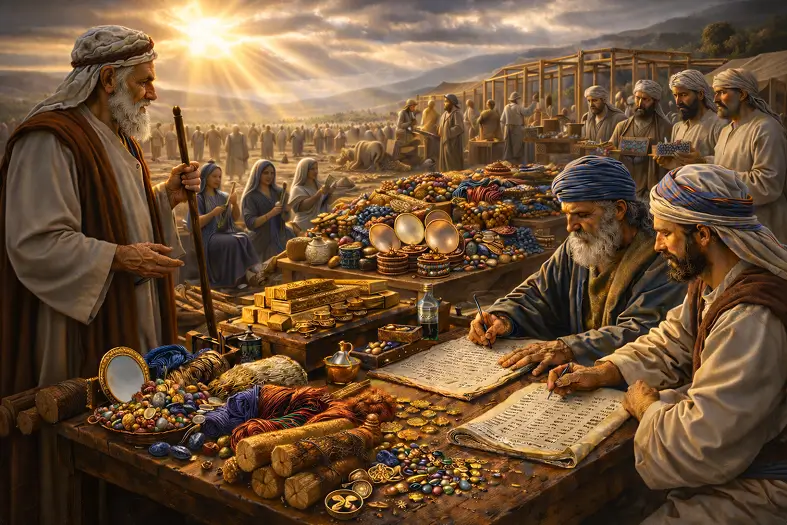
Each Parsha page on Mitzvah Minute is designed as a guided, three-level journey through the weekly Torah reading—integrating the narrative, the mitzvos, and the classical commentaries into one unified experience.
Begin with the foundations of the Parsha:
This level gives you the storyline, the key mitzvos, and the essential connections between them.
A complete journey through the parsha—moving from clarity and depth to inner connection and real-world meaning, culminating in a way to live its ideas in everyday life.
These sections show how the Parsha speaks to the mind, the heart, and the real world — offering wisdom rooted in enduring Torah.
A complete, structured commentary on the parsha—presented pasuk by pasuk, with chapter and overall summaries for clarity and flow.
This level reveals the structural depth of the Parsha and the classical underpinnings of each theme.
Together, these layers create a complete Parsha journey —
narrative, mitzvah, and commentary — all flowing toward deeper understanding, spiritual insight, and meaningful growth.
Tap the Page Navigation tab on the right side of your screen anytime to access quick-links to the entire Parsha page.

The quick-link panel gives instant access to every section — Parsha Summary, Mitzvos, Divrei Torah, Insights, and Commentaries.
“Every word of Torah and every mitzvah lifts us higher — may your learning bring you closer to Hashem.”

Parshas Vayakhel recounts the nation’s collective response to the command to build the Mishkan after the crisis of the Golden Calf. Moshe first reestablishes the primacy of Shabbos, framing all creative labor within covenantal discipline, and then calls for voluntary offerings and skilled participation. The people respond with overwhelming generosity, bringing materials and dedicating their talents until there is more than enough. Under the leadership of Betzalel and Oholiav, the Mishkan and its keilim are constructed with exact precision — from the curtains and beams to the Aron, Shulchan, Menorah, altars, and courtyard — culminating in a detailed accounting of the materials used. The parsha thus transforms national failure into unified sacred purpose, showing how commanded structure, willing hearts, and disciplined craftsmanship restore the Shechinah to the center of the camp.

"Building Holiness Together — Community, Discipline, and the Mishkan"
וְעָשׂוּ לִי מִקְדָּשׁ
Parshas Vayakhel and Pekudei describe the fulfillment of this command through the construction of the Mishkan. Every vessel, garment, and structure is fashioned precisely according to the Divine instruction, transforming human craftsmanship into a dwelling place for the Shechinah. The sanctuary becomes the center of Israel’s spiritual life, where the Divine Presence rests among the people.
אָנֹכִי ה׳ אֱלֹקֶיךָ
The construction of the Mishkan reflects the national expression of the first mitzvah: awareness of Hashem’s existence. After the rupture of the Golden Calf, the people gather under Moshe’s leadership to build a sanctuary where the Divine Presence will dwell among them. The Mishkan is therefore not merely architecture but the physical manifestation of da’at Elokim within a community. Vayakhel teaches that knowledge of Hashem must ultimately shape collective life, guiding how a nation organizes its labor, wealth, creativity, and devotion.
שְׁמַע יִשְׂרָאֵל ה׳ אֱלֹקֵינוּ ה׳ אֶחָד
The unity of the Mishkan’s design reflects the unity of Hashem. Many materials, craftsmen, and contributions combine into a single sanctuary. The gathering described by “וַיַּקְהֵל מֹשֶׁה” expresses the same principle: diverse individuals unified in service of the One G-d. Vayakhel therefore demonstrates that belief in Divine unity must manifest in social unity — a people joined together in the service of Hashem.
וְאָהַבְתָּ אֵת ה׳ אֱלֹקֶיךָ
The Mishkan contributions are repeatedly described as coming from “כָּל נְדִיב לִבּוֹ” — those whose hearts moved them to give. Love of Hashem is expressed through generosity, willingness, and enthusiasm in fulfilling His commandments. Vayakhel reveals that genuine אהבת ה׳ transforms religious obligation into joyful participation in building holiness.
אֶת ה׳ אֱלֹקֶיךָ תִּירָא
Before any instruction about constructing the Mishkan, Moshe reiterates the laws of Shabbos. This ordering teaches reverence: even the most sacred project cannot override the sanctity of the seventh day. Fear of Hashem manifests as disciplined obedience to His boundaries. Vayakhel therefore demonstrates that reverence for Hashem governs even the noblest spiritual ambitions.
וְנִקְדַּשְׁתִּי בְּתוֹךְ בְּנֵי יִשְׂרָאֵל
The Mishkan represents a national act of kiddush Hashem. A people that had recently stumbled into idolatry now channels its resources and creativity into the service of Hashem. Through unity, generosity, and obedience, the nation publicly sanctifies the Divine Name by demonstrating that their collective life is devoted to His presence.
וְהָלַכְתָּ בִּדְרָכָיו
The voluntary generosity of the Mishkan reflects the Divine attribute of kindness. By giving freely of their possessions and skills, the people imitate the generosity through which Hashem sustains the world. Vayakhel shows that building a sacred society requires individuals who model Divine virtues in their daily actions.
וְאָהַבְתָּ לְרֵעֲךָ כָּמוֹךָ
The Mishkan is built through collective cooperation. Every individual contributes — whether through wealth, labor, or skill. The gathering of the entire nation demonstrates that communal holiness emerges when individuals work for the good of the whole. Vayakhel illustrates that love of fellow Jews is expressed through shared responsibility for the spiritual life of the nation.
וְשִׁנַּנְתָּם לְבָנֶיךָ
Moshe gathers the people in order to transmit the Divine commands regarding Shabbos and the Mishkan. The assembly itself becomes an act of Torah instruction, demonstrating the central role of teaching and learning in sustaining covenantal life. Vayakhel highlights how leadership and education shape a nation capable of building holiness.
וַעֲבַדְתֶּם אֵת ה׳ אֱלֹקֵיכֶם
The Mishkan serves as the focal point of national service of Hashem. Though prayer as a fixed institution develops later, the sanctuary represents the place where Israel directs its worship and devotion toward the Creator. Vayakhel therefore reflects the broader mitzvah of avodas Hashem — structured service that aligns human life with Divine purpose.
וּבַיּוֹם הַשְּׁבִיעִי תִּשְׁבֹּת
The parsha opens with the commandment of Shabbos, emphasizing that sacred time precedes sacred space. Before constructing the Mishkan, the people must first learn to rest. Shabbos teaches that holiness is not created only through action but also through restraint and trust in Hashem’s sovereignty.
לֹא תַעֲשֶׂה כָל מְלָאכָה
The detailed work required for the Mishkan — weaving, building, crafting, and forging — forms the conceptual basis for the categories of melachah prohibited on Shabbos. Vayakhel therefore highlights the paradox that the very labors used to build the sanctuary must cease on the day that sanctifies time itself.
לֹא תְבַעֲרוּ אֵשׁ בְּכֹל מֹשְׁבֹתֵיכֶם בְּיוֹם הַשַּׁבָּת
The Torah’s prohibition of kindling fire on Shabbos underscores the sanctity of the day. Chazal derive from this verse that even judicial punishments involving fire may not be carried out on Shabbos. Vayakhel thus reinforces the principle that Shabbos suspends even the functioning of the judicial system.
זָכוֹר אֶת יוֹם הַשַּׁבָּת לְקַדְּשׁוֹ
The commandment to remember and sanctify Shabbos is reflected in Moshe’s public proclamation of its laws before any other instruction. Vayakhel emphasizes that sacred time must be consciously recognized and honored before the nation turns to building sacred space.
זֶה יִתְּנוּ כָּל־הָעֹבֵר עַל־הַפְּקֻדִים מַחֲצִית הַשֶּׁקֶל
Although commanded earlier, the spirit of the half-shekel resonates strongly in Vayakhel. The Mishkan is funded through the collective contributions of the people, emphasizing that every individual participates equally in sustaining the national sanctuary. The half-shekel symbolizes shared responsibility for communal holiness.
פָּתֹחַ תִּפְתַּח אֶת־יָדְךָ לוֹ
Parshas Vayakhel portrays generosity as the foundation of sacred community. When Moshe calls for materials to build the Mishkan, the people respond with offerings from those whose hearts are moved to give — כָּל נְדִיב לִבּוֹ (שמות ל״ה:ה). The sanctuary emerges not from obligation but from voluntary generosity. This spirit reflects the mitzvah of tzedakah: opening one’s hand so that material resources become instruments of holiness and communal responsibility.
הַחֹדֶשׁ הַזֶּה לָכֶם
The communal structure visible in Vayakhel reflects the broader system of national order established through Torah law. The sanctification of time by the courts parallels the sanctification of space through the Mishkan, demonstrating that Jewish life is structured through both sacred institutions and sacred rhythms.
וַהֲרֵעֹתֶם בַּחֲצֹצְרוֹת
The Mishkan project follows the crisis of the Golden Calf and the nation’s repentance. The rebuilding of the covenant reflects the mitzvah of turning to Hashem in moments of national distress. Vayakhel illustrates how spiritual repair begins when a people seeks renewed closeness to Hashem.
וְעַתָּה כִּתְבוּ לָכֶם אֶת הַשִּׁירָה הַזֹּאת
The wisdom and knowledge required for constructing the Mishkan parallel the intellectual devotion expressed through Torah writing and study. Both acts represent the preservation of Divine instruction within the life of the nation. Vayakhel therefore highlights the importance of preserving Torah as the blueprint of Jewish existence.
וְעָשׂוּ לָהֶם צִיצִת
The textiles produced for the Mishkan echo the broader symbolism of garments used in Divine service. Just as the Mishkan’s fabrics reflect holiness through craftsmanship, tzitzit transform everyday clothing into reminders of the commandments. Vayakhel emphasizes how material objects can become vessels for spiritual awareness.
וְאָכַלְתָּ וְשָׂבָעְתָּ וּבֵרַכְתָּ
The gratitude expressed through voluntary donations for the Mishkan parallels the broader mitzvah of blessing Hashem for sustenance. Both acts recognize that human prosperity ultimately comes from Hashem. Vayakhel demonstrates how gratitude naturally leads to generosity.
וְהִתְוַדּוּ אֶת חַטָּאתָם
The entire project of the Mishkan emerges after the sin of the Golden Calf. The people’s enthusiasm to contribute represents a collective expression of teshuvah. Through repentance and renewed devotion, the same energies that once fueled idolatry are redirected toward building a dwelling place for the Shechinah.
וּבוֹ תִדְבָּק
The leadership of Moshe, Betzalel, and the wise-hearted artisans demonstrates the importance of attaching oneself to those who possess spiritual wisdom. Vayakhel shows how a nation grows in holiness when it gathers around leaders who embody knowledge of Hashem.
וְעָשִׂיתָ אֹתוֹ שֶׁמֶן מִשְׁחַת־קֹדֶשׁ
The sacred anointing oil consecrates the Mishkan, its vessels, and the Kohanim who serve within it. Parshas Vayakhel describes the construction of the sanctuary that will later be sanctified through this oil, teaching that sacred space is established through both human craftsmanship and Divine consecration.
עַל־בְּשַׂר אָדָם לֹא יִיסָךְ
The Torah forbids reproducing the anointing oil for personal use in order to preserve its unique holiness. In the world of Vayakhel, where the Mishkan is built for Divine service, this mitzvah safeguards the distinction between sacred consecration and ordinary use.
וְהַקְּטֹרֶת אֲשֶׁר תַּעֲשֶׂה בְּמַתְכֻּנְתָּהּ לֹא תַעֲשׂוּ לָכֶם
The ketores is reserved exclusively for the service of Hashem in the Mishkan. By prohibiting the reproduction of its formula for personal enjoyment, the Torah protects the sanctity of the Temple service described in Vayakhel and preserves the boundary between sacred worship and private use.

Rashi frames the opening of Parshas Vayakhel as historically and spiritually significant. Moshe gathers the entire nation immediately after Yom HaKippurim — לְמָחֳרַת יוֹם הַכִּפּוּרִים — the day after forgiveness for the chet ha’eigel (שמות ל״ה:א). The Mishkan therefore begins not merely as a construction project but as the first collective act of renewed covenantal life.
Rashi also clarifies the grammar of וַיַּקְהֵל. The verb is in the causative form: Moshe did not physically assemble the people; they gathered in response to his command. The Targum appropriately renders the word as ואכניש, “he caused them to assemble.”
This opening scene sets the tone for the entire parsha: a nation previously fractured by sin now re-gathers under Torah leadership to build holiness together.
Before Moshe commands the building of the Mishkan, he reiterates the laws of Shabbos (שמות ל״ה:ב). Rashi explains that the Torah intentionally places this warning first in order to establish a halachic principle: the construction of the Mishkan does not override Shabbos (מכילתא).
The Mishkan may be the most sacred national project, yet it cannot violate the sanctity of sacred time. Holiness in Judaism therefore emerges through disciplined boundaries rather than enthusiasm alone.
Rashi further notes the debate among Chazal concerning the prohibition of fire (שמות ל״ה:ג):
Through this debate, Rashi reveals that even a seemingly simple prohibition becomes the basis for the halachic structure of Shabbos.
The Mishkan contributions are described as coming from נְדִיב לִבּוֹ — a generous heart (שמות ל״ה:ה). Rashi explains that a person is called נדיב לב because his heart motivates the act of giving.
The Mishkan is therefore not built through taxation or compulsion. Its materials arise from voluntary devotion. The physical sanctuary is an expression of the people’s inner generosity.
Rashi also observes that those who possessed the necessary materials — תכלת, ארגמן, תולעת שני, and animal skins — simply brought what they had (שמות ל״ה:כ״ג). The Mishkan thus becomes a collective offering where every individual contributes according to his resources.
Rashi carefully clarifies the terminology describing the Mishkan’s architecture (שמות ל״ה:י״א–י״ז):
He similarly explains that מסך describes any form of screening or protective partition. He supports this definition through biblical usage:
Through these linguistic clarifications, Rashi shows that the Torah’s architectural terminology carries precise functional meaning.
Rashi highlights that even preparing the oil for the Menorah required expert knowledge (שמות ל״ה:י״ד). The olives had to ripen properly at the top of the tree and produce oil that was כתית וזך — beaten and pure — as described in Menachos פ״ו.
He also emphasizes the remarkable craftsmanship of the women who spun the goats’ hair directly from the backs of living goats (שמות ל״ה:כ״ו; שבת צ״ט). This unusual technique preserved the softness of the fibers and demonstrated exceptional skill.
In Rashi’s reading, the Mishkan emerges as the product of both generosity and mastery.
When describing the contributions of the tribal princes, the Torah spells their title without the letter י: והנשאם (שמות ל״ה:כ״ז). Rashi interprets this unusual spelling as a moral teaching.
The princes initially delayed their participation, reasoning:
But the people brought so much that nothing remained unfinished (שמות ל״ו:ז). The princes then brought the precious stones for the ephod and choshen.
Because they hesitated at the outset, the Torah subtly removes a letter from their title to indicate that something was lacking — zeal in performing the mitzvah (במדבר רבה י״ב:ט״ז).
This episode illustrates a central lesson: spiritual leadership requires eagerness, not merely responsibility.
Rashi emphasizes that Oholiav, Betzalel’s partner in the Mishkan’s construction, came from the tribe of Dan (שמות ל״ה:ל״ד). Dan descended from the sons of the maidservants and was considered among the lower-ranking tribes.
Yet Hashem paired Oholiav with Betzalel, who came from the prestigious tribe of Yehudah. Rashi explains that this fulfills the verse:
וְלֹא נִכַּר שׁוֹעַ לִפְנֵי דָל
“He does not favor the rich over the poor” (איוב ל״ד:י״ט).
The Mishkan is therefore built through partnership between the greatest and the humblest members of the nation.
When the craftsmen begin their work, they report that the contributions exceed what is needed (שמות ל״ו:ה). Rashi explains that מִדֵּי הָעֲבֹדָה means more than the work requires.
Moshe therefore commands the people to stop bringing donations (שמות ל״ו:ו). The Torah records that the materials were sufficient — and even left over — for the entire project (שמות ל״ו:ז).
This moment demonstrates the extraordinary generosity of Klal Yisrael once their hearts are aligned with Hashem.
Although many craftsmen participated in the work, the Torah frequently attributes the construction to Betzalel (שמות ל״ז:א). Rashi explains that this is because Betzalel devoted himself to the work more completely than the others (שמות רבה).
The Mishkan is therefore associated with the individual who demonstrated the deepest commitment to the task.
One of the most striking passages in Rashi concerns the copper mirrors donated by the women (שמות ל״ח:ח).
These mirrors had been used for personal adornment, and Moshe initially rejected them because they seemed connected to vanity. Hashem, however, instructed Moshe to accept them, declaring that they were more beloved than all the other contributions.
Rashi explains why.
During the harsh slavery in Mitzrayim, the women used these mirrors to sustain hope and family life. When their husbands returned exhausted from forced labor:
Through this loving encouragement they rebuilt family life and brought new children into the world, fulfilling the verse:
תַּחַת הַתַּפּוּחַ עוֹרַרְתִּיךָ
“Under the apple tree I awakened you” (שיר השירים ח׳:ה׳).
The kiyor was made from these mirrors. Rashi explains that this is fitting because the kiyor ultimately promotes peace between husband and wife in the ritual of the sotah (במדבר ה׳).
Objects once used for personal beauty thus become instruments of spiritual purification and marital reconciliation.
Rashi concludes by explaining technical details such as the hollow structure of the outer mizbeach (שמות ל״ח:ז) and the proportions of the courtyard curtains (שמות ל״ח:י״ח).
Yet even these architectural explanations reinforce the larger theme: every detail of the Mishkan reflects a deeper spiritual order.
Through linguistic precision, Midrashic insight, and ethical teaching, Rashi presents the Mishkan as the physical expression of a transformed nation — a people whose generosity, humility, craftsmanship, and devotion together create a dwelling place for the Shechinah.
📖 Source
Ramban understands the opening of Parshas Vayakhel as a decisive moment of reconciliation between Hashem and Klal Yisrael. When the Torah states:
"וַיַּקְהֵל מֹשֶׁה אֶת כָּל עֲדַת בְּנֵי יִשְׂרָאֵל" (שמות ל״ה:א׳)
Moshe gathers the entire nation — men and women alike — because the Mishkan is the project of the entire covenantal community. This assembly takes place after Moshe descends with the second Luchos following the forgiveness granted after the chet ha’eigel.
Ramban explains that Moshe now conveys the command of the Mishkan that had originally been given before the sin. The renewed instruction demonstrates that the Divine relationship has been restored. The original promise therefore resumes:
"וְעָשׂוּ לִי מִקְדָּשׁ וְשָׁכַנְתִּי בְּתוֹכָם" (שמות כ״ה:ח׳)
The Mishkan is thus not merely a sanctuary. It is the visible sign that the covenant has returned to the state of affection that existed before the rupture — the restoration of the “wedding” between Hashem and Yisrael.
Immediately after the national assembly, Moshe commands the observance of Shabbos before describing the Mishkan’s construction (שמות ל״ה:ב׳). Ramban explains that this sequence establishes a halachic and theological hierarchy: even the sacred work of building the Mishkan does not override Shabbos.
The Torah teaches this principle through textual order. By introducing the laws of Shabbos first, Moshe clarifies that the work of the Mishkan must take place only during the six weekdays.
Ramban emphasizes that this teaching is derived specifically from the placement of the verses here, not from the word "אַךְ" in the earlier command:
"אַךְ אֶת שַׁבְּתֹתַי תִּשְׁמֹרוּ" (שמות ל״א:י״ג).
Thus the sanctity of sacred time precedes even the sanctity of sacred space.
The verse:
"לֹא תְבַעֲרוּ אֵשׁ בְּכֹל מֹשְׁבֹתֵיכֶם בְּיוֹם הַשַּׁבָּת" (שמות ל״ה:ג׳)
is interpreted by Ramban as clarifying the scope of Shabbos prohibition. The Torah had already forbidden melachah, yet here the Torah singles out fire in order to teach that even acts connected to bodily needs — such as cooking or baking — are forbidden on Shabbos.
This clarification was necessary because the verse here says simply “melachah,” which might otherwise allow one to think that activities required for food preparation could be permitted, similar to the allowance of ochel nefesh on festivals.
Ramban also records the Talmudic dispute (שבת ע׳):
In Ramban’s presentation, the verse simultaneously clarifies the nature of Shabbos labor and preserves the layered interpretive tradition of Chazal.
One of Ramban’s central themes is the spiritual elevation of voluntary generosity. When the Torah describes those who came to participate in the Mishkan’s work:
"וַיָּבֹאוּ כָּל אִישׁ אֲשֶׁר נְשָׂאוֹ לִבּוֹ" (שמות ל״ה:כ״א)
Ramban explains that this phrase refers specifically to the artisans who undertook the sacred craftsmanship.
These individuals had not formally learned the crafts required for the Mishkan. Instead:
This reflects a Divine empowerment. Just as Betzalel was filled with רוח אלקים בחכמה ובתבונה ובדעת (שמות ל״א:ג׳), so too others discovered within themselves unexpected wisdom.
Ramban therefore distinguishes between two spiritual responses:
Both forms of inspiration participate in building the Mishkan.
Ramban emphasizes the prominent role of the women in the Mishkan donations. When the Torah says:
"וַיָּבֹאוּ הָאֲנָשִׁים עַל הַנָּשִׁים" (שמות ל״ה:כ״ב)
he explains that the women arrived first. Since ornaments were typically possessed by women, they immediately removed their jewelry — נזמים, טבעות, חח, וכומז — and donated them to the Mishkan.
The men followed afterward with their contributions.
This interpretation highlights the eagerness of the women and their leadership in the act of generosity.
Ramban also carefully analyzes the types of materials brought by the people. Certain materials such as תכלת, ארגמן, and עצי שטים were relatively rare and possessed by only a few individuals, whereas silver and copper were more widely available.
Gold, however, was rarer still, and therefore those who brought it presented it as a תְּנוּפָה — a waved offering that displayed the significance of the gift.
When the artisans began their work, the people continued bringing donations until the craftsmen themselves reported that there was more than enough material (שמות ל״ו:ה–ז).
Ramban reconstructs the chronology:
This episode praises three groups simultaneously:
Ramban contrasts Moshe’s conduct with the behavior of typical rulers who enrich themselves at the expense of their people. Moshe sought nothing for himself, fulfilling his own declaration:
"לֹא חֲמוֹר אֶחָד מֵהֶם נָשָׂאתִי" (במדבר ט״ז:ט״ו).
Ramban explains that the Torah repeats the description of the Mishkan multiple times throughout the narrative:
This repetition is intentional. Sacred work requires complete understanding before execution. Betzalel, Oholiav, and the wise-hearted artisans first received the entire blueprint of the Mishkan so that they could fully grasp the task before beginning.
The Torah therefore briefly summarizes Moshe’s instructions, assuming the artisans understood the detailed measurements and technical procedures.
The repetition also expresses Divine affection. The Torah lingers over the Mishkan narrative because it is beloved to Hashem.
Although many craftsmen participated in constructing the Mishkan, Ramban explains that Betzalel alone fashioned the Aron (שמות ל״ז:א׳).
The Aron required not merely technical skill but spiritual intention. Because Betzalel was uniquely filled with the spirit of wisdom and understanding, the most sacred vessel of the Mishkan was entrusted specifically to him.
Other items may have required greater craftsmanship, but the Aron required the deepest kavannah.
One of Ramban’s most profound discussions concerns the copper mirrors donated by the women for the kiyor (שמות ל״ח:ח׳).
Ramban records the Midrash cited by Rashi: these mirrors had once been used for adornment, and Moshe initially hesitated to accept them. Yet Hashem declared them the most beloved of all the donations because through them the women had sustained their families during the harsh slavery in Mitzrayim.
Ramban then analyzes the verse:
"אֲשֶׁר צָבְאוּ פֶּתַח אֹהֶל מוֹעֵד"
He offers several interpretations:
Ramban ultimately emphasizes the symbolic transformation involved. The mirrors — instruments of physical beauty — became the material for the kiyor, whose waters help restore peace between husband and wife in the ritual of the sotah (במדבר ה׳).
Thus the Mishkan elevates even human impulses and transforms them into vehicles of holiness.
Ramban concludes that the Torah’s repeated recounting of the Mishkan narrative is itself a sign of Divine affection. The Mishkan represents the renewed intimacy between Hashem and His people.
The repetition therefore mirrors the way a beloved subject is described again and again with care and attention.
In Ramban’s vision, the Mishkan stands as the ultimate expression of restored covenant: a sanctuary built through willing hearts, inspired wisdom, moral integrity, and sanctified human experience — a dwelling place where the Shechinah returns to reside among Yisrael.
📖 Source
Parshas Vayakhel describes the transformation of the nation from a people recently shaken by the sin of the Golden Calf into a disciplined covenantal community capable of building a dwelling place for the Shechinah. The Torah presents three dominant elements: the command of Shabbos, the communal gathering led by Moshe, and the national construction of the Mishkan.
Through the philosophical framework of the Rambam, these elements illuminate several foundational principles of Torah life: the relationship between action and character, the role of law in shaping the soul, the discipline required for communal holiness, and the gradual perfection of human beings through mitzvos and ordered society. These themes align with Rambam’s broader teachings in Mishneh Torah and Moreh Nevuchim about the structure of Torah as a system designed to refine both the individual and the nation.
The parsha begins unexpectedly with the mitzvah of Shabbos before the construction of the Mishkan:
שמות ל״ה:ב
“שֵׁשֶׁת יָמִים תֵּעָשֶׂה מְלָאכָה וּבַיּוֹם הַשְּׁבִיעִי יִהְיֶה לָכֶם קֹדֶשׁ שַׁבַּת שַׁבָּתוֹן לַה׳.”
From a Rambam perspective, this ordering reflects the Torah’s insistence that ritual structures never override the moral and spiritual disciplines that form the foundation of a holy society.
Rambam explains in Hilchos De’os (א:ד–ז) that the Torah seeks to cultivate balanced and disciplined character. Human beings naturally drift toward excess or deficiency, but mitzvos train the soul toward the “derech ha-emtza’it,” the balanced path.
Shabbos embodies precisely this educational structure:
Thus, before the Mishkan can be built, the nation must internalize a principle central to Rambam’s philosophy: holiness is not produced by structures alone but by disciplined human behavior.
The opening words of the parsha emphasize Moshe gathering the entire nation:
שמות ל״ה:א
“וַיַּקְהֵל מֹשֶׁה אֶת כָּל־עֲדַת בְּנֵי יִשְׂרָאֵל.”
For Rambam, the organization of society is not incidental to Torah life but essential. In Hilchos Melachim (ד:י) and throughout Mishneh Torah, Rambam emphasizes that Torah law creates an ordered community governed by structure, authority, and justice.
The Mishkan project demonstrates this principle vividly. Every role is clearly defined:
This hierarchical yet cooperative structure reflects Rambam’s understanding that a functioning Torah society requires coordinated roles. Human perfection is not achieved in isolation but within an organized community governed by Torah law.
A central Rambam principle appears in Moreh Nevuchim (ג:כ״ז–כ״ח): the mitzvos are designed to perfect human beings in two ways.
The Mishkan project serves both purposes simultaneously.
On the societal level, the national building effort organizes the people around a common sacred task. On the spiritual level, it directs their attention toward the presence of Hashem dwelling among them.
The Rambam consistently emphasizes that intellectual awareness of G-d cannot exist without disciplined action. The mitzvos train the body and habits of the individual, preparing the mind for deeper understanding.
Thus, the detailed physical construction of the Mishkan is not a contradiction to philosophical spirituality. It is the educational path that leads toward it.
The Torah repeatedly emphasizes the voluntary nature of the donations:
שמות ל״ה:ה
“קְחוּ מֵאִתְּכֶם תְּרוּמָה לַה׳ כֹּל נְדִיב לִבּוֹ יְבִיאֶהָ.”
Rambam teaches in Hilchos De’os (א:ה) that virtue is cultivated through repeated action. One does not become generous merely through belief; generosity becomes part of the soul through consistent acts of giving.
The Mishkan donations therefore serve as a national exercise in moral formation.
The Torah highlights several layers of participation:
This distribution of participation reflects Rambam’s belief that mitzvos engage every level of human capacity. Torah does not restrict holiness to scholars or leaders; it enables every individual to contribute according to their abilities.
A striking feature of the parsha is the emphasis on wisdom in craftsmanship:
שמות ל״ה:ל״א
“וַיְמַלֵּא אֹתוֹ רוּחַ אֱלֹקִים בְּחָכְמָה בִּתְבוּנָה וּבְדַעַת.”
For Rambam, human perfection includes intellectual mastery expressed through practical skill. Knowledge is not limited to theoretical contemplation; it also appears in the ability to shape the physical world according to rational design.
In Hilchos Yesodei HaTorah (ב:ב), Rambam describes how observing the wisdom embedded in creation leads a person to love and fear Hashem. Craftsmanship that mirrors divine wisdom therefore becomes an act of spiritual significance.
Betzalel represents this synthesis:
The Mishkan becomes a physical expression of wisdom, demonstrating that the highest human achievements occur when intellect, creativity, and Torah law work together.
Parshas Vayakhel follows the crisis of the Golden Calf. Rambam’s philosophy of teshuvah sheds light on the transformation taking place.
In Hilchos Teshuvah (ב:א), Rambam defines complete repentance as the process through which a person returns to the same situation yet chooses differently.
The Mishkan project represents the nation’s collective correction:
The same human impulses — creativity, enthusiasm, communal energy — are redirected toward holiness. Rambam repeatedly teaches that the Torah does not seek to eliminate human drives but to guide them toward proper expression.
Thus the Mishkan becomes not only a sanctuary but also a symbol of national moral rehabilitation.
The philosophical vision emerging from Parshas Vayakhel aligns closely with Rambam’s understanding of Torah as a complete system for human perfection.
Several interconnected ideas become visible:
When these elements operate together, a society becomes capable of sustaining the presence of the Shechinah.
In Rambam’s worldview, divine closeness does not appear through mystical experience alone. It emerges when a disciplined people build a just and ordered society governed by Torah and directed toward knowledge of Hashem.
Parshas Vayakhel therefore illustrates a central Rambam principle: holiness is not accidental. It is the product of law, wisdom, moral refinement, and communal responsibility working together in harmony.
📖 Sources
Ralbag approaches the narrative surrounding the construction of the Mishkan through the lens of philosophical analysis, focusing on the nature of Divine providence, human intellectual development, the purpose of mitzvos, and the structure of prophecy. His commentary situates the events leading into Parshas Vayakhel within a broader reflection on Moshe’s dialogue with Hashem and the revelation of the Divine attributes. Through this framework, Ralbag explores how knowledge of Hashem emerges through contemplation of His actions in the world and how the Torah’s commandments cultivate a people capable of sustaining Divine providence.
Ralbag explains that Moshe’s request to understand the ways of Hashem reflects a fundamental philosophical principle: the essence of Hashem cannot be grasped directly, but His actions reveal aspects of His governance.
Moshe asks that Hashem reveal His “ways” so that he may understand how Divine providence operates within the created world. Ralbag explains that human beings come to know Hashem not through direct comprehension of His essence but through observation of His actions and the order of creation.
The guiding principle is that:
For this reason Moshe requests greater knowledge of Hashem’s ways, understanding that intellectual awareness leads to a stronger connection with Divine providence.
Ralbag presents a systematic explanation of providence based on the Divine attributes revealed to Moshe.
The attributes of “רחום וחנון,” “ארך אפים,” and “רב חסד” do not describe emotional states in Hashem but express the structure of Divine governance in the natural order.
According to Ralbag, the world demonstrates several observable principles:
Divine compassion is expressed through the design of the natural world. Living beings possess physical structures and faculties that preserve their existence and protect them from harm. The organization of the world itself testifies to a system oriented toward the flourishing of creation.
This understanding allows the philosopher to recognize that Divine governance operates through wisdom embedded in the structure of nature rather than through arbitrary intervention.
Ralbag emphasizes that Divine providence is not distributed equally among all individuals. Rather, it corresponds to the level of intellectual and moral perfection achieved by a person.
The more perfected an individual becomes through knowledge of Hashem and the cultivation of virtue, the greater the degree of providence that attaches to him.
This principle explains why Moshe asks to deepen his knowledge of Hashem’s ways: increased understanding strengthens the relationship between the human intellect and Divine governance.
Providence therefore follows a rational structure:
Through this framework, Ralbag reconciles philosophical inquiry with the Torah’s descriptions of Divine involvement in human affairs.
Although Moshe seeks deeper knowledge of Hashem, Ralbag explains that the human intellect cannot grasp the Divine essence.
The statement:
שמות ל״ג:כ׳
“לֹא תוּכַל לִרְאֹת אֶת פָּנָי.”
expresses the philosophical truth that no created intellect can fully comprehend the Divine essence.
Even the highest human intellect cannot directly apprehend the separate intelligences or the essence of Hashem. At best, a person may perceive the effects of Divine governance within the created world.
This is symbolized in the Torah’s description of Moshe seeing the “אחורי” — the “back” of Hashem. According to Ralbag, this metaphor indicates that human knowledge of Hashem proceeds indirectly through His actions and the laws governing creation.
Thus the path to knowledge of Hashem lies in studying the ordered structure of the world and understanding the principles through which Hashem governs existence.
Ralbag addresses a philosophical difficulty regarding prayer. If Hashem’s governance is perfect and unchanging, how can prayer influence events?
He explains that prayer does not change Hashem but changes the human recipient. When a person prays, several transformative processes may occur:
Thus the apparent effect of prayer arises from transformation within the human being rather than change in the Divine will.
Moshe’s prayer on behalf of Israel reflects this principle. By correcting the nation’s behavior and removing the source of their sin, Moshe helps make them worthy of renewed Divine favor.
Ralbag explains that the commandments introduced after the sin of the Golden Calf serve to strengthen Israel’s attachment to Hashem and protect them from falling again into idolatry.
Many of the mitzvos repeated in this section of the Torah reinforce the memory of the foundational events of Jewish history:
Additional commandments — such as the pilgrimage festivals, the offering of first fruits, and the sanctification of the firstborn — reinforce the recognition that all existence flows from Hashem.
Through these mitzvos the Torah continually directs the nation’s attention toward the Divine source of existence and strengthens their commitment to the service of Hashem.
The commandments therefore function as an educational system designed to preserve true belief and prevent the reemergence of idolatry.
Ralbag concludes by identifying several fundamental lessons emerging from the narrative.
These teachings address both ethical conduct and philosophical understanding.
The lessons include:
Together these teachings present a coherent philosophical vision in which the pursuit of knowledge, moral refinement, and obedience to the commandments lead human beings toward greater attachment to Hashem and deeper participation in Divine providence.
📖 Source
(Baal Shem Tov · Kedushas Levi · Sfas Emes)
The Chassidic masters read Parshas Vayakhel not merely as a historical account of constructing the Mishkan, but as a profound map of the inner life of the Jewish soul. The gathering of Israel, the sanctity of Shabbos, the generosity of the Mishkan donations, and the wisdom of its craftsmen all reveal a deeper spiritual architecture: the process by which human action becomes a dwelling place for the Shechinah.
The teachings of the Baal Shem Tov, Kedushas Levi, and Sfas Emes illuminate how unity, intention, humility, and joy transform ordinary deeds into vessels for Divine presence.
The parsha begins with the commandment:
שמות לה:ג
לא תבערו אש בכל מושבותיכם ביום השבת
“Do not kindle fire in all your dwellings on the day of Shabbos.”
The Baal Shem Tov reads this verse through the imagery of the human soul. Chazal teach:
נר ה׳ נשמת אדם (משלי כ:כז)
“The soul of man is the lamp of Hashem.”
The soul itself is a flame. The Mishnah in Shabbos (מד ע״א) discusses moving lamps on Shabbos, and the Baal Shem Tov interprets this spiritually: a “lamp” refers to the human soul.
According to the Zohar, on Shabbos even souls in Gehinom experience relief, because the day itself radiates Divine compassion. Yet there is one tragic exception: one who desecrated Shabbos. Just as he extinguished the holiness of Shabbos in life, so too his soul cannot partake in its rest.
The teaching reveals a profound truth: Shabbos is not merely a commandment. It is the natural state of the soul. When a person honors Shabbos, the inner flame returns to its source. When Shabbos is violated, that flame becomes distorted.
Shabbos therefore restores the soul to its original luminosity.
The parsha opens:
שמות לה:א
ויקהל משה את כל עדת בני ישראל
“And Moshe gathered the entire assembly of Bnei Yisrael.”
The Sfas Emes explains that this gathering is not only physical. It reflects the restoration of unity after the sin of the Golden Calf. That sin fractured the spiritual unity of Israel, introducing division and multiplicity. The Mishkan repairs that rupture by drawing every element of existence back toward its root of oneness.Sfas Emes on Parshas Vayakhel
Shabbos is the key to this reunification.
The six days of work correspond to the multiplicity of the world — the many directions, energies, and activities of life. But Shabbos gathers them all into a single inner point. The Sfas Emes describes the six days as the building of a “hall” around the central point of holiness that is Shabbos.
In this sense:
Shabbos is the klal — the unifying principle.
The weekdays are the prat — the individual details.
The Mishkan reflects this same structure. Each vessel and component is a particular expression, yet all together they reveal one unified dwelling for the Divine Presence.
Thus the gathering of the people mirrors the gathering of the soul itself — all its scattered forces returning to the unity of Hashem.
The Kedushas Levi notes a surprising detail in the Torah’s wording. In relation to Shabbos the Torah says:
אלה הדברים אשר צוה ה׳ לעשות
“These are the things Hashem commanded to do.”
Yet Shabbos is defined precisely by refraining from work.
Why then does the Torah use the language of action?
The Kedushas Levi explains that even refraining from action can repair the world of action. During the weekdays, human labor rectifies the physical world. On Shabbos, however, the rectification occurs through speech, Torah, prayer, and spiritual awareness.
Paradoxically, the cessation of activity becomes the highest form of action.
When a person stops working on Shabbos, all the deeds of the week are elevated and completed. The restraint itself perfects the work.
Thus Shabbos reveals a deeper truth: holiness is not only created by what we do, but also by what we refuse to do.
A striking moment in the parsha occurs when Moshe commands the people to stop bringing donations:
שמות לו:ו
ויכלא העם מהביא
“The people were restrained from bringing.”
The Torah tells us that the contributions were both sufficient and extra:
והמלאכה היתה דים… והותר
This apparent contradiction fascinated the Chassidic masters.
The Sfas Emes explains that the wise men sensed that the donations were beginning to exceed the sincerity of the people’s inner intention. Generosity had begun to spread beyond the pure motivation of לשם שמים. Therefore Moshe restrained them.Sfas Emes on Parshas Vayakhel
True holiness depends not on quantity but on intention.
The Kedushas Levi deepens this idea by connecting it to the Divine Name א־ל שדי — the One who said “די,” enough, to creation. Just as Hashem imposed limits on the expanding universe to create order, so too human generosity sometimes requires restraint.
Holiness emerges when desire is balanced by discipline.
The Mishkan was therefore built not merely through giving, but through the wisdom of knowing when to stop.
Another subtle detail in the parsha states:
שמות לה:כב
ויבואו האנשים על הנשים
“The men came upon the women.”
The Sfas Emes interprets this through the teaching of Chazal:
במקום שבעלי תשובה עומדים אין צדיקים גמורים יכולים לעמוד (ברכות לד:)
“The place where ba’alei teshuvah stand is beyond the reach of the completely righteous.”
The men had sinned in the episode of the Golden Calf, while the women had resisted the sin. Yet in the building of the Mishkan, the men brought donations with extraordinary passion. Their repentance transformed the very energy that once fueled sin into a force for holiness.Sfas Emes on Parshas Vayakhel
Teshuvah does not erase desire.
It redirects it.
The intensity that once drove wrongdoing becomes the power that builds a sanctuary for the Divine.
The Torah repeatedly describes the craftsmen of the Mishkan as חכמי לב — “wise of heart.”
Chassidus emphasizes that their wisdom was not merely technical skill. Their thoughts and intentions were embedded within the physical work itself.
The Sfas Emes explains the verse:
לחשוב מחשבות לעשות
“To think thoughts, to perform.”
True wisdom occurs when thought and action unite. When deeds reflect inner awareness, the act itself becomes a vessel for Divine presence.Sfas Emes on Parshas Vayakhel
In this way the Mishkan became a living synthesis of heaven and earth:
Outer craftsmanship
Inner consciousness
Human action
Divine inspiration
Finally, the Sfas Emes teaches that Moshe gathered the people the day after Yom Kippur. After the sin of the Golden Calf and the anguish of repentance, Hashem gave Israel the mitzvah of building the Mishkan as a source of joy.
The donations were given with extraordinary happiness.
This joy itself became the vessel for the Shechinah.
The Sfas Emes even suggests that the joy of the Mishkan later manifests in the festival of Sukkos — a celebration that follows Yom Kippur and expresses the delight of reconciliation with Hashem.
When repentance leads to joy, the Divine Presence rests among the people.
Taken together, the Chassidic teachings reveal that the Mishkan is not only a structure in the wilderness.
It is a structure within the human soul.
The gathering of Israel reflects the gathering of scattered inner forces.
Shabbos restores the soul to its unity.
Generosity must be guided by intention and restraint.
Teshuvah transforms desire into holiness.
Action becomes sacred when joined with inner awareness.
Through these processes the human heart itself becomes a sanctuary.
As the Torah declares:
ועשו לי מקדש ושכנתי בתוכם
“Make for Me a sanctuary, and I will dwell among them.”
Not merely within it — but within them.
📖 Sources
Parshas Vayakhel marks the beginning of one of the most remarkable transformations in the Torah: the turning of a fractured people into a sacred community. Only a short time earlier the Israelites had stood at Sinai and entered a covenant with G-d. Yet almost immediately afterward they fell into the chaos of the Golden Calf. In the absence of Moshe, the people gathered themselves together in panic and confusion. What began as an assembly became a mob. Order dissolved, responsibility disappeared, and a crowd replaced a covenantal society.
The opening word of our parsha signals the repair of that rupture: וַיַּקְהֵל מֹשֶׁה — “Moshe assembled.” The same root that described the disorderly gathering around the Golden Calf now becomes the foundation of renewal. Moshe gathers the people again, but this time not as a crowd driven by fear or impulse. Instead they assemble as a kehillah, a community bound together by purpose, responsibility, and shared devotion to G-d.
Rabbi Jonathan Sacks shows that the entire parsha unfolds as a process of rebuilding society after moral failure. Moshe does not merely condemn the people or impose order from above. Instead he gives them a task that will transform them: the construction of the Mishkan. Through voluntary generosity, craftsmanship, creativity, and cooperation, the Israelites learn how to become a people again. The Sanctuary they build becomes more than a structure; it becomes the architecture of a covenantal society.
Across his essays on Vayakhel, Rabbi Sacks explores the deeper meaning of this transformation. He reflects on the role of love, creativity, and beauty in religious life; the centrality of community to Jewish spirituality; the power of shared projects to unite people; and the unique Jewish experience of journeying through history while carrying the Divine presence with them. In doing so, he reveals how the building of the Mishkan was not only the creation of a sacred space, but the birth of a sacred society.
Vayakhel therefore teaches a timeless lesson. Civilizations are not sustained by power or wealth alone. They endure when individuals join together in acts of shared purpose, responsibility, and faith. By gathering the people and inviting them to build something together for the sake of Heaven, Moshe turned a disordered crowd into a covenantal community — and in doing so laid the foundation for the Jewish nation.
At the heart of Parshas Vayakhel lies a striking insight: the Mishkan was not built merely through obedience to command. It was built through love. The Torah repeatedly emphasizes that the materials for the Sanctuary were brought not by obligation but by generosity of heart. Men and women alike brought their offerings, each according to the stirrings of their spirit, until the contributions became so abundant that Moshe eventually had to command the people to stop.
Rabbi Jonathan Sacks notes that one of the most remarkable features of this generosity is the prominent role played by women. The Torah emphasizes their initiative in bringing contributions for the Mishkan, and the commentators point out an unusual phrase describing the moment when the offerings were brought: the men came after the women. This detail reflects an earlier episode in the Torah narrative. When the Israelites demanded gold for the making of the Golden Calf, the women refused to participate. They displayed a spiritual clarity that the men lacked, distinguishing between authentic worship and idolatrous imitation.
The Torah highlights this spiritual strength through one of the most enigmatic objects donated to the Sanctuary: the copper mirrors of the women. These mirrors, used by women for personal adornment, became the raw material for the washstand in the Mishkan. At first Moshe recoiled from accepting them. To him they represented vanity and physical temptation, objects seemingly out of place in the sacred space of the Sanctuary.
According to Midrash, however, G-d rebuked Moshe and instructed him to accept them, declaring that these mirrors were more precious than any other gift. Their significance lay in the role they had played during the slavery in Egypt. When the Israelite men returned exhausted from forced labour, crushed in spirit and deprived of normal family life, it was the women who preserved hope and continuity. They used the mirrors to restore dignity, affection, and intimacy, encouraging their husbands and ensuring that the next generation of Jewish children would be born. The mirrors thus became symbols of Jewish survival.
Rabbi Sacks draws from this story a profound lesson about the Jewish understanding of love. Judaism does not divide love into separate spiritual and physical realms. The commandment to love G-d “with all your heart and all your soul and all your might” expresses a total, passionate devotion that encompasses the whole human being. The tradition even uses the language of romantic love to describe this relationship. Rambam writes that the love of G-d should resemble the passion of someone who is lovesick, whose mind is constantly absorbed in the beloved. Likewise, the Sages understood the intensely sensual poetry of Shir haShirim as an allegory for the love between G-d and Israel.
This perspective stands in contrast to philosophical traditions that sought to separate spiritual love from physical desire. In Judaism, the physical world is not an obstacle to holiness but a vehicle for it. When human love, loyalty, and faithfulness are directed toward sacred ends, they become expressions of Divine service. The mirrors of the women thus represent the transformation of ordinary human experience into something holy.
This same principle appears in the artistic dimension of the Mishkan. The Torah introduces Betzalel, the master craftsman entrusted with constructing the Sanctuary, describing him as filled with a spirit of wisdom, understanding, and knowledge. His name itself carries symbolic meaning: Betzalel means “in the shadow of G-d.” Through his artistry he becomes a partner in revealing Divine beauty within the material world.
Rabbi Sacks observes that the aesthetic dimension of Judaism is often overlooked. Because the Torah prohibits the making of idols, Jewish tradition historically approached visual art with caution. Yet the Mishkan itself demonstrates that beauty has a place within sacred life. The Sanctuary was adorned with intricate designs, precious metals, embroidered fabrics, and finely crafted objects. The garments of the Kohanim were described as being made “for dignity and beauty.”
Maimonides explained that beauty plays an important role in religious experience. Aesthetic environments inspire reverence, humility, and elevation of the soul. In a similar spirit, Rav Kook saw art as a means of expressing the deepest spiritual currents within the human soul. For him, artistic creativity was not merely decorative but revelatory: it brought hidden dimensions of the spirit into visible form.
Art, therefore, becomes a reflection of the Divine presence within creation. Just as Betzalel fashioned the Mishkan through human skill and imagination, so the artist reveals glimpses of the sacred within the world. Rabbi Sacks suggests that this is the meaning of Betzalel’s name. Art is the shadow cast by the light of G-d, the trace of transcendence that becomes visible through human creativity.
Taken together, the mirrors of the women and the craftsmanship of Betzalel convey a powerful message about the nature of holiness. Love, beauty, and creativity are not marginal to religious life. They are among its most powerful expressions. When directed toward sacred purposes, the deepest human capacities become instruments through which the Divine presence enters the world.
If Part I reveals the role of love and creativity in the building of the Mishkan, Part II explores the deeper social vision of the parsha: the creation of community. The key word that opens the narrative is וַיַּקְהֵל — “Moshe assembled.” From this root comes the word kehillah, meaning community. This single word marks the turning point between the chaos of the Golden Calf and the restoration of covenantal life.
The Torah deliberately echoes the earlier episode of the Golden Calf through the same root. There we read that the people “gathered themselves around Aharon” and demanded an idol. That gathering produced disorder, panic, and moral collapse. In Vayakhel, Moshe gathers the people again, but this time the assembly becomes the beginning of renewal. Rabbi Jonathan Sacks points out that the same human impulse to assemble can produce either a crowd or a community. The difference between the two is profound.
A crowd is driven by emotion and impulse. Individuals lose their sense of responsibility and become swept along by the passions of the group. The episode of the Golden Calf represents precisely this phenomenon. The Torah describes the people as running wild, lacking restraint and discipline. A community, by contrast, is structured by shared purpose, mutual responsibility, and moral commitment.
Moshe’s task in Vayakhel is therefore not simply to give instructions about the Mishkan. His deeper task is to rebuild the social fabric of Israel. Rabbi Sacks emphasizes that Jewish spirituality is fundamentally communal. While Judaism attaches immense value to the individual — every human being is created in the image of G-d — it also insists that the spiritual life is lived together with others.
The Torah itself expresses this principle from the beginning of human history. The first time the Torah declares something “not good” is when it says, “It is not good for man to be alone.” Human flourishing depends on relationship, cooperation, and shared responsibility. Judaism therefore places community at the center of religious life.
Moshe rebuilds this community through two institutions that stand at the heart of Jewish life: Shabbos and the Mishkan.
Shabbos represents community in time. Each week the entire nation pauses together from work and gathers in shared rest and spiritual focus. The Torah describes Shabbos not as a private experience but as a collective one that embraces the entire household and even the stranger within the gates. It creates a rhythm of shared time in which people reconnect with one another and with G-d.
The Mishkan represents community in space. It provides a physical center around which the people gather to worship, celebrate, and experience the Divine presence. Later in Jewish history this role would be taken up by the Beis HaMikdash and eventually by the synagogue. These institutions serve as focal points where the kehillah becomes visible and tangible.
Rabbi Sacks notes that modern social science has increasingly confirmed the importance of community that the Torah recognized long ago. Studies of contemporary societies reveal a growing sense of isolation and fragmentation. Individuals may be more connected technologically than ever before, yet many feel increasingly alone. The weakening of communal institutions has led to a decline in what sociologists call “social capital” — the networks of trust, cooperation, and mutual responsibility that sustain healthy societies.
Research shows that participation in communities of worship plays a powerful role in sustaining this social fabric. People who regularly attend religious gatherings are significantly more likely to volunteer, give to charity, help others in need, and engage in civic responsibility. The key factor is not merely belief but participation in a community. Being part of a shared moral environment shapes behaviour and character.
Human beings, Rabbi Sacks observes, are deeply social creatures. Our identities and actions are profoundly influenced by the people around us. We tend to adopt the habits, values, and attitudes of those with whom we interact most closely. Community therefore becomes one of the most powerful forces shaping human life.
The lesson of Vayakhel is that the spiritual life cannot flourish in isolation. The covenant between G-d and Israel was never meant to be lived by individuals alone. It is realized through a people who gather, build institutions together, and create a shared moral world.
The Golden Calf showed the destructive power of collective behaviour when it descends into chaos. Vayakhel reveals the opposite possibility: the creative power of community when it is directed toward sacred purpose. By assembling the people around Shabbos and the Mishkan, Moshe transformed a disordered crowd into a kehillah — a community capable of sustaining covenantal life.
Once Moshe had gathered the people and restored the framework of community, he introduced the task that would transform that community into a nation: the building of the Mishkan. Rabbi Jonathan Sacks emphasizes that this project was not merely about constructing a sacred structure. It was a profound exercise in nation-building and team formation.
The Israelites had only recently experienced one of the greatest moral failures in their history. The sin of the Golden Calf had shattered trust and disoriented the people. A nation that had witnessed revelation at Sinai had suddenly descended into confusion and idolatry. The question facing Moshe was therefore not simply how to restore obedience, but how to restore morale, unity, and collective purpose.
His answer was to give the people something constructive to build together.
The Torah describes the contributions to the Mishkan in language that highlights voluntary generosity. The people brought gold, silver, copper, fabrics, precious stones, and skilled labour. Craftsmen, artisans, weavers, and embroiderers all contributed their abilities. Women spun yarn, men offered materials, and skilled builders shaped the physical elements of the Sanctuary. The collective energy of the nation became directed toward a shared sacred goal.
The response was overwhelming. The people gave so generously that Moshe eventually had to issue a command instructing them to stop bringing further contributions because the materials were already more than sufficient. What had once been a restless crowd now became a united workforce, channeling their talents toward the construction of the Divine dwelling.
Rabbi Sacks highlights a profound psychological insight embedded in this process: people bond most deeply when they work together to build something meaningful. Shared creation generates a sense of belonging and responsibility. When individuals contribute their unique talents to a common project, they begin to see themselves as part of something larger than themselves.
Modern social science has demonstrated this principle through various studies of group dynamics. One famous experiment divided participants into rival groups and then deliberately created tension and hostility between them. Attempts to reconcile the groups through dialogue and social interaction failed. What ultimately dissolved the hostility was the introduction of shared challenges that required cooperation. When both groups had to work together to solve practical problems that neither could solve alone, the antagonism gradually disappeared and cooperation replaced conflict.
This insight mirrors what Moshe achieved in Vayakhel. Rather than attempting to lecture the people about their past failure, he redirected their energies into a constructive national mission. The Mishkan became the project through which the people could rediscover unity, dignity, and purpose.
The transformation is particularly striking when we compare the two gatherings described in the Torah. The gathering around Aharon during the Golden Calf was spontaneous, impulsive, and emotionally driven. The people demanded an immediate symbol of Divine presence and, in their impatience, created an idol.
In Vayakhel, however, the people channel the same desire for closeness to G-d into disciplined and purposeful action. They still seek a visible symbol of Divine presence among them, but now that longing is expressed through obedience to G-d’s command rather than through human improvisation. The Mishkan becomes the legitimate fulfillment of the impulse that had previously gone astray.
Rabbi Sacks notes that this process illustrates a fundamental principle of leadership. When people possess strong emotional energy, the task of leadership is not merely to suppress it but to redirect it toward constructive ends. The Israelites’ enthusiasm, generosity, and desire for connection with G-d were not eliminated; they were transformed into creative service.
The Mishkan therefore represents more than architecture. It represents the rebirth of collective purpose. Every individual had something to contribute, whether material, skill, or labour. Each person could look upon the finished Sanctuary and say, in some measure, “I helped build this.”
This shared achievement created a sense of belonging that no command alone could have produced. Through the act of building together, the Israelites became more than a group of former slaves wandering in the wilderness. They became a people capable of collective responsibility and sacred mission.
The lesson is timeless. Communities are not formed merely through shared beliefs or declarations of unity. They are forged through shared action. When people join together to build something meaningful — whether a sanctuary, a society, or a moral culture — they discover the bonds that turn individuals into a community and a community into a nation.
While the Mishkan stands at the center of Parshas Vayakhel as a place of gathering, Rabbi Jonathan Sacks emphasizes that it was never meant to be a permanent structure rooted in one location. Unlike the Beis HaMikdash that would later stand in Yerushalayim, the Mishkan was designed to move. It was portable, dismantled and reassembled as the Israelites journeyed through the wilderness. This seemingly technical detail reveals one of the most profound insights into the nature of Jewish identity.
At the end of Sefer Shemos the Torah describes the relationship between the Mishkan and the Cloud of Divine presence that guided the Israelites. When the Cloud lifted, the people travelled. When it rested, they encamped. The Torah concludes by describing how the Cloud of G-d remained visible to the entire people “in all their journeys.”
Rabbi Sacks notes a subtle textual detail that attracted the attention of Rashi. The phrase “in all their journeys” appears twice, but its meaning differs slightly in each instance. In the first case it refers to the actual moments when the Israelites travelled. In the second case it refers to the periods when they had stopped and were encamped.
Rashi resolves this by making a striking linguistic observation: even an encampment is called a journey. A resting place is still considered part of the journey because it is only temporary. The people know that sooner or later they will move again.
This insight captures something essential about Jewish history. From the time of Avraham, who was commanded to leave his land and travel toward an unknown destination, Jewish identity has been shaped by movement. The Jewish people have repeatedly experienced exile, displacement, and migration. Yet rather than destroying Jewish identity, this experience of journeying became one of its defining features.
The Mishkan symbolizes precisely this idea. It was not tied to one sacred location. Instead it travelled with the people, expressing the revolutionary belief that the Divine presence is not confined to a particular geographical space. In the ancient world, every nation had its own gods linked to its territory. Egypt had its gods, Moav had its gods, and each temple represented the domain of a specific deity.
The Torah introduced a radically different concept: the G-d of Israel is the G-d of everywhere. His presence accompanies His people wherever they go. The portable Sanctuary becomes the visible symbol of this truth.
Rabbi Sacks points out that this idea helped sustain the Jewish people through centuries of exile. Unlike other nations whose identity depended on territory and political power, Jewish identity became rooted in covenant and Torah. The Ark of the Covenant, which held the Tablets of the Law, had carrying poles that were never to be removed. The Torah explicitly commands that the poles remain in place, ready for travel.
Commentators saw this as deeply symbolic. The Torah itself was never meant to belong exclusively to a single place. Wherever Jews went, the Torah went with them. It became what the poet Heinrich Heine famously called the “portable homeland of the Jew.”
Throughout history the Jewish people carried their covenant with them across continents and generations. Communities rose and fell, nations expelled them, and borders shifted. Yet the covenant endured because it was never dependent on geography alone. The Mishkan, moving through the wilderness together with the people, became the archetype of this enduring spiritual mobility.
Rabbi Sacks connects this ancient idea with the broader arc of Jewish history. Time and again Jews found themselves forced to uproot their lives and begin again in unfamiliar lands. Despite the trauma of exile, they preserved their identity through Torah, faith, and communal life. The awareness that even a place of rest might one day become another stage in the journey cultivated resilience and hope.
This perspective also explains a remarkable feature of Jewish consciousness: the constant orientation toward the future. The Jewish people remember their past, but they also live with a sense that the journey is not yet complete. Each stage of history becomes another encampment on the road toward redemption.
Thus the Mishkan teaches a paradox. It is both a place of presence and a symbol of movement. It represents stability and continuity, yet it is designed to travel. In this way it reflects the unique rhythm of Jewish existence: rooted in covenant yet always moving through history.
To be a Jew, Rabbi Sacks suggests, is to live with this awareness. Even when circumstances appear settled, the journey continues. The people of Israel carry their faith forward through time, guided by the Divine presence that accompanies them in every stage of their travels.
Having explored the power of community and the importance of shared creation, Rabbi Jonathan Sacks turns to a deeper question: why is community so essential to human flourishing? The answer, he suggests, lies in the very structure of human nature and society. Human beings are not merely individuals who happen to live near one another. We are, at our core, community-creating beings.
The Torah expresses this insight in the opening chapters of Bereishis when it declares, “It is not good for man to be alone.” Human beings achieve their fullest potential not in isolation but in relationship with others. The moral and spiritual life emerges within networks of shared responsibility, trust, and cooperation.
Parshas Vayakhel illustrates this truth through the transformation of the Israelites after the Golden Calf. The earlier episode demonstrated how collective energy can become destructive when it dissolves into the frenzy of a crowd. Vayakhel reveals the opposite possibility: collective energy can become constructive when it is channeled into a community governed by shared values.
Rabbi Sacks notes that modern societies increasingly struggle with the erosion of these communal bonds. Many contemporary cultures place enormous emphasis on individual autonomy, personal achievement, and private choice. While these ideals have produced many benefits, they have also weakened the structures that sustain shared moral life.
Sociologists have observed this phenomenon in numerous studies of modern society. One influential scholar described how people increasingly participate in activities individually rather than collectively. Even when engaging in the same leisure activities, individuals often do so alone rather than as members of organized groups. The result is a gradual decline in what researchers call “social capital,” the networks of relationships that allow communities to function.
When social capital diminishes, individuals may feel increasingly disconnected from one another. The subtle bonds that once linked neighbours, families, and institutions begin to weaken. As these bonds erode, people often turn either inward toward isolation or outward toward centralized institutions to solve problems that communities once addressed themselves.
Rabbi Sacks emphasizes that Judaism offers a powerful counterbalance to this trend. The Torah embeds community deeply within the structure of religious life. Many of the most central practices of Judaism require collective participation. Prayer reaches its fullest expression in the presence of a minyan. Celebrations and mourning alike are shared experiences. Even confession on Yom Kippur is phrased in the plural: “We have sinned.”
In this sense Judaism defines the relationship between humanity and G-d not primarily as an individual encounter but as a collective covenant. The defining spiritual relationship is not simply “I and Thou,” but “We and Thou.” A people stands before G-d together.
Rabbi Sacks also highlights an important psychological reality: the people with whom we associate exert a powerful influence on our behaviour. Human beings tend to adopt the habits, attitudes, and moral norms of those around them. When individuals live within communities that value generosity, responsibility, and compassion, those values naturally become part of their character.
This insight appears already in the writings of Rambam, who explains that human beings are shaped by the societies in which they live. People tend to follow the customs and behaviour of their friends and neighbours. Therefore one must choose one’s environment carefully and associate with individuals who embody moral integrity.
Modern research has repeatedly confirmed this phenomenon. Studies show that behaviours such as generosity, health habits, and even emotional outlook can spread through social networks. The people we surround ourselves with influence not only what we think but also what we become.
For this reason the institutions highlighted in Vayakhel — Shabbos and the Mishkan — play a critical role in sustaining the moral ecology of society. Shabbos creates a recurring moment when individuals gather, reconnect, and reaffirm shared values. The Mishkan, and later the synagogue, provides a physical center where community life can flourish.
These institutions nurture the habits of cooperation, empathy, and responsibility that healthy societies require. They cultivate what Rabbi Sacks describes as the “habits of the heart” — the moral dispositions that encourage individuals to act not only for themselves but for the common good.
The lesson of Vayakhel is therefore not only theological but social. A society cannot endure if individuals remain disconnected from one another. Moral character grows within relationships, and responsibility flourishes within communities.
By assembling the Israelites and directing them toward shared worship and collective action, Moshe restored the moral fabric of the people. He taught them that the covenant with G-d is sustained not by isolated individuals but by a living community. Through the institutions of Shabbos and the Mishkan, the Israelites learned to cultivate the social bonds that would enable them to live together as a holy nation.
Part VI — From Crowd to Nation: The Art of Nation-Building
Parshas Vayakhel describes more than the construction of a sanctuary. According to Rabbi Jonathan Sacks, it marks one of the earliest examples of deliberate nation-building in human history. The Israelites had been liberated from slavery, but freedom alone does not create a society. A people must learn how to organize themselves, cultivate responsibility, and act for the common good. The Mishkan became the project through which this transformation occurred.
The crisis of the Golden Calf revealed how fragile the newly freed nation still was. The people had lost their bearings, falling into chaos when Moshe delayed in returning from the mountain. They gathered, demanded a visible symbol of leadership, and created an idol. The Torah describes the people as running wild, lacking restraint and discipline. In that moment they resembled a crowd rather than a nation.
Moshe’s response in Vayakhel was therefore not simply to impose authority or punish wrongdoing. Instead he undertook the far more difficult task of shaping the people into a functioning society. He did this by creating structures that would cultivate cooperation, responsibility, and shared identity.
Rabbi Sacks draws an illuminating parallel between this process and the insights of modern thinkers who studied the formation of societies. Charles Darwin, in his reflections on human evolution, observed that while natural selection operates on individuals, human survival depends on cooperation within groups. A tribe whose members possess loyalty, courage, and mutual aid will outlast one whose members act only for themselves. Human beings flourish when they develop strong communal bonds.
A similar insight was discovered by Alexis de Tocqueville when he visited the United States in the nineteenth century. Tocqueville was struck by the extraordinary role played by voluntary associations in American society. Citizens frequently organized themselves into groups to address local needs, support charitable causes, and strengthen community life. These associations served as training grounds for civic responsibility. Tocqueville called this phenomenon the “art of association,” and he believed it was essential to the preservation of freedom.
Rabbi Sacks suggests that something similar occurred in the wilderness when Moshe gathered the Israelites to build the Mishkan. The Sanctuary project required the participation of the entire nation. Each individual contributed according to his or her abilities: some brought materials, others provided craftsmanship, and still others organized the work. The project fostered cooperation, generosity, and shared responsibility.
In this way the Israelites learned how to function as a people. The Mishkan became a practical school of citizenship. By building the Sanctuary together, the people learned the habits necessary for sustaining a covenantal society.
This insight also explains why Judaism places such emphasis on communal life. The Torah repeatedly portrays spiritual life as something lived together rather than alone. Prayer, celebration, mourning, and confession all occur within the framework of the community. Even the language of repentance is expressed collectively: “We have sinned.”
Rambam articulates this principle with striking clarity. In his legal code he warns against separating oneself from the community. Even a person who commits no specific transgression but distances himself from the congregation of Israel and refuses to share in their collective life forfeits participation in the covenantal destiny of the people. Jewish existence is fundamentally communal.
Rabbi Sacks contrasts this vision with philosophical traditions that describe religion as an individual’s solitary encounter with the Divine. Some thinkers portrayed spiritual life as the withdrawal of the individual soul from society in order to seek union with G-d. Judaism, by contrast, insists that the encounter with G-d occurs most fully within the life of a community bound together by covenant.
Vayakhel therefore marks a decisive moment in the formation of the Jewish people. A group that had recently been a disorganized crowd becomes a nation capable of shared responsibility and collective purpose. Through the building of the Mishkan the Israelites learn to cooperate, to give, and to work together for something greater than themselves.
The Sanctuary stands at the center of this transformation. It is not merely a dwelling place for the Divine presence. It is also the focal point around which the people organize their collective life. In building it together they discover that the path from slavery to freedom runs through responsibility, and the path from chaos to covenant runs through community.
Through Vayakhel the Israelites learn that a nation is not created simply by liberation or territory. It is formed when individuals bind themselves together in a shared moral enterprise. By assembling the people and directing them toward the sacred task of building the Mishkan, Moshe turned a liberated crowd into a covenantal nation.
Taken together, the themes of Parshas Vayakhel reveal one of the Torah’s deepest insights into the nature of society, spirituality, and human flourishing. The parsha begins in the shadow of the Golden Calf, when the people had gathered as a crowd driven by fear and confusion. It ends with the construction of the Mishkan, the sacred dwelling that symbolizes the presence of G-d among a united people. Between these two moments lies a profound transformation: the turning of chaos into covenant, and a crowd into a community.
Rabbi Jonathan Sacks shows that this transformation unfolds through several intertwined forces. First comes love — expressed through the generosity of the people who offered their gifts for the Mishkan. The mirrors of the women and the artistic work of Betzalel remind us that human love, beauty, and creativity are not obstacles to holiness but pathways toward it. When directed toward sacred purposes, the deepest elements of human experience become instruments of Divine service.
Second comes community. The word וַיַּקְהֵל signals the rebirth of the people as a kehillah, a community bound together by shared responsibility. The institutions of Shabbos and the Mishkan establish sacred time and sacred space in which that community can gather and flourish. Through them the Israelites learn that spiritual life is not lived in isolation but within the bonds of collective covenant.
Third comes shared creation. By inviting the entire nation to participate in building the Mishkan, Moshe transforms a disoriented population into a purposeful society. When individuals contribute their talents to a common project, they discover their place within the larger whole. The Sanctuary thus becomes more than a structure; it becomes the embodiment of a people learning to build together.
Fourth comes the awareness of journey. The Mishkan itself is portable, accompanying the Israelites wherever they travel. Even moments of rest remain part of a larger journey through history. Jewish identity is therefore shaped not only by place but by covenant, carried forward through time and across generations.
Finally comes nationhood. Through these experiences the Israelites learn the habits necessary for sustaining a free society: generosity, cooperation, responsibility, and commitment to the common good. The Mishkan becomes the focal point around which these qualities take root. A liberated group of former slaves begins to emerge as a covenantal nation.
The enduring message of Vayakhel is that societies are not built by power alone. They are built through acts of shared purpose that bind individuals together in responsibility and trust. Love becomes generosity, generosity becomes creativity, creativity becomes community, and community becomes nationhood.
In gathering the people and inviting them to build a home for the Divine presence, Moshe accomplished more than the construction of a sanctuary. He taught the Israelites how to build a society in which the presence of G-d could dwell. The Mishkan thus stands not only as a sacred structure in the wilderness, but as a timeless model of how human beings transform collective life into a dwelling place for holiness.
📖 Source
Parshas Vayakhel describes the building of the Mishkan, yet Rav Kook reveals that this construction was far more than an architectural project. The Tabernacle was a microcosm of creation itself, a sacred structure reflecting the spiritual architecture of the universe. Every thread, beam, and ornament symbolized deeper currents of Divine wisdom flowing through the world.
In Rav Kook’s thought, the Mishkan represents the meeting point between heaven and earth. Divine influence descends from above into the physical world, while human creativity and devotion ascend from below toward the Divine. Through Torah, mitzvos, art, leadership, and spiritual aspiration, humanity participates in the unfolding perfection of creation.
The six teachings Rav Kook presents on Vayakhel illuminate different facets of this process. They explore the nature of wisdom in both abstract and practical form, the relationship between technological power and holiness, the dual nature of the Mishkan as both spiritual symbol and practical institution, the role of art in revealing Divine beauty, the qualities necessary for true leadership, and the cosmic unity reflected in the structure of the Tabernacle.
Together these ideas reveal Rav Kook’s central vision: the Mishkan is not only a sanctuary in the wilderness. It is a reflection of the universe itself, and the Jewish people, through Torah and creative action, participate in the Divine work of elevating the world.
The Torah describes two coverings placed over the Mishkan. One was a magnificent inner covering made of fine linen and colorful wool dyed indigo, purple, and crimson. The other was a simpler outer covering made from goat hair.
At first glance the inner covering appears more impressive. Yet the Sages noted that weaving the outer covering required a higher level of wisdom. The Torah describes the women who produced the inner covering as חכמות לב, “wise-hearted,” but regarding the outer covering it states that their hearts were uplifted with wisdom (שמות ל״ה:כ״ה).
The Talmud explains that the goat hair was spun while still attached to the goats (שבת צ״ט). This remarkable technique required exceptional skill.
Rav Kook explains that these coverings symbolize two forms of wisdom that shape the world.
The first type of wisdom is abstract and intellectual. It deals with general principles and lofty concepts. Like the vibrant inner covering, this wisdom shines with imagination and brilliance.
The second form of wisdom is practical. It concerns the application of ideas within the complexities of daily life. While it may appear simpler, this wisdom is actually deeper and rarer. Translating lofty ideals into concrete reality requires profound insight.
The Torah of prophecy can reveal spiritual principles. But the practical implementation of those ideals through mitzvos requires extraordinary clarity. The women whose hearts were uplifted possessed precisely this wisdom: the ability to elevate even the most ordinary aspects of life and connect them to the eternal light.
Symbolically, spinning wool directly from the goats represents the elevation of the material world itself. Even the stubborn and earthly aspects of existence, represented by the goat, can be transformed and woven into the sacred fabric of Divine service.
The Torah issues a striking command in this parsha:
לֹא־תְבַעֲרוּ אֵשׁ בְּכֹל מֹשְׁבֹתֵיכֶם בְּיוֹם הַשַּׁבָּת
“Do not kindle fire in any of your dwellings on the Sabbath” (שמות ל״ה:ג).
Among the thirty-nine categories of labor forbidden on Shabbos, lighting fire is the only one explicitly mentioned in the Torah. Rav Kook explains that this prohibition carries symbolic meaning.
The mastery of fire represents humanity’s technological power. Fire underlies much of human innovation, from ancient metallurgy to modern industry powered by fuel and energy. It symbolizes the human capacity to transform nature through intelligence and creativity.
Shabbos teaches a profound truth about this power. When we cease from creative labor on the seventh day, we acknowledge that the ultimate Creator of the universe is G-d. Human creativity exists within the larger framework of Divine creation.
At the same time, the Torah’s wording contains a surprising limitation: the prohibition applies specifically “in your dwellings.” The Talmud explains that fire was permitted in the Beis HaMikdash on Shabbos for the sacrificial service (שבת כ׳).
Rav Kook interprets this as a powerful message about technology. Human innovation is not inherently opposed to holiness. When guided by moral wisdom and Divine purpose, human creativity becomes part of the unfolding perfection of creation.
The fire of the Temple symbolizes the ideal use of human ingenuity — scientific and technological advancement inspired by ethical vision and spiritual awareness. When humanity aligns its creative powers with Divine morality, it participates in the ongoing renewal of the world.
As the Talmud states, the righteous possess such spiritual power that “if they desire, they can create worlds” (סנהדרין ס״ה).
A puzzling feature of the Torah narrative is the repetition of the Mishkan’s construction. The commands to build it appear earlier in Parshas Terumah and Tetzaveh, and then the Torah repeats the entire description in Vayakhel and Pekudei.
Rav Kook explains that this repetition reflects a fundamental duality within Torah life.
The first set of parshiyot describes the Divine command — the ideal vision. The second set records the actual construction — the realization of that vision in the physical world.
These two stages correspond to two dimensions of Torah.
The first is Torah study: the intellectual and spiritual contemplation of Divine wisdom. The second is the performance of mitzvos: the practical embodiment of that wisdom in daily life.
Although action is the ultimate goal, Torah study possesses intrinsic value. The Sages taught:
גדול תלמוד תורה שמביא לידי מעשה
“Great is Torah study, for it leads to action” (קידושין מ׳).
Yet the fact that a blessing is recited before studying Torah demonstrates that study itself is a mitzvah, not merely preparation for action.
Rav Kook compares these two movements to the angels in Yaakov’s dream who ascend and descend upon the ladder (בראשית כ״ח:י״ב).
The Mishkan itself embodies both movements. Through korbanot and sacred service, the Jewish people elevate the physical world upward toward G-d. At the same time, the Shechinah descends into the sanctuary, bringing Divine inspiration into human life.
Thus the Mishkan stands at the intersection of heaven and earth.
When Moshe appoints Betzalel to oversee the construction of the Mishkan, the Torah describes him as possessing three forms of wisdom:
חָכְמָה, תְּבוּנָה, וְדַעַת
Wisdom, insight, and knowledge (שמות ל״ו:ל׳–ל״א).
The Sages taught that Betzalel knew how to combine the letters through which heaven and earth were created (ברכות נ״ה).
Rav Kook explains that these three attributes correspond to the creative structure of the universe itself.
חכמה (chochmah) refers to the fundamental principles underlying reality — the laws of nature that govern the cosmos.
בינה (binah) refers to the process of development, the unfolding of creation toward its ultimate purpose.
דעת (da’at) refers to attention to detail — the precise care through which each element of creation is sustained.
King Shlomo describes creation using these same three qualities:
ה׳ בְּחָכְמָה יָסַד אָרֶץ
כּוֹנֵן שָׁמַיִם בִּתְבוּנָה
בְּדַעְתּוֹ תְּהוֹמוֹת נִבְקָעוּ
משלי ג׳:י״ט–כ׳
The artist mirrors the Creator by employing these same forms of wisdom.
Betzalel’s mastery of these qualities allowed him to construct the Mishkan as a true reflection of the Divine order of creation. The sanctuary’s beauty elevated the emotions of those who beheld it and inspired reverence for G-d.
The appointment of Betzalel also provides Rav Kook with insight into the nature of leadership.
According to Midrash, G-d first asked Moshe whether Betzalel was acceptable to him. Moshe responded that if he was acceptable to G-d, he was certainly acceptable to him. Yet G-d instructed Moshe to consult the people as well (ברכות נ״ה).
Why was this consultation necessary if G-d Himself had chosen Betzalel?
Rav Kook explains that leadership requires three distinct qualities.
The first and most important quality is inner moral integrity. This is the purity of heart that only G-d can fully perceive.
The second quality is wisdom and judgment — the ability to guide a community wisely. This trait can be recognized by other wise individuals such as Moshe.
The third quality is the ability to inspire the people through charisma and visible talents.
These qualities correspond to three levels of evaluation.
True leadership begins with integrity. Without moral purity, external talents become dangerous and corrupting. Only when integrity forms the foundation can wisdom and charisma produce righteous leadership.
The tapestries covering the Mishkan were joined together by fifty golden fasteners. The Talmud notes that from inside the Mishkan these fasteners sparkled like stars against the background of the rich fabrics (שבת צ״ט).
Rav Kook explains that this comparison reveals a profound symbolism.
Stars appear to be independent powers within the universe, radiating light and exerting influence over the world. Yet their deeper function is to maintain the harmony of the cosmos.
Similarly, the fasteners of the Mishkan served to unite the separate sections of the tapestry into a single structure. Their purpose was not merely decorative but unifying: “the Tabernacle shall become one” (שמות ל״ו:י״ג).
The Mishkan as a whole reflects the unity of creation. The beams, sockets, coverings, and fasteners all interlock with precise harmony. This intricate design mirrors the structure of the universe itself, where countless forces operate together in perfect balance.
Recognizing this harmony leads to a deeper spiritual awareness. All the diverse elements of the world ultimately form a unified creation governed by the One Creator.
Just as the stars hold together the canopy of the heavens, the fasteners of the Mishkan symbolize the Divine unity that binds together all aspects of existence.
Rav Kook’s teachings on Parshas Vayakhel reveal the Mishkan as far more than a physical sanctuary. It is a reflection of the spiritual architecture of the universe.
The coverings symbolize the relationship between abstract wisdom and practical action. The fire of Shabbos teaches that human creativity must be guided by Divine morality. The repetition of the Mishkan’s construction reflects the partnership between Torah study and mitzvah performance. The artistry of Betzalel mirrors the creative wisdom through which the universe was formed. The appointment of Betzalel demonstrates the moral foundations of leadership. And the sparkling fasteners reveal the unity underlying all creation.
Through the Mishkan, the Jewish people were invited to participate in the Divine work of perfecting the world. By elevating the material realm, aligning human creativity with holiness, and recognizing the unity of all existence under G-d, humanity moves closer to the ultimate harmony for which creation was intended.
The Tabernacle thus becomes a vision of redemption itself — a world in which Divine wisdom illuminates every dimension of life, and all the forces of creation unite in the service of the One Creator.
📖 Sources
One of the deepest realities of modern life is that people can be surrounded by constant noise, constant messaging, constant connectivity, and still feel profoundly alone. Vayakhel speaks directly into that condition. The parsha begins not with private spirituality but with gathering: וַיַּקְהֵל מֹשֶׁה. After the chaos of the eigel, after confusion, shame, and fracture, Moshe does not rebuild the people through spectacle. He rebuilds them by turning them into a kehillah again — a community ordered around kedushah, responsibility, and shared purpose. Vayakhel reveals that the repair of the nation began when a crowd became a covenantal people, and when scattered energy was redirected toward a holy task.
That remains true now. Much of contemporary life trains people to live as isolated selves: productive, expressive, visible, and yet inwardly detached. Vayakhel reminds us that a Torah life cannot be sustained as a purely private project. A person may have convictions, knowledge, even sincerity, but the soul reaches greater wholeness when it becomes part of something larger than itself. The parsha’s modern relevance lies in this simple but demanding truth: holiness is not built only in the inner life. It is built between people, through presence, trust, generosity, and the steady work of belonging.
Vayakhel places Shabbos before the Mishkan, teaching that even the holiest building project may not overrun the sanctity of sacred time. In the developed materials for this parsha, Shabbos appears not only as halachic restraint but as a reordering of human life: it places limit before ambition, being before building, and belonging before production. Across the teachings of Rambam, Rashi, Ramban, Chassidus, and Rav Kook, a shared insight emerges. Human creativity is precious, but it becomes truly elevated only when it knows how to stop, how to receive, and how to remember that the world is not ours to master. The world belongs to Hashem.There must always remain a space of humility, restraint, and recognition of the Divine.
That message is piercingly contemporary. Modern people live under the pressure of perpetual output. Devices keep the mind alight; work spills into evenings; attention is fragmented; rest becomes guilt-ridden; silence becomes rare. In such a world, Shabbos is not only a mitzvah among mitzvos. It is a reclamation of human dignity. It tells a person that worth is not identical with usefulness, and that the deepest truths of life appear when striving loosens its grip. A home shaped by Shabbos becomes a protest against the idea that exhaustion is noble and constant acceleration is freedom. Vayakhel teaches that the Shechinah does not dwell only where much is accomplished. It dwells where time itself is sanctified.
The parsha’s language of giving is strikingly inward: נְדִיב לֵב, נְשָׂאוֹ לִבּוֹ, נָדְבָה רוּחוֹ. The Mishkan is not built by coercion. It rises out of awakened hearts. The developed Vayakhel materials underscore that this generosity was not merely financial. Some brought metals, some skill, some craftsmanship, some vision, some willingness, some heart. The Mishkan became possible because people offered what they possessed rather than waiting to possess everything.
That is one of the most liberating applications of Vayakhel for modern life. Many people feel disqualified from significance because they imagine they have too little to offer. They do not have enough time, enough confidence, enough resources, enough learning, enough influence. But Vayakhel does not ask whether every person can do everything. It asks whether each person will bring something. In the Torah’s vision, a holy society is not built by a few extraordinary figures carrying everyone else. It is built when ordinary people stop underestimating the spiritual worth of what they can actually contribute.
In today’s world, where comparison is relentless and public recognition often distorts motivation, Vayakhel restores a healthier standard. The question is not whether one’s gift appears impressive. The question is whether it is offered honestly, with lev, with inwardness, with sincerity. The Mishkan was made from donated gold and spun wool, but also from readiness, humility, and responsiveness. A generation that learns to give from the heart rather than from performance begins to recover its moral center.
A powerful thread running through the Vayakhel material is that craftsmanship itself becomes avodas Hashem. Betzalel’s wisdom, the artistry of the workers, the rare skill of the women spinning directly from the goats, and Rav Kook’s reading of chochmah, binah, and da’as all point toward a great Torah truth: there is no firm divide between spiritual seriousness and excellent making. The Mishkan teaches that care, precision, beauty, and discipline are not secular virtues later borrowed by religion. They are themselves part of how the Divine will is served.
This is deeply relevant in the modern era, when many people live with a painful split between what they believe and what they do all day. Work is often experienced as merely functional, transactional, or draining, while spirituality is imagined as something separate, reserved for rare elevated moments. Vayakhel challenges that split. It suggests that when labor is guided by integrity, excellence, and right intention, it participates in the same movement that built the Mishkan: taking raw material and shaping it into something that can hold light.
That does not romanticize all labor or deny the frustrations of modern work. But it does ennoble the human capacity to build carefully, serve faithfully, and bring order where there was disorder. A person who acts with honesty, skill, responsibility, and restraint is doing more than maintaining professionalism. He is bearing witness to a Torah understanding of creation itself: that the world is unfinished, and that human beings are invited to refine it.
Because Vayakhel stands after the eigel, it carries unusual power for anyone who knows what it means to fail, regret, or feel spiritually compromised. The nation had misused gold, energy, imagination, and collective passion. Now those same capacities are redirected toward the Mishkan. The materials developed for this parsha repeatedly stress that the repair did not happen by annihilating human drive, but by sanctifying it. The same emotional force that once became distortion now becomes devotion. The same need for visible closeness to Hashem is no longer expressed through idolatrous improvisation, but through commanded holiness.
That is one of the most hopeful truths a modern reader can carry. People often imagine teshuvah as a story of subtraction: less desire, less intensity, less self, less fire. But Vayakhel presents a more mature vision. Teshuvah is not the destruction of the self. It is the reorientation of the self. It is not becoming someone with no passion. It is becoming someone whose passions no longer rule destructively.
This matters because many of the forces that trouble contemporary life are not evil in themselves. Ambition can become vanity, but it can also become holy striving. Longing for beauty can become superficial, but it can also become reverence. The need for recognition can become ego, but it can also mature into responsibility. Human energy is dangerous when untethered, but magnificent when placed in the service of truth. Vayakhel does not merely condemn misdirected power. It shows that brokenness itself can become building material.
Chazal and later commentators place meaningful emphasis on the role of the women: their refusal to join the eigel, their initiative in the donations, and the transformation of their mirrors into the kiyor. That movement from adornment to holiness is not a rejection of the human, but its elevation. What preserved Jewish continuity in Mitzrayim, and what helped build the Mishkan in the midbar, was not only official leadership. It was quiet moral strength, relational faithfulness, and the refusal to surrender hope.
For today, this is a needed corrective. Modern culture often overvalues the loud, the immediate, and the publicly measurable. Vayakhel honors another kind of greatness: the kind that preserves life from within, that sustains people when they are tired, that protects sanctity before history recognizes its worth. Much of what keeps homes, communities, and futures alive is not glamorous. It is patient, relational, and often unnoticed. Yet the Torah reveals that such work is not peripheral to redemption. It is one of its deepest foundations.
Rav Kook’s treatment of the prohibition of fire gives Vayakhel a startlingly current edge. Fire symbolizes human technological power — the capacity to harness energy, transform matter, and extend control. Shabbos therefore becomes not a rejection of innovation, but its moral framing. Human beings may create, invent, and build, but they must never forget that their power exists within a higher wisdom. Technology is not self-justifying. It becomes elevated only when directed by moral clarity and reverence.
This feels almost prophetic in the present age. We inhabit a civilization of immense capacity and uneven wisdom. The tools are stronger, faster, and more immersive than ever. But the question Vayakhel presses is not merely what we can build. It is what kind of people we are becoming while building it. The Torah does not ask humanity to abandon creativity. On the contrary, Betzalel stands as one of its great heroes. But Vayakhel insists that creative power without inner formation can become destructive. Fire needs a moral home. Innovation needs Shabbos. Skill needs yirah. The future becomes more humane only when wisdom grows alongside capacity.
The Vayakhel materials also highlight a searching model of leadership through Rav Kook’s reading of Betzalel: true leadership rests on inner integrity, wisdom recognized by the wise, and the ability to inspire the people. That triad is extraordinarily relevant. Modern societies often confuse visibility with depth, eloquence with character, charisma with trustworthiness. Vayakhel returns leadership to firmer ground. Before a leader can build anything lasting, he must be worthy inwardly.
This applies beyond formal leadership. Every parent, teacher, employer, builder, and friend exercises influence. The parsha suggests that the credibility of that influence does not begin with image. It begins with alignment between inner life and outward action. A world saturated with branding and projection leaves many people hungry not merely for impressive leaders, but for trustworthy ones. Vayakhel teaches that holiness in public life is possible only when character precedes performance.
One of the major themes in the modern voice section is that the Mishkan was portable. It traveled with Klal Yisrael. Even moments of rest were part of a larger journey. That gives Vayakhel a special power for an age of instability. People change cities, jobs, communities, and life stages. Families carry uncertainty. Identities are tested by motion. In such a world, Vayakhel offers a profoundly Jewish answer: kedushah need not wait for perfect conditions or permanent arrival. The Mishkan itself moved. The Presence traveled with the people.
That means a Torah life is not built only in ideal seasons. It is built in transit, in incompletion, in the middle of becoming. A person does not need every question resolved before beginning to build a home for the Shechinah. Faithfulness is often forged precisely while the cloud is still moving. Vayakhel gives dignity to the unfinished life. It teaches that encampment and journey are not opposites. Even pauses are part of the road.
Vayakhel is one of the Torah’s great parshiyos of reconstruction. It begins after failure, yet it is not heavy with despair. It is full of work, generosity, wisdom, beauty, order, and joy. It teaches that what was broken can be regathered; that what was misused can be redirected; that what was scattered can become a sanctuary.
For the modern Jew, that is not a distant wilderness lesson. It is a living one. We too know distraction, fragmentation, fatigue, moral confusion, overreach, and the ache of disconnection. Vayakhel answers not with abstraction, but with a vision of life rebuilt through kedushah in time, generosity in relationship, integrity in labor, humility in leadership, and shared purpose in community. When these come together, the world does not become less human. It becomes more fit for the Shechinah.
Rashi’s commentary on Parshas Vayakhel reveals how the rebuilding of the Mishkan after the chet ha’eigel is not merely a technical construction project, but a moral and spiritual recalibration of Klal Yisrael. He anchors the parsha chronologically to the day after Yom HaKippurim, establishing the Mishkan as the first national act after forgiveness. He clarifies halachic hierarchy — Shabbos precedes Mishkan — refines grammar and linguistic nuance, and draws Midrashic teachings that illuminate character, leadership, generosity, and humility. Through careful attention to words, structure, and textual anomalies, Rashi shows that the Mishkan was built not only with gold and acacia wood, but with renewed discipline, unity, and inner transformation.
ויקהל משה. לְמָחֳרַת יוֹם הַכִּפּוּרִים כְּשֶׁיָּרַד מִן הָהָר, וְהוּא לְשׁוֹן הִפְעִיל, שֶׁאֵינוֹ אוֹסֵף אֲנָשִׁים בְּיָּדַיִם, אֶלָּא הֵן נֶאֱסָפִין עַל פִּי דִּבּוּרוֹ, וְתַרְגּוּמוֹ וְאַכְנֵישׁ:
“And Moshe assembled [all the congregation of Bnei Yisrael]…”
Rashi explains that this gathering occurred on the morrow after Yom HaKippurim, when Moshe descended from Har Sinai.
He further clarifies that ויקהל is in the causative (hif’il) form. A person does not physically gather people with his hands; rather, they are assembled through his command. Therefore, the proper Targum is ואכניש (caused to assemble), not וכנש.
ששת ימים. הִקְדִּים לָהֶם אַזְהָרַת שַׁבָּת לְצִוּוּי מְלֶאכֶת הַמִּשְׁכָּן, לוֹמַר שֶׁאֵינוֹ דוֹחֶה אֶת הַשַּׁבָּת (מכילתא):
“Six days shall work be done…”
Rashi explains that the warning regarding Shabbos was intentionally placed before the command concerning the Mishkan’s construction. This teaches that the building of the Mishkan does not override Shabbos (מכילתא).
35:3 — לֹא תְבַעֲרוּ אֵשׁ
לא תבערו אש. יֵשׁ מֵרַבּוֹתֵינוּ אוֹמְרִים הַבְעָרָה לְלָאו יָצָאת, וְיֵשׁ אוֹמְרִים לְחַלֵּק יָצָאת (שבת ע'):
“You shall not kindle a fire…”
Rashi records two Talmudic interpretations (Shabbat 70a):
זה הדבר אשר צוה ה'. לִי לאמר לָכֶם:
“This is the thing which Hashem commanded…”
Rashi explains that the phrase means: “which Hashem commanded me to tell you.” The word לאמר refers back to Moshe’s mandate to transmit the command.
נדיב לבו. עַל שֵׁם שֶׁלִּבּוֹ נוֹדְבוֹ, קָרוּי נְדִיב לֵב. כְּבָר פֵּרַשְׁתִּי נִדְבַת הַמִּשְׁכָּן וּמְלַאכְתּוֹ בִּמְקוֹם צַוָּאתָן:
“Whosoever is of a willing heart…”
A person is called נדיב לב because his heart prompts him to generosity. Rashi notes that he has already explained the various materials contributed to the Mishkan and its craftsmanship in the earlier sections where they were commanded.
את המשכן. יְרִיעוֹת הַתַּחְתּוֹנוֹת הַנִּרְאוֹת בְּתוֹכוֹ קְרוּיִים מִשְׁכָּן:
“The Tabernacle…”
Rashi explains that משכן refers specifically to the lower curtains visible inside.
את אהלו. הִיא אֹהֶל יְרִיעוֹת עִזִּים, הֶעָשׂוּי לְגַג:
“Its tent…”
This refers to the covering of goats’ hair curtains that functioned as the roof.
ואת מכסהו. מִכְסֵה עוֹרוֹת אֵילִים וְהַתְּחָשִׁים:
“And its covering…”
This refers to the coverings made of rams’ skins and tachash skins.
ואת פרכת המסך. פָּרֹכֶת הַמְּחִיצָה; כָּל דָּבָר הַמֵּגֵן, בֵּין מִלְמַעְלָה בֵּין מִכְּנֶגֶד, קָרוּי מָסָךְ וּסְכָךְ, וְכֵן סַכְתָּ בַעֲדוֹ (איוב א'), הִנְנִי סָךְ אֶת דַּרְכֵּךְ (הושע ב'):
“And the curtain of partition…”
Rashi explains that any object that screens or shields — whether from above or in front — is called מסך or סכך.
He cites:
These usages demonstrate the meaning of protective partitioning.
לחם הפנים. כְּבָר פֵּרַשְׁתִּי, עַל שֵׁם שֶׁהָיוּ לוֹ פָּנִים לְכָאן וּלְכָאן, שֶׁהוּא עָשׂוּי כְּמִין תֵּבָה פְרוּצָה:
“The Showbread…”
Rashi reiterates that it is called לחם הפנים because it had “faces” on both sides — shaped like an open box.
ואת כליה. מֶלְקָחַיִם וּמַחְתּוֹת:
“And its vessels…”
These are the tongs and snuff-dishes.
נרתיה. לוּצִי"שׁ בְּלַעַז, בָּזִיכִים שֶׁהַשֶּׁמֶן וְהַפְּתִילוֹת נְתוּנִין בָּהֶן:
“Its lamps…”
These are bowls (luces in Old French) into which the oil and wicks were placed.
ואת שמן המאור. אַף הוּא צָרִיךְ חַכְמֵי לֵב, שֶׁהוּא מְשֻׁנֶּה מִשְּׁאָר שְׁמָנִים, כְּמוֹ שֶׁמְּפֹרָשׁ בִּמְנָחוֹת (דף פ"ו), מְגַרְגְּרוֹ בְרֹאשׁ הַזַּיִת, וְהוּא כָּתִית וְזַךְ:
“And the oil for the light…”
Even the oil required wise-hearted craftsmen to prepare it, because it differed from other oils. As explained in מנחות פ״ו ע״א, the olive was allowed to ripen at the top of the tree, and the oil was “beaten and clear” (כתית וזך), as prescribed earlier (שמות כז:כ).
מסך הפתח. וִילוֹן שֶׁלִּפְנֵי הַמִּזְרָח, שֶׁלֹּא הָיוּ שָׁם קְרָשִׁים וְלֹא יְרִיעוֹת:
“The screen for the entrance…”
This was the curtain on the eastern side, where there were neither boards nor curtains.
את עמדיו ואת אדניה. הֲרֵי חָצֵר קָרוּי כָּאן לְשׁוֹן זָכָר וּלְשׁוֹן נְקֵבָה, וְכֵן דְּבָרִים הַרְבֵּה:
“Its pillars and its sockets…”
Here חצר is treated both as masculine (עמדיו) and feminine (אדניה). Rashi notes that many nouns in Hebrew fluctuate between genders (cf. בראשית ל״ב:ט).
ואת מסך שער החצר. וִילוֹן פָּרוּשׂ לְצַד הַמִּזְרָח עֶשְׂרִים אַמָּה אֶמְצָעִיּוֹת שֶׁל רֹחַב הֶחָצֵר – שֶׁהָיָה חֲמִשִּׁים רֹחַב – וּסְתוּמִין הֵימֶנּוּ לְצַד צָפוֹן ט"ו אַמָּה, וְכֵן לַדָּרוֹם, שֶׁנֶּאֱמַר, וַחֲמֵשׁ עֶשְׂרֵה אַמָּה קְלָעִים לַכָּתֵף (שמות כז:יד–טו):
“And the screen for the gate of the enclosure…”
This curtain hung on the eastern side covering the central twenty cubits of the enclosure’s fifty-cubit width. On both the north and south sides of the entrance were fifteen cubits of hangings, as stated in שמות כז:יד–טו: “Fifteen cubits of hangings for the one side…”
יתדת. לִתְקֹעַ וְלִקְשׁוֹר בָּהֶם סוֹפֵי הַיְרִיעוֹת בָּאָרֶץ, שֶׁלֹּא יָנוּעוּ בָּרוּחַ:
“The pins…”
Rashi explains that these were inserted into the ground in order to fasten the ends of the curtains so that they would not move in the wind.
מיתריהם. חֲבָלִים לִקְשֹׁר:
“Their cords…”
These were ropes used for tying and fastening.
בגדי השרד. לְכַסּוֹת הָאָרוֹן וְהַשֻּׁלְחָן, הַמְּנוֹרָה וְהַמִּזְבְּחוֹת בִּשְׁעַת סִלּוּק מַסָּעוֹת:
“The knitted garments…”
Rashi explains that these were used to cover the Aron, the Shulchan, the Menorah, and the Mizbechos at the time of dismantling and packing the Mishkan for travel.
על הנשים. עִם הַנָּשִׁים וּסְמוּכִין אֲלֵיהֶן:
“Upon the women…”
Rashi explains that this means “with the women and close to them,” indicating the men accompanied and stood near the women in bringing their contributions.
חַח. הוּא תַּכְשִׁיט שֶׁל זָהָב עָגֹל, נָתוּן עַל הַזְּרוֹעַ, וְהוּא הַצָּמִיד:
“Chach…”
This was a circular golden ornament worn on the arm — the same as the צמיד mentioned elsewhere (cf. במדבר ל״א:נ׳).
וְכוּמָז. כְּלִי זָהָב הוּא נָתוּן כְּנֶגֶד אוֹתוֹ מָקוֹם לָאִשָּׁה, וְרַבּוֹתֵינוּ פֵּרְשׁוּ שֵׁם כּוּמָז, כָּאן מְקוֹם זִמָּה (שבת ס"ד):
“Chumaz…”
This was a golden ornament worn opposite a woman’s private area.
Chazal explain the name כּוּמָז as an acrostic:
“Here is the place of licentiousness” (שבת ס״ד ע״א).
וכל איש אשר נמצא אתו. תְּכֵלֶת אוֹ אַרְגָּמָן אוֹ תוֹלַעַת שָׁנִי אוֹ עוֹרוֹת אֵילִים אוֹ תְּחָשִׁים כֻּלָּם הֵבִיאוּ:
“And every man with whom was found…”
Anyone who possessed techeiles, argaman, tola’as shani, rams’ skins, or tachash skins — all of them brought whatever they had.
טוו את העזים. הִיא הָיְתָה אָמָּנוּת יְתֵרָה, שֶׁמֵּעַל גַּבֵּי הָעִזִּים טוֹוִין אוֹתָם (שבת צ"ט):
“And they spun the goats’ hair…”
Rashi explains that this required exceptional skill. The women spun the goats’ hair directly from the backs of the goats while the animals were still alive (שבת צ״ט ע״א).
והנשאם הביאו.
R. Nasan asked:
Why did the princes contribute first at the dedication of the Mizbeach (במדבר ז׳), yet not contribute first toward the construction of the Mishkan?
Rashi explains their reasoning:
However, once the community completed everything in full — as it states:
The princes said:
Therefore, they brought the onyx stones and other precious stones.
Because they were first at the dedication of the Mizbeach, they corrected their earlier delay.
Since they were somewhat dilatory at the beginning, a letter is missing from their title here:
Instead of:
This indicates that something — zeal — was lacking in them (במדבר רבה י״ב:ט״ז).
חור. בְּנָהּ שֶׁל מִרְיָם הָיָה (סוטה י״א ע״ב):
“Hur…”
Rashi states that Hur was the son of Miriam (סוטה י״א ע״ב; cf. שמות כ״ד:י״ד).
ואהליאב. מִשֵּׁבֶט דָּן מִן הַיְרוּדִין שֶׁבַּשְּׁבָטִים – מִבְּנֵי הַשְּׁפָחוֹת – וְהִשְׁוָהוּ הַמָּקוֹם לִבְצַלְאֵל לִמְלֶאכֶת הַמִּשְׁכָּן וְהוּא מִגְּדוֹלֵי הַשְּׁבָטִים, לְקַיֵּם מַה שֶּׁנֶּ' וְלֹא נִכַּר שׁוֹעַ לִפְנֵי דָל (איוב ל״ד):
“And Oholiav…”
Oholiav was from the tribe of Dan — one of the lower-ranking tribes, descended from the sons of the maidservants.
Yet Hashem equated him with Betzalel in the work of the Mishkan, even though Betzalel came from Yehudah, one of the greatest tribes.
This fulfills the verse:
“He does not favor the rich over the poor” (תנחומא).
In this section, Rashi continues to clarify:
Rashi weaves together halachic detail, linguistic precision, Midrashic teaching, and ethical instruction — showing that the Mishkan was built not only with materials, but with character.
Chapter 35, in Rashi’s presentation, establishes the moral and structural foundation of the Mishkan’s construction. Moshe gathers the nation immediately after Yom HaKippurim, signaling renewed covenantal alignment. The warning of Shabbos precedes the Mishkan command to teach that even sacred construction does not override kedushas Shabbos. Rashi clarifies the categories of melachah through the debate over hav’arah, defines the architectural terminology of the Mishkan’s coverings and curtains, and details the voluntary generosity of the people. He highlights the extraordinary skill of the women, the ethical lesson in the princes’ delayed participation, and the equal stature of Oholiav alongside Betzalel. Chapter 35 thus frames the Mishkan as a national act of disciplined generosity, humility, and renewed unity.
מדי העבדה. יוֹתֵר מִכְּדֵי צֹרֶךְ הָעֲבוֹדָה:
“More than enough for the work…”
Rashi explains that this means more than was necessary for the needs of the labor.
ויכלא. לְשׁוֹן מְנִיעָה:
“And they restrained…”
Rashi explains that ויכלא is an expression of withholding or preventing.
והמלאכה היתה דים לכל המלאכה. וּמְלֶאכֶת הַהֲבָאָה הָיְתָה דַיָּם שֶׁל עוֹשֵׂי הַמִּשְׁכָּן, לְכָל הַמְּלָאכָה שֶׁל מִשְׁכָּן, לַעֲשׂוֹת אוֹתָהּ וּלְהוֹתֵר:
“The work was sufficient…”
Rashi explains that the work of bringing contributions was sufficient for the craftsmen of the Mishkan, for all the labor required — to complete it and even to leave some over.
והותר. כְּמוֹ וְהַכְבֵּד אֶת לִבּוֹ (שמות ח׳:י״א), וְהַכּוֹת אֶת מוֹאָב (מלכים ב ג׳:כ״ד):
“And to leave over…”
Rashi notes that והותר is an infinitive used in a perfect sense, similar to:
ויעש בצלאל. לְפִי שֶׁנָּתַן נַפְשׁוֹ עַל הַמְּלָאכָה יוֹתֵר מִשְּׁאָר חֲכָמִים, נִקְרֵאת עַל שְׁמוֹ (שמות רבה):
“And Betzalel made…”
Because Betzalel devoted himself more wholeheartedly to the work than the other wise men, the act is attributed specifically to him (שמות רבה; תנחומא ויקהל י׳).
נבוב לחת. נָבוּב הוּא חָלוּל, וְכֵן וְעָבְיוֹ אַרְבַּע אֶצְבָּעוֹת נָבוּב (ירמיהו נ״ב:כ״א):
“Hollow with tablets…”
Rashi explains that נבוב means hollow, as in:
נבוב לחת — הַלּוּחוֹת שֶׁל עֲצֵי שִׁטִּים לְכָל רוּחַ, וְהֶחָלָל בָּאֶמְצַע:
The word נבוב is in construct form subordinate to לחת. The meaning is that the altar was formed from planks of shittim wood on all sides, leaving a hollow space in the middle. That hollow space — which was filled with earth — formed the altar. Unlike the golden altar, it had no roof (cf. שמות כ״ז:ח׳).
במראת הצבאת.
Rashi explains that the women of Israel possessed copper mirrors which they used when adorning themselves. Even these they did not withhold from donating to the Mishkan.
Moshe initially rejected them, because they were associated with the yetzer hara. However, the Holy One, blessed be He, told him:
Through these mirrors, the women established multitudes in Mitzrayim. When their husbands were exhausted from crushing labor:
Through this, they aroused desire and affection, became pregnant, and bore children there — as it says:
This is the meaning of מראות הצבאות — the mirrors of the women who established hosts (צבאות).
The kiyor was made from them because it promotes peace between husband and wife — for its waters are used in the case of a sotah (במדבר ה׳), giving opportunity for reconciliation (סוטה ט״ו ע״ב).
Rashi further proves that these were literal mirrors:
Therefore, the copper of the kiyor was not part of the general copper donation; it came specifically from the mirrors.
R. Tanchuma explained this, and Onkelos translates:
The word מחזית is the Targum of מראות — mirrors (cf. ישעיהו ג׳:כ״ג, where גליונים is translated מחזיתא).
אשר צבאו. לְהָבִיא נִדְבָתָן:
“Who assembled…”
This means the women who gathered in crowds to bring their donations.
לעמת קלעי החצר. כְּמִדַּת קַלְעֵי הֶחָצֵר:
“Answering to the hangings of the enclosure…”
This means according to the height and measure of the hangings of the courtyard.
In this section, Rashi clarifies:
Rashi consistently combines linguistic precision, Midrashic exposition, halachic implication, and moral teaching — revealing that every physical detail of the Mishkan reflects deeper spiritual meaning.
In Chapters 36–38, Rashi emphasizes the overwhelming generosity of Klal Yisrael, to the point that Moshe must restrain further contributions. He clarifies grammatical forms such as ויכלא and והותר, and explains that the contributions were sufficient — and even surplus — for the entire work. Betzalel’s name is singled out because of his exceptional devotion, teaching that leadership is defined by wholehearted commitment. Rashi explicates the hollow structure of the outer Mizbeach and the technical construction details of the courtyard. Most profoundly, he elevates the women’s copper mirrors — initially rejected by Moshe — into the most beloved of contributions, for through them the women sustained and multiplied Israel in Mitzrayim. The kiyor, fashioned from these mirrors, becomes a vessel of shalom bayis. Thus, Rashi shows that even physical construction details are infused with ethical and redemptive meaning.
Rashi’s treatment of Parshas Vayakhel presents the Mishkan as a corrective to the chet ha’eigel and a blueprint for restored national holiness. He demonstrates that sacred building requires order, halachic discipline, humility in leadership, eagerness in mitzvah performance, and sanctified human relationships. From the prioritization of Shabbos, to the princes’ lesson in zeal, to the elevation of the women’s mirrors into instruments of reconciliation, Rashi reveals that the Mishkan is not merely a dwelling place for the Shechinah — it is a reflection of a refined people. Every grammatical nuance and structural detail becomes part of a larger spiritual architecture: a nation learning how to build holiness properly.
📖 Source
In Parshas Vayakhel, Ramban presents the Mishkan not merely as a construction narrative but as the theological restoration of Israel after the sin of the Golden Calf. The gathering of the entire nation signals renewed covenantal intimacy — a return to the love of the original Divine plan. Ramban weaves together halachic precision, grammatical insight, mystical depth, and philosophical reflection. He emphasizes the supremacy of Shabbos even over the Mishkan, the spiritual elevation of voluntary generosity, the Divine endowment of craftsmanship, and the sanctification of human materials and impulses. Through repetition, detail, and order, Ramban reveals that the Mishkan narrative expresses Divine affection — a dwelling place built not only of gold and acacia wood, but of reconciliation, wisdom, and willing hearts.
וַיַּקְהֵל מֹשֶׁה אֶת כָּל עֲדַת בְּנֵי יִשְׂרָאֵל
“And Moshe assembled all the congregation of the children of Israel.”
Ramban explains that the phrase כָּל עֲדַת בְּנֵי יִשְׂרָאֵל includes both men and women, for all of them volunteered for the work of the Mishkan. The gathering is therefore not limited to leadership or representatives; it is a national assembly.
He situates this event chronologically. After Moshe commanded Aharon, the Nesi’im, and the men of Israel all that Hashem had spoken with him at Har Sinai following the breaking of the Luchos (שמות ל״ד:ל״ב), and after placing the masveh (veil) upon his face (שם פסוק ל״ג), he once again gathered the entire congregation — men and women.
Ramban suggests that this gathering may have occurred the day after Moshe descended from the mountain with the second Luchos.
He then explains the theological turning point:
Moshe now tells them about the Mishkan, which he had originally been commanded concerning before the breaking of the Luchos. Since the Holy One, blessed be He, had become reconciled with them, gave Moshe the second Luchos, and made a new covenant that Hashem would go in their midst, the relationship returned to its prior state — to the love of their “wedding.”
Thus, it became evident that His Presence would dwell among them as originally commanded, as it says:
"וְעָשׂוּ לִי מִקְדָּשׁ וְשָׁכַנְתִּי בְּתוֹכָם" (שמות כ״ה:ח׳).
Therefore, Moshe now commanded them all that he had originally been told.
Ramban frames the Mishkan not as a concession to sin, but as a reinstatement of the original Divine plan once reconciliation occurred.
שֵׁשֶׁת יָמִים תֵּעָשֶׂה מְלָאכָה
אֵלֶּה הַדְּבָרִים אֲשֶׁר צִוָּה ה׳ לַעֲשֹׂת אֹתָם
שֵׁשֶׁת יָמִים תֵּעָשֶׂה מְלָאכָה
“These are the things which Hashem has commanded, that you should do them. Six days shall work be done.”
Ramban explains that “these are the things” refers to the work of the Mishkan — its vessels and all its service.
However, Moshe first introduces Shabbos. The meaning is that these works are to be performed during six days, but not on the seventh day, which is holy to Hashem.
From here we learn that the construction of the Mishkan does not override Shabbos.
Ramban emphasizes that this derivation is learned from here — from the textual sequence placing Shabbos before Mishkan — and not from the word אַךְ (“but”) in “אַךְ אֶת שַׁבְּתֹתַי תִּשְׁמֹרוּ” (שמות ל״א:י״ג), as he explained in Parshas Ki Sisa (רמב״ן על שמות ל״א:י״ג).
Thus:
לֹא תְבַעֲרוּ אֵשׁ בְּכֹל מֹשְׁבֹתֵיכֶם בְּיוֹם הַשַּׁבָּת
“You shall kindle no fire throughout your habitations on the day of Shabbos.”
Ramban explains that this verse certainly comes to prohibit even melachah necessary for food preparation.
The Torah had stated: כָּל הָעֹשֶׂה בוֹ מְלָאכָה יוּמָת — “whoever does work therein shall be put to death.” The specification of fire clarifies that even baking bread and cooking meat are prohibited, since fire is necessary for all food preparation.
This clarification was necessary because the Torah did not here say “whoever does any manner of work” as it says in the Aseres HaDibros:
"לֹא תַעֲשֶׂה כָל מְלָאכָה" (שמות כ׳:י׳).
Here it simply says “melachah,” which might have allowed us to exclude melachah for ochel nefesh. Indeed, regarding Chag HaMatzos it says:
"לֹא תַעֲשֶׂה מְלָאכָה" (דברים ט״ז:ח׳),
and there food preparation is permitted.
Therefore, the Torah explicitly forbids kindling fire to teach that even ochel nefesh is forbidden on Shabbos.
Ramban cites the Mechilta (מכילתא כאן), quoting Rabbi Nasan:
Rabbi Nasan explains that since the parsha opens with “And Moshe assembled,” one might think it is permitted to light a lamp, keep food warm, or make a fire on Shabbos. Therefore the Torah says: “You shall kindle no fire.”
This aligns with Ramban’s understanding: these bodily-benefit activities were not necessarily included in the original general prohibition.
Rabbi Nasan’s intent is that baking and cooking were already prohibited earlier through:
"אֵת אֲשֶׁר תֹּאפוּ אֵפוּ וְאֵת אֲשֶׁר תְּבַשְּׁלוּ בַּשֵּׁלוּ" (שמות ט״ז:כ״ג).
However, one might still think that bodily pleasures such as:
would be permitted, as they enhance oneg Shabbos. Therefore “לא תבערו אש” comes to prohibit all.
Ramban then brings another Midrash from the Talmud (שבת ע):
Since the Torah did not say “whoever does any manner of work shall be put to death,” nor “whoever kindles fire shall be put to death,” Chazal derived:
Ramban faithfully presents both views.
יְבִיאֶהָ אֵת תְּרוּמַת ה׳
“Let him bring it, the offering of Hashem.”
Ramban first explains the grammatical structure. It is as though it said:
יָבִיא אֶת תְּרוּמַת ה׳
Scripture sometimes uses a pronoun and then clarifies it. He gives parallel examples:
Many similar constructions exist.
On the level of sod, Ramban explains that the phrase can be read as “let him bring it with the offering of Hashem” — meaning he brings the higher offering, in the secret of:
"וְיִקְחוּ לִי תְּרוּמָה" (שמות כ״ה:ב׳),
which Ramban already explained there (רמב״ן על שמות כ״ה:ג׳). The physical donation corresponds to a supernal תרומה עליונה.
He also cites the Midrash (סוטה י״ב:) on “וַתִּפְתַּח וַתִּרְאֵהוּ אֶת הַיֶּלֶד,” that she saw with him the Shechinah — illustrating how the pronoun-plus-clarification structure can hint to deeper realities.
Ramban concludes by explaining why Moshe detailed the Mishkan:
Moshe needed to tell the entire congregation all the work Hashem commanded in order to inform them that large donations would be necessary, for the work is great.
Therefore, he listed:
He mentioned them generally.
The use of the definite article — הַמִּשְׁכָּן, הָאָרוֹן, הַשֻּׁלְחָן — implies:
These are the Mishkan and vessels whose detailed specifications and measurements would later be explained to the wise artisans. To the general congregation he mentioned only their names broadly.
וַיָּבֹאוּ כָּל אִישׁ אֲשֶׁר נְשָׂאוֹ לִבּוֹ
“And they came — every man whose heart stirred him up.”
Ramban explains that the phrase אֲשֶׁר נְשָׂאוֹ לִבּוֹ refers specifically to the חכמים העושים במלאכה — the artisans who undertook the actual construction work. We do not find this expression of “lifting of the heart” with regard to those who merely brought donations; regarding them the Torah speaks instead of נדיבות.
The meaning of נְשָׂאוֹ לִבּוֹ is that they were moved to approach the work itself. None of them had formally learned these crafts from a teacher, nor had they trained their hands in these skills at all. Rather:
Ramban notes that he has already explained this idea earlier (רמב״ן על שמות ל״א:ב׳), regarding the Divine endowment of wisdom for Mishkan craftsmanship.
Thus, the pasuk distinguishes between two groups:
Moshe informed them all that Hashem had called by name Betzalel and Oholiav (שמות ל״ה:ל׳). Afterwards Moshe summoned them and every חכם לב (שמות ל״ו:ב׳), and he entrusted them with the entire donation so that they could proceed with the work.
וַיָּבֹאוּ הָאֲנָשִׁים עַל הַנָּשִׁים
“And the men came with the women.”
Ramban explains that the expression עַל הַנָּשִׁים indicates that the women came first.
Donations of ornaments were more commonly found among women, and all of them possessed jewelry. They immediately removed their:
and they came first. The men who possessed ornaments brought them along afterward.
Thus, עַל הַנָּשִׁים means that the women were there initially and the men attached themselves to them.
Ramban supports this linguistic usage with parallels:
The Torah then states that all came — men and women — with their various gold ornaments, because everyone had some form of jewelry to bring.
It adds that some brought תְּנוּפַת זָהָב — an offering of gold, either in broken pieces or as coin.
וְכָל אִישׁ אֲשֶׁר נִמְצָא אִתּוֹ תְּכֵלֶת וְאַרְגָּמָן
“And every man with whom was found blue-purple and red-purple…”
Ramban explains that these materials were found only among a minority of the people.
Similarly:
וְאֲשֶׁר נִמְצָא אִתּוֹ עֲצֵי שִׁטִּים
“And whoever had acacia wood…”
Even fewer people possessed acacia wood.
Then the Torah says:
כָּל מֵרִים תְּרוּמַת כֶּסֶף וּנְחֹשֶׁת
“Every one who set apart an offering of silver and brass.”
Most people possessed silver and brass in coins or vessels. Scripture did not mention silver and brass earlier together with the gold ornaments (שמות ל״ה:כ״ב), because that earlier verse was speaking specifically of the women, and women generally possessed gold jewelry rather than silver and brass, as Aharon had said:
"נִזְמֵי הַזָּהָב אֲשֶׁר בְּאָזְנֵי נְשֵׁיכֶם" (שמות ל״ב:ב׳).
וְכָל אִישׁ אֲשֶׁר הֵנִיף תְּנוּפַת זָהָב
“And every man who waved a wave-offering of gold…”
Those who brought gold were fewer than those who brought silver and brass, and the quantity of gold was not as abundant as silver and brass.
Therefore:
The one who brought gold would wave it with his hand to demonstrate the significance of his donation, or those receiving it would wave it to display and honor the donor.
In Parshas Eileh Pekudei (להלן ל״ח:כ״ד, כ״ט), Scripture calls both gold and brass תְּנוּפָה, because there the Torah does not mention the term תְּרוּמָה at all — only:
"כֶּסֶף פְּקוּדֵי הָעֵדָה."
It is possible that brass too was called תְּנוּפָה because it was more valued by them than silver, since they possessed less of it. Alternatively, brass itself was extremely precious, as in:
"וּכְלֵי נְחֹשֶׁת מֻצְהָב טוֹבָה שְׁנַיִם חֲמוּדֹת כַּזָּהָב" (עזרא ח׳:כ״ז).
Chapter 35, according to Ramban, marks the moment of national restoration. Moshe gathers all Israel — men and women — because the Mishkan belongs to the entire covenantal community. Ramban situates this gathering immediately after the second Luchos, framing the Mishkan as the reinstatement of the original Divine design once reconciliation was achieved. The precedence of Shabbos teaches that even the holiness of the Mishkan does not override its sanctity. The prohibition of fire clarifies that even ochel nefesh is forbidden on Shabbos. Ramban distinguishes between those whose hearts were “lifted” to undertake sacred craftsmanship and those whose spirits were generous in donation, highlighting the Divine inspiration that empowered untrained artisans. He underscores the primacy of the women in giving, explains linguistic nuances of the donations, and explores both grammatical and mystical dimensions of “יְבִיאֶהָ אֵת תְּרוּמַת ה׳.” Chapter 35 thus presents generosity, skill, and sanctity as flowing from awakened hearts within a restored covenant.
וַיִּקְחוּ מִלִּפְנֵי מֹשֶׁה
“And they took from before Moshe all the offering…”
Ramban explains the chronology of the donations. In a single day the people brought all of the contributions mentioned earlier (לעיל ל״ה:כ״ב–כ״ט) to the Ohel Moed — the tent that belonged to Moshe.
The sequence unfolded as follows:
Regarding the surplus, Ramban notes that it was not of sufficient importance for the Torah to record in Parshas Eileh Pekudei what was done with it. Perhaps:
The Torah’s statement:
"מַרְבִּים הָעָם לְהָבִיא"
is meant to praise:
Moshe is thus contrasted with typical rulers. He had no desire for their silver and gold, unlike other leaders who exploit their people, as he himself declared:
"לֹא חֲמוֹר אֶחָד מֵהֶם נָשָׂאתִי" (במדבר ט״ז:ט״ו).
אִישׁ וְאִשָּׁה אַל יַעֲשׂוּ עוֹד מְלָאכָה
“Let neither man nor woman make any more work…”
Ramban explains that the word מְלָאכָה can refer to property or goods. He cites examples:
Thus, the meaning is that they should not bring anything further for the sacred work.
However, the Torah uses the phrase “אַל יַעֲשׂוּ עוֹד מְלָאכָה” — “let them not make any more work” — in order to include the women as well. The women were still spinning the goats’ hair. Therefore:
Moshe restrained them entirely — both from additional production and from further contributions.
וַיַּעֲשׂוּ כָל חֲכַם לֵב בְּעֹשֵׂי הַמְּלָאכָה אֶת הַמִּשְׁכָּן עֶשֶׂר יְרִיעֹת
“And every wise-hearted man among those who wrought the work made the Tabernacle of ten curtains…”
Ramban observes that the Torah repeats the description of the Mishkan’s construction five times:
Ramban explains why the Torah first presented the command in general form. Hashem commanded Moshe to inform Betzalel, Oholiav, and the wise men of the entire scope of the project before beginning. They could not properly undertake sacred work until:
When Moshe addressed them, he spoke briefly. Surely he told them exact measurements and specifications — “make the Tabernacle of ten curtains, such-and-such a length and width” — but Scripture does not record that procedural detail. It is understood.
Instead, Moshe summarized:
The Torah’s brevity here hints at their:
Thus Scripture then returns to describe the entire construction in detail.
When it states:
"וַיַּעַשׂ יְרִיעוֹת עִזִּים"
"וַיַּעַשׂ אֶת הַקְּרָשִׁים"
this does not mean Betzalel alone performed each task, but that every wise-hearted craftsman did so.
However, regarding the Aron it states explicitly:
"וַיַּעַשׂ בְּצַלְאֵל אֶת הָאָרוֹן" (שמות ל״ז:א׳).
Ramban explains that Betzalel alone made the Aron because:
Other items may have required greater technical skill, but the Aron required spiritual depth.
When Scripture later says:
"וַיַּעַשׂ אֶת הַשֻּׁלְחָן"
"וַיַּעַשׂ אֶת הַמְּנוֹרָה"
Ramban rejects Rabbi Avraham ibn Ezra’s view that these refer solely to Betzalel. Rather, they refer back to every wise-hearted artisan.
After completing both general and specific accounts, Scripture describes the bringing of the Mishkan to Moshe in general terms:
"וַיָּבִיאוּ אֶת הַמִּשְׁכָּן אֶל מֹשֶׁה" (שמות ל״ט:ל״ג).
This demonstrates their wisdom and orderliness:
Notably, in this section Scripture does not repeatedly say “כַּאֲשֶׁר צִוָּה ה׳ אֶת מֹשֶׁה” regarding the Mishkan and its vessels. That formulation appears repeatedly only in Parshas Eileh Pekudei regarding the priestly garments (ל״ט:א׳, ה׳, ז׳, כ״א, כ״ו, כ״ט, ל״א).
The reason is that the entire Mishkan work is summarized in:
"וּבְצַלְאֵל בֶּן אוּרִי... עָשָׂה אֵת כָּל אֲשֶׁר צִוָּה ה׳ אֶת מֹשֶׁה" (ל״ח:כ״ב).
Perhaps, Ramban suggests, this relates to changes in order, as Chazal mention (ברכות נ״ה).
In general, Ramban concludes, the repetition of the Mishkan narrative reflects love and distinction. Hashem desires this work and repeats it in the Torah to increase reward for those who engage in it.
As Chazal state in Midrash:
"יפה שיחת עבדי אבות לפני הקב״ה מתורתם של בנים"
The lengthy recounting of Eliezer’s words — spanning multiple columns — demonstrates that the Torah’s repetition is itself an expression of Divine affection and honor.
In Chapter 36, Ramban focuses on the integrity, order, and spiritual stature of the Mishkan’s execution. He reconstructs the chronology of the donations, demonstrating how the people brought abundantly until the craftsmen themselves insisted there was more than enough. This overabundance praises the nation’s generosity, the artisans’ honesty, and Moshe’s selfless leadership. Ramban analyzes the language of “אַל יַעֲשׂוּ עוֹד מְלָאכָה,” showing that even spinning and donation are termed “melachah,” thereby including women in the cessation command. He explains the Torah’s fivefold repetition of the Mishkan narrative as an expression of Divine love and reward. The artisans first received the complete blueprint before beginning, for sacred work requires full comprehension and acceptance. Betzalel alone crafted the Aron because it demanded the highest level of kavannah. The orderly presentation of the completed Mishkan reflects wisdom and reverence. For Ramban, the repetition is not redundancy but affection — the Torah lingers lovingly over the dwelling place of the Shechinah.
וַיַּעַשׂ אֶת שֶׁמֶן הַמִּשְׁחָה קֹדֶשׁ וְאֶת קְטֹרֶת הַסַּמִּים טָהוֹר
“And he made the holy anointing oil and the pure incense of sweet spices…”
Ramban observes that the Torah does not describe the preparation of the anointing oil and the ketores in the same detailed manner as the other Mishkan components.
According to the pattern used elsewhere, the Torah should have stated explicitly:
However, Ramban explains that this omission is deliberate.
When the command for the anointing oil was first given, the Torah did not spell out the entire procedural process of preparation, as Ramban already explained earlier (לעיל ל׳:כ״ה). Likewise, with the ketores, not all the spices are enumerated in the execution narrative; rather, Scripture relied upon the artisans by stating:
מַעֲשֵׂה רוֹקֵחַ
“after the art of the perfumer.”
Therefore, in the performance narrative, the Torah merely states that they made it in accordance with the method of perfumers.
This is the meaning of:
קֹדֶשׁ… טָהוֹר… מַעֲשֵׂה רוֹקֵחַ
The holiness and purity are inherent in its proper formulation by expert craftsmen, according to the previously commanded specification.
בְּמַרְאוֹת הַצּוֹבְאוֹת בְּנוֹת יִשְׂרָאֵל
“From the mirrors of the women who assembled…”
Ramban first cites Rashi’s explanation:
The women of Israel possessed bronze mirrors, which they used when adorning themselves. Even these they did not withhold from donation. Moshe initially rejected them, since they were instruments associated with arousing the yetzer hara. Hashem responded that these were more beloved than all other donations, for through them the women raised many hosts in Egypt. Therefore, the kiyor was made from them, since it serves to bring peace between husband and wife — the water drawn from it being used for the sotah (see סוטה י״ב).
Ramban explains the intent of this Midrash (תנחומא פקודי י):
In all other Mishkan donations, ornaments from women were accepted, as it states:
"וַיָּבֹאוּ הָאֲנָשִׁים עַל הַנָּשִׁים" (שמות ל״ה:כ״ב),
bringing חָח, נֶזֶם, טַבַּעַת, וְכוּמָז. The chumaz, according to its Midrashic interpretation (שבת ס״ד), is even more distasteful. Yet there, all ornaments became mixed into the general donation.
Here, however, a specific vessel — the kiyor — was to be fashioned solely from items originally associated with arousing desire. For that reason, Moshe initially recoiled and would not have chosen to make a distinct sacred vessel from them until commanded explicitly by Hashem.
Ramban then raises a difficulty:
How can we interpret, according to this Midrash, the phrase:
"אֲשֶׁר צָבְאוּ פֶּתַח אֹהֶל מוֹעֵד"
— “who assembled at the entrance of the Tent of Meeting” — when the Mishkan had not yet been erected?
He suggests several approaches.
First possibility:
The women brought the mirrors to Moshe’s personal tent, which was also called Ohel Moed. Moshe himself accepted them according to Divine instruction, since the Mishkan structure had not yet been completed.
Onkelos translates:
"דְּאַתְיָאן לְצַלָּאָה לִתְרַע מִשְׁכַּן זִמְנָא"
— “who came to pray at the entrance of the Tent of Meeting.”
This aligns somewhat with Rabbi Avraham ibn Ezra, who explains that these women were devoted servants of Hashem, having separated themselves from worldly desire. They donated their mirrors and would come daily to the entrance of the Tent of Meeting to pray and hear the teachings of mitzvos.
Ramban then offers a peshat interpretation:
Moshe fashioned the kiyor and its base from the mirrors of the women who came in a large assembly, gathering at the entrance of the Tent of Meeting in order to donate their mirrors willingly.
The bronze of these mirrors was:
For this reason, Moshe designated this superior bronze from the outset for the kiyor.
When the women saw that Moshe accepted this donation, they gathered in large groups — צְבָאוֹת צְבָאוֹת — to offer all their mirrors, so that the entire kiyor and its base would be made from them.
It is also plausible, Ramban concludes, that from the beginning the women intended these mirrors specifically for the kiyor because of its association with the sotah ritual. They accepted that law joyfully upon themselves and were willing to contribute the very instruments of adornment for the sake of marital peace and sanctity.
In the concluding section through 38:8, Ramban highlights both technical precision and moral transformation. The Torah’s brevity regarding the anointing oil and incense reflects reliance on expert formulation according to previously commanded specifications — holiness expressed through disciplined craftsmanship. The mirrors of the women, however, introduce a profound theological theme. Ramban records Rashi’s Midrashic view that Moshe initially hesitated to accept them, yet Hashem declared them most beloved, for through them Israel’s future was sustained in Egypt. Ramban grapples with the phrase “אֲשֶׁר צָבְאוּ פֶּתַח אֹהֶל מוֹעֵד,” offering multiple interpretations — historical, devotional, and plain-sense. Ultimately, he emphasizes that the polished bronze mirrors, once instruments of adornment, became the kiyor — a vessel used to restore marital harmony. Human impulse itself is elevated into sanctity. The Mishkan transforms physical beauty, skilled artistry, and even elements associated with desire into instruments of peace and Divine service.
Ramban’s commentary on Vayakhel portrays the Mishkan as the spiritual rebuilding of Israel after rupture. The covenant is renewed; Shabbos remains supreme; generosity flows freely; craftsmanship is divinely inspired; and leadership is marked by integrity. The repetition of the Mishkan narrative reflects Divine affection — an expression of love rather than redundancy. Ramban teaches that holiness is not achieved through mystical abstraction alone, but through ordered execution, willing hearts, moral refinement, and sanctified materials. From lifted hearts to polished mirrors, from surplus donations to precise formulation, the Mishkan stands as testimony that reconciliation with Hashem restores both structure and spirit. In Ramban’s vision, the dwelling of the Shechinah emerges where wisdom, humility, generosity, and covenantal love converge.
📖 Source
Sforno reads Parshas Vayakhel through a teleological lens: the Torah’s repetition of the Mishkan’s instructions is not mere narrative duplication but a revelation of purpose, discipline, and alignment with the precise will of Hashem. He emphasizes boundaries—Shabbos limits even holy labor; donations must remain voluntary; craftsmanship must neither add nor subtract from the Divine blueprint. The Mishkan emerges in his reading not only as a physical structure but as a model of ordered sanctity: zeal restrained by law, generosity guided by measure, skill directed toward exact obedience.
וַיַּקְהֵל מֹשֶׁה אֶת כָּל עֲדַת בְּנֵי יִשְׂרָאֵל וַיֹּאמֶר אֲלֵהֶם אֵלֶּה הַדְּבָרִים אֲשֶׁר צִוָּה ה׳ לַעֲשֹׂת אֹתָם
“These are the matters which Hashem commanded to do them.”
Sforno explains that “אֵלֶּה הַדְּבָרִים” refers back to what Moshe had already conveyed when he transmitted all that Hashem had spoken to him on Har Sinai. The phrase underscores continuity: the commandments now being implemented were already commanded earlier. They are to be performed specifically “בִּימֵי הַחֹל,” during the weekdays.
The gathering itself thus marks the transition from command to execution, but strictly within the temporal framework that Hashem established.
וּבַיּוֹם הַשְּׁבִיעִי יִהְיֶה לָכֶם קֹדֶשׁ…
“And on the seventh day it shall be holy for you…”
Even though the work of the Mishkan is sacred, one may not perform it on Shabbos. The sanctity of Shabbos overrides even sacred construction.
כָּל הָעֹשֶׂה בוֹ מְלָאכָה יוּמָת — even though the labor is a “מְלֶאכֶת מִצְוָה,” it remains prohibited. The holiness of the goal does not suspend the Divine boundary placed upon time. The Mishkan must be built in submission to the covenantal rhythm of creation.
לֹא תְבַעֲרוּ אֵשׁ בְּכֹל מֹשְׁבֹתֵיכֶם בְּיוֹם הַשַּׁבָּת
“You shall not kindle fire in any of your dwellings on the Sabbath day.”
Sforno notes that generally, kindling a fire may be considered destructive rather than productive. Nevertheless, because fire is indispensable for most forms of labor, the Torah prohibits it explicitly.
Even an act that might appear minor or even destructive is forbidden when it functions as an enabling instrument for creative work. Shabbos demands total cessation from the processes that drive human productivity.
קְחוּ מֵאִתְּכֶם תְּרוּמָה לַה׳
“Take from among yourselves a donation for Hashem.”
The people are instructed to select from among themselves individuals who will receive the donations.
כֹּל נְדִיב לִבּוֹ — the contribution must be voluntary. No collectors are to coerce or force payment. Sacred giving must arise from inner generosity, not external pressure.
יְבִיאֶהָ אֶת תְּרוּמַת ה׳ — the voluntary gift is to be brought together with the obligatory terumah, namely the half-shekel (בֶּקַע לַגֻּלְגֹּלֶת). Sforno distinguishes between:
Both converge in the sacred enterprise, but their nature differs: obligation and generosity operate side by side.
אֶת הַמִּשְׁכָּן אֶת אָהֳלוֹ…
This refers to the items Moshe had already described previously when he conveyed all that Hashem had spoken to him on Har Sinai (שמות לד:לב). The materials and structure are not innovations but the implementation of prior Divine instruction.
וַיָּבֹאוּ הָאֲנָשִׁים עַל הַנָּשִׁים
The men came together with the women who were donating voluntarily. They accompanied them to demonstrate consent and approval, since ordinarily one does not accept significant gifts from women independently (בבא קמא קיט:).
וְכָל אִישׁ אֲשֶׁר הֵנִיף תְּנוּפַת זָהָב
Men also brought gold offerings alongside the women’s golden jewelry. The Torah separates materials by type: all silver was grouped together, all gold grouped together. Contributions were organized by raw material, not by donor identity. This reflects ordered sanctity and clarity in administration.
טָווּ אֶת הָעִזִּים
The goat hair was spun while still attached to the goats (שבת צט.). This method produced an additional sheen.
Sforno observes a broader principle: many materials lose some of their quality when separated from their source. He compares this to bees’ honey and other natural substances that diminish once removed from their natural habitat.
The Mishkan’s materials were handled with an awareness of preserving inherent excellence.
אִישׁ אִישׁ מִמְּלַאכְתּוֹ
The Torah recounts the faithfulness and craftsmanship of each artisan. Every craftsman contributed according to his particular skill. The emphasis is on both professional competence and the generosity of spirit that animated their labor.
לַמְּלָאכָה אֲשֶׁר צִוָּה ה׳ לַעֲשֹׂת אֹתָהּ
The donations exceeded what was needed for the specific tasks Hashem had commanded. Hashem desired no additions and no omissions.
The phrase “לַעֲשֹׂת אֹתָהּ” implies performing precisely what was commanded—without augmentation or subtraction. Sforno contrasts this with the later Temples built by Shlomo and Herod, where expansions occurred. The Mishkan, by contrast, adhered strictly to the Divine measure and limit.
אַל יַעֲשׂוּ עוֹד מְלָאכָה לִתְרוּמַת הַקֹּדֶשׁ
Moshe did not proclaim that no more donations be brought. Rather, he declared that no additional labor should be undertaken for the sacred contribution.
This includes:
The halt applied to production work, not to voluntary giving itself.
וְהַמְּלָאכָה הָיְתָה דַיָּם
The craftsmanship and volunteer labor were sufficient for every aspect of the project.
לְכָל הַמְּלָאכָה — for every category of work.
לַעֲשֹׂת אֹתָהּ וְהוֹתֵר — not only was there enough to complete the task, there was surplus. The artisans did not need to economize or compromise quality out of concern that materials would be insufficient. The abundance enabled excellence.
וַיַּעֲשׂוּ כָל חֲכַם לֵב בְּעֹשֵׂי הַמְּלָאכָה
The most skilled artisans fashioned the Mishkan’s woven components, creating designs visible on both sides (יומא עב.). These curtains were not thick like the paroches.
The Torah repeats the details already given in Parshas Terumah to demonstrate that the people executed everything in precise alignment with Hashem’s will and ultimate purpose.
Regarding the Aron, the most distinguished vessel, Betzalel personally fashioned it. The Sages say that Betzalel knew how to combine the letters with which heaven and earth were created (ברכות נה.). His craftsmanship reflected cosmic wisdom.
וַיַּעַשׂ אֶת שֶׁמֶן הַמִּשְׁחָה קֹדֶשׁ
The anointing oil was prepared with the intention that it endure indefinitely, as stated earlier: “קֹדֶשׁ יִהְיֶה זֶה לִי לְדֹרֹתֵיכֶם” (שמות ל:לא). Here, “קֹדֶשׁ” connotes enduring sanctity.
וְאֶת קְטֹרֶת הַסַּמִּים טָהוֹר
The incense was made from spices that were fully purified of any foreign matter, as described “מְמֻלָּח טָהוֹר” (שמות ל:לה). Purity here denotes unadulterated composition.
וַיַּעַשׂ אֶת הַכִּיּוֹר… בְּמַרְאֹת הַצֹּבְאֹת
The copper from the mirrors of the women was not included in the “נְחֹשֶׁת הַתְּנוּפָה” mentioned in Parshas Pekudei (שמות לח:ל). The basin and its stand were fashioned from these mirrors separately.
אֲשֶׁר צָבְאוּ פֶּתַח אֹהֶל מוֹעֵד
These women gathered at the entrance of the Ohel Moed in order to hear the words of the living G-d, as stated earlier: “וְהָיָה כָּל מְבַקֵּשׁ ה׳ יֵצֵא אֶל אֹהֶל מוֹעֵד” (שמות לג:ז).
By donating their mirrors, they demonstrated rejection of vanity and adornment. The mirrors had once served a constructive function, but that time had passed. Their gift signified spiritual maturity and the redirection of personal adornment toward communal sanctity.
Sforno’s commentary on Parshas Vayakhel presents the Mishkan as disciplined devotion. Shabbos frames the work; generosity remains voluntary; craftsmanship honors material integrity; abundance does not justify excess; repetition proves fidelity. The entire project becomes a model of measured holiness—zeal governed by command, talent guided by purpose, and beauty subordinated to the precise will of Hashem.
📖 Source
In Parshas Vayakhel, Abarbanel approaches the opening of the parsha not merely as a narrative transition but as a structural and theological pivot in Sefer Shemos. Having already analyzed the command of the Mishkan in Terumah–Tetzaveh and its interruption through the chet ha’eigel, he now confronts the renewed command and execution of the Mishkan after kapparah. True to his method, he opens with a series of sharply formulated questions that probe textual repetition, order, linguistic variation, and theological consistency. His goal is not only to resolve technical difficulties, but to demonstrate the integrity and inner coherence of the Torah’s structure.
“Moshe assembled the entire congregation of Bnei Yisrael…”
Abarbanel introduces six major questions on this section.
If Moshe gathered all of Yisrael in order to command them regarding the construction of the Mishkan, as implied by the verse:
אֵלֶּה הַדְּבָרִים אֲשֶׁר צִוָּה ה׳ לַעֲשֹׂת אֹתָם
why does he begin instead with the mitzvah of Shabbos:
שֵׁשֶׁת יָמִים תֵּעָשֶׂה מְלָאכָה…
This mitzvah had already been given:
In Ki Sisa, Shabbos was mentioned after the Mishkan. Here it appears before it. Why is it repeated here at all? And why in this position?
Moshe begins by saying:
אֵלֶּה הַדְּבָרִים אֲשֶׁר צִוָּה ה׳ לַעֲשֹׂת אֹתָם
Clearly this refers to the construction of the Mishkan and its vessels. Yet immediately after mentioning Shabbos, Moshe repeats:
זֶה הַדָּבָר אֲשֶׁר צִוָּה ה׳
Why is there this apparent duplication of speech? Why introduce the command twice?
The Torah later mentions:
אֶת בִּגְדֵי הַשְּׂרָד לְשָׁרֵת בַּקֹּדֶשׁ
If this refers to the priestly garments, the Torah already states:
וְאֶת בִּגְדֵי הַקֹּדֶשׁ לְאַהֲרֹן הַכֹּהֵן וְאֶת בִּגְדֵי בָנָיו לְכַהֵן
If instead “בגדי השרד” refers, as Rashi explains, to the coverings placed over the Aron, Shulchan, Menorah, and Mizbechos during travel, a difficulty arises:
What, then, is the precise meaning and role of בגדי השרד?
Why does the Torah not use a uniform expression for the construction of all the Mishkan components?
For example:
Why are the forms inconsistent? What accounts for these shifts between plural, singular, and explicit naming of Betzalel?
There appears to be excessive repetition in the Torah’s recounting of the Mishkan.
The Torah mentions the Mishkan and its vessels five times:
In this very parsha Moshe tells Yisrael:
כָּל חֲכַם לֵב בָּכֶם יָבֹאוּ וְיַעֲשׂוּ אֶת כָּל אֲשֶׁר צִוָּה ה׳
He then lists each component in detail.
Afterward, the Torah again describes the making of each item individually.
Would it not have sufficed to say:
Why enumerate the components repeatedly?
Why does the Torah not state, regarding the making of the Mishkan vessels:
כַּאֲשֶׁר צִוָּה ה׳ אֶת מֹשֶׁה
as it does in Parshas Pekudei concerning the priestly garments, where it repeatedly emphasizes that each item was made “כאשר צוה ה׳ את משה”?
And later, it concludes generally:
כְּכֹל אֲשֶׁר צִוָּה ה׳ אֶת מֹשֶׁה כֵּן עָשׂוּ
Why is such language absent here in the detailed description of the vessels?
With these six structured questions, Abarbanel prepares to interpret the entire section in a manner that resolves them systematically and demonstrates the coherence of the Torah’s presentation.
והנני מפרש הפסוקים באופן יותרו השאלות האלה כלם
Abarbanel begins by situating the entire episode historically and spiritually.
After Moshe descended from Har Sinai with the second Luchos, he assembled “כל עדת בני ישראל” — both men and women — at his own Ohel Moed, which stood outside the camp. The purpose of this gathering was that they hear directly from him what Hashem had commanded: that they should donate toward the building of the Mishkan.
Abarbanel cites Ramban, who suggests that this gathering occurred on the day after Moshe descended from the mountain (רמב״ן לשמות ל״ה:א׳). The timing is crucial.
The sequence is as follows:
At that moment, Yisrael were filled with joy and renewed favor. After the ימים של כעס came the ימים של רצון. Since Hashem had again agreed to let His Shechinah dwell among them, they returned to their earlier spiritual standing — to what Abarbanel calls “קדמותם ולאהבת כלולתם.”
Now, therefore, Moshe reintroduces the Mishkan — a command that had originally been given before the sin of the eigel. The Mishkan had been suspended by their failure; with forgiveness, it is reinstated.
This explains the opening phrase:
אֵלֶּה הַדְּבָרִים אֲשֶׁר צִוָּה ה׳ לַעֲשֹׂת אֹתָם
Moshe is returning to the earlier Divine command.
Moshe precedes the Mishkan instructions with a warning about Shabbos:
שֵׁשֶׁת יָמִים תֵּעָשֶׂה מְלָאכָה וּבַיּוֹם הַשְּׁבִיעִי יִהְיֶה לָכֶם קֹדֶשׁ…
Why repeat Shabbos here?
Abarbanel explains that Moshe needed to clarify something fundamental: although the Mishkan is a holy project, its construction does not override Shabbos.
The people might have reasoned:
Moshe therefore prefaces the command to build by establishing the limit:
He then explains the added phrase:
לֹא תְבַעֲרוּ אֵשׁ בְּכָל מֹשְׁבֹתֵיכֶם בְּיוֹם הַשַּׁבָּת
Why specify fire?
Because in other contexts, such as Yom Tov, the Torah states:
לֹא תַעֲשֶׂה כָל מְלָאכָה
yet permits אוכל נפש (שמות י״ב:ט״ז).
One might therefore think that perhaps cooking is permitted on Shabbos as well.
Abarbanel argues that the explicit prohibition of kindling fire teaches:
Fire is the basis of cooking and food preparation. By singling it out, the Torah clarifies that Shabbos is more stringent than Yom Tov.
He further explains the phrase:
בְּכָל מֹשְׁבֹתֵיכֶם
This teaches two things:
Thus Shabbos is reaffirmed here to set the boundary of Mishkan labor.
Moshe first says:
אֵלֶּה הַדְּבָרִים אֲשֶׁר צִוָּה ה׳ לַעֲשֹׂת אֹתָם
Then after discussing Shabbos he says:
זֶה הַדָּבָר אֲשֶׁר צִוָּה ה׳
Why the apparent repetition?
Abarbanel gives two possible explanations.
First approach:
Thus the second statement re-anchors the discussion after the Shabbos digression.
Second approach (alternative reading):
In this reading, each phrase introduces a different command.
Either way, the duplication is purposeful and resolves the structural tension.
Through this framing, Abarbanel resolves:
The Shabbos command establishes the theological hierarchy: even the dwelling of the Shechinah must operate within the sanctity of time.
The Mishkan is sacred space.
Shabbos is sacred time.
And time governs space.
After establishing the framework of Shabbos and the reinstatement of the Mishkan, Abarbanel turns to the structure of the donations and the execution of the work itself.
The Structure of the Donations
Moshe commands:
כָּל נְדִיב לֵב יְבִיאֶהָ אֵת תְּרוּמַת ה׳
Abarbanel emphasizes that Moshe did not impose a fixed levy, nor did collectors go tent-to-tent. Rather:
The phrase “יביאה” means “יביא אותה,” similar to:
וַתִּפְתַּח וַתִּרְאֵהוּ אֶת הַיֶּלֶד (שמות ב׳:ו׳).
He then explains the second component of donation:
וְכָל חֲכַם לֵב בָּכֶם יָבֹאוּ וְיַעֲשׂוּ
Not only material gifts were donated — the craftsmanship itself was a form of נדבה.
Because Bnei Yisrael had not practiced these crafts in Mitzrayim, they did not possess formal training. Rather:
Thus Moshe enumerates every component:
אֶת הַמִּשְׁכָּן, אֶת אָהֳלוֹ, וְאֶת מִכְסֵהוּ…
The detailed list allows each listener to say:
The list is functional — it distributes responsibility through clarity.
The Torah includes:
אֶת בִּגְדֵי הַשְּׂרָד
Abarbanel addresses whether these refer to:
He raises the difficulty:
Abarbanel offers a refined interpretation.
While Rashi identifies them as transport coverings, Abarbanel suggests they were:
This explains:
The primary Mishkan vessels express theological symbolism.
בגדי השרד are utilitarian — serving the maintenance of the holy objects.
Thus they were mentioned in Moshe’s list and later described in Pekudei as made from תכלת, ארגמן, ותולעת שני.
Question 3 is thereby resolved.
Abarbanel describes the people’s reaction:
They rejoiced “כשמחת בקציר” and immediately returned to their tents to bring contributions.
The Torah distinguishes two types of donors:
Regarding:
וַיָּבֹאוּ הָאֲנָשִׁים עַל הַנָּשִׁים
Abarbanel explains that the women came first, immediately giving their jewelry:
The men followed them.
He notes Ramban’s distinction between תנופה and תרומה, where תנופה may involve lifting or displaying the offering. Abarbanel himself suggests that תנופה and תרומה both indicate dedication; even in Pekudei נחושת is called תנופה.
He also explains:
כָּל אִישׁ אֲשֶׁר נִמְצָא אִתּוֹ תְּכֵלֶת…
These materials were scarce and “נמצא אתו” indicates limited availability — including עצי שטים, possibly obtained near Har Sinai or through trade.
Regarding:
כָּל אִשָּׁה חַכְמַת לֵב בְּיָדֶיהָ טָווּ
Spinning was a traditionally female craft.
Some women brought already-spun yarn from Mitzrayim — they had preserved it.
The נשיאים
The נשיאים delayed, allowing the people to give first. By the time they came, the basic materials were already abundant.
Therefore they contributed:
These were items uniquely in their possession.
The Torah later states:
כָּל אִישׁ וְאִשָּׁה אֲשֶׁר נָדַב לִבָּם אֹתָם…
Abarbanel explains this is not repetition but clarification:
Their giving was לשמה — for Hashem, not for self-display or pride.
Why are different grammatical forms used?
Abarbanel offers two explanations.
First explanation:
The verse:
וַיַּעֲשׂוּ כָּל חֲכַם לֵב
is a general statement encompassing all construction.
Subsequently, the Torah details each item individually using singular “ויעש” to describe how each was executed.
Second explanation:
The curtains of the Mishkan were the first items made. All artisans gathered together to complete them quickly so the structure could be erected.
Therefore:
וַיַּעֲשׂוּ כָּל חֲכַם לֵב
But subsequent items were crafted by individual specialists:
Regarding the Aron:
וַיַּעַשׂ בְּצַלְאֵל אֶת הָאָרֹן
Because of its supreme sanctity and precedence, Betzalel himself crafted it with his own hands.
Other vessels were made by artisans and their assistants.
Thus the linguistic shifts reflect practical reality and hierarchy.
Question 4 is resolved.
Abarbanel rejects Ralbag’s explanations and states:
The Torah recounts the Mishkan construction in such detail because the order of execution differed from the order of command in Parshas Terumah.
Since the artisans did not follow the exact sequence given to Moshe, the Torah must describe the execution carefully.
Without detailed recounting, one might assume they altered:
The Torah therefore clarifies:
The repetition is thus necessary to demonstrate fidelity to the Divine command.
There is no redundancy.
Question 5 is resolved.
Abarbanel addresses why the Torah does not repeatedly state, regarding the making of the Mishkan vessels, that they were made:
כַּאֲשֶׁר צִוָּה ה׳ אֶת מֹשֶׁה
as it does concerning the priestly garments in Parshas Pekudei.
He answers that the Torah ultimately does affirm this — but collectively, not item by item.
At the conclusion of the work, it states:
כְּכֹל אֲשֶׁר צִוָּה ה׳…
וַיַּרְא מֹשֶׁה אֶת כָּל הַמְּלָאכָה וְהִנֵּה עָשׂוּ אֹתָהּ כַּאֲשֶׁר צִוָּה ה׳ כֵּן עָשׂוּ (שמות ל״ט:מ״ג)
Thus the Torah does not need to repeat “כאשר צוה” for every vessel individually here; it certifies compliance in a comprehensive statement.
This resolves Question 6.
Abarbanel now analyzes the episode where the artisans inform Moshe:
מַרְבִּים הָעָם לְהָבִיא מִדֵּי הָעֲבֹדָה לַמְּלָאכָה
He explains that the generosity of the people was twofold:
The artisans may themselves have contributed additional gifts, possibly “בבקר בבקר” — early in the morning after accepting the people’s initial donations.
Alternatively, many commentators explain that Bnei Yisrael continued bringing additional donations daily.
The artisans ultimately reported that the contributions exceeded what was required.
The Torah praises:
Moshe ordered:
אִישׁ וְאִשָּׁה אַל יַעֲשׂוּ עוֹד מְלָאכָה לִתְרוּמַת הַקֹּדֶשׁ
Abarbanel emphasizes Moshe’s virtue:
He did not seek excess wealth or material accumulation. His sole concern was the fulfillment of Hashem’s command in perfection.
The Meaning of “מלאכה” in This Context
Abarbanel carefully analyzes the wording.
“מלאכה” can sometimes refer to property or assets (cf. אם לא שלח ידו במלאכת רעהו, שמות כ״ב:ז׳).
However, here it cannot simply mean money, because the verse says:
אַל יַעֲשׂוּ עוֹד מְלָאכָה
And later:
וַיִּכָּלֵא הָעָם מֵהָבִיא
If “מלאכה” meant merely property, the wording would not align with “ויעשו.”
Abarbanel therefore explains:
The artisans asked Moshe whether they should:
Moshe’s proclamation meant:
However, Moshe did not forbid the bringing of raw materials such as:
These could be stored in the treasury for future use, such as:
But the people, upon understanding that the immediate construction needs were satisfied, voluntarily ceased bringing further donations altogether.
Thus:
אִישׁ וְאִשָּׁה אַל יַעֲשׂוּ עוֹד מְלָאכָה
וַיִּכָּלֵא הָעָם מֵהָבִיא
The estimation of the artisans proved correct: what had already been given was sufficient and even surplus.
Order of Execution vs. Order of Command
Abarbanel reiterates his explanation for the Torah’s detailed repetition.
The artisans did not follow the exact chronological order of the Divine command as presented in Parshas Terumah.
Therefore the Torah recounts:
to demonstrate that although the order differed, the substance did not.
Nothing was altered in:
Only the sequencing of work differed.
Thus the detailed repetition safeguards the integrity of the Mishkan’s fulfillment.
The Kiyor and the מראות הצובאות
Regarding:
וַיַּעַשׂ אֶת הַכִּיּוֹר וְאֶת כַּנּוֹ נְחֹשֶׁת בְּמַרְאֹת הַצֹּבְאֹת אֲשֶׁר צָבְאוּ פֶּתַח אֹהֶל מוֹעֵד
Abarbanel records Rashi’s citation of Chazal:
The women possessed copper mirrors used for adornment. Moshe initially rejected them, considering them instruments of the yetzer hara. Hashem told him that these were beloved, for through them the women strengthened their husbands in Mitzrayim and established many legions of Yisrael (cf. Rashi ad loc.).
Ramban explains that although other jewelry was accepted, Moshe hesitated regarding an item uniquely associated with vanity until explicitly instructed by Hashem.
Ibn Ezra writes that these were righteous women who abandoned worldly vanity and donated their mirrors. They gathered daily at the entrance of the Ohel Moed to pray and hear mitzvos — hence “אשר צבאו.”
Abarbanel then presents his own peshat:
In Mitzrayim, women commonly adorned themselves with copper or glass mirrors to beautify their hair and appearance.
These mirrors were:
The women donated these mirrors at the entrance of Moshe’s Ohel Moed. Seeing the exceptional quality of the copper, Moshe commanded that the Kiyor and its base be fashioned from them.
The phrase:
בְּמַרְאֹת
means “מִמַּרְאֹת” — from the mirrors.
And “אשר צבאו” means:
They gathered en masse, like a large army, at the entrance of the Ohel Moed to bring their gifts.
Thus Abarbanel provides:
Through this extended treatment of ל״ה:א׳, Abarbanel demonstrates:
What appears at first as textual redundancy and structural irregularity is revealed to be deliberate theological precision.
The assembly of Yisrael at the beginning of Vayakhel is not merely logistical. It is the moment in which:
Abarbanel reads Parshas Vayakhel as the theological restoration of the Mishkan after the rupture of the eigel. He frames the entire section through structured questions that probe the placement of Shabbos, the repetition of commands, the variations in language of construction, the role of בגדי השרד, and the detailed recounting of the Mishkan’s execution. His central thesis is that Vayakhel marks the transition from anger to favor — from sin to renewed covenant — and that the Mishkan is reinstated only after forgiveness and the return of the Shechinah. Shabbos is therefore placed first to establish that even sacred construction does not override sacred time. The extensive repetition of the Mishkan narrative serves to demonstrate absolute fidelity to Hashem’s command despite differences in execution order. The people’s voluntary generosity, the integrity of the artisans, and Moshe’s refusal to accumulate excess wealth all reflect a purified national spirit. Even the mirrors once used for adornment become the copper of the Kiyor, symbolizing the elevation of the physical toward sanctity. For Abarbanel, Vayakhel is not merely a technical account of construction; it is the narrative of a restored nation building a dwelling place for the Divine presence through disciplined obedience and wholehearted devotion.
📖 Source
Parshas Vayakhel appears at first glance to be a continuation of the technical instructions for constructing the Mishkan. Yet Rav Avigdor Miller demonstrates that these parshiyos contain far more than architectural detail. The Torah devotes extraordinary space to describing the Mishkan because it is presenting a comprehensive blueprint for Jewish existence. The Mishkan was not merely a structure erected in the wilderness; it was a living demonstration of how a nation organizes its life around the service of Hashem. Every detail, every contribution, and every action surrounding the Mishkan reveals the essential identity of the Jewish people as a nation centered upon avodas Hashem.
Rav Miller emphasizes that the opening of the parsha already signals the deeper lesson. Before Moshe begins speaking about the Mishkan itself, he gathers the entire nation and first teaches the laws of Shabbos:
שֵׁשֶׁת יָמִים תֵּעָשֶׂה מְלָאכָה וּבַיּוֹם הַשְּׁבִיעִי יִהְיֶה לָכֶם קֹדֶשׁ שַׁבַּת שַׁבָּתוֹן לַה׳ (שמות ל״ה:ב).
This surprising introduction reveals the fundamental idea that the Mishkan in space is only one expression of holiness; the deeper sanctuary that defines Jewish life is the sanctification of time itself through Shabbos. Even while engaged in the sacred labor of building a dwelling place for the Shechinah, the nation must halt all activity when the seventh day arrives, because Shabbos itself is a greater sanctuary.
From this point Rav Miller unfolds a sweeping vision of the Mishkan as a model for the entire structure of Jewish civilization. The building of the Mishkan required the participation of כָּל עֲדַת בְּנֵי יִשְׂרָאֵל—every member of the nation contributing materials, labor, and enthusiasm. The project transformed the camp of Israel into a living center of avodas Hashem, teaching that the Jewish people exist not merely as a nation with a religion, but as a nation whose very identity is service of Hashem.
At the same time, the Mishkan also teaches the power of ordinary mitzvah observance. Rav Miller repeatedly notes that the participation of every Jew—through offerings, obligations, and daily Torah life—binds the nation into a covenant community whose destiny is eternal. Through simple faithfulness to mitzvos, Jews become participants in an eternal mission and acquire a share in the עולם הבא promised to the nation that lives by the Torah.
Ultimately, the lessons of the Mishkan extend beyond the wilderness sanctuary itself. Rav Miller shows that its meaning continues in three enduring arenas of Jewish life: the Jewish nation united around Torah, the Jewish home that becomes a miniature sanctuary, and the sacred time of Shabbos that transforms ordinary life into an encounter with the presence of Hashem. The Mishkan therefore serves as the Torah’s enduring blueprint for how the Jewish people build a life in which the Shechinah dwells not only in a building, but within the nation, the home, and the sanctified rhythm of time.
The following sections synthesize Rav Avigdor Miller’s teachings from his Vayakhel discourses, tracing how the Mishkan becomes the foundation for national identity, personal avodah, the sanctity of the Jewish home, and the weekly sanctuary of Shabbos that renews the presence of Hashem within Jewish life.
שמות ל״ה:א
וַיַּקְהֵל מֹשֶׁה אֶת כָּל עֲדַת בְּנֵי יִשְׂרָאֵל
“Moshe gathered together the entire congregation of the Bnei Yisroel.”
Rav Avigdor Miller emphasizes that the Torah begins the parsha not with construction plans but with an assembly. Moshe gathers כָּל עֲדַת בְּנֵי יִשְׂרָאֵל — the entire nation. This phrase is not incidental. It is repeated again and again throughout the Mishkan narrative to highlight a central principle: the Mishkan was not built by specialists alone. It was the project of the entire Jewish people.
The Torah stresses that everyone participated:
This was not a passive population watching craftsmen build a sanctuary. In every tent throughout the camp people were busy contributing something toward the House of Hashem. Some brought gold and silver, others copper or linen. Craftsmen hammered, weavers worked their looms, leather workers prepared skins, and artisans shaped precious metals. Even children were swept into the excitement of the national endeavor.
The result was that the entire camp became animated with a single purpose. Conversations revolved around the same question: What can I do for the Mishkan? The building of the sanctuary transformed the nation into a society entirely focused on serving Hashem.
Rav Miller explains that the Mishkan taught the Jewish people a foundational truth about their identity. The Mishkan stood physically at the center of the camp, surrounded by the tribes of Israel. This arrangement was not merely geographic; it was symbolic.
The lesson was clear:
The Jewish people are not simply a nation that happens to possess a religion. Rather, the service of Hashem is the very center of Jewish national existence.
Everything else in the camp was arranged around that central sanctuary. The Mishkan was the heart of the nation. Around it revolved the entire life of the people.
This experience left a permanent imprint on that generation. They learned that the defining feature of the Jewish people is avodas Hashem. Their identity was not political power, land, or culture. Their identity was the service of Hashem that stood at the center of their camp and of their lives.
Even after the nation entered Eretz Yisroel and the Mishkan was established in Shiloh, the same idea remained. Although the tribes were now spread across the land rather than camped around the sanctuary, the Mishkan in Shiloh continued to function as the spiritual center of the nation.
Yet Rav Miller notes that history shows how easily that central focus can weaken. During the era of the Shoftim, danger from the Plishtim made travel to Shiloh difficult. The roads were unsafe, and people feared being attacked or robbed along the way. Gradually, fewer people made the journey to the sanctuary. The national focus on the Mishkan began to diminish.
The Song of Devorah describes this decline:
שופטים ה:ו
חָדְלוּ אֳרָחוֹת
“The highways ceased.”
People avoided the main roads, traveling instead along winding byways to avoid enemy patrols. Over time this practical difficulty produced a spiritual effect: the central place of the Mishkan in the national consciousness weakened.
At this point Rav Miller introduces a powerful historical example. In the early chapters of Sefer Shmuel we encounter a man named Elkanah:
שמואל א א:ג
וְעָלָה הָאִישׁ הַהוּא מֵעִירוֹ מִיָּמִים יָמִימָה לְהִשְׁתַּחֲוֹת וְלִזְבֹּחַ לַה׳ בְּשִׁלֹה
“This man would go up from his city year after year to bow and to offer sacrifices to Hashem in Shiloh.”
According to Chazal (ילקוט שמעוני ע״ז), Elkanah deliberately took different routes each year so that he could pass through new towns and encourage other Jews to join him on the pilgrimage. As he traveled, he invited people to come along:
לְכוּ וְנַעֲלֶה אֶל הַר ה׳
“Come, let us go up to the House of Hashem.”
At first only a few joined him. But gradually larger and larger groups formed. Over time the journeys to Shiloh became major national gatherings once again.
Rav Miller explains that this single individual reignited the national consciousness that the Mishkan must stand at the center of Jewish life. The flame of idealism never disappears completely within the Jewish people; sometimes it only needs someone to fan the embers back into a fire.
The opening word of the parsha — וַיַּקְהֵל — therefore captures the essence of the Mishkan’s message. The sanctuary was not merely a structure; it was the instrument that unified the Jewish people around their ultimate purpose.
The Mishkan taught the nation that:
This vision of a people united around the service of Hashem forms the foundation for the next stage of Rav Miller’s teaching: how participation in Torah life transforms the Jewish people into a covenant community whose destiny extends beyond this world.
One of the most striking institutions in the life of the Jewish nation was the annual collection of the machatzis hashekel, the half-shekel contribution that every Jew brought for the service of the Beis Hamikdash. Rav Avigdor Miller explains that in earlier generations this event was not merely a financial matter but a powerful national demonstration of Jewish unity and purpose. Beginning on Rosh Chodesh Adar, announcements were made throughout Jewish communities reminding everyone of the obligation:
בְּאֶחָד בְּאֲדָר מַשְׁמִיעִין עַל הַשְּׁקָלִים
“On the first of Adar they make proclamations regarding the shekalim.”
Across the Jewish world officials were appointed to collect the half-shekel from every member of the nation. The sum itself was small, but because it was required from every Jew, enormous collections were gathered. These funds were then transported to Yerushalayim in large convoys, sometimes accompanied by thousands of people traveling together toward the Beis Hamikdash.
The spectacle was extraordinary. Jews from many lands converged upon Yerushalayim with the same purpose: to participate in the avodah of the national sanctuary. In this way every Jew—whether living in Eretz Yisroel, Bavel, or elsewhere—had a share in the korbanos tzibbur and in the service of the Beis Hamikdash.
Rav Miller explains that the half-shekel was far more than a tax. It symbolized membership in Klal Yisroel. Through that contribution every individual Jew participated in the collective avodah of the nation.
The Mishkan in the wilderness functioned according to this same principle. The sanctuary was built from the offerings of the entire people. The result was that every Jew felt personally connected to the Mishkan because every Jew had a share in it.
In this way the Mishkan served as the foundation of the Jewish covenantal community. It was not merely a building where kohanim served; it was the national center of a people bound together by shared obligations to Hashem.
The lesson is profound: Jewish identity is not defined by geography, language, or ethnicity. It is defined by participation in Torah life.
Rav Miller contrasts this idea with the way other nations define themselves. Many peoples take pride in belonging to a particular ethnicity or culture. While such loyalty may be admirable, it ultimately relates only to life in this world.
For the Jewish people, however, membership in the nation carries an entirely different meaning. The Torah teaches that the Jewish people are bound to eternity. Their mission extends beyond the temporal world.
The Mishnah expresses this principle succinctly:
כָּל יִשְׂרָאֵל יֵשׁ לָהֶם חֵלֶק לָעוֹלָם הַבָּא
“All Israel have a share in the World to Come.” (סנהדרין צ)
This statement does not refer exclusively to extraordinary saints. It speaks about the entire nation. Rav Miller explains that this promise rests upon the covenant established through Torah and mitzvos. When a Jew fulfills the obligations of the Torah, he participates in the eternal destiny of Klal Yisroel.
The symbolism of the half-shekel therefore reaches far beyond its historical function. Just as the half-shekel entitled every Jew to a share in the service of the Mishkan, the fulfillment of Torah obligations grants every Jew a share in the eternal Mishkan of Olam Haba.
The half-shekel thus represents the broader concept of Jewish obligation. Rav Miller explains that the “minimum membership” in Klal Yisroel includes the entire system of Torah observance:
Through these obligations a Jew does not merely perform religious acts; he becomes part of a covenantal nation whose destiny transcends the boundaries of this world.
Rav Miller offers a vivid image to describe this reality. Just as the ancient convoys carrying the half-shekel money marched toward Yerushalayim from every corner of the Jewish world, so too throughout history the Jewish people travel together along the path of Torah.
Each Jew who observes the mitzvos joins that great procession. Communities scattered across the globe—each fulfilling the same Torah—form a single nation moving toward its ultimate destiny.
Participation in mitzvos therefore unites the Jewish people not only in space but also across generations. The covenant established at Sinai continues to bind Jews together in a shared mission that stretches from the wilderness Mishkan to the eternal future promised by the Torah.
The Mishkan thus taught the Jewish people that their identity as a nation rests upon shared participation in avodas Hashem. Yet Rav Miller emphasizes that this national mission depends upon something deeper still: the daily actions of individual Jews.
The covenant of Klal Yisroel is sustained not only through great national events but through the steady practice of ordinary mitzvos performed by countless individuals.
It is to this crucial idea—the power of everyday Torah observance—that Rav Miller now turns in the next stage of his teaching.
After explaining that participation in the covenant of Klal Yisroel grants every Jew a share in eternity, Rav Avigdor Miller notes a curious phenomenon in the words of Chazal. Throughout the Gemara we repeatedly encounter the question:
אֵיזֶהוּ בֶּן עוֹלָם הַבָּא
“Who is worthy of the World to Come?”
At first glance the question seems puzzling. If the Mishnah already teaches:
כָּל יִשְׂרָאֵל יֵשׁ לָהֶם חֵלֶק לָעוֹלָם הַבָּא
“All Israel have a share in the World to Come,”
then why would the Sages ask which individuals merit that reward?
Rav Miller explains that this question reveals two complementary dimensions of Jewish life. On one hand, belonging to the covenant community through the fulfillment of Torah obligations grants a Jew a share in eternity. Yet the Sages also wished to highlight the many ways in which a person can elevate himself beyond the minimum and achieve extraordinary spiritual greatness.
Before discussing extraordinary achievements, however, Rav Miller stresses an essential point: the foundation of Jewish greatness lies not in rare heroic acts but in the steady observance of ordinary mitzvos.
The Torah system is built upon daily obligations that every Jew fulfills. These practices form the spiritual structure of Jewish life.
A Jew begins his day with negel vasser, washes his hands upon awakening, recites the morning blessings, and places tefillin upon his arm and head. He eats only kosher food, observes Shabbos, and structures his life according to halachah. Each of these actions may appear small in isolation, yet together they form the framework of a life devoted to Hashem.
In earlier generations, Rav Miller notes, such observance was universal. Throughout the Jewish communities of Europe—even among the simplest members of society—the details of Torah life were faithfully maintained. Every Jew rose from his bed only after washing his hands. Every Jew wore a head covering. Every Jew observed the fasts and the festivals. These practices were woven into the fabric of daily life.
The key to this enduring faithfulness was the power of habit. Rav Miller explains that the Jewish people cultivated patterns of behavior that preserved Torah observance across generations. When mitzvos become habitual, they shape a person’s character and worldview.
In such a society, even individuals who might not have been great scholars nevertheless lived lives deeply anchored in Torah. The routines of mitzvah observance guided their actions from morning until night.
These habits created an entire civilization centered upon avodas Hashem. The Mishkan may have stood physically in the center of the camp, but in everyday life the mitzvos themselves became the living sanctuary through which the Jewish people served their Creator.
Rav Miller illustrates this idea through the development of the Shulchan Aruch. Some critics once complained that Rav Yosef Karo’s codification of halachah placed the Jewish people into a “straightjacket” of rules governing every aspect of life.
Yet Rav Miller responds that this structure is precisely the source of Jewish strength. Without the clear guidance of halachah, human behavior easily becomes inconsistent and confused. The detailed system of Torah law ensures that Jewish life remains directed along the straight path of service to Hashem.
What others might describe as a restrictive framework is, in truth, the pathway that leads the Jewish people toward their eternal destiny. Through adherence to halachah, Jews across the world and across centuries participate in the same covenantal life.
Rav Miller therefore returns to the image of the great convoys that once carried the half-shekel contributions to Yerushalayim. Just as those caravans united Jews from many lands in a common journey toward the Beis Hamikdash, so too the daily observance of mitzvos unites Jews across time in a shared spiritual journey.
Every Jew who fulfills the commandments joins that procession.
The person who keeps Shabbos, who eats kosher, who places mezuzos on his doorposts, who sends his children to study Torah—such a person walks along the path traveled by generations of faithful Jews.
This path leads toward the fulfillment of the Torah’s promise that the Jewish nation will endure forever and that those who live by its commandments will share in the eternal world prepared for them.
Yet Rav Miller emphasizes that the observance of mitzvos does not occur in isolation. The habits that sustain Torah life are transmitted within the most fundamental institution of Jewish civilization: the Jewish home.
It is within the home that children witness the rhythms of mitzvah observance and learn to internalize the values that define the Jewish people. The household therefore becomes the primary setting in which the ideals represented by the Mishkan are translated into daily life.
In the next stage of Rav Miller’s teaching, the focus shifts from the nation and the individual to the place where Torah life is nurtured from generation to generation—the Jewish home, which becomes a miniature Mishkan in which the presence of Hashem dwells.
Rav Avigdor Miller explains that the Mishkan in the wilderness was not intended to remain the sole sanctuary of the Jewish people. While it served as the physical center of the nation during the years in the midbar, its deeper purpose was to teach a model that would eventually be reproduced throughout Jewish life.
The Mishkan demonstrated what it means for a society to organize itself around the service of Hashem. Once that lesson was learned, the responsibility for sustaining that sanctity shifted to a different institution: the Jewish home.
The Torah repeatedly describes how every member of the nation contributed to the construction of the Mishkan. Men and women, craftsmen and donors, elders and children—all were involved in the sacred project. The result was that the entire camp became animated with the same goal: to build a dwelling place for the Shechinah.
Rav Miller teaches that this atmosphere of collective avodah was meant to continue even after the Mishkan itself was completed. Each Jewish household would become a small extension of the sanctuary, a place where the presence of Hashem could dwell within daily life.
One of the most powerful forces in shaping a child’s character is the environment of the home. Rav Miller notes that when children see their parents treating Torah and mitzvos as the most important realities in life, that attitude becomes the natural framework of their own worldview.
During the construction of the Mishkan, the entire nation experienced such an environment. Everywhere people were engaged in acts of devotion—donating materials, preparing garments, crafting sacred vessels. The excitement of serving Hashem filled every tent in the camp.
Children growing up in such an atmosphere absorbed the lesson that avodas Hashem is the most important pursuit in life. When a child sees that his parents care deeply about something, he begins to care about it as well.
This principle applies equally to the Jewish home in every generation. When the household revolves around mitzvos—Shabbos preparations, Torah learning, prayer, and acts of kindness—the home itself becomes a sanctuary.
Rav Miller emphasizes that when the Mishkan stood in the center of the camp, it served as a constant reminder that the Jewish nation exists for the purpose of serving Hashem. The tribes encamped around it, orienting their entire communal life toward that sacred center.
In later generations, even when the Mishkan or the Beis Hamikdash was physically distant, the memory of that arrangement continued to shape Jewish consciousness. The sanctuary remained the spiritual heart of the nation, reminding the people that their identity was defined by avodas Hashem.
The Jewish home carries this same symbolism on a smaller scale. Within the household, the observance of Torah establishes the spiritual center around which family life revolves. The home becomes a place where meals, conversations, and daily routines are infused with the awareness that one lives in the presence of Hashem.
Rav Miller points out that throughout Jewish history the survival of Torah life has depended less upon institutions than upon families. Even during times when national structures weakened—when travel to the Mishkan or Beis Hamikdash became difficult or when external pressures threatened Jewish practice—the sanctity of the home preserved the continuity of the nation.
Within the walls of the household, parents passed down the habits and values of Torah observance to their children. These small daily practices created a chain of transmission stretching from generation to generation.
Thus the Mishkan’s message continued long after the wilderness sanctuary disappeared. Every Jewish home became a miniature center of avodas Hashem, ensuring that the ideals revealed in the desert would endure throughout Jewish history.
Yet Rav Miller emphasizes that the sanctity of the home reaches its highest expression in one particular moment each week. The rhythms of Jewish household life lead toward the arrival of Shabbos, the sacred day that transforms ordinary time into holiness.
The preparations that fill the Jewish home on Friday—cooking, cleaning, arranging the table, dressing in special garments—are not merely practical tasks. They are acts of preparation for entering a sanctuary.
For when Shabbos arrives, the entire home becomes part of a greater sanctuary, the Mikdash of time that descends upon the Jewish people every seventh day.
It is this profound concept—the transformation of time itself into a sanctuary—that forms the next stage of Rav Avigdor Miller’s vision of Parshas Vayakhel.
שמות ל״ה:ב
שֵׁשֶׁת יָמִים תֵּעָשֶׂה מְלָאכָה וּבַיּוֹם הַשְּׁבִיעִי יִהְיֶה לָכֶם קֹדֶשׁ שַׁבַּת שַׁבָּתוֹן לַה׳
When Moshe gathered the entire nation to begin preparations for the Mishkan, one might expect him to begin immediately with instructions about the sacred vessels and the construction of the sanctuary. Instead, he introduces an entirely different subject: the observance of Shabbos.
Rav Avigdor Miller explains that this apparent “detour” is the Torah’s way of teaching a profound principle. Even though the Jewish people were about to undertake the monumental task of building a dwelling place for the Shechinah, Moshe first established a boundary: the work of the Mishkan must stop when Shabbos arrives.
During the six days of the week the nation could labor tirelessly in building the sanctuary. But when the seventh day arrived, everything came to a halt. The message was unmistakable. The Mishkan in space was sacred, but the sanctity of Shabbos surpassed even that great national project.
From this teaching Rav Miller develops one of his most striking ideas: Shabbos itself is a Beis Hamikdash in time.
The Mishkan was a sanctuary located in a specific place. Its walls and vessels marked a physical location where the presence of Hashem rested among the people. Shabbos, however, introduces a different form of holiness. It sanctifies not a place but a segment of time.
Every week, as the sun sets on Friday evening, the Jewish people enter a sacred realm. Although it cannot be seen with the eyes, Shabbos surrounds the world with a spiritual atmosphere of holiness.
To the untrained observer, Shabbos may appear similar to any other day. The hours pass as they do on a weekday. Yet the Torah declares that these hours possess a unique kedushah. They are sanctified beyond ordinary time.
In this sense, Shabbos functions as a sanctuary into which the Jewish people enter every week. Just as one approaches the Beis Hamikdash with reverence, so must one approach Shabbos with a sense of awe.
Because Shabbos is a sanctuary, it requires preparation. Rav Miller emphasizes that one cannot simply stumble into such a holy time without thought. The Torah itself teaches this principle through the command given before the revelation at Sinai:
שמות ל״ד:ב
וֶהְיֵה נָכוֹן לַבֹּקֶר
“Be prepared for the morning.”
The lesson is that spiritual encounters demand readiness. Just as the Jewish people prepared themselves to receive the Torah, they must also prepare themselves to receive the sanctity of Shabbos.
In Jewish homes this preparation begins long before sunset on Friday. The house is cleaned, food is prepared, and the table is set. Each member of the household participates in these activities.
Yet Rav Miller stresses that alongside these practical preparations there must also be mental preparation. While cooking, cleaning, or shopping, a person should remind himself that these actions are part of the preparation for entering the sanctuary of Shabbos.
The most important ingredient in all these preparations is therefore the awareness that one is preparing to step into a sacred realm.
One of the ways Jews prepare for Shabbos is by changing into special clothing. Rav Miller explains that this custom is not merely a matter of aesthetics but reflects a deep parallel between Shabbos and the Beis Hamikdash.
The Gemara teaches:
מִנַּיִן לְשִׁנּוּי בְּגָדִים מִן הַתּוֹרָה
“How do we know that one must change garments for Shabbos?” (שבת קי״ד)
The Sages derive the principle from the verse describing the service of the kohanim:
וּפָשַׁט אֶת בְּגָדָיו וְלָבַשׁ בְּגָדִים אֲחֵרִים
Just as a kohen entering the Mikdash wore special garments, so too Jews prepare to enter the sanctuary of Shabbos by donning bigdei Shabbos.
In this sense every Jew becomes like a kohen approaching the Temple. The act of changing clothing symbolizes the transition from ordinary weekday life into sacred time.
Rav Miller describes the arrival of Shabbos in vivid imagery. As the sun sets and the stars begin to appear, it is as though a canopy of holiness spreads across the world.
At that moment the Jewish people step into the sanctuary of Shabbos.
This transition should not be taken lightly. Just as a person entering the Beis Hamikdash would walk with reverence, so too one should enter Shabbos with a sense of awe. The arrival of Shabbos marks the moment when ordinary life becomes infused with sanctity.
Even when walking through one’s own home or along the street, a person should remember that he is now standing within the precincts of the sanctuary of time.
The Mishkan of the wilderness stood for a limited period, and the Beis Hamikdash in Yerushalayim was eventually destroyed. But the sanctuary of Shabbos remains with the Jewish people in every generation.
Each week the Jewish nation receives a renewed opportunity to enter a realm of holiness that transcends ordinary existence. Shabbos therefore preserves the spiritual message of the Mishkan even in times when no physical sanctuary stands.
Through Shabbos, the Jewish people continue to experience the presence of Hashem within their lives, not only in sacred places but within the very rhythm of time itself.
In the next stage of Rav Miller’s teaching, this idea is developed further. If Shabbos is truly a sanctuary, then the way one behaves during its hours must reflect the awareness that he is living inside the Mikdash of time.
If Shabbos is truly a sanctuary, Rav Avigdor Miller explains, then the behavior of a Jew during those hours must reflect the awareness that he is standing in a holy place. The Torah does not merely command cessation from labor; it calls for an entire transformation of a person’s conduct.
שבת קי״ג:א
שֶׁלֹּא יְהֵא הִלּוּכְךָ שֶׁל שַׁבָּת כְּהִלּוּכְךָ שֶׁל חוֹל
“Your manner of walking on Shabbos should not be like your walking during the weekday.”
Rav Miller explains that this teaching reflects the idea that Shabbos places a person in the presence of the Shechinah. Just as the kohanim in the Beis Hamikdash moved with deliberate care and dignity, so too a Jew should conduct himself on Shabbos with calmness and composure.
The pace of life changes. The hurried stride of the workweek gives way to a slower gait that reflects serenity and reverence. Even the way one walks reminds him that he is moving within a sacred domain.
The sanctity of Shabbos also affects the way a person speaks. Rav Miller describes how in earlier generations Jews were extremely careful about their speech during Shabbos.
The Gemara recounts that when Shabbos arrived people curtailed unnecessary conversation. They still greeted one another warmly, shared meals, sang zemiros, and discussed Torah. But idle chatter was avoided because it did not belong in a sacred environment.
One sage rebuked his elderly mother when she continued speaking excessively after Shabbos began. He simply reminded her, “Mother, it is Shabbos,” and she immediately stopped speaking. The reminder itself was enough, because the awareness of Shabbos created an atmosphere of restraint and dignity.
This discipline reflects the recognition that a person standing in the Mikdash would not speak casually or frivolously. When Jews remember that Shabbos is a sanctuary of time, their speech naturally becomes more thoughtful and elevated.
Rav Miller describes a remarkable phenomenon that existed in earlier generations: the fear of Shabbos. The sanctity of the day was so deeply ingrained in the Jewish consciousness that even individuals who were otherwise careless about certain matters felt a profound reverence for Shabbos.
The Yerushalmi records that on Shabbos one could rely on the word of an am ha’aretz regarding matters of tithing because the awe of Shabbos restrained him from speaking falsely.
ירושלמי דמאי ד:א
אֵימַת שַׁבָּת עַל עַם הָאָרֶץ
“The fear of Shabbos rests upon the unlearned person.”
Rav Miller emphasizes the significance of this statement. Even individuals who might not have been meticulous during the week felt a deep reluctance to violate the sanctity of Shabbos. The presence of the sacred day itself inspired honesty and restraint.
This phenomenon illustrates the transformative power of Shabbos. When a society collectively recognizes the holiness of a day, that awareness elevates the moral and spiritual character of the people.
Ultimately, the purpose of these practices is to cultivate awareness of the Divine presence. Shabbos places a Jew in an environment where the distractions of weekday labor are removed, allowing him to focus on the reality that he stands before Hashem.
Through prayer, Torah study, family meals, and reflection, the hours of Shabbos become an opportunity to experience closeness to the Creator. The sanctity of time itself becomes a medium through which the Shechinah is encountered.
Rav Miller therefore teaches that the Mishkan of the wilderness was not merely a historical structure. Its message continues each week when the Jewish people enter the sanctuary of Shabbos and conduct their lives as if they are standing within the Beis Hamikdash.
The physical Mishkan eventually gave way to the Beis Hamikdash, and the Beis Hamikdash itself was later destroyed. Yet the sanctity that those structures represented has never disappeared.
The Mishkan lives on in three enduring forms:
These dimensions of Jewish life preserve the message that the Torah revealed in the wilderness. The Shechinah does not dwell only in a building but within the life of the people who dedicate themselves to serving Hashem.
This realization leads to the final synthesis of Rav Avigdor Miller’s teaching: the Mishkan was never meant to remain confined to a structure of wood and gold. Its true purpose was to transform the Jewish people themselves into a living sanctuary for the Divine presence.
The narrative of Parshas Vayakhel appears at first to describe the construction of a physical sanctuary in the wilderness. Yet Rav Avigdor Miller shows that the Mishkan was never intended to remain merely a structure of wood, gold, and woven fabrics. The Torah devotes so much space to these details because the Mishkan was designed to teach a permanent blueprint for Jewish life.
The opening word of the parsha already reveals this purpose:
שמות ל״ה:א
וַיַּקְהֵל מֹשֶׁה אֶת כָּל עֲדַת בְּנֵי יִשְׂרָאֵל
Moshe gathered together the entire nation. The Mishkan was not the project of a small group of craftsmen but the work of the entire people. Men and women, donors and artisans, elders and children all participated. Through that collective effort the Jewish people learned that their national identity is defined by the service of Hashem. The sanctuary stood at the center of the camp because avodas Hashem stands at the center of Jewish existence.
From that national experience emerges the deeper meaning of Jewish belonging. Just as every member of the nation contributed to the Mishkan, every Jew participates in the covenant through the observance of mitzvos. The obligations of Torah life bind the Jewish people together into a single community whose destiny extends beyond the boundaries of this world. Through the fulfillment of mitzvos the Jewish people become participants in the eternal mission promised to them by Hashem.
Yet Rav Miller emphasizes that the greatness of this mission is sustained not primarily through extraordinary acts but through the steady observance of ordinary mitzvos. The daily rhythms of Jewish life—prayer, Shabbos, kashrus, and the countless details of halachah—form the framework through which generations of Jews have walked the same path toward eternity. The covenant endures because countless individuals faithfully live according to the Torah’s guidance.
Within this structure the Jewish home becomes a crucial sanctuary. The excitement that once filled the tents of the wilderness as the Mishkan was being built must continue within every Jewish household. When parents demonstrate that Torah and mitzvos are the center of their lives, children absorb that message naturally. In this way each home becomes a small extension of the Mishkan, preserving the presence of Hashem within the everyday life of the Jewish people.
The Torah then reveals an even deeper dimension of the Mishkan’s message. Before Moshe begins the instructions for building the sanctuary, he teaches the laws of Shabbos:
שמות ל״ה:ב
שֵׁשֶׁת יָמִים תֵּעָשֶׂה מְלָאכָה וּבַיּוֹם הַשְּׁבִיעִי יִהְיֶה לָכֶם קֹדֶשׁ שַׁבַּת שַׁבָּתוֹן לַה׳
This placement teaches that the sanctuary in space must yield to the sanctity of time. Even the sacred work of building the Mishkan stops when Shabbos arrives, because Shabbos itself is a greater sanctuary. Each week the Jewish people enter a Mikdash of time, a realm in which the presence of Hashem fills the world.
Living within that sanctuary transforms a person’s behavior. The pace of life slows, speech becomes more thoughtful, and the atmosphere of the day inspires reverence and honesty. Even those who might otherwise act carelessly feel the awe of Shabbos, demonstrating the extraordinary power of sacred time to elevate human conduct.
In this way the Mishkan continues to live long after the physical structure disappeared. Its message survives in the enduring institutions of Jewish life:
Through these forms the presence of the Shechinah remains among the Jewish people in every generation.
The Mishkan of the wilderness therefore achieved something far greater than the construction of a building. It taught a nation how to organize its life around the service of Hashem. When Jews build their homes upon Torah, live their days through mitzvos, and enter the sanctuary of Shabbos with reverence, they fulfill the true purpose of the Mishkan: to create a world in which the Divine presence dwells among the people who dedicate themselves to His service.
📖 Sources

Dive into mitzvos, tefillah, and Torah study—each section curated to help you learn, reflect, and live with intention. New insights are added regularly, creating an evolving space for spiritual growth.
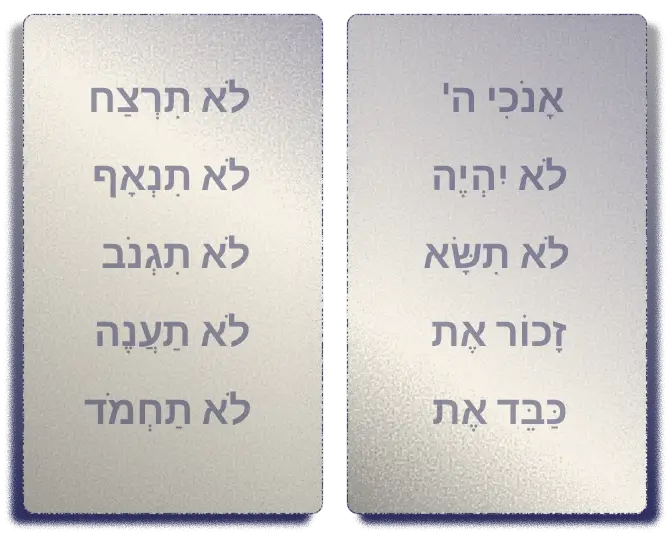
Explore the 613 mitzvos and uncover the meaning behind each one. Discover practical ways to integrate them into your daily life with insights, sources, and guided reflection.

Learn the structure, depth, and spiritual intent behind Jewish prayer. Dive into morning blessings, Shema, Amidah, and more—with tools to enrich your daily connection.
Each week’s parsha offers timeless wisdom and modern relevance. Explore summaries, key themes, and mitzvah connections to deepen your understanding of the Torah cycle.