www.Mitzvah-Minute.com
"Vayakhel — Part IV — “חָכְמַת לֵב”: Craftsmanship, Leadership, and Sacred Creativity"
4.5 — Building the Divine Dwelling Together
Rambam and Abarbanel — The Structure of a Sacred Society
As the narrative of Parshas Vayakhel unfolds, the Torah gradually reveals that the Mishkan is not the product of a single group or individual. Instead, it emerges from the coordinated efforts of the entire nation. The text moves through a sequence of roles: the people bring their donations, the artisans transform those materials into sacred vessels, and the leaders oversee the work to ensure that every element follows the Divine command.
This progression reveals an underlying structure. The Mishkan is built through the interaction of generosity, craftsmanship, and leadership.
Rambam’s broader understanding of covenant society highlights the significance of this pattern. Torah institutions are sustained when individuals contribute according to their abilities and responsibilities. Some give resources, others contribute skill, and others provide guidance and direction. Each role becomes necessary for the fulfillment of the Divine command.
Abarbanel often draws attention to the architectural logic embedded within the Torah’s narratives. In the case of the Mishkan, the structure of the story itself reflects the structure of the society that produced it. The sanctuary arises only when multiple forms of human contribution converge.
The Mishkan therefore represents more than a physical building. It becomes a portrait of a functioning covenant community.
Ramban — The Presence That Dwells Among the People
Ramban emphasizes that the Mishkan serves as the continuation of the revelation at Mount Sinai. The Divine Presence that appeared on the mountain now rests within the camp of Israel.
Yet this presence does not descend arbitrarily.
The Torah carefully describes how the sanctuary is constructed through the participation of the entire nation. Men and women bring materials, artisans shape them into vessels, and leaders ensure that the work reflects the instructions given to Moshe.
Through this process, the Mishkan becomes a dwelling place for the Divine Presence precisely because it reflects the unity of the people.
Holiness in the Torah is not merely the result of sacred objects. It emerges when a community acts together in harmony with the Divine will.
The sanctuary therefore embodies the collective devotion of the nation.
Rav Kook — Creativity in the Service of Holiness
Rav Kook often described the spiritual potential contained within human creativity. The physical world contains immense possibilities for beauty and meaning, and human beings possess the ability to reveal those possibilities through creative effort.
The Mishkan represents the elevation of this creative power.
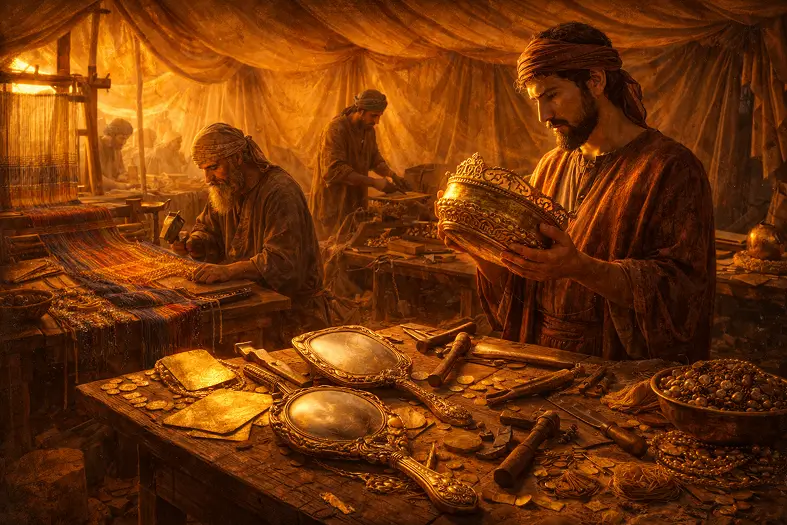
Raw materials—wood, metal, stone, and fabric—are transformed through the skill of artisans into vessels that reflect harmony and beauty. Generosity supplies the materials, craftsmanship shapes them, and leadership guides the process.
In this way, human creativity becomes a vehicle for holiness.
The sanctuary stands as a testament to the capacity of human beings to sanctify the physical world when their efforts are directed toward a sacred purpose.
Rabbi Jonathan Sacks — Institutions That Sustain a Nation
Rabbi Jonathan Sacks often wrote that one of the Torah’s greatest contributions to human civilization lies in its understanding of institutions. Healthy societies depend on structures that sustain moral, spiritual, and communal life.
The Mishkan represents one of the earliest examples of such an institution.
It becomes the center of worship, teaching, and national identity. Yet the Torah emphasizes that this institution was not imposed from above. It was built through the voluntary participation of the people.
The sanctuary therefore reflects a principle essential to covenant society: institutions endure when individuals feel a sense of ownership and responsibility for them.
Because the Mishkan was built through the contributions of the entire nation, it belonged to the entire nation.
Rav Avigdor Miller — The Power of Shared Purpose
Rav Avigdor Miller frequently emphasized that one of the Torah’s greatest achievements was the creation of a people united around a shared mission.
The construction of the Mishkan provides a vivid illustration of this unity. Each individual participates according to his or her ability. Some bring materials. Others contribute skill. Leaders guide the process and ensure that the work remains faithful to the Divine design.
The result is a project that transcends individual ambition.
The Mishkan does not belong to a single tribe, artisan, or leader. It belongs to the entire nation. Every contribution—large or small—becomes part of a structure that expresses the collective devotion of Israel.
Through this shared purpose, the people become capable of creating a dwelling place for the Divine Presence.
A Dwelling Built by a Nation
The Torah’s description of the Mishkan reveals a profound vision of covenant life. Holiness does not emerge from isolated acts of devotion. It arises when individuals combine their efforts in service of a shared spiritual goal.
Generous donors supply the materials needed to begin the project. Skilled artisans transform those materials into vessels of beauty and function. Responsible leaders ensure that every element reflects the Divine instructions given to Moshe.
Together, these roles create a structure that none of them could have produced alone.
The Mishkan therefore becomes more than a sanctuary. It becomes the embodiment of a people working together to bring holiness into the world.
Application for Today
Modern societies often struggle with fragmentation. Communities become divided along social, economic, and professional lines, making collective projects increasingly difficult to sustain.
The Mishkan offers a different vision.
When individuals recognize that their unique talents and resources contribute to a shared purpose, cooperation becomes possible. Institutions capable of nurturing spiritual and communal life emerge when people see themselves as partners in building something greater than any individual achievement.
The Torah’s description of the Mishkan reminds us that enduring institutions are created when generosity, skill, and leadership converge.
When communities cultivate these qualities, they create spaces—both physical and spiritual—where the Divine Presence can dwell among them.
📖 Sources
- Full sources available on the Mitzvah Minute Parshas Vayakhel page under insights and commentaries